
Submitted:
11 August 2026
Posted:
12 August 2026
You are already at the latest version
Abstract
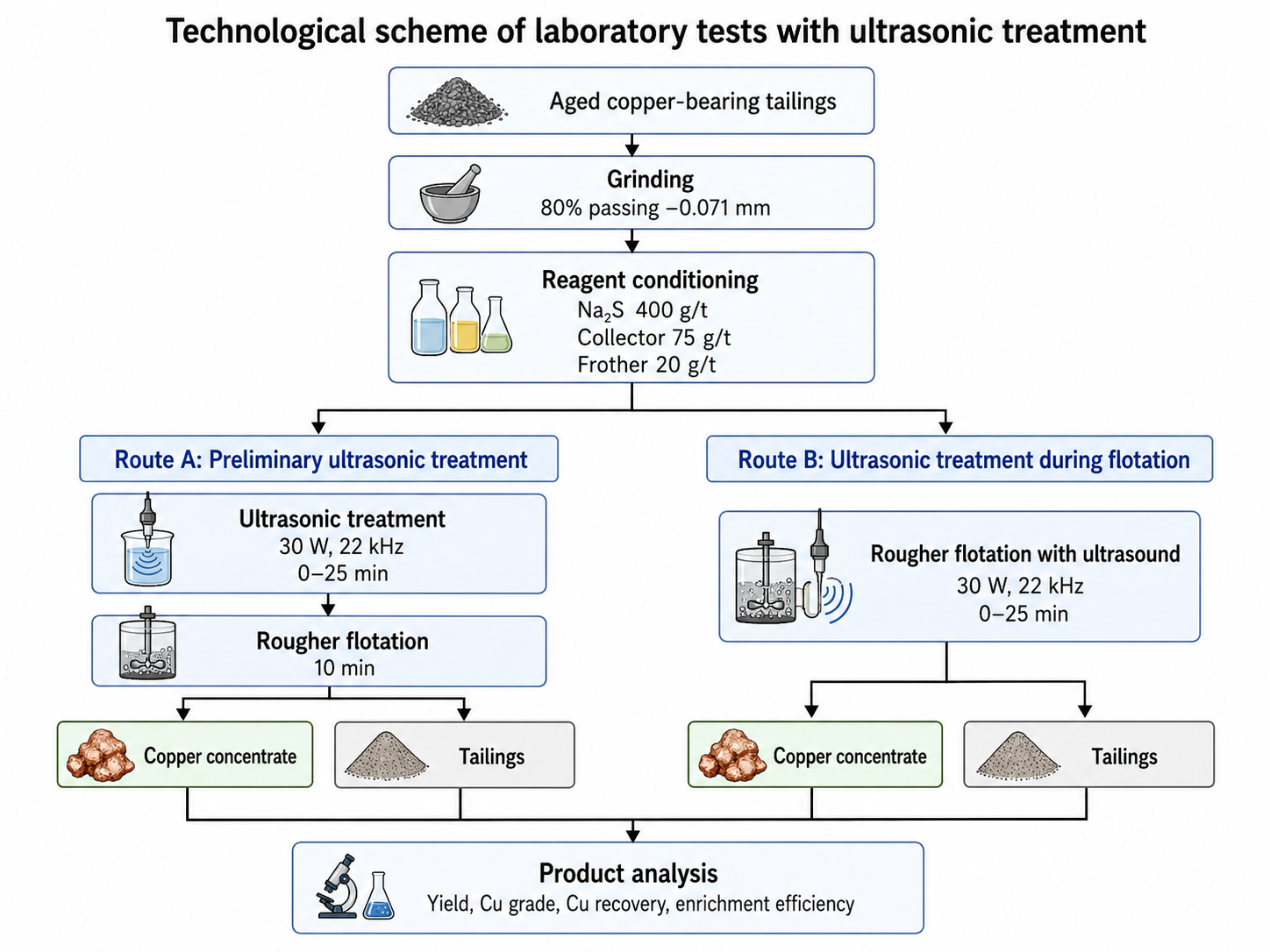
This study investigates the effect of preliminary ultrasonic treatment on the flotation re-covery of copper from aged tailings of copper-porphyry ores. The initial sample was char-acterized by a low copper content of 0.17%, a high proportion of oxidized copper forms of 53.84%, and fine dissemination of copper-bearing minerals, which complicates their re-covery by conventional flotation. Ultrasonic treatment was applied after grinding as a physical method of surface activation. The pulp was treated at a power of 30 W and a fre-quency of 22 kHz, while the treatment duration varied from 0 to 25 min. The effects of ul-trasonic treatment on concentrate yield, copper grade, copper recovery, and enrichment efficiency were evaluated. One-way analysis of variance (ANOVA) was used to assess the statistical significance of the results, and SEM analysis was performed to examine changes in particle surface morphology. The best flotation performance was obtained after 15 min of preliminary ultrasonic treatment. Under these conditions, the copper grade in the con-centrate was 1.79 ± 0.06%, copper recovery was 44.37 ± 0.21%, and enrichment efficiency was 40.06 ± 0.38%. Longer treatment times did not improve the results. SEM observations indicated particle disaggregation and partial removal of slime coatings. The results con-firm that preliminary ultrasonic treatment can improve copper flotation from aged tailings.
Keywords:
aged tailings
; copper
; flotation
; ultrasonic treatment
; cavitation
; copper recovery
; ANOVA
; SEM
Copyright: This open access article is published under a Creative Commons CC BY 4.0 license, which permit the free download, distribution, and reuse, provided that the author and preprint are cited in any reuse.


