
Submitted:
10 August 2026
Posted:
11 August 2026
You are already at the latest version
Abstract
Crypto currency is one of most interesting financial innovation of 21st century. Crypto currency trading not only involve financial literacy while trading but also there are psychological factors affecting the decision of traders. Keeping in view the psychological factors and investors’ decision, this research study is designed to investigate the complex interplay between psychological triggers and market dynamics in the cryptocurrency sector in Pakistan, specifically examining how these elements coalesce to drive investor behavior and market volatility. While traditional financial models often attribute asset fluctuations to technological or fundamental shifts, this study posits that cryptocurrency markets are fundamentally driven by human perception and emotional reactivity. Utilizing a quantitative methodological approach, data was collected from a sample of 175 experienced traders to analyze the impact of emotional states, market sentiment, and behavioral discipline on trading outcomes. The empirical results, derived through multiple linear regression analysis, reveal that the model possesses a high level of explanatory power, accounting for 56% of the variance in emotional trading behavior (R2=0.56R2=0.56). Market sentiment emerged as the primary determinant of impulsive trading (β=0.48β=0.48), demonstrating that external social cues often exert a stronger influence on decision-making than internal emotional states. Among specific psychological variables, Fear, Uncertainty, and Doubt (FUD) were identified as the most significant predictors of rash choices (β=0.34β=0.34), while the Fear of Missing Out (FOMO) also demonstrated a substantial, though secondary, effect (β=0.21β=0.21). Conversely, the study found that trading experience and the application of systematic strategies serve as vital moderating factors that decrease emotional reactivity and enhance behavioral stability (β=−0.19β=−0.19). The findings contribute to the fields of behavioral finance and digital economics by illustrating that the volatility inherent in digital assets is a systemic byproduct of individual psychological biases aggregated through digital narratives. The research concludes that achieving a sustainable financial ecosystem requires moving beyond purely technical regulations. Instead, it advocates for the implementation of behaviorally-informed safeguards, such as algorithmic "cooling-off" periods and sentiment-aware trading tools, to mitigate the risks associated with reactive investing. Ultimately, this work provides a blueprint for a more resilient digital financial future by prioritizing human factors in market governance.
Keywords:
cryptocurrency trading
; behavioral finance
; market sentiment
; FOMO
; FUD
1. Introduction
The cryptocurrency market is a new emerging market; due to its decentralized and unregulated nature, it is riskier than other markets, such as the stock market and the forex market. Its availability for traders (i. e 24/7 ) makes it even more attractive and risky with no day off. Many countries also do not regulate this market, including Pakistan. But due to its decentralized nature, the traders are engaged with this market, which makes it necessary to conduct a study on this topic. This research topic was selected due to the urgent need to understand how psychological influences and market dynamics shape cryptocurrency trading behavior. This research study provides essential findings that benefit policymakers together with traders working in the cryptocurrency market. As a major financial market sector, cryptocurrency exists with characteristics that include high market movements and fast expansion together with decentralization (Zhou, 2024). Traditional financial market influences come from distinct psychological elements, but cryptocurrency trading operates under its own set of psychological and market criteria. A comprehension of these components of the market will become significant to every competitor in the cryptocurrency space, along with financial analysts who want to go through this complicated market landscape.
The fundamental research problem of the study is to explore the interactions between psychological variables and market forces in the cryptocurrency trading, excluding the regulations of the market: centralization, decentralization, and regulatory variables. The analysis targets the general aspects without targeting a specific territory or region, although the specific situation in non-regulated settings (like Pakistan) in the context of the study highlights the relevance of the study. The decision made by cryptocurrency traders is founded on psychological factors, which significantly affect their decisions. The emotions experienced by investors between fear along with greed and excitement produce unregulated market actions resulting in large price shifts. The unpredictability within this market sharpens due to both the existence of cognitive biases with overconfidence along with the bandwagon effect. Substantial influence from psychological factors affects both decision-making processes and market results through key mechanisms that result in destructive trading behavior (Mahmood, 2023). The key factors behind excessive trading in cryptocurrency markets is overconfidence in personal abilities and knowledge as well as FOMO sensations along with obsession and the fear of future regret. The combination of emotions and cognitive biases within traders results in unwise choices, including price overbidding due to confidence or panic-based price dropping (Othman, 2024).
Fear of Missing Out (FOMO) traders often buy assets at peak prices due to the fear of missing out on potential gains as a result, a lot of traders lose their funds. Fear, Uncertainty, and Doubt (FUD) negative news or market downturns can lead to panic selling. The potential for high returns can drive investors to take excessive risks. The leverage trading is available for every trader due to which they use a high leverage without proper knowledge which leads to high frequency of liquidation. Social media and community opinions can significantly impact market behavior. Recently the price of ripple is surged by six times almost 600% within half in a month (Fletcher et al., 2024). Due to the circulation of opinion of some reputational crypto experts, trust in block chain technology and positive perceptions of a crypto currency can drive demand. The cryptocurrency market stands out as one of the few financial markets that operates 24/7 without account opening fees or stringent onboarding requirements, making it highly accessible to retail participants. The crypto currency market traders experience extreme volatility due to how prices are influenced by continuous 24-hour trading combined with the worldwide market structure and psychological influence issues. Crypto currency market volatility originates from its unstable price patterns with significant regular fluctuations (Gonçalves, 2023). Market dynamics could be influenced by different factors like supply and demand. The total supply of bitcoin is 21 million, with a circulating supply of 20 million as of October 2024 (Porter, 2025). So, as the circulating supply reaches towards the total supply, we witness the rise in Bitcoin price in the long term. News and events should not be ignored in this section. Major news events and announcements can cause significant price fluctuations. FOMC meetings always fluctuate the prices of cryptocurrencies. Changes in regulations also impact investor confidence and market behavior. Nowadays the ETF is under discussion as the approval of ETFs allows the institution to add liquidity, which was restricted to holding crypto directly and could be called a regulatory development.
This study enables better market force comprehension, which leads to strategy development for risk management and enhanced decision processes. The study of cryptocurrency trading involves a thorough investigation of the psychological factors, market dynamics which shape the cryptocurrencies prices. This research aims to identify and analyze the key psychological factors that influence investors’ behavior in crypto currency trading examine the role of market dynamics in shaping crypto currency market trends; (3) identify how psychological factors and market dynamics interact and drive market volatility and trader decision-making and offer feasible advice to the traders and policymakers on the way forward to the crypto currency market to reduce the risks of the volatile markets which are caused by psychological volatility and market volatility.
Hypotheses of the Study:
H1. Psychological factors (fear, greed, and social influence) have a significant effect on investor decision-making in crypto trading.
H2. FOMO has a significant positive impact on impulsive trading behavior.
H3. Fear, Uncertainty, and Doubt (FUD) positively correlate with panic selling in the cryptocurrency market.
H4. Market dynamics (technological advancement, AI integration, Bitcoin halving) significantly affect cryptocurrency price volatility.
H5. The combination of positive news and technical innovations has a positive impact on cryptocurrency prices.
H6. Restrictive policies negatively affect investor trust.
H7. The improved comprehension of psychological aspects and market hedge will make a positive input in shaping Better understanding of psychological factors and market hedging practices have positive influence on crypto currencies traders’ strategies efficient trading strategies among the investors in cryptocurrencies.
H8. Psychological factors and market dynamics have positive effect on the volatility of cryptocurrency market.
2. Literature Review
Cryptocurrency market is one of the most radical financial innovations of the 21st century. This market has since the introduction of Bitcoin in 2009 evolved into a niche experiment in decentralized finance to gain trillions of dollars in value at its highest point (CoinMarketCap, 2024). The crypto market is not a centralized and geographically located system, as bonds, commodities, or forex are in financial markets; it is a decentralized and borderless ecosystem that works round the clock (Zhou, 2024). Such structural distinctiveness democratizes access and facilitates financial inclusion and at the same time increases volatility and subjects’ players to greater psychological stressors. Its 24/7 Round the clock characteristics of cryptocurrency trading, coupled with real-time dynamic flows of information across the globe through social media platforms, generate a hyper-reactive atmosphere where moods can change within a few hours.
2.1. Psychological Factors
2.2.1. Fear of Missing Out (FOMO)
The Dread force Behind Speculative Mania Fear of Missing Out (FOMO) is perhaps the strongest psychological force in the cryptocurrency markets. FOMO can be defined as a general feeling of anxiousness that a person may be enjoying a good time and he or she is not there to share in that experience (Delfabbro et al., 2021), so when prices are on the rise and other users share their experiences in the game, many feel compelled to buy the currency even though they do not know the reason behind their decision. Seeing fellow traders or influencers raking in on an asset price increase, they have a sharp sense of fear of missing out on these gains and they will, often without due diligence, join in buying just when the asset has reached its highest value.
2.2.2. Greed and Overconfidence:
Greed the vehemence of excessively and blindly seeking out more money comes in the form of crypto trading excessively reckless risk-taking, over-leveraging, and hoping to acquire 100x returns. Greed is progressive because it causes traders to take excessively high returns even in a stable or bearish market despite the presence of FOMO and FUD (FUD and FOMO are unstable emotions). The correlation between Greed and overconfidence tendency to overestimate knowledge, skills or predictability has been strongly proven with empirical evidence (Shan and Irfan, 2025). In general, it was discovered that most overconfident investors trade more efficiently, with high transaction costs, and with lower returns than their less-confident counterparts. Overconfidence abides in crypto markets where moonshot cases of going on a $500 purchase and turning it into $50,000 are the order of the day (Odean 2001). According to Binance Research (2022), more than 80% of retail crypto traders lose money, in the long-term, but most of them think they are above-average traders a typical over confidence effect.
2.2.3. Loss Aversion and the Disposition Effect
The main tenet of the Prospect Theory is loss aversion, an idea according to which a human being feels more pain due to a loss than a similar pleasure due to a gain (Kahneman and Tversky, 1979). The brain of the trader does not actually recognize unrealized loss (a falling price on paper) as a realized loss (actually selling) as he would rather cut a loss and save remaining capital. In order to prevent the reality of physical and emotional suffering that loss will cause, the trader keeps holding, and usually not making sense. This asymmetry is increased in the case of cryptocurrency where one could easily see the price move up or down by 10-20 percent in a single day (Rodriguez, & Ibarra-Valdez, 2018). The direct behavioral implication of the aversion to loss is known as the Disposition Effect.
2.2.4. Social Influence and Herding Behavior
Contrary to the traditional trading patterns when the information flows via an official report, cryptocurrency scripts are built and reinforced on platforms such Twitter), Reddit, and Telegram. Under such conditions, social proof the psychological phenomenon of individuals adopting the behavior of other people as correct behavior is the main facilitator of market movement. A feedback loop is created when a story e.g., a particular meme coin or a DeFi protocol goes viral on social media. New traders, who notice thousands of other traders buying the dip, would be getting the impression that the people themselves were approving of the value of the asset, without considering that it is actually useful or not. Traders exhibiting herding behavior are guided by the crowd, as the believe that the group possesses insider knowledge or better information then they do.
2.3. Market Dynamics and Structural Amplifiers
2.3.1. Supply and Demand: Artificial Value Creation, Scarcity and Halvings
The most important concept in the cryptocurrency valuation is the traditional economic law of supply and demand. The hard limit of 21 million coins of Bitcoin helps to generate artificial scarcity which support the long-term investment stories. Reducing miner rewards by half with events in every 210,000 blocks cut new supply and caused bull runs in the past. But in altcoins the situation is more complicated with supply (Aysan, & Topuz, 2021). Some are inexhaustible (e.g. Dogecoin), whereas others are deflationary (e.g. Binance Coin) and use burn mechanisms. The speculative bubbles occurred in Pakistan, where tokenomics literacy is weak. The very center of cryptocurrency price dynamics is the inherent economic supply-demand relationships but in the digital assets market, these entities take place within the programmed regulations than in a real-life market. This can be seen nowhere better than in Bitcoin whose protocol sets a strict limitation of 21 million coins.
2.3.2. Policy Uncertainty on the Two-Sided Sword of Regulatory Change
The most potent external one in crypto markets is regulation. Good regulation such as American Bitcoin ETF approval increases institutional adoption (Krause, 2024). In contrast, prohibitions or ambiguity such as China 2021 crackdown are associated with sell-offs. State Bank in Pakistan has reported the crypto currencies to be illegal, but it is not always enforced (Nawaz et al., 2025). A gray market where traders act in legal gray waters is the result of this regulatory limbo, increasing FUD and reducing access to banking services. The most powerful external force that can influence the dynamics of the cryptocurrency market and at the same time trigger the institutional adoption of this asset as well as a deep correction of the market is regulation (Oluwaferanmi, 2025). Compared to more traditional financial instruments, which exist in a legal environment with a well-developed legal framework to regulate them, cryptocurrencies, in contrast, live in an international patchwork of jurisdictions, some of which tend to be more friendly and others are simply banning Vincent, O., & Evans, O. (2019). That inconsistency increases uncertainty, and makes policy decisions into market-moving events. The impacts are tended to be transformative when the governments come up with transparent and supportive regulations (Westwood, 2024). One of the brightest illustrations is the allowing of spot Bitcoin exchange-traded funds (ETF) by the U.S. Securities and Exchange Commission (SEC) at the beginning of 2024.
2.3.4. Macroeconomic Shocks and the Failed Safe Haven
Although some analysts early opined that bitcoin is digital gold, the trend is being empirically illustrated and therefore is strongly associated with risk assets such as equities during crisis moments (Corbet et al., 2020). Cryptos prices are affected by interest rate, inflation statistics, and political occurrences (including the geopolitical factor) all these indicate that it is entering the world of financial systems. To traders in PKR, this puts them in a situation of two exposures of losses due to crypto depreciation alongside devaluation of PKR. During its inception years, Bitcoin was often described as the so-called digital gold, a decentralized, scarce asset, which would act as a buffer against inflation, currency debasement and systematic financial turmoil. Advocates cited that the fixed quantity supply and political neutrality of Bitcoin would shield it against the macroeconomic volatility, so the token would make the perfect store of value in a period of crisis (Maktoof et al., 2025).
2.3.5. Liquidity, Leverage, and Fragmentation Market Microstructure
The market microstructure is a field finance that analyzes the mechanism and results of trading assets. It studies the impacts of the plumbing of markets such as rules, technologies and behaviors of participants to price formation, liquidity, transaction costs and stability (O’Hara, 2011).24/7 round the clock trading no circuit breakers news in any time zone triggers Price differences across markets provides arbitrage opportunities, as well as manipulations. Retail traders come after whales and insiders. Liquidity is the capacity to trade large size promptly, cheaply, and without relocating the price. It has been said to possess three dimensions tightness (the bid-ask spread), depth (the amount that can be traded at quoted prices), and resiliency (the rate at which the prices recover after the occurrence of a random shock) (Kyle, 1985). Liquidity and market making in crypto currencies market are no longer given by traditional market makers only but also by high-frequency trading (HFT) companies. Such companies are able to inject considerable volume of liquidity into the market in normal times but can quickly withdraw it in disturbed situations, as was evidenced in the case of the Flash Crash of 2010 (Kirilenko et al., 2017).
2.3.6. Market Sentiment and Social Media: It Works Two Ways
Market sentiment, typically quantified as Fear and Greed Index, is one of the most effective indicators of investor behavior and it can be empirically linked with the effect of bitcoin prices on a strong level (Griffith et al., 2020).The surges of high optimism are more likely to trigger the feeling of fear of missing out (FOMO) that causes retail traders to blow up positions, leading to the growth of the prices. In contrast, an unfavorable sentiment leads to the activation of fear, insecurity, and doubt (FUD), which results in panic selling and worsening the market conditions. This mutual feedback pattern creates a self-affirming circular effect: as the price trend works on sentiment as a whole, the sentiment works on the price trend in turn. The Pakistani setting has a distinct setting of information flows that are localized, especially the positively rated social media and in-ad-hoc peer-to-peer (P2P) trading networks (Zhang, 2025).
2.4. Theoretical Frameworks and Research Gaps
This study is anchored in Prospect Theory, Herding Behavior Theory, and the Adaptive Market Hypothesis (AMH). Prospect Theory explains asymmetric responses to gains and losses (Kahneman & Tversky, 1979), Herding Theory accounts for collective imitation under uncertainty (Lin et al., 2021), and AMH frames market efficiency as an evolving curve shaped by competition and adaptation (Lo, 2004). While well-documented in traditional finance, their application to 24/7, socially embedded crypto markets remain underdeveloped. Most empirical studies focus on developed markets, neglecting trader-level behavioral data in emerging economies (de Vries et al., 2024). This study addresses the gap that how psychological triggers and market dynamics coalesce in Pakistan. The available literature mainly focuses on established nations with little consideration being made to developing nations such as Pakistan. There are also a few studies which have concentrated on individual variables, however, in most cases they have not examined them in combination. This study fills those gaps by examining various factors including the dynamics of the market and the psychological influences in order to establish the interaction between these factors in influencing the use of the derived decisions while trading.
3. Methodology
3.1. Introduction
A detailed literature about the variables of the study is provided. The comprehensive study helped in defining and measuring variables, which is the focus of this chapter. For measuring the variables self-reported scores of Structured questionnaires were utilized.
3.2. Research Design and Sample
A quantitative cross-sectional survey design is employed. The target population comprises of active cryptocurrency traders in Pakistan with a minimum of one year of trading experience, ensuring exposure to multiple market cycles. Using G*Power analysis, a final sample of 175 experienced traders was retained. Respondents were recruited through professional trading forums and social media platforms. Self-reported data was collected via a structured electronic questionnaire using a 5-point Likert scale.
3.3. Variable Measurement
Independent Variables: independent variables are Psychological factors (FOMO, FUD, Greed) and market dynamics (market sentiment, news/regulatory impact, supply-demand fundamentals). Social media sentiment was operationalized as reliance on community opinions (Selvakumar et al., 2025).
Dependent Variables: Dependent variables include, Investor behavior (trading frequency, holding duration, emotional trading propensity) and market volatility (perceived volatility risk, frequency of sharp price movements >10% in 24 hours) (Abbas et al., 2025).
control & moderating Variables: Trading experience, portfolio size, and trading strategy use (Chalissery et al., 2023).
3.4. Empirical Specification
Multiple linear regression (OLS) was employed. The baseline model is:
ETi =β0 +β1 MSi +β2 FUDi +β3 FOMOi +β4 TEi +ϵi
A second model introduced interaction terms to test the moderating role of trading strategy:
ETi =β0 +β1 FOMOi +β2 FUDi +β3 Strategyi +β4 (FOMO×Strategy)i +β5 (FUD×Strategy)i +ϵi
All models controlled for demographic and behavioral covariates. Heteroskedasticity-consistent standard errors were applied. Diagnostic tests confirmed acceptable VIF values (<2) and no significant specification errors (Ramsey RESET p>0.10).
3.5. Hypothesis Testing Protocol
To empirically test the framework, hypotheses H1–H8 are examined using correlation matrices, OLS regression coefficients, and subgroup stratifications. Support is determined at p<0.05p<0.05 significance thresholds, with partial support assigned when quantitative effects are present but secondary to sentiment-driven behavior.
4. Results and Descriptive Analysis
Descriptive statistics is performed in order to know about the distribution and variability of the data. As evidenced in Table 1, external cues in the crypto market are viewed through the prism of behavioral science traders give preference to fast changing and emotionally fueled data (sentiment, headlines) over slower, more analytic data (supply/demand). Market sentiment recorded the highest mean by major news impact (4.29), while supply-demand fundamentals scored lower (3.84). Emotional trading prevalence was high, with respondents reporting losses due to emotion-driven decisions (mean = 4.14). FUD demonstrated the strongest composite mean (4.09), reflecting acute sensitivity to negative news, while FOMO (3.97) and Greed (3.88) showed moderate-to-strong agreement.
4.2. Correlation Analysis
Pearson correlations confirmed strong positive relationships between psychological drivers and behavioral outcomes. Market sentiment and emotional trading exhibited the highest correlation (r=0.72, p<0.001), validating sentiment as the dominant catalyst for reactive decisions. FUD correlated strongly with emotional trading (r=0.61, p<0.001) and negative sentiment (r=0.69, p<0.001). FOMO showed a moderate link to emotional trading (r=0.58, p<0.001) and a strong association with market sentiment (r=0.65r, p<0.001). Experience negatively correlated with FOMO (r=−0.32r=, p=0.001) and emotional trading (r=−0.29, p=0.003), indicating that tenure gradually reduces reactivity but does not eliminate it.
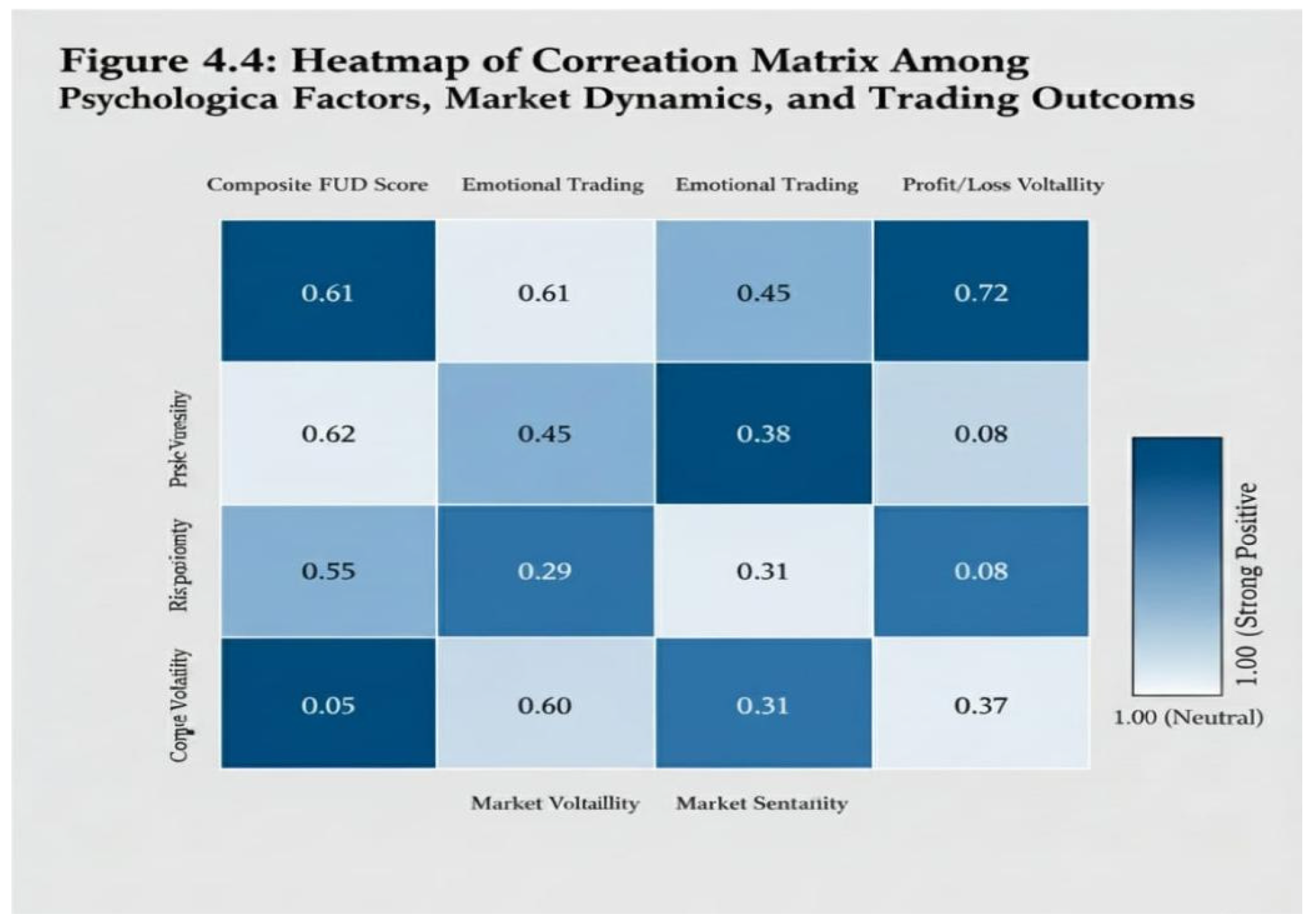

Table 2.
Pearson Correlation Matrix of Core Variables (N = 100).
| Variables | MS | FUD | FOMO | Greed | ET | TE |
| Market Sentiment (MS) | 1 | |||||
| FUD | 0.69 | 1 | ||||
| FOMO | 0.65 | 0.41 | 1 | |||
| Greed | 0.36 | 0.29 | 0.52 | 1 | ||
| Emotional Trading (ET) | 0.72 | 0.61 | 0.58 | 0.44 | 1 | |
| Trading Experience (TE) | -0.21 | -0.24 | -0.32 | -0.18 | -0.29 | 1 |
| Note: p < 0.05, p < 0.01, p < 0.001. |
4.3. Regression Results
Table 3 presents the baseline OLS results. Market sentiment emerged as the strongest predictor of emotional trading (β=0.48β=0.48, p<0.001p<0.001), followed by FUD (β=0.34β=0.34, p<0.001p<0.001) and FOMO (β=0.21β=0.21, p=0.022p=0.022). Greed was statistically insignificant when controlling for other variables (p=0.091p=0.091). Trading experience negatively predicted emotional reactivity (β=−0.19β=−0.19, p=0.002p=0.002). The model explained the variance (R2=0.56R2=0.56), confirming high explanatory power.
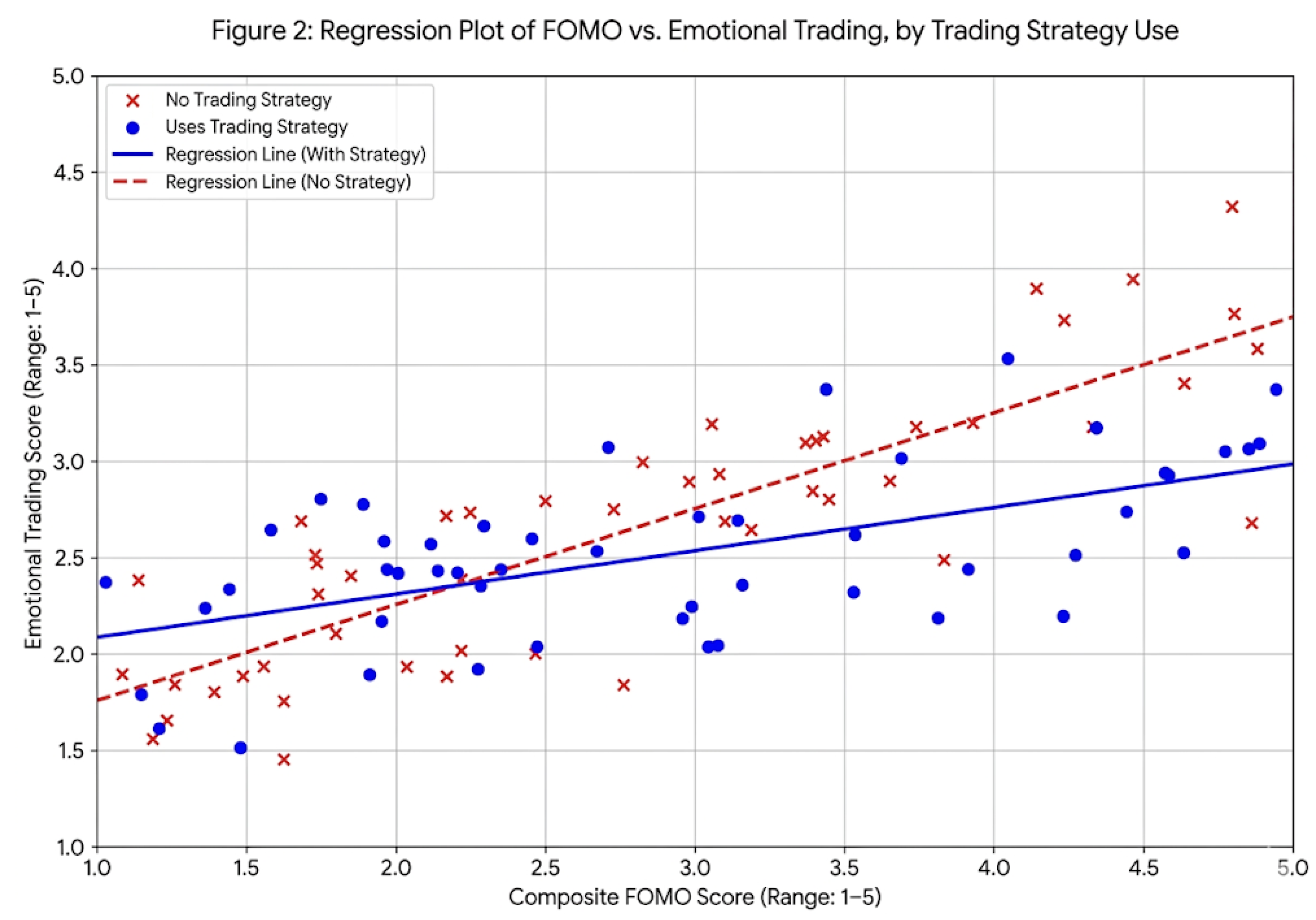
Table 4 tests the moderating role of trading strategy. Both interaction terms were statistically significant (p<0.05p<0.05), with negative coefficients indicating that strategy use weakens the link between psychological biases and emotional trading. The adjusted R2R2 improved to 0.61. For non-strategic traders, a one-unit increase in FOMO raised emotional trading by 0.52 units, whereas for strategic traders, the effect reduced to 0.24 units.
4.4. Hypothesis Testing Summary
Empirical testing confirmed most hypotheses. H1–H3 (psychological factors impact decision-making; FOMO increases impulsive trading; FUD correlates with panic selling) were fully supported. H4 and H6 (market dynamics and regulatory policies affect volatility/trust) were partially supported, as quantitative impact was secondary to sentiment-driven behavior. H5, H7, and H8 (news/innovation impact, psychological/market dynamics drive volatility, strategy improves outcomes) were fully supported. Results validate that emotional trading is systemic, not merely a novice trait, and that structured strategies significantly mitigate behavioral vulnerability.
4.5. Subgroup Analysis by Trading Experience
This part explores the differences in the psychological factors, responsiveness of the market, and trading outcomes of the less and more experienced cryptocurrency traders. Since the behavioral trends shift as the market is exposed to, such a dissection offers more information on how the maturity of trading development influences the behavior and susceptibility of investors to market volatility.
Table 5.
Subgroup Analysis by Trading Experience.
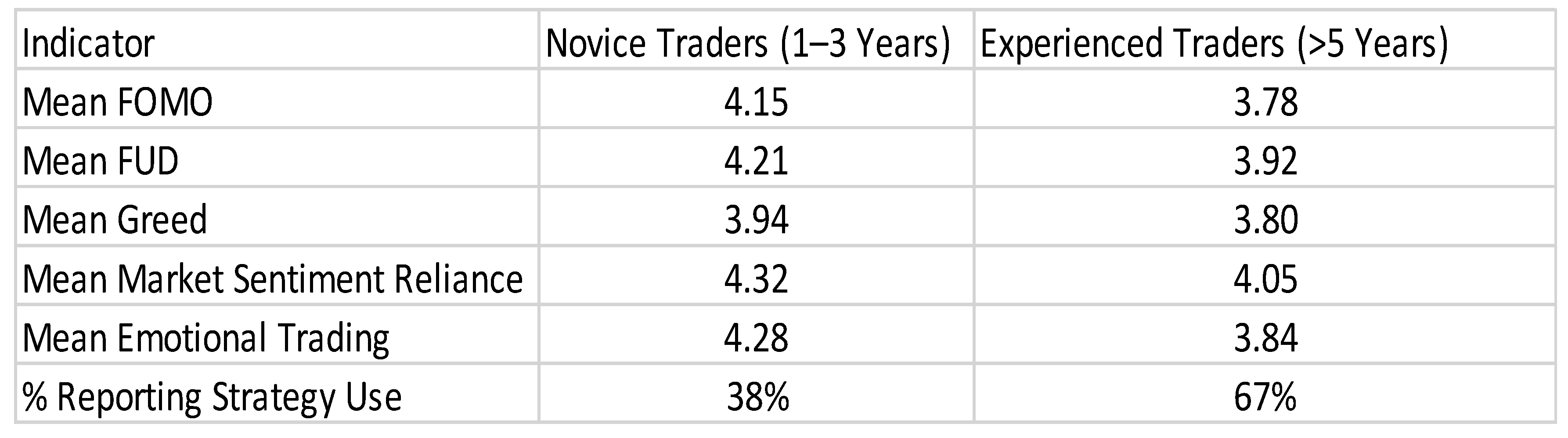 |
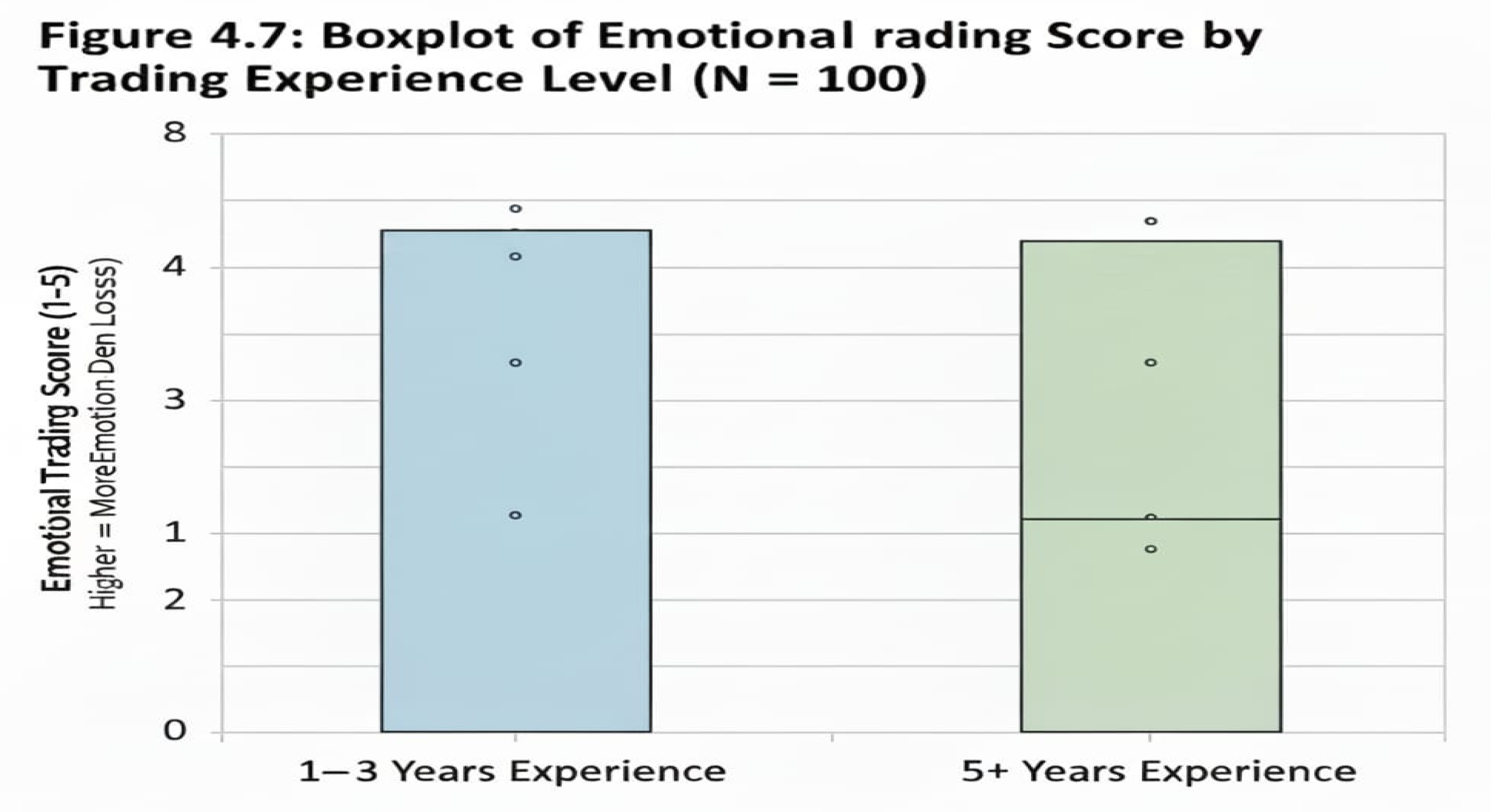
Novice traders (1–3 years) are more emotionally reactive: they have a higher FOMO (4.15 vs. 3.78) and more FUD (4.21 vs. 3.92). Seasoned traders (>5 years) are more behaviorally disciplined: they self-report lesser emotional reactivity, but are also much more likely to apply a trading strategy (67% vs. 38%), indicating that experience creates better-organized decision-making. Sentiment reliance is high in both groups, though significantly higher in novices (4.32 vs. 4.05). Greed does not change very much, except that it decreases slightly among the veterans (3.94 vs. 3.80). Even more experienced traders, despite reduced emotional scores, are more than ever occupied with sentiment and emotion, confirming that psychological aspects are endemic to crypto markets rather than an issue of inexperience.
5. Discussion and Conclusions
The empirical results demonstrate that cryptocurrency trading is fundamentally driven by human perception and emotional reactivity. Market sentiment's dominance (β=0.48β=0.48) over internal psychological states confirms that digital asset markets function as socially embedded ecosystems where herd behavior and influencer narratives dictate price discovery. FUD's strong predictive power (β=0.34β=0.34) aligns with Prospect Theory, illustrating that loss aversion triggers rapid liquidation even when fundamentals remain intact. FOMO's secondary effect (β=0.21β=0.21) reflects opportunity-seeking behavior amplified by social media echo chambers, particularly during bull markets and meme-coin rallies.
Contrary to intuitive assumptions, trading experience alone does not eradicate emotional reactivity. While veterans (>5 years) reported lower FOMO and FUD scores than novices (1–3 years), they remained highly susceptible to sentiment-driven decisions. This validates the Adaptive Market Hypothesis, which posits that heuristics adapt to environmental conditions but persist under high uncertainty. Crucially, trading strategy emerged as the strongest moderator. Pre-established rules (stop-loss orders, position sizing, planned reviews) decoupled emotional triggers from execution, reducing impulsive behavior by more than half. This underscores that behavioral architecture, not rationality or tenure, is the primary safeguard against crypto volatility.
Theoretically, this study extends Prospect Theory and Herding Behavior to 24/7 decentralized markets, demonstrating that cognitive biases compound into systematic volatility when institutional buffers are absent. The findings support a real-time behavioral finance framework where algorithmic social media, leverage, and continuous trading amplify emotional computation into market-wide price swings. Practically, the results highlight the inadequacy of purely technical or restrictive regulatory approaches. Instead, platforms should integrate behaviorally-informed safeguards: cooling-off periods for high-impulse orders, sentiment-aware alerts during volatility spikes, and mandatory educational pop-ups on cognitive biases. For policymakers in emerging markets, the emphasis should shift from blanket bans to investor empowerment through financial literacy, transparent risk disclosures, and platform accountability for sentiment manipulation.
Limitations include the cross-sectional design, self-reported survey data, and geographic focus on Pakistan. Recall bias and social desirability may influence responses, and the sample size, while adequate for OLS modeling, limits subgroup granularity. Future research should employ longitudinal designs or experimental methods to establish causal pathways between specific emotions and trading performance. Integrating on-chain data with behavioral metrics could bridge micro-macro gaps, while cross-cultural analyses (collectivist vs. individualist markets) would clarify contextual moderators. Additionally, investigating how AI-driven trading bots amplify or dampen human emotional contagion remains an underexplored frontier. This paper examined the overall interaction among psychological factors (Fear of Missing Out, Fear/Uncertainty/Doubt, Greed) and external market forces (sentiment, news, technological events) and their role to explain investor behavior and market volatility in cryptocurrency trading. peripheral in cryptocurrency trading choices. FUD proved to be the most significant indicator of emotional trading, which confirms the main idea of the Prospect Theory of loss aversion: traders are more responsive to possible losses than to corresponding gains, as this tendency can lead to a panic sale in times of minor declines. In its turn, FOMO drives impulsive purchases during market booms (enhanced by social media discourse), especially when it is fueled by theory-driven speculation nearing self-fulfilling price foams. There was some Greed, but it was a secondary factor, and its influence over behavior of the less experienced traders was only important.
The fact that market sentiment was the only most powerful factor of emotional trading (β = 0.48, p < 0.001), even more powerful than the internal psychological states. This proves that crypto markets are social, emotion-based ecosystems, where herd behavior, influencer and platform-mediated signals control price discovery, as opposed to fundamental forces of supply/demand and token omics. This interaction produces feedback: FOMO/FUD is driven by sentiment and this calcifies into emotional trades, which heighten volatility, which drives more sentiment a circle; which explains the extreme fluctuations in price in crypto.
Though trading experience may provide some significant shield against emotional reactivity, as the expected intuition may suggest, it is not a significantly high degree of protection. Although experienced traders (>5 years) were found to manifest lesser FOMO and FUD than beginner traders (13 years), they were still the most vulnerable in being influenced by sentiments and emotions in their decision-making. Through the implementation of a warmed trading strategy, time in market was not the actual safeguard against bias. Those traders who used pre-established rules (e.g., stop-loss order, position sizing, planned reviews) demonstrated much fewer connections between FOMO/FUD and impulsive behavior, which then confirms the idea that behavioral discipline, rather than rationality is the gospel to survival in volatile markets.
Author Contributions
Conceptualization, Shahab Azim; Methodology, Shahab Azim; Validation, Shakir Ullah; Formal analysis, Lala Rukh; Investigation, Shahab Azim; Data curation, Shahab Azim; Writing – original draft, Shahab Azim; Writing – review & editing, Lala Rukh and Shakir Ullah; Visualization, Shakir Ullah; Supervision, Lala Rukh; Project administration, Lala Rukh. All authors have read and agreed to the published version of the manuscript.
Funding
This research received no external funding.
Institutional Review Board Statement
The study received ethical clearance from the Ethical Institutional Review Board (EIRB), University of Swat (Reference No. UoS/ORIC/2025/043; approved on 17 March 2025).
Informed Consent Statement
Informed consent for publication was obtained from all identifiable human participants.
Data Availability Statement
The original contributions presented in this study are included in the article. Further inquiries can be directed to the corresponding author.
Conflicts of Interest
The authors declare no conflicts of interest.
References
- Zhou, F. (2024). Cryptocurrency: A new player or a new crisis in financial markets?——Evolutionary analysis of association and risk spillover based on network science. Physica A: Statistical Mechanics and its Applications, 648, 129955.
- Ur Rehman, A., Nasir, N., Mahmood, A., & Iqbal, M. (2025). Mapping the Research Landscape of Blockchain in Cryptocurrencies: A Bibliometric Review. Journal of Organisational Studies & Innovation, 12(3), 21.
- Othman, A. A., & Al-Raddah, K. (2026). Crypto Price Analysis: An AI Perspective. Sistemasi: Jurnal Sistem Informasi, 15(7), 2683-2704.
- Fletcher, G. G. S., Martinez, V. R., & Schwarcz, S. L. (2026). Regulating DeFi Platforms. European Corporate Governance Institute-Law Working Paper, (937).
- Almeida, J., & Gonçalves, T. C. (2023). A decade of cryptocurrency investment literature: A cluster-based systematic analysis. International Journal of Financial Studies, 11(2), 71.
- Rudd, M. A., & Porter, D. (2025). A supply and demand framework for Bitcoin price forecasting. Journal of risk and financial management, 18(2), 66.
- Hu, Z., Yu, R., Zhang, Z., Zheng, H., Liu, Q., & Zhou, Y. (2024, December). Developing cryptocurrency trading strategy based on autoencoder-CNN-GANs algorithms. In 2024 4th International Conference on Artificial Intelligence, Robotics, and Communication (ICAIRC) (pp. 973-977). IEEE.
- Delfabbro, P., King, D. L., & Williams, J. (2021). The psychology of cryptocurrency trading: Risk and protective factors. Journal of behavioral addictions, 10(2), 201-207.
- Shan, M., Liu, X., Jiang, D., & Qiao, Y. (2025). Reading Bimodal Emotion Recognition and Psychological Analysis on the Big Data Blockchain Network Platform. J. COMBIN. MATH. COMBIN. COMPUT, 127, 2057-2070.
- Omosebi, U. (2025). Cryptocurrency Strategies for Small Enterprises (Doctoral dissertation, Walden University).
- Quispe, J. A. H. (2023). Qualitative study of heuristics and biases influencing cryptocurrency investment (Doctoral dissertation, Bachelor’s thesis, available at: https://digikogu. taltech. ee/et).
- Alvarez-Ramirez, J., Rodriguez, E., & Ibarra-Valdez, C. (2018). Long-range correlations and asymmetry in the Bitcoin market. Physica A: Statistical Mechanics and its Applications, 492, 948-955.
- Aysan, A. F., Khan, A. U. I., Topuz, H., & Tunali, A. S. (2021). Survival of the fittest: A natural experiment from crypto exchanges. The Singapore Economic Review, 1-20.
- Krause, D. (2024). Unlocking Ethereum's Potential: The Rise of Spot ETFs in Cryptocurrency Investment. Available at SSRN 4856380.
- Nawaz, A., Alim, W., Abbas, S., & Shah, S. M. (2025). Cryptocurrency Market Spillovers to Stock Indexes: A Co-Integration Analysis in the Context of Global and Asian Markets. Journal of Asian Development Studies, 14(3), 1631-1649.
- Liang, W., Mary, B. J., Hamzah, F., Taofeek, A., Mattew, B., Blessing, M., ... & Oluwaferanmi, A. (2025). Next-Gen AML Technologies and Financial Crime: The Role of AI and Blockchain in Regulating Cryptocurrency Markets. Next-Gen AML Technologies and Financial Crime: The Role of AI and Blockchain in Regulating Cryptocurrency Markets.
- Vincent, O., & Evans, O. (2019). Can cryptocurrency, mobile phones, and internet herald sustainable financial sector development in emerging markets?. Journal of Transnational Management, 24(3), 259-279.
- Westwood, T. (2024). Money Machines: How Algorithms Are Shaping Finance. eBookIt. com.
- Corbet, S., Hou, Y. G., Hu, Y., Larkin, C., & Oxley, L. (2020). Any port in a storm: Cryptocurrency safe-havens during the COVID-19 pandemic. Economics letters, 194, 109377.
- Maktoof, M. A. J., Ali Alal, S., Kyzy Zhamal, K., Saeed Issa, S., & S Mohammed, G. (2025). Blockchain Beyond Cryptocurrency: Emerging Applications in Secure Data Sharing. Iranian Journal of Information Processing and Management, 40(Special Issue 4), 205-232.
- O'Hara, M., & Ye, M. (2011). Is market fragmentation harming market quality?. Journal of Financial Economics, 100(3), 459-474.
- Kyle, A. S. (1985). Continuous auctions and insider trading. Econometrica: Journal of the Econometric Society, 1315-1335.
- Kirilenko, A., Kyle, A. S., Samadi, M., & Tuzun, T. (2017). The flash crash: High-frequency trading in an electronic market. The Journal of Finance, 72(3), 967-998.
- Griffith, J., Najand, M., & Shen, J. (2020). Emotions in the stock market. Journal of Behavioral Finance, 21(1), 42-56.
- Guo, H., & Zhang, Y. (2025, November). in Cryptocurrency. In Data Science: 11th International Conference of Pioneering Computer Scientists, Engineers and Educators, ICPCSEE 2025, Hiroshima, Japan, September 19–21, 2025, Proceedings (p. 446). Springer Nature.
- Lin, C. H., Yen, K. C., & Cheng, H. P. (2021). Lottery-like momentum in the cryptocurrency market. The North American Journal of Economics and Finance, 58, 101552.
- de Vries, A. (2024). Bitcoin’s growing water footprint. Cell Reports Sustainability, 1(1).
- Selvakumar, P., Mishra, R. K., Budhiraja, A., Dahake, P. S., Chandel, P. S., & Vats, C. (2025). Social media influence on market sentiment. In Unveiling investor biases that shape market dynamics (pp. 225-250). IGI Global Scientific Publishing.
- Abbas, S. F., Sajjad, A., Rizavi, H., & Sadiq, N. (2025). Cryptocurrency and Future of Money: Introduction to Cryptocurrency. In Algorithmic Training, Future Markets, and Big Data for Finance Digitalization (pp. 219-260). IGI Global Scientific Publishing.
- Chalissery, N., Tabash, M. I., Nishad, T. M., Aburezeq, I. M., & Daniel, L. N. (2023). Does the investor’s trading experience reduce susceptibility to heuristic-driven biases? The moderating role of personality traits. Journal of Risk and Financial Management, 16(7), 325.
Table 1.
Descriptive Statistics for Market Dynamics and Psychological Indicators (N = 100).
| Variable | Mean | SD | Min | Max |
| Market Sentiment | 4.21 | 0.81 | 1.0 | 5.0 |
| News & Events Impact | 4.29 | 0.79 | 1.0 | 5.0 |
| Supply, Demand, Awareness | 3.84 | 0.93 | 1.0 | 5.0 |
| FUD Composite | 4.09 | 0.85 | 1.0 | 5.0 |
| FOMO Composite | 3.97 | 0.88 | 1.0 | 5.0 |
| Greed/Overconfidence | 3.88 | 0.96 | 1.0 | 5.0 |
| Emotional,Trading,Frequency | 4.14 | 0.84 | 1.0 | 5.0 |
| Systematic Strategy Use | 3.25 | 1.02 | 1.0 | 5.0 |
Table 3.
Regression Results for Model 1 (Predictors of Emotional Trading).
| Variable | Coefficient | Std. Error | t-Statistic | p-Value |
| Constant | 0.112 | 0.089 | 1.26 | 0.210 |
| Market Sentiment | 0.480 | 0.061 | 7.87 | <0.001 |
| FUD | 0.340 | 0.058 | 5.86 | <0.001 |
| FOMO | 0.210 | 0.091 | 2.31 | 0.022 |
| Trading Experience | −0.190 | 0.064 | −2.97 | 0.002 |
| Adj. $R^2 | 0.56 |
Table 4.
Moderating Effect of Trading Strategy on Psychological Reactivity.
| Variable | Coefficient | Std. Error | t-Statistic | p-Value |
| FOMO | 0.520 | 0.074 | 7.03 | <0.001 |
| FUD | 0.480 | 0.069 | 6.96 | <0.001 |
| Strategy Use | −0.310 | 0.085 | −3.65 | <0.001 |
| FOMO × Strategy | −0.280 | 0.098 | −2.86 | 0.005 |
| FUD × Strategy | −0.210 | 0.087 | −2.41 | 0.017 |
| Adj. $R^2$ | 0.61 |
Disclaimer/Publisher’s Note: The statements, opinions and data contained in all publications are solely those of the individual author(s) and contributor(s) and not of MDPI and/or the editor(s). MDPI and/or the editor(s) disclaim responsibility for any injury to people or property resulting from any ideas, methods, instructions or products referred to in the content. |
© 2026 by the authors. Licensee MDPI, Basel, Switzerland. This article is an open access article distributed under the terms and conditions of the Creative Commons Attribution (CC BY) license (http://creativecommons.org/licenses/by/4.0/).
Copyright: This open access article is published under a Creative Commons CC BY 4.0 license, which permit the free download, distribution, and reuse, provided that the author and preprint are cited in any reuse.


