

Submitted:
11 August 2026
Posted:
11 August 2026
You are already at the latest version
Abstract
The human gut microbiome is a complex adaptive ecosystem whose functions arise from interactions among microbial populations rather than from isolated taxa. Nevertheless, many microbiome-directed interventions remain based on the administration of individual strains, with limited consideration of the ecological processes governing community assembly, succession, and resilience. This review integrates evidence from microbial ecology, comparative genomics, systems biology, mechanistic physiology, and clinical microbiome research to propose a testable framework for the ecological engineering of the human gut microbiome. Within this framework, selected spore-forming probiotics are hypothesized to function as transient pioneer organisms that modify intestinal physicochemical and metabolic conditions, thus facilitating the establishment and activity of functionally complementary microbial populations delivered through rationally designed synbiotic consortia. The proposed process comprises five stages: pioneer activity, niche remodeling, facilitated community assembly, functional-network stabilization, and the emergence of host-associated outcomes. Available genomic, physiological, and clinical observations support the biological plausibility of individual components of this model but do not yet demonstrate directed ecological succession as a complete causal process. Accordingly, the framework distinguishes established evidence from ecological inference and generates experimentally testable predictions of temporal niche modification, metabolic cross-feeding, functional redundancy, resilience after treatment withdrawal, and host metabolic responses. This ecological perspective shifts the objective of microbiome therapeutics from transient strain supplementation toward the predictable modulation of community trajectories, providing an experimental foundation for developing more resilient, mechanism-based interventions.
Keywords:
gut microbiome
; microbial ecology
; probiotics
; synbiotics
; spore-forming bacteria
; community assembly
; colonization
; biotherapeutics
1. Introduction
The human gut microbiome is a complex microbial ecosystem that contributes to host metabolism, immune regulation, epithelial homeostasis, and resistance to colonization by pathogens [1,2,3,4,5,6,7,8]. These functions are not produced by individual microorganisms acting independently. They arise from interactions among microbial populations and from the combined effects of their genes, metabolic products, and responses to the intestinal environment [9,10]. As such, the biological activity of the microbiome cannot be fully understood by identifying the microorganisms present in a sample. It is also necessary to determine what these organisms are doing, how they interact, and how those interactions change after a disturbance or therapeutic intervention [11,12,13].
This ecological view of the microbiome has important consequences for the design of probiotics and other microbiome-directed therapies. Many probiotic organisms have favorable safety profiles, and some have produced measurable clinical benefits [14,15,16,17,18,19,20,21,22,23,24]. Their effects, however, vary considerably among individuals, and the administered organisms are frequently detected for only a limited period. The absence of permanent colonization does not necessarily indicate therapeutic failure [25,26]. A microorganism that passes through the intestine may still produce metabolites, compete for nutrients, alter local physicochemical conditions, interact with resident organisms, or influence host signaling [27,28]. The more relevant question may therefore be whether an administered microorganism produces an ecological effect during the period in which it remains active.
The resident microbiome presents a considerable barrier to such an effect [29,30]. The adult intestine contains a dense and established microbial community in which organisms compete for nutrients and attachment sites, produce inhibitory compounds, and modify the environment in ways that favor some populations while excluding others [31,32,33,34,35,36,37]. Diet, medications, host physiology, inflammation, and the initial composition of the microbiome further influence the response to an intervention. The order in which organisms and microbial functions become established may also be important. These priority effects help explain why the same formulation may produce different microbiological or clinical outcomes in different recipients. They also indicate that adding microorganisms without considering the ecological state of the recipient community may not be sufficient to produce a predictable response [38].
There is an increasing effort to address these limitations through multi-strain probiotics, synbiotics, defined microbial consortia, live biotherapeutic products, engineered microorganisms, targeted bacteriophages, and fecal microbiota transplantation [39,40,41]. These approaches demonstrate that the microbiome can be modified at several biological levels. Much of the evidence, however, continues to be interpreted through changes in the relative abundance of individual taxa [42,43,44]. Such measurements are useful, but they do not necessarily reveal the ecological process responsible for the observed change. An increase in a bacterial population may result from direct growth, reduced competition, altered substrate availability, a change in host physiology, or normal temporal variation [30,45,46]. Likewise, detecting an administered strain does not establish that it has become functionally integrated into the resident community.
Ecological succession may provide a useful framework for examining these processes. In natural ecosystems, early organisms can modify their environment and thereby affect the establishment or activity of organisms that appear later [47,48,49,50,51,52,53,54]. This process may involve facilitation, inhibition, or tolerance but it does not always produce a more diverse or stable community, nor does it necessarily move the ecosystem toward a desirable state. The intestinal microbiome also differs from an unoccupied habitat because it is already densely populated and is continuously influenced by diet and the host [55,56]. Nevertheless, an administered microorganism could perform a pioneer-like function if its activity alters local conditions and if those changes precede and contribute to the response of other microbial populations.
Spore-forming probiotics are plausible candidates for such a role. Their endospores can survive exposure to gastric acidity and bile and may subsequently germinate in the intestine [57,58,59]. Following germination, their vegetative cells may affect nutrient availability, pH, redox conditions, oxygen concentration, antimicrobial activity, or metabolite production [57,60,61]. These changes could influence resident microorganisms or organisms delivered later as part of a complementary consortium. Permanent engraftment would not be required. The ecological contribution of the spore-forming organism could be transient, provided that its activity changes the conditions under which other microbial functions are expressed.
At present, no single study has shown that a spore-forming probiotic can initiate and direct the complete succession process proposed here. Genomic and physiological studies indicate that these organisms possess traits that could modify the intestinal environment [62]. Clinical investigations of probiotics and synbiotics have also reported changes in metabolic markers and microbiome composition [63,64]. These findings are important, but each represents only part of the proposed process. Demonstrating succession will require evidence that the spore-forming organism becomes active first, produces a measurable change in the intestinal environment, and that this change influences the organisms or microbial functions that follow.
The purpose of this review is to determine whether these separate lines of evidence can be brought together into a useful ecological model. We propose that the process can be examined in five stages: pioneer activity, niche remodeling, facilitated community assembly, stabilization of microbial functions, and effects on the host. We refer to the deliberate use of these activities and interactions as ecological engineering. This does not imply that every intervention will produce succession or that a stable microbiome will always be beneficial. Some interventions may have no ecological effect, while others could move the community in an undesirable direction. The model is useful only if it allows these outcomes to be distinguished from transient passage of the administered organisms, independent strain effects, dietary responses, and normal microbiome variation. If the proposed sequence can be demonstrated, microbiome therapeutics could be designed around complementary ecological functions instead of relying principally on the properties of individual strains.
2. Review Scope and Conceptual Approach
The scientific literature considered in this review was identified through searches of PubMed and Google Scholar. The search was last updated on 26 July 2026. Search terms were used alone and in different combinations and included gut microbiome, ecological succession, community assembly, ecosystem engineering, microbiome resilience, colonization resistance, priority effects, probiotics, spore-forming probiotics, synbiotics, live biotherapeutic products, microbial consortia, metabolic cross-feeding, and host–microbiome interactions.
The purpose of the search was to identify evidence relevant to the ecological processes that may determine the gut microbiome's response to therapeutic intervention. The literature examined included experimental studies, clinical investigations, genomic and physiological studies, ecological models, consensus documents, and previous reviews. Foundational studies were included when they defined ecological principles or experimental methods central to the proposed model. More recent publications were used to assess the application of these principles to probiotics, synbiotics, and other microbiome-directed therapies.
This was a narrative and conceptual review rather than a systematic review or meta-analysis. No quantitative pooling of clinical outcomes was performed. Studies were selected for their relevance to one or more elements of the proposed framework, including survival and germination of spore-forming organisms, modification of the intestinal environment, metabolic cooperation, community assembly, functional redundancy, resilience, and host-associated effects.
We used this literature to examine whether observations from different areas of microbiome research could support a common ecological model. Important gaps remain, particularly in demonstrating the order and causality of the proposed events. The model presented here is intended to guide those experiments. It does not represent a mechanism that has already been demonstrated.
The framework was developed by bringing these separate lines of evidence together and identifying where they agree, where they remain incomplete, and what experiments would be required to distinguish the proposed process from alternative explanations. It should therefore be regarded as a model for experimental evaluation rather than as an established mechanism of microbiome therapy.
3. Current Strategies for Microbiome Engineering: Progress and Ecological Limitations
3.1. From Individual Strains to Microbial Communities
Probiotic development has traditionally focused on the selection of individual strains with desirable properties [65,66,67]. These properties may include survival during gastrointestinal transit, adhesion to intestinal surfaces, production of antimicrobial compounds, modulation of immune responses, or the ability to perform a particular metabolic function [37,39,40,48]. This approach has produced probiotics with established safety records and documented benefits in selected clinical conditions. It has also provided much of the physiological and genomic information on which more complex formulations are now based.
The activity of a probiotic strain, however, cannot be separated from the microbial community into which it is introduced [68,69]. An organism that performs well under laboratory conditions may behave differently in an intestine where substrates are limited, attachment sites are occupied, and resident microorganisms are already competing for the same resources. The response may also differ according to diet, medication use, intestinal transit time, host physiology, and the initial composition of the microbiome [70]. These factors do not make the strain-centered approach invalid, but they limit the extent to which the properties of a strain alone can predict its effect in a microbial community.
Long-term persistence has often been considered a desirable characteristic of a probiotic [71,72]. Persistence may be beneficial in some circumstances, but permanent colonization is not required for every therapeutic effect [30,73]. A transient organism may remain metabolically active long enough to influence resident microorganisms or the host [74,75]. The more important consideration is whether that activity is reproducible and whether it produces the intended biological effect. This distinction shifts attention from the presence of the administered organism to the changes that occur while it is present.
3.2. Synbiotics and Rational Microbial Consortia
The development of prebiotics and synbiotics expanded probiotic therapy by combining microorganisms with substrates intended to support microbial activity [76,77,78]. Early synbiotic formulations were often assembled by pairing established probiotic strains with broadly fermentable carbohydrates. Such combinations may be useful, but the presence of a microorganism and a fermentable substrate does not by itself demonstrate a cooperative ecological relationship [79].
A rationally designed synbiotic should be based on a defined functional connection between its components. A substrate may support the growth or metabolic activity of an administered organism, or it may be converted into products used by resident microorganisms. Likewise, one member of a consortium may transform a nutrient into an intermediate required by another member. These cross-feeding relationships can distribute metabolic functions among several populations and may allow the consortium to perform activities that are not produced by any member acting alone.
Defined microbial consortia extend this principle by selecting organisms according to complementary functions rather than simply increasing the number of strains in a formulation [80]. The objective is not necessarily to reproduce the taxonomic complexity of a healthy microbiome. It is to provide a limited set of organisms capable of initiating or supporting functions that are absent, reduced, or poorly expressed in the recipient community. This approach requires knowledge of substrate use, metabolite production, environmental requirements, and possible competition among the selected organisms.
The behavior of a consortium remains dependent on the resident microbiome [6,81]. Organisms that cooperate in vitro may compete in vivo, while a metabolic product that supports one population may inhibit another. Functions may also be supplied by resident taxa, making an administered member redundant. For these reasons, the design of a consortium should include not only the characteristics of its members but also the ecological conditions under which their proposed interactions are expected to occur.
3.3. Live Biotherapeutic Products and Engineered Microorganisms
Live biotherapeutic products have introduced greater precision into the development and regulatory evaluation of microbial therapies [82,83]. They are generally composed of defined organisms manufactured under controlled conditions for the prevention, treatment, or management of disease. Their development requires careful attention to identity, purity, potency, stability, antimicrobial resistance, and safety. These requirements represent an important advance over products whose composition or biological activity is poorly characterized.
Many live biotherapeutic products are still developed around the activity of one organism or one principal mechanism [84,85]. Others use defined mixtures intended to replace missing functions or suppress undesirable populations [86,87]. Genetically engineered microorganisms provide an additional level of control by introducing specific sensing, metabolic, or delivery functions [88,89]. These organisms may be designed to detect local signals, consume selected substrates, produce therapeutic molecules, or interfere with pathogenic processes.
Precision at the level of the engineered organism does not eliminate the ecological problem [90]. The activity of the product may still depend on nutrient availability, spatial access, competition, host responses, and interactions with the resident microbiome. An engineered function that is readily detected in culture may be reduced or lost in the intestine. Ecological measurements should therefore accompany measurements of strain survival [91] and product expression.
3.4. Fecal Microbiota Transplantation
Fecal microbiota transplantation provides the clearest clinical example of a therapeutic effect produced by transferring a microbial community rather than an individual strain [91,92]. Its effectiveness in recurrent Clostridioides difficile infection demonstrates that large-scale modification of the intestinal microbiome can restore colonization resistance and alter disease outcome [93]. FMT also shows that microbial functions can be transferred even when the individual organisms responsible for those functions are not fully defined [94].
FMT is not, however, a controlled form of ecological engineering. Donor material contains a complex and incompletely characterized mixture of microorganisms, genes, metabolites, bacteriophages, and other biological components. The contribution of each component is difficult to determine, and the resulting community may vary among donors and recipients. Safety screening reduces identifiable risks but does not provide complete control over the biological material being transferred [95].
The success of FMT establishes that ecosystem-level intervention is possible. It does not demonstrate that the same effect can be reproduced with a small consortium, nor does it prove that directed succession is responsible for the clinical outcome. The challenge is to determine whether the relevant functions of a complex community can be reproduced using defined organisms and substrates whose activities can be measured, controlled, and manufactured consistently.
3.5. The Remaining Ecological Gap
Current microbiome therapies operate across a wide range, from individual probiotics and dietary substrates to engineered organisms, defined consortia, and whole-community transfer. Each approach modifies some component of the intestinal ecosystem. What remains poorly defined is the sequence of events connecting the administered intervention to the resulting microbial and host response.
A change in community composition may indicate that an intervention had an effect, but it does not explain how the change occurred. The administered organisms may act directly on the host, compete with resident organisms, alter nutrient availability, produce inhibitory compounds, or change environmental conditions. Several of these processes may occur at the same time. Without temporal measurements and appropriate controls, it is difficult to determine which event initiated the response and which changes occurred secondarily.
We use the term ecological engineering to describe the deliberate use of these processes to influence the direction of microbial-community change. Under this definition, the objective is not simply to add beneficial microorganisms or remove undesirable ones. It is to alter the conditions and interactions that determine which microbial functions can become established and maintained. The following section examines how such a process could occur through a sequence beginning with pioneer activity and ending, under favorable conditions, with a measurable effect on the host.
The principal strategies used to modify the gut microbiome differ in their composition and immediate objectives, but each encounters limitations imposed by the recipient ecosystem. These differences, and their implications for the proposed framework, are summarized in Table 1.
4. The Five-Stage Ecological Engineering Framework
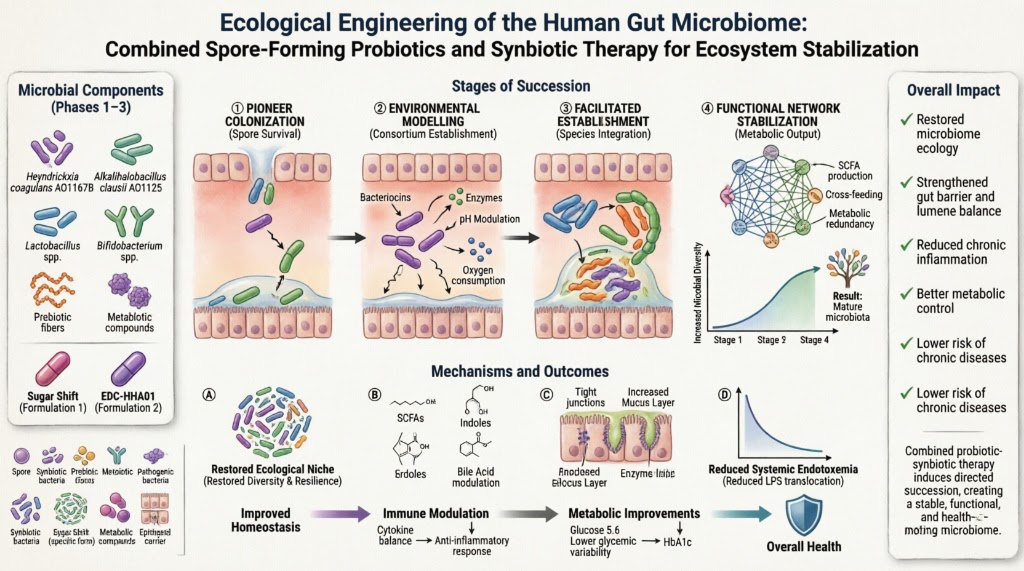
The proposed framework consists of five related stages: pioneer activity, niche remodeling, facilitated community assembly, functional-network stabilization, and host-associated effects (Figure 1). These stages are presented sequentially to define the events required for directed ecological succession. In practice, they may overlap, fail to occur, or proceed along different trajectories according to the initial microbiome structure, the composition of the intervention, diet, medication use, and host physiology. The model therefore describes a hypothesis to be tested rather than an inevitable response to treatment.
4.1. Stage 1: Pioneer Activity
The first stage begins when administered spore-forming bacteria survive passage through the upper gastrointestinal tract, germinate, and become metabolically active. Their proposed role is not necessarily to establish permanent populations. Rather, they may act transiently during a period in which their metabolic activities can alter the conditions encountered by other members of the community.
Endospore formation provides an obvious advantage during gastrointestinal transit. The dormant spore is resistant to acid, bile, desiccation, and other environmental stresses that would reduce the viability of many vegetative bacteria. Strain-specific studies of Alkalihalobacillus clausii AO1125 [98] and Heyndrickxia coagulans AO1167B [99] have reported survival under simulated gastrointestinal conditions and genomic characteristics consistent with their use as orally administered microorganisms. These observations support survival and potential metabolic activity after ingestion. They do not, however, establish where germination occurs in vivo, how long the resulting vegetative populations remain active, or whether their activity precedes changes in the resident microbiome.
The central prediction of this stage is therefore temporal. Spore germination and vegetative activity should occur before the environmental and community changes assigned to the subsequent stages. This prediction can be examined by combining strain-specific quantification with measurements of germination, transcriptional activity, and metabolite production at closely spaced intervals after administration. Detection of spores or strain DNA in feces alone would not be sufficient, because neither establishes germination nor metabolic activity within the intestine.
4.2. Stage 2: Niche Remodeling
Following endospore germination, the vegetative cells become metabolically active and begin to alter their immediate surroundings [100]. They consume available substrates, produce organic acids and other metabolites, and may inhibit competing organisms. These activities may change the conditions under which neighboring microbial populations must function. This is the basis for the proposed niche-remodeling stage.
Oxygen availability is particularly important in the intestine [36,101]. The healthy colon is predominantly anaerobic, but inflammation and impaired epithelial metabolism can increase the availability of oxygen and other respiratory electron acceptors near the mucosal surface. These conditions favor facultative anaerobes, including members of the Enterobacteriaceae, and may restrict obligate anaerobes associated with normal fermentation and short-chain-fatty-acid production [102,103]. Oxygen consumption by metabolically active pioneer organisms could contribute to the restoration of a lower redox potential. Organic-acid production and bacteriocin activity could provide additional selective pressures [98,99].
There is evidence that individual strains can carry out some of these activities under laboratory conditions. Whether they do so within the intestine, and whether the resulting changes are sufficient to influence other members of the microbiome, remains uncertain. Genomic analysis can identify the metabolic capabilities of a strain, but the presence of the relevant genes does not tell us when, where, or to what extent they are expressed after ingestion.
This stage predicts a measurable environmental change following pioneer activity. Such a change might include reduced oxygen availability, altered redox potential, localized changes in pH, depletion of particular substrates, production of organic acids, or inhibition of competing organisms. It must also precede the response of the organisms presumed to benefit from niche remodeling. Without this temporal relationship, subsequent changes in community composition cannot confidently be attributed to pioneer activity.
4.3. Stage 3: Facilitated Community Assembly
If pioneer activity produces favorable environmental changes, microbial populations introduced with a synbiotic consortium—or already present at low abundance in the recipient—may become more metabolically active or increase in abundance. This constitutes facilitation only when the response of these populations depends upon conditions created by the earlier organisms. Their simultaneous detection is not, by itself, evidence of an ecological relationship.
The proposed process may involve several forms of facilitation. Oxygen consumption may favor strict anaerobes [36]. Organic acids or other fermentation products may serve as substrates for secondary consumers [104]. Antimicrobial compounds may reduce competition from susceptible organisms. Prebiotic components may provide selectively utilized substrates, while the metabolic products of one population may support the growth or activity of another [105,106]. These interactions could permit community functions to arise that would not be produced by the strains acting independently.
Clinical studies of multicomponent probiotic and synbiotic formulations, including Sugar Shift and EDC-HHA01, have reported changes in microbiome composition and metabolic biomarkers [80,107,108]. These findings are compatible with community-level effects, but they do not yet show that the observed changes were produced through pioneer-mediated facilitation. Demonstrating facilitation will require comparisons among the pioneer organisms alone, the secondary consortium alone, the complete formulation, and appropriate controls. A true facilitative interaction should produce an effect in the combined intervention that cannot be explained by adding the independent effects of its components.
Several ecological processes could contribute to the assembly of the secondary community. They include modification of the local environment, exchange of metabolic products, use of complementary substrates, and relief from competition. Table 2 summarizes these proposed interactions, the functions they may support, and the observations needed to determine whether they occur during treatment.
The principal prediction of Stage 3 is that community assembly will depend upon both formulation and order of exposure. If niche remodeling is necessary, administering the pioneer organisms before or with the secondary consortium should produce a different outcome from administering the consortium alone. Reversing the order, altering the interval between components, or disabling a proposed pioneer function should weaken or eliminate the effect.
4.4. Stage 4: Functional-Network Stabilization
The appearance of a newly assembled community does not mean that it will persist. Administered organisms may simply pass through the intestine, while changes among the resident populations may disappear after treatment has ended. Stage 4 addresses whether the functions and interactions that emerged during the earlier stages are maintained.
Functional stability may develop when important metabolic activities are distributed among multiple microbial populations. This functional redundancy can allow a community to maintain its output despite changes in the abundance of individual taxa [114,115]. Cross-feeding may provide a second source of stability. Lactate and acetate produced by bifidobacteria and lactic-acid bacteria, for example, can be used by obligate anaerobes that produce butyrate, including members of Faecalibacterium, Roseburia, Anaerobutyricum, and related genera [110,111,116]. A clinical evaluation of H. coagulans AO1167B reported an association with changes in Faecalibacterium prausnitzii, although the mechanism and direction of causality remain to be established [99].
Stabilization does not require every individual to develop the same microbial composition. Different organisms can perform many of the same metabolic functions, and the organisms responsible for those functions may vary from one person to another [117,118]. For this reason, changes in taxonomic abundance provide only part of the evidence. It is also necessary to determine whether important metabolic activities persist and whether the community retains them when it is disturbed.
The strongest evidence for Stage 4 would be the maintenance of an altered functional state after treatment withdrawal or following a defined perturbation. If the observed changes disappear immediately when administration stops, the intervention may have produced a temporary pharmacological or nutritional effect.
4.4. 1Baseline Microbiome and Priority Effects
Whether the proposed sequence continues beyond its early stages will depend in part on the microbiome already present. Resident organisms can either support the activity of newly introduced organisms or prevent them from becoming established. Ecologists refer to this influence of earlier inhabitants on later arrivals as a priority effect. Such effects may account for some of the differences observed when the same microbiome intervention is given to different individuals.
A microbiome depleted by antibiotics may offer limited colonization resistance but may also lack organisms required for cross-feeding [119]. A diverse microbiome dominated by facultative anaerobes may contain the necessary functional capacity but resist displacement or environmental change. In a comparatively stable microbiome, the intervention may produce little taxonomic change while still altering the activity of existing populations [120]. These conditions should not be treated as equivalent starting points.
The prediction is that baseline community structure and function will explain a meaningful proportion of treatment variability. Baseline measurements may eventually permit the selection of intervention components, sequence, or dose according to the ecological state of the recipient. At present, however, this remains a research objective rather than a clinically validated basis for personalization.
4.5. Stage 5: Host-Associated Effects
In the final stage, changes in the microbial community composition begin to affect the host. The response may be detected in the intestinal barrier, in inflammatory activity, or in the metabolic regulation of glucose and lipid metabolism. There must be evidence connecting these responses to the microbial activities described in the preceding stages. Without this evidence, they are simply clinical observations whose relationship to the proposed ecological sequence is uncertain.
Short-chain fatty acids provide one possible connection. Butyrate serves as an energy source for colonocytes and contributes to epithelial metabolism and maintenance of a low-oxygen mucosal environment. Acetate and propionate participate in additional metabolic and signaling pathways, including pathways involving free-fatty-acid receptors [15,16]. Changes in microbial metabolites may also affect tight-junction integrity, immune activity, and exposure to microbial products such as lipopolysaccharide.
Clinical studies of EDC-HHA01 and other formulations have reported changes in HOMA-IR, circulating lipopolysaccharide, and related metabolic measurements [80,99,107]. These findings are encouraging and are consistent with parts of the model proposed here. They cannot, however, tell us how the changes occurred. In particular, the studies were not designed to follow the ecological events from spore germination through modification of the intestinal environment and, eventually, to a response by the host.
Establishing that sequence will require measurements taken at several points during and after treatment. It will first be necessary to determine when the pioneer organisms become active and whether their activity changes the surrounding environment. Changes in other microbial populations and their metabolic products can then be followed, together with the host response. The proposed mechanism would be more convincing if preventing one of the early events also prevented the events expected to follow it. Of the five stages, this connection between microbial activity and host response will probably be the most difficult to establish.
4.6. Factors That May Alter the Ecological Trajectory
The sequence proposed here should not be expected to occur in every individual. Spores may pass through the intestine without germinating in sufficient numbers, or the vegetative cells may become active without appreciably changing their surroundings. Even when the intestinal environment is altered, the resident community may not respond as predicted. Any changes that do occur may disappear after treatment is discontinued, and persistence of a microbial change does not necessarily mean that it will benefit the host.
These differences are likely to depend upon the condition of the intestine at the beginning of treatment. Diet and medication use will affect the substrates available to the community, while intestinal transit, inflammation, and the composition of the resident microbiome will affect the survival and activity of the administered organisms [121,122,123]. As a result, a formulation that promotes the desired response in one person may have little effect in another. It may even move the microbiome along a different trajectory. These possibilities are not exceptions to be dismissed. They are outcomes that must be included when the model is tested, particularly if microbiome changes are to be attributed to ecological engineering rather than to the normal variation that occurs within the intestinal community.
4.7. Experimental Evaluation of the Framework
A decisive evaluation of the framework requires more than comparing microbiome profiles before and after treatment. The sequence of events must be established, and the dependence of each stage on the preceding one must be tested. This will require longitudinal sampling, strain-resolved analysis, measurements of microbial gene expression and metabolites, assessment of physicochemical conditions within the intestine, and controlled comparisons of the individual and combined components of the intervention. The principal predictions for each stage and the experimental approaches that could be used to test them are summarized in Table 3.
5. Discussion
5.1. From Probiotic Administration to Ecological Intervention
When a microorganism enters the intestine, it encounters an already established microbial community. Whether it survives and becomes active will depend on that community, as well as on the physiology of the host, the available nutrients, and previous exposures. The introduced organism may also change the conditions it encounters. As such, probiotic activity cannot be explained entirely by studying the organism in isolation. It must also be examined in the context of the intestinal ecosystem.
This difference has practical importance. Probiotic strains have commonly been selected according to characteristics measured in pure culture, such as tolerance to acid and bile, adhesion, antimicrobial activity, and metabolite production [124,125,126]. These characteristics tell us something about the organism, but not necessarily what it will do after it enters an established microbial community. A strain that performs well in the laboratory may have little effect in the intestine if the required substrates are unavailable or if resident organisms restrict its activity. Its metabolic products may also be of little consequence unless other members of the community can use them.
The framework proposed here examines what happens after the strain is administered. For a pioneer organism, the important question is whether its activity changes the conditions encountered by other microorganisms. The same reasoning applies to a synbiotic consortium. Its usefulness will depend less on the number of components it contains than on whether those components can function together under conditions present in the intestine.
This interpretation does not make the individual strain unimportant. Strain identity determines metabolic capacity, stress tolerance, safety, and the range of possible interactions. The difference is that these properties are evaluated in relation to an ecological role. A strain intended to serve as a pioneer should be selected for its ability to become active under the relevant intestinal conditions and to produce a measurable change in the surrounding environment. A strain intended to participate later in the sequence should be able to use the substrates or conditions created during the earlier stages.
5.2. What the Available Evidence Establishes
The framework draws upon observations made in several areas of microbiome research. The survival of bacterial spores during gastrointestinal transit and their subsequent return to vegetative growth have been demonstrated for selected strains [98,99]. Once active, these organisms enter an intestinal environment that is itself responsive to inflammation, epithelial metabolism, diet, and microbial activity [102,103]. They also become part of a community in which the products released by one population may be used by another [76]. Such exchanges can distribute related metabolic functions among different organisms and contribute to the functional redundancy observed in complex microbial communities [14,127,128,129].
Clinical studies of probiotics and synbiotic formulations provide another line of evidence. Trials involving Sugar Shift, EDC-HHA01, and the spore-forming strains considered here have reported changes in microbial composition, metabolic pathways, or host-associated measurements [80,107,108,130,131]. These studies show that the interventions are biologically active under the conditions in which they were tested. They also provide observations that can be examined in relation to the framework.
What remains unproven is the proposed connection among these observations. Survival of a spore does not demonstrate that its vegetative activity remodeled an intestinal niche. A change in the abundance of another organism does not show that the change was facilitated by the pioneer. Likewise, an improvement in HOMA-IR or circulating lipopolysaccharide cannot be assigned to microbial succession unless the intervening events have been followed [132]. The evidence presently available supports the plausibility of the individual stages, but not the entire sequence as a demonstrated mechanism.
This problem extends well beyond the studies considered here. Most clinical trials ask whether an intervention produces an effect; they are not designed to follow the ecological events that lead to it [133,134]. Samples are often collected at the beginning and end of treatment, and much of what happens between those points is missed. Reliance on fecal material creates a further limitation because it reveals relatively little about the small intestine, proximal colon, or organisms associated with the mucosa. Failure to detect one of the proposed intermediate events may therefore reflect when and where samples were collected rather than showing that the event did not occur.
For this reason, the framework should be judged by the experiments it makes possible. If the predicted order of events is not observed, or if removal of an early stage has no effect on what follows, the model will require revision. Clinical benefit could still occur, but it would have to be explained by another mechanism. The purpose of the model is not to accommodate every outcome. It is to identify the observations that would support or contradict the proposed ecological process.
5.3. Implications for the Design of Microbiome Therapeutics
If the model is supported, formulation design would begin with the ecological problem to be addressed. An intestine characterized by increased oxygen availability and expansion of facultative anaerobes presents a different problem from one depleted of fermentative organisms after antibiotic treatment. Both conditions may be described as dysbiosis, but they are unlikely to respond in the same way to an identical microbial formulation.
This approach would require investigators to define the intended function of each component. Some organisms may be included because they survive transit and alter the local environment. Others may supply enzymes that release substrates from otherwise inaccessible dietary compounds. Still others may use the resulting metabolites or restore functions that are poorly represented in the resident community. Prebiotic ingredients would be selected according to the organisms expected to use them and the products expected to result, rather than added as general stimulants of microbial growth.
The order and timing of administration may prove as important as composition [135]. If secondary organisms depend on conditions created by pioneers, simultaneous delivery may not always be optimal. Conversely, separating the components by too long an interval may allow the initial environmental change to disappear before the secondary community becomes active. These possibilities can be examined directly by varying the sequence and timing of treatment.
Dose will also require further consideration. A larger number of viable organisms does not necessarily ensure a better response. For an organism serving as a pioneer, the important consideration may be whether it remains active long enough to produce the required environmental change. Increasing the dose beyond that point could have little additional value and might alter acid production, competition for substrates, or inhibition of other organisms in unintended ways. The appropriate dose may therefore depend as much on the activity and persistence of the organism as on the number administered.
An ecological approach may also improve the interpretation of nonresponse. Failure of an intervention does not necessarily mean that every component lacks biological activity. The process may have stopped at a particular stage. The pioneer may not have germinated, the environmental change may have been too small, or the recipient may have lacked the microbial partners needed to continue the sequence. Identifying where the process stopped would be more informative than classifying the entire intervention as effective or ineffective.
5.4. The Importance of the Baseline Microbiome
Differences among individuals are commonly viewed as an obstacle to determining the average effect of an intervention. In this case, however, those differences may help determine the response itself. Treatment begins with the microbial community already present in the recipient, and its composition and activity will affect what the administered organisms are able to do.
A depleted microbiome may offer little resistance to incoming organisms but may lack the partners needed to complete a metabolic pathway [28,136]. A diverse but disrupted community may retain those functions while resisting the introduced organisms. In other individuals, the required organisms may already be present, and treatment may act mainly by increasing their activity. Similar clinical responses could therefore arise from different taxonomic changes, while similar taxonomic changes could have different consequences depending on the functions already present [118,137].
This may explain why baseline taxonomic markers alone have had limited success in predicting response. The relevant question is not simply which organisms are present. It is whether the community contains the functions, substrates, and interactions needed for the proposed sequence to proceed. Prediction will probably require information about microbial activity and the intestinal environment in addition to community composition.
The longer-term objective is to determine where the response is most likely to stop in a given recipient. It may then be possible to modify the intervention by selecting a different pioneer, changing the organisms or substrates that follow it, or altering the timing of administration. There is not yet sufficient evidence to personalize treatment in this way. Nevertheless, the model suggests how such an approach might eventually be investigated.
5.5. Limitations of the Framework
Dividing the proposed process into five stages is useful for experimental purposes, but it is an obvious simplification of what occurs within the intestine. The stages will probably not begin and end at clearly defined points. Pioneer organisms may remain active as other populations respond, and the host may begin to react before the microbial community has reached a stable state. That response may, in turn, change the intestinal environment and influence the community that is still developing.
The term “directed succession” also requires care. Direction does not imply complete control or guarantee a beneficial endpoint. At most, an intervention may increase the probability that the community will follow one trajectory rather than another. The resident microbiome and the host remain active participants and either may oppose or redirect the intended process.
The evidence used to develop the framework was not obtained from a single type of study or from comparable experimental conditions. Genomic analysis can show what an organism may be capable of doing, but it cannot show that the same activity occurs after ingestion. Laboratory models allow intestinal conditions to be examined more closely, although they reproduce only part of the environment found in the host. Studies in animals and humans provide additional evidence, but each introduces different limitations. In particular, most clinical trials were not sampled often enough to determine whether the events proposed here occurred in sequence. The framework therefore brings together observations made at different levels of investigation, with the uncertainty that such a synthesis necessarily carries.
The strains and formulations used to illustrate the framework do not independently prove the model. Evidence relevant to its individual stages also appears in studies of probiotic engraftment, defined bacterial consortia, microbiome recovery after antibiotics, and fecal microbiota transfer. Human studies have shown that the establishment of an administered strain depends on ecological opportunities within the recipient microbiome, and that recovery of probiotic organisms in feces does not necessarily reflect their activity at the mucosal surface [138,139]. Studies of VE303 and SER-109 provide additional examples in which defined or spore-based microbial preparations influenced colonization, community recovery, microbial metabolites, and clinical outcomes [140,141,142]. Other experimental work has established plausible mechanisms involving epithelial oxygenation, metabolic cross-feeding, and the dependence of treatment response on the baseline microbiome [116,143,144,145]. None of these studies demonstrates the complete five-stage sequence, but together they broaden the evidence beyond the formulations from which the present framework was initially developed.
Broader Significance
Although particular strains and formulations have been used to illustrate the model, it may apply to other organisms. A different microorganism could perform the pioneer role if it survives administration and becomes active where an environmental change is needed. The organisms that respond later need not be fixed either. Their importance lies in whether they can use, extend, or complement the activities initiated during the earlier stages.
The broader contribution of the framework is therefore not a particular combination of organisms. It is a way of deciding why the organisms should be combined and what must occur after they are administered. This changes the central question from whether an individual strain possesses a desirable property to whether a sequence of microbial activities can move a community toward a more persistent and useful functional state.
Whether this can be accomplished remains an open question. The model provides a way to investigate it by following the activity of the administered organisms, the response of the resident community, and the effects observed in the host. If these events occur in the proposed order, future formulations could be selected according to the ecological functions their components perform together, rather than principally from characteristics measured one strain at a time.
6. Conclusions and Future Directions
The gut microbiome is often treated as a collection of organisms whose individual properties can be selected and combined to produce a therapeutic effect. This approach has yielded useful probiotics and greatly advanced our understanding of individual strains. However, it does not fully account for the community into which those organisms are introduced. The intestinal microbiome is already established, and its response will depend on the organisms and functions present when treatment begins.
The framework proposed in this review considers whether selected microorganisms can be used in a defined ecological sequence. Spore-forming organisms may serve as transient pioneers if they survive administration, germinate, and alter conditions within the intestine. Those changes could then affect resident populations or organisms supplied as part of a synbiotic consortium. If the resulting functions become distributed among several members of the community, some may persist after the administered organisms are no longer detected. A host response would represent the final stage of this process.
There is evidence supporting the biological plausibility of the individual stages. Studies have demonstrated spore survival and germination, metabolic exchange among intestinal microorganisms, environmental control of community composition, recipient-dependent engraftment, and changes in host measurements following microbiome interventions. What has not been demonstrated is that these events occur in the order proposed here or that each depends on the one preceding it. The five-stage framework should therefore not be regarded as an established mechanism of probiotic or synbiotic action.
The next experiments should be designed to follow the process as it occurs. This will require sampling at intervals capable of detecting early microbial activity, together with measurements of the intestinal environment, microbial gene expression, metabolic products, and host response. Studies comparing the individual components of an intervention with the complete formulation will be particularly important. Changing the order of administration or removing a proposed pioneer function would provide a direct test of whether later events depend on earlier ones. Follow-up after treatment has ended will also be needed to determine whether an altered function persists or disappears with the administered organisms.
The value of ecological engineering will ultimately depend on whether it improves the predictability of microbiome intervention. The framework may prove incomplete, and different starting communities may follow different trajectories. Even so, determining where the proposed sequence succeeds or fails would provide information that cannot be obtained from endpoint comparisons alone. The central question is no longer which strain should be administered. It is whether the activities of several organisms can be arranged so that an initial ecological change permits other microbial functions to develop and, under appropriate conditions, to be maintained.
Author Contributions
Conceptualization, R.D.J.C.; literature investigation, A.D., G.G. and R.D.J.C.; writing—original draft preparation, R.D.J.C.; writing—review and editing, A.D., G.G. and R.D.J.C.; visualization, R.D.J.C.; supervision, R.D.J.C. All authors have read and agreed to the published version of the manuscript.
Funding
Please add: This research received no external.
Data Availability Statement
No new data were created or analyzed in this review. Data sharing is therefore not applicable.
Acknowledgments
During the preparation of this manuscript, the authors used OpenAI ChatGPT and Codex for language revision, editorial organization, and assistance with reference management. The authors reviewed and edited all outputs and take full responsibility for the content of the publication.
Conflicts of Interest
Raúl de Jesús Cano is the Chief Executive Officer of Chauvell, LLC. EDC-HHA01, a formulation discussed in this review, is a Chauvell, LLC product commercialized under the name Advanced Daily and licensed as a white-label product. Chauvell, LLC funded the previously published clinical investigations of EDC-HHA01 and supplied the investigational products without charge. Chauvell, LLC participated in the design of the clinical trial protocols but did not conduct the trials. Antonio Díaz and Gissel García are independent researchers who conducted clinical investigations of EDC-HHA01 and the probiotic strains Alkalihalobacillus clausii AO1125 and Heyndrickxia coagulans AO1167B. They have no employment, ownership, consulting, or other financial relationship with Chauvell, LLC. All three authors are authors of previously published studies discussed in this review. These relationships are disclosed in the interest of full transparency.
References
- Thursby, E.; Juge, N. Introduction to the human gut microbiota. Biochem J. 2017, 474, 1823–1836. [Google Scholar] [CrossRef] [PubMed]
- Marchesi, J.R.; Adams, D.H.; Fava, F.; Hermes, G.D.; Hirschfield, G.M.; Hold, G.; Quraishi, M.N.; Kinross, J.; Smidt, H.; Tuohy, K.M. The gut microbiota and host health: a new clinical frontier. Gut 2016, 65, 330–339. [Google Scholar] [PubMed]
- Sender, R.; Fuchs, S.; Milo, R. Revised estimates for the number of human and bacteria cells in the body. PLoS Biol. 2016, 14, e1002533. [Google Scholar] [CrossRef] [PubMed]
- Gilbert, J.A.; Blaser, M.J.; Caporaso, J.G.; Jansson, J.K.; Lynch, S.V.; Knight, R. Current understanding of the human microbiome. Nat. Med. 2018, 24, 392–400. [Google Scholar] [CrossRef] [PubMed]
- Faust, K.; Raes, J. Microbial interactions: from networks to models. Nat. Rev. Microbiol. 2012, 10, 538–550. [Google Scholar] [CrossRef] [PubMed]
- Coyte, K.Z.; Schluter, J.; Foster, K.R. The ecology of the microbiome: Networks, competition, and stability. Science 2015, 350, 663–666. [Google Scholar] [CrossRef] [PubMed]
- Ding, G.; Yang, X.; Li, Y.; Wang, Y.; Du, Y.; Wang, M.; Ye, R.; Wang, J.; Zhang, Y.; Chen, Y. Gut microbiota regulates gut homeostasis, mucosal immunity and influences immune-related diseases. Mol. Cell. Biochem. 2025, 480, 1969–1981. [Google Scholar] [PubMed]
- Banerjee, S.; Schlaeppi, K.; van der Heijden, M.G.A. Keystone taxa as drivers of microbiome structure and functioning. Nat. Rev. Microbiol. 2018. [Google Scholar] [CrossRef] [PubMed]
- Li, Z.; Samui, S.; Liu, J.a.; Yang, Y.; Liu, X.; Chen, Q.; Li, J.; Gopinath, D.; Luo, P.; Shan, D. Gut microbiome and metabolic health: mechanisms and precision interventions. Gut Microbes 2026, 18, 2644677. [Google Scholar] [CrossRef] [PubMed]
- Shen, Y.; Fan, N.; Ma, S.x.; Cheng, X.; Yang, X.; Wang, G. Gut microbiota dysbiosis: pathogenesis, diseases, prevention, and therapy. MedComm 2025, 6, e70168. [Google Scholar] [CrossRef] [PubMed]
- Zelezniak, A.; Andrejev, S.; Ponomarova, O.; Mende, D.R.; Bork, P.; Patil, K.R. Metabolic dependencies drive species co-occurrence in diverse microbial communities. Proc. Natl. Acad. Sci. 2015, 112, 6449–6454. [Google Scholar] [CrossRef] [PubMed]
- Zmora, N.; Suez, J.; Elinav, E. You are what you eat: diet, health and the gut microbiota. Nat. Rev. Gastroenterol. Hepatol. 2019, 16, 35–56. [Google Scholar] [CrossRef] [PubMed]
- Suchiita, A.; Gupta, N.; Nandi, K.; Sonkar, S.; Chandra, L. Harmony within: unravelling the microbiome–immune system symbiosis for health. Aging Med. 2025, 2025. [Google Scholar] [CrossRef]
- Adam, P.A.; Robert, W.C.; Christopher, S.H.; Nomi, L.H.; Rick, S.; Sergei, M.; Paramvir, D.; Doreen, W.; Fernando, P.; Shane, C.; et al. KBase: The United States Department of Energy Systems Biology Knowledgebase. Nat. Biotechnol. 2018, 36, 566–569. [Google Scholar] [CrossRef] [PubMed]
- Ara, K.; Filipe De, V.; Petia, K.D.; Fredrik, B. From Dietary Fiber to Host Physiology: Short-Chain Fatty Acids as Key Bacterial Metabolites. Cell 2016, 165, 1332–1345. [Google Scholar] [CrossRef] [PubMed]
- Parada Venegas, D.; De la Fuente, M.K.; Landskron, G.; González, M.J.; Quera, R.; Dijkstra, G.; Harmsen, H.J.M.; Faber, K.N.; Hermoso, M.A. Short Chain Fatty Acids (SCFAs)-Mediated Gut Epithelial and Immune Regulation and Its Relevance for Inflammatory Bowel Diseases. Front Immunol. 2019, 10, 277. [Google Scholar] [CrossRef] [PubMed]
- Gomes, J.M.G.; de Assis Costa, J.; Alfenas, R.d.C.G. Metabolic endotoxemia and diabetes mellitus: a systematic review. Metabolism 2017, 68, 133–144. [Google Scholar] [CrossRef] [PubMed]
- Hotamisligil, G.S. Inflammation and metabolic disorders. Nature 2006, 444, 860–867. [Google Scholar] [CrossRef] [PubMed]
- Ina, B.; José María, M.N. The relevance of intestinal barrier dysfunction, antimicrobial proteins and bacterial endotoxin in metabolic dysfunction-associated steatotic liver disease. Eur. J. Clin. Investig. 2024, 54, e14224–e14224. [Google Scholar] [CrossRef] [PubMed]
- Douglas, J.M.; Tom, P. Formation of short chain fatty acids by the gut microbiota and their impact on human metabolism. Gut Microbes 2016, 7, 189–200. [Google Scholar] [CrossRef] [PubMed]
- Henrik, M.R.; Tine Rask, L. Microbial tryptophan catabolites in health and disease. Nat. Commun. 2018, 9, 3294–3294. [Google Scholar] [CrossRef] [PubMed]
- Wei, J.; Guoxiang, X.; Weiping, J. Bile acid–microbiota crosstalk in gastrointestinal inflammation and carcinogenesis. Nat. Rev. Gastroenterol. Hepatol. 2017, 15, 111–128. [Google Scholar] [CrossRef] [PubMed]
- Pamer, E.G. Resurrecting the intestinal microbiota to combat antibiotic-resistant pathogens. Science 2016, 352, 535–538. [Google Scholar] [CrossRef] [PubMed]
- Waaij, D.V.d.; Vries, J.M.B.-d.; Wees, J.E.C.L.-v.d. Colonization resistance of the digestive tract in conventional and antibiotic-treated mice. J. Hyg. 1971, 69, 405–411. [Google Scholar] [CrossRef] [PubMed]
- Sadhu, S.; Paul, T.; Yadav, N. Therapeutic engineering of the gut microbiome using synthetic biology and metabolic tools: a comprehensive review with E. coli Nissle 1917 as a model case study. Arch. Microbiol. 2025, 207, 213. [Google Scholar] [CrossRef] [PubMed]
- Kern, L.; Tofield, A.; Frame, J.; Elinav, E. Next-generation probiotics: an outlook into current applications and future developments. Nat. Rev. Microbiol. 2026, 1–20. [Google Scholar]
- Chen, X.; You, W.; Zhou, S. The architecture of gut microecological networks and the governance of host metabolic homeostasis. Mycology 2026, 1–25. [Google Scholar] [CrossRef]
- Jyoti; Dey, P. Mechanisms and implications of the gut microbial modulation of intestinal metabolic processes. npj Metab. Health Dis. 2025, 3, 24. [Google Scholar] [CrossRef] [PubMed]
- Suteau, L.; Colaert-Sentenac, L.; Law, S.R.; Simonin, M. Transient microbial architects: tracing the legacy effects of ephemeral taxa during plant microbiome assembly. Curr. Opin. Microbiol. 2025, 88, 102664. [Google Scholar] [CrossRef] [PubMed]
- Lewandowski, R. The gut microbiome as a rainforest: probiotic colonization resistance, functional effects, and next-generation strategies. FEMS Microbiol. Lett. 2026, 373, fnag035. [Google Scholar] [CrossRef] [PubMed]
- Trevor, D.L.; Donna, M.B.; Yana, E.H.; Christine, G.; David, A.R.; Denise, M.M. Host Transmission of Salmonella enterica Serovar Typhimurium Is Controlled by Virulence Factors and Indigenous Intestinal Microbiota. Infect. Immun. 2008, 76, 403–416. [Google Scholar] [CrossRef] [PubMed]
- Clemente, J.C.; Ursell, L.K.; Parfrey, L.W.; Knight, R. The impact of the gut microbiota on human health: an integrative view. Cell 2012, 148, 1258–1270. [Google Scholar] [CrossRef] [PubMed]
- Charlie, G.B.; Eric, G.P. Microbiota-mediated colonization resistance against intestinal pathogens. Nat. Rev. Immunol. 2013, 13, 790–801. [Google Scholar] [CrossRef] [PubMed]
- Clive, G.J.; John, H.L.; Moshe, S. Organisms as Ecosystem Engineers. Oikos 1994, 69, 373–373. [Google Scholar] [CrossRef] [PubMed]
- Clive, G.J.; John, H.L.; Moshe, S. POSITIVE AND NEGATIVE EFFECTS OF ORGANISMS AS PHYSICAL ECOSYSTEM ENGINEERS. Ecology 1997, 78, 1946–1957. [Google Scholar] [CrossRef]
- Shang, T.; Zhang, R.; Liu, Y.; Shi, S. Intestinal oxygen and microbiota crosstalk: implications for pathogenesis of gastrointestinal diseases and emerging therapeutic strategies. Gut Pathog. 2025, 17, 100. [Google Scholar] [CrossRef] [PubMed]
- Jotham, S.; Niv, Z.; Eran, S.; Eran, E. The pros, cons, and many unknowns of probiotics. Nat. Med. 2019, 25, 716–729. [Google Scholar] [CrossRef] [PubMed]
- Henderson, A.; Schubert, O.T.; van Vliet, S.; Ackermann, M. Microbial interactions as modular: Implications for ecosystem dynamics and evolution. Ecol. Monogr. 2026, 96, e70072. [Google Scholar]
- Nadja, B.K.; Thomas, B.; Kristine, H.A.; Trine, N.; Tue, H.H.; Oluf, P. Alterations in fecal microbiota composition by probiotic supplementation in healthy adults: a systematic review of randomized controlled trials. Genome Med. 2016, 8, 52–52. [Google Scholar] [CrossRef] [PubMed]
- Daniel, M.; Bruno, P.; Gregory, L.; Arthur, C.O.; Geoffrey, A.P.; Christopher, A.E.; Colin, H.; Zachery, T.L.; Andi, L.S.; Niv, Z.; et al. Emerging issues in probiotic safety: 2023 perspectives. Gut Microbes 2023, 15, 2185034–2185034. [Google Scholar] [CrossRef] [PubMed]
- Colin, H.; Francisco, G.; Gregor, R.; Glenn, R.G.; Daniel, M.; Bruno, P.; Lorenzo, M.; Roberto Berni, C.; Harry, J.F.; Seppo, S.; et al. The International Scientific Association for Probiotics and Prebiotics consensus statement on the scope and appropriate use of the term probiotic. Nat. Rev. Gastroenterol. Hepatol. 2014, 11, 506–514. [Google Scholar] [CrossRef] [PubMed]
- Rodenes-Gavidia, A.; Lamelas, A.; Bloor, S.; Hobson, A.; Treadway, S.; Haworth, J.; Vijayakumar, V.; Naghibi, M.; Day, R.; Chenoll, E. An insight into the functional alterations in the gut microbiome of healthy adults in response to a multi-strain probiotic intake: a single arm open label trial. Front. Cell. Infect. Microbiol. 2023, 13, 1240267. [Google Scholar] [CrossRef] [PubMed]
- FitzGerald, J.; Patel, S.; Eckenberger, J.; Guillemard, E.; Veiga, P.; Schäfer, F.; Walter, J.; Claesson, M.J.; Derrien, M. Improved gut microbiome recovery following drug therapy is linked to abundance and replication of probiotic strains. Gut Microbes 2022, 14, 2094664. [Google Scholar] [CrossRef] [PubMed]
- Xie, G.; Chen, X.; Feng, Y.; Yu, Z.; Lu, Q.; Li, M.; Ye, Z.; Lin, H.; Yu, W.; Shu, H. Effects of dietary multi-strain probiotics on growth performance, antioxidant status, immune response, and intestinal microbiota of hybrid groupers (Epinephelus fuscoguttatus♀× E. Lanceolatus♂). Microorganisms 2024, 12, 1358. [Google Scholar] [CrossRef] [PubMed]
- Kuziel, G.A.; Rakoff-Nahoum, S. The gut microbiome. Curr. Biol. 2022, 32, R257–R264. [Google Scholar] [CrossRef] [PubMed]
- Barreto, H.C.; Gordo, I. Intrahost evolution of the gut microbiota. Nat. Rev. Microbiol. 2023, 21, 590–603. [Google Scholar] [CrossRef] [PubMed]
- Zheng, J.; Wittouck, S.; Salvetti, E.; Franz, C.M.; Harris, H.M.; Mattarelli, P.; O’toole, P.W.; Pot, B.; Vandamme, P.; Walter, J. A taxonomic note on the genus Lactobacillus: Description of 23 novel genera, emended description of the genus Lactobacillus Beijerinck 1901, and union of Lactobacillaceae and Leuconostocaceae. Int. J. Syst. Evol. Microbiol. 2020, 70, 2782–2858. [Google Scholar] [CrossRef] [PubMed]
- Salminen, S.; Ouwehand, A.; Benno, Y.; Lee, Y.-K. Probiotics: how should they be defined? Trends Food Sci. Technol. 1999, 10, 107–110. [Google Scholar] [CrossRef]
- Mary Ellen, S.; Daniel, M.; Gregor, R.; Glenn, R.G.; Robert, A.R. Probiotics and prebiotics in intestinal health and disease: from biology to the clinic. Nat. Rev. Gastroenterol. Hepatol. 2019, 16, 605–616. [Google Scholar] [CrossRef] [PubMed]
- Zeilstra, D.; Jessica, A.Y.; Robert, J.B.; Michiel, K. Perspective: Fundamental Limitations of the Randomized Controlled Trial Method in Nutritional Research: The Example of Probiotics. Adv. Nutr. 2018, 9, 561–571. [Google Scholar] [CrossRef] [PubMed]
- Dingfa, L.; Fei, W.; Dexi, Z.; Buzhen, T.; Tingtao, C. Commercial probiotic products in public health: current status and potential limitations. Crit. Rev. Food Sci. Nutr. 2024, 64, 6455–6476. [Google Scholar] [CrossRef] [PubMed]
- Shampa, G.; Krishna Kumar, S.; Manchala, R.; Jitendra Kumar, S. Clinical Trials and Evidence-Based Nutraceutical Interventions; 2025; pp. 427–455. [Google Scholar]
- Elizabeth, K.C.; Christian, L.L.; Micah, H.; Noah, F.; Jeffrey, I.G.; Rob, K. Bacterial Community Variation in Human Body Habitats Across Space and Time. Science 2009, 326, 1694–1697. [Google Scholar] [CrossRef] [PubMed]
- Jizhong, Z.; Daliang, N. Stochastic Community Assembly: Does It Matter in Microbial Ecology? Microbiol. Mol. Biol. Rev. 2017, 81. [Google Scholar] [CrossRef] [PubMed]
- Walter, J.; Ley, R. The human gut microbiome: ecology and recent evolutionary changes. Annu. Rev. Microbiol. 2011, 65, 411–429. [Google Scholar] [CrossRef] [PubMed]
- Couch, C.E.; Epps, C.W. Host, microbiome, and complex space: applying population and landscape genetic approaches to gut microbiome research in wild populations. J. Hered. 2022, 113, 221–234. [Google Scholar] [CrossRef] [PubMed]
- Koopman, N.; Remijas, L.; Seppen, J.; Setlow, P.; Brul, S. Mechanisms and applications of bacterial sporulation and germination in the intestine. Int. J. Mol. Sci. 2022, 23, 3405. [Google Scholar] [CrossRef] [PubMed]
- Romero-Rodríguez, A.; Paredes-Sabja, D. Endospores, sporulation, and germination. In Molecular Medical Microbiology; Elsevier, 2024; pp. 141–152. [Google Scholar]
- Mao, Y.; Lou, X.; Che, J.; Huang, X.; Chen, Y.; Lan, J.; Chen, M.; Liu, X.; Huang, Q.; Wang, J. Screening and Evaluation In Vitro of Bacillus-Based Probiotics for Feed Additives. Microorganisms 2026, 14, 834–834. [Google Scholar] [CrossRef] [PubMed]
- Lu, S.; Na, K.; Li, Y.; Zhang, L.; Fang, Y.; Guo, X. Bacillus-derived probiotics: metabolites and mechanisms involved in bacteria–host interactions. Crit. Rev. Food Sci. Nutr. 2024, 64, 1701–1714. [Google Scholar] [PubMed]
- Vittoria, M.; Saggese, A.; Isticato, R.; Baccigalupi, L.; Ricca, E. Probiotics as an alternative to antibiotics: genomic and physiological characterization of aerobic spore formers from the human intestine. Microorganisms 2023, 11, 1978. [Google Scholar] [CrossRef] [PubMed]
- Shalon, D.; Culver, R.N.; Grembi, J.A.; Folz, J.; Treit, P.V.; Shi, H.; Rosenberger, F.A.; Dethlefsen, L.; Meng, X.; Yaffe, E. Profiling the human intestinal environment under physiological conditions. Nature 2023, 617, 581–591. [Google Scholar] [CrossRef] [PubMed]
- Chalotra, R.; Gupta, T.; Kumar, A.; Gupta, A.; Kumar, S.; Singh, T.G.; Singh, R. Prebiotics, probiotics, and postbiotics in modulating gut microbiota: Emerging therapeutic approaches for metabolic syndrome. Curr. Obes. Rep. 2026, 15, 9. [Google Scholar] [CrossRef] [PubMed]
- García, G.; del Carmen Campos, M.; Soto, J.; Diaz, A.; Buchaca, E.; Martínez, D.; Bernal, M.; Escobar, V.; Rodríguez, L.; Valdés, E. Effects of the Synbiotic Formulation EDC-HHA01 on Glucose Regulation in Adults with Type 2 Diabetes and Prediabetes: A Randomized, Placebo-Controlled Study. 2026. [Google Scholar] [CrossRef] [PubMed]
- Uhegwu, C.C.; Anumudu, C.K. Probiotic Potential of Traditional and Emerging Microbial Strains in Functional Foods: From Characterization to Applications and Health Benefits. Microorganisms 2025, 13, 2521. [Google Scholar] [CrossRef] [PubMed]
- Grumet, L.; Tromp, Y.; Stiegelbauer, V. The development of high-quality multispecies probiotic formulations: from bench to market. Nutrients 2020, 12, 2453. [Google Scholar] [CrossRef] [PubMed]
- Shewale, R.N.; Sawale, P.D.; Khedkar, C.; Singh, A. Selection criteria for probiotics: A review. Int. J. Probiotics Prebiotics 2014, 9, 17. [Google Scholar]
- Shokryazdan, P.; Sieo, C.C.; Kalavathy, R.; Liang, J.B.; Alitheen, N.B.; Faseleh Jahromi, M.; Ho, Y.W. Probiotic potential of Lactobacillus strains with antimicrobial activity against some human pathogenic strains. BioMed Res. Int. 2014, 2014, 927268. [Google Scholar] [CrossRef] [PubMed]
- Govaert, M.; Rotsaert, C.; Vannieuwenhuyse, C.; Duysburgh, C.; Medlin, S.; Marzorati, M.; Jarrett, H. Survival of Probiotic Bacterial Cells in the Upper Gastrointestinal Tract and the Effect of the Surviving Population on the Colonic Microbial Community Activity and Composition. Nutrients 2024, 16. [Google Scholar] [CrossRef] [PubMed]
- Procházková, N.; Falony, G.; Dragsted, L.O.; Licht, T.R.; Raes, J.; Roager, H.M. Advancing human gut microbiota research by considering gut transit time. Gut 2023, 72, 180–191. [Google Scholar] [CrossRef] [PubMed]
- Kechagia, M.; Basoulis, D.; Konstantopoulou, S.; Dimitriadi, D.; Gyftopoulou, K.; Skarmoutsou, N.; Fakiri, E.M. Health benefits of probiotics: a review. ISRN Nutr. 2013, 2013, 481651. [Google Scholar] [CrossRef] [PubMed]
- Tukaram, K.S.; Sopanrao, S.R.; Kacharu, L.O. Unveiling The Therapeutic Potential of Probiotics: A Review. J. Future Foods 2025. [Google Scholar] [CrossRef]
- Backman, T.; Cui, J.; Caullireau, E.; Bleak, E.; Bezrukov, I.; Girardi, P.; Hawks, A.; Lasky, J.R.; Latorre, S.M.; Erberich, J.M.; et al. Persistent trade-offs balance competition and colonization across centuries. Proc. Natl. Acad. Sci. 2026, 123, e2534310123. [Google Scholar] [CrossRef] [PubMed]
- Orman, M.A.; Ngo, H.G.; Mohiuddin, S.G. Beyond metabolic dormancy: metabolic rewiring in bacterial persistence. Nat. Commun. 2026, 17. [Google Scholar] [CrossRef] [PubMed]
- Fassarella, M.; Blaak, E.E.; Penders, J.; Nauta, A.; Smidt, H.; Zoetendal, E.G. Gut microbiome stability and resilience: elucidating the response to perturbations in order to modulate gut health. Gut 2021, 70, 595–605. [Google Scholar] [CrossRef] [PubMed]
- Kavita, P.; Suresh, R.N.; Babu, V.V. Probiotics, prebiotics and synbiotics- a review. J. Food Sci. Technol. 2015, 52, 7577–7587. [Google Scholar] [CrossRef] [PubMed]
- Kelly, S.S.; Glenn, R.G.; Robert, H.; Raylene, A.R.; Gregor, R.; Kristin, V.; Karen, P.S.; Hannah, D.H.; Meghan, B.A.; Nathalie, M.D.; et al. The International Scientific Association for Probiotics and Prebiotics (ISAPP) consensus statement on the definition and scope of synbiotics. Nat. Rev. Gastroenterol. Hepatol. 2020, 17, 687–701. [Google Scholar] [CrossRef] [PubMed]
- Dorna, D.-D.; Manica, N.; Iman, K.; Mostafa, S.; Milad, M.; Seyed Jalil, M.; Aydin, B.; Younes, G. Prebiotics: Definition, Types, Sources, Mechanisms, and Clinical Applications. Foods 2019, 8, 92–92. [Google Scholar] [CrossRef] [PubMed]
- Zhu, C.J.; Zhong, Y.L.; Zhang, Y.Z.; Shan, Z.C.; Qu, H.Y.; Cheng, F.; Feng, W.; Wang, P.; Sun, X.T.; Liu, X.Q.; et al. Ecological roles of lactic acid bacteria biodiversity and cross-feeding in shaping the flavor landscape of traditional Huangjiu fermentation. Bioresour. Technol. 2026, 444, 133981. [Google Scholar] [CrossRef] [PubMed]
- G García, G.; Campos, M.D.C.; Soto, J.; Diaz, A.; Buchaca, E.; Martínez, D.; Bernal, M.; Escobar, V.; Rodríguez, L.; Valdés, E.; Nuez, M.; Domínguez, N.; Sichel, L.; Cano, R.J. Effects of the Synbiotic Formulation EDC-HHA01 on Glucose Regulation in Adults with Type 2 Diabetes and Prediabetes: A Randomized, Placebo-Controlled Study. Microorganisms 2026, 14(4), 749. [Google Scholar] [CrossRef] [PubMed] [PubMed Central]
- Coyte, K.Z.; Rakoff-Nahoum, S. Understanding Competition and Cooperation within the Mammalian Gut Microbiome. Curr. Biol. 2019, 29, R538–r544. [Google Scholar] [CrossRef] [PubMed]
- Tseng, C.H.; Wong, S.; Yu, J.; Lee, Y.Y.; Terauchi, J.; Lai, H.C.; Luo, J.C.; Kao, C.Y.; Yu, S.L.; Liou, J.M.; et al. Development of live biotherapeutic products: a position statement of Asia-Pacific Microbiota Consortium. Gut 2025, 74, 706–713. [Google Scholar] [CrossRef] [PubMed]
- Tillotson, G. Editorial: Live Biotherapeutic Products: where are we? Front. Microbiomes 2025, Volume 4 - 2025. [Google Scholar] [CrossRef] [PubMed]
- Jyoti; Padhi, S.; Rai, A.K. Chapter Two - Live biotherapeutics and nutraceuticals: Exploring the differences and synergies. In Progress in Molecular Biology and Translational Science; Das, B., Ed.; Academic Press, 2026; Volume 220, pp. 37–64. [Google Scholar]
- Ducarmon, Q.R.; Kuijper, E.J.; Olle, B. Opportunities and Challenges in Development of Live Biotherapeutic Products to Fight Infections. J. Infect. Dis. 2021, 223, S283–S289. [Google Scholar] [CrossRef] [PubMed]
- Bodke, H.; Jogdand, S. Role of Probiotics in Human Health. Cureus 2022, 14, e31313. [Google Scholar] [CrossRef] [PubMed]
- El-Saadony, M.T.T.; Saad, A.M.M.; Sitohy, M.; Alkafaas, S.S.S.; Dladla, M.; Ghosh, S.; Mohammed, D.M.; Ibrahim, E.H.; Fahmy, M.A.; Elkelish, A.A.; et al. Probiotics and human health: biological activities, nutritional aspects, immunomodulatory properties, applications, and future perspectives - a comprehensive review. Front. Immunol. 2026, 16–2025. [Google Scholar] [CrossRef] [PubMed]
- Dey, P. Gut microbial strain improvement through genetic and metabolic engineering. Gut Microbiome Health 2026, 1, 100003. [Google Scholar] [CrossRef]
- Duhan, P.; Gupta, B.; Ahmed, M.; Bansal, P. Gut microbiome engineering with probiotics: current trends and future directions. Discov. Appl. Sci. 2025, 7, 1354. [Google Scholar] [CrossRef]
- Wu, L.; Li, Z.; Zhu, J.; Sun, Z.; Yan, L.; Luo, M.; Chen, H.; Yin, Y. Engineering the Gut Microbiome: Emerging Genome-Editing Strategies and Therapeutic Applications. Microorganisms 2026, 14, 1174. [Google Scholar] [CrossRef] [PubMed]
- Liu, Y.; Li, X.; Chen, Y.; Yao, Q.; Zhou, J.; Wang, X.; Meng, Q.; Ji, J.; Yu, Z.; Chen, X. Fecal microbiota transplantation: application scenarios, efficacy prediction, and factors impacting donor-recipient interplay. Front. Microbiol. 2025, Volume 16 - 2025. [Google Scholar] [CrossRef] [PubMed]
- Uppala, P.K.; Karanam, S.K.; Maddi, R. Science of fecal microbiota transplant: From history to cutting-edge clinical practice. World J. Gastrointest. Endosc. 2026, 18, 113133. [Google Scholar] [CrossRef] [PubMed]
- Els van, N.; Anne, V.; Max, N.; Susana, F.; Erwin, G.Z.; Willem, M.d.V.; Caroline, E.V.; Ed, J.K.; Bartelsman, J.F.W.M.; Jan, G.P.T.; et al. Duodenal Infusion of Donor Feces for Recurrent Clostridium difficile. N. Engl. J. Med. 2013, 368, 407–415. [Google Scholar] [CrossRef] [PubMed]
- Sen, P.; Kaulmann, D.; Youngster, I.; Abdeen, S.K.; Elinav, E. Advances and challenges in microbiome transplantation. Cell Host Microbe 2026, 34, 1202–1219. [Google Scholar] [CrossRef] [PubMed]
- Merrick, B.; Allen, L.; Masirah, M.Z.N.; Forbes, B.; Shawcross, D.L.; Goldenberg, S.D. Regulation, risk and safety of Faecal Microbiota Transplant. Infect. Prev. Pract. 2020, 2, 100069. [Google Scholar] [CrossRef] [PubMed]
- Ruan, Y.; Zhu, T.; Yang, R.; Su, F.; An, C.; Hu, Z.; Li, X.; Li, Y.; Chen, P.; Shao, X.; et al. Donor-derived microbial engraftment and gut microbiota shifts associated with weight loss following fecal microbiota transplantation. Appl. Env. Microbiol. 2025, 91, e0012025. [Google Scholar] [CrossRef] [PubMed]
- Chen, Q.; Wu, C.; Xu, J.; Ye, C.; Chen, X.; Tian, H.; Zong, N.; Zhang, S.; Li, L.; Gao, Y.; et al. Donor-recipient intermicrobial interactions impact transfer of subspecies and fecal microbiota transplantation outcome. Cell Host Microbe 2024, 32, 349–365.e344. [Google Scholar] [CrossRef] [PubMed]
- Gissel, G.a.; Josanne, S.; Antonio, D.; Jesús, B.; Carmen, S.; Ana, B.A.P.; Suselys, B.; Raúl, J.C. Randomized Clinical Trials Demonstrate the Safety Assessment of Alkalihalobacillus clausii AO1125 for Use as a Probiotic in Humans. Microorganisms 2024, 12, 2299–2299. [Google Scholar] [CrossRef] [PubMed]
- Gissel, G.a.; Josanne, S.; Antonio, D.; Jesús, B.; Carmen, S.; Ana Beatriz Alvarez, P.; Suselys, B.; Ángela, G.; Raúl, J.C. Clinical and In Vitro Safety of Heyndrickxia coagulans AO 1167B: A Double-Blind, Placebo-Controlled Trial. Microorganisms 2024, 12, 2584–2584. [Google Scholar] [CrossRef] [PubMed]
- Fan, L.; Zhang, Y.; Ismail, B.B.; Muhammad, A.I.; Li, G.; Liu, D. Bacillus spore germination: mechanisms, identification, and antibacterial strategies. Crit. Rev. Food Sci. Nutr. 2024, 64, 11146–11160. [Google Scholar] [CrossRef] [PubMed]
- Campbell, E. L-16 - Oxygen homeostasis in intestinal health and inflammation. Free Radic. Biol. Med. 2018, 120, S10. [Google Scholar] [CrossRef]
- Sebastian, W.; Andreas, J.B. Gut dysbiosis: Ecological causes and causative effects on human disease. Proc. Natl. Acad. Sci. 2023, 120, e2316579120–e2316579120. [Google Scholar] [CrossRef] [PubMed]
- Mariana, X.B.; Erin, E.O.; Fabian, R.-C.; Connor, R.T.; Stephanie, A.C.; Kristen, L.L.; Teresa, P.T.; Austin, J.B.; Franziska, F.; Yandong, G.; et al. Microbiota-activated PPAR-γ signaling inhibits dysbiotic Enterobacteriaceae expansion. Science 2017, 357, 570–575. [Google Scholar] [CrossRef] [PubMed]
- Auchtung, J.M.; Hallen-Adams, H.E.; Hutkins, R. Microbial interactions and ecology in fermented food ecosystems. Nat. Rev. Microbiol. 2025, 23, 622–634. [Google Scholar] [CrossRef] [PubMed]
- Smolinska, S.; Popescu, F.D.; Zemelka-Wiacek, M. A Review of the Influence of Prebiotics, Probiotics, Synbiotics, and Postbiotics on the Human Gut Microbiome and Intestinal Integrity. J. Clin. Med. 2025, 14. [Google Scholar] [CrossRef] [PubMed]
- Ali, S.; Hamayun, M.; Siraj, M.; Khan, S.A.; Kim, H.-Y.; Lee, B. Recent advances in prebiotics: Classification, mechanisms, and health applications. Future Foods 2025, 12, 100680. [Google Scholar] [CrossRef]
- Gissel, G.a.; Josanne, S.; Michael, N.; Nur, A.H.; Emilio, F.B.; Duniesky, M.; Martha, C.; Raúl, J.C. Evaluating the Effects of Sugar Shift® Symbiotic on Microbiome Composition and LPS Regulation: A Double-Blind, Placebo-Controlled Study. Microorganisms 2024, 12, 2525–2525. [Google Scholar] [CrossRef] [PubMed]
- Marcella, C.; Eloísa Martins da, S.; Niels Olsen Saraiva, C. Gut Microbiota Resilience Mechanisms Against Pathogen Infection and its Role in Inflammatory Bowel Disease. Curr. Clin. Microbiol. Rep. 2023, 10, 187–197. [Google Scholar] [CrossRef]
- Kaup, B.; Bringer-Meyer, S.; Sahm, H. D: -Mannitol formation from D: -glucose in a whole-cell biotransformation with recombinant Escherichia coli. Appl. Microbiol. Biotechnol. 2005, 69, 397–403. [Google Scholar] [CrossRef] [PubMed]
- Oliveira, R.A.; Ng, K.M.; Correia, M.B.; Cabral, V.; Shi, H.; Sonnenburg, J.L.; Huang, K.C.; Xavier, K.B. Klebsiella michiganensis transmission enhances resistance to Enterobacteriaceae gut invasion by nutrition competition. Nat. Microbiol. 2020, 5, 630–641. [Google Scholar] [CrossRef] [PubMed]
- Cheng, C.C.; Duar, R.M.; Lin, X.; Perez-Munoz, M.E.; Tollenaar, S.; Oh, J.H.; van Pijkeren, J.P.; Li, F.; van Sinderen, D.; Gänzle, M.G.; et al. Ecological Importance of Cross-Feeding of the Intermediate Metabolite 1,2-Propanediol between Bacterial Gut Symbionts. Appl. Env. Microbiol. 2020, 86. [Google Scholar] [CrossRef] [PubMed]
- Savage, H.P.; Bays, D.J.; Tiffany, C.R.; Gonzalez, M.A.F.; Bejarano, E.J.; Carvalho, T.P.; Luo, Z.; Masson, H.L.P.; Nguyen, H.; Santos, R.L.; et al. Epithelial hypoxia maintains colonization resistance against Candida albicans. Cell Host Microbe 2024, 32, 1103–1113.e1106. [Google Scholar] [CrossRef] [PubMed]
- Park, B.; Kim, J.Y.; Riffey, O.F.; Walsh, T.J.; Johnson, J.; Donohoe, D.R. Crosstalk between butyrate oxidation in colonocyte and butyrate-producing bacteria. iScience 2024, 27, 110853. [Google Scholar] [CrossRef] [PubMed]
- Louca, S.; Polz, M.F.; Mazel, F.; Albright, M.B.N.; Huber, J.A.; O’Connor, M.I.; Ackermann, M.; Hahn, A.S.; Srivastava, D.S.; Crowe, S.A.; et al. Function and functional redundancy in microbial systems. Nat. Ecol. Evol. 2018, 2, 936–943. [Google Scholar] [CrossRef] [PubMed]
- Ge, J. Functional redundancy as a stabilizing principle in bacterial communities under antibiotic perturbation: mechanisms, trade-offs, and emerging frameworks. Front. Med. 2026, Volume 13 - 2026. [Google Scholar] [CrossRef] [PubMed]
- Belenguer, A.; Duncan, S.H.; Calder, A.G.; Holtrop, G.; Louis, P.; Lobley, G.E.; Flint, H.J. Two routes of metabolic cross-feeding between Bifidobacterium adolescentis and butyrate-producing anaerobes from the human gut. Appl. Env. Microbiol. 2006, 72, 3593–3599. [Google Scholar] [CrossRef] [PubMed]
- Bakkeren, E.; Piskovsky, V.; Foster, K.R. Metabolic ecology of microbiomes: Nutrient competition, host benefits, and community engineering. Cell Host Microbe 2025, 33, 790–807. [Google Scholar] [CrossRef] [PubMed]
- Ma, Z.; Zuo, T.; Frey, N.; Rangrez, A.Y. A systematic framework for understanding the microbiome in human health and disease: from basic principles to clinical translation. Signal Transduct. Target. Ther. 2024, 9, 237. [Google Scholar] [CrossRef] [PubMed]
- Shah, T.; Baloch, Z.; Shah, Z.; Cui, X.; Xia, X. The Intestinal Microbiota: Impacts of Antibiotics Therapy, Colonization Resistance, and Diseases. Int. J. Mol. Sci. 2021, 22. [Google Scholar] [CrossRef] [PubMed]
- Hitch, T.C.A.; Hall, L.J.; Walsh, S.K.; Leventhal, G.E.; Slack, E.; de Wouters, T.; Walter, J.; Clavel, T. Microbiome-based interventions to modulate gut ecology and the immune system. Mucosal Immunol. 2022, 15, 1095–1113. [Google Scholar] [CrossRef] [PubMed]
- Albenberg, L.G.; Wu, G.D. Diet and the intestinal microbiome: associations, functions, and implications for health and disease. Gastroenterology 2014, 146, 1564–1572. [Google Scholar] [CrossRef] [PubMed]
- Hou, K.; Wu, Z.-X.; Chen, X.-Y.; Wang, J.-Q.; Zhang, D.; Xiao, C.; Zhu, D.; Koya, J.B.; Wei, L.; Li, J.; et al. Microbiota in health and diseases. Signal Transduct. Target. Ther. 2022, 7, 135. [Google Scholar] [CrossRef] [PubMed]
- Alali, M.A.; Shori, A.B. Understanding the human gut microbiome: from composition to disease association. Front. Microbiomes 2026, Volume 5 - 2026. [Google Scholar] [CrossRef] [PubMed]
- Bubnov, R.V.; Babenko, L.P.; Lazarenko, L.M.; Mokrozub, V.V.; Spivak, M.Y. Specific properties of probiotic strains: relevance and benefits for the host. Epma J. 2018, 9, 205–223. [Google Scholar] [CrossRef] [PubMed]
- Zommara, M.; El-Ghaish, S.; Haertle, T.; Chobert, J.-M.; Ghanimah, M. Probiotic and technological characterization of selected Lactobacillus strains isolated from different egyptian cheeses. BMC Microbiol. 2023, 23, 160. [Google Scholar] [CrossRef] [PubMed]
- Sliti, A.; Kim, R.-H.; Shin, J.-H. Screening and characterization of probiotic lactic acid bacteria from Korean fermented foods for functional food development. Appl. Food Res. 2026, 6, 101787. [Google Scholar] [CrossRef]
- Andrés, M.; Manuel, F. Functional Redundancy-Induced Stability of Gut Microbiota Subjected to Disturbance. Trends Microbiol. 2016, 24, 402–413. [Google Scholar] [CrossRef] [PubMed]
- Jinfang, Z.; Qiwei, G.; Yuchen, Y.; Xinpeng, Z.; Le, H.; Yanbin, Y. dbCAN3: automated carbohydrate-active enzyme and substrate annotation. Nucleic Acids Res. 2023, 51, W115–W121. [Google Scholar] [CrossRef] [PubMed]
- Richard, R.S.; Vanni, B.; Nora, C.T.; Charlie, G.B.; Gunnar, R.; Eric, G.P.; Chris, S.; João, B.X. Ecological Modeling from Time-Series Inference: Insight into Dynamics and Stability of Intestinal Microbiota. PLoS Comput. Biol. 2013, 9, e1003388–e1003388. [Google Scholar] [CrossRef] [PubMed]
- Christine Tara, P.; Josue Perez, S.; Stanislav, N.I.; Deepak, C.; Dmitry, A.R.; Scott, N.P. Short-Chain Fatty Acids Modulate Healthy Gut Microbiota Composition and Functional Potential. Curr. Microbiol. 2022, 79. [Google Scholar] [CrossRef] [PubMed]
- Mazzantini, D.; Ghelardi, E. Spore-Forming Probiotics and Their Mechanisms of Action: A Particular Focus on Alkalihalobacillus clausii. Nutrients 2026, 18. [Google Scholar] [CrossRef] [PubMed]
- Ni, Z.; Xie, J.; Zhang, Z.; Zhang, K.; Ding, J.; Chang, M.; Su, Y.; Zhang, Y.; Yao, M.; Wang, C.; et al. Microbiome and aging: Trajectories of microbiome age across human ecosystems and their systemic effects. iMeta 2026, n/a, e70148. [Google Scholar] [CrossRef]
- Petersen, J.J.; Hemberg, L.; Thabane, L.; Hopewell, S.; Chan, A.W.; Hróbjartsson, A.; Mathiesen, O.; Kandasamy, S.; Siegfried, N.; Williamson, P.R.; et al. Reporting of environmental outcomes in randomised clinical trials: a protocol for a scoping review. BMJ Open 2025, 15, e101709. [Google Scholar] [CrossRef] [PubMed]
- Raul de Jesus, C.; Gissel, G.a. Why Clinical Trials of Microbiome-Targeted Interventions Often Fail to Support Health Claims: A Commentary on Probiotics and Translational Design. Microorganisms 2026, 14, 470–470. [Google Scholar] [CrossRef] [PubMed]
- Szajewska, H.; Guarner, F.; Herrera-deGuise, C.; Cohen, H.; Salminen, S.; Karakan, T.; Ramakrishna, B.; Piscoya, A.; Sanders, M.E.; Merenstein, D.; et al. World Gastroenterology Organisation Global Guidelines: Probiotics and Prebiotics. J. Clin. Gastroenterol. 2024, 58, 533–553. [Google Scholar] [CrossRef] [PubMed]
- Shafik, A.N.; Fahim, V.F.; Iskander, F.A.; Elsayegh, H.A.; Serag, H.; Sallam, H.S. The Role of the Gut Microbiome Dysbiosis in Metabolic Dysfunction: A Mini Review. Healthcare 2025, 13. [Google Scholar] [CrossRef] [PubMed]
- Mancabelli, L.; Milani, C.; De Biase, R.; Bocchio, F.; Fontana, F.; Lugli Gabriele, A.; Alessandri, G.; Tarracchini, C.; Viappiani, A.; De Conto, F.; et al. Taxonomic and metabolic development of the human gut microbiome across life stages: a worldwide metagenomic investigation. mSystems 2024, 9, e01294-01223. [Google Scholar] [CrossRef] [PubMed]
- Maldonado-Gómez, M.X.; Martínez, I.; Bottacini, F.; O'Callaghan, A.; Ventura, M.; van Sinderen, D.; Hillmann, B.; Vangay, P.; Knights, D.; Hutkins, R.W.; et al. Stable Engraftment of Bifidobacterium longum AH1206 in the Human Gut Depends on Individualized Features of the Resident Microbiome. Cell Host Microbe 2016, 20, 515–526. [Google Scholar] [CrossRef] [PubMed]
- Zmora, N.; Zilberman-Schapira, G.; Suez, J.; Mor, U.; Dori-Bachash, M.; Bashiardes, S.; Kotler, E.; Zur, M.; Regev-Lehavi, D.; Brik, R.B.; et al. Personalized Gut Mucosal Colonization Resistance to Empiric Probiotics Is Associated with Unique Host and Microbiome Features. Cell 2018, 174, 1388–1405.e1321. [Google Scholar] [CrossRef] [PubMed]
- Louie, T.; Golan, Y.; Khanna, S.; Bobilev, D.; Erpelding, N.; Fratazzi, C.; Carini, M.; Menon, R.; Ruisi, M.; Norman, J.M.; et al. VE303, a Defined Bacterial Consortium, for Prevention of Recurrent Clostridioides difficile Infection: A Randomized Clinical Trial. Jama 2023, 329, 1356–1366. [Google Scholar] [CrossRef] [PubMed]
- Feuerstadt, P.; Louie, T.J.; Lashner, B.; Wang, E.E.L.; Diao, L.; Bryant, J.A.; Sims, M.; Kraft, C.S.; Cohen, S.H.; Berenson, C.S.; et al. SER-109, an Oral Microbiome Therapy for Recurrent Clostridioides difficile Infection. N Engl. J. Med. 2022, 386, 220–229. [Google Scholar] [CrossRef] [PubMed]
- Menon, R.; Bhattarai, S.K.; Crossette, E.; Prince, A.L.; Olle, B.; Silber, J.L.; Bucci, V.; Faith, J.; Norman, J.M. Multi-omic profiling a defined bacterial consortium for treatment of recurrent Clostridioides difficile infection. Nat. Med. 2025, 31, 223–234. [Google Scholar] [CrossRef] [PubMed]
- Byndloss, M.X.; Olsan, E.E.; Rivera-Chávez, F.; Tiffany, C.R.; Cevallos, S.A.; Lokken, K.L.; Torres, T.P.; Byndloss, A.J.; Faber, F.; Gao, Y.; et al. Microbiota-activated PPAR-γ signaling inhibits dysbiotic Enterobacteriaceae expansion. Science 2017, 357, 570–575. [Google Scholar] [CrossRef] [PubMed]
- Kootte, R.S.; Levin, E.; Salojärvi, J.; Smits, L.P.; Hartstra, A.V.; Udayappan, S.D.; Hermes, G.; Bouter, K.E.; Koopen, A.M.; Holst, J.J.; et al. Improvement of Insulin Sensitivity after Lean Donor Feces in Metabolic Syndrome Is Driven by Baseline Intestinal Microbiota Composition. Cell Metab. 2017, 26, 611–619.e616. [Google Scholar] [CrossRef] [PubMed]
- Vrieze, A.; Van Nood, E.; Holleman, F.; Salojärvi, J.; Kootte, R.S.; Bartelsman, J.F.; Dallinga-Thie, G.M.; Ackermans, M.T.; Serlie, M.J.; Oozeer, R.; et al. Transfer of intestinal microbiota from lean donors increases insulin sensitivity in individuals with metabolic syndrome. Gastroenterology 2012, 143, 913–916.e917. [Google Scholar] [CrossRef] [PubMed]
Figure 1.
Five-stage framework for ecological engineering of the human gut microbiome. The proposed sequence begins with the germination and metabolic activity of transient pioneer organisms, followed by modification of the intestinal environment, facilitated assembly of functionally complementary microbial populations, stabilization of microbial functions, and measurable effects on the host. The stages represent a proposed sequence for experimental evaluation and should not be interpreted as a process that has already been demonstrated in its entirety. Progression through the framework may vary with the baseline microbiome, diet, host physiology, medications, intervention composition, and other ecological conditions.
Figure 1.
Five-stage framework for ecological engineering of the human gut microbiome. The proposed sequence begins with the germination and metabolic activity of transient pioneer organisms, followed by modification of the intestinal environment, facilitated assembly of functionally complementary microbial populations, stabilization of microbial functions, and measurable effects on the host. The stages represent a proposed sequence for experimental evaluation and should not be interpreted as a process that has already been demonstrated in its entirety. Progression through the framework may vary with the baseline microbiome, diet, host physiology, medications, intervention composition, and other ecological conditions.
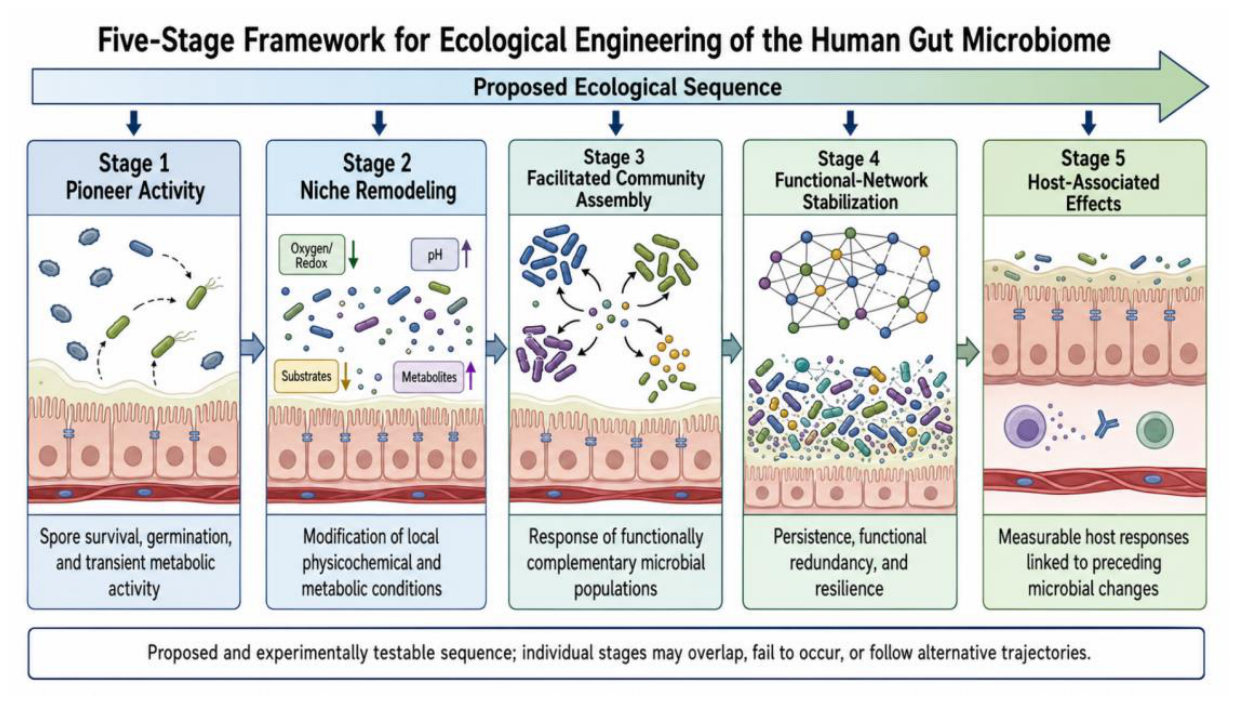

Table 1.
Comparison of current microbiome-directed strategies and the ecological considerations relevant to their design.
Table 1.
Comparison of current microbiome-directed strategies and the ecological considerations relevant to their design.
| Strategy | Primary objective | Ecological limitation |
Implication for ecological design |
| Conventional probiotics |
Delivery of one or more selected strains | Activity and persistence depend on the resident microbiome and the availability of a suitable niche [37,39,40,41,47,49] | Benefit may arise from transient activity; permanent engraftment should not be assumed or required |
| Synbiotics | Delivery of microorganisms together with substrates intended to support microbial activity | Outcomes depend on whether the substrate is used by the intended organisms and whether their functions complement those already present [76,77,78] | Organisms and substrates should be selected according to the metabolic relationships expected after administration |
| Live biotherapeutic products | Administration of defined live organisms for the prevention, treatment, or management of disease | Product characterization does not by itself predict behavior within a complex recipient community [39,40,65] | Development should include measurements of ecological interactions and community-level function |
| Fecal microbiota transplantation | Transfer of a complex donor-derived microbial community | Composition is incompletely defined, and the behavior of the transferred community depends on both donor and recipient factors [93,96,97] | Defined consortia may provide greater experimental control, although they reproduce only part of the complexity of a complete community |
Table 2.
Proposed ecological processes, biochemical mechanisms, and anticipated system-level outcomes during facilitated community assembly.
Table 2.
Proposed ecological processes, biochemical mechanisms, and anticipated system-level outcomes during facilitated community assembly.
| Ecological Process | Biochemical Mechanism | Emergent System Outcome |
| Metabolic Cross-Feeding | Pioneer amylases and glycoside hydrolases break down complex prebiotics (inulin) into short oligosaccharides [98,99]. | Secondary obligate anaerobes utilize these intermediates to fuel high-rate butyrogenesis [99] |
| Glycemic Shunting | Specific strains endogenously convert dietary glucose and fructose into D-mannitol [109]. | Reduction of luminal monosaccharide availability for pathobionts; provision of alternative fermentable substrates [110,111]. |
| Metabiotic Signaling | Enzymatic lysate of L. delbrueckii delivers non-viable microbial constituents with preserved bioactive components [75]. | Enhanced functional delivery independent of in vivo replication; increased robustness across heterogeneous baseline microbiomes [75]. |
| Niche Expansion & Exclusion | Co-localization of vegetative spore-formers and synbiotic strains within the inner mucus layer, supported by adhesin genes (spaCBA, eno) [98,99]. | Physical saturation of binding sites paired with localized bacteriocin synthesis (gdmA, nisBC), preventing pathobiont invasion. |
| Redox Stabilization | Butyrate-producing taxa fuel colonocyte β-oxidation, reinforcing mucosal hypoxia and suppressing facultative anaerobe expansion [112,113] | Establishment of a strict anaerobic filter that stabilizes the Lachnospiraceae:Enterobacteriaceae (LE) ratio [112,113]. |
Table 3.
Experimental requirements for evaluating the five-stage ecological engineering framework.
| Hypothesis / Ecological Stage | Primary Biological Level | Key Experimental Approaches |
Critical Validation Criterion |
| H1 / Stage 1 & 2: Pioneer Germination as Allogenic Ecological Filter | Microbial niche remodeling |
Humanized continuous bioreactor models (SHIME); real-time microsensor measurements of dissolved O2 and pH; metatranscriptomics (for facultative anaerobes). | Suggestion of causal temporal sequence: pioneer germination → environmental remodeling → pathobiont suppression. |
| H2 / Stage 3: Synergistic Metabolic Outputs from Cross-Feeding | Microbial metabolic cooperation |
Randomized four-arm design (placebo, spore-formers, synbiotic, combined); GC-MS metabolomics; stable isotope probing (SIP) with ¹³C-labeled substrates. | Demonstration of synergistic (non-additive) metabolic outputs (SCFAs, mannitol) in the combined arm. |
| H3 / Stage 4: Directed Succession and Functional Redundancy | Ecosystem resilience | Long-term clinical monitoring with extended washout; longitudinal shotgun metagenomics; ecological network analysis (nestedness, modularity). | Persistence of functional redundancy and network resilience after treatment cessation. |
| H4 / Stage 5: Ecological Remodeling and Host Adaptation | Host metabolic response |
Correlation analysis linking multi-omic microbiome profiles to systemic biomarkers (LPS, HOMA-IR); human intestinal organoids exposed to metabolic supernatants; TEER measurement. | Demonstration of causal chain: ecological remodeling → epithelial reinforcement → resolution of endotoxemia → improved insulin sensitivity. |
Disclaimer/Publisher’s Note: The statements, opinions and data contained in all publications are solely those of the individual author(s) and contributor(s) and not of MDPI and/or the editor(s). MDPI and/or the editor(s) disclaim responsibility for any injury to people or property resulting from any ideas, methods, instructions or products referred to in the content. |
© 2026 by the authors. Licensee MDPI, Basel, Switzerland. This article is an open access article distributed under the terms and conditions of the Creative Commons Attribution (CC BY) license (http://creativecommons.org/licenses/by/4.0/).
Copyright: This open access article is published under a Creative Commons CC BY 4.0 license, which permit the free download, distribution, and reuse, provided that the author and preprint are cited in any reuse.