

Submitted:
09 August 2026
Posted:
11 August 2026
You are already at the latest version
Abstract
Microplastics are increasingly recognized not only as persistent pollutants but also as novel microbial habitats capable of influencing ecological processes across aquatic ecosystems. Although the plastisphere has been extensively described, its broader ecological significance remains poorly integrated within ecosystem theory. Here, we propose the Ecological Infrastructure Framework (EIF), in which colonized microplastics function as persistent mobile substrates that simultaneously provide habitat, maintain biological organization, connect previously isolated ecosystems and redistribute microbial communities together with their associated ecological functions. Within this framework, eco-corona formation, microbial succession and environmental selection act as hierarchical ecological filters that shape plastisphere assembly throughout transport. We further introduce the concept of ecological filter compression, whereby persistent mobile substrates simultaneously relax geographic dispersal barriers while strengthening deterministic ecological selection, promoting the dispersal of metabolically organized biofilm communities rather than isolated microbial cells. Extending this perspective beyond community ecology, we discuss how the redistribution of microbial functional potential may influence carbon cycling and ecosystem resilience through changes in microbial connectivity. By integrating eco-corona formation, ecological filtering, microbial succession, metacommunity theory and ecosystem functioning into a unified systems perspective, this review redefines the ecological role of colonized microplastics and generates explicit, testable predictions regarding microbial connectivity, biogeochemical cycling and ecosystem resilience.
Keywords:
microplastics
; ecological infrastructure
; plastisphere
; eco-corona
; functional connectivity
; mobile ecological corridors
; community assembly
; ecological filter compression
; carbon cycling
; ecosystem resilience
1. Introduction
Plastic pollution has become one of the defining environmental challenges of the Anthropocene [1], profoundly altering ecosystem structure and function across terrestrial, freshwater and marine environments. Despite increasing awareness of its environmental impacts and growing international efforts to reduce plastic waste, global plastic production and environmental emissions continue to increase, with projections indicating that plastic inputs into natural ecosystems will outpace mitigation strategies for decades to come [2,3,4]. Owing to their exceptional durability, buoyancy and resistance to degradation, plastic materials undergo progressive weathering through ultraviolet radiation, thermo-oxidative reactions, mechanical abrasion and biological activity, generating vast quantities of microplastics that are now detected from polar ice and mountain glaciers to deep-sea sediments and the atmosphere [5,6,7,8]. These findings demonstrate that microplastics are no longer localized contaminants but globally distributed environmental components capable of interacting with virtually every ecosystem.
Initially, research on microplastics focused predominantly on their ecotoxicological impacts, including ingestion by aquatic organisms, trophic transfer, physical injury, and the release or transport of hazardous chemical additives [9,10,11]. However, this perspective has changed substantially over the past decade. Rather than behaving as chemically inert particles, microplastics rapidly acquire an eco-corona composed of natural organic matter, extracellular polymeric substances, proteins, lipids, and other biomolecules that fundamentally alters their surface properties and promotes microbial colonization [6,12,13]. Within hours to days after entering aquatic environments, polymer surfaces become colonized by bacteria, archaea, fungi, microalgae, viruses and other microorganisms that progressively develop structured biofilms through ecological succession [6,12,14]. Consequently, plastic particles become biologically active habitats whose ecological characteristics continuously evolve throughout their environmental lifetime.
This realization gave rise to the concept of the plastisphere, which describes the complex microbial communities inhabiting plastic debris and their interactions with the surrounding environment. Since its introduction, the plastisphere has become one of the fastest-growing research areas in environmental microbiology, revealing that plastic-associated microbial assemblages frequently differ from those colonizing natural particles in terms of taxonomic composition, ecological succession and metabolic potential [6,15,16]. Recent studies further demonstrate that plastisphere communities participate in nutrient cycling, organic matter transformation, sulfur metabolism, and polymer degradation while also serving as reservoirs and dissemination hubs for opportunistic pathogens, antibiotic resistance genes, and mobile genetic elements [17,18,19]. These discoveries have shifted the field from simple descriptions of microbial colonization toward a broader understanding of plastics as dynamic microbial habitats with important ecological and public health implications.
Despite these remarkable advances, current conceptual frameworks remain largely centered on the role of plastics as artificial substrates or transport vectors. Considerable attention has been devoted to microbial diversity, polymer degradation, pathogen dissemination, horizontal gene transfer and antimicrobial resistance within the plastisphere, providing valuable insights into individual ecological processes [6,19,20,21]. Nevertheless, these perspectives primarily describe what occurs on plastic surfaces rather than considering how billions of persistent, mobile and biologically active particles collectively influence ecosystem organization. As a consequence, the ecological significance of microplastics has been interpreted mainly through isolated functions instead of their cumulative contribution to ecosystem connectivity and biogeochemical functioning.
From an ecosystem perspective, however, microplastics exhibit a unique combination of characteristics rarely found in natural suspended particles. They are exceptionally persistent, continuously transported across environmental compartments, progressively modified by physical and biological weathering, and capable of sustaining metabolically active biofilms over extended periods. During their environmental lifetime, individual particles may repeatedly connect rivers, estuaries, coastal waters, the open ocean, sediments and even atmospheric pathways while simultaneously transporting microorganisms, genes and metabolic functions between previously disconnected habitats [4,6,19]. These properties suggest that the ecological importance of microplastics extends beyond providing surfaces for microbial attachment, raising the possibility that they actively reshape patterns of ecological connectivity operating across ecosystems.
Here, we propose a broader conceptual interpretation in which microplastics are viewed as ecological infrastructure. Rather than functioning solely as contaminants, artificial substrates or passive transport vectors, colonized plastic particles are considered persistent structural elements capable of connecting microbial habitats, redistributing ecological functions and influencing ecosystem processes across spatial and temporal scales. Under this systems perspective, the ecological significance of plastics emerges from the integration of their physical persistence, environmental mobility and biological colonization, creating novel pathways through which microorganisms, carbon transformations and ecosystem functions become interconnected. We argue that this framework complements the plastisphere concept by extending its implications from microbial colonization to ecosystem organization, providing a unified perspective for understanding the ecological role of microplastics in an increasingly human-modified biosphere.
2. Microplastics as Ecological Infrastructure
The concept of infrastructure has traditionally been associated with human-built systems that support societal organization, including roads, bridges, communication networks and energy distribution. In ecology, however, infrastructure encompasses a broader meaning. Rather than referring to human constructions, ecological infrastructure describes persistent physical structures that create habitat, facilitate biological interactions and sustain ecosystem functioning across spatial and temporal scales. Natural examples include coral reefs, mangrove forests, seagrass meadows, kelp forests and coarse woody debris, all of which modify environmental conditions while simultaneously providing surfaces for colonization, shelter, nutrient retention and the movement of organisms throughout ecosystems (22, 23,). Their ecological importance therefore arises not simply from their physical presence, but from their ability to organize biological interactions and regulate ecological processes.
Importantly, ecological infrastructure is defined by function rather than origin [24,25,26]. Whether natural or artificial, any persistent physical structure capable of supporting biological communities, promoting ecological connectivity and influencing ecosystem processes may function as ecological infrastructure. Artificial reefs illustrate this principle particularly well [26,27,28]. Although entirely anthropogenic in origin, they rapidly develop complex biological communities and perform ecological functions comparable to many natural benthic habitats, including habitat provision and restoration, biodiversity enhancement and trophic support [27,28,29]. Likewise, floating docks, breakwaters and offshore platforms frequently become colonized by diverse sessile organisms, creating novel habitats that modify local ecological dynamics [26,30]. These examples demonstrate that ecological infrastructure emerges from ecological functionality rather than from whether a structure is naturally formed or human-made.
We argue that this same ecological reasoning has not yet been fully applied to microplastics. Most current studies describe plastic particles either as artificial substrates available for microbial colonization or as passive vectors transporting organisms across ecosystems [6,31,32,33]. Although both perspectives are supported by substantial experimental evidence, neither adequately captures the ecological consequences arising from the global accumulation of billions of persistent, mobile and biologically active particles circulating simultaneously through interconnected environmental compartments [2,3,4]. We therefore propose that, collectively, these particles constitute far more than isolated microbial habitats; rather, they represent an expanding physical network capable of continuously supporting ecological interactions across multiple ecosystems.
Unlike transient suspended particles, microplastics combine several characteristics rarely found within a single environmental component. They are highly persistent, globally distributed, continuously transported by hydrological and atmospheric processes, progressively modified through physical and biological weathering, and rapidly colonized by metabolically active microbial communities [3,4,6,19]. Throughout their environmental lifetime, individual particles repeatedly enter and leave rivers, estuaries, coastal waters, the open ocean, sediments and even atmospheric transport pathways while carrying dynamically changing microbial assemblages [34]. Consequently, each particle functions not merely as an isolated substrate but as a mobile structural element embedded within larger ecological networks.
A fundamental distinction of our framework is that ecological infrastructure is viewed as an emergent ecological property rather than an intrinsic characteristic of plastic materials themselves [35,36]. Newly manufactured plastic particles possess none of the ecological functions described above. Only after environmental exposure, eco-corona formation, microbial attachment, biofilm development and ecological succession do plastics acquire the capacity to sustain biological communities and participate actively in ecosystem processes (6, 31,37). In this sense, ecological infrastructure is not created by the polymer itself, but emerges from the continuous interaction between the physical properties of plastics and the biological processes that transform them into living habitats.
Accordingly, we define microplastic ecological infrastructure as a network of persistent, colonized plastic particles that supports biological communities while promoting ecological connectivity, functional exchange and ecosystem processes across spatial and temporal scales [6,22,36]. This definition expands the plastisphere concept beyond microbial colonization by recognizing that the ecological significance of plastics lies not only in the organisms inhabiting their surfaces, but also in their collective ability to reorganize interactions among habitats, microorganisms and ecosystem functions [6,31]. Under this perspective, microplastics should be understood not simply as environmental pollutants, but as novel structural components of the Anthropocene biosphere.
2.1. Ecological Infrastructure: An Ecological Perspective
The concept of ecological infrastructure has gained increasing attention in ecology, conservation biology and ecosystem management as a framework for understanding how physical structures support ecological processes. Unlike conventional infrastructure, which is designed to facilitate human activities, ecological infrastructure comprises physical components that maintain ecosystem functioning by creating habitat, mediating species interactions and enabling the movement of organisms, energy and materials across landscapes and seascapes [22,23,37]. Although frequently discussed within the context of nature-based solutions and ecosystem restoration, the underlying ecological principle is considerably broader: persistent structural elements can influence ecosystem organization by shaping biological interactions rather than merely occupying physical space [38,39,40].
Natural ecosystems provide numerous examples of this principle. Coral reefs, mangrove forests, seagrass meadows, kelp forests and coarse woody debris all function as ecological infrastructure because they generate three-dimensional habitat, modify environmental conditions and promote ecological connectivity among organisms and ecological processes [26,38,39,41]. Their importance extends well beyond serving as substrates for colonization. These structures regulate nutrient retention, alter hydrodynamic regimes, provide refuges from predation, facilitate dispersal and contribute to ecosystem resilience by maintaining functional interactions across multiple spatial scales [22,23].
Importantly, the ecological role of infrastructure is determined by its function rather than its origin. Artificial reefs illustrate this principle particularly well. Although entirely anthropogenic, they rapidly become integrated into surrounding ecosystems by supporting diverse biological communities and performing ecological functions comparable to those of natural reef habitats, including habitat provision, trophic support and biodiversity enhancement [27,42,43]. Similarly, coastal engineering structures such as breakwaters, pontoons and offshore platforms frequently develop complex fouling communities that modify local ecological dynamics and create novel habitats for numerous marine species [26,30]. These examples demonstrate that anthropogenic structures may acquire ecological significance when they consistently support biological communities and ecosystem processes [44].
Collectively, these observations suggest that ecological infrastructure should not be regarded as a fixed category restricted to specific natural ecosystems, but rather as a functional ecological property emerging whenever persistent physical structures organize biological interactions and facilitate ecological processes. [39]. This functional interpretation provides a broader conceptual framework for evaluating the ecological role of novel anthropogenic materials. As human activities increasingly introduce durable artificial substrates into natural environments, the question shifts from whether these structures are natural or artificial to whether they perform ecological functions comparable to established forms of ecological infrastructure. This distinction forms the conceptual foundation for reinterpreting colonized microplastics within the broader context of ecosystem organization. Ecological infrastructure is therefore best understood not as a particular type of habitat, but as a functional property of persistent structures that organize ecological interactions across space and time.
2.2. Why Colonized Microplastics Fulfil the Definition of Ecological Infrastructure
The functional definition of ecological infrastructure proposed above provides an objective framework for evaluating whether colonized microplastics can be interpreted within this broader ecological context. Rather than asking whether plastics resemble traditional natural habitats, the relevant question is whether they exhibit the defining ecological properties of infrastructure: persistence, the capacity to sustain biological communities, the promotion of ecological connectivity and the regulation of ecosystem processes [45,46,47]. Increasing evidence indicates that colonized microplastics satisfy each of these criteria through persistent microbial succession, structured community assembly and sustained ecological functioning across environmental compartments [48,49].
Persistence represents the first fundamental requirement. Unlike most naturally occurring suspended particles, which are rapidly degraded, remineralized or incorporated into sediments, microplastics remain in the environment for years to decades while undergoing only gradual physical fragmentation and chemical weathering [50,51,52,53]. This exceptional longevity allows individual particles to participate repeatedly in ecological interactions throughout their environmental lifetime, providing stable surfaces for microbial colonization and continuous biological succession. Rather than functioning as ephemeral substrates, microplastics persist long enough to support the establishment of mature, metabolically active biofilms capable of sustained ecological activity [6,49,54].
A second defining characteristic is the ability to support biological communities. Numerous studies have demonstrated that plastic surfaces are rapidly colonized by bacteria, archaea, fungi, microalgae, protists and viruses, forming highly organized biofilms that differ from those associated with surrounding water or natural particulate matter [6,55,56]. These microbial assemblages are not static. Instead, they undergo ecological succession driven by environmental conditions, polymer characteristics and interspecific interactions, progressively developing complex metabolic networks that include primary producers, heterotrophs, decomposers and organisms involved in nutrient transformation [43,57,58]. Consequently, individual plastic particles function as living microbial habitats rather than inert synthetic materials.
The third criterion is ecological connectivity. Owing to their buoyancy, hydrodynamic transport and atmospheric dispersal, microplastics continuously move among rivers, estuaries, coastal waters, open oceans, sediments and even terrestrial environments [5,7,59,60,61]. During this movement, colonized particles transport entire microbial assemblages, functional genes and biofilm-associated metabolic capabilities across ecological boundaries that would otherwise remain weakly connected [62,63,64]. Unlike natural organic particles, whose persistence is generally limited by rapid biodegradation, microplastics maintain their structural integrity while repeatedly entering new habitats, thereby increasing opportunities for microbial dispersal, ecological succession and biological exchange over large spatial scales [58,65].
Finally, ecological infrastructure is characterized not only by supporting organisms but also by influencing ecosystem functioning. Increasing evidence suggests that plastisphere communities actively participate in biogeochemical cycling through carbon transformation, nitrogen metabolism, sulfur cycling, extracellular enzyme production and polymer degradation [6,18,66,67]. Simultaneously, these biofilms may concentrate environmental pollutants, facilitate horizontal gene transfer, harbor antibiotic resistance genes and alter microbial interaction networks, generating ecological consequences that extend well beyond the surface of individual particles [10,17,20,68]. Thus, the ecological significance of microplastics arises not simply from the organisms they host, but from the ecosystem processes that emerge from these biological communities.
Taken together, these characteristics demonstrate that colonized microplastics satisfy the principal functional attributes traditionally associated with ecological infrastructure. They are persistent physical structures, capable of sustaining diverse biological communities, facilitating ecological connectivity and influencing ecosystem processes across multiple spatial and temporal scales. Their uniqueness, however, lies in the unprecedented combination of these properties within a globally distributed, mobile and continuously expanding anthropogenic material. This combination distinguishes microplastics from previously recognized forms of ecological infrastructure and provides the conceptual basis for considering them as a novel structural component of Anthropocene ecosystems.
2.3. Ecological Infrastructure as an Emergent Property
A key distinction of the framework proposed here is that ecological infrastructure is not an intrinsic property of plastic materials but an emergent ecological property acquired through environmental colonization. Freshly manufactured plastic particles are biologically inert. Although their physicochemical characteristics—including polymer composition, surface roughness, density and hydrophobicity—influence subsequent microbial attachment [11,17], these properties alone do not confer ecological functionality. Rather, ecological infrastructure develops progressively through eco-corona formation, microbial attachment, biofilm development and ecological succession, ultimately converting synthetic particles into biologically active habitats [31,36,45].
This transformation begins immediately after environmental exposure with the formation of an eco-corona, a dynamic layer of dissolved organic matter, proteins, polysaccharides, lipids and other biomolecules adsorbed onto the plastic surface [11,37]. The eco-corona fundamentally modifies the physicochemical identity of the particle, altering its surface energy, charge, wettability and molecular recognition properties [14]. As a result, microorganisms no longer interact directly with the polymer itself but with a biologically conditioned interface that strongly influences microbial recruitment and early community assembly [69].
The establishment of the eco-corona is followed by microbial attachment, biofilm development and ecological succession (Figure 1). Pioneer colonizers modify local environmental conditions through the production of extracellular polymeric substances (EPS), creating structural complexity and generating new ecological niches for additional microorganisms [6,12]. As succession proceeds, microbial communities become increasingly diverse and metabolically integrated, incorporating primary producers, heterotrophic bacteria, fungi, protists and viruses into functionally interconnected biofilms [70]. At this stage, the particle no longer represents merely a synthetic surface but a self-organized microbial habitat whose ecological characteristics differ substantially from those of the original polymer.
Importantly, the ecological properties of colonized microplastics cannot be explained by the simple sum of their physical and biological components. Rather, they emerge from continuous interactions among polymer characteristics, environmental conditions and biological processes operating across multiple organizational levels [35]. The resulting biofilm exhibits collective properties—including metabolic complementarity, nutrient recycling, extracellular enzyme production, chemical signaling, horizontal gene transfer and adaptive succession—that are absent from sterile plastic particles and cannot be attributed to individual microorganisms alone [20,36,49,71]. These collective behaviors are characteristic of complex ecological systems, in which interactions among components generate novel ecosystem-level functions [35,36].
This emergent perspective also explains why ecological infrastructure should be understood as a dynamic rather than static property. Throughout their environmental lifetime, microplastics continuously experience weathering, fragmentation, biofilm maturation, partial detachment, recolonization and shifts in community composition driven by changing environmental conditions [52,54,57,58]. Consequently, their ecological role is not fixed but evolves as biological communities reorganize and adapt to new habitats. Individual particles therefore undergo repeated cycles of ecological transformation while maintaining their structural persistence, allowing ecological functions to be continuously renewed across space and time [51].
Recognizing ecological infrastructure as an emergent property fundamentally changes the ecological interpretation of microplastics [35,36]. Rather than functioning solely as artificial substrates available for colonization, colonized particles become self-organizing ecological units whose functional significance arises from the integration of persistent physical structure with dynamic biological processes. Under this framework, ecological infrastructure is generated through the continuous interaction between persistent abiotic structure and dynamic biological organization: the polymer provides the durable structural scaffold, whereas microbial colonization progressively transforms that scaffold into a biologically functional component capable of influencing ecosystem organization. Consequently, ecological function is not an inherent property of the plastic itself, but an emergent system-level property arising from the interactions among material persistence, microbial succession and environmental conditions. This transition—from a persistent abiotic scaffold to biologically functional ecological infrastructure—constitutes the central conceptual advance proposed in this review.
2.4. From Individual Particles to Ecosystem Networks
The ecological significance of microplastics extends beyond the biological activity occurring on individual particles. While each colonized particle functions as a discrete microbial habitat, the unprecedented abundance, persistence and mobility of microplastics allow these habitats to operate collectively as interconnected components of larger ecological networks [2,60,61]. Consequently, their ecological influence emerges not from isolated biofilms but from the cumulative organization of billions of mobile, colonized particles that continuously redistribute microbial communities, functional genes and metabolic potential across environmental compartments [49,57].
In natural ecosystems, connectivity governs the movement of organisms, energy and matter, thereby influencing community assembly, ecosystem stability and biogeochemical cycling [22,72,73]. Traditionally, ecological connectivity has been associated with relatively stable landscape corridors, river networks, ocean currents and habitat mosaics that facilitate dispersal between otherwise separated environments [74,75]. Colonized microplastics introduce an additional dimension to this framework by functioning as persistent mobile habitats that remain biologically active while moving through aquatic and terrestrial ecosystems [59,60,61]. Unlike conventional corridors, whose connectivity is constrained by fixed spatial configurations, microplastics generate dynamic and recurrent connections among ecosystems by transporting living microbial communities independently of permanent habitat continuity [57]. In doing so, they partially decouple habitat from geography, allowing ecological interactions to persist while the habitat itself is transported through the environment. Rather than simply drifting with environmental flows, colonized particles carry pre-assembled microbial communities capable of establishing ecological interactions wherever they are deposited, thereby creating transient yet repeatedly renewed pathways for biological exchange across ecosystem boundaries [48,49].
This mobility enables repeated connections among environments that differ markedly in their physical, chemical and biological characteristics. Plastic particles may originate in terrestrial systems, enter rivers, transit through estuaries, disperse across coastal and open-ocean waters, settle temporarily within sediments and later become resuspended by hydrodynamic processes. Atmospheric transport further extends these pathways by redistributing microplastics across continental and marine environments [5,7,76]. Throughout these transitions, microbial communities remain associated with particle surfaces, continuously experiencing environmental selection while retaining the capacity to transport microorganisms, genes and metabolic functions between ecosystems.
Importantly, the connectivity mediated by colonized microplastics is not limited to organism dispersal. Mature plastisphere communities exchange metabolites, extracellular enzymes, signaling molecules and genetic material through tightly integrated microbial interactions, including quorum sensing, horizontal gene transfer and syntrophic metabolism [12,13,18,20]. As particles move among habitats, these functional attributes may also be redistributed, creating opportunities for the transfer of ecological capabilities rather than simply taxonomic diversity. Consequently, colonized microplastics may facilitate the redistribution of functional traits—including pollutant degradation, nutrient transformation and stress tolerance—across ecosystems that would otherwise remain only weakly connected, thereby extending ecological connectivity from the movement of organisms to the movement of ecosystem functions [77,78].
From this perspective, microplastics should not be regarded as isolated ecological units but as components of a self-organizing ecological network. Each colonized particle represents a localized ecological node, whereas hydrological, atmospheric and biological transport processes continuously generate dynamic connections among nodes operating across multiple spatial scales [61,73,74]. The resulting network is continuously reorganized through particle fragmentation, environmental transport, biofilm succession, dispersal and recolonization [45,48,52], producing an adaptive ecological system in which interactions emerge simultaneously at particle, community and ecosystem levels. Such hierarchical organization is consistent with complex adaptive systems, where ecosystem-level properties emerge from numerous decentralized local interactions rather than centralized control [35]. Within this framework, ecological connectivity becomes an emergent property of the network itself, arising from the continuous reorganization of billions of colonized particles that collectively redistribute microorganisms, genetic information and ecological functions across environmental boundaries.
Viewing microplastics as components of ecological networks also helps explain why their environmental influence may exceed predictions based solely on particle abundance or polymer concentration [79,80]. Conventional assessments typically quantify the number, size or mass of plastic particles, assuming that ecological impacts scale proportionally with these metrics. However, if colonized microplastics function as interconnected ecological infrastructure, their influence will depend equally on the architecture of the network they create, including connectivity, residence time, transport pathways and the diversity of associated microbial communities. In this framework, ecological function becomes an emergent property of network organization rather than merely a consequence of particle density.
This network-based interpretation therefore expands the plastisphere concept from the scale of individual particles to that of ecosystem organization. Colonized microplastics become mobile ecological nodes that connect habitats, redistribute biological functions and integrate microbial processes across environmental boundaries. Such a perspective provides a mechanistic foundation for understanding how persistent anthropogenic materials contribute not only to microbial dispersal but also to the reorganization of ecosystem connectivity throughout the Anthropocene.
2.5. Mobile Ecological Corridors: Expanding Ecological Connectivity Across Environmental Boundaries
Ecological corridors are traditionally defined as landscape elements that facilitate the movement of organisms, propagules and ecological processes between otherwise disconnected habitats, thereby reducing habitat isolation and enhancing both structural and functional connectivity [72,75,81]. By promoting dispersal, resource exchange and biological interactions across heterogeneous landscapes and seascapes, ecological corridors influence community assembly, gene flow, ecosystem resilience and biogeochemical functioning [73,82]. Rivers, riparian vegetation, ocean currents and habitat mosaics represent classical examples of natural ecological corridors because they facilitate biological exchange while maintaining ecological interactions across spatially separated environments. Despite differences in scale, permanence and physical structure, these corridors share a common ecological property: they provide pathways through which organisms, biological information and ecosystem processes can be redistributed, thereby maintaining ecological connectivity across landscapes. Importantly, ecological corridors have traditionally been interpreted as fixed spatial structures embedded within landscapes or seascapes. Colonized microplastics challenge this paradigm by introducing mobile corridors that transport not only organisms but also biologically active habitats and ecosystem functions.
Colonized microplastics introduce a fundamentally different form of ecological corridor. Unlike conventional corridors, which remain spatially fixed while organisms move through them, colonized microplastics function as persistent mobile habitats that transport entire biological communities while maintaining their ecological organization [83,84]. Each particle simultaneously serves as habitat, transport vector and dispersal platform, allowing microorganisms to remain associated with a persistent substrate while moving through multiple environmental compartments [59,61]. Consequently, biological connectivity is no longer restricted to the movement of organisms between habitats; instead, the habitat itself becomes the moving corridor, carrying pre-assembled microbial communities together with their associated functional potential across ecosystem boundaries [48,49]. This distinction fundamentally expands the classical concept of ecological corridors by demonstrating that connectivity may arise not only through organism movement within fixed habitats, but also through the movement of biologically functional habitats themselves.
The ecological effectiveness of these mobile corridors derives from the interaction between the physicochemical properties of plastic polymers and the environmental processes governing particle transport. Polymer density, hydrophobicity, shape, size, mechanical resistance and exceptional environmental persistence determine the transport behavior of microplastics, enabling many particles to remain suspended within the water column, float at the air–water interface or become repeatedly resuspended following temporary sediment deposition [3,4,85]. Polyethylene and polypropylene, for example, possess densities lower than seawater and may remain buoyant for prolonged periods, whereas denser polymers may undergo repeated vertical transport as biofilm development, biofouling, defouling and hydrodynamic forcing continuously modify their effective density and settling velocity (86, 87, 88.). Consequently, microplastics experience transport dynamics that differ fundamentally from those of most natural particulate matter, allowing individual particles to repeatedly traverse ecological boundaries and connect habitats over extended spatial and temporal scales [59,89].
Most naturally occurring suspended particles represent transient ecological substrates. Organic aggregates, marine snow and plant debris undergo rapid decomposition, microbial remineralization or sedimentation, resulting in relatively short ecological lifespans (Simon et al., 2002; Azam & Malfatti, 2007). Mineral particles, although physically persistent, generally exhibit limited mobility because of their higher densities and rapid settling velocities [90,91]. Colonized microplastics combine characteristics that rarely coexist within natural particles: long-term persistence, mechanical durability, repeated transport, continuous recolonization and sustained biological activity. This combination dramatically extends both the spatial and temporal dimensions of microbial dispersal.
Importantly, these corridors are not restricted to aquatic systems. Atmospheric transport has emerged as an important pathway for the global redistribution of microplastics, allowing particles to move between terrestrial ecosystems, freshwater environments, coastal zones and remote marine regions [5,7]. The capacity to alternate between aquatic and atmospheric transport pathways greatly expands ecological connectivity by linking environmental compartments that have historically been considered largely independent with respect to microbial dispersal. Consequently, colonized microplastics may facilitate biological exchange across environmental boundaries operating at continental and even global scales.
The ecological significance of these mobile corridors extends far beyond species dispersal. Mature plastisphere communities transport not only microorganisms but also functional traits, metabolic pathways, extracellular enzymes, signaling molecules and mobile genetic elements that collectively determine ecosystem functioning [12,18,36,92]. As colonized particles migrate among ecosystems, they may redistribute ecological capabilities—including nutrient transformation, pollutant degradation, stress tolerance and horizontal gene transfer—thereby enhancing functional connectivity in addition to taxonomic connectivity [77,78,93]. Under this perspective, ecological corridors are defined not only by the movement of organisms but also by the redistribution of ecological functions that influence ecosystem processes across environmental boundaries.
Within the conceptual framework proposed here, mobile ecological corridors emerge as a functional consequence of ecological infrastructure. Persistent colonized particles provide the structural foundation, whereas their prolonged environmental mobility generates dynamic pathways through which biological communities, functional traits and ecosystem processes are continuously redistributed across space and time [35,73]. Collectively, billions of mobile particles form a self-organizing ecological network in which large-scale ecosystem properties emerge from decentralized local interactions [94,95]. This interpretation extends classical corridor theory by introducing a novel category of self-contained mobile ecological corridors, in which habitat, biological community and ecological functions are transported together as an integrated ecological unit. By coupling persistent abiotic structures with dynamic biological organization, colonized microplastics function as mobile ecological infrastructure capable of reshaping ecological connectivity and ecosystem organization throughout the Anthropocene.
3. Functional Connectivity: When Ecological Functions Become Mobile
Metacommunity theory provides a useful conceptual framework for interpreting the ecological consequences of mobile plastisphere communities. By recognizing that local communities are interconnected through the dispersal of organisms and their interactions across multiple spatial scales, metacommunity ecology emphasizes that ecosystem functioning depends not only on local environmental conditions but also on exchanges among communities [73,96]. Colonized microplastics extend this perspective by introducing persistent mobile habitats that transport biologically organized microbial communities together with their associated functional capacities across ecosystem boundaries.
Functional connectivity describes the extent to which ecological processes can be maintained across landscapes through the movement of organisms, resources and biological interactions [97,98]. Unlike structural connectivity, which depends primarily on the physical arrangement of habitats, functional connectivity reflects the effective transfer of ecological functions between ecosystems [22,75]. Colonized microplastics introduce an additional dimension to this concept because they transport intact microbial assemblages together with their associated metabolic capabilities, ecological interactions and functional traits [12,18,36]. Consequently, the dispersal of microorganisms becomes inseparable from the dispersal of ecosystem functions, extending ecological connectivity from the movement of species to the redistribution of ecosystem processes across environmental boundaries [74,77]. Accordingly, connectivity should be interpreted not only as a property of landscapes, but also as an emergent property of interacting biological systems, arising from the continuous redistribution of metabolically active communities and their associated ecological functions.
Mature plastisphere communities comprise metabolically diverse microorganisms capable of performing a wide range of ecological processes, including primary production, organic matter degradation, nitrogen transformations, sulfur metabolism, extracellular enzyme production and polymer degradation [12,18]. These ecological functions emerge from cooperative interactions among community members, including metabolic complementarity, syntrophic metabolism and biochemical signaling, and are maintained by the spatial organization and functional integration of mature biofilms rather than by isolated microbial taxa [36,92,99]. As colonized particles move through different environments, they therefore transport integrated functional systems rather than independent species, redistributing ecological capabilities that may influence ecosystem functioning beyond local community composition [77,96].
Figure 2.
Conceptual representation of how colonized microplastics enhance functional connectivity among ecosystems.
Figure 2.
Conceptual representation of how colonized microplastics enhance functional connectivity among ecosystems.
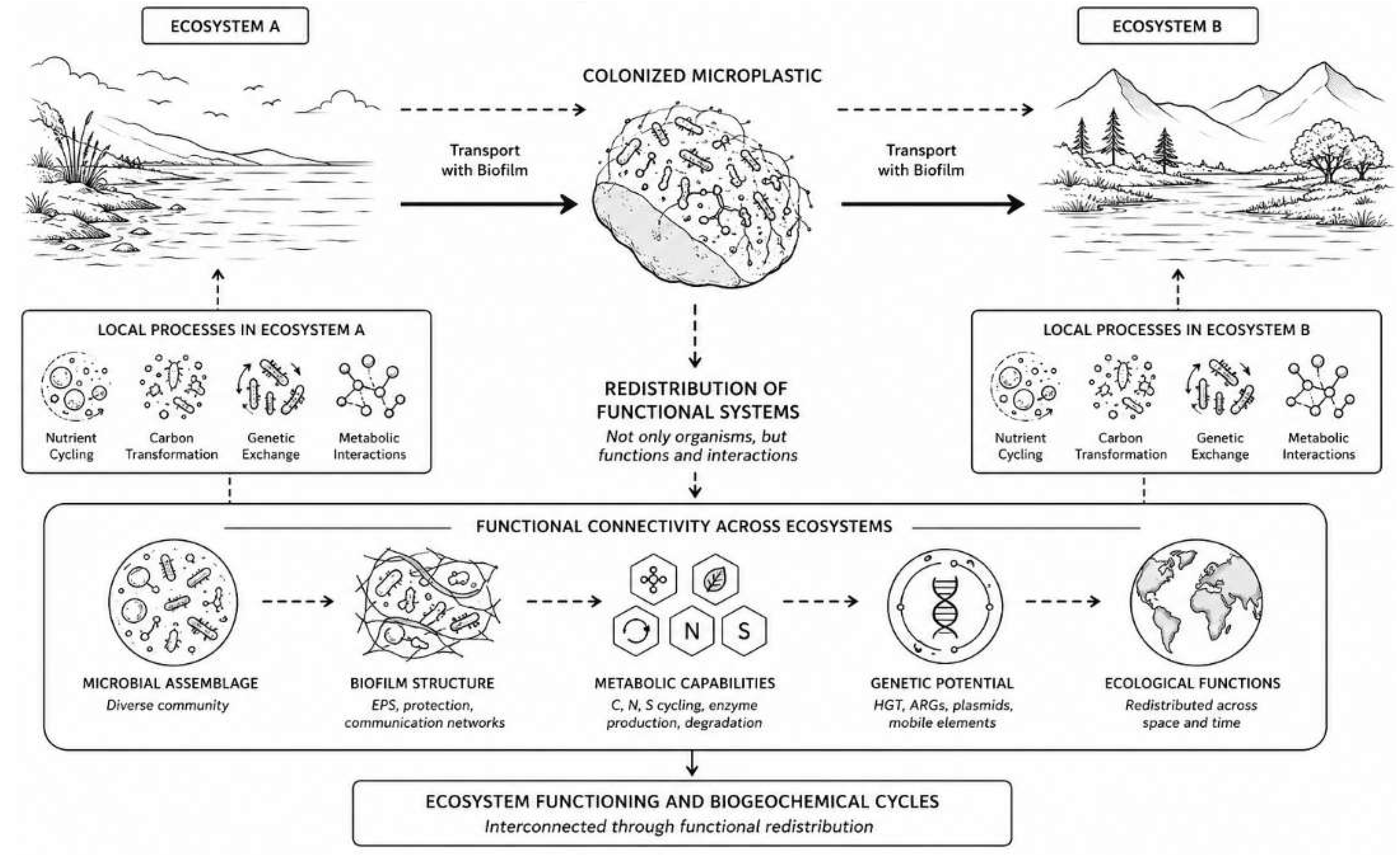
This distinction has important ecological implications. Classical models of microbial dispersal generally assume that organisms arriving in a new habitat establish ecological interactions only after local recruitment, competition and community assembly have occurred [92,100]. Colonized microplastics challenge this paradigm by transporting pre-assembled microbial consortia that already possess established metabolic cooperation, extracellular polymeric matrices, quorum sensing networks and functional complementarity [12,36,99]. Consequently, ecological integration may begin with an already organized biological system rather than with independent colonization by free-living microorganisms, potentially accelerating ecosystem functioning following dispersal.
Functional connectivity also extends to the redistribution of adaptive capacity. Plastisphere biofilms have been recognized as hotspots for horizontal gene transfer, antibiotic resistance genes, plasmids and other mobile genetic elements, thereby facilitating the exchange of genetic information among taxonomically distinct microorganisms [17,18,20,101]. As mature biofilms disperse across ecosystems, they transport not only microorganisms but also adaptive genetic repertoires that may enhance microbial innovation, metabolic flexibility and ecological resilience under changing environmental conditions [35,92]. Accordingly, functional connectivity encompasses not only the redistribution of organisms and ecological functions but also the movement of evolutionary potential among ecosystems.
The implications become particularly relevant for global biogeochemical cycles. Because plastisphere communities actively participate in carbon processing, nutrient regeneration, organic matter decomposition, nitrogen transformations, sulfur cycling and other microbial processes that regulate ecosystem metabolism [12,18,102], their redistribution may modify not only the spatial distribution of microorganisms but also the spatial organization of ecosystem functions. As metabolically integrated microbial communities are transported among ecosystems, they carry functional capacities that may influence local biogeochemical processes following colonization [77,92,103]. Consequently, ecosystem metabolism should not be viewed exclusively as a product of local environmental conditions and community assembly, but also as being influenced by the continual redistribution of metabolically active microbial systems across ecological boundaries.
From this perspective, colonized microplastics should be understood not merely as vectors of microorganisms, but as vectors of ecosystem functionality. Their ecological importance resides not only in transporting living organisms but in redistributing the biological organization required to perform ecological work. Rather than dispersing isolated taxa, colonized particles disperse self-organized microbial systems that integrate community structure, metabolic interactions and functional capabilities. This transition—from the dispersal of biodiversity to the dispersal of ecosystem functionality—represents one of the central conceptual advances of the ecological infrastructure framework proposed in this review [35,73].
4. Functional Connectivity: When Ecological Functions Become Mobile
Functional connectivity describes the extent to which ecological processes can be maintained across landscapes through the movement of organisms, resources and biological interactions [97,98]. Unlike structural connectivity, which depends primarily on the physical arrangement of habitats, functional connectivity reflects the effective transfer of ecological functions between ecosystems [75,82]. Colonized microplastics introduce an additional dimension to this concept because they transport intact microbial assemblages together with their associated ecological interactions, metabolic capabilities and functional traits [12,18,36]. Consequently, the dispersal of microorganisms becomes inseparable from the redistribution of ecosystem functions, extending ecological connectivity from the movement of species to the movement of ecological processes across environmental boundaries [73,77].
Mature plastisphere communities comprise metabolically diverse microorganisms capable of performing a wide range of ecological processes, including primary production, organic matter degradation, nitrogen transformations, sulfur metabolism, extracellular enzyme production and polymer degradation [12,18]. These ecological functions emerge through metabolic complementarity, syntrophic interactions, division of labour and biochemical communication among community members and are maintained by the structural organization of mature biofilms rather than by isolated microbial taxa [36,92,99]. As colonized particles move through different environments, they therefore transport self-organized functional systems rather than independent microbial species, redistributing ecological capabilities that may influence ecosystem functioning beyond local community composition [77,78].
This distinction has important ecological implications. Classical models of microbial dispersal generally assume that organisms arriving in a new habitat establish ecological interactions only after local recruitment, competition and community assembly have occurred [73,92,100]. Colonized microplastics challenge this paradigm by transporting pre-assembled microbial consortia that already possess established metabolic cooperation, extracellular polymeric matrices, quorum sensing networks and functional complementarity [12,36,99]. Consequently, ecological integration may begin with an already organized biological system rather than through the independent colonization of free-living microorganisms, potentially accelerating ecosystem functioning following dispersal.
Functional connectivity also extends to the redistribution of adaptive capacity. Plastisphere biofilms have been recognized as hotspots for horizontal gene transfer, antibiotic resistance genes, plasmids and other mobile genetic elements, thereby facilitating the exchange of genetic information among taxonomically distinct microorganisms [17,20,49,101]. As mature biofilms disperse across ecosystems, they transport not only microorganisms but also adaptive genetic repertoires that may enhance microbial innovation, metabolic flexibility and ecological resilience under changing environmental conditions [35,92]. Accordingly, functional connectivity encompasses not only the redistribution of organisms and ecological functions but also the movement of evolutionary potential among ecosystems.
The implications of mobile functional connectivity become particularly significant for ecosystem functioning and global biogeochemical cycles. Plastisphere communities actively participate in carbon processing, nutrient regeneration, organic matter decomposition, nitrogen transformations and other microbial processes that regulate ecosystem metabolism [12,49,102]. As these metabolically integrated communities are redistributed among ecosystems, they transport not only microorganisms but also functional capacities that may influence local biogeochemical processes following colonization [77,92,103]. Consequently, ecosystem metabolism should not be viewed exclusively as a product of local environmental conditions and community assembly, but also as being influenced by the continual redistribution of metabolically active microbial systems across ecological boundaries.
From this perspective, colonized microplastics should be understood not merely as vectors of microorganisms, but as vectors of ecosystem functionality. Their ecological importance resides not only in transporting living organisms but in redistributing the biological organization required to perform ecological work. Rather than dispersing isolated taxa, colonized particles disperse self-organized microbial systems that integrate community structure, metabolic interactions and functional capabilities. This transition—from the dispersal of biodiversity to the dispersal of ecosystem functionality—represents one of the central conceptual advances of the ecological infrastructure framework proposed in this review [35,73].
5. Functional Connectivity as a Driver of Carbon Cycling and Ecosystem Resilience
Ecological connectivity has traditionally been interpreted as a mechanism facilitating the movement of organisms among habitats. However, within complex ecosystems, connectivity also governs the redistribution of ecological functions, influencing how energy, nutrients and carbon are processed across environmental gradients [77,78,102,104]. If colonized microplastics function as mobile ecological corridors, their influence extends beyond microbial dispersal to the redistribution of metabolic processes that collectively regulate ecosystem functioning [105,106].
Microbial communities associated with the plastisphere actively participate in multiple stages of biogeochemical cycling. Numerous studies have demonstrated that plastisphere biofilms harbor microorganisms involved in carbon fixation, heterotrophic respiration, organic matter decomposition, nitrogen transformations, sulfur metabolism and extracellular enzyme production [6,12,18]. These processes are not performed independently but emerge through metabolic cooperation among taxonomically diverse microorganisms embedded within highly structured biofilms. Consequently, each colonized particle represents a localized biogeochemical microreactor whose metabolic activity reflects the collective functioning of its associated microbial consortium [86,87].
The ecological importance of these microreactors increases dramatically when considered collectively. Because billions of colonized particles are simultaneously transported through rivers, estuaries, coastal waters, open oceans, sediments and the atmosphere, they create a distributed network of mobile biogeochemical hotspots. Unlike fixed benthic habitats or transient organic aggregates, these hotspots continuously relocate while maintaining metabolically active microbial communities. As a result, carbon transformation is no longer restricted to static environmental compartments but becomes increasingly associated with mobile ecological structures capable of redistributing metabolic activity across ecosystems.
This perspective has important implications for the biological carbon pump. Traditionally, carbon export has been viewed as the result of primary production, particle aggregation, sinking dynamics and microbial remineralization occurring within relatively well-defined oceanographic compartments [107,108]. Colonized microplastics introduce an additional level of complexity because they modify both the physical behavior of suspended particles and the biological communities responsible for carbon processing. Biofilm development alters particle density, buoyancy and aggregation potential, while microbial succession influences rates of organic matter degradation, extracellular enzyme production and carbon remineralization. Consequently, microplastics may indirectly reshape the spatial organization and efficiency of carbon processing throughout the water column.
Beyond carbon cycling, functional connectivity may also enhance ecosystem resilience. Ecological resilience depends on the capacity of ecosystems to maintain essential functions despite environmental disturbance, a property strongly influenced by biodiversity, functional redundancy and dispersal among habitats [109,110,111]. Mobile ecological corridors created by colonized microplastics may increase opportunities for microbial recolonization following disturbance by transporting entire functional communities into newly available habitats. Unlike dispersal by individual planktonic cells, these particles deliver pre-assembled microbial consortia that retain established metabolic interactions, extracellular matrices and communication networks, potentially accelerating ecological recovery after environmental perturbation.
At the same time, this increased connectivity may also facilitate undesirable ecological outcomes. Enhanced dispersal of opportunistic pathogens, antibiotic resistance genes, invasive microorganisms and harmful metabolic traits may reduce ecological stability while increasing functional homogenization across ecosystems [17,20]. Consequently, ecological infrastructure should not be interpreted as inherently beneficial or detrimental. Rather, it represents a novel mechanism through which anthropogenic materials amplify ecological connectivity, generating both positive and negative consequences depending on environmental context, community composition and ecosystem resilience.
The framework proposed here therefore shifts the ecological interpretation of microplastics from localized contaminants to components of an emerging planetary connectivity network. Their significance lies not only in their abundance or persistence but in their capacity to redistribute microbial metabolism across environmental boundaries, integrating previously disconnected habitats into increasingly interconnected ecological systems. In this sense, colonized microplastics may influence ecosystem functioning through mechanisms analogous to those by which transportation networks reshape human societies: not by creating new biological functions, but by dramatically increasing the efficiency with which existing functions are exchanged, redistributed and integrated across space.
6. Polymer-Driven Selection: From Eco-Corona Assembly to a Pre-Adapted Plastisphere
The capacity of colonized microplastics to operate as mobile ecological corridors depends not only on their persistence and transport potential, but also on the ecological identity they acquire before and during dispersal. Rather than representing random subsets of surrounding microbial communities, plastisphere assemblages emerge through a hierarchical sequence of physicochemical and biological selection processes [12,112]. Polymer-specific surface properties—including chemical composition, hydrophobicity, crystallinity and surface roughness—initially regulate eco-corona formation, which subsequently mediates pioneer microbial recruitment, biofilm development and ecological succession [36,112,113]. Consequently, community assembly is not stochastic but progressively filtered through multiple levels of environmental and biological selection operating at the polymer–environment interface [17,73,114]. This framework suggests that microplastics do not merely transport microorganisms; they actively influence which microorganisms become incorporated into mobile ecological communities and, ultimately, which ecological functions are redistributed across ecosystems [6,18].
Immediately after entering the environment, plastic surfaces adsorb dissolved organic matter, proteins, lipids, polysaccharides and other biomolecules, forming an eco-corona that rapidly replaces the virgin polymer as the effective interface between the particle and its surrounding environment [112,113]. The composition of this eco-corona is governed by the physicochemical properties of the polymer—including hydrophobicity, surface charge, surface roughness and chemical functionality—as well as by environmental weathering and the composition of the surrounding dissolved organic matter [3,112,115]. Photochemical oxidation, mechanical abrasion and additive leaching further modify surface reactivity by generating new functional groups and heterogeneous binding sites, thereby altering the affinity of plastic surfaces for specific classes of biomolecules and microorganisms [3,36]. Consequently, different polymer types and weathering states may develop chemically distinct eco-coronas even when exposed to the same environment, creating the initial physicochemical filter that drives subsequent microbial recruitment and plastisphere assembly [114,116].
This molecular conditioning constitutes a first selective step. Adsorption onto plastic surfaces is not chemically neutral, because biomolecules differ in their affinity, concentration and residence time at the polymer–water interface [112,115]. Eco-coronas comprise both weakly associated molecules that exchange rapidly with the surrounding environment and more persistent fractions that remain tightly bound to the surface, generating a dynamic yet structured biomolecular interface [112]. These relatively stable components modify particle charge, wettability, surface energy and molecular recognition, thereby creating a secondary surface whose biological characteristics differ substantially from those of both virgin plastic and the surrounding medium [3,115]. Consequently, the ecological identity of the particle begins to emerge before stable microbial colonization has occurred, establishing the initial physicochemical filter that shapes subsequent microbial recruitment and community assembly [114,116].
The eco-corona subsequently imposes a second selective step by influencing the recruitment of pioneer microorganisms. Biomolecules retained at the particle–water interface may act as nutrient sources, adhesion mediators and molecular recognition cues, favoring microorganisms capable of recognizing and exploiting the conditioned surface [112,115]. Experimental studies have demonstrated that eco-corona formation can accelerate initial microbial attachment, stimulate biofilm formation and extracellular polymeric substance production, and promote the establishment of distinct pioneer communities on plastic surfaces [12,113]. Because early colonizers strongly influence subsequent biofilm succession and community development, eco-corona-mediated recruitment represents an important deterministic process in microbial community assembly (114, 116,). In this sense, the eco-corona functions not merely as a passive molecular coating but as an ecological filter that shapes the identity of pioneer colonizers and, consequently, the ecological trajectories available for subsequent plastisphere succession.
Because early colonizers modify the surface through extracellular polymeric substance production, resource transformation and chemical signaling, initial selection may generate lasting priority effects that influence subsequent community assembly [116,117]. Pioneer taxa shape the recruitment and exclusion of later colonizers, modify local redox conditions and nutrient availability, and contribute to the construction of microscale ecological niches within the developing biofilm [12,36]. Differences among polymer types have been associated with distinct plastisphere communities, although environmental drivers such as salinity, nutrient availability and hydrodynamic conditions may exert equally strong or even stronger selective pressures in some environments [6,118]. Polymer-driven selection should therefore not be interpreted as complete material control over community composition, but rather as the first stage of a hierarchical filtering process in which polymer properties interact with environmental selection, species interactions and ecological succession to determine the assembly of mature plastisphere communities [114,116].
This hierarchical process may be conceptualized as a sequence of nested ecological filters. First, polymer physicochemical properties and environmental weathering determine which biomolecules are preferentially adsorbed onto the particle surface, thereby governing eco-corona formation (3, 112, 115. Second, the resulting eco-corona selectively influences the adhesion, recruitment and establishment of pioneer microorganisms through molecular recognition, nutrient availability and surface conditioning [112,113]. Third, pioneer colonizers modify the interface through extracellular polymeric substance production, metabolic activity and biological interactions, generating priority effects that influence subsequent biofilm succession and community assembly (Flemming et al., 2016; Fukami, 2015; Nemergut et al., 2013). Finally, the developing plastisphere remains continuously filtered by the environmental conditions encountered during transport, including salinity, nutrient availability, hydrodynamics and other local selective pressures [6,118]. The resulting plastisphere should therefore be interpreted not as a random microbial assemblage but as the outcome of successive physicochemical, ecological and environmental filtering processes operating across multiple organizational levels [114,116].
We propose that this process may generate a pre-adapted plastisphere, defined here not as a community universally adapted to any destination, but as a microbial consortium preselected for persistence on a durable, chemically heterogeneous and frequently stressful mobile substrate [114,116]. Traits favored during plastisphere development—including surface adhesion, extracellular polymeric substance production, metabolic flexibility, contaminant tolerance, cooperative metabolism and resistance to environmental stress—represent functional characteristics that increase persistence under environmental filtering [36,119]. These same traits may also enhance survival during transport and establishment following arrival in new habitats. The processes that promote persistence on plastic surfaces may therefore simultaneously enrich microorganisms possessing characteristics associated with dispersal success.
The protective organization of mature biofilms may further strengthen this effect. Microorganisms embedded within extracellular polymeric matrices experience buffered microscale conditions and are frequently less exposed to ultraviolet radiation, osmotic fluctuations, desiccation, oxidative stress, hydrodynamic shear and toxic compounds than freely suspended cells [36,120]. Although direct evidence demonstrating that plastisphere biofilms universally enhance long-distance survival remains limited, well-established biofilm mechanisms support the hypothesis that colonized particles may function as protective dispersal units [12,36]. Under this interpretation, polymer durability provides the physical substrate for transport, whereas the plastisphere maintains biological continuity by protecting organized microbial communities throughout dispersal.
This distinction is important because successful dispersal requires more than movement. Organisms must remain viable during transport, retain sufficient functional capacity and successfully establish ecological interactions after reaching a new environment [73,114]. Colonized microplastics may influence each of these stages. Their durability, buoyancy and resistance to degradation increase the spatial and temporal scale of transport [3,87]; eco-corona formation influences the selective recruitment of pioneer microorganisms [112,115]; and mature biofilms provide structural organization and physiological protection that may enhance the persistence of microbial consortia during environmental transitions [36,120]. Consequently, microplastic-mediated dispersal should not be viewed simply as the passive redistribution of free-living microorganisms or those associated with short-lived natural particles, but as the transport of pre-organized microbial communities with an enhanced capacity to maintain ecological functions during dispersal.
Natural particles also acquire conditioning films and support diverse microbial communities [12], and many organic aggregates provide considerably richer nutritional environments than plastic surfaces. The distinctive feature of microplastics is therefore not their exclusive ability to develop an eco-corona or biofilm, but the unique conjunction of selective surface chemistry, exceptional environmental persistence, repeated weathering, sustained mobility and continuous biological succession [3,36]. Together, these characteristics allow the molecular and biological interface of individual particles to be repeatedly reconstructed while the underlying structural scaffold remains intact, creating a persistent substrate for successive cycles of ecological selection.
Polymer-driven selection therefore adds a new mechanistic dimension to the ecological infrastructure framework. Microplastics do not simply increase the frequency or spatial extent of dispersal events; they may also modify the composition, physiological state and functional potential of the communities being dispersed [114,116]. Polymer properties shape eco-corona formation, the eco-corona influences pioneer recruitment, and successive stages of biofilm development progressively filter organisms capable of persisting within a mobile ecological structure. This hierarchical sequence of ecological filters provides the conceptual link between eco-corona formation and ecological filter compression, suggesting that microplastics may simultaneously weaken geographical barriers to dispersal while strengthening ecological selection acting upon the organisms they transport.
Accordingly, we propose the following central hypothesis:
“Polymer chemistry selects the eco-corona, the eco-corona selects the early plastisphere, and plastisphere development produces a functionally non-random community with an enhanced probability of surviving transport and establishing in new environments.”
This hypothesis predicts that differences in polymer composition, weathering and additive profiles should generate reproducible differences in eco-corona chemistry, pioneer colonization, biofilm function and dispersal success. It also predicts that microplastic-associated communities reaching distant environments should display stronger enrichment of adhesion, stress-response, biofilm-formation and metabolic-flexibility traits than simultaneously transported free-living microbial assemblages. Testing these predictions will be essential for determining whether microplastics function merely as additional dispersal surfaces or as selective ecological systems capable of changing which microorganisms, genes and functions successfully cross ecosystem boundaries.
7. Carbon Cycling and Ecosystem Resilience
The ecological consequences of microplastic-mediated connectivity extend beyond microbial dispersal and community assembly. Microorganisms regulate major transformations of carbon and nutrients in aquatic ecosystems, including primary production, organic-matter degradation, respiration, nutrient regeneration, dissolved organic matter processing, and the formation and remineralization of sinking particles [107,108,121,122]. Because these processes depend on the composition, metabolic potential, interactions, and spatial organization of microbial communities, changes in microbial connectivity have the potential to propagate from community-level processes to biogeochemical functioning [78,122].
The plastisphere provides a particularly relevant interface through which such effects may occur. Plastic-associated communities frequently differ from surrounding planktonic assemblages in taxonomic composition, community assembly, and functional potential, and plastisphere communities include microorganisms involved in organic-compound metabolism, carbon transformation, nitrogen transformations, sulfur cycling, and polymer degradation [123,124]. Global analyses further indicate that plastisphere communities may exhibit distinct coexistence patterns and substantial potential for organic-compound metabolism, while freshwater studies have reported altered representation of genes associated with nitrification, denitrification, nitrate reduction, sulfur oxidation, and sulfate reduction [123,124]. Thus, colonized microplastics represent biologically active interfaces capable of participating in biogeochemical transformations rather than inert surfaces carrying microbial cells.
Importantly, the carbon associated with these interfaces can originate from multiple sources. Plastisphere microorganisms may assimilate recently fixed organic matter, dissolved and particulate organic carbon from surrounding waters, and, under some circumstances, compounds released through polymer weathering and degradation. Photochemical alteration of plastics can release plastic-derived dissolved organic carbon, part of which is biologically available to marine microorganisms and can subsequently enter microbial biomass, respiration pathways, and extracellular polymeric substances [125,126,127]. Consequently, plastisphere-associated carbon processing should not automatically be interpreted as additional atmospheric carbon fixation; rather, it represents the transformation and redistribution of carbon derived from different pools with distinct biogeochemical origins.
This distinction becomes particularly important when microplastic-associated microbial activity is considered in relation to the biological carbon pump. Carbon export from surface waters depends on particle formation, aggregation, sinking velocity, trophic processing, microbial degradation and remineralization depth rather than on primary production alone [107,108,128,129]. Microplastics can become incorporated into marine snow and other organic aggregates, while biofilm development and extracellular polymeric substances modify aggregation dynamics, particle density and sinking behavior [87,130,131]. These interactions provide a direct mechanistic pathway through which plastics may influence particle-mediated carbon transport and the efficiency of the biological carbon pump.
Recent experimental evidence supports this possibility. Ziervogel et al. (2024) [132] showed that plastic-derived dissolved organic carbon was rapidly utilized by natural marine microbial assemblages and that microbial processing promoted extracellular polymeric substance production and marine plastic snow formation. Marine plastic snow exhibited lower sinking velocities than comparable aggregates without plastics [132]. Similarly, Roberts et al. (2024) [133] demonstrated experimentally that the incorporation of positively buoyant microfibers into diatom aggregates decreased aggregate cohesion, settling velocity, and carbon content, potentially increasing residence time in the upper water column and therefore the opportunity for microbial remineralization before carbon reaches deeper waters.
By extending the residence time of particulate organic matter within oxygenated waters, slower-sinking microplastic-associated aggregates may increase the temporal window during which microbial respiration, trophic processing and organic matter remineralization can occur before particles reach long-term deep-ocean reservoirs. Consequently, the ecological influence of microplastics on the biological carbon pump may arise not only from modifications in particle transport but also from prolonging the period during which biologically available carbon remains exposed to microbial processing. This mechanism provides a plausible explanation for how persistent microplastics could alter carbon sequestration efficiency without necessarily changing primary production (Figure 3).
These findings indicate that the relationship between microplastics and carbon cycling cannot be reduced to sinking or floating properties of plastic particles. Increased vertical transport of colonized plastics does not necessarily imply increased carbon sequestration, just as increased biofilm biomass does not necessarily represent additional carbon fixation. Carbon associated with plastisphere communities may be respired, recycled, grazed, detached, dissolved, transferred trophically, or remineralized during transport. Long-term sequestration ultimately depends on the fraction of carbon escaping upper-ocean remineralization, the depth at which remineralization occurs, and the residence and ventilation times of receiving water masses [108,128,129]. The effect of microplastics on the carbon cycle should therefore be interpreted as a modification of carbon-processing pathways rather than as either enhancement or suppression of carbon sequestration.
The ecological infrastructure framework developed here introduces an additional dimension to this problem: mobility of microbial function. If colonized microplastics operate as mobile ecological corridors, microorganisms associated with carbon and nutrient transformations may be redistributed together with established biofilm structures, metabolic interactions, and functional traits. In this scenario, the potential biogeochemical influence of microplastics does not arise exclusively from reactions occurring on individual particles. It also emerges from their capacity to redistribute microbial functional potential among environmental compartments. Evidence that plastisphere communities contain distinct metabolic profiles and that dispersal itself can modify both compositional and functional diversity in aquatic microbial communities provides empirical support for the individual components of this mechanism [123,124].
Experimental and theoretical studies of microbial metacommunities demonstrate that dispersal limitation can maintain high beta diversity and functional variability, whereas increased dispersal may enhance compositional similarity while reducing regional diversity and functional differentiation among communities [73,134,135]. Accordingly, reducing dispersal limitation through persistent mobile substrates may simultaneously introduce functional traits into local communities while eroding spatial differentiation among microbial assemblages.
This trade-off has direct implications for ecosystem resilience. Resilience depends not simply on local species richness, but on response diversity, functional redundancy, connectivity, spatial heterogeneity and the capacity of ecological communities to reorganize following disturbance [109,110,136]. Increased microbial dispersal may, under some circumstances, facilitate recolonization and functional recovery by increasing the availability of microorganisms capable of restoring ecological functions lost during disturbance. However, excessive connectivity may produce the opposite effect if it promotes biotic homogenization, weakens spatial ecological differentiation or reduces the regional reservoir of alternative community configurations capable of responding differently to environmental change [137].
Under the Ecological Filter Compression hypothesis proposed in this review (Figure 4), this trade-off becomes particularly important. Microplastics are predicted to partially weaken dispersal limitation while leaving environmental selection operative. Consequently, microorganisms and functional traits that previously remained geographically restricted may increasingly encounter distant ecosystems, where temperature, salinity, oxygen availability, nutrient conditions, competition, predation, and other local filters determine whether they persist. The resulting change is therefore both quantitative and qualitative: ecological connectivity increases, but the relative contribution of different assembly mechanisms also changes [78].
Such a mechanism could produce contrasting biodiversity outcomes across spatial scales. Locally, increased dispersal may transiently increase richness by introducing additional taxa and functions. Regionally, however, repeated exchange among previously differentiated microbial communities may decrease beta diversity and promote biotic homogenization. This possibility is particularly relevant to isolated or environmentally specialized microbial systems, where geographic separation historically contributes to maintaining distinct community compositions [138,139]. If persistent mobile substrates reduce that separation, environmental filtering rather than geographic isolation may increasingly determine which organisms persist.
The polymer-driven selection mechanism proposed earlier in this framework further complicates this process. Dispersal mediated by colonized microplastics is unlikely to represent random exchange among microbial communities. Plastisphere communities are selectively assembled through interactions among polymer characteristics, environmental conditions, eco-corona formation, microbial attachment, biofilm succession, and interspecific interactions [6,123]. Consequently, ecological infrastructure may disproportionately redistribute microorganisms possessing traits favorable to surface attachment, biofilm formation, stress tolerance, metabolic flexibility, and persistence during transport. The implications for ecosystem resilience are therefore inherently context dependent. Microplastic-mediated connectivity could enhance short-term functional recovery following disturbance while simultaneously increasing long-term homogenization, introduce metabolic capabilities that complement local functions while also facilitating undesirable organisms or genes, or modify carbon processing while producing opposing effects on export and remineralization. These possibilities should not be interpreted as established universal outcomes but as testable predictions arising from the ecological infrastructure framework.
We therefore propose that the principal biogeochemical consequence of microplastics may not be a direct increase or decrease in carbon cycling, but a modification of the ecological processes that regulate carbon cycling. By altering microbial dispersal, community assembly, functional connectivity, particle aggregation, and spatial ecological heterogeneity, microplastics may change where, when, and by which microbial communities carbon transformations occur. Their influence on carbon cycling and ecosystem resilience should therefore be evaluated as an emergent consequence of interacting physical, biological, and biogeochemical processes rather than as the isolated effect of plastic particles themselves [6,107,108,127,133].
8. Future Perspectives and Testable Predictions
One of the principal strengths of conceptual ecological frameworks is their capacity to generate explicit, testable predictions that extend beyond the interpretation of existing observations. The ecological infrastructure framework proposed here does not simply reinterpret the plastisphere as a novel microbial habitat; it predicts that persistent colonized microplastics reorganize ecological connectivity through mechanisms operating simultaneously at molecular, community and ecosystem scales. These mechanisms provide a series of hypotheses that can be evaluated experimentally across diverse aquatic environments.
A first prediction is that increasing microplastic abundance should progressively weaken dispersal limitation among microbial communities. Classical metacommunity theory predicts that geographic distance and habitat isolation contribute to increasing community dissimilarity because organism exchange becomes progressively restricted with distance (73. 74. 78). Persistent mobile substrates introduce an additional dispersal pathway that repeatedly connects otherwise weakly connected habitats. Consequently, microbial communities associated with regions experiencing chronic microplastic contamination should exhibit greater functional connectivity and reduced distance-decay relationships than comparable ecosystems with lower plastic abundance. Similarity is expected to increase particularly for functional traits rather than for species composition because environmental filtering will continue to constrain successful establishment after dispersal [96,116,135].
The framework further predicts that ecological filtering will increasingly favor functional convergence among plastisphere communities. Polymer properties, eco-corona composition, priority effects and biofilm succession should consistently enrich microorganisms possessing traits associated with surface adhesion, extracellular polymeric substance production, metabolic flexibility, stress tolerance and cooperative metabolism. Although taxonomic composition may remain regionally variable, communities colonizing persistent mobile substrates are expected to converge toward similar functional profiles because they experience comparable selective pressures throughout transport and succession [100,114,117,119].
A third prediction concerns the organization of microbial dispersal itself. Rather than transporting isolated microbial cells, colonized microplastics are expected to redistribute self-organized microbial consortia in which metabolic interactions, syntrophic relationships, quorum sensing networks and extracellular polymeric matrices have already become established [71,99,120]. Consequently, colonization following dispersal should occur through the transfer of partially integrated ecological units rather than through independent assembly of individual taxa. Experimental comparisons between planktonic inocula and intact plastisphere biofilms should therefore reveal distinct colonization dynamics and community assembly trajectories.
The ecological infrastructure framework also predicts that increasing microbial connectivity will modify ecosystem functioning by redistributing functional capacity rather than simply redistributing organisms. Plastisphere communities contain microorganisms involved in carbon transformation, nitrogen cycling, sulfur metabolism, polymer degradation and organic matter processing [6,118,123]. Their repeated transport among environmental compartments should therefore increase the exchange of metabolic pathways, extracellular enzymes and mobile genetic elements, potentially strengthening functional connectivity even when taxonomic similarity remains comparatively low [66,101,126].
This framework further predicts measurable consequences for ocean biogeochemistry. Because biofilm maturation alters particle aggregation, extracellular polymeric substance production, marine snow formation and sinking behavior, the ecological effects of microplastics on the biological carbon pump should depend primarily on microbial organization rather than on polymer abundance alone [107,108]. Future studies integrating microbial ecology with particle dynamics should therefore detect stronger relationships between biofilm maturity, aggregate structure and carbon export efficiency than between carbon export and microplastic concentration alone. Recent experimental studies demonstrating altered marine snow formation and settling velocity following microplastic incorporation provide an initial empirical foundation for this prediction [130,131,132,133,147].
Finally, the framework predicts that ecosystem resilience will increasingly depend on the balance between enhanced ecological connectivity and biotic homogenization. Greater dispersal of metabolically organized microbial communities may accelerate recolonization following disturbance by increasing the availability of functional consortia capable of restoring ecosystem processes. Conversely, excessive connectivity may reduce regional response diversity, facilitate pathogen dissemination, accelerate the spread of antibiotic resistance genes and promote functional homogenization across ecosystems [103,109,110,113] The ecological consequences of mobile ecological infrastructure are therefore expected to be context dependent, with positive or negative outcomes emerging according to the balance between functional recovery and ecological homogenization.
Collectively, these predictions transform the ecological infrastructure framework from a conceptual synthesis into a falsifiable scientific theory. Its validity will ultimately depend on whether future experimental, observational and modeling studies consistently demonstrate that persistent colonized microplastics reorganize microbial connectivity, redistribute ecological functions and alter ecosystem processes through mechanisms that cannot be explained solely by the physical presence of plastic particles. Confirmation of these predictions would establish ecological infrastructure as a general systems framework for understanding how persistent anthropogenic materials reshape biological organization across the Anthropocene.
9. Knowledge Gaps and Research Priorities
The ecological infrastructure framework proposed in this review integrates concepts from polymer science, microbial ecology, community assembly, metacommunity theory and biogeochemistry into a unified mechanistic perspective. Although each individual component is supported by existing literature, their integration generates new hypotheses that remain largely unexplored experimentally. Consequently, the framework should be viewed not as a definitive explanation of microplastic ecology, but as a conceptual model that generates explicit and testable predictions.
One of the first research priorities concerns the molecular mechanisms governing eco-corona formation. Although numerous studies have demonstrated that eco-corona composition depends on polymer characteristics and environmental conditions e.g., [140,141,142,143], it remains unclear to what extent different polymers consistently generate distinct molecular interfaces across aquatic ecosystems. Future research should determine whether polymer-specific eco-coronas exhibit reproducible molecular signatures and whether these signatures can predict subsequent microbial recruitment.
A second priority involves understanding the relationship between eco-corona composition and plastisphere assembly. Current evidence indicates that eco-coronas influence microbial colonization and biofilm development [19,144], yet the ecological consequences of these interactions remain poorly understood. Integrating metabolomics, proteomics and metagenomics with time-resolved colonization experiments may reveal whether eco-corona chemistry consistently determines pioneer recruitment, ecological succession and functional organization within plastisphere communities.
A third challenge concerns the concept of Polymer-Driven Selection proposed here. Although differences among plastisphere communities associated with distinct polymers have been repeatedly reported [140,141,143], it remains unknown whether these differences arise primarily from polymer chemistry, environmental selection or stochastic ecological processes. Comparative experiments using multiple polymer types exposed under identical environmental conditions would allow quantification of the relative contribution of each mechanism to microbial community assembly.
Another major knowledge gap involves the protective role of mature plastisphere biofilms during dispersal. Biofilm physiology strongly suggests that extracellular polymeric substances buffer microorganisms against multiple environmental stressors, including ultraviolet radiation, osmotic fluctuations, oxidative stress and hydrodynamic shear (145. Shay et al., 2022; 36. Flemming et al., 2023). However, direct experimental evidence demonstrating increased long-distance survival of plastisphere-associated microorganisms remains scarce. Controlled dispersal experiments comparing free-living microorganisms, natural particles and colonized microplastics would provide critical tests of this hypothesis.
The hypothesis of Ecological Filter Compression also requires direct validation. If persistent anthropogenic ecological infrastructure reduces dispersal limitation, measurable changes should occur in microbial community assembly across spatial scales. Future studies should investigate whether increasing microplastic abundance is associated with reduced distance-decay relationships, decreased microbial beta diversity, altered metacommunity structure and increasing dominance of environmental filtering relative to geographic isolation.
Because the framework predicts redistribution of microbial functions rather than microorganisms alone, future research should move beyond taxonomic characterization of plastisphere communities. Functional metagenomics, metatranscriptomics and metabolomics should be integrated with ecological network analyses to determine whether persistent synthetic particles redistribute metabolic pathways involved in carbon cycling, nitrogen transformations, sulfur metabolism, contaminant degradation and other ecosystem functions.
The interaction between anthropogenic ecological infrastructure and the biological carbon pump represents another promising research frontier. Existing evidence demonstrates that microplastics interact with marine snow and modify aggregate formation and sinking dynamics [146,147]. However, it remains unknown how these interactions influence microbial remineralization depth, carbon residence time and long-term sequestration under realistic oceanographic conditions. Coupling biogeochemical observations with microbial functional analyses will be essential for quantifying these effects.
An equally important challenge concerns biodiversity conservation. The present framework predicts that persistent mobile substrates may simultaneously facilitate recolonization while promoting regional biotic homogenization. Long-term monitoring programs integrating environmental DNA, microbial community analyses and ecological network approaches may determine whether increasing plastic pollution is associated with progressive reductions in microbial beta diversity, functional uniqueness and spatial ecological heterogeneity.
The ecological infrastructure concept may have broader implications for ecological theory itself. Persistent synthetic materials introduce a novel class of anthropogenic structures capable of modifying dispersal, connectivity and community assembly across ecosystems. Future theoretical studies should therefore explore whether anthropogenic ecological infrastructure can be incorporated into metacommunity models, ecological network theory and Earth system models describing biosphere connectivity under Anthropocene conditions.
Collectively, these research priorities define a multidisciplinary agenda extending from molecular interactions occurring on polymer surfaces to planetary-scale ecosystem processes. The greatest contribution of the ecological infrastructure framework may therefore reside not only in offering a new interpretation of microplastic ecology, but also in providing a coherent theoretical foundation from which future empirical studies can formulate hypotheses, design experiments and quantitatively evaluate the ecological consequences of persistent synthetic materials.
10. Conclusions and Future Perspectives
Microplastics have traditionally been investigated as environmental contaminants, artificial substrates for microbial colonization, vectors of pollutants and pathogens, or emerging stressors capable of disrupting aquatic ecosystems. Although these perspectives have substantially advanced our understanding of plastic pollution, they have primarily emphasized local interactions between plastic particles and surrounding organisms. Consequently, the broader ecological implications of persistent synthetic materials have remained fragmented across studies focusing separately on ecotoxicology, microbial ecology, dispersal biology, biofilm formation and biogeochemistry.
In this review, we propose an integrative conceptual framework in which colonized microplastics are interpreted as Anthropogenic Ecological Infrastructure. Within this perspective, their ecological significance emerges not simply from their abundance or persistence, but from the interaction between polymer physicochemical properties, eco-corona formation, deterministic microbial recruitment, plastisphere development, protected microbial dispersal and ecological connectivity. Together, these processes generate persistent mobile ecological infrastructure capable of redistributing microorganisms, genes and ecological functions across environmental boundaries, thereby linking molecular, microbial, ecological and biogeochemical processes into a single mechanistic framework (Amaral-Zettler et al., 2020; Sun et al., 2023; Zhang et al., 2023).
A central contribution of this framework is the recognition that microplastic-mediated dispersal is unlikely to represent a random redistribution of microorganisms. Polymer chemistry influences eco-corona formation; the eco-corona shapes pioneer colonization; early colonizers determine biofilm succession; and mature plastisphere communities may increase the probability of successful transport by buffering microorganisms against multiple environmental stressors encountered during dispersal. Consequently, persistent plastics may not simply transport microorganisms over greater distances but may selectively redistribute microbial consortia possessing traits associated with adhesion, biofilm formation, stress tolerance and metabolic flexibility. This distinction transforms microplastics from passive vectors into selective ecological infrastructure whose biological identity emerges through successive molecular and ecological filters.
Building upon this mechanism, we introduce the concept of Ecological Filter Compression, proposing that persistent anthropogenic ecological infrastructure may reduce the relative importance of dispersal limitation while preserving environmental selection as the principal determinant of long-term establishment. Rather than eliminating ecological filters, microplastics modify their relative contribution to community assembly by increasing the frequency and success of long-distance dispersal events. This hypothesis provides a mechanistic explanation linking polymer properties, microbial ecology and metacommunity theory while extending existing concepts of dispersal limitation, environmental filtering and functional connectivity.
The framework further predicts that modifications in microbial dispersal will propagate to ecosystem functioning through the redistribution of microbial functional traits. Changes in the spatial organization of microbial metabolism may influence carbon processing, nutrient cycling, particle aggregation, biological carbon pump dynamics and ecosystem resilience, not because plastics directly regulate these processes, but because they modify the ecological mechanisms governing where, when and by which microbial communities these functions are performed. The ecological consequences of plastic pollution should therefore be interpreted as emergent properties resulting from interactions among material characteristics, biological self-organization and ecosystem processes rather than from the intrinsic properties of polymers alone. Within this perspective, persistence is no longer viewed solely as a material property but also as an ecological attribute capable of reshaping connectivity, community assembly and ecosystem functioning across multiple spatial and temporal scales.
An important implication of this framework is that it generates explicit and testable predictions. If the Ecological Infrastructure Framework is correct, future studies should test whether: (i) different polymer types consistently generate distinct eco-coronas that influence microbial recruitment; (ii) plastisphere communities exhibit deterministic assembly driven by successive molecular and ecological filters; (iii) mature biofilms increase the probability of successful long-distance microbial dispersal; (iv) regions with greater microplastic connectivity exhibit reduced effects of dispersal limitation and increasing importance of environmental filtering; (v) functional traits associated with adhesion, extracellular polymeric substance production, stress tolerance and metabolic flexibility become disproportionately redistributed among ecosystems; and (vi) changes in microbial connectivity can be linked to measurable alterations in beta diversity, community assembly processes and biogeochemical functioning. These predictions provide a clear research agenda through which the ecological infrastructure hypothesis can be experimentally evaluated, refined or rejected.
The framework presented here also opens several promising research directions. Future studies integrating metagenomics, metatranscriptomics, metabolomics, eco-corona characterization, particle-tracking approaches and ecological network analyses will be essential for understanding how molecular-scale interactions propagate to ecosystem-scale consequences. Likewise, combining field observations with controlled mesocosm experiments and predictive ecological models may allow quantitative assessment of how persistent synthetic particles influence microbial dispersal, functional connectivity and ecosystem resilience under different environmental scenarios.
Ultimately, we propose that the greatest ecological significance of microplastics may not reside in their toxicity alone, but in their capacity to reorganize ecological processes operating across the biosphere. Persistent synthetic particles increasingly function as components of the ecological architecture of the Anthropocene, altering how microorganisms disperse, assemble, interact and regulate ecosystem functioning. From this perspective, the central scientific question shifts from "Which microorganisms colonize plastics?" to "How do persistent synthetic materials reorganize the ecological processes that sustain aquatic ecosystems?" Answering this question may fundamentally reshape our understanding of how persistent synthetic materials influence ecological organization across the biosphere.
Author Contributions
All authors contributed equally to the conception and design of the study, development of the theoretical framework, interpretation of ecological concepts, manuscript writing, figure design, critical revision of the manuscript, and approval of the final version.
Funding
This work was supported by the Ministry of Education of Brazil (Ministério da Educação – MEC) through financial support provided for the sabbatical leave of E.M.F. in Spain. This research received no specific grant from any funding agency in the public, commercial, or not-for-profit sectors. The APC received no external funding.
Institutional Review Board Statement
Not applicable.
Informed Consent Statement
Not applicable.
Data Availability Statement
No new data were created or analyzed in this study. Data sharing is not applicable to this article.
Conflicts of Interest
The authors declare no conflict of interest.
Acknowledgments
The authors gratefully acknowledge Professor Juan Nogales Enrique, Head of the Department of Systems Biology and leader of the Systems Biotechnology Group at the Centro Nacional de Biotecnología (CNB-CSIC), Madrid, Spain, for his generous academic support, scientific discussions, and hospitality during the sabbatical stay of E.M.F. in Spain, which greatly contributed to the development of the conceptual framework presented in this manuscript. The authors also acknowledge the Department of Geology and Geophysics (LAGEMAR), Institute of Geosciences, Universidade Federal Fluminense (UFF), Brazil, for its continuous institutional support throughout the development of this work.
References
- Geyer, R.; Jambeck, J.R.; Law, K.L. Production, use, and fate of all plastics ever made. Sci. Adv. 2017, 3, e1700782. [Google Scholar] [CrossRef] [PubMed]
- Borrelle, S.B.; Ringma, J.; Law, K.L.; Monnahan, C.C.; Lebreton, L.; McGivern, A.; Murphy, E.; Jambeck, J.; Leonard, G.H.; Hilleary, M.A.; Eriksen, M.; Possingham, H.P.; De Frond, H.; Gerber, L.R.; Polidoro, B.; Tahir, A.; Bernard, M.; Mallos, N.; Barnes, M.; Rochman, C.M. Predicted growth in plastic waste exceeds efforts to mitigate plastic pollution. Science 2020, 369, 1515–1518. [Google Scholar] [CrossRef] [PubMed]
- Hartmann, N.B.; Hüffer, T.; Thompson, R.C.; Hassellöv, M.; Verschoor, A.; Daugaard, A.E.; Rist, S.; Karlsson, T.; Brennholt, N.; Cole, M.; Herrling, M.P.; Hess, M.C.; Ivleva, N.P.; Lusher, A.L.; Wagner, M. Are we speaking the same language? Recommendations for a definition and categorization framework for plastic debris. Environ. Sci. Technol. 2019, 53, 1039–1047. [Google Scholar] [CrossRef] [PubMed]
- Arp, H.P.H.; Kühnel, D.; Rummel, C.D. Macromolecular anthropogenic polymers as a source of microplastics in the environment. Nat. Rev. Earth Environ. 2021, 2, 453–471. [Google Scholar] [CrossRef]
- Brahney, J.; Hallerud, M.; Heim, E.; Hahnenberger, M.; Sukumaran, S. Plastic rain in protected areas of the United States. Science 2020, 368, 1257–1260. [Google Scholar] [CrossRef] [PubMed]
- Amaral-Zettler, L.A.; Zettler, E.R.; Mincer, T.J. Ecology of the plastisphere. Nat. Rev. Microbiol. 2020, 18, 139–151. [Google Scholar] [CrossRef] [PubMed]
- Allen, S.; Allen, D.; Phoenix, V.R.; Le Roux, G.; Durántez Jiménez, P.; Simonneau, A.; Binet, S.; Galop, D. Atmospheric transport and deposition of microplastics in a remote mountain catchment. Nat. Geosci. 2019, 12, 339–344. [Google Scholar] [CrossRef]
- Kane, I.A.; Clare, M.A.; Miramontes, E.; Wogelius, R.; Rothwell, J.J.; Garreau, P.; Pohl, F. Seafloor microplastic hotspots controlled by deep-sea circulation. Science 2020, 368, 1140–1145. [Google Scholar] [CrossRef] [PubMed]
- Wright, S.L.; Thompson, R.C.; Galloway, T.S. The physical impacts of microplastics on marine organisms: A review. Environ. Pollut. 2013, 178, 483–492. [Google Scholar] [CrossRef] [PubMed]
- Rochman CM, Hoh E, Hentschel BT, Kaye S. Long-term field measurement of sorption of organic contaminants to five types of plastic pellets: Implications for plastic marine debris. Environ. Sci. Technol. 2013, 47, 1646–1654. https://doi.org/10.1021/es303700s.Galloway, T. S., Cole, M., & Lewis, C. (2017). Interactions of microplastic debris throughout the marine ecosystem. Nature Ecology & Evolution, 1, 0116. [CrossRef]
- Dang, H.; Lovell, C.R. Microbial surface colonization and biofilm development in marine environments. Microbiol. Mol. Biol. Rev. 2016, 80, 91–138. [Google Scholar] [CrossRef] [PubMed]
- Fadare, O.O.; Wan, B.; Liu, K.; Yang, Y.; Zhao, L.; Guo, L.H. Eco-corona vs. protein corona: Effects of humic substances on corona formation and nanoplastic particle toxicity in Daphnia magna. Environ. Sci. Technol. 2020, 54, 8001–8009. [Google Scholar] [CrossRef] [PubMed]
- Rummel, C.D.; Jahnke, A.; Gorokhova, E.; Kühnel, D.; Schmitt-Jansen, M. Impacts of biofilm formation on the fate and potential effects of microplastic in the aquatic environment. Environ. Sci. Technol. Lett. 2017, 4, 258–267. [Google Scholar] [CrossRef]
- Wallbank, J.A.; Lear, G.; Kingsbury, J.M.; Weaver, L.; Doake, F.; Smith, D.A.; Audrézet, F.; Maday, S.D.M.; Gambarini, V.; Donaldson, L.; Theobald, B.; Barbier, M.; Pantos, O. Into the plastisphere, where only the generalists thrive: Early insights in plastisphere microbial community succession. Front. Mar. Sci. 2022, 9, 841142. [Google Scholar] [CrossRef]
- Hou, X.; Li, X.; Lin, Y.; et al. Plastisphere provides a unique ecological niche for microorganisms in Zostera marina seagrass meadows. Commun. Earth Environ. 2025, 6, 632. [Google Scholar] [CrossRef]
- Zhu, D.; Chen, Q.L.; An, X.L.; Yang, X.R.; Christie, P.; Ke, X.; Wu, L.H.; Zhu, Y.G. The soil plastisphere as a hotspot of antibiotic resistance genes and potential pathogens. ISME J. 2022, 16, 521–532. [Google Scholar] [CrossRef] [PubMed]
- Wang, Y.; Xiang, L.; Amelung, W.; Elsner, M.; Gan, J.; Küppers, S.; Christian, L.; Jiang, X.; Adu-Gyamfi, J.; Heng, L.E.; et al. Micro- and nanoplastics in soil ecosystems: Analytical methods, fate, and effects. TrAC Trends Anal. Chem. 2023, 169, 117309. [Google Scholar] [CrossRef]
- Ormsby, M.J.; Quilliam, R.S. The aquatic plastisphere: Ecology, pathogen dissemination and antimicrobial resistance. Nat. Rev. Microbiol. 2026, 24, 446–462. [Google Scholar] [CrossRef] [PubMed]
- Arias-Andres, M.; Klümper, U.; Rojas-Jimenez, K.; Grossart, H.P. Microplastic pollution increases gene exchange in aquatic ecosystems. Environ. Pollut. 2018, 237, 253–261. [Google Scholar] [CrossRef] [PubMed]
- Wright RJ, Langille MGI, Walker TR. Food or just a free ride? A meta-analysis reveals the global diversity of the plastisphere. ISME J. 2021, 15, 789–806. https://doi.org/10.1038/s41396-020-00814-9.Albert, C., Aronson, J., Fürst, C., & Opdam, P. (2014). Integrating ecosystem services in landscape planning: Requirements, approaches, and impacts. Landscape Ecology, 29(8), 1277–1285. [CrossRef]
- Cohen-Shacham, E.; Walters, G.; Janzen, C.; Maginnis, S. (Eds.) Nature-Based Solutions to Address Global Societal Challenges; IUCN: Gland, Switzerland, 2016. [Google Scholar] [CrossRef]
- Jones, C.G.; Lawton, J.H.; Shachak, M. Organisms as ecosystem engineers. Oikos 1994, 69, 373–386. [Google Scholar] [CrossRef] [PubMed]
- Benedict, M.A.; McMahon, E.T. Green Infrastructure: Linking Landscapes and Communities; Island Press: Washington, DC, USA, 2006. [Google Scholar]
- Firth, L.B.; Browne, K.A.; Knights, A.M.; Hawkins, S.J.; Nash, R. Eco-engineered coastal infrastructure: Advances and opportunities for biodiversity enhancement. Glob. Ecol. Conserv. 2016, 3, 542–554. [Google Scholar]
- Becker, A.; Taylor, M.D.; Folpp, H.; Lowry, M.B. Managing the development of artificial reef systems: The need for quantitative goals. Fish. Fish. 2018, 19, 740–752. [Google Scholar] [CrossRef]
- Baine, M. Artificial reefs: A review of their design, application, management and performance. Ocean Coast. Manag. 2001, 44, 241–259. [Google Scholar] [CrossRef]
- Bracho-Villavicencio, C.; Matthews-Cascon, H.; Rossi, S. Artificial reefs around the world: A review of the state of the art and a meta-analysis of its effectiveness for the restoration of marine ecosystems. Environments 2023, 10, 121. [Google Scholar] [CrossRef]
- Bishop, M.J.; Mayer-Pinto, M.; Airoldi, L.; et al. Effects of ocean sprawl on ecological connectivity: Impacts and solutions. J. Exp. Mar. Biol. Ecol. 2017, 492, 7–30. [Google Scholar] [CrossRef]
- Zettler, E.R.; Mincer, T.J.; Amaral-Zettler, L.A. Life in the "Plastisphere": Microbial communities on plastic marine debris. Environ. Sci. Technol. 2013, 47, 7137–7146. [Google Scholar] [CrossRef] [PubMed]
- Kiessling, T.; Gutow, L.; Thiel, M. Marine litter as habitat and dispersal vector. In Marine Anthropogenic Litter; Bergmann, M., Gutow, L., Klages, M., Eds.; Springer: Cham, Switzerland, 2015; pp. 141–181. [Google Scholar] [CrossRef]
- Rech, S.; Borrell, Y.; García-Vázquez, E. Marine litter as a vector for non-native species: What we need to know. Mar. Pollut. Bull. 2016, 113, 40–43. [Google Scholar] [CrossRef] [PubMed]
- Haque, F.; Fan, C. Fate and impacts of microplastics in the environment: Hydrosphere, pedosphere, and atmosphere. Environments 2023, 10, 70. [Google Scholar] [CrossRef]
- Levin, S.A. Ecosystems and the biosphere as complex adaptive systems. Ecosystems 1998, 1, 431–436. https://doi.org/10.1007/s100219900037.Flemming, H.-C., Wingender, J., Szewzyk, U., Steinberg, P., Rice, S. A., & Kjelleberg, S. (2016). Biofilms: An Emergent Form of Bacterial Life. Nature Reviews Microbiology, 14(9), 563–575. [CrossRef]
- Junaid, M.; Wang, J. Interaction of nanoplastics with extracellular polymeric substances (EPS) in the aquatic environment: A special reference to eco-corona formation and associated impacts. Water Res. 2021, 201, 117319. [Google Scholar] [CrossRef] [PubMed]
- Scarano, F.R. Ecosystems as infrastructure. Perspect. Ecol. Conserv. 2017, 15, 32–35. [Google Scholar] [CrossRef]
- Jones, C.G.; Lawton, J.H.; Shachak, M. Organisms as ecosystem engineers. Oikos 1994, 69, 373–386. [Google Scholar] [CrossRef] [PubMed]
- Scarano, F.R. Ecosystems as infrastructure. Perspect. Ecol. Conserv. 2017, 15, 32–35. [Google Scholar] [CrossRef]
- Graham, M.H.; Vasquez, J.A.; Buschmann, A.H. Global ecology of the giant kelp Macrocystis: From ecotypes to ecosystems. Oceanogr. Mar. Biol. Annu. Rev. 2007, 45, 39–88. [Google Scholar]
- Lima, J.S.; Zalmon, I.R.; Love, M. Artificial reefs around the world: A review of the state of the art and a meta-analysis of its effectiveness for the restoration of marine ecosystems. Environments 2023, 10, 121. [Google Scholar] [CrossRef]
- Lee, M.O.; Otake, S.; Kim, J.K. Transition of artificial reefs (ARs) research and its prospects. Ocean Coast. Manag. 2018, 154, 55–65. [Google Scholar] [CrossRef]
- Jones, C.G.; Lawton, J.H.; Shachak, M. Positive and negative effects of organisms as physical ecosystem engineers. Ecology 1997, 78, 1946–1957. [Google Scholar] [CrossRef]
- Delacuvellerie, A.; Ballerini, T.; Frère, L.; Matallana-Surget, S.; Dumontet, B.; Wattiez, R. From rivers to marine environments: A constantly evolving microbial community within the plastisphere. Mar. Pollut. Bull. 2022, 179, 113660. [Google Scholar] [CrossRef] [PubMed]
- Zhang, S.J.; Zeng, Y.H.; Zhu, J.M.; Cai, Z.H.; Zhou, J. The structure and assembly mechanisms of plastisphere microbial community in natural marine environment. J. Hazard. Mater. 2022, 421, 126780. [Google Scholar] [CrossRef] [PubMed]
- Sun, Y.; Ren, X.; Cao, Y.; Wang, J.; et al. Deciphering the mechanisms shaping the plastisphere microbiota in soil. mSystems 2022, 7, e00352-22. [Google Scholar] [CrossRef] [PubMed]
- Miao, L.; Li, W.; Adyel, T.M.; Liu, M.; Wang, J.; Liu, J.; Zhao, Y. Spatio-temporal succession of microbial communities in plastisphere and their potentials for plastic degradation in freshwater ecosystems. Water Res. 2023, 229, 119406. [Google Scholar] [CrossRef] [PubMed]
- Wang, Z.; Lin, Z.; Huang, D.; Cao, Y.; Huang, Y.; Wang, Y.; Amin, M.A.E.H.; Zhang, H.; Sun, W. Characterization of microbial community, ecological functions and antibiotic resistance in estuarine plastisphere. Sci. Total Environ. 2023, 866, 161322. [Google Scholar] [CrossRef] [PubMed]
- Barnes, D.K.A.; Galgani, F.; Thompson, R.C.; Barlaz, M. Accumulation and fragmentation of plastic debris in global environments. Philos. Trans. R. Soc. B Biol. Sci. 2009, 364, 1985–1998. https://doi.org/10.1098/rstb.2008.0205.Andrady, A. L. (2011). Microplastics in the marine environment. Marine Pollution Bulletin, 62(8), 1596–1605. [CrossRef]
- Gewert, B.; Plassmann, M.M.; MacLeod, M. Pathways for degradation of plastic polymers floating in the marine environment. Environ. Sci. Process. Impacts 2015, 17, 1513–1521. [Google Scholar] [CrossRef] [PubMed]
- Chamas, A.; Moon, H.; Zheng, J.; Qiu, Y.; Tabassum, T.; Jang, J.H.; Abu-Omar, M.; Scott, S.L.; Suh, S. Degradation rates of plastics in the environment. ACS Sustain. Chem. Eng. 2020, 8, 3494–3511. [Google Scholar] [CrossRef]
- Lobelle, D.; Cunliffe, M. Early microbial biofilm formation on marine plastic debris. Mar. Pollut. Bull. 2011, 62, 197–200. [Google Scholar] [CrossRef] [PubMed]
- Rogers, K.L.; Carreres-Calabuig, J.A.; Gorokhova, E.; Posth, N.R. Micro-by-micro interactions: How microorganisms influence the fate of marine microplastics. Limnol. Oceanogr. Lett. 2020, 5, 18–36. [Google Scholar] [CrossRef]
- Deng, W.; et al. The spatiotemporal successions of bacterial and fungal plastisphere communities and their effects on microplastic degradation in soil ecosystems. Environ. Sci. Technol. 2025, 59, 15408–15419. [Google Scholar] [CrossRef] [PubMed]
- Oberbeckmann, S.; Osborn, A.M.; Duhaime, M.B. Microbes on a bottle: Substrate, season and geography influence community composition of microbes colonizing marine plastic debris. PLoS ONE 2016, 11, e0159289. [Google Scholar] [CrossRef] [PubMed]
- Kesy, K.; Oberbeckmann, S.; Kreikemeyer, B.; Labrenz, M. Spatial environmental heterogeneity determines young biofilm assemblages on microplastics in Baltic Sea mesocosms. Microbiome 2021, 9, 202. [Google Scholar] [CrossRef]
- Cózar, A.; Echevarría, F.; González-Gordillo, J.I.; Irigoien, X.; Úbeda, B.; Hernández-León, S.; Palma, A.T.; Navarro, S.; García-de-Lomas, J.; Ruiz, A.; Fernández-de-Puelles, M.L.; Duarte, C.M. Plastic debris in the open ocean. Proc. Natl. Acad. Sci. USA 2014, 111, 10239–10244. [Google Scholar] [CrossRef] [PubMed]
- Evangeliou, N.; Grythe, H.; Klimont, Z.; Heyes, C.; Eckhardt, S.; Lopez-Aparicio, S.; Stohl, A. Atmospheric transport is a major pathway of microplastics to remote regions. Nat. Commun. 2020, 11, 3381. [Google Scholar] [CrossRef] [PubMed]
- Meijer, L.J.J.; van Emmerik, T.; van der Ent, R.; Schmidt, C.; Lebreton, L. More than 1000 rivers account for 80% of global riverine plastic emissions into the ocean. Sci. Adv. 2021, 7, eaaz5803. [Google Scholar] [CrossRef] [PubMed]
- Kiessling, T.; Gutow, L.; Thiel, M. Marine litter as habitat and dispersal vector. In Marine Anthropogenic Litter; Bergmann, M., Gutow, L., Klages, M., Eds.; Springer: Cham, Switzerland, 2015; pp. 141–181. [Google Scholar] [CrossRef]
- Pinto, M.; Langer, T.M.; Hüffer, T.; Hofmann, T.; Herndl, G.J. The composition of bacterial communities associated with plastic biofilms differs between different polymers and stages of weathering. Environ. Pollut. 2019, 257, 113545. [Google Scholar] [CrossRef] [PubMed]
- Jacquin, J.; Cheng, J.; Odobel, C.; Pandin, C.; Conan, P.; Pujo-Pay, M.; Barbe, V.; Meistertzheim, A.-L.; Ghiglione, J.-F. Microbial ecotoxicology of marine plastic debris: A review on colonization and biodegradation by the plastisphere. Front. Microbiol. 2019, 10, 865. https://doi.org/10.3389/fmicb.2019.00865.Kirstein, I. V., Kirmizi, S., Wichels, A., Garin-Fernandez, A., Erler, R., Löder, M., & Gerdts, G. (2016). Dangerous hitchhikers? Evidence for potentially pathogenic Vibrio spp. on microplastic particles. Marine Environmental Research, 120, 1–8. [CrossRef]
- Lear, G.; Kingsbury, J.M.; Franchini, S.; Gambarini, V.; Maday, S.D.M.; Wallbank, J.A. Plastics and the microbiome: Impacts on microbial diversity and ecosystem functioning. Environ. Microbiome 2021, 16, 36. [Google Scholar] [CrossRef]
- Seeley, M.E.; Song, B.; Passie, R.; Hale, R.C. Microplastics affect sedimentary microbial communities and nitrogen cycling. Nat. Commun. 2020, 11, 2372. [Google Scholar] [CrossRef] [PubMed]
- Wu, Z.; Sun, J.; Xu, L.; Zhou, H.; Cheng, H.; Chen, Z.; Wang, Y.; Yang, J. Depth significantly affects plastisphere microbial evenness, assembly and co-occurrence pattern but not richness and composition. J. Hazard. Mater. 2024, 463, 132921. [Google Scholar] [CrossRef] [PubMed]
- Li, C.; Wang, L.; Ji, S.; Chang, M.; Wang, L.; Gan, Y.; Liu, J. The ecology of the plastisphere: Microbial composition, function, assembly, and network in the freshwater and seawater ecosystems. Water Res. 2021, 202, 117428. [Google Scholar] [CrossRef] [PubMed]
- He, X.; Li, Z.; Ji, D.; Zhang, S.; Shen, Z.; Feng, C. Plastisphere as a unique metabolic hotspot in river water: Impact of plastic substrate biodegradability. J. Hazard. Mater. 2026, 141168. [Google Scholar] [CrossRef] [PubMed]
- Nadell, C.D.; Xavier, J.B.; Foster, K.R. The sociobiology of biofilms. FEMS Microbiol. Rev. 2009, 33, 206–224. [Google Scholar] [CrossRef] [PubMed]
- Olds, A.D.; Pitt, K.A.; Maxwell, P.S.; Connolly, R.M.; Schlacher, T.A. Quantifying the conservation value of seascape connectivity: A global synthesis. Glob. Ecol. Biogeogr. 2016, 25, 3–15. [Google Scholar]
- Leibold, M.A.; Holyoak, M.; Mouquet, N.; Amarasekare, P.; Chase, J.M.; Hoopes, M.F.; Holt, R.D.; Shurin, J.B.; Law, R.; Tilman, D.; Loreau, M.; Gonzalez, A. The metacommunity concept: A framework for multi-scale community ecology. Ecol. Lett. 2004, 7, 601–613. [Google Scholar] [CrossRef]
- Clobert, J.; Baguette, M.; Benton, T.G.; Bullock, J.M. (Eds.) Dispersal Ecology and Evolution; Oxford University Press: Oxford, UK, 2012. [Google Scholar]
- Taylor, P.D.; Fahrig, L.; Henein, K.; Merriam, G. Connectivity is a vital element of landscape structure. Oikos 1993, 68, 571–573. [Google Scholar] [CrossRef]
- Wang, Z.; Xu, H.; Li, X.; Lei, Q.; Li, F.; Chen, J. Global research trends and knowledge map of atmospheric microplastics: History, evolution and atmospheric science perspectives. Atmosphere 2026, 17, 517. [Google Scholar] [CrossRef]
- Loreau, M.; Mouquet, N.; Holt, R.D. Meta-ecosystems: A theoretical framework for a spatial ecosystem ecology. Ecol. Lett. 2003, 6, 673–679. [Google Scholar] [CrossRef]
- Leibold, M.A.; Chase, J.M. Metacommunity Ecology; Princeton University Press: Princeton, NJ, USA, 2017. https://doi.org/10.1515/9781400889068.Fan, P., Tan, W. and Yu, H., 2022. Effects of different concentrations and types of microplastics on bacteria and fungi in alkaline soil. Ecotoxicology and Environmental Safety, 229, p.113045. [CrossRef]
- Lan, T.; Dong, X.; Liu, S.; Zhou, M.; Li, Y.; Gao, X. Coexistence of microplastics and Cd alters soil N transformation by affecting enzyme activity and ammonia oxidizer abundance. Environ. Pollut. 2024, 342, 123073. [Google Scholar] [CrossRef] [PubMed]
- Hilty, J.A.; Worboys, G.L.; Keeley, A.; Woodley, S.; Lausche, B.; Locke, H.; Carr, M.; Pulsford, I.; Pittock, J.; White, J.W.; Theobald, D.M.; Levine, J.; Reuling, M.; Watson, J.E.M.; Ament, R.; Tabor, G.M. Guidelines for Conserving Connectivity through Ecological Networks and Corridors; IUCN: Gland, Switzerland, 2020. [Google Scholar]
- Albert, C.H.; Rayfield, B.; Dumitru, M.; Gonzalez, A. Applying network theory to prioritize multispecies habitat networks that are robust to climate and land-use change. Conserv. Biol. 2017, 31, 1383–1396. [Google Scholar] [CrossRef] [PubMed]
- Kiessling, T.; Gutow, L.; Thiel, M. Marine litter as habitat and dispersal vector. In Marine Anthropogenic Litter; Bergmann, M., Gutow, L., Klages, M., Eds.; Springer: Cham, Switzerland, 2015; pp. 141–181. [Google Scholar] [CrossRef]
- Jacquin, J.; Cheng, J.; Odobel, C.; Pandin, C.; Conan, P.; Pujo-Pay, M.; Barbe, V.; Meistertzheim, A.-L.; Ghiglione, J.-F. Microbial ecotoxicology of marine plastic debris: A review on colonization and biodegradation by the plastisphere. Front. Microbiol. 2019, 10, 865. [Google Scholar] [CrossRef] [PubMed]
- Kowalski, N.; Reichardt, A.M.; Waniek, J.J. Sinking rates of microplastics and potential implications of their alteration by physical, biological, and chemical factors. Mar. Pollut. Bull. 2016, 109, 310–319. [Google Scholar] [CrossRef] [PubMed]
- Kaiser, D.; Kowalski, N.; Waniek, J.J. Effects of biofouling on the sinking behavior of microplastics. Environ. Res. Lett. 2017, 12, 124003. [Google Scholar] [CrossRef]
- Kooi, M.; van Nes, E.H.; Scheffer, M.; Koelmans, A.A. Ups and downs in the ocean: Effects of biofouling on vertical transport of microplastics. Environ. Sci. Technol. 2017, 51, 7963–7971. [Google Scholar] [CrossRef] [PubMed]
- Fazey, F.M.C.; Ryan, P.G. Biofouling on buoyant marine plastics: An experimental study into the effect of size on surface longevity. Environ. Pollut. 2016, 210, 354–360. [Google Scholar] [CrossRef] [PubMed]
- van Sebille, E.; Aliani, S.; Law, K.L.; Maximenko, N.; Alsina, J.M.; Bagaev, A.; et al. The physical oceanography of the transport of floating marine debris. Environ. Res. Lett. 2020, 15, 023003. [Google Scholar] [CrossRef]
- Gondikas, A.; Mattsson, K.; Hassellöv, M. A new form of hazardous microparticulate contamination to the marine environment from ships using heavy fuel oil with exhaust gas scrubbers: Characterization and implications for fate, transport and ecotoxicity. Sci. Total Environ. 2025, 959, 178263. [Google Scholar] [CrossRef] [PubMed]
- Fulke, A.B.; Swain, G.K.; Jadhav, H.S.; Bhanushali, S.; Dora, G.U.; Panigrahi, J.; Badesab, F. Microplastics and coliforms distribution in distinctive magnetic minerals content beaches of northwest coast of India under typical metocean conditions. Mar. Pollut. Bull. 2026, 222, 118643. [Google Scholar] [CrossRef] [PubMed]
- Widder, S.; Allen, R.J.; Pfeiffer, T.; et al. Challenges in microbial ecology: Building predictive understanding of community function and dynamics. ISME J. 2016, 10, 2557–2568. [Google Scholar] [CrossRef] [PubMed]
- Loreau, M.; Naeem, S.; Inchausti, P.; et al. Biodiversity and ecosystem functioning: Current knowledge and future challenges. Science 2001, 294, 804–808. [Google Scholar] [CrossRef] [PubMed]
- Montoya, J.M.; Pimm, S.L.; Solé, R.V. Ecological networks and their fragility. Nature 2006, 442, 259–264. [Google Scholar] [CrossRef] [PubMed]
- Bascompte, J.; Jordano, P. Plant-animal mutualistic networks: The architecture of biodiversity. Annu. Rev. Ecol. Evol. Syst. 2007, 38, 567–593. [Google Scholar] [CrossRef]
- Hanson, C.A.; Fuhrman, J.A.; Horner-Devine, M.C.; Martiny, J.B.H. Beyond biogeographic patterns: Processes shaping the microbial landscape. Nat. Rev. Microbiol. 2012, 10, 497–506. [Google Scholar] [CrossRef] [PubMed]
- Brennan, A.; Naidoo, R.; Greenstreet, L.; Mehrabi, Z.; Ramankutty, N.; Kremen, C. Functional connectivity of the world's protected areas. Science 2022, 376, 1101–1104. https://doi.org/10.1126/science.abl8974.Zhou, Y., Yao, J., Chen, M. and Tang, M., 2023. Optimizing an urban green space ecological network by coupling structural and functional connectivity: A case for biodiversity conservation planning. Sustainability, 15(22), p.15818. [CrossRef]
- Morris, B. E. L.; Henneberger, R.; Huber, H.; Moissl-Eichinger, C. Microbial syntrophy: Interaction for the common good. FEMS Microbiol. Rev. 2013, 37, 384–406. [Google Scholar] [CrossRef] [PubMed]
- Echenique-Subiabre, I.; Jackrel, S.L.; McCarren, J.; James, C.C.; Perez-Coronel, E.; Tran, C.; Perreault, M.; Farah, U.; White, P.S.; Baker, H.K.; Wall, C.B. Traits determine dispersal and colonization abilities of microbes. Appl. Environ. Microbiol. 2025, 91(3), e02055–24. [Google Scholar] [CrossRef] [PubMed]
- Frost, L. S.; Leplae, R.; Summers, A. O.; Toussaint, A. Mobile genetic elements: The agents of open source evolution. Nat. Rev. Microbiol. 2005, 3, 722–732. [Google Scholar] [CrossRef] [PubMed]
- Falkowski, P. G.; Fenchel, T.; DeLong, E. F. The Microbial Engines That Drive Earth's Biogeochemical Cycles. Science 2008, 320(5879), 1034–1039. [Google Scholar] [CrossRef] [PubMed]
- Allison, S. D.; Martiny, J. B. H. Resistance, resilience, and redundancy in microbial communities. Proc. Natl. Acad. Sci. USA (PNAS) 2008, 105 (Supplement 1), 11512–11519. [Google Scholar] [CrossRef] [PubMed]
- Preston, J.; Debney, A.; Gamble, C.; Hardy, M. J.; Underwood, G. J. C.; Garbutt, A.; Harley, J.; Baker, R.; Dunk, R. M.; Grigg, M.; Hancock, B. T.; Hendy, I. W.; La Marca, E. C.; Murray, J.; Pettorelli, N.; Pittman, S. J.; Reeves, S. E.; Robertson, M.; Sturrock, A. M.; Thurstan, R. H.; Unsworth, R. K. F.; Ward, E. A.; Ward, S. L.; Watson, G. J.; Watson, S. C. L.; Wedding, L. M.; Worthington, T. A.; Wright, R. A.; Yesson, C.; zu Ermgassen, P. S. E. Seascape connectivity: Evidence, knowledge gaps and implications for temperate coastal ecosystem restoration practice and policy. npj Ocean Sustain. 2025, 4(1), 33. [Google Scholar] [CrossRef] [PubMed]
- Odum, E. P. The Strategy of Ecosystem Development. Science 1969, 164, 262–270. [Google Scholar] [CrossRef] [PubMed]
- Chapin, F. S.; Matson, P. A.; Mooney, H. A. Principles of Terrestrial Ecosystem Ecology; Springer, 2002. [Google Scholar]
- Echenique-Subiabre, I.; Jackrel, S.L.; McCarren, J.; James, C.C.; Perez-Coronel, E.; Tran, C.; Perreault, M.; Farah, U.; White, P.S.; Baker, H.K.; Wall, C.B. Traits determine dispersal and colonization abilities of microbes. Appl. Environ. Microbiol. 2025, 91, e02055-24. [Google Scholar] [CrossRef] [PubMed]
- Frost, L.S.; Leplae, R.; Summers, A.O.; Toussaint, A. Mobile genetic elements: The agents of open source evolution. Nat. Rev. Microbiol. 2005, 3, 722–732. [Google Scholar] [CrossRef] [PubMed]
- Falkowski, P.G.; Fenchel, T.; DeLong, E.F. The microbial engines that drive Earth’s biogeochemical cycles. Science 2008, 320, 1034–1039. [Google Scholar] [CrossRef] [PubMed]
- Allison, S.D.; Martiny, J.B.H. Resistance, resilience, and redundancy in microbial communities. Proc. Natl. Acad. Sci. USA 2008, 105, 11512–11519. [Google Scholar] [CrossRef] [PubMed]
- Preston, J.; Debney, A.; Gamble, C.; Hardy, M.J.; Underwood, G.J.C.; Garbutt, A.; Harley, J.; Baker, R.; Dunk, R.M.; Grigg, M.; Hancock, B.T.; Hendy, I.W.; La Marca, E.C.; Murray, J.; Pettorelli, N.; Pittman, S.J.; Reeves, S.E.; Robertson, M.; Sturrock, A.M.; Thurstan, R.H.; Unsworth, R.K.F.; Ward, E.A.; Ward, S.L.; Watson, G.J.; Watson, S.C.L.; Wedding, L.M.; Worthington, T.A.; Wright, R.A.; Yesson, C.; zu Ermgassen, P.S.E. Seascape connectivity: Evidence, knowledge gaps and implications for temperate coastal ecosystem restoration practice and policy. npj Ocean Sustain. 2025, 4, 33. [Google Scholar] [CrossRef] [PubMed]
- Odum, E.P. The strategy of ecosystem development. Science 1969, 164, 262–270. [Google Scholar] [CrossRef] [PubMed]
- Chapin, F.S.; Matson, P.A.; Mooney, H.A. Principles of Terrestrial Ecosystem Ecology; Springer: New York, NY, USA, 2002. [Google Scholar]
- Boyd, P.W.; Claustre, H.; Levy, M.; Siegel, D.A.; Weber, T. Multi-faceted particle pumps drive carbon sequestration in the ocean. Nature 2019, 568, 327–335. [Google Scholar] [CrossRef] [PubMed]
- Buesseler, K.O.; Boyd, P.W.; Black, E.E.; Siegel, D.A. Metrics that matter for assessing the ocean biological carbon pump. Proc. Natl. Acad. Sci. USA 2020, 117, 9679–9687. [Google Scholar] [CrossRef] [PubMed]
- Folke, C.; Biggs, R.; Norström, A.V.; Reyers, B.; Rockström, J. Social-ecological resilience and biosphere-based sustainability science. Ecol. Soc. 2016, 21, 41. [Google Scholar] [CrossRef]
- Oliver, T.H.; Heard, M.S.; Isaac, N.J.B.; Roy, D.B.; Procter, D.; Eigenbrod, F.; Freckleton, R.; Hector, A.; Orme, C.D.L.; Petchey, O.L.; Proença, V.; Raffaelli, D.; Suttle, K.B.; Mace, G.M.; Martín-López, B.; Woodcock, B.A.; Bullock, J.M. Biodiversity and resilience of ecosystem functions. Trends Ecol. Evol. 2015, 30, 673–684. [Google Scholar] [CrossRef] [PubMed]
- Edmunds, P.J.; Lasker, H.R. Cryptic regime shift in benthic community structure on shallow reefs in St. John, US Virgin Islands. Mar. Ecol. Prog. Ser. 2022, 689, 1–15. [Google Scholar]
- Monikh, F.A.; Vijver, M.G.; Schaaf, M.J.M.; Johnston, B.D.; Peijnenburg, W.J.G.M. The ecological role of the biomolecular corona in environmental fate and effects of engineered nanomaterials and microplastics. J. Hazard. Mater. 2021, 422, 126927. [Google Scholar] [CrossRef] [PubMed]
- Gkoutselis, G.; Rohrbach, S.; Harjes, J.; Obst, M.; Brachmann, A.O.; Horn, M.A.; Rambold, G. Microplastics accumulate fungal pathogens in terrestrial ecosystems. Sci. Rep. 2021, 11, 13214. [Google Scholar] [CrossRef] [PubMed]
- Vellend, M. Conceptual synthesis in community ecology. Q. Rev. Biol. 2010, 85, 183–206. [Google Scholar] [CrossRef] [PubMed]
- Yao, S.; Li, X.; Wang, T.; Jiang, X.; Song, Y.; Arp, H.P.H.; et al. Soil metabolome impacts the formation of the eco-corona and adsorption processes on microplastic surfaces. Environ. Sci. Technol. 2023, 57, 8139–8148. [Google Scholar] [CrossRef] [PubMed]
- Nemergut, D.R.; Schmidt, S.K.; Fukami, T.; O’Neill, S.P.; Bilinski, T.M.; Stanish, L.F.; Knelman, J.E.; Darcy, J.L.; Lynch, R.C.; Wickey, P.; Ferrenberg, S. Patterns and processes of microbial community assembly. Microbiol. Mol. Biol. Rev. 2013, 77, 342–356. [Google Scholar] [CrossRef] [PubMed]
- Fukami, T. Historical contingency in community assembly: Integrating niches, species pools, and priority effects. Annu. Rev. Ecol. Evol. Syst. 2015, 46, 1–23. [Google Scholar] [CrossRef]
- Qiang, L.; Cheng, J.; Mirzoyan, S.; Kerkhof, L.J.; Häggblom, M.M. Characterization of microplastic-associated biofilm development along a freshwater-estuarine gradient. Environ. Sci. Technol. 2021, 55, 16402–16412. [Google Scholar] [CrossRef] [PubMed]
- Violle, C.; Navas, M.-L.; Vile, D.; Kazakou, E.; Fortunel, C.; Hummel, I.; Garnier, E. Let the concept of trait be functional! Oikos 2007, 116, 882–892. [Google Scholar] [CrossRef]
- Hall-Stoodley, L.; Costerton, J.W.; Stoodley, P. Bacterial biofilms: From the natural environment to infectious diseases. Nat. Rev. Microbiol. 2004, 2, 95–108. [Google Scholar] [CrossRef] [PubMed]
- Moran, M. A.; Kujawinski, E. B.; Stubbins, A.; Fatland, R.; Aluwihare, L. I.; Buchan, A.; Crump, B. C.; Dorrestein, P. C.; Dyhrman, S. T.; Hess, N. J.; Howe, B.; Longnecker, K.; Medeiros, P. M.; Nigro, L. M.; Obernosterer, I.; Repeta, D. J.; Waldbauer, J. R.; Wrighton, K. C. Deciphering ocean carbon in a changing world. Proc. Natl. Acad. Sci. USA (PNAS) 2016, 113(12), 3143–3151. [Google Scholar] [CrossRef] [PubMed]
- Cavicchioli, R.; Ripple, W.J.; Timmis, K.N.; Azam, F.; Bakken, L.R.; Baylis, M.; Behrenfeld, M.J.; Boetius, A.; Boyd, P.W.; Classen, A.T.; Crowther, T.W.; Danovaro, R.; Foreman, C.M.; Huisman, J.; Hutchins, D.A.; Jansson, J.K.; Karl, D.M.; Koskella, B.; Mark Welch, D.B.; et al. Scientists’ warning to humanity: Microorganisms and climate change. Nat. Rev. Microbiol. 2019, 17, 569–586. [Google Scholar] [CrossRef] [PubMed]
- Sun, Y.; Zhang, Y.; Ding, J.; et al. Lake plastisphere as a new biotope in the Anthropocene: Potential pathogen colonization and distinct microbial functionality. J. Hazard. Mater. 2023, 462, 132492. [Google Scholar] [CrossRef] [PubMed]
- Zhang, Y.; Li, M.; Ding, J.; Chen, Q.; Liu, Y.; Wang, J.; et al. Ecology and risks of the global plastisphere as a newly expanding microbial habitat. Innovation 2024, 5, 100543. [Google Scholar] [CrossRef] [PubMed]
- Romera-Castillo, C.; Pinto, M.; Langer, T.M.; Álvarez-Salgado, X.A.; Herndl, G.J. Dissolved organic carbon leaching from plastics stimulates microbial activity in the ocean. Nat. Commun. 2018, 9, 1430. [Google Scholar] [CrossRef] [PubMed]
- Zhu, D.; Chen, Q.-L.; An, X.-L.; Yang, X.-R.; Christie, P.; Ke, X.; Wu, L.-H.; Zhu, Y.-G. Exposure of soil plastisphere to microplastics shapes the microbial community and enhances the dissemination of antibiotic resistance genes. Environ. Sci. Technol. 2020, 54, 7800–7810. [Google Scholar] [CrossRef] [PubMed]
- Ziervogel, K.; Amaral-Zettler, L.A.; Zettler, E.R. The plastisphere: Microbial life on plastic in aquatic ecosystems. Nat. Rev. Earth Environ. 2024, 5, 336–352. [Google Scholar]
- Boscolo-Galazzo, F.; Crichton, K.A.; Barker, S.; Pearson, P.N. Temperature dependency of metabolic rates determines the strength of the biological carbon pump. Proc. Natl. Acad. Sci. USA 2021, 118, e2014406118. [Google Scholar] [CrossRef] [PubMed]
- Stukel, M.R.; Kelly, T.B.; Aluwihare, L.I.; Barbeau, K.A.; Goericke, R.; Krause, J.W.; Landry, M.R.; Benitez-Nelson, C.R. The biological carbon pump in a changing ocean. Nat. Rev. Earth Environ. 2023, 4, 475–491. [Google Scholar] [CrossRef]
- Long, M.; Moriceau, B.; Gallinari, M.; Lambert, C.; Huvet, A.; Raffray, J.; Soudant, P. Interactions between microplastics and phytoplankton aggregates: Impact on their respective fates. Mar. Chem. 2015, 175, 39–46. [Google Scholar] [CrossRef]
- Michels, J.; Stippkugel, A.; Lenz, M.; Wirtz, K.; Engel, A. Rapid aggregation of biofilm-covered microplastics with marine biogenic particles. Proc. R. Soc. B Biol. Sci. 2018, 285, 20181203. [Google Scholar] [CrossRef] [PubMed]
- Ziervogel, K.; Kehoe, S.; Zapata De Jesus, A.; Saidi-Mehrabad, A.; Robertson, M.; Patterson, A.; Stubbins, A. Microbial interactions with microplastics: Insights into the plastic carbon cycle in the ocean. Mar. Chem. 2024, 262, 104395. [Google Scholar] [CrossRef]
- Roberts, C.; Flintrop, C.M.; Khachikyan, A.; Milucka, J.; Munn, C.B.; Iversen, M.H. Microplastics may reduce the efficiency of the biological carbon pump by decreasing the settling velocity and carbon content of marine snow. Limnol. Oceanogr. 2024, 69, 1918–1928. [Google Scholar] [CrossRef]
- Logares, R.; Deutschmann, I.M.; Junger, P.C.; Giner, C.R.; Krabberød, A.K.; Schmidt, T.S.B.; Rubinat-Ripoll, L.; Mestre, M.; Salazar, G.; Ruiz-González, C.; Sebastián, M.; de Vargas, C.; Acinas, S.G.; Duarte, C.M.; Gasol, J.M.; Massana, R.; Pedrós-Alió, C. Disentangling the mechanisms shaping the surface ocean microbiota. Microbiome 2018, 6, 55. [Google Scholar]
- Zhou, J.; Ning, D. Stochastic community assembly: Does it matter in microbial ecology? Microbiol. Mol. Biol. Rev. 2017, 81, e00002-17. [Google Scholar] [CrossRef] [PubMed]
- Peterson, G.; Allen, C.R.; Holling, C.S. Ecological resilience, biodiversity, and scale. Ecosystems 1998, 1, 6–18. [Google Scholar] [CrossRef]
- Peterson, G.; Allen, C.R.; Holling, C.S. Ecological resilience, biodiversity, and scale. Ecosystems 1998, 1, 6–18. [Google Scholar] [CrossRef]
- Olden, J.D.; LeRoy Poff, N.; Douglas, M.R.; Douglas, M.E.; Fausch, K.D. Ecological and evolutionary consequences of biotic homogenization. Trends Ecol. Evol. 2004, 19, 18–24. [Google Scholar] [CrossRef] [PubMed]
- Santini, T.C.; Gramenz, L.; Southam, G.; Zammit, C. Microbial community structure is most strongly associated with geographical distance and pH in salt lake sediments. Front. Microbiol. 2022, 13, 920056. [Google Scholar] [CrossRef] [PubMed]
- Yapan, B.C.; Janssen, F.; Boetius, A.; Haeckel, M.; Molari, M. Diversity and connectivity of bacterial communities in polymetallic nodule-rich abyssal plains (Eastern Tropical Pacific). Front. Mar. Sci. 2026, 13, 1759595. [Google Scholar] [CrossRef]
- Lundqvist, M.; Stigler, J.; Elia, G.; Lynch, I.; Cedervall, T.; Dawson, K.A. Nanoparticle size and surface properties determine the protein corona with possible implications for biological impacts. Proc. Natl. Acad. Sci. USA 2008, 105, 14265–14270. https://doi.org/10.1073/pnas.0805135105.Liu, X., Zhao, R., Liu, M., Zheng, T., Hao, Y., Wang, C., Liu, L., Zhao, Y., Liu, Z., Dai, Y. and Yue, T., 2025. Transport of eco-corona coated nanoplastics in coastal sediments. Water Research, 284, p.123893. [CrossRef]
- Fregolente, L.G.; dos Santos, J.V.; da Silva, G.H.; Salles, T.D.R.; dos Santos, S.G.; Costa, L.S.; Nogueira, G.A.; Bisinoti, M.C.; Pérez, C.A.; Hatcher, P.G.; Lynch, I. Water-extractable organic matter from tropical soils and biochar amendment tailors the colloidal behavior of nanoparticles and mitigates their toxicity through molecular eco-corona formation. Environ. Sci. Nano 2026, 13, 1871–1895. [Google Scholar] [CrossRef]
- Mützel, S.; Cuzzeri, A.S.; Crosta, A.; Summerer, M.; Weisleitner, K.; Unterberger, S.H.; Weissenbach, E.; Seybold, A.; Gerdts, G.; Sattler, B. Polymer matters: Substrate-specific plastic biofilms in glacial melt host bacteria linked to polymer degradation. ACS ES&T Water 2026, 6, 2090–2102. [Google Scholar] [CrossRef]
- Yao, S.; Wang, T.; Bei, Q.; Wu, X.; Jiang, X.; Luo, Y.; Song, Y.; Chang, S.X.; Arp, H.P.H. Eco-corona of microplastics in soil inhibits their role as a contaminant vector while enhancing their role as a microorganism vector. Environ. Sci. Technol. 2026, 60, 20035. [Google Scholar] [CrossRef] [PubMed]
- Shay, R.; Wiegand, A.A.; Trail, F. Biofilm formation and structure in the filamentous fungus *Fusarium graminearum*, a plant pathogen. Microbiol. Spectr. 2022, 10, e00171-22. [Google Scholar] [CrossRef] [PubMed]
- Gaylarde, C.C.; de Almeida, M.P.; Neves, C.V.; Neto, J.A.B.; da Fonseca, E.M. The importance of biofilms on microplastic particles in their sinking behavior and the transfer of invasive organisms between ecosystems. Micro 2023, 3, 320–337. [Google Scholar] [CrossRef]
- Olivia, M.; Wu, W.H.; Tsai, A.Y.; Hsu, H.C.; Gong, G.C.; Shiu, R.F. Microplastics affect marine snow formation and sinking to the ocean's interior. Water Res. 2025, 124601. [Google Scholar] [CrossRef] [PubMed]
Figure 1.
Conceptual framework illustrating the emergence of microplastics as ecological infrastructure.
Figure 1.
Conceptual framework illustrating the emergence of microplastics as ecological infrastructure.
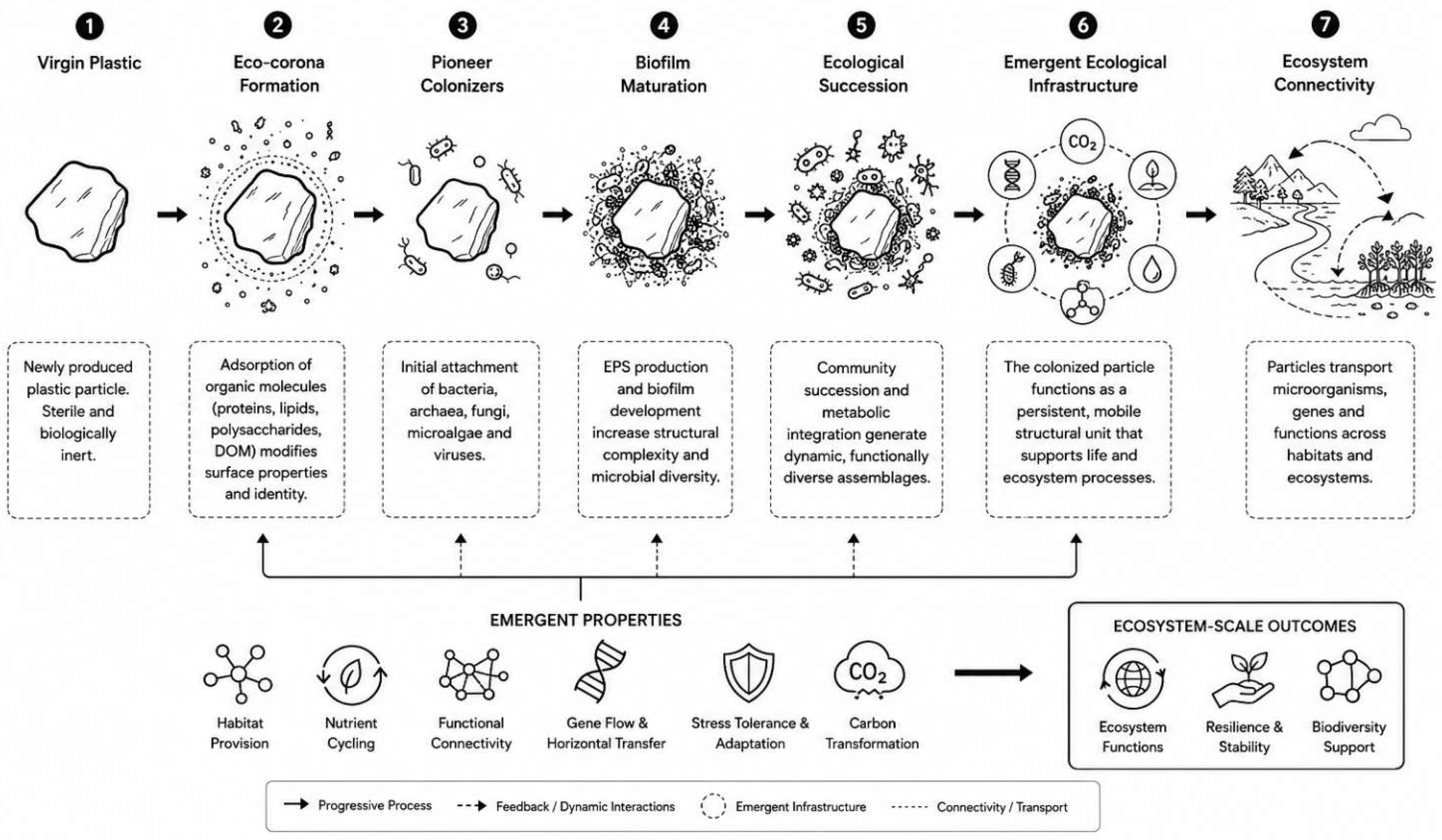
Figure 3.
Conceptual mechanisms through which microplastics may influence the biological carbon pump. Three non-mutually exclusive hypotheses have been proposed. (A) Enhanced biofouling may increase particle density and promote carbon export through faster sinking. (B) Incorporation of buoyant microplastics may reduce aggregate cohesion and settling velocity, decreasing carbon export efficiency. (C) The ecological infrastructure framework proposed here emphasizes an additional mechanism whereby slower-sinking microplastic-associated aggregates extend the residence time of particulate organic matter within oxygenated waters, increasing the temporal window available for microbial respiration, trophic processing and remineralization before carbon reaches long-term deep-ocean reservoirs. Consequently, the influence of microplastics on the biological carbon pump may depend not only on changes in sinking velocity but also on modifications to the temporal dynamics of microbial carbon processing.
Figure 3.
Conceptual mechanisms through which microplastics may influence the biological carbon pump. Three non-mutually exclusive hypotheses have been proposed. (A) Enhanced biofouling may increase particle density and promote carbon export through faster sinking. (B) Incorporation of buoyant microplastics may reduce aggregate cohesion and settling velocity, decreasing carbon export efficiency. (C) The ecological infrastructure framework proposed here emphasizes an additional mechanism whereby slower-sinking microplastic-associated aggregates extend the residence time of particulate organic matter within oxygenated waters, increasing the temporal window available for microbial respiration, trophic processing and remineralization before carbon reaches long-term deep-ocean reservoirs. Consequently, the influence of microplastics on the biological carbon pump may depend not only on changes in sinking velocity but also on modifications to the temporal dynamics of microbial carbon processing.
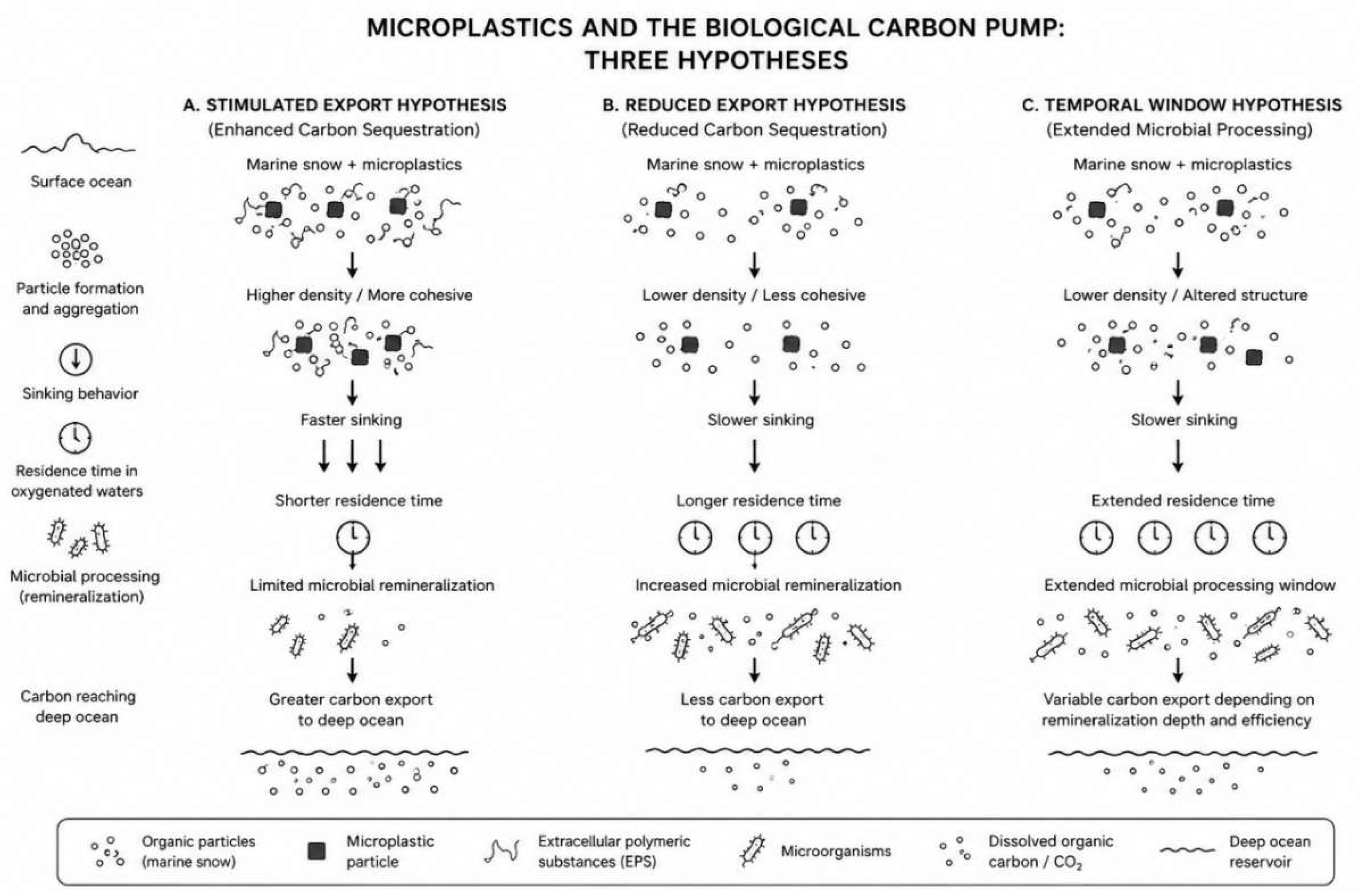
Figure 4.
Proposed conceptual framework showing how colonized microplastics redistribute microbial functional potential among ecosystems, thereby influencing carbon-processing pathways and ecosystem resilience through changes in functional connectivity, community assembly and ecological interactions.
Figure 4.
Proposed conceptual framework showing how colonized microplastics redistribute microbial functional potential among ecosystems, thereby influencing carbon-processing pathways and ecosystem resilience through changes in functional connectivity, community assembly and ecological interactions.
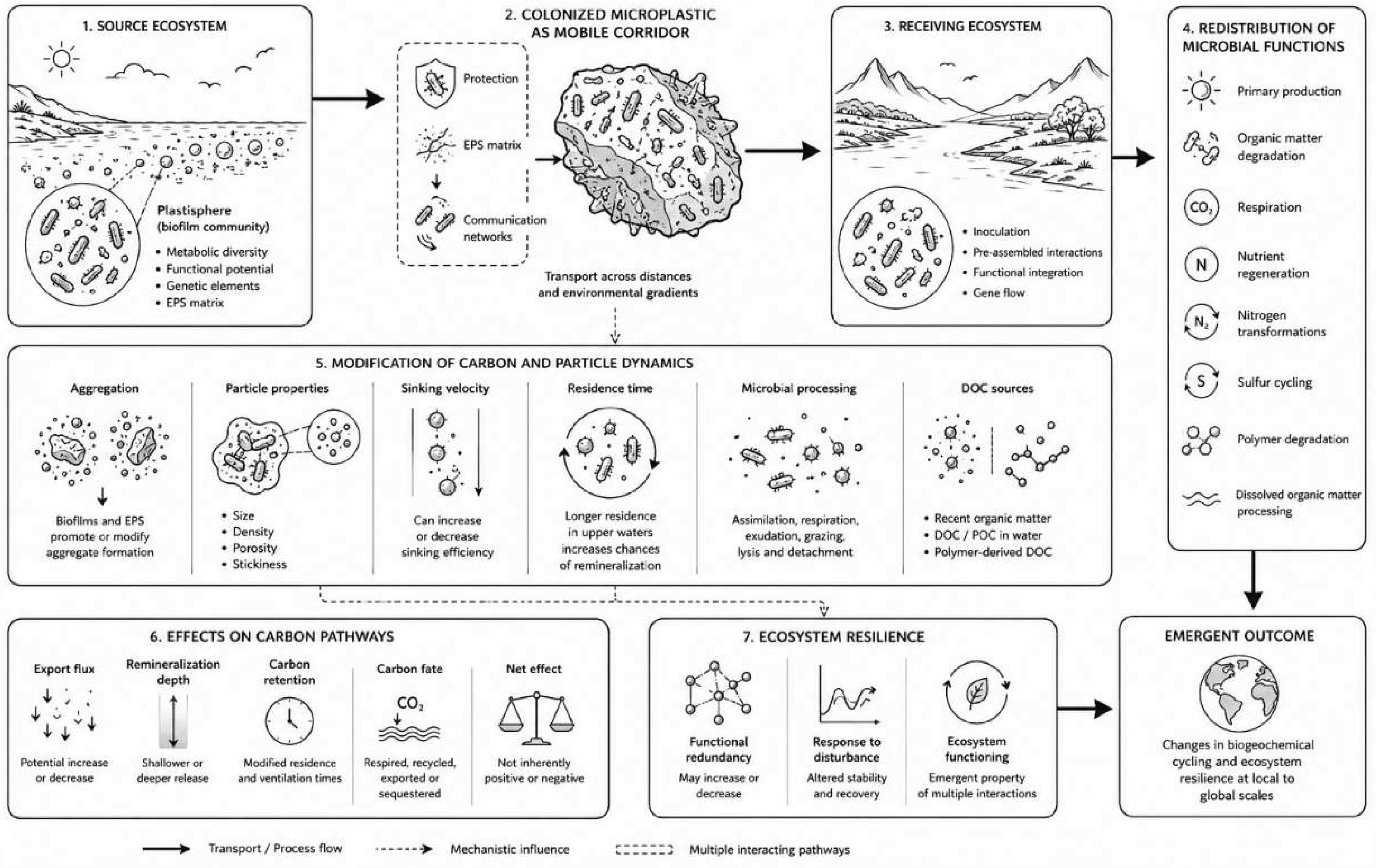
Disclaimer/Publisher’s Note: The statements, opinions and data contained in all publications are solely those of the individual author(s) and contributor(s) and not of MDPI and/or the editor(s). MDPI and/or the editor(s) disclaim responsibility for any injury to people or property resulting from any ideas, methods, instructions or products referred to in the content. |
© 2026 by the authors. Licensee MDPI, Basel, Switzerland. This article is an open access article distributed under the terms and conditions of the Creative Commons Attribution (CC BY) license (http://creativecommons.org/licenses/by/4.0/).
Copyright: This open access article is published under a Creative Commons CC BY 4.0 license, which permit the free download, distribution, and reuse, provided that the author and preprint are cited in any reuse.