
Submitted:
07 August 2026
Posted:
10 August 2026
You are already at the latest version
Abstract
Magnetic reconnection describes the rapid conversion of stored magnetic energy during solar flares, yet the physical mechanism initiating the earliest release remains incompletely resolved. This article introduces magnetic breakdown as a proposed threshold-driven phenomenon in which a pre-existing, current-supported magnetic structure loses local stability and releases energy at the onset of magnetic reassignment and reconnection. The interpretation is developed through Photony theory, in which internal free electrons associated with current transduce dynamic elemental charge photons into linked magnetic chains that provide a proposed physical organization underlying magnetic fields and magnetically confined plasma structures. These chains assemble into magnetic fibrils whose magnetic structure embodies the substantial energy required for their formation, organization, confinement, and continued maintenance within the solar environment. Additional loading develops through chain density, curvature, compression, interaction, twist, and confinement. When this loading exceeds the capacity for stable accommodation or continuous reassignment, localized chain fragmentation is proposed to initiate radiation, particle acceleration, plasma heating and motion, current redistribution, and subsequent magnetic reconfiguration. Solar-flare observations, including precursor electromagnetic emission, rapid nonthermal electron acceleration, magnetic shear, fibril interaction, and the timing of energy release relative to macroscopic reconnection, are examined as evidence relevant to this proposed sequence. Electric-field and voltage-breakdown phenomena are considered only as needed to distinguish them from magnetic breakdown and will be developed separately in a companion article.
Keywords:
Photony theory
; magnetic breakdown
; magnetic fibrils
; magnetic energy
; solar flares
; magnetic reassignment
; magnetic reconnection
; plasma instability
; precursor emission
; current-supported magnetic structures
1. Introduction
Solar flares provide a particularly important example. They release large quantities of stored magnetic energy over short timescales, producing electromagnetic radiation, particle acceleration, plasma heating, bulk plasma motion, and, in some cases, coronal mass ejections. Magnetic reconnection is widely used to describe the associated change in magnetic connectivity and the conversion of magnetic energy into these observable forms. However, an important physical question remains: what initiates the earliest rapid energy release before the larger magnetic structure has completed the reconfiguration described as reconnection?
This article introduces magnetic breakdown as a proposed, threshold-driven phenomenon that may provide the incipient physical mechanism for solar-flare energy release. Magnetic breakdown is defined here as the localized structural failure and fragmentation of a pre-existing, current-supported magnetic organization within a highly conductive plasma. It is proposed to occur when increasing magnetic-chain density, curvature, compression, interaction, or mechanical stress exceeds the ability of the magnetic structure to remain stable or to reassign continuously into admissible pathways. The resulting fragmentation releases stored magnetic energy into radiation, accelerated particles, plasma motion, and heat, while preparing the disrupted magnetic structure for subsequent reassignment and macroscopic reconnection.
The proposed mechanism is developed through Photony theory, which provides a physical interpretation of conventional electric and magnetic field lines. In this framework, elemental charge photons occur in static and dynamic forms, and electrons act as transducers that organize these elemental charge photons into linked photon chains. Internal free electrons associated with current transduce dynamic elemental charge photons into magnetic-chain loops that provide a proposed physical structure for magnetic field lines. Individual magnetic chains are organized into extended magnetic fibrils, and groups of fibrils form larger structures such as magnetic flux tubes and flux ropes. The formation, organization, confinement, and continued maintenance of these current-supported structures embody substantial stored magnetic energy. Their loading may be increased or redistributed through chain density, curvature, compression, tension, twist, interaction, and confinement.
Electron transduction is therefore essential to the proposed physicality of the field. Magnetic field lines are not treated only as geometrical curves representing the direction of a continuous field. They are interpreted as observable-scale representations of organized magnetic chains produced and maintained by free electrons in a conducting material or plasma. This interpretation allows magnetic structures to have finite organization, mechanical loading, reassignment capacity, and a threshold for fragmentation. Magnetic breakdown is the proposed consequence when that threshold is exceeded.
Magnetic breakdown is an instability of a current-supported magnetic structure that already exists within a highly conductive environment. Conductivity therefore plays a central role in regime selection. Poorly conducting and insulating media favor electric-field accumulation and voltage breakdown, whereas highly conducting plasmas permit large currents and magnetic structures to develop prior to rapid energy release.
This distinction is especially important in the solar environment. The solar atmosphere is already ionized and conductive, and active regions contain pre-existing currents, magnetic fibrils, flux tubes, and flux ropes before a flare begins. Localized electric fields may arise during a solar flare event and may contribute strongly to particle acceleration, but their presence does not by itself demonstrate dielectric voltage breakdown. The initiating process must instead be determined from the temporal sequence of magnetic stress, radiation, particle acceleration, electric-field development, plasma motion, and large-scale magnetic reconfiguration.
An associated article (Beyond Field-Line Descriptions: Electric Energy-Release Regimes) treats electric-field generation, organization, voltage, and voltage breakdown as a separate but complementary topic. That article will focus on the accumulation and release of electric-field energy, the formation and failure of electric chains, and the development of a conducting path through an initially insulating, resistive, or incompletely conducting region. The present article therefore limits electric-field generation, organization, voltage, and voltage breakdown topics to the distinctions needed to separate voltage breakdown from the proposed magnetic-breakdown regime in solar and other highly conducting plasmas.
The central hypothesis of this article is that magnetic breakdown initiates the earliest rapid energy release at the onset of magnetic reassignment and reconnection and can be distinguished from the later macroscopic reconfiguration process. Solar-flare evidence relevant to this hypothesis includes precursor brightening, early extreme-ultraviolet and X-ray emission, rapid nonthermal electron acceleration, concentrated magnetic shear, interacting or converging magnetic fibrils, strong field curvature, and energy release that begins before the complete development of the macroscopic reconnection geometry. These observations do not independently establish the photon-chain interpretation, but they provide measurable conditions against which the proposed magnetic-breakdown sequence can be evaluated.
For clarity, magnetic reconfiguration is used as the general term for any change in the geometry, organization, connectivity, or energy distribution of a magnetic structure. Magnetic reconnection refers to the conventional plasma-physics description of a topology-changing process in which magnetic energy is converted into plasma heating, particle acceleration, radiation, or bulk motion. Magnetic reassignment is the Photony interpretation of the underlying structural process in which magnetic chains or fibrils are redirected into new admissible pathways. Reassignment may occur without destructive breakdown, or it may follow magnetic breakdown as the fragmented magnetic structure reorganizes.
This article has four main objectives. First, it defines magnetic breakdown as a distinct physical phenomenon and places it relative to magnetic reassignment and reconnection. Second, it presents the Photony foundation required to explain electron transduction, magnetic-chain formation, and the proposed physical organization underlying magnetic field lines. Third, it examines solar-flare data and observations that may support or challenge magnetic breakdown as an incipient energy-release mechanism. Fourth, it identifies observational and quantitative criteria through which magnetic breakdown may be distinguished from stable magnetic reassignment, current-sheet development, and the later macroscopic reconnection process.
The purpose is not to replace established electromagnetic, plasma, or magnetohydrodynamic models. Photony theory is used as a complementary physical interpretation layered onto those established descriptions. The empirical case for magnetic breakdown must therefore depend on quantitative agreement with observations, successful distinction from competing flare-initiation models, and predictions that can be falsified through synchronized magnetic, current-density, radiative, thermal, particle, and plasma measurements.
2. Essential Photony Foundation for Physical Field Structures
Photony theory does not replace the established mathematical descriptions of electric and magnetic fields. Maxwell’s equations, electromagnetic energy densities, magnetohydrodynamic models, and plasma diagnostics remain the principal quantitative descriptions of the systems considered here. Photony theory is applied as a complementary physical interpretation in which conventional field lines correspond to organized chains of elemental charge photons. This chain interpretation allows field structures to be discussed in terms of formation, continuity, density, curvature, compression, interaction, reassignment, and fragmentation.
The complete Photony framework begins with energy filaments and their motion within discrete Planck Space [1]. A full treatment of Planck-scale geometry is beyond the scope of this article. Accordingly, the present section introduces only the structures required to explain magnetic-chain formation, electron transduction, magnetic fibrils, energy storage, reassignment, and magnetic breakdown.
The distinction between conventional magnetic and electric field-line representations and the proposed chain-based interpretations is illustrated in Figure 1. The field lines indicate the direction of the field, whereas the chains are proposed as the underlying linked physical organization represented by the associated line.
The figure does not imply that the conventional field-line description is incorrect. The two representations serve different purposes. The field line describes magnetic direction and geometry at the macroscopic level, whereas the chain representation proposes a physical structure capable of density, curvature, continuity, reassignment, and fragmentation.
2.1. Elemental Charge Photons and Classical Photons
Photony theory begins with the energy filament as the fundamental energetic structure. The filament follows admissible pathways through Planck Space and cannot move laterally as an independent extended structure. Its geometry, curvature, indexing, and direction of motion determine the configurations that can be formed.
An elemental charge photon is a closed filament configuration that carries the fundamental structure identified with electric charge. Elemental charge photons occur in two principal forms. A static elemental charge photon is a closed ground-state loop associated with stored charge and electric potential. A dynamic elemental charge photon is a reconfigured helical form that possesses forward motion and is associated with charge transport and current.
The terms static and dynamic describe the configuration and motion of the elemental charge photon rather than the waveform of a macroscopic source. Static elemental charge photons are associated primarily with stored charge and electric-chain formation, whereas dynamic elemental charge photons possess directed filament motion and participate in current-associated magnetic-chain formation. The term dynamic is therefore not used as a synonym for alternating current.
A classical photon is formed from a chainlet of two interlinked elemental charge photons. Unlike a static elemental charge photon, a classical photon is a propagating energy quantum and cannot remain at rest. Classical photons may be emitted when stored chain energy is released, and they can also serve as linked units within extended chain structures. The relationship among these structures may be summarized as
This sequence is not intended to replace the conventional energy relation . It identifies the proposed physical organization associated with the photon and with the longer chains used in the present interpretation of electric and magnetic field lines.
2.2. Electron Transduction
Electrons are the principal transducers and regulators of photon-chain organization. In the present magnetic application, internal free electrons associated with current interact with dynamic elemental charge photons and organize them into extended magnetic chains according to the electron distribution, current-supported geometry, surrounding conductivity, and local energy flow.
Transduction is the process through which internal free electrons receive, organize, link, redirect, and release dynamic elemental charge photons within a current-supported magnetic structure. The process is directional and depends on the electron distribution, current-supported geometry, surrounding conductivity, and local rate of energy delivery.
For the present article, the essential pathway is internal-electron transduction. Internal free electrons associated with current transduce dynamic elemental charge photons into linked magnetic-chain loops. The term dynamic elemental charge photon refers to directed charge transport and filament motion rather than to any particular current waveform.
Surface-associated electrons may also transduce predominantly static elemental charge photons into electric chains. That pathway is mentioned here only to distinguish it from internal-electron transduction and is developed separately in the companion article on electric energy-release regimes.
The magnetic transduction pathway may be represented schematically as
where denotes internal-electron transduction, denotes the participating dynamic elemental charge photons, and denotes a magnetic chain. Equation (2) is a structural representation and does not replace conventional electromagnetic field equations.
Internal-electron transduction provides continuity between the dynamic elemental charge-photon population and the extended magnetic chains represented macroscopically as magnetic field lines. It also introduces a finite local organizational capacity. Electrons can process, align, redirect, and maintain only those magnetic-chain configurations that remain compatible with the local geometry, conductivity, chain density, current, and rate of energy delivery. As the required transduction approaches or exceeds the available organizational capacity, chain crowding or discontinuity may develop, increasing the likelihood of magnetic reassignment or breakdown.
Figure 2.
Electron transduction and reduction in the Photony framework. During internal-electron transduction, free electrons associated with current receive and organize dynamic elemental charge photons into linked magnetic chains represented macroscopically as magnetic field lines. During reduction, the same electrons decrease, redirect, or disassemble part of the magnetic-chain population as the supporting current or elemental charge-photon supply declines. When transduction demand approaches or exceeds the available local organizational capacity, chain crowding or discontinuity may increase the likelihood of magnetic reassignment or breakdown.
Figure 2.
Electron transduction and reduction in the Photony framework. During internal-electron transduction, free electrons associated with current receive and organize dynamic elemental charge photons into linked magnetic chains represented macroscopically as magnetic field lines. During reduction, the same electrons decrease, redirect, or disassemble part of the magnetic-chain population as the supporting current or elemental charge-photon supply declines. When transduction demand approaches or exceeds the available local organizational capacity, chain crowding or discontinuity may increase the likelihood of magnetic reassignment or breakdown.
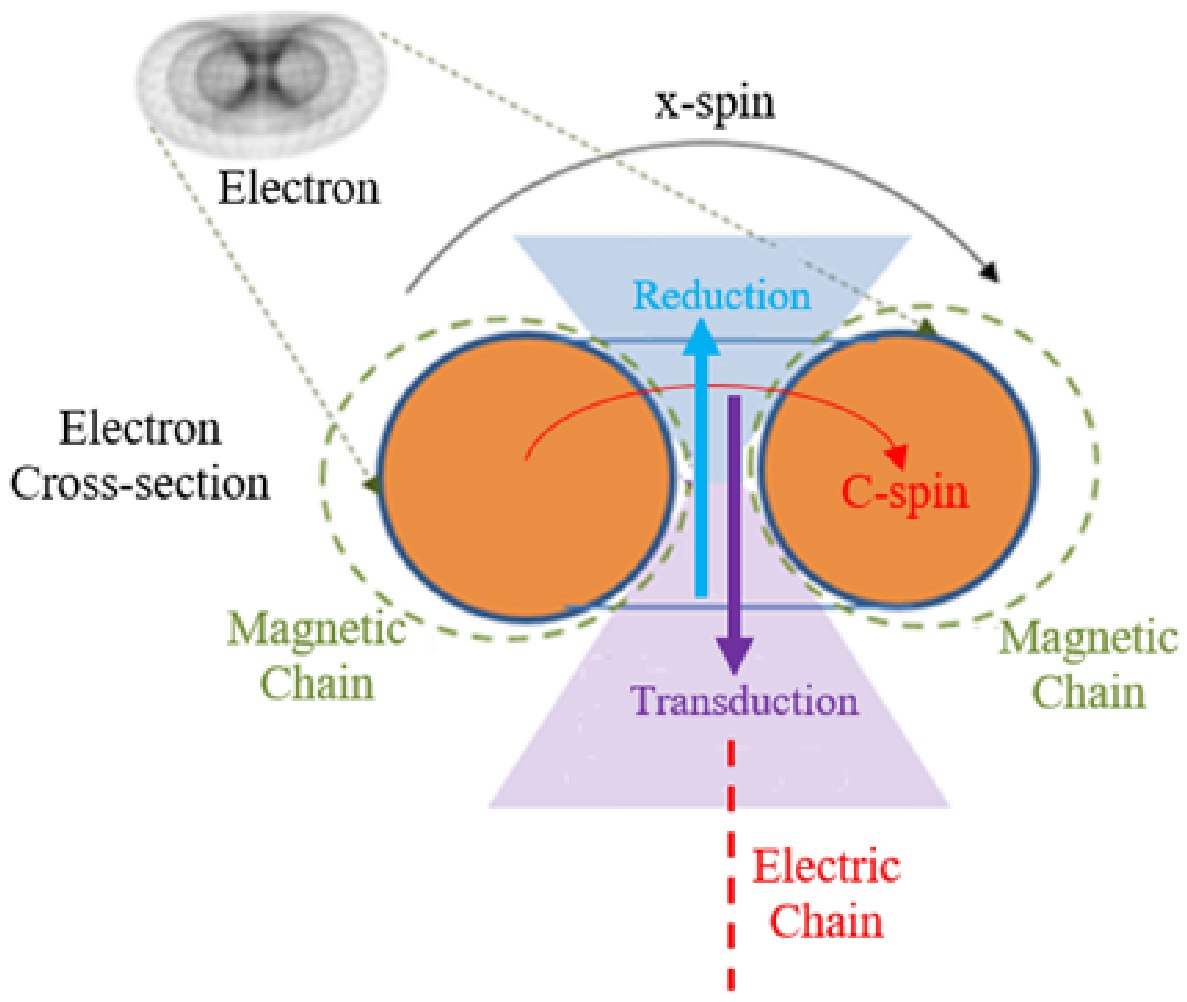
2.3. Magnetic-Chain Formation
A magnetic field is conventionally associated with electric current, magnetic flux density, and forces on moving charges or magnetic materials. Photony theory retains these measurable descriptions while proposing that magnetic field lines physically correspond to linked magnetic-chain loops.
Magnetic chains are formed through the transduction of dynamic elemental charge photons by internal free electrons associated with electric current. The electrons align with the local current-supported structure and organize the dynamic elemental charge photons into continuous loops. These loops follow the geometry conventionally represented by magnetic field lines around a current-carrying conductor or within a conducting plasma.
Unlike the surface-supported electric-chain organization treated in the companion article, magnetic chains are maintained throughout a conducting volume by internal free electrons associated with current. They form closed loops and do not terminate at isolated magnetic charges. Their continuity must therefore be maintained through loop closure, reassignment, or collective structural change.
The magnetic-chain density may be represented schematically as
where is the number of magnetic chains that cross the area A, and includes the effects of chain geometry, alignment, spacing, and local permeability. This relation expresses a proposed structural interpretation and does not replace the conventional definition or measurement of the magnetic flux density.
Individual magnetic chains produced within the Sun are organized into magnetic fibrils. A magnetic fibril is an extended bundle of magnetic chains capable of guiding and confining plasma. Plasma-containing fibrils may assemble into larger solar magnetic structures, including flux tubes, coronal loops, and twisted flux ropes. The formation and continued maintenance of these current-supported structures embody substantial stored magnetic energy. Additional loading may develop through magnetic-field strength, chain density, curvature, compression, stretching, twist, interaction, and confinement.
High conductivity favors magnetic-chain formation because abundant internal free electrons are available to transduce and maintain dynamic chain loops. This condition is important in solar plasmas, where organized magnetic structures exist before flare onset. The relevant instability is therefore not normally the creation of the first conducting path. It is the loss of stability of a magnetic organization already supported by current in a conducting plasma.
2.4. Chains, Fibrils, Energy Storage, and Structural Stability
The chain interpretation provides a proposed physical basis for distinguishing stored magnetic energy from the processes through which that energy is accommodated, reassigned, or released. Conventional electromagnetic theory quantifies magnetic-field energy through
Photony theory does not alter this measurable energy density. It proposes that the energy is physically organized through magnetic chains, magnetic fibrils, and the larger current-supported structures assembled from them.
A chain can remain stable only as long as its geometry, density, curvature, continuity, and electron support are compatible with the surrounding medium. Increasing field strength does not require breakdown by itself. Additional energy may be accommodated by the formation of more chains, changes in chain spacing, increased curvature, expansion of the organized region, or reassignment into alternative pathways.
Magnetic reassignment occurs when magnetic chains or fibrils are redirected into new admissible pathways while sufficient chain continuity is preserved. Reassignment can reduce curvature, crowding, or total structural energy without catastrophic fragmentation. At the macroscopic level, collective reassignment may contribute to the change in magnetic connectivity described conventionally as magnetic reconnection.
Breakdown is a different outcome. It occurs when the existing chain configuration cannot remain stable and cannot be relieved sufficiently through continuous reassignment. The system then crosses a structural threshold and loses chain integrity. The distinction can be represented as
The magnetic structures considered here are already assembled, current-supported, and energetically organized before additional loading develops. Their formation, confinement, and continued maintenance embody substantial stored magnetic energy. Subsequent changes in chain density, curvature, compression, stretching, twist, interaction, and confinement may increase or redistribute that loading.
As the loading increases, the structure may respond through stable accommodation. This may include expansion, deformation, changes in chain spacing, current redistribution, or other adjustments that preserve magnetic continuity.
A second possible response is non-destructive magnetic reassignment. Magnetic chains or fibrils may be redirected into new admissible pathways while sufficient structural continuity is retained. Reassignment may reduce local curvature, crowding, or stress and may contribute to the larger change in magnetic connectivity described conventionally as reconnection.
Magnetic breakdown occurs only when the existing organization can no longer remain stable and cannot relieve the loading sufficiently through continuous reassignment. The structure then crosses a local threshold, loses magnetic-chain continuity, and undergoes localized fragmentation. This fragmentation releases part of the stored magnetic energy and initiates the proposed magnetic-breakdown process.
The magnetic sequence may therefore be summarized as
The products of localized fragmentation may include elemental charge photons, classical photons, surviving chainlets, and larger magnetic-chain sections that remain capable of reassignment. At observable scales, the released energy may appear as electromagnetic radiation, particle acceleration, plasma heating and motion, current redistribution, and magnetic reconfiguration.
Electric-chain organization and voltage breakdown are outside the principal scope of this article and are developed separately in the companion article on electric energy-release regimes.
This foundation permits the following sections to examine how stored magnetic energy may be maintained, loaded, reassigned, or released through magnetic breakdown.
3. Magnetic-Field Energy and Release Pathways
Magnetic fields store measurable physical energy within current-supported systems. The Photony interpretation developed in Section 2 does not replace the conventional electromagnetic description of this energy. Instead, it proposes a physical chain organization through which magnetic energy may be supported, transferred, reassigned, or released.
A central purpose of this article is to distinguish controlled magnetic-field reduction from threshold-driven magnetic breakdown. A magnetic field may decrease because its supporting current is intentionally reduced, because energy is transferred through an established pathway, or because the current-supported magnetic organization becomes unstable. Only the last condition constitutes the proposed magnetic-breakdown phenomenon.
The initiating mechanism cannot be determined solely from observable outcomes such as radiation, heating, current change, particle acceleration, plasma motion, or magnetic reconfiguration. These outcomes may follow from different physical sequences. Classification must therefore consider the pre-event magnetic organization, the manner in which energy was stored, the structure that first became unstable, and the temporal order of the measured magnetic, radiative, thermal, particle, and plasma signatures.
3.1. Conventional Magnetic-Field Energy
In conventional electromagnetic theory, the magnetic-field energy density is
where is the magnetic permeability of the medium and B is the magnetic flux density.
For a magnetic structure occupying a volume V, the total magnetic energy may be represented as
Only part of this total energy is generally available for rapid release. The relevant reservoir is the magnetic free energy associated with the departure of the current-supported structure from a lower-energy admissible configuration.
Equations (6) and (7) quantify stored magnetic energy. They do not, by themselves, specify the physical organization that supports the field or the microscopic sequence through which instability begins. Photony theory adds a proposed structural interpretation while retaining these conventional relations as the quantitative description of the energy reservoir.
Internal free electrons associated with current transduce dynamic elemental charge photons into linked magnetic-chain loops. These chains become organized into magnetic fibrils, and plasma-containing fibrils may assemble into larger structures such as solar flux tubes, coronal loops, and flux ropes. Increasing current and magnetic-field strength correspond, in the Photony interpretation, to increasing density or loading of this magnetic-chain organization.
The conventional and Photony descriptions therefore serve complementary purposes. Conventional electromagnetic relations quantify the energy. The chain interpretation proposes how that energy is physically organized and identifies structural variables that may influence stability, including chain density, curvature, compression, continuity, interaction, confinement, and electron transduction capacity.
3.2. Controlled Magnetic-Field Reduction Without Breakdown
Stored magnetic energy may be released gradually or rapidly without magnetic breakdown. Controlled reduction occurs when the source, current system, plasma flow, or mechanical configuration decreases the process that established and sustained the magnetic field.
In the Photony interpretation, the internal free electrons that transduced dynamic elemental charge photons into magnetic chains also regulate their controlled reduction. As the supporting current or energy input decreases, the electrons reduce, redirect, or disassemble part of the magnetic-chain population. Stored magnetic energy may then be transferred, recovered, or dissipated without catastrophic structural fragmentation.
This complementary relationship may be stated as follows:
Reducing the supporting current decreases magnetic flux density and stored magnetic energy. In a controlled system, the energy may be returned to a source, transferred to another structure, converted into plasma motion, or dissipated through established processes. The corresponding Photony interpretation is a controlled reduction or redirection of the dynamic elemental charge-photon flow and magnetic-chain population maintained by internal free electrons.
Current changes, heating, mechanical forces, plasma motion, or radiation may still accompany this reduction. These effects do not establish magnetic breakdown so long as the energy follows an established transfer pathway and the current-supported magnetic organization does not undergo threshold-driven fragmentation.
3.3. Externally Imposed Current Reduction
Rapid reduction of current does not automatically constitute magnetic breakdown. Current may decrease because of an imposed source change, a boundary-condition change, plasma expansion, mechanical displacement, or an externally initiated interruption of the supporting pathway.
In such cases, the magnetic field decreases as a consequence of the imposed current reduction. The initial cause lies outside the magnetic organization rather than in an internal structural instability. The corresponding sequence is
Magnetic breakdown requires a different initiating condition. It requires evidence that a pre-existing current-supported magnetic structure became internally unstable and began releasing stored magnetic energy before, or as the incipient cause of, the rapid current and field changes.
The proposed magnetic-breakdown sequence is
Externally imposed field reduction and internally initiated magnetic breakdown may eventually produce overlapping magnetic, thermal, radiative, and plasma signatures. Their initiating mechanisms are nevertheless different.
3.4. Threshold-Driven Release of Stored Magnetic Energy
Threshold-driven release occurs when a current-supported magnetic configuration can no longer remain stable under increasing loading. Instead of following a controlled decrease in its supporting source, the structure loses continuity and undergoes localized fragmentation.
Magnetic breakdown, as proposed in this article, is a threshold-driven instability of a pre-existing current-supported magnetic organization within a highly conducting medium. Current, internal free electrons, and organized magnetic structures, including plasma-containing fibrils assembled into solar flux tubes, are already present before onset.
In the Photony interpretation, structural loading may increase through magnetic-chain density, fibril curvature, compression, stretching, twist, interaction, current concentration, or confinement. The magnetic structure may initially respond through expansion, deformation, current redistribution, or non-destructive chain reassignment. Breakdown becomes possible when the loading exceeds both the capacity for stable accommodation and the capacity for continuous reassignment into alternative admissible pathways.
The threshold sequence may be represented as
3.5. Conductivity and Pre-Existing Magnetic Organization
High conductivity is a defining environmental condition for the proposed magnetic-breakdown regime because it permits substantial current and organized magnetic structures to exist before the rapid release begins. Abundant mobile charge carriers support internal-electron transduction and the continued formation and maintenance of dynamic magnetic-chain loops.
In a highly conducting plasma, organized magnetic structures can accumulate energy through field strength, current density, curvature, compression, stretching, twist, interaction, and confinement. The resulting sequence is
Conductivity alone does not determine whether breakdown occurs. Magnetic geometry, current density, plasma density, temperature, composition, confinement, interaction, event history, and the rate of energy input must also be considered. Different parts of the same magnetic system may have different loading and stability conditions.
The relevant regime can therefore be summarized qualitatively as
This relation identifies a regime tendency rather than a universal threshold. A highly conducting magnetic structure may remain stable, expand, or reassign without breakdown if sufficient accommodation capacity remains available.
3.6. Temporal Sequence as the Primary Classification Method
Magnetic breakdown, magnetic reassignment, and magnetic reconnection may produce overlapping observable effects. Each may involve current change, electromagnetic emission, plasma heating, particle acceleration, magnetic motion, and reconfiguration. Classification by final outcome alone is therefore unreliable.
The primary question is which physical organization first became unstable and initiated the rapid release. A magnetic-breakdown classification requires evidence that a pre-existing current-supported magnetic structure crossed a local instability threshold and thereby initiated the principal rapid energy conversion.
Relevant measurements may include magnetic-field strength, current-density estimates, magnetic shear, fibril or loop curvature, compression, interaction, precursor radiation, particle acceleration, plasma heating, magnetic-field change, plasma motion, and the timing of large-scale reassignment or reconnection.
3.7. Magnetic-Breakdown Characteristics and Relationship to Reconnection
Magnetic breakdown is distinguished by the instability of a magnetic organization that is already current-supported and energetically loaded. The classification is based on the pre-event structure and temporal sequence rather than on the final observable products.
This magnetic-only framework establishes the basis for the following sections, which examine solar-flare energy release, the missing incipient mechanism, and magnetic breakdown as a distinct threshold-driven phenomenon.
Figure 3 illustrates the proposed relationship between magnetic breakdown and magnetic reconnection. Before onset, oppositely directed or strongly stressed current-supported magnetic structures converge toward a highly loaded interaction region. This pre-breakdown configuration is interpreted as a stressed, higher-energy magnetic state. Localized magnetic breakdown is proposed to disrupt part of the pre-existing magnetic organization and initiate the first rapid energy release.
The higher- and lower-energy descriptions indicate the proposed relative magnetic loading of the two configurations rather than a quantitative calculation of their total magnetic energies. The figure is intended only as a structural guide. It does not replace the conventional current-sheet, diffusion-region, inflow, or outflow descriptions of reconnection. Instead, it summarizes the Photony interpretation that localized magnetic breakdown initiates the first rapid energy release as the system enters magnetic reassignment and macroscopic reconnection. The sequence may be summarized as follows:
This sequence distinguishes functional roles rather than requiring widely separated stages. Reassignment and the developing reconnection geometry may begin immediately after the local threshold crossing and may overlap with continuing magnetic breakdown.
Table 1 summarizes the principal characteristics of the proposed regime.
4. Solar-Flare Energy Release and the Missing Incipient Mechanism
Solar flares are rapid releases of energy stored primarily in stressed magnetic structures within the solar atmosphere. Their observable consequences include electromagnetic radiation across a broad spectral range, plasma heating, nonthermal particle acceleration, bulk plasma motion, changes in magnetic organization, and, in some events, coronal mass ejection. These consequences may develop in close temporal succession, but they do not necessarily identify the physical process that initiated the earliest energy release.
The established solar-physics framework attributes flare energy primarily to magnetic free energy accumulated before onset. Photospheric and subphotospheric motions can progressively stress the magnetic structures extending through the photosphere, chromosphere, transition region, and corona. Flux emergence, shearing motion, differential rotation, twisting, braiding, convergence, and interaction between neighboring magnetic structures can increase current density, magnetic shear, curvature, compression, and stored magnetic energy. The flare begins when part of this stressed system can no longer remain in its previous configuration and rapidly transfers energy into other forms.
Magnetic reconnection provides the principal conventional framework for describing the associated change in magnetic connectivity and conversion of magnetic energy. The present article accepts that framework while separating two questions that are often discussed together:
- 1.
- How does the larger magnetic system change connectivity and relax toward a lower-energy configuration?
- 2.
- What physical instability initiates the earliest rapid release of stored magnetic energy?
Magnetic reconnection addresses the large-scale reorganization and energy conversion of solar flares with substantial theoretical, numerical, and observational support. Multi-instrument observations have, for example, identified current-sheet properties consistent with reconnection during solar flares, strengthening the connection between magnetic reconfiguration and flare-energy release [2]. The onset problem, however, is more specific: what causes a gradually stressed magnetic system to cross from slow evolution into explosive energy release? Research on solar-eruption initiation has shown that reconnection may weaken restraining magnetic structures during the pre-eruptive phase, while the physical transition from gradual rise to fast eruption is not always conclusively identified [3]. Current-sheet geometry, changes in magnetic connectivity, and non-ideal plasma terms describe essential features of reconnection, but they do not necessarily identify a distinct physical structure whose local loss of stability initiates the first rapid energy release. This unresolved onset question provides a credible and testable conceptual opening for magnetic breakdown as a proposed incipient mechanism rather than as a replacement for reconnection.
4.1. Magnetic Free Energy as the Flare-Energy Reservoir
The energy available to a flare is associated principally with the magnetic field as a confinement structure rather than with the release of plasma pressure from within a ruptured structure. The magnetic energy density is
where B is the magnetic flux density and is the magnetic permeability of the medium. For a solar volume V, the magnetic energy available for conversion may be represented schematically as
Only part of this total magnetic energy is normally available for explosive release. The relevant reservoir is the magnetic free energy associated with the departure of the active-region field from a lower-energy reference configuration. Magnetic shear, twist, curvature, current concentration, interaction between flux systems, and confinement by surrounding magnetic structures can increase this available energy.
In the Photony interpretation, the same measurable magnetic energy is organized through current-supported magnetic chains assembled into fibrils, flux tubes, coronal loops, and flux ropes. The plasma (and hydrogen) contained within these structures is guided, confined, heated, accelerated, and sometimes ejected by the magnetic organization. Solar fibrils contain magnetically guided plasma composed principally of hydrogen and helium, together with electrons and trace heavier ions. In the cooler chromospheric environment, part of the hydrogen population may remain neutral or only partially ionized [4]. The energy released during a flare remains the stored magnetic-field energy quantified by conventional relations such as Equations (15) and (16).
This distinction is important for the proposed event sequence. A fibril or flux tube may expand, lose confinement, change connectivity, or participate in an eruption, but the energetic source is the stressed magnetic organization. Radiation, particle acceleration, plasma heating, outflow, and coronal mass-ejection motion are therefore treated as products and carriers of released magnetic energy rather than as the original source of that energy.
4.2. Current Sheets and the Conventional Reconnection Sequence
In the classical reconnection picture, magnetic structures of different orientation are driven together and form a localized region of concentrated current. Outside the non-ideal region, the magnetic field and conducting plasma remain approximately coupled. Within the reconnection region, the ideal frozen-in condition becomes locally inadequate, magnetic connectivity changes, magnetic stress is redistributed, and plasma is accelerated away from the region.
The Sweet–Parker model (see Figure 4) provides the foundational resistive magnetohydrodynamic description of this process. Oppositely directed magnetic fields converge toward a long, thin current sheet. Plasma enters the sheet through the inflow boundaries, magnetic connectivity changes within a central diffusion region, and plasma leaves along the sheet through opposing outflow regions. In the coordinate convention used here, the inflow velocity is vertical, , and the outflow velocity is horizontal, .
This model provides an essential conservation-law framework that connects the length of the current-sheet, the thickness of the sheet, the inflow, the outflow, the resistivity, and the Alfvén speed. Its classical limitation is that the reconnection rate is constrained by the elongated geometry and small thickness-to-length ratio of the diffusion region. In highly conducting solar plasma, the corresponding Lundquist number can be very large, making steady resistive reconnection too slow by itself to account for many explosive flare timescales.
This limitation has led to the development of faster and more complex reconnection mechanisms, including localized Petschek-type reconnection, Hall reconnection, collisionless and kinetic reconnection, plasmoid-mediated reconnection, turbulent reconnection, anomalous resistivity, ambipolar diffusion, current-sheet thinning, and current-sheet fragmentation. These mechanisms represent important advances and should not be treated as alternatives that must be discarded for magnetic breakdown to have value. They describe how current sheets form, become unstable, develop internal structure, transfer magnetic flux, accelerate plasma, and support rapid energy conversion.
The remaining question is more specific. Even when a current sheet, diffusion region, plasmoid instability, Hall region, or kinetic process is identified, it remains necessary to determine what physical threshold first caused the stressed magnetic system to begin releasing energy rapidly. A current sheet can be an essential site and consequence of magnetic reconfiguration without, by itself, identifying the deeper structural event that initiated the release.
4.3. Precursor Activity and the Earliest Detectable Release
Solar flares frequently develop through an interval of magnetic loading and localized precursor activity before the most intense impulsive emission and large-scale magnetic reconfiguration. Potential indicators include localized brightening, changes in extreme-ultraviolet and X-ray emission, increasing magnetic shear, flux emergence or cancellation, converging magnetic structures, current concentration, fibril interaction, loop deformation, localized heating, and early particle acceleration.
No single precursor is expected to identify a universal initiation mechanism. Some changes may represent gradual stressing, some may reflect stable magnetic reassignment, and others may be secondary responses to energy release that has already begun. The relevant issue is temporal and spatial coincidence.
The proposed incipient mechanism would be supported if repeated, time-resolved observations showed a consistent spatial and temporal sequence. First, the earliest measurable energy release should occur within or adjacent to a region of strong pre-flare magnetic nonpotentiality, such as concentrated magnetic shear, current density, or field curvature. Second, this localized release should precede the full development of the large-scale current sheet, reconnection outflows, flare arcade, or eruptive structure. Observations have shown flare onset near sites of maximum magnetic shear and have also indicated that reconnection signatures can begin in a small region before the current sheet and flare arcade expand to the scale of the driving magnetic system [5,6]. Early EUV and soft-X-ray emission during the slow-rise phase of filament eruptions provides an additional measurable precursor that can be compared with the later fast-eruption phase [7].
The event sequence should therefore be resolved as
This sequence is not intended to require that every current sheet forms only after the first energy release. A stressed active region may contain pre-existing current layers, and current-sheet thinning may be part of the approach to onset. The critical distinction is whether the earliest rapid energy conversion can be attributed completely to the already identified reconnection process or whether a preceding structural instability is needed to explain why the system crossed from gradual loading into explosive release.
Similarly, the first detected radiation is not automatically the initiating event. Radiation may become observable only after an earlier, weaker, or more localized energy conversion has begun. Measurements with insufficient temporal, spatial, or spectral resolution may combine the incipient release, current-sheet development, particle acceleration, and reconnection into a single apparent onset. Testing an incipient mechanism therefore requires synchronized observations of magnetic-field evolution, current-density proxies, radiation, particle distributions, plasma temperature, plasma motion, and the developing reconnection geometry.
4.4. The Missing Incipient Mechanism
Conventional reconnection theory describes magnetic-topology change, flux transport, current-sheet evolution, non-ideal plasma behavior, and the conversion of magnetic energy with substantial explanatory power. It does not necessarily assign a physical substructure to the magnetic field lines whose stretching, twisting, breaking, and reconnection are used to describe the event. Field lines are conventionally integral curves of the magnetic vector field rather than independent material objects.
This does not weaken the validity of the conventional equations. It does, however, leave an interpretive question that becomes important at flare onset: what physical organization accumulates stress, what loses continuity at the first threshold crossing, and what directly releases the initial portion of the stored magnetic energy?
The present article proposes magnetic breakdown as a possible answer. Magnetic breakdown is not introduced as a replacement for current sheets, diffusion regions, Hall physics, kinetic effects, plasmoid formation, turbulence, or magnetic reconnection. It is proposed as the threshold-driven incipient instability of a pre-existing, current-supported magnetic organization. In the Photony interpretation, the instability occurs when magnetic chains or fibrils can no longer accommodate increasing density, curvature, compression, stretching, twist, interaction, or confinement through stable deformation or continuous reassignment.
The proposed relationship can be stated compactly:
These processes may overlap in space and time. Smooth reassignment may occur without destructive breakdown. Localized breakdown may occur without immediate large-scale reconnection. In an explosive flare, magnetic breakdown may initiate or intensify the release, while reassignment and reconnection provide the pathways through which the surrounding magnetic system reorganizes toward a lower-energy configuration.
Section 5 develops magnetic breakdown as a distinct physical phenomenon, identifies its required preconditions, and defines the structural difference between stable accommodation, non-destructive reassignment, and threshold-driven fragmentation.
5. Magnetic Breakdown as a Distinct Physical Phenomenon
Magnetic breakdown is defined in this article as the localized, threshold-driven loss of structural continuity within a pre-existing, current-supported magnetic organization. The affected structure already exists within a conducting medium and already stores magnetic energy before onset. Breakdown therefore does not create the first conducting path. It destabilizes magnetic chains, fibrils, or larger current-supported structures that have become unable to accommodate additional loading or to reassign continuously into stable pathways.
This definition separates magnetic breakdown from three related processes. First, it differs from controlled magnetic-field reduction, in which the supporting current decreases through an imposed circuit, mechanical, or plasma process without internal structural failure. Second, it differs from non-destructive magnetic reassignment, in which magnetic chains or fibrils move into alternative configurations while sufficient continuity is preserved. Third, it differs from magnetic reconnection as conventionally described, which concerns the macroscopic change of magnetic connectivity, flux transfer, current-sheet evolution, plasma inflow, and plasma outflow. Magnetic breakdown may precede, accompany, intensify, or locally interrupt reassignment and reconnection, but it is not defined by those later reconfiguration processes.
The defining event is the first local loss of stable magnetic-chain continuity. In the Photony interpretation, this loss occurs when the current-supported chain organization can no longer preserve an admissible configuration under the combined effects of density, curvature, compression, stretching, twist, interaction, confinement, and continuing energy input. The resulting fragmentation releases part of the stored magnetic energy and changes the local conditions under which subsequent reassignment or reconnection proceeds.
5.1. Required Physical Preconditions
Magnetic breakdown requires a different initial state from voltage breakdown. The medium must already support substantial charge transport, current, and magnetic organization. The principal preconditions are:
- 1.
- A conducting environment. The medium must contain sufficient mobile charge carriers to support current before the rapid release begins. Solar and astrophysical plasmas naturally satisfy this general condition, although local conductivity and ionization may vary strongly with temperature, density, and position.
- 2.
- A pre-existing current-supported magnetic structure. Magnetic chains, magnetic fibrils, flux tubes, coronal loops, flux ropes, current layers, or interacting magnetic systems must be present before onset. The proposed breakdown is an instability of this existing organization rather than the creation of the first current channel.
- 3.
- Stored magnetic free energy. The magnetic configuration must depart from a lower-energy admissible state. Current concentration, magnetic shear, twist, curvature, compression, interaction, and confinement provide measurable macroscopic indicators that free energy may be available.
- 4.
- Continued structural loading. Energy or mechanical stress must continue to enter or accumulate in the magnetic organization. Flux emergence, photospheric motion, shearing, twisting, convergence, interaction between fibrils, compression, and eruptive stretching may contribute to this loading.
- 5.
- Limited accommodation or reassignment capacity. The structure must be unable to reduce its loading sufficiently through expansion, redistribution, deformation, or non-destructive reassignment. Breakdown is not required while an admissible lower-stress pathway remains continuously available.
These conditions are necessary within the proposed interpretation, but no single condition is sufficient by itself. A strong magnetic field does not automatically imply breakdown. A highly curved fibril may remain stable if its electron support, surrounding geometry, and reassignment pathways are adequate. Similarly, a current sheet may persist or evolve without catastrophic fragmentation. Magnetic breakdown is proposed to occur only when the combined loading exceeds the local capacity for both stable accommodation and continuous reassignment.
The precondition sequence may be summarized as
The word possible is essential. The presence of the preconditions identifies a candidate breakdown regime, not proof that breakdown has occurred. Evidence for the phenomenon must also include the timing and location of the initial energy release.
5.2. Structural Loading of Magnetic Chains and Fibrils
Magnetic loading is multidimensional. It cannot be reduced to magnetic-field magnitude alone. Two regions having similar values of B may differ in current density, shear, curvature, twist, confinement, interaction with neighboring structures, and ability to expand or reassign. The local stability condition must therefore depend on a combination of measurable macroscopic quantities and proposed chain-level variables.
For the purposes of this article, magnetic loading is treated as a combined effect of several measurable and structural variables:
where B is magnetic flux density, J is current density, is a measure of magnetic or fibril curvature, represents twist, C represents compression or crowding, S represents stretching or shear, represents interaction between neighboring fibrils or flux systems, represents external confinement, and represents the rate of continuing energy input.
Equation (20) is not proposed as a completed constitutive law. It identifies the classes of variables that a quantitative magnetic-breakdown criterion must eventually include. Their relative importance may differ between active regions, current sheets, flux ropes, coronal loops, and other conducting magnetic environments.
In the Photony interpretation, increasing B corresponds to increasing magnetic-chain density or organization. Increasing curvature requires the chains to remain continuous through more strongly bent pathways. Compression and interaction reduce the available spacing between neighboring chains or fibrils. Stretching and twist increase the geometrical distance and structural constraint over which continuity must be maintained. Confinement limits expansion into lower-stress configurations. Continued energy input requires internal free electrons to sustain, redirect, and organize a changing dynamic elemental charge-photon population.
The loading variables can reinforce one another. A strongly curved fibril may remain stable when isolated but become unstable when compressed by a neighboring flux system. A twisted flux rope may accommodate further energy through expansion until an overlying magnetic structure prevents additional motion. A current layer may thin progressively while remaining coherent and then fragment when the combined current density, shear, confinement, and energy-input rate exceed its local support capacity.
5.3. Accommodation, Reassignment, and Breakdown
A stressed magnetic organization has at least three possible responses: stable accommodation, non-destructive reassignment, and breakdown.
During stable accommodation, the system remains within its current topological organization while adjusting its density, spacing, curvature, volume, current distribution, or surrounding plasma motion. Magnetic energy may continue to increase, but chain continuity remains supported.
During non-destructive reassignment, magnetic chains or fibrils move into alternative admissible pathways that reduce local loading while preserving sufficient continuity. At observable scales, collective reassignment may contribute to gradual magnetic reconfiguration or to an orderly component of magnetic reconnection.
During breakdown, neither continued accommodation nor continuous reassignment can preserve the local magnetic-chain organization. The structure crosses a threshold and fragments. Part of the stored magnetic energy is then released before, during, or in conjunction with the larger reorganization of the surrounding magnetic system.
The three branches can be represented as
where represents the local capacity for stable accommodation and represents the maximum loading that can be relieved through continuous reassignment.
These quantities should be interpreted as effective local capacities rather than universal constants. They may depend on field geometry, electron and ion density, temperature, current support, ionization state, surrounding magnetic pressure, plasma motion, boundary conditions, and the rate at which the loading changes. A structure may therefore cross a threshold because its loading increases, because its accommodation or reassignment capacity decreases, or because both changes occur together.
A useful dimensionless representation is the magnetic structural utilization ratio
The proposed regimes are then
The threshold is a conceptual boundary, not yet an independently calibrated physical constant. Its value cannot presently be calculated from first principles because the required chain-level constitutive relations have not been experimentally established. The ratio is introduced to make the hypothesis explicit and testable: breakdown should begin where the inferred loading rises to or above the local reassignment capacity.
These signatures are not unique to magnetic breakdown. They are also associated with established reconnection, current-sheet, and plasma-instability processes. The magnetic-breakdown interpretation therefore depends on their temporal ordering and spatial relationship to the pre-flare magnetic structure. The strongest evidence would be an initial localized release at a region of high magnetic loading before the complete development of the larger reconnection geometry, followed by outward propagation, current redistribution, reassignment, or reconnection.
The proposed sequence is:
The sequence does not require a long delay between breakdown and reconnection. At present observational resolution, the processes may appear nearly simultaneous. The hypothesis requires only that the local structural failure be physically distinguishable as the first threshold-driven release, even when the ensuing magnetic reconfiguration develops immediately.
5.4. Incipient and Continuing Magnetic Breakdown
Magnetic breakdown is proposed as both an incipient and potentially continuing process. The first localized fragmentation may initiate the rapid release, but the event need not end with that first failure. The resulting current redistribution, plasma motion, loss of confinement, and magnetic reorganization may transfer stress to neighboring fibrils or adjacent portions of the same structure. Additional regions may then cross their own local thresholds.
This possibility produces a cascading sequence:
A cascading interpretation may help explain how an initially small release develops into a flare-scale event without requiring the entire active region to cross one global threshold simultaneously. It is also consistent with spatially intermittent emission, multiple brightening sites, fragmented current sheets, successive reconnection episodes, and the progressive involvement of neighboring magnetic structures. These observations are not proof of magnetic breakdown, but they define phenomena against which the proposed cascade can be compared.
The continuing phase must not be confused with the macroscopic reconnection process. Reconnection describes how the magnetic system changes connectivity and transfers flux as the event develops. Continuing breakdown describes the possibility that additional local magnetic-chain structures repeatedly lose continuity and release energy while that larger reorganization is occurring. The two processes may therefore coexist and reinforce one another.
5.5. Distinction from Ideal-MHD Instability and Reconnection Onset
Established flare and eruption models include ideal and resistive instabilities, such as kink instability, torus instability, tearing, plasmoid instability, current-sheet disruption, and transitions from slow to fast reconnection. Magnetic breakdown should not be treated as a substitute name for any one of these mechanisms.
Figure 5 presents the Photony chain-based interpretation of the Sweet–Parker geometry previously shown in Figure 4. The inflow, diffusion-region, and outflow geometry remains consistent with the conventional model. The additional chain-level representation is intended to illustrate how magnetic fibrils and their constituent magnetic chains may become compressed, redirected, or fragmented as they enter the central current-sheet region.
The Figure 5 is not intended to alter the conservation laws, inflow–outflow relations, or diffusion-region geometry of the Sweet–Parker model. It adds the proposed Photony interpretation of the physical organization represented conventionally by magnetic field lines.
An ideal-MHD instability may alter the position, shape, or confinement of a flux rope or magnetic structure while preserving the ideal frozen-in condition during its early development. That instability may increase current-sheet formation, curvature, stretching, or interaction and thereby raise the proposed magnetic loading. It can therefore act as a driver toward magnetic breakdown without being identical to the breakdown event.
A tearing or plasmoid instability concerns the instability and fragmentation of a current sheet within established plasma physics. Such behavior may provide a macroscopic or mesoscopic manifestation of the conditions under which magnetic breakdown is proposed to occur. Not every tearing mode or plasmoid is evidence of chain-level breakdown. Magnetic breakdown is intended to address the more specific question of what physical structure loses stability as the rapid release begins. The two descriptions may refer to different levels of the same event, but they should not be declared equivalent without observational or experimental evidence.
5.6. Localized Fragmentation and Initial Energy Release
Magnetic breakdown is expected to begin locally rather than through simultaneous failure of an entire active region. Magnetic loading, current density, curvature, shear, plasma composition, and confinement vary spatially. The first threshold crossing should therefore occur in a limited region where loading is concentrated or where accommodation and reassignment capacity are locally reduced.
In the Photony interpretation, local magnetic-chain continuity is lost and the affected structure fragments into elemental charge photons, classical photons, surviving chainlets, and larger chain sections. These proposed chain-level products provide pathways through which the stored magnetic energy can be redistributed. At observable scales, the initial release may appear through one or more of the following signatures:
- localized electromagnetic emission
- rapid heating within or adjacent to a stressed magnetic structure
- early nonthermal particle acceleration
- abrupt plasma motion or the onset of a localized jet
- a rapid change in current density or magnetic-field organization
- current-sheet thinning, disruption, or fragmentation
- subsequent expansion of the affected region into a larger reconnection or eruptive system
Localized magnetic-chain fragmentation releases part of the stored magnetic energy. Within the Photony interpretation, the immediate products may include elemental charge photons, classical photons, surviving chainlets, and larger chain sections capable of subsequent reassignment.
The principal released products associated with magnetic-chain collision or fragmentation are summarized schematically in Figure 6.
At observable scales, the release may appear as electromagnetic radiation, accelerated particles, plasma heating, bulk plasma motion, current redistribution, and magnetic reconfiguration. Magnetic reassignment and conventional reconnection may follow or develop concurrently, but should not be treated as identical to the initiating fragmentation event.
The classification therefore depends on whether the pre-existing current-supported magnetic organization reached its instability threshold before the principal energy release.
5.7. Operational Criteria for Identifying Magnetic Breakdown
For magnetic breakdown to function as a distinct scientific classification, it must be identifiable through operational criteria rather than inferred only from the final appearance of a flare. A candidate event should satisfy the following conditions:
- 1.
- A conducting, current-carrying magnetic structure is present before the rapid release.
- 2.
- Magnetic free energy and structural loading are concentrated before onset, as indicated by measurable quantities such as magnetic shear, curvature, twist, current density, compression, interaction, or confinement.
- 3.
- The earliest reproducible energy-release signature is spatially associated with the stressed magnetic structure.
- 4.
- The initial release begins as the system enters large-scale magnetic reassignment and reconnection and is detected before the macroscopic reconfiguration is fully established.
- 5.
- The event does not require the formation of the first conducting path through an initially insulating or strongly resistive region.
- 6.
- The subsequent evolution is consistent with energy transfer from the pre-existing magnetic field into radiation, particle acceleration, heating, plasma motion, current redistribution, and lower-energy magnetic configurations.
Failure to satisfy these conditions would weaken or exclude a magnetic-breakdown classification. If magnetic connectivity changes smoothly without evidence of threshold-driven fragmentation or a distinct initial energy release, the event may be described as non-destructive reassignment or reconnection without demonstrated magnetic breakdown.
These operational criteria do not yet establish that magnetic breakdown occurs in solar flares. They define what observations would be required to separate the proposal from established descriptions and from alternative flare-initiation models.
6. Limitations and Scope
The present article has a deliberately focused objective. It introduces magnetic breakdown as a proposed threshold-driven instability of a pre-existing, current-supported magnetic organization and examines its possible role during the incipient stage of solar-flare energy release. The article defines the proposed phenomenon, distinguishes it from magnetic reassignment and reconnection, and identifies the physical conditions and temporal sequence associated with its development.
6.1. Emphasis on Magnetic Rather than Electric Breakdown
Electric fields are an essential part of time-dependent magnetic systems. They arise during current-sheet evolution, magnetic-flux transport, particle acceleration, charge redistribution, and reconnection. Their limited treatment in this article does not imply that they are absent or unimportant during solar flares.
The present article instead concentrates on the initiating magnetic regime. Magnetic breakdown is proposed for an environment that is already conducting, already current-carrying, and already magnetically organized before rapid energy release begins. The central question is whether a pre-existing magnetic structure crosses a structural threshold before or during the earliest stage of magnetic reassignment and reconnection.
Electric-chain organization and voltage breakdown begin from a different initial condition and require separate treatment. They are mentioned here only to distinguish them from the failure of a pre-existing current-supported magnetic organization. Their full development is reserved for the companion article on electric energy-release regimes.
6.2. Present Solar Scope
The Sun is the principal physical environment considered in this article. Solar active regions contain strong pre-existing currents, stressed magnetic structures, substantial magnetic free energy, organized plasma, precursor emission, rapid particle acceleration, and large-scale magnetic reconfiguration. These properties make solar flares especially suitable for examining a threshold-driven magnetic energy-release mechanism.
Magnetic breakdown is proposed as the local structural threshold crossing that initiates the earliest rapid energy release as the system enters magnetic reassignment and reconnection. The relevant observational sequence includes magnetic loading, localized precursor activity, initial energy release, current redistribution, and the later development of the larger reconnection and eruptive geometry.
The present article does not attempt a complete survey of every solar-flare model or every class of solar eruption. Its purpose is narrower: to define the magnetic-breakdown mechanism and place it within the temporal development of flare energy release.
6.3. Possible Application Beyond the Sun
The present treatment is centered on the Sun because solar flares provide the clearest large-scale example of rapid magnetic-energy release from a pre-existing current-supported plasma structure. Magnetic breakdown, as defined here, has not yet been developed in this article as a general model for other stars, planetary magnetospheres, laboratory plasmas, or engineered current-carrying systems. Other highly conducting environments may nevertheless contain the principal conditions required by the proposed mechanism: pre-existing current, stored magnetic energy, magnetic shear, curvature, compression, interaction, and rapid magnetic reconfiguration. These environments may therefore provide future opportunities for extending the framework beyond the solar case.
Potential applications include stellar flares, planetary magnetospheres, magnetotail current systems, laboratory plasma devices, pulsed-power systems, and high-current conductors. Each environment would require its own treatment of geometry, plasma composition, conductivity, loading, confinement, and diagnostic accessibility.
6.4. Absence of Direct Chain-Level Measurements
Magnetic chains and their internal fragmentation are not directly resolved by present electromagnetic and plasma instruments. Conventional measurements provide magnetic and electric fields, current density, particle distributions, radiation, temperature, density, composition, and plasma velocity.
The Photony structures proposed to underlie conventional magnetic field lines must therefore be evaluated initially through observable macroscopic signatures. Relevant signatures include magnetic shear, current concentration, fibril curvature, compression, interaction, abrupt radiation onset, particle acceleration, rapid heating, plasma motion, current-sheet development, and magnetic reconfiguration.
These measurements provide the practical bridge between the proposed chain-level mechanism and observable solar-flare behavior. Improvements in temporal, spatial, and spectral resolution may allow the incipient release to be separated more clearly from the later evolution of the current sheet, reconnection outflows, flare arcade, and eruptive structure.
6.5. Present Quantitative Limits
The present article identifies magnetic-chain density, curvature, compression, stretching, twist, interaction, confinement, energy-input rate, and reassignment capacity as contributors to magnetic structural loading. It does not yet provide a fully calibrated constitutive equation that combines these variables into a universal magnetic-breakdown threshold.
The magnetic-loading function and structural utilization ratio introduced in Section 5 are therefore preliminary representations. They organize the variables expected to influence stability and provide a basis for later quantitative development.
Future work will be required to determine the relative weighting of these variables, their scaling relationships, their dependence on plasma conditions, and the critical conditions associated with the transition from stable accommodation to reassignment or fragmentation.
A more complete quantitative model should ultimately permit comparison between the proposed magnetic-breakdown threshold and measurable parameters such as magnetic-field strength, current density, curvature, plasma density, temperature, energy-input rate, current-sheet thickness, and characteristic plasma timescales.
6.6. Laboratory and Observational Development
The present article does not report a dedicated laboratory demonstration of Photony magnetic breakdown. Laboratory plasma experiments that produce pre-existing current-supported magnetic structures, current sheets, plasmoids, magnetic-energy conversion, particle acceleration, and rapid reconfiguration may nevertheless provide useful future test environments.
A laboratory investigation would require controlled magnetic loading and synchronized measurements of current, magnetic-field geometry, radiation, particle distributions, temperature, and plasma motion. Particular attention would be directed toward the earliest localized release and its relationship to later current-sheet development and reconnection.
Solar observations remain the primary basis for the present application. Future studies may compare precursor brightening, current-density proxies, magnetic shear, fibril interaction, particle acceleration, and the timing of macroscopic reconnection across multiple flare events. Such comparisons may help determine whether a consistent incipient magnetic-breakdown sequence can be identified.
The scope of the present article is therefore limited to the conceptual definition of magnetic breakdown, its placement within solar-flare energy release, and the identification of its principal physical and observational characteristics. Detailed voltage-breakdown theory, complete quantitative threshold laws, laboratory evaluation, direct chain-level diagnostics, and applications to stellar, planetary, and engineered systems are reserved for subsequent work. “`
7. Discussion
This article proposes magnetic breakdown as the localized, threshold-driven loss of continuity within a pre-existing, current-supported magnetic organization. The principal distinction is between the initial structural failure, the subsequent reassignment of magnetic chains or fibrils, and the larger connectivity change described conventionally as magnetic reconnection. These processes may overlap in space and time, but they represent different aspects of the energy-release sequence.
The proposed interpretation does not replace established electromagnetic, magnetohydrodynamic, or kinetic descriptions. Conventional theory continues to quantify magnetic energy, current-sheet formation, non-ideal plasma behavior, flux transfer, particle acceleration, heating, and plasma outflow. The Photony perspective adds a proposed physical organization beneath the field-line representation and identifies the threshold-driven loss of that organization as the proposed incipient release mechanism.
7.1. Interpretation of the Onset Sequence
The central hypothesis is that magnetic loading can increase through current concentration, shear, curvature, compression, twist, interaction, stretching, and confinement. A magnetic structure may initially respond through deformation, expansion, redistribution, or non-destructive reassignment. Magnetic breakdown becomes possible when these responses can no longer maintain local structural continuity.
The resulting event sequence is interpreted as
This sequence does not require the current sheet to be absent before the initial release. Current concentration, current-sheet thinning, and limited reconnection may already be developing. The proposed distinction concerns the local threshold that changes the system from gradual evolution to rapid energy release.
Because magnetic loading varies throughout an active region, the first threshold crossing is expected to be localized. The initial disruption may then alter neighboring currents, confinement, and magnetic stresses, allowing the affected region to expand. This provides a possible progression from a small precursor event to a flare-scale reconfiguration without requiring the entire magnetic system to become unstable simultaneously.
7.2. Relationship to Reconnection
Magnetic reconnection remains the principal conventional description of magnetic-connectivity change and large-scale energy conversion during solar flares. Magnetic breakdown is proposed to address the narrower onset question: what physical organization first becomes unstable and releases energy as the system enters the rapid reconnection regime?
The chain-based Sweet–Parker representation illustrates this relationship. The conventional inflow, current-sheet, diffusion-region, and outflow geometry is retained. The additional Photony interpretation represents the incoming magnetic structures as magnetic chains and fibrils that may undergo compression, reassignment, and localized fragmentation near the central region.
Magnetic breakdown instead proposes a chain-level structural event that initiates the local rapid energy release and may accompany the subsequent development of tearing, plasmoid formation, current-sheet disruption, or macroscopic reconnection.
The distinction can be summarized as
This hierarchy allows reconnection theory to retain its established quantitative role while separating the onset event from the later reconfiguration of the larger magnetic system.
7.3. Interpretation of Solar-Flare Precursors
Solar-flare precursors are important because they may identify the interval between gradual magnetic loading and fully developed reconnection. Relevant measurements include localized extreme-ultraviolet or X-ray emission, current-density enhancement, magnetic shear, fibril interaction, loop deformation, rapid heating, and early particle acceleration.
The most useful evidence would be a repeated spatial and temporal sequence in which the earliest measurable release occurs within or adjacent to a strongly loaded magnetic structure and precedes the complete development of the larger current sheet, reconnection outflows, flare arcade, or eruptive geometry.
No individual precursor is sufficient to identify the proposed mechanism. The classification depends on the ordering of several synchronized measurements. Radiation, heating, energetic particles, jets, and plasmoids may all become visible after energy conversion has already begun. The earliest detected signal must therefore be compared with the evolution of the magnetic structure and the developing reconnection geometry.
The first observed emission may also occur later than the physical onset because of instrumental sensitivity and finite temporal, spatial, and spectral resolution. Multi-instrument observations are therefore required to separate the initial localized release from the rapid processes that follow.
7.4. Implications of the Proposed Classification
The proposed classification provides a more specific vocabulary for describing flare development. Magnetic breakdown identifies the local threshold event, reassignment identifies structural reorganization, and reconnection identifies the larger magnetic-connectivity change. Separating these stages may reduce ambiguity when flare onset, instability, reconnection, and energy release are discussed as though they were one process.
The framework also suggests that flare prediction should not depend on magnetic-field strength alone. A candidate onset region may instead be identified through combinations of current density, shear, curvature, compression, twist, fibril interaction, confinement, and energy-input rate. The relevant threshold may therefore be local and multivariable rather than a single universal critical field value.
A localized breakdown process may also provide a pathway for cascading energy release. Initial fragmentation may redistribute current and magnetic stress into adjacent structures, causing additional regions to approach their own thresholds. Reconnection can then spread through the active region while continuing localized breakdown contributes to the evolving release.
7.5. Quantitative and Observational Development
The next stage of development is to connect the proposed structural loading variables to measurable solar quantities. Candidate measurements include magnetic-field strength, current-density proxies, shear angle, loop or fibril curvature, twist, current-sheet thickness, plasma density, temperature, confinement, and the rate of magnetic-energy input.
Analysis across multiple flare events will be required to determine whether a reproducible combination of these loading variables develops before the local threshold crossing and the earliest rapid energy release. High-cadence observations should compare magnetic loading with precursor emission, particle acceleration, heating, plasma motion, current-sheet development, and the onset of macroscopic reconnection.
Laboratory plasma systems may eventually provide controlled test environments by establishing a pre-existing current-supported magnetic structure and progressively increasing its loading. Such experiments would need to resolve the timing of the first radiation, heating, particle, current, and magnetic signatures relative to current-sheet development and reconnection.
The main contribution of the present article is therefore the separation of three physical levels within rapid magnetic-energy release. Magnetic breakdown is proposed as the initial threshold-driven structural failure, magnetic reassignment describes the reorganization of the remaining magnetic structures, and magnetic reconnection describes the larger connectivity change through which the system evolves toward a lower-energy configuration.
8. Conclusions
This article proposes magnetic breakdown as a localized, threshold-driven loss of continuity within a pre-existing, current-supported magnetic organization. In the Photony interpretation, magnetic chains assemble into fibrils and larger plasma-confining structures that already embody substantial stored magnetic energy. Additional loading through current concentration, curvature, compression, twist, interaction, and confinement may drive the structure toward instability.
Magnetic breakdown is proposed to begin when the structure can no longer accommodate this loading or reassign continuously without fragmentation. The resulting local failure releases part of the stored magnetic energy and may initiate radiation, particle acceleration, plasma heating and motion, current redistribution, and subsequent magnetic reconfiguration.
The article distinguishes magnetic breakdown from magnetic reassignment and magnetic reconnection. Breakdown is the proposed initial structural failure, reassignment is the redirection of surviving chains and fibrils, and reconnection is the larger macroscopic change in magnetic connectivity. These processes may overlap, but they are not physically identical.
The proposed mechanism is not yet experimentally confirmed. Its evaluation will require time-resolved observations showing that localized energy release begins in a highly loaded magnetic structure as the system enters reassignment and reconnection, before the full macroscopic reconnection geometry develops.
Supplementary Materials
The following supporting information can be downloaded at the website of this paper posted on Preprints.org.
Author Contributions
Conceptualization, methodology, formal analysis, investigation, writing—original draft preparation, writing—review and editing, and visualization, F.L.M. The author has read and agreed to the published version of the manuscript.
Funding
This research received no external funding.
Institutional Review Board Statement
Not applicable.
Informed Consent Statement
Not applicable.
Data Availability Statement
No new data were created or analyzed in this study. Data sharing is not applicable to this article.
Acknowledgments
During the preparation of this manuscript, the author used Grammarly for language editing and spelling, various AI-assisted search engines for raw material acquisition, and ChatGPT for LaTeX debug assistance. The author takes full responsibility for the content of the publication.
Conflicts of Interest
The author declares no conflicts of interest.
Abbreviations
The following abbreviations are used in this manuscript:
| MHD | Magnetohydrodynamics |
References
- Martin, F.L. The Photony Mathematical Compendium; 2026. [Google Scholar] [CrossRef]
- National Aeronautics and Space Administration. Seeing Double: NASA Missions Measure Solar Flare from Two Spots in Space, 2016. (accessed on 4 August 2026).
- Sterling, A.C.; Moore, R.L. Initiation of Solar Eruptions. In Nasa technical report; Available through the NASA Technical Reports Server; National Aeronautics and Space Administration, 2007. [Google Scholar]
- National Aeronautics and Space Administration. What Is a Solar Prominence? 2015. (accessed on 4 August 2026).
- Hagyard, M.J.; Smith, J. B.J. Flare Onset at Sites of Maximum Magnetic Shear. Accession No. 89N15858; Proceedings of the Flare Research at the Next Solar Maximum: Workshop 1, Scientific Objectives. National Aeronautics and Space Administration; NASA Technical Reports Server, 1988. [Google Scholar]
- Moore, R.L.; Sterling, A.C.; Gary, G.A.; Cirtain, J.W.; Falconer, D.A. Observed Aspects of Reconnection in Solar Eruptions. Space Sci. Rev. 2011, 160, 73–94. [Google Scholar] [CrossRef]
- Sterling, A.C.; Moore, R.L. Hinode Observations of the Onset Stage of a Solar Filament Eruption. In Proceedings of the Announcing First Results from Hinode. National Aeronautics and Space Administration; Document ID 20070038370; NASA Technical Reports Server, 2007. [Google Scholar]
Figure 1.
Comparison between a conventional magnetic field-line representation and the proposed Photony chain-based interpretation. The field line is a geometrical representation of the magnetic field, whereas the magnetic chain is proposed as a linked physical organization formed through electron transduction.
Figure 1.
Comparison between a conventional magnetic field-line representation and the proposed Photony chain-based interpretation. The field line is a geometrical representation of the magnetic field, whereas the magnetic chain is proposed as a linked physical organization formed through electron transduction.
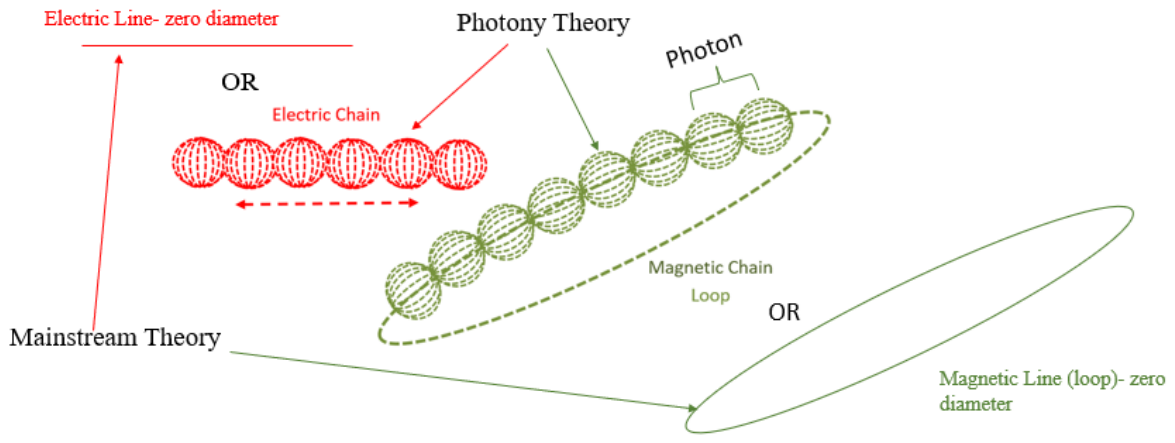
Figure 3.
Schematic before-and-after representation of reconnection as a result of magnetic breakdown. Before onset, stressed current-supported magnetic chains or fibrils approach a highly loaded interaction region. Localized magnetic breakdown is proposed to fragment part of the pre-existing magnetic organization and release stored magnetic energy. Surviving chains and fibrils are then reassigned into new pathways, producing the larger connectivity change identified macroscopically as magnetic reconnection.
Figure 3.
Schematic before-and-after representation of reconnection as a result of magnetic breakdown. Before onset, stressed current-supported magnetic chains or fibrils approach a highly loaded interaction region. Localized magnetic breakdown is proposed to fragment part of the pre-existing magnetic organization and release stored magnetic energy. Surviving chains and fibrils are then reassigned into new pathways, producing the larger connectivity change identified macroscopically as magnetic reconnection.
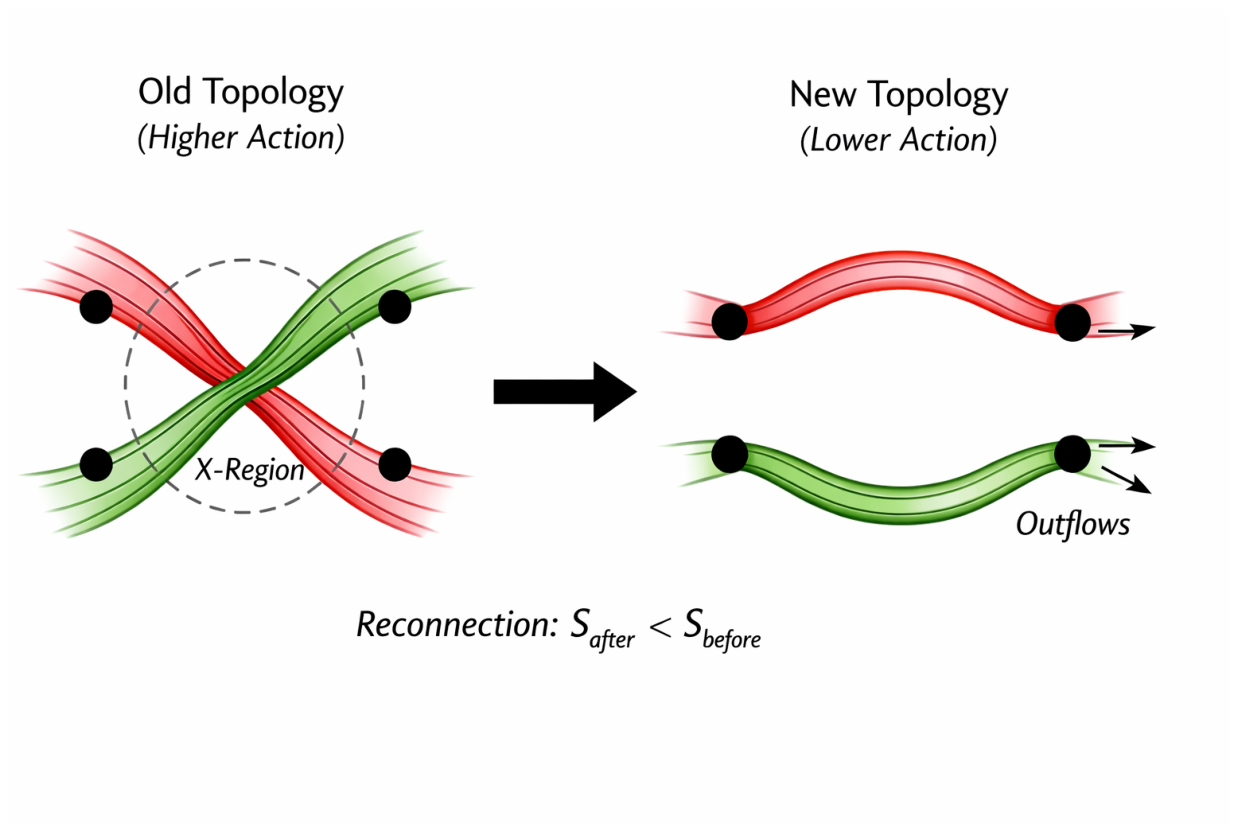
Figure 4.
The Sweet-Parker Model.
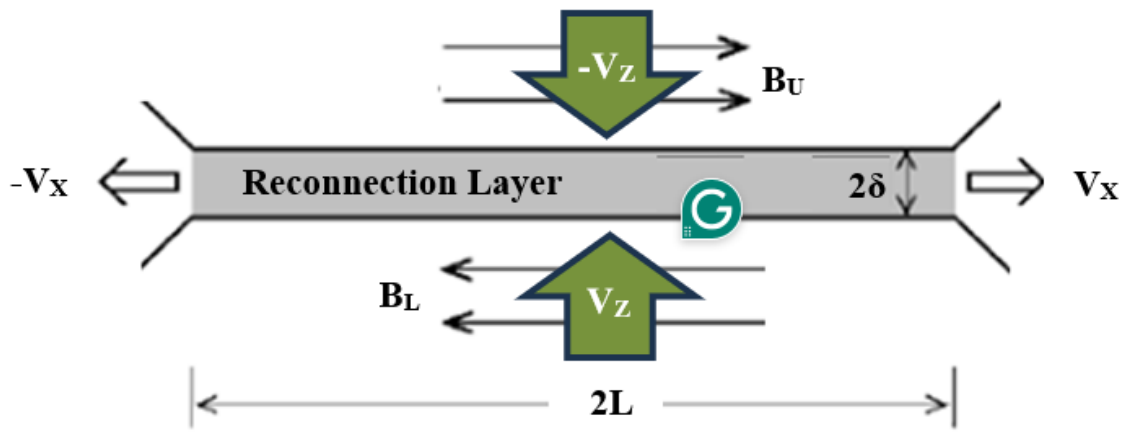
Figure 5.
Chain-based interpretation of the Sweet–Parker reconnection geometry. Oppositely directed magnetic fibrils converge toward the central current-sheet region, where magnetic-chain compression, reassignment, and possible localized fragmentation are proposed to occur. Plasma and magnetic structures enter through the inflow regions and leave through the opposing outflow regions.
Figure 5.
Chain-based interpretation of the Sweet–Parker reconnection geometry. Oppositely directed magnetic fibrils converge toward the central current-sheet region, where magnetic-chain compression, reassignment, and possible localized fragmentation are proposed to occur. Plasma and magnetic structures enter through the inflow regions and leave through the opposing outflow regions.
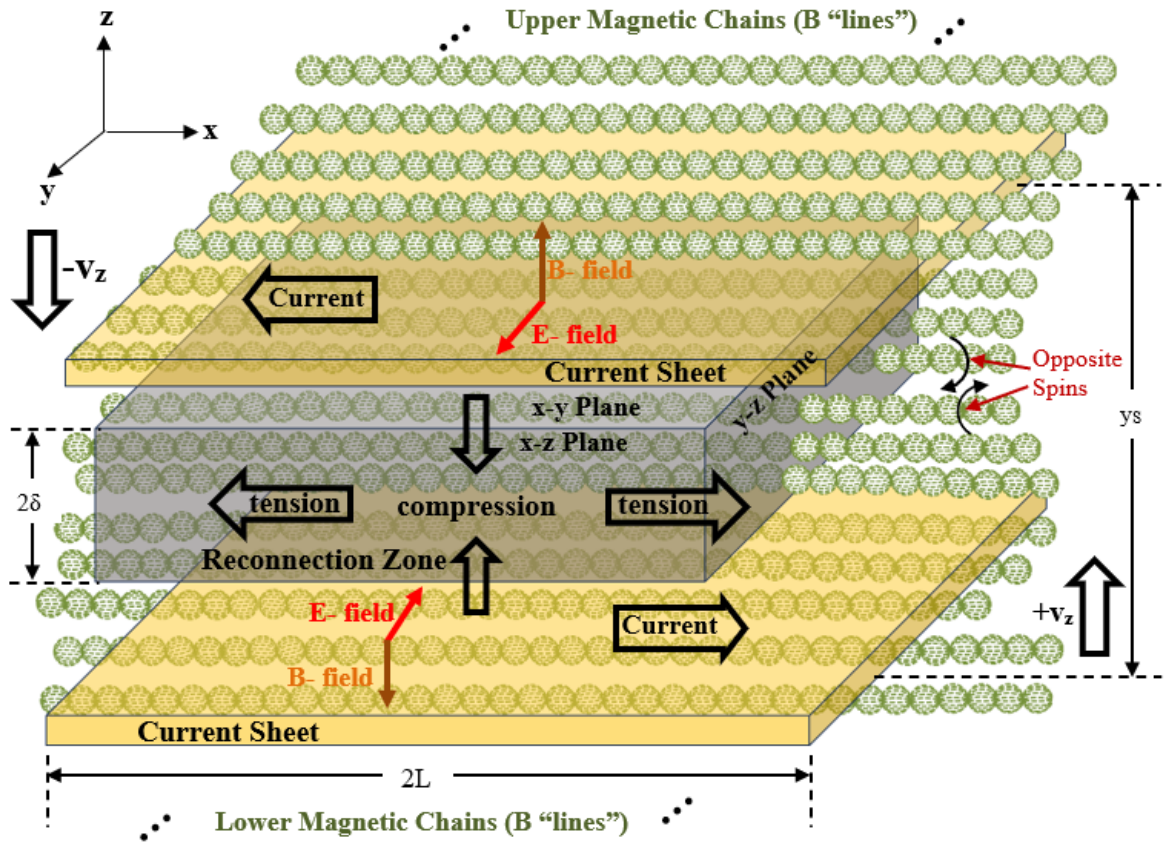
Figure 6.
Schematic representation of the released products associated with magnetic-chain collision or localized fragmentation. In the Photony interpretation, colliding or overloaded magnetic chains may release stored magnetic energy in the forms of elemental charge photons, classical photons, surviving chainlets, and larger chain sections. The emitted classical photons may span a broad spectrum, including visible light as well as infrared, ultraviolet, X-ray, and gamma-ray radiation. At observable scales, the release may also be associated with particle acceleration, localized heating, plasma motion, and subsequent magnetic reassignment or reconnection.
Figure 6.
Schematic representation of the released products associated with magnetic-chain collision or localized fragmentation. In the Photony interpretation, colliding or overloaded magnetic chains may release stored magnetic energy in the forms of elemental charge photons, classical photons, surviving chainlets, and larger chain sections. The emitted classical photons may span a broad spectrum, including visible light as well as infrared, ultraviolet, X-ray, and gamma-ray radiation. At observable scales, the release may also be associated with particle acceleration, localized heating, plasma motion, and subsequent magnetic reassignment or reconnection.
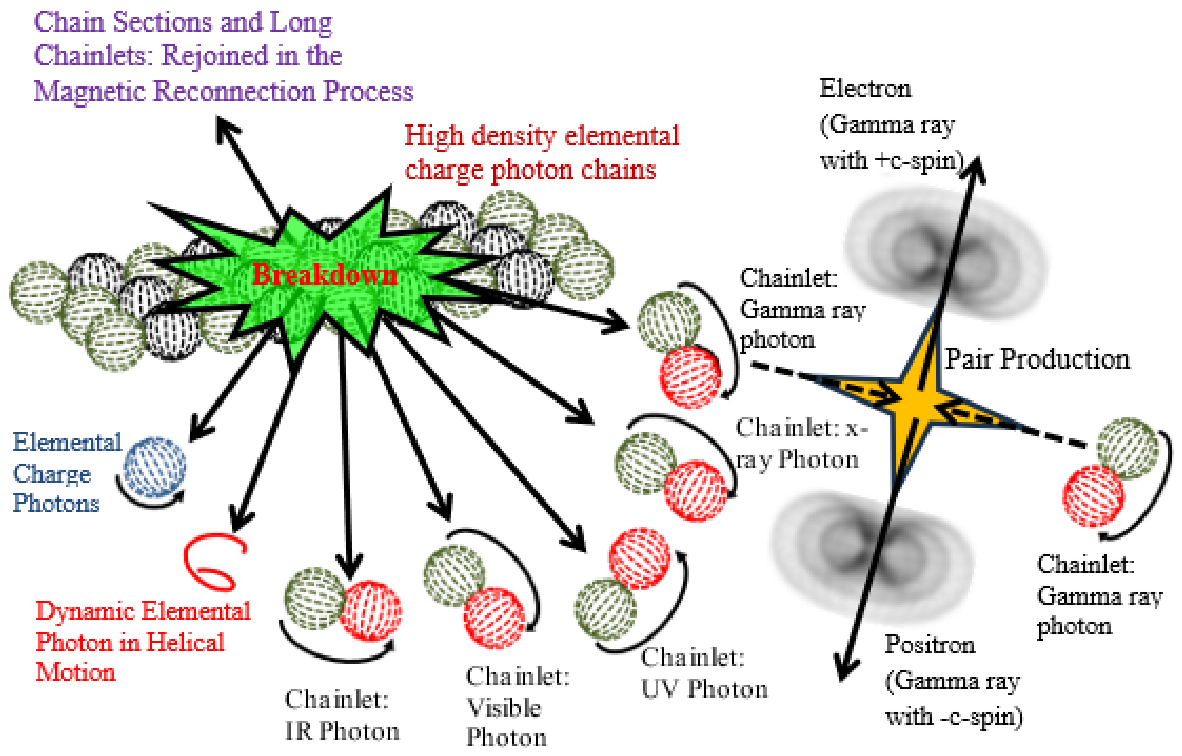

Table 1.
Principal characteristics of the proposed magnetic-breakdown regime.
| Characteristic | Magnetic Breakdown |
|---|---|
| Primary physical organization | Dynamic magnetic-chain organization maintained by internal free electrons associated with pre-existing current |
| Typical pre-event environment | Highly conducting material or plasma containing an established current-supported magnetic structure |
| Current before onset | Already present and supporting magnetic fibrils, flux tubes, coronal loops, flux ropes, current layers, or related magnetic structures |
| Structure crossing the threshold | Pre-existing magnetic chains, magnetic fibrils, or a larger current-supported magnetic organization |
| Principal stored-energy reservoir | Magnetic energy embodied in the assembled and maintained current-supported structure, including additional free energy associated with stress, curvature, compression, twist, interaction, and confinement |
| Important loading variables | Magnetic-field strength, current density, magnetic-chain density, fibril curvature, compression, stretching, twist, interaction, confinement, and reassignment capacity |
| Stable pre-threshold responses | Expansion, deformation, current redistribution, reduced loading, or non-destructive magnetic reassignment |
| Threshold condition | Structural loading exceeds the capacities for stable accommodation and continuous reassignment |
| Immediate proposed consequence | Localized loss of magnetic-chain continuity and fragmentation of part of the pre-existing magnetic organization |
| Initial observable products | Radiation, particle acceleration, localized heating, plasma motion, current redistribution, and magnetic-field change |
| Initial temporal sequence | Magnetic loading followed by a local structural threshold crossing, fragmentation, initial energy release, and current redistribution |
| Relationship to reassignment | Surviving chains and fibrils may be redirected into new admissible pathways after or during the initial fragmentation |
| Relationship to reconnection | Magnetic breakdown initiates the local rapid energy release and may accompany the developing macroscopic connectivity change described as magnetic reconnection |
| Representative proposed environment | Solar active regions containing strongly stressed, pre-existing, current-supported magnetic structures |
| Primary classification evidence | A localized magnetic structural instability initiates the earliest rapid energy release as the system enters magnetic reassignment and reconnection. |
Disclaimer/Publisher’s Note: The statements, opinions and data contained in all publications are solely those of the individual author(s) and contributor(s) and not of MDPI and/or the editor(s). MDPI and/or the editor(s) disclaim responsibility for any injury to people or property resulting from any ideas, methods, instructions or products referred to in the content. |
© 2026 by the authors. Licensee MDPI, Basel, Switzerland. This article is an open access article distributed under the terms and conditions of the Creative Commons Attribution (CC BY) license (http://creativecommons.org/licenses/by/4.0/).
Copyright: This open access article is published under a Creative Commons CC BY 4.0 license, which permit the free download, distribution, and reuse, provided that the author and preprint are cited in any reuse.


