
Submitted:
06 August 2026
Posted:
10 August 2026
You are already at the latest version
Abstract
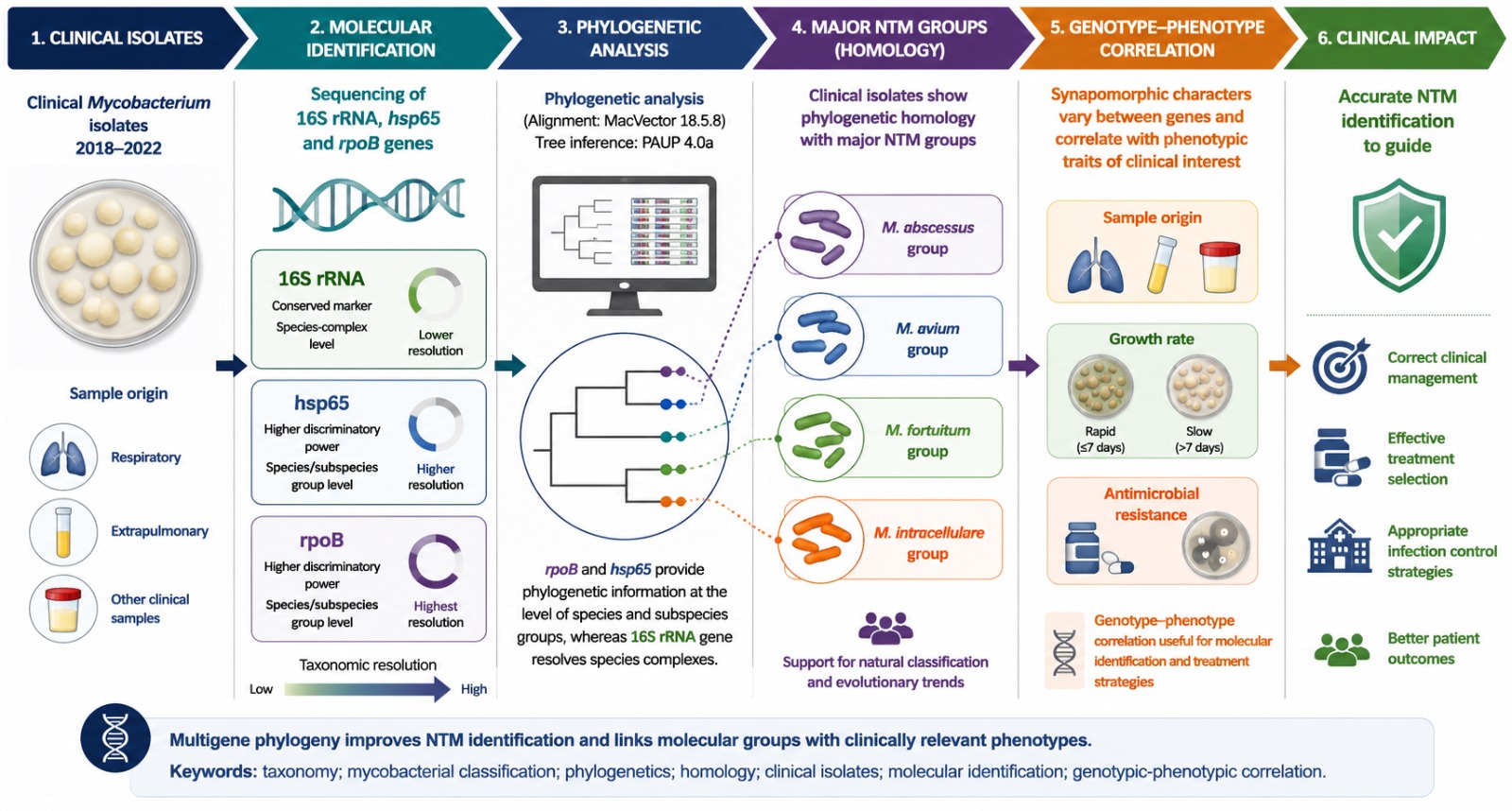
Due to the differential treatment required by non-tuberculous mycobacteria (NTM) infections, accurate identification in clinical isolates is necessary for correct management, effective treatment, and appropriate control strategies. Traditional methods, including phenotypic tests, are slow, cumbersome, and often not definitive. PCR-based methods, such as restriction fragment length polymorphism analysis, are still very time-consuming and sometimes lead to inaccurate identification because they handle fragments of different sequences but do not agree with their evolutionary origin. Sequencing is the most accurate method for species identification, with the 16S rRNA, hsp65, and rpoB genes being considered as candidates for phylogenetic and diagnostic studies. In this study, we developed a phylogenetic analysis using the 16S rRNA, hsp65, and rpoB gene sequences of Mycobacterium clinical isolates, collected between 2018 and 2022, for taxonomic categorization of Mycobacterium species, and evaluated their use for Mycobacterium species identification of clinical interest. In addition, we analyzed the genotype-phenotype correlation using characteristics such as sample origin, growth rate, and antimicrobial resistance. An alignment matrix was built (MacVector 18.5.8) based on the sequences generated in this study and sequences retrieved from NCBI, and phylogenetic analyses were performed using PAUP 4.0a. The rpoB and hsp65 markers showed phylogenetic information at the level of groups of species and subspecies, while the 16S rRNA gene was shown to be the most conserved gene, yielding a structure at the level of species complexes that can be used as a first level of identification. The clinical isolates showed phylogenetic homology with the M. abscessus, M. avium, M. fortuitum, and M. intracellulare groups. The synapomorphic characters varied between genes analyzed, showing a correlation between genotype and phenotype useful for evolutionary trends, natural classification, and molecular identification methods for clinical and treatment purposes. Keywords: taxonomy; mycobacterial classification; phylogenetics; homology; clinical isolates; molecular identification; genotypic-phenotypic correlation.
Keywords:
taxonomy
; mycobacterial classification
; phylogenetics
; homology
; clinical isolates
; molecular identification
; genotypic-phenotypic correlation
Copyright: This open access article is published under a Creative Commons CC BY 4.0 license, which permit the free download, distribution, and reuse, provided that the author and preprint are cited in any reuse.


