
Submitted:
06 August 2026
Posted:
07 August 2026
You are already at the latest version
Abstract
Rare actinobacteria are promising sources of specialized metabolites, yet genome mining still prioritizes genomes encoding many biosynthetic gene clusters (BGCs) rather than clusters that are distant from characterized chemistry. Here, we describe the isolation, for the first time, of a novel Jiangella strain reported from a marine, animal-associated plastisphere, and place its biosynthetic repertoire in the context of the whole genus. Digital DNA-DNA hybridization (57.8%) and OrthoANIu (94.65%) values against its closest relative, J. alba DSM 45237ᵀ, support its assignment as a candidate novel species. antiSMASH predicted twelve BGCs, within the range observed across the genus (7-13), of which only one matched a characterized pathway, and the Biosynthetic Novelty Index of the genome was 865.3, the fourth highest among the twelve genomes analyzed. Across these genomes, 124 BGCs grouped into 70 gene cluster families, 74% of them strain-specific. Two families without any characterized representative, a lasso-peptide family and a RiPP recognition element-containing family, were instead conserved across a subclade, down to nearly identical precursor peptides. No antimicrobial activity was detected under the conditions tested. Genus-wide comparison therefore identifies conserved yet uncharacterized families as rational priorities that cluster counts alone would miss.
Keywords:
Jiangella
; rare actinobacteria
; comparative genomics
; genome mining
; biosynthetic gene clusters
; gene cluster families
; lasso peptide
; plastisphere
; Caretta caretta
1. Introduction
Rare actinobacteria -genera recovered far less frequently than Streptomyces under standard cultivation conditions, and correspondingly less studied - are of interest for natural product discovery not for the quantity of specialized metabolism they encode, but because their evolutionary distance from well-studied taxa makes their chemistry more likely to differ from what is already known [1]. In bacteria, the genes responsible for the biosynthesis of specialized metabolites are organized in biosynthetic gene clusters (BGCs), and clusters encoding related pathways in different strains can be grouped into gene cluster families (GCFs) [2]. Genome mining now predicts more BGCs than can be experimentally investigated, shifting the bottleneck from detection to selection [3]. Genomes are commonly ranked by the number of predicted clusters, a criterion that favors biosynthetically prolific taxa and is insensitive to how far those clusters lie from characterized chemistry. The Biosynthetic Novelty Index (BiNI) was introduced to address this limitation, weighting each predicted cluster according to its distance from known gene cluster families rather than counting clusters, thereby providing a more informative measure of biosynthetic novelty [4].
Biosynthetic novelty alone, however, provides only part of the picture. Without an evolutionary framework, it is difficult to establish whether a predicted cluster represents a conserved feature of a lineage, a recent strain-specific acquisition, or, particularly in draft genomes, a prediction artifact. Comparative analyses across multiple genomes of the same genus resolve this ambiguity, as a gene cluster family recovered independently from several assemblies is unlikely to be an artifact, and its distribution can be interpreted against the phylogeny of the group. Evolutionary information of this kind is one of the criteria proposed for prioritizing BGCs [5], and genus-wide comparisons have been carried out in Salinispora [6], Amycolatopsis [7] and Streptomyces [8]. These studies revealed a recurring organization, in which a small set of families conserved across the genus coexists with a much larger accessory fraction: the conserved core is largely inherited vertically, whereas horizontal transfer contributes substantially to the accessory repertoire, in proportions that differ markedly between genera. Conservation, on its own, says nothing about whether a family has been studied: a family may recur throughout a genus and still have no experimentally characterized representative. This combination is informative, because recurrence across independently sequenced species indicates that the cluster is real and has been maintained by the lineage, whereas the absence of a characterized representative indicates that its product is unknown. Families with both features are therefore rational starting points for experimental work.
Novel actinobacterial taxa encoding uncharacterized biosynthetic pathways continue to be described from extreme and poorly sampled habitats [9]. One such underexplored niche is marine plastic debris, a durable artificial substrate that is rapidly colonized by complex microbial biofilms, collectively referred to as the plastisphere [10]. While culture-independent surveys have revealed considerable taxonomic diversity within these communities [10,11], culture-dependent work has concentrated on pathogens and antibiotic-resistant bacteria [12] and on polymer-degrading strains. Marine actinomycetes are of particular interest in this respect, as the same lineages that hydrolyze synthetic polyesters also frequently accumulate polyhydroxyalkanoates (PHAs), placing them at the intersection of plastic waste valorization and bioplastic production [13]. Their capacity to produce specialized metabolites from this niche has, by contrast, received little attention. Plastic debris recovered from the digestive tract of marine vertebrates represents an even less explored niche. Loggerhead sea turtles (Caretta caretta), which frequently ingest plastic debris and are widely recognized as sentinels of marine litter in the Mediterranean Sea [14], retain ingested fragments in the digestive tract for prolonged periods [15], and the biofilms recovered from them have therefore been exposed to the host gut environment - a combination of substrate and environment that has not been examined as a source of biosynthetically novel actinobacteria.
Following this lead, we isolated a strain of Jiangella from these plastic debris recovered from the gut of a Mediterranean loggerhead sea turtle. The genus Jiangella comprises a rare actinobacterial lineage first described in 2005 [16], currently including eleven validly published species recovered from a wide range of different environments, including arid and desert soils, caves and mangrove sediments, as well as from plant tissues [16,17,18,19]. The jiangrines and jiangolide, isolated from Jiangella gansuensis are the first specialized metabolites reported from the entire order Jiangellales, and most of them showed anti-inflammatory activity [20,21]. The genus therefore remains almost entirely unexplored from a biosynthetic perspective, and its specialized metabolism has never been examined within a comparative evolutionary framework.
In the present study, we characterized strain BA12 phenotypically and by whole-genome sequencing and placed its biosynthetic repertoire in the context of all publicly available Jiangella genomes meeting our quality criteria. Our aims were to establish the taxonomic position of the strain, to annotate its BGCs with complementary detection tools and quantify their distance from characterized cluster families using BiNI across the genus, to describe how biosynthetic diversity is organized within Jiangella, and to identify cluster families that are conserved across the genus yet lack any characterized representative, as priorities for future functional work.
2. Results
2.1. Morphological and Phenotypic Characterization
Strain BA12 was recovered as part of a broader collection of isolates from the plastisphere of Caretta caretta; the present study focuses on this isolate. 16S rRNA gene Sanger sequencing and further BLAST analysis assigned strain BA12 to the genus Jiangella. Strain BA12 showed morphological characteristics commonly present in the Jiangella genus. Colonies were cream to off-white (Figure 1A,B). A white and velvety colony phenotype was associated with the development of a thin aerial mycelium; margins were generally regular, although in some cases an irregular expansion was observed. Growth on ISP2 was abundant at 30 °C (+++), moderate at 37 °C (++), limited at 20 and 25 °C (+) and absent at 50 °C (−). No diffusible pigment was observed under any condition tested. No inhibition zone was observed in the agar plug diffusion assay against Kocuria rhizophila, Staphylococcus aureus or Escherichia coli, on any of the four media tested.
2.2. Genome Analysis
The draft genome of strain BA12 comprised 27 contigs totaling 7,462,732 bp, with the largest contig of 1,369,243 bp, an N50 of 886,138 bp (L50 = 4), and a G+C content of 72.81 mol%. Quality-filtered reads corresponded to an average genome coverage of 287×. Genome completeness and contamination estimated with CheckM were 100.00% and 0.59%, respectively. Annotation with PGAP predicted 6,815 genes, 46 tRNAs, and 3 rRNAs (Table 1, Figure 2).
2.3. Phylogenomic Analysis and Species Delimitation
A nearly full-length 16S rRNA gene (~1,517 bp) recovered from the assembly was most similar to that of Jiangella alba (99.80 % identity), followed by other members of the genus Jiangella (Table S1). All best hits belonged to Jiangella, placing strain BA12 within this genus.
In the core-gene phylogeny (Figure 3), all validly published Jiangella type strains formed a strongly supported monophyletic clade, with Haloactinopolyspora spp. as its sister group. Within this clade, strain BA12 was recovered in a robust sister relationship with the clade formed by the type strain of J. alba and Jiangella sp. DSM 45060 (bootstrap support 1.00); this group joined J. muralis with equally strong support (1.00), whereas the successive node including J. endophytica received moderate support (0.63).
Classification with GTDB-Tk placed strain BA12 in the genus Jiangella without assigning it to any described species. dDDH values (formula d4) between strain BA12 and the type strains of all validly published Jiangella species were well below the 70 % species threshold (Table 2). The highest value was obtained against J. alba DSM 45237ᵀ (57.8 %), followed by J. muralis DSM 45357ᵀ (51.0 %); all remaining type strains gave values ≤ 37.7 %. Type-based species clustering in TYGS assigned BA12 to a distinct species cluster, not shared with any described Jiangella species.
Consistent with the dDDH results, the OrthoANIu value between BA12 and its closest relative, J. alba DSM 45237ᵀ, was 94.65 %, followed by J. muralis DSM 45357ᵀ (93.23 %) and J. endophytica KE2-3ᵀ (89.35 %).
2.4. Biosynthetic Potential
Genome mining with antiSMASH predicted twelve BGCs in the genome of strain BA12, ranging from 10.8 to 42.5 kb and distributed over seven contigs (Table 3, Figure 2). None of the twelve regions was truncated by a contig boundary. One cluster showed high similarity to a characterized pathway, two showed low similarity, and the remaining nine had no close match in the MIBiG database. The BiNI of the genome was 865.3, with nine of the twelve clusters exceeding the novelty threshold (d > 900) [4]; all twelve regions were reported as complete by BiG-FAM, none being truncated by a contig boundary. DeepBGC independently predicted 100 candidate regions, 61 of which were not assigned to a known product class and predicted antibacterial activity for 71 of the 100 regions; the complete set of DeepBGC predictions is reported in Supplementary Table S2.
The only cluster with a close characterized counterpart was the type III polyketide synthase (T3PKS) cluster of region GA3_5.r2 (41.1 kb), three of whose proteins shared 59–65 % identity (KnownClusterBlast; Table S6) with SGR_470, SGR_471 and SGR_472 of the phenolic lipid biosynthetic cluster of Streptomyces griseus (MIBiG BGC0000282). Two further clusters retained only weak similarity to characterized pathways: a non-ribosomal peptide synthetase (NRPS)-independent siderophore (NI-siderophore) cluster (GA3_1.r1; 33.3 kb) related to schizokinen, and a hydrogen-cyanide cluster (GA3_1.r2; 12.8 kb) related to aborycin.
Five of the twelve clusters were assigned to RiPP or RiPP-associated classes. The most complete was the lasso-peptide cluster of region GA3_2.r1 (22.5 kb), which encoded a complete set of predicted maturation enzymes - a PF00733 lasso cyclase, a B2 leader peptidase and a PqqD-family RiPP recognition element - together with two distinct precursor peptides of 47 and 44 residues sharing a conserved leader ending in the same GSVRELTL motif (Table S5). RODEO identified both as the highest-scoring lasso precursors of the cluster and placed the leader-core boundary immediately after this motif, predicting in each case a nine-residue macrolactam closed between an N-terminal alanine and an aspartate at position 9, an aromatic-rich loop, and core masses of 2859 and 2718 Da; no paired cysteines were present in either core. Both obtained the highest heuristic scores within the cluster (10 and 9) but were classified as negative by the tool's binary classifier. The redox-cofactor cluster of region GA3_2.r2 (29.5 kb) corresponded to a complete predicted mycofactocin locus, encoding a putative MftA precursor (34 residues; C-terminal core DGMCGVY) together with MftB, the radical S-adenosylmethionine (SAM) maturase MftC, and MftD, MftE and MftF [22], and was independently recovered by BAGEL4. Region GA3_14.r1 (20.3 kb) was organized around a PqqD-family RiPP recognition element with a DUF6355-family protein as putative precursor, flanked by two methyltransferases and three glycosyltransferases, and also encoded an ABC transporter permease and its ATP-binding subunit.
Of the two clusters assigned to the antiSMASH “RiPP-like” category, region GA3_8.r1 (10.8 kb) encoded a putative family-1 encapsulin shell protein together with a dye-decolorizing (DyP-type) peroxidase and an adjacent SigE-family sigma factor, while region GA3_7.r1 (11.5 kb) contained no identifiable precursor peptide. A genome-wide BAGEL4 analysis recovered the mycofactocin and encapsulin loci but not the lasso-peptide or RiPP recognition element-containing clusters and returned no further areas of interest apart from a radical-SAM-associated call within the terpene-precursor region (GA3_5.r1) that lacked a recognizable precursor peptide.
The remaining four clusters had no close match to characterized pathways: a terpene-precursor cluster (GA3_5.r1; 21.1 kb), an N-acetylglutaminylglutamine amide (NAGGN) cluster (GA3_6.r1; 18.2 kb), an NRPS-like cluster (GA3_6.r3; 42.5 kb) and an uncharacterized cluster assigned by antiSMASH to the “other” category (GA3_6.r2; 40.5 kb), which returned no significant hit in the MIBiG database. In the terpene-precursor cluster, the only gene matching a biosynthetic rule was a polyprenyl synthetase of the farnesyl pyrophosphate synthase (FPPS)-like family, accompanied by a phytoene desaturase family protein but by neither a phytoene synthase nor a terpene cyclase. In the NRPS-like cluster, the only gene matching a biosynthetic rule was an AMP-binding protein with an adjacent PP-binding domain, for which antiSMASH returned no substrate prediction. In the “other” cluster, the assignment rested on two adjacent genes encoding a neocarzinostatin apoprotein domain-containing protein and an HtaA domain-containing protein; the antiSMASH transcription factor binding site (TFBS) finder predicted a binding site for the iron-dependent regulator DmdR1 with medium confidence in the intergenic region immediately upstream of them, and the remaining genes of the region encoded transporters and catabolic enzymes.
2.5. Comparative Analysis of Biosynthetic Gene Clusters Across the Genus Jiangella
The number of BGCs per genome ranged from 7 to 13 (median 11); strain BA12, with 12, was exceeded only by J. alba (13). BiNI, calculated for all twelve genomes under identical conditions (Table S7), ranged from 335.0 in J. anatolica to 1217.4 in J. mangrovi, with a median of 787.6, and strain BA12 ranked fourth. Twenty-four of the 112 regions predicted in the reference genomes were reported as fragmented by BiG-FAM, concentrated in the least contiguous assemblies: seven of ten in J. aurantiaca, six of ten in J. anatolica, five of seven in J. ureilytica, and five of ten in J. asiatica. Fragmented regions had a lower mean distance than complete ones (898.5 against 959.8), so the index is underestimated in those genomes.
The 124 BGC regions predicted across the twelve genomes were grouped into 70 GCFs at a distance cut-off of 0.3, comprising 8 common (11 %), 10 rare (14 %) and 52 strain-specific families (74 %) (Table S4). At a cut-off of 0.5, the same regions resolved into 47 families, of which 10 were common (21 %), 6 rare (13 %), and 31 strain-specific (66 %). Several antiSMASH product classes were represented by more than one family shared by two or more genomes, including three RiPP-like families and two families each of RiPP recognition element-containing, terpene-precursor, NAGGN, NRPS-like and NI-siderophore clusters (Figure 4).
Of the twelve BGCs of strain BA12, ten fell into families shared with at least one other genome - six common and four rare at a cut-off of 0.3 - and two formed strain-specific families. Across the dataset, the number of strain-specific families per genome ranged from two to six; strain BA12, J. muralis, and Jiangella sp. DSM 45060 each carried two, the lowest value observed.
The most widely distributed families were the hydrogen-cyanide family, present in 10 of the 12 genomes, the terpene-precursor and mycofactocin families, each present in 7 (in J. anatolica the mycofactocin region is classified by antiSMASH as a ranthipeptide), and the NRPS-like family, present in 6. All five RiPP and RiPP-associated clusters of BA12 belonged to families shared within the genus. The lasso-peptide family comprised four strains (BA12, J. alba, J. muralis and Jiangella sp. DSM 45060) at a cut-off of 0.3 and six at 0.5, additionally including J. asiatica and J. gansuensis. The RiPP recognition element-containing family comprised three strains at 0.3 (BA12, J. muralis and Jiangella sp. DSM 45060) and six at 0.5, additionally including J. alba, J. asiatica and J. gansuensis. Of the remaining RiPP families, the encapsulin-associated RiPP-like family was present in three strains and the second RiPP-like family in two. At the precursor level (Table S5), the 47-residue lasso precursor of BA12 was identical in all members of the lasso-peptide family, whereas the 44-residue precursor was identical to that of J. muralis and differed by a single substitution (Asn to Asp) from that of J. alba and by two from that of Jiangella sp. DSM 45060. The DUF6355 putative precursor of the RiPP recognition element-containing cluster differed from its homologs in J. alba, J. muralis and Jiangella sp. DSM 45060 by two substitutions over the shared region, the annotated coding sequences differing additionally in the position of the start codon.
Some functions conserved across the genus were nevertheless encoded by clusters that did not group into a single family. The NAGGN cluster was detected in all genomes except Jiangella sp. DSM 45060 but resolved into four families at a cut-off of 0.3: BA12 grouped with J. alkaliphila, J. mangrovi and J. ureilytica; J. muralis fell into the largest family (five genomes); and J. alba and J. endophytica each formed a singleton. The NI-siderophore cluster was detected in all twelve genomes but resolved into ten families at the same cut-off, most of them singletons, with the BA12 family shared only with Jiangella sp. DSM 45060; at a cut-off of 0.5, the number of genomes sharing this family rose to eight. The most extreme case was the T3PKS class, predicted in all twelve genomes (13 regions, J. aurantiaca carrying two), in which every region was assigned to a family of its own at a cut-off of 0.3 (Table S4).
The two strain-specific families of BA12 corresponded to the T3PKS cluster of region GA3_5.r2 and to the uncharacterized cluster (“other”) of region GA3_6.r2 (Table 3). The former showed similarity to the phenolic lipid cluster of Streptomyces griseus, whereas the latter returned no significant match in the MIBiG database and was absent from all other genomes at both cut-offs.
3. Discussion
Strain BA12 represents a candidate novel species of the genus Jiangella. The highest genome-relatedness values it shares with any type strain fall below the 70% dDDH and 95–96% ANI thresholds that delineate prokaryotic species [23], and both the type-based clustering in TYGS and the core-gene phylogeny recover it as a distinct lineage sister to J. alba.
Its source is equally unusual: To our knowledge, strain BA12 is the first member of the genus Jiangella to be isolated from the biofilm colonizing plastic debris ingested by a loggerhead sea turtle, as previously described species originate from desert and coastal soils, caves, mangrove sediments and plant tissues [17,18,19,24,25]. This extends the known ecological range and adds a marine, animal-associated substrate to the habitats from which members of the genus have been isolated.
Genome mining with antiSMASH identified 12 BGCs, consistent with the range observed across the genus and well supported by the contiguity of the assembly (27 contigs, N50 886 kb). The interest of this strain lies primarily in the novelty of its clusters rather than their number: only three of the twelve BGCs showed similarity to previously characterized clusters, the single strong match being the T3PKS cluster of region GA3_5.r2, while the two weak matches involved peripheral genes only, with no hit to a core biosynthetic gene in either case (Table S6). Consistently, the BiNI of BA12 (865.3) is high relative to values reported for other rare actinobacterial genera, exceeding the genus-level means reported by González-Salazar et al., which ranged from 155.2 to 548.4 [4]. Within Jiangella, however, this value is not exceptional: BA12 ranks fourth among twelve genomes, whereas the genus median is 787.6. The elevated biosynthetic divergence therefore appears to be a characteristic of the lineage rather than a unique feature of this strain. If anything, the ranking is favorable to BA12, as three genomes with lower BiNI values contain a high proportion of fragmented BGCs, a factor expected to underestimate the index. Because BiNI also depends on the antiSMASH version used for BGC prediction (v8.0.4 here versus v6.0 in the original study), comparisons with published values should be interpreted as indicative rather than directly quantitative. Of the nine BGCs lacking a MIBiG match, three could be assigned a confident function based on conserved gene content and synteny with characterized systems: the canonical mycofactocin (mftA–mftF) locus, a redox-cofactor pathway of central rather than specialized metabolism [22]; the NAGGN cluster, encoding an osmoprotectant compatible solute (46), a function compatible with the osmotic stress encountered in both saline and arid habitats; and an encapsulin-associated locus encoding the shell protein together with its DyP-type peroxidase cargo, a system indicative of a role in oxidative stress resistance and particularly common among Actinobacteria [26]. Although these loci are detected by antiSMASH because they conform to recognized biosynthetic architectures, they do not encode specialized metabolites in the conventional sense.
Of the remaining six BGCs, none showed similarity to a characterized reference. The second RiPP-like cluster (GA3_7.r1) lacks an unambiguous precursor peptide call, precluding any structural inference. The terpene-precursor cluster contains a polyprenyl synthetase of the FPPS-like family and a phytoene desaturase family protein, but neither a phytoene synthase nor a terpene cyclase, so the pathway cannot be reconstructed, and no scaffold can be inferred. The NRPS-like cluster's adenylation domains did not yield confident substrate-specificity codes, leaving the peptide backbone composition unresolved. The "other" region (GA3_6.r2) is a borderline case: its assignment rests on two adjacent genes encoding a neocarzinostatin apoprotein domain protein and an HtaA-domain protein, with a DmdR1 binding site predicted immediately upstream, features that in actinobacteria are associated with iron and heme acquisition rather than with secondary metabolism [27,28].
Against this backdrop, the lasso-peptide locus of region GA3_2.r1 and the RiPP recognition element-containing locus of region GA3_14.r1 stand out as the most compelling candidates for detailed analysis, since for both the maturation machinery and precursor peptide could be confidently assigned despite the absence of a MIBiG match. The lasso-peptide locus encodes a complete set of maturation enzymes - a lasso cyclase, a B2 leader peptidase, and a PqqD-family RiPP recognition element - together with two distinct precursor peptides of 47 and 44 residues sharing a conserved leader ending in the same GSVRELTL motif, suggesting a small family of related products from a single locus. RODEO placed the leader–core boundary immediately after this motif, consistent with the threonine that occupies the penultimate position of lasso leader peptides and acts as a recognition element for the maturation machinery [29] and predicted in both cases a nine-residue macrolactam closed between the N-terminal alanine and an aspartate at position 9, followed by an aromatic-rich loop. Both features are canonical: small residues are strongly preferred at the first core position of characterized lasso peptides (Gly 62%, Ala 16%), and the acceptor residue falls within the seven- to nine-residue range reported for the lasso macrolactam [30,31]. The RiPP recognition element-containing locus shows a comparable situation: a recognition element, a putative precursor, tailoring enzymes and an ABC export system are all present, which is the canonical composition of a RiPP pathway [30], yet the combination of methylation and glycosylation points to a heavily modified peptide that cannot be assigned to any described class. For neither locus did KnownClusterBlast detect a counterpart among the characterized clusters of the MIBiG repository. In both cases, therefore, the biosynthetic logic can be read in full from the sequence while the nature of the product cannot be predicted from it, which is precisely where sequence-based inference reaches its limit.
Comparative analysis of the predicted BGCs with BiG-SCAPE among strains of the Jiangella genus revealed a smaller, conserved repertoire alongside a larger, variable fraction, a pattern consistent with what has been reported for other actinobacterial genera [6,7,8]. The distribution of these families broadly mirrors the phylogeny of the genus (Figure 4), suggesting that vertical inheritance, together with lineage-specific gain and loss, has been the dominant force shaping the biosynthetic repertoire. This repertoire can be partitioned into three components.
The first is a small biosynthetic core shared by most species, within which the hydrogen-cyanide, terpene-precursor, mycofactocin and NRPS-like families are the most broadly conserved.
The second is an intermediate set of families restricted to the subclade formed by BA12, J. alba, J. muralis and Jiangella sp. DSM 45060 and absent from J. endophytica and all more distantly related lineages; it includes the lasso-peptide, RiPP recognition element-containing and encapsulin-associated families, none of which corresponds to a characterized biosynthetic pathway. The lasso peptide locus features a 47-residue precursor, which is identical in all four strains, and a second 44-residue precursor differing by a single substitution (Asn to Asp) from that of J. alba and by two from that of Jiangella sp. DSM 45060. This substitution falls outside the macrolactam ring and is therefore not expected to alter the topology of the product. The putative precursor of the RiPP recognition element-containing cluster is likewise nearly identical to those of the other three strains. Both families are therefore conserved across the subclade down to the precursor peptide itself, and to our knowledge no lasso peptide has so far been isolated from any member of the genus Jiangella. This is not unexpected, since lasso peptides are frequently undetectable in their native host under standard culture conditions and heterologous expression is the established route to access such clusters (Cheng & Hua, 2020).
The third group comprises strain-specific families, which account for approximately three quarters of all families delineated at a BiG-SCAPE cut-off of 0.3. These require cautious interpretation, however, because a family represented by a single genome cannot readily be distinguished from a locus fragmented by assembly breaks or from an artifactual prediction. Only two of the twelve BA12 BGCs formed strain-specific families, a value at the lower end of the range observed across the dataset (two to six per genome) and shared with J. muralis and Jiangella sp. DSM 45060. One of these is the T3PKS cluster of region GA3_5.r2, three of whose proteins shared 59–65% identity with SrsA, SrsB and SrsC (SGR_470–SGR_472) of the phenolic lipid cluster of Streptomyces griseus. The three genes are contiguous and transcribed in the same direction, reproducing the organization of the S. griseus operon, so the correspondence rests on conserved gene order as well as on sequence similarity. In S. griseus, these enzymes produce alkylresorcinols and alkylquinones that are incorporated into the cell membrane and contribute to membrane integrity and resistance to beta-lactams [32]. Whether the BA12 cluster performs the same function cannot be established from sequence alone, and a UbiA-family prenyltransferase encoded divergently from the operon, with no counterpart in the S. griseus cluster, suggests that the product may differ. As noted above, every T3PKS predicted in the genus formed a family of its own, so the strain-specific status of this cluster reflects a genus-wide pattern rather than a peculiarity of BA12. The other strain-specific family corresponds to the "other" region GA3_6.r2 (40.5 kb), whose iron- and heme-related features make its assignment as a biosynthetic cluster uncertain. This family is absent from all other Jiangella genomes analyzed, at both cut-offs.
This three-layer picture depends nonetheless on where the similarity threshold is placed. The NAGGN and NI-siderophore functions are conserved across the genus, yet each resolves into several families at a cut-off of 0.3, and the RiPP recognition element-containing cluster of J. alba forms a family of its own even though its precursor peptide differs from that of BA12 by only two residues. Family assignment therefore reflects the similarity of entire predicted regions rather than the conservation of the biosynthetic function they encode, and counts obtained at a single cut-off should be read with this in mind.
Overall, these observations qualify the lasso-peptide and RiPP recognition element-containing families as the most promising targets within the genus: they are conserved across a subclade, and therefore unlikely to be artifacts of a single assembly, yet they have no counterpart among characterized clusters. In addition, lasso peptides are known to combine unusual thermal and proteolytic stability with a broad range of reported activities, including antibacterial action, enzyme inhibition and receptor antagonism [30,31], and this combination makes an entirely uncharacterized, genus-conserved family of this class a target worth investigating further.
The tools used gave partly different pictures of the same genome. antiSMASH, rule-based, provided the cluster set used throughout, but its RiPP-like category proved heterogeneous. DeepBGC flagged 100 candidate regions, mostly unclassified, and recovered only one antiSMASH RiPP cluster, at low confidence. Lacking both a class assignment and defined boundaries, these regions could not be prioritized or compared across genomes, so the rule-based antiSMASH set was used throughout (Table S2). BAGEL4 and RODEO performed well on loci with known counterparts but poorly on the two divergent ones. Combining complementary approaches is therefore advisable in taxa for which few reference pathways are available.
BA12 produced no detectable antimicrobial activity against the indicator strains under standard laboratory conditions, although DeepBGC predicted antibacterial activity for the majority of its candidate regions. This is not in itself surprising: only a subset of the predicted clusters would be expected to encode antibacterial metabolites, and many BGCs are transcriptionally silent or only weakly expressed under standard laboratory conditions [33]. Moreover, the bioassay employed here was limited to detecting growth inhibition against three indicator organisms and therefore sampled only a small fraction of the possible biological activities encoded by the genome. Comparative genome mining cannot resolve this discrepancy because it measures relatedness among BGCs rather than the biological function of their products. Consequently, several explanations remain plausible: the relevant clusters may not have been expressed under the conditions tested; they may have produced metabolites that were inactive against the selected indicator strains or active at concentrations below the detection limit of the assay; alternatively, they may encode compounds with biological activities or target spectra not represented in the present screening.
All analyses presented here are in silico; the structures, modifications and bioactivities inferred for the lasso and RiPP recognition element-containing clusters remain to be verified by confirming precursor expression, isolating and characterizing the products by mass spectrometry and nuclear magnetic resonance spectroscopy, and testing broader bioactivity panels under elicitation conditions. The genus-wide comparison also rests on a limited genome set; only twelve assemblies of acceptable quality are currently available for Jiangella, so the classification of families as common, rare, or strain-specific is provisional: it will need revision as more genomes are sequenced, and it remains dependent on the similarity cut-off applied. Finally, although dDDH and OrthoANIu values support assignment of BA12 to a new species, its formal description will require phenotypic and chemotaxonomic characterization [34].
4. Materials and Methods
4.1. Sampling, Isolation and Identification
A transparent plastic film fragment (sample ID 22146) was recovered on 21 August 2024 from the feces of a loggerhead sea turtle (Caretta caretta) that had stranded near Ustica Island (Sicily, Italy; approximately 38.71° N, 13.19° E) and was undergoing rehabilitation at the Istituto Zooprofilattico Sperimentale della Sicilia “A. Mirri” (Palermo, Italy).
The fragment was gently rinsed with sterile distilled water to remove loosely attached debris without disrupting the biofilm, transferred to a sterile tube, and preserved at -20 ºC. A smaller piece of 1x1 cm was cut and resuspended in 1.5 mL of phosphate-buffered saline (PBS). The tube was incubated at 27 °C for 1 h with shaking at 500 rpm; sterile glass beads (0.5 mm in diameter) were then added, and the tube was vortexed for 1 min, with pauses every 15 s, to avoid overheating.
Ten-fold serial dilutions of the resulting suspension were prepared in PBS and 100 µL aliquots were spread-plated, down to 10⁻⁶, onto Blood Agar (Istituto Zooprofilattico Sperimentale della Sicilia, Palermo, Italy), Marine Agar (MA; Conda, Madrid, Spain) and Starch Casein Agar (soluble starch 10 g L⁻¹, casein 0.3 g L⁻¹, KNO₃ 2 g L⁻¹, K₂HPO₄ 2 g L⁻¹, MgSO₄·7H₂O 0.05 g L⁻¹, CaCO₃ 0.02 g L⁻¹, NaCl 30 g L-1, agar 15 g L⁻¹), the last of these supplemented with nalidixic acid (25 µg mL⁻¹). Plates were incubated aerobically at 30 °C for 7-14 days. Colonies were picked and re-streaked onto Tryptic Soy Agar (TSA; Merck Millipore, Darmstadt, Germany) to obtain axenic cultures. For long-term preservation, the isolate was grown in Tryptic Soy Broth (TSB; Merck Millipore, Darmstadt, Germany) at 30 °C with shaking, and glycerol stocks (25 %, v/v) were prepared and stored at -80 °C.
DNA template was obtained directly from a pure culture by colony PCR [35]: one colony was suspended in 100 µL of sterile distilled water, subjected to heat lysis at 99 °C for 15 min, and centrifuged at 10,000 x g for 15 min. The supernatant was recovered and used as a template. The 16S rRNA gene was amplified with primers F1 (5′-GAGTTTGATCCTGGCTCAG-3′) and R12 (5′-ACGGCTACCTTGTTACGACT-3′) using DreamTaq DNA polymerase (Thermo Fisher Scientific, Waltham, MA, USA), with an initial denaturation of 2 min at 95 °C, 35 cycles of 30 s at 95 °C, 30 s at 56 °C and 90 s at 72 °C, and a final extension of 5 min at 72 °C. Amplification was verified by electrophoresis on a 1 % (w/v) agarose gel, and amplicons were Sanger-sequenced with the forward primer by BMR Genomics s.r.l. (Padova, Italy) and compared against the NCBI database by BLASTn.
4.2. Phenotypic Characterization and Antimicrobial Activity
Colony morphology was recorded after 21 days at 30 °C on ISP2 agar (yeast extract 4 g L⁻¹, malt extract 10 g L⁻¹, dextrose 4 g L⁻¹, agar 20 g L⁻¹). Growth at different temperatures was assessed on the same medium by streaking from a fresh plate and scoring the extent of biomass development after 14 days at 20, 25, 30, 37 and 50 °C on a semi-quantitative scale (+++, abundant growth; ++, moderate growth; +, scant growth; −, no growth).
Antimicrobial activity was screened by an agar plug diffusion assay. Strain BA12 was grown for 6-7 days at 30 °C on MA, mannitol-soya flour agar (mannitol 20 g L⁻¹, soya flour 20 g L⁻¹, agar 20 g L⁻¹), Czapek's agar (sucrose 30 g L⁻¹, NaNO₃ 3 g L⁻¹, K₂HPO₄ 1 g L⁻¹, MgSO₄·7H₂O 0.5 g L⁻¹, KCl 0.5 g L⁻¹, FeSO₄·7H₂O 0.01 g L⁻¹, agar 15 g L⁻¹) and R5A agar (K₂SO₄ 0.25 g L⁻¹, MgCl₂·6H₂O 10.12 g L⁻¹, glucose 10 g L⁻¹, casamino acids 0.1 g L⁻¹, yeast extract 5 g L⁻¹, MOPS 21 g L⁻¹, agar 15 g L⁻¹, and 2 mL L⁻¹ of a trace element solution containing ZnCl₂ 0.04 g L⁻¹, FeCl₃·6H₂O 0.2 g L⁻¹, CuCl₂·2H₂O 0.01 g L⁻¹, MnCl₂·4H₂O 0.01 g L⁻¹, Na₂B₄O₇·10H₂O 0.01 g L⁻¹ and (NH₄)₆Mo₇O₂₄·4H₂O 0.01 g L⁻¹; adjusted to pH 6.8 with KOH) and agar plugs (6 mm in diameter) were transferred onto TSA plates previously inoculated with the indicator strains Kocuria rhizophila ATCC 9341, Staphylococcus aureus ATCC 25923 and Escherichia coli ATCC 25922. Plates were incubated at 30 °C for 24 h and activity was recorded as the diameter (mm) of the inhibition zone.
4.3. DNA Extraction
Genomic DNA of strain BA12 was extracted from a 25 mL culture grown in R5A medium for 3 days at 30 °C using a salting-out procedure, adapted from Kieser et al. [36]. Briefly, the cell pellet was resuspended in SET buffer (75 mM NaCl, 25 mM EDTA pH 8.0, 20 mM Tris-HCl pH 7.5) and lysed with lysozyme (1 mg/mL, 37 °C, 1 h), followed by SDS and proteinase K (0.5 mg/mL, 55 °C, 2 h). Proteins were precipitated with 5 M NaCl and removed by chloroform extraction. Genomic DNA was precipitated with isopropanol, spooled, washed with 70 % ethanol, and dissolved in sterile distilled water. DNA purity and concentration were assessed with a NanoDrop spectrophotometer and integrity by 0.8 % agarose gel electrophoresis.
4.4. Whole-Genome Sequencing and Genome Assembly
Whole-genome sequencing and primary bioinformatic analysis were performed by mBioWorks ApS (Copenhagen, Denmark) based on an internal pipeline. Libraries were sequenced on an Illumina NovaSeq 6000 platform (paired end, 2 × 150 bp; ≥ 2 Gb per sample). Sequencing yielded 7,802,320 read pairs of 150 bp. Adapter removal and quality trimming were performed with fastp v0.24.0, retaining 7,749,691 read pairs and corresponding to an average genome coverage of 287×. Reads were assembled de novo with Unicycler v0.5.0. Assembly metrics were computed with QUAST, and genome completeness and contamination were assessed with CheckM. The genome was annotated with the NCBI Prokaryotic Genome Annotation Pipeline (PGAP) [37]. Accession numbers had not yet been assigned at the time of submission and will be provided during review.
4.5. Phylogenomic Analysis and Species Delimitation
Taxonomic placement was first assessed with GTDB-Tk v2.7.2 [38], against GTDB release R226. Genome-based taxonomy was then refined using the Type (Strain) Genome Server (TYGS; https://tygs.dsmz.de) [39,40,41], with nomenclatural information retrieved from the List of Prokaryotic names with Standing in Nomenclature (LPSN) [39,40]. All TYGS and LPSN analyses were performed on 10 July 2026. Within TYGS, the closest type strains were identified both from genome-wide MASH distances [42] and from the 16S rRNA gene, extracted with RNAmmer [43] and compared by BLAST+ [44]. Intergenomic distances were computed with the Genome BLAST Distance Phylogeny approach (GBDP; algorithm 'trimming', distance formula d5) over 100 replicates [45], and digital DNA–DNA hybridization (dDDH) values with confidence intervals were obtained with GGDC 4.0 under recommended settings [40,45]. Type-based species delimitation was carried out using a 70 % dDDH radius around each type strain [41]. A concatenated core-gene maximum-likelihood tree was reconstructed with autoMLST2 (IQ-TREE) [46], with Klenkia taihuensis as the outgroup. The tree was visualized and annotated in iTOL [47]. Average nucleotide identity (ANI) was additionally calculated with the OrthoANIu tool [48] through EzBioCloud (www.ezbiocloud.net/tools/ani; accessed on 13 July 2026). The circular genome map was drawn with Proksee (https://proksee.ca; accessed on 29 July 2026), including genomic features such as coding sequences, tRNA and rRNA genes, GC content, GC skew and the predicted BGC regions; these were computed within Proksee over a 10,000 bp window with a 1,000 bp step [49].
4.6. Bioinformatic Prediction of Biosynthetic Gene Clusters
BGCs were predicted with antiSMASH v8.0.4 under relaxed strictness [50] and with DeepBGC (default parameters, detection score ≥ 0.5) [51]. Similarity to characterized pathways was assessed from the antiSMASH KnownClusterBlast comparison against the MIBiG repository [52]. Biosynthetic novelty was quantified as the BiNI of González-Salazar et al. [4]. Each antiSMASH job was submitted to the BiG-FAM platform (accessed on 5 July 2027), which returns the distance (d) of every predicted region to the closest gene cluster family in the database; the index was calculated as the sum of the distances exceeding the novelty threshold of 900, divided by the total number of regions predicted in that genome. Ribosomally synthesized and post-translationally modified peptide (RiPP) clusters were examined further with BAGEL4 (accessed on 25 July 2026) [53], and with RODEO [54] (peptide type ‘lasso’, default parameters, window of ±8 coding sequences) to score the lasso precursors and predict their leader–core boundaries and macrolactam topology.
4.7. Comparative Analysis of Biosynthetic Gene Clusters Across the Genus
All Jiangella genome assemblies available in NCBI RefSeq (accessed 13 July 2026) were retrieved (n = 14; Supplementary Table S3). Draft genomes consisting of more than 300 contigs were omitted from downstream analyses due to assembly quality constraints (e.g., J. rhizosphaerae NEAU-YY265ᵀ), following Adamek et al. [7]; when a species was represented by more than one assembly, the more contiguous assembly was retained. The final dataset comprised 12 genomes: strain BA12, the type strains of ten validly published Jiangella species, and Jiangella sp. DSM 45060. Reference genomes were analyzed with antiSMASH v8.0.4 using the same settings as applied to BA12, yielding 124 BGC regions in total. BiNI was calculated for each reference genome as described for strain BA12, using the same antiSMASH version and detection strictness, so that values are directly comparable across the twelve genomes. Regions were compared using BiG-SCAPE v2.0.3 [55] with the Pfam 38.2 database, binned both by antiSMASH class and as a combined (“mix”) dataset, with singletons retained. To account for sequence divergence among homologous clusters, GCFs were delineated at two distance cut-offs: 0.3 (the tool default, grouping closely related clusters into smaller families) and 0.5 (merging more divergent homologs), an approach also adopted in comparative analyses of other actinobacterial genera [8]. Unless otherwise stated, all reported GCF assignments correspond to the 0.3 cut-off. Reference clusters from the MIBiG repository were not included, so that GCF assignments reflect relatedness within the genus rather than similarity to characterized pathways. GCFs were classified as common (present in ≥ 4 strains), rare (2–3 strains) or strain-specific (present in a single strain), as described in Adamek et al. [7]. Precursor peptides of the lasso-peptide, RiPP recognition element-containing, and mycofactocin families were extracted from the GenBank files of the corresponding antiSMASH regions and compared with those of strain BA12 by pairwise alignment.
5. Conclusions
Strain BA12 represents a candidate novel species of the genus Jiangella and, to our knowledge, the first member of the genus to be isolated from a plastic substrate and from an animal host. Its genome encodes twelve BGCs, a number typical of the genus, yet only one of them has a characterized counterpart, and its BiNI places the repertoire far from the families catalogued to date. Comparing these clusters with those of the eleven other Jiangella genomes available showed that the biosynthetic repertoire of the genus has been largely inherited vertically, and that the loci without characterized counterparts are conserved across entire lineages rather than confined to single strains. Among them, the lasso-peptide family is the clearest starting point for experimental work: it is conserved across four species, and no lasso peptide has yet been isolated from any member of the genus. Accessing their products will require dedicated activation strategies, combined with untargeted metabolomic profiling as the next logical step. Together with the deposited genome, these results provide both a defined taxonomic entity and a prioritized set of targets for the chemical exploration of an underexplored actinobacterial lineage.
Supplementary Materials
The following supporting information can be downloaded at the website of this paper posted on Preprints.org, Table S1: Closest 16S rRNA gene hits (type strains) for strain BA12; Table S2: Complete set of biosynthetic gene cluster predictions generated by DeepBGC (n = 100); Table S3: Jiangella genome assemblies retrieved from NCBI RefSeq and used in the comparative analysis; Table S4: Assignment of the 124 antiSMASH regions to gene cluster families at cut-offs of 0.3 and 0.5; Table S5: Precursor peptides of the lasso-peptide, RiPP recognition element-containing and mycofactocin clusters; Table S6: Protein-level similarity between the BGCs of strain BA12 and characterized clusters of the MIBiG repository; Table S7: Biosynthetic Novelty Index of the twelve Jiangella genomes.
Author Contributions
Conceptualization, R.B., F.C.C., P.G., R.A.; methodology, R.B, F.C.C..; software, R.B., F.C.C.; formal analysis, R.B., F.C.C., P.G.; investigation, R.B., F.C.C., P.G.; data curation, R.B., F.C.C.; writing—original draft preparation, R.B.; writing—review and editing, R.B., F.C.C., P.G, R.A.; supervision, R.A.. All authors have read and agreed to the published version of the manuscript.
Funding
This research was funded by Ministero della salute Italiano RC IZSSi 08/23.
Data Availability Statement
The draft genome sequence of Jiangella sp. BA12 has been deposited at DDBJ/ENA/GenBank under BioProject [XXXXXXXXX], BioSample [XXXXXXXXX] and assembly accession [XXXXXXXXX], and the raw sequencing reads under Sequence Read Archive accession [XXXXXXXXX]. The genome assemblies used in the comparative analysis are publicly available in NCBI RefSeq, with accession numbers listed in Table S3. All other data supporting the findings of this study are included in the article and its Supplementary Materials.
Conflicts of Interest
The authors declare no conflicts of interest.
Abbreviations
The following abbreviations are used in this manuscript:
| ANI | average nucleotide identity |
| BGC | biosynthetic gene cluster |
| BiNI | Biosynthetic Novelty Index |
| dDDH | digital DNA–DNA hybridization |
| DyP | dye-decolorizing peroxidase |
| FPPS | farnesyl pyrophosphate synthase |
| GCF | gene cluster family |
| MA | Marine Agar |
| MIBiG | Minimum Information about a Biosynthetic Gene cluster |
| NAGGN | N-acetylglutaminylglutamine amide |
| NI-siderophore | NRPS-independent siderophore |
| NRPS | non-ribosomal peptide synthetase |
| PBS | phosphate-buffered saline |
| RiPP | ribosomally synthesized and post-translationally modified peptide |
| RRE | RiPP recognition element |
| SAM | S-adenosylmethionine |
| T3PKS | type III polyketide synthase |
| TFBS | transcription factor binding site |
| TSA | tryptic soy agar |
References
- Parra, J.; Beaton, A.; Seipke, R.F.; Wilkinson, B.; Hutchings, M.I.; Duncan, K.R. Antibiotics from Rare Actinomycetes, beyond the Genus Streptomyces. Curr. Opin. Microbiol. 2023, 76, 102385. [Google Scholar] [CrossRef] [PubMed]
- Navarro-Muñoz, J.C.; Selem-Mojica, N.; Mullowney, M.W.; Kautsar, S.A.; Tryon, J.H.; Parkinson, E.I.; De Los Santos, E.L.C.; Yeong, M.; Cruz-Morales, P.; Abubucker, S.; et al. A Computational Framework to Explore Large-Scale Biosynthetic Diversity. Nat. Chem. Biol. 2020, 16, 60–68. [Google Scholar] [CrossRef] [PubMed]
- Tran, P.N.; Yen, M.-R.; Chiang, C.-Y.; Lin, H.-C.; Chen, P.-Y. Detecting and Prioritizing Biosynthetic Gene Clusters for Bioactive Compounds in Bacteria and Fungi. Appl. Microbiol. Biotechnol. 2019, 103, 3277–3287. [Google Scholar] [CrossRef] [PubMed]
- González-Salazar, L.A.; Quezada, M.; Rodríguez-Orduña, L.; Ramos-Aboites, H.; Capon, R.J.; Souza-Saldívar, V.; Barona-Gomez, F.; Licona-Cassani, C. Biosynthetic Novelty Index Reveals the Metabolic Potential of Rare Actinobacteria Isolated from Highly Oligotrophic Sediments. Microb. Genom. 2023, 9. [Google Scholar] [CrossRef] [PubMed]
- Malit, J.; Leung, H.; Qian, P.-Y. Targeted Large-Scale Genome Mining and Candidate Prioritization for Natural Product Discovery. Mar. Drugs 2022, 20, 398. [Google Scholar] [CrossRef] [PubMed]
- Ziemert, N.; Lechner, A.; Wietz, M.; Millán-Aguiñaga, N.; Chavarria, K.L.; Jensen, P.R. Diversity and Evolution of Secondary Metabolism in the Marine Actinomycete Genus Salinispora. Proc. Natl. Acad. Sci. 2014, 111. [Google Scholar] [CrossRef] [PubMed]
- Adamek, M.; Alanjary, M.; Sales-Ortells, H.; Goodfellow, M.; Bull, A.T.; Winkler, A.; Wibberg, D.; Kalinowski, J.; Ziemert, N. Comparative Genomics Reveals Phylogenetic Distribution Patterns of Secondary Metabolites in Amycolatopsis Species. BMC Genom. 2018, 19, 426. [Google Scholar] [CrossRef] [PubMed]
- Caicedo-Montoya, C.; Manzo-Ruiz, M.; Ríos-Estepa, R. Pan-Genome of the Genus Streptomyces and Prioritization of Biosynthetic Gene Clusters With Potential to Produce Antibiotic Compounds. Front. Microbiol. 2021, 12, 677558. [Google Scholar] [CrossRef] [PubMed]
- Sayed, A.M.; Hassan, M.H.A.; Alhadrami, H.A.; Hassan, H.M.; Goodfellow, M.; Rateb, M.E. Extreme Environments: Microbiology Leading to Specialized Metabolites. J. Appl. Microbiol. 2020, 128, 630–657. [Google Scholar] [CrossRef] [PubMed]
- Zettler, E.R.; Mincer, T.J.; Amaral-Zettler, L.A. Life in the “Plastisphere”: Microbial Communities on Plastic Marine Debris. Environ. Sci. Technol. 2013, 47, 7137–7146. [Google Scholar] [CrossRef] [PubMed]
- Amaral-Zettler, L.A.; Zettler, E.R.; Mincer, T.J. Ecology of the Plastisphere. Nat. Rev. Microbiol. 2020, 18, 139–151. [Google Scholar] [CrossRef] [PubMed]
- Ormsby, M.J.; White, H.L.; Metcalf, R.; Oliver, D.M.; Quilliam, R.S. Clinically Important E. Coli Strains Can Persist, and Retain Their Pathogenicity, on Environmental Plastic and Fabric Waste. Environ. Pollut. 2023, 326, 121466. [Google Scholar] [CrossRef] [PubMed]
- Oliveira, J.; Almeida, P.L.; Sobral, R.G.; Lourenço, N.D.; Gaudêncio, S.P. Marine-Derived Actinomycetes: Biodegradation of Plastics and Formation of PHA Bioplastics—A Circular Bioeconomy Approach. Mar. Drugs 2022, 20, 760. [Google Scholar] [CrossRef] [PubMed]
- Schirò, G.; Galluzzo, P.; Disclafani, R.; Palumbo, P.; Lomonaco, C.; Matiddi, M.; Silvestri, C.; Geraci, F.; Catalano, R.; Monteverde, V.; et al. Analysis of Marine Litter Ingested by Sea Turtles Stranded in Sicily: A 7-Year Report. Mar. Pollut. Bull. 2025, 220, 118427. [Google Scholar] [CrossRef] [PubMed]
- Solomando, A.; Pujol, F.; Sureda, A.; Pinya, S. Ingestion and Characterization of Plastic Debris by Loggerhead Sea Turtle, Caretta Caretta, in the Balearic Islands. Sci. Total Environ. 2022, 826, 154159. [Google Scholar] [CrossRef] [PubMed]
- Song, L.; Li, W.-J.; Wang, Q.-L.; Chen, G.-Z.; Zhang, Y.-S.; Xu, L.-H. Jiangella Gansuensis Gen. Nov., Sp. Nov., a Novel Actinomycete from a Desert Soil in North-West China. Int. J. Syst. Evol. Microbiol. 2005, 55, 881–884. [Google Scholar] [CrossRef] [PubMed]
- Lee, S.D. Jiangella Alkaliphila Sp. Nov., an Actinobacterium Isolated from a Cave. Int. J. Syst. Evol. Microbiol. 2008, 58, 1176–1179. [Google Scholar] [CrossRef] [PubMed]
- Suksaard, P.; Duangmal, K.; Srivibool, R.; Xie, Q.; Hong, K.; Pathom-aree, W. Jiangella Mangrovi Sp. Nov., Isolated from Mangrove Soil. Int. J. Syst. Evol. Microbiol. 2015, 65, 2569–2573. [Google Scholar] [CrossRef] [PubMed]
- Qin, S.; Zhao, G.-Z.; Li, J.; Zhu, W.-Y.; Xu, L.-H.; Li, W.-J. Jiangella Alba Sp. Nov., an Endophytic Actinomycete Isolated from the Stem of Maytenus Austroyunnanensis. Int. J. Syst. Evol. Microbiol. 2009, 59, 2162–2165. [Google Scholar] [CrossRef] [PubMed]
- Monciardini, P.; Simone, M.; Iorio, M.; Maffioli, S.I.; Sosio, M.; Donadio, S. Trends in Metabolite Discovery from Actinomycetes. Nat. Prod. Rep. 2025, 42, 1533–1547. [Google Scholar] [CrossRef] [PubMed]
- Han, L.; Gao, C.; Jiang, Y.; Guan, P.; Liu, J.; Li, L.; Xu, L.; Huang, X. Jiangrines A–F and Jiangolide from an Actinobacterium, Jiangella Gansuensis. J. Nat. Prod. 2014, 77, 2605–2610. [Google Scholar] [CrossRef] [PubMed]
- Ellerhorst, M.; Nikitushkin, V.; Al-Jammal, W.K.; Gregor, L.; Vilotijević, I.; Lackner, G. Recent Insights into the Biosynthesis and Biological Activities of the Peptide-Derived Redox Cofactor Mycofactocin. Nat. Prod. Rep. 2025, 42, 1344–1366. [Google Scholar] [CrossRef] [PubMed]
- Chun, J.; Oren, A.; Ventosa, A.; Christensen, H.; Arahal, D.R.; Da Costa, M.S.; Rooney, A.P.; Yi, H.; Xu, X.-W.; De Meyer, S.; et al. Proposed Minimal Standards for the Use of Genome Data for the Taxonomy of Prokaryotes. Int. J. Syst. Evol. Microbiol. 2018, 68, 461–466. [Google Scholar] [CrossRef] [PubMed]
- Song, L.; Li, W.-J.; Wang, Q.-L.; Chen, G.-Z.; Zhang, Y.-S.; Xu, L.-H. Jiangella Gansuensis Gen. Nov., Sp. Nov., a Novel Actinomycete from a Desert Soil in North-West China. Int. J. Syst. Evol. Microbiol. 2005, 55, 881–884. [Google Scholar] [CrossRef] [PubMed]
- Ay, H.; Nouioui, I.; Carro, L.; Klenk, H.-P.; Cetin, D.; Igual, J.M.; Sahin, N.; Isik, K. Jiangella Anatolica Sp. Nov. Isolated from Coastal Lake Soil. Antonie Van Leeuwenhoek 2019, 112, 887–895. [Google Scholar] [CrossRef] [PubMed]
- Giessen, T.W.; Silver, P.A. Widespread Distribution of Encapsulin Nanocompartments Reveals Functional Diversity. Nat. Microbiol. 2017, 2, 17029. [Google Scholar] [CrossRef] [PubMed]
- Allen, C.E.; Schmitt, M.P. HtaA Is an Iron-Regulated Hemin Binding Protein Involved in the Utilization of Heme Iron in Corynebacterium Diphtheriae. J. Bacteriol. 2009, 191, 2638–2648. [Google Scholar] [CrossRef] [PubMed]
- Flores, F.J.; Martín, J.F. Iron-Regulatory Proteins DmdR1 and DmdR2 of Streptomyces Coelicolor Form Two Different DNA-Protein Complexes with Iron Boxes. Biochem. J. 2004, 380, 497–503. [Google Scholar] [CrossRef] [PubMed]
- Pan, S.J.; Rajniak, J.; Maksimov, M.O.; Link, A.J. The Role of a Conserved Threonine Residue in the Leader Peptide of Lasso Peptide Precursors. Chem. Commun. 2012, 48, 1880. [Google Scholar] [CrossRef] [PubMed]
- Barrett, S.E.; Mitchell, D.A. Advances in Lasso Peptide Discovery, Biosynthesis, and Function. Trends Genet. 2024, 40, 950–968. [Google Scholar] [CrossRef] [PubMed]
- Cheng, C.; Hua, Z.-C. Lasso Peptides: Heterologous Production and Potential Medical Application. Front. Bioeng. Biotechnol. 2020, 8, 571165. [Google Scholar] [CrossRef] [PubMed]
- Funabashi, M.; Funa, N.; Horinouchi, S. Phenolic Lipids Synthesized by Type III Polyketide Synthase Confer Penicillin Resistance on Streptomyces Griseus. J. Biol. Chem. 2008, 283, 13983–13991. [Google Scholar] [CrossRef] [PubMed]
- Rutledge, P.J.; Challis, G.L. Discovery of Microbial Natural Products by Activation of Silent Biosynthetic Gene Clusters. Nat. Rev. Microbiol. 2015, 13, 509–523. [Google Scholar] [CrossRef] [PubMed]
- Tindall, B.J.; Rosselló-Móra, R.; Busse, H.-J.; Ludwig, W.; Kämpfer, P. Notes on the Characterization of Prokaryote Strains for Taxonomic Purposes. Int. J. Syst. Evol. Microbiol. 2010, 60, 249–266. [Google Scholar] [CrossRef] [PubMed]
- Woodman, M.E.; Savage, C.R.; Arnold, W.K.; Stevenson, B. Direct PCR of Intact Bacteria (Colony PCR). Curr. Protoc. Microbiol. 2016, 42. [Google Scholar] [CrossRef] [PubMed]
- Practical Streptomyces Genetics; Kieser, T., Ed.; Innes: Norwich, 2000; ISBN 978-0-7084-0623-6. [Google Scholar]
- Tatusova, T.; DiCuccio, M.; Badretdin, A.; Chetvernin, V.; Nawrocki, E.P.; Zaslavsky, L.; Lomsadze, A.; Pruitt, K.D.; Borodovsky, M.; Ostell, J. NCBI Prokaryotic Genome Annotation Pipeline. Nucleic Acids Res. 2016, 44, 6614–6624. [Google Scholar] [CrossRef] [PubMed]
- Chaumeil, P.-A.; Mussig, A.J.; Hugenholtz, P.; Parks, D.H. GTDB-Tk: A Toolkit to Classify Genomes with the Genome Taxonomy Database. Bioinformatics 2020, 36, 1925–1927. [Google Scholar] [CrossRef] [PubMed]
- Freese, H.M.; Meier-Kolthoff, J.P.; Sardà Carbasse, J.; Afolayan, A.O.; Göker, M. TYGS and LPSN in 2025: A Global Core Biodata Resource for Genome-Based Classification and Nomenclature of Prokaryotes within DSMZ Digital Diversity. Nucleic Acids Res. 2026, 54, D884–D891. [Google Scholar] [CrossRef] [PubMed]
- Meier-Kolthoff, J.P.; Carbasse, J.S.; Peinado-Olarte, R.L.; Göker, M. TYGS and LPSN: A Database Tandem for Fast and Reliable Genome-Based Classification and Nomenclature of Prokaryotes. Nucleic Acids Res. 2022, 50, D801–D807. [Google Scholar] [CrossRef] [PubMed]
- Meier-Kolthoff, J.P.; Göker, M. TYGS Is an Automated High-Throughput Platform for State-of-the-Art Genome-Based Taxonomy. Nat. Commun. 2019, 10, 2182. [Google Scholar] [CrossRef] [PubMed]
- Ondov, B.D.; Treangen, T.J.; Melsted, P.; Mallonee, A.B.; Bergman, N.H.; Koren, S.; Phillippy, A.M. Mash: Fast Genome and Metagenome Distance Estimation Using MinHash. Genome Biol. 2016, 17, 132. [Google Scholar] [CrossRef] [PubMed]
- Lagesen, K.; Hallin, P.; Rødland, E.A.; Stærfeldt, H.-H.; Rognes, T.; Ussery, D.W. RNAmmer: Consistent and Rapid Annotation of Ribosomal RNA Genes. Nucleic Acids Res. 2007, 35, 3100–3108. [Google Scholar] [CrossRef] [PubMed]
- Camacho, C.; Coulouris, G.; Avagyan, V.; Ma, N.; Papadopoulos, J.; Bealer, K.; Madden, T.L. BLAST+: Architecture and Applications. BMC Bioinform. 2009, 10, 421. [Google Scholar] [CrossRef] [PubMed]
- Meier-Kolthoff, J.P.; Auch, A.F.; Klenk, H.-P.; Göker, M. Genome Sequence-Based Species Delimitation with Confidence Intervals and Improved Distance Functions. BMC Bioinform. 2013, 14, 60. [Google Scholar] [CrossRef] [PubMed]
- Pourmohsenin, B.; Wiese, A.; Ziemert, N. AutoMLST2: A Web Server for Phylogeny and Microbial Taxonomy. Nucleic Acids Res. 2025, 53, W45–W50. [Google Scholar] [CrossRef] [PubMed]
- Letunic, I.; Bork, P. Interactive Tree of Life (iTOL) v6: Recent Updates to the Phylogenetic Tree Display and Annotation Tool. Nucleic Acids Res. 2024, 52, W78–W82. [Google Scholar] [CrossRef] [PubMed]
- Yoon, S.-H.; Ha, S.; Lim, J.; Kwon, S.; Chun, J. A Large-Scale Evaluation of Algorithms to Calculate Average Nucleotide Identity. Antonie Van Leeuwenhoek 2017, 110, 1281–1286. [Google Scholar] [CrossRef] [PubMed]
- Grant, J.R.; Enns, E.; Marinier, E.; Mandal, A.; Herman, E.K.; Chen, C.; Graham, M.; Van Domselaar, G.; Stothard, P. Proksee: In-Depth Characterization and Visualization of Bacterial Genomes. Nucleic Acids Res. 2023, 51, W484–W492. [Google Scholar] [CrossRef] [PubMed]
- Blin, K.; Shaw, S.; Vader, L.; Szenei, J.; Reitz, Z.L.; Augustijn, H.E.; Cediel-Becerra, J.D.D.; de Crécy-Lagard, V.; Koetsier, R.A.; Williams, S.E.; et al. antiSMASH 8.0: Extended Gene Cluster Detection Capabilities and Analyses of Chemistry, Enzymology, and Regulation. Nucleic Acids Res. 2025, 53, W32–W38. [Google Scholar] [CrossRef] [PubMed]
- Hannigan, G.D.; Prihoda, D.; Palicka, A.; Soukup, J.; Klempir, O.; Rampula, L.; Durcak, J.; Wurst, M.; Kotowski, J.; Chang, D.; et al. A Deep Learning Genome-Mining Strategy for Biosynthetic Gene Cluster Prediction. Nucleic Acids Res. 2019, 47, e110–e110. [Google Scholar] [CrossRef] [PubMed]
- Zdouc, M.M.; Blin, K.; Louwen, N.L.L.; Navarro, J.; Loureiro, C.; Bader, C.D.; Bailey, C.B.; Barra, L.; Booth, T.J.; Bozhüyük, K.A.J.; et al. MIBiG 4.0: Advancing Biosynthetic Gene Cluster Curation through Global Collaboration. Nucleic Acids Res. 2025, 53, D678–D690. [Google Scholar] [CrossRef] [PubMed]
- van Heel, A.J.; de Jong, A.; Song, C.; Viel, J.H.; Kok, J.; Kuipers, O.P. BAGEL4: A User-Friendly Web Server to Thoroughly Mine RiPPs and Bacteriocins. Nucleic Acids Res. 2018, 46, W278–W281. [Google Scholar] [CrossRef] [PubMed]
- Tietz, J.I.; Schwalen, C.J.; Patel, P.S.; Maxson, T.; Blair, P.M.; Tai, H.-C.; Zakai, U.I.; Mitchell, D.A. A New Genome-Mining Tool Redefines the Lasso Peptide Biosynthetic Landscape. Nat. Chem. Biol. 2017, 13, 470–478. [Google Scholar] [CrossRef] [PubMed]
- Draisma, A.; Loureiro, C.; Louwen, N.L.L.; Kautsar, S.A.; Navarro-Muñoz, J.C.; Doering, D.T.; Mouncey, N.J.; Medema, M.H. BiG-SCAPE 2.0 and BiG-SLiCE 2.0: Scalable, Accurate and Interactive Sequence Clustering of Metabolic Gene Clusters. Nat. Commun. 2026, 17, 2000. [Google Scholar] [CrossRef] [PubMed]
Figure 1.
Colony morphology of Jiangella sp. BA12. (a) Macroscopic growth on ISP2 agar after 21 days at 30 °C; (b) magnification of single colonies after 10 days on tryptic soy agar, showing the thin white aerial mycelium. Scale bar in (b), 1 mm.
Figure 1.
Colony morphology of Jiangella sp. BA12. (a) Macroscopic growth on ISP2 agar after 21 days at 30 °C; (b) magnification of single colonies after 10 days on tryptic soy agar, showing the thin white aerial mycelium. Scale bar in (b), 1 mm.
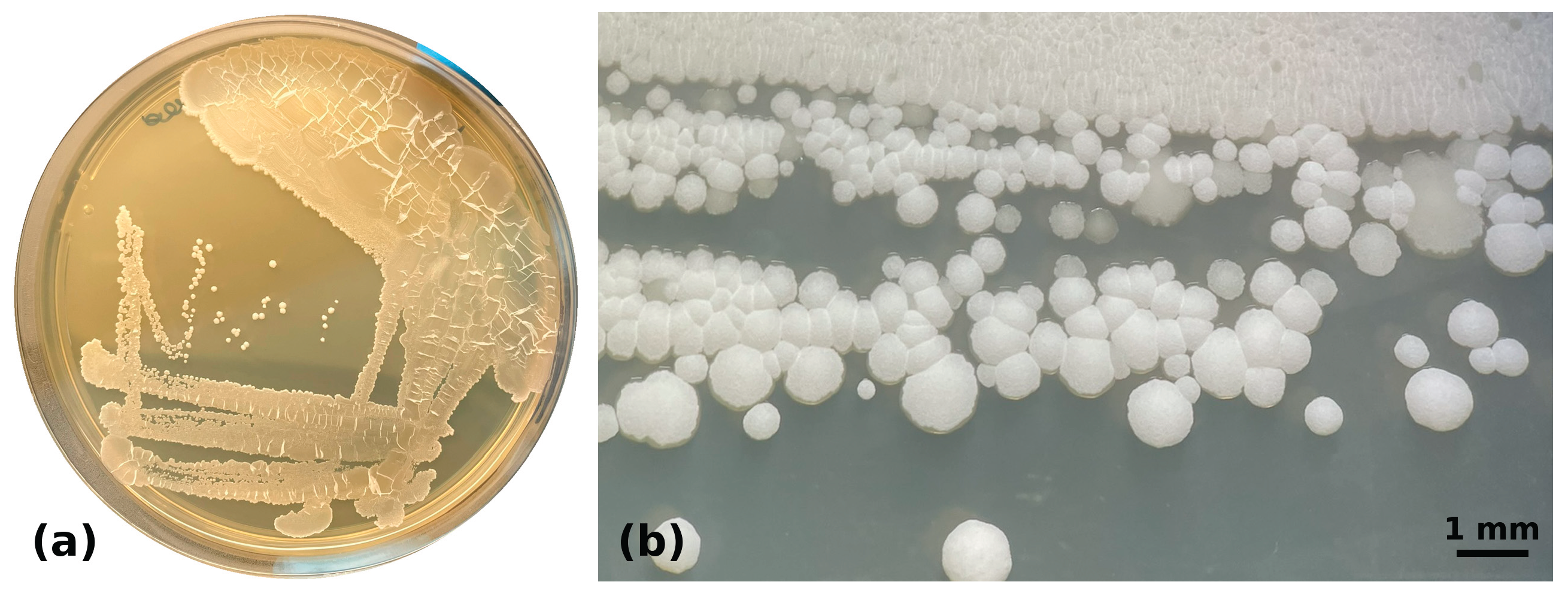
Figure 2.
Circular map of the Jiangella sp. BA12 draft genome. From the outermost ring inwards: predicted biosynthetic gene clusters (magenta), labelled with their antiSMASH product class; protein-coding genes on the forward strand; the sequence backbone, in which alternating shades of grey mark the boundaries of the 25 annotated contigs (two contigs shorter than 1 kb were excluded before annotation); protein-coding genes on the reverse strand; GC content plotted as deviation from the genome mean of 72.81 % (black); and GC skew, calculated as (G−C)/(G+C), with positive values in green and negative values in purple. Transfer RNA and ribosomal RNA genes are included in the coding rings. The position scale is given in Mb. Contig order in a draft assembly is arbitrary and inter-contig distances are not biologically meaningful. Product classes are abbreviated as follows: NI-siderophore, non-ribosomal peptide synthetase (NRPS)-independent siderophore; T3PKS, type III polyketide synthase; NAGGN, N-acetylglutaminylglutamine amide; NRPS-like, non-ribosomal peptide synthetase-like; RiPP-like, ribosomally synthesized and post-translationally modified peptide-like; RRE-containing, RiPP recognition element-containing.
Figure 2.
Circular map of the Jiangella sp. BA12 draft genome. From the outermost ring inwards: predicted biosynthetic gene clusters (magenta), labelled with their antiSMASH product class; protein-coding genes on the forward strand; the sequence backbone, in which alternating shades of grey mark the boundaries of the 25 annotated contigs (two contigs shorter than 1 kb were excluded before annotation); protein-coding genes on the reverse strand; GC content plotted as deviation from the genome mean of 72.81 % (black); and GC skew, calculated as (G−C)/(G+C), with positive values in green and negative values in purple. Transfer RNA and ribosomal RNA genes are included in the coding rings. The position scale is given in Mb. Contig order in a draft assembly is arbitrary and inter-contig distances are not biologically meaningful. Product classes are abbreviated as follows: NI-siderophore, non-ribosomal peptide synthetase (NRPS)-independent siderophore; T3PKS, type III polyketide synthase; NAGGN, N-acetylglutaminylglutamine amide; NRPS-like, non-ribosomal peptide synthetase-like; RiPP-like, ribosomally synthesized and post-translationally modified peptide-like; RRE-containing, RiPP recognition element-containing.
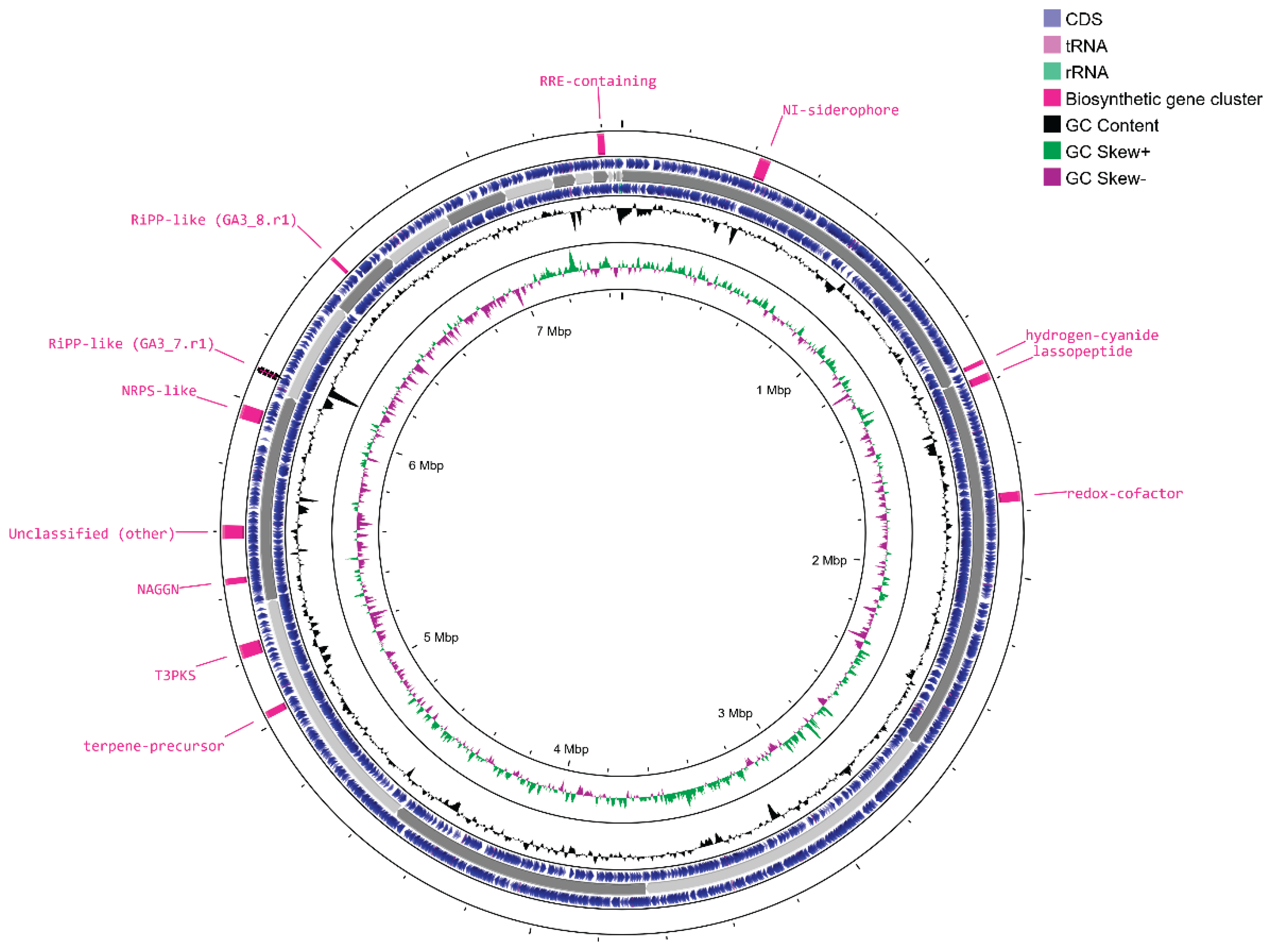
Figure 3.
Maximum-likelihood phylogenomic tree of Jiangella sp. BA12 inferred from concatenated core genes with autoMLST2 (IQ-TREE). The tree was reconstructed using the full autoMLST reference set (52 genomes) and pruned to the 17 taxa shown; it is rooted on Klenkia taihuensis. The genus Jiangella is shaded in grey and strain BA12 is shown in bold. All Jiangella strains shown are the type strains of validly published species, with the exception of Jiangella sp. DSM 45060 and our strain BA12. Numbers at nodes indicate branch support (%); the scale bar represents 0.01 substitutions per site.
Figure 3.
Maximum-likelihood phylogenomic tree of Jiangella sp. BA12 inferred from concatenated core genes with autoMLST2 (IQ-TREE). The tree was reconstructed using the full autoMLST reference set (52 genomes) and pruned to the 17 taxa shown; it is rooted on Klenkia taihuensis. The genus Jiangella is shaded in grey and strain BA12 is shown in bold. All Jiangella strains shown are the type strains of validly published species, with the exception of Jiangella sp. DSM 45060 and our strain BA12. Numbers at nodes indicate branch support (%); the scale bar represents 0.01 substitutions per site.
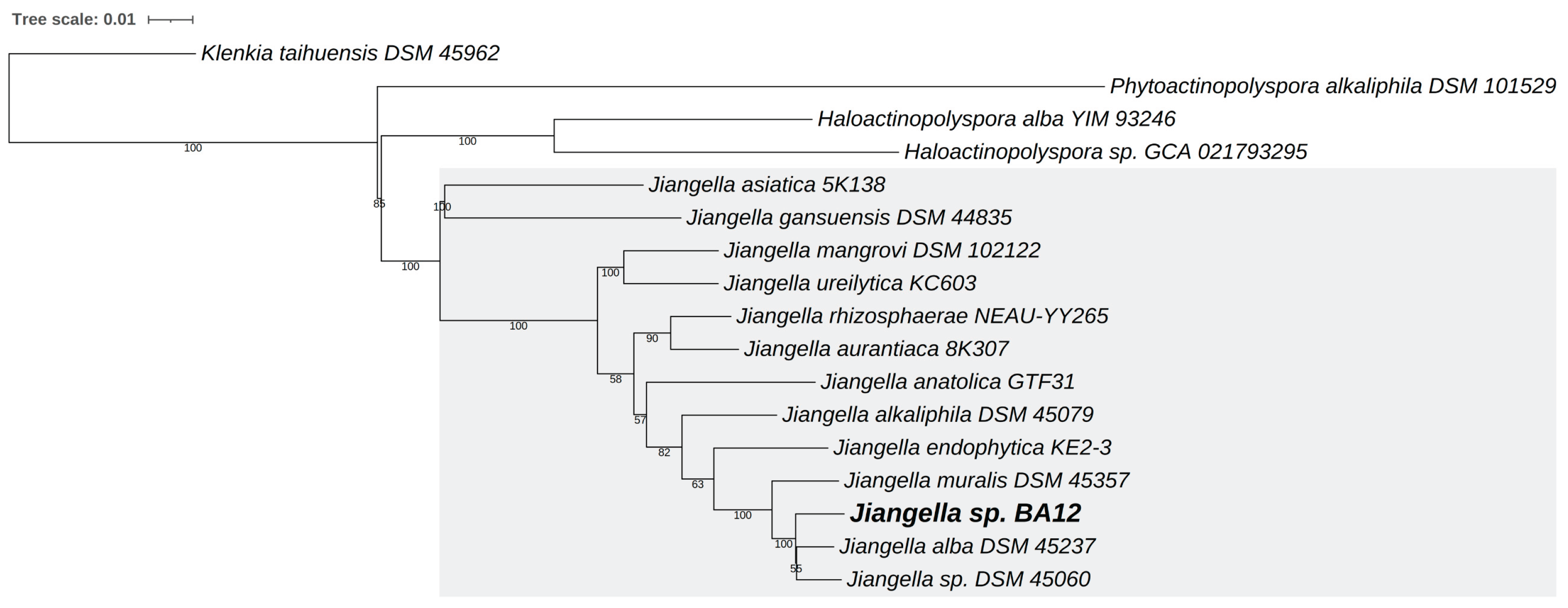
Figure 4.
Distribution of biosynthetic gene cluster families across the genus Jiangella. The tree is the concatenated core-gene maximum-likelihood phylogeny of Figure 3, pruned to the twelve genomes included in the comparative analysis; J. rhizosphaerae is not represented because its assembly did not pass the contig-number filter applied in the Methods. Strain BA12 is shown in bold. The matrix shows the eighteen gene cluster families delineated with BiG-SCAPE v2.0.3 at a distance cut-off of 0.3 that are shared by two or more genomes; filled square indicates that the genome contains at least one cluster of that family. Families are labelled by their antiSMASH product class, and roman numerals distinguish different families assigned to the same class. Dark blue, families present in four or more genomes (common); light blue, families present in two or three genomes (rare). The fifty-two strain-specific families, each restricted to a single genome, are not shown individually in the matrix. The stacked bars on the right give the number of biosynthetic gene clusters (BGCs) predicted in each genome, divided into the same three categories (grey, strain-specific), with the total for each genome indicated at the far right.
Figure 4.
Distribution of biosynthetic gene cluster families across the genus Jiangella. The tree is the concatenated core-gene maximum-likelihood phylogeny of Figure 3, pruned to the twelve genomes included in the comparative analysis; J. rhizosphaerae is not represented because its assembly did not pass the contig-number filter applied in the Methods. Strain BA12 is shown in bold. The matrix shows the eighteen gene cluster families delineated with BiG-SCAPE v2.0.3 at a distance cut-off of 0.3 that are shared by two or more genomes; filled square indicates that the genome contains at least one cluster of that family. Families are labelled by their antiSMASH product class, and roman numerals distinguish different families assigned to the same class. Dark blue, families present in four or more genomes (common); light blue, families present in two or three genomes (rare). The fifty-two strain-specific families, each restricted to a single genome, are not shown individually in the matrix. The stacked bars on the right give the number of biosynthetic gene clusters (BGCs) predicted in each genome, divided into the same three categories (grey, strain-specific), with the total for each genome indicated at the far right.
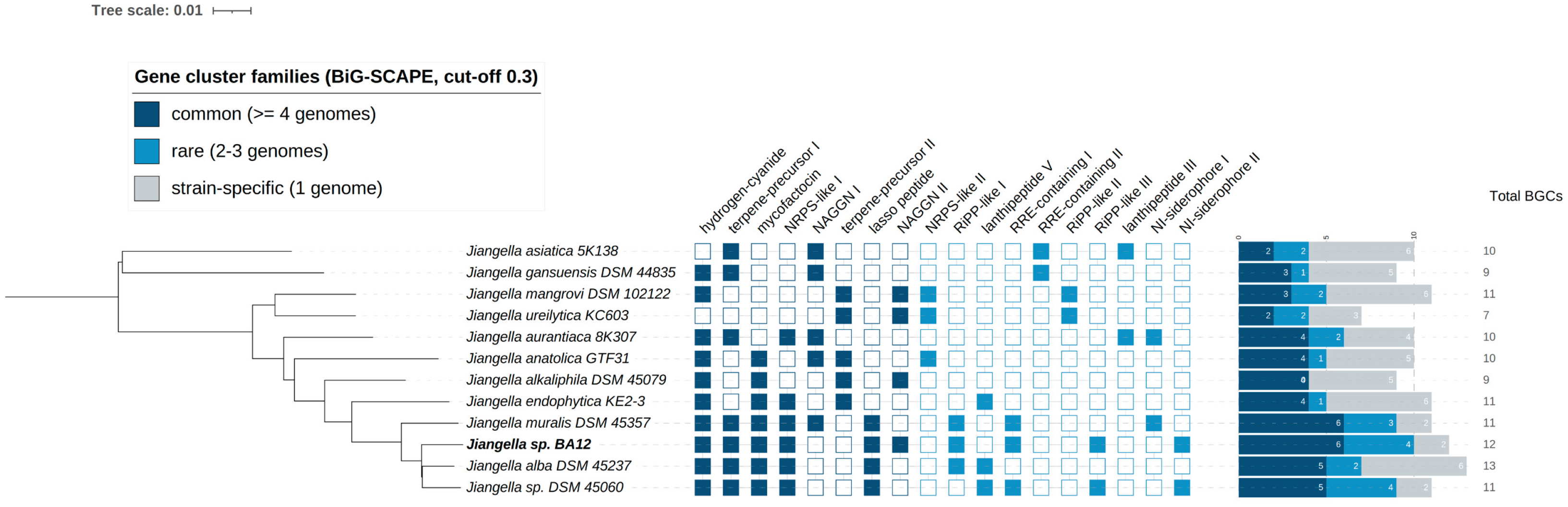

Table 1.
Genome assembly and annotation summary for Jiangella sp. BA12 (genome size, G+C content, number of contigs, largest contig, N50, N90, completeness and contamination estimated with CheckM, and the numbers of total genes, protein-coding genes, tRNA and rRNA genes).
Table 1.
Genome assembly and annotation summary for Jiangella sp. BA12 (genome size, G+C content, number of contigs, largest contig, N50, N90, completeness and contamination estimated with CheckM, and the numbers of total genes, protein-coding genes, tRNA and rRNA genes).
| Features | BA12 |
|---|---|
| Genome size (bp) | 7,462,732 |
| G+C content (mol%) | 72.81 |
| No. of contigs | 27 |
| Largest contig (bp) | 1,369,243 |
| N50 (bp) | 886,138 |
| N90 (bp) | 230,876 |
| L50 | 4 |
| L90 | 9 |
| N's per 100 kbp | 0.00 |
| N’s | 0 |
| Completeness (CheckM, %) | 100.00 |
| Contamination (CheckM, %) | 0.59 |
| Coverage | 287× |
| Total genes | 6,815 |
| Protein-coding genes (CDS) | 6,763 |
| tRNA genes | 46 |
| rRNA genes | 3 |
Table 2.
Digital DNA–DNA hybridization (dDDH, formula d4) and OrthoANIu values between strain BA12 and the type strains of the validly published species of the genus Jiangella.
Table 2.
Digital DNA–DNA hybridization (dDDH, formula d4) and OrthoANIu values between strain BA12 and the type strains of the validly published species of the genus Jiangella.
| Type strain | dDDH d4 (%) | OrthoANIu (%) |
|---|---|---|
| J. alba DSM 45237ᵀ | 57.8 | 94.65 |
| J. muralis DSM 45357ᵀ | 51.0 | 93.23 |
| J. endophytica KE2-3ᵀ | 37.7 | 89.35 |
| J. alkaliphila DSM 45079T | 36.1 | 88.62 |
| J. rhizosphaerae NEAU-YY265ᵀ | 35.8 | 88.31 |
| J. aurantiaca 8K307ᵀ | 35.1 | 88.04 |
| J. anatolica GTF31ᵀ | 34.6 | 88.08 |
| J. mangrovi DSM 102122ᵀ | 31.1 | 86.34 |
| J. asiatica 5K138ᵀ | 24.9 | 81.76 |
Table 3.
Biosynthetic gene clusters predicted in the genome of Jiangella sp. BA12 by antiSMASH, listing the predicted product class, cluster size, closest characterized cluster and percentage similarity.
Table 3.
Biosynthetic gene clusters predicted in the genome of Jiangella sp. BA12 by antiSMASH, listing the predicted product class, cluster size, closest characterized cluster and percentage similarity.
| Region | Type * | Length (bp) | Similar to | Similarity confidence | MIBiG accession ID |
|---|---|---|---|---|---|
| GA3_1.r1 | NI-siderophore | 33.345 | Schizokinen | Low | BGC0002683 |
| GA3_1.r2 | Hydrogen-cyanide | 12.801 | Aborycin | Low | BGC0002285 |
| GA3_2.r1 | Lasso-peptide | 22.538 | ND | ND | |
| GA3_2.r2 | Redox-cofactor | 29.482 | ND | ND | |
| GA3_5.r1 | Terpene-precursor | 21.100 | ND | ND | |
| GA3_5.r2 | T3PKS | 41.079 | 2-methoxy-5-methyl-6-(13-methyltetradecyl)-1,4-benzoquinone/2-methoxy-5-methyl-6-(13-methyltetradecyl)phenol | High | BGC0000282 |
| GA3_6.r1 | NAGGN | 18.205 | ND | ND | |
| GA3_6.r2 | Other | 40.476 | ND | ND | |
| GA3_6.r3 | NRPS-like | 42.540 | ND | ND | |
| GA3_7.r1 | RiPP-like | 11.496 | ND | ND | |
| GA3_8.r1 | RiPP-like | 10.800 | ND | ND | |
| GA3_14.r1 | RiPP recognition element-containing | 20.281 | ND | ND |
* Product classes are reported as assigned by antiSMASH: NI-siderophore, non-ribosomal peptide synthetase (NRPS)-independent siderophore; T3PKS, type III polyketide synthase; NAGGN, N-acetylglutaminylglutamine amide; NRPS-like, non-ribosomal peptide synthetase-like; RiPP-like, ribosomally synthesized and post-translationally modified peptide-like.
Disclaimer/Publisher’s Note: The statements, opinions and data contained in all publications are solely those of the individual author(s) and contributor(s) and not of MDPI and/or the editor(s). MDPI and/or the editor(s) disclaim responsibility for any injury to people or property resulting from any ideas, methods, instructions or products referred to in the content. |
© 2026 by the authors. Licensee MDPI, Basel, Switzerland. This article is an open access article distributed under the terms and conditions of the Creative Commons Attribution (CC BY) license (http://creativecommons.org/licenses/by/4.0/).
Copyright: This open access article is published under a Creative Commons CC BY 4.0 license, which permit the free download, distribution, and reuse, provided that the author and preprint are cited in any reuse.


