

Submitted:
06 August 2026
Posted:
07 August 2026
You are already at the latest version
Abstract
Frost damage to reproductive tissues is a major constraint to stable yield in ‘Hass’ avocado (Persea americana Mill.) orchards, yet practical protected-cultivation strategies for mature trees remain limited. While shading nets are widely used to mitigate heat stress, their potential to reduce frost damage in mature, bearing avocado trees remains insufficiently understood. We evaluated the effects of winter deployment of high-density (60%) silver shading nets on microclimate, physiological performance, and productivity of mature ‘Hass’ avocado trees over two consecutive winters. During a severe frost event (minimum −3.5 °C; approximately 11 h below 0 °C), shading nets had little effect on minimum nighttime temperatures but reduced daytime solar irradiance and maximum temperatures. Following the frost event, control trees suffered extensive vegetative and reproductive damage, whereas net-covered trees exhibited substantially lower injury, with floral bud damage declining from 80% to 22%. Net-covered trees exhibited significantly higher maximum quantum efficiency of photosystem II (Fv/Fm; 0.74 vs. 0.48 in control trees). These responses were associated with greater flowering intensity and a significant yield advantage in the subsequent season (16 vs. 0.4 kg tree-¹). In contrast, no treatment differences were observed during a frost-free winter. This findings indicate that winter deployment of shading nets can sustain reproductive performance in mature avocado trees following a severe frost event. Validation across additional orchards and frost events is required to establish their potential as a protected-cultivation strategy to improve orchard resilience under increasing climatic variability.
Keywords:
climate change
; frost-protection
; orchard management
; Persea americana
; protected cultivation
1. Introduction
Avocado (Persea americana Mill.) is a commercially valuable evergreen fruit tree cultivated extensively in tropical and subtropical regions worldwide [1]. Among the various cultivars, the black-skinned Guatemalan–Mexican hybrid ‘Hass’ accounts for most of the global production and market share. In 2018, ‘Hass’ comprised approximately 97% of the total avocado market in the United States, reflecting strong consumer preference for its attributes, including desirable fruit size, thick peel, rich buttery flavor, and smooth, creamy texture [2,3]. Despite its economic importance and increasing consumer demand, the geographical distribution and further expansion of ‘Hass’ orchards are constrained by the cultivar’s pronounced susceptibility to extreme climatic conditions, particularly low-temperature stress [4]. Cold-stress events are generally classified into two categories: (i) frost events, in which air temperatures drop to below 0 °C [5]; (ii) chilling events, characterized by non-freezing (above 0 °C) low temperatures [6].
Frost events cause plant injury primarily by forming ice within intercellular spaces, leading to direct mechanical damage to surrounding tissues. Ice crystallization in the extracellular space lowers water potential, thereby driving water efflux from the cells. This process results in protoplast contraction and cellular dehydration [7,8,9]. In addition to these physical effects, exposure to freezing temperatures, particularly when followed by high irradiance during the morning hours, can overstimulate the respiratory and photosynthetic electron-transport systems. The resultant imbalance enhances the generation of reactive oxygen species, thereby increasing oxidative stress and further contributing to cellular damage [10].
In avocado, severe frost events can damage vegetative and reproductive organs, including leaves, floral buds, flowers, and developing fruit, ultimately resulting in substantial yield losses [11,12]. Under controlled freezing conditions, ‘Hass’ leaves exhibited a significant decline in the maximum quantum efficiency of photosystem II (Fv/Fm), indicating frost-induced photoinhibition and impairment of the photosynthetic apparatus [13]. Furthermore, exposure of potted ‘Hass’ plants to overnight freezing temperatures followed by high irradiance the next day resulted in a significant reduction in net CO₂-assimilation rates and stomatal conductance, reflecting sustained physiological damage [14].
With the intensification of climate change, extreme cold events are projected to increase in frequency and unpredictability, including in regions where such events are historically uncommon [15]. Consequently, the development of effective strategies to mitigate cold-induced damage in avocado orchards has gained importance. Various frost-protection approaches have been evaluated in perennial fruit crops, including avocado. For example, wind machines and over-canopy sprinkler irrigation systems have been tested for their capacity to moderate orchard microclimate and reduce frost injury [11,16,17]. Shading nets are also widely used in horticultural systems to protect crops from adverse environmental factors, including hail, strong winds, and excessive solar radiation [18,19,20]. Shading nets have also shown potential for reducing cold-related stress. In banana plants, those covered with a 50% Aluminet shading net exhibited substantially less frost damage than those protected by a low-density Crystal 10% net [21]. Studies have proposed the use of shading nets to mitigate chilling stress, highlighting their potential to reduce physiological impairment caused by low temperatures in subtropical fruit crops. For example, during cold winters without frost events, young ‘Reed’ avocado trees grown under a high-density Silver 70% net maintained higher mid-winter Fv/Fm values, chlorophyll content, and trunk diameter than uncovered controls, indicating improved physiological performance under chilling conditions [22]. In a multiyear study conducted over three consecutive frost-free winters, ‘Pinkerton’ avocado trees covered with Silver 50% or 70% nets demonstrated enhanced fruit yield compared to non-covered trees, further supporting the potential of shading nets to mitigate cold damage in subtropical orchards [23].
In a previous study, we evaluated the impact of high-density shading nets on young ‘Hass’ avocado trees during two consecutive winters [24]. Silver 60% nets were installed over the trees, with uncovered trees serving as controls. During both winters, the orchard experienced chilling and freezing events between December and March, with minimum temperatures reaching -2.49 °C. Although minimum air temperatures were similar in both treatments, control trees exhibited markedly greater damage to vegetative shoots and floral buds. Trees covered with Silver 60% nets maintained higher or similar CO₂-assimilation rates, stomatal conductance, Fv/Fm, and chlorophyll content, as well as increased trunk diameter and flowering intensity relative to controls. Fruit yield was not assessed due to the trees’ young age. Overall, findings demonstrated that winter deployment of Silver 60% shading nets could reduce frost injury and enhance physiological performance in young ‘Hass’ avocado trees. Nevertheless, no field studies have evaluated whether winter deployment of high-density shading nets can preserve reproductive performance and productivity of mature ‘Hass’ avocado trees following severe frost events. We hypothesized that winter deployment of high-density shading nets would mitigate frost damage in mature ‘Hass’ avocado trees, thereby sustaining canopy integrity, promoting flowering intensity, and ultimately improving yield performance. Accordingly, the primary objective of this study was to evaluate the physiological and agronomic responses of mature ‘Hass’ avocado trees to winter-specific coverage with high-density shading nets under field conditions. Consistent with our previous study, shading nets were deployed exclusively during the winter period, when the probability of extreme cold events is highest [24]. This seasonal deployment strategy was adopted to minimize potential adverse effects on pollination, as shading during the spring may interfere with bee activity and consequently impair pollination efficiency in net-covered trees [25].
2. Materials and Methods
2.1. Experimental Site
The study was carried out from late 2023 through January 2026 in a 0.6-ha experimental ‘Hass’ avocado orchard located at the Northern Agriculture R&D research farm in northwestern Israel (lat. 33°09′07′′N, long. 35°37′28′′E, 72 m a.s.l.). The region is characterized by a Mediterranean climate, with hot, dry summers and relatively cool, humid winters, and a mean annual rainfall of 500–550 mm, mostly between October and April. The long-term mean daily temperature ranges from 12 °C in January to 29 °C in August (Israel Meteorological Service, available online: https://ims.gov.il/he/data_gov; accessed on March 3rd 2026). The soil at the site consists of 54% clay, 28% silt, and 18% sand. All experimental trees were grafted onto the West Indian ‘Ashdot 17’ rootstock, with ‘Ettinger’ avocado trees planted at a ratio of 1:9 as pollinizers. The orchard was deliberately established in an area characterized by a high probability of extreme cold events. Trees were planted in 2020 and were already producing commercial yields during the experimental period. The orchard was planted at a spacing of 6 m between rows and 4 m within rows, with rows oriented north–south. Monthly irrigation rates throughout the experimental period are provided in Table 1. Liquid fertilizer (NPK 8-1-8, Deshanim Ltd., Israel) was supplied with each irrigation. No pesticides were used during the experiment. During the first winter season (December–March), the orchard was exposed to chilling temperatures but did not experience freezing events. During the second winter season, both chilling and freezing conditions were recorded.
2.2. Experimental Shading-Treatment Design
Combined (woven) Leno 5039 pearl/silver 60% shading nets (Silver 60%; Ginegar Plastic Products Ltd., Ginegar, Israel) providing 60% shade were installed over the designated treatment trees (Figure 1) from late December 2023 to late March 2024 and again from mid-December 2024 to mid-March 2025. Spectra of solar irradiation under the Silver 60% shading nets and under full sunlight (control) were characterized in a previous study [26]. The nets were mounted on a metal support structure at a height of approximately 5 m above ground level. Trees assigned to the control treatment remained uncovered throughout the study period. The experiment comprised six spatially distinct plots, with three plots independently assigned to each treatment (control and Silver 60%, n=3). Each replicate plot comprised approximately 40 trees and occupied slightly less than 0.1 ha. Treatments were allocated randomly among plots, resulting in a completely randomized design with three independent plot-level replicates per treatment. Each net-covered plot had a separate net structure and was managed independently. The plot was considered the experimental unit. All measurements were conducted exclusively on the centrally located trees within each replicate to minimize edge effects.
2.3. Microclimate and Meteorological Monitoring
To characterize the light environment beneath the shading nets, photosynthetic photon flux density (PPFD) was measured at the leaf level using a LI-6800 portable photosynthesis system (clear-top 9 cm2 chamber, LI-COR, Lincoln, NE, USA). Measurements were obtained from seven representative trees within a single plot for each treatment under clear-sky conditions at midday. These measurements were used to quantify the reduction in incident photosynthetically active radiation (PAR) beneath the nets and are presented as supplementary microclimatic observations.
Air temperature and relative humidity were monitored using miniature waterproof HOBO data loggers (MX2301A; Onset Corp., Bourne, MA, USA). Sensors were installed at a height of 1.5 m above ground level and positioned beneath the canopy to prevent direct exposure to solar radiation. Air temperature was recorded at 10-min intervals throughout each period during which the shading nets were installed. Two independent data loggers were deployed per treatment. Meteorological data, including annual relative humidity, wind speed, solar radiation, and precipitation, were acquired from a nearby meteorological station in Kibbutz Kfar Blum (Israeli Meteorological Services, Figure 2) and presented as descriptive measurements of the experimental conditions.
2.4. Analysis of Chlorophyll a Fluorescence
Chlorophyll a fluorescence was assessed under dark conditions using a portable FluorPen FP100 fluorometer (Photon Systems Instruments, Drásov, Czech Republic). Fv/Fm was determined following established methodology [27,28,29]. For each treatment replicate, measurements were collected from three fully expanded leaves on each of four centrally located trees. The four trees served as biological subsamples within a replicate. Measurements were averaged first at the tree level and subsequently at the replicate level, yielding a single value per replicate for statistical analysis. Thus, the experimental unit was the replicate plot, with three independent replicates per treatment (n = 3).
2.5. Observations of Foliage and Floral Bud Damage and Estimation of Flowering Intensity
On 3 Mar 2025, following the severe frost event recorded in February 2025, frost injury to foliage and floral buds was assessed in both the control and Silver 60% treatments. Floral bud damage was evaluated by examining swollen buds at phenological stage 511, according to the extended BBCH scale [1]. Buds were excised and transversely sectioned, and the internal tissues were visually inspected for browning. A bud was classified as frost-damaged when browning exceeded 25% of the cross-sectional tissue area. For each treatment replicate, ten buds were assessed on at least seven centrally located trees. The seven trees served as biological subsamples within a replicate. Measurements were averaged first at the tree level and subsequently at the replicate level. Statistical analyses were performed using replicate means, with the replicate plot considered the experimental unit (n = 3). Foliar frost injury was assessed independently by two evaluators, and the two scores were averaged to obtain a single damage score for each tree. Each tree was assigned a visual damage score ranging from 0 to 5, where 0 indicated no visible injury (fully green, healthy foliage) and 5 indicated severe frost damage characterized by extensive leaf browning [11]. Measurements were obtained from at least seven centrally located trees per replicate. Tree-level scores were averaged within each replicate, and replicate means were used for statistical analysis (n = 3). Flowering intensity was evaluated during peak bloom in April 2024 and April 2025, following previously established protocols [11,30]. Assessments were conducted under blinded conditions, with two independent evaluators scoring each tree on a 0–5 scale. A score of 0 indicated the absence of visible flowering, and 5 represented maximal flowering intensity. Measurements were obtained from at least seven centrally located trees per replicate. Tree-level scores were averaged within each replicate, and replicate means were used for statistical analysis (n = 3).
2.6. Whole-Tree Carbon-Uptake Measurements
Twelve trees were selected for continuous monitoring, six per treatment, from one representative plot per treatment. All monitored trees exhibited no visible symptoms of disease or nutrient deficiency and were located near the center of the orchard. Because the carbon-uptake sensors were installed on selected trees from one plot per treatment, rather than being distributed across all replicate plots, these data were treated as complementary physiological evidence and were interpreted in relation to the plot-level measurements. Stem diameter at 0.5 m height ranged between 8.3 and 11.5 cm. Tree carbon uptake was monitored continuously using tree-specific sensors installed directly on the stem, each connected to a data logging and transmission device (Kitera IO, Tel Aviv, Israel). These sensors use a validated methodology [31,32,33], providing values of gross assimilation comparable to those measured with infrared gas analyzers at leaf or canopy scale. Sensors provided gross values of gram carbon per hour for each individual tree from mid-November 2024 to mid-March 2025.
2.7. Tree Yield and Average Fruit Weight
During the commercial harvests in January 2025 and January 2026, fruit were manually harvested from the experimental trees. For each replicate, yield was recorded at the individual-tree level by weighing the total harvested fruit per tree (kg tree-¹). Mean fruit weight (g) was calculated by dividing total fruit mass by the corresponding number of fruit harvested from each tree. Measurements were obtained from at least seven centrally located trees per replicate. Tree-level values were averaged within each replicate, and replicate means were used for statistical analysis (n = 3).
2.8. Statistical Analysis
Individual trees, leaves, or buds were treated as subsamples and were averaged within each replicate before statistical analysis as described above. The experimental unit was defined at the plot level, with each replicate representing an independent field unit. Treatment comparisons were therefore conducted using replicate means. All results from the same measurement time points were subjected to an unpaired t-test using GraphPad Prism version 10.6.1 software (GraphPad Software, LLC). Flowering intensity, fruit yield, and mean fruit weight were analyzed across years using linear mixed-effects models in JMP version 18.2.2 (SAS Institute, Cary, NC, USA), with treatment, year, and their interaction included as fixed effects and plot nested within treatment included as a random effect to account for repeated measurements of the same plots across years.
3. Results
3.1. Year 1
3.1.1. Effect of Shading Nets on Air Temperature
Representative leaf-level PPFD measurements confirmed a 62% reduction in incident PAR beneath the Silver 60% nets relative to the uncovered control (Figure S1). During the first experimental year, winter minimum air temperatures in the orchard remained above 0 °C (Figure 3A). On the coldest night, recorded on 1 Mar 2024, the minimum air temperature in the control plots reached 2.1 °C, while the highest temperature recorded during this period was 28.9 °C on 14 March (Figure 3B). Minimum air temperatures measured beneath the Silver 60% shading nets were similar to those recorded in the control plots. In contrast, daytime maximum temperatures were generally slightly lower under the shading nets than in the control treatment (Figure 3).
3.1.2. Effect of Shading Nets on Flowering Intensity, Fruit Yield, and Fruit Weight
In April 2024, flowering intensity was moderate and did not differ significantly (p > 0.05) between treatments, with trees in the control and Silver 60% plots receiving a mean score of 3 and 2.9 out of 5, respectively (Figure 4A). In January 2025, fruit yield did not differ significantly (p > 0.05) between treatments, averaging 40.1 and 34.6 kg tree-1 in the control and Silver 60% treatments, respectively (Figure 4B). Fruit weight also did not differ significantly (p > 0.05) between treatments, averaging 158 and 163 g in the control and Silver 60% treatments, respectively (Figure 4C).
3.2. Year 2
3.2.1. Effect of Shading Nets on Air Temperature and Relative Humidity
Winter conditions were colder in the second experimental year than in the first, with minimum air temperatures in the orchard dropping below 0 °C on six occasions (Figure 5A). The lowest temperature recorded in the control plots was -3.5 °C on 25 Feb 2025, while the maximum temperature during this period reached 35.5 °C on 16 March (Figure 5B). Consistent with observations from the first year, minimum air temperatures measured beneath the Silver 60% shading nets were similar to those recorded in the control plots (Figure 5A), whereas daytime maximum temperatures were generally lower under the nets (Figure 5B). A severe frost event occurred on 24–25 Feb 2025. In the control plots, air temperature declined to -3.5 °C and remained below 0 °C from 2110 h on 24 February until 0750 h on 25 February, corresponding to approximately 11 h of freezing conditions (Figure 5C). Under the Silver 60% nets, the minimum temperature reached -2.9 °C, and the duration of subzero conditions was slightly shorter, 2220 h on 24 February to 0750 h on 25 February. Relative humidity during the freezing period was marginally lower beneath the shading nets compared to the control treatment (Figure 5D).
3.2.2. Frost Protection by the Shading Nets
On 3 Mar 2025, following the frost event, pronounced injury to leaves and floral buds was evident in trees from the control plots, whereas trees protected by the Silver 60% nets showed minimal visible damage (Figure 6A–D). Frost injury to young vegetative shoots in control trees was rated at 2.0 on a 0–5 scale, which was significantly (p < 0.01) higher than the negligible damage observed in the Silver 60% treatment (0.01 out of 5, Figure 6E). Floral bud-damage assessments revealed severe injury in 80% of the buds examined in control trees (Figure 6F). In contrast, only 22% of buds from trees under the Silver 60% nets exhibited damage, representing a highly significant (p < 0.0001) reduction compared to the control.
3.2.3. Effect of Shading Nets on Whole-Tree Carbon Uptake and Maximum Quantum Yield (Fv/Fm)
Tree carbon uptake showed a diurnal cycle, from zero at night and increasing rapidly at sunrise, reaching a maximum of 50–150 g C h-1 tree-1 in the late morning (Figure S2). Values typically remained high around noon and gradually decreased during the afternoon, approaching zero at sunset. This behavior was ubiquitous across all trees, with or without shading nets, and variations among the trees were relatively small, around 5–10 g C h-1 tree-1. Day-to-day changes were in line with meteorological factors such as solar radiation, temperature, and humidity. In the period preceding the frost event on 25 Feb 2025, tree carbon uptake was almost identical across treatments (Figure S2A). The first difference between the treatment groups was observed on 16 Feb 2025 and lasted for 3 days (Figure S2B). This transient difference could be related to temperatures as low as 2 ºC in the preceding nights (Figure 5A). Unfortunately, data were unavailable during late February, including the frost event itself, due to sensor malfunction; however, in early March, carbon uptake was consistently 5–50 g C h-1 tree-1 lower for control vs. net-shaded trees during daytime hours (Figure S2C).
Fv/Fm was measured immediately after the frost event at the end of February 2025 (Figure S3). Leaves of trees covered with the Silver 60% shading net exhibited an Fv/Fm value of 0.74, which was significantly higher (p < 0.0001) than that of the control treatment (0.48).
3.2.4. Effect of Shading Nets on Flowering Intensity, Fruit Yield, and Fruit Weight
In April 2025, flowering intensity was generally low. Nevertheless, flowering intensity in the Silver 60% trees was rated 1.4 out of 5, significantly higher (p < 0.01) than in the control, which was rated 0.3 out of 5 (Figure 7A–C). In January 2026, fruit yield in the Silver 60% trees was 16 kg tree-1, significantly greater (p < 0.05) than in the control, which was 0.4 kg tree-1 (Figure 7D–F). Fruit weight did not differ significantly (p > 0.05) between treatments, averaging 190 and 171 g in the control and Silver 60% treatments, respectively (Figure 7G).
3.3. Across-Year Analysis of Flowering Intensity, Fruit Yield, and Fruit Weight
Mixed-model analysis across the two experimental years revealed a significant overall effect of treatment on flowering intensity (P < 0.05) and a significant effect of year (P < 0.01). However, the treatment × year interaction was not significant (P > 0.05). For fruit yield, year had a significant effect (P < 0.01), whereas neither the overall treatment effect (P > 0.05) nor the treatment × year interaction (P > 0.05) was significant. Similarly, fruit weight differed significantly between years (p < 0.05), but the treatment effect (p > 0.05) and treatment × year interaction (p > 0.05) were not significant. Thus, although separate within-year comparisons showed higher flowering intensity and yield under the shading nets in the second year, the mixed-model analysis did not provide statistical evidence that the magnitude of the treatment response differed between years.
4. Discussion
We evaluated the impact of winter deployment of Silver 60% high-density shading nets on frost mitigation and subsequent performance of mature ‘Hass’ avocado trees. The experimental site was deliberately selected for its high susceptibility to extreme cold events. Consistent with this characterization, a severe frost event during the second year of the study caused extensive damage to the control trees, with clear, widespread external injury (Figure 6). Pronounced tissue damage was observed in young vegetative shoots. The floral buds, recognized as particularly frost-sensitive [11], were also severely damaged. In contrast, the trees that were protected by the shading nets exhibited significantly lower visible damage to both vegetative tissues and floral buds. Comparable findings have been reported in banana, where the use of a high-density net (50% Aluminet) significantly reduced frost damage relative to a low-density 10% Crystal Leno net [21]. This protective effect was associated with a modified microclimate under the former net, characterized by reduced daytime irradiance and lower maximum temperatures, alongside an increase in minimum air temperature of more than 2 °C during frost events compared to the Crystal Leno treatment [21]. However, in the present study, as well as in our previous work [24], although the Silver 60% shading nets markedly reduced daytime irradiance and maximum air temperatures, their effect on minimum night temperatures was limited (Figure 3 and Figure 5). This pattern is consistent with findings from studies on ‘Reed’ and ‘Pinkerton’ avocado, where silver shading nets (50% and 70%) effectively reduced daytime light intensity but did not significantly affect minimum nighttime temperatures [22,23]. A similar response was recently reported in Cabernet Sauvignon vineyards, where shading nets significantly altered bunch-zone PAR without significantly affecting air-temperature-derived thermal indices [34]. Interestingly, despite having only a minor effect on minimum air temperature, the shading nets reduced frost injury and were associated with improved physiological and reproductive performance during the frost-affected year (Figure 6 and Figure 7, S2, S3). The mechanisms underlying this response remain unclear. Previous studies have shown that high irradiance can exacerbate plant stress following freezing events [35], suggesting that the reduced radiation environment beneath the nets may have contributed to the observed protection. However, leaf temperature, thawing dynamics, and indicators of oxidative stress were not measured in the present study, preventing direct evaluation of this hypothesis. Trees protected by the nets maintained significantly higher Fv/Fm values following the frost event than control trees (Figure S3), indicating lower impairment of PSII photochemical efficiency. Similar reductions in Fv/Fm following freezing stress have been reported previously in avocado [14,36]. In addition, the shading nets reduced daytime maximum temperatures during the experimental period (Figure 5). Previous studies have suggested that a slower thawing rate following freezing nights has been associated with reduced cellular injury, likely due to minimized membrane disruption [37,38,39]. Whether differences in post-freeze warming dynamics contributed to the reduced frost damage observed under the nets remains unknown. Further research incorporating detailed measurements of radiation, leaf temperature, and post-freeze thawing dynamics is required to identify the microclimatic and physiological processes responsible for the protective effects observed under shading nets.
Exploratory continuous monitoring of selected trees indicated that daytime whole-tree carbon uptake was lower in the control trees during cold periods following the frost event than in trees protected by shading nets (Figure S2). This pattern was broadly consistent with the plot-level responses in frost injury and yield. In a previous study of avocado under shading nets, we observed a similar physiological response, as indicated by periodic measurements of leaf photosynthesis [24]. Continuous whole-tree monitoring provides a temporally resolved and more integrated perspective on tree carbon uptake than conventional leaf-scale measurements. However, because the sensors in the present study were installed on selected trees within only one plot per treatment and measurements were unavailable during the frost event itself, these observations were interpreted descriptively as complementary physiological evidence and were not used for treatment-level inference.
In the first year of the experiment, with no frost events, no differences in flowering intensity were detected between treatments (Figure 4). Similar results have been found in young ‘Reed’ trees, where winter coverage with Silver 50% shading nets during cold seasons without frost events resulted in a slight, non-significant reduction in spring flowering intensity compared to uncovered control trees [22]. In contrast, in the second year, a separate within-year comparison showed significantly greater flowering intensity in the subsequent spring following a frost event, with higher flowering observed on the net-covered trees than on the control (Figure 7). This effect was likely driven by improved survival and development of floral buds under the protected conditions (Figure 6). The contrasting within-year patterns are consistent with the hypothesis that shading-net benefits may become more pronounced under severe cold stress. However, this interpretation remains tentative because the treatment × year interaction was not significant (Table 2) and only one frost-affected year was evaluated. Accordingly, yield and average fruit weight in the first year of the experiment were similar between the two treatments (Figure 4). This absence of treatment effects under relatively mild winter conditions is informative, as it indicates that the winter deployment of Silver 60% nets did not inherently enhance productivity in the absence of frost, nor did it reduce tree reproductive performance. In contrast, in the second year, following the severe frost event, the difference in flowering intensity was translated into a significant yield advantage at harvest, whereas mean fruit weight was not significantly affected (Figure 7). The slight, non-significant reduction in fruit weight observed in the net-covered trees compared to the control is consistent with the commonly reported inverse relationship between fruit size and overall yield [40]. Together, the second-year findings indicate that the major yield benefit of the shading nets was due primarily to the preservation of reproductive potential, rather than to the enhancement of individual fruit size. Nevertheless, yields in the second year were lower than in the first. While this reduction may partly reflect the direct impact of the frost event on yield potential, the pronounced protective effect of the shading nets on floral buds suggests that the observed decline can be attributed to an alternate bearing pattern rather than to frost-induced damage alone [41,42]. Accordingly, further research is required to evaluate the effects of shading nets on long-term yield dynamics and productivity.
From a horticultural-management perspective, the results suggest that the main value of winter net deployment may lie in reducing the risk of severe yield loss following frost rather than in increasing baseline productivity under mild conditions. This distinction is important for commercial decision-making because the intervention may function primarily as an insurance-type strategy in frost-prone orchards rather than as a general yield-enhancing practice. The positive effect of the shading nets on yield carries substantial economic implications. Considering that the yield from the net-covered trees was higher by 15.6 kg tree-1, and assuming a planting density of 420 trees ha-1, this translates to an additional ~6.5 tons ha-1. Based on a conservative average price of 2.3 USD kg-1 (according to AvocadoGal packing house, Israel, 14 Apr 2026), this corresponds to an estimated increase of approximately 15,000 USD ha-1 compared to the control. This simple gross-revenue estimate does not account for net installation, supporting infrastructure, labor, maintenance, depreciation, or market-price variability, and should therefore be interpreted only as an indication of the potential economic scale of the yield effect. The use of growth regulators, such as the gibberellin-biosynthesis inhibitor Uniconazole, may serve as a complementary tool to control tree vigor and reduce canopy height [43], thereby enabling a lower and less costly supporting metal structure and contributing to further cost reduction. Future studies should evaluate whether canopy-height management can reduce the infrastructure costs associated with winter net deployment. Nevertheless, given the substantial costs of the shading nets and their supporting metal infrastructure, a comprehensive economic analysis is required to assess their overall commercial feasibility.
Beyond their role in mitigating cold damage, accumulating evidence suggests that shading nets also confer agronomic benefits under heat-stress conditions, which are expected to increase in frequency under potential climate-change scenarios [26]. Studies conducted on several crop species, including avocado, have shown that high-density shading nets can reduce heat stress, improve photosynthetic performance, reduce photoinhibition, and enhance light-use efficiency under conditions of high irradiance and temperature [26,44,45]. In addition, shading nets may reduce evapotranspiration and improve water-use efficiency, representing a potential advantage in water-limited environments [25,46,47]. However, these benefits must be balanced against possible drawbacks, including reduced photosynthetic performance under moderate conditions and potential interference with pollination [25,26,48]. Therefore, the integration of shading nets as a multiseason management strategy warrants further investigation, particularly to optimize shading intensity and deployment timing across different climatic scenarios. Furthermore, integrating shading nets with avocado cultivars exhibiting relatively high tolerance to abiotic stresses, such as the ‘Hass’-like ‘GEM’ [12], may substantially enhance the resilience of avocado orchards to extreme climatic events under changing environmental conditions. While this study was conducted under specific Mediterranean conditions, it can be relevant across a wide range of subtropical and temperate orchard systems. Therefore, the use of shading nets as a targeted frost-mitigation strategy may have broader applicability beyond avocado, particularly in regions characterized by high irradiance following freezing events.
5. Conclusions
Overall, our findings demonstrate that winter deployment of high-density silver shading nets is an effective strategy for mitigating frost damage and preserving reproductive potential in mature ‘Hass’ avocado trees, but the specific mechanisms underlying this response were not directly assessed. Reduced post-frost radiation exposure is one possible explanation, although other microclimatic effects may also have contributed. The resulting improvements in flowering, yield, and whole-tree carbon assimilation highlight both agronomic and economic benefits, particularly under extreme climatic conditions. This study demonstrates that the effectiveness of shading nets emerges from their ability to selectively buffer extreme climatic events without altering baseline conditions, thereby supporting their role as adaptive, event-driven interventions within resilient orchard systems. Such strategies align with climate-resilient system design principles, where interventions are optimized to mitigate episodic stress while minimizing trade-offs under non-stress conditions. However, their long-term impacts, economic feasibility, and optimal integration into multi-season orchard-management systems require further investigation.
Supplementary Materials
The following supporting information can be downloaded at the website of this paper posted on Preprints.org, Figure S1: Representative midday leaf-level PPFD measured in the uncovered control and beneath the Silver 60% shading net; Figure S2: Effects of shading nets on whole-tree carbon uptake; Figure S3: Effects of shading nets on maximum quantum yield (Fv/Fm).
Author Contributions
Conceptualization, L.R.; Investigation, M.L., O.E. and T.K.; Formal analysis, T.K., O.E. and L.R.; Writing-original draft preparation, M.L., O.E., T.K. and L.R.; Writing review and editing, M.L., O.E., T.K. and L.R.; Funding acquisition, L.R. All authors have read and agreed to the published version of the manuscript.
Funding
This work was supported by the Israeli Fruit Board.
Data Availability Statement
The original contributions presented in this study are included in the article/supplementary material. Further inquiries can be directed to the corresponding author.
Acknowledgments
The authors thank the Israeli Fruit Board for financial support, and the ‘Mataim’ experimental farm team, Michael Noy, Nitzan Szenes, and Marc Perel for their invested effort in this study.
Conflicts of Interest
The authors declare no conflicts of interest.
Abbreviations
The following abbreviations are used in this manuscript:
| a.s.l. | Above Sea Level |
| NPK | Nitrogen–Phosphorus–Potassium |
| PAR | Photosynthetically Active Radiation |
| PPFD | Photosynthetic Photon Flux Density |
| PSII | Photosystem II |
| SE | Standard Error |
| USD | United States Dollar |
References
- Alcaraz, M.L.; Thorp, T.G.; Hormaza, J.I. Phenological Growth Stages of Avocado (Persea Americana) According to the BBCH Scale. Sci. Hortic. 2013, 164, 434–439. [CrossRef]
- Silva, T.A.; Ledesma, N. Avocado History, Biodiversity and Production. In Sustainable Horticultural Systems; Nandawani, D., Ed.; Springer International Publishing, Switzerland, 2014; Vol. 2, pp. 157–205 ISBN 978-3-319-06903-6.
- Ballen, F.H.; Evans, E.; Parra-Acosta, Y.K. Consumer Preferences for Green Skin Avocados in the US Market: The Role of Experienced Quality Attributes, Credence Attributes, and Demographic Factors. J. Agric. Food Ind. Organ. 2021, 20, 1–9. [CrossRef]
- Charrier, G.; Ngao, J.; Saudreau, M.; Améglio, T. Effects of Environmental Factors and Management Practices on Microclimate, Winter Physiology, and Frost Resistance in Trees. Front. Plant Sci. 2015, 6, 1–18. [CrossRef]
- Perry, K.B. Basics of Frost and Freeze Protection for Horticultural Crops. Horttechnology 1998, 8, 10–15.
- Jouyban, Z.; Hasanzade, R.; Sharafi, S. Chilling Stress in Plants. International Journal of Agriculture and Crop Sciences 2013, 5, 2961–2968.
- Jones, H.G. Frost Protection: Fundamentals, Practice, and Economics. Volume 1. Exp. Agric. 2006, 42, 369. [CrossRef]
- Verslues, P.E.; Agarwal, M.; Katiyar-Agarwal, S.; Zhu, J.; Zhu, J.K. Methods and Concepts in Quantifying Resistance to Drought, Salt and Freezing, Abiotic Stresses That Affect Plant Water Status. Plant Journal 2006, 45, 523–539. [CrossRef]
- De Melo-Abreu, J.P.; Villalobos, F.J.; Mateos, L. Frost Protection. In Principles of Agronomy for Sustainable Agriculture; Villalobos, F.J., Fereres, E., Eds.; Springer International Publishing: Cham, 2016; pp. 443–457 ISBN 978-3-319-46116-8.
- Janda, T.; Szalai, G.; Rios-Gonzalez, K.; Veisz, O.; Páldi, E. Comparative Study of Frost Tolerance and Antioxidant Activity in Cereals. Plant Science 2003, 164, 301–306. [CrossRef]
- Bar-Noy, Y.; Sofer-Arad, C.; Perel, M.; Cohen, H.; Senesh, N.; Noy, M.; Rubinovich, L. Frost Protection Efficiency Evaluation in Avocado with a Horizontal Wind Machine. Fruits 2019, 74, 124–129. [CrossRef]
- Lahack, M.; Noy, M.; Szenes, N.; Rubinovich, L. Vegetative Growth, Flowering, and Physiological Parameters of Young Avocado “Hass” and ’Hass’-Like Cultivars Under Extreme Weather Conditions. International Journal of Fruit Science 2025, 25, 378–392. [CrossRef]
- Weil, A.; Sofer-Arad, C.; Bar-Noy, Y.; Liran, O.; Rubinovich, L. Comparative Study of Leaf Antioxidant Activity as a Possible Mechanism for Frost Tolerance in ‘Hass’ and ‘Ettinger’ Avocado Cultivars. J. Agric. Sci. 2019, 157, 342–349. [CrossRef]
- Joshi, N.C.; Yadav, D.; Ratner, K.; Kamara, I.; Aviv-Sharon, E.; Irihimovitch, V.; Charuvi, D. Sodium Hydrosulfide Priming Improves the Response of Photosynthesis to Overnight Frost and Day High Light in Avocado (Persea Americana Mill, Cv. ‘Hass’). Physiol. Plant. 2019, 168, 394–405. [CrossRef]
- Zhang, X.; Lu, C.; Guan, Z. Weakened Cyclones, Intensified Anticyclones and Recent Extreme Cold Winter Weather Events in Eurasia. Environmental Research Letters 2012, 7, 044044. [CrossRef]
- Ghaemi, A.A.; Rafiee, M.R.; Sepaskhah, A.R. Tree-Temperature Monitoring for Frost Protection of Orchards in Semi-Arid Regions Using Sprinkler Irrigation. Agric. Sci. China 2009, 8, 98–107. [CrossRef]
- Ribeiro, A.C.; De Melo-Abreu, J.P.; Snyder, R.L. Apple Orchard Frost Protection with Wind Machine Operation. Agric. For. Meteorol. 2006, 141, 71–81. [CrossRef]
- Manja, K.; Aoun, M. The Use of Nets for Tree Fruit Crops and Their Impact on the Production: A Review. Sci. Hortic. 2019, 246, 110–122. [CrossRef]
- Shahak, Y. Photoselective Netting: An Overview of the Concept, R&D and Practical Implementation in Agriculture. Acta Hortic. 2014, 1015, 155–162. [CrossRef]
- Shahak, Y.; Ratner, K.; Giller, Y.E.; Zur, N.; Or, E.; Gussakovsky, E.E.; Stern, R.; Sarig, P.; Raban, E.; Harcavi, E.; et al. Improving Solar Energy Utilization, Productivity and Fruit Quality in Orchards and Vineyards by Photoselective Netting. In Proceedings of the Acta Horticulturae; International Society for Horticultural Science, 2008; Vol. 772, pp. 65–72.
- Zait, Y.; Elingold, I.; Londener, A.; Gal, E.; Or, G.; Galpaz, N. Banana Frost Protection by Thermal Nets. In Proceedings of the Acta Horticulturae; International Society for Horticultural Science: Istanbul, Turkey, March 23 2020; Vol. 1272, pp. 21–26.
- Chernoivanov, S.; Neuberger, I.; Levy, S.; Szenes, N.; Rubinovich, L. Covering Young ‘Reed’ Avocado Trees with Shading Nets during Winter Alleviates Cold Stress and Promotes Vegetative Growth. Eur. J. Hortic. Sci. 2022, 87, 1–10. [CrossRef]
- Rubinovich, L.; Sofer-Arad, C.; Chernoivanov, S.; Szenes, N. Effects of Covering Mature Avocado ‘Pinkerton’ Trees with High-Density Shading Nets during Cold Winters on Microclimate, Chlorophyll Fluorescence, Flowering, and Yield. HortScience 2023, 58, 1201–1204. [CrossRef]
- Lahak, M.; Alon, E.; Chen, A.; Rubinovich, L. Covering Young Avocado ‘Hass’ Trees with High-Density Shading Nets during the Winter Mitigates Frost Damage and Improves Tree Performance. Trees 2024, 38, 327–338. [CrossRef]
- Mditshwa, A.; Magwaza, L.S.; Tesfay, S.Z. Shade Netting on Subtropical Fruit: Effect on Environmental Conditions, Tree Physiology and Fruit Quality. Sci. Hortic. 2019, 256, 108556. [CrossRef]
- Alon, E.; Shapira, O.; Azoulay-Shemer, T.; Rubinovich, L. Shading Nets Reduce Canopy Temperature and Improve Photosynthetic Performance in ‘Pinkerton’ Avocado Trees during Extreme Heat Events. Agronomy 2022, 12, 1360. [CrossRef]
- Schreiber, U.; Schliwa, U.; Bilger, W. Continuous Recording of Photochemical and Non-Photochemical Chlorophyll Fluorescence Quenching with a New Type of Modulation Fluorometer. Photosynth. Res. 1986, 10, 51–62. [CrossRef]
- Kramer, D.M.; Johnson, G.; Kiirats, O.; Edwards, G.E. New Fluorescence Parameters for the Determination of QA Redox State and Excitation Energy Fluxes. Photosynth. Res. 2004, 79, 209–218. [CrossRef]
- Baker, N.R. Chlorophyll Fluorescence: A Probe of Photosynthesis in Vivo. Annu. Rev. Plant Biol. 2008, 59, 89–113. [CrossRef]
- Ziv, D.; Zviran, T.; Zezak, O.; Samach, A.; Irihimovitch, V. Expression Profiling of FLOWERING LOCUS T-like Gene in Alternate Bearing ‘Hass’ Avocado Trees Suggests a Role for PaFT in Avocado Flower Induction. PLoS One 2014, 9, 1–14. [CrossRef]
- Rog, I.; Hilman, B.; Fox, H.; Yalin, D.; Qubaja, R.; Klein, T. Increased Belowground Tree Carbon Allocation in a Mature Mixed Forest in a Dry versus a Wet Year. Glob. Chang. Biol. 2024, 30, e17172. [CrossRef]
- Klein, T.; Hoch, G. Tree Carbon Allocation Dynamics Determined Using a Carbon Mass Balance Approach. New Phytologist 2015, 205, 147–159. [CrossRef]
- Klein, T.; Rotenberg, E.; Tatarinov, F.; Yakir, D. Association between Sap Flow-Derived and Eddy Covariance-Derived Measurements of Forest Canopy CO2 Uptake. New Phytologist 2016, 209, 436–446. [CrossRef]
- Gutiérrez-Gamboa, G.; Araya-Alman, M.; Romero-Bravo, S.; Carrasco-Benavides, M.; Verdugo-Vásquez, N.; Chacón-Fuentes, M. Shading Nets Modified Cluster-Zone Radiation, Bunch Sunburn Percentage and Berry Amino Acid Content in Cabernet Sauvignon: A Preliminary Study. Plants 2026, 15, 2183. [CrossRef]
- Wise, R.R. The Production, Action and Study of Reactive Oxygen Species during Chilling in the Light. Photosynth. Res. 1995, 45, 79–97.
- Chung, S.W.; Rho, H.; Lim, C.K.; Jeon, M.K.; Kim, S.; Jang, Y.J.; An, H.J. Photosynthetic Response and Antioxidative Activity of ‘Hass’ Avocado Cultivar Treated with Short-Term Low Temperature. Sci. Rep. 2022, 12, 11593. [CrossRef]
- Yoshida, S.; Sakai, A. The Effect of Thawing Rate on Freezing Injury in Plants. II. The Change in the Amount of Ice in Leaves as Produced by the Change in Temperature. Low Temperature Science, Series Biological Sciences 1968, B 26, 23–31.
- Snyder, R.L. (Richard L.); Melo-Abreu, J.P. de. Frost Protection : Fundamentals, Practice and Economics; Food and Agriculture Organization of the United Nations, 2005; ISBN 9251053286.
- Gusta, L. V; Fowler, D.B. Factors Affecting the Cold Survival of Winter Cereals. Can. J. Plant Sci 1976, 57, 219–231.
- Mickelbart, M. V.; Robinson, P.W.; Witney, G.; Arpaia, M.L. “Hass” Avocado Tree Growth on Four Rootstocks in California. II. Shoot and Root Growth. Sci. Hortic. 2012, 143, 205–210. [CrossRef]
- Lovatt, C.J. Alternate Bearing Of “Hass” Avocado. California Avocado Society Yearbook 2010, 93, 125–140.
- Pochamreddy, M.; Haim, D.; Halon, E.; Keinan, E.; Rai, A.C.; Kamara, I.; Sadka, A.; Irihimovitch, V. Alternate Bearing in ‘Hass’ Avocado: Fruit Load-Induced Changes in Bud Auxin Homeostasis Are Associated with Flowering Repression. J. Exp. Bot. 2024, 75, 5717–5733. [CrossRef]
- Lahack, M.; Szenes, N.; Rubinovich, L. Effects of Uniconazole Treatment on ‘Hass’ Avocado Productivity and Gas-Exchange Parameters under Mediterranean Climate. Front. Plant Sci. 2025, 16, 1–13. [CrossRef]
- Mupambi, G.; Musacchi, S.; Serra, S.; Kalcsits, L.A.; Layne, D.R.; Schmidt, T. Protective Netting Improves Leaf-Level Photosynthetic Light Use Efficiency in ‘Honeycrisp’ Apple under Heat Stress. HortScience 2018, 53, 1416–1422. [CrossRef]
- El-Naby, S.K.M.A.; Esmail, A.M.A.M.; Baiea, M.H.M.; Amin, O.A.E.F.; Mohamed, A.A.A. Mitigation of Heat Stress Effects by Using Shade Net on Washington Navel Orange Trees Grown in Al-Nubaria Region, Egypt. Acta Scientiarum Polonorum, Hortorum Cultus 2020, 19, 15–24. [CrossRef]
- Mira-García, A.B.; Conejero, W.; Vera, J.; Ruiz-Sánchez, M.C. Leaf Water Relations in Lime Trees Grown under Shade Netting and Open-Air. Plants 2020, 9, 510. [CrossRef]
- Boini, A.; Bortolotti, G.; Perulli, G.D.; Venturi, M.; Bonora, A.; Manfrini, L.; Corelli Grappadelli, L. Gala Apple Production Benefits from High Shading Levels and Water Limitation, under Exclusion Netting. Sci. Hortic. 2023, 310, 111756. [CrossRef]
- Stern, R.A.; Rozen, A.; Eshed, R.; Zviran, T.; Sisai, I.; Sherman, A.; Irihimovitch, V.; Sapir, G. Bumblebees (Bombus Terrestris) Improve ‘Hass’ Avocado (Persea Americana) Pollination. Plants 2021, 10, 1372. [CrossRef]
Figure 1.
The experimental ‘Hass’ avocado orchard located at the Northern Agriculture R&D research farm in northwestern Israel. Silver 60% shading nets were installed over the designated treatment trees from late December 2023 to late March 2024 and again from mid-December 2024 to mid-March 2025. The nets were mounted on a metal support structure at a height of approximately 5 m above ground level. Photo credit: Lior Rubinovich.
Figure 1.
The experimental ‘Hass’ avocado orchard located at the Northern Agriculture R&D research farm in northwestern Israel. Silver 60% shading nets were installed over the designated treatment trees from late December 2023 to late March 2024 and again from mid-December 2024 to mid-March 2025. The nets were mounted on a metal support structure at a height of approximately 5 m above ground level. Photo credit: Lior Rubinovich.
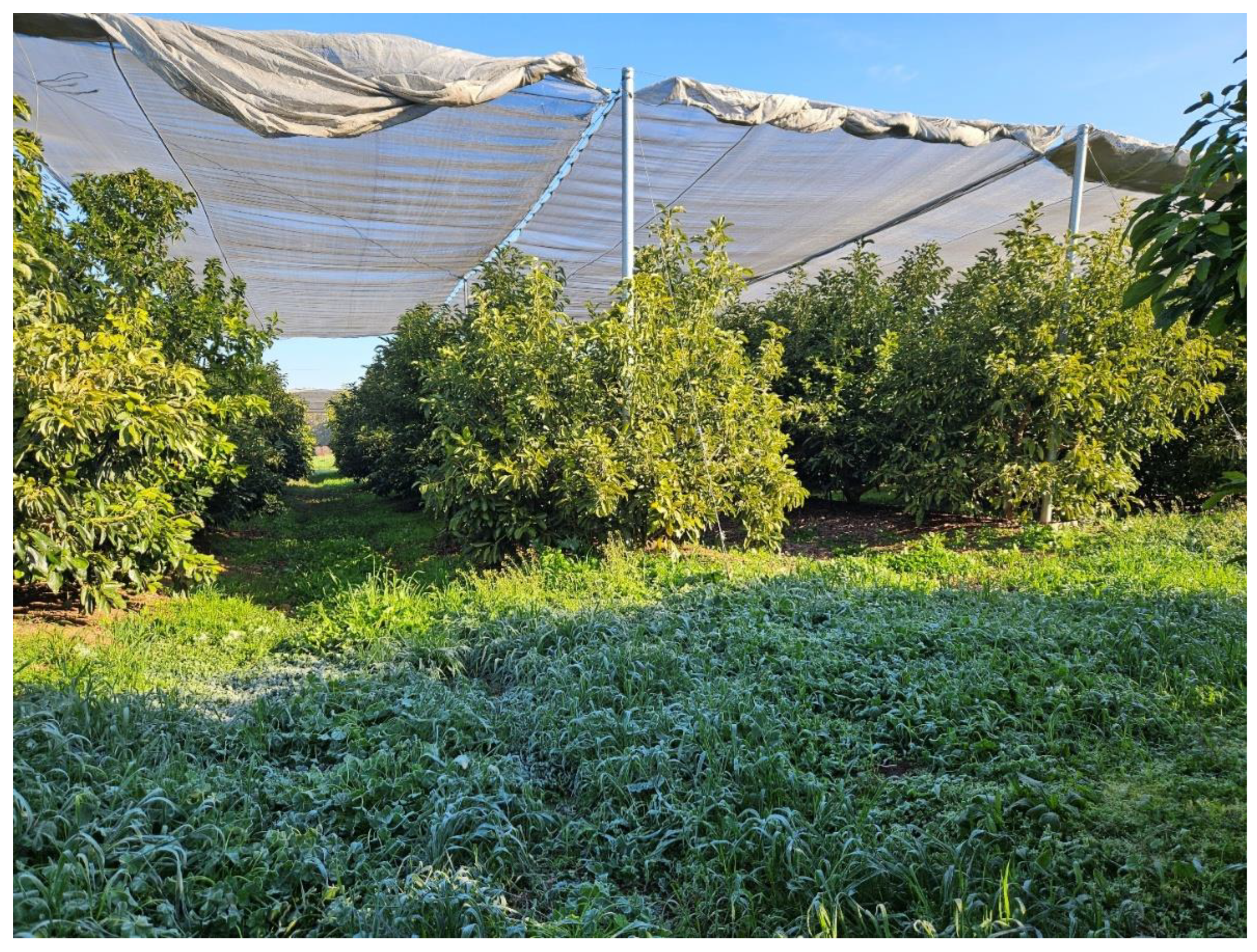
Figure 2.
Meteorological data. (A) Relative humidity. (B) Wind speed. (C) Solar radiation. (D) Precipitation. Data were recorded from December 2023 through March 2025 at the Kfar Blum meteorological station, close to the experimental site.
Figure 2.
Meteorological data. (A) Relative humidity. (B) Wind speed. (C) Solar radiation. (D) Precipitation. Data were recorded from December 2023 through March 2025 at the Kfar Blum meteorological station, close to the experimental site.
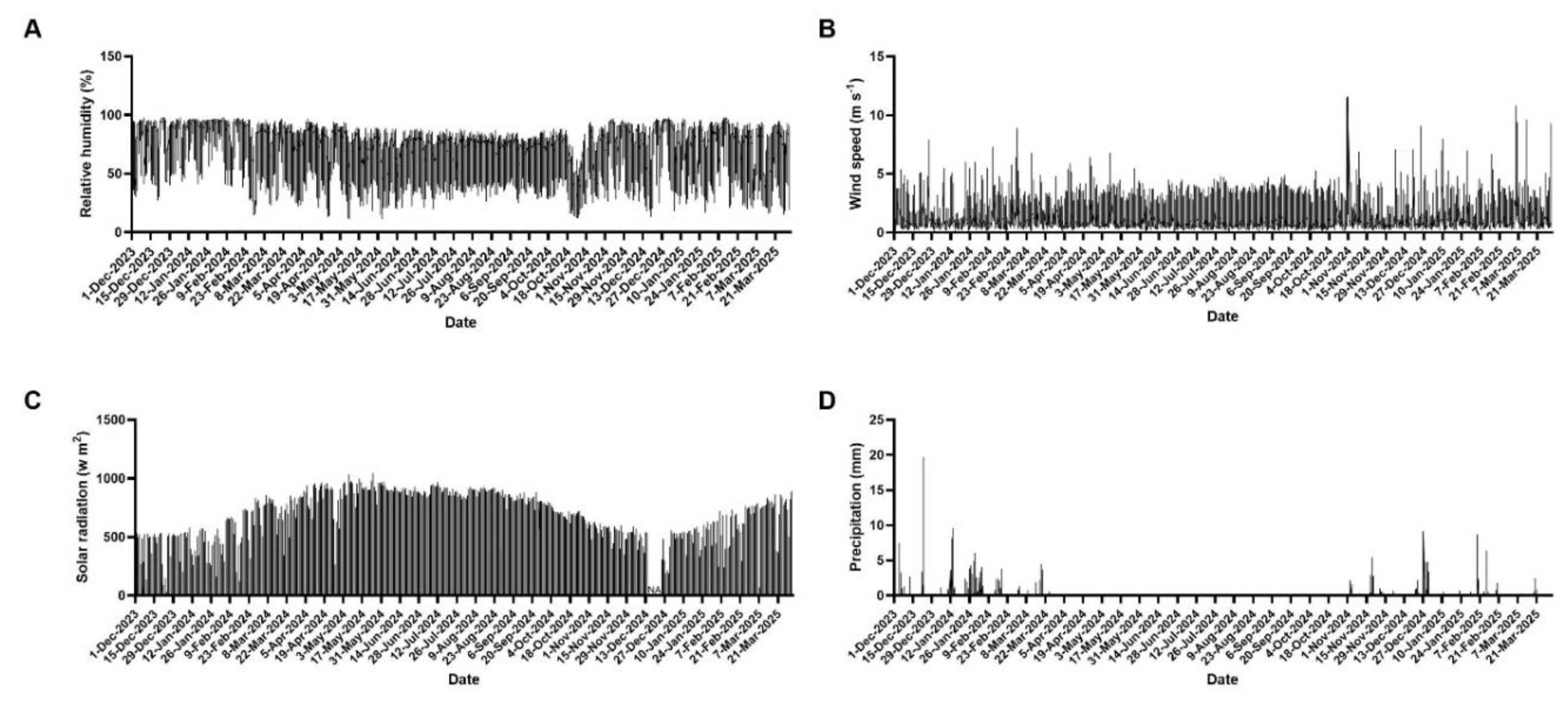
Figure 3.
Minimum (A) and maximum (B) daily air temperatures in the control plots and under the Silver 60% shading nets during the winter of 2023–2024. The mean temperature for each treatment is the average of two data loggers.
Figure 3.
Minimum (A) and maximum (B) daily air temperatures in the control plots and under the Silver 60% shading nets during the winter of 2023–2024. The mean temperature for each treatment is the average of two data loggers.
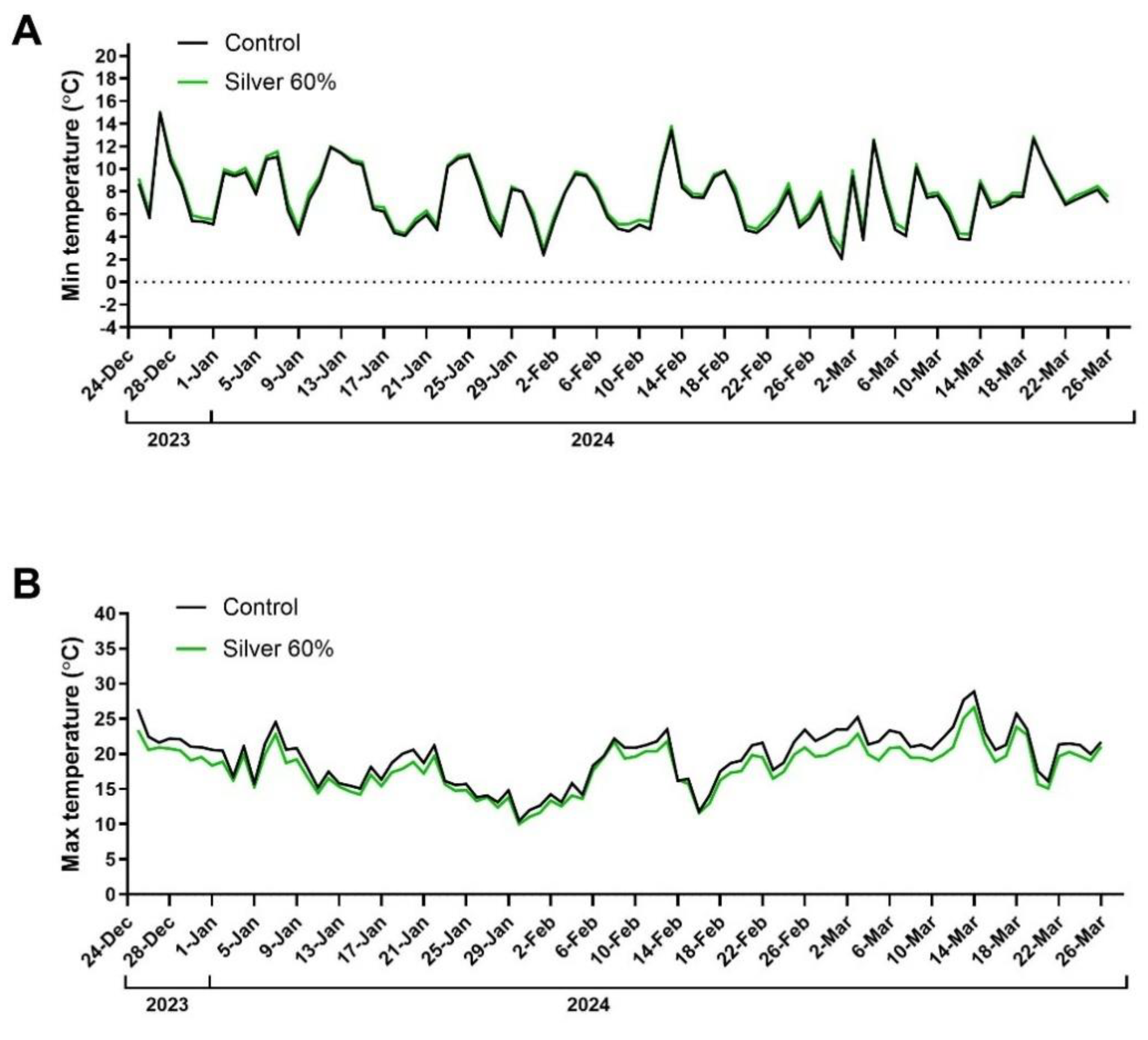
Figure 4.
Flowering intensity and fruit yield and weight for the control and Silver 60% trees. Flowering intensity was assessed and scored in April 2024 (A) on a scale of 0–5, with 0 representing no apparent flowering and 5, maximum bloom. Fruit yield (B) was determined in January 2025. Mean fruit weight (C) was calculated for the same harvest period by dividing the total fruit weight by the number of fruit on each tree. Values are means ± SE of three independent replicate plots (n = 3). Each replicate was based on measurements collected from at least seven trees. Results were subjected to an unpaired t-test (ns – not significant).
Figure 4.
Flowering intensity and fruit yield and weight for the control and Silver 60% trees. Flowering intensity was assessed and scored in April 2024 (A) on a scale of 0–5, with 0 representing no apparent flowering and 5, maximum bloom. Fruit yield (B) was determined in January 2025. Mean fruit weight (C) was calculated for the same harvest period by dividing the total fruit weight by the number of fruit on each tree. Values are means ± SE of three independent replicate plots (n = 3). Each replicate was based on measurements collected from at least seven trees. Results were subjected to an unpaired t-test (ns – not significant).
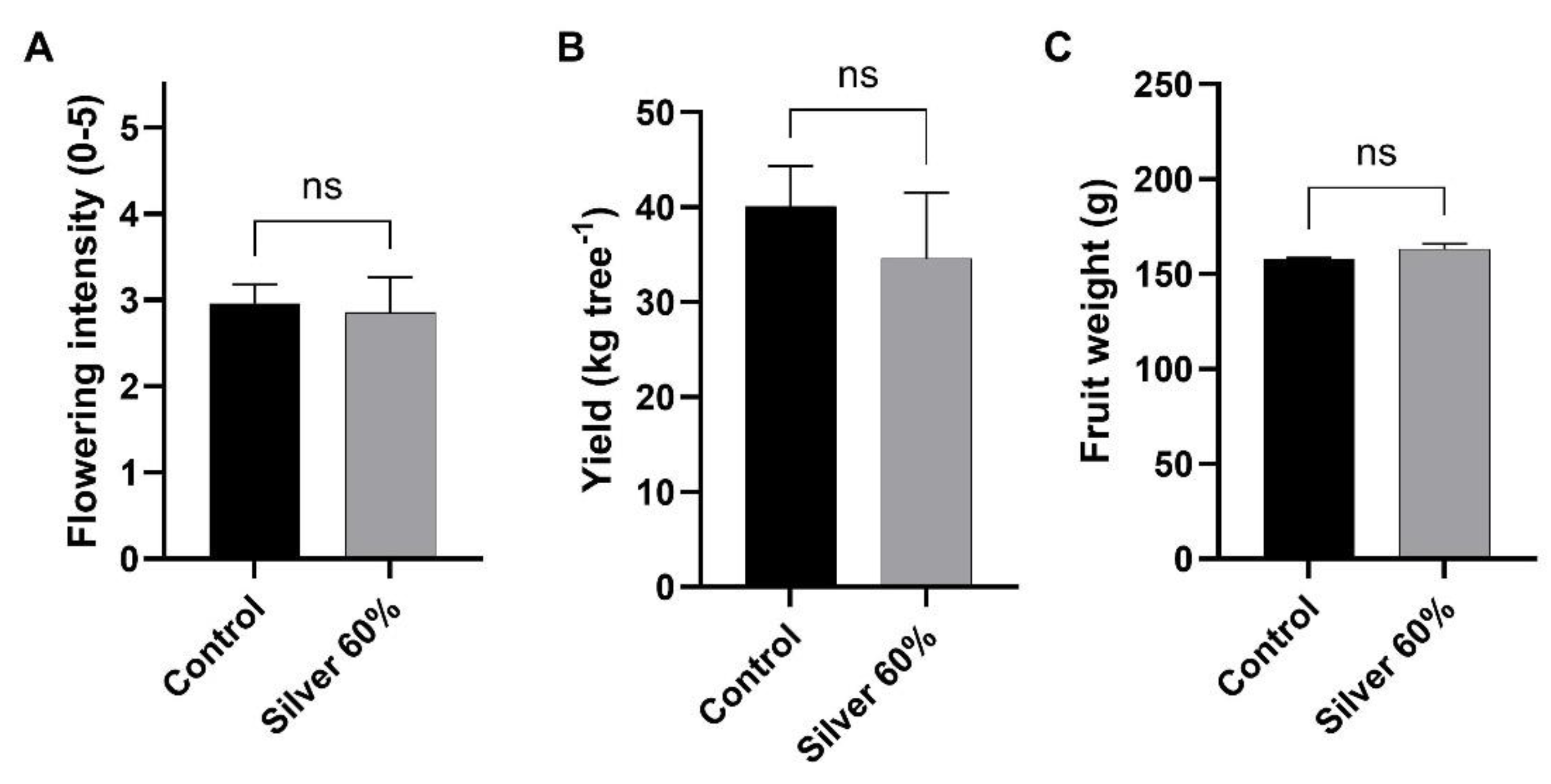
Figure 5.
Minimum (A) and maximum (B) daily air temperatures in the control plots and under the Silver 60% shading nets during the winter of 2024–2025. Daily air temperatures (C) and relative humidity (D) in the control plots and under the Silver 60% shading nets on 24 and 25 Feb 2025. The mean temperature and relative humidity for each treatment are the averages of two data loggers.
Figure 5.
Minimum (A) and maximum (B) daily air temperatures in the control plots and under the Silver 60% shading nets during the winter of 2024–2025. Daily air temperatures (C) and relative humidity (D) in the control plots and under the Silver 60% shading nets on 24 and 25 Feb 2025. The mean temperature and relative humidity for each treatment are the averages of two data loggers.
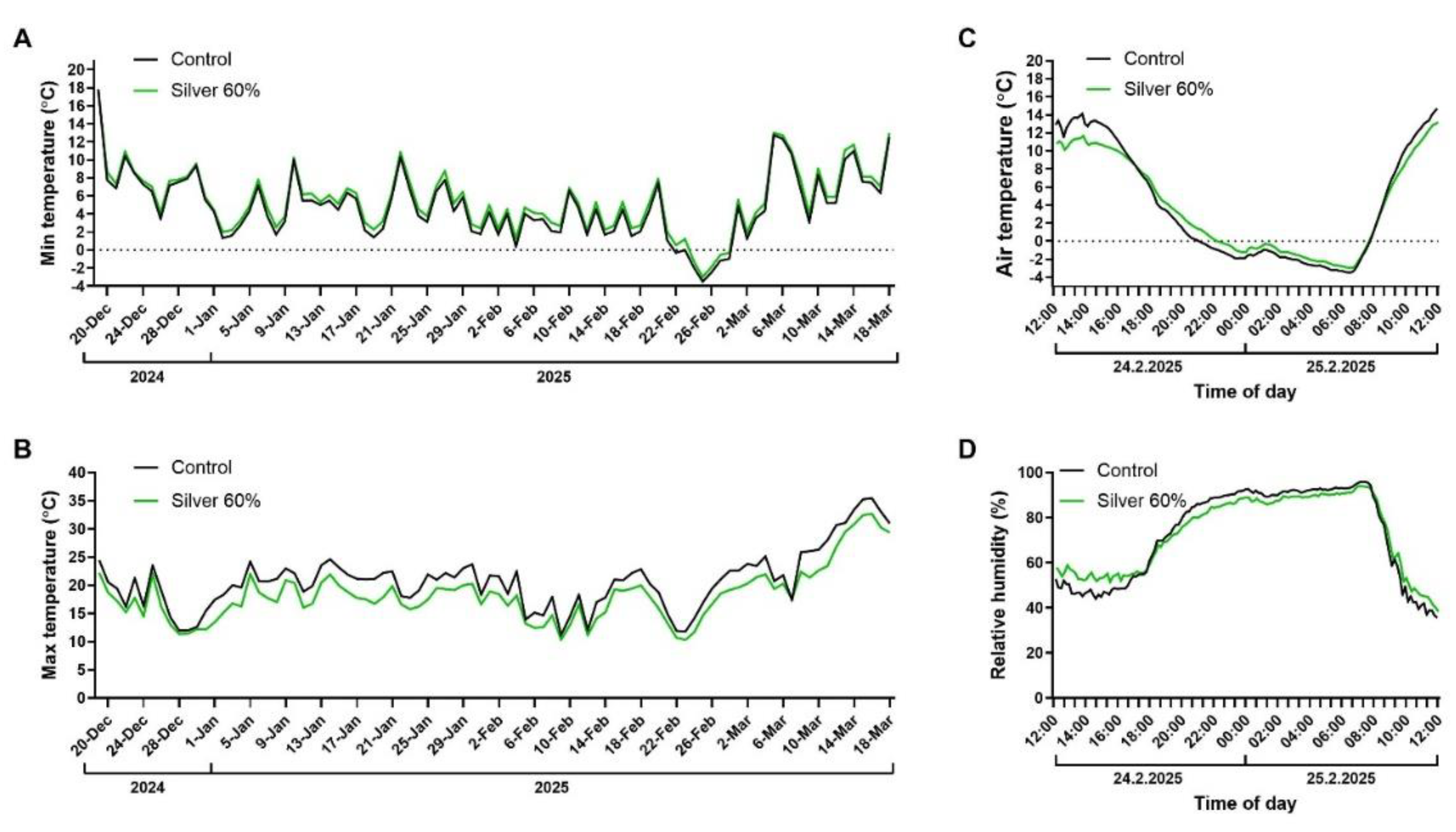
Figure 6.
Effect of shading nets on frost damage in mature avocado trees. (A–D) Representative images captured on 3 Mar 2025, following the severe frost event of February 2025. (A) Mature tree and (B) floral bud from the control treatment. (C) Mature tree and (D) floral bud from the Silver 60% treatment. (E) Frost-damage scores for young vegetative shoots and (F) proportion of damaged floral buds in control and Silver 60% trees assessed on 3 Mar 2025. Values are means ± SE of three independent replicate plots (n = 3). Each replicate was based on measurements collected from at least seven trees, with a minimum of 10 floral buds evaluated per tree for bud damage assessments. Asterisks indicate significant differences between treatments (unpaired t-test, **p < 0.01, ****p < 0.0001).
Figure 6.
Effect of shading nets on frost damage in mature avocado trees. (A–D) Representative images captured on 3 Mar 2025, following the severe frost event of February 2025. (A) Mature tree and (B) floral bud from the control treatment. (C) Mature tree and (D) floral bud from the Silver 60% treatment. (E) Frost-damage scores for young vegetative shoots and (F) proportion of damaged floral buds in control and Silver 60% trees assessed on 3 Mar 2025. Values are means ± SE of three independent replicate plots (n = 3). Each replicate was based on measurements collected from at least seven trees, with a minimum of 10 floral buds evaluated per tree for bud damage assessments. Asterisks indicate significant differences between treatments (unpaired t-test, **p < 0.01, ****p < 0.0001).
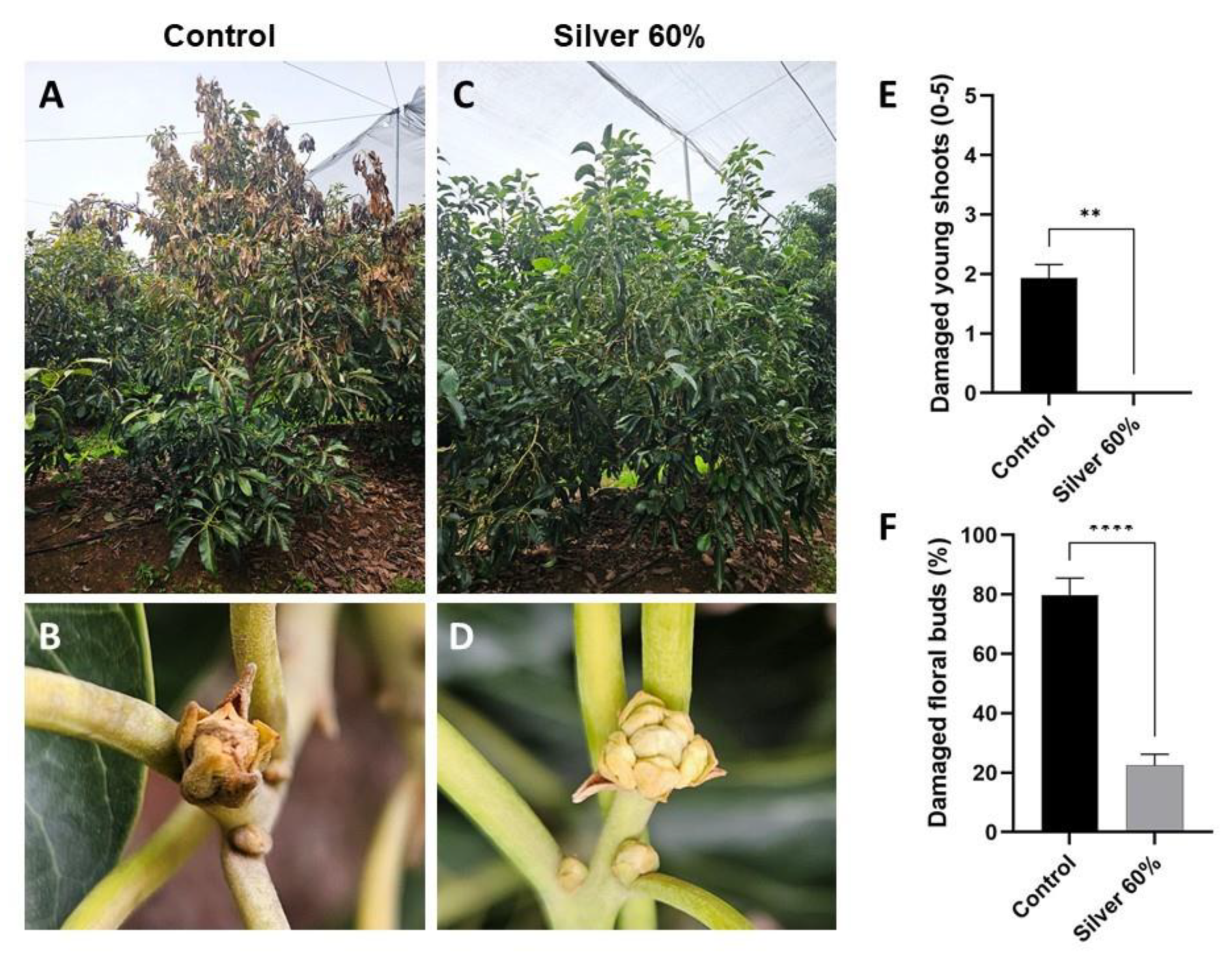
Figure 7.
Flowering intensity and fruit yield and weight in the control and Silver 60% trees. Flowering intensity was assessed and scored in April 2025 (A–C) on a scale of 0–5, with 0 representing no apparent flowering and 5, maximum bloom. Fruit yield (D–F) was determined in January 2026. Mean fruit weight (G) was calculated for the same harvest period by dividing the total fruit weight by the number of fruit on each tree. Values are means ± SE of three independent replicate plots (n = 3). Each replicate was based on measurements collected from at least seven trees. Results were subjected to an unpaired t-test (*p < 0.05, **p < 0.01, ns – not significant).
Figure 7.
Flowering intensity and fruit yield and weight in the control and Silver 60% trees. Flowering intensity was assessed and scored in April 2025 (A–C) on a scale of 0–5, with 0 representing no apparent flowering and 5, maximum bloom. Fruit yield (D–F) was determined in January 2026. Mean fruit weight (G) was calculated for the same harvest period by dividing the total fruit weight by the number of fruit on each tree. Values are means ± SE of three independent replicate plots (n = 3). Each replicate was based on measurements collected from at least seven trees. Results were subjected to an unpaired t-test (*p < 0.05, **p < 0.01, ns – not significant).
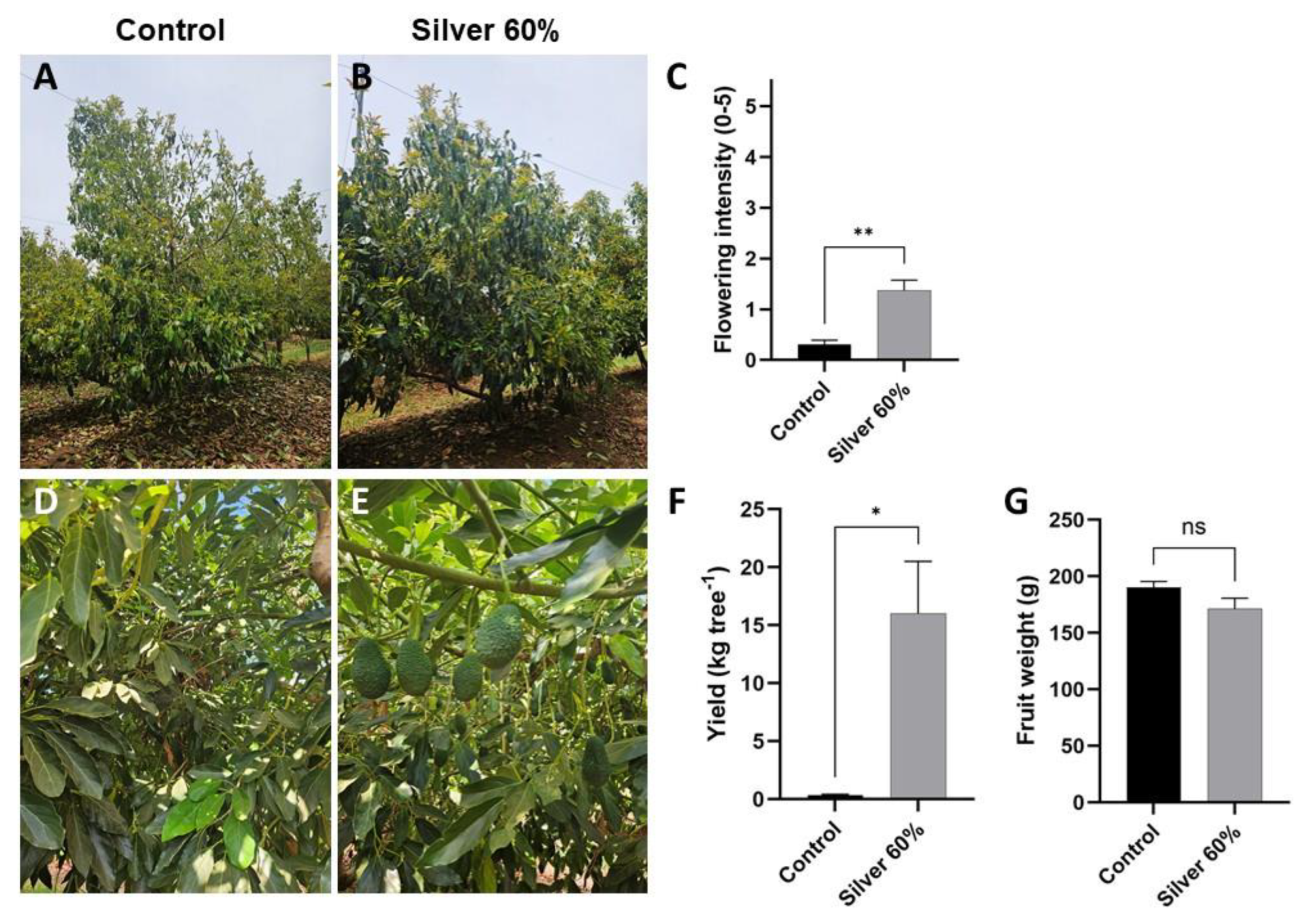

Table 1.
Irrigation rates in the experimental orchard during the experimental period.
| Month | Dec-23 | Jan-24 | Feb-24 | Mar-24 | Apr-24 | May-24 | Jun-24 | Jul-24 |
| Irrigation (m3 ha-1) | 0 | 0 | 30 | 128 | 292 | 186 | 942 | 1306 |
| Month | Aug-24 | Sep-24 | Oct-24 | Nov-24 | Dec-24 | Jan-25 | Feb-25 | Mar-25 |
| Irrigation (m3 ha-1) | 1276 | 1620 | 952 | 480 | 0 | 382 | 90 | 254 |
| Month | Apr-25 | May-25 | Jun-25 | Jul-25 | Aug-25 | Sep-25 | Oct-25 | Nov-25 |
| Irrigation (m3 ha-1) | 740 | 940 | 1900 | 1820 | 1838 | 1592 | 912 | 638 |
| Month | Dec-25 | Jan-26 | ||||||
| Irrigation (m3 ha-1) | 60 | 26 |
Table 2.
Results of fixed-effects tests from linear mixed-effects models evaluating the effects of treatment, year, and their interaction on agronomic traits. Asterisks indicate significance at * p < 0.05, ** p < 0.01, “ns” denotes non-significant.
Table 2.
Results of fixed-effects tests from linear mixed-effects models evaluating the effects of treatment, year, and their interaction on agronomic traits. Asterisks indicate significance at * p < 0.05, ** p < 0.01, “ns” denotes non-significant.
| Flowering intensity | Fruit yield | Fruit weight | |
| Treatment | * | ns | ns |
| Year | ** | ** | * |
| Treatment x Year | ns | ns | ns |
Disclaimer/Publisher’s Note: The statements, opinions and data contained in all publications are solely those of the individual author(s) and contributor(s) and not of MDPI and/or the editor(s). MDPI and/or the editor(s) disclaim responsibility for any injury to people or property resulting from any ideas, methods, instructions or products referred to in the content. |
© 2026 by the authors. Licensee MDPI, Basel, Switzerland. This article is an open access article distributed under the terms and conditions of the Creative Commons Attribution (CC BY) license (http://creativecommons.org/licenses/by/4.0/).
Copyright: This open access article is published under a Creative Commons CC BY 4.0 license, which permit the free download, distribution, and reuse, provided that the author and preprint are cited in any reuse.


