

Submitted:
29 July 2026
Posted:
07 August 2026
You are already at the latest version
Abstract
Within the first year of life, infants can perceptually discriminate people by race. However, beyond perceptual discrimination, it remains unclear whether infants use race to guide their social behaviors, such as whether they approach or withdraw from people of different races. This question is particularly understudied during toddlerhood (between 1 and 2 years of age), before children can reliably report racial attitudes around 3 to 4 years of age. The present study examined whether 12- to 25-month-old U.S. toddlers (N = 118) show greater wariness toward strangers from unfamiliar than familiar racial groups in a within-subject design to determine whether toddlers use a person’s race to guide their social behaviors. Toddlers did not exhibit significantly greater wariness toward strangers from unfamiliar than familiar racial groups, and this pattern was not moderated by their racial backgrounds, temperament, or racial diversity of their social networks or neighborhoods. These findings suggest that race may not function as a salient cue for guiding toddlers’ social responses during the second year of life. More broadly, these findings contribute to growing evidence that early perceptual sensitivity to race does not necessarily entail race-based biases in evaluations or behaviors in early childhood.
Keywords:
infant
; toddler
; race
; stranger wariness
; temperament
Does the Race of the Stranger Matter? Investigating Toddlers’ Wariness Towards Familiar and Unfamiliar Race Strangers
Structural and interpersonal racism in the United States continue to create racial inequities between racial groups and biases in favor of white people (Bailey et al., 2017; Roberts & Rizzo, 2020; Rogers et al., 2021; Salter et al., 2018). One avenue towards addressing racism and its resulting consequences is a better understanding of its ontogeny (Baron, 2015). Many children demonstrate racial biases, such as preferring people or endorsing stereotypes according to race, by 3 to 4 years of age (Hailey & Olson, 2013; Hughes et al., 2023; Rhodes & Baron, 2019). However, the specific developmental mechanisms that lead to the formation of such racial biases remain largely unknown (Eddie et al., 2025; Lee et al., 2017; Liberman et al., 2017; Quinn et al., 2019). We know perceptual discrimination based on racial groups occurs within the first year of life and the child’s social environment heavily influences this perceptual process (Bar-Haim et al., 2006; Quinn et al., 2018; Sugden & Marquis, 2017). Yet, whether non-perceptual biases, such as differences in social behaviors toward people based on racial backgrounds, emerge before 3 to 4 years of age is severely under investigated (Eddie et al., 2025; Lee et al., 2017; Quinn et al., 2019).
To address this substantial gap in knowledge about the developmental processes that unfold between infancy (0-12 months) and the preschool age (3-5 years), we focus on toddlerhood (1-2 years). Toddlerhood is a crucial period of rapid social-cognitive development, marked by growth in language and the expansion of social relationships beyond the immediate family (Brownell & Kopp, 2007; Hay et al., 2018; Wagner & Hoff, 2012). As such, this period provides an important opportunity to investigate how young children are beginning to think about race and people from different racial backgrounds. Here, we use early-emerging, ecologically valid, and naturalistic social behaviors (specifically, wariness toward strangers) to examine toddlers’ responses to people from different racial backgrounds and the factors that may moderate these responses, ranging from children’s individual temperament to exposure to racial diversity in their social networks and neighborhoods.
Developing Perceptions of Race in Infancy
During the first year of life, infants begin to perceptually differentiate between people from racial backgrounds familiar to them (often referred to as “own-race”1) and people from unfamiliar racial backgrounds (or “other-race”) during the first year of life (Quinn et al., 2019; Sugden & Marquis, 2017). By around 9 months of age, many infants also better individuate faces from racial groups they see more frequently in their environment, a phenomenon called the other-race effect (Anzures et al., 2013; Ferera et al., 2021). Such perceptual narrowing processes appear to be dependent on infants’ exposure to racial diversity. That is, the other-race effect is found among infants living in racially homogeneous environments, such as white infants in predominately white environments (Kelly et al., 2007) or Han Chinese infants in predominately Han Chinese environments (Kelly et al., 2009; Liu et al., 2015). In fact, infants who initially showed an other-race effect in face recognition showed reductions in this effect after receiving regular exposure to other-race faces (Anzures et al., 2012; Heron-Delaney et al., 2011). Researchers have proposed that this type of asymmetrical exposure to own-race versus other-race faces may have both perceptual and social consequences (Lee et al., 2017). This theory, known as the perceptual-social linkage hypothesis, posits that early emerging perceptual biases in face processing in infancy may become the foundation for implicit bias and other more fully-fledged racial biases found in older children (Qian et al., 2017, 2019). However, direct evidence for this hypothesis remains limited, particularly during toddlerhood, the developmental period between 1 to 2 years of age.
Limited Research in Toddlerhood
The limited prior work on how toddlers respond to people from different racial backgrounds is likely due, at least in part, to methodological constraints. Toddlers are typically more active than infants, making looking time metrics difficult to implement, but they are also not yet reliable respondents to verbal questioning (Adolph & Franchak, 2017; Byers-Heinlein et al., 2022; Chen & Siegler, 2000; Hessels & Hooge, 2019). For these reasons, researchers examining social cognitive development during the toddler period often rely on observational methods or paradigms designed to elicit naturalistic behaviors (Brownell & Kopp, 2007).
The few studies that have examined how infants and toddlers respond to people from different racial backgrounds have yielded mixed results. Several studies suggest that infants and toddlers do not demonstrate a reliable difference in behavior toward people from familiar racial backgrounds over unfamiliar racial backgrounds. For example, two studies examining differences in how wary infants were towards familiar and unfamiliar racial group strangers found no difference in how infants behaved towards either group: One study with 3- to 9-months-old white, Asian, and Hawaiian infants (Bronson, 1972) and another study with 2- to 23-months-old white and Black infants (Scarr & Salapatek, 1970). Similarly, (Kinzler & Spelke, 2011) found that 10-month-old and 2.5-year-old white infants did not prefer taking a toy from a white experimenter over a Black experimenter when the two simultaneously offered a toy.
In contrast, other studies have found evidence of race-based differences: (Feinman, 1980) found that 4-to-24-month white infants were more wary of Black than white strangers. More recently, Laible et al. (2021) found that 24-month-old (but not 18-month-old) mostly white toddlers were more likely to provide instrumental help, such as helping retrieve a dropped crayon, to white experimenters than to Black experimenters. What might explain these discrepancies?
What Can Explain Toddlers’ Social Responses to Strangers from Different Racial Groups?
Exposure to Racial Diversity
First, prior studies have rarely measured toddlers’ everyday exposure to racial diversity in relation to their social behaviors, making it difficult to determine whether variation in their social environments helps explain the mixed findings, similar to how exposure to racial diversity relates to infants’ race-based perceptual discrimination as reviewed above. Consistent with this possibility, studies that found no differences in infants’ social wariness toward familiar versus unfamiliar racial group members were conducted in relatively racially diverse areas, including Boston, Massachusetts (Kinzler & Spelke, 2011), Honolulu, Hawaii (Bronson, 1972), and Philadelphia, Pennsylvania (Scarr & Salapatek, 1970). In contrast, studies that found race-related differences were conducted in relatively less racially diverse areas with predominantly white samples, such as Laramie, Wyoming (Feinman, 1980) and Bethlehem, Pennsylvania (Laible et al., 2021).
Further, recent research highlights that exposure to racial diversity can be measured at multiple levels, from distal neighborhood to proximal social network levels. Neighborhood level racial diversity has been associated with differences in how infants attend to race and preschool-age children’s racial preferences (Bauer et al., 2023; Hwang et al., 2021; Rizzo et al., 2022; Singh et al., 2022). Other work suggests that racial diversity within children’s social networks is a strong predictor of these processes, more so than neighborhood level racial diversity for infants (Arnold et al., 2024; Immel & Liberman, 2024). Moreover, neighborhood and network level diversity may interact in meaningful ways. For example, Burke et al. (2023) found that 4- to 11-year-old white children (despite being from low racial diversity neighborhoods) showed less anti-Black bias in their explanations for racial inequality if they had more racial diverse social networks.
In addition, most studies examining environmental racial diversity as a predictor of children’s racial bias have focused on exclusively white samples (Eddie et al., 2025), overlooking the important role that children’s own racial backgrounds may play in these processes. Regardless of the racial diversity of their neighborhoods or social networks, infants and children from minoritized racial backgrounds may be more likely to come into contact with members of the racial majority (e.g., white adults in institutional settings such as schools), than white children are to come into contact with racially minoritized individuals (Hagerman, 2018; La Salle et al., 2020; Turner et al., 2021; Yip et al., 2019). Thus, children’s own racial backgrounds, as well as the racial diversity they encounter across both proximal to distal social environments, are essential for understanding trajectories of children’s racial bias development.
Individual Difference in Temperament
Second, although several studies assessing race-related differences in infants’ social wariness were primarily motivated by broader questions about temperament and stranger wariness (Bronson, 1972; Feinman, 1980; Scarr & Salapatek, 1970), none had directly examined whether individual differences in temperament help explain toddlers’ response to strangers from different racial backgrounds. One exception is Hwang et al. (2023), who found that parent-reported shyness moderated 2- to 7-year-old children’s social wariness toward strangers based on race. Specifically, shyer children showed greater wariness toward unfamiliar than familiar racial group strangers. Given that temperamental shyness is strongly associated with fearful responses to novel stimuli and stranger wariness in infants and children (see Rubin et al. (2009) for a review), temperament may be an important factor to measure when examining toddlers’ wariness toward strangers from unfamiliar racial backgrounds. However, to our knowledge, no study has examined whether this interaction is present during toddlerhood, particularly before 24 months of age. Thus, it remains unclear whether temperament-related differences in responses to unfamiliar racial group strangers are already evident before 2 years of age. In addition, the present study addressed the limitations of Hwang et al. (2023) in several ways, such as testing participants in a within-subject design (rather than in a between-subject design), having strangers who were from multiple different ethnic-racial backgrounds (rather than having only white strangers), and collecting metrics on exposure to racial diversity (rather than having no information about racial diversity).
Current Study
In the current study, we examined whether toddlers use a person’s race to guide their social behavior. Specifically, we assessed 12- to 25-month-old toddlers’ social wariness toward strangers from familiar and unfamiliar racial groups using a within-subject design. To characterize potential sources of variation in toddlers’ responses, we also examined whether ethnic-racial background (as white or racially minoritized), individual differences in temperament, social network racial diversity, or neighborhood racial diversity moderated their wariness toward familiar and unfamiliar racial group strangers. This study was designed to address the following research questions: (1) Do toddlers exhibit different levels of social wariness toward strangers from familiar versus unfamiliar racial groups? (2) Does toddlers’ racial background (white or racially minoritized) moderate differences in wariness toward familiar versus unfamiliar racial group strangers? (3) Does temperamental shyness moderate wariness toward familiar versus unfamiliar racial group strangers? (4) Does racial diversity in toddlers’ neighborhoods and social networks relate to variations in wariness toward familiar versus unfamiliar racial group strangers?
Hypotheses
RQ1: Do toddlers exhibit different levels of social wariness toward strangers from familiar versus unfamiliar racial groups? We hypothesized that toddlers’ social wariness might vary as a function of whether strangers were from familiar versus unfamiliar racial groups. If toddlers showed greater wariness toward strangers from unfamiliar than familiar racial groups, this would suggest that toddlers are using a person’s race to guide their behaviors toward unfamiliar adults. In contrast, if toddlers showed comparable levels of wariness toward familiar and unfamiliar racial group strangers, this would suggest that race may not yet be a salient cue for toddlers in this 12- to 25-month period.
RQ2: Does toddlers’ racial background (white or racially minoritized) moderate differences in wariness toward familiar versus unfamiliar racial group strangers? We also expected that toddlers’ own ethnic-racial background might shape these responses. Given that white children in the U.S., on average, have less racially diverse social networks and live in less racially diverse neighborhoods compared to racially minoritized children (Eddie et al., 2025) and white children often show higher levels of racial bias than racially minoritized children (Hailey & Olson, 2013), white toddlers may show greater wariness to unfamiliar racial group strangers than racially minoritized toddlers. However, if no differences emerge between white and racially minoritized toddlers, this would suggest that toddlers’ own ethnic-racial background may not yet play a major role in shaping race-related variation in social wariness at this age.
RQ3: Does temperamental shyness moderate wariness toward familiar versus unfamiliar racial group strangers? In addition, we expected that temperamental shyness might moderate toddlers’ social wariness responses as found in Hwang and colleagues (2023). Specifically, shyer toddlers may show greater wariness toward unfamiliar relative to familiar racial group strangers because they may be more sensitive to novel or unfamiliar stimuli, whereas less shy toddlers may show minimal differences in wariness across stranger racial groups. In contrast, if temperament does not moderate differential responses by stranger racial groups, this potentially would suggest toddlers are not yet consistently using a person’s race as a cue to guide wary responses toward unfamiliar adults.
RQ4: Does racial diversity in toddlers’ neighborhood and social network relate to variations in wariness toward familiar versus unfamiliar racial group strangers?
Finally, we hypothesized toddlers’ exposure to racial diversity in their social environments would relate to variation in their social wariness responses. Greater racial diversity in toddlers’ neighborhoods and social networks may be associated with less differentiation in wariness toward familiar versus unfamiliar racial group strangers as toddlers in racially diverse environments may find it a common experience to see and interact with people from varying racial backgrounds. In contrast, lower levels of racial diversity may be associated with toddlers showing greater wariness to unfamiliar than familiar racial group strangers, as these toddlers may have limited exposure to and interactions with people from different racial backgrounds.
Given mixed findings in the prior literature, we used both frequentist linear mixed-effects models and Bayesian analyses to evaluate these hypotheses. Frequentist models allowed us to test whether toddlers’ wariness differed as a function of stranger racial groups and whether these responses were moderated by toddlers’ ethnic-racial background, temperamental shyness, neighborhood racial diversity, or social network racial diversity. Bayesian analyses further allowed us to characterize the strength and direction of the evidence, including the posterior distributions of effects and Bayes factors for theoretically meaningful null findings. This analytic approach was chosen because the absence of race-related differences in social wariness during toddlerhood is theoretically informative for understanding whether, and when, race begins to function as a salient cue guiding children’s social behaviors.
Method
Data was collected between July, 2024 to December, 2025. The study design and protocol were approved by the Institutional Review Board of University of California Santa Cruz (IRB #HS-FY2023-23). All anonymized data and analyses files are available on Open Science Framework (OSF): https://osf.io/phwma/
Participants
The final sample consisted of 118 toddlers (Meanage = 17.03 months; SD = 3.39 months; Range = 12 months to 25 months; 58 females; 60 males). Of these toddlers, 58 were identified as monoracial white and 60 were identified as racially minoritized (28 Hispanic/Latine or Hispanic/Latine and white, 7 East Asian and white, 3 East Asian, 2 South Asian, 20 multi-racial) by their caregivers. Participants were recruited from Santa Cruz, California and surrounding areas through social media and online advertisements using OpenClinical.com. Participants lived in 49 unique zip codes across the area.
Caregivers reported toddlers’ language backgrounds as follows: 43.70% heard only English, 25.21% heard primarily English with some exposure to another language, 27.73% heard two or more languages regularly, and 2.52% did not report their language background. The primary caregiver, defined as the caregiver who spent the most time with the toddler, was identified as female for 87.39% of participants, male for 5.88%, and non-binary for 1.68%, and 4.20% did not report primary caregiver gender. Primary caregivers’ highest level of education was most commonly a bachelor’s degree (45.38%) or a graduate/professional degree (34.45%), followed by some college but no degree (6.72%), an associate’s or technical degree (5.04%), a high school diploma or GED (2.52%), prefer not to say (0.84%) and did not report (4.20%). The median reported household income was $150,000.
In addition, 49 toddlers participated but were excluded due to experimenter mistakes or protocol deviation (n = 15), toddlers later determined to have been assigned two familiar or two unfamiliar racial group strangers (n = 12), camera equipment failure (n= 6), toddlers crying and ending the session early (n= 6), parents not following instructions (n= 9), and being older than our age range (n= 1).
Study Design & Procedure
As a within-group design, all toddlers completed two stranger sessions: one with a familiar racial group stranger and another with an unfamiliar racial group stranger. The order of which stranger toddlers saw first was randomized. A stranger was considered from a familiar racial group if their racial identities matched at least one of the racial backgrounds of toddlers’ primary caregiver(s), and unfamiliar if not. For example, if a toddler was identified as having two primary caregivers (one Black parent and one white parent), then a stranger who was Black or white was assigned as the familiar racial group stranger and a stranger who was East Asian was assigned as the unfamiliar racial group stranger. This categorization method is identical to previous studies using similar paradigms (Gaither et al., 2020; Hwang et al., 2023). All strangers were female presenting. In total, there were 1 Black stranger, 5 East Asian strangers, 1 East Asian and Native Hawaiian or other Pacific Islander stranger, 6 Hispanic/Latine strangers, 5 South Asian (Indian) strangers, 7 white strangers, and 1 white and Middle Eastern stranger who conducted the study. See Table 1 for the distribution of participants who saw each stranger race by familiarity.
Stranger Wariness Task. All participants came to the university campus to participate. After providing consent and given instructions by a white male experimenter, who was never one of the strangers, one caregiver accompanied the child into the testing room. The stranger session protocol followed well-established stranger wariness paradigms (Degnan et al., 2014).
First, the male experimenter provided the child with some toys, and the child and caregiver were allowed to free play for 5 minutes to get accustomed to the testing room. After 5 minutes, the male experimenter came back and took away the toys and instructed the caregiver to complete the questionnaires and to not interact with their child when the strangers entered. Then, the first stranger (an unfamiliar experimenter the child has not seen before) entered the testing room and sat in the corner for 1 minute with a neutral facial expression, not looking at or interacting with the child. After 1 minute, the first stranger left the room and reentered with a toy truck and some blocks. The stranger played with the truck, dumping blocks silently for 1 minute. If the child had not already joined the stranger in play by this first minute, the stranger prompted the child to join by saying “Would you like to come and help me pick up the blocks?”, and then again 20 seconds later if the child had not yet touched the toys or engaged with the stranger after the first prompt. The stranger stayed in the room for a total of about 2 minutes with the truck before exiting. Then, the second stranger entered and repeated the same procedure.
Social Preference Task. After the stranger sessions were completed, both strangers entered the room together, each holding an identical novel toy with multiple sound-producing and manipulable features, and sat down equidistant from the child and each other. The two experimenters then played with their toys for about 1 minute, and if the child did not make a choice, then offered the toy to the child and said at the same time, “Do you want to play?” If the child did not make a choice after another 20 seconds, the prompt was repeated. The child was considered making a choice if they touched one of the toys or strangers. Once this task was complete, caregivers and children were thanked and offered a certificate, compensation, a brief debriefing, and an opportunity to ask any questions.
Measures
Standardized Composite Social Wariness Scores. Each stranger session was coded for: (1) the length of time (in seconds) that the child was within close proximity to the caregiver (close proximity was defined by if any of the child’s body was within the round pink rug (radius = ~1 foot) on which the caregiver’s chair was positioned); (2) time (in seconds) to first touch the toy, (3) time (in seconds) to first vocalize, and (4) time (in seconds) to first touch the stranger, following Degnan et al. (2014). If the event did not occur (i.e., no vocalization occurred during the stranger session), the time was set to the end of the session time. All times were then converted to a proportion score by dividing the time by the total duration of each session. These times were z-scored and averaged to create a composite wariness score, one for the familiar racial group stranger and another for the unfamiliar racial group stranger. Higher scores indicated greater social wariness. Three coders completed the behavioral coding and 20% of the data were double coded to assess interrater reliability. Reliability was high across coded behaviors (Mean ICC = 0.989).
Toddler Behavior Assessment Questionnaire (TBAQ). Caregivers completed the 19-item social fear subscale of the Toddler Behavior Assessment Questionnaire (TBAQ) (Goldsmith, 1996), used to index shyness and avoidance of novelty. This subscale asked caregivers to report on their child’s behaviors in social situations, such as encountering people on the playground and in doctors’ offices, during the past month. The scores were averaged per child and z-scored to create a social fear composite score.
Demographic Survey. Caregivers completed demographic information about their child and themselves, including the current Zip code that their child lives in.
Neighborhood Racial Diversity. The Zip code was then used to extract neighborhood racial demographics from the 2024 American Community Survey (ACS), based on U.S. Census data. We examined two measures of neighborhood racial diversity.
First, we calculated neighborhood entropy, which reflects both the number of racial groups represented in the child’s Zip code and the relative proportion of each group. Thus, it captures the extent to which children’s neighborhoods include multiple racial groups as well as how evenly represented those groups are (see (Burke et al., 2022) for a detailed description). We used the R package entropy (Hausser & Strimmer, 2008) and racial demographic data from the 2024 ACS as noted above to calculate this metric. An entropy value of 0 indicates no diversity and more positive entropy values indicate greater racial diversity.
Second, we calculated the neighborhood outgroup population, which reflected the proportion of residents in the child’s zip code who did not share the child’s racial background. For monoracial white children, for example, this value reflected the proportion of residents in the child’s zip code who were not monoracial white. For biracial white and Black children, this value reflected the proportion of residents who did not identify as either monoracial white or monoracial Black. A value of 0 would indicate all populations in the child’s Zip code were the same race as them, whereas 1 would indicate that all populations were of a different race to the child.
Social Network Questionnaire. Caregivers completed a shortened version of the social network questionnaire (Burke et al., 2022), which asked caregivers to report the people that their child regularly interacts with in different settings (e.g., home, daycare, and play activities) and demographic information about these people.
Social Network Diversity. We calculated two measures of social network racial diversity, paralleling our measure of neighborhood racial diversity and following Burke et al. (2022). First, we calculated social network entropy using the R package entropy to capture both the number of distinct racial groups represented in the child’s social network and the relative proportion of each group. Higher entropy values indicated greater racial diversity within the child’s social network.
Second, we calculated the EI index using the R package egor (Krenz et al., 2024), which captures the proportion of people in the child’s social network who are not from the same racial backgrounds as the child. Specifically, the EI index was calculated as the number of network members from racial backgrounds different from the child minus the number of network members from the same racial background as the child, divided by total network size. Scores can range from -1 to 1, with -1 indicating that all network members were from the same racial background as the child and 1 indicating that all network members were from a different racial background than the child.
Results
Data Analytic Approach
We first report results from frequentist linear mixed-effects models (LMMs). We then present results from Bayesian analyses, including Bayes Factors (BF₀₁) and posterior distributions, to quantify the evidence for the theoretically meaningful null findings. Following common interpretive guidelines, BF₀₁ between 1 and 3 were interpreted as weak or anecdotal evidence, BF₀₁ between 3 and 10 as moderate evidence, and BF₀₁ greater than 10 as strong evidence for one model over another (Lee & Wagenmakers, 2014). We used a bottom-up model-building approach, beginning with the simplest model and sequentially adding predictors to evaluate whether each additional term improved model fit using likelihood ratio tests (LRTs).
Preliminary Analyses
We first constructed a LMM with only random effects for child ID and stranger name. Child ID was included to account for repeated observations within children, and stranger name was included to account for variability across the different strangers who conducted the study. Because the estimated variance associated with stranger name was effectively zero and resulted in singular model fits, subsequent models retained only the random intercept for child ID. Next, we assessed whether strangers’ racial background (as reported in Table 1) explained any variance in toddlers’ social wariness. LRT indicated that adding stranger racial background as a fixed effect predictor did not improve model fit beyond the model with the random effect only, χ2(7) = 8.661, p = .278. Because our primary theoretical question focused on whether toddlers responded differently to strangers from familiar versus unfamiliar racial groups, rather than to specific stranger racial backgrounds, stranger racial background was not included as a fixed effect predictor in subsequent models and analyses.
Next, we tested whether stranger order (unfamiliar racial group stranger first vs. familiar racial group stranger first) explained variance in toddlers’ social wariness. Adding stranger order as a fixed effect predictor did not improve model fit relative to the model with random effect only, χ2(1) = 0.767, p = .381. This finding suggests that there were no stranger order effects on toddlers’ social wariness, supporting the use of the within-subject design to examine toddlers’ wariness toward familiar versus unfamiliar racial group strangers. We retained stranger order as a fixed effect predictor in subsequent analyses because it was experimentally manipulated and we wanted to account for this factor when interpreting our main hypotheses.
Next, we added social fear (social fear subscale from TBAQ), child sex (male or female), child age (in months), and child race (dichotomized as monoracial white vs. racially minoritized) as fixed effect predictors because, although these variables were not central to all our main hypotheses, prior research indicates they are significantly associated with toddlers’ social wariness (Brooker et al., 2013; Degnan et al., 2014; Hwang et al., 2023). Adding these child-level predictors (social fear, child sex, child age, and child race) significantly improved model fit relative to the model that included stranger order only, χ2(4) = 32.461, p < .001. Thus, these predictors were retained in subsequent models.
Main Analyses
RQ1: Do toddlers exhibit different levels of social wariness toward strangers from familiar versus unfamiliar racial groups?
To test this hypothesis, we constructed a LMM predicting toddlers’ social wariness with child ID as a random effect and the following fixed-effect predictors: Stranger group (familiar vs. unfamiliar racial group), stranger session order, social fear (social fear subscale from TBAQ), child sex (male or female), child age (in months), and child race (dichotomized as white vs. racially minoritized).
There was no significant main effect of stranger group, b = 0.05, SE = 0.05, 95% CI [−0.05, 0.16], p = .327, suggesting that toddlers did not differ significantly in their social wariness toward unfamiliar racial group strangers compared with familiar racial group strangers. However, caregiver-reported social fear significantly predicted social wariness, b = 0.25, SE = 0.04, 95% CI [0.16, 0.33], p < .001, such that toddlers with higher caregiver-reported social fear exhibited greater overall social wariness. This finding is consistent with a large body of work identifying caregiver-reported infant temperament as a predictor of social wariness (Brooker et al., 2013; Degnan et al., 2014; Rubin et al., 2009). There was also a significant main effect of child age, b = 0.03, SE = 0.01, 95% CI [0.01, 0.06], p = .019, indicating that older toddlers exhibited greater social wariness. Child sex, b = −0.01, SE = 0.09, 95% CI [−0.19, 0.18], p = .956, child race, b = 0.02, SE = 0.09, 95% CI [−0.16, 0.20], p = .835, and stranger order, b = −0.05, SE = 0.05, 95% CI [−0.16, 0.06], p = .353, were not significant.
Bayesian Results. Given the null findings of stranger group and to better characterize the evidence for the role of stranger group, we fit Bayesian linear mixed-effects models (Bayesian LMMs) using the brms package in R (Bürkner, 2017). We compared a model including stranger group as a fixed effect predictor with an otherwise identical model excluding stranger group. Both models included fixed effect predictors for stranger order, social fear, child sex, child race, and child age, as well as child ID as random effects. We used weakly informative priors appropriate for psychological studies and a standardized continuous outcome: Normal(0, 0.5) priors for fixed effects, a Normal(0, 1) prior for the intercept, and Student-t(3, 0, 2) priors for random-effect and residual standard deviations. Models were estimated with four chains, 10,000 iterations per chain, and 5,000 warmup iterations. We use this same prior specification for the subsequent Bayesian analyses.
Across 10 bridge-sampling runs, the Bayes Factor (BF₀₁) comparing the model without stranger group to the model with stranger group was stable, median BF₀₁ = 5.67, range = 5.57–5.75. This suggests data were approximately 5.67 times more likely under the model excluding stranger group than under the model including stranger group, indicating moderate evidence against including stranger group as a predictor of toddlers’ social wariness.
In the model including stranger group, the posterior estimate for unfamiliar relative to familiar racial group strangers was positive but uncertain, b = 0.05, 95% credible interval (CrI) [−0.06, 0.16]. Although 83.17% of the posterior distribution was greater than zero, the credible interval included zero, indicating uncertainty in the direction and magnitude of this effect. Together, these Bayesian results suggest that there is moderate evidence that stranger racial group does not meaningfully predicted toddlers’ social wariness.
RQ2: Does toddlers’ racial background (white or racially minoritized) moderate differences in wariness toward familiar versus unfamiliar racial group strangers?
To examine this hypothesis, we added an interaction between child race (white vs. racially minorized) and stranger group (unfamiliar vs. familiar racial group stranger) to the previous specified LMM model, which included only main effect predictors. Adding this interaction term did not improve model fit, χ2(1) = 0.867, p = .352. The interaction between child racial background and stranger group was also not significant, b = 0.10, SE = 0.11, 95% CI [−0.12, 0.32], p = .359. These findings suggest that white and racially minoritized toddlers did not differ in their social wariness toward familiar versus unfamiliar racial group strangers.
Bayesian Results. We fit a Bayesian LMM that added the interaction between child race and stranger group to the main-effects-only Bayesian LMM specified previously. Across bridge-sampling runs, the Bayes factor comparing the main-effects-only Bayesian model to the interaction model was stable, median BF₀₁ = 3.12, range = 3.06–3.17. Thus, the data were approximately 3.12 times more likely under the model excluding the child race × stranger group interaction than under the model including this interaction, indicating moderate evidence in favor of the model without this moderation effect. The posterior estimate for the interaction between child racial background and stranger group was positive but uncertain, b = 0.10, 95% CrI [−0.11, 0.31], with 81.47% of the posterior distribution greater than zero. These results provide moderate evidence that child racial background did not meaningfully moderate toddlers’ social wariness toward familiar versus unfamiliar racial group strangers.
RQ3: Does temperamental shyness moderate wariness toward familiar versus unfamiliar racial group strangers?
To examine whether shyer toddlers show greater wariness to unfamiliar than familiar racial group strangers, we added an interaction between social fear and stranger group to the main-effects-only LMM. This interaction did not improve model fit, χ2(1) = 1.845, p = .174, and the interaction term was not significant, b = −0.07, SE = 0.05, 95% CI [−0.17, 0.03], p = .181. Thus, contrary to findings reported by Hwang et al. (2023), we did not find evidence that caregiver-reported social fear moderated toddlers’ social wariness toward strangers from familiar versus unfamiliar racial groups.
Bayesian Results. We assessed the interaction between social fear and stranger group and the BF₀₁ comparing the main-effects-only model to the interaction model was stable, median BF₀₁ = 4.23, range = 4.09 – 4.31. This suggests the data were approximately 4.23 times more likely under the Bayesian main-effects-only model than under the model including the social fear x stranger group interaction, indicating moderate evidence in favor of no interaction. The posterior estimate for the interaction was negative but uncertain, b = −0.07, 95% CrI [−0.17, 0.04], with 10.06% of the posterior distribution greater than zero. These findings suggest that there was moderate evidence against caregiver-reported social fear moderating toddlers’ differential wariness toward familiar versus unfamiliar racial group strangers.
Exploratory Analyses of Stranger Group Interactions
Because our primary questions concerned whether toddlers’ social wariness varied by stranger group and which factors might moderate these responses, we conducted exploratory analyses testing additional two-way and three-way interactions involving stranger group. None of these interaction terms significantly improved model fit relative to the main-effects-only LMM. None of these interaction terms significantly improved model fit beyond the main-effects-only LMM (ps > .05). Full model comparisons results are available on OSF.
RQ4: Does racial diversity in toddlers’ neighborhood and social network relate to variations in wariness toward familiar versus unfamiliar racial group strangers?
Descriptives and Comparison between Racially Minoritized vs. White Toddlers’ Racial Diversity. See Table 2 for median, means, and standard deviations of neighborhood and social network racial diversity for racially minoritized and white toddlers. Racially minoritized and white toddlers did not differ in their neighborhood racial entropy (t(112.41) = .019, p = .985, d = .003), but racially minoritized toddlers were more likely to live in Zip codes with greater racial outgroup population than white toddlers (t(109.48) = 2.600, p = .011, d = 478). Racially minoritized toddlers also had more racially diverse social networks than white toddlers (network entropy: t(101.130) = 2.959, p = .004, d = .57; EI index: t(104.538) = 3.299, p = .001, d = .63). Network size did not differ between racially minoritized and white toddlers (t(99.784) = 1.005, p = 3.17, d = .19).
Neighborhood Racial Diversity. We first examined whether neighborhood racial entropy was associated with toddlers’ social wariness overall by adding it as a fixed effect predictor to the main-effects-only LMM. Neighborhood racial entropy did not significantly predict toddlers’ social wariness, b = 0.18, SE = 0.14, 95% CI [−0.10, 0.46], p = .212. To specifically test our hypothesis, we then examined whether neighborhood racial entropy moderated toddlers’ wariness toward familiar versus unfamiliar racial group strangers. The interaction between neighborhood racial entropy and stranger group was not significant, b = 0.29, SE = 0.16, 95% CI [−0.04, 0.61], p = .080. Exploratory models testing two-way and three-way interactions among neighborhood racial entropy, child race, and stranger group were also not significant. Similarly, models using neighborhood racial outgroup population instead of neighborhood racial entropy did not significantly predict toddlers’ social wariness.
Bayesian Results. The BF₀₁ comparing the Bayesian main-effects-only LMM with the model with the interaction between neighborhood racial entropy and stranger group was stable, median BF₀₁ = 1.06, range = 1.03–1.08. Because this value is very close to 1, the data provided essentially no meaningful evidence favoring either model, although they were nominally slightly more likely under the model without the interaction. The interaction estimate was positive but imprecise, b = 0.22, 95% CrI [−0.06, 0.49]. Although 94.12% of posterior samples were above zero, suggesting some directional support for a positive interaction, the credible interval included zero and BF did not clearly distinguish between the models. Thus, the results provide inconclusive evidence that neighborhood racial entropy may moderate toddlers’ responses to familiar versus unfamiliar racial group strangers. We found similar results for the neighborhood racial outgroup population, with more evidence toward the Bayesian main-effect-only model without the neighborhood racial outgroup population x stranger racial group interaction (median BF₀₁ = 2.50, range = 2.45–2.55; b = 0.05, 95% CrI [−0.33, 0.44]; 60.86% of posterior samples above zero). In sum, this pattern of findings suggest that it is unclear if neighborhood level racial diversity impacts toddlers’ differential social wariness toward familiar versus unfamiliar racial group strangers.
Social Network Racial Diversity. Next, we examined whether racial diversity within toddlers’ social networks predicted their social wariness. Because social network size has been linked to children’s social cognition (Burke et al., 2022), network size was included as a predictor in all social network models to account for its effect. There were no significant main effects of social network racial entropy, b = 0.04, SE = 0.08, 95% CI [−0.13, 0.21], p = .644, or network size, b = 0.01, SE = 0.01, 95% CI [−0.01, 0.03], p = .390. We then tested whether social network racial entropy moderated toddlers’ wariness toward familiar versus unfamiliar racial group strangers. This interaction was not significant, b = 0.03, SE = 0.09, 95% CI [−0.15, 0.20], p = .775. Additional models using the EI index as an alternative measure of social network racial diversity also did not significantly predict toddlers’ social wariness.
Bayesian Results. Bayesian model comparison showed a stable BF₀₁ when comparing the main-effects-only LMM with the model including the network racial entropy × stranger group interaction: median BF₀₁ = 5.35, range = 5.22–5.44. This BF₀₁ suggests that data were approximately 5.35 times more likely under the model excluding the network racial entropy × stranger group interaction than under the model including this interaction, indicating moderate evidence in favor of the model without this interaction. The posterior estimate for the interaction was small and uncertain, b = 0.09, 95% CrI [−0.14, 0.19], with 61.00% of the posterior distribution greater than zero. We found similar results using the EI index as another measure of social network racial diversity, with the Bayesian main-effects-only LMM favored over the model including the EI index × stranger group interaction. Overall, this result provides moderate evidence against social network racial diversity moderating toddlers’ differential wariness toward familiar versus unfamiliar racial group strangers.
Neighborhood x Social Network Racial Diversity. We also explored whether neighborhood racial diversity and social network racial diversity interacted in predicting toddlers’ social wariness. Using entropy-based measures of racial diversity, the interaction between neighborhood racial entropy and social network racial entropy was not significant, b = 0.19, SE = 0.22, 95% CI [−0.25, 0.63], p = .396. The three-way interaction among neighborhood racial entropy, social network racial entropy, and stranger group was also not significant, b = 0.04, SE = 0.25, 95% CI [−0.46, 0.54], p = .869. Similar nonsignificant patterns emerged when using neighborhood outgroup population and the EI index as alternative measures of neighborhood and social network racial diversity.
Bayesian Results. Bayesian model comparison provided weak evidence in favor of the model excluding the neighborhood racial entropy × social network racial entropy interaction (median BF₀₁ = 2.30, range = 2.26–2.35; b = 0.12, 95% CrI [−0.21, 0.44], with 77.25% of posterior samples above zero). Bayesian model comparison provided strong evidence against adding the three-way interaction among stranger group, neighborhood racial entropy, and social network racial entropy (median BF₀₁ = 42.13, range = 40.38–42.58, b = 0.10, 95% CrI [−0.21, 0.41], with 73.58% of posterior samples above zero). Similar patterns were found for using neighborhood racial outgroup population and network EI. In sum, these findings suggest there is moderate to strong evidence that neighborhood and social network racial diversity do not interact to moderate toddlers’ differential wariness toward familiar versus unfamiliar racial group strangers.
Social Preferences
Most toddlers did not make a clear choice between the unfamiliar and familiar racial group stranger in the social preference task, with 67.23% (n = 80) making no choice, 18.64% (n = 22) choosing the unfamiliar racial group stranger, and 13.45% (n = 16) choosing the familiar racial group stranger. A chi-square goodness-of-fit test indicated that toddlers’ social preference choices were not evenly distributed across response categories, χ2(2, N = 118) = 63.53, p < .001, Cohen’s W = .73. This pattern was primarily driven by the large proportion of toddlers who made no choice, suggesting that most toddlers did not show a clear preference for either stranger. We explored whether children’s social preferences varied as a function of their racial background (see Table 3 for distribution of choices) using a chi-square test of independence, but there were no significant differences found, χ2(2, N = 118) = 3.93, p = .140, Cramér’s V = .182.
In addition, to explore social preference effects in relation to other moderators, a mixed-effects multinomial logistic regression was conducted to examine predictors of social preference (no choice, familiar stranger, unfamiliar stranger; familiar stranger as reference level) with random effect for child ID. Predictors included child race (white vs. minoritized), stranger order, social fear, child sex, and child age in months. Child racial background significantly predicted the odds of choosing the unfamiliar racial group stranger relative to the familiar racial group stranger. Specifically, white children had significantly lower odds of taking a toy from an unfamiliar racial group stranger relative to a familiar racial stranger compared to racially minoritized children, B = −1.50, SE = 0.73, z = −2.06, p = .040, OR = 0.22, 95% CI [0.05, 0.93]. Social fear was marginally associated with the odds of making no choice relative to choosing the familiar racial group stranger, B = 0.56, SE = 0.32, z = 1.75, p = .080, OR = 1.75, 95% CI [0.94, 3.28], such that toddlers higher in caregiver-reported social fear tended to have greater odds of making no choice. Stranger order, child sex, child age, and other comparisons were not significantly associated with either contrast (ps > .05). Adding neighborhood and social network diversity as predictors showed these factors were not significantly associated with toddlers’ social preference choices.
General Discussion
The current study examined whether in toddlerhood, specifically between 12 and 25 months of age, there is evidence for differences in social behavior toward strangers according to race. This developmental period is of particular interest because prior work has established that perceptual discrimination of racial groups occurs in infancy as early as 3 months of age, yet it is unclear whether this perceptual discrimination translates to social behaviors until around 3 to 4 years of age when verbal measures can be used more reliably (Eddie et al., 2025; Lee et al., 2017; Quinn et al., 2019; Rhodes & Baron, 2019). Existing research on toddlerhood present mixed findings, with some finding evidence of toddlers showing less wariness or more helping of familiar racial group people than unfamiliar racial group people (Feinman, 1980; Laible et al., 2021), and others finding no differences in toddlers’ wariness or preference behaviors by race (Bronson, 1972; Kinzler & Spelke, 2011; Scarr & Salapatek, 1970).
Given these mixed findings, the present study’s relatively large sample (N = 118) and within-subject design provided a well-powered, direct test of whether toddlers showed differential wariness toward familiar versus unfamiliar racial group strangers. We also comprehensively measured factors identified in the prior literature as potentially moderating toddlers’ responses, including individual temperamental differences in social fear, children’s racial background as white or racially minoritized, and exposure to racial diversity at the neighborhood and social network levels. Thus, the current study provides a comprehensive evaluation of whether a person’s race influences toddlers’ naturalistic social behaviors of stranger wariness.
First, we found that, overall, toddlers did not show significantly greater wariness toward unfamiliar compared to familiar racial group strangers, suggesting that race may not be a strong cue guiding toddlers’ social behavior in this context. However, this finding should be interpreted with caution as Bayesian analyses provided moderate evidence in favor of the model excluding stranger racial group, BF₀₁ = 5.67. The current findings do not provide strong evidence for a definitive null effect, but they also do not support stranger racial group as a meaningful predictor of toddlers’ social wariness. Given the sample size and within-subject design, the moderate evidence against an effect of stranger racial group suggests that any true effect, if present, is likely to be small. The present findings suggest that, within this paradigm and sample, race did not function as a strong or reliable cue guiding toddlers’ wary responses toward strangers.
Importantly, this null finding is unlikely to reflect a failure of our experimental paradigm to capture meaningful individual differences in toddlers’ behavior. Caregiver-reported social fear was significantly associated with greater social wariness during the stranger sessions, such that toddlers higher in social fear as reported by their caregivers showed greater social wariness to both familiar and unfamiliar racial group strangers. These findings are consistent with prior work linking caregiver-reported shyness to children’s responses to unfamiliar people and contexts (Brooker et al., 2013; Degnan et al., 2014; Rubin et al., 2009), suggesting our paradigm accurately captured children’s stranger wariness. Instead, our data suggests that for 13-to 25-month-old toddlers, their stranger wariness may be driven more strongly by individual differences in temperament rather than by the racial identity of the strangers.
Our second hypothesis was that toddlers’ racial background may moderate their responses to familiar versus unfamiliar racial group strangers. Specifically, we predicted that white toddlers might show greater differentiation between familiar and unfamiliar racial group strangers than racially minoritized toddlers. This prediction was based on prior research suggesting that perceptual discrimination based on race may be modulated by infants’ racial background (Bauer et al., 2023; Hwang et al., 2021) as well as evidence that white children tend to show higher levels of racial bias in childhood, potentially due to white children having less exposure on average to racial diversity than racially minoritized children (Hagerman, 2018; Hailey & Olson, 2013; Hughes et al., 2023). Consistent with this pattern of race-based differences in exposure to racial diversity, we found that white toddlers were significantly less likely to have racially diverse networks and fewer racial outgroup population in their zip codes than racially minoritized toddlers (although we did not find significant differences in racial entropy at the zip code level between white and racially minoritized toddlers in this sample). However, we did not find any significant effects of toddler’s racial background interacting with stranger racial group on their wariness and moderate evidence (BF₀₁ = 3.12) in favor of the model without this moderation effect. This finding suggests that early perceptual discrimination of race does not necessarily translate into differences in socially interactive behaviors, such as stranger wariness. It also suggests that white and racially minoritized toddlers, despite differences in their exposure to racial diversity, may not yet differ meaningfully in their social wariness toward familiar versus unfamiliar racial group strangers.
One limitation of the current study in testing this hypothesis was that children’s racial backgrounds were dichotomized into white versus racially minoritized identities, which may have obscured important heterogeneity among racially minoritized and multiracial toddlers. Children from different minoritized ethnic-racial backgrounds have distinct experiences with racial diversity, racialization, and majority group contact (Hughes et al., 2023; Muñoz & Gaither, 2025). For example, multiracial toddlers may not only have greater everyday exposure to multiple racial groups within their home environments but may also observe and learn more about relationships and interactions across different races than monoracial toddlers. Future studies should recruit larger samples that allow for more fine-grained analyses across specific racial and ethnic groups, as well as larger samples of multiracial children, for more representative and comprehensive understanding of these groups’ experiences.
Our third hypothesis was that temperamental shyness, indexed by caregiver-reported social fear, would moderate toddlers’ responses to different race strangers. This hypothesis was motivated by prior work showing that shyer 2- to 7-year-old children exhibited greater wariness toward unfamiliar than familiar racial group strangers (Hwang et al., 2023). In the present study, however, social fear did not significantly moderate toddlers’ response to strangers from different racial groups, with moderate evidence (BF₀₁ = 4.23) in support for the model not including this moderation effect. Thus, although social fear robustly predicted toddlers’ overall social wariness, it did not appear to influence whether toddlers were more wary toward unfamiliar versus familiar racial group strangers. One possibility is that temperament begins to moderate race-related social responses later in development, once children have developed more stable social meanings attached to racial categories and have had more extensive experience with racial group boundaries, potentially after 2 years of age, as found in Hwang et al. (2023).
Our fourth hypothesis was that toddlers’ exposure to racial diversity in their neighborhoods and social networks would relate to variation in their wariness toward familiar versus unfamiliar racial group strangers. Contrary to our hypothesis and despite robust evidence that exposure to racial diversity is associated with race-based perceptual discrimination in infancy (Arnold et al., 2024; Bar-Haim et al., 2006; Lee et al., 2017), we did not find support for this hypothesis for either neighborhood or social network racial diversity. Bayesian analyses suggested weak to moderate evidence (BF₀₁ of 1.06 to 5.35) in favor of models without moderation by neighborhood or social network diversity, with stronger evidence against network diversity. We also found strong evidence against neighborhood and social network racial diversity interaction shaping toddlers’ responses to familiar versus unfamiliar racial group strangers in this dataset (BF₀₁ = 42.13). These findings suggest that exposure to racial diversity may not robustly shape differences in social wariness toward strangers based on race during toddlerhood.
Lastly, exploratory analyses of toddlers’ social preference choices also provided converging evidence that most toddlers did not show a clear preference between the familiar and unfamiliar racial group strangers. Most toddlers made no choice in the social preference task (67%). Although a mixed-effects multinomial logistic regression suggested that white toddlers had lower odds of choosing the unfamiliar racial group stranger relative to the familiar racial group stranger compared with racially minoritized toddlers, this effect should be interpreted cautiously due to the high proportion of toddlers making no choice in this sample. These results are consistent with the broader pattern of findings that race did not appear to strongly or consistently organize toddlers’ stranger wariness responses and replicate findings of Kinzler and Spelke (2011), who found no clear preferences in a similar forced-choice paradigm with 2.5-year-old children.
Together, these findings have several implications for theories of early social cognition and racial bias development. First, the absence of a significant main effect of stranger racial group, along with the lack of significant moderation by temperament, children’s racial backgrounds, and exposure to neighborhood and social network racial diversity on children’s social responses in this study suggests that race may not yet be a salient cue guiding toddlers’ social wariness and preference behaviors. More broadly, these findings suggest that early perceptual sensitivity to race may not translate to race-based differences in social behavior during toddlerhood. Although infants can perceptually discriminate faces by race and show experience-dependent differences in face processing (Eddie et al., 2025; Lee et al., 2017; Quinn et al., 2019), such perceptual sensitivities may not produce differential wary behavior or preferences toward adults from familiar versus unfamiliar racial groups. Second, these findings highlight the importance of investigating diverse domains of racial bias development. Perceptual discrimination, stranger wariness, social preferences, helping behavior, explicit attitudes, and essentialist thinking about race may follow distinct developmental trajectories. Race may become meaningful for specific types of cognitive, affective, or behavioral processes earlier than others, and stranger wariness and social preference may not be one of the earliest domains in which race-based differentiation reliably appears.
These findings also help contextualize mixed prior findings in the literature. The current study had a relatively diverse U.S. sample (i.e., comparable number of white and racially minoritized toddlers and they lived in neighborhoods with 43-55% racial outgroup population on average) and used a within-subject design that allowed us to compare responses within the same child, and toddlers did not show robust race-based differences in wariness. It is possible that if our sample had more restricted exposure to racial diversity, we might have observed findings more similar to those reported by Feinman (1980) and Laible et al. (2021) whose sample came from predominately white neighborhoods and communities. Our BF analyses indicated the least evidence (BF of 1) against neighborhood racial diversity moderating toddlers’ wariness by stranger race, suggesting that racial diversity of where toddlers live could potentially be an important factor influencing toddlers’ stranger wariness toward different race people. Because toddlers in our sample generally lived in relatively racially diverse neighborhoods, these findings may not generalize to toddlers living in more racially homogeneous areas. Future research examining children across a broader range of neighborhood racial diversity would help clarify the role of racial exposure in toddlers’ social responses.
In addition, these findings contribute to a growing pattern of evidence suggesting that children may not show robust race-based differences in social behavior before 2 years of age. Interestingly, Laible et al. (2021) did not observe race-based differences in toddlers’ helping behaviors at 18 months, but did observe such differences at 24 months, suggesting potential developmental change across toddlerhood. Similarly, a recent study using an online version of the stranger wariness paradigm found that 17- to 19-month-old toddlers did not show differences in stranger wariness by racial group, although they did show differences by language group (Wang et al., n.d.). Lastly, as mentioned above, Hwang et al. (2023) found temperament moderated children’s stranger wariness response by race starting at 2 years of age. Taken together, these patterns may be consistent with the possibility that race becomes a more reliable cue for guiding social behavior later in early toddlerhood, perhaps as children gain more experience with racial categories, social norms, and culturally transmitted meanings about race.
Limitations & Future Directions
Several limitations should be considered. First, although the sample size was relatively large for a toddler behavioral study and the within-subject design provided sensitivity to detect within-child differences, the Bayesian evidence for the main stranger group related effect were weak to moderate rather than strong. Therefore, the present findings should not be interpreted as definitive evidence that stranger racial group has no effect on toddler wariness. Rather, they suggest that any effect of stranger racial group in stranger wariness is likely to be small. Larger preregistered replications and longitudinal studies will be necessary for determining whether this pattern reflects a genuine developmental absence of race-based differentiation in stranger wariness at this age or limited sensitivity to detect small effects.
Second, the categorization of familiar versus unfamiliar racial group strangers was based on whether the stranger’s racial background matched at least one of the toddler’s primary caregiver’s racial backgrounds. This approach followed prior work (Gaither et al., 2020; Hwang et al., 2023) and provided an experimental method to operationalize racial group familiarity. However, this approach has some limitations. First, although we collected measures of neighborhood and social network racial diversity, these were collected after the experimental session and therefore could not be incorporated into our familiarity classification at the time of testing. Second, due to practical constraints, white experimenters were sometimes assigned as the unfamiliar stranger for racially minoritized children, even though white individuals may not have been truly unfamiliar to these children given their likely exposure to white individuals in broader U.S. society. Notably, we did not observe stranger race level differences (i.e., no differences in stranger wariness were observed across Black, white, East Asian, and South Asian experimenters), suggesting that this limitation is unlikely to fully explain our null findings. However, our sample was often drawn from relatively racially diverse neighborhoods, which may have further reduced the likelihood of detecting such differences.
Third, although we measured racial diversity at both the neighborhood and social network levels, these measures may still only approximate toddlers’ meaningful lived experience with racial diversity. Zip code level racial diversity may not reflect the specific spaces toddlers regularly occupy, such as daycare, playgrounds, extended family networks, or activity groups. Similarly, our social network measures could not fully capture the quality, frequency, or emotional significance of children’s interactions with network members. Future studies would benefit from combining caregiver-reported social network data with more detailed measures of daily contact, childcare environments, and observational measures of children’s interactions across different settings.
Fourth, the current study was cross-sectional and did not measure toddlers’ ability to categorize or perceptually discriminate people based on race. Longitudinal research following children from infancy through preschool age would be especially valuable for testing whether and when perceptual discrimination of race becomes linked with social preferences, wariness, prosocial behavior, and racial attitudes. Longitudinal evidence is necessary to fully test the perceptual-social linkage hypothesis (K. Lee et al., 2017; Quinn et al., 2018) and clarify whether race-based perceptual discrimination predicts subsequent differences in children’s social behaviors. Because the current study did not assess perceptual discrimination, we could not determine whether greater race-based differentiation was associated with increased wariness in toddlers. It is possible that because our sample of toddlers came from relatively racially diverse environments, their perceptual discrimination and categorization of racial groups as clearly familiar or not (or ingroup versus outgroup) may have been weaker as well. A longitudinal study with multiple measures of perceptual discrimination, racial categorization, and social behaviors would help clarify whether toddlerhood represents a period in which race is perceptually discriminable but not yet consistently used to guide social behavior, or whether race-related social responses emerge only under particular environments, such as in more racially homogeneous contexts.
Conclusions
In sum, the present study provides moderate evidence against toddlers between 12 and 25 months of age using race as a cue to guide their social wariness toward unfamiliar adults. Toddlers did not show reliable differences in wariness toward familiar versus unfamiliar racial group strangers, and this pattern was not meaningfully moderated by child racial background, temperamental social fear, neighborhood racial diversity, or social network racial diversity. At the same time, toddlers’ overall wariness was robustly associated with caregiver-reported social fear, suggesting that the paradigm captured meaningful individual differences in stranger wariness. More broadly, these findings contribute to growing evidence that early perceptual sensitivity to race does not necessarily entail race-based differences in social evaluations or behaviors during early childhood. Because toddlerhood remains underrepresented in research on racial bias development, increasing evidence from this period is vital for creating clearer and more complete trajectories of social bias development. Understanding when, how, and under what conditions race becomes socially meaningful will require continued research that bridges infancy, toddlerhood, and early childhood while attending carefully to children’s diverse social environments, cultural norms, and the broader messages about race that children observe in everyday life.
Data Availability Statement
Study materials, data, analysis codes, and supplementary analyses are available on the Open Science Framework: https://osf.io/phwma/.
Acknowledgments
We thank Helen Wu, Kinsey Peterlinz, Ally Radford, Arielle Ong, Ian Ferrucci, and Victoria Flores for assistance in data collection. We also thank David Menendez for his helpful feedback on this manuscript. This research was supported by NICHD R00HD104989.
Conflicts of Interest
Authors have no conflicts of interest to declare.
References
- Adolph, K. E., & Franchak, J. M. (2017). The development of motor behavior: The development of motor behavior. Wiley Interdisciplinary Reviews. Cognitive Science, 8(1–2), e1430.
- Anzures, G., Wheeler, A., Quinn, P. C., Pascalis, O., Slater, A. M., & Heron-Delaney, M. (2012). Brief daily exposures to Asian females reverses perceptual narrowing for Asian faces in Caucasian infants. Journal of Experimental Child Psychology, 112(4), 484–495.
- Anzures, Gizelle, Quinn, P. C., Pascalis, O., Slater, A. M., Tanaka, J. W., & Lee, K. (2013). Developmental origins of the other-race effect. Current Directions in Psychological Science, 22(3), 173–178.
- Arnold, S. H., Burke, N., Leshin, R. A., & Rhodes, M. (2024). Infants’ visual attention to own-race and other-race faces is moderated by experience with people of different races in their daily lives. Journal of Experimental Psychology. General, 153(11), 2686–2699.
- Bailey, Z. D., Krieger, N., Agénor, M., Graves, J., Linos, N., & Bassett, M. T. (2017). Structural racism and health inequities in the USA: evidence and interventions. Lancet, 389(10077), 1453–1463.
- Bar-Haim, Y., Ziv, T., Lamy, D., & Hodes, R. M. (2006). Nature and nurture in own-race face processing. Psychological Science, 17(2), 159–163.
- Baron, A. S. (2015). Constraints on the development of implicit intergroup attitudes. Child Development Perspectives, 9(1), 50–54.
- Bauer, T., Hall, C., Bursalıoğlu, A., & Guy, M. W. (2023). Community diversity and the other-race effect in infancy. Frontiers in Psychology, 14, 1214075.
- Bronson, G. W. (1972). Infants’ reactions to unfamiliar persons and novel objects. Monographs of the Society for Research in Child Development, 37(3), 1–46.
- Brooker, R. J., Buss, K. A., Lemery-Chalfant, K., Aksan, N., Davidson, R. J., & Goldsmith, H. H. (2013). The development of stranger fear in infancy and toddlerhood: normative development, individual differences, antecedents, and outcomes. Developmental Science, 16(6), 864–878.
- Brownell, C. A., & Kopp, C. B. (2007). Transitions in toddler socioemotional development: Behavior, understanding, relationships. The Guilford Press.
- Burke, N., Brezack, N., & Woodward, A. (2022). Children’s social networks in developmental psychology: A network approach to capture and describe early social environments. Frontiers in Psychology, 13, 1009422.
- Burke, N., Rizzo, M. T., Britton, T. C., & Rhodes, M. (2023). Does racial diversity affect White children’s racial bias and reasoning? Depends on where they live and how their social world is structured. Developmental Psychology, 59(11), 2094–2104.
- Bürkner, P.-C. (2017). Brms: An R package for Bayesian multilevel models using Stan. Journal of Statistical Software, 80(1). [CrossRef]
- Byers-Heinlein, K., Bergmann, C., & Savalei, V. (2022). Six solutions for more reliable infant research. Infant and Child Development, 31(5). [CrossRef]
- Chen, Z., & Siegler, R. S. (2000). Across the great divide: bridging the gap between understanding of toddlers’ and older children’s thinking. Monographs of the Society for Research in Child Development, 65(2), i–vii, 1–96.
- Degnan, K. A., Almas, A. N., Henderson, H. A., Hane, A. A., Walker, O. L., & Fox, N. A. (2014). Longitudinal trajectories of social reticence with unfamiliar peers across early childhood. Developmental Psychology, 50(10), 2311–2323.
- Eddie, A. L., Vallotton, C. D., Brophy-Herb, H., Kim, L., Graves, C., & Dalimonte-Merkling, D. (2025). Mapping research on early ethnic-racial awareness development among infants and toddlers: A scoping review. Infancy: The Official Journal of the International Society on Infant Studies, 30(4), e70040.
- Feinman, S. (1980). Infant response to race, size, proximity, and movement of strangers. Infant Behavior & Development, 3, 187–204.
- Ferera, M., Pun, A., Baron, A. S., & Diesendruck, G. (2021). The effect of familiarity on infants’ social categorization capacity. PloS One, 16(3), e0247710.
- Gaither, S. E., Fan, S. P., & Kinzler, K. D. (2020). Thinking about multiple identities boosts children’s flexible thinking. Developmental Science, 23(1), e0012871.
- Goldsmith, H. H. (1996). Studying temperament via construction of the Toddler Behavior Assessment Questionnaire. Child Development, 67(1), 218–235.
- Hagerman, M. A. (2018). White kids: Growing up with privilege in a racially divided America. New York University Press. [CrossRef]
- Hailey, S. E., & Olson, K. R. (2013). A social psychologist’s guide to the development of racial attitudes: The development of racial attitudes. Social and Personality Psychology Compass, 7(7), 457–469.
- Hausser, J., & Strimmer, K. (2008). Entropy inference and the James-Stein estimator, with application to nonlinear gene association networks. In arXiv [stat.ML]. arXiv. http://arxiv.org/abs/0811.3579.
- Hay, D. F., Caplan, M., & Nash, A. (2018). The beginnings of peer relations. In William M. Bukowski, Brett Laursen, Kenneth H. Rubin (Ed.), Handbook of Peer Interactions, Relationships, and Groups 2nd Edition (Vol. 121142). Guliford Press.
- Heron-Delaney, M., Anzures, G., Herbert, J. S., Quinn, P. C., Slater, A. M., Tanaka, J. W., Lee, K., & Pascalis, O. (2011). Perceptual training prevents the emergence of the other race effect during infancy. PloS One, 6(5), e19858.
- Hessels, R. S., & Hooge, I. T. C. (2019). Eye tracking in developmental cognitive neuroscience - The good, the bad and the ugly. Developmental Cognitive Neuroscience, 40(100710), 100710.
- Hughes, D., Cox, B., & Das, S. (2023). Growing up, learning race: An integration of research on cognitive mechanisms and socialization in context. Annual Review of Developmental Psychology, 5(1), 137–167.
- Hwang, H. G., Debnath, R., Meyer, M., Salo, V. C., Fox, N. A., & Woodward, A. (2021). Neighborhood racial demographics predict infants’ neural responses to people of different races. Developmental Science, 24(4), e13070.
- Hwang, H. G., Filippi, C. A., Morales, S., Fox, N. A., & Woodward, A. (2023). Children’s social wariness toward a different-race stranger relates to individual differences in temperament. Developmental Science, 26(6), e13390.
- Immel, B. A., & Liberman, Z. (2024). Probing the impact of exposure to diversity on infants’ social categorization. Journal of Experimental Psychology. General, 153(12), 2977–2984.
- Kelly, D. J., Liu, S., Lee, K., Quinn, P. C., Pascalis, O., Slater, A. M., & Ge, L. (2009). Development of the other-race effect during infancy: evidence toward universality? Journal of Experimental Child Psychology, 104(1), 105–114.
- Kelly, D. J., Quinn, P. C., Slater, A. M., Lee, K., Ge, L., & Pascalis, O. (2007). The other-race effect develops during infancy: evidence of perceptual narrowing: Evidence of perceptual narrowing. Psychological Science, 18(12), 1084–1089.
- Kinzler, K. D., & Spelke, E. S. (2011). Do infants show social preferences for people differing in race? Cognition, 119(1), 1–9.
- La Salle, T. P., Wang, C., Wu, C., & Rocha Neves, J. (2020). Racial mismatch among minoritized students and white teachers: Implications and recommendations for moving forward. Journal of Educational and Psychological Consultation: The Official Journal of the Association for Educational and Psychological Consultants, 30(3), 314–343.
- Laible, D., Karahuta, E., Stout, W., Van Norden, C., Cruz, A., Neely, P., Carlo, G., & Agalar, A. E. (2021). Toddlers’ helping, sharing, and empathic distress: Does the race of the target matter? Developmental Psychology, 57(9), 1452–1462.
- Lee, K., Quinn, P. C., & Pascalis, O. (2017). Face race processing and racial bias in early development: A perceptual-social linkage. Current Directions in Psychological Science, 26(3), 256–262.
- Lee, M. D., & Wagenmakers, E. J. (2014). Bayesian cognitive modeling: A practical course. https://faculty.sites.uci.edu/mdlee/files/2011/03/BB_Free.pdf.
- Liberman, Z., Woodward, A. L., & Kinzler, K. D. (2017). The origins of social categorization. Trends in Cognitive Sciences, 21(7), 556–568.
- Liu, S., Xiao, W. S., Xiao, N. G., Quinn, P. C., Zhang, Y., Chen, H., Ge, L., Pascalis, O., & Lee, K. (2015). Development of visual preference for own- versus other-race faces in infancy. Developmental Psychology, 51(4), 500–511.
- Muñoz, M. A., & Gaither, S. E. (2025). Considering multiplicity in racial ethnic socialization. Annual Review of Developmental Psychology, 7(1), 267–287.
- Qian, M. K., Quinn, P. C., Heyman, G. D., Pascalis, O., Fu, G., & Lee, K. (2017). Perceptual individuation training (but not mere exposure) reduces implicit racial bias in preschool children. Developmental Psychology, 53(5), 845–859.
- Qian, M. K., Quinn, P. C., Heyman, G. D., Pascalis, O., Fu, G., & Lee, K. (2019). A long-term effect of perceptual individuation training on reducing implicit racial bias in preschool children. Child Development, 90(3), e290–e305.
- Quinn, P. C., Lee, K., & Pascalis, O. (2018). Perception of face race by infants: Five developmental changes. Child Development Perspectives, 12(3), 204–209.
- Quinn, P. C., Lee, K., & Pascalis, O. (2019). Face processing in infancy and beyond: The case of social categories. Annual Review of Psychology, 70(1), 165–189.
- Rhodes, M., & Baron, A. (2019). The development of social categorization. Annual Review of Developmental Psychology, 1(1), 359–386.
- Rizzo, M. T., Britton, T. C., & Rhodes, M. (2022). Developmental origins of anti-Black bias in White children in the United States: Exposure to and beliefs about racial inequality. Proceedings of the National Academy of Sciences of the United States of America, 119(47), e2209129119.
- Roberts, S., & Rizzo, M. (2020). The psychology of American racism. In American Psychologist. [CrossRef]
- Rogers, L. O., Niwa, E. Y., Chung, K., Yip, T., & Chae, D. (2021). M(ai)cro: Centering the macrosystem in human development. Human Development, 65(5–6), 270–292.
- Rubin, K. H., Coplan, R. J., & Bowker, J. C. (2009). Social withdrawal in childhood. Annual Review of Psychology, 60(1), 141–171.
- Salter, P. S., Adams, G., & Perez, M. J. (2018). Racism in the structure of everyday worlds: A cultural-psychological perspective. Current Directions in Psychological Science, 27(3), 150–155.
- Scarr, S., & Salapatek, P. (1970). Patterns of fear development during infancy. Merrill-Palmer Quarterly of Behavior and Development, 16(1), 53–90.
- Singh, L., Phneah, K. T., Wijayaratne, D. C., Lee, K., & Quinn, P. C. (2022). Effects of interracial experience on the race preferences of infants. Journal of Experimental Child Psychology, 216(105352), 105352.
- Sugden, N. A., & Marquis, A. R. (2017). Meta-analytic review of the development of face discrimination in infancy: Face race, face gender, infant age, and methodology moderate face discrimination. Psychological Bulletin, 143(11), 1201–1244.
- Till Krenz, Pavel N. Krivitsky, Raffaele Vacca, Michal Bojanowski and Andreas Herz. (2024). egor: Import and Analyse Ego-Centered Network Data (R package version 1.24.2) [Computer software]. https://CRAN.R-project.org/package=egor.
- Turner, M. A., Chingos, M. M., & Spievack, N. (2021). White people’s choices perpetuate school and neighborhood segregation. Urban Institute. https://www.urban.org/sites/default/files/publication/104127/white-peoples-choices-perpetuate-school-and-neighborhood-segregation.pdf.
- Wagner, L., & Hoff, E. (2012). Language Development. In R. M. Lerner & M. A. Easterbrooks (Eds.), Handbook of Psychology, Volume 6: Developmental Psychology, 2nd edition. (pp. 173–196). Wiley Press.
- Wang, Y., Colomer, M., Hwang, H. G., Huo, J., Groves, C., Filippi, C. A., & Woodward, A. (under review). The Nature of Social Biases in Infancy.
- Yip, T., Cheon, Y. M., & Wang, Y. (2019). The diversity paradox: Opportunities and challenges of “contact in context” across development. Research in Human Development, 16(1), 51–75.
| 1 | Because the terms “own-race” vs. “other-race” imply that infants understand race as marking ingroup versus outgroup distinctions, we are careful to limit its usage here. We instead use “familiar” versus “unfamiliar” racial groups to ensure we are not implying infants and toddlers necessarily categorize people as belonging, or not belonging, to their own social group. However, the perceptual discrimination literature provides substantial evidence that infants can track differences between racial groups that they are more versus less familiar with in their everyday environments. Therefore, we use familiar vs. unfamiliar racial groups in this study. |

Table 1.
The number of participants who saw familiar or unfamiliar racial group strangers according to the stranger’s racial background.
Table 1.
The number of participants who saw familiar or unfamiliar racial group strangers according to the stranger’s racial background.
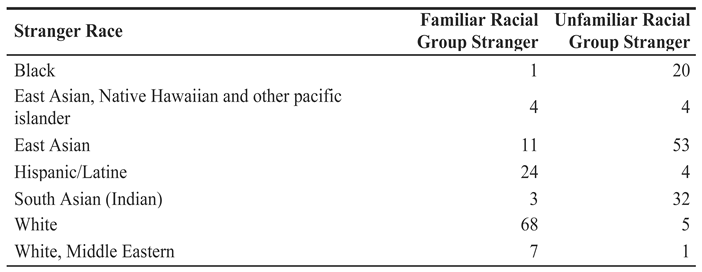 |
Table 2.
Descriptive Statistics for Neighborhood and Social Network Variables by Child Race Group.
| Racially minoritized toddlers | White toddlers | |||
|---|---|---|---|---|
| Variable | Mdn | M (SD) | Mdn | M (SD) |
| Neighborhood racial entropy | 1.51 | 1.51 (.35) | 1.51 | 1.52 (.31) |
| Neighborhood racial outgroup population | .65 | .55 (.28) | .34 | .43 (.21) |
| Network racial entropy | 1.22 | 1.15 (.72) | .81 | .78 (.57) |
| Network EI index | -.10 | -.14 (.59) | -.60 | -.50 (.52) |
| Network size | 11.00 | 12.19 (5.26) | 11.00 | 13.38 (7.06) |
Note. Mdn = median; M = mean; SD = standard deviation.
Table 3.
Social Preference Choices by Child Racial Background.
| Child Race | No choice n (%) |
Familiar Racial Group Stranger n (%) | Unfamiliar Racial Group Stranger n (%) |
|---|---|---|---|
| Racially minoritized | 39 (65.00%) | 6 (10.00%) | 15 (25.00%) |
| White | 41 (70.69%) | 10 (17.24%) | 7 (12.07%) |
| Total | 80 (67.23%) | 16 (13.56%) | 22 (18.64%) |
Note. Percentages in Table 2 are calculated within each child racial background group.
Disclaimer/Publisher’s Note: The statements, opinions and data contained in all publications are solely those of the individual author(s) and contributor(s) and not of MDPI and/or the editor(s). MDPI and/or the editor(s) disclaim responsibility for any injury to people or property resulting from any ideas, methods, instructions or products referred to in the content. |
© 2026 by the authors. Licensee MDPI, Basel, Switzerland. This article is an open access article distributed under the terms and conditions of the Creative Commons Attribution (CC BY) license (http://creativecommons.org/licenses/by/4.0/).
Copyright: This open access article is published under a Creative Commons CC BY 4.0 license, which permit the free download, distribution, and reuse, provided that the author and preprint are cited in any reuse.


