
Submitted:
04 August 2026
Posted:
06 August 2026
You are already at the latest version
Abstract
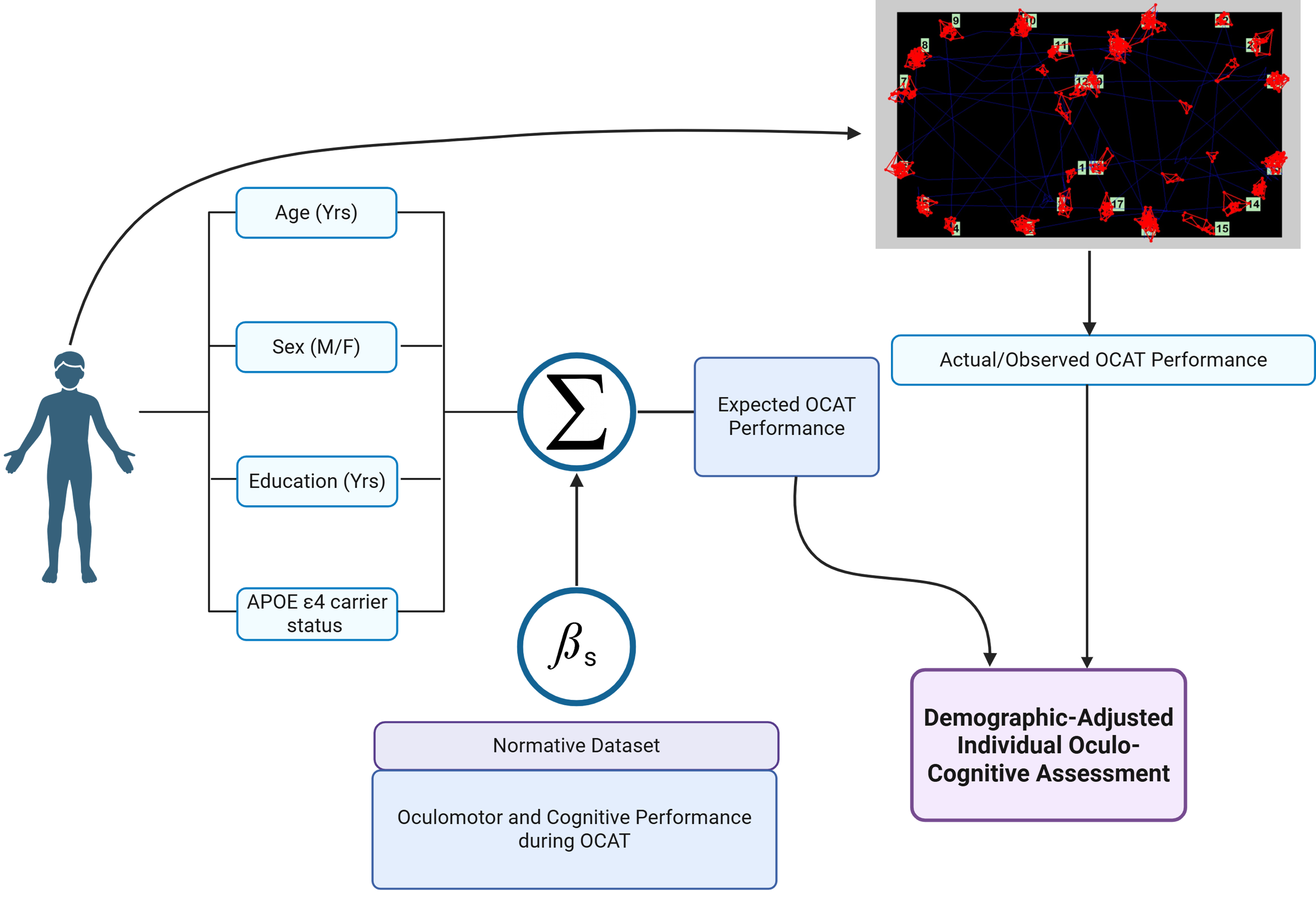
Background: Many neurological and cognitive disorders have early oculomotor hallmarks. The Oculo-Cognitive Addition Test (OCAT) is a quick, objective screening tool that measures eye movement and time-based biomarkers of cognitive processing during simple mental addition tasks in under two minutes. Normative values for age, sex, education level, and genetic predisposition to Alzheimer’s disease must be established so cognitively normal populations are not misdiagnosed. Methods: 382 patients completed OCAT, and raw gaze data were processed to derive fixations, saccades, blinks, pupillary dynamics, and time-based features. Separate multiple linear regression models were fitted for each feature with age, sex, education, and apolipoprotein E Type 4 (APOE ε4) carrier status as predictors to establish demographic-adjusted normative equations. Results: Processing time, fixation time, fixation size and fixation area and their variability increased progressively from the first to the third number within each addition sequence, consistent with increasing cognitive workload. Demographic-adjusted multiple linear regression models generated normative equations for individual OCAT feature based on age, sex, education, and APOE ε4 carrier status. These models were used to derive individualized expected values, 95% reference intervals, and z-scores. Conclusions: These demographic-adjusted normative equations enable individualized interpretation of OCAT performance and are necessary steps towards clinical implementation.
Keywords:
cognitive performance
; cognitive screening
; neurocognitive testing
; oculomotor
; eye movements
; fixation
; saccade
; oculo-cognitive addition test
Copyright: This open access article is published under a Creative Commons CC BY 4.0 license, which permit the free download, distribution, and reuse, provided that the author and preprint are cited in any reuse.


