

Submitted:
04 August 2026
Posted:
06 August 2026
You are already at the latest version
Abstract
Wild carnivores play an important role in maintaining Trichinella spp. infection in the sylvatic environment and may contribute to the transmission of the parasite to domestic animals and humans. Northeastern Romania hosts a large population of red foxes (Vulpes vulpes), a species not routinely included in trichinellosis surveillance programs. This study aimed to determine the geographical distribution and prevalence of Trichinella infection in red foxes and to identify the species involved. Between 2023 and 2025, muscle samples (tongue, diaphragm, and intercostal muscles) were collected from 617 red foxes culled as part of epidemiological surveillance activities. Samples were examined by direct trichinelloscopy, and positive specimens were further analyzed by multiplex PCR at the European Union Reference Laboratory for Parasites Rome, Italy, for species identification. Trichinella infection was detected in foxes from all investigated counties of northeastern Romania, regardless of geographical relief. The overall prevalence was 24.31% (150/617), and all analyzed isolates were identified as Trichinella britovi. The widespread distribution and high prevalence of T. britovi confirm the role of the red fox as an important natural reservoir, supporting the maintenance and circulation of the parasite in the sylvatic environment and highlighting the need for continued surveillance and further epidemiological studies.
Keywords:
Trichinella britovi
; Red fox (Vulpes vulpes)
; PCR multiplex
; sylvatic trichinellosis
; North-Eastern Romania
1. Introduction
Trichinellosis is a serious parasitic zoonosis with global spread, caused by the ingestion of raw or undercooked meat infected with larvae of the Trichinella genus, which parasitize autoheteroxenically in mammals and birds [1]. Taxonomically, the genus Trichinella is classified in the phylum Nematoda, class Enoplea, subclass Dorylaimia, order Trichinellida, family Trichinellidae [2] and includes, to date, 10 species and 3 genomes. Depending on the presence of the collagen capsule around the larva in the muscle cell, the species are separated into two groups: encapsulated species and non-encapsulated species [3].
The encapsulated species are: Trichinella spiralis (T1), Trichinella nativa (T2), Trichinella britovi (T3), Trichinella murrelli (T5), Trichinella nelsoni (T7), Trichinella patagoniensis (T12), T. chancalensis (T13), and three genotypes (Trichinella T6, T8 and T9). The non-encapsulated species are: Trichinella pseudospiralis (T4), Trichinella papuae (T10), Trichinella zimbabwensis (T11); all Trichinella species infect humans [4]. In nature, the Trichinella genus has a larger natural reservoir in wildlife than in domestic animals, which complicates the epidemiological surveillance of trichinellosis [5]. In Europe, four species circulate more frequently: Trichinella spiralis, T. britovi, T. nativa and T. pseudospiralis [6].
Trichinella britovi, first reported by Pozio et al. (1992) [7], is an encapsulated, freeze-tolerant species that infects humans, with a wide geographical distribution: it starts in northwestern Africa, covers most of Europe and continues to Central Asia [8]. Trichinella britovi parasitizes mainly in wild carnivores, being involved in the sylvatic cycle of trichinellosis throughout the European continent [9]. It is most commonly reported in wild boar and red fox, but also in other canids, felids, mustelids, ursids, beavers, rats and humans [10]. In red fox (Vulpes vulpes), T. britovi has been identified in most European countries: Austria, Bulgaria, Croatia, Czech Republic, Estonia, Finland, France, Germany, Greece, Hungary, Italy, Latvia, Lithuania, Netherlands, Norway, Poland, Portugal, Romania, Serbia, Slovakia and Switzerland [10].
The prevalence of T. britovi in red foxes in Europe varies across countries and geographical regions. Exceptionally high infection rates have been documented in Northern Europe: prevalence reached 96.4% in Latvia [11], and 69.0% in Estonia [12]. A high value was also observed in Sardinia, Italy, standing at 27.6% [13]. In Serbia, findings varied between 4.7% and 12.3% [14,15], with T. britovi accounting for 22.2% of the isolates. Similarly, Slovakia showed an average prevalence of 9.6%, with T. britovi representing 93.9% of the infections [16]. In Hungary, regional infection rates fluctuated between 1.8% and 6%, with T. britovi comprising 85.7% of the isolates [17]. In Poland, prevalence varied depending on the study, with reported values of 15.6% [18], 2.7% [19], and local ranges spanning from 0.5% to 7.7% [20].
Much lower prevalence levels were observed in Western and Southern mainland Europe, including 2.7% in France [21], 2.1% in northern Portugal [9], 1.1% in mainland Italy [22], and 0.31% in Germany [19]. Although T. britovi is frequently the dominant species, it can coexist with other species in foxes; specifically, co-infections or sympatric occurrences have been reported with T. nativa in Germany, Slovenia, and the Netherlands, and with T. spiralis in Germany and Poland [10].
In Romania, T. britovi is the most prevalent in wild animals [23], being identified in wolf (Canis lupus), golden jackal (Canis aureus) ([24,25], wild cat (Felis silvestris), Eurasian lynx (Lynx lynx) [26], pine marten (Martes martes), [27], brown bear (Ursus arctos), wild boar (Sus scrofa) [28], European badger (Meles meles) [29], red fox (Vulpes vulpes) [30,31].
In this context, North-Eastern Romania, which has a varied relief, ensures the existence of an abundant population of red fox (Vulpes vulpes) that has never been studied unitarily and is not included in the epidemiological surveillance activity of trichinellosis.
The aim of this research is to establish, for the first time, the prevalence of Trichinella species in red fox, in North-Eastern Romania, the geographical distribution of Trichinella infection, and the molecular identification of the Trichinella species involved.
2. Materials and Methods
2.1. Animals
A total of 617 red fox carcasses, obtained through routine epidemiological surveillance activities in northeastern Romania, were examined for Trichinella spp. infection by trichinelloscopy between 2023 and 2025.
2.2. Sampling Area
The study was conducted in northeastern Romania, within the historical region of Moldavia (Romanian: Moldova). The investigated area included eight counties: Suceava (Sv), Botoșani (Bt), Neamț (Nt), Bacău (Bc), Iași (Is), Vaslui (Vs), Vrancea (Vr), and Galați (Gl), covering a total area of 46,173 km2. Geographically, the region extends between 44.78° and 48.24° N latitude and 24.97° and 28.18° E longitude. The landscape is characterized by diverse geomorphological features, including the Carpathian Mountains, the Subcarpathian hills, plateaus, and lowland plains
2.3. Sampling and Preservation of Samples
Muscle tissue samples (tongue, diaphragm, and intercostal muscles) were collected from each fox, with an average of 50 g of tissue obtained per animal. The samples were individually packaged in plastic bags, labeled, and stored at -80oC until laboratory examination.
2.4. Examination of Muscle Samples
Frozen samples were thawed gradually at 4 °C for 24 hours before examination. Muscle tissues were tested for the presence of Trichinella larvae by direct trichinelloscopy. Muscle tissue fragments found positive were transferred to 1.5 mL microcentrifuge tube and refrozen at -80 °C until molecular analysis for species identification.
2.5. Molecular Identification of Trichinella Species
Trichinella positive muscle tissue fragments were submitted to the European Union Reference Laboratory for Parasites (EURL-P), Rome, Italy, for species identification by multiplex PCR [32]. Species identification of Trichinella larvae was done by multiplex polymerase chain reaction (Multiplex PCR) assay, at the European Union Reference Laboratory for Parasites (EURLP), Instituto Superiore di Sanita, Rome, Italy.
Because the samples had undergone repeated freezing and thawing cycles and consisted of very small muscle fragments, recovery of larvae by the standard HCl-pepsin artificial digestion method was not feasible. Therefore, DNA extraction was performed directly from encapsulated larvae present within the muscle tissue. Individual encysted larvae were carefully dissected from the surrounding muscle tissue using a sterile scalpel and transferred into clean 1.5 mL microcentrifuge tubes. For each positive fox, between three and five encysted larvae were collected and analyzed.
Genomic DNA was extracted using the DNA IQ System and Tissue and Hair Extraction kits (Promega, Madison, WI, USA). Species identification was performed by multiplex PCR using five primer pairs targeting the expansion segment V (ESV), ITS1, and ITS2 regions of the ribosomal DNA repeat, generating species-specific amplification profiles [33]. PCR products were analyzed by capillary electrophoresis using the QIAxcel Advanced System equipped with a DNA High Resolution Cartridge (Qiagen GmbH, Hilden, Germany). Electrophoretic separation was performed using the OM500 method with QIAxcel ScreenGel software (version 2.1), and fragment analysis was carried out using the QX Alignment Marker (15–600 bp) and the QX DNA Size Marker (50–800 bp).
2.6. Statistical Analysis
Confidence intervals (95% CI) were calculated using the Wilson method for binomial proportions using Microsoft Excel 2016 Professional. Confidence Interval; α = 0.05 was considered as statistically significant
3. Results
3.1. Prevalence and Spatial Distribution of Trichinella spp in Red Fox
The prevalence of Trichinella infection varied among the investigated areas, with positive red foxes identified in all eight counties (Table 1, Figure 1 and Figure S1). County-specific prevalence rates ranged from a minimum of 13.89% in Galați to a maximum of 43.59% in Bacău. High endemicity was also evident in Botoșani and Neamț, which exhibited prevalence rates of 38.10% and 32.43% respectively. The remaining counties, Vrancea (26.83%), Iași (23.81%), Vaslui (20.00%), and Suceava (14.76%), showed intermediate levels of infection, confirming widespread circulation of the parasite throughout the entire northeastern region of Romania.
The annual and overall prevalence of Trichinella infection during the study period (2023–2025) is presented in Table 2 and Figure S2. Over the three-year investigation, the overall prevalence was 24.31% (150/617; 95% CI: 19.8–29.5%). A distinct temporal trend was observed, with the highest annual prevalence recorded in 2023 at 52.70%. In the following years, the infection rate decreased progressively, dropping to 23.91% in 2024, and reaching its lowest value in 2025 at 16.26%.
3.2. Molecular Identification of Trichinella spp. in Red Fox
Out of the 148 Trichinella isolates tested by multiplex PCR, 120 (81.08%) yielded a positive result, all of which were identified as Trichinella britovi. In particular, amplification success rates varied across the study years: positive results were obtained for 21 out of 39 isolates (53.85%) in 2023, 58 out of 67 isolates (86.57%) in 2024, and 41 out of 42 isolates (97.62%) in 2025. A representative capillary electrophoresis showing the specific amplification bands for T. britovi is displayed in Figure 2.
4. Discussion
Wild carnivores play a key role in maintaining the sylvatic cycle of Trichinella spp., thereby contributing to the persistence of the parasite in natural ecosystems and representing a continuous source of infection for other wildlife species, domestic animals, and, occasionally, humans [34].
Romania, due to its extensive and heterogeneous ecosystems, supports large populations of wild carnivores, including the wolf, lynx, golden jackal, and red foxes [35], which contribute to the maintenance and circulation of Trichinella spp.
The distribution of Trichinella britovi in wild carnivores in Romania is strongly influenced by altitude and landform (mountain, hill, and plain), which determine habitat characteristics and shape the sylvatic food chain. Adapted to wildlife and temperate climatic conditions, T. britovi is primarily associated with mountainous and hilly ecosystems [5,28,36]. Mountainous regions represent the principal ecological reservoir for T. britovi in Romania. In a recent survey, Iacob et al. (2022) [28] reported that T. britovi was detected exclusively in mountainous areas and only in game species such as wild boar (Sus scrofa) and brown bear (Ursus arctos). This distribution is closely related to the ecology and abundance of its principal hosts. Large carnivores and omnivores involved in maintaining the sylvatic cycle, including the brown bear, Eurasian lynx (Lynx lynx), wolf (Canis lupus), and wild boar, reach their highest population densities in the Carpathian Mountains [37]. Likewise, the Eurasian lynx finds its optimal habitat in the Carpathian forests, where its population density is greatest [26]. In addition, the environmental characteristics of mountainous areas, particularly lower temperatures and extensive forest cover, favour the long-term survival of T. britovi larvae in animal carcasses and carrion [8].
Hilly regions represent a transitional ecological zone and provide suitable habitats for numerous wild carnivores. In these areas, T. britovi frequently co-occurs with T. spiralis, reflecting the overlap between the sylvatic and synanthropic transmission cycles. The occurrence of T. britovi at intermediate altitudes is supported by its identification in host species that occupy both mountainous and hilly habitats, such as the pine marten (Martes martes), which is widely distributed in deciduous, mixed, and coniferous forests throughout Romania [27].
In general, lowland ecosystems, including plains and floodplains, are associated with a lower prevalence and a more limited distribution of T. britovi in the raccoon dog (Nyctereutes procyonoides), a species restricted in Romania to the Danube Delta and the Danube and Prut floodplains, demonstrates that the parasite also circulates in these habitats, although apparently at a lower frequency than in mountainous regions [38]. Moreover, widely distributed carnivores inhabiting these areas, such as the golden jackal (Canis aureus) and the red fox, contribute substantially to the maintenance of the parasite and ensure the continuity of the sylvatic transmission cycle in lowland areas [15,39].
The red fox is considered one of the most important sentinel species for monitoring the circulation of Trichinella spp. because of its wide geographical distribution, high population density, opportunistic feeding behavior, and scavenging habits [40]. This behavior allows foxes to establish an ecological links between the sylvatic and domestic transmission cycles through predation and scavenging of infected wildlife or domestic animal carcasses [31]. The prevalence of Trichinella infection in red foxes, reported from some regions of Romania, varies according to the geographical area investigated and the diagnostic method used. Imre et al. (2015) [40] identified T. britovi in 24 of 25 examined foxes from western Romania (Arad, Hunedoara and Timiș counties), demonstrating the excellent adaptation of this parasite to its principal wildlife host.
In Transylvania, Gherman et al. (2022) [23] reported a prevalence of 16% for Trichinella spp. in red foxes, whereas Nesterov et al. (1991) [30] found a prevalence of 15.8% in central Romania, although species identification was not performed. In western Romania, Marin et al. (2021) [31] confirmed T. britovi in red foxes with a prevalence of 28.12%, further supporting the epidemiological importance of this host.
The present study, conducted in northeastern Romania, complements the curent epidemiological knowledge of Trichinella infection in the red foxes and contributes to better understanding of the role of this host in the mainteining the sylvatic cycle and its potential implications for transmission of T. britovi to other wildlife, domestic animals and humans.
Our results demonstrate the widespread occurrence of T. britovi infection in red foxes from northeastern Romania, with positive cases detected in all investigated counties and regardless of the predominant landform. An overall prevalence of 24.31% (150/617) was recorded, confirming the extensive circulation of this parasite in the studied area. The differences observed among counties may be related to several ecological and environmental factors, including habitat characteristics, host population density, prey availability, and local conditions influencing the sylvatic cycle.
In the area characterized mainly by mountainous relief (Suceava, Neamț, Bacău, and Vrancea counties), the highest prevalence was recorded in Bacău County (43.59%; 34/78), while the lowest was observed in Suceava County (14.77%; 35/237). In areas with mixed landscapes, including hills, plateaus, plains or lowland ecosystems (Botoșani, Iași, Vaslui, and Galați counties), the highest prevalence was recorded in Botoșani county (38.10%; 24/63), while the lowest in Galați county (13.89%; 10/72).
The prevalence values obtained in northeastern Romania are comparable with those reported in other regions of the country [23,30,31,40], suggesting a similar epidemiological pattern and confirming the continuous circulation of T. britovi in Romanian red fox populations. Differences in Trichinella prevalence among geographical areas have also been reported in Slovakia. Hurnikova et al. (2006) [41] observed lower infection levels in lowland regions (6.9%) and higher values in mountainous areas (14.2–25.2%, depending on location), with an overall prevalence of 15.6% in the country. Similarly, Hurnikova and Dubinský (2009) [42], in a large-scale survey involving 5270 red foxes, demonstrated that Trichinella infection was widely distributed in Slovakia, with prevalence increasing from 4.9% in 2000 to 20.5% in 2007.
During the present study, annual prevalence showed variation among years, reaching 52.7% (39/74) in 2023, 23.9% (71/297) in 2024, and 16.26% (40/246) in 2025. These differences may partly reflect annual variation in the number and geographical distribution of examined foxes. Nevertheless, the detection of infected animals throughout the study period confirms the stable presence of T. britovi within the red fox population of northeastern Romania.
Molecular investigations performed on selected positive samples consistently identified T. britovi as the only detected species, with no evidence of mixed infections (Figure 2 and Figures S3–S6).
The negative multiplex PCR results obtained for some of the trichinelloscopy-positive samples could be attributed to a partial DNA degradation caused by the repeated freezing and thawing cycles. Nevertheless, the high success rate of the DNA extraction method applied directly to encapsulated larvae confirms the robustness of the protocol, which proved effective for the vast majority of these samples.
Although Iacob et al. (2022) [28] reported a prevalence of 36.76% of T. britovi infection in brown bears from the same geographical area, the red fox remains an important epidemiological indicator due to its abundance, ecological adaptability, and mobility. These characteristics contribute to its role in maintaining the circulation of T. britovi within wildlife populations in northeastern Romania and beyond.
Authors should discuss the results and how they can be interpreted from the perspective of previous studies and of the working hypotheses. The findings and their implications should be discussed in the broadest context possible. Future research directions may also be highlighted.
5. Conclusions
Trichinella britovi was the only species identified in red foxes sampled in the northeastern part of Romania so far. The high prevalence observed (24.31%; 150/617) highlights the significant circulation of T. britovi within the sylvatic environment and confirms the epidemiological relevance of the red fox as a sentinel host for monitoring Trichinella infection. The geographical distribution of positive cases across all investigated counties indicates a widespread and established circulation of T. britovi in red fox population suggesting the existence of a stable sylvatic transmission cycle over a large and heterogeneus territory. These findings suggest the need for continued epidemiological surveillance of the fox population to better asses the dynamics of T. britovi circulation and the potential risk of transmission to domestic animals, wildlife, and humans.
Supplementary Materials
The following supporting information can be downloaded at the website of this paper posted on Preprints.org, Figures S1-S8: titles.
Author Contributions
Conceptualization, O.I. and L.A.O.; methodology, G.M., F.C.; software, L.A.O.; validation, O.I., L.A.O., G.M., F.C., and M.M.; formal analysis, G.M., F.C.; investigation, O.I.; data curation, G.M.; L.A.O.; writing—original draft preparation, O.I.; writing—review and editing, O.I., G.M., M.M.; visualization, O.I.; supervision, O.I., M.M. All authors have read and agreed to the published version of the manuscript.
Funding
This research received no external funding.
Institutional Review Board Statement
The animal study protocol was approved by the Institutional Review Board (or Ethics Committee) of the Faculty of Veterinary Medicine Iasi (protocol code 1073/06, 05, 2023).
Informed Consent Statement
Not applicable.
Data Availability Statement
Not applicable.
Acknowledgments
I would like to express my sincere gratitude for the support and collaboration of the Veterinary Sanitary and Food Safety Directorates and the Veterinary Sanitary and Food Safety Laboratories in the counties of Moldova: Botoșani, Suceava, Neamț, Iași, Bacău, Vaslui, Vrancea, Galați, in carrying out this scientific endeavor. I would like to thank the teams that did their utmost to safely collect and ship muscle tissue samples from the red fox for parasitological examination. I would like to express my gratitude to my colleagues: Dr. Harabagiu Teodor, Dr. Partenie Alina (Botoșani), Dr. Voloșeniuc Mihai, Dr. Lupeș Gertruda (Suceava), Dr. Ulea Sorin, Dr. Bărănguță Adina (Neamț), Dr. Ișan Elena, Dr. Tihulcă Dănuț (Iași), Dr. Conoro Constantin, Dr. Busuioc Iulia (Bacău), Dr. Jako Andras Levente (Vaslui), Dr. Ciornohac Mona, Dr. Ciornohac George (Vrancea), Dr. Ciuhureanu Anca (Galați). Special thanks to my collaborator Parasca Mălina who sectioned several tens of thousands of muscle fragments and prepared them for trichinelloscopic examination.
Conflicts of Interest
The authors declare no conflicts of interest.
Abbreviations
The following abbreviations are used in this manuscript:
| PCR | Polymerase Chain Reaction |
| T. | Trichinella |
| CI | Confidence Interval |
References
- Iacob, O.; Pașca, A.S.; Olariu, L.A.; Ivănescu, L.M.; Mareș, M. Controlled freezing inactivates Trichinella britovi in wild boar meat: insights from a murine infection model and multiplex polymerase chain reaction. Vet. World 2025, 18(6), 1667–1674. [Google Scholar] [CrossRef] [PubMed]
- Takahashi, Y. Biology of Trichinella. In Trichinella and trichinellosis; Bruschi, F., Ed.; Academic Press: London; Sand Diego; Cambridge, 2021; pp. 77–101. [Google Scholar]
- Zarlenga, D.; Thompson, P.; Pozio, E. Trichinella species and genotypes. Res. Vet. Sci. 2020, 133, 289–296. [Google Scholar] [CrossRef] [PubMed]
- Pozio, E.; Zarlenga, D.S. Trichinella and Trichinellosis; Elsevier Inc.: Amsterdam, The Netherlands; Academic Press: Cambridge, MA, USA, 2021; pp. 35–76. [Google Scholar]
- Pozio, E. The impact of globalization and climate change on Trichinella spp. epidemiology. Food Waterborne Parasitol. 2022, 27, e00154. [Google Scholar] [CrossRef] [PubMed]
- Marucci, G.; Tonanzi, D.; Interisano, M.; Vatta, P.; Galati, F.; La Rosa, G. The International Trichinella Reference Centre database. Report on thirty-three years of activity and future perspectives. Food Waterborne Parasitol. 2022, 27(e00156), pp:1–9. [Google Scholar] [CrossRef] [PubMed]
- Pozio, E.; La Rosa, G.; Murrell, K.D.; Lichtenfels, J.R. Taxonomic revision of the genus Trichinella. J. Parasitol. 1992, 78, 654–659. [Google Scholar] [CrossRef] [PubMed]
- Pozio, E. Adaptation of Trichinella spp. for survival in cold climates. Food Waterborne Parasitol. 2016, 4, 4–12. [Google Scholar] [CrossRef]
- Lopes, A.P.; Vila-Vicosa, M.J.; Coutinhoa, T.; Cardoso, L.; Gottstein, B.; Müllerd, N.; Cortes, H.C.E. Trichinella britovi in a red fox (Vulpes vulpes) from Portugal. Vet. Parasitol. 2015, 210, 260–263. [Google Scholar] [CrossRef] [PubMed]
- Malone, J.C.; Oksanen, A.; Mukaratirwa, S.; Sharma, R.; Jenkins, E. From wildlife to humans: The global distribution of Trichinella species and genotypes in wildlife and wildlife-associated human trichinellosis. IJP-PAW 2024, 24(100934), 1–32. [Google Scholar] [CrossRef] [PubMed]
- Deksne, G.; Seglina, Z.; Jahundovica, I.; Esıte, Z.; Bakasejevs, E.; Bagrade, G.; Keidane, D.; Interisano, M.; Marucci, G.; Tonanzi, D.; Pozio, E.; Kirjusina, M. High prevalence of Trichinella spp. in sylvatic carnivore mammals of Latvia. Vet. Parasitol. 2016, 231, 118–123. [Google Scholar] [CrossRef] [PubMed]
- Kärssin, A.; Häkkinen, L.; Niin, E.; Peik, K.; Vilem, A.; Jokelainen, P.; Lassen, B. Trichinella spp. biomass has increased in raccoon dogs (Nyctereutes procyonoides) and red foxes (Vulpes vulpes) in Estonia. Parasit. Vectors 2017, 10, 609. [Google Scholar] [CrossRef] [PubMed]
- Bandino, E.; Goddi, L.; Mulas, M.; Murgia, M.C.; Soddu, M.; Marucci, G.; Pezzotti, P.; Cabras, P.A.; Pozio, E. Trichinella britovi from domestic to wild animals of Sardinia, Italy. Vet. Parasitol. 2015, 212, 262–266. [Google Scholar] [CrossRef] [PubMed]
- Zivojinovic, M.; Sofronic-Milosavljevic, L.; Cvetkovic, J.; Pozio, E.; Interisano, M.; Plavsic, B.; Radojicic, S.; Kulisic, Z. Trichinella infections in different host species of an endemic district of Serbia. Vet. Parasitol. 2013, 194, 136–138. [Google Scholar] [CrossRef] [PubMed]
- Klun, I.; Cosic, N.; Cirovic, D.; Vasilev, D.; Teodorovic, V.; Djurkovic-Djakovic, O. Trichinella spp. in wild mesocarnivores in an endemic setting. Acta Vet. Hung. 2019, 67, 34–39. [Google Scholar] [CrossRef] [PubMed]
- Antolová, D.; Fecková, M.; Valentová, D.; Hurníková, Z.; Miklisová, D.; Avdičová, M.; Halánová, M. Trichinellosis in Slovakia – epidemiological situation in humans and animals (2009–2018). Ann. Agric. Env. Med. 2020, 27(3), 361–367. [Google Scholar] [CrossRef] [PubMed]
- Szell, Z.; Marucci, G.; Bajmoczy, E.; Cseplo, A.; Pozio, E.; Sreter, T. Spatial distribution of Trichinella britovi, T. pseudospiralis and T. spiralis in red foxes (Vulpes vulpes) in Hungary. Vet. Parasitol. 2008, 156, 210–215. [Google Scholar] [CrossRef] [PubMed]
- Wiśniewski, J.; Bełkot, Z.; Orłowska, B.; Bogdan, J.; Welz, M.; Kaczor, S.; Nowicki, M.; Puchalska, M.; Tracz, M.; Różycki, M.; Chmurzyńska, E.; Bilska-Zając, E.; Anusz, K. Prevalence of Trichinella britovi in muscle tissue samples from foxes from Podkarpackie Voivodeship, Poland. Med. Weter. 2016, 72(11), 681–685. [Google Scholar] [CrossRef]
- Chmurzynska, E.; Rózycki, M.; Bilska-Zajac, E.; Nöckler, K.; Mayer-Scholl, A.; Pozio, E.; Cencek, T.; Karamon, J. Trichinella nativa in red foxes (Vulpes vulpes) of Germany and Poland: Possible different origins. Vet. Parasitol. 2013, 198, 254–257. [Google Scholar] [CrossRef] [PubMed]
- Bilska-Zając, E.; Różycki, M.; Grądziel-Krukowska, K.; Bełcik, A.; Mizak, I.; Karamon, J.; Sroka, J.; Zdybel, J.; Cencek, T. Diversity of Trichinella species in relation to the host species and geographical location. Vet. Parasitol. 2020, 279, 1–8, 109052. [Google Scholar] [CrossRef] [PubMed]
- Aoun, O.; Lacour, S.A.; Levieuge, A.; Marie, J.-L.; Vallee, I.; Davoust, B. Screening for Trichinella britovi infection in red fox (Vulpes vulpes) and wild boar (Sus scrofa) in Southeastern France. J. Wildl. Dis. 2012, 48(1), 223–225. [Google Scholar] [CrossRef] [PubMed]
- Scarcelli, S.; Buono, F.; D’Alessio, N.; Rea, S.; Castaldo, E.; Pesce, A.; Locantore, F.; Fioretti, A.; Marucci, G.; Sgroi, G.; Modrý, D.; Veneziano, V. Trichinella spp. in wolves (Canis lupus) and red foxes (Vulpes vulpes) of southern Italy. Res. Vet. Sci. 2024, 179, 105381. [Google Scholar] [CrossRef] [PubMed]
- Gherman, C.M.; Boros, Z.; Băieș, M.H.; Cozma-Petruț, A.; Cozma, V. A review of Trichinella species infection in wild animals in Romania. Food Waterborne Parasitol. 2022, 28, e00178. [Google Scholar] [CrossRef] [PubMed]
- Blaga, R.; Gherman, C.; Seucom, D.; Cozma, V.; Boireau, P. First identification of Trichinella sp. in Golden jackal (Canis aureus) in Romania. J. Wild. Dis. 2008, 44, 457–459. [Google Scholar] [CrossRef] [PubMed]
- Marin, A.M.; Codrean, C.L.; Marucci, G.; Cherchi, S.; Prunar, S.; Prunar, F.; Popa, D.; Mederle, N. The wolf (Canis lupus), an indicator species for the sylvatic Trichinella cycle in Romania. Rev. Rom. Med. Vet. 2024, 34(3), 48–52. [Google Scholar]
- Marin, A.M.; Marucci, G.; Dărăbuș, G.; Herman, V.; Cristina, R.T.; Popovici, D.C.; Moraru, M.M.F.; Dreghiciu, I.C.; Mederle, N. Molecular characterization of Trichinella britovi in Lynx (Lynx lynx) from Bihor County, Romania: a case report. Rev. Rom. Med. Vet. 2023, 33(4), 85–88. [Google Scholar]
- Marin, A.M.; Mederle, O.A.; Marucci, G.; Popovici, D.C.; Mederle, N. First Identification and Molecular Characterization of Trichinella britovi (Nematoda: Trichinellidae) from the Pine Marten (Martes martes Linnaeus, 1758) in Romania. Microorganisms 2023, 11(9), 2339. [Google Scholar] [CrossRef] [PubMed]
- Iacob, O.; Chiruță, C.; Mareș, M. Trichinella spiralis and T. britovi in North-Eastern Romania: A Six-Year Retrospective Multicentric Survey. Vet. Sci. 2022, 9(9), 509. [Google Scholar] [CrossRef] [PubMed]
- Boros, Z.; Ionică, A.M.; Deak, G.; Mihalca, A.D.; Chisamera, G.B.; Györke, A.; Gherman, C.; Cozma, V. The European badger, (Meles meles), as a new host for Trichinella britovi in Romania. Vet. Parasitol. 2020, 288, 109301. [Google Scholar] [CrossRef] [PubMed]
- Nesterov, V.; Ciolofan, I.; Nițulescu, A.; Costiov, F.; Dumitrescu, C.; Milla, C.; Popescu, S. Implicații ale activității umane în epizootologia trichinelozei silvatice (Implications of human activity in the epizootiology of silvical trichinosis). Rev. Rom. Paraz. 1991, 71–72. [Google Scholar]
- Marin, A.M.; Dărăbuș, G.; Herman, V.; Morariu, S.; Olariu, T.R.; Dărăbuș, R.G.; Sîrbu, B.A.M.; Mederle, N. Study on the prevalence and larval burden of the nematode Trichinella spp. in red foxes from hunting grounds in Timis county. Rev. Rom. Med. Vet. 2021, 31(2), 23–26, ISSN: 1220-3173; E-ISSN: 2457-7618. [Google Scholar]
- Pozio, E.; Zarlenga, D.S. International Commission on Trichinellosis: Recommendations for genotyping Trichinella muscle stage larvae. Food Waterborne Parasitol. 2019, 15, e00033. [Google Scholar] [CrossRef] [PubMed]
- Pozio, E.; La Rosa, G. Trichinella. In Molecular detection of Foodborne Pathogens; Liu, D., Ed.; CRC Press, Taylor & Francis Group: Boca Raton, USA, 2010; pp. 851–863. [Google Scholar]
- Balić, D.; Marucci, G.; Krajina, M.; Benić, M.; Mihaljević, Z.; Andreanszky, T.; Sukalić, T.; Lukačević, D.; Miškić, T.; Škrivanko, M. Is golden jackal (Canis aureus) the most important indicator species of Trichinella infection in Croatia? Vet. Parasitol. 2025, 333, 110239. [Google Scholar] [CrossRef] [PubMed]
- Ilieş, A.; Ilieş, D.C.; Tătar, C.; Ilieş, M. The Geography of Tourism of Central and Eastern European Countries. In Geography of tourism in Romania, 2nd ed.; Widawski, K., Wyrzykowski, J., Eds.; Springer International Publishing: Cham; Wroclaw, Poland, 2017; pp. 329–374. [Google Scholar] [CrossRef]
- Blaga, R.; Gherman, C.; Cozma, V.; Zocevic, A.; Pozio, E.; Boireau, P. Trichinella species circulating among wild and domestic animals in Romania. Vet. Parasitol. 2009, 159, 218–221. [Google Scholar] [CrossRef] [PubMed]
- Kärssin, A.; Hakkinen, L.; Vilem, A.; Jokelainen, P.; Lassen, B. Trichinella spp. in wild boars (Sus scrofa), brown bears (Ursus arctos), eurasian lynxes (Lynx lynx) and badgers (Meles meles) in Estonia, 2007 - 2014. Animals 2021, 11, 183. [Google Scholar] [CrossRef] [PubMed]
- Marin, A.M.; Popovici, D.C.; Dărăbuș, G.; Marian, C.; Nițușcă, D.; Mederle, N. The First Identification of Trichinella britovi in the Raccoon Dog (Nyctereutes procyonoides) in Romania. Pathogens 2023, 12(9), 1132. [Google Scholar] [CrossRef] [PubMed]
- Marin, A.M.; Popovici, D.; Pavlovic, I.; Moraru, M.; Ilie, M.S.; Ghilean, B.; Drechiciu, C.; Mederle, N. Study on the prevalence and larval burden of the nematode Trichinella spp. in jackals from hunting grounds in Timiș county (Romania). Lucr. Științifice med. Vet. Timișoara 2022, vol. LV, 4, 105–111. [Google Scholar]
- Imre, K.; Pozio, E.; Tonanzi, D.; Sala, C.; Ilie, M.S.; Imre, M.; Morar, A. The red fox (Vulpes vulpes) plays a minor role in the epidemiology of the domestic cycle of Trichinella in Romania. Vet. Parasitol. 2015, 212, 448–450. [Google Scholar] [CrossRef] [PubMed]
- Hurnikova, Z.; Bartkova, D.; Dubinsky, P. Analysis of the epidemiological factors influencing vulpine trichinellosis in ecologically different regions of Slovakia. Wiad. Parazytol. 2006, 52(3), 213–218. [Google Scholar] [PubMed]
- Hurnıkova, Z.; Dubinsky, P. Long-term survey on Trichinella prevalence in wildlife of Slovakia. Vet. Parasitol. 2009, 159, 276–280. [Google Scholar] [CrossRef] [PubMed]
Figure 1.
Spatial distribution of Trichinella infection in red foxes (Vulpes vulpes) from northeastern Romania during 2023–2025. For each county, the number of tested animals is reported, with the prevalence (%) given in brackets.
Figure 1.
Spatial distribution of Trichinella infection in red foxes (Vulpes vulpes) from northeastern Romania during 2023–2025. For each county, the number of tested animals is reported, with the prevalence (%) given in brackets.
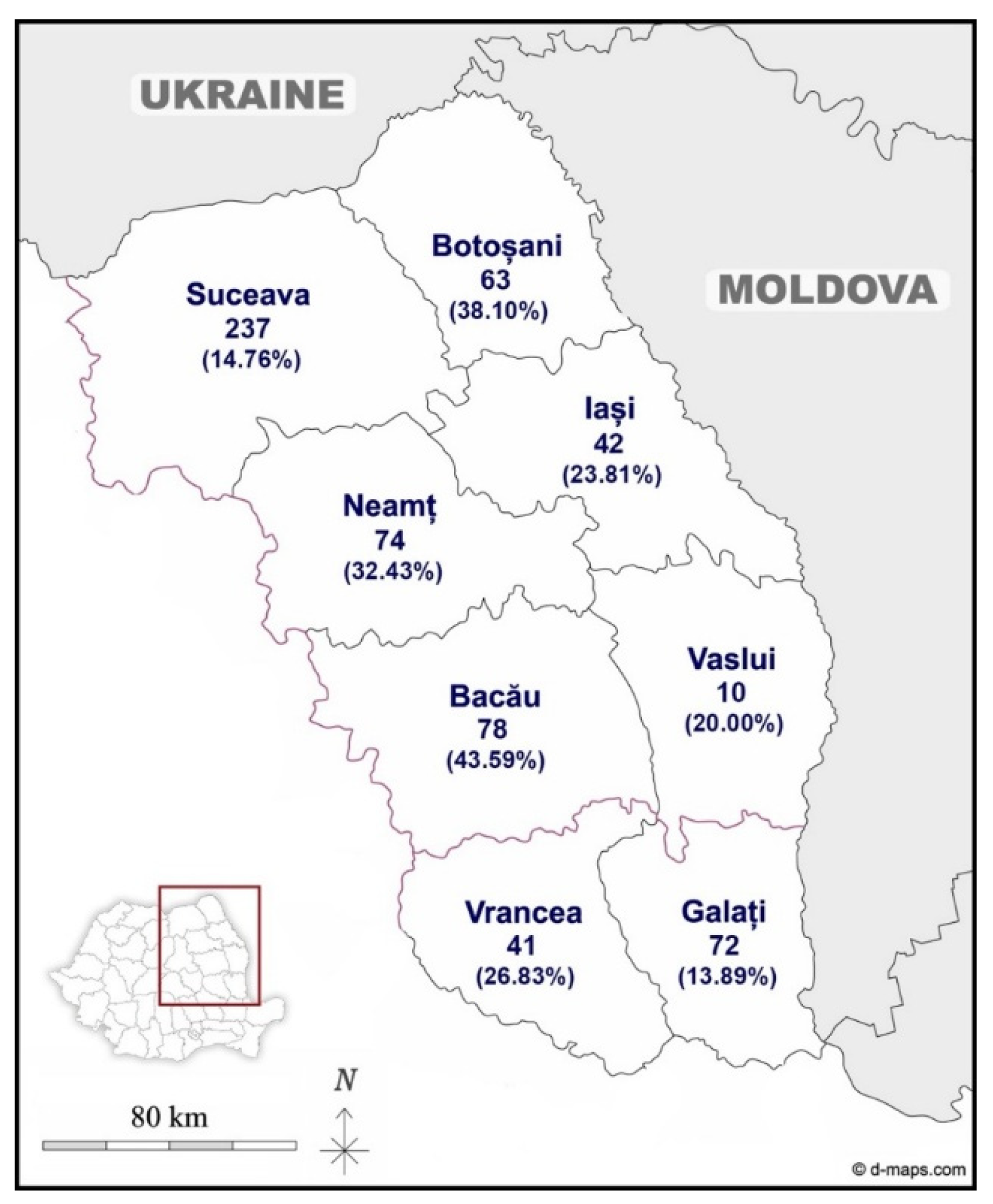
Figure 2.
Representative capillary electrophoresis of multiplex PCR products for Trichinella species identification. Lanes A1 to B5: 2025 Romanian red fox isolates from Botoșani, Iași, Bacău, and Vaslui counties; Lane B6: T. spiralis positive control (reference larva) for the DNA purification step; Lane B7: T. britovi positive control (reference DNA) for the PCR; Lane B8: PCR negative control; Lane B9: size marker.
Figure 2.
Representative capillary electrophoresis of multiplex PCR products for Trichinella species identification. Lanes A1 to B5: 2025 Romanian red fox isolates from Botoșani, Iași, Bacău, and Vaslui counties; Lane B6: T. spiralis positive control (reference larva) for the DNA purification step; Lane B7: T. britovi positive control (reference DNA) for the PCR; Lane B8: PCR negative control; Lane B9: size marker.
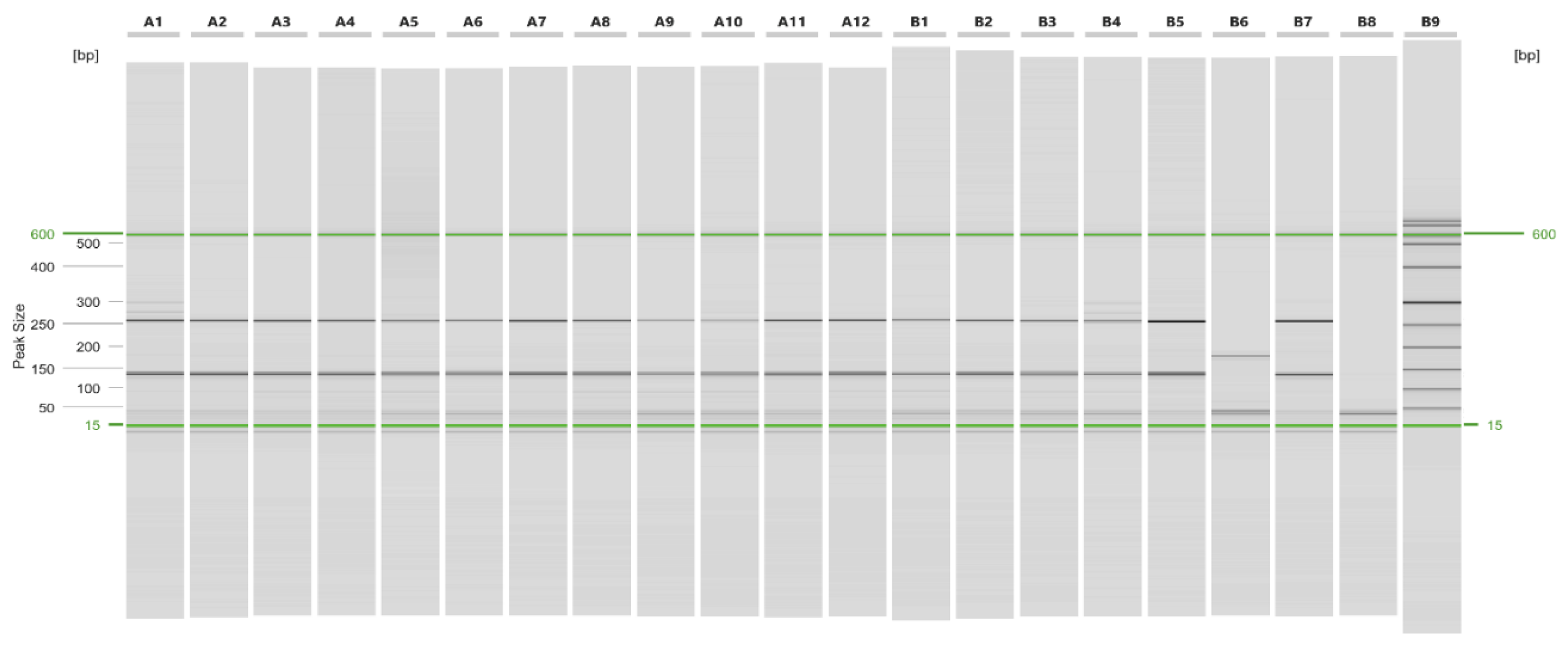

Table 1.
Prevalence of Trichinella spp. in red foxes, in northeastern Romanian counties during 2023–2025.
Table 1.
Prevalence of Trichinella spp. in red foxes, in northeastern Romanian counties during 2023–2025.
| County | Tested foxes | Positive foxes | Prevalence (%) | CI 95% |
|---|---|---|---|---|
| Suceava (Sv) | 237 | 35 | 14.76 | 10.25 - 19.28 |
| Botoșani (Bt) | 63 | 24 | 38.10 | 26.10 - 50.08 |
| Neamț (Nt) | 74 | 24 | 32.43 | 21.76 - 43.09 |
| Iași (Is) | 42 | 10 | 23.81 | 10.92 - 36.69 |
| Bacău (Bc) | 78 | 34 | 43.59 | 32.58 - 54.59 |
| Vaslui (Vs) | 10 | 2 | 20.00 | 4.79 - 44.79 |
| Vrancea (Vr) | 41 | 11 | 26.83 | 13.26 - 40.39 |
| Galați (Gl) | 72 | 10 | 13.89 | 5.90 - 21.87 |
C.I. 95% (Confidence Interval; α = 0.05 was considered as statistically significant).
Table 2.
Annual and overall prevalence of Trichinella spp. in red foxes, in northeastern Romania during 2023–2025.
Table 2.
Annual and overall prevalence of Trichinella spp. in red foxes, in northeastern Romania during 2023–2025.
| Category/Year | 2023 | 2024 | 2025 | Total |
|---|---|---|---|---|
| Tested foxes | 74 | 297 | 246 | 617 |
| Positive foxes | 39 | 71 | 40 | 150 |
| Prevalence (%) | 52,70 | 23.91 | 16.26 | 24.31 |
| Confidence interval (CI) 95% | 41.3-63.9 | 19.2-29.0 | 12.0-21.3 | 19.8-29.5 |
Disclaimer/Publisher’s Note: The statements, opinions and data contained in all publications are solely those of the individual author(s) and contributor(s) and not of MDPI and/or the editor(s). MDPI and/or the editor(s) disclaim responsibility for any injury to people or property resulting from any ideas, methods, instructions or products referred to in the content. |
© 2026 by the authors. Licensee MDPI, Basel, Switzerland. This article is an open access article distributed under the terms and conditions of the Creative Commons Attribution (CC BY) license.
Copyright: This open access article is published under a Creative Commons CC BY 4.0 license, which permit the free download, distribution, and reuse, provided that the author and preprint are cited in any reuse.