

Submitted:
05 August 2026
Posted:
05 August 2026
You are already at the latest version
Abstract
Romania's forest sector has undergone significant transformation over the past two decades, with certification emerging as a key instrument for improving transparency, ecological safeguards and market access. This study examines the current state of forest certification in Romania within broader European trends toward sustainable forest management. Using national statistics, policy documents and comparative European data, the analysis evaluates the ecological, economic and social benefits of certification and the structural barriers limiting its adoption, especially among private and communal owners. Results show that certification has improved biodiversity protection, monitoring and institutional accountability, while facilitating access to international markets. A comparative analysis of 18 European countries, controlling for national income and EU accession timing, shows that Romania's certification coverage lags roughly 16 percentage points behind the level predicted by its income and accession cohort, comparable to gaps in wealthier Western European economies, indicating structural rather than economic barriers. Persistent challenges, including fragmented ownership, uneven administrative capacity and infrastructure gaps, continue to restrict implementation. The study concludes that Romania is progressing toward European models of sustainable forest management, but further convergence requires coherent policies, stronger institutional capacity and targeted support for small forest owners, in line with the Agenda 2030 for Sustainable Development.
Keywords:
forest certification
; sustainable forest management
; FSC
; PEFC
; Romania
; forest policy
; biodiversity protection
; Agenda 2030
1. Introduction
Forests are among the most strategic components of Europe’s ecological landscape. Beyond their environmental functions, climate regulation, biodiversity protection, soil and water conservation, forests also support rural livelihoods and contribute to regional economic stability. Within the European Union (EU), sustainable forest management has become increasingly prominent, being integrated into the European Green Deal, the EU Biodiversity Strategy for 2030 and the objective of achieving climate neutrality by mid-century. In this broader context, forest certification, especially under the Forest Stewardship Council (FSC) and the Programme for the Endorsement of Forest Certification (PEFC), has evolved into an important voluntary mechanism that encourages responsible forest governance and transparent management practices [1,2,3].
The international rise of certification systems reflects longstanding concerns regarding illegal logging, forest degradation and the limited traceability of timber flows. FSC and PEFC provide independent verification that forest management complies with clearly defined ecological, social and economic principles. Over time, these schemes have gained considerable credibility, helping to rebuild trust among forest managers, public authorities and markets. What initially emerged as an environmental tool has gradually become a practical requirement in many sectors, as retailers, construction industries and public procurement increasingly prefer or even demand certified products, particularly in countries with strong environmental regulations such as Germany, Sweden, Austria and the Netherlands [4,5,6].
At the European level, certification currently covers more than 160 million hectares, representing close to 39% of the EU’s forest area [7]. Countries with well-established forestry sectors, Finland, Sweden, Germany, have integrated certification into their national strategies, using it not only as a market instrument but also as a component of governance. Finland, where over 90% of forest area is certified (predominantly under PEFC), reflects decades of investment in infrastructure and long-term planning [8]. Germany operates with both FSC and PEFC systems, a dual structure closely linked to its regional governance model and its tradition of multifunctional forest management [9]. These examples show that certification functions effectively when embedded in coherent institutions, clear policies and well-developed forestry infrastructures.
Romania, however, presents a more heterogeneous picture. With approximately 6.7 million hectares of forests, around 29% of national territory, the country hosts some of Europe’s most valuable forest ecosystems, including significant areas of primary and old-growth forests in the Carpathians [10]. Yet, alongside this ecological richness, Romania faces several persistent challenges: fragmented ownership structures, insufficient forest road networks, fluctuating policy implementation and a public discourse marked by mistrust and concerns about illegal logging [11,12].
Forest certification was introduced in Romania in the early 2000s and expanded primarily within state-owned forests managed by RNP Romsilva [13], which today administers most of the 2.7 million hectares certified nationally. Certification brought improvements in transparency, stakeholder involvement and environmental safeguards. Private and communal owners have also begun to adopt certification, but at a slower pace, due to administrative burdens, limited financial capacity and the absence of national certification bodies [14,15]. Even so, certification remains one of the few mechanisms able to strengthen governance, improve market access and encourage sustainable practices across the forest sector.
Economically, Romania harvests only 30–35% of its annual biological growth, well below the EU average of roughly 66% [16]. This under-use is the result of structural constraints such as difficult terrain, limited accessibility and a strong public sensitivity to forest exploitation, even in cases where harvesting could be justified ecologically. In this context, certification has the potential to support both conservation and economic valorisation, especially in relation to European initiatives focused on the bioeconomy, circular economy and renewable materials.
From a policy standpoint, EU forestry remains under national competence, but various instruments, such as the EU Forest Strategy, the Regulation on Deforestation-Free Products (EUDR) and forest-related measures within the Common Agricultural Policy (CAP), shape a strategic environment that encourages stronger sustainability commitments. Certification aligns well with these frameworks, offering a practical means of demonstrating compliance with EU environmental objectives, ensuring legal timber origin and supporting biodiversity conservation [17,18,19,20]. These instruments also operationalise Romania's broader commitments under the United Nations Agenda 2030, particularly Sustainable Development Goal 15 (Life on Land) and, through certification's contribution to carbon storage and climate-resilient management, Sustainable Development Goal 13 (Climate Action).
Despite these developments, the academic literature on Romania’s certification system remains relatively fragmented, often addressing isolated aspects, such as illegal logging, administrative capacity or ownership structure [21], without a broader examination of how certification interacts with European sustainability agendas. There is still limited comparative research evaluating Romania’s progress in relation to other EU Member States or analysing the combined ecological, economic and institutional dimensions of certification. This is the main knowledge gap that the present paper aims to address.
Accordingly, this study examines the ecological, economic and social contributions of forest certification in Romania, identifies key administrative and financial obstacles and analyses the degree to which national certification practices are aligned with European trends in sustainable forest management. By integrating EU-level policies, national data and comparative examples, the paper aims to provide a clearer understanding of Romania’s position within the evolving European landscape and to highlight strategic priorities for strengthening forest governance in the years to come.
2. Materials and Methods
This study employs a mixed methodological approach that brings together documentary analysis, European-level comparative evaluation and the examination of several case studies from Romania. The choice of this design reflects the multidimensional character of forest certification, which combines ecological, economic, social and institutional considerations. The overall aim was to identify both the points where Romania aligns with European trends and the areas where significant divergence persists.
The first stage consisted of an extensive documentary analysis. National and European legislation, FSC and PEFC standards, institutional reports, statistical databases and specialised scientific literature were reviewed systematically. Official sources such as Eurostat, the Ministry of Environment, Waters and Forests, the National Institute of Statistics, FSC International and PEFC International were used to reconstruct the conceptual and regulatory context of certification and to understand current developments in sustainable forest management across the EU. This stage ensured a coherent normative framework for the subsequent analysis.
The second stage involved a comparative assessment between Romania and several EU Member States. The comparison focused on widely used indicators in the forestry sector, including certified forest area (in absolute and relative terms), annual harvesting levels compared with biological growth, development of forest infrastructure, administrative capacity, the distribution of certified forests and the existence of public support mechanisms for certification. This comparative angle made it possible to highlight the structural differences between countries with well-established certification systems (e.g., Finland, Sweden, Germany) and Romania, while also identifying potential areas for convergence.
The third stage integrated a number of case studies selected to illustrate the diversity of Romanian forest contexts. The selection was intentional rather than exhaustive: the examples include primary forests in Maramureș, certification projects coordinated by RNP Romsilva and initiatives implemented in privately owned or communal forests. These cases were chosen because they represent different forest typologies, ownership structures and management traditions, offering a more nuanced view of how certification functions under varied conditions. For each case, the analysis considered the implementation of certification requirements, ecological outcomes, contributions to biodiversity protection and socio-economic effects on local communities.
The study relies mainly on secondary data obtained from publicly accessible sources such as statistical datasets, annual reports, technical guidelines, scientific articles, audit documents, and publications from environmental organizations. Data were synthesized using descriptive, comparative and analytical methods. To ensure consistency, figures derived from different sources (e.g., INS, Eurostat, FSC) were cross-checked, and discrepancies were clarified where possible. Although the study does not involve complex quantitative modelling, the combination of methods allowed for a balanced interpretation of the available evidence, highlighting both progress and persistent limitations.
To complement the four-country comparison presented in the Results section, certified forest area data (FSC and PEFC reported separately) were compiled for 18 European countries from the FSC Global “Facts & Figures” monitoring dashboard (data retrieved August 2026) and PEFC Global Statistics (March 2025 release). These were combined with total forest area estimates (Eurostat/FAO-derived, 2023) and GDP per capita in Purchasing Power Standard (PPS, EU27=100, Eurostat dataset tec00114, 2024) to construct a small cross-country dataset. For each country, certification coverage was defined as the larger of the FSC and PEFC shares of forest area, which avoids overstating coverage in countries where a substantial share of forest is certified under both schemes simultaneously. The association between certification coverage, national income and EU accession cohort (pre-2004 vs. 2004-or-later member states) was examined using Pearson correlation and a multiple linear regression.
3. Results
3.1. Forest Context in Romania
Romania has approximately 6.7 million hectares of forests, representing around 29% of the national territory (Figure 1). Although this proportion is lower than the EU average, Romanian forests hold exceptional ecological value, including some of the largest remaining tracts of virgin and old-growth forests in Europe. These ecosystems, concentrated primarily in the Eastern and Southern Carpathians, host emblematic species such as brown bear, wolf, lynx, capercaillie, and a wide range of endemic flora.
Forest distribution is highly uneven across the country. Mountainous counties have extensive and compact forest areas, while lowland and plateau regions remain fragmented due to agricultural expansion, infrastructure development, and historical land restitution. The counties of Harghita, Suceava, Maramureș, Covasna, and Caraș-Severin represent the core forest regions of Romania, both in terms of absolute surface and share of land covered by forest. Table 1 summarizes these differences.
Following restitution policies enacted after 1990, forest ownership has become heavily fragmented, particularly in private and communal holdings. Many small owners face limited administrative capacity, insufficient technical knowledge, and restricted access to management planning services, which complicates sustainable forest management. At the same time, public concern about illegal logging and weak oversight has amplified pressure on forest governance institutions.
Forest certification has emerged as an important mechanism for addressing these issues. Certification is unequally distributed among ownership categories, with state forests managed by RNP Romsilva representing the majority of certified areas. Private owners and communal associations remain significantly underrepresented in certification schemes. Figure 2 illustrates this distribution.
3.2. Ecological Benefits
Forest certification has produced notable ecological improvements in Romania. FSC and PEFC standards require the identification and protection of High Conservation Value Forests (HCVF) [23,24], contributing to the preservation of virgin and old-growth forests in regions such as Maramureș, Făgăraș, and the Apuseni Mountains [25,26]. Certified forest management plans incorporate strict measures regarding habitat protection, sustainable harvesting levels, riparian buffer zones, soil conservation practices, and the safeguarding of species sensitive to disturbance.
Certification also supports climate mitigation objectives. Through the maintenance of structurally diverse stands, limitations on clear-cutting, and emphasis on natural regeneration, certified forests tend to store more carbon and exhibit higher resilience to climate extremes such as storms, droughts, and pest outbreaks. These ecological benefits align with Romania’s commitments under EU climate frameworks and contribute directly to biodiversity conservation at regional and European scales.
A concrete example is the high conservation value forests of Strâmbu Băiuț (Maramureș), where FSC certification has imposed strict protection measures for primary stands and sensitive habitats.
This site forms part of the UNESCO World Heritage property “Ancient and Primeval Beech Forests of the Carpathians and Other Regions of Europe”, inscribed in 2017; the Strâmbu-Băiuț component covers 598.1 ha of non-intervention core forest with a 713.1 ha buffer zone, hosting beech and silver fir stands up to approximately 500 years old and more than 10,000 recorded plant, animal and fungal species [27,28]. In September 2022, the forest district administered by RNP Romsilva's Maramureș Forest Directorate became the first in Romania to obtain FSC certification specifically for ecosystem services, in partnership with WWF Romania; the five-year certificate recognises the forest's contribution to biodiversity conservation and recreation, and extends to two adjoining locally protected areas, Tăul Negru and Peștera cu Oase [29].
3.3. Economic Benefits
Certification generates multiple economic advantages for forest managers, the wood industry, and local communities. The most significant benefit is enhanced market access. Many international retailers and wood-processing companies require certified products, making certification a de facto condition for exporting to high-value markets. Certified timber often achieves higher and more stable prices, particularly in regions with strong demand for traceability and sustainability assurance. In several European markets, certified timber is commonly traded at a premium of roughly 5–10% compared with non-certified wood, depending on species, product type and local demand patterns.
RNP Romsilva has documented increased revenues in districts where certified wood dominates production flows. Furthermore, certification opens access to European funding for sustainable forest management, biodiversity protection, bioeconomy initiatives, and innovation programs [30]. Certified forests can also be better positioned for participation in emerging carbon credit schemes, climate adaptation programs, and green public procurement.
A second case illustrates certification projects coordinated directly by RNP Romsilva. Following the collapse of centrally planned forestry and the resulting surge in illegal logging after 1990, FSC certification expanded within Romania's state forest estate from a negligible base to approximately 2.6 million hectares within roughly a decade, the great majority of it administered by RNP Romsilva [31]. One of the earlier such projects took place in the forests around Breb (Maramureș), where RNP Romsilva's local forest district obtained FSC certification in 2010 after several years of collaborative preparatory work with WWF, formally recognising the traditional, low-impact management practices that had allowed old-growth stands in the area to persist through the collectivisation period [31].
3.4. Social Benefits
Certification strengthens transparency, community engagement, and trust in Romania’s forest sector, a critical aspect given the long-standing public concerns regarding illegal logging. FSC standards require public consultation, open access to management plans, and mandatory reporting of non-conformities. In this context, several forest districts within RNP Romsilva have introduced regular public consultations and meetings with local communities when management plans are drafted or revised. These mechanisms enhance institutional accountability and reduce conflicts between forest managers and stakeholders.
Local communities benefit from improved employment opportunities in forest protection, monitoring, ecological restoration, and sustainable tourism. Certification has also encouraged educational initiatives led by NGOs and national parks, raising public awareness about the importance of forest conservation and responsible forest use. Overall, social outcomes complement ecological and economic gains by reinforcing a culture of responsible stewardship.
3.5. Challenges
Despite its advantages, forest certification in Romania faces several structural challenges. Certification and auditing costs remain high, especially for small private owners and traditional communal associations. The lack of national certification bodies increases dependency on foreign auditors, prolonging procedures and limiting accessibility [14,32].
A third case addresses certification in privately owned and communal forests, which illustrates how this cost and capacity barrier has been overcome in practice. Between 2014 and 2018, a project implemented by Preferred by Nature (formerly NEPCon) and financed by IKEA of Sweden AB supported FSC certification for eight forest management units — a mix of private and community-owned forests — totalling approximately 140,000 hectares across north-western, western and central Romania. The project combined stakeholder engagement with local and district-level authorities, pre-assessment audits and full certification assessments, and required the same High Conservation Value Forest safeguards applied in state forests, while channelling certified timber into IKEA's supply chain [33]. Unlike the RNP Romsilva-coordinated cases discussed above, this initiative suggests that certification of fragmented private and communal ownership in Romania has so far depended heavily on external buyer-driven funding and technical assistance rather than being self-sustaining, reinforcing the need for the institutional strengthening and financial support noted below.
The complexity of FSC indicators, often exceeding 250 measurable criteria, poses a barrier for owners lacking technical capacity. For instance, FSC standards include detailed indicators on sensitive habitat protection, the management of deadwood, the assessment of social impacts, and the monitoring of vulnerable species—each requiring specific procedures, field verification and consistent documentation that many forest districts struggle to operationalise in practice. Moreover, Romania’s forest infrastructure is less developed than that of many EU Member States, especially in mountainous areas where limited road access complicates monitoring, harvesting, and compliance activities. Persistent administrative fragmentation further impedes coordinated progress.
These challenges underscore the need for institutional strengthening, financial support for small owners, and investment in forest infrastructure to consolidate sustainable forest management.
3.6. Romania vs. the European Union - Convergences and Differences
When comparing Romania to EU Member States with advanced certification systems, substantial divergences become evident. Finland, Sweden, and Germany have long integrated certification into their national bioeconomy strategies, supported by stable governance frameworks, strong administrative capacity, and well-developed forest infrastructures. Romania shares Europe’s strategic orientation toward sustainable forest management but continues to face internal limitations.
Table 2 offers a macro-level comparison between Romania and the EU.
To illustrate differences in certification maturity, Table 3 compares certified area, share of forest fund, dominant certification systems, and harvest rates for Finland, Sweden, Germany, and Romania.
To better illustrate the contrasts highlighted in Table 3, the spatial distribution of certification maturity and harvesting intensity across the selected countries was visualized using two comparative maps. Figure 3(a) depicts the proportion of each country’s forest fund that is certified, while Figure 3(b) shows the corresponding harvest rate expressed as a percentage of annual biological growth. These spatial representations reinforce the numerical differences presented in the table, making the divergence between Romania and the northern European countries more explicit. Finland and Sweden stand out with both high certification coverage and high harvesting efficiency, whereas Romania remains positioned at the lower end of the spectrum on both indicators. The maps thus offer a clear and intuitive complement to the tabular comparison.
3.7. Certification Coverage in a Wider European Context
To place Romania’s certification performance within a broader European context, the comparison in Section 3.6 was extended to 18 European countries for which certified forest area, total forest area, and income data could be obtained (see Section 2). Certification coverage, defined as the larger of the FSC and PEFC shares of forest area, ranged from approximately 11% (Italy) to near-complete coverage (Croatia) across the sample (Table 4, Figure 4).
Taken individually, neither GDP per capita (Pearson r = 0.23, p = 0.36) nor EU accession cohort (Welch t = −0.48, p = 0.64) showed a statistically significant bivariate association with certification coverage. However, because income and accession cohort are themselves strongly correlated in this sample (r = −0.86, reflecting the systematically lower income of post-2004 member states), a multiple regression controlling for both simultaneously revealed a clearer pattern: holding income constant, post-2004 EU member states show significantly higher certification coverage than pre-2004 members (β = 57.9 percentage points, p = 0.006), and GDP per capita remains positively associated with coverage once accession cohort is accounted for (β = 1.94 percentage points per index point of PPS/EU27=100, p = 0.004; model R² = 0.44, adjusted R² = 0.36, n = 18).
Comparing each country’s observed certification coverage to the value predicted by this model situates Romania within the wider European pattern. Romania’s observed coverage (42%) falls approximately 16 percentage points below the model’s prediction (58%) (Figure 5). The largest negative gaps in the sample belong to Hungary (−31 points) and Italy (−30 points), followed by Lithuania (−18), Czech Republic (−18) and Romania (−16); Spain and France also certify somewhat less than predicted. By contrast, Croatia, Finland, Poland, Bulgaria, Latvia, Estonia, the United Kingdom, Sweden, Austria, Slovakia and Germany all certify more forest than their income and accession cohort alone would predict. This indicates that Romania’s certification gap is not simply a function of its income level or its post-2004 EU accession — several regional peers at similar or lower income levels (e.g., Bulgaria, Poland, Estonia) certify considerably more of their forest area — and points instead toward country-specific structural constraints, consistent with the ownership fragmentation, administrative capacity, and infrastructure limitations already discussed in Section 3.5 and Section 4.1. Notably, Romania’s gap is comparable in magnitude to that of much higher-income Western economies such as Italy and, to a lesser extent, Spain and France, suggesting that certification uptake depends on country-specific institutional and forest-ownership factors more than on income or EU tenure alone.
4. Discussion
4.1. Key Findings
The results reveal a complex and uneven landscape of forest certification in Romania, shaped by historical developments, institutional limitations, and structural asymmetries across ownership categories. While the country has made steady progress in expanding certified areas, particularly within the public forestry sector, the gap between Romania and EU Member States with long-established certification systems remains considerable. These findings echo broader European assessments, where the role of certification is strongly linked to governance stability, institutional capacity, and long-term policy coherence [9,37].
A central observation emerging from the analysis concerns the pronounced imbalance between state-owned and private forests. Public forests have undergone certification at a relatively rapid pace, benefiting from a unified management structure, professional expertise, and economies of scale. In contrast, private and communal forests face multiple barriers: fragmented ownership, limited access to technical guidance, and the relatively high cost of certification audits. This pattern is consistent with challenges documented in other Central and Eastern European countries during their transition toward diversified forest ownership models [18,19].
Ecologically, certification in Romania has generated measurable benefits. The protection of High Conservation Value Forests, improved monitoring practices, and the adoption of standards on biodiversity protection contribute directly to the objectives of the Agenda 2030, particularly SDG 15 (Life on Land) and SDG 13 (Climate Action). These commitments mirror earlier analyses on environmental thresholds and rural sustainability, including the work that emphasized the delicate balance between acceptable environmental damage and rural development trajectories [38]. In this regard, certification operates not merely as a voluntary tool but as a mechanism for aligning national forestry practices with European and global sustainability frameworks.
From an economic perspective, certified forests have gained improved access to international markets, where traceability and sustainability are increasingly non-negotiable standards. In general, the export-oriented producers benefit from price stability and predictable market conditions, a trend also reflected in prior research on quality standards and value-chain dynamics in Romania [25,26]. However, these advantages accrue disproportionately to larger owners, while smallholders continue to face obstacles that limit their integration into certified value chains. Without targeted financial and technical support, certification risks reinforcing existing inequalities within the forestry sector.
Social outcomes show similar contrasts. Certification has contributed to greater transparency, public consultation, and the dissemination of management information. These improvements resonate with earlier evaluations of public advisory systems and governance quality in the agricultural sector [39], suggesting that certification strengthens institutional trust in a domain long affected by public suspicion and fragmented authority. Nonetheless, the uneven distribution of community benefits, stronger in certified state forests and weaker in uncertified private holdings, indicates the need for broader institutional reforms.
The comparison with Finland, Sweden, and Germany highlights Romania’s position within the European forest governance architecture. Countries with high certification coverage and efficient harvesting systems benefit from decades of strategic alignment between forestry, bioeconomy, and rural development policies. Their progress is not solely the result of certification standards but of integrated policy frameworks supported by national institutions, regional authorities, and private stakeholders. This alignment reflects the interconnection between SDG 12 (responsible consumption and production) and SDG 17 (partnerships for the goals), which play a crucial role in forest-sector transitions across Europe.
Romania's relatively low harvest rate, approximately 30–35% of annual biological growth, further illustrates systemic constraints. While at first glance this may appear as a form of ecological prudence, the spatial analysis suggests that it stems largely from insufficient forest infrastructure, limited accessibility in mountain areas, and fragmented management planning. These findings are consistent with broader studies on forest productivity and sustainable harvesting in the region [34,40]. They also underline the need for investments in forest roads, digital monitoring systems, and coordinated management plans.
Taken together, the results show that certification alone cannot resolve structural governance challenges. It functions effectively when embedded within a stable policy environment, as demonstrated in countries where certification is part of national forest strategies, community development programmes, and climate adaptation frameworks. Similar conclusions were reached in previous studies emphasizing the importance of integrative management approaches for long-term sustainability [15,41]. For Romania, accelerating progress will require aligning forest certification with broader national and European policy objectives, strengthening technical capacity, and expanding financial instruments that support small owners.
Ultimately, the trajectory revealed by this study suggests cautious but meaningful convergence with European standards. Romania has begun to internalize the principles of the Agenda 2030 within its forestry sector, yet consolidation is still needed to ensure that certification serves as both a technical instrument and a catalyst for systemic transformation. With sustained institutional commitment and targeted support mechanisms, forest certification can become a key driver of ecological resilience, economic competitiveness, and social trust in Romania’s forest governance system.
The wider European comparison presented in Section 3.7 reinforces and contextualises these findings. Across 18 European countries, Romania’s certification coverage (42% of forest area) sits approximately 16 percentage points below the level predicted by a model that accounts for both national income and EU accession cohort, a gap comparable in magnitude to that of considerably wealthier Western European economies such as Italy, Spain and France. This pattern indicates that Romania’s shortfall in certification uptake cannot be attributed primarily to its income level or to the relatively recent timing of its EU accession, since several regional peers with similar or lower income — Bulgaria, Poland, Estonia — certify substantially more of their forest area. The comparative evidence therefore lends empirical support to the structural explanation advanced throughout this study: ownership fragmentation, limited administrative capacity and underdeveloped forest infrastructure, rather than macroeconomic constraints, appear to be the principal factors holding back certification in Romania. This reframes the policy implications of the study, suggesting that further progress will depend less on economic convergence with Western Europe and more on targeted institutional reform, of the kind already achieved by lower-income countries such as Bulgaria and Poland.
4.2. Limitations and Future Research
This study provides a comprehensive overview of Romania’s forest certification landscape, yet several limitations must be acknowledged. A first limitation concerns the quality and consistency of statistical data. National datasets differ significantly in methodology and frequency of reporting, particularly for private forests, where monitoring remains uneven. These challenges are well documented in institutional reports and previous analyses of Romania’s forest governance system [22,42]. International organisations and NGOs also highlight gaps in publicly accessible data on biodiversity indicators, HCVF mapping, and enforcement outcomes, which can affect the accuracy of comparative analyses [25,26,43].
A second limitation is linked to the evolving nature of certification standards. FSC, PEFC, and aligned European frameworks continuously update their procedures, criteria, and auditing requirements. As shown in recent evaluations of PEFC Europe and boreal certification systems [44,45], shifts in standard-setting can rapidly modify the operational context. Consequently, some findings presented in this study may evolve over time, especially as the EU Deforestation-Free Regulation becomes fully operational and national implementation capacity grows.
Third, the study relies primarily on secondary data. While this offers a broad view of national and European trends, it may conceal local-level complexities, such as variation in forest road accessibility, differences in management quality, or the social perceptions of certification. Recent Romanian research has shown that social attitudes toward forest management differ widely between regions and stakeholder groups [46,47], highlighting the need for deeper field-based inquiry.
Fourth, the cross-country comparison presented in Section 3.7 has its own limitations. The sample size (n = 18) is modest for multiple regression, and the strong collinearity between GDP per capita and EU accession cohort (r = −0.86) means the individual coefficients should be read with caution despite their statistical significance. Forest area, certification and income data were drawn from slightly different reference years (forest area: ~2023; certification: 2025–2026; income: 2024) and heterogeneous sources, which may introduce minor inconsistencies. The certification indicator used (the larger of the FSC and PEFC shares) is a simplification adopted to avoid double-counting forests certified under both schemes, but it does not precisely quantify their overlap. These results should therefore be read as exploratory and hypothesis-generating rather than confirmatory, and as a starting point for a more rigorous panel analysis — ideally using harmonised Forest Europe/Eurostat data across a longer time series — in future research.
Future research should prioritise primary data collection, through interviews, participatory assessments, or case studies, to capture regional differences and operational challenges observed by forest owners, auditors, and community representatives. These approaches would mirror successful international studies that emphasise the governance dynamics behind certification uptake and policy competition [48,49]. Additionally, expanding research into forest ecosystem services, including their economic valuation and integration into management planning, would respond to recent advancements in the field [15,50].
Moreover, an important avenue for future research concerns the economic dimension of certification. Comparative European studies reveal that certification interacts strongly with bioeconomy development and market positioning [39,51]. Romania could benefit from similar analyses exploring how certification contributes to rural development, local entrepreneurship, and community resilience—domains already highlighted in national policy debates and sectoral position papers [47].
A related limitation of the present study is that it relies exclusively on documentary, statistical and institutional sources rather than spatial data: no GIS-based or remote-sensing analysis — for instance, of certified-area boundaries, tree canopy cover change, or deforestation alerts — was carried out to independently verify the reported certification or forest-cover figures.
Finally, future work should examine how climate change adaptation, digital monitoring tools, remote sensing, and carbon accounting systems reshape certified forestry practices. As recent studies indicate [45,52], certification will increasingly intersect with climate policy, landscape governance, and emerging sustainability regulations. Strengthening these research directions would offer a more nuanced, operational, and forward-looking understanding of how certification can drive sustainable forest management in Romania and support long-term convergence with European standards.
5. Conclusions
This study examined Romania’s progress toward forest certification within the broader European framework of sustainable forest management. The results indicate a sector in transition, where significant advances, such as the expansion of certified areas, improved transparency, and the integration of ecological safeguards, coexist with structural limitations that continue to shape certification uptake. These developments confirm the growing role of certification as both a governance tool and a practical mechanism for balancing ecological objectives with economic and social expectations.
The comparative analysis of 18 European countries presented in this study situates these national patterns within a broader continental context. Romania’s certification coverage lags approximately 16 percentage points behind the level predicted by countries’ income and EU accession cohort alone, a gap similar in size to that of far wealthier Western European states and considerably larger than that of several lower-income regional peers. This finding strengthens the conclusion that Romania’s certification deficit is primarily structural and institutional rather than economic, reinforcing the case for targeted governance reform over purely economic convergence.
At the same time, the analysis highlights persistent disparities between state-owned and private forests, gaps in forest infrastructure, and variability in administrative capacity. These challenges slow the pace of convergence with European models of sustainable forest management and underscore the need for coordinated policies, targeted support for small forest owners, and sustained institutional strengthening. Addressing these limitations will be essential for transforming certification from an external requirement into a fully integrated component of national forestry governance.
Looking ahead, Romania’s forest sector holds substantial potential for aligning more closely with the principles and targets of the Agenda 2030 for Sustainable Development. Forest certification contributes directly to several key objectives, including responsible production and consumption (SDG 12), climate action (SDG 13), and the protection, restoration and sustainable use of terrestrial ecosystems (SDG 15). Enhancing certification coverage, improving monitoring systems, and fostering collaboration among public authorities, private owners, and local communities can significantly accelerate progress toward these goals.
Ultimately, advancing forest certification in Romania requires a long-term, coherent approach grounded in ecological integrity, economic resilience and social responsibility. Strengthening these pillars will ensure that Romania’s forests continue to provide essential environmental services, economic opportunities and cultural value, contributing meaningfully to national sustainability objectives and to the broader vision of the Agenda 2030.
Author Contributions
Conceptualization, M.M.M. and D.P.I.; methodology, S.C.; software, S.C. and D.P.I.; validation, N.F.A.G., S.C.M. and P.P.A.; formal analysis, B.M. and S.D.N.; investigation, P.P.A. and B.M.; resources, S.D.N. and P.P.A.; data curation, N.F.A.G.; writing—original draft preparation, M.M.M. and D.P.I.; writing—review and editing, S.C.; visualization, N.F.A.G. and S.C.M.; supervision, D.P.I. and S.C.; project administration, M.M.M.; funding acquisition, M.M.M. All authors have read and agreed to the published version of the manuscript.
Funding
The APC was funded by the University of Life Sciences “King Mihai I” from Timisoara, Romania.
Institutional Review Board Statement
Not applicable.
Informed Consent Statement
Not applicable.
Data Availability Statement
The original contributions presented in this study are included in the article material. Further inquiries can be directed to the corresponding author.
Conflicts of Interest
The authors declare no conflicts of interest.
Abbreviations
The following abbreviations are used in this manuscript:
| FSC | Forest Stewardship Council |
| PEFC | Programme for the Endorsement of Forest Certification |
| RNP Romsilva | National Forestry Administration Romsilva |
References
- Rametsteiner, E.; Simula, M. Forest Certification—An Instrument to Promote Sustainable Forest Management? J. Environ. Manag. 2003, 67, 87–98. [Google Scholar] [CrossRef] [PubMed]
- Auld, G.; Gulbrandsen, L.H.; McDermott, C.L. Certification Schemes and the Impacts on Forests and Forestry. Annu. Rev. Environ. Resour. 2008, 33, 187–211. [Google Scholar] [CrossRef]
- FSC. FSC Principles and Criteria for Forest Stewardship; Forest Stewardship Council: Bonn, Germany, 2006. [Google Scholar]
- McDermott, C.; Cashore, B.; Kanowski, P. Global Environmental Forest Policies: An International Comparison; Routledge: Abingdon, UK, 2010. [Google Scholar]
- Ghid Privind Certificarea de Grup Pentru Proprietarii de Pădure; Manual FSC. Available online: https://www.certificareforestiera.ro/doc/ghid%20certificare%20interior_web.pdf (accessed on 4 August 2026).
- PEFC. Programme for the Endorsement of Forest Certification. Available online: https://www.pefc.org/ (accessed on 4 August 2026).
- FSC International. Facts & Figures. Available online: https://connect.fsc.org/impact/facts-figures (accessed on 4 August 2026).
- Finnish Forest Centre (Metsäkeskus). Forest Certification. Available online: https://www.metsakeskus.fi/en/forest-use-and-ownership/rights-and-obligations/forest-certification (accessed on 4 August 2026).
- FAO. Global Forest Resources Assessment 2020: Main Report; FAO: Rome, Italy, 2020. [Google Scholar] [CrossRef]
- Sabatini, F.M.; Burrascano, S.; Keeton, W.S.; Levers, C.; Lindner, M.; Pötzschner, F.; Verkerk, P.J.; et al. Where Are Europe's Last Primary Forests? Divers. Distrib. 2018, 24, 1426–1439. [Google Scholar] [CrossRef]
- Vasile, M.; Iordăchescu, G. Forest Crisis Narratives: Illegal Logging, Datafication and the Conservation Frontier in the Romanian Carpathian Mountains. Polit. Geogr. 2022, 96, 102600. [Google Scholar] [CrossRef]
- Pokorná, A.; Matejova, M. Forest Defenders: Explaining the Violent Politics of Illegal Logging in Romania. Environ. Sci. Policy Sustain. Dev. 2023, 66, 19–31. [Google Scholar] [CrossRef]
- Pezdevšek Malovrh, Š.; Bećirović, D.; Marić, B.; Nedeljković, J.; Posavec, S.; Petrović, N.; Avdibegović, M. Contribution of Forest Stewardship Council Certification to Sustainable Forest Management of State Forests in Selected Southeast European Countries. Forests 2019, 10, 648. [Google Scholar] [CrossRef]
- Hălălișan, A.-F.; Popa, B.; Heras-Saizarbitoria, I.; Boiral, O.; Arana-Landín, G.; Nicorescu, A.-I.; Abrudan, I.V. Procedural Factors Influencing Forest Certification Audits: An Empirical Study in Romania. Forests 2021, 12, 172. [Google Scholar] [CrossRef]
- Nichiforel, L.; Duduman, G.; Scriban, R.E.; Popa, B.; Barnoaiea, I.; Drăgoi, M. Forest ecosystem services in Romania: Orchestrating regulatory and voluntary planning documents. Ecosyst. Serv. 2021, 49, 101276. [Google Scholar] [CrossRef]
- FOREST EUROPE. State of Europe's Forests 2025; Forest Europe Liaison Unit: Bratislava, Slovakia, 2025; Available online: https://foresteurope.org/state-europes-forests-2025/ (accessed on 4 August 2026).
- Agnoletti, M. Guidelines for the Implementation of Social and Cultural Values in Sustainable Forest Management: A Scientific Contribution to the Implementation of MCPFE-Vienna Resolution 3; Ministerial Conference on the Protection of Forests in Europe: Warsaw, Poland, 2007.
- Ministerul Mediului, Apelor și Pădurilor (MMAP). Hotărârea Guvernului nr. 1227/05.10.2022 privind Aprobarea Strategiei Naționale pentru Păduri 2030 (SNP 2030); MMAP: Bucharest, Romania, 2022. Available online: https://mmediu.ro/despre-noi/programe-si-strategii/strategia-nationala-pentru-paduri-2030/ (accessed on 4 August 2026).
- PEFC România. Ghid EUDR Pentru Companii: Cerințe și Modulul PEFC EUDR DDS; PEFC România: Bucharest, Romania, 2025; Available online: https://pefc.ro/eudr/ (accessed on 4 August 2026).
- Johnston, C.; Guo, J.; Prestemon, J.P. The European Union Deforestation Regulation: Implications for the Global Forest Sector. SSRN Electron. J. 2024. [Google Scholar] [CrossRef]
- Halalisan, A.F.; Abrudan, I.V.; Popa, B. Forest Management Certification in Romania: Motivations and Perceptions. Forests 2018, 9, 425. [Google Scholar] [CrossRef]
- Institutul Național de Statistică (INS). Available online: https://insse.ro/cms/ (accessed on 4 August 2026).
- Scriban, R.E.; Nichiforel, L. Abordarea Serviciilor Ecosistemice în Certificarea Forestieră FSC: Studiu de Caz Pentru Pădurile cu Valoare Ridicată de Conservare din Ocoale Silvice de Regim. Bucov. For. 2021, 21, 33–56. [Google Scholar] [CrossRef]
- Matias, G.; Cagnacci, F.; Rosalino, L.M. FSC Forest Certification Effects on Biodiversity: A Global Review and Meta-Analysis. Sci. Total Environ. 2024, 908, 168296. [Google Scholar] [CrossRef] [PubMed]
- Munteanu, C.; Senf, C.; Nita, M.D.; Sabatini, F.M.; Oeser, J.; Seidl, R.; Kuemmerle, T. Using Historical Spy Satellite Photographs and Recent Remote Sensing Data to Identify High-Conservation-Value Forests. Conserv. Biol. 2022, 36, e13820. [Google Scholar] [CrossRef] [PubMed]
- Pătru-Stupariu, I.; Angelstam, P.; Elbakidze, M.; Huzui, A.; Andersson, K. Using Forest History and Spatial Patterns to Identify Potential High Conservation Value Forests in Romania. Biodivers. Conserv. 2013, 22, 2023–2039. [Google Scholar] [CrossRef]
- Py-Saragaglia, V.; Bal, M.-C.; Brun, C.; Buscaino, S.; Guillerme, S.; Philippe, M.; et al. Knowledge and Conservation of Old-Growth Forests: A Key Issue to Face Global Changes. The Case Study of Strâmbu-Băiuț – Maramureş (Eastern Carpathians, Romania). Quad. Stor. 2020, 55, 369–404. [Google Scholar] [CrossRef]
- UNESCO World Heritage Centre. Ancient and Primeval Beech Forests of the Carpathians and Other Regions of Europe. Available online: https://whc.unesco.org/en/list/1133/ (accessed on 4 August 2026).
- WWF România. Prima Pădure Certificată Pentru Servicii Ecosistemice. Available online: https://wwf.ro/noutati/stiri/prima-padure-certificata-pentru-servicii-ecosistemice/ (accessed on 4 August 2026).
- European Court of Auditors. EU Funding for Biodiversity and Climate Change in EU Forests: Positive but Limited Results; Special Report No. 21/2021; Publications Office of the European Union: Luxembourg, 2021. [Google Scholar] [CrossRef] [PubMed]
- FSC International. Safeguarding Romania's Forests. Available online: https://fsc.org/en/newscentre/stories/safeguarding-romanias-forests (accessed on 4 August 2026).
- Albulescu, A.-C.; Manton, M.; Larion, D.; Angelstam, P. The Winding Road towards Sustainable Forest Management in Romania, 1989–2022: A Case Study of Post-Communist Social–Ecological Transition. Land 2022, 11, 1198. [Google Scholar] [CrossRef]
- Preferred by Nature. Supporting Forest Owners in Romania to Become FSC Certified. Available online: https://www.preferredbynature.org/projects/supporting-forest-owners-romania-become-fsc-certified (accessed on 4 August 2026).
- Eurostat. Forests, Forestry and Logging. Statistics Explained. Available online: https://ec.europa.eu/eurostat/statistics-explained/SEPDF/cache/52476.pdf (accessed on 4 August 2026).
- PEFC. PEFC Global Statistics. Available online: https://pefc.org/pefc-statistics (accessed on 4 August 2026).
- Eurostat. GDP per Capita in PPS (EU27=100), Indicator tec00114. Available online: https://ec.europa.eu/eurostat/databrowser/view/tec00114/default/table?lang=en (accessed on 4 August 2026).
- UNECE/FAO. Forest Sector Outlook Study 2020–2040; Geneva Timber and Forest Study Paper 51; United Nations: Geneva, Switzerland, 2021; Available online: https://unece.org/sites/default/files/2022-05/unece-fao-sp-51-main-report-forest-sector-outlook_0.pdf (accessed on 4 August 2026).
- Salasan, C.; Balan, I.M. The Environmentally Acceptable Damage and the Future of the EU's Rural Development Policy. In Economics and Engineering of Unpredictable Events; Routledge: Abingdon, UK, 2022; pp. 49–56. [Google Scholar] [CrossRef]
- Corticeiro, S.; Brás, G.; Tomé, M.; Lillebø, A.; Vieira, H. Forest Certification and Economic Insights: A European Perspective. Front. For. Glob. Change 2024, 7, 1464837. [Google Scholar] [CrossRef]
- IPCC. Climate Change 2022: Impacts, Adaptation and Vulnerability; IPCC: Geneva, Switzerland, 2022; Available online: https://www.ipcc.ch/report/ar6/wg2/ (accessed on 4 August 2026).
- Sălășan, C.; Bălan, I. Suitability of a Quality Management Approach within the Public Agricultural Advisory Services. Qual.-Access Success 2014, 15, 81–84. [Google Scholar]
- Nichiforel, L.; Orban, A.; Stanciu, G.; Stanciu, E.; Sfîrlogea, S.; Scriban, R.E.; et al. Viziune și Principii de Dezvoltare a Politicii Forestiere din România 2020-2030. Bucov. For. 2019, 19, 173–181. [Google Scholar] [CrossRef]
- WWF Central and Eastern Europe. A New Forestry Code for Romania: At the Crossroads of Vision, Implementation and Challenges. Available online: https://wwfcee.org/what-we-do/forest/the-new-forestry-code-in-romania-a-crossroad-of-vision-implementation-and-challenges (accessed on 4 August 2026).
- PEFC România. Documentație Sistem de Certificare 2024 (Revizuit). Available online: https://pefc.ro/documentatie/ (accessed on 4 August 2026).
- McDermott, C.L.; Elbakidze, M.; Teitelbaum, S.; Tysiachniouk, M. Forest Certification in Boreal Forests: Current Developments and Future Directions. In Boreal Forests in the Face of Climate Change: Sustainable Management; Springer: Cham, Switzerland, 2023; pp. 533–553. [Google Scholar] [CrossRef]
- Barbu, C.; Scriban, R.E.; Horodnic, S.A. Percepții ale Studenților din Anul I din Domeniul Silvicultură Privind Gestionarea Pădurilor. Bucov. For. 2023, 23, 97–109. [Google Scholar] [CrossRef]
- ASFOR. Bioeconomia Forestieră: Oportunități Pentru Dezvoltarea Comunităților Locale. Available online: https://asfor.ro/2025/01/19/bioeconomia-forestiera-oportunitati-pentru-dezvoltarea-comunitatilor-locale-si-tranzitia-catre-o-societate-verde/ (accessed on 4 August 2026).
- Cashore, B.; Auld, G.; Newsom, D. The United States' Race to Certify Sustainable Forestry: Non-State Environmental Governance and the Competition for Policy-Making Authority. Bus. Polit. 2003, 5, 219–259. [Google Scholar] [CrossRef]
- Paluš, H.; Marcineková, L.; Šálka, J. Was Stakeholder Participation in the PEFC Revision Process Successful in Slovakia? For. Policy Econ. 2024, 158, 103118. [Google Scholar] [CrossRef]
- Wang, J.; Tian, G. Sustainability of Forest Eco-Products: Comprehensive Analysis and Future Research Directions. Forests 2023, 14. [Google Scholar] [CrossRef]
- PEFC. PEFC Finland – Forest Certification and Bioeconomy. Available online: https://www.pefc.org/discover-pefc/our-pefc-members/national-members/pefc-finland (accessed on 4 August 2026).
- Aggestam, F. European Forest Policy and Governance: An Integrative Analytical Framework; Routledge: Abingdon, UK, 2024. [Google Scholar]
Figure 1.
Forest distribution across Romania (ha). Source: Original by authors based on [22].
Figure 1.
Forest distribution across Romania (ha). Source: Original by authors based on [22].
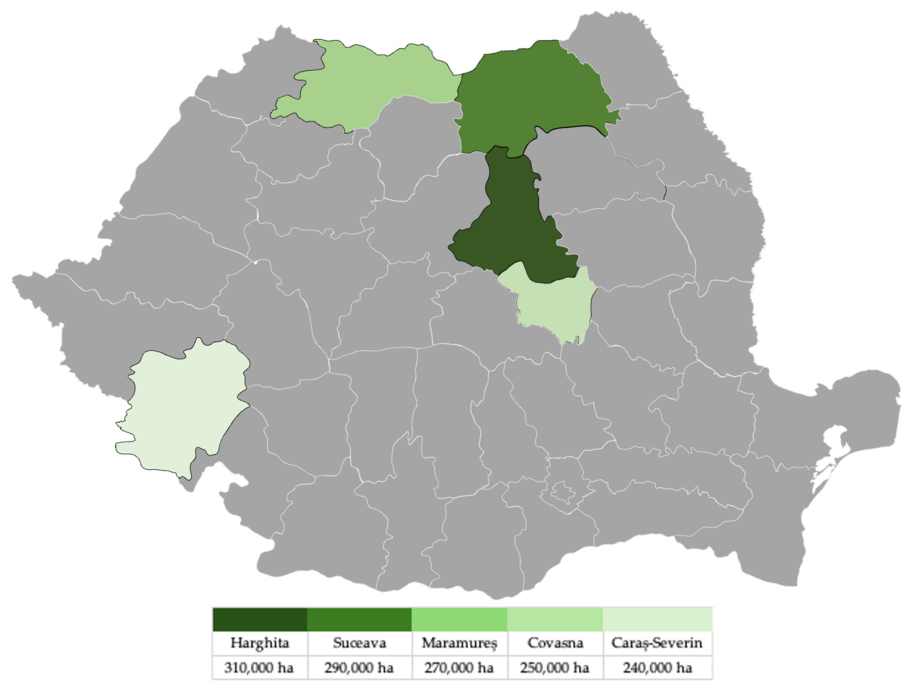
Figure 2.
Certified forest area by ownership category (ha). Source: Original by authors.
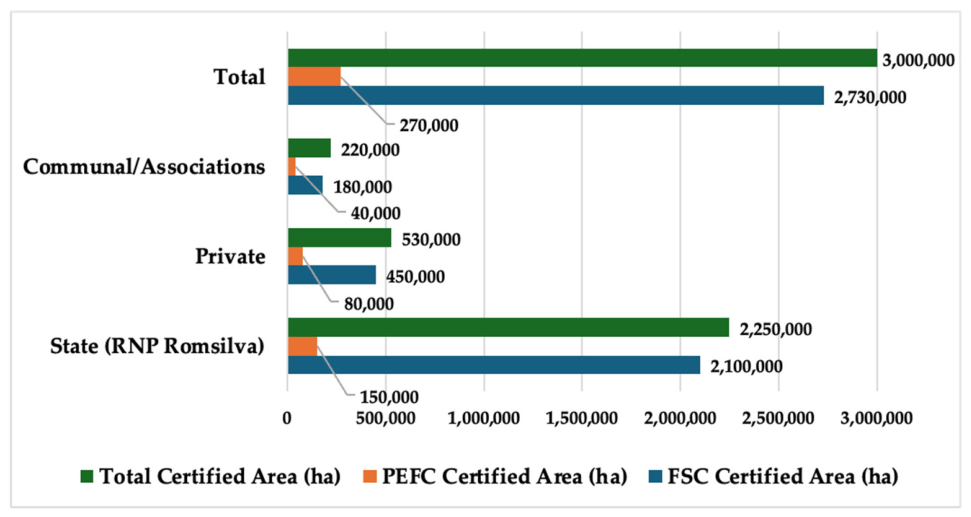
Figure 3.
Comparative spatial distribution of forest certification coverage (a) and harvest rate (b) in selected EU Member States. Source: Original by authors.
Figure 3.
Comparative spatial distribution of forest certification coverage (a) and harvest rate (b) in selected EU Member States. Source: Original by authors.
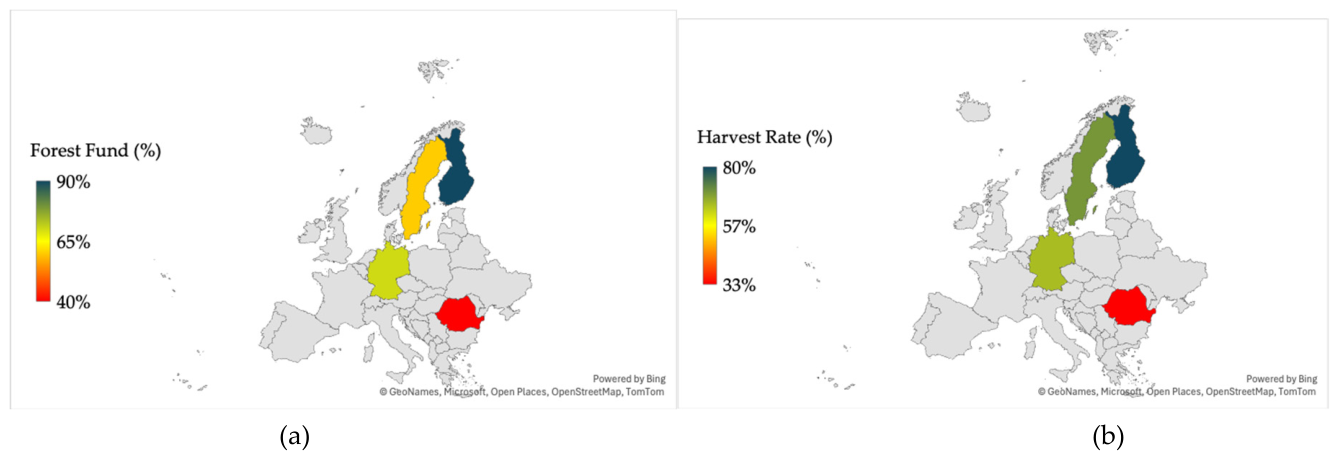
Figure 4.
Forest certification coverage (% of forest area, larger of the FSC and PEFC shares) versus GDP per capita (PPS index, EU27=100), for 18 European countries, by EU accession cohort. Romania is circled. Source: authors’ elaboration based on the FSC Global “Facts & Figures” dashboard (retrieved August 2026), PEFC Global Statistics (March 2025), and Eurostat indicator tec00114 (2024) [7,35,36].
Figure 4.
Forest certification coverage (% of forest area, larger of the FSC and PEFC shares) versus GDP per capita (PPS index, EU27=100), for 18 European countries, by EU accession cohort. Romania is circled. Source: authors’ elaboration based on the FSC Global “Facts & Figures” dashboard (retrieved August 2026), PEFC Global Statistics (March 2025), and Eurostat indicator tec00114 (2024) [7,35,36].
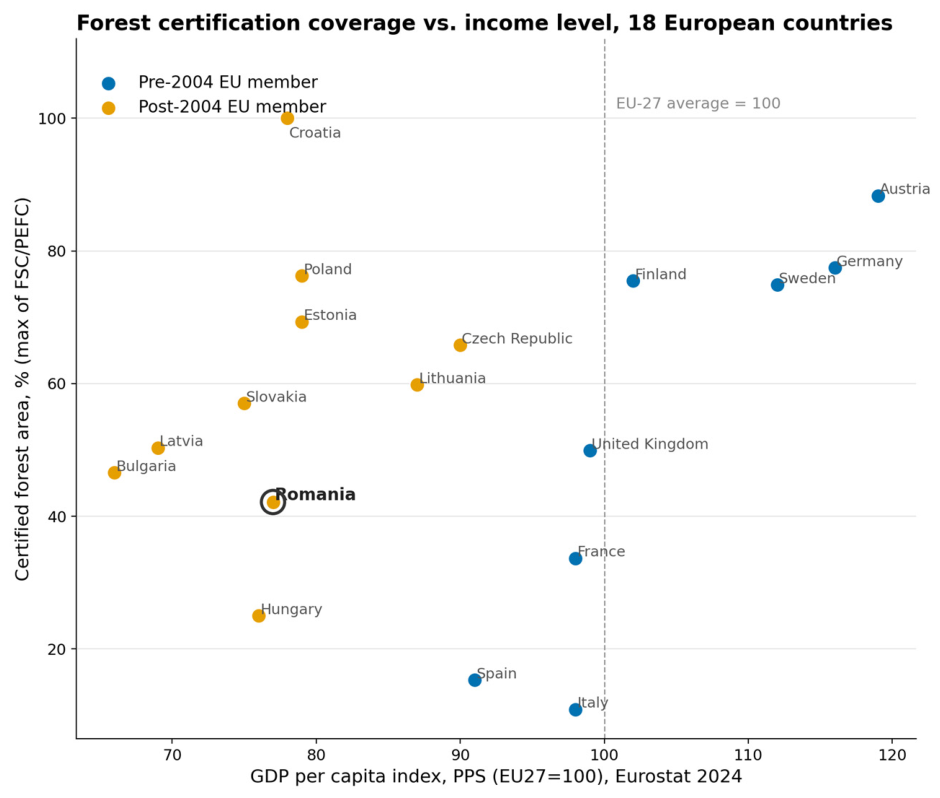
Figure 5.
Deviation between each country’s observed forest certification coverage and the coverage predicted by the regression model (percentage points), sorted from the largest negative to the largest positive gap; Romania is marked with a star. Source: authors’ elaboration.
Figure 5.
Deviation between each country’s observed forest certification coverage and the coverage predicted by the regression model (percentage points), sorted from the largest negative to the largest positive gap; Romania is marked with a star. Source: authors’ elaboration.
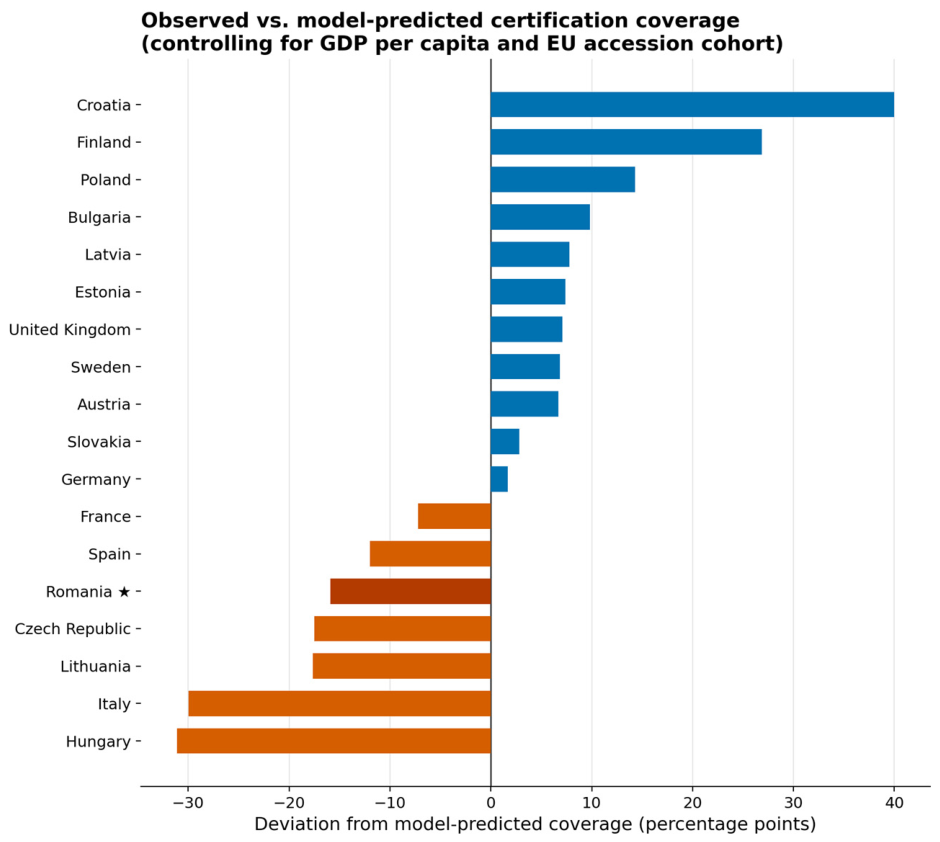

Table 1.
Forest area by county. [22].
Table 1.
Forest area by county. [22].
| County | Forest Area (ha) | % of County Surface | Dominant Forest Type |
| Harghita | 310,000 | 45% | Coniferous |
| Suceava | 290,000 | 42% | Spruce, beech |
| Maramureș | 270,000 | 40% | Virgin forests, beech, fir |
| Covasna | 250,000 | 38% | Beech, spruce |
| Caraș-Severin | 240,000 | 35% | Oak, beech |
| Indicator | Romania | European Union |
| Certified forest area | ~2.7 million ha | >100 million ha |
| Harvest rate | 30% | 66% |
| Forest infrastructure | Limited | Well developed |
| Certification bodies | External | National and international |
| Public policies | Fragmented | Integrated strategies (CAP, EUDR) |
| Country | Certified Area (mil. ha) | Forest Fund (%) | Dominant System | Harvest Rate (%) |
| Finland | 22 | 90% | PEFC | 80% |
| Germany | 11 | 70% | FSC/PEFC | 65% |
| Sweden | 20 | 60% | PEFC | 70% |
| Romania | 2.7 | 40% | FSC | 30–35% |
Table 4.
Forest certification coverage, income and EU accession cohort in 18 European countries. Source: FSC Facts & Figures, PEFC Global Statistics, and Eurostat [7,9,34,35,36].
| Country | Certified area (ha, max FSC/PEFC) | Certified % of forest area | GDP index (PPS, EU27=100) | Residual vs. model (pp) |
| Croatia | 2,035,401 | 100% | 78 | +40.0 |
| Austria | 3,442,605 | 88% | 119 | +6.7 |
| Germany | 8,846,546 | 77% | 116 | +1.7 |
| Poland | 7,259,520 | 76% | 79 | +14.3 |
| Finland | 16,912,736 | 75% | 102 | +26.8 |
| Sweden | 20,949,626 | 75% | 112 | +6.8 |
| Estonia | 1,690,444 | 69% | 79 | +7.4 |
| Czech Republic | 1,764,942 | 66% | 90 | -17.5 |
| Lithuania | 1,319,140 | 60% | 87 | -17.6 |
| Slovakia | 1,098,326 | 57% | 75 | +2.8 |
| Latvia | 1,722,504 | 50% | 69 | +7.8 |
| United Kingdom | 1,604,471 | 50% | 99 | +7.1 |
| Bulgaria | 1,830,843 | 47% | 66 | +9.8 |
| Romania | 2,920,548 | 42% | 77 | -15.9 |
| France | 5,896,646 | 34% | 98 | -7.2 |
| Hungary | 512,366 | 25% | 76 | -31.1 |
| Spain | 2,844,983 | 15% | 91 | -12.0 |
| Italy | 1,060,943 | 11% | 98 | -30.0 |
Disclaimer/Publisher’s Note: The statements, opinions and data contained in all publications are solely those of the individual author(s) and contributor(s) and not of MDPI and/or the editor(s). MDPI and/or the editor(s) disclaim responsibility for any injury to people or property resulting from any ideas, methods, instructions or products referred to in the content. |
© 2026 by the authors. Licensee MDPI, Basel, Switzerland. This article is an open access article distributed under the terms and conditions of the Creative Commons Attribution (CC BY) license (http://creativecommons.org/licenses/by/4.0/).
Copyright: This open access article is published under a Creative Commons CC BY 4.0 license, which permit the free download, distribution, and reuse, provided that the author and preprint are cited in any reuse.