
Submitted:
04 August 2026
Posted:
05 August 2026
You are already at the latest version
Abstract
Taxonomy is the foundation of biology providing the currency (species) for biological studies and the handle (epithet) to refer to them. The task at hand is urgent: a race against extinction as most species remain undescribed and expertise declines. In response various ‘rapid taxonomy’ approaches aim to hasten descriptions. Good examples exist that genuinely accelerate the growth of taxonomic knowledge, but shortcuts risk errors that may consume more time to resolve than the original work took to produce. Authors must consider: 1) the total time budget including subsequent revisions necessitated by inadequate taxonomy; 2) taxonomic literature on regional and widespread taxa; 3) illustration quality as a critical and enduring component of species description. Reviewers and editors must also ensure minimal standards. I discuss a recent example where shortcuts instead of accelerated taxonomy merely borrowed time. Anelosimus blackgardens, Anelosimus covepond, Coleosoma roadsalt—all Sherwood, Mukhida & Connor, 2026—lacked reference to genus-level revisions and established synapomorphies and are here proposed as junior synonyms of widespread theridiids: T. dilucidum Simon, 1898 syn. nov., T. melanostictum O. Pickard-Cambridge, 1876 syn. nov., add C. blandum O. Pickard-Cambridge, 1882 syn. nov., respectively. The urgent task of documenting biodiversity can be sped up, but not without due consideration of taxonomic literature.
Keywords:
Araneae
; Theridiidae
; Anelosimus
; Theridion
; Coleosoma
; species description
; taxonomic standards
; nomina dubia
; integrative taxonomy
; Caribbean
1. Introduction
Taxonomy is simultaneously one of the oldest and most urgent disciplines in biology. It provides the framework upon which ecology, conservation, evolutionary biology, and biogeography depend [1,2]. Yet taxonomy is widely perceived as being in crisis: fewer students are being trained, funding is limited, the discipline is often dismissed as merely descriptive, and taxonomic work is systematically under-cited and undervalued [3,4,5]. The irony is that the biodiversity crisis makes taxonomy more important than ever—it is impossible to conserve, monitor, or even discuss species that have not been discovered and described. The alternative is conserving critical habitat, but the measure of habitat importance is typically derived from taxonomic data.
Against this backdrop, there is pressure to describe species quickly. The lag between collection and description averages 35 years or more, with only 15% of species described within five years of collection [6]. In spiders alone, an estimated 120,000–200,000 species exist, of which only about 54,000 have been described [7,8]. The temptation to cut corners—to describe from fewer specimens, with less comparative work, without molecular data, without engaging with the broader taxonomic literature—is understandable, but can be counterproductive.
Deficient taxonomy does not save time-it borrows it. Every inadequately described species becomes a burden on subsequent workers who must re-examine types, untangle synonymies, and correct generic placements. The historical record of spider taxonomy is littered with the consequences: hundreds of species names erected by prolific but insufficiently careful workers like Embrik Strand and Cândido de Mello-Leitão have been synonymized or declared nomina dubia in subsequent revisions [9,10]. Between 2013 and 2024 alone, 335 species described by Strand and 162 by Mello-Leitão were invalidated—each synonymy representing extensive revisionary work that would have been unnecessary had the original descriptions been adequate.
Bond et al. [4] provided the first comprehensive quantitative audit of spider taxonomy over an 11-year period (2008–2018), evaluating 2,083 publications describing 8,433 new species. Their findings were sobering: only 3.6% of papers explicitly stated a species concept; 34% of species were based on two or fewer specimens; 35% were known from only one sex; only about 5% of studies made data electronically available; and fewer than 14% employed more than one line of evidence. The authors made four concrete recommendations: (1) state the species concept; (2) make data electronically accessible; (3) stop describing singleton species outside of clear revisionary context; and (4) aspire to integrative taxonomy. These recommendations have been echoed by Kuntner [11] in his identification of the ‘grand challenges’ in arachnid science.
Here, I add four more recommendations based on a recent example that illustrates the potential shortfalls of rapid taxonomy. Sherwood et al. [12] described seven new spider species from Anguilla, Lesser Antilles including three theridiids placed without reference to taxon synapomorphies or relevant systematic revisions on regional or widespread synanthropic taxa. This particular case is merely illustrative among many recent and historical examples: it is highlighted primarily because it involves Anelosimus, a group that has been central to my research programme for over two decades [13,14,15,16]. When new species are placed in a genus one has revised, a response is not optional—it is a responsibility to the integrity of the taxonomic framework that others rely upon.
Taxonomy, done properly, is a long-term investment that pays dividends. Several examples of successfully accelerating the growth of taxonomic knowledge exist, however, shortcuts that sacrifice fundamental comparison to legacy data can result in a debt that accrues interest.
2. Materials and Methods
This study combines a commentary on rapid-taxonomy practice with three nomenclatural acts arising from a single published case. The taxonomic acts proposed here rest on published descriptions and illustrations, and I state the basis of each explicitly so that readers may weigh it independently.
Two classes of act are distinguished, because they carry different evidentiary burdens. The first is generic placement. Demonstrating that a species lacks the synapomorphies of the genus in which it was described requires only that the relevant characters be assessable in the published illustrations and description. The characters diagnostic of Anelosimus [13,14] are structures whose presence or absence is apparent in figures of the quality provided in the original descriptions. A transfer on these grounds therefore does not require examination of type material.
The second is species-level synonymy, which requires matching a nominal taxon to a previously described species and is inherently less secure from published figures alone. The synonymies proposed here rest on Levi’s redescriptions of Caribbean theridiids [17,18] and, in the case of Coleosoma, additionally on the joint collection of both sexes reported by the original authors. Where the evidence for a particular act is weaker I
Comparative illustrations were modified from the sources cited in the figure captions [12,18,19,20,21,22]. Figures were modified in Adobe Photoshop and arranged in Adobe Illustrator
All publicly available cytochrome c oxidase subunit I (COI) sequences attributed to Theridion melanostictum were retrieved from GenBank on [date]: EF449610.1 (Hawaii); KX055052.1 and KX055053.1 (French Polynesia); JN306313.1 (Pakistan); and MK950561.1–MK950568.1 (Oman). Sequences were aligned in ClustalW. Phylogeny and uncorrected p-distances were estimated in Mega11. The alignment and the full distance matrices are provided as Supplementary Material (Table S1, File S1).
3. Results and Discussion
The persistent problem of inadequate taxonomy. The problem of poor species descriptions is as old as taxonomy itself. In spider systematics, several historically prolific authors illustrate the pattern. Embrik Strand (1876–1947) described over 900 valid spider species and erected 165 infraspecific names, often treating trivial variation in coloration, body size, and leg spination as grounds for new taxa. A recent review found that 39 of his subspecies are synonyms of their nominate forms, 26 are nomina dubia, and many others require further study [9]. Cândido de Mello-Leitão (1886–1948) was similarly prolific but insufficiently rigorous; his species have been synonymized or declared unrecognizable in family after family, from Theraphosidae [10] to Araneidae [23] to Uloboridae. Another source of taxonomic confusion is Barrion & Litsinger’s [24] Riceland Spiders of South and Southeast Asia, a 700-page work describing over 400 species from Philippine rice fields. While ambitious in scope, many of the theridiid descriptions in this work are so brief and poorly illustrated that the species cannot be reliably identified. Agnarsson [14], in his revision of Anelosimus, declared two species from Barrion & Litsinger—A. nigrobaricus and A. salaensis—as nomina dubia, noting that the types were in very bad condition and the original descriptions lacked sufficient detail for identification. Several other genera erected in the same work have since been synonymized. Yet, as I show below, this source, unreliable for identification, continues to be cited as a primary comparison for new species descriptions. One might hope that modern taxonomy, with access to high-resolution imaging, molecular tools, and comprehensive online databases like the World Spider Catalog, would have moved beyond these problems. The data suggests otherwise. Bond et al. [4] documented that the majority of spider taxonomic publications over the past decade are non-revisionary, non-integrative, and rely on a single morphological data source. Twenty percent of all new species were based on a single specimen—an n = 1 from which to infer species boundaries.
Effort to accelerate taxonomy is commendable and I would argue there are excellent examples of turbo taxonomy that achieve a favorable tradeoff between quality and speed of growth of taxonomic knowledge [25,26,27,28]. The term turbo-taxonomy was coined by Butcher et al. [25] for a study of Thai Aleiodes wasps that described 179 new species based on COI-barcoded specimens and typical revisionary components such as identification keys, morphological descriptions and illustrations for every species. Riedel et al. [26] formalized an equivalent ‘fast-track’ pipeline and demonstrated it on 101 new species of New Guinea Trigonopterus weevils [28], each with a barcode, high-resolution habitus and genitalic images, a short diagnosis, and open data. Critically, that group sustained the approach across further monographs [29,30,31], which is the strongest available evidence that the shortcuts genuinely accelerated the growth of taxonomic knowledge rather than merely the rate of naming. Comparable examples exist for lichens [32], annelids [33], dragonflies [34], microhylid frogs [35], phorid flies [36], and a substantial braconid literature [27,37].
What separates rapid taxonomy that works from rapid taxonomy that does not is worth stating explicitly, because the economy is in effort allocation, not in evidence. These works share a common structure: They compress descriptions, drop or simplify keys, provide simple sequence databases, and automate imaging and data capture, while retaining diagnoses, adequate illustration, deposited and accessible data, and, crucially, an explicit treatment of previously described names. The best examples all unite: 1) large comparative revisions of clades, 2) the use of high-quality imaging, and 3) uniting basic molecular and morphological data. Hartop et al. [38] make the logic explicit in their Large-scale Integrative Taxonomy framework: preliminary species hypotheses are generated from cheap, fast data and then validated against a more expensive data type for specimens chosen by objective criteria. The saving lies in deciding which specimens must be examined closely, not in abandoning examination.
The counter-examples are instructive precisely because they abandon that last set of commitments. The minimalist revisions of Meierotto et al. [39] and Sharkey et al. [40] described species largely from barcodes, without keys, descriptions, or engagement with prior names, prompting substantial critical literature [5,41,42,43,44]. Two findings from that debate bear directly on the argument advanced here. First, Fernandez-Triana [45], a turbo-taxonomy practitioner, shows that such papers are not, in fact, as fast as advertised once the hidden prior work of collecting, rearing, databasing and sequencing is costed in, and notes that very few authors have sustained the approach. Second, he observes that descriptions resting solely on molecular data force all subsequent users into molecular identification: the cost is not eliminated but transferred from the describer to every later worker. A shortcut that accelerates the author while decelerating the community does not accelerate taxonomy. This is the standard against which the present case should be read. The problem documented below is not that the work was done quickly. It is that the shortcuts taken bought no time at all: they omitted the comparative steps that would have taken hours and produced names whose correction requires the present paper.
In this context it is worth noting alternatives to turbo taxonomy, e.g., rapidly making available biodiversity data without formal taxonomic acts—providing currency (putative species boundaries and number) without affixing possibly problematic taxonomic handles [46].
Case study: misplaced and inadequately diagnosed theridiids from Anguilla. Sherwood et al. [12] described seven new spider species from Anguilla, Lesser Antilles, of which three are theridiids: Anelosimus blackgardens, Anelosimus covepond, and Coleosoma roadsalt. No species concept was stated for any of them, no molecular data were included, methods of identification of taxa were not described, nor apparently consulted as relevant revisions are not cited for ID or diagnostic/synapomorphic traits. Notably, no effort seems to have been made to check if sampled taxa might represent widespread anthropogenic species.
The Misplacement of Anelosimus
Anelosimus Simon, 1891 is diagnosed by a suite of characters established by Agnarsson [13,14]: (1) a characteristic dark notched longitudinal central band on the dorsal abdomen, edged by narrow notched white bands, with bilateral white blotches outside; (2) absence of a colulus, with two colular setae retained; (3) conspicuous ridges on the epigynal plate (in most species); (4) a subconductor in the male palp; (5) an incised mesal cymbial distal margin; and (6) a characteristic stridulatory apparatus with distinctly curved, paired rows of stridulatory picks on the male abdomen. Anelosimus is sister to the subfamily Theridiinae (which includes Theridion), together forming the ‘lost colulus clade’ [13,14]. Within this clade, Anelosimus retains two colular setae, whereas Theridion and other Theridiinae have lost even these setae—belonging to the ‘lost colular setae clade.’ The presence or absence of colular setae is thus a straightforward diagnostic character separating these genera, readily observed under a stereomicroscope.
The authors do not evaluate any of these genus-level diagnostic characters for their two new species, even though they place both species within a particular Analosimus clade: the ‘analyticus group’. The paper cites Agnarsson [14] for genitalic terminology but does not engage with the genus-level diagnosis provided therein, or the characters supporting the analyticus group. Examination of the published habitus photographs reveals that neither species exhibits the characteristic Anelosimus abdominal color pattern; instead, both show scattered irregular white blotches and spots on a pale ground—typical of many Theridion species. No mention is made of colular setae, stridulatory apparatus, epigynal ridges, or incised cymbial margin. The two Anguilla species share none of these features and, as the authors point out, further differ in palpal structure from ’other’ Anelosimus.
The other critical omission underlying the misplacement is the failure to consult the primary revisionary literature for Caribbean and cosmotropical theridiids. Levi [17,18] revised Theridion from North America and from Mexico, Central America, and the West Indies, including Anguilla. Neither paper is cited in the Anguilla survey. Comparison with the Caribbean Theridion fauna reveals strong similarities between A. blackgardens and Theridion dilucidum Simon, 1898 [4][], widespread in the Lesser Antilles and similarly, A. covepond has a typical Theridion gestalt and closely resembles the widespread synanthropic T. melanostictum (Figure 1C-E).
Misidentification of Coleosoma Roadsalt
A third new theridiid species, Coleosoma roadsalt Sherwood, Mukhida & Connor, 2026, illustrates a different but related pitfall: diagnosis by comparison to an inappropriate reference. This species is described from females only—a holotype and two paratype females. No male is known. The sole comparison offered in the diagnosis is to Coleosoma pseudoblandum Barrion & Litsinger, 1995 [24], from the Philippines (erroneously as “P. pseudoblandum”). This comparison is problematic on several levels. First, C. pseudoblandum is itself poorly described: the original account in Barrion & Litsinger [24] (p. 431, Figure 257) provides a single-sentence description of the epigynum (“Epigynum with a cup-shaped median sclerotized plate and a circular orifice on its anterior”), crude line drawings, and no male. The species is known only from the holotype female and a few spiderlings from the Philippines. It is exactly the kind of weakly founded taxonomic hypothesis that Bond et al. [4] cautioned against.
Second, the diagnosis of a Caribbean species should be made against regional congeners, not against a poorly described Philippine species. The survey recorded two other Coleosoma species from Anguilla in the same paper—C. acutiventer (Keyserling, 1884) and C. floridanum Banks, 1900—yet the diagnosis does not differentiate C. roadsalt from either of them, nor from any other New World, or cosmopolitan, Coleosoma. A diagnosis that tells us only how a species differs from a poorly known congener on a different continent, while remaining silent on how it differs from species occurring on the same island, fails the basic purpose of a diagnosis: to enable identification.
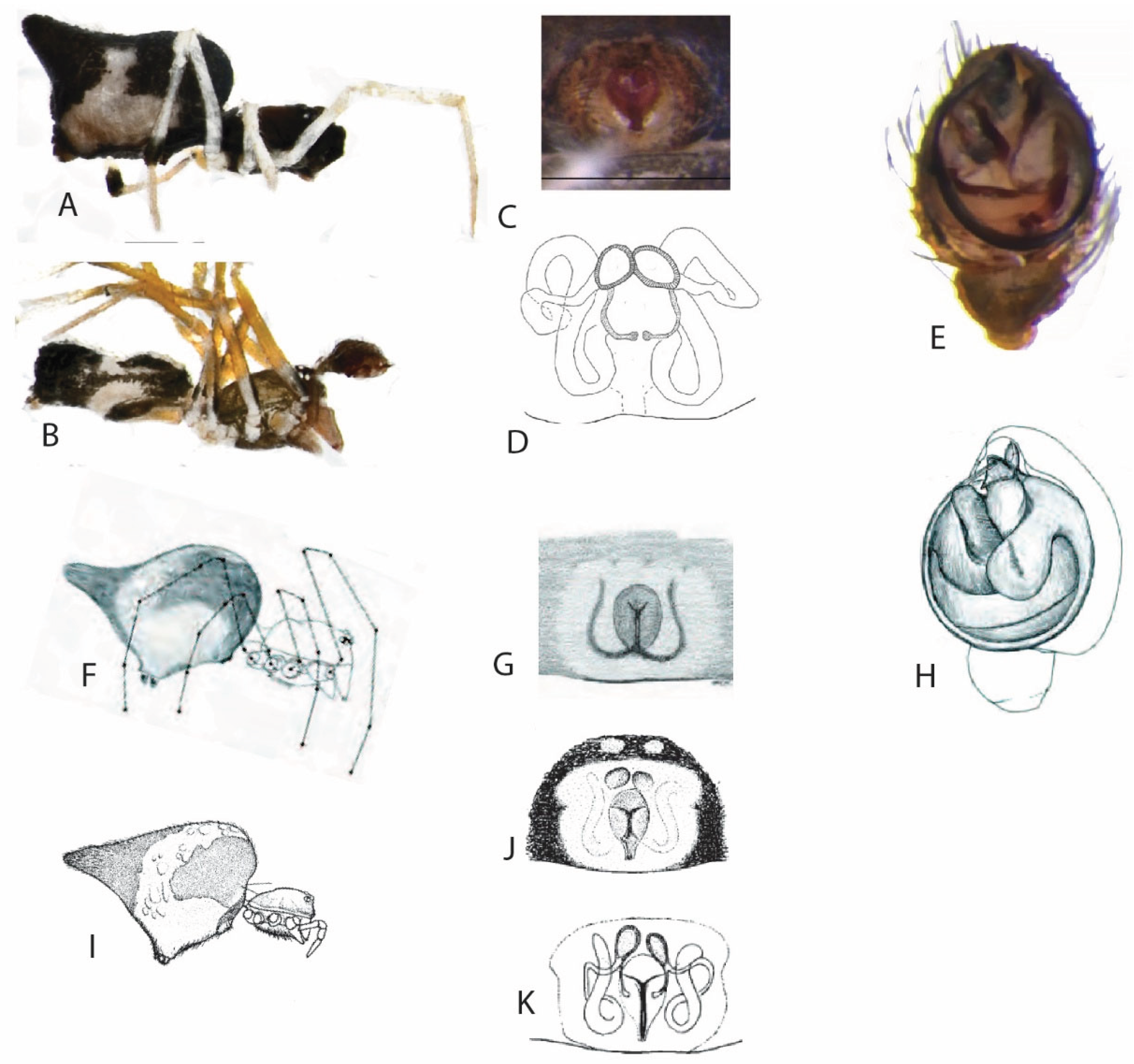
Third, and most critically, the female C. roadsalt bears a striking resemblance to males discussed in the same paper identified as C. acutiventer. Indeed, males identified as C. acutiventer and female C. roadsalt were all collected in the same samples, at two locations independently. There is little doubt these males and females are conspecific, however, neither appears to belong to C. acutiventer. The specimens instead are closely similar to the widespread synanthropic Coleosoma blandum O. Pickard-Cambridge, 1882 [49] (Figure 2A-L, see e.g., [19,21]). While C. blandum is a southeast Asian species with no prior record from the Americas, it is associated with anthropogenic habitats (e.g., agriculture) and has a broad and expanding distribution. The species was documented in India for the first time by Prasad et al. [50] and was recently introduced to the Seychelles, Hawaii, and South Africa [19,51,52]. Taken together, the description of C. roadsalt exemplifies a chain of citation in which weakly founded hypotheses become the reference standard for new ones.
4. Taxonomy
Note: these acts rest on published descriptions and illustrations rather than examination of types. The generic transfers do not require type examination: the specimens as figured lack the diagnostic characters of Anelosimus. The synonymies rest on Levi’s [17,18] redescriptions and, for Coleosoma, on the joint collection of both sexes. The next step goes beyond examining types, all three taxonomic acts involve species that may represent species-complexes and need a thorough integrative revision.
Theridion dilucidum Simon, 1898 [47]
Anelosimus blackgardens Sherwood, Mukhida & Connor, 2026 [12], 22 (mf), syn. nov. (not examined)
Anelosimus blackgardens Sherwood, Mukhida & Connor, 2026 [12] lacks Anelosimus synapomorphies and is here proposed as a junior synonym of T. dilucidum Simon, 1898 [47] (A-B, cf. [1][]: figs 78–81). In his revision of Caribbean Theridion Levi’s [18] (p. 85, figs 78–81) redescription of Theridion dilucidum closely matches A. blackgardens including an identical epigynum having “an anterior curved sclerotized plate, and a posterior depression; in between is a projecting carina” (Figure 1A-B).
Theridion melanostictum O. P.-Cambridge, 1876 [48]
Enoplognatha angkora Barrion, Barrion-Dupo & Heong, in Barrion et al. [64] (p. 38) (m), see Lin et al. [65]
Anelosimus covepond Sherwood, Mukhida & Connor, 2026 [12]: 23 (m) syn. nov. (not examined)
Anelosimus covepond Sherwood, Mukhida & Connor, 2026 [12] lacks Anelosimus synapomorphies and is here proposed as a junior synonym of T. melanostictum O. P.-Cambridge, 1876 [48] (C-E, cf. [2][]: 271, f. 37.138-140). Given a single male specimen, the sampling of more males and a female will be important for confirming the synonymy.
Theridion melanostictum is a cosmopolitan catchall name that has absorbed T. miami (North America), T. scorinum (Aldabra/Seychelles), T. ogasawarense (Japan), Enoplognatha angkora and others, and there is reason to doubt that it circumscribes a single species. Publicly available COI sequences on GenBank attributed to T. melanostictum are sparse and geographically restricted. Regardless, they fall into two tight clusters: a Pacific group (EF449610.1, Hawaii; KX055052.1, KX055053.1, French Polynesia) and a continental group (JN306313.1, Pakistan; MK950561.1–MK950568.1, Oman) (Supplementary material). Between-group divergence averages 7.8% uncorrected (K2P mean 8.2%, maximum 9.4%), while within-group divergence is negligible. These between group distances are typical among, but not within, species of theridiid spiders. This evidence, along with ’polymorphism’ in both habitus and genitalia suggests that Theridion melanostictum as currently defined consists of more than one species. The name belongs, by its type, to whichever lineage the Egyptian holotype [48] represents — possibly neither sequenced group.
The synonymy proposed here is therefore explicitly provisional in one respect. The evidence that Anelosimus covepond is not an Anelosimus is independent of this problem and stands: the specimen lacks the diagnostic characters of the genus. The evidence that it belongs to the melanostictum complex is likewise straightforward, the current taxonomic act places covepond in the most appropriate available bin. What cannot yet be established is which member of that complex it is, and hence whether melanostictum is ultimately the correct name for it. Resolving this requires an integrative revision anchored on topotypic Egyptian material. Whether T. melanostictum is a single species or a species complex awaits further study, regardless it includes an apparently synanthropic lineage introduced widely, and I expect the Anguillan specimens belong to that lineage.
Coleosoma blandum O. Pickard-Cambridge, 1882 [49]
Coleosoma roadsalt Sherwood, Mukhida & Connor, 2026 [12]: 24 (f) syn. nov. (not examined)
Coleosoma roadsalt Sherwood, Mukhida & Connor, 2026 [12], is diagnosed exclusively against a poorly described Philippine species and was sampled jointly with matching male specimens, identified as C. acutiventer. These are, however, conspecific on the evidence of habitus and genitalic morphology, and C. roadsalt is here proposed as a junior synonym of the widespread C. blandum O. Pickard-Cambridge, 1882 [49] syn. nov.
5. Recommendations
I endorse the four recommendations of Bond et al. [4] and add the following, directed at the specific problems illustrated by the present case study.
1. Consider the time budget. Is the shortcut you are taking genuinely saving time? The time necessary to compare the material here discussed against Caribbean and widespread Anelosimus, Theridion, Coleosoma species is a fraction of that needed to correct the generic placement in a separate publication, re-examining the original material by subsequent workers, potential synonymy investigations, and updates to catalogues and databases. A well-described species, placed in the correct genus with adequate illustrations and comparative data, serves the scientific community indefinitely. A poorly described species, erroneously placed, serves no one and costs everyone.
2. Evaluate genus-level characters against the primary revisionary literature, including the literature on widespread synanthropic species. Before placing a new species in a genus, authors should explicitly evaluate the characters that define that genus (synapomorphies). If a specimen lacks the diagnostic features of the genus, reconsider the placement. Describing new species from a region without consulting the primary revisions for that region, or literature on widespread species associated with human activities (readily available for spiders in the World Spider Catalog [8]), is a fundamental failing. For Caribbean theridiids, the Levi revisions [17,18] are essential starting points. Diagnoses should compare new species against regional congeners, not solely against geographically distant taxa from poorly documented sources.
3. Prioritize illustration quality. High-quality illustrations are not merely aesthetic—they are primary data and the most enduring component of a species description. High-quality photographs with adequate depth of field and contrast, supplemented by interpretive line drawings with labelled structures, should be the minimum standard. The increasing availability of focus-stacking software and high-resolution digital imaging makes this more achievable than ever. The stunning photography of ’turbo taxonomy’ in Riedel et al. [26,28,29] demonstrates quality photos are obtainable within the rapid taxonomy framework.
4. Reviewers and editors must enforce standards. The problems documented here should have been caught in peer review. Reviewers of taxonomic manuscripts should verify that genus-level diagnostic characters have been evaluated, that the relevant regional literature has been consulted, and that illustrations are of sufficient quality to enable subsequent identification. Editors of taxonomic journals should require explicit statements of species concepts and encourage data deposition. This issue reflects a broader challenge in taxonomy, where specialist expertise for many groups is concentrated in very few hands and reviewers may not have the background to evaluate genus-level placements outside their own area. This is not a criticism of any individual reviewer but a structural problem: as Bond et al. [4] noted, editorial practices and community standards need to be strengthened across the board. The responsibility is shared: authors must do the work, but reviewers and editors must be equipped and empowered to hold them to it.
6. Conclusions
Taxonomy takes time. This is not a weakness of the discipline but a feature of it. The careful comparison of specimens, the evaluation of genus-level characters, the consultation of revisionary literature, the preparation of high-quality illustrations—these are not luxuries to be dispensed with under pressure. They are the substance of taxonomy itself. When they are omitted, the result is not faster but slower science, because every shortcut creates work for someone else downstream.
The case discussed here is not an isolated example but a symptom of broader patterns documented by Bond et al. [4]: the prevalence of non-revisionary, non-comparative, non-integrative taxonomy that persists despite decades of calls for improvement.
I urge the arachnological community—and the broader taxonomic community—to take these patterns seriously. The resources for improvement exist: comprehensive online catalogues, affordable molecular tools, high-resolution imaging, and a rich revisionary literature built over centuries by careful workers. What is needed is the will to use them, and the institutional support through training, funding, and editorial standards, to make rigorous taxonomy not just aspirational but expected. Taxonomy takes time, but the alternative—shortcuts to synonymy—takes more.
Author Contributions
IA is solely responsible for the contents of this paper, conceptualization, methodology, formal analysis, investigation, data curation, writing reviewing and editing, and visualization.
Funding
This research received no external funding.
Institutional Review Board Statement
Not applicable.
Informed Consent Statement
Not applicable.
Data Availability Statement
The original contributions presented in this study are included in the article and its Supplementary Material. The COI sequences analysed are publicly available in GenBank under the accession numbers listed in Supplementary materials. No new sequence data were generated.
Conflicts of Interest
The author declares no conflict of interest.
Supplementary: Materials: The following supporting information can be downloaded at the website of this paper posted on Preprints.org.
References
- Godfray, H.C.J. Challenges for taxonomy. Nature 2002, 417, 17–19. [Google Scholar] [CrossRef] [PubMed]
- Wheeler, Q.D. Taxonomic triage and the poverty of phylogeny. Philos. Trans. R. Soc. B 2004, 359, 571–583. [Google Scholar] [CrossRef] [PubMed]
- Agnarsson, I.; Kuntner, M. Taxonomy in a changing world: seeking solutions for a science in crisis. Syst. Biol. 2007, 56, 531–539. [Google Scholar] [CrossRef] [PubMed]
- Bond, J.E.; Godwin, R.L.; Colby, J.D.; Newton, L.G.; Zahnle, X.J.; Agnarsson, I.; Hamilton, C.A.; Kuntner, M. Improving taxonomic practices and enhancing its extensibility—an example from araneology. Diversity 2022, 14, 5. [Google Scholar]
- Engel, M.S.; Ceríaco, L.M.P.; Daniel, G.M.; Dellapé, P.M.; Löbl, I.; Marinov, M.; Reis, R.E.; Young, M.T.; Dubois, A.; Agrawal, I.; et al. The taxonomic impediment: a shortage of taxonomists, not the lack of technical approaches. Zool. J. Linn. Soc. 2021, 193, 381–387. [Google Scholar] [CrossRef]
- Fontaine, B.; Perrard, A.; Bouchet, P. 21 years of shelf life between discovery and description of new species. Curr. Biol. 2012, 22, R943–R944. [Google Scholar] [CrossRef] [PubMed]
- Agnarsson, I.; Coddington, J.A.; Kuntner, M. Systematics: progress in the study of spider diversity and evolution. In Spider Research in the 21st Century: Trends and Perspectives; Penney, D., Ed.; Siri Scientific Press: Manchester, UK, 2013; pp. 58–111. [Google Scholar]
- World Spider Catalog, Version 27.0; Natural History Museum Bern. Available online: https://wsc.nmbe.ch (accessed on 6 April 2026).
- Nentwig, W.; Blick, T.; Gloor, D. Tackling taxonomic redundancy in spiders: the infraspecific spider taxa described by Embrik Strand. Arachnol. Mitt. 2019, 58, 29–51. [Google Scholar] [CrossRef]
- Bertani, R. Taxonomic revision of Lasiodora C.L. Koch, 1841 (Araneae: Theraphosidae). Zootaxa 2023, 5374, 1–100. [Google Scholar] [CrossRef] [PubMed]
- Kuntner, M. The seven grand challenges in arachnid science. Front. Arachn. Sci. 2022, 1, 1082700. [Google Scholar] [CrossRef]
- Sherwood, D.; Mukhida, F.; Connor, R.A.; Hughes, G.; Carter, D.; Curtis, I.; Hochart, J.; Gumbs, K.; Cumbs, J.C.; Buckmire, Z.; et al. New data on the spiders of Anguilla, Lesser Antilles, with description of seven new species. Faunitaxys 2026, 14, 1–30. [Google Scholar] [CrossRef]
- Agnarsson, I. Morphological phylogeny of cobweb spiders and their relatives (Araneae, Araneoidea, Theridiidae). Zool. J. Linn. Soc. 2004, 141, 447–626. [Google Scholar] [CrossRef]
- Agnarsson, I. A revision of the New World eximius lineage of Anelosimus (Araneae, Theridiidae) and a phylogenetic analysis using worldwide exemplars. Zool. J. Linn. Soc. 2006, 146, 453–593. [Google Scholar] [CrossRef]
- Agnarsson, I.; Gotelli, N.J.; Agostini, D.; Kuntner, M. Limited role of character displacement in the coexistence of congeneric Anelosimus spiders in a Madagascan montane forest. Ecography 2016, 39, 743–753. [Google Scholar]
- Luo, Y.; Goh, S.P.; Gonzaga, M.O.; Santos, A.J.; Tanikawa, A.; Yoshida, H.; Haddad, C.; May-Collado, L.C.; Chen, R.-C.; Kuntner, M.; et al. Global diversification of the cobweb spider genus Anelosimus assimilates the Neogene climate oscillations. Syst. Biol. 2020, 69, 1122–1136. [Google Scholar] [CrossRef] [PubMed]
- Levi, H.W. The spider genera Enoplognatha, Theridion, and Paidisca in America north of Mexico (Araneae, Theridiidae). Bull. Am. Mus. Nat. Hist. 1957, 112, 1–124. [Google Scholar]
- Levi, H.W. The spider genera Achaearanea, Theridion and Sphyrotinus from Mexico, Central America and the West Indies (Araneae, Theridiidae). Bull. Mus. Comp. Zool. 1959, 121, 57–163. [Google Scholar]
- Saaristo, M.I. Theridiid or cobweb spiders of the granitic Seychelles islands (Araneae, Theridiidae). Phelsuma 2006, 14, 49–89. [Google Scholar]
- Saaristo, M.I. Araneae. In Arachnida and Myriapoda of the Seychelles Islands; Gerlach, J., Marusik, Y.M., Eds.; Siri Scientific Press: Manchester, UK, 2010; pp. 8–306. [Google Scholar]
- Roberts, M.J. Contributions à l’étude de la faune terrestre des îles granitiques de l’archipel des Séchelles (Mission P.L.G. Benoit–J.J. Van Mol 1972). Theridiidae, Mysmenidae and gen. Theridiosoma (Araneidae) (Araneae). Rev. Zool. Afr. 1978, 92, 902–939. [Google Scholar]
- Baert, L.; Maelfait, J.-P.; Desender, K.; Hendrickx, F.; Dekoninck, W.; Berthet, M.; Bouckaert, K.; Caudron, J.; Leclercq, M. Updated checklist, origin, distribution, literature and genital drawings of the spiders of the Galápagos Islands. Belg. J. Entomol. 2023, 142, 1–188. [Google Scholar] [CrossRef] [PubMed]
- Poeta, M.R.M.; Marques, M.A.L.; Buckup, E.H. Description of the male of Eustala vellardi and seven species of Eustala declared as nomina dubia (Araneae, Araneidae). Iheringia Sér. Zool. 2017, 107, e2017028. [Google Scholar] [CrossRef]
- Barrion, A.T.; Litsinger, J.A. Riceland Spiders of South and Southeast Asia; CAB International: Wallingford, UK, 1995. [Google Scholar]
- Butcher, B.A.; Smith, M.A.; Sharkey, M.J.; Quicke, D.L.J. A turbo-taxonomic study of Thai Aleiodes (Aleiodes) and Aleiodes (Arcaleiodes) (Hymenoptera: Braconidae: Rogadinae) based largely on COI barcoded specimens, with rapid descriptions of 179 new species. Zootaxa 2012, 3457, 1–232. [Google Scholar] [CrossRef]
- Riedel, A.; Sagata, K.; Suhardjono, Y.R.; Tänzler, R.; Balke, M. Integrative taxonomy on the fast track—towards more sustainability in biodiversity research. Front. Zool. 2013, 10, 15. [Google Scholar] [CrossRef] [PubMed]
- Fernandez-Triana, J.; Whitfield, J.; Rodriguez, J.; Smith, M.A.; Janzen, D.H.; Hajibabaei, M.; Burns, J.M.; Solis, M.A.; Brown, J.; Cardinal, S.; et al. Review of Apanteles sensu stricto (Hymenoptera, Braconidae, Microgastrinae) from Área de Conservación Guanacaste, northwestern Costa Rica, with keys to all described species from Mesoamerica. ZooKeys 2014, 383, 1–565. [Google Scholar] [CrossRef] [PubMed]
- Riedel, A.; Sagata, K.; Surbakti, S.; Tänzler, R.; Balke, M. One hundred and one new species of Trigonopterus weevils from New Guinea. ZooKeys 2013, 280, 1–150. [Google Scholar] [CrossRef] [PubMed]
- Riedel, A.; Tänzler, R.; Balke, M.; Rahmadi, C.; Suhardjono, Y.R. Ninety-eight new species of Trigonopterus weevils from Sundaland and the Lesser Sunda Islands. ZooKeys 2014, 467, 1–162. [Google Scholar] [CrossRef] [PubMed]
- Riedel, A.; Tänzler, R. Revision of the Australian species of the weevil genus Trigonopterus Fauvel. ZooKeys 2016, 556, 97–162. [Google Scholar] [CrossRef] [PubMed]
- Riedel, A.; Narakusumo, R.P. One hundred and three new species of Trigonopterus weevils from Sulawesi. ZooKeys 2019, 828, 1–153. [Google Scholar] [CrossRef] [PubMed]
- Lücking, R.; Dal Forno, M.; Moncada, B.; Coca, L.F.; Vargas-Mendoza, L.Y.; Aptroot, A.; Lawrey, J.D. Turbo-taxonomy to assemble a megadiverse lichen genus: seventy new species of Cora (Basidiomycota: Agaricales: Hygrophoraceae). Fungal Divers. 2017, 84, 139–207. [Google Scholar]
- Summers, M.M.; Al-Hakim, I.I.; Rouse, G.W. Turbo-taxonomy: 21 new species of Myzostomida (Annelida). Zootaxa 2014, 3873, 301–344. [Google Scholar] [CrossRef] [PubMed]
- Dijkstra, K.-D.B.; Kipping, J.; Mézière, N. Sixty new dragonfly and damselfly species from Africa (Odonata). Odonatologica 2015, 44, 447–678. [Google Scholar]
- Rakotoarison, A.; Scherz, M.D.; Glaw, F.; Köhler, J.; Andreone, F.; Franzen, M.; Glos, J.; Hawlitschek, O.; Jono, T.; Mori, A.; et al. Describing the smaller majority: integrative taxonomy reveals twenty-six new species of tiny microhylid frogs (genus Stumpffia) from Madagascar. Vertebr. Zool. 2017, 67, 271–398. [Google Scholar] [CrossRef]
- Hartop, E.A.; Brown, B.V.; Disney, R.H.L. Opportunity in our ignorance: urban biodiversity study reveals 30 new species and one new Nearctic record for Megaselia (Diptera: Phoridae) in Los Angeles (California, USA). Zootaxa 2015, 3941, 451–484. [Google Scholar] [CrossRef] [PubMed]
- Arias-Penna, D.C.; Whitfield, J.B.; Janzen, D.H.; Hallwachs, W.; Dyer, L.A.; Smith, M.A.; Hebert, P.D.N.; Fernández-Triana, J.L. A species-level taxonomic review and host associations of Glyptapanteles (Hymenoptera, Braconidae, Microgastrinae) with an emphasis on 136 new reared species from Costa Rica and Ecuador. ZooKeys 2019, 890, 1–685. [Google Scholar] [CrossRef] [PubMed]
- Hartop, E.; Srivathsan, A.; Ronquist, F.; Meier, R. Towards Large-Scale Integrative Taxonomy (LIT): resolving the data conundrum for dark taxa. Syst. Biol. 2022, 71, 1404–1422. [Google Scholar] [CrossRef] [PubMed]
- Meierotto, S.; Sharkey, M.J.; Janzen, D.H.; Hallwachs, W.; Hebert, P.D.N.; Chapman, E.G.; Smith, M.A. A revolutionary protocol to describe understudied hyperdiverse taxa and overcome the taxonomic impediment. Dtsch. Entomol. Z. 2019, 66, 119–145. [Google Scholar] [CrossRef]
- Sharkey, M.J.; Janzen, D.H.; Hallwachs, W.; Chapman, E.G.; Smith, M.A.; Dapkey, T.; Brown, A.; Ratnasingham, S.; Naik, S.; Manjunath, R.; et al. Minimalist revision and description of 403 new species in 11 subfamilies of Costa Rican braconid parasitoid wasps, including host records for 219 species. ZooKeys 2021, 1013, 1–665. [Google Scholar] [CrossRef] [PubMed]
- Zamani, A.; Vahtera, V.; Sääksjärvi, I.E.; Scherz, M.D. The omission of critical data in the pursuit of ‘revolutionary’ methods to accelerate the description of species. Syst. Entomol. 2021, 46, 1–4. [Google Scholar] [CrossRef]
- Zamani, A.; Dal Pos, D.; Fric, Z.F.; Orfinger, A.B.; Scherz, M.D.; Bartoňová, A.S.; Gante, H.F. DNA barcodes on their own are not enough to describe a species. Syst. Entomol. 2022, 47, 385–389. [Google Scholar] [CrossRef]
- Ahrens, D.; Ahyong, S.T.; Ballerio, A.; Barclay, M.V.L.; Eberle, J.; Espeland, M.; Huber, B.A.; Mengual, X.; Pacheco, T.L.; Peters, R.S.; et al. Is it time to describe new species without diagnoses?—A comment on Sharkey et al. (2021). Zootaxa 2021, 5027, 151–159. [Google Scholar] [CrossRef] [PubMed]
- Meier, R.; Blaimer, B.B.; Buenaventura, E.; Hartop, E.; von Rintelen, T.; Srivathsan, A.; Yeo, D. A re-analysis of the data in Sharkey et al.’s (2021) minimalist revision reveals that BINs do not deserve names, but BOLD Systems needs a stronger commitment to open science. Cladistics 2022, 38, 264–275. [Google Scholar] [CrossRef] [PubMed]
- Fernandez-Triana, J.L. Turbo taxonomy approaches: lessons from the past and recommendations for the future based on the experience with Braconidae (Hymenoptera) parasitoid wasps. ZooKeys 2022, 1087, 199–220. [Google Scholar] [CrossRef] [PubMed]
- Cao, X.; Liu, J.; Chen, J.; Zheng, G.; Kuntner, M.; Agnarsson, I. Rapid dissemination of taxonomic discoveries based on DNA barcoding and morphology. Sci. Rep. 2016, 6, 37066. [Google Scholar] [CrossRef] [PubMed]
- Simon, E. On the spiders of the island of St Vincent. III. Proc. Zool. Soc. Lond. 1898, 65, 860–890. [Google Scholar] [CrossRef]
- Pickard-Cambridge, O. Catalogue of a collection of spiders made in Egypt, with descriptions of new species and characters of a new genus. Proc. Zool. Soc. Lond. 1876, 44, 541–630. [Google Scholar] [CrossRef]
- Pickard-Cambridge, O. On new genera and species of Araneidea. Proc. Zool. Soc. Lond. 1882, 50, 423–442. [Google Scholar] [CrossRef]
- Prasad, P.; Tyagi, K.; Kumar, V. First report of the cob-web spider Coleosoma blandum O. Pickard-Cambridge (Araneae: Theridiidae) with comments on its distribution from India. Munis Entomol. Zool. 2020, 15, 96–99. [Google Scholar]
- Simpson, A.; Sellers, E.; Pagad, S. Global Register of Introduced and Invasive Species—Hawaii, United States, Version 2.0; Invasive Species Specialist Group ISSG. Checklist Dataset. Available online. (accessed on 11 July 2026). [CrossRef]
- Robinson, T.; Ivey, P.; Powrie, L.; Winter, P.; Wong, L.J.; Pagad, S. Global Register of Introduced and Invasive Species—South Africa, Version 2.8; Invasive Species Specialist Group ISSG. Checklist Dataset. Available online. (accessed on 11 July 2026). [CrossRef]
- Petrunkevitch, A. Arachnida from Panama. Trans. Conn. Acad. Arts Sci. 1925, 27, 51–248. [Google Scholar]
- Bryant, E.B. Cuban spiders in the Museum of Comparative Zoology. Bull. Mus. Comp. Zool. 1940, 86, 247–532. [Google Scholar]
- Bryant, E.B. Notes on the spiders of the Virgin Islands. Bull. Mus. Comp. Zool. 1942, 89, 317–366. [Google Scholar]
- Benoit, P.L.G. Fam. Theridiidae. In La Faune Terrestre de l’Île de Sainte-Hélène IV;Ann. Mus. R. Afr. Cent. Sci. Zool.; Musée Royal de l’Afrique Centrale: Tervuren, Belgium, 1977; Volume 220, pp. 131–152. [Google Scholar]
- Sherwood, D.; Henrard, A.; Jocqué, R.; Fowler, L.; Marusik, Y.M.; Maddison, W.; Harvey, M.S.; Hormiga, G.; Rheims, C.A.; Piacentini, L.N.; et al. Annotated checklist of the spiders of Saint Helena, with new records, descriptions of unknown sexes, new and restored genera, and two new species (Araneae: Araneomorphae). Arachnology 2024, 19, 1218–1291. [Google Scholar] [CrossRef]
- Levi, H.W. Two new spiders of the genera Theridion and Achaearanea from North America. Trans. Am. Microsc. Soc. 1980, 99, 334–337. [Google Scholar] [CrossRef]
- Levy, G. Spiders of the genera Episinus, Argyrodes and Coscinida from Israel, with additional notes on Theridion (Araneae: Theridiidae). J. Zool. 1985, 207, 87–123. [Google Scholar]
- Roberts, M.J. Spiders of the families Theridiidae, Tetragnathidae and Araneidae (Arachnida: Araneae) from Aldabra atoll. Zool. J. Linn. Soc. 1983, 77, 217–291. [Google Scholar] [CrossRef]
- Yoshida, H. The Spider Family Theridiidae (Arachnida: Araneae) from Japan; Arachnological Society of Japan: Tokyo, Japan, 2003. [Google Scholar]
- Yoshida, H. Two new species of the genus Theridion (Araneae: Theridiidae) from the Yaeyama Islands and Haha-jima Island of the Bonin Islands, Japan. Acta Arachnol. 1993, 42, 109–113. [Google Scholar] [CrossRef]
- Yoshida, H. Two species of the genus Theridion (Araneae: Theridiidae) from Japan. Acta Arachnol. 1999, 48, 127–130. [Google Scholar] [CrossRef]
- Barrion, A.T.; Barrion-Dupo, A.L.A.; Catindig, J.L.A.; Villareal, M.O.; Cai, D.; Yuan, Q.H.; Heong, K.L. New species of spiders (Araneae) from Hainan Island, China. UPLB Mus. Publ. Nat. Hist. 2013, 3, 1–103. [Google Scholar] [CrossRef] [PubMed]
- Lin, Y.J.; Wu, L.B.; Cai, D.C.; Li, S.Q.; Barrion, A.T.; Heong, K.L. Review of 43 spider species from Hainan Island, China (Arachnida, Araneae). Zootaxa 2023, 5351, 501–533. [Google Scholar] [CrossRef] [PubMed]
- Thorell, T. Descriptive Catalogue of the Spiders of Burma, Based upon the Collection Made by Eugene W. Oates and Preserved in the British Museum; British Museum: London, UK, 1895. [Google Scholar]
- Saaristo, M.I. Spiders (Arachnida, Araneae) from the Seychelle islands, with notes on taxonomy. Ann. Zool. Fenn. 1978, 15, 99–126. [Google Scholar]
- Petrunkevitch, A. A synonymic index-catalogue of spiders of North, Central and South America with all adjacent islands, Greenland, Bermuda, West Indies, Terra del Fuego, Galapagos, etc. Bull. Am. Mus. Nat. Hist. 1911, 29, 1–791. [Google Scholar]
Figure 1.
A, Theridion dilucidum Simon, 1898 [47] female epigynum internal (above) and external (below), reproduced from [18] (figs 78-79). B, Anelosimus blackgardens Sherwood, Mukhida & Connor, 2026 [12] (=T. dilucidum syn. nov.) epigynum internal (above) and external (below), reproduced from [12] (figs 15G, 15C, respectively). C, Theridion melanostictum O. P.-Cambridge, 1876 [48] male palp ventral, reproduced from [20] (Figure 138, from Seychelles). D, Anelosimus covepond Sherwood, Mukhida & Connor, 2026 (=T. melanostictum syn. nov.) male palp ventral, reproduced from [12] (Figure 16G, from Anguilla). E, Theridion melanostictum male palp ventral, re-illustrated from [22] (Figure 127A, from Galapagos).
Figure 1.
A, Theridion dilucidum Simon, 1898 [47] female epigynum internal (above) and external (below), reproduced from [18] (figs 78-79). B, Anelosimus blackgardens Sherwood, Mukhida & Connor, 2026 [12] (=T. dilucidum syn. nov.) epigynum internal (above) and external (below), reproduced from [12] (figs 15G, 15C, respectively). C, Theridion melanostictum O. P.-Cambridge, 1876 [48] male palp ventral, reproduced from [20] (Figure 138, from Seychelles). D, Anelosimus covepond Sherwood, Mukhida & Connor, 2026 (=T. melanostictum syn. nov.) male palp ventral, reproduced from [12] (Figure 16G, from Anguilla). E, Theridion melanostictum male palp ventral, re-illustrated from [22] (Figure 127A, from Galapagos).
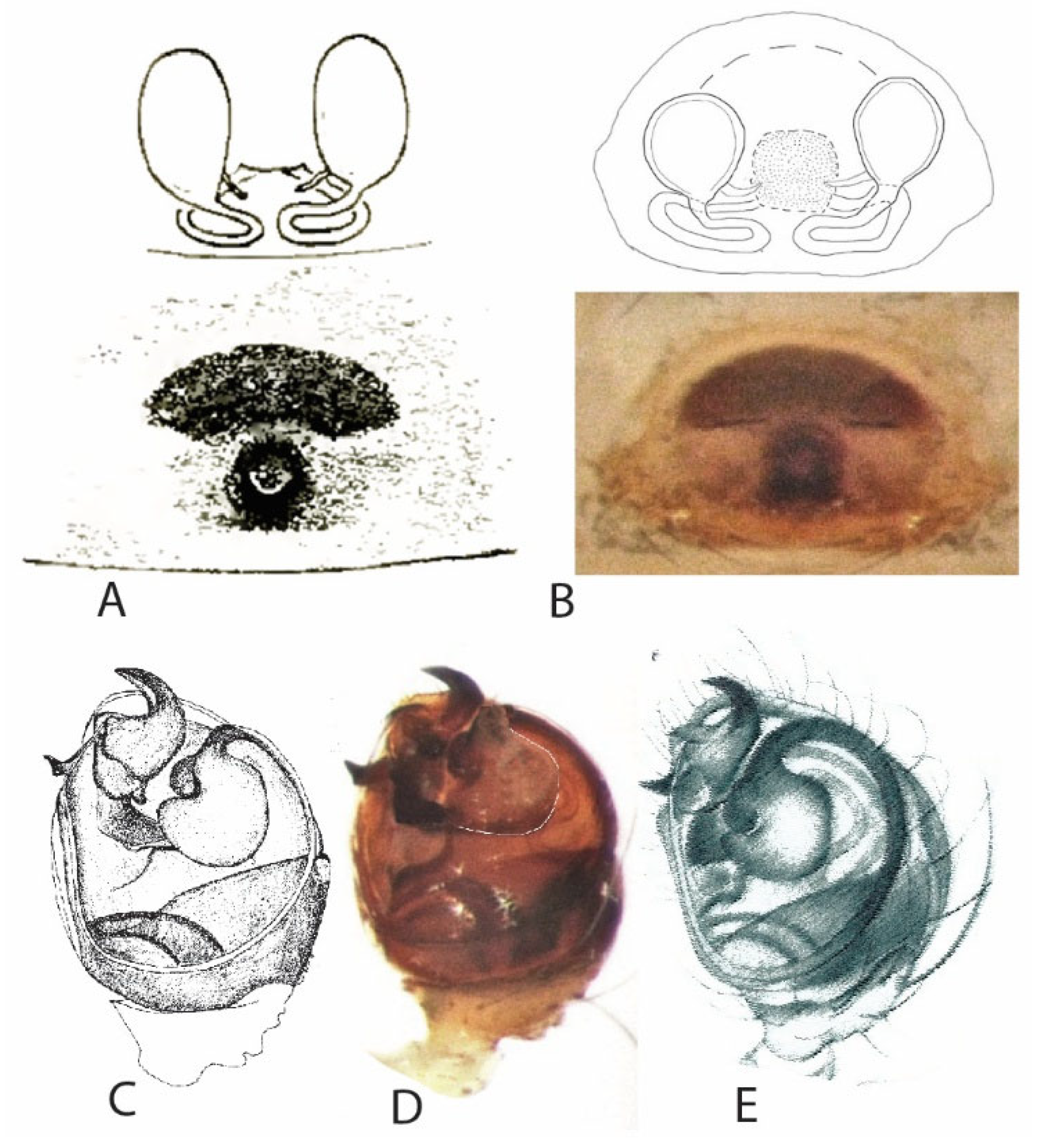
Figure 2.
A, Coleosoma roadsalt Sherwood, Mukhida & Connor, 2026 [12] (=C. blandum syn. nov.) female, modified from [12] (Figure 18C). B, ’C. acutiventer’ (Keyserling, 1884) =C. blandum, misidentified) male, modified from [12] (Figure 17D). Males in A and B were found in the same samples by [12]. C-D, C. roadsalt epigynum, C, external; D, internal, modified from [12] (Figure 18D, G, respectively). E, ’C. acutiventer’ male palp, modified from [12] (Figure 17B). F-H, C. blandum, modified from [19] (from Seychelles). F, female habitus ([19], Figure 25A); G, epigynum ([19], Figure 21); H, male palp ventral ([19], Figure 19). I-K, C. blandum, modified from [21]. I, female habitus ([21], Figure 28); J-K, epigynum, external and internal, respectively ([21], figs 29-30).
Figure 2.
A, Coleosoma roadsalt Sherwood, Mukhida & Connor, 2026 [12] (=C. blandum syn. nov.) female, modified from [12] (Figure 18C). B, ’C. acutiventer’ (Keyserling, 1884) =C. blandum, misidentified) male, modified from [12] (Figure 17D). Males in A and B were found in the same samples by [12]. C-D, C. roadsalt epigynum, C, external; D, internal, modified from [12] (Figure 18D, G, respectively). E, ’C. acutiventer’ male palp, modified from [12] (Figure 17B). F-H, C. blandum, modified from [19] (from Seychelles). F, female habitus ([19], Figure 25A); G, epigynum ([19], Figure 21); H, male palp ventral ([19], Figure 19). I-K, C. blandum, modified from [21]. I, female habitus ([21], Figure 28); J-K, epigynum, external and internal, respectively ([21], figs 29-30).
Disclaimer/Publisher’s Note: The statements, opinions and data contained in all publications are solely those of the individual author(s) and contributor(s) and not of MDPI and/or the editor(s). MDPI and/or the editor(s) disclaim responsibility for any injury to people or property resulting from any ideas, methods, instructions or products referred to in the content. |
© 2026 by the authors. Licensee MDPI, Basel, Switzerland. This article is an open access article distributed under the terms and conditions of the Creative Commons Attribution (CC BY) license (http://creativecommons.org/licenses/by/4.0/).
Copyright: This open access article is published under a Creative Commons CC BY 4.0 license, which permit the free download, distribution, and reuse, provided that the author and preprint are cited in any reuse.