

Submitted:
05 August 2026
Posted:
05 August 2026
You are already at the latest version
Abstract
New Zealand species have evolved with infrequent fires, the flora being described as non-fire adapted. Until recently there has been contradictory information in the liter-ature regarding the response of New Zealand indigenous species to fire, and little quantitative information on the resistance expressed in post-fire resprouting of New Zealand species.
Following a grass fire at a site that had been planted we measured the resprouting ability of a range of native species frequently used in revegetation. Resprouting was exhibited in many of the trees and shrubs, adding to the database of plants that show this fire resistance trait. Resprouting was unexpected given that bark provides re-sistance to fire and develops with age and the plants were less than seven years old.
Areas of regenerating native vegetation subjected to wildfire in New Zealand are fre-quently invaded by highly flammable, non-native species. Their presence contributes to what has been term a fire trap in which succession to old-growth native forest (and other habitats) is repeatedly reset. We discuss the potential of green firebreaks to es-cape this trap and conclude that such an escape will require the active engagement of all parties and the education of the volunteer workforce.
Keywords:
fire resistance
; fire trap
; green firebreak
; non-fire-prone
; resprouting
; revegetation
; wildfire
1. Introduction
With climate change, the incidence of extreme fire weather (hot, windy, low humidity) is predicted to increase globally, leading to more and intense wildfires (Jones et al., 2022; Abatzoglou et al., 2025). Where plants have evolved under conditions of frequent wildfires, such as in a large proportion of the Australian landmass, the indigenous fire-prone vegetation shows a remarkable ability to resprout (Yang S. et al., 2025). However, in countries where wildfires have not been a regular natural occurrence, the vegetation is less well adapted (Kitzberger et al., 2016; Yang X. et al., 2026). Aotearoa New Zealand (NZ) forests are an example of a non-fire-prone vegetation type (McGlone, 1983; Perry et al., 2014). In NZ, the temperate east coast of the South Island is where the dryer and hotter seasons coincide. Global predictions for temperate regions are that fire prone conditions are expected to increase along with a lengthening of the potential fire season (Senande-Rivera et al., 2022). The expectation for NZ is that this will be exacerbated by El Niño conditions (https://niwa.co.nz/climate-and-weather/el-nino-and-la-nina/impact-el-nino-and-la-nina-new-zealands-climate).
Before Polynesian people first settled the landmass that would later be known as Aotearoa New Zealand around AD 1280, most land below the alpine treeline was forested. Fire from natural sources, such as lightning or volcanic activity, had been infrequent relative to the longevity of the forest species, and the outcome of the disturbance caused by fires was little or no shift in forest species composition (Perry et al., 2014). The unique native forest flora that evolved under these circumstances was dominated by species that did not possess either, 1) well developed adaptations for fire resistance taken as the capacity to survive during fire through having thick bark, or vegetative resprouting to replace canopies of pre-existing burnt plants, or 2) fire resilience, recovering after fire by replacing dead parent plants through seedling recruitment from persistent soil seedbanks or aerial seedbanks of serotinous seed capsules, and by having high flammability foliage to promote the return of fire (Enright et al., 2014; Perry et al., 2014). Some authors regard resprouting of plants post-fire as an expression of resilience (Lawes et al., 2014).
Notable NZ exceptions to the general non-fire-prone nature of the NZ forest include widespread fire resilient myrtaceous trees mānuka (Leptospermum scoparium) and kānuka (Kunzea ericoides), both of which exhibit low fire resistance, are highly flammable, and readily colonise bare ground by wind dispersal of fine seed (Perry et al., 2014; Wyse et al. 2016), the former exhibiting fire serotinous capsules in parts of its distribution (Battersby et al., 2017). Of less widespread distribution and abundance is the thick-barked, fire resistant matagouri (Discaria toumatou) (Richardson et al., 2015).
Much of the original NZ forest cover was cleared in the “initial burn period” that occurred in some places in the first 60 years after Polynesian settlement (Perry et al., 2014), a process that was accelerated and largely completed by European settlers arriving after 1840. Additionally, Europeans introduced exotic plant species, several of which quickly naturalised and became invasive, e.g. gorse (Ulex europaeus) and broom species, including common (Scotch) broom (Cytisus scoparius) and Montpellier (French) broom (Genista monspessulana), and blackberry (Rubus fruticosus L. agg.). These are all listed as “environmental weeds” in NZ (McAlpine and Howell, 2024) and regarded as pyrophyllic because of their high flammability (Fogarty, 2001; Wyse et al., 2016), and fire resilient through persistent seed banks (Geerts et al., 2013; Taylor et al., 2018; Delaisse et al., 2023; Vorup and Pagter, 2025). Along with exotic plant species, the introduction of non-native mammals has had and continues to have a significant effect on the indigenous flora and fauna through seed predation and herbivory (Perry et al., 2015).
Such non-native plant and animal introductions contribute to the delay in succession to old-growth forest and to the increased flammability of regenerating shrubland, perpetuating wildfires on a cycle too short to allow the native plant species to develop to a size to resist or be resilient to fire. This has been termed “interval squeeze” (Nolan et al., 2021), “immaturity risk” (Enright et al., 2014), “fire-induced landscape trap” (Perry et al., 2026), and simply “fire trap” (Perry et al., 2026) from which it is hard to escape.
Recent fires on the Port Hills surrounding Christchurch have replaced regenerating bush with pyrophyllic non-native species leading to a greater appreciation of how the existing mosaic of regenerating shrubland and native remnant forest is advancing into such a fire trap (Curran et al., 2018). More information on the resistance characteristics of native species is needed to help understand their role in escaping this cycle.
There is a readily available information drawn from research and observational data on the flammability of the current indigenous and naturalised exotic flora of New Zealand (Fogarty, 2001; Wyse et al., 2016; Anon. https://www.ruralfireresearch.co.nz/resources/tools/flammability-of-native-plant-species).
However, until recently there was relatively limited published information on the fire resistance conferred by bark thickness (Lawes et al., 2014; Perry et al., 2014; Richardson et al., 2015) and resprouting (Burrows, 1994; Lawes et al., 2014; Perry et al., 2014) of the NZ indigenous flora, as discussed below.
A comprehensive review of the available data on post-fire resprouting was carried out by Teixeira et al. (2020). This review indicated limited resprouting ability in many NZ shrubs and trees. The native climax tree species do not resprout and neither do the early successional trees of bare land, kānuka and mānuka (Teixeira et al., 2020), based on qualitative yes/no assessments. However, qualitative assessment does not provide information on variability between or even within species ability to resprout post-fire.
Teixeira et al. (2020) established plots on the Port Hills, Christchurch in mixed non-native and native regenerating vegetation to study resprouting in plants that had been burnt in a severe wildfire in February (summer) 2017 and provided quantitative measures of resprouting. Aware of discrepancies with the data collected by Wabnig (2014) on an earlier fire in forest regenerating through gorse in Hinewai Reserve on Banks Peninsula in mid-winter July 2011, Teixeira et al. (2020) suggested assessing resprouting after different fire intensities.
Four months after a wildfire in short-tussock grass- and shrub-land in the Pukaki Scientific, Mackenzie Basin, southern Canterbury, resprouting was observed in a range of mature woody species (Budha-Magar et al., 2026). These authors suggested further study of the impact of wildfire on NZ native plants is needed especially where the goal is the regeneration of native vegetation.
This possibility became available after a second, low intensity fire on the Port Hills moved through an area replanted after the 2017 fire. It also provided the opportunity to collect further quantitative data.
Our study site was an area of open grassland on the northwest-facing slope of Mt Ada in the Port Hills, Banks Peninsula, Christchurch. The slope had been burnt on 13-15 February 2017 in a wildfire that covered 1660 ha and destroyed over 155 ha of regenerating indigenous vegetation on the Port Hills (Pearce, 2018). Following this fire, the study site had been replanted with a range of native woody plants. Our observations relate to the response of these plants to a second 650 ha wildfire that traversed the site on 14 February (late summer) 2024, exactly seven years after the earlier fire.
On visiting the site soon after the fire (23 February 2024) we found that grass that had been growing between the plants had been consumed by the fire. Plastic tree guards installed around the trees and shrubs with bamboo canes had melted, and their supporting canes had been burnt to the ground. However, the foliage of most of the woody plants, especially the taller ones, had not been burnt. Green foliage remained on some plants but the leaves on most others had merely desiccated without burning; some had their foliage badly scorched or burnt to different degrees. This collection of desiccated but generally not completely consumed plants presented an unusual spectacle (Figure 1). It was also an opportunity to monitor woody plant survival, resumption of canopy shoot growth, and resistance to the effects of the fire expressed in basal resprouting in woody plants that had sustained what appeared to be different degrees of fire damage.
2. Materials and Methods
2.1. Site Characteristics and Planting
The open grassland study site (ca. 250 m x 100 m) is located in a Christchurch City Council reserve at the point where the Crater Rim Walkway crosses a second walking track that rises from the nearby Summit Road to the summit of Mt Ada [172.62 E, -43.62 S].
Before the earlier fire of 14 Feb 2017, the site had been planted with woody plants native to the Banks Peninsula Ecological Region, complementing occasional clumps of Phormium tenax (native flax) that were already growing on the site. The site was surrounded by dense scrub ca. 3 m tall dominated by Ulex europaeus (gorse) and Cytisus scoparius (common broom).
During the 2017 fire, the gorse and broom were burnt to the ground, the Phormium clumps singed, and all the planted native plants killed. The gorse and broom at the perimeter of the site rapidly reestablished itself post-fire from soil-stored seed and vegetative resprouting.
Soon after the 2017 fire, a selection of woody dicotyledonous native species was replanted over three planting seasons (later in 2017, and in 2018 and 2020); plants of one monocot species Cordyline australis (te kōuka cabbage tree) were replanted in 2017 and 2020. The planting was carried out by volunteers from two organisations (Roots and Shoots, and Cashmere Rotary Club) who planted the plants at ca. 2 m centres and at a distance of ca. 5-50 m from the enclosing gorse and broom.
In the months leading up to the fire of 14 February 2024, any broom seedlings that had invaded the site were removed. However, dense, non-native pasture grass ca. 1 m tall was left growing between the plants and right up to their bases. The grass had not been maintained in the year leading up to the fire (D. Carter pers. comm.). It had senesced and dried off over the weeks preceding the fire. Many of the plants had been protected from browsing animals by green plastic tree guards held in place by 2-3 bamboo canes, many of which had not been removed at the time of the fire. The wildfire was reported shortly after 2 pm and continued to burn unchecked after nightfall through grass and areas of regenerating native vegetation including that at the study site.
2.2. Tagging Plants
Fifteen days after the fire (29 Feb 2024) a sample of 153 woody plants was tagged and each provisionally identified to the genus or species level from the intact if generally desiccated foliage, growth habit, and branching. These identifications were supported by species lists of the plantings made in 2017, 2018, and 2020 provided by Christchurch City Council.
The sample included plants in the genus Coprosma (C. lucida, C. propinqua, and C. robusta), Cordyline australis (cabbage tree tī kōuka), Corokia cotoneaster (korokio), Dodonaea viscosa (akeake), Griselinia littoralis (broadleaf kāpuka), Hebe salicifolia and H. strictissima (Banks Peninsula hebe), Hoheria angustifolia (houhere), Kunzea robusta (kānuka), Olearia avicenniifolia and O. paniculata, Pittosporum tenuifolium (kōhūhū), Podocarpus totara (tōtara), Pseudopanax arboreus (five-finger) and P. crassifolius (lancewood horoeka), and Sophora microphylla (weeping kōwhai).
Within each species we tagged plants that by visual assessment had sustained a range of fire damage based on the following five defined classes:
- Foliage largely desiccated but with some green leaves remaining
- Foliage all desiccated but not charred or burnt
- Foliage all desiccated and some charred or burnt
- Foliage largely burnt
- Foliage completely burnt off
We recorded the approximate original plant height of each tagged plant evident from the remaining foliage and branches.
2.3. Observations Post-Fire
The site was revisited and observations made five times over the next 17 months: after ca. 6 months (11 Aug 2024; late winter), 9 months (28 Oct 2024; spring), 12 months (16 Feb 2025; late summer), 15 months (14 May 2025; late autumn), and 17 months (17 Jul 2025; winter). On each occasion the tagged plants were examined for resumption of shoot growth from the crown and for the resprouting of shoots at the root collar (basal resprouting). The number of shoots resprouting from the base was recorded in three classes (1-5, 6-20, and >20 shoots) and the length (height) of the tallest basal shoots was measured. The absence of vegetative shoot growth from the crown and of resprouting was taken to indicate that the plant had died. After 17 months some of the plants had been broken off and dispersed by the wind, animals or human disturbance, and observations were terminated.
3. Results
Three of the five Cordyline australis plants that had been tagged survived the fire. They were 0.6-1.8 m tall at the time of the 2024 fire. They produced new leaves from the original crown soon after the fire and continued to grow over the 17 months they were observed. Two smaller Cordyline (~0.2 m tall) produced no new leaves and died. Long-established Phormium clumps produced new leaves weeks after the fire.
The larger Cordyline plants were an exception. For all the other tagged plants there was no resumption of shoot growth from within the crown or leaf growth on the burnt branches regardless of fire damage class. Any green leaves remaining after the fire on plants in fire damage Class 1 (the least severely damaged) died within 6 months.
All plants of five species showed no post-fire resprouting and were killed by the fire: Kunzea robusta, Dodonaea viscosa, Hebe spp., Corokia cotoneaster, and Podocarpus totara.
We found shoots resprouting from around the root collar of other species after 6 months, with additional shoots appearing in subsequent months. This was taken as an indication that these plants had survived as long as these shoots did not subsequently die.
Overall, across all species, the greater the observed fire damage (progressively greater from damage Classes 1 to 5), the higher the percentage of plants that died with all but one plant in fire damage Class 5 dying (Table 1).
The species that did resprout showed varying capacity to do this in terms of the number of resprouts, their vigour, and survival (Table 2).
By far the most successful resprouting species were those of Coprosma (17 out of 18 plants resprouted, 94%). Resprouting was first observed after 6 months and, by 17 months, ten had 1-5 resprouts, five had 6-20 resprouts, and two had >20 resprouts; three plants had resprouts over 0.5 m tall. Resprouts on one of the Coprosma plants had died after 17 months.
The next four most successful resprouting species were Hoheria angustifolia (2 sprouting out of 9 plants), Olearia avicenniifolia (3/6), Pseudopanax arboreus (5/11), and Sophora microphylla (6/9), representing 22-66% resprouting. As with Coprosma, resprouts started to emerge within 6-12 months after the fire. However, there were no more than five new resprouts per plant in these species in contrast to the resprouting in Coprosma. Moreover, all resprouts on four of the six Sophora plants, and those on one of the P. arboreus plants had died when examined at 17 months. The survival rate of Sophora therefore dropped from 66% to 22% and of P. arboreus from 45% to 36%.
Only one plant of each of 20 Pittosporum, 15 Griselinia, eight Olearia paniculata, and six Pseudopanax crassifolius plants resprouted. The first three species each produced 1-5 resprouts which were <100 mm tall after 17 months; the P. crassifolius plant had produced two resprouts 12 months after the fire that were >200 mm tall after 17 months. The resprouts on the single Olearia paniculata had died after 17 months. The rest of the Pittosporum, Griselinia, P. crassifolia, and O. paniculata plants (>84% of those tagged) were presumed killed by the fire (Table 2).
Apart for the Cordyline plants noted above, there was no indication that taller, presumably older, plants resisted the fire any better than smaller plants. Most resprouting plants produced 1-5 new shoots that were up to 300 mm in height after 17 months regardless of pre-fire plant height. Similarly, plants produced mostly 1-5 shoots up to 300 mm in height irrespective of fire damage class.
4. Discussion
“Ignition marks the onset of combustion” but fire spreads by a successional process in which multitudes of individual fuel particles reach ignition (Perry, 1996). A fire in vegetation spreads by heating the fuel (individual leaves, shoots, stems etc.) by radiation and convection which causes moisture on the surface and within the fuel to evaporate and the fuel’s organic components to decompose and volatilise until ignition occurs; “non-ignition” occurs if the fuel is not heated for long enough or with sufficient intensity for the fuel to reach its ignition temperature (Perry, 1996; Perry et al., 2014).
In view of these processes, we suggest the unusual spectacle of the plants in our study was brought about by two fire-related processes: 1) a nearby radiation source (flaming gorse and broom surrounding the planting) that heated the native plants to a high enough temperature for long enough to at least desiccate foliage, stems, and branches but not sufficiently to reach ignition (a non-ignition); and 2) a rapidly moving grass fire that passed though the planting, likely after the full intensity of the fire in the surrounding gorse and broom had subsided. It was the grass fire that burnt the individual native plants in the planting to varying degrees depending on localised variation in grass fuel load, the intrinsic flammability of each plant, and other factors, e.g. the presence of cages and bamboo canes. These factors gave rise to the differential responses to fire we observed.
The death of almost all above-ground parts of the plants we studied can be attributed in part to the desiccating, if not pyrolysing, effect of the nearby burning scrub. The bark of woody plants provides some insulation against damagingly high temperatures. As the diameter of the basal collar, main trunk and branches of woody plants increases with stature and age, the protective layer of bark becomes thicker giving the internal tissues of older plants greater resistance than those of young ones (Perry et al., 2014). Except for the taller plants of Cordyline australis, the above-ground parts of all the plants in our study were killed regardless of their stature, which is consistent with their relatively young age (no more than 7 years from planting). Cordyline australis is an “apical sprouter” with the apical bud protected by tightly packed leaf bases (Clarke et al., 2013).
In addition, most New Zealand woody angiosperms have relatively thin bark by world standards; the angiosperms listed by Perry et al. (2014) have bark thickness value of 1 or 2 on a 1-to-3 scale, with 3 the thickest. The same, or closely related species to those observed in our study, viz. Olearia avicenniifolia, Sophora microphylla and Pittosporum eugenioides have been reported to have low relative bark thickness (Lawes et al., 2014). That plants of some species we observed were able to resprout from buds located at the root collar at or below the ground surface indicates that killing temperatures were not experienced at this point (Vesk and Westoby, 2004), possibly because vegetative bud initials were sufficiently protected beneath an albeit thin bark.
There have been three fire occurrences in the Port Hills/Banks Peninsula region following which resprouting has been quantitatively measured: the first, a winter fire (12 Jul 2011) caused by a rare lightning strike after an exceptionally dry autumn affecting 300 ha in Hinewai Reserve (Wilson, 2012; Wabnig, 2014); the second, formed of two coalescing and extreme summer fires (23-25 Feb 2017) that burnt 1,660 ha on the Port Hills (Pearce, 2018; Teixeira et al., 2020); and the third, less intense summer fire (24 Feb 2024) in this report. This enabled intraspecies comparisons based on relative disturbance (Vesk and Westoby, 2004; Moreira et al., 2012).
Fire response as reported in the literature has tended to divide plants species dichotomously into “sprouters vs. non-sprouters”, whereas responses to other types of disturbance, such as windthrow, are more often reported as a continuum (Vesk and Westoby, 2004; Clarke et al., 2013). Although limited by the diversity of species planted in our study, there was a dichotomous divide between those that did not survive the fire – Kunzea, Dodonaea, Hebe, Corokia and Podocarpus totara – and those that did survive. Within the latter we observed a continuum of sprouting ability and survival of sprouts.
Similarly, Kunzea and Hebe were killed in the 2017 summer wildfire close to where our observations were made, whereas other species showed a range of sprouting response (Teixeira et al., 2020); and Kunzea was killed in the 2011 winter wildfire in the Hinewai Reserve, but numerous other species resprouted to different degrees (Wabnig, 2014) (Table 2).
Griselinia littoralis is a good example of a species with a resprouting response that differed in the three Banks Peninsula fires. In our study, 14 of the 15 G. littoralis plants died without resprouting. By contrast, after the severe 2017 fire, Teixeira et al. (2020) reported that 55% of the G. littoralis resprouted, classifying the species as an intermediate resprouter; and Wabnig (2014) reported 100% resprouting in mature G. littoralis. Others have also reported resprouting in this species (Kitzberger et al., 2016; Appendix A, Table 1A in Teixeira et al., 2020).
Mature Griselinia littoralis is reported to have relative bark thickness of ca 5.75 on a 1-to-10 scale, which is one of the highest reported for New Zealand angiosperms (Lawes et al., 2014), indicating a potentially high resistance to fire by survival and resprouting responses (Perry et al., 2014). The plants of G. littoralis studied post-fire by Teixeira et al. (2020) had regenerated naturally and were >5 cm diameter at 30 cm height. Those studied by Wabnig (2014) had also regenerated naturally over as long as 30 years. By contrast, the G. littoralis plants under our observations were <7 years old from being planted, typically well less than 5 cm in stem diameter and 50-110 cm tall. We therefore attribute the very low level of resprouting of G. littoralis in our study to the young age and stature of these plants relative to those of the other reports.
The importance of quantitative measures is further exemplified when other species monitored after these three Banks Peninsula fires are compared. We noted only moderate resprouting (5/11) in Pseudopanax arboreus and very low resprouting (1/20) in Pittosporum. Resprouting rates registered by Teixeira et al. (2020) for Pseudopanax arboreus (5%, n = 43) and Pittosporum tenuifolium/eugenioides (3%, n = 35) were very low, whereas after the winter fire in Hinewai Reserve, 100% of the Pseudopanax arboreus trees sampled (n = 7) resprouted, as did 87.5% of the Pittosporum eugenioides (n = 16) (Wabnig, 2014). The generally high resprouting in all species studied by Wabnig (2014) could be a reflection of cooler weather at the time of the winter fire. The 71% resprouting of Podocarpus totara (tōtara) reported by Wabnig (2014) is remarkable as, like many other gymnosperm tall forest trees, tōtara is regarded as being fire sensitive (Perry et al., 2014). Not surprisingly, all the young tōtara trees planted in our study were killed by the 2024 fire (Table 2).
In contrast, Coprosma species were good or moderately good resprouters in all three studies (Table 2) (see also Teixeira et al., 2020, and table within). Coprosma plants clearly possess this capacity at an early age, with the ability to produce multiple sprouts even in the <7-year-old plants we observed. Not only does Coprosma have above ground parts that are better able to resist fire owing to the foliage being less flammable (Wyse et al., 2016), the vegetative buds at or below the ground surface were better able than those of other species to resprout and continue to grow in the months after the three Banks Peninsula fires.
Several species noted previously for their strong resprouting ability had not been planted in the site we sampled (Table 2). Direct field measurements by Teixeira et al. (2020) showed 100% resprouting by Fuchsia excorticata and 69% for Melicytus ramiflorus; M. ramiflorus was the only plant capable of producing both epicormic shoots and basal resprouts (Teixeira et al., 2020). Epicormic and basal sprouting after fire have also been observed in Discaria toumatou (matagouri) (Richardson et al., 2015).
Studying the wildfire response of mixed shrubland and short-tussock grassland in the Pukaki Scientific Reserve, Mackenzie Basin, inland Canterbury, Budha-Magar et al. (2026) found resprouting in the widespread, thick-barked Discaria toumatou (matagouri), as well as in the divaricating Corokia cotoneaster (korokio), and other shrub species. Unlike those in the Pukaki Reserve, the newly planted C. cotoneaster plants in our study did not resprout and died.
The ability of plants in the New Zealand flora to resprout after fire including Coprosma spp., Corokia cotoneaster, Melicytus ramiflorus, Fuchsia excorticata, and Discaria toumatou, Alectryon excelsus, Myrsine australis, and Hymenanthera alpina was noted by Burrows (1994) (Table 2). The observations made by Wabnig (2014) and Budha-Magar et al. (2026) have extended this list (Table 2). However, Burrows (1994) also noted that resprouting occurs in several native woody species following other disturbances including felling, windthrow, and browsing. It is remarkable that resprouting after fire should come to the fore in the New Zealand flora that is acknowledged as having evolved in the absence of a frequent fire regime (Lawes et al., 2014; Perry et al., 2014; Budha-Magar et al., 2026). Burrows (1994) noted that resprouting occurred in forested environments as a response to disturbance in the absence of fire, commenting that this “disturbance” could include browsing by moa species that we now know fed on a range of dominant tree and subcanopy shrub species (Burrows, 1980; Wood et al., 2020).
4.1. Implications for Escaping the Fire Trap
The remnant native plant cover of seminatural areas in New Zealand and places where natural regeneration, sometimes assisted by planting, is occurring on land retired from agricultural or other land uses are typically shared with invasive exotic species that are well adapted to a fire prone environment, notably the pyrophyllic gorse (Ulex europaeus).
Our study site, albeit small and planted rather than regenerating by a natural process of seed dispersal and seedling establishment, represents a microcosm of the many actions taken to manage native/non-native interactions played out across the wider landscape. In this case perceived regeneration failure, or at least stalled succession, suggested planting to increase native plant cover and achieve canopy closure sufficient to suppress the grass; and removal of Cytisus scoparius seedlings that had invaded the grassland. The outcome was affected by the proximity of dense and highly flammable Cytisus and Ulex, and the persistence of the non-native grass throughout the planting. As modelled by Perry et al. (2026) the flammability of non-native grassland (“pastureland dominated by non-native graminoids”) is very high, and it is this grassland that “facilitates the spread of fire from adjacent land uses, a frequently occurring dynamic”. The site and surrounding non-native scrub had been completely burnt in 2017, possibly during the night as the fire reached nearby high ground before burning downhill along descending spurs and down into gullies in a neighbouring valley (Pearce, 2018). On this occasion (Feb 2024) the fire was not as damaging and control of the grass near plants could have seen many more of the desiccated native plants survive by resprouting.
The graphic “hump-shaped” relationship describing the rapid increase in flammability and slower decline over time in secondary succession after fire (Perry et al., 2014; Gross et al., 2024; Perry et al., 2026) presents the challenge to manage the traverse of this flammability “hump” in practice. The challenge is clearly stated by these authors: In order to maintain and restore existing native forest cover “ensure that fire does not occur during this period” (the “hump” of early succession); and “stressors slowing regeneration, such as dispersal and regeneration failure, are curtailed” (Perry et al., 2026). In these ways, the cyclical fire trap can be escaped, at least to the extent that disturbances associated with climate change such as floods, landslides, extreme temperatures, and drought permit.
Removing stressors that slow regeneration has focused for many years in New Zealand on excluding with fencing and the trapping of mammal browsers (e.g. possums, wallabies, and ungulates) and feral predators by using increasingly sophisticated technology and a highly skilled workforce resulting in the return of a cooler, moister, forest understorey to reduce flammability and enhance canopy seed production and dispersal. Ensuring wildfires do not occur during succession has been more difficult, as recent fire history in Canterbury demonstrates (Curran et al., 2018).
Perry et al. (2014) list Ulex europaeus, Pinus spp., and Hakea spp. as examples of invasive fire adapted exotic species that augment the flammability of early successional native vegetation dominated by Kunzea and Leptospermum. Fire laboratory experiments indicate that the presence of such fire weeds in regenerating broadleaf shrublands of relatively low flammability results, not in low flammability being diluted by the more flammable addition, but by the mixture having the flammability of the most flammable component (Wyse et al., 2018). Similarly, modelling the effect of invasive exotic species on the flammability of dry sclerophyll forest in Australia demonstrated the potential of the invasive species to increase the spread of wildfires (Murray et al., 2013).
It is therefore particularly important to eradicate or progressively contain highly flammable non-native plant species to prevent fires spreading. In addition to Pinus spp., Ulex, Cytisus scoparius and the native Kunzea, other examples of notable pyrophyllic species include Cytisus monspessulanus (Montpellier broom), Leycesteria formosa (Himalayan honeysuckle) and Rubus spp. (blackberry). These non-native species are “ladder fuels” that produce multiple, flammable, ascending stems that smother regenerating native species and facilitate the progress and lifting of surface wildfires into regenerating trees (Fogarty, 2001; Pauchard et al., 2008; Gross et al., 2024).
Before the rapid rise in the hump-shaped curve of flammability as succession progresses (Perry et al., 2014), there are some weeks after a fire or other largescale disturbance such as a landslip, when there is low risk of fire because insufficient fuel has been accumulated. This is an opportunity for highly flammable non-native invasive species to be eliminated, especially those that survive fire and resprout from deeply buried rootstocks, e.g. non-native Rubus spp. (blackberry) and gorse.
The state-and-transition modelling of Perry et al. (2026) showed how topography and surrounding land uses in the landscape abutting regenerating native shrubland and forest can influence the outcome of fire, with simulated fires in neighbouring grasslands resulting in larger fires in the shrubland and forest. Grazed grasslands (along with grassed roadside verges and plantations of non-native conifers with grassy and neglected peripheries) are common land uses adjacent to native shrubland and forests on Banks Peninsula and elsewhere in New Zealand, suggesting that effective boundary firebreaks around natural areas would be a useful defence against fire especially where topography, aspect, and climatic factors indicate high risk fire entry points.
4.2. Green Firebreaks
Green firebreaks, a term that covers various barriers of low-flammability vegetation (Curran et al., 2018) are an attractive prospect for protecting areas of regenerating native shrubland and forests (Cui et al., 2019; Smith et al., 2025; Favero et al., 2026), especially when they are composed of species that are native to the area being protected. Green firebreaks can be used in other situations, e.g. to protect areas of agricultural and horticultural cropping (Pagadala et al., 2024) and urban areas and infrastructure where low flammability is of vital importance (Murray et al., 2020). Assessment of flammability, a critical trait required of plants in green firebreaks, has received special attention (Dent et al., 2019; Murray et al., 2020; Schwilk et al., 2025).
Given that green firebreaks are considered more akin to linear woodlands or forests than traditional, narrow windbreaks (Cui et al., 2019), when they are composed of species local to the area they are protecting, they become engineered components of the regenerating shrubland; vulnerable edges adjacent to other land uses become a focus of attention in defence of the interior.
We suggest that low flammability species that we and other authors have found to be resistant to fire and capable of resprouting (Table 2) would make good candidates for inclusion in green firebreaks. For instance, Griselinia, has low flammability (Wyse et al., 2016) and is frequently part of a planting schedule of species recommended for revegetation. However, the response to fire of young plants of G. littoralis and others in our study highlights the need to protect green firebreak plantings from fire until they are old enough to attain a size and bark characteristics sufficient for their resprouting capacity to be expressed.
Preventing fire in regenerating areas will not always be achievable and given the right conditions all vegetation is fuel for fire (Cui et al., 2019). Fires can breach traditional boundary firebreaks and live green firebreaks. They can be initiated within regenerating areas by lightning strikes (Wabnig, 2014, Gross et al., 2024), by accident, and by careless use of equipment; they can also arise as spot fires from airborne embers generated by torching kānuka, pine, bracken, and gorse (Gross et al., 2024); and from Cordyline that retain dead leaves and “exploding” flax (Fogarty, 2001). Fires do not stop at night when changing meteorological conditions can cause fires to move downhill (Pretorius et al., 2020) and with sufficient severity to enter gullies that are generally regarded as refugia (Collins et al., 2019; Perry et al., 2026). While regenerating natural areas can eventually become forests (and other biodiversity-rich habitats) they also present the potential routes wildfires can take towards forest remnants embedded in them (Richardson et al., 2018), especially if invaded by flammable non-native plants. It would therefore be prudent to use every opportunity to construct what could be considered green firebreaks within regenerating areas. With strategically placed green firebreaks on the boundary, internal firebreaks would form a network of resistance to the spread of fire wherever it should arise. Regenerating natural areas frequently already have walking track networks; recognised highly flammable species, native or non-native, and long grass growing either side of walking tracks could be selectively removed some distance back as part of track maintenance. This would help build greater pyrosecurity into the internal green firebreak network, created out of existing regeneration.
5. Conclusions
Understanding of fire behaviour in the context of successional change continues to advance as does the means to model achievement of desired outcomes. However, successfully guiding revegetating areas through successional change, and sometimes augmenting that with native planting, depends on the successful engagement of relevant parties, most importantly national and local governmental bodies, landowners, tenants, lessees, contractors, trustees, cultural guardians, graziers, neighbours with sundry land uses including their residences, and the multitudes of volunteers who affect progress over the hump-shaped curve.
Volunteers work tirelessly and, as resources permit, are successfully removing “stressors slowing regeneration” (Perry et al., 2026). Managing and maintaining regenerating areas to avoid or minimise the impact of fires both for conservation and recreational purposes is an area where education and practice need to improve. Acknowledgement of the fire trap and that it cannot be addressed by letting nature take its course would be the first step.
The little microcosm we were able to observe through a quirk of fire behaviour showed the potential use of some plants to resist fire by resprouting, but it also showed how vulnerable regenerating areas and plantings are when non-native pasture grasses are allowed to persist in the path of fire. Not reported on this occasion were nearby areas where highly flammable non-native “environmental weeds” (McAlpine and Howell, 2024) had been allowed to become entrenched in regenerating bush, transforming it from low/moderate to high flammability. Many hectares of regeneration burnt on 14 February 2024. The engagement of volunteers in the strategic removal of high flammability species, the shaping and maintenance of green firebreak networks, and, where appropriate, planting and maintaining native plants for quick canopy closure would be the second step in the care of the regenerating natural resource.
Author Contributions
Conceptualization, JC and PEJ; Methodology, JC; Validation, JC and PEJ; Formal Analysis, JC; Investigation, JC; Resources, PEJ; Data Curation, JC; Visualisation, JC; Writing – Original Draft Preparation, JC and PEJ; Writing – Review & Editing, JC and PEJ; Project Administration, JC and PEJ.
Funding
This research received no funding.
Data Availability Statement
The original contributions presented in this study are included in the article. Further inquiries can be directed to the corresponding authors.
Conflicts of interest
The authors declare no conflict of interest.
Acknowledgments
We thank Di Carter of the Christchurch City Council (CCC) for helpful advice and information regarding the community planting, for provision of the species lists and permission to label and monitor the plants located on CCC land.
References
- Abatzoglou, J.T.; Kolden, C.A.; Cullen, A.C.; et al. Climate change has increased the odds of extreme regional forest fire years globally. Nat. Commun. 2025, 16, 6390. [Google Scholar] [CrossRef] [PubMed]
- Battersby, P.F.; Wilmshurst, J.M.; Curran, T.J.; McGlone, M.S.; Perry, G.L.W. Exploring fire adaptation in a land with little fire: serotiny in Leptospermum scoparium (Myrtaceae). J. Biogeogr. 2017, 44, 1306–1318. [Google Scholar] [CrossRef]
- Budha-Magar, S.; Buckley, H.L.; Curran, T.J.; Day, N.J. High resprouting of plants within 16 months of wildfire in a dry grassland in Aotearoa New Zealand. N. Z. J. Bot. 2026, 64(2), e70099. [Google Scholar] [CrossRef]
- Burrows, C. Some empirical information concerning the diet of moas. N. Z. J. Ecol. 1980, 3, 125–130. [Google Scholar]
- Burrows, C. Do New Zealand forest trees regenerate from sprouts? Canterb. Bot. Soc. J. 1994, 28, 63–68. [Google Scholar]
- Clarke, P. J.; Lawes, M.; Midgley, J.J.; Lamont, B.; Ojeda, F.; Burrows, G.; Enright, N.; Knox, K. Resprouting as a key functional trait: how buds, protection and resources drive persistence after fire. New Phytol. 2013, 197, 19–35. [Google Scholar] [CrossRef] [PubMed]
- Collins, L.; Bennett, A.F.; Leonard, S.W.J.; Penman, T.D. Wildfire refugia in forests: severe fire weather and drought mute the influence of topography and fuel age. Glob. Chang Biol. Epub. 2019, 25, 3829–3843. [Google Scholar] [CrossRef] [PubMed]
- Cui, X.; Alam, Md A.; Perry, G.L.W.; Paterson, A.M.; Wyse, S.V.; Curran, T.J. Green firebreaks as a management tool for wildfires: lessons from China. J. Environ. Manag. 2019, 233, 329–336. [Google Scholar] [CrossRef] [PubMed]
- Curran, T.J.; Perry, G.L.W.; Wyse, S.V.; Alam, M.A. Managing fire and biodiversity in the wildland-urban interface: a role for green firebreaks. Fire 2018, 1, 3. [Google Scholar] [CrossRef]
- Delaisse, C.; Yeoh, P.B.; Didham, R.K.; Lewandrowski, W.; Scott, J.K.; Webber, B.L. Improving weed management by targeting the seed ecology of blackberry (Rubus anglocandicans) in a biodiversity hotspot. Aust. J. Bot. 2023, 71, 28–42. [Google Scholar] [CrossRef]
- Dent, J.M.; Buckley, H.L.; Lustig, A.; Curran, T.J. Flame temperatures saturate with increasing dead material in Ulex europaeus, but flame duration, fuel consumption and overall flammability continue to increase. Fire 2019, 2, 6. [Google Scholar] [CrossRef]
- Enright, N.J.; Fontaine, J.B.; Lamont, B.B.; Miller, B.P.; Westcott, V.C. Resistance and resilience to changing climate and fire regime depend on plant functional traits. J. Ecol. 2014, 102, 1572–1581. [Google Scholar] [CrossRef]
- Favero, L.; Redivo, l.; Petruzzellis, F.; Tomasella, M.; Nardini, A. Pyro-ecophysiology of 11 woody karst species: leaf flammability analysis reveals fire-safe species for green firebreaks development. For. Ecol. Manag. 2026, 599, 123276. [Google Scholar] [CrossRef]
- Fogarty, L.G. A flammability guide for some common New Zealand native tree and shrub species; Forest Research Bulletin 197, Forest and Rural Fire Scientific and Technical Series Report 6. Forest Research Institute in association with the New Zealand Fire Service Commission and National Rural Fire Authority: Rotorua, Wellington, 2001. [Google Scholar]
- Geerts, S.; Botha, P.W.; Visser, V.; Richardson, D.M.; Wilson, J.R.U. Montpellier broom (Genista monspessulana) and Spanish broom (Spartium junceum) in South Africa: an assessment of invasiveness and options for management. S. Afr. J. Bot. 2013, 87, 134–145. [Google Scholar] [CrossRef]
- Gross, S.; Clifford, V.; Strand, T.; Aguilar-Arguello, S.; Wallace, H.; Pearce, G. Understanding the effect of afforestation on wildfire risk and hazard within New Zealand landscapes; Parliamentary Commissioner for the Environment Te Kaitiaki Taiao a Te Whare Pāremata: Epub, 2024; p. 73 p. ISBN 978-0-473- 72234-0. [Google Scholar]
- Jones, M.W.; Abatzoglou, J.T.; Veraverbeke, S.; Andela, N.; Lasslop, G.; Forkel, M.; Le Quéré, C. Global and regional trends and drivers of fire under climate change. Rev. Geophys. 2022, 60, e2020RG000726. [Google Scholar] [CrossRef]
- Kitzberger, T.; Perry, G.; Paritsis, J.; Gowda, J.; Tepley, A.; Holz, A.; Veblen, T. Fire-vegetation feedbacks and alternative states: common mechanisms of temperate forest vulnerability to fire in southern South America and New Zealand. N. Z. J. Bot. 2016, 54, 247–272. [Google Scholar] [CrossRef]
- Lawes, M.J.; Richardson, S.J.; Clarke, P.J.; Midgley, J.J.; McGlone, M.S.; Bellingham, P.J. Bark thickness does not explain the different susceptibility of Australian and New Zealand temperate rain forests to anthropogenic fire. J. Biogeogr. 2014, 41, 1467–1477. [Google Scholar] [CrossRef]
- McAlpine, K.G.; Howell, C.J. List of environmental weeds in New Zealand 2024 (Science for Conservation No. 340); Department of Conservation, 2024. [Google Scholar]
- McGlone, M.S. Polynesian deforestation of New Zealand: a preliminary synthesis. Archaeol. Ocean. 1983, 18, 11–25. [Google Scholar] [CrossRef]
- Moreira, B.; Tormo, J.; Pausas, J.G. To resprout or not to resprout: factors driving intraspecific variability in resprouting. Oikos 2012, 121, 1577–1584. [Google Scholar] [CrossRef]
- Nolan, R.H.; Collins, L.; Leigh, A.; Ooi, M.K.J.; Curran, T.J.; Fairman, T.A.; Resco de Dios, V.; Bradstock, R. Limits to post-fire vegetation recovery under climate change. Plant Cell Environ. 2021, 44, 3471–3489. [Google Scholar] [CrossRef] [PubMed]
- Murray, B.R.; Hardstaff, L.K.; Phillips, M.L. Differences in leaf flammability, leaf traits and flammability-trait relationships between native and exotic plant species of dry sclerophyll forest. PLoS ONE 2013, 8, e79205. [Google Scholar] [CrossRef] [PubMed]
- Murray, B.R.; Brown, C.; Murray, M.L.; Krix, D.W.; Martin, L.J.; Hawthorne, T.; Wallace, M.I.; Potvin, S.A.; Webb, J.K. an integrated approach to identify low-flammability plant species for green firebreaks. Fire 2020, 3, 9. [Google Scholar] [CrossRef]
- Pagadala, T.; Alam, Md A.; Maxwell, T.M.R.; Curran, T.J. Measuring flammability of crops, pastures, fruit trees, and weeds: a novel tool to fight wildfires in agricultural landscapes. Sci. Total Environ. 2024, 906, 167489. [Google Scholar] [CrossRef] [PubMed]
- Pauchard, A.; García, R.A.; Peña, E.; González, C.; Cavieres, L.A.; Bustamanteet, R.O. Positive feedbacks between plant invasions and fire regimes: Teline monspessulana (L.) K. Koch (Fabaceae) in central Chile. Biol. Invasions 2008, 10, 547–553. [Google Scholar] [CrossRef]
- Pearce, H.G. The 2017 Port Hills wildfires - a window into New Zealand’s fire future? Aust. J. Disaster Trauma Stud. 2018, 22, 35–50. [Google Scholar]
- Perry, G.L.W.; Wilmshurst, J.M.; McGlone, M.S. Ecology and long-term history of fire in New Zealand. N. Z. J. Ecol. 2014, 38, 157–176. Available online: http://www.jstor.org/stable/24060795.
- Perry, G.L.W. GIS-supported simulation of the spatial behaviour of wildland fire, Cass Basin, New Zealand; MSc Geography University of Canterbury, 1996. [Google Scholar]
- Perry, G.L.W.; Wilmshurst, J.M.; Ogden, J.; Enright, N.J. Exotic mammals and invasive plants alter fire-related thresholds in southern temperate forested landscapes. Ecosystems 2015, 18, 1290–1305. [Google Scholar] [CrossRef]
- Perry, G.L.W.; Simpkins, C.E.; Reihana, K.; Brock, J.M.R.; Bellingham, P.J. Regeneration failure, fire, topography, and climate interact to drive temperate wet forest landscapes into fire traps. Ecography 2026, e08550. [Google Scholar] [CrossRef]
- Pretorius, I.; Sturman, A.; Strand, T.; Katurji, M.; Pearce, G. A meteorological study of the Port Hills fire, Christchurch, New Zealand. J. Appl. Meteorol. Climatol. 2020, 59, 263–280. [Google Scholar] [CrossRef]
- Richardson, S.J.; Laughlin, D.C.; Lawes, M.J.; Holdaway, R.J.; Wilmshurst, J.M.; Wright, M.; Curran, T.J.; Bellingham, P.J.; McGlone, M.S. Functional and environmental determinants of bark thickness in fire-free temperate rain forest communities. Am. J. Bot. 2015, 102, 1590–1598. [Google Scholar] [CrossRef] [PubMed]
- Richardson, S.J.; King, S.; Rose, A.B.; McGlone, M.S.; Holdaway, R.J. Post-fire recovery of a dryland forest remnant in the Wither Hills, Marlborough. N. Z. J. Ecol. 2018, 42, 222–228. [Google Scholar] [CrossRef]
- Senande-Rivera, M.; Insua-Costa, D.; Miguez-Macho, G. Spatial and temporal expansion of global wildland fire activity in response to climate change. Nat. Commun. 2022, 13, 1208. [Google Scholar] [CrossRef] [PubMed]
- Schwilk, D.W.; Alam, M.A.; Gill, N.; Murray, B.R.; Nolan, R.H.; Ondei, S.; Perry, G.L.W.; et al. From plant traits to fire behavior: scaling issues in flammability studies. Am. J. Bot. 2025, 112, e70040. [Google Scholar] [CrossRef] [PubMed]
- Smith, J.D.; Putz, F.E.; Van Holsbeeck, S. Green firebreaks: potential to proactively complement wildfire management. Fire 2025, 8, 352. [Google Scholar] [CrossRef]
- Taylor, B.J.O.; Pollock, K.M.; Moot, D.J. Emergence and control of gorse seedlings after the 2017 Port Hills fire. J. N. Z. Grassl. 2018, 80, 249–254. [Google Scholar] [CrossRef]
- Teixeira, A.M.; Curran, T.J.; Jameson, P.E.; Meurk, C.D.; Norton, D.A. Post-fire resprouting in New Zealand woody vegetation: implications for restoration. Forests 2020, 11, 269. [Google Scholar] [CrossRef]
- Vesk, P.A.; Westoby, M. Sprouting ability across diverse disturbances and vegetation types worldwide. J. Ecol. 2004, 92, 310–320. [Google Scholar] [CrossRef]
- Vorup, L.D.; Pagter, M. Prescribed burning of heathland vegetation increases seed germinability and seedling emergence of introduced Scotch broom (Cytisus scoparius) in Northern Europe. Plant Ecol. 2025, 226, 161–169. [Google Scholar] [CrossRef]
- Wabnig, T. Case Study at Hinewai-Reserve: Post-fire Assessment of the Resprouting Ability of some New Zealand Native Woody Plants. MSc Thesis, Natural Resources Management and Ecological Engineering, Lincoln University, Lincoln, New Zealand, 2014; p. 2014. [Google Scholar]
- Wilson, H. Fire on Hinewai Reserve. Canterb. Bot. Soc. J. 2012, 43, 9–10. [Google Scholar]
- Wood, J.R.; Richardson, S.J.; McGlone, M.S.; Wilmshurst, J.M. The diets of moa (Aves: Dinornithiformes). N. Z. J. Ecol. 2020, 44, 1–21. Available online: https://www.jstor.org/stable/26872856. [CrossRef]
- Wyse, S.V.; Perry, G.L.; Curran, T.J. Shoot-level flammability of species mixtures is driven by the most flammable species: implications for vegetation-fire feedbacks favouring invasive species. Ecosystems 2018, 21, 886–900. [Google Scholar] [CrossRef]
- Wyse, S.V.; Perry, G.L.W.; O’Connell, D.M.; Holland, P.S.; Wright, M.J.; Hosted, C.L.; Whitelock, S.L.; Geary, I.J.; Maurin, K.J.L.; Curran, T.J. A quantitative assessment of shoot flammability for 60 tree and shrub species supports rankings based on expert opinion. Int. J. Wildland Fire 2016, 25, 466–477. [Google Scholar] [CrossRef]
- Yang, S.; Ooi, M.K.J.; Falster, D.S.; Cornwell, W.K. Continental-scale empirical evidence for relationships between fire response strategies and fire frequency. New Phytol. 2025, 246, 528–542. [Google Scholar] [CrossRef] [PubMed]
- Yang, X.; Urban, M.C.; Su, B.; Zhong, Z.; Wu, C.; Chen, D. Wildfire risk for species under climate change. Nat. Clim. Chang. 2026, 16, 613–621. [Google Scholar] [CrossRef]
Figure 1.
Part of the study area on Mt Ada, Banks Peninsula, Christchurch on 29 Feb 2024.
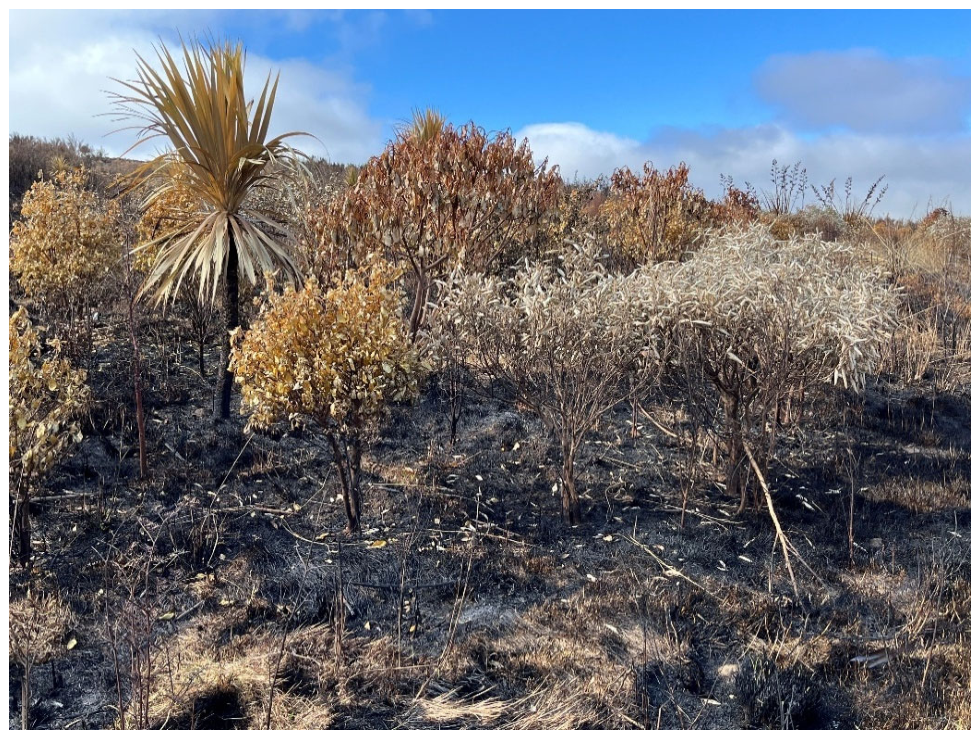

Table 1.
Plant survival as indicated by the presence of basal resprouting across all species in each of five fire damage classes on 17 July 2025 (17 months post-fire).
Table 1.
Plant survival as indicated by the presence of basal resprouting across all species in each of five fire damage classes on 17 July 2025 (17 months post-fire).
| Fire damage class | No. plants per class | No. plants resprouting | % plants resprouting |
|---|---|---|---|
| 1 (least severe) | 13 | 7 | 53.8 |
| 2 | 50 | 17 | 34.0 |
| 3 | 41 | 5 | 12.2 |
| 4 | 26 | 2 | 7.7 |
| 5 (most severe) | 20 | 1 | 5.0 |
| Totals | 150 | 32 |
Table 2.
Basal resprouting (shoot apical regrowth in Cordyline) following wildfires on Banks Peninsula in this study, as reported by Teixeira et al. (2020), and Wabing (2014), at Pukaki Scientific Reserve by Budha-Magar et al. (2026), and by Burrows (1994); shoot flammability of respective species (or congeneric species*) from Fogarty (2001) and Wyse et al. (2016).
Table 2.
Basal resprouting (shoot apical regrowth in Cordyline) following wildfires on Banks Peninsula in this study, as reported by Teixeira et al. (2020), and Wabing (2014), at Pukaki Scientific Reserve by Budha-Magar et al. (2026), and by Burrows (1994); shoot flammability of respective species (or congeneric species*) from Fogarty (2001) and Wyse et al. (2016).
| Species | Resprouting (%) <17 months |
Resprouting (%) 17 months |
Resprout number (maximum) | Resprouting (%) |
Resprout ability |
Resprouting (%) |
Resprouting (yes/-) |
Resprouting response to fire | Flammability |
|---|---|---|---|---|---|---|---|---|---|
| This study | This study | This study | Teixeira et al. (2020) | Teixeira et al. (2020) | Wabnig (2014) | Budha-Magar et al. (2026) | Burrows (1994) |
||
| Coprosma spp. | 94 | 89 | >20 | 64 | intermediate | 100 | yes | Low/Mod | |
| Sophora microphylla | 66 | 33 | 5-20 | - | - | - | Low/Mod | ||
| Cordyline australis | 60 | 60 | n/a | 100 | strong | - | Mod | ||
| Olearia avicenniifolia | 50 | 50 | 1-5 | 0 | none | - | Mod/High* | ||
| Pseudopanax arboreus | 45 | 36 | 1-5 | 5 | weak | 100 | Low | ||
| Hoheria angustifolia | 22 | 22 | 1-5 | - | - | - | Low/Mod | ||
| Pseudopanax crassifolius | 16 | 16 | 2 | - | - | - | Low | ||
| Olearia paniculata | 12 | 0 | 1-5 | - | - | - | Mod/High* | ||
| Griselinia littoralis | 7 | 7 | 1-5 | 55 | intermediate | 100 | yes | Low/Mod | |
| Pittosporum spp. | 5 | 5 | 1-5 | 3 | weak | 87-100 | Mod | ||
| Podocarpus totara | 0 | 0 | 0 | - | - | 71 | Mod/High | ||
| Kunzea robusta | 0 | 0 | 0 | 0 | none | 0 | no | Mod/High | |
| Hebe spp. | 0 | 0 | 0 | 0 | none | - | Low/Mod | ||
| Dodonaea viscosa | 0 | 0 | 0 | - | - | - | Mod | ||
| Corokia cotoneaster | 0 | 0 | 0 | - | - | - | yes | yes | High* |
| Fuchsia excorticata | - | - | - | 100 | strong | 100 | yes | Low | |
| Melicytus ramiflorus | - | - | - | 69 | intermediate | 93 | yes | Low/Mod | |
| Plagianthus regius | - | - | - | 9 | weak | - | Low/Mod | ||
| Schefflera digitata | - | - | - | - | - | 100 | - | ||
| Aristotelia serrata | - | - | - | - | - | 100 | Low/Mod | ||
| Teucridium parvifolium | - | - | - | - | - | 100 | - | ||
| Carpodetus serratus | - | - | - | - | - | 90 | Low | ||
| Pseudowintera colorata | - | - | - | - | - | 77 | - | ||
| Discaria toumatou | - | - | - | - | - | - | yes | Mod/High | |
| Acrothamnus colensoi | - | - | - | - | - | - | yes | - | |
| Gaultheria depressa | - | - | - | - | - | - | yes | - | |
| Leucopogon fraseri | - | - | - | - | - | - | yes | Mod/High* | |
| Alectryon excelsus | yes | High | |||||||
| Myrsine australis | yes | Low | |||||||
| Hymenanthera alpina | yes | - |
Disclaimer/Publisher’s Note: The statements, opinions and data contained in all publications are solely those of the individual author(s) and contributor(s) and not of MDPI and/or the editor(s). MDPI and/or the editor(s) disclaim responsibility for any injury to people or property resulting from any ideas, methods, instructions or products referred to in the content. |
© 2026 by the authors. Licensee MDPI, Basel, Switzerland. This article is an open access article distributed under the terms and conditions of the Creative Commons Attribution (CC BY) license.
Copyright: This open access article is published under a Creative Commons CC BY 4.0 license, which permit the free download, distribution, and reuse, provided that the author and preprint are cited in any reuse.