

Submitted:
05 August 2026
Posted:
05 August 2026
You are already at the latest version
Abstract
Hymenoptera play important ecological roles in agroecosystems as parasitoids, predators, and pollinators. This study investigated the species composition and diversity of Hymenoptera in pummelo (Citrus maxima (Burm.) Merr.) orchards in Xishuangbanna, Yunnan Province, China, from February 2025 to February 2026. A total of 8,446 specimens were collected using Malaise traps and sweep-netting, belonging to 11 superfamilies, 37 families, and 191 species. The community was dominated by parasitoids (140 species, 73.30%), followed by predators (30 species, 15.71%) and pollinators (18 species, 9.42%). Ichneumonoidea (42 species, 21.99%), Chalcidoidea (35 species, 18.32%), Vespoidea (30 species, 15.71%) and Apoidea (28 species, 14.66%) were the dominant superfamilies, collectively accounting for 70.68% of all species. At the family level, Ichneumonidae (25 species), Braconidae (17 species), Bethylidae (13 species), and Pompilidae and Scelionidae (11 species each) were the most species-rich families. Shannon–Wiener diversity was higher at the family level (H′ = 2.9340) than at the superfamily level (H′ = 2.0302), indicating greater heterogeneity at finer taxonomic resolution. These results demonstrate that pummelo orchards in Xishuangbanna harbor a species-rich and functionally diverse hymenopteran community with substantial potential for biological pest control and pollination services.
Keywords:
pummelo
; hymenoptera
; species diversity
; community structure
1. Introduction
Assemblages of Hymenoptera represent a dominant component of arthropod communities in perennial agroecosystems, where they mediate critical ecosystem processes including biological control, pollination, and trophic regulation [1,2]. Parasitoids, in particular, function as core natural enemy resources for biological pest control by ovipositing within or on host arthropods, with larvae completing development through host tissue consumption, thereby suppressing pest populations [3,4]. Predatory groups, including Pompilidae, Formicidae, and Crabronidae, regulate arthropod populations through active hunting, whereas pollinators within the superfamily Apoidea provide essential pollination services for crops and co-flowering plants [5]. Neutral taxa such as Cynipidae, although not directly involved in predation or pollination, influence plant-herbivore interactions and food-web complexity through gall induction. Thus, comprehensive knowledge of hymenopteran species composition and functional structure in orchard ecosystems is fundamental to understanding agroecosystem service mechanisms and developing integrated pest management strategies.
Citrus is among the most economically important fruit crops globally. China, as the world’s largest producer, accounts for the greatest share of citrus cultivation area and yield [6]. Pummelo (Citrus maxima (Burm.) Merr.) is widely cultivated in southern China due to its large fruit size, nutritional value, and high economic returns. This study focused on pummelo orchards in Jinghong City, Xishuangbanna Dai Autonomous Prefecture, Yunnan Province, a tropical region renowned for its exceptionally high biodiversity. However, the expansion and intensification of pummelo production have been accompanied by increasing pest pressure, while excessive reliance on chemical pesticides has disrupted orchard ecosystem balance and depleted natural enemy resources, posing severe challenges to sustainable production [7,8].
Previous studies on insect communities in Chinese pummelo orchards have yielded valuable survey data, albeit with important limitations. Insect communities in Meizhou, Guangdong Province, were surveyed, identifying Ichneumonidae as the dominant natural enemy family and Noctuidae as the principal pest family, with diversity indices exhibiting marked seasonal fluctuations [9]. Twenty-five insect species (7 orders, 20 families) were documented in a honey pummelo orchard in Zhangzhou, Fujian Province, where natural enemy insects accounted for merely 29.41% of total species richness [10]. Inter-row ground cover management significantly influenced insect community structure in Sizhou pummelo orchards, Guizhou Province, with Paspalum notatum and Lolium perenne treatments showing higher beneficial-to-pest ratios [11]. Notably, these investigations were conducted in subtropical regions and targeted either general insect fauna or pest assemblages, lacking systematic surveys specifically focused on Hymenoptera.
Research on hymenopteran diversity in tropical pummelo orchards remains particularly scarce. A survey of arthropods in lemon orchards in Dehong, Yunnan Province, was conducted, but hymenopterans were reported only at the ordinal level, precluding lower-taxon identification and analysis [12]. Regarding methodological advances, Regarding methodological advances, DNA metabarcoding was employed to assess insect diversity in citrus orchards in Ganzhou, Jiangxi Province, recovering 2,141 Barcode Index Numbers (BINs) from pooled Malaise trap samples [13]. While this study demonstrated the potential of molecular approaches for orchard biodiversity assessment, comparison against the BOLD database revealed limited barcode reference sequence coverage for Chinese citrus insects, constraining the widespread application of metabarcoding in the region.
In summary, previous studies exhibit three principal limitations: a geographic bias toward subtropical regions, with insufficient attention to tropical pummelo orchards; a taxonomic focus on general insect assemblages or pest complexes, rather than systematic investigations of Hymenoptera; and limited use of molecular identification tools in orchard hymenopteran surveys. To address these gaps, the present study systematically sampled hymenopteran communities in pummelo orchards in Jinghong City, Xishuangbanna, a tropical region in southwestern China, using Malaise traps and sweep netting, and combined morphological identification with COI DNA barcoding. The specific objectives were to characterize the species composition and community structure of Hymenoptera at multiple taxonomic levels, to quantify community diversity using multiple indices and assess scale-dependent diversity patterns, and to classify taxa into functional guilds (parasitoids, predators, pollinators, and neutral insects) to evaluate their potential for providing ecosystem services in pummelo agroecosystems.
2. Materials and Methods
2.1. Overview of the Study Area
This study was conducted from February 2025 to February 2026 in a pummelo orchard located in Jinghong City, Xishuangbanna Dai Autonomous Prefecture, Yunnan Province, China (21°27′–22°36′ N, 100°25′–101°31′ E). The region is characterized by a tropical monsoon climate, with mean annual temperatures ranging from 18.6 to 22.9 °C, annual precipitation of 1,140–1,700 mm, and altitudes ranging from 485 to 2,196.8 m above sea level. The pummelo variety employed in this study was the native Citrus maxima ‘Dongshizao’, indigenous to Xishuangbanna. The sampled orchard consisted of 6.67 hectares (100 mu) of pummelo trees aged 6–26 years, maintained under conventional cultivation management practices.
2.2. Sampling Methods
Two systematic sampling methods were employed: (1) Malaise trapping: Five Malaise traps were set up in the pummelo orchard, and specimens were collected monthly. (2) Sweep netting: A standard insect sweep net was used to collect specimens along predetermined transects, with three sweeps performed per transect. Sampling was conducted every two weeks throughout the study period, which encompassed all four seasons [14].
2.3. Specimen Identification and Preservation
All collected specimens were fixed and stored in 75% ethanol, and examined under a stereomicroscope for morphological identification. Preliminary taxonomic assignments were made by reference to pertinent taxonomic literature and identification keys. For specimens of uncertain identity, genomic DNA was extracted and the mitochondrial cytochrome c oxidase subunit I (COI) barcode region was amplified and sequenced to assist in species confirmation [15]. Voucher specimens are preserved in Laboratory 329, Citrus Research Group, Yunnan Institute of Tropical Crops, Jinghong, Yunnan Province, China.
2.4. Data Analysis Methods
The following diversity indices were calculated:
Shannon-Wiener diversity index (H′) [16]:
where pi = Ni / N, Ni is the number of individuals in taxonomic unit i, and N is the total number of individuals.
H′ = -Σ pi ln pi,
Simpson’s dominance index (D) [17]:
where S is the total number of taxonomic units and N is the total number of individuals.
D = 1 − Σ(pi)2,
Pielou’s evenness index (J) [18]:
where pi is the proportion of individuals in taxonomic unit i. D represents the probability that two randomly selected individuals belong to different taxonomic units.
J = H′ / ln S,
Margalef richness index (R) [19]:
where S is the total number of taxonomic units and N is the total number of individuals.
R = (S − 1) / ln N,
3. Results
3.1. Species Composition
A total of 8,446 hymenopteran specimens were collected in this study, belonging to 11 superfamilies, 37 families, and 191 species. Species richness was highest in Ichneumonoidea (42 species, 21.99%), followed by Chalcidoidea (35 species, 18.32%), Vespoidea (30 species, 15.71%), and Apoidea (28 species, 14.66%), which collectively comprised 135 species (70.68%). Chrysidoidea (16 species, 8.38%), Cynipoidea (12 species, 6.28%), and Platygastroidea (11 species, 5.76%) represented intermediate contributors, whereas Proctotrupoidea (9 species, 4.71%), Evanioidea (5 species, 2.62%), Ceraphronoidea (2 species, 1.05%), and Mymarommatoidea (1 species, 0.52%) were comparatively minor components (Table 1).
At the family level, species richness was highest in Ichneumonidae (25 species, 13.09%), followed by Braconidae (17 species, 8.90%), Bethylidae (13 species, 6.81%), Scelionidae (11 species, 5.76%), and Pompilidae (11 species, 5.76%), which collectively comprised 77 species (40.31%). Halictidae (9 species, 4.71%), Formicidae (9 species, 4.71%), Eulophidae (9 species, 4.71%), Apidae (7 species, 3.66%), and Diapriidae (7 species, 3.66%) represented substantial contributors, whereas the remaining 27 families, each containing six or fewer species, accounted for 84 species (43.98%) and were comparatively minor components individually (Table 2).
3.2. Community Structure Characteristics
3.2.1. Superfamily-Level Community Structure
Based on the relative species abundance of each superfamily, the Hymenoptera community in pummelo orchards was classified into three groups: dominant (≥10%), common (5%-10%), and rare (<5%) (Figure 1).
The dominant group comprised four superfamilies—Ichneumonoidea, Chalcidoidea, Vespoidea, and Apoidea, which collectively accounted for 135 species (70.68% of the total). Among these, Ichneumonoidea was the most species-rich, contributing 42 species (21.99%) and representing more than one-fifth of the recorded community. The common group encompassed Chrysidoidea, Cynipoidea, and Platygastroidea, totaling 39 species (20.42%), while the rare group comprised Proctotrupoidea, Evanioidea, Ceraphronoidea, and Mymarommatoidea, together representing 17 species (8.9%).
3.2.2. Family-Level Community Structure
Based on absolute species counts per family, the 37 hymenopteran families were classified into three categories: dominant (≥10 species), common (5–9 species), and rare (≤4 species) (Figure 2).
Five families were classified as dominant: Ichneumonidae (25 species, 13.09%), Braconidae (17 species, 8.90%), Bethylidae (13 species, 6.81%), Scelionidae (11 species, 5.76%), and Pompilidae (11 species, 5.76%), which together accounted for 77 species (40.31% of total species). Ichneumonidae was the most species-rich family, followed by Braconidae. Ten families fell into the common category: Halictidae, Formicidae, Eulophidae (nine species each), Apidae, Diapriidae (seven species each), Chalcididae, Encyrtidae, Tiphiidae, Crabronidae (6 species each), and Evaniidae (5 species), totaling 70 species (36.65%). The remaining 22 families were classified as rare, accounting for 44 species (23.04%). These included one family with four species, five families with three species each, eight families with two species each, and eight monotypic families.
3.2.3. Functional Composition
According to their feeding habits and ecological functions, the hymenopteran species were categorized into four functional guilds: parasitoids, predators, pollinators and neutral insects (Figure 3).
Parasitoids constituted the dominant functional group, encompassing 140 species from 24 families and accounting for 73.30% of all recorded species. This guild exhibited substantial phylogenetic diversity, spanning nine superfamilies (Ichneumonoidea, Chalcidoidea, Chrysidoidea, Platygastroidea, Proctotrupoidea, Evanioidea, Ceraphronoidea, and Mymarommatoidea), as well as the parasitoid families within Vespoidea (Tiphiidae, Mutillidae, and Scoliidae) and Cynipoidea (Charipidae, Eucoilidae, and Figitidae). Predators encompassed 30 species distributed across five families, accounting for 15.71% of the total species richness. This functional group was represented by Pompilidae (11 species), Formicidae (9 species), Crabronidae (6 species), Pemphredonidae (2 species), and Sphecidae (2 species). Pollinators comprised 18 species from three families, accounting for 9.42% of the total species recorded. Halictidae (9 species) was the most species-rich pollinator family, followed by Apidae (7 species) and Megachilidae (2 species). Neutral insects comprised solely Cynipidae (3 species, 1.57%).
In summary, the functional composition of the hymenopteran community was dominated by parasitoids (73.30%), with predators (15.71%) and pollinators (9.42%) as secondary components, and neutral insects representing only 1.57% of the total.
3.3. Diversity Indices
3.3.1. Superfamily-Level Diversity
At the superfamily level, the Shannon–Wiener diversity index (H′) was 2.0302, the Simpson diversity index (D) was 0.8498, the Pielou evenness index (J) was 0.8466, and the Margalef richness index (R) was 1.1060.
3.3.2. Superfamily-Level Diversity
At the family level, the Shannon–Wiener diversity index (H′) was 2.9340, the Simpson diversity index (D) was 0.9241, the Pielou evenness index (J) was 0.8125, and the Margalef richness index (R) was 3.9817.
4. Discussion
4.1. Overview of Hymenopterans in Pummelo Orchards
The present study documents the hymenopteran community associated with pummelo orchards in Xishuangbanna, southwestern China, based on the collection of 8,446 specimens belonging to 11 superfamilies, 37 families, and 191 species. To our knowledge, this represents the first species-level inventory of Hymenoptera in tropical pummelo agroecosystems in China. Previous surveys of pummelo-associated insects in subtropical China [10,22] and tropical Indonesia reported [23] hymenopterans at broader taxonomic levels (family or order) without enumerating species, precluding direct quantitative comparisons of species richness. Xishuangbanna’s tropical monsoon climate, characterized by high annual rainfall (1,140–1,700 mm) and warm temperatures (18.6–22.9 °C) [24], provides conditions conducive to year-round hymenopteran activity, which likely contributes to the high species richness documented here. The assemblage was strongly skewed toward parasitoids (140 species, 73.30%), with predators, pollinators, and neutral insects representing minor components. The 191 species recorded here provide the first quantitative reference for hymenopteran diversity in tropical pummelo orchards in China, filling a geographic gap between subtropical citrus systems and broader Southeast Asian tropical agroecosystems.
4.2. Superfamily-Level Community Structure and Species Dominance
Categorization of the 11 superfamilies by relative species richness into dominant (≥10%), common (≥5% to <10%), and rare (<5%) groups revealed a strongly right-skewed distribution. Four superfamilies, Ichneumonoidea, Chalcidoidea, Vespoidea, and Apoidea, collectively accounted for 70.68% of all recorded species, constituting the dominant assemblage. This pattern is consistent with the prevalence of dominant-species structures frequently reported in diverse tropical insect assemblages [25,26]. The co-dominance of Ichneumonoidea and Chalcidoidea (40.31% combined) reflects the high representation of these two most species-rich parasitoid lineages in the study system. Their prevalence in pummelo orchards is attributable to the availability of diverse herbivorous hosts, particularly lepidopteran larvae and hemipteran sap-suckers, associated with citrus agroecosystems.
The three common superfamilies, Chrysidoidea (8.38%), Cynipoidea (6.28%), and Platygastroidea (5.76%), contributed 20.42% of total species richness, functioning as subdominant but ecologically significant components. Platygastroidea, in particular, has been recorded as a specialized parasitoid of hemipteran eggs, a trait with ecological relevance for controlling sap-sucking pests in citrus [1]. Four rare superfamilies, Proctotrupoidea (4.71%), Evanioidea (2.62%), Ceraphronoidea (1.05%), and Mymarommatoidea (0.52%), collectively comprised 8.90% of species. Their low species richness may reflect narrow host ranges, specialized microhabitat requirements, or lower detectability by the sampling methods employed. Ampulicidae, for example, is a specialized parasitoid of cockroach oothecae, a scarce niche resource in managed orchard environments [27].
The multi-dominant structure of the hymenopteran community, characterized by the absence of a single overwhelmingly dominant superfamily and the presence of multiple co-dominant lineages, indicates functional redundancy among major taxonomic lineages. This redundancy likely enhances community resilience to environmental perturbations and management disturbances, thereby supporting ecosystem stability in pummelo orchards.
4.3. Family-Level Composition and Dominant Families
At the family level, the community was structured around five core families—Ichneumonidae, Braconidae, Bethylidae, Pompilidae, and Scelionidae—which collectively comprised 40.32% of the total species pool. Ichneumonidae (25 species, 13.09%) and Braconidae (17 species, 8.90%) were the most species-rich families, their co-dominance reflecting the central role of these two largest parasitoid lineages in regulating herbivore populations within pummelo orchards. Bethylidae (13 species, 6.81%), Scelionidae (11 species, 5.76%), and Pompilidae (11 species, 5.76%) constituted the remaining core families, contributing to parasitoid and predator diversity, respectively. The dominance of Ichneumonidae in our study corroborates its prevalence as a natural enemy taxon in subtropical Chinese pummelo systems [9]. Ichneumonid and braconid wasps attack a broad spectrum of hosts, including lepidopteran larvae and coleopteran pests that are major consumers of citrus foliage and fruit [1], thereby providing natural pest suppression services.
Chalcidoidea exhibited the highest family-level diversity, encompassing 11 families and 35 species (18.32%). Within this superfamily, Eulophidae (9 species, 4.71%), Chalcididae (6 species, 3.14%), and Encyrtidae (6 species, 3.14%) were the dominant families, all of which include species with biocontrol potential against whiteflies, aphids, and scale insects, economically important pests of citrus worldwide [1]. The diversity of Chalcidoidea indicates complementary host-use strategies, with Eulophidae, Chalcididae, and Encyrtidae targeting sap-sucking pests, while other families exploit concealed herbivores, collectively broadening the biocontrol niche space.
Bethylidae (13 species, 6.81%) and Scelionidae (11 species, 5.76%) were significant components of the parasitoid fauna. Bethylidae are idiobiont ectoparasitoids of concealed larvae, primarily Coleoptera and Lepidoptera, while Scelionidae are specialized egg parasitoids of Orthoptera and Hemiptera [28,29,30]. The functional complementarity among these parasitoid families, manifested through attack on different host life stages and occupation of distinct microhabitats, contributes to the overall biocontrol potential of the hymenopteran community.
4.4. Functional Guilds and Ecosystem Service Potential
The hymenopteran community was classified into four functional guilds (parasitoids, predators, pollinators, and neutral insects) [31], revealing a community strongly skewed toward parasitoid-mediated ecosystem services. Parasitoids accounted for 73.30% of hymenopteran species richness, a proportion substantially higher than the ranges generally reported for temperate agroecosystems. This predominance is attributable to the year-round growing conditions in Xishuangbanna, which sustain continuous herbivore populations and consequently stable parasitoid communities. Spanning ten superfamilies, the parasitoid assemblage reflects the convergence of multiple independent evolutionary lineages on the parasitoid life history strategy, a pattern consistent with the high diversification rates of parasitoid Hymenoptera in tropical regions [32]. Parasitoids include both endoparasitic and ectoparasitic species that exert top-down regulation of pest populations in pummelo orchards. Families such as Eulophidae, Chalcididae, and Encyrtidae include species with biocontrol potential against sap-sucking pests (whiteflies, aphids, and scale insects), suggesting their applicability in integrated pest management programs.
Predators accounted for 15.71% of species richness and were dominated by Pompilidae (11 species, 5.76%), Formicidae (9 species, 4.71%), and Crabronidae (6 species, 3.14%). Pompilidae, as spider-hunting wasps, occupy a unique predatory niche distinct from other hymenopteran predators, contributing to spider population regulation in the orchard understory. Crabronidae, predators of small insects including dipterans, aphids, and leafhoppers, occupy a complementary functional niche. Although Formicidae exhibit broad dietary flexibility (ranging from predation to honeydew feeding and seed consumption), their inclusion in the predatory guild reflects their substantial contribution to arthropod population regulation through active hunting and associated trophic effects. The historical use of predatory ants (Oecophylla smaragdina) for citrus pest management in China was documented, a practice dating back hundreds of years that illustrates the importance of predatory Hymenoptera in citrus agroecosystems [33]. The co-occurrence of diverse predatory lineages, together with the rich parasitoid community, indicates a multi-layered natural enemy system that provides complementary pest suppression in pummelo orchards.
Pollinators, represented exclusively by three families within Apoidea (Halictidae, Apidae, and Megachilidae), contributed 9.42% of species richness. Although modest in proportional representation, this guild provides essential pollination services to pummelo and co-flowering plants within and adjacent to orchards. The specialized pilose body structures of adult bees facilitate pollen collection and adherence during foraging, enhancing their efficiency as pollen vectors. Pummelo varieties exhibit self-incompatibility, rendering insect pollinators indispensable for fruit set and yield [5]. The presence of Halictidae (9 species) and Apidae (7 species) in the present study indicates that analogous pollination services operate in Xishuangbanna pummelo orchards. Notably, the pollinator guild was confined to three families within Apoidea, indicating a narrow phylogenetic basis for pollination services in this agroecosystem.
The neutral guild was represented exclusively by Cynipidae (3 species, 1.57%). As members of this family neither prey upon other arthropods nor participate in plant pollination, their ecological role in the pummelo orchard community is primarily expressed through plant–herbivore interactions. Cynipidae are predominantly phytophagous, with females inducing gall formation via oviposition-triggered abnormal proliferation of plant tissues in which larvae complete their development. Although species richness was low in this study, gall wasps exert localized effects on host plant physiology and serve as resources for parasitoid lineages (Figitidae, endoparasitoids of cynipid larvae), thereby contributing indirectly to food web complexity. The low representation of phytophagous Hymenoptera indicates that plant-feeding wasps constitute a minor component of the pummelo orchard community, likely because managed citrus systems are dominated by non-hymenopteran herbivores such as psyllids, scale insects, and mites [1,9,22].
In summary, the hymenopteran community in the pummelo orchards was functionally dominated by parasitoids, which accounted for 73.30% of total species richness, followed by predators (15.71%) and pollinators (9.42%), whereas neutral insects comprised a negligible proportion (1.57%). The predominance of parasitoids indicates an abundant natural enemy resource base in this tropical agroecosystem, contributing to pest population suppression. The co-occurrence of diverse parasitoid, predator, and pollinator guilds indicates the capacity of this community to provide multiple ecosystem services, namely biological pest control and pollination. The functional structure of this community, dominated by parasitoids with complementary predator and pollinator components, suggests that pummelo orchards can simultaneously support biological pest control and pollination, provided that management practices preserve guild-specific habitat requirements.
4.5. Scale-Dependent Variation in Diversity Indices
Comparative analysis of diversity indices at the superfamily and family levels revealed substantial scale-dependent variation in community structure. At the family level, the Shannon–Wiener index (H′ = 2.9340) and Simpson diversity index (D = 0.9241) were substantially higher than their superfamily-level estimates (H′ = 2.0302; D = 0.8498), indicating that finer taxonomic resolution reveals greater heterogeneity in species distribution. This pattern is expected given that species richness increased from 11 superfamilies to 37 families; however, the magnitude of the increase, particularly for D (absolute difference: 0.074; relative increase: 8.7%), suggests that species are distributed across numerous families rather than being concentrated within a few dominant lineages.
Pielou’s evenness index was slightly lower at the family level (J = 0.8125) than at the superfamily level (J = 0.8466). This difference arises from the mathematical structure of the index (J = H′/ln S): although H′ increased by 44.5% from the superfamily to the family level, the denominator ln(S) increased by 50.5% (from ln(11) = 2.398 to ln(37) = 3.611), resulting in a marginally lower J value. The modest difference in J between the two scales (ΔJ = 0.034) indicates that the increase in species heterogeneity (H′) was proportionally matched by the increase in taxonomic unit number (S), suggesting a relatively balanced species distribution across both classification levels.
The most pronounced difference was observed for Margalef richness (R = 3.9817 at the family level vs. R = 1.1060 at the superfamily level), which is attributable solely to the difference in the number of taxonomic units (S = 37 vs. S = 11), as the total specimen count (N = 8,446) was identical across both scales. This pronounced sensitivity of R to taxonomic unit number corroborates comparative assessments of diversity indices in plant and arthropod communities, which have identified Margalef richness as the index most responsive to variation in species (or taxonomic unit) counts [34]. Our findings, together with these previous assessments, underscore the necessity of explicitly reporting the taxonomic resolution employed when presenting richness indices and caution against direct inter-study comparisons of values derived at different taxonomic scales.
4.6. Implications for Conservation and Sustainable Pest Management
The functional structure documented in this study has direct implications for pest management in tropical pummelo orchards. Parasitoid dominance (73.30%) indicates that these orchards harbor substantial natural enemy diversity, but this biocontrol potential is vulnerable to insecticide-induced disruption. We recommend three management strategies: (1) replace calendar-based spraying with threshold-based or hotspot-targeted application of broad-spectrum insecticides; (2) maintain flowering understory vegetation within orchards and adjacent hedgerows to support parasitoid and pollinator populations beyond the pummelo flowering season; (3) minimize insecticide application during peak hymenopteran activity periods to preserve predator and pollinator guilds. These measures align with conservation biological control principles and may reduce chemical dependence while maintaining pest suppression efficacy.
From a conservation perspective, the 191 species documented across 37 families indicate that pummelo orchards can serve as refugia for hymenopteran biodiversity in tropical agricultural landscapes. However, this capacity is contingent on habitat management that preserves floral resources, nesting substrates, and alternative host populations. The historical shift from natural enemy-rich citrus agroecosystems to chemically dependent systems [7] underscores the risk that intensive management poses to the parasitoid-dominated community documented here. Long-term monitoring of hymenopteran community responses to management interventions, such as organic conversion, intercropping, or reduced-spray regimes should employ replicated protocols that track both taxonomic and functional shifts. Although COI barcoding was employed here to resolve taxonomically problematic specimens, high-throughput metabarcoding offers complementary advantages for community-level surveys, particularly in detecting cryptic diversity and rare taxa that may elude traditional morphological methods [35,36]. Integrating metabarcoding with morphological identification would thus improve diversity estimates and strengthen the empirical basis for conservation-oriented management in tropical orchard systems.
5. Conclusions
This study provides the first species-level inventory of Hymenoptera in tropical pummelo orchards in China, documenting 8,446 specimens belonging to 11 superfamilies, 37 families, and 191 species from Xishuangbanna. The community was overwhelmingly dominated by parasitoids (73.30%), with substantial contributions from predators (15.71%) and pollinators (9.42%%), indicating a strong functional bias toward natural-enemy-mediated ecosystem services. Diversity analysis at two taxonomic resolutions demonstrated that family-level indices captured significantly greater heterogeneity than superfamily-level estimates, underscoring the necessity of multi-scale assessments in orchard biodiversity surveys. This study provides a taxonomic and functional inventory of Hymenoptera in tropical pummelo orchards, demonstrating the importance of parasitoid-dominated communities for ecosystem service delivery in perennial tropical agroecosystems.
Supplementary Materials
The following supporting information can be downloaded at the website of this paper posted on Preprints.org, Figure S1: Superfamily-level community structure; Figure S2: Family-level community structure; Figure S3: Functional composition; Table S1: Species composition at the superfamily; Table S1: Species composition at the family.
Author Contributions
Conceptualization, C.Z. and X.X.; methodology, C.Z.; software, C.Z.; validation, X.Z., Q.D. and X.L.; formal analysis, C.Z.; investigation, X.X., Q.D. and X.L.; data curation, C.Z.; writing—original draft preparation, C.Z.; writing—review and editing, C.Z. and S.G.; visualization, Q.D.; supervision, X.L.; project administration, S.G.; funding acquisition, S.G. All authors have read and agreed to the published version of the manuscript.
Funding
This research was funded by the Special Project for the Construction of Tropical Crop Science and Technology Innovation System in Yunnan Province, grant number RF2026.
Data Availability Statement
The data supporting the findings of this study are available within the article and its Supplementary Materials. Voucher specimens are deposited in Laboratory 329, Citrus Research Group, Yunnan Institute of Tropical Crops, Yunnan Province, China. DNA sequences generated during this study have been deposited in GenBank under accession numbers [PZ761219–PZ761242]. Additional data are available from the corresponding author upon reasonable request.
Acknowledgments
We thank the Yunnan Institute of Tropical Crops for providing laboratory facilities and specimen storage. We also acknowledge the use of DeepSeek (version 2.0) to improve the language and readability of the manuscript. The authors have reviewed and edited the output and take full responsibility for the content of this publication.
Conflicts of Interest
The authors declare no conflicts of interest.
References
- Niu JZ, Hull-Sanders H, Zhang YX, et al. Biological control of arthropod pests in citrus orchards in China. Biological Control, 2014, 72: 1-12.
- Ammari M, Ziri R, El Bahja F, et al. Biological control of citrus pests: A systematic bibliometric analysis 2000–2023. Journal of Agriculture and Food Research, 2025, 19: 101492.
- Chen XX, He JH, Shi ZH, et al. Overview of studies on the relationship between parasitoids and their host insects. Chinese Journal of Entomology, 2001, 8(Suppl.): 95-101.
- Wang ZZ, Tang P, Ye XQ, et al. Research progress and prospects of parasitoid wasps in China. Chinese Journal of Applied Entomology, 2025, 62(6): 1709-1724.
- Cholis MN, Atmowidi T, Kahono S. The diversity and abundance of visitor insects on pummelo (Citrus maxima (Burm.) Merr.) cv. Nambangan. Journal of Entomology and Zoology Studies, 2020, 8(4): 344-351.
- Zhou, R. Investigation and analysis report on China’s pomelo market and industry. Nongchanpin Shichang 2021, 24, 47-48.
- Wu XG, Lai YS, Lin SX. Insect succession in Guangdong citrus orchards. Acta Entomologica Sinica, 1975, 18(2): 201-210.
- Arne Janssen,Paul C. J. van Rijn. Pesticides do not significantly reduce arthropod pest densities in the presence of natural enemies. Ecology Letters, 2021, 24(9): 2010-2024.
- Lan MX, Liu HN, Yang HS. Temporal dynamics of insect community structure and diversity in pummelo orchards in the Meizhou region. Journal of Jiaying University (Natural Science), 2022, 40(3): 30-33.
- Wu Y, Lin XL, Cao MH, et al. Preliminary investigation on ground cover plants and insect communities in honey pummelo orchards. Fujian Science & Technology of Tropical Crops, 2015, 40(1): 9-11.
- Huang SX, Li JL, Fan B, et al. Investigation on weed species in Sizhou pummelo orchards and effects of ground cover management on insect community structure. Modern Agricultural Science and Technology, 2024(10): 59-61.
- Gao JY, Yue JQ, Guo J, et al. Investigation on arthropod species in lemon orchards in Dehong Prefecture. Journal of Southern Agriculture, 2012, 43(9): 1307-1311.
- Liu C, Ashfaq M, Yin Y, et al. Using DNA metabarcoding to assess insect diversity in citrus orchards. PeerJ, 2023, 11: e15338.
- Wu, Q.; Tang, P.; Chen, X.X.; et al. Collection and field survey sampling techniques for parasitic wasps. Chinese Journal of Applied Entomology 2015, 52, 759-769.
- Hebert P, Cywinska A, Ball S L, et al. Biological identification through dna barcodes[J]. Proceedings of the Royal Society of London B, 2003,270:313-321.
- Shannon, C.E.; Weaver, W.; Wiener, N. The Mathematical Theory of Communication. Physics Today. 1950, 3, 31–32.
- Simpson, E.H. Measurement of Diversity. Nature. 1949, 163, 688–688.
- Pielou, E.C. An Introduction to Mathematical Ecology. Bioscience. 2011, 24, 7–12.
- Simon, A. Perspectives in Ecological Theory; Princeton University Press, 2016.
- Oksanen, J.; Simpson, G.L.; Blanchet, F.G.; Kindt, R.; Legendre, P.; Minchin, P.R.; O’Hara, R.B.; Solymos, P.; Stevens, M.H.H.; Szoecs, E.; et al. vegan: Community Ecology Package; Version 2.6-2; 2022.
- R Core Team. R: A Language and Environment for Statistical Computing; R Foundation for Statistical Computing: Vienna, Austria, 2022.
- Lan MX, Yang HS. Comparison of pest community structure and diversity in pummelo orchards under different habitats. Guangdong Agricultural Sciences, 2022, 56(4): 16-19.
- Anisa T, Hidayat P, Rauf A, et al. Insect diversity and community structure in pummelo orchards in Indonesia. Agrivita, 2022, 44(2): 123-135.
- Luo, Y., Li, Y.W., Qin, H.L., Deng, X.B., Chen, H., Sha, L.Q., Cao, M. & Lin, L.X. A dataset of soil moisture in Xishuangbanna tropical seasonal rain forests (2009–2017). China Scientific Data, 2023, 8(3), 284–295.
- Novotny V, Drozd P, Miller SE, et al. Why are there so many species of herbivorous insects in tropical rainforests?. Science, 2007, 313(5783): 1115-1118.
- Basset Y, Cizek L, Cuenoud P, et al. Arthropod diversity in a tropical forest. Science, 2012, 338(6113): 1481-1484.
- Frederic Libersat, Ram Gal. What can parasitoid wasps teach us about decision-making in insects?. Journal of Experimental Biology, 2013, 216(1): 47-55.
- Hougardy, E., Grégoire, JC. Bark-Beetle Parasitoids Population Surveys Following Storm Damage in Spruce Stands in the Vosges Region (France). Integrated Pest Management Reviews 6, 2001, 163–168 .
- Marc Kenis. Prospects for classical biological control of Spodoptera frugiperda (Lepidoptera: Noctuidae) in invaded areas using parasitoids from the Americas. Journal of Economic Entomology, 2023, 116(2): 331-341.
- Zhao Haoxiang, Xian Xiaoqing, Yang Nianwan, Zhang Yongjun, Liu Hui, Wan Fanghao, Guo Jianyang, Liu Wanxue, Insights from the biogeographic approach for biocontrol of invasive alien pests: Estimating the ecological niche overlap of three egg parasitoids against Spodoptera frugiperda in China, Science of The Total Environment, Volume 862, 2023, 160785.
- Wang ZZ, Tang P, Ye XQ, et al. Research progress and prospects of parasitoid wasps in China. Chinese Journal of Applied Entomology, 2025, 62(6): 1709-1724.
- VEIJALAINEN, A., SÄÄKSJÄRVI, I.E., ERWIN, T.L., GÓMEZ, I.C. and LONGINO, J.T. Subfamily composition of Ichneumonidae (Hymenoptera) from western Amazonia: Insights into diversity of tropical parasitoid wasps. Insect Conservation and Diversity, 2013, 6: 28-37.
- Yang, P. Historical perspective of the red tree ant, Oecophylla smaragdina and its utilization against citrus insect pests. Chin. J. Biol. Control, 2002, 18, 28–32.
- Mulya M, Rahayu S, Hadi S, et al. Diversity and evenness of understory vegetation in mangrove ecosystem restoration areas. Biodiversitas, 2021, 22(7): 2571-2578.
- Li, Bingyan, et al. “DNA Metabarcoding-based Monitoring of Insect Biodiversity across Agricultural Ecosystems in China.” PEST MANAGEMENT SCIENCE, vol. 82, no. 2, 2025: 2023–34.
- Yamoa O, Kpan DB, Kassie M, et al. Combining conventional taxonomy and metabarcoding to assess insect diversity in agroecosystems. Scientific Reports, 2025, 15: 27432.
Figure 1.
Classification of 11 hymenopteran superfamilies by relative species abundance in pummelo orchards, Xishuangbanna, Yunnan Province, China (N = 191 total species). Inner ring: dominant (≥10%, n = 135), common (5–10%, n = 39), and rare (<5%, n = 17) groups. Outer ring: proportional contribution of each superfamily.
Figure 1.
Classification of 11 hymenopteran superfamilies by relative species abundance in pummelo orchards, Xishuangbanna, Yunnan Province, China (N = 191 total species). Inner ring: dominant (≥10%, n = 135), common (5–10%, n = 39), and rare (<5%, n = 17) groups. Outer ring: proportional contribution of each superfamily.
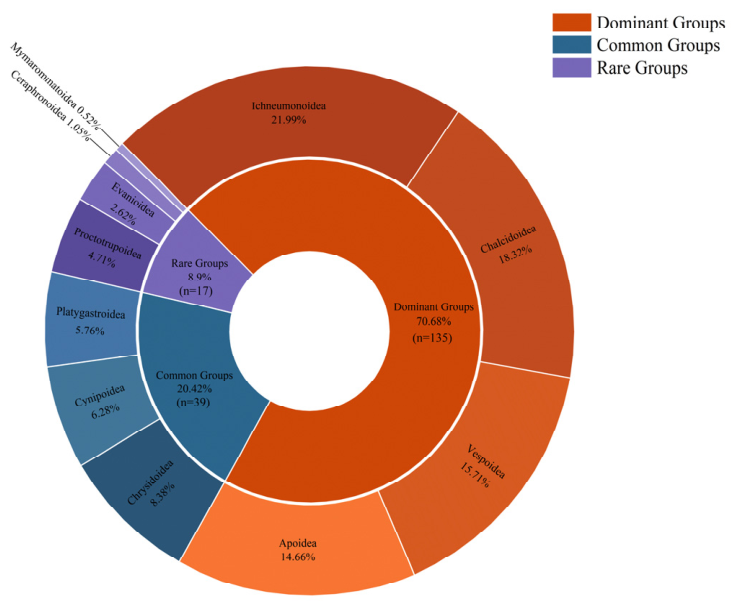
Figure 2.
Classification of 37 hymenopteran families by species richness in pummelo orchards, Xishuangbanna, Yunnan Province, China (N = 191 total species). Families are grouped into three dominance categories: dominant (≥10 species, n = 77), common (5–9 species, n = 70), and rare (≤4 species, n = 44). Outer ring: proportional contribution of each family.
Figure 2.
Classification of 37 hymenopteran families by species richness in pummelo orchards, Xishuangbanna, Yunnan Province, China (N = 191 total species). Families are grouped into three dominance categories: dominant (≥10 species, n = 77), common (5–9 species, n = 70), and rare (≤4 species, n = 44). Outer ring: proportional contribution of each family.
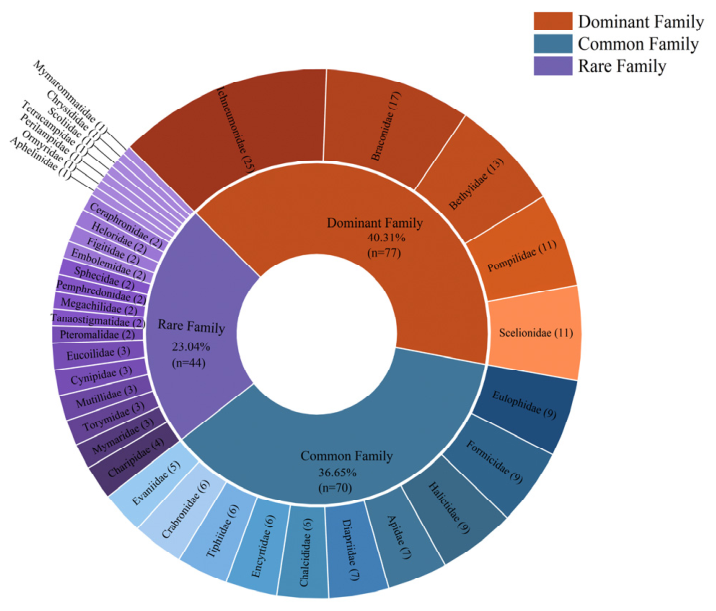
Figure 3.
Classification of hymenopteran species into four functional guilds in pummelo orchards, Xishuangbanna, Yunnan Province, China (N = 191 total species). Species were categorized by feeding habits and ecological functions into four guilds: parasitoids (n = 140), predators (n = 30), pollinators ( n = 18), and neutral insects (1.6%, n = 3).
Figure 3.
Classification of hymenopteran species into four functional guilds in pummelo orchards, Xishuangbanna, Yunnan Province, China (N = 191 total species). Species were categorized by feeding habits and ecological functions into four guilds: parasitoids (n = 140), predators (n = 30), pollinators ( n = 18), and neutral insects (1.6%, n = 3).
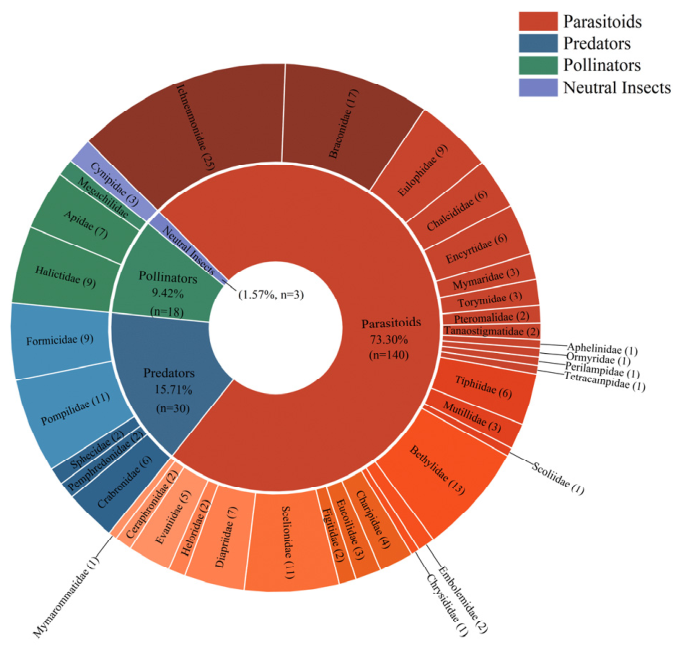

Table 1.
Species composition of Hymenoptera in pummelo orchards at the superfamily levels.
| NO. | Superfamily | Number of Species | Ratio |
|---|---|---|---|
| I | Ichneumonoidea | 42 | 21.99% |
| II | Chalcidoidea | 35 | 18.32% |
| III | Vespoidea | 30 | 15.71% |
| Ⅳ | Apoidea | 28 | 14.66% |
| Ⅴ | Chrysidoidea | 16 | 8.38% |
| Ⅵ | Cynipoidea | 12 | 6.28% |
| Ⅶ | Platygastroidea | 11 | 5.76% |
| Ⅷ | Proctotrupoidea | 9 | 4.71% |
| Ⅸ | Evanioidea | 5 | 2.62% |
| Ⅹ | Ceraphronoidea | 2 | 1.05% |
| Ⅺ | Mymarommatoidea | 1 | 0.52% |
Table 2.
Species composition of Hymenoptera in pummelo orchards at the family levels.
| No. | Superfamily | Family | Number of Species | Ratio |
|---|---|---|---|---|
| I | Ichneumonoidea | Ichneumonidae | 25 | 13.09% |
| Braconidae | 17 | 8.90% | ||
| II | Chalcidoidea | Eulophidae | 9 | 4.71% |
| Chalcididae | 6 | 3.14% | ||
| Encyrtidae | 6 | 3.14% | ||
| Mymaridae | 3 | 1.57% | ||
| Torymidae | 3 | 1.57% | ||
| Pteromalidae | 2 | 1.05% | ||
| Tanaostigmatidae | 2 | 1.05% | ||
| Aphelinidae | 1 | 0.52% | ||
| Ormyridae | 1 | 0.52% | ||
| Perilampidae | 1 | 0.52% | ||
| Tetracampidae | 1 | 0.52% | ||
| III | Vespoidea | Pompilidae | 11 | 5.76% |
| Formicidae | 9 | 4.71% | ||
| Tiphiidae | 6 | 3.14% | ||
| Mutillidae | 3 | 1.57% | ||
| Scoliidae | 1 | 0.52% | ||
| IV | Apoidea | Halictidae | 9 | 4.71% |
| Apidae | 7 | 3.66% | ||
| Crabronidae | 6 | 3.14% | ||
| Megachilidae | 2 | 1.05% | ||
| Pemphredonidae | 2 | 1.05% | ||
| Sphecidae | 2 | 1.05% | ||
| V | Chrysidoidea | Bethylidae | 13 | 6.81% |
| Embolemidae | 2 | 1.05% | ||
| Chrysididae | 1 | 0.52% | ||
| VI | Cynipoidea | Charipidae | 4 | 2.09% |
| Cynipidae | 3 | 1.57% | ||
| Eucoilidae | 3 | 1.57% | ||
| Figitidae | 2 | 1.05% | ||
| VII | Platygastroidea | Scelionidae | 11 | 5.76% |
| VIII | Proctotrupoidea | Diapriidae | 7 | 3.66% |
| Heloridae | 2 | 1.05% | ||
| IX | Evanioidea | Evaniidae | 5 | 2.62% |
| X | Ceraphronoidea | Ceraphronidae | 2 | 1.05% |
| XI | Mymarommatoidea | Mymarommatidae | 1 | 0.52% |
Disclaimer/Publisher’s Note: The statements, opinions and data contained in all publications are solely those of the individual author(s) and contributor(s) and not of MDPI and/or the editor(s). MDPI and/or the editor(s) disclaim responsibility for any injury to people or property resulting from any ideas, methods, instructions or products referred to in the content. |
© 2026 by the authors. Licensee MDPI, Basel, Switzerland. This article is an open access article distributed under the terms and conditions of the Creative Commons Attribution (CC BY) license (http://creativecommons.org/licenses/by/4.0/).
Copyright: This open access article is published under a Creative Commons CC BY 4.0 license, which permit the free download, distribution, and reuse, provided that the author and preprint are cited in any reuse.