

Submitted:
04 August 2026
Posted:
04 August 2026
You are already at the latest version
Abstract
Fashion and textile industry generate substantial volume of waste, during the production phase, as well as in the consumer phase. Textile waste is disposed in the landfills or incinerated, significantly affecting the environment. At the same time, construction industry faces demand to consider different approaches to the conventional formwork systems, which are resource intensive and disposed after the use. Feasibility of the usage of the cut-off knitted textile waste bonded with polymer-cement binder to create the composite formwork for casting concrete and mortar elements is presented in this paper. Experiments are designed with different types of cement-based mixtures to make the textile formwork composite and the polymer-cement mixture. Experimental research tested the bond between two pieces of textile bound by the selected polymer-cement binder and a proposal was given for determining the required overlap length. Obtained testing results for adequate and optimal samples, showed that the recycled textile waste may be used as efficient and low-cost alternative to traditional formwork, while providing flexible and non-prismatic geometrical shapes of the products and reducing the environmental impact.
Keywords:
concrete and mortar
; fabric formwork
; textile waste
; material reuse
; sustainability
1. Introduction
Numerous reports suggested that construction industry is responsible for almost a third of all waste in the world [1,2,3], hence making it one of the biggest causes of environmental change and often an environmental degradation. The industry in general means the transformation of the accessible natural resources, and this exploitation can exceed the sustainability limits and additionally brings large amounts of the consumer waste into the environment. Global urbanization is in this sense just as harmful as industry—it produces artificial space, at the expense of the natural environment. Still, worldwide, urbanization is carried out at a high speed, at least in the construction of new, improved and modernized infrastructure and utilities, while simultaneously removing and adapting the existing one. The process consequently consumes large amounts of natural resources and leaves a significant amount of construction waste. While most of the construction waste is generated from the demolition of existing structures, either buildings, infrastructural or industrial facilities, still almost 10% is generated during the construction of new ones [4].
On the other side, the textile industry, namely the fashion industry in its “fast fashion” phase, contributes highly to the amount of the generated municipal waste. Most of the textile waste ends up in landfills—75% [5], or it is burned. In recent years, new methods of textile recycling have attracted a lot of attention from the professional public [6,7]. The focus of recycling is shifted from basic mechanical to more advanced chemical [8] and biodegradation [9], while a large number of procedures used for recycling can be more harmful to the environment than the waste itself [10]. The recycling of used textiles, however, remains an open challenge [11], due to the large increase in the volume of production and its impact of the recycling processes themselves on the environment.
The majority of methods used for recycling are reduced to converting fabric into fibers that are then reused [12,13]. Although a lot of work and energy is invested in the production of textiles, a limited number of studies deal with ways to recover the invested energy and material in the most efficient way [14].
From the point of view of textile recycling, the most common methods of textile recycling are mechanical recycling (shredding, shredding of fibers), chemical and biochemical recycling (chemical decomposition of fibers), energy (burning) and reuse, upcycling and creative reuse (reuse of textiles or parts in a different way) [15,16,17].
In EU, according to the Ecodesign for Sustainable Products Regulation (ESPR), starting 19 July 2026 (for large companies) and starting from 2030 (for medium-sized companies too), destruction of the unsold clothes is practically banned, encouraging reuse (repairing, refurbishing or remanufacturing) [18]. Even if it represents less than 9% of all textile products put on the European market [19], pre-consumer knitted textile waste generates 10% to 20% surplus scrap material, and is still disposed in landfills all-around the world.
The most common application of textiles in construction and concrete structures in general, is twofold: as specially produced glass, polyethylene or carbon fibers or meshes that are embedded in concrete and mortar as reinforcement, increasing the tensile strength of the base material [20,21], or as a textile flexible formwork—special deformable mold—for pouring concrete and mortar, in order to make the products with unusual, often curved shapes that cannot be obtained using the usual wooden and metal formwork [22].
Although the first industrial applications and patents for the use of textiles as formwork for concrete date back to the 19th century [23], and historical traces of fabric formwork date back to the beginnings of the use of concrete in the Roman era [24], textile formwork did not manage to occupy a significant place in the industry of production and construction of concrete structures [25]. Textile paneling is fundamentally different from conventional wooden or metal panels. Conventional formwork uses rigid flat plates made of wood or metal so mostly rectangular flat shapes of concrete forms are realized. Achieving curved shapes with this formwork is many times more expensive and technically demanding. By using soft, stretchable, deformable textile materials, free and curved forms can be obtained much more easily and economically. The freedom and diversity of these elements is formed using the hydrostatic pressure of the fresh concrete mixture on the fabric cut according to the desired shape. This free approach to the formation of the concrete elements’ geometry is not easy to reconcile with the completely deterministic way in which concrete structures are usually designed, calculated and constructed.
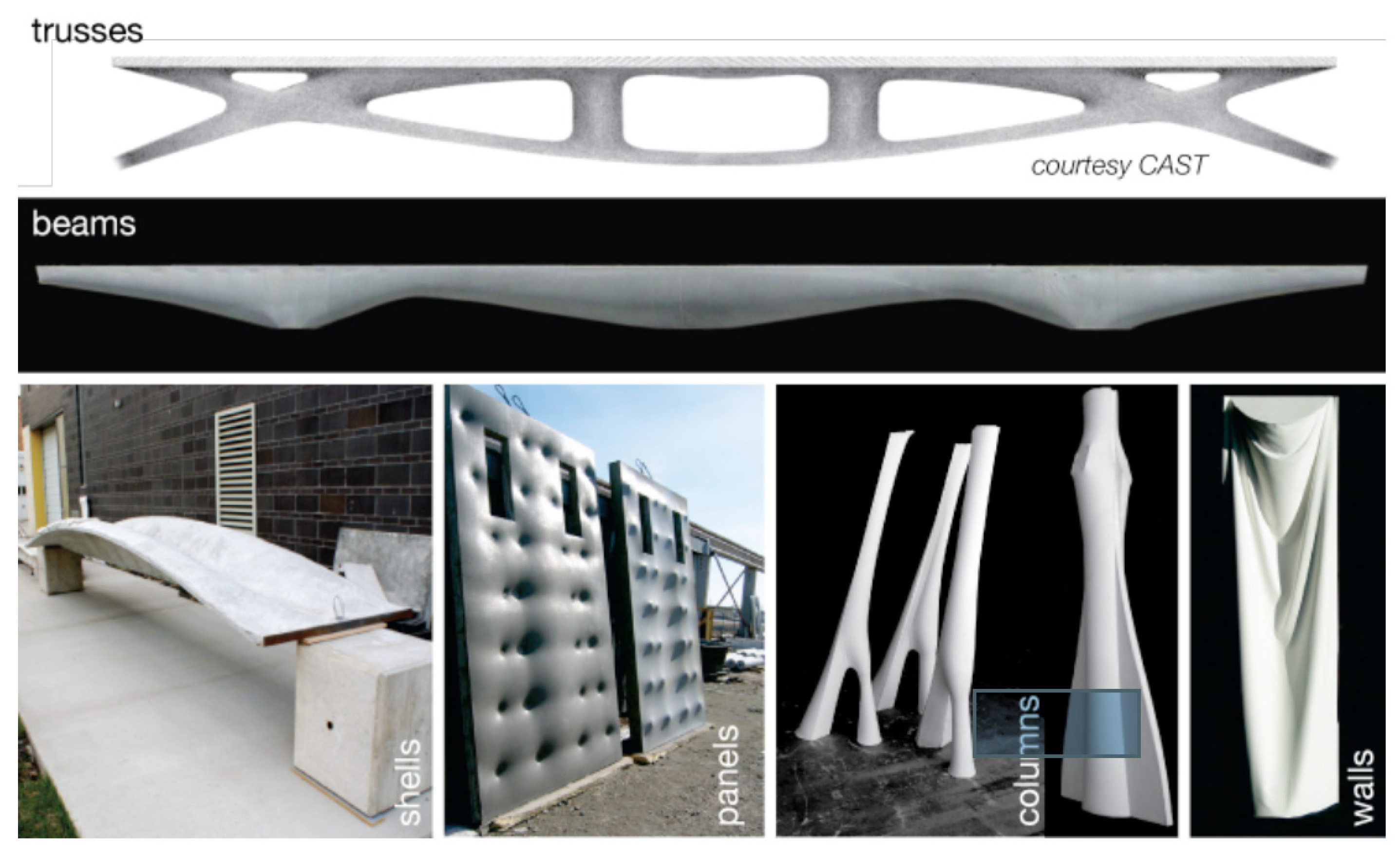
On the other hand, the freedom and flexibility that textile formwork provides, as well as the variety of concrete surface textures that faithfully replicate textile formwork, have attracted the attention of numerous artists, architects, architectural and structural engineers. Through the work of many authors (Mark West, at the University of Manitoba, C.A.S.T projects, Anne-Mette Manelius at the Royal Danish Academy of Fine Arts, John J. Orr and Will Hawkins, at the University of Bath, etc.), the numerous possibilities offered by this type of formwork in the fields of art, architecture, construction, optimization, topology, etc. have been explored [26,27]. From the typology point of view and the nature of the load, formwork can be divided into two categories [28]: formwork that changes shape when filled with concrete (filled molds), and formwork that preserves its shape (surface molds).
Recycled textile waste in the form of fibers for reinforcing cement matrix is not suitable due to the accumulation of dirt and their uncontrolled distribution in the textile-cement composite material. Therefore, recycled textile waste is also not suitable for the production of composite cement-textile formwork.
For the production of textile formwork from used or waste textiles, it is best to apply the reuse-method, where the textile waste parts, after sorting and separating the fabric cut-offs, are connected into a whole. For the production of formwork that enables the change of the shape, parts of textile waste can be sewn together, while for the production of preformed textile formwork that preserves the given shape, parts of textile waste can be joined by gluing. When joining by gluing, the durability and load-bearing capacity of the textile paneling depends on the load-bearing capacity of the joints.
Figure 1.
Research into various applications of textile formwork (Mark West (CAST), according to [23]).
Figure 1.
Research into various applications of textile formwork (Mark West (CAST), according to [23]).
This paper shows the exploration of the production of the surface molds made of the knitted textile parts bonded with polymer-cement material. The basic intention of such textile polymer-cement composite formwork is to provide affordable production of the enable the economical production of concrete products with freely formed, arbitrarily curved surfaces. Thanks to polymer-cement bond, this formwork can be retained as a final, permanent coating and become an integral part of the concrete structure.
The research includes testing all essential characteristics of the new polymer-cement-textile material, namely:
- Optimal polymer-cement mixture design;
- Determination of the mechanical characteristics of knitted waste textiles and waste textiles reinforced with polymer-cement binder;
- Testing of different overlap lengths on textile parts connected with polymer-cement binder;
- Defining the required overlap length on textile extensions.
The main purpose of textiles in cement-based materials, mortar or concrete, is to improve its tensile strength. Compressive stresses will be transferred by the cementitious material. The basic assumption in this paper is that the textile overlaps will behave similarly to the reinforcement extensions in reinforced concrete, i.e., that a suitable polymer-cement binder will be able to transfer tensile force from one part of the textile to another, without the need for any other bonding agent. Determining a sufficient overlap length that allows the extension to transmit the same force as the unconnected polymer-cement-textile material will enable the production of continuous textile formwork surfaces from parts of textile waste. These textile formworks can be formed into a variety of shapes and adapted to a range of multi-curved surfaces of architectural objects.
2. Materials and Methods
In the composite polymer-cement-textile material, a cement-based binder is used for bonding textile waste parts because of its high compressive strength and the compressive strength of the composite material depends solely on it. However, since cement-based materials are brittle, the tensile strength of the composite material depends on properties of the textile material. A higher tensile strength of the composite mixture provides reduced initiation of cracks and uniform distribution along the material. In addition, adhesion is important property of a cement-based mixture, in order to enable the strong bond between two overlapped parts of textile waste.
Research on the possibility of using textile waste for the cement-textile formwork was carried out in several steps. First, experiments are designed with different mixtures of cement and various additives, and initial observations showed the optimal polymer-cement mixture. Second, the tensile load-bearing capacity of waste textiles and of the polymer-cement-textile composite are tested and compared. Finally, load-bearing capacity of the connection of two parts of waste textiles, continued with several lengths of overlap and bonded using the selected polymer-cement binder, is tested.
2.1. Optimal Polymer-Cement Mixture Design
Optimal polymer-cement mixture should have high compressive strenght, high bending tensile strength and good adhesion. Main factor for the compressive strength is W/C ratio. Key role of W/C ratio in compessive strength of concrete was defined in 1918. by Duff Abrams [29], as a special variation of Feret’s Rule (presented in 1892.). A.M Neville underlined the strength primarily as a function of the gel-space ratio (solid hydrated cement paste vs. total available space) that is depending on amount of cement and excess water-induced (capillary) pores [30]. S. Popovich introduce some additional parameters for concrete strength prediction [30,31]. P-C. Aïtcin highlighted the essential role of high water reducers (new-generation superplasticizers) for the compressive an tensile strength of the high-performance concretes (HPC) and ultra-high performance concretes (UHPC—also known as reactive powder concretes—RPC) [33,34].
For the textile formwork production, especially in the case when it will not be removed but will remain as an integral part of the concrete structure, high compressive strength is not necessary. According the European Ready Mixed Concrete Organization (ERCO), almost 2/3 of concrete production in EU is C 25/30 and C 30/37, and almost 80% of all ready mixed concrete production in Europe is below C 35/45 grade [35]. Furthermore, the use of superplasticizers to reduce the W/C factor and increase strength may be inappropriate due to the need for the polymer-cement mixture to have a stable consistency and sufficient cohesion on curved and inclined surfaces.
The most influential property is bond between the textile and the cementitious matrix, and more specifically, adhesion of the cement matrix to the textile surface. Introducing polymers in cement matrix seems to be the best way to enhance this property [36,37,38,39,40]. Various water-based polymers are used for improvement of the properties of cement matrix [41]. Due to superior adhesion and waterproofing properties as well as its cost-efficiency [42,43] styrene-butadiene rubber (SBR) latex was chosen for the application in the mixture design. Although the addition of SBR latex entrains air into the mix bringing to some reduction in compressive strength [44], the significant increase in tensile strength, adhesion and deformability of the binder far outweighs it [45]. The use of liquid polymers increases the total amount of water, increasing the W/C factor, consequently increasing the porosity, thus the permeability, i.e., reducing the strength and waterproofing [46]. Therefore, in the mixture design, the added water must be reduced by the amount introduced through the addition of polymer [47]. Mixes designed in this way have higher water resistance, lower permeability and, as a result, increased durability. Addition of SBR latex also significantly increase ductility [48], property of great importance for textile formwork. This property is very important for all concrete elements that are exposed to the atmospheric influences [49], which applies to textile formwork. In addition, the introducing of SBR latex improves the robustness and manufacturability of cement mixtures, as well as sustainability [50], so that they can be used with a variety of recycled aggregates [51], modern application techniques [52], and for various purposes [53,54].
Experimental mixtures were prepared with Ordinary Portland Cement (OPC) type CEM I 42.5 R (according to EN 197/1, produced by Holcim Srbija, Beočin, Serbia). Cement mixtures were modified with styrene-butadiene rubber (SBR) latex (Planicrete SBR latex, produced by MAPEI, Italy, white liquid, density 1020 kg/m3, with 36% dry solid contents) with different polymer to cement ratio. SBR latex was added in the two dosages, 10% and 20% calculating on dry solid content (28% and 56% calculating on liquid content). Higher dosages of SBR latex were applied due to demand of higher tensile strength and elasticity of polymer-cement-textile composite. As an aggregate quartz sand were used (Jugokaolin—Ub Quarry, Serbia). Two different quartz sand types were used for preliminary mixtures: KPLC 011 and KPLC 022. Particle size distribution of the aggregates are shown in the Table 1.
Preliminary mixtures were made to test the mechanical characteristic of the polymer-cement binder (compressive strength, bending strength and adhesion).
There were two aggregate types were used (KPLC 011 and KPLC 022), two different polymer-to-cement ratios P/C (0.1 and 0.2) and two W/C ratios (0.4 and 0.5). The amount of the polymer in the P/C ratio is determined as a dry solid content percent of the liquid.
Waste material from the manufacturing of organic knitwear (cotton cut-offs), used for the production of T-shirts was used to produce the polymer-cement-textile formwork. In contrast to cement mortar and concrete, the textile is very elastic, flexible and stretchy in both directions, so one of the intentions was to test to what extent the stiffness of the cement binder will affect the elasticity of the composite material. When stretched, the average size of the holes formed between the textile fibers are 350–450 microns. The aggregate size of dmax ≤ 150 microns was determined as 1/3 of the hole size. Preliminary testing showed that mechanical characteristic of the mixtures made with larger aggregate size (KPLC 022) were satisfactory, but the aggregate size was too big for the application with textile parts chosen, as they couldn’t penetrate through the textile holes, nor bond textile cut-offs, and the polymer-cement mixture separated from the textile. In the end, the larger size aggregate, namely KPLC 022 was not included in the research, and all the mixtures were made using small-size quartz aggregate KPLC 011. Table 2 shows the proportions /cement (C) : polymer (P) : quartz sand (QS)/ of the chosen mixtures. Total amount of water for the targeting W/C was calculated as a sum of the water in the liquid polymer and additional water. Additional water was added to achieve desired W/C ratios (0.4 and 0.5).
Prismatic testing samples (dimensions 40 mm × 40 mm × 160 mm) were made using the chosen mixtures. After 24 hours, samples were demolded and water-cured. After 28 days, samples were tested for bending and compression strength, in accordance with EN 196-1 using CONTROLS PILOT Pod press (Class 1, 0.5-300 kN). Adhesion to concrete surface was tested according to EN 1542 on Controls digital pull-of tester (0-16 kN).
2.2. Testing of the Textile Parts and Polymer-Cement-Textile Composite
Textile parts, i.e., cut-off knitted textile waste is the second component of the tested polymer-cement-textile composite: particular textile cut-offs are the knitted textile waste generated in clothes factory situated in Arilje, Serbia, during the regular tailoring process of clothes. Samples of waste textiles were taken directly from the production line and delivered in sacks to the laboratory for testing, without any special treatment or preparation. The designed role of the textile in the composite material is to bear the tension forces and provide greater elongation deformations of the of the material before tearing. Therefore, the textile samples were tested exclusively for tension. The tensile test was performed on rectangular textile samples (dimensions: 350 mm × 50 mm), where the thickness of textile fabric was d = 0.54 mm, cut from parts of textile waste. In addition to untreated samples of the textile itself (plain textile), composite polymer-cement-textile samples with one and two layers of textiles, of the same dimensions (350 mm × 50 mm), were also made, shown in Figure 2.
All samples were tested using electronic testing universal machine HENSGRAND WDW 10E (0-10 kN, Class 1/ Class 0.5, load resolution 1/30,000, resolution of displacement 0.01 mm/250mm). The load application rate was 50 N per minute.
2.3. Testing of the Bond Between Two Strips of Textile Waste Connected by Overlapping and Polymer-Cement Binder
The tests explained in the previous Section 2.1 and Section 2.2 were designed to verify whether it was possible to create composite polymer-cement-textile plates and curved surfaces formwork, which would enable the production of the concrete structures formwork. The results obtained showed not only that the new composite material is suitable for the production of such elements, but also that the composite material has higher tensile strength than the textile itself. Those encouraging results allowed us to verify the initial assumption that it is possible to achieve the continuation of two textile parts only by overlapping the polymer-cement-textile material while the polymer-cement material is still fresh.
The main task of the test to follow, was to determine the length of the textile overlap which would be sufficient for the parts to be continued one to another, i.e., what the length of the textile overlap would be able to transfer the applied force in the same way as the composite material sample as a whole. For this purpose, samples were made of two textile strips 50 mm wide, impregnated with polymer-cement material and then overlapped in the middle while the polymer-cement material was fresh, as shown in Figure 3.
The parts overlapped in this way hardened for 28 days and then tested for tension. Three groups of samples with different overlap lengths of 25, 37.5 and 50 mm were formed. These overlap lengths were determined as a function of the thickness of the textile sample (0.54 mm) as 50×d, 75×d and 100×d, and using the analogy with the usual reinforcement anchorage lengths in reinforced concrete structures. After curing and before testing, the samples were cut to a length of 350 mm. These samples were also tested on a HENSGRAND WDW 10E with a load application rate of 50 N per minute.
3. Experimental Results and Discussion
Testing outcomes were in compliance with the expetation based on previous experiences of the authors and results available in the literature. The testing results are shown in Table 3.
Testing showed that all the mixtures tested had high compressive strength (42–64 MPa), which was sufficient for the mixtures to be applied not only for the production of concrete cladding elements, but also for the concrete structural elements. Compressive strengths of the polymer-cement mixtures made with quartz aggregate were higher than those made without the aggregate—this was expected, because quartz aggregate has high compressive strength. The increase in compressive strength followed the expected dependence on the W/C factor, so that mixtures with a lower W/C factor had higher average compressive strength. Samples also exhibited high values of the bending strengths, significantly higher than those of concrete C 25/30 and C 30/37, which makes them suitable for protection and cladding of damaged concrete structures. Higher bending strengths are directly related to higher amounts of added polymer, which also caused lower compressive strengths. The drop in compressive strengths due to polymer addition is not dramatic, as great care was taken to mix the samples slowly and gently to avoid entraining air into the mixture during preparation. The adhesion of the tested mixtures was tested in the usual way, in accordance with the EN 1542 standard, by determining the adhesion to the concrete substrate, in order to ensure reliable and comparable results. As expected, the mixtures with quartz aggregate showed lower adhesion values. This is probably due to the smaller contact area of the polymer-cement binder with the substrate, due to the presence of aggregate grains.
All polymer-cement mixtures met the requirements for the production of polymer-cement-textile formwork. The following results of the P-C mixture testing were considered, for the selection of the appropriate P-C mixture for the next testing phase:
- All polymer-cement mixtures with quartz aggregate (M1-4) had much lower adhesion to the substrate than the basic ones (R1-4);
- Polymer-cement mixtures with quartz sand showed higher stiffness and cohesion (measured as smaller mini-slump and spreading), which could affect the quality of the bond with textiles;
- All polymer-cement mixtures with more polymers (20%) had better adhesion than those with less (10%);
- A higher amount of polymer directly affects the significantly higher price of the mixture.
Based on all of the above, polymer-cement mixtures without quartz aggregate (R1-4) were selected for further testing. When textile waste was tested for water absorption, it was determined that textile fabric absorbed approximately 15% of water from the polymer-cement mixture. Therefore, polymer-cement mixtures made with bigger water volume were chosen (R2, R4). Finally, to lower the price of the designed composite, the R2 mixture, with the smaller amount of polymer, was selected in the end. On the other hand, since the R2 mixture showed weaker adhesion than the R4 mixture, the results obtained with weaker adhesion will be on the safe side for determining the required length of the textile waste overlap.
The purpose of introducing textiles into the polymer-cement mixture is to increase the tensile strength. Therefore, in the second part of the research, samples of plain (non-coated) textile parts, used as a reference sample and composite polymer-cement-textile materials with one (single) and two (double) layers of textiles were tested for tension only. The results of testing the tensile strength and maximum deformations of these samples are given in Table 4.
Obviously, the non-coated textile sample showed a large elongation at the breaking point (average 148 mm on a 250 mm sample). As expected, the elongation at the breaking point of the polymer-cement-textile samples were much smaller (average 58 mm for single and 80 mm for double textile), due to the hardened cement stone, but the tensile force that brought to the breaking points were almost twice as high (182 N, 248 N and 576 N, respectively). Figure 4 shows the force-elongation diagrams for all three types of samples.
The diagrams of the composite material samples show the uniform development of cracks in the material during the loading cycle. The development of these cracks during loading is clearly visible in Figure 5.
The third part of the research was the testing of samples of composite polymer-cement-textile material, in which different length of the overlap of two textile strips was tested, where the overlap was bonded only by coating of the polymer-cement binder. The test results are given in Table 5.
In order to test the load-bearing capacity of the overlap of the textile parts, all the samples were made with a single textile layer. During the testing, the development of cracks in the samples was monitored. It was observed that the cracks developed evenly along the sample, which suggested that the polymer-cement material transferred the load well along the textile. Cracks did not develop at the overlap points, probably because of the greater stiffness and strength due to the double thickness of the material. The testing procedure is shown in Figure 6.

Table 5.
Average force/elongation values of 25 mm, 37,5 mm and 50 mm overlapped, single layer P-C slurry joined textile samples.
Table 5.
Average force/elongation values of 25 mm, 37,5 mm and 50 mm overlapped, single layer P-C slurry joined textile samples.
| Type of bond in the sample | Average Force (N) | Average dilatation (mm) |
|---|---|---|
| P-C fresh liquid paste, overlap 25 mm | 240 | 55,9 |
| P-C fresh liquid paste, overlap 37,5 mm | 256 | 47,8 |
| P-C fresh liquid paste, overlap 50 mm | 272 | 52,3 |
Figure 6.
Test samples of P-C fresh liquid paste bonded textile samples.
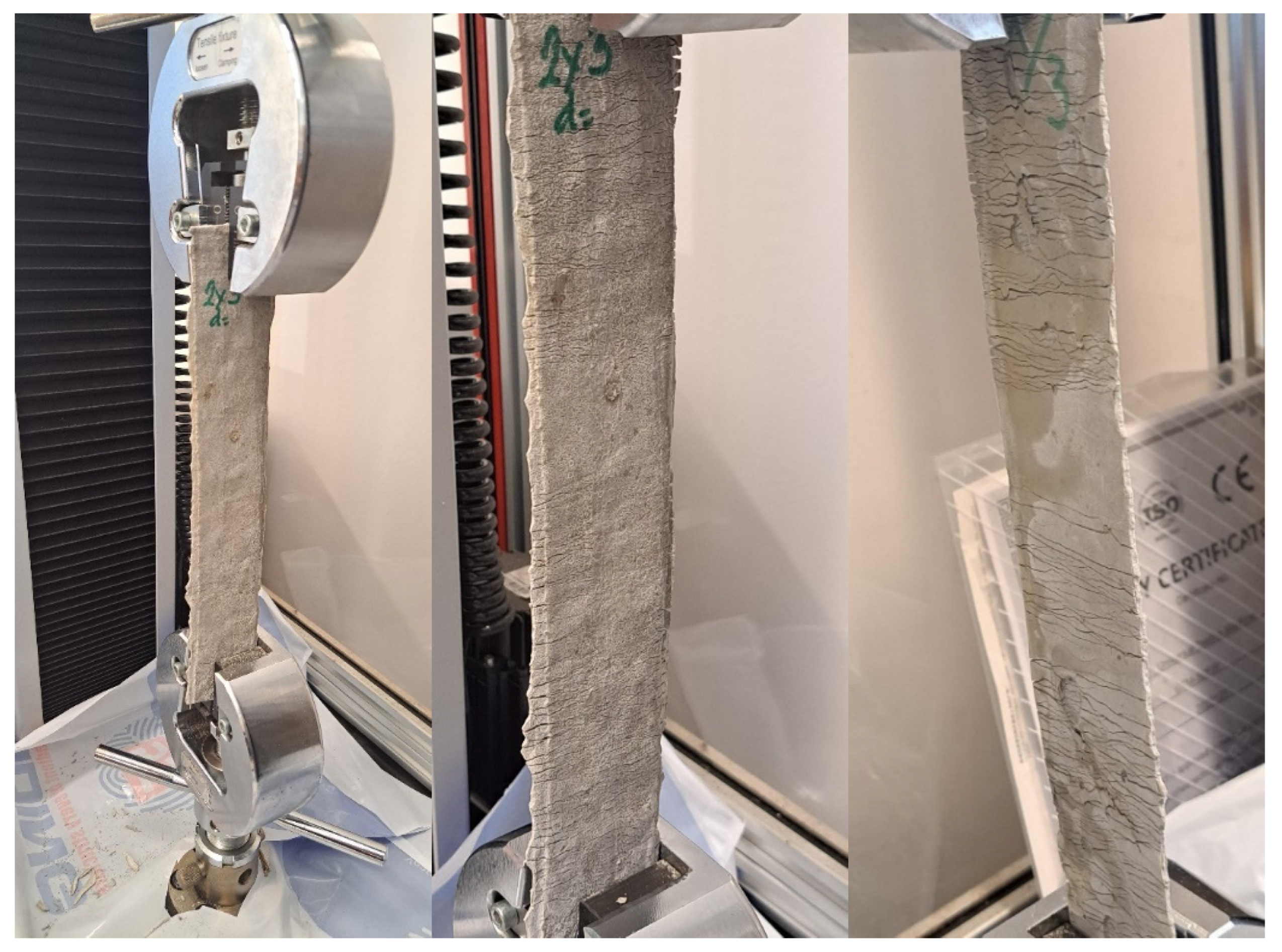
The development of cracks and the separation (delamination) of the sample at the point of the overlap is shown in Figure 7. The fracture of all the samples occurred after the separation of the bonded parts of the textile at the point of overlap.
Figure 8 shows the location of the overlap after the sample was torn. It is noticeable that the polymer-cement material has penetrated through the weave of the textile sample, creating a good bond, and that traces of the broken binder are visible on both parts of the textile strips. This leads to the conclusion that this type of overlap connection is quite sufficient for joining textile parts when forming larger surfaces.
The assumption that it is possible to continue waste parts of textiles with polymer-cement material was justified by this test. The overlap length of 25 mm practically enables the same tension force (97%) compared to the tension force achieved in test with a continuous textile stripe. Longer overlaps, 37.5 mm and 50 mm, increase the tear force by 3% and 10%, respectively, while reducing overall sample elongation. A small increase in tension force is probably due to a thicker layer of polymer-cement material at the place of the overlap. Load-displacement diagram of those samples shows increased stiffness of a composite material at the beginning, and further decrease in elastic modulus due to formation of cracks (Figure 9).
4. Discussion
The construction industry has a major impact on the environment, both due to the significant use of resources and energy, and due to the large amount of waste it generates. At the same time, it also has great potential for the application and recycling of waste from various other industries. The textile and fashion industries are one of the major producers of used materials that end up as waste. Reusing this waste is a modern challenge.
The test showed that coating the textile with polymer-cement material increases the tensile strength of the composite, while at the same time significantly reducing elongation. The test also showed that parts of the textile could be continued with the selected polymer-cement material simply by overlapping. It was shown that the overlap length of 25 mm practically allowed achieving the same tension force (97%) in the two parts continued by overlapping textile samples, as in the continuous textile strip (100%). Overlaps of 37.5 mm and 50 mm increase the tension force by 3% and 10% respectively, with a decrease in elongation. The small increase in tension force is due to the thicker layer of polymer-cement material at the overlap, while the decrease in elongation is the result of the longer overlap length, where cracks do not occur. As a practical and approximate estimate, overlap of two textile fabric pieces should be greater than 50 times of the textile thickness. This recommended length of the overlap depends on the type and texture of the textile fabric, so it is necessary to test the required length of the overlap before each application of the textile waste.
In order to test the simplicity and manufacturability of the proposed method, some small mockups were casted. These prototypes mimic the forms of corrugated sheets and ribbed plates, but also free forms (Figure 10). Continuation of the textile parts was easy and fast, but bottom mold was needed.
Textile formwork has long been present in construction. Textile formwork offers great opportunities for faster, more flexible and more economical construction. This research has shown that it is possible to form textile formwork from parts of waste textiles in a simple way, by bonding them with a cement-polymer binder. Such formwork can be prefabricated and preformed into the required dimensions or shapes, and above all, simply continued on site. This construction method allows easy and fast forming of free and curved forms, which is an emerging trend in the contemporary architecture. The surface of the preformed formwork from textile waste can also be used as a part of the molded concrete structure.
Further research is necessary in order to fully realize the potential of preformed formwork made of textiles waste. The task is not only to determine the characteristics of the material and formwork itself, but also to expand the field and methods of its application. More testing is required to establish the applicability and durability of this material. In this process, building engineers from all professions (designers, architects, structural and construction engineers, project managers and contractors) must closely cooperate.
5. Conclusions
Experiments are designed and research is conducted to test the hypothesis that textile waste components may be bonded using a cement-based binder to form surface elements of various shapes (flat or curved), which could serve as prefabricated formwork for the construction of concrete structures in various architectural forms. Obtained test results defined the appropriate polymer-cement binder, indicated mechanical properties of the composite polymer—cement—textile waste material and determined overlapping length for ensuring textile cut-offs continuity. The major research outcomes can be summarized as follows:
- Polymer-cement binder can be used to continue parts of knitted textile waste cut-offs. The addition of polymers significantly improved adhesion and elasticity of the cement binder, which enabled a better bond to the textile fabric.
- Adding stone aggregate to the polymer-cement mixture contributed to the economy of the composite material, but increased its consistency and reduced adhesion to the textiles. The possibility of using stone aggregate depends on its granulometry, which should be adjusted to the size of the stretched knitted textile openings (1/3–1/2 the size of the opening in the stretched knit fabric).
- Continuation of textile parts by overlapping and connecting them with a polymer-cement binder can completely transfer the stress from one part to another, and enable complete continuity in the composite material. For the length of the overlap, the recommendation for anchoring reinforcement length in reinforced concrete constructions can be adopted, la ≥ 50 d, where d is the thickness of the textile fiber. This recommended length of the overlap is a rule of the thumb; it depends on the type and texture of the textile fabric, so it is necessary to test the required length of the overlap before each application.
- Further studies are needed to investigate the applicability and durability of such materials. In this approach, close cooperation of engineers from all professions (architects, technologists, civil engineers, mechanical engineers) is needed.
Author Contributions
Conceptualization, D.P. and D.V.; methodology, D.P. and D.V.; validation, D.V., J.T. and N.Š.; formal analysis, D.P., D.V., J.T., B.I. and N.S; investigation, D.P., N.S. and I.I.; resources, D.P. D.V. and N.Š.; data curation, B.I. and N.S.; writing—original draft preparation, D.P., D.V. and B.I; writing—review and editing, J.T., N.S. and N.Š.; visualization, B.I., N.S. and I.I.; supervision, D.V., J.T. and N.Š.; project administration, D.P. and I.I.; funding acquisition, D.P., D.V., J.T., B.I. and N.Š. All authors have read and agreed to the published version of the manuscript.
Funding
This research received no external funding.
Data Availability Statement
The data presented in this study are available on request from the corresponding author.
Conflicts of Interest
The authors declare no conflicts of interest.
Abbreviations
The following abbreviations are used in this manuscript:
| P | Polymer |
| C | Cement |
| QS | Quartz sand |
| dsc | Dry solid content |
References
- Sakthibala, R.K.; Vasanthi P.; Hariharasudhan C.; Partheeban P. A critical review on recycling and reuse of construction and demolition waste materials, Cleaner Waste Systems 2025, Volume 12, 100375, ISSN 2772-9125. [CrossRef]
- UN Environment Programme: Not just another brick in the wall: The solutions exist—Scaling them will build on progress and cut emissions fast. Global Status Report for Buildings and Construction 2024/2025. Available online: https://wedocs.unep.org/handle/20.500.11822/47214 (accessed on 23 July 2026).
- Petrović, E. K.; Thomas, C. A. Global Patterns in Construction and Demolition Waste (C&DW) Research: A Bibliometric Analysis Using VOSviewer. Sustainability 2024, 16, 1561. [CrossRef]
- Bonifazi, G., Grosso, C., Palmieri, R., Serranti, S. Current trends and challenges in construction and demolition waste recycling, Current Opinion in Green and Sustainable Chemistry 2025, Volume 53, 101032, ISSN 2452-2236. [CrossRef]
- Juanga-Labayen, J. P.; Labayen, I. V.; Yuan, Q. A Review on Textile Recycling Practices and Challenges. Textiles 2022, 2, 174-188. [CrossRef]
- Dissanayake, D. G. K.; Weerasinghe, D. U. Fabric Waste Recycling: a Systematic Review of Methods, Applications, and Challenges. Materials Circular Economy 2021, 3, 24. [CrossRef]
- Tang, K. H. D. State of the Art in Textile Waste Management: A Review. Textiles 2023, 3, 454-467. [CrossRef]
- Mohtaram, F.; Fojan, P. From Waste to Value: Advances in Recycling Textile-Based PET Fabrics, Textiles 2025, 5, 24. [CrossRef]
- Biyada, S.; Urbonavičius, J. Circularity in textile waste: Challenges and pathways to sustainability, Cleaner Engineering and Technology 2025, Volume 24, 100905, ISSN 2666-7908. [CrossRef]
- Brydges, T.; Henninger, C. E.; Amasawa, E.; Wood, J.; Zeng, L.; Wakefield-Rann, R.; Allen, E.; Asuquo, E.; Garforth, A. Textile Recycling—Positive Change or Toxic Truth? In Proceedings of the 32nd CIRP Conference on Life Cycle Engineering (LCE 2025), Manchester, United Kingdom, (7-9 April 2025), Procedia CIRP 2025, Volume 135, 374-378, ISSN 2212-8271. [CrossRef]
- Abrishami, S.; Shirali A.; Sharples, N,: Kartal, G. E.; Macintyre, L.; Doustdat, O. Textile Recycling and Recovery: An Eco-friendly Perspective on Textile and Garment Industries Challenges, Textile Research Journal 2024, Volume 94, Issue 23-24, 2815-2834. [CrossRef]
- Abtew, M. A.; Atalie, D.; Dejene, B. K. Recycling of cotton textile waste: Technological process, applications, and sustainability within a circular economy, Journal of Industrial Textiles 2026, Volume 55. [CrossRef]
- Bonifazi, G.; Gasbarrone, R.; Palmieri, R.; Serranti, S. A Characterization Approach for End-of-Life Textile Recovery Based on Short-Wave Infrared Spectroscopy. Waste Biomass Valor 2024, 15, 1725–1738. [CrossRef]
- Papamichael, I.; Voukkali, I.; Economou, F.; Loizia, P.; Demetriou, G.; Esposito, M.; Naddeo, V.; Liscio, M. C.; Sospiro, P.; Zorpas, A.A. Mobilisation of textile waste to recover high added value products and energy for the transition to circular economy, Environmental Research 2024, Volume 242, 117716. [CrossRef]
- Tripathi, M.; Sharma, M., Bala, S.; Thakur, V.K.; Singh, A.; Dashora, K.; Hart, K.; Gupta, V. K. Recent technologies for transforming textile waste into value-added products: A review, Current Research in Biotechnology 2024, Volume 7, 100225, ISSN 2590-2628. [CrossRef]
- Islam, M. M.; Yin, R.; West, A. A Brief Review of Mechanical Recycling of Textile Waste. Textiles 2025, 5, 41. [CrossRef]
- Wegener, C.; Aakjaer, M. Upcycling—a new perspective on waste in social innovation, Journal of Comparative Social Work 2016, Volume 11, 242-260. [CrossRef]
- Directorate-General for Environment of the European Commission. Ban on destruction of unsold clothes and shoes enters into application, Available online: https://environment.ec.europa.eu/news/ban-destruction-unsold-clothes-and-shoes-enters-application-2026-07-17_en (accessed 20 July 2026).
- European Environment Agency. The destruction of returned and unsold textiles in Europe’s circular economy. Available online: https://www.eea.europa.eu/en/analysis/publications/the-destruction-of-returned-and-unsold-textiles-in-europes-circular-economy (accessed 20 July 2026).
- Folic, R., Zenunović, D. (2023). Textile reinforced concrete. Tekstilna industrija 2023, Vol. 71, 13-25. [CrossRef]
- Scheurer, M.; Friese, D.; Penzel, P.; Dittel, G.; Bhat, S.; Overhage, V.; Hahn, L.; Heins, K.; Cherif, C.; Gries, T. Current and Future Trends in Textiles for Concrete Construction Applications. Textiles 2023, 3, 408-437. [CrossRef]
- Schmitz R. P. Fabric Forms for Architectural Concrete: A State-of-the-Art Report. In Proceedings of AEI 2015: Birth and Life of Integrated Building, Milwaukee, Wisconsin, USA, (24-27 March 2015), 259-268. [CrossRef]
- Abdelgader H.; West, M.; Górski, J. State-of-the-Art Report on Fabric Formwork. In Proceedings of International Conference on Construction and Building Technology 2008 (ICCBT 2008), Kuala Lumpur, Malaysia, (16-20 June 2008), pp 93-106. https://www.researchgate.net/publication/266731955_State-of-the-Art_Report_on_Fabric_Formwork.
- Veenendaal, D.; West, M.; Block, P. History and overview of fabric formwork: using fabrics for concrete casting. Structural Concrete 2011, 12, 164-177. [CrossRef]
- Schmitz, R. (2016). Is there a future for fabric-formed concrete structures? In Proceedings of the 3rd International Conference on Structures and Architecture (ICSA 2016), Guimaraes, Portugal (27-29 July 2016). https://www.researchgate.net/publication/329758857_Is_there_a_future_for_fabric-formed_concrete_structures.
- Pedreschi, R. Fabric formed concrete structures and architectural elements. In Proceedings of the ICSA 2013 Second International Conference on Structures and Architecture, Guimaraes, Portugal (24-26 July 2016). http://www.crcpress.com/product/isbn/9780415661959.
- Orr, J.; Darby, A.; Ibell, T.; Evernden, M. Flexible formwork for visual concrete. Concrete 2012, Volume 46, ISSN 0010-5317. [CrossRef]
- Hawkins, W.; Herrmann, M.; Ibell, T.; Kromoser, B.; Michaelski, A.; Orr, J., Pedreschi, R., Pronk, A. D. C., Schipper, R., Shepherd, P., Veenendaal, D., Wansdronk, R., & West, M. (2016). Flexible formwork technologies: a state of the art review, Structural Concrete 2016, Volume17, Issue 6, 911–935. [CrossRef]
- Duff Abrams, Design of concrete mixtures, Publisher: Structural materials research laboratory, Lewis Institute, Chicago, USA, 1919, 1-20. https://dn760103.eu.archive.org/0/items/designofconcrete00abrarich/designofconcrete00abrarich.pdf.
- Neville A.M. Properties of concrete: Fourth and Final Edition, Publisher: Wiley, New York, USA, 1996, p. 844.
- Popovics, S. Strength and Related Properties of Concrete: A Quantitative Approach, Publisher: John Wiley & Sons, Inc., New York, 1998, p. 535.
- Popovics, S.; Ujhelyi J. Contribution to the Concrete Strength versus Water-Cement Ratio Relationship, Journal of Materials in Civil Engineering 2008, Volume 20, Issue 7, 459–463. [CrossRef]
- Aïtcin, P.-C. High Performance Concrete, Publisher: E & FN Spon, London, United Kingdom, 1998, p. 624. [CrossRef]
- Aïtcin, P-C.; Lessard, J-M. 8—The composition and design of high-strength concrete and ultrahigh-strength concrete, In Developments in the Formulation and Reinforcement of Concrete, 2nd ed.; Editor: Mindess, S. Publisher: Woodhead Publishing, Duxford, United Kingdom, 2019, pp. 171-192. [CrossRef]
- ERMCO, Ready-Mixed Concrete Industry Statistics Year 2023. Available on-line: www.nrmca.org/wp-content/uploads/4-2ERMCO_Statistics_Report2023September2024.pdf), 2024, pp.14 (accessed on 20 July 2026).
- Xu, S.; Li, H. Bond properties and experimental methods of textile reinforced concrete, J. Wuhan Univ. Technol. 2007, 22, 529–532. [CrossRef]
- Dvorkin, D.; Poursaee, A.; Peled, A.; Weiss, W.J. Influence of bundle coating on the tensile behavior, bonding, cracking and fluid transport of fabric cement-based composites, Cement and Concrete Composites 2013, Volume 42, 9-19. [CrossRef]
- Awani, O.; El-Maaddawy, T.; Ismail, N. Fabric-reinforced cementitious matrix: A promising strengthening technique for concrete structures, Construction and Building Materials 2017, 132, 94-111. [CrossRef]
- Silva, R.M.d.C.; Zhao, J.; Liebscher, M.; Curosu, I.; Silva, F.d.A.; Mechtcherine,V. Bond behavior of polymer- and mineral-impregnated carbon fiber yarns towards concrete matrices at elevated temperature levels, Cement and Concrete Composites 2022, Volume 133, 104685. [CrossRef]
- Alatawna, A.; Sripada, R.; Nahum, L.; Birenboimi, M.; Regev, O.; Peled, A. Textile-cement bond enhancement: Sprinkle some hydrophilic powder, Cement and Concrete Composites 2021, Volume 120, 104031, ISSN 0958-9465. [CrossRef]
- Aggarwal, L.K.; Thapliyal, P.C.; Karade, S.R. Properties of polymer-modified mortars using epoxy and acrylic emulsions. Construction and Building Materials. 2007, 21, 379-383. [CrossRef]
- Chitte, K.G.; Puri, R.G.; Mahajan, D.S.; Rathi, S.; Narkhede, J.S. SBR-latex modified cementitious composite coatings for concrete rehabilitation and assessment of performance measure. European Journal of Environmental and Civil Engineering 2021, 26, 8073-8090. [CrossRef]
- Diamanti, M.V.; Brenna, A.; Bolzoni, F.; Berra, M.; Pastore, T.; Ormellese, M. Effect of polymer modified cementitious coatings on water and chloride permeability in concrete. Construction and Building Materials 2013, 49, 720-728. [CrossRef]
- Cheng, D.; Li, X.; Gao, X.; Fan, X.; Zhao, R.; Yang, T. Influence of Polymer Latexes on the Properties of High Performance Cement–Based Materials. Crystals 2022, 12, 789. [CrossRef]
- Yan, R.; Wang, L.; Ni, Y.; Zhang, S.; He, Z.; Guan, B. A Study on the Properties of Composite Modified Mortar with Styrene–Butadiene Rubber Latex and Silica Fume. Polymers 2024, 16, 697. [CrossRef]
- Mayhoub, O.A.; Abadel, A.A.; Alharbi, Y.R.; Nehdi, M.L.; de Azevedo, A.R.G.; Kohail, M. Effect of Polymers on Behavior of Ultra-High-Strength Concrete. Polymers 2022, 14, 2585. [CrossRef]
- Choo, Y.J.; Lee, G.H.; Lee, S.-J.; Park, C.-G. Effects of Wollastonite Fiber and Styrene–Butadiene Latex Polymer on the Long-Term Durability of Cement-Based Repair Materials. Materials 2022, 15, 5433. [CrossRef]
- Kim, J.J. Absorbed Energy and Fracture Characteristics of Cement Paste Modified with SBR Latex through Charpy and Three-Point Bending Tests. Buildings 2025, 15, 1976. [CrossRef]
- Zhao, C.; Jia, X.; Yi, Z.; Li, H.; Peng, Y. Mechanical Performance of Single-Graded Copolymer-Modified Pervious Concrete in a Corrosive Environment. Materials 2021, 14, 7304. [CrossRef]
- Salami, B. A.; Bahraq, A. A.; Moin ul Haq, M.; Ojelade, O. A.; Taiwo, R.; Wahab, S.; Adewumi, A. A.; Ibrahim, M. Polymer-enhanced concrete: A comprehensive review of innovations and pathways for resilient and sustainable materials, Next Materials, Volume 4, 2024, 100225. [CrossRef]
- Wang, W.; Feng, Y.; Feng, J. Multiscale Analysis of Styrene–Butadiene Latex Modified Rubber Concrete. Buildings 2025, 15, 3881. [CrossRef]
- Kim, K.K.; Yeon, J.; Lee, H.J.; Yeon, K.-S. Strength Development Characteristics of SBR-Modified Cementitious Mixtures for 3-Demensional Concrete Printing. Sustainability 2019, 11, 4164. [CrossRef]
- Qureshi, H.J.; Khurram, N.; Akmal, U.; Arifuzzaman, M.; Habib, M.Q.; Al Fuhaid, A.F. Flexure Performance of Ferrocement Panels Using SBR Latex and Polypropylene Fibers with PVC and Iron Welded Meshes. Polymers 2023, 15, 2304. [CrossRef]
- Jing, S.; Pang, B.; Chen, Y.; Wang, J.; Wang, P.; Song, S.; Lai, W. A Review on Polymer-Modified Cementitious Materials for Underwater Repair: Workability, Bonding, Mechanical Performance and Durability. Buildings 2026, 16, 2751. [CrossRef]
Figure 2.
Test samples of plain (a), single layer (b) and double layer (c) P-C coating textile.
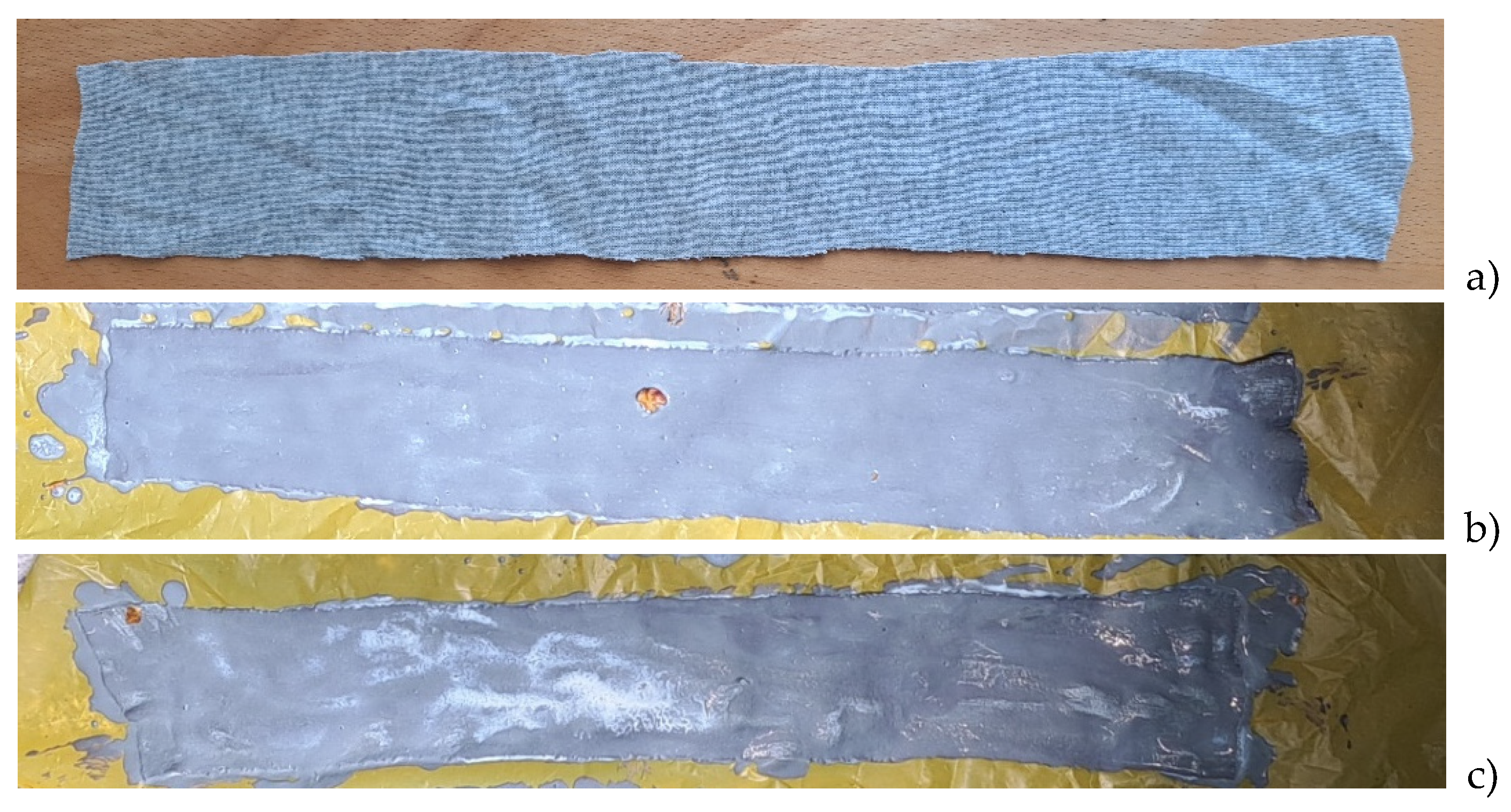
Figure 3.
Test samples of textile samples bonded with P-C fresh liquid paste.
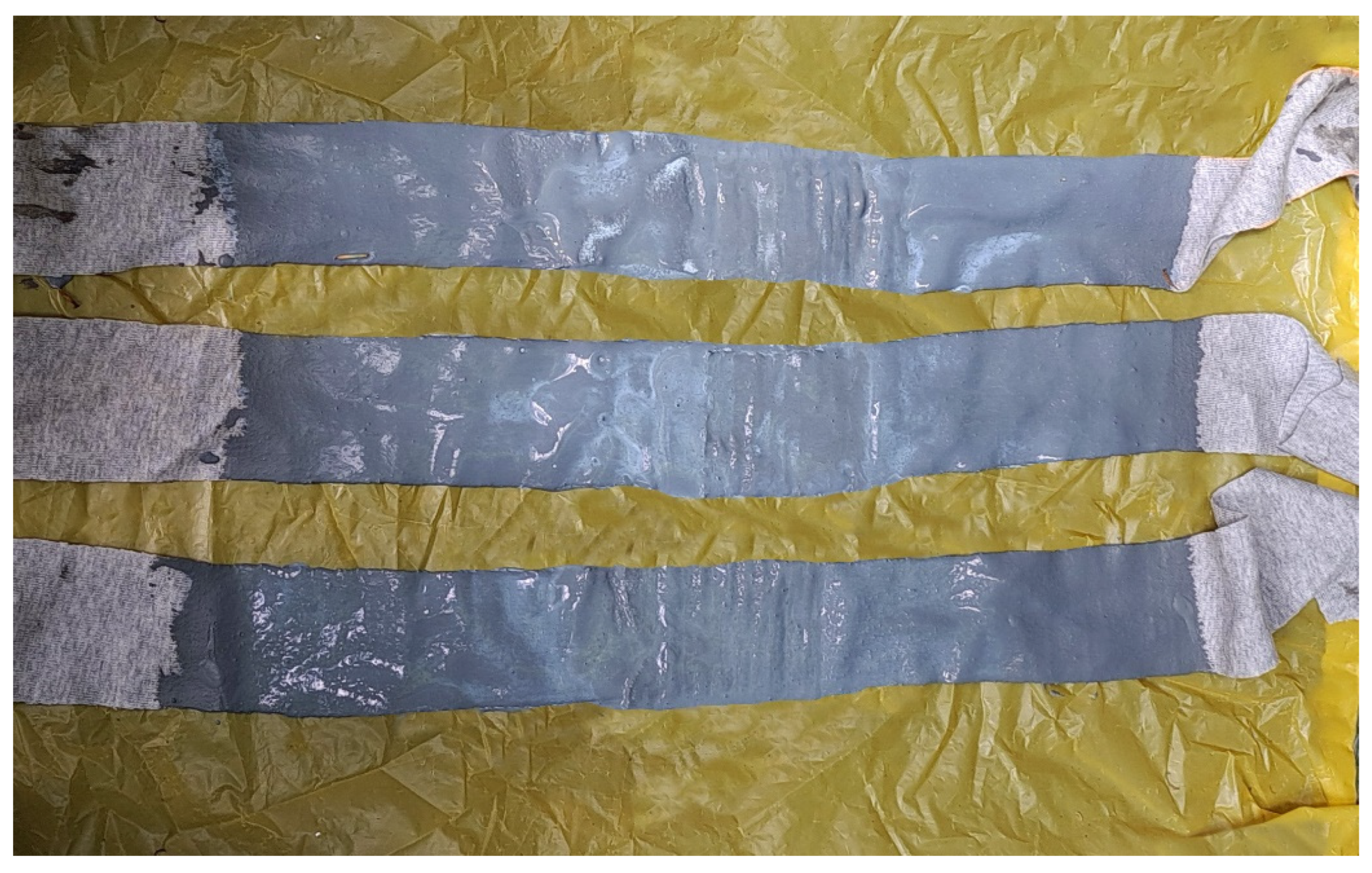
Figure 4.
Force-elongation diagrams of tested plain (a), single layer (b) and double layer (c) P-C coating textile samples.
Figure 4.
Force-elongation diagrams of tested plain (a), single layer (b) and double layer (c) P-C coating textile samples.
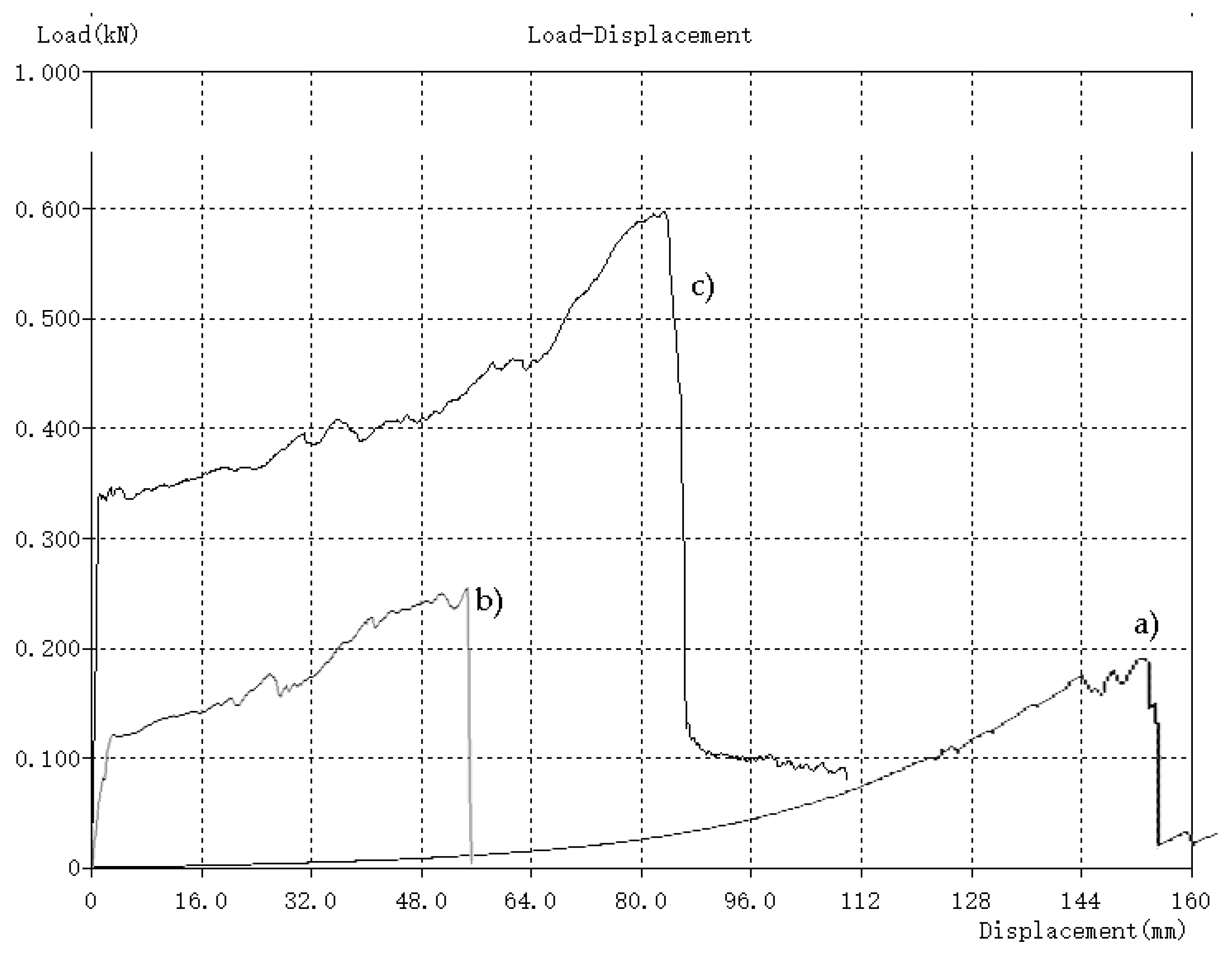
Figure 5.
Cracks pattern on the tested P-C coated textile sample.
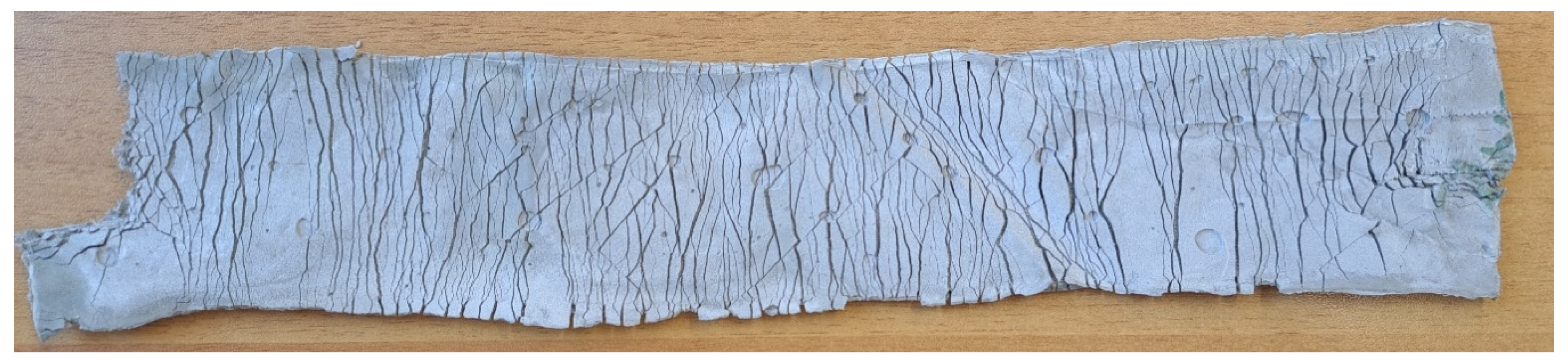
Figure 7.
Development of cracks and delamination of bonded textile samples during testing.
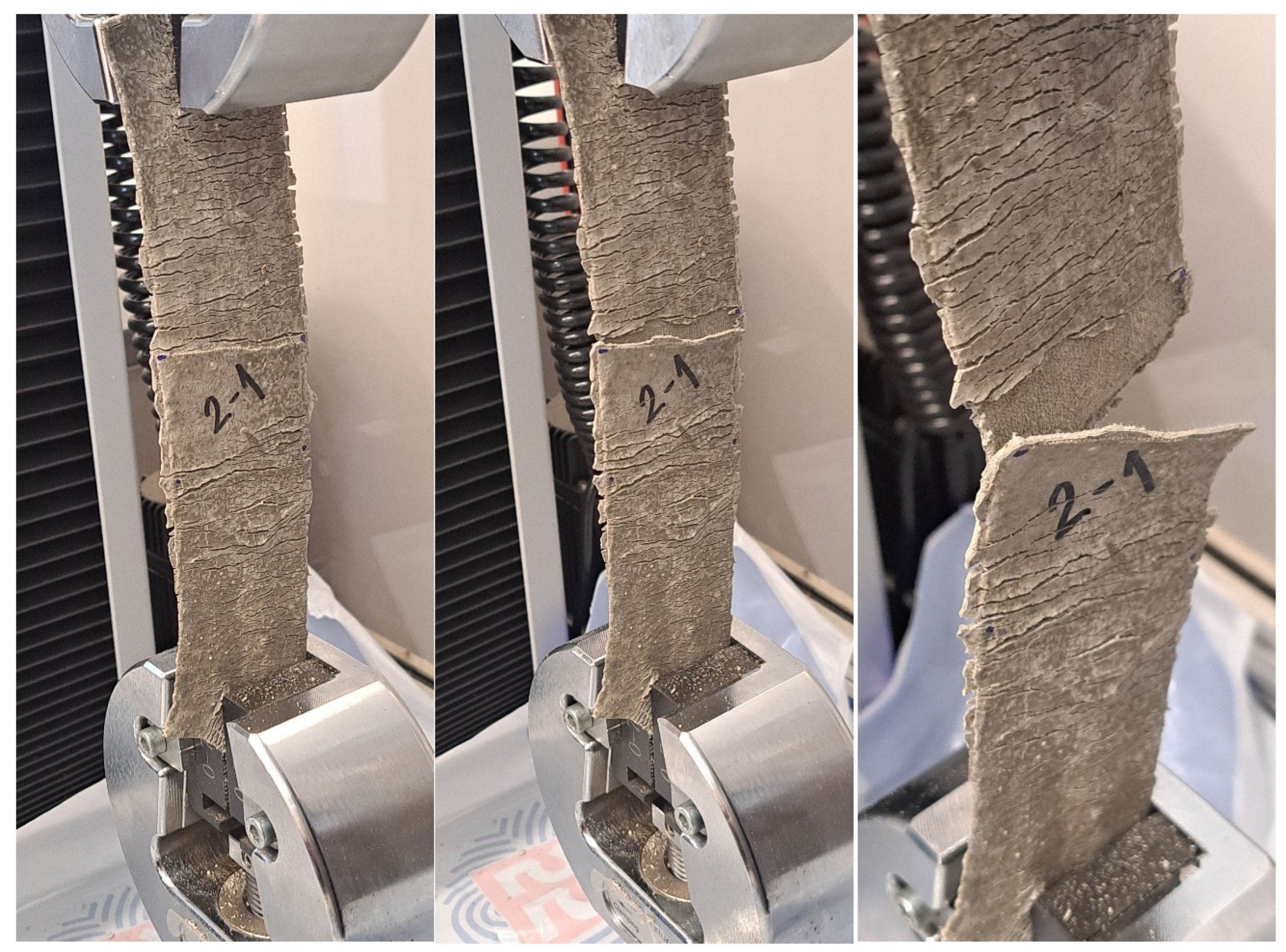
Figure 8.
Textile overlapped joint after the sample brake.
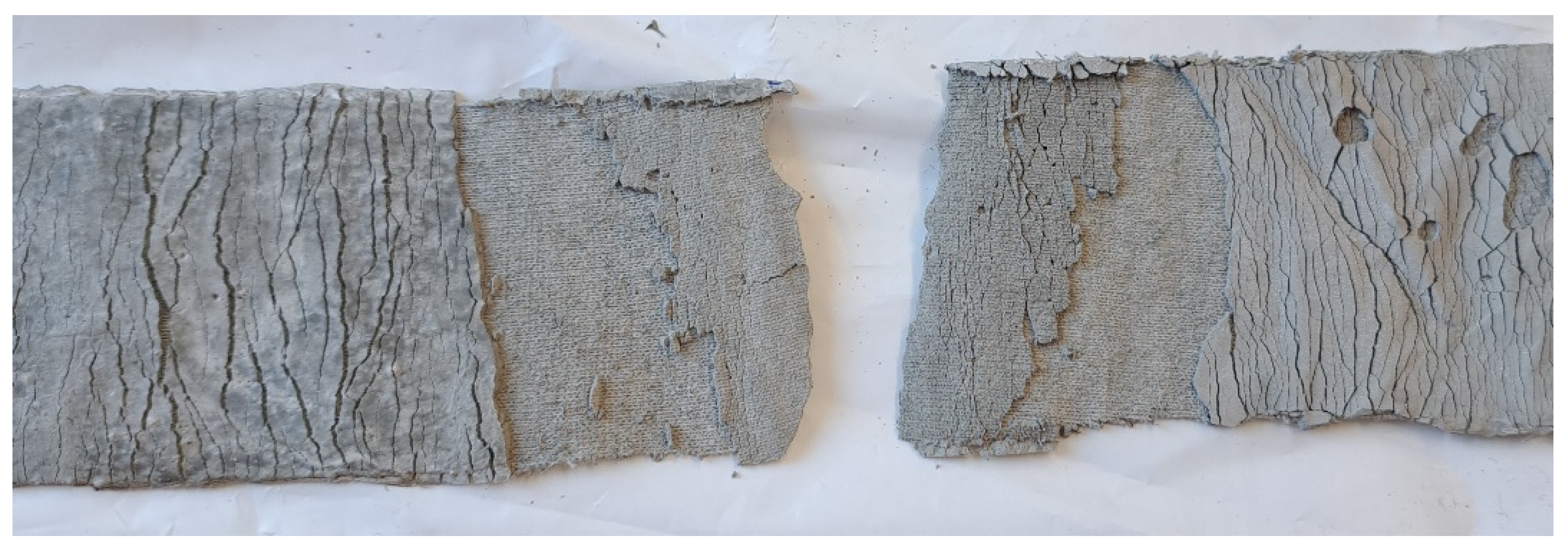
Figure 9.
Force-elongation diagram of sample tested with overlapped joint (25 mm).
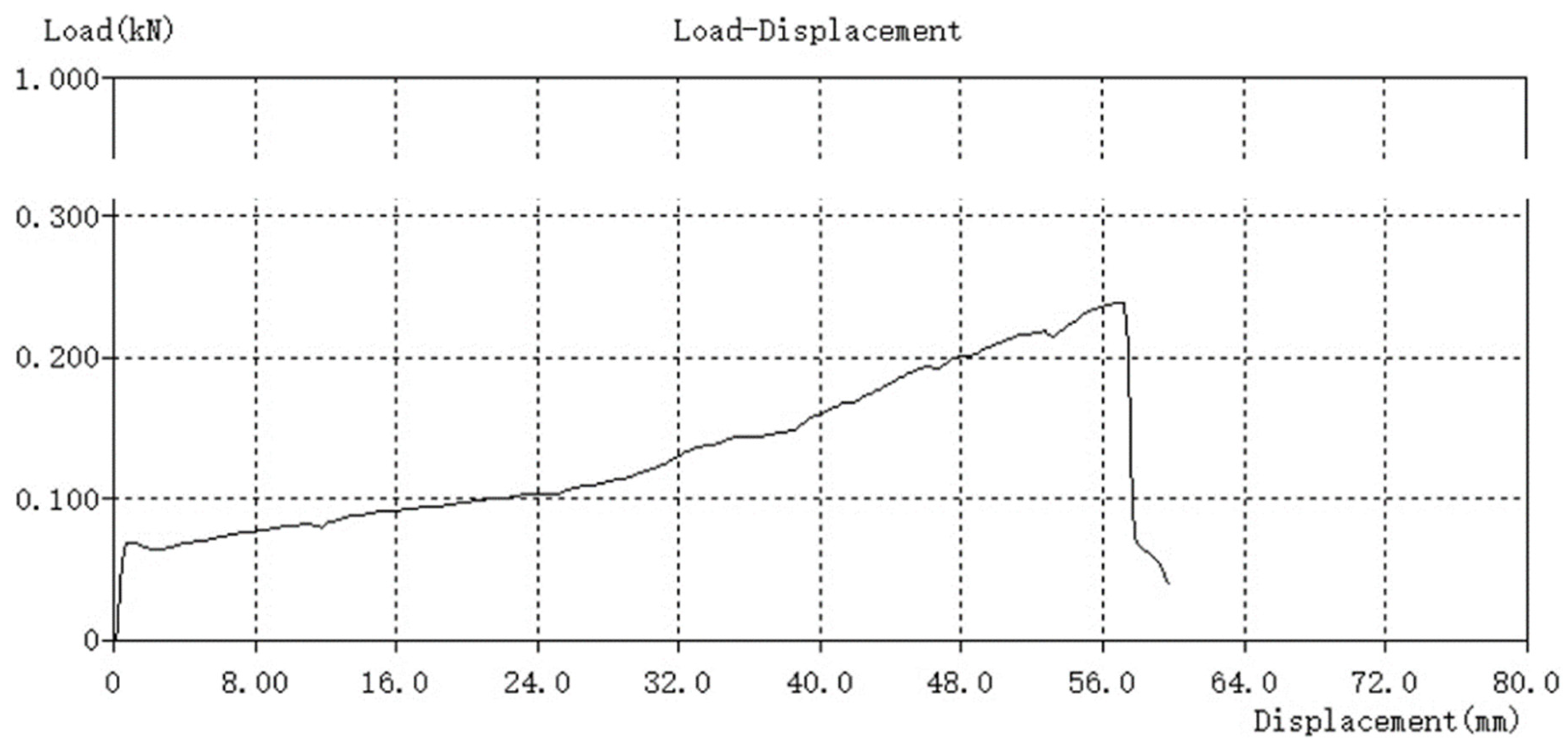
Figure 10.
Samples of application of triple fabric layer polymer-cement-textile waste composite mimic ribbed plates (a), corrugated sheets (b, c) and free form (d).
Figure 10.
Samples of application of triple fabric layer polymer-cement-textile waste composite mimic ribbed plates (a), corrugated sheets (b, c) and free form (d).
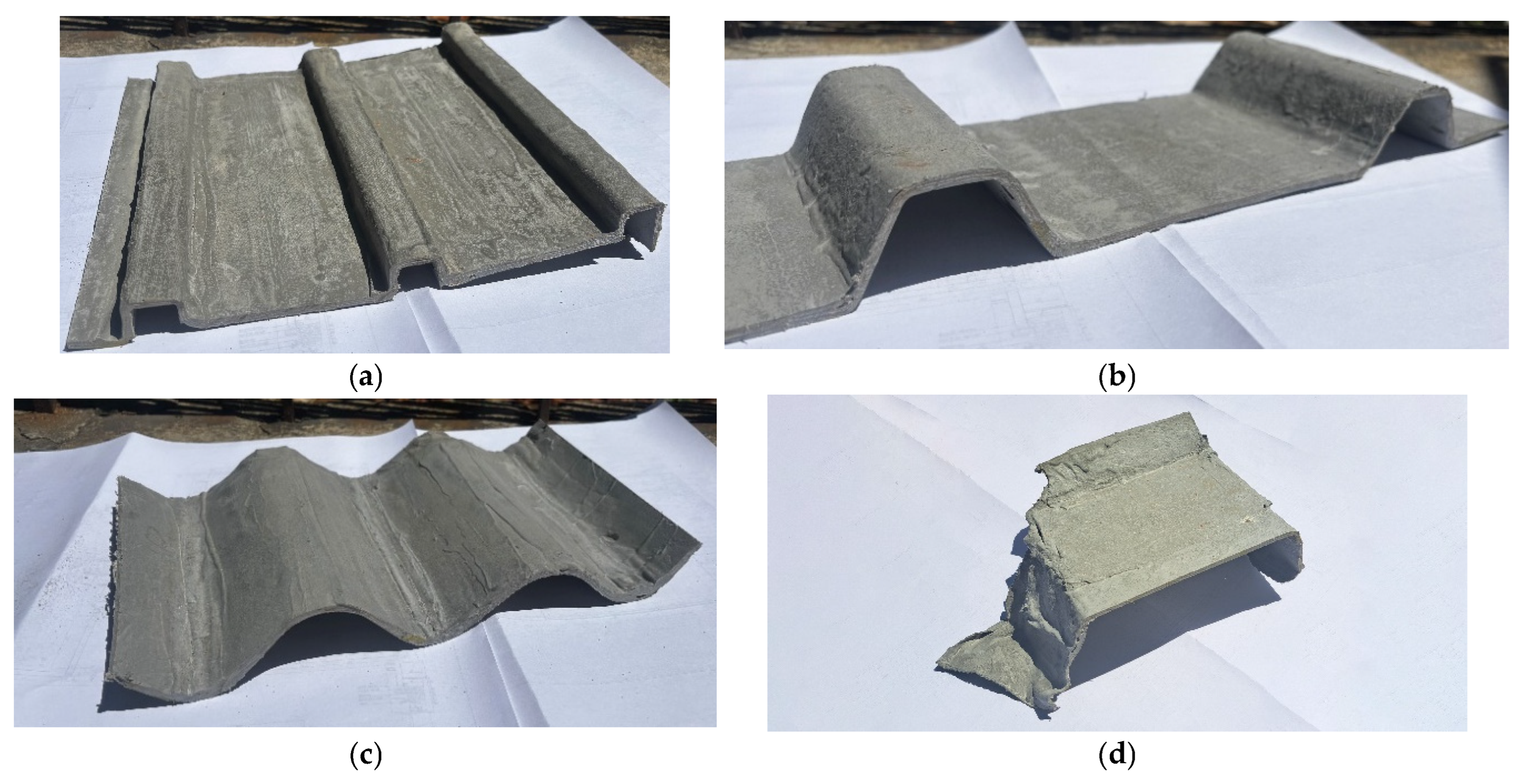
Table 1.
Particle size distribution of KPLC011 and KPLC 022 quartz sand.
| Sieve Size (mm) | KPLC 011 Sieve Residue (%) |
KPLC 022 Sieve Residue (%) |
|---|---|---|
| 0.71 | − | max 0.5 |
| 0.5 | − | max 2.0 |
| 0.355 | max 0.1 | max 10.0 |
| 0.25 | max 0.2 | 20.0–40.0 |
| 0.18 | max 10.0 | 30.0–40.0 |
| 0.125 | 50.0–70.0 | 10.0–30.0 |
| 0.09 | 20.0–40.0 | max 8.0 |
| 0.063 | max 5.0 | max 1.0 |
| Bottom Rest | max 1.0 | max 0.5 |
Table 2.
Proportions of tested mixes.
| Mix | Cement CEM I 42.5 R W/C (%) |
Polymer SBRL P (dsc)/C (%) |
Quartz sand KPLC 011 QS/C (%) |
|---|---|---|---|
| R1 | 40 | 10 | − |
| R2 | 50 | 10 | − |
| R3 | 40 | 20 | − |
| R4 | 50 | 20 | − |
| M11 | 40 | 10 | 200 |
| M12 | 50 | 10 | 300 |
| M13 | 40 | 20 | 200 |
| M14 | 50 | 20 | 300 |
Table 3.
Average compressive and bending strength and adhesion to the concrete (in MPa).
| Mix | Compressive strength (MPa) | Bending strength (MPa) | Adhesion (MPa) |
|---|---|---|---|
| R1 | 45.5 | 7.2 | 1.92 |
| R2 | 42.8 | 6.8 | 1.78 |
| R3 | 41.6 | 9.0 | 2.42 |
| R4 | 39.4 | 8.2 | 2.22 |
| M11 | 64.8 | 7.4 | 1.42 |
| M12 | 54.4 | 7.2 | 1.18 |
| M13 | 59.5 | 5.9 | 1.60 |
| M14 | 57.5 | 5.8 | 1.38 |
Table 4.
Average force/elongation values of plain (non-coated), single and double layer P-C coated textile samples.
Table 4.
Average force/elongation values of plain (non-coated), single and double layer P-C coated textile samples.
| Type of sample | Average Force (N) | Average dilatation (mm) |
|---|---|---|
| Reference plain non-coated textile | 182 | 148,0 |
| P-C coated single layer textile | 248 | 58,4 |
| P-C coated double layer textile | 576 | 80,6 |
Disclaimer/Publisher’s Note: The statements, opinions and data contained in all publications are solely those of the individual author(s) and contributor(s) and not of MDPI and/or the editor(s). MDPI and/or the editor(s) disclaim responsibility for any injury to people or property resulting from any ideas, methods, instructions or products referred to in the content. |
© 2026 by the authors. Licensee MDPI, Basel, Switzerland. This article is an open access article distributed under the terms and conditions of the Creative Commons Attribution (CC BY) license (http://creativecommons.org/licenses/by/4.0/).
Copyright: This open access article is published under a Creative Commons CC BY 4.0 license, which permit the free download, distribution, and reuse, provided that the author and preprint are cited in any reuse.