
Submitted:
04 August 2026
Posted:
10 August 2026
You are already at the latest version
Abstract
Shot peen forming and creep age forming are the principal industrial routes for generating contour in metallic aircraft wing covers. Although the mechanics of both are well documented, neither has been examined with the patent record as the unit of analysis. This study assembles comparative corpora of 157 patent families spanning 1951 to 2026, by classification-anchored retrieval and systematic citation-network tracing, coding every family by claim type and determining its jurisdictional breadth and grant outcome. The two processes exhibit measurably different bottlenecks. Creep age forming devotes 40% of its corpus to tooling against 15% for shot peen forming, whereas shot peen forming devotes 24% to control and compensation against 8% for creep age forming. The binding constraint has been geometry transfer for the former and process control for the latter, so the two routes require different de-risking strategies. Three further results follow. The foundational era of shot peen forming is tri-national rather than exclusively American. Apparent Chinese dominance of the recent record survives neither normalisation against background filing nor a breadth measure, 96% of Chinese families being filed at a single office. Citation tracing rather than classification search is required to observe such a landscape.
Keywords:
patent landscape
; shot peen forming
; creep age forming
; aircraft wing cover
; process selection
1. Introduction
Metallic wing covers, comprising the wing skin together with its mechanically attached or integrally machined stringers, are formed to aerodynamic contour by a small number of industrially established routes. Two of these, shot peen forming and creep age forming, account for the majority of civil and business-aircraft production practice reported in the open literature. Both have attracted substantial attention to their underlying mechanics: eigenstrain generation and coverage behaviour in the case of shot peen forming [1], and coupled creep-ageing constitutive modelling and springback prediction in the case of creep age forming [2].
For an engineer selecting between the two routes, the process-mechanics literature establishes how each process operates but not where each has proved difficult to industrialise. The patent record addresses that question indirectly but systematically, on the reasoning that firms and institutions patent where they invest inventive effort, and that the composition of what they claim indicates where the obstacle lay. Patents appear throughout the existing literature, but consistently in a corroborating role: a number is cited in support of an attribution such as the use of a given route on a given aircraft, and the document is then set aside. No published work known to the author treats the patent record for these processes as a primary analytical object.
1.1. Basis for the Novelty Claim
Since this paper argues that retrieval strategy determines what a searcher finds, it would be inconsistent to assert a gap in the literature without stating how that gap was established. Scopus, Web of Science and Google Scholar were searched to April 2026 for combinations of the terms patent landscape, patent analysis, patent mapping and citation analysis with shot peen forming, peen forming, creep age forming, age forming and wing panel, wing skin or wing cover. The reference lists of [1,2,3,4] and the citing literature of [2,4] were additionally screened. That search returned process-mechanics reviews, notably [2] for creep age forming and [4] for shot peen forming, together with patent-landscape studies of other manufacturing domains, but none taking the patent record for either process as its object and none comparing the two. This is reported as a bounded negative result rather than a claim of exhaustiveness.
1.2. Relationship to Prior Work
The present paper is intended as a companion to two existing reviews rather than a restatement of either. Levers [3] reviews metallic wing-cover manufacture across mechanical, stress-based, thermo-mechanical and hybrid routes, employing patents as capability evidence graded alongside peer-reviewed papers and supplier disclosures; its treatment of process mechanics and aircraft-programme attribution is more detailed than is attempted here. Xiao et al. [4] review shot peen forming with a scope restricted to incremental deformation and forming-accuracy control, and neither treat patents as a landscape nor address creep age forming. To ensure that the present paper is self-contained, the claim-type scheme employed here is restated in full in Section 2.3 rather than incorporated by reference to [3].
2. Materials and Methods
2.1. Corpus Construction
The two corpora were constructed using different retrieval strategies, and the difference between them constitutes a result in its own right (Section 3.4).
Shot peen forming occupies a settled position within the international classification system. CPC B24C 1/10 captures the core process class, with C21D 7/06 and C21D 9/50 capturing heat-treatment-adjacent filings. The corresponding corpus was constructed by combining a CPC-anchored search of Espacenet and Google Patents with keyword filtering on the terms “wing skin”, “aircraft panel”, “compound contour” and “peen forming”, in order to isolate aerospace-relevant filings from the substantially larger general shot-peening corpus.
Creep age forming possesses no equivalently dedicated code, and relevant filings are dispersed across general metal-forming and heat-treatment classes. That corpus was therefore constructed by keyword search, cross-checked against patents known from the process-mechanics literature to belong to named assignees, namely Textron Aerostructures, BAe and BAE Systems, Rockwell and Boeing, Vought, COMAC and Northwestern Polytechnical University, in order to validate recall against probable omissions.
Both corpora were deduplicated at patent-family level, such that a family spanning several offices is counted once. Section 3.4 examines the consequences of that decision, which are not neutral.
2.2. Citation-Network Pass and Record Flow
The corpora as first constructed were subsequently subjected to a systematic citation-network pass. For a seed set of confirmed members, the backward citations (prior art cited) and forward citations (later patents citing the member) were retrieved from the Google Patents citation index and read individually, and every candidate was checked against its own patent record before admission.
Figure 1 reports the resulting record flow. The initial corpus comprised 41 families, of which 18 were shot peen forming and 23 creep age forming. Those named in this paper are itemised in Supplementary Table S2, which also records that a definitive itemisation of the pre-pass corpus remains outstanding, so that the division between initial and citation-added families should be regarded as provisional. The citation pass identified 210 candidate records, of which 124 were admitted following individual verification. Three of these resolved at family level into families already represented, giving 121 net new families. Fifty-one candidates were excluded with reasons recorded, and 34 were left uncounted as residual. A final scope review excluded five further records, two of which were measure-and-correct production-loop patents falling under the exclusion of corrective methods stated in Section 2.4. All five are itemised in Supplementary Table S3.
The counted corpus therefore comprises 157 families, of which 94 are shot peen forming and 63 creep age forming, resolving to 154 distinct simple families. Totals are reported as verified lower bounds rather than as a census, since the residual set is real and uncounted.
All five final-review exclusions are Western in origin, so that the exclusion displaces every comparison between China and the West in a single direction. Three observations are therefore recorded. The same scope rules were applied to both sides of the corpus. The Chinese side yielded the larger absolute number of exclusions at earlier stages. And the substantive conclusions are unchanged in direction and only marginally altered in magnitude: the claim-type ratios move from 2.9 to 2.7 and from 3.3 to 3.1, and the age-matched grant differential from 13.1 to 12.8 percentage points. A reader electing to retain all five records would reach the same conclusions.
2.3. Claim-Type Coding
Every family was coded into one of three claim types. Proc. denotes a claim to the curvature-generating route itself, comprising the forming method, its sequence and its parameters. Tool. denotes a claim to enabling hardware, comprising fixtures, dies, jigs, clamps, delivery systems and autoclave furniture. Dev. denotes a claim to compensation, measurement, simulation, prediction or control, that is, to the methods by which a forming operation is corrected or steered. Where a record combines types, the cue hierarchy Dev. > Tool. > Proc. was applied, such that a compensation method embodied in tooling is coded as Dev. Coding was applied to title and subject matter rather than to full independent-claim text. The rule set and the per-family assignments are provided in the Supplementary Material.
A random 20% sample of 33 families was independently coded by a second coder working from the rule set without access to the first coder’s assignments. Raw agreement was 72.7% and Cohen’s κ was 0.51 (95% confidence interval 0.24 to 0.78), which is moderate rather than strong. The nine disagreements were not randomly distributed. Five moved a record into the Dev. category, and three had a mechanical cause in the first coder’s cue list: the register abbreviates “simulation” to “sim”, which the cue “simulat” does not match, and the accuracy-related cues “accuracy” and “precision” were absent. Correction of those defects raises agreement to 81.8% and κ to 0.69.
Because that correction was identified after inspection of the second coder’s assignments, κ is reported for the coding actually employed, and the corrected coding is treated as a sensitivity analysis rather than as a replacement. Under the corrected cue list the shot-peen Dev. share rises by approximately four percentage points, and both ratios reported in Section 3.2 are unchanged. The direction of the residual coding error is therefore known, in that Dev. is under-detected rather than over-detected, and it operates against the control-locus result rather than in its favour.
2.4. Scope Rules
The corpus is restricted to the forming of aircraft wing covers and directly related airframe panels. The following categories were excluded: corrective rather than contour-generating methods, including measure-and-correct production loops and weld-distortion correction; measurement-only methods, except where the claimed subject matter forms part of a forming route; strengthening without forming; non-panel geometry, including engine blades, brackets and beams; and launch-vehicle propellant-tank forming, which shares the process but constitutes a distinct application domain and is discussed as adjacent in Section 3.5.
2.5. The Evidential Limits of Patent Counts
Three constraints are structural rather than incidental, and they bound every result reported below.
First, patenting measures disclosure behaviour rather than technical activity. A patent is evidence that an actor elected to disclose an invention in exchange for a time-limited exclusion right, in a given jurisdiction, at a cost. Where that exchange is unattractive, whether because infringement cannot be detected in a delivered part, because the holder does not operate under patent incentives, or because secrecy is preferred, the technical activity proceeds while the record remains silent. Absence of patenting is therefore not evidence of absence of capability.
Second, patenting measures appropriability rather than difficulty. A difficult problem whose solution cannot be enclosed generates no patents. Filing volume is accordingly not interpreted here as a measure of difficulty, and claims concerning the direction of effort rest on the composition of a corpus rather than on its size, composition being less sensitive to the general propensity to patent.
Third, citation is a strategic act with a temporal structure. Applicants have an incentive not to cite art that would narrow their claims; examiners add citations that the applicant has not read; and citation counts per patent have risen secularly and differ between offices. Of particular importance, older patents have had decades in which to be located and cited, whereas filings from the 2020s are still accruing citations. Any comparison of citation density between an older and a more recent stratum is therefore confounded with citation-accretion time.
Four further limitations are narrower in scope. Assignee counts overstate the number of independent programmes, since two of the largest sub-fields concentrate under single principal investigators. Membership of a forward-citation set is not proof of topical membership, so every citation-derived candidate was judged individually. Certain recent Chinese filings are discussed from application-publication text rather than from granted claims. Finally, origin is assigned by office of publication, because the harmonised applicant country is populated for only 34 of 150 queried records and is absent for 97 of the 103 Chinese-published records.
2.6. Data Sources and AI-Assisted Tools
Patent records were retrieved from Google Patents and Espacenet. Patent-family membership, jurisdictional breadth, grant status and titles were obtained from the Google Patents public dataset held on Google BigQuery. It should be noted that the family identifier in that dataset is the simple family, whereas corpus deduplication was performed at extended-family level. The normalisation baseline counts distinct applications per office per year in CPC or IPC B21D, C21D and B24C from the same source; publications from 2025 onward are incomplete in that dataset and are excluded throughout. Current legal status was read from Google Patents and Espacenet legal-event records for a stratified subset of 60 families. All queries are reproduced in the Supplementary Material.
During the preparation of this work the author used artificial-intelligence-assisted tools (Anthropic Claude) to support patent-database search, citation-network tracing, verification of patent records, statistical analysis and figure preparation, and to assist with language editing. The author reviewed and edited all resulting content and takes full responsibility for the article.
2.7. Falsification Conditions for the Central Methodological Claim
The claim that forward-only classification search under-samples the older and non-domestic record is falsifiable. Had backward-citation tracing returned only material already held, or only material of the same era and provenance as that already held, the claim would have failed. Had the newly surfaced material been distributed randomly in time and geography rather than concentrated before 1990 and outside China, the claim would have been substantially weakened. Neither outcome was observed. It should further be noted that the finding operates against the initial corpus, which was assembled by the present author.
3. Results
3.1. Corpus Composition
The counted corpus comprises 157 families. On raw counts, the shot-peen-forming corpus (n = 94) comprises China 64, the United States, United Kingdom and other Western offices 16, Japan 8, Germany 5 and Belgium 1. The creep-age-forming corpus (n = 63) comprises China 51, Western offices 8, Japan 2, Germany 1 and Brazil 1. Section 3.4 normalises these counts and establishes why they should not be interpreted as shares of inventive effort.
3.2. Claim-Type Composition and the Location of the Bottleneck
Coding every family by claim type yields the principal result of this study, presented in Figure 2.
Across the whole corpus, creep age forming devotes 40% of its families to tooling, against 15% for shot peen forming, a 2.7-fold difference. Shot peen forming devotes 24% to control and compensation, against 8% for creep age forming, a 3.1-fold difference. Both differentials are large relative to any plausible coding error; they operate in opposite directions, which a systematic coding bias would not produce; and both are invariant to the coding correction described in Section 2.3.
Interpreted as revealed bottleneck, these data indicate something more specific than a difference of maturity between the two processes. In the case of creep age forming, the obstacle was not the material physics but the transfer of geometry. The creep-ageing response of aluminium alloys was characterised early, and the persistent patenting problem was the construction, compensation and reuse of a die capable of delivering a target contour after springback. In the case of shot peen forming, the mechanism was settled early and the obstacle became process control: the Dev. share rises from nil before 1980 to approximately one third of recent filings, whereas the corresponding share for creep age forming does not exceed one fifth in any era. The control trajectory is corroborated independently of the patent record, the trade literature having reported the transition to computer-controlled peen forming by the mid-1980s [9], at the point at which the corpus Dev. share begins to rise.
Two qualifications are necessary. The tooling emphasis in creep age forming is concentrated in its foundational and build-out eras, at 67% of filings in the 1990s and 47% in the period 2010 to 2017, and inverts in the most recent era, in which 69% of filings are process claims corresponding to the acceleration methods discussed in Section 3.3. That inversion represents a change in the mode of attack on the cycle-time problem rather than evidence that the tooling problem has been solved. Furthermore, since coding is applied at title level, composition should be interpreted at the level of these large contrasts rather than of era-to-era fluctuation.
3.3. Filing History and Foundational Eras
Shot peen forming. The record begins with the Lockheed filing of 1951, US2,701,408A, following origination of the process at Lockheed during the 1940s [5]. Filing activity is continuous rather than clustered thereafter, and the foundational period is not an American phenomenon followed by diffusion. The corpus contains near-simultaneous foundational filings in three countries: the United States, comprising Lockheed (1951), AVCO ball forming (US3,705,511, priority 1969) and Boeing compound-contour forming (US4,329,862, 1980); Germany, comprising Kopp (US4,350,035A, priority 1979, essentially contemporaneous with the Boeing patent) followed by Dornier (US5,072,606A and US4,974,434A, both priority 1988); and Japan, comprising Kawasaki Heavy Industries (JPS5299961A, 1976), the earliest single-nation entry in the corpus and earlier than the Boeing compound-contour work.
The German entries constitute a coherent school exhibiting inventor continuity, centred on RWTH Aachen and Dornier, extending from Kopp through Dornier to Kugelstrahlzentrum Aachen (US7,181,944B2, priority 2000, rib peen forming with opposed twin nozzles), with the same inventor named on both the Dornier and the Aachen patents and Daimler-Benz Aerospace (DE19503620C2, 1995) a further member. The associated academic method is documented by Kopp and Schulz [8]. The Japanese presence extends beyond Kawasaki to Mitsubishi Heavy Industries (JP3740103B2 and JP2003191028A, 2001; JP5851813B2, 2011; JP6104725B2 with its international member WO2014199928A1, 2013), Mitsubishi Aircraft (JP5535957B2, 2011) and Subaru (CN110709207A, 2018).
Table 1 summarises the principal eras. Boundaries are expository, drawn where the dominant claim focus changes rather than by a statistical breakpoint procedure.
Figure 3.
Cumulative filing trajectories of the two corpora. Counts are verified lower bounds and are not normalised against background filing rates; see Section 3.4.
Figure 3.
Cumulative filing trajectories of the two corpora. Counts are verified lower bounds and are not normalised against background filing rates; see Section 3.4.
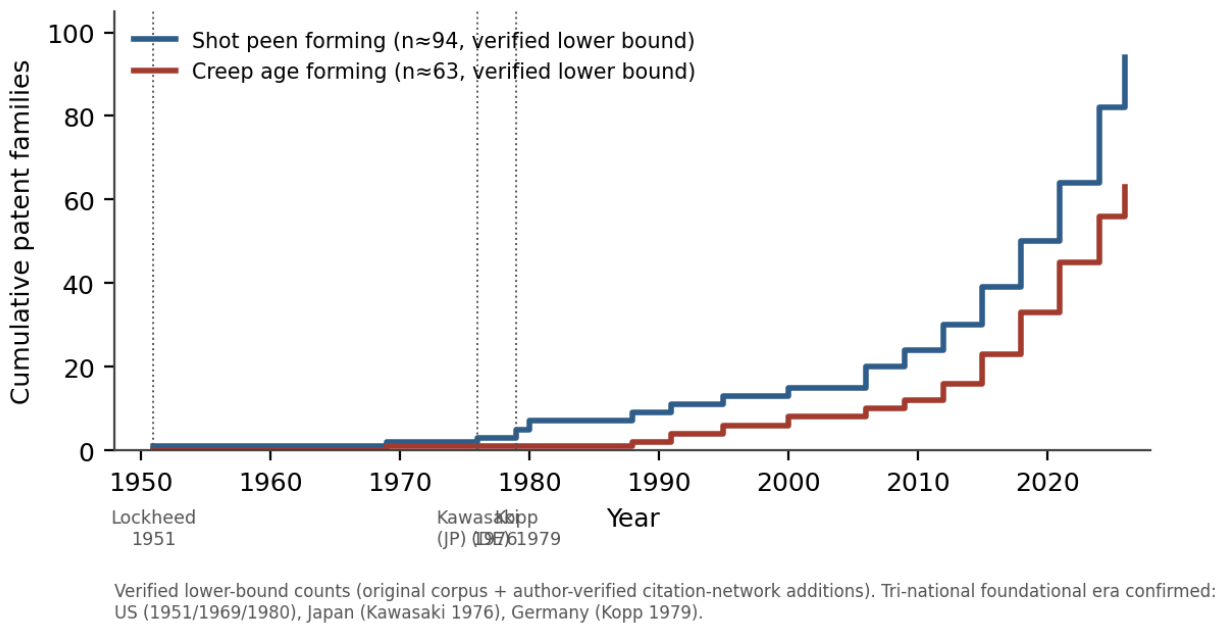
Creep age forming. This record is smaller and more discontinuous, but its foundational era is earlier and more traceable than a forward-only reading indicates. A tooling lineage is documented by direct citation. AVCO Corporation, whose aerostructures business subsequently became Textron Aerostructures, holds a foundational springback-compensated age-forming tooling patent, US5,341,303A (1991), whose inventors also authored the seminal autoclave age-forming papers [6,7], together with a companion analysis patent, US5,528,504A (1994). That patent is cited directly by the Vought tool-surface patent US5,729,462, whose assignee of record is now Northrop Grumman, and by the Embraer form-before-machining patent US20200222967A1, yielding a traceable chain from AVCO and Textron (1991) through Vought and Northrop (1995) to Embraer (2019). The Kawasaki age-forming jig of 1995, JP2742034B2, which cites the AVCO and Textron patent, extends the chain to Japan. A second thread, concerning reconfigurable tooling, is discussed in Section 4.3.
Table 2 summarises the creep-age-forming eras.
The row covering the 2000s is labelled dormancy in the patent record rather than dormancy in the technology. The distinction is material, since this is the interval during which creep age forming was being industrialised for large civil wing covers, including the Airbus A380 upper wing panels, as documented in the process-mechanics and programme literature [2,3]. A silent record across an interval of active deployment demonstrates directly that the record may fall quiet while the technology does not.
The acceleration sub-lineage. The most recent creep-age-forming activity concentrates upon a single shared problem, the multi-hour autoclave dwell, which is attacked by technically unrelated means (Table 3).
These approaches are best interpreted not as three independent streams but as a field in which one actor is dominant. Central South University, led by the lead author of [2], conducts a multi-patent programme spanning all of the acceleration modalities, comprising approximately thirty families on the present count and constituting the largest institutional cluster in the corpus. Section 4.1 argues that the persistence of unrelated modalities, rather than their number, is the informative feature.
The pin-module die patent US10,875,074B2 and EP3259081B1, held by the AVIC Beijing Aeronautical Manufacturing Technology Research Institute, functions as a hub, being cited by at least nine Central South University patents across its family members. One of its named inventors also appears on a shot-peen-forming patent from the same institution, CN115635004A and CN115635004B, which shares a mutual direct citation with the AVIC Xi’an shot-peen patent CN117340047A. Cross-process activity by a single actor is not a recent development, since AVCO appears on both the shot-peen side (US3,705,511) and the creep-age-forming side (US5,341,303A) of the Western foundational record.
3.4. Geography Under Three Measures
The raw geography (Figure 4) exhibits a qualitative near-inversion relative to the foundational eras of the two processes. Three corrections modify that reading, and they constitute the grounds for the caution expressed here against reporting family counts alone.
Under-sampling of the non-Chinese record. An entire German school, a Japanese cluster extending from Kawasaki (1976) through Mitsubishi and Subaru, the American laser-peen origin and the recent Airbus peening-forming patents became visible only through citation tracing. This is the corollary of the classification asymmetry noted in Section 2.1: because creep age forming lacks a settled class, and because classification search from a contemporary starting point under-samples the older and non-domestic record, that corpus is doubly exposed to recall error, and the shot-peen corpus is more exposed than its settled classification would suggest.
Normalisation against background filing. Raw counts cannot distinguish an increase of Chinese interest in wing-cover forming from a general increase in Chinese patenting. Both corpora were therefore indexed against a same-office, same-class baseline. The baseline is itself notable (Figure 5, left): filing in these classes at the Chinese office grew 235-fold between 1990 and 2024, from 249 to 58,631 applications per year, whereas the United States grew 4.2-fold and the European Patent Office 2.8-fold, and Japan and Germany fell to 0.5 and 0.7 respectively of their 1990 levels. The in-class share of each office’s total filing is approximately stable, indicating that this is not an artefact of class drift.
Division of the corpus by that baseline yields filing intensity, with exact Poisson confidence intervals (Table 4).
Chinese intensity fell by a factor of 0.43 between the two periods (95% confidence interval 0.22 to 0.85, excluding unity). Western intensity fell by a factor of 0.65 (95% confidence interval 0.33 to 1.29, not distinguishable from constancy). The Chinese corpus grew approximately tenfold in raw count while its background grew approximately twenty-four-fold. What survives normalisation is therefore not a Chinese expansion but a Western and Japanese contraction.
Jurisdictional breadth. Resolving every entry to its simple family and counting distinct offices (Figure 5, right), Chinese-origin families span a mean of 1.09 offices, with 96% filed at a single office. Western-origin families span a mean of 4.65 offices, with 59% filed in two or more offices and a maximum of 13. The difference in means is 3.56 offices (95% bootstrap confidence interval 2.36 to 4.85). Western families are on average 4.3 times broader, and the two distributions differ in shape, the Chinese distribution forming a spike at a single office and the Western distribution exhibiting an extended tail.
Grant outcomes. Filing is not equivalent to a right. Assessing grant at family level, 82.5% of Chinese-published families were granted in at least one office, against 95.7% of Western families. That comparison is confounded by recency, the median Chinese filing year being 2019 against 2000 for the West. Restricting the comparison to an age-matched cohort filed in 2019 or earlier, 84.6% of Chinese families were granted (95% confidence interval 72.5 to 92.0, n = 52) against 97.4% of Western families (86.8 to 99.5, n = 39), a difference of 12.8 percentage points (z = 2.03, p = 0.043). The territorial result is more pronounced: among granted families, Chinese grants span a mean of 1.01 offices, with 99% granted at exactly one office, against a Western mean of 3.33 offices and 42% granted at a single office. The difference between the two records therefore lies in enforceable scope rather than in grant success.
No claim is advanced here concerning live rights. Renewal status was determined for a stratified subset of 60 families: Chinese rights were 93% active with none past nominal term, and Western rights 21% active with 75% past term. Interpreted naively, that pattern would indicate Chinese predominance among live rights, but it is an artefact of filing age. The age-independent signal, namely early lapse within nominal term, occurs in only three records, which is too sparse to support a maintenance claim in either direction.
3.5. Transfer, Parallel Invention and Directional Flow
For the foundational methods and tooling, three transfer lineages are linked by direct citation, several of them passing through European or Japanese nodes (Figure 6): media shot-peen forming, from AVCO and Boeing through Dornier to Sonaca and AVIC; reconfigurable and flexible tooling, from Northrop Grumman to US8,303,729B2 and the AVIC Beijing pin-module die; and creep-age-forming tooling, from AVCO and Textron through Vought and Northrop to Embraer, and separately to Kawasaki. These are positive findings, in that the citation links are present in the record and are individually verifiable.
For the recent acceleration methods, no comparable citation linkage is present. It is not concluded from this that those methods were independently invented. As Section 2.5 establishes, absent citation constitutes weak evidence, and the recent stratum has had substantially less time in which to accumulate citations, so that sparse linkage is the expected observation even under identical underlying dynamics. The defensible statement is asymmetric: transfer is documented where citations record it, whereas independence is not documented anywhere.
Concerning directional flow, the West seeded the foundational methods, which are cited by later Chinese filings. In the opposite direction, the Airbus peening-forming patent of 2023, EP4450653A1, cites Chinese university laser-peen-forming patents as prior art alongside the American origin patents US6,410,884B1 and US6,670,578B2. This constitutes a threshold crossing rather than a demonstrated reversal of net flow. A single Western filing citing Chinese academic work establishes that this literature has become visible in Western prosecution, which was previously unattested, but it does not establish that the balance of influence has reversed, which would require a directional citation balance that has not been computed here. In European practice the search report is the product of the examiner, so that such citations may evidence examiner search reach rather than applicant knowledge. Separation of applicant-supplied from examiner-supplied citations is a precondition for any claim concerning influence, and is not attempted in this study.
The corpus additionally contains a clear instance of domestic diffusion (Figure 7). The COMAC seed patent CN101988146B, filed in 2009 and granted in 2012, is cited directly by eight later Chinese patents across at least seven institutional assignees between 2012 and 2024, while its own backward citations indicate that it drew upon prior Chinese work already in existence by 2006 and 2007. The domestic Chinese creep-age-forming lineage therefore substantially predates the 2009 filing, and did not originate, by any citation link visible in this record, in the Western patents of the 1990s.
One analysis reported in this paper rests upon a patent of which the author is an inventor, namely the forward-citation count for US7,322,223, the founding mechanical-vibration patent. It was compiled by the author rather than by an independent party, and independent replication is recommended before it is relied upon beyond the present analysis.
The corpus further surfaced a coherent multi-institution literature concerning creep age forming of launch-vehicle propellant-tank domes, comprising work by Tianjin Aerospace Long March, Beijing Xinghang Machinery, the Shanghai Aerospace Equipment Manufacturer, the Beijing Institute of Aerospace Systems Engineering, the tank-side programme at Central South University, and the Aérospatiale Matra Lanceurs patent FR2809033A1. This body of work shares the core process but constitutes a distinct application domain. It is excluded here and noted as material that a broader aerospace study could absorb. Its existence is itself a finding, in that creep age forming possesses a second and institutionally distinct aerospace application.
3.6. Convergence of the Two Lineages
A cluster of filings dated between 2019 and 2024 combines peening with thermal or electrical creep-forming mechanisms (Figure 8), reconstructed both from the background section of US12,529,130 and from independent citation checks. Its composition constrains what may be inferred from it. The members are Suzhou University of Science and Technology, Changzhou University, Northwestern Polytechnical University, Jiangsu University, Ningbo University and Central South University, comprising six universities and no original-equipment manufacturer. Since patents evidence claimed capability rather than production use, and academic filings constitute the weakest available evidence of industrial commitment, this cluster is not read as evidence that the two process families are merging in industrial practice. The better-supported interpretation is the converse: mechanism-level convergence is visible in the Chinese academic literature and absent from manufacturer filings in either corpus, which is consistent with a decoupling of academic from industrial activity.
4. Discussion
4.1. Implications of the Divergent Bottlenecks for Process Choice
The claim-type result reported in Section 3.2 constitutes the most directly applicable output of this analysis, since it locates the difficulty associated with each process rather than describing its mechanics.
For an engineer evaluating creep age forming, the patent record indicates that risk resides in tooling and geometry transfer. Forty per cent of the corpus, concentrated in the eras during which the process was being industrialised, addresses die construction, springback compensation and contour development. The implication is that a creep-age-forming route should be costed and de-risked principally around die design, springback prediction and tool reuse across variants, rather than around the metallurgy, which the corpus treats as largely settled. This is consistent with the constitutive-modelling emphasis of the mechanics literature [2].
For shot peen forming the record indicates the converse. The mechanism was settled by the 1980s, and in three countries rather than one, and 24% of the corpus, rising to approximately one third of recent filings, addresses measurement, compensation and closed-loop control. A shot-peen route should therefore be costed around process control, inspection and the digital infrastructure required to hold contour tolerance, which is the area in which the industry itself has invested since the mid-1980s [9].
A third and cross-cutting observation follows from Table 3. Multiple actors have attacked the autoclave dwell by physically unrelated means, comprising mechanical vibration, ultrasound, electric pulse and laser, sustained over two decades without convergence upon any one of them. In a functioning technology race, a method that succeeded would attract imitation and the diversity would collapse. Its persistence is therefore evidence that none has solved the problem, which establishes cycle time as the binding economic constraint upon creep age forming rather than a solved parameter. For a manufacturer, this argues against assuming near-term relief from the dwell penalty.
4.2. Classification, Schedules and the Consequences for Creep Age Forming
Shot peen forming acquired a stable classification early, whereas creep age forming has not. This is interpreted here as a property of the technologies rather than as an administrative accident. Shot peen forming involves media, a nozzle, a machine, a measurable coverage state and an inspectable surface signature, all of which are features that classification schemes are constructed to index. The novelty of creep age forming resides in a time, temperature and load schedule executed in generic equipment: the autoclave is not specific to the process, and what is invented is a trajectory through time. Classification systems index apparatus and material transformations, and possess no natural category for a schedule.
This generalises into a falsifiable proposition: process innovations whose novelty resides in a schedule rather than in a machine will tend to be under-classified, to be harder to detect infringement of, and correspondingly to be protected by secrecy rather than by patent. Three consequences follow for creep age forming, all of them consistent with observation. Its patent record understates its industrial significance to a greater degree than does that of shot peen forming. Its recall behaviour under classification search is poor. And its apparent dormancy during industrial deployment on the A380 wing is expected rather than anomalous. The proposition is testable outside the present domain, in that heat treatment, ageing and curing processes generally should exhibit the same signature relative to their apparatus-based neighbours.
4.3. Programmable Geometry as the Substantive Convergence
Section 3.6 declines to interpret the recent hybrid academic filings as industrial convergence. There is, however, a convergence within the record that is better evidenced, of longer standing and industrial in character. The Northrop Grumman reconfigurable pin-die patent US6,089,061A (1999) is a documented common ancestor, by direct citation, both of a creep-forming tool (US8,303,729B2) and of the AVIC Beijing pin-module creep-age-forming die (US10,875,074B2). Reconfigurable and prestress tooling recurs on the shot-peen side also, in US5,826,453 and in the Chinese prestress-fixture filings.
Considered together with the finding that the binding constraint upon creep age forming is geometry transfer, this indicates that the object of innovation in both families is converging not upon a shared forming mechanism but upon a shared capability, namely inexpensive and reconfigurable definition of contour. Whether curvature is delivered by shot, by laser or by thermal creep is secondary to whether target geometry can be specified, held and altered without commitment to a dedicated die. This convergence is evidenced by direct citation between industrial actors rather than reconstructed from the background section of a patent, dates from 1999 rather than 2019, and involves manufacturers rather than universities.
The most recent stratum is consistent with the same interpretation. Simulation-guided closed-loop forming, comprising Airbus EP4450653A1 (2023), the COMAC lineage (2020 to 2026) and Central South University CN118308589B (2024), is indifferent to the means by which the eigenstrain is delivered. If the frontier has moved to the control and geometry-definition layer, the classification distinction that rendered shot peen forming legible will progressively cease to track the location of innovation, and the two corpora will become more difficult to separate. This constitutes a dated and falsifiable prediction, in that continued divergence of the two classes would refute it.
4.4. Patent Records as Evidence of Institutional Behaviour
The corpora exhibit a contrast across institutional forms, and the patent signatures differ more across those forms than across the two technologies. Soviet and Russian state institutes are near-silent: a targeted search of the Russian and Soviet record returned no retrievable wing-panel filings in either process. This is interpreted as evidence concerning a disclosure regime rather than concerning capability, since the underlying engineering is not in doubt, development having been conducted in state design bureaux that documented outputs in internal technical literature for which a domestic exclusion right served little function. Chinese universities file in high volume, 96% at a single office, obtaining grants that are territorially confined, and concentrate under few principal investigators. Chinese state-owned manufacturers conduct sustained domestic multi-stream programmes. Western manufacturers file few but broad multinational families across long intervals. Individual inventors file narrowly but persistently.
Three consequences follow. First, this accounts for the creep-age-forming dormancy without recourse to any loss of technical interest, since the quiet interval of the 2000s coincides with industrial application, and what lapsed was the incentive to disclose rather than the technology. Second, national shares are not comparable without conditioning upon institutional composition; the normalisation reported in Section 3.4 renders this concrete rather than merely cautionary, since a raw reading would have supported the converse of what the normalised evidence supports. Third, it reframes the purpose of a landscape study: read as a census of technical activity such a study is unreliable, whereas read as a record of which actors elected to disclose what, where and under which incentives, it constitutes direct evidence, the decision to file being deliberate, dated and jurisdictionally specific.
A reflexive observation is appropriate here. The lead author of [2], the review that substantially frames creep age forming for the international literature, is also the principal investigator of the largest patent cluster in the present corpus. No impropriety is implied, this being the normal condition of a small and specialised field. It carries a methodological consequence, however, in that a landscape study seeding its search from the review literature inherits the framing of that literature, and where a single actor authors both the canonical review and the dominant portfolio, the two do not constitute independent sources of evidence concerning what matters in the field. The same standard applies to the present paper, whose initial corpus was seeded in part from [3], the author’s own work, and whose geography the citation pass subsequently corrected.
4.5. Limitations
The structural limits upon what patent counts can support are set out in Section 2.5 and are not repeated here. Beyond them, five specific gaps bound this study.
Corpus totals are verified lower bounds: a residual of 34 candidate records is uncounted, and the itemisation of the 41 initial families has not been reconciled, so that the division between initial and citation-added families in Figure 1 is provisional. Claim-type coding is applied at title level rather than to claim text, and is double-coded on a 20% sample only, with a wide confidence interval upon κ at n = 33; coding from full independent-claim text would eliminate the cue-matching failure mode entirely. Applicant-supplied and examiner-supplied citations are not separated, which limits the claims concerning influence advanced in Section 3.5. Origin is assigned by office of publication rather than by applicant nationality, because the harmonised applicant field is largely absent. Finally, a recall audit against an independent gold standard, comprising the patents cited in [2,4] and the trade literature, would convert the expression “verified lower bound” from a hedge into a measured recall figure, and would test directly the central methodological claim of this paper.
Geographic coverage extends to the principal aerospace-manufacturing jurisdictions, with Belgian and Brazilian members. The Korean and Australian records were examined only where they intersected the citation network and were not searched systematically; they constitute an acknowledged coverage boundary. In the case of Russia, retrieval caveats are material: Soviet-era indexing and translation coverage are weaker than for the other offices searched, so that a retrieval failure cannot be fully separated from an absence of filing, and no claim is advanced that these processes were absent from Soviet or Russian wing structures.
5. Conclusions
Shot peen forming and creep age forming exhibit measurably different bottlenecks, and this constitutes the result of greatest utility for route selection. Creep age forming devotes 40% of its patent corpus to tooling against 15% for shot peen forming, whereas shot peen forming devotes 24% to control and compensation against 8% for creep age forming. The binding constraint upon creep age forming has been geometry transfer, and that upon shot peen forming has been process control. A creep-age-forming route should therefore be de-risked around die design, springback compensation and tool reuse, and a shot-peen route around measurement, control and the digital infrastructure required to hold contour tolerance. The persistence of unrelated cycle-time acceleration methods over two decades, without convergence upon any of them, indicates that the autoclave dwell remains the unrelieved economic constraint upon creep age forming.
The foundational era of shot peen forming is tri-national, comprising the United States, Germany and Japan, rather than exclusively American, and three foundational transfer lineages are documented by direct citation, frequently through European or Japanese nodes. In the recent strata no comparable linkage exists, but no conclusion of independent invention is drawn from that absence, since citation accretion and office practice predict sparse linkage in a young stratum irrespective of the underlying dynamics.
The apparent Chinese dominance of the recent record survives neither correction applied to it. Indexed against filing in the same classes and offices, Chinese intensity fell by a factor of 0.43 between the periods 1990 to 2009 and 2010 to 2024, the Chinese background having grown 235-fold while the Chinese corpus grew approximately tenfold. Furthermore, 96% of Chinese families do not extend beyond their home office, against a Western mean of 4.65 offices, and 99% of Chinese grants are confined to a single office against a Western mean of 3.33. What survives these corrections is a Western and Japanese contraction, Japanese and German filing in these classes being absolutely lower at present than in 1990. A landscape read without a denominator, without a breadth measure and without grant data would have supported the converse conclusion on three separate counts.
Two further conclusions concern the manner in which such records should be read. Classification systems index machines rather than schedules, which accounts both for the absence of a settled class for creep age forming and for the understatement of its industrial significance by its patent record, the process having been in production on a wide-body wing during the interval in which that record falls quiet. And the convergence exhibited by manufacturers is not upon hybrid forming mechanisms, which to date appear only in university filings, but upon programmable geometry: the reconfigurable-tooling node of 1999 is a documented common ancestor of both families, and the simulation-guided filings of the 2020s are indifferent to the means by which the eigenstrain is delivered.
Methodologically, a landscape observed only through classification search from a contemporary starting point is observed with a systematic bias toward the vantage point of the searcher. Citation-network tracing enlarged the present corpus approximately fourfold and reversed several of its apparent findings, including the account of its geography previously advanced by this author.
Supplementary Materials
The following supporting information can be downloaded at the website of this paper posted on Preprints.org.
Author Contributions
Conceptualization, A.L.; Methodology, A.L.; Software, A.L.; Validation, A.L.; Formal Analysis, A.L.; Investigation, A.L.; Data Curation, A.L.; Writing – Original Draft Preparation, A.L.; Writing – Review & Editing, A.L.; Visualization, A.L.; Project Administration, A.L.
Funding
This research received no external funding.
Data Availability Statement
All patent records analysed in this study are publicly available via Google Patents and Espacenet, and the numbers required to retrieve every record discussed are provided in the text, in the tables and in the Supplementary Material. The consolidated corpus register, comprising every counted and excluded family together with its scope decision, verification status and claim-type coding, the patents-cited list with titles, the normalisation baseline and the queries reproducing the analysis are provided as Supplementary Material. These will be deposited in a public repository with a persistent identifier upon acceptance, in order that the counts, the coding and the exclusions may be independently audited or re-coded.
Conflicts of interest
AL is an inventor on two of the patent families analysed in this study. The first, US7,322,223, is discussed in Section 3.3 and appears in Table 3 as the founding entry of the mechanical and vibrational acceleration approach. The second, US8,303,729B2, is discussed in Section 3.5 and Section 4.3 as a corpus member descending from the Northrop Grumman reconfigurable pin-die patent. Both families are treated in the analysis on the same evidentiary footing as every other family in the corpus, with no differential weighting or narrative emphasis. The single analysis resting upon the author’s own patent, namely the forward-citation reading of US7,322,223, is identified in Section 3.5, and independent replication is recommended before it is relied upon. AL certifies that he has no other financial conflicts of interest, whether consultancies, stock ownership, equity interest, or other patent or licensing arrangements, in connection with this article. AL further notes that reference [3] is his own preprint. In order to avoid dependence upon non-peer-reviewed work, the claim-type classification scheme is restated in full in Section 2.3 rather than incorporated by reference.
Acknowledgments
The author thanks the second coder who independently coded the claim-type reliability sample reported in Section 2.3. [amend or delete as appropriate].
References
- Miao, H.; Demers, D.; Larose, S.; Perron, C.; Lévesque, M. Experimental study of shot peening and stress peen forming. J. Mech. Work. Technol. 2010, 210, 2089–2102. [Google Scholar] [CrossRef]
- Zhan, L.; Lin, J.; A Dean, T. A review of the development of creep age forming: Experimentation, modelling and applications. Int. J. Mach. Tools Manuf. 2011, 51, 1–17. [Google Scholar] [CrossRef]
- Levers. Metal forming of metallic aircraft wing covers: process origins, industrial development and programme-level evidence, Preprints.org. 2026. [Google Scholar] [CrossRef]
- Xiao, X.; Tan, Z.; Gao, G.; Du, J.; Zhang, Y.; Li, Y.; Guo, M. Review on incremental deformation in shot peen forming and forming accuracy control methods. Int. J. Adv. Manuf. Technol. 2026, 143, 6179–6200. [Google Scholar] [CrossRef]
- Moore, D. The Application of Shot Peen Forming Technology to Commercial Aircraft Wing Skins. Aerospace Congress and Exposition, LOCATION OF CONFERENCE, United StatesDATE OF CONFERENCE.
- Brewer, H. Age forming integrally stiffened, aluminum aerospace structures in an autoclave. Aircraft Design and Operations Meeting, LOCATION OF CONFERENCE, U.S.ADATE OF CONFERENCE.
- Holman, M.C. Autoclave age forming large aluminum aircraft panels. J. Mech. Work. Technol. 1989, 20, 477–488. [Google Scholar] [CrossRef]
- Kopp, R.; Schulz, J. Flexible Sheet Forming Technology by Double-sided Simultaneous Shot Peen Forming. CIRP Ann. 2002, 51, 195–198. [Google Scholar] [CrossRef]
- Vaccari, J.A. Peen forming enters the computer age. Am. Mach. 1985, 129, 91. [Google Scholar]
Figure 1.
Record flow for corpus construction, from initial classification- and keyword-anchored search through the citation-network pass to the counted corpus.
Figure 1.
Record flow for corpus construction, from initial classification- and keyword-anchored search through the citation-network pass to the counted corpus.
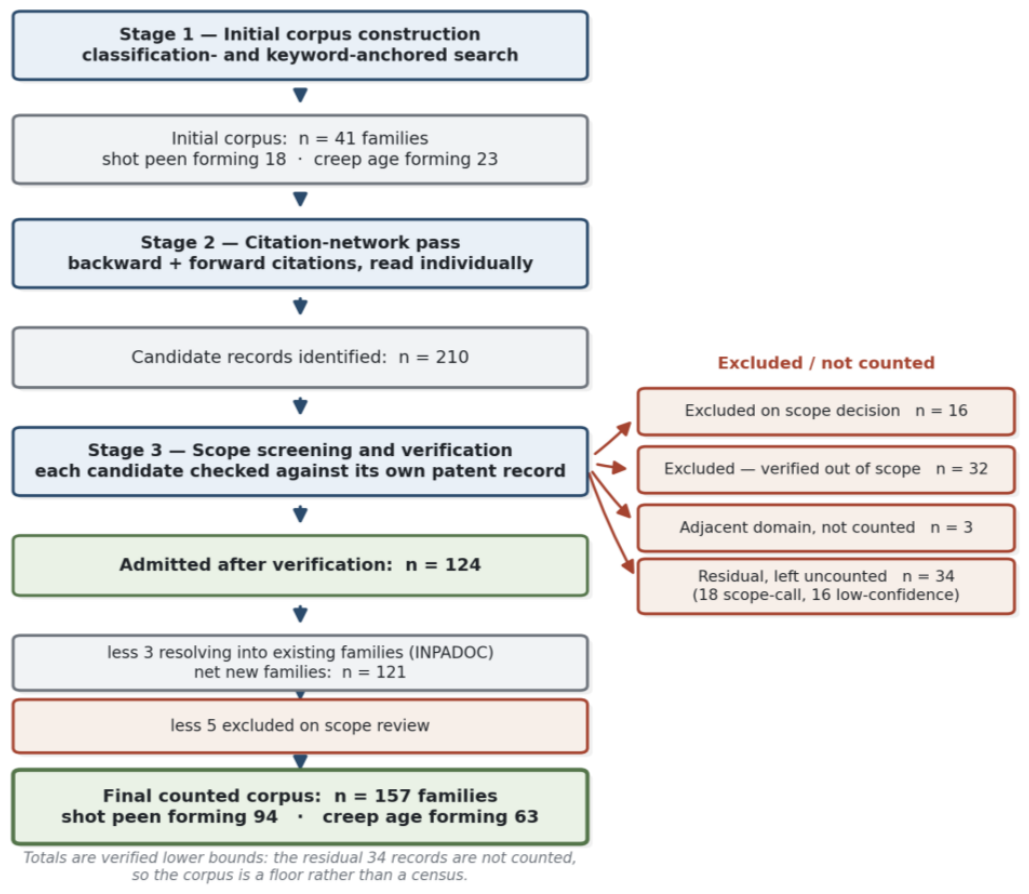
Figure 2.
Claim-type composition of the two corpora by era and overall. Coding is applied at title and subject level, with a 20% sample double-coded; shares rather than counts carry the comparison, and both reported ratios are invariant to the coding correction described in Section 2.3.
Figure 2.
Claim-type composition of the two corpora by era and overall. Coding is applied at title and subject level, with a 20% sample double-coded; shares rather than counts carry the comparison, and both reported ratios are invariant to the coding correction described in Section 2.3.
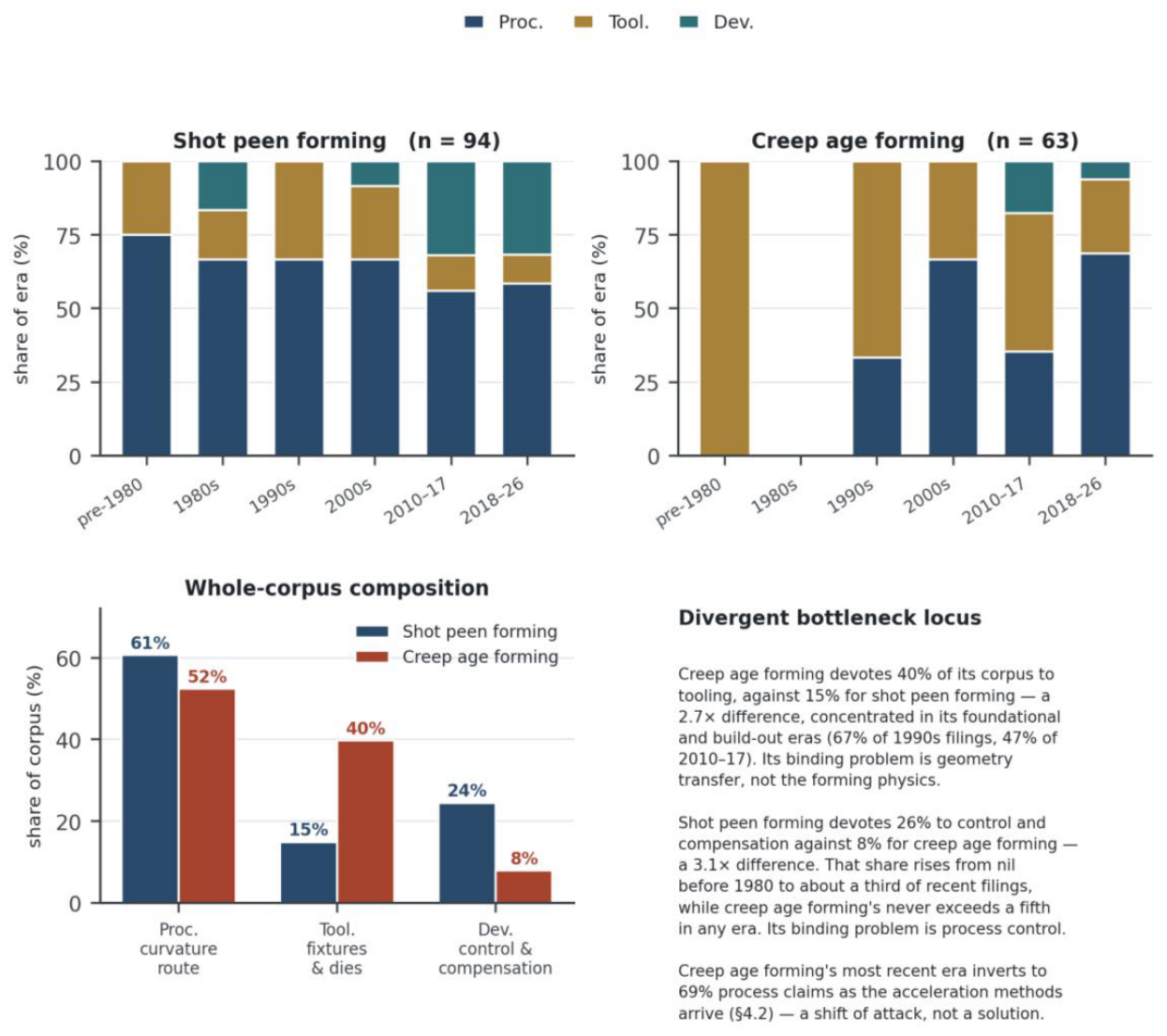
Figure 4.
Assignee geography of the two corpora by counted family. Family-level counting weights a domestically confined filing and a multinational family equally.
Figure 4.
Assignee geography of the two corpora by counted family. Family-level counting weights a domestically confined filing and a multinational family equally.
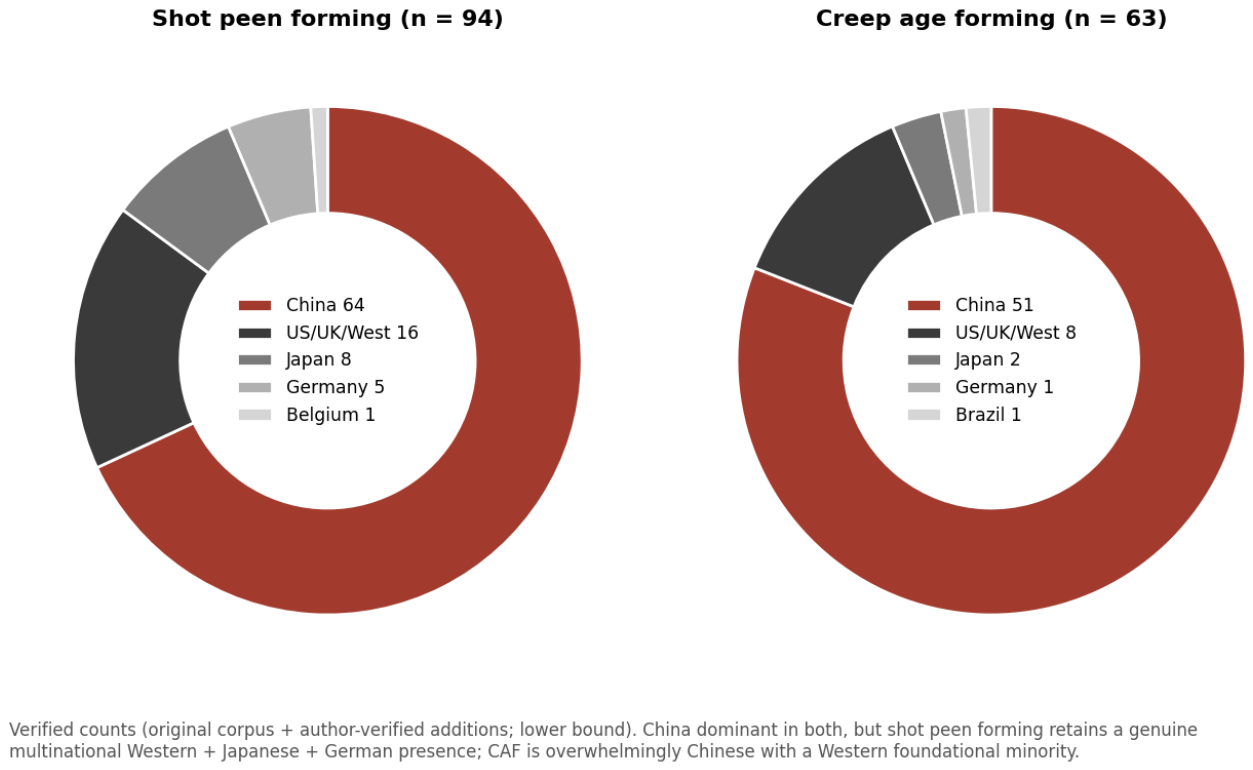
Figure 5.
Left: background filing in B21D, C21D and B24C by office, logarithmic scale, 1990 to 2024. Centre: corpus filing intensity normalised against that baseline, with exact Poisson 95% confidence intervals. Right: jurisdictional breadth, expressed as distinct offices per simple family, by origin.
Figure 5.
Left: background filing in B21D, C21D and B24C by office, logarithmic scale, 1990 to 2024. Centre: corpus filing intensity normalised against that baseline, with exact Poisson 95% confidence intervals. Right: jurisdictional breadth, expressed as distinct offices per simple family, by origin.
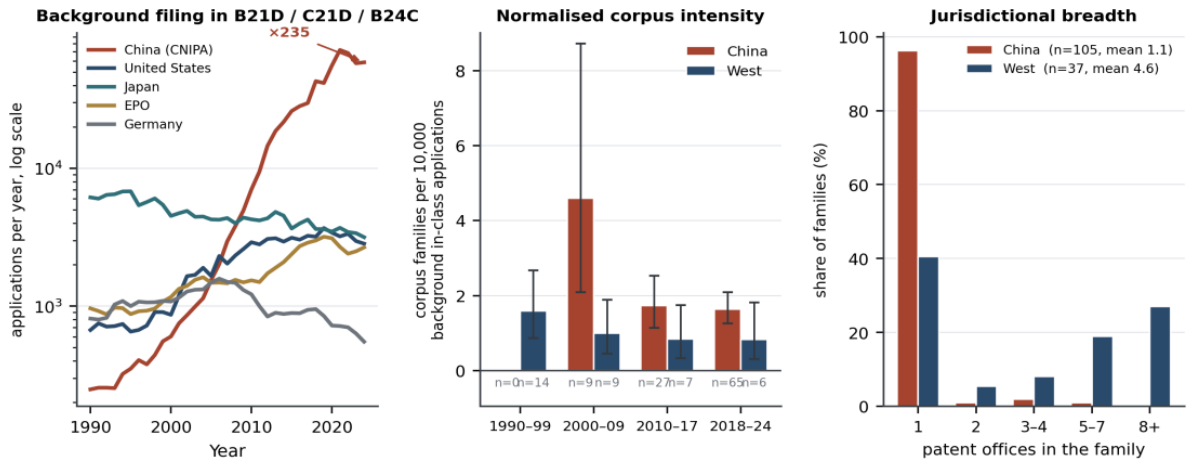
Figure 6.
Documented foundational-transfer lineages and the bidirectional relationship between the Western and Chinese literatures.
Figure 6.
Documented foundational-transfer lineages and the bidirectional relationship between the Western and Chinese literatures.
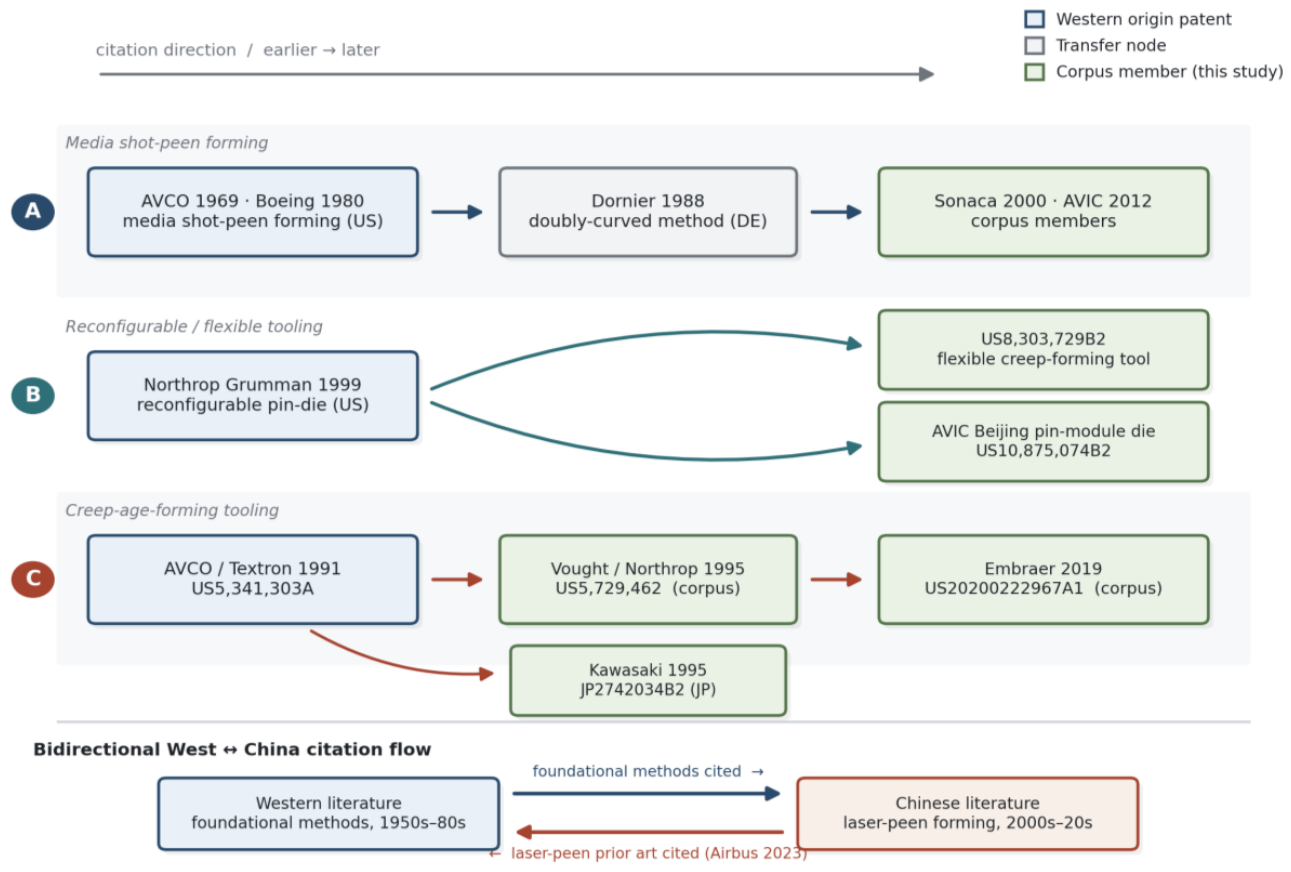
Figure 7.
Citation network of the COMAC seed creep-age-forming patent, showing backward citations to prior domestic work and eight forward citations across seven institutions.
Figure 7.
Citation network of the COMAC seed creep-age-forming patent, showing backward citations to prior domestic work and eight forward citations across seven institutions.
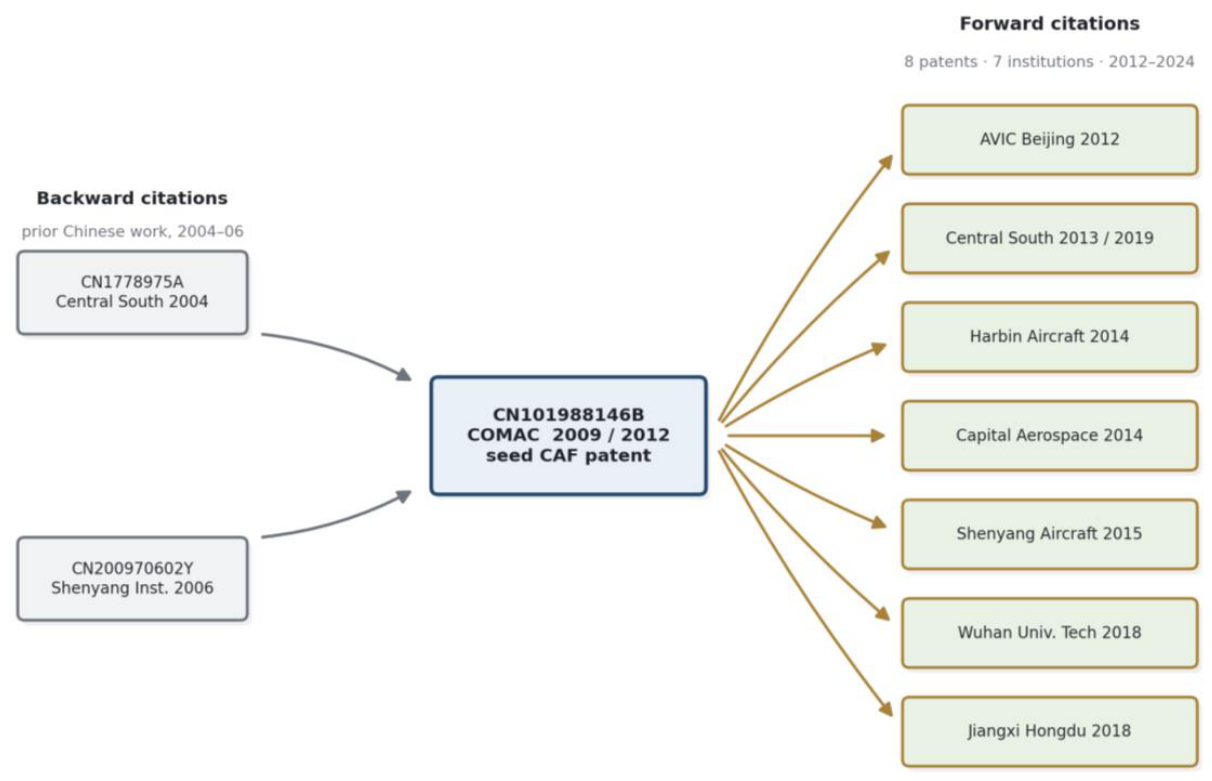
Figure 8.
Convergence cluster combining peening with thermal or electrical creep forming, 2019 to 2024. All members are university assignees.
Figure 8.
Convergence cluster combining peening with thermal or electrical creep forming, 2019 to 2024. All members are university assignees.
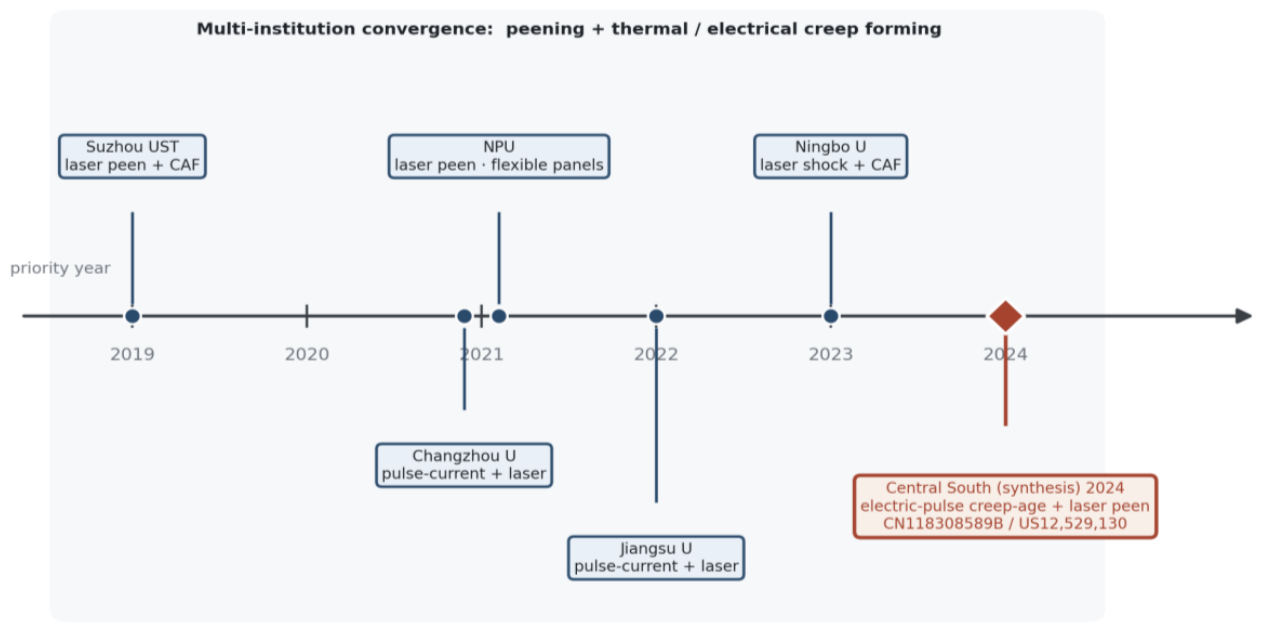

Table 1.
Principal eras in the shot-peen-forming corpus.
| Era | Approximate dates | Representative patents | Claim focus |
| Foundational, United States | 1951-1970s | Lockheed US2,701,408A (1951); AVCO US3,705,511 | Basic curvature generation by shot or ball impact |
| Foundational, international | 1976-1988 | Kawasaki JPS5299961A (1976); Kopp US4,350,035A (1979); Boeing US4,329,862 (1980); Dornier US5,072,606A (1988) | Near-simultaneous development in three countries; equal-strain track-line and doubly-curved methods |
| Compound-contour codification | 1980s | US4,329,862; US4,694,672; German equal-strain-zone method | Spanwise, chordwise and saddle-back contour control |
| Fixture and prestress | 1990s | US5,826,453; Kugelstrahlzentrum Aachen US7,181,944B2 | Preload fixtures; simultaneous two-sided rib peening |
| Directional rib peening | 2000s-2010s | CA2317845C (Sonaca) | Selective zone peening for dihedral generation |
| Independent Chinese development | 2006-present | CN101015908A and CN100431793C, and CN101045287A (Xi’an Aircraft Industry Group, 2006); CN103433854B (NPU, 2013) | Chordwise equal-strength-zone forming; numerical control |
| Digitisation and digital twin | 2019-present | US10,695,890; US11,583,976B2 (Textron); Airbus EP4450653A1 (2023); COMAC simulation lineage (CN113158351B) | Closed-loop optical verification; simulation-guided forming |
Table 2.
Principal eras in the creep-age-forming corpus.
| Era | Approximate dates | Representative patents | Claim focus |
| Foundational, Western | 1970s-1990s | Boeing vacuum creep-forming fixture US3,739,617A (priority 1970); AVCO and Textron US5,341,303A (1991) and US5,528,504A; US5,729,462 (Vought, record assignee Northrop Grumman); US5,168,169A (Textron) | Basic process; springback-compensated die-contour development |
| International foundational | 1988-2000 | Kawasaki JP2742034B2 (1995); Daimler-Benz Aerospace and EADS Deutschland (1995, 2000) | Tooling and forming outside the United States and United Kingdom |
| Dormancy in the patent record | c. 2000-2010 | None | Limited new patenting activity |
| Chinese institutional build-out | 2008-present | CN101988146B (COMAC, 2011); CN102581124B (NPU, 2012); CN101518803B (NPU, 2008); Central South University tooling body | Springback-compensated clamps and flexible tooling |
| Cycle-time acceleration | 2001-2025 | See Table 3 | Reduction of the multi-hour autoclave dwell |
| Hybrid convergence | 2019-2025 | CN110802218B; CN118308589B and US12,529,130; CN116274593A | Combination of creep-ageing and peen-based eigenstrain mechanisms |
Table 3.
Approaches to reducing the autoclave dwell in creep age forming.
| Approach | Representative patents | Actor type | Mechanism |
| Mechanical and vibrational loading | US7,322,223 (priority 2001); CN102416419B (Central South University, 2011) | Individual inventor, subsequently Central South University | Static and cyclic load during the ageing dwell to raise creep rate |
| Ultrasonic assistance | US11,597,008B2 and continuations; CN118616568A, CN118492157A (2024) | Individual inventor; Central South University | High-intensity ultrasonic vibration with load and heat |
| Electric-pulse assistance | CN118308589B and US12,529,130; CN118513444B; CN117772914B; CN118832048B | Predominantly Central South University | Current pulses reduce activation energy and raise creep strain |
| Hybrid electric-pulse and laser peening | CN118308589B and US12,529,130 (priority 11 June 2024) | Central South University | Combination of electric-pulse creep ageing with laser peening |
Table 4.
Corpus filing intensity normalised against background filing in the same classes and offices, with exact Poisson 95% confidence intervals.
Table 4.
Corpus filing intensity normalised against background filing in the same classes and offices, with exact Poisson 95% confidence intervals.
| Period and group | Families | Baseline | Per 10,000 | 95% CI |
| 1990-2009 China | 9 | 23,065 | 3.90 | 1.78 - 7.41 |
| 1990-2009 West | 23 | 178,448 | 1.29 | 0.82 - 1.94 |
| 2010-2024 China | 92 | 552,027 | 1.67 | 1.34 - 2.04 |
| 2010-2024 West | 13 | 154,221 | 0.84 | 0.45 - 1.44 |
Disclaimer/Publisher’s Note: The statements, opinions and data contained in all publications are solely those of the individual author(s) and contributor(s) and not of MDPI and/or the editor(s). MDPI and/or the editor(s) disclaim responsibility for any injury to people or property resulting from any ideas, methods, instructions or products referred to in the content. |
© 2026 by the authors. Licensee MDPI, Basel, Switzerland. This article is an open access article distributed under the terms and conditions of the Creative Commons Attribution (CC BY) license (http://creativecommons.org/licenses/by/4.0/).
Copyright: This open access article is published under a Creative Commons CC BY 4.0 license, which permit the free download, distribution, and reuse, provided that the author and preprint are cited in any reuse.


