
Submitted:
03 August 2026
Posted:
04 August 2026
You are already at the latest version
Abstract
Teacher creativity plays a central role in fostering creative learning environments. However, most evaluations of creativity training focus on performance outcomes and self-report measures rather than changes in underlying cognitive organisation. We investigated whether an eight-month certified teacher-training course based on the Scientific Creativity in Practice (SCIP) framework was associated with changes in Austrian secondary teachers’ creative performance, semantic organisation, and professional mindsets. Seventeen teachers completed pre- and post-training assessments, including the Alternative Uses Task, Verbal Fluency, Word-Sentence-Construction, Behavioural Forma Mentis associations with valence ratings, and written reflections. We assessed originality in the AUT with two independent AI-based systems. Semantic and affective changes were modelled through cognitive networks, mindset streams, and measures of emotional framing. At POST, teachers had higher AUT originality scores and generated largely different concepts than at PRE. They produced broader conceptual repertoires and larger semantic networks, although other structural changes differed across tasks. Affective changes were more modest. Positive valence predominated at both measurement points and became slightly more common, while negative valence declined. Separate PRE and POST mindset streams showed substantial pathway turnover but remained predominantly positive. These findings suggest that creativity training may support changes in how teachers organise and connect professional knowledge, and does not only impact how creatively they perform. Furthermore, our findings show that cognitive network analyses can complement traditional creativity assessments by revealing changes in semantic organisation and professional mindsets that remain invisible in performance scores alone.
Keywords:
scientific creativity
; STEM
; teacher training
; education
; cognitive network science
; AI
1. Introduction
Scientific creativity is not only a desirable outcome for students in science education. It is also needed in teachers to teach science as a process of exploration, inquiry, and adaptation rather than as a collection of fixed facts [1]. Teachers who foster creativity in the classroom must do more than transmit knowledge: They must help students explore different concepts [2], identify and build relations across domains [3], develop resilience in the face of uncertainty [4,5], and, ultimately, become capable of re-framing mistakes as opportunities for discovery [3,5,6,7]. These processes are deeply cognitive. They involve how knowledge is organised, how concepts become associated, and how scientific ideas are emotionally framed during professional practice [8].
A useful way to study these processes is to consider learning as a complex adaptive system [3,4,9,10]. In this view, concepts are not isolated units. They form structured systems whose organisation can support or constrain learning, exploration, and problem solving [11]. Cognitive network science provides a natural framework for this perspective, because it models cognition through networks of representations, links, processes, and dynamics [12,13,14]. This approach is especially relevant when the goal is not only to evaluate whether an intervention changes performance, but also to understand how it may reorganise the cognitive architecture supporting that performance [8,15].
The mental lexicon offers a powerful starting point for this endeavour [16]. According to this modelling metaphor, words in the mind are not stored as static dictionary entries: They are embedded in flexible webs of associations, meanings, contexts, and affective experiences [16,17]. A growing body of work indicates that the topology of these cognitive networks of words (or concepts [8]) can provide insights into a variety of cognitive phenomena. Network distance can quantify how close or remote two concepts are in semantic memory [18]. Centrality measures can predict aspects of lexical processing [12,19]. This suggests that the position of a word in a cognitive network reflects meaningful cognitive processes rather than being a neutral network property [20]. This motivates the use of network measures to study conceptual accessibility, semantic search, and the organisation of knowledge. Detecting changes in the structural properties of the mental lexicon can be a valuable way of measuring the cognitive traces of learning, as performed in previous work with engineering and health students [8].
This network perspective is particularly well suited for studying creativity [2,21,22]. Creative thought often requires moving beyond dominant associations and reaching concepts that are remote, unusual, or weakly connected [15,23,24,25]. Quantitative measures of semantic distance can illuminate how people explore conceptual space during creative cognition [2]. Previous work has also shown that creativity can be characterised through multiplex lexical networks and machine-learning approaches, linking creative potential to the viability of cognitive pathways across different layers of lexical organisation [13,26,27]. In this sense, creativity is not simply the production of many ideas. Instead, it is the capacity to navigate, reshape, and recombine cognitive networks of interconnected concepts. This point is crucial for teacher education [6]. A creativity-oriented training programme should not be evaluated only by asking whether participants generate more original responses after the intervention. Although this question is important, it is rather incomplete. If the intervention is cognitively meaningful, it should also affect teachers’ mindsets or perceptions. Thus, it may alter the semantic and affective systems through which teachers organise their mental representations in relationship with creativity [8,9]. Such teacher training might expand participants’ conceptual inventories [2,7], differentiate the semantic type and emotional associations of conceptual framings [2,22,28], or create novel bridges between previously distant ideas [3,8].
The present study investigates this possibility in the context of a teacher training course based on the Scientific Creativity in Practice (SCIP) programme [6]. SCIP is an educational framework for fostering scientific creativity in the classroom through a set of complementary tools. In the present study, this framework was implemented as an eight-month certified course for secondary-school teachers.
The SCIP tools target divergent thinking [2], associative thinking [9], imagination [23] and flexible problem solving [1] while fostering a positive attitude towards failure [7].
In this study, we use the term professional mindset to refer to the semantic associations and affective evaluations elicited by selected education-, science-, and creativity-related prompts. We acknowledge that these measures capture aspects of professional cognition, but not the full range of teachers’ beliefs, classroom practices, or professional identities.
1.1. Data Science Approaches
To capture these different levels of change, the present study combines classic creativity assessment with cognitive network modelling. Divergent thinking and originality are assessed through Alternative Uses responses [15,24,27]. Semantic exploration is assessed through verbal fluency and the Word-Sentence-Construction (Woseco) task [27]. In Woseco, participants build chains of sentences by repeatedly integrating concepts into coherent semantic sequences. This task can thus capture individuals’ cognitive ability to maintain meaning while generating new syntactic links within a given topic or knowledge domain. The present study further uses behavioural forma mentis networks [3,9] to reconstruct how teachers associate and emotionally evaluate concepts related to science, school, and creativity. Forma mentis networks were introduced to quantify how individuals structure knowledge and affect around relevant topics [3]. Their strength lies in combining two forms of information: semantic associations between concepts and valence labels attached to those concepts. These cognitive networks can be useful for studying not only what people associate with a topic, but also whether these associations form positive, neutral, or negative cognitive environments [9,13]. This dual semantic-affective perspective is important because professional mindsets are not purely conceptual. Attitudes arise from the interplay of cognition and affect [29]. Importantly, the strength of attitudes and their resistance to change also depend on the internal structure of individuals, not only on isolated evaluations [5,30]. In educational settings, a teacher may know many scientific concepts while still associating science with anxiety, rigidity, or failure. These associations might be passed on to students, bolstering negative attitudes toward statistics [19,31] or other math-related disciplines [3]. In contrast, another teacher may frame science as playful, exploratory, and open-ended. These affective differences matter because emotions influence language processing and conceptual accessibility [8,32]. They are therefore an integral part of the cognitive processes underlying scientific creativity. The present work also analyses written reflections through textual forma mentis networks [10,33]. Texts provide a complementary window into professional cognition. Unlike free associations, written reflections require participants to organise concepts syntactically and semantically in discourse. Network approaches to texts can reveal structural patterns in word use and conceptual organisation [34]. In this study, we use textual forma mentis networks on teachers’ reflections on creativity in science. Through these, we examine changes in semantic richness and emotional framing after the intervention.
1.2. Research Questions
This multi-layered design addresses a gap in creativity-training research. Many studies focus on behavioural outcomes [5,25]. For instance, they may ask whether creativity improved after an intervention or how the training influenced a given trait. Fewer studies ask whether such training changes the underlying cognitive structures from which creative behaviour emerges [8,19]. This is relevant since network approaches in education have shown that concept maps and knowledge landscapes can be analysed as structured cognitive systems [19,31].
Building on these advances, the framework presented here allows us to examine creativity training at three complementary levels:
- RQ1 – Creative Performance: How did participants’ AUT originality scores differ between PRE and POST?
- RQ2 – Semantic Organisation: How did participants’ conceptual repertoires and semantic network structures change from PRE to POST?
- RQ3 – Affective Framing: How did the affective framing and valence of education-, science-, and creativity-related concepts differ between PRE and POST?
We expect higher AUT originality scores and broader conceptual repertoires at POST. Because we have limited evidence for the expected direction of structural and affective changes, we treat the network-topology and emotional-framing analyses as exploratory.
This study integrates creativity scores, various cognitive network approaches (transition networks, behavioural forma mentis networks, textual forma mentis networks), and affective analyses to offer a fine-grained data-informed view of teacher professional growth. Our contribution is both empirical and methodological. Empirically, our approach examines whether teachers show changes in creative performance, semantic organisation, and professional mindsets after the SCIP programme. Methodologically, this work shows how cognitive network science can move beyond outcome measurement toward the reconstruction of the representational systems that support scientific creativity.
2. Materials and Methods
Our study used an 8-month longitudinal pre-post intervention design to investigate changes in teachers’ semantic, affective, and creative cognition following participation in the Scientific Creativity in Practice (SCIP) training programme. The teachers completed the same battery of tasks before the start (PRE) and after the completion (POST) of the training. The study was conducted in accordance with the Declaration of Helsinki, and was approved by the Ethics Committee of the University of [removed for blind review] (Protocol 2024-021, approved 21 March 2024).
2.1. Participants
A total of 35 teachers from Austrian middle and high schools participated in the PRE-study, of whom only 17 participants also completed the post-assessment. We carried out attrition analyses based on demographic and baseline variables to compare completers with dropouts who only participated in PRE. We found no statistically detectable differences between completers and dropouts. However, the attrition analysis had limited power, and selective attrition cannot be excluded. For all analyses in this research, we only consider the data of those 17 matched participants who completed both PRE and POST.
The average age was 41.6 years (PRE: 41.3; POST: 42), ranging from 24 to 57 years, with 71% female participants. Regarding the highest education level of the participants, four had a Bachelor’s degree, twelve a Master’s degree and one participant had obtained a PhD. All teachers had Austrian nationality. Our participants represent a broad spectrum of STEM and related disciplines typical of Austrian secondary education, ranging from Biology, Chemistry, Physics, and Mathematics to Informatics, English, and Geography. In Austria, secondary teacher education is based on a combination of two teaching subjects (or one teaching subject and a specialisation). Thus, prospective teachers are required to acquire qualifications in at least two domains. As a result, Austrian teachers commonly teach and receive professional training in more than one subject area [35]. This leads to overlapping subject backgrounds within our participant sample.
We recruited participants through the SCIP training programme for teachers (see Section 2.2). This is a certified professional development course for Austrian secondary school teachers, training them to teach SCIP tools in their classrooms [6]. Participation in the programme was voluntary. Teachers voluntarily enrolled through the official platform for Austrian teacher training and were not required by their school to take part. Participation in the research study connected to the training was likewise voluntary. Their successful completion of the programme and obtaining a certificate was independent of participation in the research study. Because enrolment in the SCIP programme was voluntary, our participants likely represent a self-selected group of teachers with above-average interest in creativity and professional development. A control group was not included in the study, which will be further discussed in the Limitations section.
2.2. SCIP Teacher Training
2.2.1. Intervention Timeline
The intervention examined in this study was an eight-month certified professional-development course based on the Scientific Creativity in Practice (SCIP) framework. SCIP is a didactic framework designed to foster scientific creativity through the development of divergent and associative thinking, imagination, metacognition, flexible problem solving, and a constructive approach to errors. The course was designed for Austrian secondary-school teachers, primarily from STEM subjects, who intended to implement these principles and tools in their own classrooms [1,6].
The course is designed to take place over one academic year (October-June) and consists of two instruction phases, two implementation phases, and a final presentation event (see Table 1). Activities are carried out both online and in person at the University of [removed for blind review].
The course followed a theory–practice–reflection cycle. During the input phases, participants were introduced to the theoretical foundations of scientific creativity and experienced the SCIP tools from a learner’s perspective. During the subsequent implementation phases, they applied selected tools in their regular classrooms, documented the implementation, and reflected on the results. These experiences were discussed with peers and course instructors in online reflection sessions. The second input phase built on these classroom experiences and the basic SCIP tools taught previously. Teachers were then introduced to more advanced approaches involving metacognition, embodied learning, collaboration, and positive error culture.
The course comprised 13 scheduled live sessions. This includes eight online meetings and five in-person meetings, corresponding to a total of approximately 60 contact hours. In addition, participants performed on average 10 classroom implementations. To successfully complete the course, participants were required to attend at least 85% of these scheduled sessions and implement selected SCIP tools in their own classrooms. Additionally, they had to submit written reflections, and compile a final portfolio. The portfolio documented the selected tool, how the teacher adapted it, their classroom experience, and reflection on successes and difficulties. The course instructors provided feedback on these experiences during the online reflection sessions.
2.2.2. SCIP Tools
Within the SCIP framework, scientific creativity is understood as the ability to generate varied and original ideas while maintaining scientific appropriateness. Various cognitive domains play a crucial part in it: Divergent thinking supports the production of alternatives and associative thinking enables connections between concepts. Imagination supports mental modelling and analogical reasoning, and domain-specific knowledge constrains ideas so that they remain scientifically meaningful. Metacognition helps learners monitor, evaluate, and revise their ideas. Meanwhile, a constructive error culture supports persistence under uncertainty. Therefore, SCIP treats scientific creativity not as a single skill but as the coordinated use of several cognitive, affective, and domain-related capacities. Consequently, the SCIP programme incorporates a range of instructional tools designed to support these capacities (see Table 2). Importantly, SCIP is not intended as a collection of stand-alone creativity exercises. Rather, the tools are embedded within a broader cycle of scientific knowledge activation, divergent exploration, evaluation, implementation, and reflection [6].
One tool in the SCIP programme is clustering. In these clustering activities, learners compile a list of scientific terms, based on a recently discussed scientific topic, and then organise them into meaningful categories. These categories are developed by the learners themselves. Participants are encouraged to compare alternative categories and identify relationships that are not immediately apparent. The activity is designed to improve the speed at which specialist terms can be retrieved, as well as the semantic organisation of these terms [1,7].
To further strengthen associative thinking, the programme uses the Word-Sentence-Construction (Woseco) task. Unlike clustering, which uses isolated scientific concepts, Woseco requires learners to form complex and meaningful sentence chains with newly learned technical terms. In the Woseco task, each sentence introduces a new technical term that must be incorporated into a following sentence. There it is connected with another new technical term, creating a continuous chain of linked ideas. For example, a participant might write the following in a chemistry lesson: “In chemistry, we conduct experiments. One experiment is neutralisation. Neutralisation involves acids. You mix acids with bases to form salt. Bases have a high pH value. The pH value…” Through this process, learners must continuously retrieve, connect, and integrate scientific concepts while maintaining semantic coherence. In this way, Woseco not only prompts participants to consolidate scientific knowledge, but it also encourages the creation of new semantic and syntactic links between concepts [1].
A key component in SCIP is called Flexperiments (flexible-experiments). These are open-ended experimental tasks in which learners are given a scientific problem but not a prescribed procedure. Learners need to generate several possible approaches, formulate hypotheses, test solutions, evaluate the evidence, and revise their strategy when necessary. Unlike verification experiments with a predetermined procedure and expected result, Flexperiments emphasise the exploration and comparison of alternative pathways. For example, learners may investigate how to extinguish a candle flame by using only different gases or gas-producing reactions. Many tasks use accessible, everyday materials instead of complex lab equipment. This aims to direct the attention toward experimental reasoning rather than the specialised equipment. This also shows to learners that scientific procedures can be carried out in everyday life using common items in uncommon ways [6,7].
Live Acts are learning activities based on embodied cognition. They represent scientific principles through movement, role play, and spatial arrangements. For instance, to visualise the behaviour of water molecules in liquids and ice, learners may take on the role of a molecule. In the liquid state, they move freely and continuously around one another. In ice, the participants remain in fixed positions and only vibrate slightly with their arms and legs. Such activities require learners to translate between bodily experience, macroscopic observations, and submicroscopic scientific models. They are intended to support perspective switching, model-based reasoning, analogy formation, and scientific imagination [1].
Another central component of the programme is Thinkflex (think-flexibly) which is designed to boost participants’ cognitive flexibility and divergent thinking. Thinkflex is a structured divergent-thinking method that prompts learners to generate multiple perspectives, hypotheses, explanations, arguments, or solutions in response to a scientific issue. Tasks are designed not only to increase the number of ideas, but also encourages to move across conceptual categories and generate less conventional responses. One thinkflex task may be to think of many advantages and disadvantages of fireworks. Then learners need to cluster the answers into categories, such as environmental, social, technical, and aesthetic aspects. Finally, they may come up with alternatives to regular fireworks. In this way, Thinkflex addresses ideational fluency, categorical flexibility, and originality [1,6].
In addition, the SCIP programme includes structured instruments for reflection to promote metacognition, self-regulation, tolerance for ambiguity, resilience, and positive error culture during creative problem solving. Throughout the programme, participants repeatedly reflect on their experiences, their successes, as well as what did not go as expected and why. This approach is intended to foster a constructive error culture in which unsuccessful attempts and uncertainty are recognised as normal elements of creative scientific problem solving [1]. Furthermore, reflections among peers were used to discuss implementation difficulties and generate alternative instructional solutions. This collaborative component was intended to expose participants to approaches beyond their own disciplinary routines.
Participants were encouraged to adapt these SCIP tools to their own subject areas and resources available in their classrooms. Because the teacher training targets participants from various STEM-related fields, the course focused on shared principles of scientific creativity rather than on a fixed set of subject-specific lesson plans.
As outlined in Table 2, these SCIP tools target various cognitive dimensions associated with scientific creativity, including divergent and associative thinking, metacognition, and imagination. To assess these dimensions in our study, we selected a set of tasks to capture changes in cognitive, semantic, and affective processes in our participants. They do not provide direct or exhaustive measures of all components of the SCIP programme. Table 2 therefore presents conceptual correspondences between SCIP tools and study tasks rather than one-to-one mappings. The following section provides a detailed description of these tasks and how we administered them in our study.
2.3. Study Design and Network Construction
We used a longitudinal pre-post intervention design over the course of the 8-month SCIP programme. Participants completed the same tasks before the start of the programme and after its completion. Table 2 shows which study task was used to assess each cognitive dimension targeted by the SCIP tools.
For each task, we constructed undirected semantic networks separately for PRE and POST data. All networks were built from the original German responses to avoid translation errors distorting the underlying networks. We translated the node labels into English only for the visuals presented in the Results section while keeping the original network structure intact.
2.3.1. Verbal Fluency Task
Associative thinking and semantic exploration were assessed using a semantic verbal fluency (VF) task. Verbal fluency requires participants to generate as many concepts as possible within a specified topic in a given time window. Beyond the total number of responses, the order in which concepts are produced provides information about semantic search and associative retrieval. Consecutive responses can be interpreted as transitions through semantic knowledge [7,31]. Verbal fluency data has been widely used to investigate semantic memory structure and the organisation of domain-general and domain-specific knowledge [31].
These processes are relevant to creativity because creative ideation draws on the search, retrieval, and combination of concepts stored in semantic memory. Previous research has associated the clustering of related responses and switching between semantic regions with divergent thinking and the ability to generate remote associations [36,37]. Verbal fluency networks have also been applied in previous research involving SCIP to examine the organisation of domain-general and science-specific semantic knowledge in relation to scientific creativity [7,27].
We administered two semantic fluency tasks using the prompts "school" and "science" with a time limit of one minute. These prompts were selected because they directly related to the teachers’ educational contexts.
During the analysis, we constructed undirected semantic transition networks for each topic and measurement point. This was done to retain the sequential structure of the responses. For a response sequence , an edge was created between every pair of consecutive concepts. For example, the sequence teacher, classroom, student generated the edges teacher–classroom and classroom–student.
Nodes in the networks represent the concepts produced by the participants, while edges represent transitions between them [27]. The order of the responses was only used to determine which concepts were connected. The resulting networks were created as undirected. The participant-level edge lists were then aggregated to construct one group-based network for each topic (school or science) and measurement point (PRE or POST). Repeated occurrences of the same transition were collapsed into a single edge in the unweighted group network.
Unlike many semantic-network approaches, we also retained concepts produced by only one participant. This decision was motivated by the high prevalence of idiosyncratic responses identified in the preliminary analyses (see Section 3.2.2). Excluding these concepts would have removed a substantial proportion of potentially meaningful and original responses.
For visual comparison, the PRE and POST networks are displayed as aligned temporal layers within a multiplex structure. We ensured identical node positions across both measurement points for comparability. The full code used to create and visualise the networks is openly available in our OSF repository (https://osf.io/pwgbt/overview).
2.3.2. Woseco Task
In the Word–Sentence–Construction task (Woseco), participants write a chain of consecutive sentences that are linked through repeated concepts [1] (see Section 2.2.2). Each sentence introduces a new target concept that has to be repeated and meaningfully integrated into the following sentence together with another new concept. This continues to form a chain of semantically connected sentences. The task therefore captures participants’ ability to flexibly connect concepts while maintaining grammatical and semantic coherence [27].
Woseco is relevant to the study of creativity because creative ideation involves retrieving, combining, and reorganising existing knowledge into new and appropriate relations [38,39]. In contrast to verbal fluency, which primarily involves a concept list related to a cue, Woseco requires them to construct explicit relations between concepts within a meaningful context [27]. The task combines associative retrieval with controlled conceptual integration: participants must generate a new concept, connect it to the preceding concept, and formulate a coherent sentence that constrains which associations are appropriate. Both associative abilities and controlled retrieval processes have been linked to creative idea generation [36,40]. In the context of scientific creativity, Woseco further requires participants to draw on domain-relevant knowledge and integrate scientific or educational concepts into meaningful explanations [1,27].
We want to highlight that Woseco served both as an instructional tool within the SCIP programme and as an assessment task in our study. The PRE–POST comparison allowed us to examine whether explicit practice in associative sentence construction was accompanied by changes in performance on the trained task. However, because participants became familiar with Woseco during the programme, changes in this measure may reflect task-specific learning or increased familiarity with the sentence-chain procedure. We consequently interpret the Woseco results separately from the untrained measures.
Participants completed Woseco tasks using the same two prompts as in the verbal fluency tasks, namely school and science. Their responses consisted of sentence chains in which repeated target concepts linked each sentence to the next.
To construct the Woseco networks, we extracted the repeated target concepts from each participant’s sentence chain and preserved the order in which they occurred. These target concepts formed an ordered sequence analogous to the response sequence obtained from the verbal fluency task (see Section 2.3.1). For example, a sentence chain could be: In science we conduct experiments. Experiments require a hypothesis. Whether the hypothesis is true, we see in the results. The repeated target concepts would be science, experiment, hypothesis, result. This leads to the edges science–experiment; experiment–hypothesis; hypothesis–result. Following previous work [27], the remaining words in the sentences were not included in the network representations.
The Woseco networks followed the same construction process as the verbal fluency networks (described in Section 2.3.1). Again, we created undirected semantic transition networks for each topic and measurement point. We aggregated participant-level edge lists into a group-based network, and retained idiosyncratic responses.
2.3.3. Behavioural Forma Mentis Networks and Mindset Streams
To further investigate semantic organisation and emotional framing, we used behavioural forma mentis networks (BFMN). Behavioural forma mentis networks combine continued free associations with explicit valence ratings. Thereby, they represent which concepts participants associate with a topic and how they emotionally evaluate those concepts [3,9,41]. Continued free-association tasks elicit several responses to the same cue and can provide broader coverage of associative knowledge than single-response tasks [42].
For each cue, participants were asked to produce the first three associations that came to mind. Afterwards, they rated the emotional valence of all cue words and responses on a five-point scale ranging from very negative (1) to very positive (5) [3]. Participants responded to ten cue words related to education, science, and creativity: art, biology, chemistry, creativity, life, mathematics, sustainability, physics, school, and university. This set of cue words was adapted from previous forma mentis research on STEM perception and professional mindsets [3,8,9]. We retained established cues related to STEM and educational contexts, but replaced less relevant concepts with creativity and sustainability.
BFMNs are relevant here because professional mindsets contain both cognitive and affective components. Teachers may associate the same scientific concept with different ideas and may evaluate these associations positively, neutrally, or negatively. Previous applications have used BFMNs to identify differences in how students, researchers, and professionals structure and emotionally frame STEM, education, health, and innovation [3,8,9].
We constructed group-level BFMNs for the pre- and post-assessments. In each network, nodes represent the cue words and their associations. For every participant, an associative edge was created between each cue and each of its three responses [3,9]. For example, if a participant associated science with experiment, discovery, and knowledge, the corresponding edges were science–experiment, science–discovery, and science–knowledge. No edges were created between the three responses themselves because the task establishes direct cue–response associations rather than sequential transitions between responses [9,42].
We then aggregated the cue–response edges from all participants. Repeated occurrences of the same association were collapsed into a single edge, producing an undirected and unweighted group network. Concepts can be connected across cues if they occur as a response to several cue words, or if the word itself is also one of the predefined cues.
For the group-level BFMNs, associations produced by only one participant were excluded. This filtering reduces the influence of isolated responses on global network measures [3,8,9]. However, in the separate analyses of conceptual updating and mindset streams, we retained idiosyncratic responses.
In addition to their associative topology, BFMNs include an affective layer by assigning each concept a positive, neutral, or negative valence label. Extending previous BFMN approaches to affective concept labelling [3,43,44], we used a direction-constrained participant-adaptive procedure. We developed this adaptation to account for differences in how participants used the five-point rating scale while preserving the original direction of the scale. For this participant-adaptive procedure, we calculated the labels separately for each participant and measurement point. When a participant rated the same concept more than once, we first represented that concept by its median rating. We then calculated the first and third quartiles, and , across that participant’s concept-level ratings. When a participant consistently used only one rating value, we retained the original scale interpretation: ratings of 1 or 2 were classified as negative, a rating of 3 as neutral, and ratings of 4 or 5 as positive. When ratings varied, a rating of 1 was always classified as negative and a rating of 5 as positive. For the remaining ratings, values below were classified as negative, values above as positive, and values between the quartiles as neutral. We then constrained this adaptive classification so that it could not reverse the direction of the original rating scale. Ratings below 3 could be classified as negative or neutral, but never as positive. Ratings above 3 could be classified as neutral or positive, but never as negative. A rating of 3 could be classified as negative, neutral, or positive depending on its position within the participant’s rating distribution. For example, if a participant mainly used ratings of 3, 4, and 5, a rating of 3 would be relatively negative, 4 neutral, and 5 positive. In contrast, if a participant only used ratings of 1, 2, and 3, the rating of 3 would be classified as positive. However, a rating of 4 could never be classified as negative and a rating of 2 could never be classified as positive.
To obtain one group-level label for each concept and measurement point, we selected the most frequent participant-level label. When two or more categories were tied, we assigned a neutral group label. Concepts produced by only one participant received that participant’s adaptive label. We did not apply word-level significance tests as done in BFMN studies with larger sample sizes [3,9] because many concepts were rated by only one or two participants. Such tests would lack sufficient observations for these concepts and would classify rare concepts as neutral by design.
As a complementary analysis, we extracted mindset streams from the BFMNs. Mindset streams are subgraphs comprising all shortest paths connecting two concepts within the network [45]. In a network, a path is a sequence of connected, non-repeated nodes. Its length corresponds to the number of edges it contains. When several paths of equal minimum length connect two chosen concepts, all of these shortest paths are included in the corresponding mindset stream. Shortest network paths have been linked to perceived semantic relatedness in memory networks [18]. Thus, they provide an interpretable representation of the conceptual routes connecting key concepts within teachers’ mindsets. Therefore, mindset streams reveal which concepts provide the most direct associative bridges between two target ideas. They further indicate whether these bridges are emotionally positive, neutral, negative, or conflicting in valence [45].
For the longitudinal comparison, we selected seven pairs to examine how creativity was connected with concepts from STEM and education. For the mindset-stream analysis, we retained idiosyncratic associations that had been excluded from the group-level BFMNs. This allowed potentially meaningful and original conceptual bridges to remain visible. In the visualisations, associations shared by at least two participants are represented by thicker edges, whereas associations produced by only one participant are shown with thinner edges. The streams are represented as undirected graphs and can be read from either endpoint.
2.3.4. Textual Forma Mentis Networks and Emotional Profiles
Participants also completed a short written reflection addressing the question: "According to you, to what extent does creativity play a role in science?" They were asked to write approximately 100 words within a time limit of six minutes. From the resulting texts we constructed textual forma mentis networks (TFMNs). These represent semantic, syntactic, and emotional structures in written data [10,33]. Written reflections provide a complementary perspective to the more constrained tasks used in this study. While verbal fluency and behavioural forma mentis tasks elicit individual concepts or associations, written reflections require participants to organise their ideas within a coherent discourse. TFMNs have previously been used to reconstruct mindsets from public discourse [10] and to examine how semantic, syntactic, and emotional features of short texts relate to creativity ratings [26]. Unlike behavioural forma mentis networks, which are constructed from explicit free associations and participant-provided valence ratings, TFMNs derive their network structure directly from written texts. Their affective information is assigned through an external psycholinguistic lexicon [33,46] (more details below).
We constructed group-level TFMNs for the pre- and post-assessments using the EmoAtlas Python library [33]. The construction of each TFMN proceeded sentence by sentence. First, the texts were divided into sentences and tokenised. Each sentence was then analysed through dependency parsing, which represents its grammatical structure as a syntactic tree [10,26,33]. This approach differs from linear co-occurrence networks, which connect words based only on their proximity in the written sequence. In contrast, dependency parsing can connect words that are separated by several intervening words [47].
After the syntactic trees were extracted, stop words were removed. Through lemmatisation we reduced inflected words to a common base form. Thus, grammatical variants of the same concept were represented by a single node. We established links between meaningful words located within a maximum distance of three steps on the dependency tree [26,33]. Nodes represent concepts expressed as lemmatised word forms, while edges represent syntactic relationships between concepts. This process is repeated for each sentence. Then, we merged all sentence-level edge lists into a participant-level representation. Finally, we aggregated the networks of all participants to obtain a group-level PRE and POST network. We collapsed duplicate edges into a single edge in the unweighted group network.
In addition to syntactic structure, TFMNs capture the emotional framing of concepts. Emotional information was obtained using the Word–Emotion Association Lexicon, also known as EmoLex [46]. EmoLex associates words with positive and negative valence and with Plutchik’s eight basic emotions: joy, trust, anticipation, surprise, fear, sadness, anger, and disgust [48]. The lexicon-based labels were assigned to the lemmatised concepts included in the networks.
Emotion profiles were quantified using the EmoAtlas procedure described by Semeraro and colleagues [33]. For each emotion, the observed number of emotion-associated concepts in the reflections was compared with a null distribution obtained through random sampling from the reference lexicon. The resulting z-score indicates whether an emotion occurred more or less frequently than expected in a null model [26,33]. Positive z-scores indicate over-representation, whereas negative z-scores indicate under-representation. Values above or below were interpreted as statistically different from the null expectation at . Like this, we computed separate emotion profiles for the pre- and post-texts and visualised them as two emotion flowers. These flowers show the relative prominence of the eight emotions of Plutchik’s theory [48].
The resulting networks were examined for differences in network size, connectivity, and emotional framing between the two measurement points (see further Section 2.4).
2.3.5. Alternative Uses Task and Calculation of Creativity Scores
To assess divergent thinking and originality, participants completed the Alternative Uses Task (AUT), a widely used measure of creative potential and idea generation [24]. In this task, participants come up with as many unusual uses for an everyday object as possible under time constraints. In our study, participants were given three minutes to generate unusual uses for a bottle and a fork.
To derive creativity scores from the AUT responses, we used two independent AI-based scoring systems: CLAUS [49] and OCSAI [50]. We chose this method over relying on human raters scoring the responses for originality, which is time- and labour-intensive. CLAUS (Cross-Lingual Alternate Uses Scoring) is based on a fine-tuned XLM-RoBERTa system and works for scoring responses in twelve languages, including German [49]. OCSAI (Open Creativity Scoring with Artificial Intelligence) is also available for German data and is based on a GPT-4o-mini supervised model [50]. Both systems estimate the originality of the AUT responses and have shown positive correlations with creativity scores assigned by human raters [51,52]. By using two independent AI methods for rating AUT originality, we aimed to reduce possible model-specific biases, achieving more accurate estimates of creativity levels.
CLAUS returns originality scores on a scale from 0 to 1, whereas OCSAI returns scores from 1 to 5. We linearly rescaled each OCSAI score to the 0–1 range before combining the two systems:
This transformation maps an OCSAI score of 1 to 0 and a score of 5 to 1. For each participant, we calculated a mean originality score separately for CLAUS and the rescaled OCSAI scores across their AUT responses. We then averaged these two system-level scores to obtain one combined AUT originality score ranging from 0 to 1. This procedure ensured that both scoring systems contributed equally despite their original differences in scale.
2.3.6. Psychometric Questionnaires: Big Five and PANAS
Finally, participants completed established psychometric questionnaires assessing personality and affect at PRE and POST. Personality traits were measured using the German version of the 10-item Big Five Inventory (BFI-10). Affect was assessed through the Positive and Negative Affect Schedule (PANAS). We used these questionnaires at both measurement points to examine their consistency across the study period. These measures provide additional personality information that may be associated with changes in creative cognition and semantic organisation.
The BFI-10 is a brief measure of the five major personality dimensions: openness, conscientiousness, extraversion, agreeableness, and neuroticism [53]. It was developed for research settings in which assessment time is limited and captures each personality dimension using two items. Personality is relevant to the present study because individual differences, particularly high openness to experience, have been consistently associated with divergent thinking and creative achievement [54,55,56]. Participants rated ten statements on a five-point scale (1 = strongly disagree; 5 = strongly agree), with two items representing each personality dimension. Of these two items, one was formulated positively, and one negatively. For instance, the items for the extraversion dimension state: "I see myself as someone who... is outgoing, sociable" (positive framing) / "... is reserved" (negative framing). We reverse-coded negatively keyed items by subtracting the given rating from 6. For instance, a rating of 2 for a negatively framed statement would result in a reverse-coded value of 4 (6-2=4). This value would then be added to the rating of the positively framed item to get the total value for this trait. Scores therefore range from 2 to 10, with higher values indicating a stronger expression of the respective trait.
The PANAS measures positive and negative affect as two separate dimensions. Depending on the timeframe specified in the instructions, it can assess momentary affect or a more enduring affective disposition [57]. We asked participants how the feelings applied to them "in general", and interpret their responses as trait-like affective tendencies rather than temporary mood states. Affect is relevant to creativity because it can influence cognitive flexibility, persistence, and idea generation [58]. Meta-analytic evidence suggests that activating positive affect generally supports creative performance, whereas the effects of negative affect depend more strongly on activation and context [58,59]. We therefore included the PANAS to characterise the affective context in which teachers approached the creativity tasks. The questionnaire consists of ten positive- and ten negative-affect adjectives [57]. We used the validated German adaptation [60,61]. Participants indicated on a five-point scale (1 = not at all; 5 = extremely) how each feeling applied to them "in general", rather than at that particular moment. For the positive and negative subscale, we summed over the responses for the ten corresponding items. This produced positive- and negative-affect scores ranging from 10 to 50. Higher scores indicate a stronger tendency to experience the respective form of affect.
Personality traits have been found to be typically stable in adulthood, although they remain capable of some change [62]. Likewise, PANAS can measure relatively enduring affective tendencies when asking about general rather than momentary feelings [57]. Therefore, we expected only limited changes in these measures over the eight-month study period. Consistent with this expectation, paired PRE–POST comparisons showed no statistically significant differences in any BFI-10 or PANAS dimension (all p > .05; see Table 3). These findings indicate that the matched participants showed a broadly consistent personality and affective profile across both measurement points.
Table 3 presents the mean scores for the Big Five personality traits and affective disposition obtained from the PANAS questionnaire. We found no statistically detectable pre-post differences. Therefore, we averaged the PRE- and POST-scores to describe the overall profile of the matched sample. Participants showed high levels of openness () and conscientiousness (), followed by extraversion () and agreeableness (). Neuroticism was lower (), indicating that our sample was generally emotionally stable.
A similar pattern can be observed for affective disposition (scores ranging from 10=low to 50=high). Participants reported positive-affect scores above the scale midpoint (), and negative-affect scores below the midpoint (). These values describe a sample characterised by relatively high openness, conscientiousness, and positive affect. Given that our participants voluntarily enrolled in the creativity programme, this suggests that our participants were already a strongly motivated group prior to the creativity training.
2.4. Measures of Network Structure
Across all network types, we calculated a set of measures on the largest connected component (LCC): number of nodes and edges, average shortest path length (ASPL), density, clustering coefficient (CC), and modularity.
Let denote a simple undirected network, where V is the set of nodes (or vertices) and E is the set of edges. The number of nodes was calculated as
and the number of edges as
Network density represents the proportion of all possible connections that are present in the network [13]:
The local clustering coefficient of node i was calculated as
where is the number of neighbours of node i and is the number of edges between these neighbours. The average clustering coefficient of the network was then calculated as
Average shortest path length (ASPL) represents the mean shortest-path distance between all pairs of nodes in the LCC [13]:
where is the length of the shortest path between nodes i and j.
Finally, modularity was calculated as
where indicates whether nodes i and j are connected. and are their degrees, and equals 1 when both nodes belong to the same module and 0 otherwise [13].
These measures provide descriptive information about network size and structure. However, density, clustering, modularity, and path length can depend on network size and degree distribution. Because the pre- and post-intervention networks differed in size, we interpret changes in these measures cautiously.
2.5. Measures of Conceptual Stability and Idiosyncrasy
We examined conceptual change in two ways. First, we measured how much each participant’s conceptual repertoire changed between the pre- and post-assessments (what we term time-idiosyncratic). Second, we identified concepts that were unique to one participant relative to the rest of the group (group-idiosyncratic).
2.5.1. Time-Idiosyncratic Concepts: Within-Participant Concept Change
Concepts that only occur in PRE or POST and not at both time points for each individual we call time-idiosyncratic concepts. For each participant, we converted the responses of the PRE and POST test into a set of unique concepts. Repeated uses of the same concept by the same participant were counted only once. Let denote the set of concepts produced by participant i in the pre-assessment and the corresponding set in the post-assessment. We measured concept stability using the Jaccard similarity coefficient [63]:
The numerator contains concepts produced at both measurement points. The denominator contains every distinct concept produced by the participant across either measurement point. A stability rate of 1 indicates identical PRE- and POST-concept sets, whereas a rate of 0 indicates that no concept occurred at both measurement points.
We divided the concepts that occurred at only one measurement point into gains and losses:
Gain represents the proportion of the repertoire that occurred only in the post-assessment. Loss represents the proportion that occurred only in the pre-assessment. However, this "loss" only suggests that the concept was not produced in the post-assessment. It does not assume that the concept was lost from the participant’s mental lexicon. Because all three measures use the same denominator, stability, gain, and loss sum to 1 for each participant.
For verbal fluency and Woseco, we calculated these measures separately for the school and science prompts. We then averaged the participant-level rates across both prompts within each task family. For the BFMN, we pooled each participant’s association responses across the ten cue words before comparing their pre- and post-sets. The predefined cue words were not included in this comparison.
2.5.2. Group-Idiosyncratic Concepts: Group-Level Concept Change
We also examined how distinctive the responses were relative to the group. For each task family and measurement point, we counted the number of participants who produced each concept. A concept was classified as group-idiosyncratic when it was produced by exactly one participant.
Let denote the set of unique concepts produced by participant i at measurement point t. The complete group repertoire was defined as:
For each concept w, we calculated its participant frequency as:
where equals 1 when participant i produced the concept and 0 otherwise. The set of group-idiosyncratic concepts was then:
Finally, we calculated the group-idiosyncrasy rate as:
For verbal fluency and Woseco, we pooled the concepts from the school and science prompts separately. For the behavioural forma mentis network, we pooled the association responses across all ten cue words, while excluding the cue words themselves.
2.5.3. Valence Stability between Pre and Post
We also examined whether the concepts that were produced at both measurement points retained the same valence label. For participant i, let denote the set of concepts produced at both PRE and POST. We calculated participant-level valence stability as:
where and are the direction-constrained participant-adaptive valence labels assigned to concept w at the two measurement points. We then averaged this rate across participants.
We separately examined group-level transitions. For each concept present in both group repertoires, we compared its PRE and POST group labels. We visualise these transitions in a Sankey diagram (see Section 3.4.1).
Participant-level stability was calculated within each participant and then averaged across participants. Group-level stability was calculated separately from the majority labels assigned to concepts occurring in both group repertoires. These two analyses therefore describe different levels of valence stability.
3. Results
We evaluated the SCIP-based teacher training from three complementary perspectives. First, we examined whether teachers’ creative performance improved over the course of the intervention (RQ1). Second, we investigated whether the training was accompanied by changes in conceptual repertoires and semantic network structure, indicating increased cognitive flexibility (RQ2). Finally, we analysed whether teachers’ professional mindsets showed changes in emotional framing related to science and creativity (RQ3).
Given the exploratory nature and small sample size (N=17) of this study, we report exact p-values and effect sizes where available. We used the conventional significance threshold of . The group-level network comparisons are descriptive and were not subjected to inferential testing.
3.1. Changes in Creative Performance
Before examining changes in creative performance, we assessed the correlation between the two AI-based scoring systems. We used two different systems as "raters" in order to reduce potential model-specific biases. Across the 17 participants, scores from CLAUS and OCSAI were strongly positively correlated both before the intervention (, 95% CI , ) and after the intervention (, 95% CI , ). Thus, participants who received higher originality scores from one scoring system generally also received higher scores from the other system. Based on this strong correlation, we averaged the CLAUS and OCSAI scores to obtain one combined AUT originality score per participant. The subsequent PRE–POST analysis used these combined AUT scores.
To examine whether creative performance changed over the course of the intervention, we compared participants’ combined AUT scores before and after the SCIP programme. Figure 1 shows the distribution of AUT scores before and after the training period. AUT originality scores increased from () at PRE to () at POST. A paired-samples t-test showed that this increase was statistically significant (, ) with a large paired-samples effect size, . The mean increase was 0.094, 95% CI [0.065, 0.123].
The paired participant trajectories (Figure 1 panel b) reveal that this increase is consistent across the sample. Only one outlier participant had a far higher AUT score at PRE than the rest of the group, and showed a slight decrease in originality for POST. However, these results should be interpreted with caution. Because the study did not include a control group and the same AUT objects were used at both measurement points, it is not possible to determine whether the observed improvement reflects effects of the SCIP training, repeated exposure to the task, or a combination of both factors. Nevertheless, the results demonstrate that teachers generated more original responses at the end of the eight-month period than at the beginning.
3.2. Changes in Conceptual Repertoires
To analyse whether teachers’ semantic representations changed over the course of the training, we analysed conceptual change at two levels. First, we quantified time-idiosyncratic concepts on the individual level. This captures how the vocabulary of each participant changed between the pre and post assessment. We assessed the extent to which concepts were retained, newly introduced, or no longer used at POST within the same individual. Secondly, we investigated group-idiosyncratic concepts, referring to concepts that were unique to individual participants relative to the rest of the group for a given task.
We want to highlight that the Woseco task was explicitly practised as part of the SCIP programme. Therefore, changes in Woseco responses might be due to greater familiarity with the task, rather than mindset change. We report Woseco alongside the other tasks for descriptive comparison but interpret its results separately in Section 3.3.2.
3.2.1. Time-Idiosyncratic Concepts
At the individual level, we calculated the proportion of concepts that (i) remained stable between measurements (Concept Stability Rate), (ii) that were newly introduced in the POST-test (Gain Rate), or (iii) were no longer present (Loss Rate). Figure 2 shows the average stability, gain, and loss rates across the three task families behavioural forma mentis (BFMN), verbal fluency (VF) and Woseco (WSC).
The mean concept stability rate was low across all three task families (BFMN: 10.2%; VF: 14.8%; WSC: 9.2%). Only approximately 9–15% of the concepts in participants’ combined repertoires occurred at both PRE and POST. The remaining concepts occurred at only one measurement point. Gain rates ranged from 43.5% in BFMN to 49.0% in WSC, while loss rates ranged from 39.3% in VF to 46.2% in BFMN. Because stability, gain, and loss were calculated using the same union-based denominator, the three rates sum to one within each task family. In VF and WSC, gain rates exceeded loss rates, suggesting more words being added in POST than were lost from PRE. BFMN showed the opposite pattern, although the difference between gain and loss was small.
These findings are noteworthy given the different task constraints. For the BFMN, participants produced exactly three associations for each cue word. In contrast, the VF and WSC tasks allowed participants to generate as many responses as possible within a time limit. Therefore, both the VF and WSC tasks naturally provide greater opportunity for conceptual expansion or loss, compared to the BFMN task with fixed response length. Nevertheless, even in the more constrained BFMN setting, participants did not simply reproduce the same associations, even though the cue words were identical between PRE and POST. Instead, they updated their semantic repertoires substantially.
3.2.2. Group-Idiosyncratic Concepts
We also examined group-level idiosyncratic concepts across the three task types Verbal Fluency, Woseco and behavioural forma mentis. We defined group-idiosyncratic concepts as those produced by only one participant within a given task. This measure describes how rare a concept was within the group. It did not determine whether the concept was retained in subsequent network construction, because the filtering rules differed across task families.
Overall, we observed task-dependent patterns of change (see Table 4). Across the Verbal Fluency tasks, participants produced more unique concepts after the intervention (+52 concepts), accompanied by a substantial increase in idiosyncratic concepts (+56 concepts). As a result, the proportion of concepts produced by only one participant increased from 63.8% to 72.2%.
A similar pattern emerged for the Woseco task, although the increase was smaller (+23 unique concepts; +13 idiosyncratic concepts). Despite this increase in absolute numbers, the idiosyncrasy rate remained relatively stable (83.7% vs. 81.1%). In contrast, the behavioural forma mentis networks showed a slight decrease in the number of unique concepts (-19 unique concepts). Likewise, the number of group-idiosyncratic concepts decreased (-21 idiosyncratic concepts). This is not surprising given the constrained nature of the task, where participants were required to produce exactly 30 associations to 10 cue words. The corresponding idiosyncrasy rate changed only slightly, from 76.8% to 74.6%. Nevertheless, despite the decrease, approximately three quarters of the BFMN concepts at each measurement point were produced by only one participant.
These observed increases in idiosyncratic responses have direct implications for the resulting semantic networks generated from the data. Because idiosyncratic concepts are, by definition, not shared across participants, they are typically excluded from group-level network construction. This means that higher idiosyncrasy in VF and WSC may not lead to larger networks but instead reduces the pool of shared concepts available if they are removed. Therefore, we retained all responses in the verbal-fluency and Woseco networks and did not discard idiosyncratic responses. In contrast, for the global BFMN measures we excluded associations produced by only one participant to be consistent with previous BFMN studies [3,9]. However, we retained these idiosyncratic associations in the conceptual-change and mindset-stream analyses, where potentially distinctive conceptual connections were directly relevant.
3.3. Changes in Semantic Network Structure
To examine whether the organisation of teachers’ semantic knowledge changed over time, we constructed group-level networks from the verbal fluency, Woseco, and forma mentis tasks. We retained idiosyncratic responses in the verbal fluency and Woseco networks. For the global BFMN measures, we retained only associations produced by at least two participants. This task-specific approach follows the construction rules described in Section 2.3.3.
3.3.1. Verbal Fluency Networks
Table 5 summarises the global network properties calculated for the largest connected component. In both verbal fluency tasks, the POST-intervention networks contained more nodes and more edges than their corresponding PRE-intervention networks. This shows that participants produced a broader set of concepts after the intervention. Density decreased for both topics, while modularity and average shortest path length showed topic-dependent changes. Because the POST-intervention networks were larger, some changes in density, modularity, and path length may simply result from the larger number of nodes and edges. We therefore interpret these measures only as descriptive features of the networks.
See Section 3.3.2 for an interpretation of the changes in Woseco network structure.
3.3.2. Woseco Networks
As mentioned previously, the Woseco task was explicitly taught and practised as part of the SCIP programme. Changes in Woseco performance may thus reflect greater familiarity with the task practised during the training. They cannot be interpreted in the same way as changes in tasks that were not directly trained. Therefore, we discuss them in this separate subsection.
As shown in Table 5, both Woseco networks contained more nodes and more edges after the intervention. For the school topic, density decreased and modularity increased. For the science topic, density remained unchanged, while modularity decreased slightly. Average shortest path length increased for the school network but decreased for the science network. Since the post-intervention networks were larger, these differences may partly reflect network size rather than meaningful structural change.
Figure 3 shows the Woseco science networks as an example of how the networks changed between before and after the training. In the visual, node positions were fixed across both layers to allow easier comparison. Blue nodes indicate concepts present in the respective network, while orange nodes indicate concepts shared between pre- and post-intervention networks. Grey nodes represent concepts absent from the displayed layer but present in the multiplex structure considering both layers. The font size of the node reflects closeness centrality within the respective network, with larger labels indicating more central concepts. Since closeness centrality is calculated for the PRE or POST networks respectively, nodes shared between both layers may be shown in larger font for one and smaller font in the other network (e.g. see node "experiment" which is more central in PRE than in POST). Edges are shown only for concepts connected within the corresponding layer.
Taken together, the Woseco networks contained more nodes and edges at POST, but the other structural measures changed differently across topics. Because Woseco was directly practised during the course and the networks differed in size, these results cannot be interpreted as independent evidence of greater semantic differentiation.
3.3.3. Behavioural and Textual Forma Mentis Networks
We also constructed behavioural forma mentis and textual forma mentis networks. These networks differ substantially in how they are generated, which is why their structural properties should be interpreted separately from the fluency-based semantic networks discussed above. BFMNs are based on a constrained continuous association task in which participants provide three associations each to a set of cue words. In contrast, TFMNs are derived from written texts and connect words through syntactic relationships. Table 6 summarises the global properties of both network types. Because the BFMNs contained multiple disconnected components, we report the size of both the full graph (G) and the largest connected component (LCC). Average-shortest-path length, density, clustering coefficient, and modularity were calculated on the LCC.
The BFMN showed slightly more nodes and edges overall at POST. However, its largest connected component became smaller (49 to 35 nodes). This indicates that the post network was slightly larger overall, but also more fragmented. Within the smaller post LCC, average shortest path length and modularity decreased, density increased, and the clustering coefficient fell to zero. Because these measures were calculated on LCCs with different sizes and structures, these measures should be interpreted with caution.
The TFMNs showed a slightly different pattern. The post-training network contained more nodes and more edges in both the entire graph and the LCC, indicating a richer semantic structure in teachers’ written reflections. At the same time, density remained virtually unchanged and modularity was highly stable (modularity: 0.551 vs. 0.560). Average shortest path length and clustering coefficient also changed only marginally. Overall, the TFMNs suggest an expansion of the semantic content of teachers’ reflections while preserving a largely stable global organisation.
3.4. Changes in Emotional Framing
3.4.1. Adaptive Valence Profiles and Valence Stability
We next examined how teachers evaluated the concepts in their behavioural forma mentis responses. Table 7 reports the direction-constrained participant-adaptive labels. Each participant–concept pair was counted once at each measurement point. When a participant rated the same concept more than once, we used its median rating.
Positive labels formed the largest category at both measurement points (PRE: 53.4%; POST: 56.8%). In terms of change, positive labels became slightly more common at POST, while negative labels decreased (PRE: 13.5%; POST: 10.7%). The proportion of neutral labels changed little (PRE: 33.1%; POST: 32.5%). However, a chi-square test of homogeneity showed that the overall distribution of positive, neutral, and negative labels did not differ significantly between PRE and POST: , , Cramer’s . Thus, the observed differences represent a small descriptive shift rather than a statistically detectable change in the overall valence distribution.
We then examined concepts produced by the same participant at both measurement points. If a concept was rated as positive/negative/neutral at both PRE and POST, we consider its valence as stable. Averaged across participants, of concepts that occurred at PRE and POST retained the same participant-level valence label (). This shows that participants generally evaluated repeated concepts in a similar way, although the degree of stability varied across teachers.
Figure 4 shows the corresponding transitions between group-level labels. A total of 117 concepts occurred in both group repertoires. Of these, 74 concepts (63.2%) retained the same group-level label. The largest flow consisted of concepts that remained positive. 19 concepts moved towards a positive label (15 neutral, 4 negative → positive) and only 3 towards a negative label (3 neutral → negative). No concept changed directly from positive at PRE to negative at POST. 21 concepts shifted to neutral (13 positive, 8 negative → neutral). In total, the positive valence category increased from 58 to 64 at POST, neutral increased slightly from 45 to 48, and negative valence labels were reduced from 14 to 5. The Sankey diagram in Figure 4 shows this stable positive core together with some updating of the group-level valence.
The valence stability rate of 75.2% on the individual-level suggests that the teachers maintained a stable positive foundation while reducing negative concepts.
3.4.2. Emotional Profile of Creativity-Science Texts
While the behavioural forma mentis analysis examined participants’ explicit valence ratings of concepts, the textual forma mentis network analysis provides insight into the emotional framing embedded in teachers’ written reflections on the role of creativity in science. To compare emotional framing before and after the intervention, we constructed separate TFMNs from the PRE- and POST-texts and derived an emotion profile for each measurement point.
Figure 5 shows the emotion profiles of the PRE and POST texts. The emotion flowers visualise the relative prominence of Plutchik’s eight basic emotions [48]. Larger petals indicate stronger representation of an emotion in the text. Higher positive z-scores indicate that a given emotion was present more often than expected from a null model. In contrast, larger negative z-scores indicate that an emotion was more strongly absent than expected by random chance. Petals filled with colour show z-scores significantly higher or lower than random expectation. Non-significant findings are shown as petals filled with white.
The two emotion profiles in Figure 5 show both stable and changing features. Trust was significantly over-represented at both measurement points and increased from in PRE texts to in POST. Anticipation was significantly over-represented before the training (), but not after (). Fear, anger and disgust were significantly under-represented at both measurement points. Sadness changed from non-significant under-representation before the intervention () to significant under-representation afterwards (). Joy and surprise were not significantly represented at either measurement point, although their z-scores increased from PRE to POST.
Overall, both emotion profiles suggest that teachers discussed the role of creativity in science using language characterised by high trust. Emotions associated with negativity or threat were largely absent. This pattern aligns with the predominantly positive participant-adaptive concept labels observed in Section 3.4.1. Both analyses suggest a positive emotional orientation, although the BFMN transitions also show some movement between positive and neutral evaluations.
3.5. Mindset Streams Linking Creativity and Science
To examine how the conceptual pathways around creativity changed over time, we extracted mindset streams from the PRE and POST behavioural forma mentis networks. Figure 6 and Figure 7 show mindset streams connecting creativity to concepts from STEM, science and joy. In the visuals, thick edges indicate associations produced by at least two participants, whereas thin edges indicate associations produced by only one participant. All mindset streams are undirected and can be read from both directions.
Figure 6 and Figure 7 show various changes in the pathways connecting creativity with the selected concepts. These changes do not follow one consistent direction. For instance, the mindset stream between creativity and biology shortened from a three-step stream at PRE to a direct connection at POST. The connection with sustainability also became shorter. In contrast, the streams connecting creativity with physics and joy became longer and included more alternative paths at POST.
The mindset streams not only show the length of the connection between creativity and the selected concepts. They also show which concepts appeared as bridges between them. The connection between creativity and biology was mediated by concepts related to nature, fun, and freedom. The cue chemistry was linked through experiment-related concepts such as reaction, materials, and colour, but also emotionally charged terms such as fun and excitement. Mathematics was connected to creativity through concepts related to thinking and solution. In PRE, physics was linked only through the intermediary concept movement, but more diversely in POST through concepts relating to mathematics and understanding. The stream connecting creativity and research involved concepts such as innovation, freedom, fun, and university, while sustainability was connected via new, fun and important. Finally, creativity was closely linked to joy in PRE through art. In POST, the mindset stream became more diverse, with six paths leading over biology, life, solution, openness to joy.
Across all concepts, the most common valence was positive. The PRE streams contained positive and neutral intermediate concepts and no negative valence. The POST streams also contained mainly positive and neutral concepts. Interestingly, one negative label appeared: time was rated negatively in the participant-adaptive valence, connecting creativity and joy.
The observed changes in cognitive pathways are noteworthy because they align with SCIP’s emphasis on both domain-specific scientific thinking and positive engagement with creativity. Taken together, the mindset streams suggest that teachers’ understanding of creativity is strongly integrated with scientific thinking, learning processes, and positive affective experiences.
4. Discussion
The present study investigated whether an eight-month teacher-training course based on SCIP was associated with changes in their creativity, semantic knowledge organisation, and professional mindsets. We combined traditional creativity assessment with several network-based approaches to capture cognitive and affective change at multiple levels. At POST, teachers showed higher creativity scores, substantial turnover in the concepts they produced, and broader semantic networks. Their emotional framing remained predominantly positive, with a small increase of positive and decrease in negative valence. Together, these findings show PRE–POST differences in AUT originality scores, conceptual repertoires, and affective framing. Since the study did not include a control group and used the same assessment tasks at both measurement points, these differences cannot be attributed specifically to the SCIP training. However, the results illustrate how cognitive network approaches can complement traditional creativity assessments in exploratory studies of teacher professional development.
Creativity Training Associated with Multi-Level Cognitive Change
Our findings indicate that the SCIP training was associated with changes at several cognitive levels. Teachers obtained higher AUT scores at POST and produced different conceptual repertoires across all semantic tasks. Their semantic networks also became larger, although changes in their wider structural properties differed across tasks. Their emotional framing remained predominantly positive and changed less than their conceptual repertoires. Rather than reproducing the same responses, teachers generated largely different concepts at POST. This pattern supports views of creativity as a process involving changes in knowledge organisation rather than isolated increases in idea fluency alone [18,28,31,38]. Overall, our findings demonstrate that combining creativity measures with cognitive network approaches provides a richer picture of professional learning than either method alone.
Expanding Semantic Repertoires Rather than Stable Associations
One of the most striking findings was the remarkably low concept stability across all three association tasks. Only approximately 9–15% of the concepts in participants’ combined PRE–POST repertoires occurred at both measurement points. The remaining concepts occurred at only one measurement point. The group networks further expanded from PRE to POST. This indicates substantial turnover in the concepts participants produced, rather than simple rehearsal of existing knowledge.
This interpretation is consistent with associative theories of creativity, which describe creative thinking as the formation of new connections between concepts rather than the repeated retrieval of existing ones [38]. Likewise, recent semantic network research argues that highly creative cognition is characterised by flexible and richly interconnected semantic memory structures [14,66]. The present study applies this network perspective to teacher professional development and documents corresponding PRE–POST differences in teachers’ conceptual repertoires. Rather than simply increasing the number of concepts teachers produced, they explored new semantic pathways and conceptual combinations.
Professional Mindsets Remained Predominantly Positive
In contrast, emotional changes were considerably smaller than the structural changes observed in the semantic networks. Positive participant-adaptive labels formed the largest category at both measurement points and became slightly more common at POST. Negative labels decreased, while neutral labels remained broadly stable. This shows that teachers already associated creativity and science with predominantly positive concepts before the training, leaving little room for further improvement.
A predominance of positive emotions was also found in the textual forma mentis analysis. Teachers’ reflections on the relation between science and creativity revealed strong expressions of trust and curiosity, whereas emotions related to threat, anger, or fear were largely absent. Such findings are compatible with theories proposing that positive emotions broaden cognitive processes and facilitate creativity and learning [67,68]. Together with the teachers’ self-reported personality traits, these results suggest that teachers entered the programme with an already positive professional mindset. This positive framing remained stable and became slightly stronger. However, the changes were modest compared with the turnover in participants’ conceptual repertoires. Because the teachers voluntarily enrolled in the creativity training, self-selection may partly explain their positive baseline.
Educators’ Mindsets Matter for Creativity
Creativity research has traditionally focused on students and the cognitive processes underlying their creative performance. Comparatively little attention has been given to the teachers who create the conditions in which creativity develops. Yet teachers’ beliefs, knowledge, and attitudes strongly influence whether creativity is recognised, encouraged, or unintentionally constrained in everyday classroom practice [69,70,71]. Our findings suggest that teachers’ professional mindsets are not static. At the POST assessment, teachers produced substantially new conceptual repertoires while maintaining a predominantly positive orientation towards creativity and science. This indicates that professional development may shape not only what teachers know, but also how they organise and connect this knowledge. Understanding these professional mindsets better is an important step towards designing teacher education that supports creativity in the classroom and, ultimately, students’ creative development [70,71].
Limitations and Future Research
Several limitations should be considered when interpreting these findings. First, the study included a relatively small sample and did not include a control group. Consequently, we cannot attribute the observed changes directly to the SCIP intervention.
A further limitation is that we used the same tasks and cue words at both measurement points. This may introduce retest effects that are hard to separate from true intervention effects. Combined with the lack of a control group, some observed improvements may reflect repeated exposure to the same tasks and cue words, practice effects, or teachers’ ongoing professional development outside the programme. Future studies should therefore include control groups and alternative task versions to better isolate intervention-specific effects.
Next, our sample consisted of teachers who voluntarily enrolled in the creativity training programme. These participants were likely more interested in creativity and more open to innovative teaching approaches than the general teacher population. Their already positive attitudes may partly explain the strong positive emotional baseline observed at PRE.
In addition, 18 of the 35 PRE participants did not complete the POST assessment. We found no statistically detectable baseline differences between completers and non-completers. However, the attrition analysis had limited power and selective attrition cannot be completely ruled out.
Our approach to classifying valence in the BFMNs also requires caution. We used a procedure that was adaptive for each participant and constrained for direction. This procedure combines the original direction of the five-point scale with each participant’s rating distribution. It avoids classifying a clearly positive rating as negative, while still allowing the interpretation of middle ratings to differ between participants. However, this exact procedure has not yet been established as a standard valence classification method for BFMNs. Future research should compare fixed cut-off points, participant-adaptive classifications, and statistical group-level comparisons in larger samples.
Regarding methodological considerations, we intentionally retained idiosyncratic concepts during semantic network construction of verbal fluency and Woseco networks because creativity interventions are expected to increase unique responses. Although this approach preserved potentially meaningful creative associations, future studies with larger samples should compare analyses that retain or discard idiosyncratic responses. This may help to determine how different network construction strategies influence conclusions about changes in network topology.
Finally, the study covered only a relatively short period. Future research should investigate whether the observed semantic restructuring persists over time, translates into classroom practice, and ultimately benefits students’ creativity and learning.
5. Conclusions
This exploratory study examined PRE–POST differences during an eight-month teacher training course based on SCIP. Teachers obtained higher originality scores on the repeated AUT at POST and produced substantially different conceptual repertoires across the two measurement points. The group-level semantic networks were generally larger at POST, although other structural properties varied across tasks. In contrast, the affective changes were modest. Teachers already evaluated creativity- and science-related concepts positively before the intervention, and this positive orientation remained at POST. Participant-adaptive labels showed a small shift towards more positive evaluations, and also the mindset streams remained predominantly, but not uniformly, positive. Our findings indicate that PRE–POST differences occurred at the levels of performance, conceptual organisation, and affect. These levels did not necessarily differ to the same degree. Our work shows what cognitive network science can add to teacher professional-development research. Instead of only asking whether teachers scored higher on creativity tests at POST, we can also describe how their reported conceptual organisation differed between measurement points. Future research should test whether these differences are specific to SCIP-based professional development and whether they translate into classroom practice and students’ own creative development.
Author Contributions
Conceptualization: E.H., K.H., W.A. and M.S.; Data curation: E.H., K.H. and W.A.; Formal Analysis: E.H.; Investigation: E.H., K.H. and W.A.; Methodology: E.H. and M.S.; Project administration: E.H.; Resources: K.H. and W.A.; Software: E.H. and M.S.; Supervision: G.R. and M.S.; Writing - original draft: E.H., G.R. and M.S.; Writing - review & editing: E.H., K.H., W.A., G.R. and M.S. All authors have read and agreed to the published version of the manuscript.
Funding
This research received no external funding.
Institutional Review Board Statement
The study was conducted in accordance with the Declaration of Helsinki, and approved by the Ethics Committee of the University of [removed for blind review] (Protocol 2024-021, approved 21 March 2024).
Informed Consent Statement
Informed consent was obtained from all subjects involved in the study.
Data Availability Statement
The original data presented in the study are openly available on OSF at https://osf.io/pwgbt/overview.
Conflicts of Interest
We declare that two co-authors of this study were involved in the development of the Scientific Creativity in Practice (SCIP) programme that was investigated in the present study. Their involvement reflects their academic interest in evaluating the effects of the intervention. None of the authors receive personal financial benefits from participant enrolment, or the outcomes of this study. All authors declare that they have no financial conflicts of interest related to the present study.
Abbreviations
The following abbreviations are used in this manuscript:
| AUT | Alternative Uses Task |
| BFMN | Behavioural Forma Mentis Network |
| LCC | Largest Connected Component |
| SCIP | Scientific Creativity in Practice |
| TFMN | Textual Forma Mentis Network |
| VF | Verbal Fluency |
| WSC | Word-Sentence-Construction; Woseco |
References
- Haim, K.; Aschauer, W. Fostering scientific creativity in the classroom: The concept of flex-based learning. International Journal of Learning, Teaching and Educational Research 2022, 21, 196–230. [CrossRef]
- Zhang, W.; Kenett, Y.N.; Ma, M.; Liu, P.; Yang, W. How Knowledge Structure and Form Shape Scientific Divergent Thinking: Evidence from Semantic Network Analysis and the Scientific Divergent Application Task. Journal of Intelligence 2026, 14, 118. [CrossRef]
- Stella, M.; De Nigris, S.; Aloric, A.; Siew, C.S. Forma mentis networks quantify crucial differences in STEM perception between students and experts. PsyArXiv 2019. [CrossRef]
- Zasso, S.; Gaggero, G.; De Marco, L.; Manfredi, L.; Sailis, G.; Sette, S.; Perinelli, E.; et al. The Role of Teacher–Student Closeness in the Relationship Between Prosocial Behavior and Academic Achievement: A Longitudinal Study in Lower Secondary Schools. In The Human and Scientific Legacy of Albert Bandura at His Centenary: The Power of Beliefs, the Courage to Change.; 2025.
- Perinelli, E. Substantive individual differences in social desirability: Stability, change, and associations with personality traits and job satisfaction in a large-scale longitudinal survey. Journal of Research in Personality 2026, p. 104726. [CrossRef]
- Haim, K.; Aschauer, W. Innovative FOCUS: A program to foster creativity and innovation in the context of education for sustainability. Sustainability 2024, 16, 2257. [CrossRef]
- Lai, C.K.; Haim, E.; Aschauer, W.; Haim, K.; Beaty, R.E. Fostering creativity in science education reshapes semantic memory. Thinking Skills and Creativity 2024, 53, 101593. [CrossRef]
- Stella, M.; Zaytseva, A. Forma mentis networks map how nursing and engineering students enhance their mindsets about innovation and health during professional growth. PeerJ Computer Science 2020, 6, e255. [CrossRef]
- Haim, E.; Van den Bergh, L.; Siew, C.S.; Kenett, Y.N.; Marinazzo, D.; Stella, M. Cognitive networks highlight differences and similarities in the STEM mindsets of human and LLM-simulated trainees, experts and academics. Journal of Complex Networks 2026, 14, cnag004. [CrossRef]
- Stella, M. Text-mining forma mentis networks reconstruct public perception of the STEM gender gap in social media. PeerJ Computer Science 2020, 6, e295. [CrossRef]
- Thomas, J.; Zaytseva, A. Mapping complexity/Human knowledge as a complex adaptive system. Complexity 2016, 21, 207–234. [CrossRef]
- Siew, C.S.; Wulff, D.U.; Beckage, N.M.; Kenett, Y.N. Cognitive Network Science: A review of research on cognition through the lens of network representations, processes, and dynamics. Complexity 2019, 2019. [CrossRef]
- Haim, E.; Stella, M. Cognitive Networks for Knowledge Modeling: A Gentle Introduction for Data-and Cognitive Scientists. Wiley Interdisciplinary Reviews: Cognitive Science 2026, 17, e70026. [CrossRef]
- Kenett, Y.N.; Anaki, D.; Faust, M. Investigating the structure of semantic networks in low and high creative persons. Frontiers in human neuroscience 2014, 8, 407. [CrossRef]
- Kenett, Y.N. What can quantitative measures of semantic distance tell us about creativity? Current Opinion in Behavioral Sciences 2019, 27, 11–16. [CrossRef]
- Vitevitch, M.S.; Siew, C.; Castro, N. Spoken Word Recognition. The Oxford Handbook of Psycholinguistics 2018, p. 31.
- Aitchison, J. Words in the mind: An introduction to the mental lexicon; John Wiley & Sons, 2012.
- Kenett, Y.N.; Levi, E.; Anaki, D.; Faust, M. The semantic distance task: Quantifying semantic distance with semantic network path length. Journal of Experimental Psychology: Learning, Memory, and Cognition 2017, 43, 1470. [CrossRef]
- Siew, C.S. Using network science to analyze concept maps of psychology undergraduates. Applied Cognitive Psychology 2019, 33, 662–668.
- Goldstein, R.; Vitevitch, M.S. The influence of closeness centrality on lexical processing. Frontiers in psychology 2017, 8, 1683. [CrossRef]
- Campidelli, L.; Domanti, U.; Fusi, G.; Kenett, Y.N.; Agnoli, S. Creativity, the fountain of youth: Association between creativity and semantic memory networks across the lifespan. Cognition 2026, 266, 106318. [CrossRef]
- Ross, W.; Agnoli, S.; Baas, M.; Danek, A.H.; Lebuda, I.; Ackerman, R.; Ammalainen, A.; Benedek, M.; Bai, H.; Ball, L.J.; et al. Creative cognition: a collaborative research agenda. The Journal of Creative Behavior 2026, 60, e70097. [CrossRef]
- Beaty, R.E.; Johnson, D.R.; Zeitlen, D.C.; Forthmann, B. Semantic distance and the alternate uses task: Recommendations for reliable automated assessment of originality. Creativity Research Journal 2022, 34, 245–260. [CrossRef]
- Guilford, J.P. The nature of human intelligence.; McGraw-Hill, 1967.
- Luchini, S.A.; Beaty, R.E.; Boyce, A.S.; Zappe, S.E.; Forthmann, B. Automating creativity assessment in engineering design: A psychometric validation of AI-generated items of the design problem task. Journal of Engineering Education 2026, 115, e70066. [CrossRef]
- Haim, E.; Fischer, N.; Citraro, S.; Rossetti, G.; Stella, M. Forma mentis networks predict creativity ratings of short texts via interpretable artificial intelligence in human and AI-simulated raters. Journal of Computational Social Science 2026, 9, 22. [CrossRef]
- Haim, E.; Clin, L.; Beaty, R.E.; Stella, M. The word–sentence–construction task versus the verbal fluency task: Capturing features of scientific creativity via semantic networks. Psychology of Aesthetics, Creativity, and the Arts 2026, 20, 781. [CrossRef]
- Benedek, M.; Kenett, Y.N.; Umdasch, K.; Anaki, D.; Faust, M.; Neubauer, A.C. How semantic memory structure and intelligence contribute to creative thought: A network science approach. Thinking & Reasoning 2017, 23, 158–183. [CrossRef]
- Edwards, K. The interplay of affect and cognition in attitude formation and change. Journal of personality and social psychology 1990, 59, 202. [CrossRef]
- Eagly, A.H.; Chaiken, S. Attitude strength, attitude structure, and resistance to change. Attitude strength: Antecedents and consequences 1995, 4, 413–432. [CrossRef]
- Siew, C.S.; Guru, A. Investigating the network structure of domain-specific knowledge using the semantic fluency task. Memory & Cognition 2023, 51, 623–646.
- Kuperman, V.; Estes, Z.; Brysbaert, M.; Warriner, A.B. Emotion and language: Valence and arousal affect word recognition. Journal of Experimental Psychology: General 2014, 143, 1065. [CrossRef]
- Semeraro, A.; Vilella, S.; Improta, R.; De Duro, E.S.; Mohammad, S.M.; Ruffo, G.; Stella, M. EmoAtlas: An emotional network analyzer of texts that merges psychological lexicons, artificial intelligence, and network science. Behavior Research Methods 2025, 57, 77. [CrossRef]
- Akimushkin, C.; Amancio, D.R.; Oliveira Jr, O.N. On the role of words in the network structure of texts: Application to authorship attribution. Physica A: Statistical Mechanics and its Applications 2018, 495, 49–58. [CrossRef]
- Österreichisches Bundesministerium für Bildung. Allgemeinbildung – Lehramtsstudien an den Pädagogischen Hochschulen – Bereich Primarstufe und Sekundarstufe, 2019.
- Ovando-Tellez, M.; Benedek, M.; Kenett, Y.N.; Hills, T.; Bouanane, S.; Bernard, M.; Belo, J.; Bieth, T.; Volle, E. An investigation of the cognitive and neural correlates of semantic memory search related to creative ability. Communications Biology 2022, 5, 604. [CrossRef]
- Beaty, R.E.; Kenett, Y.N.; Hass, R.W.; Schacter, D.L. Semantic memory and creativity: The costs and benefits of semantic memory structure in generating original ideas. Thinking & Reasoning 2023, 29, 305–339. [CrossRef]
- Mednick, S. The associative basis of the creative process. Psychological review 1962, 69, 220. [CrossRef]
- Beaty, R.E.; Kenett, Y.N. Associative thinking at the core of creativity. Trends in cognitive sciences 2023, 27, 671–683. [CrossRef]
- Wang, X.; Chen, Q.; Zhuang, K.; Zhang, J.; Cortes, R.A.; Holzman, D.D.; Fan, L.; Liu, C.; Sun, J.; Li, X.; et al. Semantic associative abilities and executive control functions predict novelty and appropriateness of idea generation. Communications Biology 2024, 7, 703. [CrossRef]
- Stella, M. Cognitive network science for understanding online social cognitions: A brief review. Topics in Cognitive Science 2022, 14, 143–162. [CrossRef]
- De Deyne, S.; Navarro, D.J.; Storms, G. Better explanations of lexical and semantic cognition using networks derived from continued rather than single-word associations. Behavior research methods 2013, 45, 480–498. [CrossRef]
- Franchino, E.; Gariboldi, F.; Grecucci, A.; Lattanzi, G.; Stella, M. Complex networks map test anxiety and wellbeing levels in students and ChatGPT. arXiv preprint arXiv:2602.13302 2026.
- Gariboldi, F.; Franchino, E.; Haim, E.; Lattanzi, G.; Grecucci, A.; Stella, M. Cognitive networks reconstruct mindsets about STEM subjects and educational contexts in almost 1000 high-schoolers, University students and LLM-based digital twins. arXiv preprint arXiv:2602.14749 2026.
- Brian, K.; Stella, M. Introducing mindset streams to investigate stances towards STEM in high school students and experts. Physica A: Statistical Mechanics and its Applications 2023, 626, 129074. [CrossRef]
- Mohammad, S.M.; Turney, P.D. Crowdsourcing a word–emotion association lexicon. Computational intelligence 2013, 29, 436–465. [CrossRef]
- Passaro, R.; Haim, E.; Stella, M. How to predict creativity ratings from written narratives: A comparison of co-occurrence and textual forma mentis networks. arXiv preprint arXiv:2601.07327 2026.
- Plutchik, R. A general psychoevolutionary theory of emotion. In Theories of emotion; Elsevier, 1980; pp. 3–33.
- Patterson, J.D.; Pronchick, J.; Panchanadikar, R.; Fuge, M.; van Hell, J.G.; Miller, S.R.; Johnson, D.R.; Beaty, R.E. CAP: The creativity assessment platform for online testing and automated scoring. Behavior research methods 2025, 57, 264. [CrossRef]
- Organisciak, P.; Acar, S.; Dumas, D.; Berthiaume, K. Beyond semantic distance: Automated scoring of divergent thinking greatly improves with large language models. Thinking Skills and Creativity 2023, 49, 101356. [CrossRef]
- Primi, R.; Beaty, R.E.; Benedek, M.; Dumas, D.; Organisciak, P.; Patterson, J.D.; Calico, T.; Piacentini, M. AI-Powered Scoring for Creative Thinking: Methods and Challenges in PISA Assessment. The Journal of Creative Behavior 2026, 60, e70082. [CrossRef]
- Saretzki, J.; Knopf, T.; Forthmann, B.; Goecke, B.; Jaggy, A.K.; Benedek, M.; Weiss, S. Scoring German alternate uses items applying large language models. Journal of Intelligence 2025, 13, 64. [CrossRef]
- Rammstedt, B.; John, O.P. Measuring personality in one minute or less: A 10-item short version of the Big Five Inventory in English and German. Journal of research in Personality 2007, 41, 203–212. [CrossRef]
- Feist, G.J. A meta-analysis of personality in scientific and artistic creativity. Personality and social psychology review 1998, 2, 290–309. [CrossRef]
- Grajzel, K.; Acar, S.; Singer, G. The Big Five and divergent thinking: A meta-analysis. Personality and Individual Differences 2023, 214, 112338. [CrossRef]
- Kaufman, S.B.; Quilty, L.C.; Grazioplene, R.G.; Hirsh, J.B.; Gray, J.R.; Peterson, J.B.; DeYoung, C.G. Openness to experience and intellect differentially predict creative achievement in the arts and sciences. Journal of personality 2016, 84, 248–258. [CrossRef]
- Watson, D.; Clark, L.A.; Tellegen, A. Development and validation of brief measures of positive and negative affect: the PANAS scales. Journal of personality and social psychology 1988, 54, 1063. [CrossRef]
- Baas, M.; De Dreu, C.K.; Nijstad, B.A. A meta-analysis of 25 years of mood-creativity research: Hedonic tone, activation, or regulatory focus? Psychological bulletin 2008, 134, 779. [CrossRef]
- Baas, M.; et al. The psychology of creativity: Moods, minds, and motives. PhD thesis, Universiteit van Amsterdam, 2010.
- Krohne, H.W.; Egloff, B.; Kohlmann, C.W.; Tausch, A. Positive and negative affect schedule–German version. Diagnostica 1996.
- Breyer, B.; Bluemke, M. Deutsche Version der Positive and Negative Affect Schedule PANAS (GESIS panel). Social Science Open Access Repository 2016.
- Bleidorn, W.; Schwaba, T.; Zheng, A.; Hopwood, C.J.; Sosa, S.S.; Roberts, B.W.; Briley, D. Personality stability and change: A meta-analysis of longitudinal studies. Psychological bulletin 2022, 148, 588. [CrossRef]
- Real, R.; Vargas, J.M. The Probabilistic Basis of Jaccard’s Index of Similarity. Systematic Biology 1996, 45, 380–385. [CrossRef]
- Silvia, P.J.; Winterstein, B.P.; Willse, J.T.; Barona, C.M.; Cram, J.T.; Hess, K.I.; Martinez, J.L.; Richard, C.A. Assessing Creativity with Divergent Thinking Tasks: Exploring the Reliability and Validity of New Subjective Scoring Methods. Psychology of Aesthetics, Creativity, and the Arts 2008, 2, 68–85. [CrossRef]
- Reiter-Palmon, R.; Forthmann, B.; Barbot, B. Scoring Divergent-Thinking Tests: A Review and Systematic Framework. Psychology of Aesthetics, Creativity, and the Arts 2019, 13, 144–152. [CrossRef]
- Li, Y.; Kenett, Y.N.; Hu, W.; Beaty, R.E. Flexible semantic network structure supports the production of creative metaphor. Creativity Research Journal 2021, 33, 209–223. [CrossRef]
- Fredrickson, B.L. The role of positive emotions in positive psychology: The broaden-and-build theory of positive emotions. American psychologist 2001, 56, 218. [CrossRef]
- St-Louis, A.C.; Vallerand, R.J. A successful creative process: The role of passion and emotions. Creativity Research Journal 2015, 27, 175–187. [CrossRef]
- Cropley, A.J. Fostering creativity in the classroom: General principles. The creativity research handbook 1997, 1, 1–46.
- Beghetto, R.A. Does creativity have a place in classroom discussions? Prospective teachers’ response preferences. Thinking skills and creativity 2007, 2, 1–9. [CrossRef]
- Davies, D.; Jindal-Snape, D.; Collier, C.; Digby, R.; Hay, P.; Howe, A. Creative learning environments in education—A systematic literature review. Thinking skills and creativity 2013, 8, 80–91. [CrossRef]
Figure 1.
Changes in AUT originality scores from pre- to post-intervention. (a) Boxplots showing the AUT score distribution before and after the training. (b) Paired participant trajectories illustrating individual changes in AUT scores. The green lines represent the group mean.
Figure 1.
Changes in AUT originality scores from pre- to post-intervention. (a) Boxplots showing the AUT score distribution before and after the training. (b) Paired participant trajectories illustrating individual changes in AUT scores. The green lines represent the group mean.
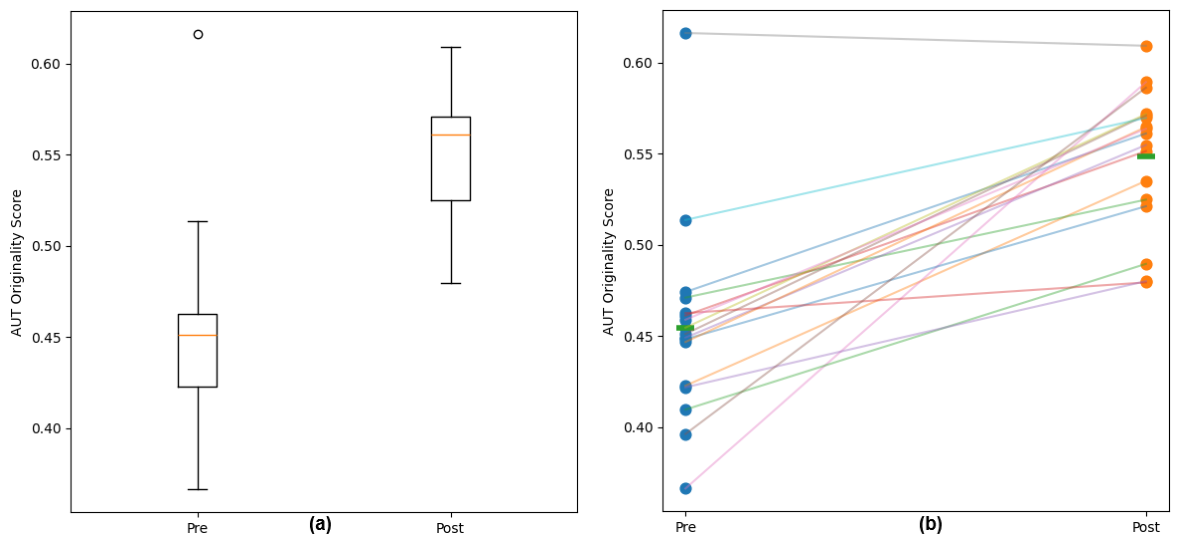
Figure 2.
Mean concept stability, gain, and loss rates across the 17 participants for the three task families. Rates were calculated separately for each participant using the union of their pre- and post-sets. For verbal fluency and Woseco, participant-level rates were averaged across the school and science prompts. For BFMN, responses were pooled across the ten cue words. Bars show group means, error bars show standard error of the mean, and points show individual participant values.
Figure 2.
Mean concept stability, gain, and loss rates across the 17 participants for the three task families. Rates were calculated separately for each participant using the union of their pre- and post-sets. For verbal fluency and Woseco, participant-level rates were averaged across the school and science prompts. For BFMN, responses were pooled across the ten cue words. Bars show group means, error bars show standard error of the mean, and points show individual participant values.
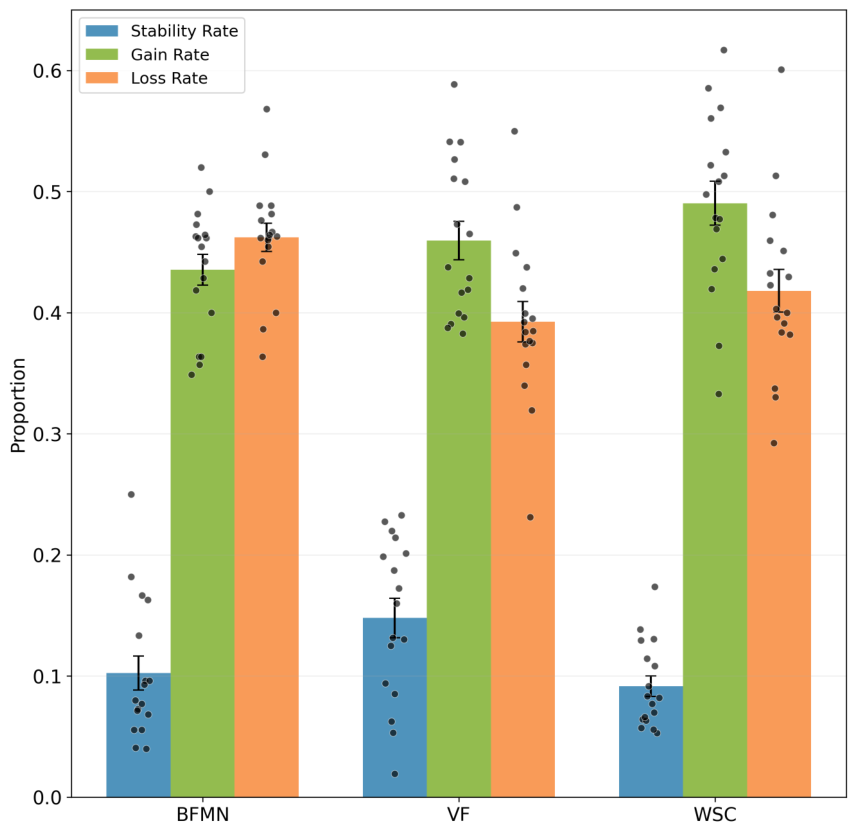
Figure 3.
Visualisation with fixed node positions of the WSC Science network before (top) and after (bottom) the intervention.
Figure 3.
Visualisation with fixed node positions of the WSC Science network before (top) and after (bottom) the intervention.
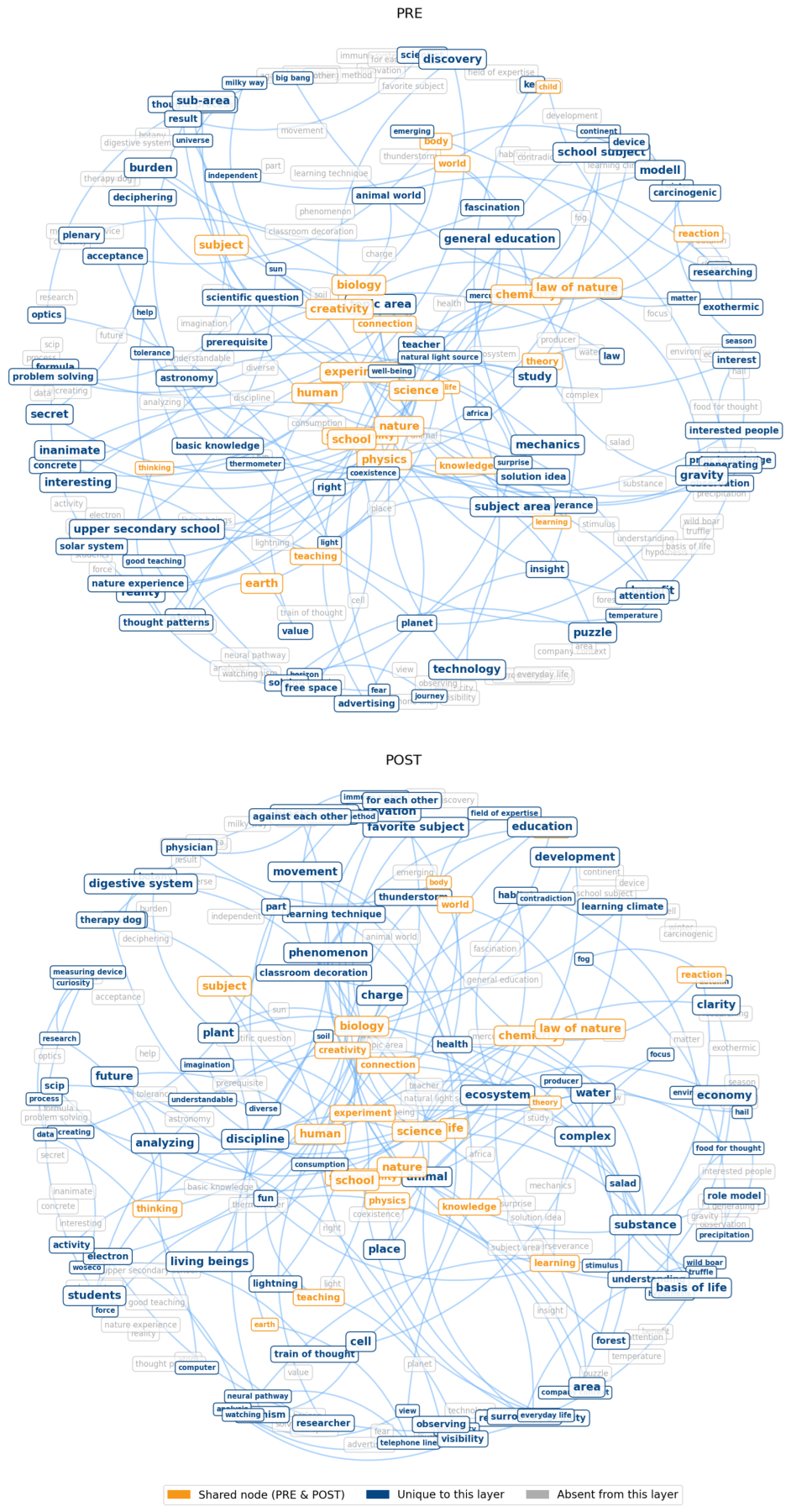
Figure 4.
Group-level direction-constrained adaptive valence transitions among the 117 concepts produced at both measurement points. Group labels were obtained from the most frequent participant-level label, with ties assigned neutral. Flow widths represent the number of concepts moving between PRE and POST categories.
Figure 4.
Group-level direction-constrained adaptive valence transitions among the 117 concepts produced at both measurement points. Group labels were obtained from the most frequent participant-level label, with ties assigned neutral. Flow widths represent the number of concepts moving between PRE and POST categories.
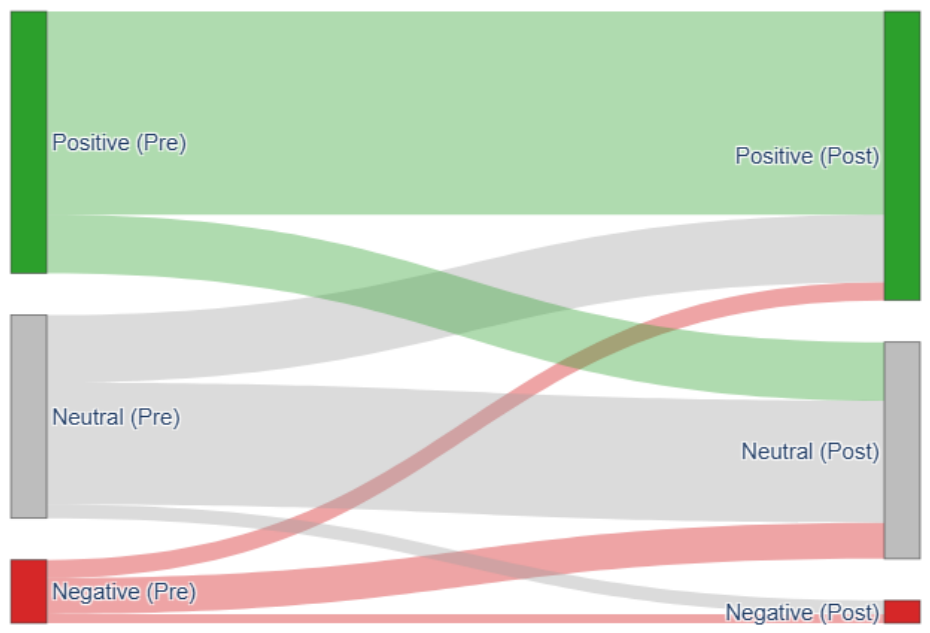
Figure 5.
Emotion flowers derived from the PRE and POST reflections on the role of creativity in science.
Figure 5.
Emotion flowers derived from the PRE and POST reflections on the role of creativity in science.
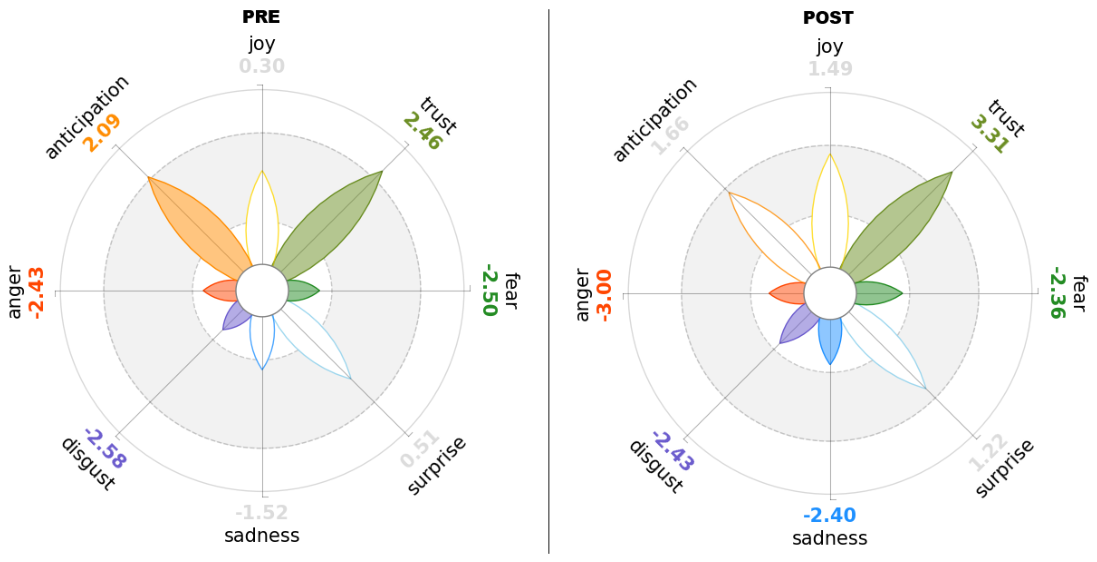
Figure 6.
Mindset streams connecting creativity with STEM concepts: (a) Biology, (b) Chemistry, (c) Mathematics, (d) Physics. Blue nodes indicate positive valence, grey nodes indicate neutral valence, and red nodes indicate negative valence. Blue edges connect two positive nodes, grey edges involve at least one neutral node, and purple edges connect a negative and a positive node.
Figure 6.
Mindset streams connecting creativity with STEM concepts: (a) Biology, (b) Chemistry, (c) Mathematics, (d) Physics. Blue nodes indicate positive valence, grey nodes indicate neutral valence, and red nodes indicate negative valence. Blue edges connect two positive nodes, grey edges involve at least one neutral node, and purple edges connect a negative and a positive node.
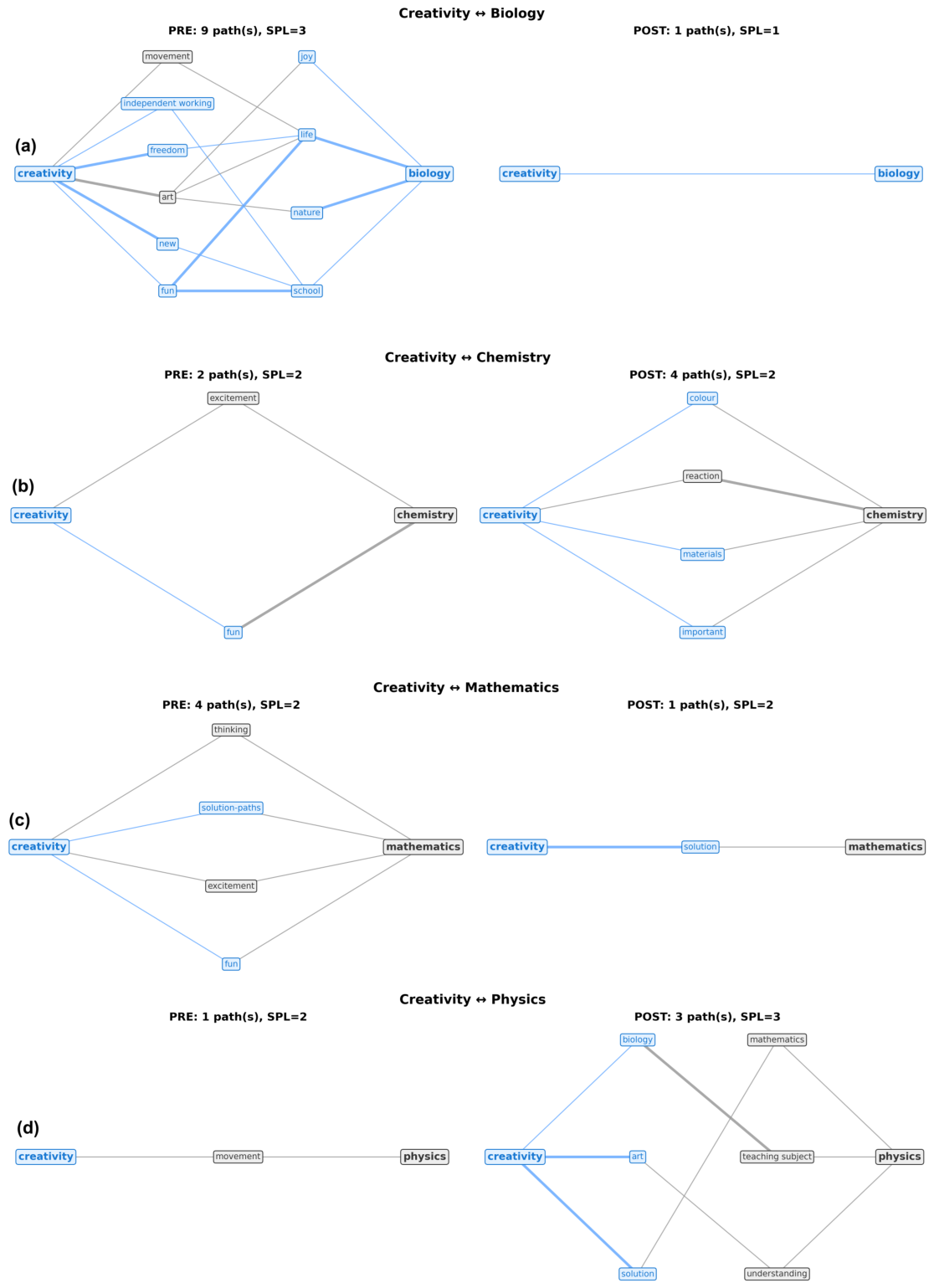
Figure 7.
Mindset streams connecting creativity with concepts from science and "joy": (a) Research, (b) Sustainability, (c) Joy. Blue nodes indicate positive valence, grey nodes indicate neutral valence, and red nodes indicate negative valence. Blue edges connect two positive nodes, grey edges involve at least one neutral node, and purple edges connect a negative and a positive node.
Figure 7.
Mindset streams connecting creativity with concepts from science and "joy": (a) Research, (b) Sustainability, (c) Joy. Blue nodes indicate positive valence, grey nodes indicate neutral valence, and red nodes indicate negative valence. Blue edges connect two positive nodes, grey edges involve at least one neutral node, and purple edges connect a negative and a positive node.
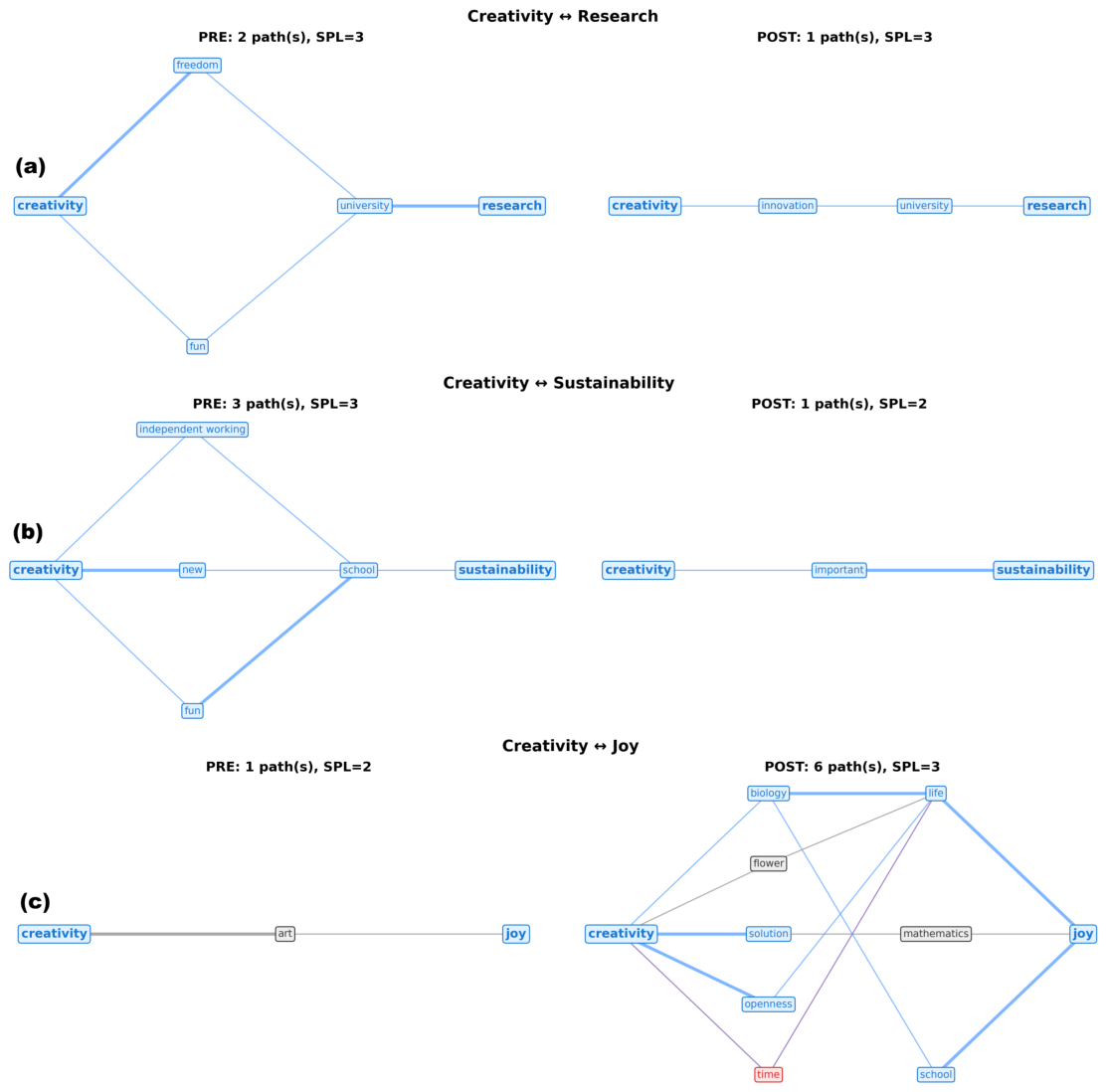

Table 1.
Timeline and structure of the SCIP teacher training.
| Phase | Period | Format | Focus |
|---|---|---|---|
| Input I | October | 2 online, 2 in person | Foundations of scientific creativity, SCIP tools |
| Implementation I | Nov–Jan | Online reflection | Classroom implementation |
| Input II | March | 2 online, 2 in person | Advanced SCIP tools, metacognition, embodiment, and teamwork |
| Implementation II | April–May | Online reflection | Classroom implementation |
| Final Event | June | In person | Presentation, reflection |
Table 2.
SCIP tools used in the creativity intervention, alongside the cognitive dimensions targeted by the tool and the related task used in the study. This tool-dimension-task mapping describes a general relation between them, rather than direct measures of the effects of individual SCIP tools.
Table 2.
SCIP tools used in the creativity intervention, alongside the cognitive dimensions targeted by the tool and the related task used in the study. This tool-dimension-task mapping describes a general relation between them, rather than direct measures of the effects of individual SCIP tools.
| SCIP Tool | Cognitive Dimension | Related Study Task |
|---|---|---|
| Clustering & Woseco | Associative thinking, semantic organisation, syntactic linking | BFMN associations, Verbal Fluency, Woseco |
| Flexperiments | Creative problem solving, exploration of alternatives | Alternative Uses Task |
| Live Acts | Imagination, analogical thinking | Alternative Uses Task |
| Thinkflex | Divergent thinking, cognitive flexibility | Alternative Uses Task, Verbal Fluency, Woseco |
| Error-culture tools | Reduced fear of mistakes, emotional reframing | BFMN valence, TFMN emotions |
| Reflection tools | Metacognition, self-awareness | TFMN text reflection |
Table 3.
Descriptive statistics and paired pre–post comparisons for BFI-10 personality traits and PANAS affect measures. Values are means with standard deviations in parentheses. Pre–post differences were tested using two-sided Wilcoxon signed-rank tests ().
Table 3.
Descriptive statistics and paired pre–post comparisons for BFI-10 personality traits and PANAS affect measures. Values are means with standard deviations in parentheses. Pre–post differences were tested using two-sided Wilcoxon signed-rank tests ().
| Questionnaire | Dimension | Pre, | Post, | W | p |
|---|---|---|---|---|---|
| BFI-10 | Openness | 7.53 (1.94) | 7.94 (1.43) | 25.5 | .277 |
| Conscientiousness | 7.71 (1.36) | 8.06 (0.97) | 21.5 | .293 | |
| Extraversion | 7.18 (2.32) | 7.06 (2.14) | 33.0 | 1.000 | |
| Agreeableness | 7.12 (1.41) | 6.76 (1.52) | 22.0 | .318 | |
| Neuroticism | 5.53 (1.97) | 5.53 (1.37) | 39.0 | 1.000 | |
| PANAS | Positive affect | 36.12 (6.11) | 36.41 (6.85) | 56.0 | .820 |
| Negative affect | 16.24 (3.96) | 16.59 (4.02) | 61.0 | .716 |
Table 4.
Pre–post changes in semantic fluency and idiosyncrasy across task families. Counts are absolute values summed up for the entire group. (pp = percentage points)
Table 4.
Pre–post changes in semantic fluency and idiosyncrasy across task families. Counts are absolute values summed up for the entire group. (pp = percentage points)
| Task | Measure | Pre | Post | Change |
|---|---|---|---|---|
| VF | Unique concepts | 221 | 273 | +52 |
| Idiosyncratic concepts | 141 | 197 | +56 | |
| Idiosyncrasy rate | 63.8% | 72.2% | + 8.4 pp | |
| WSC | Unique concepts | 215 | 238 | +23 |
| Idiosyncratic concepts | 180 | 193 | +13 | |
| Idiosyncrasy rate | 83.7% | 81.1% | -2.6 pp | |
| BFMN | Unique concepts | 306 | 287 | -19 |
| Idiosyncratic concepts | 235 | 214 | -21 | |
| Idiosyncrasy rate | 76.8% | 74.6% | -2.2 pp |
Table 5.
Global network properties of Verbal Fluency (VF) and Woseco (WSC) semantic networks before and after the intervention. All measures are calculated on the Largest Connected Component (LCC).
Table 5.
Global network properties of Verbal Fluency (VF) and Woseco (WSC) semantic networks before and after the intervention. All measures are calculated on the Largest Connected Component (LCC).
| Network | Nodes | Edges | ASPL | Density | CC | Modularity (Q) |
|---|---|---|---|---|---|---|
| VF School PRE | 125 | 204 | 4.287 | 0.026 | 0.072 | 0.577 |
| VF School POST | 161 | 224 | 5.873 | 0.017 | 0.025 | 0.643 |
| VF Science PRE | 114 | 174 | 5.087 | 0.027 | 0.050 | 0.598 |
| VF Science POST | 132 | 196 | 4.817 | 0.023 | 0.045 | 0.601 |
| WSC School PRE | 118 | 155 | 4.898 | 0.022 | 0.031 | 0.638 |
| WSC School POST | 145 | 178 | 6.828 | 0.017 | 0.018 | 0.712 |
| WSC Science PRE | 114 | 134 | 6.331 | 0.021 | 0.002 | 0.716 |
| WSC Science POST | 121 | 155 | 5.139 | 0.021 | 0.035 | 0.665 |
Table 6.
Global network properties of Behavioural (BFMN) and Textual (TFMN) Forma Mentis networks before and after the intervention. Node and edge counts are shown for the full graph and the largest connected component (LCC). All other measures are calculated only on LCC.
Table 6.
Global network properties of Behavioural (BFMN) and Textual (TFMN) Forma Mentis networks before and after the intervention. Node and edge counts are shown for the full graph and the largest connected component (LCC). All other measures are calculated only on LCC.
| Network | Nodes G∣LCC |
Edges G∣LCC |
ASPL | Density | CC | Modularity (Q) |
|---|---|---|---|---|---|---|
| BFMN PRE | 61|49 | 63|52 | 4.896 | 0.044 | 0.044 | 0.680 |
| BFMN POST | 65|35 | 70|37 | 3.724 | 0.062 | 0.000 | 0.610 |
| TFMN PRE | 381|369 | 1131|1124 | 3.403 | 0.016 | 0.577 | 0.551 |
| TFMN POST | 426|404 | 1372|1358 | 3.331 | 0.015 | 0.594 | 0.560 |
Table 7.
Distribution of direction-constrained participant-adaptive valence labels across unique participant–concept pairs. Percentages were calculated separately within each measurement point.
Table 7.
Distribution of direction-constrained participant-adaptive valence labels across unique participant–concept pairs. Percentages were calculated separately within each measurement point.
| Valence | PRE n | PRE % | POST n | POST % |
|---|---|---|---|---|
| Positive | 329 | 53.4% | 340 | 56.8% |
| Neutral | 204 | 33.1% | 195 | 32.5% |
| Negative | 83 | 13.5% | 64 | 10.7% |
Disclaimer/Publisher’s Note: The statements, opinions and data contained in all publications are solely those of the individual author(s) and contributor(s) and not of MDPI and/or the editor(s). MDPI and/or the editor(s) disclaim responsibility for any injury to people or property resulting from any ideas, methods, instructions or products referred to in the content. |
© 2026 by the authors. Licensee MDPI, Basel, Switzerland. This article is an open access article distributed under the terms and conditions of the Creative Commons Attribution (CC BY) license (http://creativecommons.org/licenses/by/4.0/).
Copyright: This open access article is published under a Creative Commons CC BY 4.0 license, which permit the free download, distribution, and reuse, provided that the author and preprint are cited in any reuse.


