

Submitted:
31 July 2026
Posted:
04 August 2026
You are already at the latest version
Abstract
Active stoppers based on scintillating fibres provide fast signal formation, fine segmentation and compact geometry. On the other hand, their implementation requires a readout that can handle many silicon photomultiplier channels and a wide range of light intensities. We present a laboratory characterization of a resistively multiplexed SiPM readout for the Fibre IMPlanter concept. The readout combines 16 SiPM input nodes into four analog outputs. Localized pulsed-light excitation was used to scan individual SiPM positions, and the four signals were processed by baseline subtraction, charge integration and normalized charge-division reconstruction. In an intermediate signal range, the reconstructed position plane shows distinguishable clusters for the individual inputs, indicating that spatial information is retained after a factor-of-four reduction in readout channels. At low amplitudes, the reconstruction is limited by baseline noise and reduced signal-to-noise ratio. At high amplitudes, it is limited by SiPM non-linearity, finite microcell occupancy and distortions of the charge sharing. The results identify the signal range in which resistive multiplexing remains a practical compact readout option for SiPM-based scintillating-fibre radiation detectors.
Keywords:
silicon photomultiplier
; SiPM
; scintillating fibre detector
; radiation sensor
; resistive multiplexing
; charge division
; position reconstruction
; active stopper
; FIMP
; DESPEC
; GSI/FAIR
1. Introduction
Decay spectroscopy of exotic nuclei relies on event-by-event correlations between implanted ions and their subsequent radioactive decays. At GSI Helmholtzzentrum für Schwerionenforschung and the Facility for Antiproton and Ion Research (GSI/FAIR), the DEcay SPECtroscopy (DESPEC) programme was developed for nuclear-structure studies of exotic nuclei produced at the Fragment Separator (FRS) and, in future experiments, at the Superconducting Fragment Separator (Super-FRS) [1]. Together with the High-resolution In-flight SPECtroscopy (HISPEC) programme, DESPEC will exploit rare-isotope beams from the Super-FRS for in-beam and decay-spectroscopy studies at FAIR [2]. In a DESPEC experiment, the active stopper must determine the implantation time and position, detect subsequent , , isomeric or delayed-particle decays, and provide sufficient energy information to separate different event classes. It is typically surrounded by high-resolution -ray, neutron, and fast-timing arrays. The present DESPEC workhorse, the Advanced Implantation Detector Array (AIDA), is based on double-sided silicon strip detectors (DSSSDs) and provides fine segmentation and a large dynamic range, but the decay-event timing in the relevant operating mode is limited to a microsecond scale [3]. Fast timing performance is essential for the study of short-lived nuclei, high implantation rates, and decay chains in which random correlations can dominate the measured spectra. The need for segmentation follows directly from the implantation–decay correlation problem. If the active stopper were treated as a single sensitive volume, all decays detected within a chosen correlation time window would be possible candidates for previous implantations in that volume. By dividing the sensitive volume into many strips, fibres, pixels or voxels, the local implantation rate per detector element is reduced. In a simplified picture:
where is the mean implantation rate in one detector segment, is the total implantation rate over the full sensitive detector volume, and N is the number of equivalent detector segments. For small random-correlation probabilities, the probability of an unrelated event within a time window scales approximately as:
Finer segmentation, therefore, improves the reliability of implantation-decay correlations, but it also increases the number of readout channels. This trade-off is one of the main motivations for studying compact multiplexed readout schemes.
Scintillator-based active stoppers provide a complementary approach to silicon implantation detectors. Plastic scintillators offer fast signal formation and robust signal processing, and scintillating fibres extend this concept towards finer spatial granularity. Scintillating-fibre detectors with silicon photomultiplier (SiPM) readout have been developed for compact tracking and timing applications [4,5], while single-photon avalanche-diode (SPAD) array readout has also been demonstrated useful for scintillating-fibre tracking and active-target applications [6]. The Fibre IMPlanter (FIMP) is being developed as a scintillating-fibre active stopper in which orthogonal fibre layers are read out by SiPMs [7]. In this concept, the fibre geometry provides the spatial segmentation, while the SiPM readout provides compact photosensor coupling and fast timing. The main readout challenge is that a detector with millimeter granularity requires a large number of SiPM channels.
The channel count is therefore a central sensor-design parameter. Large SiPM arrays increase the number of cables, front-end channels, digitizer inputs, bias connections, and data streams. Analogue multiplexing reduces this complexity by combining several SiPM signals into a smaller number of outputs. Such readout reduction is widely used in position-sensitive radiation detectors and has been reviewed in the context of SiPM readout for nuclear imaging and positron-emission tomography (PET) systems [8,9]. Resistive charge division is one of the simplest implementations: the position is encoded in the relative charge collected at a small number of outputs [10,11]. Recent position-sensitive SiPM developments also show that current or charge partitioning can retain sub-millimetre position information with few readout channels [12].
For an active implantation detector, the readout must remain useful over a broad dynamic range. Implanted ions produce large light signals along their tracks and near the Bragg peak. Alpha particles produce relatively large local deposits and are expected to be distinguishable from beta particles by their larger local energy deposition. On the other hand, beta particles and secondary electrons generate smaller and more variable signals. Beta particles in the relevant DESPEC experiments have typical energies of the order of 1 MeV, while the deposited energy in one 0.5 mm fibre layer can be close to the detection threshold. The requirement that a beta particle reaches two adjacent orthogonal layers, therefore, sets a low-energy detection limit of the order of a few hundred keV in the present concept [7]. The usable range of the reconstructed response is determined by both the SiPM response and the multiplexing network. At low light levels, the reconstruction is limited by photon statistics, dark counts and electronic noise. At high light levels, the finite number of SiPM microcells introduces non-linearity and saturation-like behaviour; large signal currents and voltage drops in the resistive network may also modify the relative charge sharing [13,14]. The relevant question is therefore not only whether the multiplexing works but also over which signal range it remains a reliable position sensor.
In this work, we characterize a 16-to-4 resistively multiplexed SiPM readout for the FIMP detector concept. The emphasis is on sensor-level response: charge sharing, position reconstruction, noise sensitivity, amplitude dependence, temperature effects, and the useful operating window. Localized pulsed-light excitation is used as a controlled input to the SiPM array. This does not replace source or beam measurements with scintillating fibres, but it isolates the behaviour of the multiplexing network and reconstruction algorithm. The results identify the conditions under which a factor-of-four reduction in readout channels can retain position sensitivity in the tested laboratory configuration, and provide a sensor-level evaluation of resistive multiplexing for compact SiPM-based radiation detectors.
2. Materials and Methods
2.1. Scintillating-Fibre Detector
The FIMP detector is based on multiple layers of scintillating fibres arranged in orthogonal directions. The fibres act both as the active detection medium and as light guides that transport scintillation photons to SiPM photosensors. A photograph of the prototype is shown in Figure 1. The orthogonal fibre geometry provides two independent projections of the event topology. When a particle deposits sufficient energy in each of two consecutive orthogonal layers, two-dimensional position information can be reconstructed.
The fibre pitch, approximately 0.5 mm in the present concept, is a compromise between spatial granularity and light output per channel. Reducing the fibre size improves granularity, but it also reduces the number of detected photons and makes the timing and threshold performance more sensitive to light yield, attenuation, optical coupling and SiPM photon-detection efficiency. The same compromise is encountered in other scintillating-fibre timing detectors [15,16].
The readout must therefore retain position information for weak beta-like signals while remaining usable for much larger implantation or alpha-like signals.
2.2. SiPM Response Relevant to Multiplexed Readout
An SiPM consists of many Geiger-mode microcells connected in parallel. Each fired microcell releases an approximately fixed charge determined by the effective cell capacitance and the overvoltage. The gain of one microcell can be written as:
where is the effective microcell capacitance, q is the elementary charge, is the applied bias voltage and is the breakdown voltage [13,14]. At low light levels, when the probability that more than one photon is detected by the same microcell during its recovery time is small, the total collected charge is approximately proportional to the number of fired microcells. This proportionality is the basis for using integrated SiPM signals as charge-like observables in a position-reconstruction algorithm.
Several SiPM parameters enter directly into the multiplexed response. The photon-detection efficiency (PDE) depends on the overvoltage and wavelength and can be written, in a simplified form, as:
where F is the geometrical fill factor, is the quantum efficiency and is the avalanche-triggering probability. The PDE determines the number of fired microcells for a given light input and therefore affects both the signal amplitude and the position resolution.
The response becomes non-linear when the number of photons arriving within the relevant recovery time is no longer small compared to the number of available microcells. In a simple saturation model for a short light pulse, the mean number of fired microcells is:
where M is the total number of microcells and is the number of incident photons. The former equation neglects cross-talk, afterpulsing and microcell recovery during the light pulse, but it captures the first-order loss of linearity caused by finite microcell occupancy. Equation 5 shows why the same readout can behave approximately linearly for moderate light pulses but distort at high amplitudes.
In a resistively multiplexed readout, SiPM non-linearity is especially important because the reconstructed coordinates depend on ratios of the four output charges. If one part of the readout network enters a non-linear regime earlier than another, the relative charge sharing changes, and the reconstructed position can shift. Noise mechanisms also affect the low-amplitude limit. Dark counts, afterpulsing and optical cross-talk add charge fluctuations that are not related to the scintillation or LED signal. These fluctuations affect both the total signal Z and the charge ratios used for position reconstruction.
Temperature is also a relevant control parameter. At fixed bias voltage, a change in temperature changes the breakdown voltage of an SiPM and therefore the overvoltage, which in turn changes the gain. The dark-count rate also depends strongly on temperature [13,14]. A stable multiplexed detector, therefore, requires either temperature stabilization or a calibration that corrects the gain of the four outputs as a function of temperature. These considerations motivated the tests of signal amplitude, noise and temperature dependence described below.
2.3. Resistive Charge-Division Readout Network
A resistively multiplexed SiPM array was studied as a channel-reduction strategy. The tested array used 16 Broadcom AFBR-S4N44P014M SiPMs, multiplexed into four output channels denoted A, B, C and D. The scheme follows a 16-to-4 charge-division architecture in which the relative distribution of charge among the four outputs encodes the position of the activated SiPM node [10,11]. The network used resistors in the range from 300 to 10 k in a symmetric ladder configuration, as illustrated in Figure 2. The purpose of this layout is to provide a monotonic mapping between input position and output-charge ratios while keeping the response of the different SiPM nodes as uniform as possible.
The reduction from 16 input nodes to four output channels corresponds to a factor-of-four reduction in the number of DAQ channels. In a full scintillating-fibre detector, where large channel counts are expected, such a reduction simplifies cabling, front-end electronics, and data acquisition. The consequence of this simplification is that individual SiPM signals are no longer measured independently. The interaction position and signal amplitude must instead be inferred from the shared outputs. The performance of the method, therefore, depends on the stability of the charge sharing, the signal-to-noise ratio, the gain matching of the SiPMs and the calibration of the four output channels.
2.4. Pulsed-Light Test Setup
The multiplexed SiPM readout was tested in a light-tight laboratory setup using localized pulsed-light excitation. A light-emitting diode (LED) with a pulse shaping circuit was coupled to an optical fibre and used to illuminate selected SiPM positions through a custom mechanical holder. This configuration provided good control over the input amplitude and allowed the response of individual SiPM nodes to be mapped systematically.
The SiPMs were biased at 36 V. Output waveforms from the four multiplexed channels were acquired with a PicoScope 6824E oscilloscope and processed offline. For each illumination configuration, approximately 1000 waveforms were recorded. The LED pulse width was 16 ns, and the LED circuit driving amplitude was varied over the range 5.8–20.0 V. These voltage settings define controlled pulsed-light amplitudes and are not direct equivalents of deposited radiation energy. Calibration with scintillation signals from charged particles will therefore be required for the final detector response.
2.5. Signal Processing and Charge-Division Reconstruction
For each event, the four output waveforms were processed using the same analysis sequence. A baseline value was determined from a pre-signal region and subtracted from each waveform. The signal charge in each output channel was then obtained by trapezoidal integration of the baseline-corrected waveform. The resulting integrated charges are denoted by A, B, C and D.
The total signal was defined as:
The normalized charge-division coordinates were calculated as:
and
These coordinates reduce the first-order dependence on the total signal amplitude and encode the relative charge sharing between the four outputs. Events with small Z are more sensitive to baseline fluctuations and were therefore used to assess the low-amplitude reconstruction limit.
3. Results
The reconstructed distributions for the 16 SiPM illumination positions are shown in Figure 3. Distinct clusters are visible for the individual input nodes, indicating that the four-output resistive network retains spatial information under suitable operating conditions. The cluster topology reflects the mapping of the SiPM nodes through the resistive ladder and shows that the normalized charge-asymmetry method provides a usable position estimator for the 16-to-4 architecture.
At intermediate signal amplitudes, the reconstructed clusters were compact and separated. This was the most favourable region observed in the present measurements, because the signal-to-noise ratio was sufficiently high while the SiPM response and resistive network remained approximately linear. In this range, the observed clustering supports considering multiplexed SiPM readout as a compact option for position-sensitive scintillating-fibre detectors.
A three-dimensional representation using X, Y and the total signal Z is shown in Figure 4. This representation displays position and amplitude simultaneously. In a calibrated radiation detector, such information may help separate event classes, for example, beta-like low-amplitude events, alpha-like events and larger ion-implantation signals. One has to stress, though, that this interpretation requires calibration with radioactive sources or beam data and is not inferred from LED data alone.
Noise was one of the main limitations at low signal amplitudes. In the initial high-noise configuration, the reconstructed clusters showed elongation and broad tails, as illustrated in Figure 5(a). Such behaviour is expected when baseline fluctuations and noise pickup become comparable to the integrated signal. Because the position coordinates in Equations (7) and (8) are normalized by Z, even moderate fluctuations in the individual channels can produce large apparent coordinate excursions when Z is small.
The reconstructed distribution for a configuration with lower noise pickup at equivalent incident light intensities is shown in Figure 5(b). It retains a more compact cluster topology, indicating that stable analog signal handling is essential for multiplexed charge-division readout.
The low-amplitude limit is particularly relevant for beta-decay detection. If the signal produced by a beta particle in a fibre is close to the detection threshold, the reconstructed total signal can become comparable to the baseline uncertainty. In this regime, cluster overlap and unstable normalized coordinates are expected. A robust operating threshold must therefore be defined not only from the detectability of a signal in one channel, but from the ability to reconstruct a stable position after multiplexing.
To characterize the response of the readout, a rough order of magnitude energy to Z value equivalence measurement was first performed for the purpose of determining the suitable SiPM overvoltage by placing a Na-22 source next to a 2x 2 x 20 mm³ LYSO crystal, which was optically coupled to SiPM 16. While the light output of a LYSO crystal is higher than that of a polystyrene based scintillator, fibres exhibit better light transport. The intensity of light produced by 511 keV -rays was determined to correspond to a Z value of 369. The response of the readout was then studied as a function of LED driving amplitude. Figure 6 shows the reconstructed response for several LED settings. At the lowest amplitudes, the reconstructed distribution is dominated by noise and threshold effects. At intermediate amplitudes, compact and stable cluster regions were obtained. At the highest amplitudes, the response is distorted by non-linear effects. These observations identify an operating window defined by noise at low signals and by saturation or non-linear signal sharing at high signals.
The total signal Z increased with increasing input amplitude, but deviations from linear behaviour were observed at higher amplitudes. Such deviations can originate from SiPM saturation due to finite microcell recovery, amplifier saturation, or non-linear response of the multiplexing network. Since the position coordinates are normalized by Z, unequal non-linearities in the four output channels can translate into shifts of the reconstructed centroids and different deviation onset amplitudes.
For radiation detection, this amplitude dependence has direct consequences. The low-amplitude boundary is expected to contribute to beta sensitivity and to the probability of losing decay events close to threshold. The operating point is therefore chosen by balancing SiPM overvoltage, light collection, front-end gain and the required dynamic range.
Radiation events in a scintillating-fibre detector may produce light in several neighbouring fibres or be coupled to several SiPM inputs simultaneously. This is especially relevant for implanted ions, which produce extended tracks, and for particles crossing more than one fibre. Additional laboratory tests were therefore performed with simultaneous excitation of several SiPM inputs. The corresponding position maps showed spatially extended or shifted distributions rather than single-node clusters, as shown in Figure 7.
This behaviour is consistent with the multiplexing principle. The reconstructed coordinates represent the charge-weighted response of the activated nodes. For single-fibre or single-node excitation, the result is a cluster associated with one input position. For multi-node excitation, the reconstructed position moves toward the charge-weighted centroid of the active nodes. In a complete detector, this effect could be useful for reconstructing extended ion tracks, but it also means that event-topology reconstruction will require calibration or simulation of the fibre response, optical cross-talk and charge sharing.
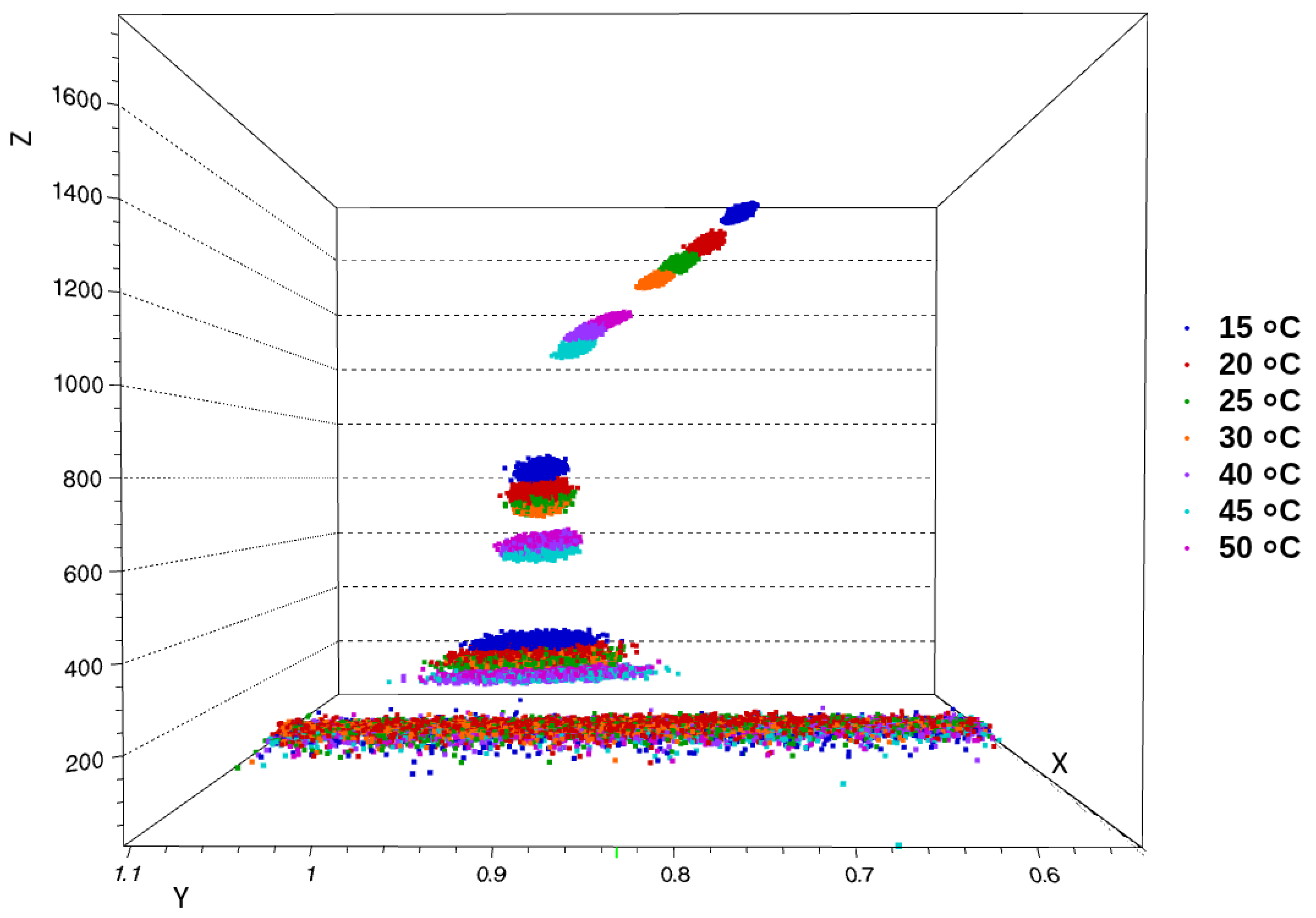
The SiPM gain, dark-count rate and breakdown voltage are temperature dependent [13,14]. At fixed bias voltage, temperature variations change the effective overvoltage and therefore the gain, while the dark-count rate modifies the noise contribution. These changes can affect the reconstructed position if the four output channels are not affected identically. A temperature-dependence test was performed over a range of set temperatures, as shown in Figure 8.
4. Discussion
Two physical limits define the usable operating range of the resistively multiplexed SiPM readout. At low amplitudes, the limiting factor is the signal-to-noise ratio. Baseline fluctuations, grounding pickup, dark-count contributions and integration uncertainty broaden the reconstructed clusters and can make the normalized coordinates unstable. This limit is particularly important for beta detection, because beta particles can deposit relatively small amounts of energy in individual fibres.
At high amplitudes, the limiting factor is non-linearity. The SiPM response is only quasi-linear while the number of fired microcells remains small compared to the number of available cells. Once the microcell occupancy increases, additional photons no longer produce proportional charge. Larger currents through the resistive network can also introduce voltage drops or unequal response among the four outputs. Both effects modify the relative charge sharing and can shift the reconstructed coordinates. A simple total-charge threshold is therefore not sufficient. The reconstruction quality has to be evaluated as a function of both signal amplitude and position.
The intermediate amplitude range provides the most favourable reconstruction conditions observed in the present measurements. In this regime, the clusters are compact and distinguishable, and the total signal remains close to the linear-response region. The operating range should therefore be defined using quantitative criteria: a minimum cluster separation-to-width ratio, a maximum allowed centroid shift and a maximum deviation from linearity in Z. These criteria should be extracted from the same calibration data that define the charge-division map.
The channel-count reduction studied here is directly relevant for scalable scintillating-fibre radiation sensors. Reducing 16 SiPM input nodes to four output channels simplifies the digitization chain and reduces the number of cables and front-end inputs. This is advantageous for compact detector assemblies embedded inside -ray and neutron detector arrays, where space and material budget are constrained.
The consequence of this simplification is a stronger dependence on calibration and reconstruction. The detector response must be mapped, and gain variations among SiPMs, optical-coupling non-uniformities and temperature effects must be corrected. In a full detector, the charge-division map should therefore be treated as part of the sensor calibration, not only as an electronics feature.
For FIMP, the relevant application is implantation–decay correlation. The detector must detect high-amplitude ion implantations and subsequent lower-amplitude decay particles in the same active volume. A multiplexed readout is useful if it retains sufficient spatial information for both event classes. The LED measurements provide a controlled characterization of the readout network.
The use of orthogonal fibre layers also means that a complete detector event will involve correlations between two or more readout planes. The present 16-to-4 characterization addresses one multiplexed sensor plane or module. In a full detector, reconstruction should combine charge-division coordinates from multiple planes with timing and amplitude information. This multi-plane information may improve background rejection, distinguish true decay events from cross-talk-induced hits and reduce false implantation–decay correlations.
The present LED measurements should therefore be regarded as a sensor-level characterization of the multiplexed readout rather than as a complete detector-efficiency measurement. The tests isolate the behaviour of the SiPM array, resistive network and reconstruction algorithm, but they do not include the full optical transport, fibre attenuation, particle-dependent energy deposition or realistic multi-fibre light sharing of the complete detector.
5. Conclusions
A resistively multiplexed SiPM readout for position-sensitive scintillating-fibre radiation detectors was characterized using controlled pulsed-light excitation. The architecture combines 16 SiPM input nodes into four output channels, reducing the number of digitizer channels by a factor of four. Position reconstruction was performed using normalized charge-division coordinates derived from the four integrated output signals.
The reconstructed charge-asymmetry plane showed distinguishable clusters for the individual SiPM positions in an intermediate signal-amplitude range. At low amplitudes, the reconstruction was limited by baseline noise and the reduced signal-to-noise ratio. At high amplitudes, finite SiPM microcell occupancy, saturation-like response and possible network-induced changes in charge sharing distorted the reconstructed coordinates. The useful operating range is therefore bounded by the noise-dominated regime at small signals and the non-linear regime at large signals.
The results support resistive multiplexing as a candidate compact readout strategy for SiPM-based scintillating-fibre radiation detectors. For the FIMP detector concept, the method offers a possible route to reduced front-end complexity while retaining the position information needed for implantation–decay correlation. Future work will intend to quantify reconstruction metrics, establish temperature and gain corrections, calibrate the LED response with source or beam data and evaluate the method with realistic fibre-detector event topologies.
Author Contributions
Conceptualization, all authors; methodology, all authors; investigation, K.Ž.,all.; electronics development, K.Ž., G.K. and M.V.; formal analysis, K.Ž.; writing—original draft preparation, K.Ž. and J.V.; writing—review and editing, all authors; supervision, J.V. and J.G.; project administration, J.V. and J.G.; funding acquisition, J.V., J.G. and G. S, Li All authors have read and agreed to the published version of the manuscript.
Funding
This work was supported by the Slovenian Research and Innovation Agency under Grants No. I0-E005 and No. P1-0102.
Institutional Review Board Statement
Not applicable.
Informed Consent Statement
Not applicable.
Data Availability Statement
The data presented in this study are available from the corresponding author upon reasonable request.
Acknowledgments
The authors acknowledge the FIMP and DESPEC collaborations for discussions and technical support.
Conflicts of Interest
The authors declare no conflict of interest.
References
- Mistry, A.K.; Albers, H.M.; Arıcı, T.; Banerjee, A.; Benzoni, G.; Cederwall, B.; Gerl, J.; Górska, M.; Hall, O.; Hubbard, N.; et al. The DESPEC setup for GSI and FAIR. Nucl. Instrum. Methods Phys. Res. A 2022, 1033, 166662. [Google Scholar] [CrossRef]
- Podolyák, Z. From RISING to HISPEC/DESPEC. Nucl. Instrum. Methods Phys. Res. B 2008, 266, 4589–4594. [Google Scholar] [CrossRef]
- Hall, O.; Davinson, T.; Griffin, C.J.; Woods, P.J.; Appleton, C.; Bruno, C.G.; Estrade, A.; Kahl, D.; Sexton, L.; Burrows, I.; et al. The Advanced Implantation Detector Array (AIDA). Nucl. Instrum. Methods Phys. Res. A 2023, 1050, 168166. [Google Scholar] [CrossRef]
- Beischer, B.; Gast, H.; Greim, R.; Karpinski, W.; Kirn, T.; Nakada, T.; Roper Yearwood, G.; Schael, S.; Wlochal, M. A high-resolution scintillating fiber tracker with silicon photomultiplier array readout. Nucl. Instrum. Methods Phys. Res. A 2010, 622, 542–554. [Google Scholar] [CrossRef]
- Joram, C.; Uwer, U.; Leverington, B.D.; Kirn, T.; Bachmann, S.; Ekelhof, R.J.; Müller, J. LHCb Scintillating Fibre Tracker Engineering Design Review Report: Fibres, Mats and Modules; CERN: Geneva, Switzerland, 2015; Available online: https://cds.cern.ch/record/2004811 (accessed on 22 June 2026).
- Franks, M.; Dieminger, T.; Kaneyasu, K.; Sgalaberna, D.; Bruschini, C.; Charbon, E.; Kose, U.; Li, B.; Mos, P.; Wayne, M.; et al. Demonstration of particle tracking with scintillating fibres read out by a SPAD array sensor and application as a neutrino active target. Eur. Phys. J. C 2024, 84, 202. [Google Scholar] [CrossRef] [PubMed]
- Vesić, J.; Košir, G.; Vencelj, M.; Žagar, K.; Lovšin, E. Detector developments for HISPEC/DESPEC collaboration at the Slovenian Nuclear Instrumentation Laboratory. Nucl. Phys. A 2025, 1062, 123159. [Google Scholar] [CrossRef]
- Hatefi Hesari, S.; Haque, M.A.; McFarlane, N. A comprehensive survey of readout strategies for SiPMs used in nuclear imaging systems. Photonics 2021, 8, 266. [Google Scholar] [CrossRef]
- Park, H.; Yi, M.; Lee, J.S. Silicon photomultiplier signal readout and multiplexing techniques for positron emission tomography: a review. Biomed. Eng. Lett. 2022, 12, 263–283. [Google Scholar] [CrossRef] [PubMed]
- David, S.L.; Georgiou, M.; Fysikopoulos, E.; Loudos, G. Comparison of three resistor network division circuits for the readout of 4×4 pixel SiPM arrays. Nucl. Instrum. Methods Phys. Res. A 2013, 702, 121–125. [Google Scholar] [CrossRef]
- Downie, E.; Yang, X.; Peng, H. Investigation of analog charge multiplexing schemes for SiPM based PET block detectors. Phys. Med. Biol. 2013, 58, 3943–3964. [Google Scholar] [CrossRef] [PubMed]
- Acerbi, F.; Merzi, S.; Gola, A. Position-sensitive silicon photomultiplier arrays with large-area and sub-millimeter resolution. Sensors 2024, 24, 4507. [Google Scholar] [CrossRef] [PubMed]
- Gundacker, S.; Heering, A. The silicon photomultiplier: fundamentals and applications of a modern solid-state photon detector. Phys. Med. Biol. 2020, 65, 17TR01. [Google Scholar] [CrossRef] [PubMed]
- Klanner, R. Characterisation of SiPMs. Nucl. Instrum. Methods Phys. Res. A 2019, 926, 36–56. [Google Scholar] [CrossRef]
- Bravar, A.; Demets, Y. Timing properties of blue-emitting scintillating fibers. J. Instrum. 2022, 17, P12020. [Google Scholar] [CrossRef]
- Bravar, A.; Buonaura, A.; Corrodi, S.; Damyanova, A.; Demets, Y.; Gerritzen, L.; Grab, C.; Martin Perez, C.; Papa, A. Development of the scintillating fiber timing detector for the Mu3e experiment. Nucl. Instrum. Methods Phys. Res. A 2024, 1058, 168766. [Google Scholar] [CrossRef]
Figure 1.
Photograph of the FIMP prototype. The active stopper concept uses orthogonal layers of scintillating fibres read out by SiPMs to provide fast timing and millimetre-scale position sensitivity for implantation–decay correlation measurements.
Figure 1.
Photograph of the FIMP prototype. The active stopper concept uses orthogonal layers of scintillating fibres read out by SiPMs to provide fast timing and millimetre-scale position sensitivity for implantation–decay correlation measurements.
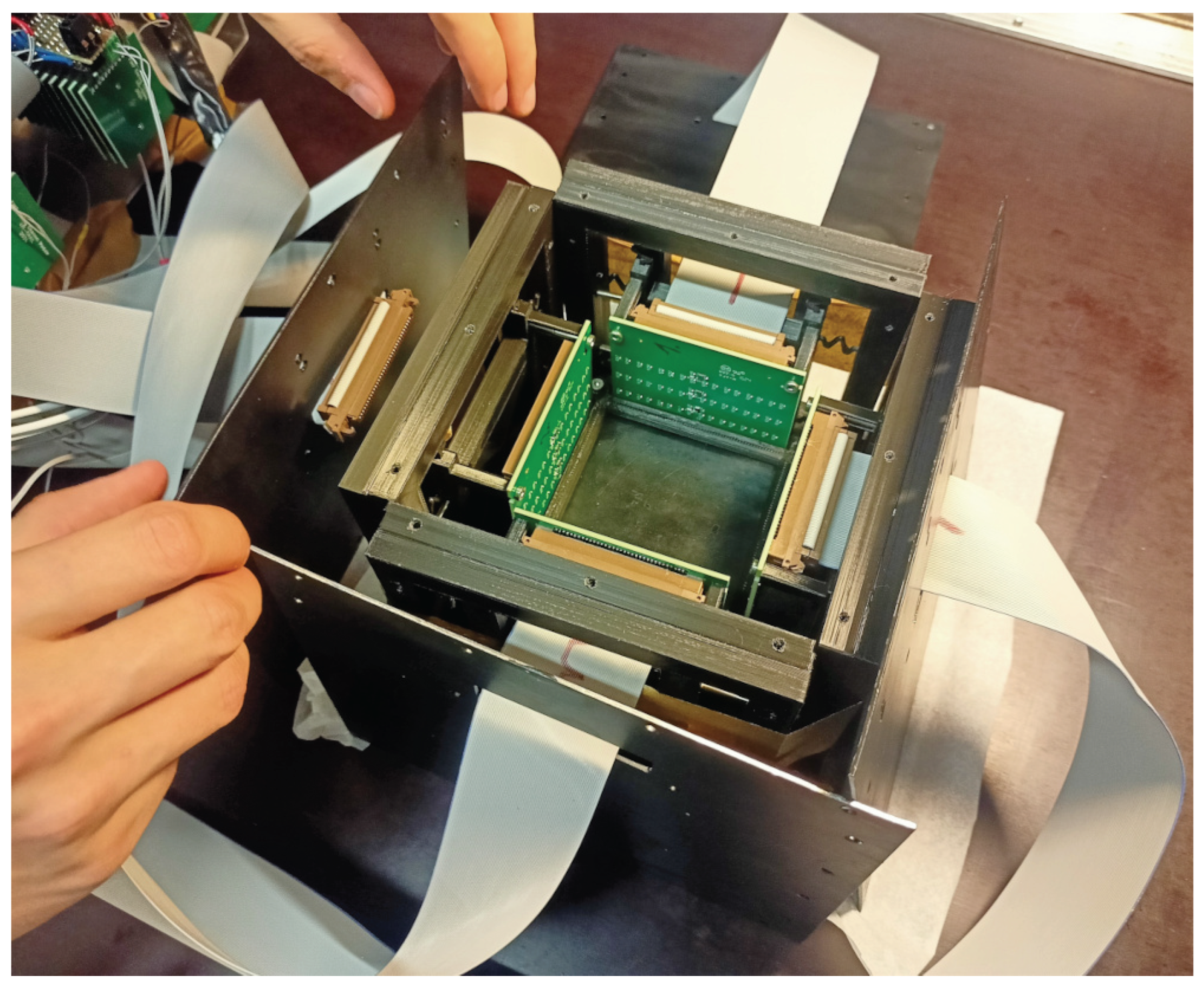
Figure 2.
Resistive multiplexing network used to encode 16 SiPM input nodes into four output channels A, B, C and D. The relative charge collected at the four outputs is used for normalized charge-division position reconstruction.
Figure 2.
Resistive multiplexing network used to encode 16 SiPM input nodes into four output channels A, B, C and D. The relative charge collected at the four outputs is used for normalized charge-division position reconstruction.
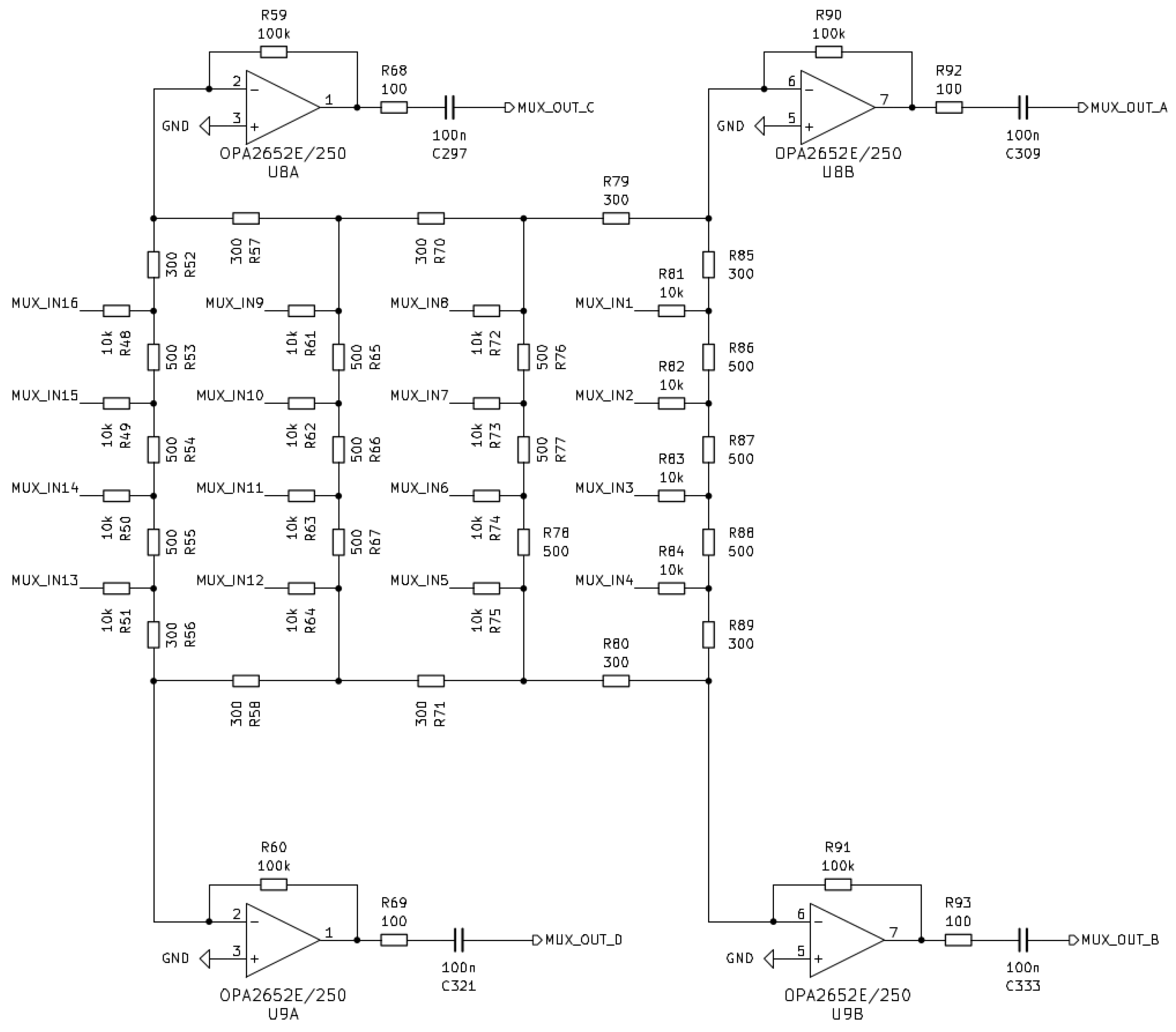
Figure 3.
Reconstructed position map for the 16 SiPM input positions using normalized charge-division coordinates. The colour coding corresponds to the illuminated SiPM position. Distinct clusters indicate that the 16 input nodes remain distinguishable after reduction to four output channels.
Figure 3.
Reconstructed position map for the 16 SiPM input positions using normalized charge-division coordinates. The colour coding corresponds to the illuminated SiPM position. Distinct clusters indicate that the 16 input nodes remain distinguishable after reduction to four output channels.
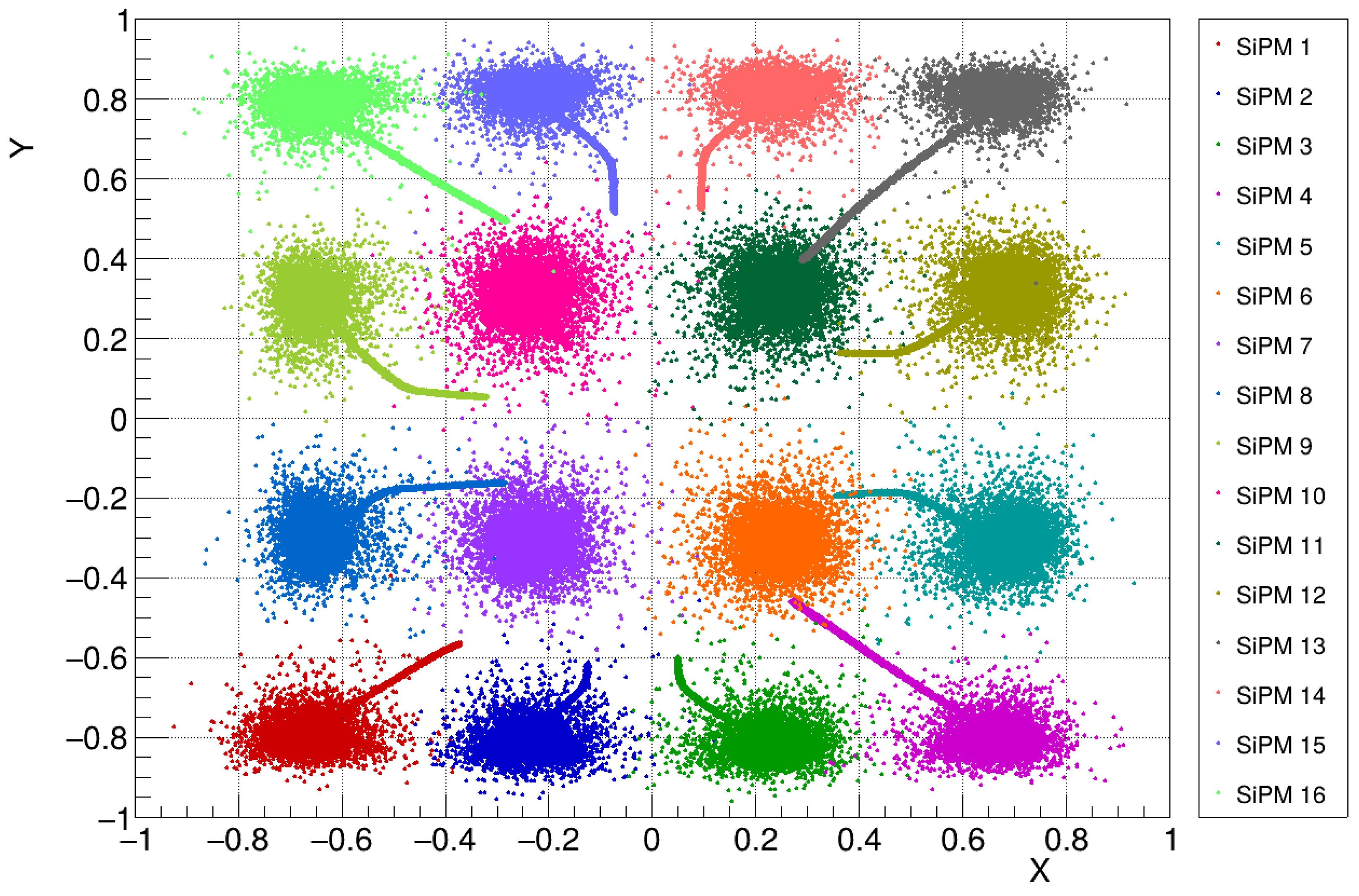
Figure 4.
Three-dimensional representation of the reconstructed response, showing the normalized position coordinates together with the total signal proxy Z for the practical signal amplitude range. This view is useful for assessing whether position and amplitude information remain correlated or separable after resistive multiplexing.
Figure 4.
Three-dimensional representation of the reconstructed response, showing the normalized position coordinates together with the total signal proxy Z for the practical signal amplitude range. This view is useful for assessing whether position and amplitude information remain correlated or separable after resistive multiplexing.
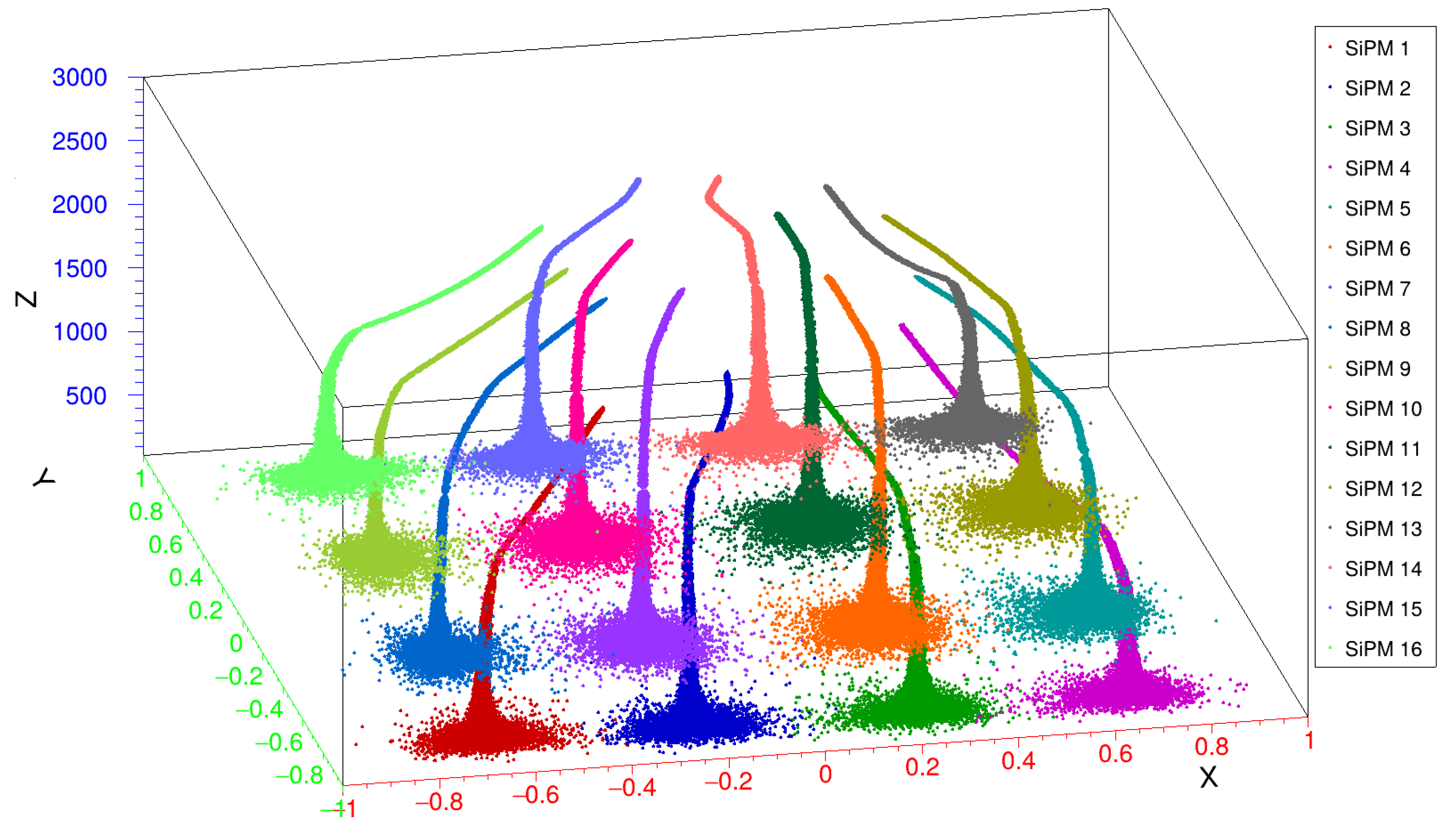
Figure 5.
Effect of front-end noise on reconstructed position. (a) High-noise configuration with elongated reconstructed clusters and large coordinate excursions. (b) Lower-noise configuration after improved grounding and readout implementation.
Figure 5.
Effect of front-end noise on reconstructed position. (a) High-noise configuration with elongated reconstructed clusters and large coordinate excursions. (b) Lower-noise configuration after improved grounding and readout implementation.
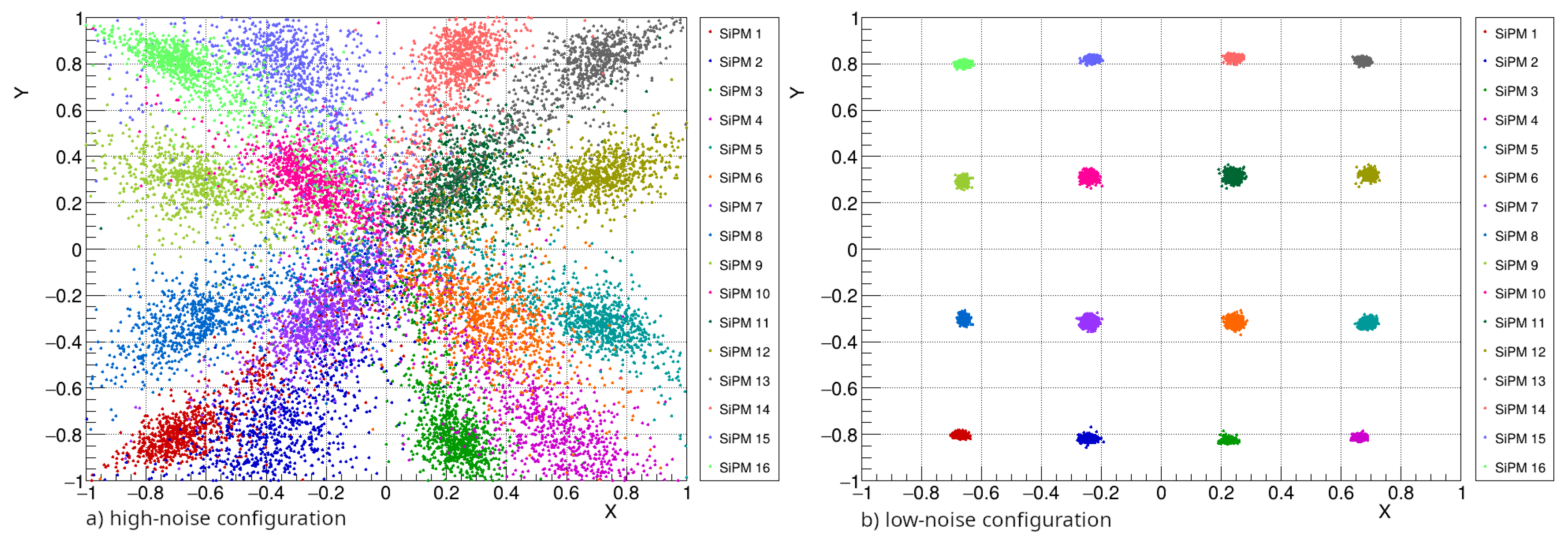
Figure 6.
Dependence of the reconstructed response on LED driving amplitude. The tested amplitudes include the low-signal regime, an intermediate regime with stable reconstruction and a high-amplitude regime in which non-linear effects become visible. The plotted peak-to-peak voltage values correspond to LED drive settings, not directly to deposited radiation energy.
Figure 6.
Dependence of the reconstructed response on LED driving amplitude. The tested amplitudes include the low-signal regime, an intermediate regime with stable reconstruction and a high-amplitude regime in which non-linear effects become visible. The plotted peak-to-peak voltage values correspond to LED drive settings, not directly to deposited radiation energy.
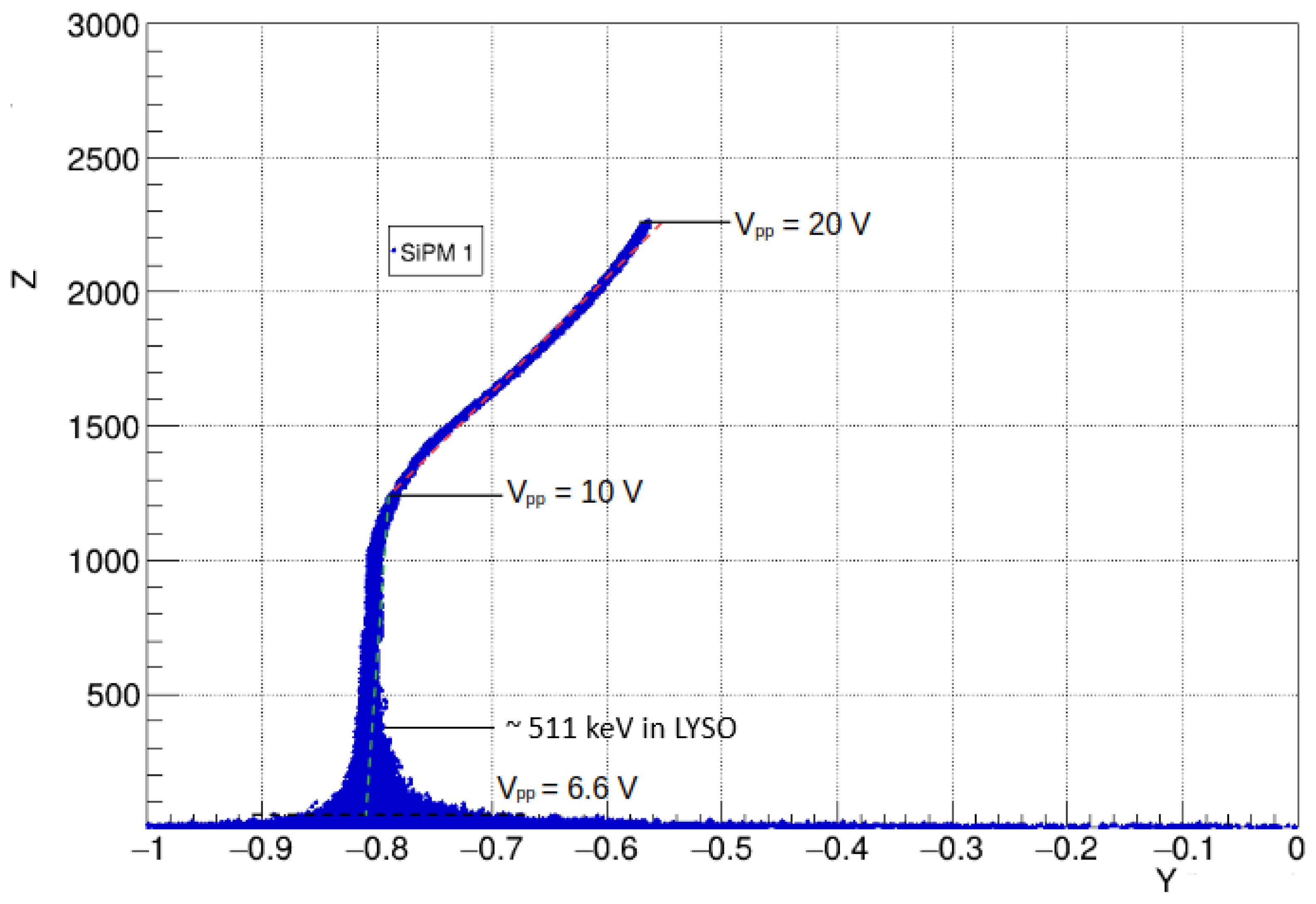
Figure 7.
Reconstructed position map of events with simultaneous illuminations of pairs of SiPMs. Clusters corresponding to proper SiPM node reconstructions are circled in yellow for reference.
Figure 7.
Reconstructed position map of events with simultaneous illuminations of pairs of SiPMs. Clusters corresponding to proper SiPM node reconstructions are circled in yellow for reference.
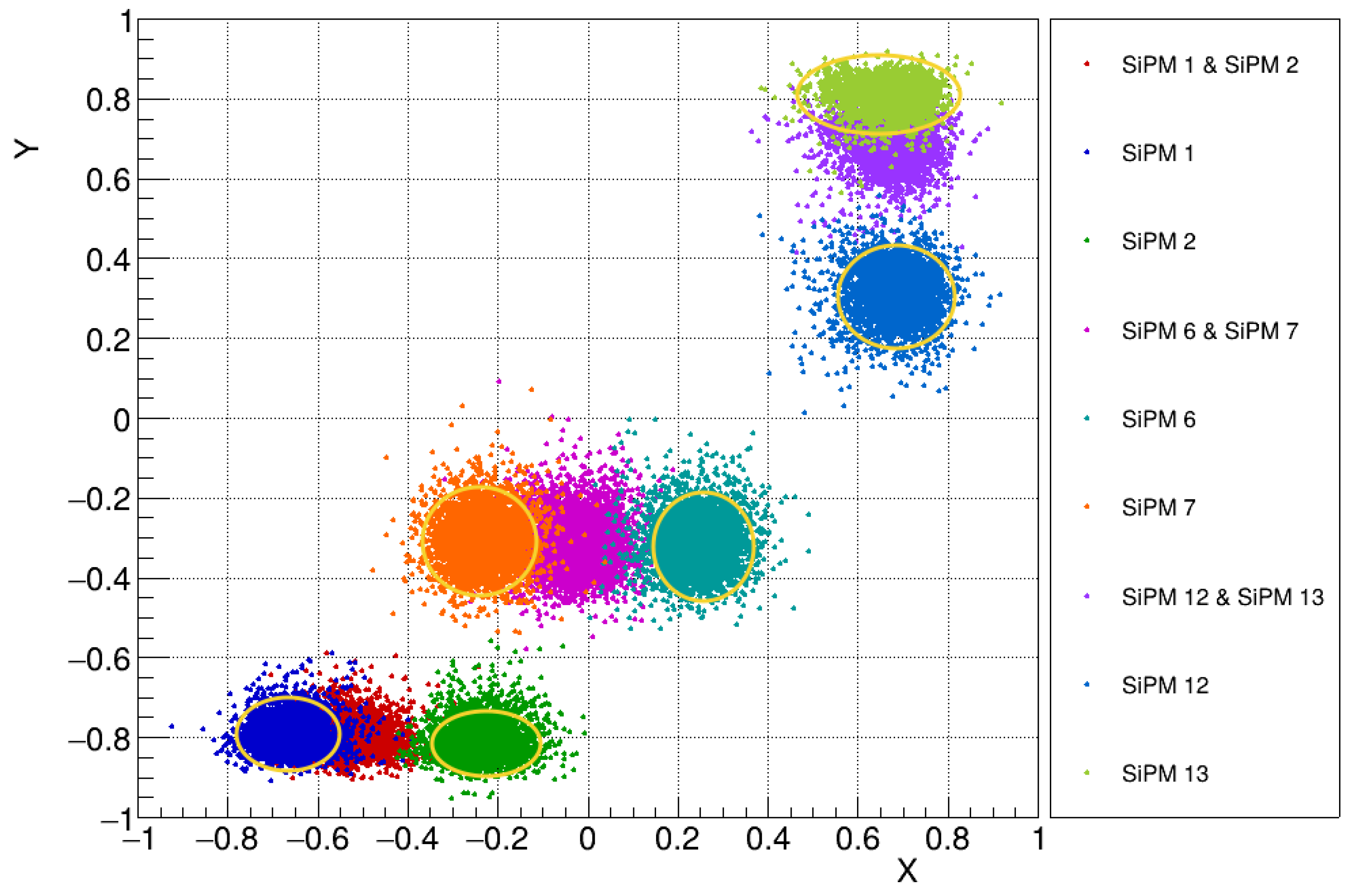
Figure 8.
Preliminary temperature-dependence test of the reconstructed response. Temperature-dependent changes in SiPM gain and noise can affect the charge-division coordinates and therefore require stabilization or calibration.
Figure 8.
Preliminary temperature-dependence test of the reconstructed response. Temperature-dependent changes in SiPM gain and noise can affect the charge-division coordinates and therefore require stabilization or calibration.
Disclaimer/Publisher’s Note: The statements, opinions and data contained in all publications are solely those of the individual author(s) and contributor(s) and not of MDPI and/or the editor(s). MDPI and/or the editor(s) disclaim responsibility for any injury to people or property resulting from any ideas, methods, instructions or products referred to in the content. |
© 2026 by the authors. Licensee MDPI, Basel, Switzerland. This article is an open access article distributed under the terms and conditions of the Creative Commons Attribution (CC BY) license (http://creativecommons.org/licenses/by/4.0/).
Copyright: This open access article is published under a Creative Commons CC BY 4.0 license, which permit the free download, distribution, and reuse, provided that the author and preprint are cited in any reuse.