

Submitted:
02 August 2026
Posted:
03 August 2026
You are already at the latest version
Abstract
We prove the Wave Function Identity (WFI), a new symmetry constraint on the solutions of the Schrödinger-Pauli equation for the Coulombically interacting N = 3 electron 2-dimensional harmonically bound ‘artificial atom’ or quantum dot in a uniform magnetic field. The symmetry is comprised of an interchange of the spatial coordinates of two electrons whilst keeping their spin moments unchanged, followed by an inversion of all three electron coordinates. The proof is achieved by first deriving the general form of the exact correlated wave function in the high-electron-correlation Wigner regime and then proving the WFI employing this form for a quartet state. The satisfaction of the Pauli principle (PP) and the odd parity of this state are also proved. An exact closed-form analytical expression for a quartet state in the Wigner regime is derived, and the properties of the PP, WFI, parity and other properties exhibited diagrammatically. Together with our prior proof of the WFI for the N = 2 electron case, we propose ad hoc the validity of the WFI for all bound-state N ≥ 2 electron systems for arbitrary symmetric binding potential, arbitrary electron-interaction of the form ω(|r – r’|) and arbitrary dimensionality.
Keywords:
symmetry in quantum mechanics
; Schrödinger-Pauli equation
; Wave Function Identity
; three-electron problem
; quantum dot
; quantum dot in magnetic field
; quartet state
1. Introduction
Symmetry plays a significant role in physics. A symmetry operation leaves a physical system invariant and facilitates the solution of a quantum-mechanical system as defined by its Hamiltonian. It further constitutes a constraint or ‘sum-rule’ on both the exact and any approximate solution. In this paper, we prove the Wave Function Identity (WFI), a symmetry constraint on the wave function solutions of the Schrödinger [1] and Schrödinger-Pauli [2] equations for the Coulombically interacting electron system bound by an electrostatic field with harmonic potential and in the presence of a uniform magnetic field. The WFI is a recently discovered [3] symmetry constraint on the exact wave function proved for the electron bound systems. Based on the proofs for the and now the electron cases, we propose ad hoc the validity of the WFI for bound electron systems. Further, that the WFI is valid for arbitrary binding potential, electron interaction of the form , and dimensionality. Thus, the WFI is a symmetry requirement of the solutions of the many-electron Schrödinger-Pauli/Schrödinger equations for systems such as the elements of the Periodic Table and multi-electron and ‘artificial atoms’.
Consider a system of N electrons (of mass m, charge , and spin moment ), with arbitrary electron interaction of the form , in an arbitrary external binding electric field such that , where is a symmetrical scalar potential, and a magnetic field with the vector potential. In the corresponding Schrödinger-Pauli theory Hamiltonian , the interaction of the spin moment with the magnetic field is explicitly considered. The exact and approximate wave function solutions (with ; , the spatial and the spin coordinate) of the stationary-state Schrödinger-Pauli equation must satisfy certain physical and mathematical constraints. The Schrödinger equations in the presence and absence of a magnetic field (with spinless Hamiltonian) constitute special cases. The corresponding solutions too must satisfy the same constraints.
The physical and mathematical constraints on the wave function for are the following:
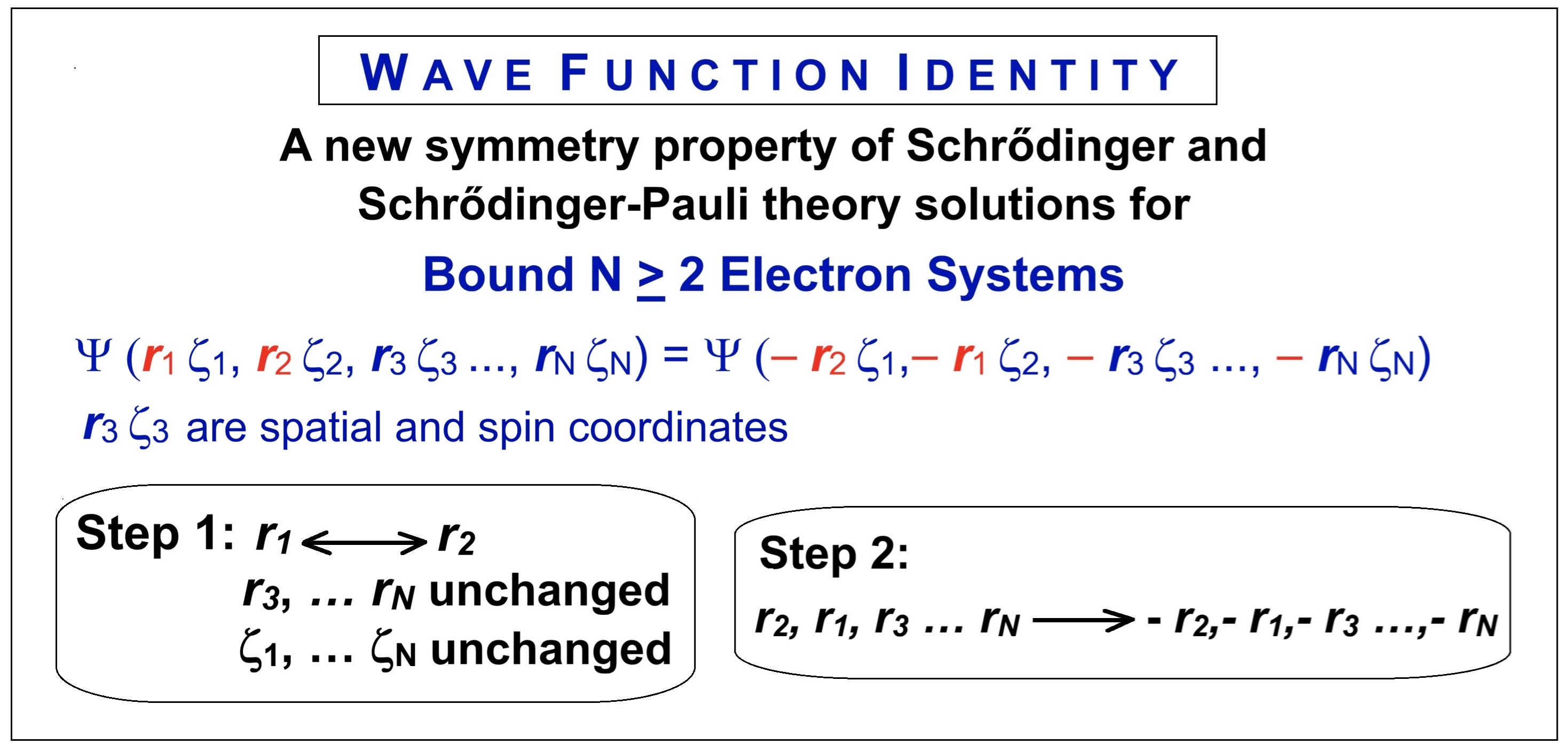
(i) Wave Function Identity. This symmetry operation is comprised of the interchange of the spatial coordinates of any two electrons whilst keeping their spin coordinates unchanged, followed by the inversion of all electron coordinates. Thus,
where . The application of the permutation operator [4] to the transformed wave function then leads [3] to its parity.
(ii) Pauli Principle (PP) [5,6,7]. In an interchange of the coordinates of any two electrons (including the spin coordinate), the wave function must be antisymmetric:
(iii) Parity. The wave function must possess the correct parity.
(iv) Electron Coalescence Constraints [8,9,10,11,12,13]. The wave function must satisfy the electron-electron and electron-nucleus coalescence constraints. The general form of the wave function (with the spin coordinate suppressed) in D-dimensional space when two charged particles of mass and coalesce is
where is the reduced mass, the relative coordinate, and an unknown vector. For electron-electron coalescence, , , and . Depending on the state, the wave function must satisfy either the node or cusp coalescence constraint. For electron-nucleus coalescence , the nuclear charge, and .
(v) Parity about each point of Electron-Electron Coalescence [8]. The wave function must possess the correct odd or even parity about each point of electron-electron coalescence.
(vi) Single-Valued, Smooth, and Quadratically Integrable. The wave function must be single-valued and smooth. It must also be quadratically integrable to be normalizable, and for the determination of properties as expectation values of Hermitian operators.
(vii) Nodes. Depending on the state of the interacting system, the corresponding wave function must possess the correct number of nodes.
For the 2-dimensional 3-electron harmonically bound system in a uniform magnetic field, it is possible to derive [14] the general form of the exact solution to the Schrödinger-Pauli equation in the Wigner high-electron-correlation regime [15,16,17,18]. This regime is characterized by low energy density, high electron-interaction energy relative to kinetic energy, and a high electron correlation contribution to the kinetic energy.
(Due to advances in semiconductor technology, such an ‘artificial atom’ or quantum dot can be physically created. In a semiconductor quantum dot [19,20,21], the electrons are confined to 2-dimensions in a quantum well within a thin layer of semiconductor such as GaAs sandwiched between two layers of another semiconductor such as AlGaAs. The mass of the electron is the band-effective mass, and its charge is modified by the dielectric constant of the semiconductor. Further, as opposed to natural atoms, the electrons in an‘artificial atom’ are bound by a harmonic potential. There has been recent work on the creation of such quantum dot Wigner crystals [22,23,24,25].)
Employing the exact general form of the wave function for the quartet state [26,27] of a 3-electron quantum dot, we prove the satisfaction of the Pauli Principle, the Wave Function Identity, and consequently prove the parity of a quartet state to be odd. In a quartet state, the spin moments of each electron are the same. Thus, its multiplicity since . (A similar proof can be provided for any state, e.g. the ground state for which two electrons have the same spin moment whilst the third has an opposite moment.) The choice of the quartet state in the present work is further governed by the fact that because of constraints on the solutions of the corresponding Schrödinger-Pauli equation as explained in the following section, a closed-form analytical expression for the wave function can be derived. This expression then allows for the easier determination and pictorial representation of the properties of the quartet state wave function.
In Sect II, we provide a brief outline of the derivation of the general solution of the 2-dimensional Schrödinger-Pauli equation in the Wigner regime for the 3-electron harmonically bound system in a uniform magnetic field. Employing the general form of the wave function for a quartet state, we prove in Sect. III the satisfaction of the Pauli Principle, the Wave Function Identity, and that the parity of a quartet state is odd. The details of the proofs are given in Appendices A, B and C, respectively. (The proof of the Pauli Principle is deemed necessary as it is possible to obtain a solution of the Schrödinger-Pauli equation that leads to an energy lower than the ground state but one which does not satisfy the Pauli Principle.) We then derive an exact analytical expression for the quartet state wave function in the Wigner regime, and present plots demonstrating the satisfaction of all symmetry and coalescence constraints. Concluding remarks are made in Sect. IV.
2. Derivation of General Form of Wave Function in Wigner Regime
The 2-dimensional Hamiltonian of the Schrödinger-Pauli equation for 3-electrons, each of mass m, charge , and spin moment , in a binding electric field with a harmonic scalar potential , with the force constant and frequency, and a magnetic field with a vector potential , is the sum of the Feynman kinetic , electron-interaction , and external potential operators:
where the electron spin moment ; the spin gyromagnetic ratio ; the Bohr magneton , with c the velocity of light; the spin angular momentum operator in its matrix representation , with the Pauli spin matrix; the physical or kinetic momentum operator with the canonical momentum operator .
The Schrödinger-Pauli equation for the 3-electron system is then
where are the eigenfunctions and eigenvalues, and ; . In a uniform magnetic field and symmetric gauge , the form of the eigenfunctions is a product of a spatial and spin component, where and . Thus,
The Hamiltonian of Eq. (4) can be decoupled [14] so as to be written as a sum of three interacting single-particle-pair (or quasi-particle) Hamiltonians. This is possible only in the high-electron-correlation Wigner regime for which the center of mass coordinate is set to zero:
One makes an orthogonal transformation that leaves the kinetic energy in a uniform magnetic field and the harmonic potential energy invariant. In this orthogonal transformation, the center of mass coordinate is also invariant. Setting in the transformed Hamiltonian, one obtains the decoupled Hamiltonian (in a.u., as
where , so that , and
with
and where corresponds to for any th pair: .
The corresponding quasi-particle or pair equation for the spatial component is
where the are the pair-function and eigenvalue of the th pair equation, with q representing the quantum numbers of that pair. The pair-function satisfies the normalization constraint:
The general formula of the solution of the pair-equation Eq. (15) for each th pair in polar coordinates is
where are the quantum numbers; n is the number of nodes of the pair function; m is the angular momentum quantum number ; p is the number of terms in the polynomial ; the coefficients of the polynomial ; is the angle of the relative coordinate vector ; is the effective force constant; and is the Larmor frequency.
The number of nodes n of a pair-function depends on the value of chosen. For the lowest value of , there are zero nodes; for the next higher value of , there is one node, and so on. (The reader is referred to the original literature [14] and to [8] for details of the derivation of the pair-function).
As the interacting 3-electron system is reduced to 3 noninteracting quasi-particle systems, the wave function of Eq. (10) is then the Hartree product of the wave functions of each pair-system:
where the are the normalized spin functions of the th pair. Further, the effective force constant is the same for each pair. With the general form of the spatial component of Eq. (17) and with the spin functions known, the wave function is the exact solution to the Schrödinger-Pauli equation Eq. (9) for the harmonically bound 3-electron system in the Wigner regime. The total energy E is the sum of the eigenvalues of each th pair-equation:
A closed-form analytical solution for a given state can be obtained provided the quantum numbers of each pair-function are the same.
The pair-equation Eq. (15) for the 3-electron system is similar to that of the harmonically bound 2-electron system in a magnetic field [8,28,29]. Hence, the individual pair-function components of the 3-electron sysstem, and thus the wave function , can be obtained from the solutions of the 2-electron system by a simple scaling.
3. Symmetry Properties of the Quartet State
This section is comprised of two parts. The first is the analytical proof of the symmetry properties of the Pauli principle, Wave Function Identity (WFI), and odd parity of a quartet state. The details of the proofs are given, respectively, in Appendices A, B, and C employing the general form of the exact 3-electron wave function derived in the previous section.
In the second part, we derive an analytical expression for the wave function of a quartet state in the high-electron-correlation Wigner regime. We then employ this expression to demonstrate pictorially the satisfaction of the symmetry properties of this state. Additionally, these diagrams demonstrate that the quartet state satisfies the node electron-electron coalescence constraint, that the parity about the point of electron coalescence is odd, and that the wave function exhibits a single node.
In Appendix A we employ the general form of the wave function of Eq. (20) for a quartet state to prove the satisfaction of the Pauli principle. In the quartet state, the electrons have the same spin moment. Hence, the spin function components of each pair-function are symmetric in an interchange of any two spin coordinates. It follows that the total spin function is symmetric in the interchange of the spin of any two of the 3 electrons. Therefore, the spatial part of the total wave function must be antisymmetric in an interchange of the spatial coordinates of any two electrons. In the proof we employ the angular momentum of each pair-function to be , so that the total angular momentum in the solvable state is . (Note that in contrast, the total ground state cannot be built up from identical ground-state pair-functions with . This would lead to the lowest energy but would not satisfy the Pauli principle.)
Employing the above general form of the quartet state wave function (with ), we prove in Appendix B the satisfaction of the WFI both analytically and by a vector diagram analysis.
Finally, using the WFI symmetry transformed quartet state wave function, we prove in Appendix C its parity to be odd.
To demonstrate pictorially the above symmetry and constraint properties of the quartet state we have derived the spatial component (with ) of the pair function of the 3-electron wave function of Eq. (20). The quantum numbers employed are . (See Eq. (17) for the definitions of these quantum numbers.) Thus,
where the normalization constant ; the angle is that of the relative coordinate ; ; ; ; ; ; ; ; .
The spatial part of the quartet state wave function designated as for the 3-electron quantum dot is comprised of 6 variables . To plot this wave function we fix the coordinates of one electron and the angles of the other two electrons. Thus, we present the Real and Imaginary parts of as a function of the radial coordinates of the two electrons.
In Figure 1(a) we plot the Real part of the quartet state wave function in (a.u.) for a fixed position of electron ; and fixed angles of electrons 1 and . In Figure 1(b), the coordinates of electrons 1 and 2 are switched so that it is a plot of the with , and for the same fixed position of electron 3. (Note that the coordinate axes of Figure 1(b) have also been switched.) Observe that multiplication of the plot of Figure 1(b) by reproduces the plot of Figure 1(a). This proves the satisfaction of the Pauli principle for this arbitrary fixed position of one electron and fixed angles of the other two electrons.
Figure 2a,b are the corresponding plots for the Imaginary parts of the quartet state wave function: . Once again, the Pauli principle is satisfied for this component of the wave function.
Also observe the following in Figure 1(a) and Figure 2(a). (i) The structure of the and are distinctly different; (ii) Both the and exhibit a single node; (iii) At the point of electron-electron coalescence at the origin , both the and satisfy the node electron-electron coalescence constraint. (There are, of course, an infinite number of such nodes when any two of the three electrons coalesce.)
In Figure 3 and Figure 4, we show the satisfaction of the WFI symmetry property. Figure 3(a) is a plot of the for fixed position of electron 3 at ; and fixed angles of electrons 1 and 2 at . In Figure 3(b), the WFI symmetry constraint of interchanging the positions of two electrons followed by an inversion of all three electrons is applied to the . Thus, what is plotted in Figure 3(b) is with the position of electron 3 at ; and the angles of electrons 1 and 2 fixed at . The plots of Figs. 3(a) and 3(b) are the same, thus demonstrating the satisfaction of the WFI by the Real part of the quartet state wave function. Figure 4(a) and 4(b) are plots of the demonstrating the satisfaction of the WFI for this component of the quartet state wave function.
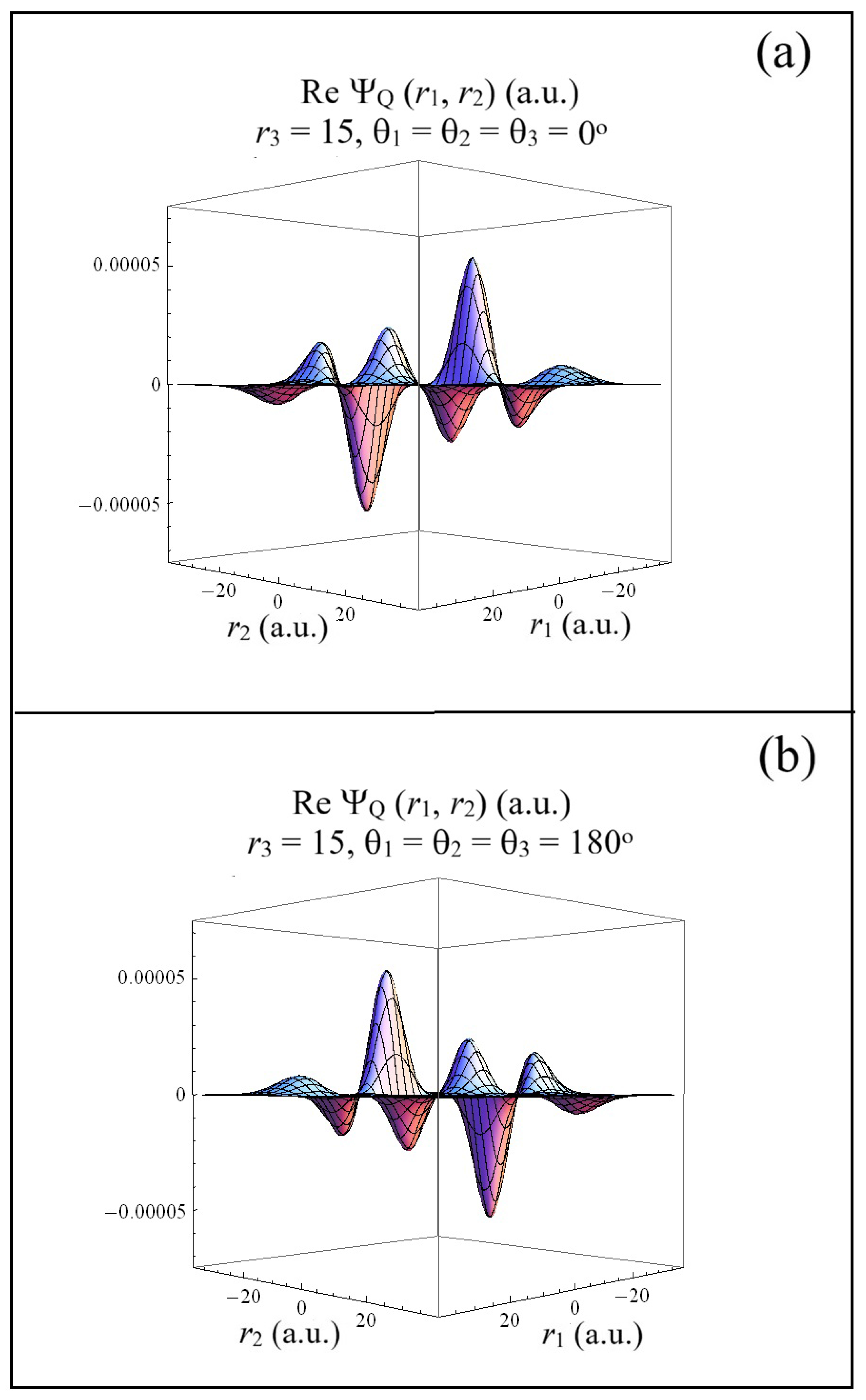
Finally, in Figure 5 we demonstrate that the parity of the quartet state is odd. In Figure 4(a) we plot for electron 3 fixed at ; and the angles of electrons 1 and 2 fixed at . Figure 5(b) is a plot of with electron 3 fixed at ; and the angles of electrons 1 and 2 fixed at . A comparison of panels (a) and (b) show the parity to be odd.
4. Concluding Remarks
The principal conclusion of the present work is the ad hoc proposal that for N-electron systems with arbitrary symmetric binding potential, arbitrary interaction of electrons of the form , and arbitrary dimensionality, the wave function solutions to the Schrödinger-Pauli/Schrödinger equations satisfy the symmetry property of the Wave Function Identity (WFI). This symmetry operation is comprised of the interchange of the spatial coordinates of any two electrons whilst keeping their spin coordinates unchanged, followed by an inversion of all the electron coordinates. This conclusion is arrived at based on our prior work of the satisfaction of the WFI by the exact wave function for the electron case, and the present proof for the exact solution of the Schrödinger-Pauli equation of the 2-dimensional Coulombically interacting electron ‘artificial’ atom or semiconductor quantum dot in a uniform magnetic field. For the 3-electron quantum dot, it is possible to obtain the general analytical form of the exact solutions in the high-electron-correlation Wigner regime. The satisfaction of the WFI is proved employing the general form of the wave function of a quartet state. The satisfaction of the Pauli principle and the odd parity of the quartet state wave function is also proved analytically. Additionally, we demonstrate these symmetry properties pictorially by deriving a specific closed-form exact analytical expression for the quartet state (with total angular momentum in the Wigner regime. These Figures further exhibit the following properties of a quartet state: it satisfies the node electron-electron coalescence constraint; the parity about each point of electron-electron coalescence is odd; and the state possesses a single node. Finally, we conclude by reiterating that the WFI symmetry requirement for a bound many-electron system is founded on exact analytical correlated wave function solutions of the Schrödinger-Pauli/Schrödinger equations for the 2- and 3-electron systems.
Author Contributions
Conceptualization, M.S. and V.S.; Formal analysis, M.S. and V.S.; Writing – original draft, M.S. and V.S.; Writing – review and editing, M.S. and V.S.
Funding
This research received no external funding.
Data Availability Statement
All data generated and analyzed in this study are available from the corresponding author on reasonable request.
Conflicts of Interest
The authors declare no competing interests.
Appendix A. Proof of Pauli Principle for the Quartet State
Employing the general form of the exact wave function of Eq. (20) valid in the Wigner regime, we prove in this Appendix the the satisfaction of the Pauli principle for the quartet state. As noted in the text, a closed-form analytical expression for the wave function of this state can be obtained provided the quantum numbers in the expressions of each pair are the same.
The spin component of the wave function is
where the is the spin component of a pair-function with the spin coordinate. In the quartet state, each electron is either in the positive spin state - or negative spin state -. Thus, in the interchange of the spin coordinates of any two electrons, the pair spin functions are symmetric, i.e.
It follows that the total spin function is symmetric. Hence, for the satisfaction of the Pauli principle, it must be proved that the spatial component of the wave function must be antisymmetric in an interchange of the spatial coordinates of any two electrons. Note that each pair-function component of depends spatially on the relative coordinate of that pair of electrons and on its angle, and on the angular momentum quantum number. Thus, we rewrite the spatial component of each pair-function in terms of the relative coordinate of a pair of electrons . The vector points from the tip of to the tip of . The angle of the vector is labeled . The angular momentum quantum number is designated . (The Gaussian component of the pair-function remains unchanged in an interchange of the spatial coordinates of any two electrons, and as such we do not include it in the expression.)
The general form of the spatial pair-functions is then
For the quartet state we choose . Thus,
The total wave function including the spin functions is then
As the spin moments of the electrons are the same, the spin functions are symmetric in an interchange of the spin coordinates (see Eq. (A2)). On the other hand, each spatial function changes sign on an interchange of the spatial coordinates of any two electrons.
Thus, define the permutation operator as causing the interchange of the spatial coordinates and .
First consider the interchange of the spatial coordinates of electrons 1 and 2. Hence, on applying the operator to , we have
The negative sign (−) arises because vector points from the tip of to tip of , so that . Thus, changes to .
Similarly,
and changes to , Finally,
and changes to .
Thus, on interchanging electrons 1 and 2,
Hence, the Pauli principle is satisfied.
Next consider interchanging the spatial coordinates of electrons 1 and 3. Then,
Thus, changes to .
Similarly,
so that changes to .
Finally,
and changes to .
Hence, on interchanging electrons 1 and 3,
and the Pauli principle is satisfied.
Lastly, on an interchange of electrons 2 and 3, the satisfaction of the Pauli principle can be proved as above.
Appendix B. Proof of Wave Function Identity for the Quartet State
In this Appendix, we prove the wave function identity (WFI) for the specific quartet state wave function of Eq. (A8) of Appendix A. To recall, the symmetry considered is a two-step process in which first the spatial coordinates of any two of the three electrons is interchanged whilst keeping their spin coordinates unchanged, followed by an inversion of the spatial coordinates of all three electrons through the center of symmetry. Once again, as the spin coordinate of each electron is the same, it remains the same in any symmetry operation. Hence, the WFI symmetry operator acts solely on the spatial coordinates and initially switching them and then performing the inversion to and whilst ensuring the spatial coordinate of the remaining electron is also negatized.
First consider the symmetry operation with regard to electrons 1 and 2. Then,
Note that since , the angle .
Next consider
Note again that since , the angle .
Finally, consider
Again, since , the angle .
The wave function prior to the symmetry operation is
The symmetry operation acting on is from (B5), (B10), (B15):
which proves the satisfaction of the WFI.
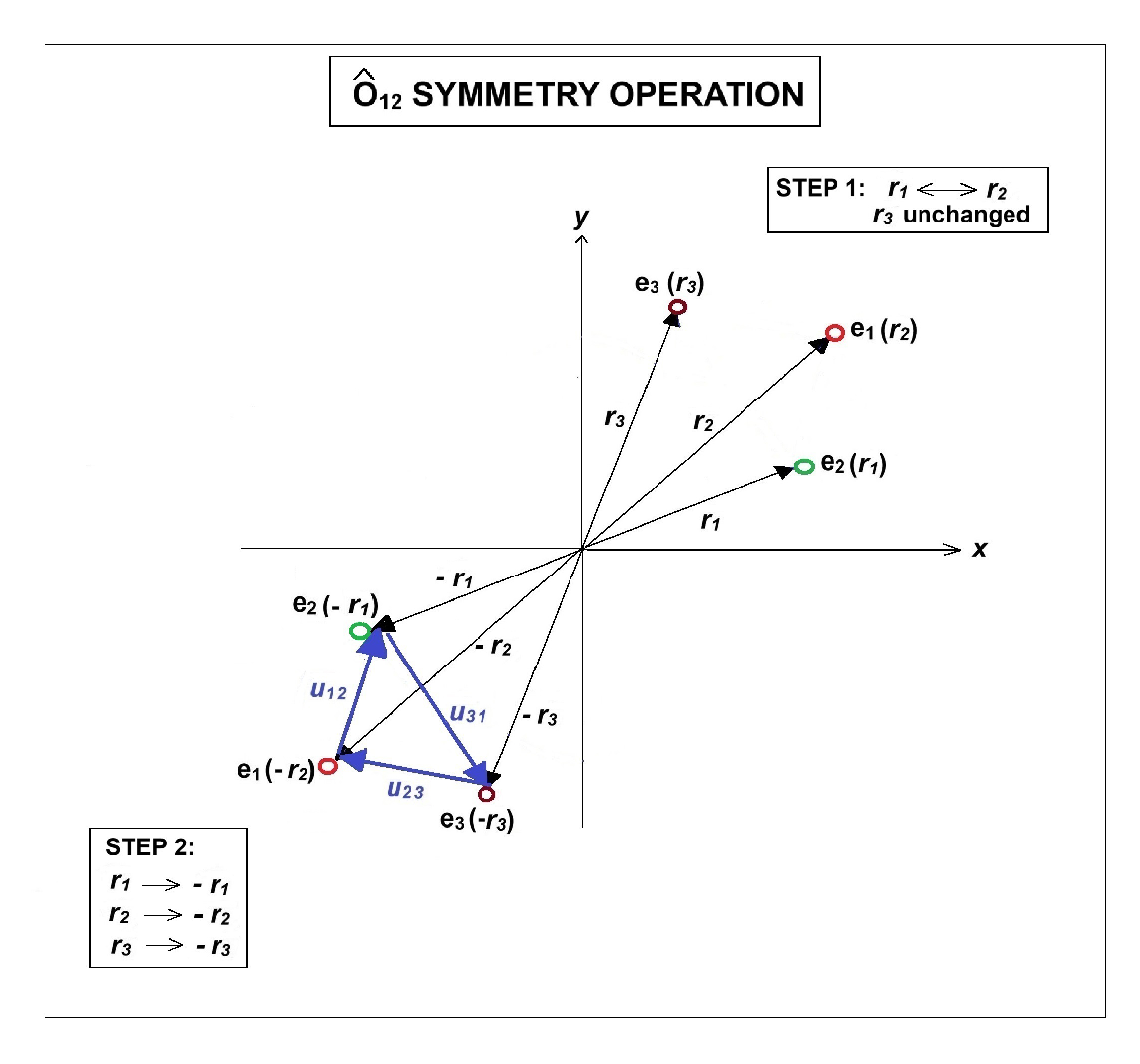
The wave function is a product of three pair functions which depend on the vector . Thus, the action of a symmetry operator such as on the wave function proving the WFI can be understood via vector diagrams. In Figure A6, the original configuration of the electrons are shown: . In the Figure 6, the vectors are emphasized. Note that the spin coordinates are not included as they are the same for each electron. In Figure A7, the vector description of the symmetry operation for the 3-electron system is shown. In Step 1 (quadrant 1), the spatial coordinates of electrons 1 and 2 are interchanged so that electron 1 is at and electron 2 at , with electron 3 remaining at : thus . In Step 2 (quadrant 3) an inversion about the origin is performed. Thus, electron 1 is at , electron 2 at , and electron 3 at : hence . Following the symmetry operation, the vectors (emphasized) are the same as those of Figure 6, thus proving the satisfaction of the WFI.
Figure A6.
Vector diagram of electron positions for the 3-electron quartet state: electron 1 at position , electron 2 at , and electron 3 at : . Emphasized are the vectors and . The spin coordinates of each electron being the same are not indicated.
Figure A6.
Vector diagram of electron positions for the 3-electron quartet state: electron 1 at position , electron 2 at , and electron 3 at : . Emphasized are the vectors and . The spin coordinates of each electron being the same are not indicated.
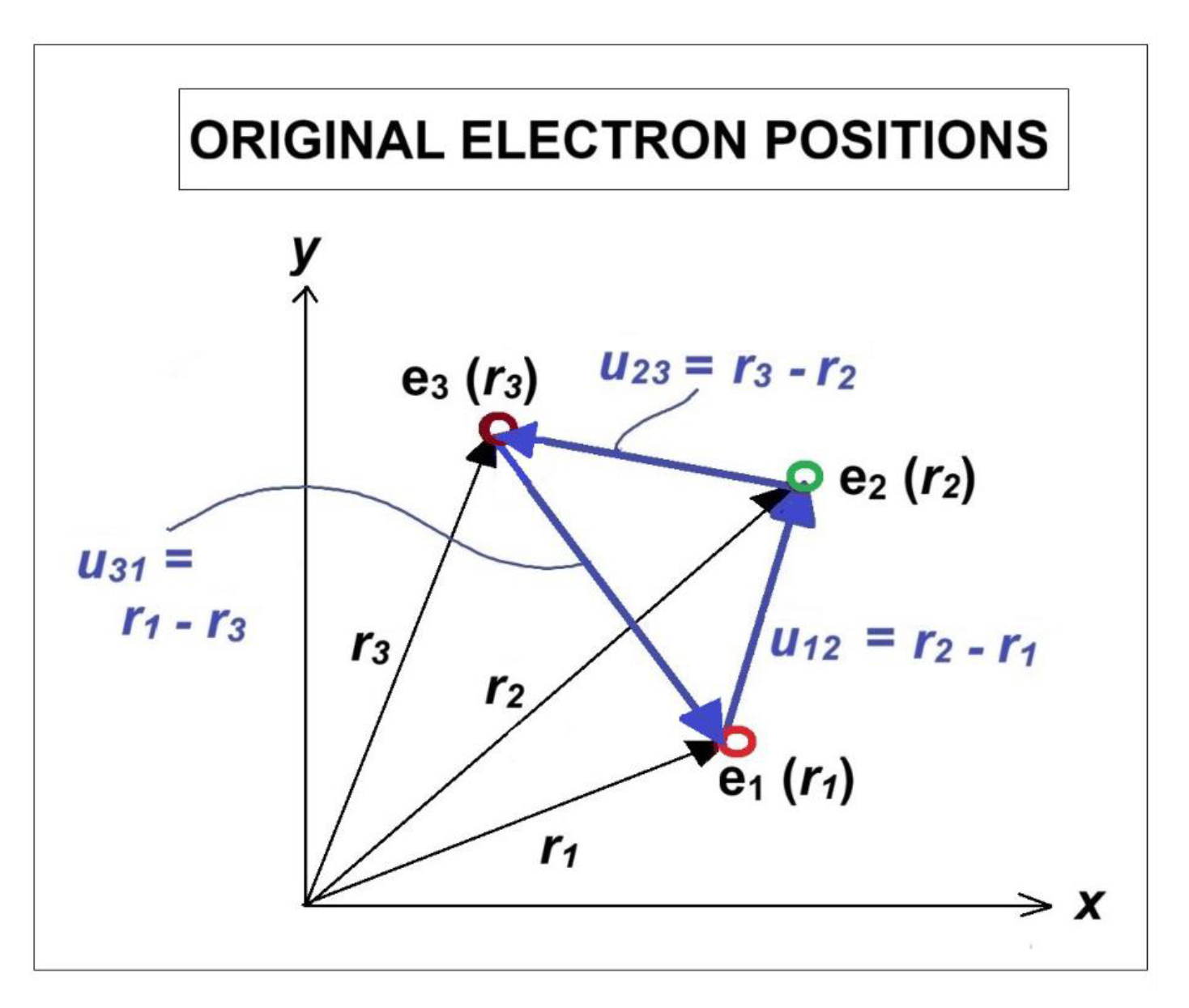
Figure A7.
Vector description to illustrate the symmetry operation acting on the wave function for the 3-electron system quartet state. The original electron configuration is shown in Figure 6. The symmetry operation is a two-step process. STEP 1 (quadrant 1): The spatial coordinates of electrons 1 and 2 are interchanged so that electron 1 is at , electron 2 is at , and electron 3 remains at : thus . STEP 2 (quadrant 3) is an inversion about the origin. Thus, electron 1 is at , electron 2 is at , and electron 3 at : hence . Observe that following the symmetry operation, the vectors (emphasized) are the same as those of Figure 6, thereby exhibiting the satisfaction of the Wave Function Identity.
Figure A7.
Vector description to illustrate the symmetry operation acting on the wave function for the 3-electron system quartet state. The original electron configuration is shown in Figure 6. The symmetry operation is a two-step process. STEP 1 (quadrant 1): The spatial coordinates of electrons 1 and 2 are interchanged so that electron 1 is at , electron 2 is at , and electron 3 remains at : thus . STEP 2 (quadrant 3) is an inversion about the origin. Thus, electron 1 is at , electron 2 is at , and electron 3 at : hence . Observe that following the symmetry operation, the vectors (emphasized) are the same as those of Figure 6, thereby exhibiting the satisfaction of the Wave Function Identity.
Next consider the symmetry operation of electrons 1 and 3. Then,
Note that since , the angle .
Next consider
Note that since , the angle .
Finally,
Again, since , the angle .
Therefore, from B23, B28, B33,
which proves the satisfaction of the WFI. Similarly, on application of the symmetry operation of electrons 2 and 3, we have
so that
which once again proves the satisfaction of the WFI.
Appendix C. Proof of Odd Parity of Quartet State
In this appendix, we prove that the parity of a quartet state is odd. The quantal state wave function is of the form (see Eq. (A8)):
where the functions are defined in Appendix A. The wave function is the product of 3 pair functions. Hence, the parity of any pair function will govern the parity of the total wave function.
The action of the WFI symmetry operator for electrons 1 and 2 is defined as (see Appendix B)
The WFI is the equality of the symmetry transformed function to the function. Thus, for two electrons
For the quartet state, the spin functions are symmetric in an interchange of the spin coordinates (see Eq. (A2)),
Next apply the Permutation operator to Eq. (C2):
where Eqs. (C6) and (C8) follow the Pauli principle (or equivalently via the use of the negative eigenvalue of the operator ); Eqs. (C7) and (C9) from Eq. (C4) of the symmetric spin function; and Eq. (C10) from the WFI statement of Eq. (C3).
Equating Eqs. (C10) and (C7), we have
so that the parity of the pair function is odd. One could also arrive at the same conclusion via the WFI. Apply the Pauli principle to the right hand side of Eq. (C3). Thus
where Eq. (C4) is used to obtain Eq. (C13). Equating Eq. (C13) to the left hand side of the WFI Eq. (C3) recovers Eq. (C11). As each pair component of the quartet state wave function is odd, the quartet state has odd parity, i.e.
References
- Schrödinger, E. Collected Papers on Wave Mechanics, American Mathematical Society Chelsea Publishing, Providence, Rhode Island, USA (2014).
- Pauli, W. On the quantum mechanics of magnetic electrons. Z. Physik 43, 601-623 (1927).
- Slamet, M. and Sahni, V. Wave function identity: A new symmetry for 2-electron systems in an electromagnetic field. Chem. Phys. 556 111453 (2022). [CrossRef]
- Messiah, A. Quantum Mechanics, Vol. II, (John Wiley and Sons, New York, (1966)).
- Pauli, W. On the connexion between the completion of electron groups in an atom with the complex structure of spectra. Z. Physik 31, 765-777 (1925).
- Dirac, P.A.M. On the theory of quantum mechanics. Proc. R. Soc. Lond. A 112, 661-667 (1926).
- Heisenberg, W. Mehrkrperproblem und Resonanz in der Quantenmechanik. (Many-body problem and resonance in Quantum Mechanics. Z. Physik 38, 411-426 (1926).
- Sahni, V. Schrödinger Theory of Electrons: Complementary Perspectives, Springer Tracts in Modern Physics Vo. 285 (Springer Nature Switzerland AG, (2022)).
- Pan, X.-Y. and Sahni, V. Integral coalescence conditions in D≥2, dimension space. J. Chem. Phys. 119, 7083-7086 (2003).
- Bingel, W.A. The behavior of the first-order density matrix at the Coulomb singularities of the Schrödinger equation. Z. Naturforsch. 18a, 1249-1253 (1963).
- Pack, R.T. and Brown, W.B. Cusp conditions for molecular wave functions. J. Chem. Phys. 45, 556-559 (1966).
- Bingel, W.A. A physical interpretation of the cusp conditions for molecular wave functions. Theoret. Chim. Acta. (Berl) 8, 54-61 (1967). [CrossRef]
- Moore, C. C. and Staroverov, V. N. Representation of electron-nucleus cusps in Slater and Gaussian basis sets. J. Chem. Phys. 163, 244106 (2025) (and references to recent literature therein). [CrossRef]
- Taut, M. Special analytical solutions of the Schrödinger equation for two and three electrons in a magnetic field and ad hoc generalizations to N particles. J. Phys. Condens. Matter 12, 3689-3710 (2000).
- Wigner, E.P. On the interaction of electrons in metals. Phys. Rev. 46, 1002-1011 (1934).
- Wigner, E.P. Effects of electron interaction on the energy levels of electrons in metals. Trans. Faraday Soc. 34, 678-685 (1938). [CrossRef]
- Achan, D., Massa, L., and Sahni, V. Wigner high electron correlation regime in nonuniform electron density systems: Kinetic and correlation-kinetic aspects. Comp. Theor. Chem. 1035, 14-18 (2014). [CrossRef]
- Achan, D., Massa, L., and Sahni, V. Wigner high electron correlation regime in nonuniform density systems: Kinetic and correlation-kinetic aspects. Comp. Theor. Chem. 1035, 14-18 (2014). [CrossRef]
- Ashoori, R.C. et al. Single-electron capacitance spectroscopy of discrete quantum levels. Phys. Rev. Lett. 68, 3088-3091 (1992). [CrossRef]
- Ashoori, R.C. Electrons in artificial atoms. Nature 379, 413-419 (1996). [CrossRef]
- Reimann, S.M. and Manninen, M. Electron structure of quantum dots. Rev. Mod. Phys. 74, 1283-1342 (2002).
- Tsui, Y.-C., et al. Direct observation of a magnet-field-induced Wigner crystal. Nature 628, 287-292 (2024).
- Smolenski, T. et al. Signatures of Wigner crystal of electrons in a monolayer semiconductor. Nature 595, 53-57 (2021). [CrossRef]
- Rubio-Verd, C. Electron crystals come under the microscope. Nature 597, 640-641 (2021).
- Andrei, E.Y., et al. Observation of a magnetically induced Wigner solid. Phys. Rev. Lett. 60, 2765-2768 (1988). [CrossRef]
- Schiff, L. I. Quantum Mechanics, (McGraw Hill, New York, (1966)).
- Paunz, R. Spin Eigenfunctions, (Plenum Press, New York, London, (1979)).
- Taut, M. Two electrons in a homogeneous magnetic field: Particular analytical solutions. J. Phys. A 27, 1045-1055 (1994); Corrigenda: J. Phys. A 27, 4723-4724 (1994). [CrossRef]
- Taut, M. and Eschrig, H. Exact solutions for a two-electron quantum dot in a magnetic field and application to more complex systems. Z. Phys. Chem. 224, 631-649 (2010). [CrossRef]
Figure 1.
Satisfaction of the Pauli principle for the Real part of the quartet state wave function in a.u.: (a) ; ; ; (b) ; ; . (Note the switching of the coordinate axes labels in (b).)
Figure 1.
Satisfaction of the Pauli principle for the Real part of the quartet state wave function in a.u.: (a) ; ; ; (b) ; ; . (Note the switching of the coordinate axes labels in (b).)
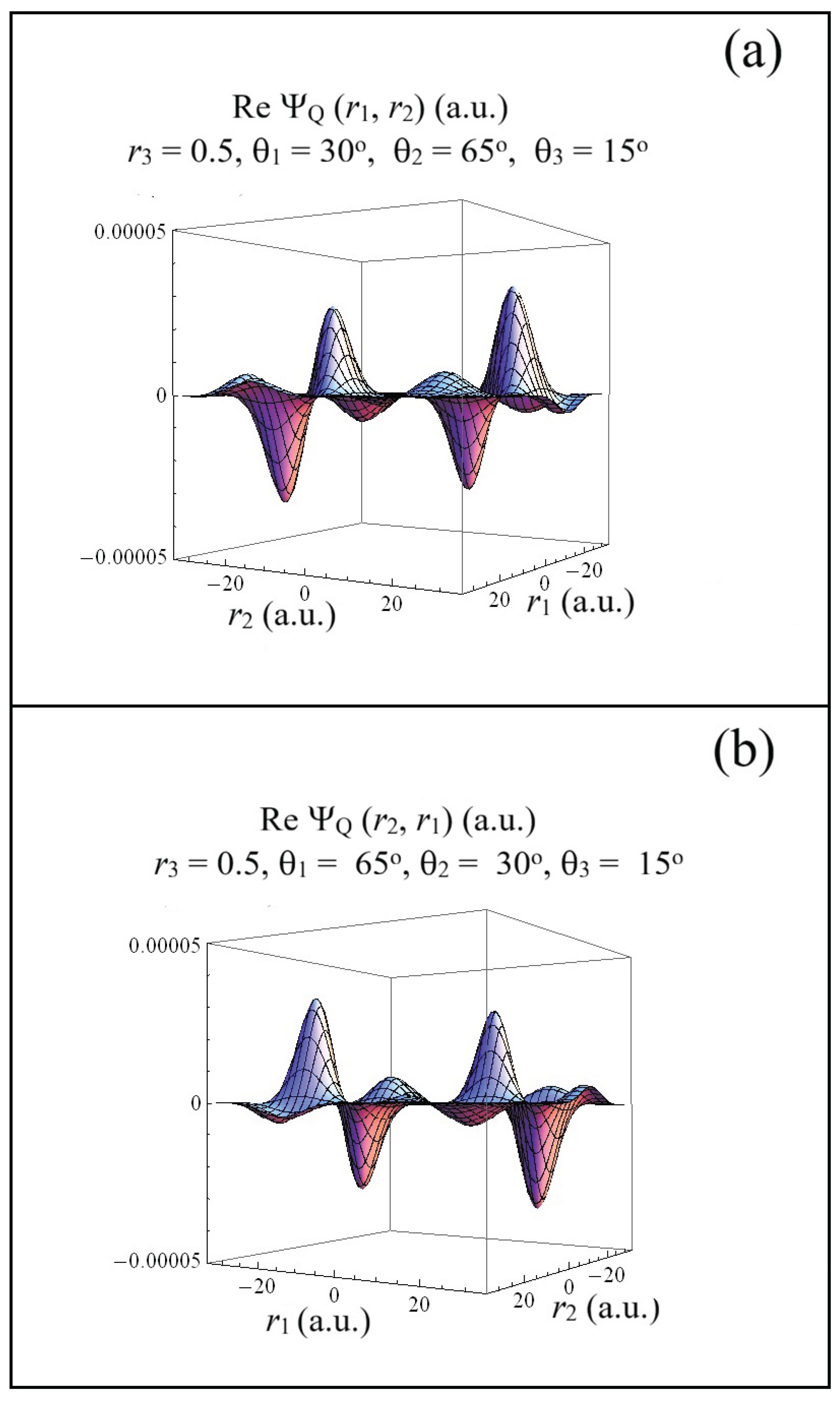
Figure 2.
Satisfaction of the Pauli principle for the Imaginary part of the quartet state wave function in a.u.: (a) ; ; ; (b) ; ; . (Note the switching of the coordinate axes labels in (b).)
Figure 2.
Satisfaction of the Pauli principle for the Imaginary part of the quartet state wave function in a.u.: (a) ; ; ; (b) ; ; . (Note the switching of the coordinate axes labels in (b).)
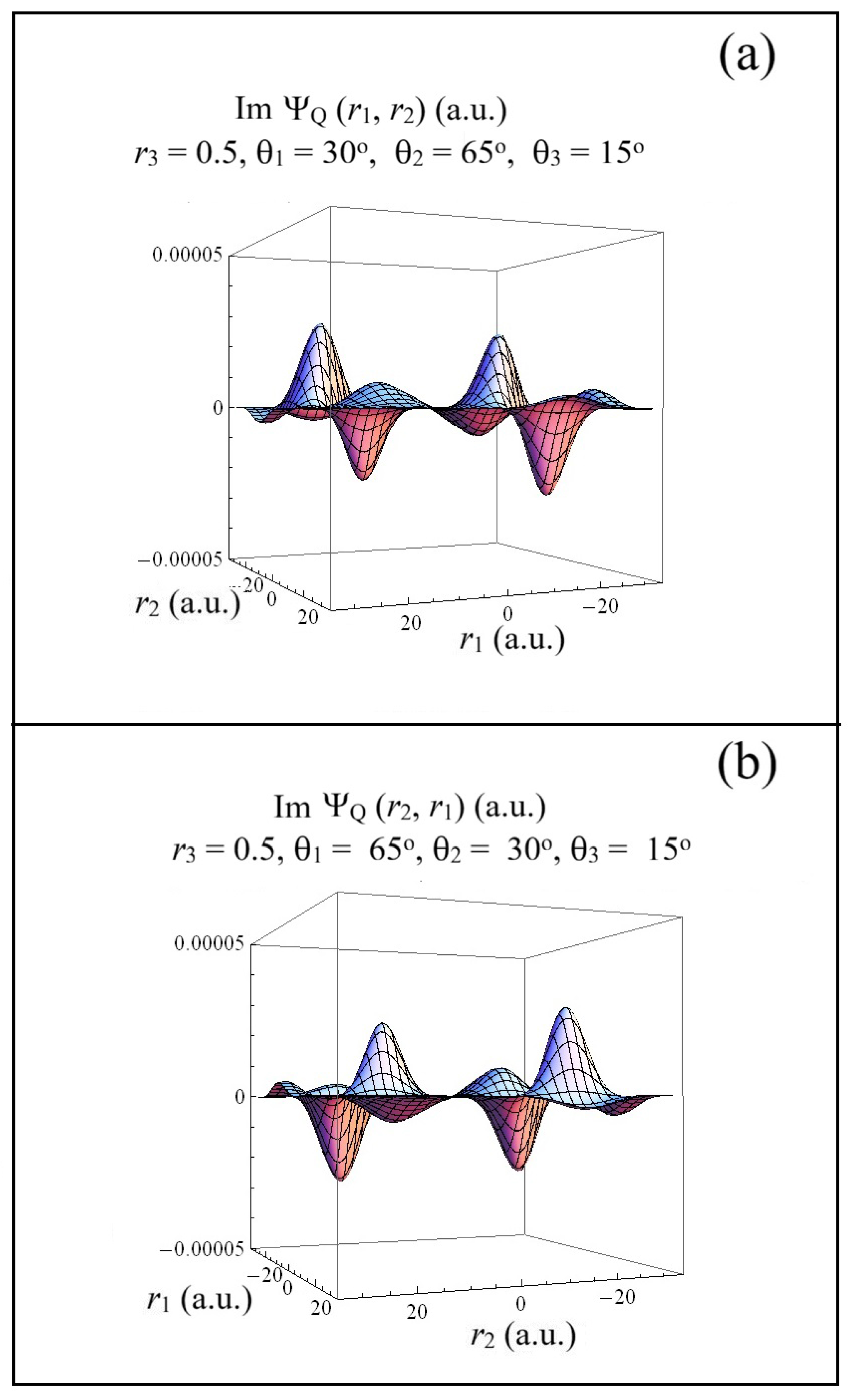
Figure 3.
Satisfaction of the Wave Function Identity for the Real part of the quartet state wave function in a.u.: (a) ; ; ; (b) ; ; . (Note the switching of the coordinate axes labels in (b).)
Figure 3.
Satisfaction of the Wave Function Identity for the Real part of the quartet state wave function in a.u.: (a) ; ; ; (b) ; ; . (Note the switching of the coordinate axes labels in (b).)
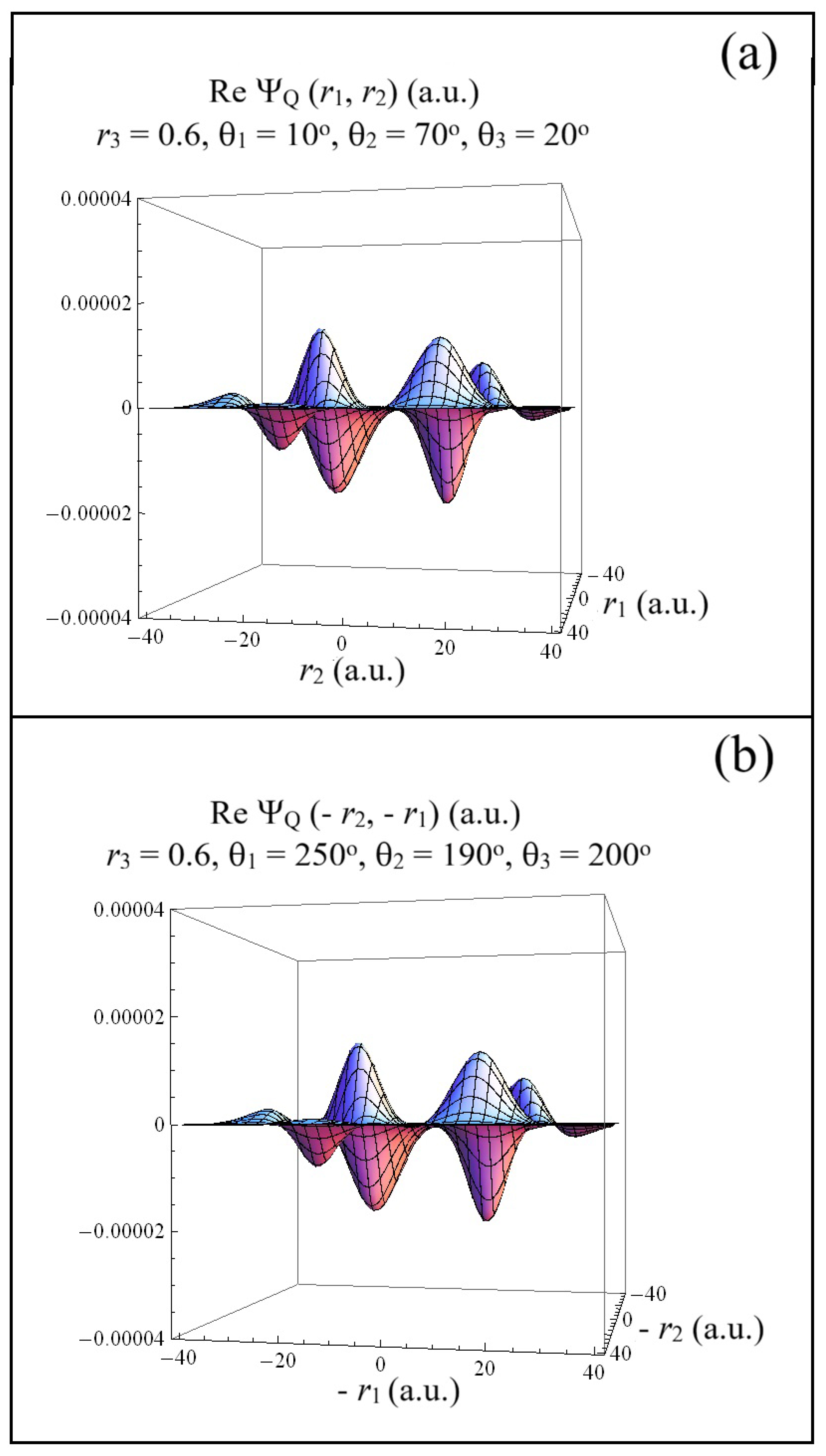
Figure 4.
Satisfaction of the Wave Function Identity for the Imaginary part of the quartet state wave function in a.u.: (a) ; ; ; (b) ; ; .
Figure 4.
Satisfaction of the Wave Function Identity for the Imaginary part of the quartet state wave function in a.u.: (a) ; ; ; (b) ; ; .
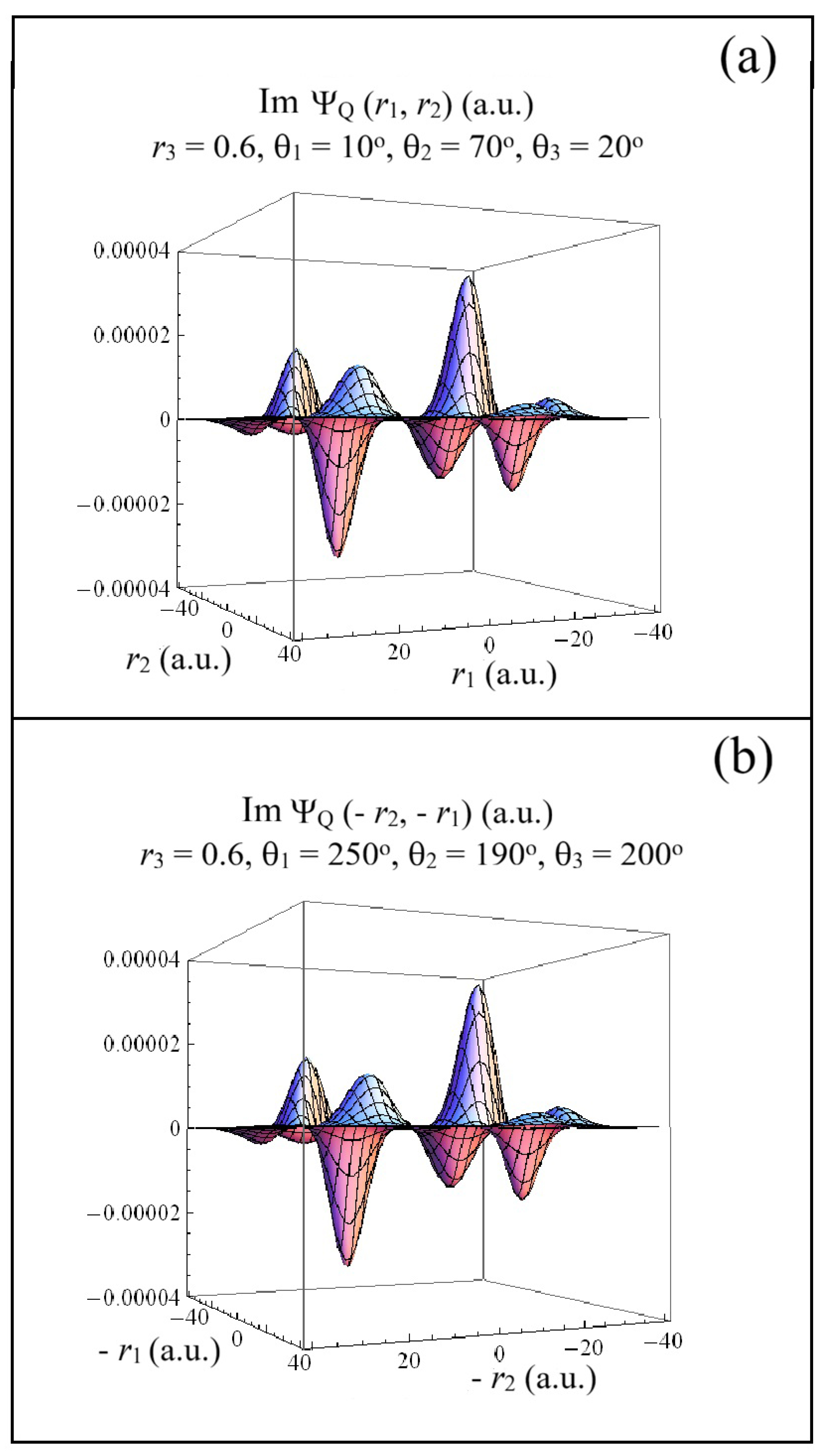
Figure 5.
Odd parity of the Real part of the quartet state wave function in a.u.: (a) ; ; (b) ; .
Disclaimer/Publisher’s Note: The statements, opinions and data contained in all publications are solely those of the individual author(s) and contributor(s) and not of MDPI and/or the editor(s). MDPI and/or the editor(s) disclaim responsibility for any injury to people or property resulting from any ideas, methods, instructions or products referred to in the content. |
© 2026 by the authors. Licensee MDPI, Basel, Switzerland. This article is an open access article distributed under the terms and conditions of the Creative Commons Attribution (CC BY) license.
Copyright: This open access article is published under a Creative Commons CC BY 4.0 license, which permit the free download, distribution, and reuse, provided that the author and preprint are cited in any reuse.


