

Submitted:
31 July 2026
Posted:
03 August 2026
You are already at the latest version
Abstract
With advancements in DNA nanotechnology, DNA has evolved far beyond its traditional genetic role into a programmable material distinguished by specific molecular recognition and controllable self-assembly. As contemporary environmental pollutants become increasingly complex, conventional remediation technologies often face critical limitations due to their poor selectivity and low adaptability. Consequently, DNA nanotechnology presents a promising alternative for intelligent remediation. Specifically, functional nanostructures such as aptamers, DNAzymes, hydrogels, and hybrid nanocomposites serve as innovative platforms for the highly selective sequestration, degradation, and isolation of diverse contaminants. This review summarizes the fundamental properties of DNA relevant to environmental remediation, including enzyme-free amplification and stimulus-responsive structural transitions. We further discuss diverse DNA-based material platforms and systematically classify recent remediation strategies by pollutant categories, such as heavy metals, organic/biological contaminants, and radionuclides. Finally, we evaluate the current challenges hindering the practical translation of DNA-based remediation systems and outline promising future directions, offering a comprehensive perspective on developing next-generation smart materials for sustainable environmental management.
Keywords:
DNA materials
; environmental remediation
; DNA nanotechnology
; molecular recognition
; self-assembly
1. Introduction
Deoxyribonucleic acid (DNA) is a biopolymer composed of four nucleotide bases, adenine (A), thymine (T), cytosine (C), and guanine (G) which stores genetic information within its specific sequence. The most inherently unique characteristic of DNA lies in the sequence-specific interactions of these four bases, known as Watson-Crick base pairing which enables not only the precise structural control at the nanometer scale but also the sophisticated recognition and capture of targets ranging from biomacromolecules to small organic molecules [1,2,3,4]. Driven by these excellent properties and the rapid advancements in nanotechnology, DNA has emerged as a highly versatile functional material that far exceeds its traditional biological role as a carrier of genetic information. The programmability of DNA has enabled a wide range applications in biomedicine, molecular computing, and information storage [2,4,5,6,7,8,9]. In particular, in the environmental field, functional DNA technologies such as aptamers, DNAzymes, and Isothermal-amplification of nucleic acids have been widely studied as platforms for environmental monitoring and pollutant detection based on their high selectivity and sensitivity [10,11,12]. More recently, DNA-based materials are attracting attention as a promising next-generation platforms not only for environmental monitoring but also in the field of environmental remediation for the capture, degradation, and removal of pollutants due to their precise molecular recognition capabilities, adaptability, and stimulus responsiveness [13,14,15,16].
This growing interest stems from the fact that contemporary environmental pollution has become increasingly diverse and complex, exposing the critical limitations in the real-world application of conventional remediation technologies. Today, rapid population growth, industrialization, and urbanization have led to increasingly complex environmental challenges characterized by the widespread coexistence of diverse contaminants, including heavy metals, organic pollutants, pharmaceutical residues, pesticides, and pathogenic microorganisms [17,18]. Owing to their persistence, toxicity, and potential for bioaccumulation, these contaminants pose serious risks to ecosystems, water resources, and human health. Consequently, the establishment of efficient and reliable technologies for intelligent environmental management and remediation has emerged as a critical global priority. However, Conventional environmental systems typically suffer from decoupled recognition and remediation processes, often requiring multistep external operations and manual intervention to address complex environmental challenges [16]. Moreover, maintaining high selectivity and performance in the presence of diverse contaminants and coexisting interferents remains a persistent challenge in real-world environmental matrices [18,19]. Therefore, DNA-based materials have emerged as particularly attractive candidates for environmental applications owing to their ability to integrate molecular recognition, stimuli-triggered operation, and contaminant removal within a single programmable platform [10,16,20]. In addition, DNA-based materials generally exhibit low intrinsic toxicity and can be degraded into naturally occurring nucleotides, potentially reducing concerns regarding secondary environmental contamination.
While conventional environmental materials such as activated carbon, zeolites, metal-organic frameworks (MOFs), and pristine metallic nanoparticles which are limited by their limited selectivity, static structures and lack of adaptability, the DNA platform offers the unique advantage of structural flexibility and rational programmability, allowing it to be tailored for recognizing specific targets with exceptional affinity [13,21,22,23]. Specifically, this platform enables the easily introduction of aptamers tailored through screening processes for highly selective target recognition [24,25]. Aptamers can be integrated with heterogeneous nanomaterials, such as carbon nanotubes, graphene, gold nanoparticles, magnetic nanoparticles (MNPs), mesoporous silica nanoparticles (MSNPs) and metal–organic frameworks, to construct hybrid nanocomposites that combine the exceptional molecular recognition capability of aptamers with the high surface area, adsorption capacity, and catalytic properties of nanomaterials, thereby enabling selective pollutant capture and enhanced remediation performance [24,25]. Furthermore, by integrating with enzyme-free isothermal nucleic acid amplification cascades such as hybridization chain reaction (HCR), this system can autonomously assemble into 3D networked DNA hydrogels upon target recognition, providing an excellent macrostructural matrix for the high-capacity sequestration and isolation of specific pollutants [10,26,27]. This multi-functional versatility shifts environmental management from conventional passive treatments to intelligent, interactive processes, thereby serving as an innovative platform capable of simultaneously achieving the selective recognition, targeted capture, catalytic degradation of diverse contaminants within complex ecosystems (Figure 1) [13,16].
In this review, we comprehensively examine the recent advancements in programmable DNA nanotechnology explicitly tailored for complex environmental remediation applications. Specifically, we systematically categorize and discuss the utilization of these DNA-based platforms for the selective recognition and high-capacity remediation of major contemporary pollutants, including heavy metals, organic dyes, biotoxins, biological contaminants and emerging pharmaceuticals. Furthermore, we provide detailed insights into the structural design strategies of advanced DNA nanoarchitectures, such as hybrid nanocomposites and 3D hydrogels. In particular, this review discusses the key challenges limiting the practical translation of DNA-based remediation systems, including structural stability under real-world environmental conditions, production cost, scalability, and long-term durability, while highlighting recent engineering advances that are gradually transforming these long-standing limitations into manageable design challenges. Finally, we present promising future directions for expanding DNA-based remediation through the integration of functional material platforms, the extension toward new classes of target pollutants, and the rational development of next-generation smart materials for sustainable environmental remediation.
2. Molecular Functions of DNA for Environmental Remediation
To critically evaluate the potential of DNA-based environmental remediation systems, a fundamental understanding of the intrinsic molecular functionalities of DNA is essential. These functionalities can be broadly categorized into (1) target-specific molecular recognition, (2) catalytic transformation and degradation, and (3) enzyme-free self-assembly and signal amplification. In fact, all of these mechanisms originate fundamentally from the structural flexibility of single-stranded DNA and the programmability of nucleotide sequence (Figure 2A). These allow diverse and unique functions to DNA through unique folding and hybridization behaviors. Despite this excellent potential, DNA-based environmental applications have so far been concentrated in the monitoring field, and only recently has their scope expanded to environmental remediation [10,12,13,28]. Although some of these functionalities have not yet been fully exploited for environmental remediation, understanding their underlying mechanisms provides opportunities for the rational design of more advanced DNA-based remediation platforms. In this section, we comprehensively review the working principles and rational design strategies underlying these three core molecular functionalities of DNA nanotechnology, providing a conceptual framework for understanding how they are implemented in the diverse DNA-based remediation platforms discussed in the following section and how they may be further exploited in next-generation systems.
2.1. Target-Specific Molecular Recognition
In complex aquatic environments where numerous dissolved species coexist, the ability to selectively distinguish target contaminants from competing substances is essential for practical remediation. Among the various excellent functions of DNA, molecular recognition is one of the most powerful capabilities enabling selective pollutant capture and isolation. Aptamers refer to short single-stranded DNA that has high affinity and selectivity for specific targets through sequence-dependent folding and molecular interactions. Aptamers are typically 20–100 nucleotides in length and are obtained through the systematic evolution of ligands by exponential enrichment (SELEX) process [4,24,25]. The SELEX process Starting from a massive synthetic library containing up to 1016 highly diverse and randomized oligonucleotide sequences. Subsequently, through repetitive binding–separation–amplification cycles, sequences that bind strongly to the target are selectively enriched, ultimately yielding aptamers with high affinity and selectivity. Through this screening methodology, aptamers can be custom-tailored to bind a broad spectrum of environmental contaminants ranging from heavy metal ions such as Hg2+, Pb2+, and Cd2+ to complex organic pollutants such as pesticides, antibiotics, and endocrine disruptors with exceptional affinity and specificity [24,25,29]. This extensive target range demonstrates that aptamer-based recognition technologies can be utilized as a basis for various DNA-based environmental remediation strategies.
Recognition between aptamers and targets is mediated by various non-covalent interactions, including hydrogen bonding, electrostatic interactions, van der Waals forces, hydrophobic effects, and π-π stacking [30,31]. These aptamer-target interactions induce structural changes that stabilize the target binding state, which can then be utilized to trigger downstream molecular events such as catalytic DNAzyme activation, induction of strand substitution reactions, and the initiation of enzyme-independent amplification pathways like HCR and catalytic hairpin assembly (CHA) (Figure 2B). Consequently, aptamers can act not only as simple recognition elements but also as molecular switches linking contaminant detection with functional reactions, which is one of the key advantages distinguishing DNA from conventional adsorption-based materials [4,11]. Another key advantage of aptamers is the ability to customize selectivity during the SELEX process. By incorporating competing ions or structurally similar compounds into the selection process, aptamers can be evolved to preferentially recognize target contaminants while minimizing non-specific interactions [32,33]. This target specificity is particularly important in modern environmental systems where target contaminants coexist with chemically similar substances. Finally, aptamers can be easily integrated with various existing environmental remediation materials, enabling more precise and efficient capture and removal of pollutants by imparting molecular selectivity to existing materials, which are highly efficient but inherently lacking in selectivity [13,15,34,35]. In summary, aptamers enable highly selective recognition of target contaminants even in chemically complex environmental matrices and, through target-induced conformational changes, can couple molecular recognition to downstream functional responses. Furthermore, as they can be utilized as functional modules to impart selectivity to existing environmental remediation materials, aptamers are a core component of programmable DNA-based environmental remediation platforms that integrate diverse functions.
2.2. Catalytic Transformation and Degradation
Selective recognition and capture can effectively isolate target contaminants from complex environmental matrices. However, complete remediation often requires their transformation into less toxic or environmentally benign products, particularly when pollutants remain chemically present for a long time after capture. Therefore, interest in catalytic strategies capable of converting pollutants into less harmful substances is gradually increasing [36]. Protein enzyme catalysts have long been regarded as one of the most ideal strategies for environmental remediation due to their high substrate specificity, excellent catalytic efficiency, and ability to accelerate reactions under mild conditions [37,38]. However, protein enzymes face challenges in applying to real-world environmental systems due to limited stability, high production costs, and complex manufacturing and storage processes. As an alternative to overcome these limitations, DNA-based catalysts are emerging, offering high chemical stability, easy synthesis, excellent programmability, and high compatibility with various DNA-based structures [38,39,40,41]. Interestingly, DNA sequence-dependent folding can not only enable selective target recognition but also generate catalytically active structures that bind to specific cofactors such as metal ions or small molecules to facilitate chemical transformation. Single-stranded DNA molecules with such catalytic activity, known as DNAzymes, are obtained through in vitro selection processes like aptamers, and numerous DNAzymes have been reported that can catalyze reactions such as RNA phosphodiester bond cleavage, linkage, phosphorylation, and porphyrin-mediated oxidation [39,42]. Among these, RNA-cleaving DNAzymes (RCDs) and G-quadruplex-based peroxidase-mimicking DNAzymes (PMDs) are receiving particular attention in the field of environmental remediation because they can act as molecular switches that induce structural modifications and subsequent reactions, or directly catalyze oxidation reactions for the decomposition of pollutants.
This remarkable ability to endow DNA with catalytic functionality stems from the capacity of specific nucleotide sequences to fold into well-defined three-dimensional structures, precisely spatializing substrates and cofactors in a manner similar to the active sites of natural protein enzymes [39,40]. RCDs are typically activated by specific divalent metal ions, including Mg2+, Pb2+, Cu2+, UO22+, and Hg2+, which serve as catalytic cofactors by promoting the formation of catalytically competent conformations and facilitating phosphodiester bond cleavage within RNA or RNA-containing substrates [42]. In particular, since some of these metal ions are environmentally important pollutants, RCDs can directly link molecular recognition with functional responses by utilizing the pollutants themselves as inducing factors for catalytic activity [10,12]. While this switching mechanism has been extensively exploited for environmental sensing, it has only recently begun to be translated into DNA-based environmental remediation systems [38,43]. Specifically, RCDs can be employed to induce DNA structural rearrangement, hydrogel degradation, or the controlled release of functional components, thereby providing a molecular mechanism for the spatiotemporal regulation of DNA-based environmental remediation systems. In contrast to RCDs, PMDs catalyze redox reactions rather than nucleic acid cleavage. PMDs are typically constructed by the non-covalent assembly of guanine-rich DNA sequences into G-quadruplex (G4) structures, followed by the incorporation of hemin as a catalytic cofactor [38,40]. These G-quadruplex/hemin complexes catalyze oxidation reactions capable of degrading organic contaminants, dyes, and phenolic compounds in the presence of hydrogen peroxide (Figure 2C) [38]. Collectively, RCDs and PMDs represent two complementary catalytic strategies in DNA-based environmental remediation. Whereas RCDs translate pollutant-induced molecular recognition into programmable structural and functional responses, PMDs directly catalyze oxidative pollutant degradation. Such catalytic DNA systems provide a promising alternative to conventional enzymatic remediation strategies due to their high stability, low cost, and facile sequence programmability.
2.3. Enzyme-Free Self-Assembly Amplification
Beyond molecular recognition and catalysis, the programmability of DNA enables enzyme-free isothermal amplification (EFIA), a programmable reaction strategy in which toehold-mediated strand displacement drives autonomous hybridization cascades. These EFIA strategies were originally developed to enhance analytical sensitivity by converting a single molecular trigger into amplified DNA outputs [26,44,45]. Beyond signal amplification, however, these reactions possess a unique capability to autonomously assemble programmable DNA architectures, including hydrogels and functional nanostructures, under mild aqueous conditions [27,46]. Among various EFIA strategies, CHA and HCR are the two most widely used systems due to their simplicity, high programmability, and operation under mild isothermal conditions. Both systems induce programmable DNA hybridization chain reactions using toehold-mediated strand displacement without enzymes. While CHA primarily amplifies molecular reactions through the catalytic recycling of hairpin substrates, HCR binds to the initiation strand to sequentially assemble alternating hairpin monomers to form a long double-stranded DNA polymer with a nick [26,47]. Thus, CHA primarily amplifies molecular functions by catalytically generating multiple functional DNA modules, whereas HCR amplifies structural functions by assembling extended DNA polymers and higher-order architectures. The resulting DNA architectures can provide a structural framework for concentrating molecular recognition elements, catalytic DNAzymes, and other functional modules within confined microenvironments. In particular, clamped HCRs (C-HCRs) are useful for constructing functional DNA structures because they introduce multiple arms or clamped DNA components, causing individual HCR products to connect to each other during the polymerization process to form a three-dimensional DNA hydrogel rather than a linear structure (Figure 2D) [48].
Specifically, C-HCR follows the same strand-displacement cascade as conventional HCR, consisting of two metastable DNA hairpins (H1 and H2) and an initiator strand (I), but with additional clamping domains engineered into the hairpin monomers. In the absence of the initiator, the complementary domains between H1 and H2 remain sequestered within the folded hairpin structures, preventing nonspecific hybridization. Upon introduction of the initiator, toehold-mediated strand displacement opens H1, exposing a previously hidden sequence that subsequently hybridizes with H2. Alternating H1–H2 hybridization then proceeds autonomously, as in conventional HCR. The newly exposed clamping domains simultaneously hybridize with complementary clamping domains on neighboring HCR products, introducing interchain crosslinks that transform one-dimensional DNA polymers into interconnected three-dimensional DNA networks. Importantly, the products of HCR are not merely amplified DNA strands but extended DNA networks that can serve as the structural foundation for functional DNA materials. Unlike isolated DNA strands, higher-order DNA networks enable the collective organization of functional DNA motifs into spatially defined structures. Owing to their porous three-dimensional architecture, high density of programmable functional sites, and compatibility with diverse DNA motifs, these networks provide a versatile framework for integrating molecular recognition, catalytic modules, and other functional components [46,49]. In addition, HCR-mediated assembly can be combined with existing nanomaterials, enabling the assembly of programmable DNA structures onto material surfaces to generate functional DNA nanocomposites with enhanced functional density [50]. Enzyme-free amplification circuits have so far been utilized primarily for signal amplification in the fields of biosensing and environmental monitoring. However, the ability of these circuits to autonomously generate functional DNA modules and assemble higher-order DNA structures combines molecular recognition with in-situ material assembly, enabling the construction of adaptive remediation systems, programmable structural reorganization, and self-repair systems with enhanced functional density, moving beyond mere molecular detection. Although these strategies have not yet been fully studied, they present a promising direction for next-generation DNA-based environmental remediation technologies.
3. DNA-Based Material Architectures for Environmental Remediation
While the molecular mechanisms described earlier provide the functional foundation for DNA-based environmental remediation, practical remediation requires integrating these molecular functions into structurally stable and possess useful properties. Owing to its inherent programmability, predictable base pairing, ease of introducing functional groups, and structural diversity, it can be rationally designed into various functional architectures such as DNA hydrogels, MNPs, and MSNPs. These DNA-based materials not only maintain its inherent recognition, catalytic, and amplification functions but also enhance structural stability, increase functional density and diversity, and offer the potential to integrate various remediation modules within a single platform. This section focuses on the structural characteristics, fabrication strategies, and recent applications in the field of environmental remediation for representative DNA-based material platforms, including DNA hydrogels, DNA nanoparticles, and DNAzymes.
3.1. Hydrogel Platforms
DNA hydrogels are three-dimensional cross-linked polymer networks composed wholly or partially of DNA strands that can be applied to hold or capture target substances. This material offers various advantages, including a porous microstructure, large surface area, precise nanostructure programming, easy functionalization, intrinsic stimulus responsiveness, and high stability [13,27,46,49]. Owing to these structural characteristics, since the first pure DNA hydrogel composed solely of branched DNA building blocks was reported in 2006, DNA hydrogels have been widely studied as biomaterials in the fields of drug delivery, tissue engineering, biosensing, and regenerative medicine [13,27,46,49,51]. More recently, these structural characteristics have attracted increasing interest for environmental applications, particularly as selective adsorbent materials for water remediation [13]. The large surface area and porous network structure of DNA hydrogels facilitate contaminant diffusion, while the densely negatively charged phosphate backbone provides abundant binding sites for metal ions through electrostatic interactions and coordination, and the aromatic nucleobases contribute to the adsorption of organic contaminants via π–π stacking, hydrogen bonding, and hydrophobic interactions. Current environmental studies generally utilize two DNA hydrogel design strategies: pure DNA hydrogels and hybrid DNA-polymer hydrogels. The first strategy involves using DNA itself as both a structural support and a functional adsorbent. In 2015, Fernández-Solis et al. demonstrated that DNA-based hydrogels can selectively capture aromatic organic pollutants in aqueous solutions through cooperative π-π stacking interactions, hydrogen bonding, and porous DNA networks. This study proved that DNA hydrogels can function not only as structural biomaterials but also as selective environmental adsorbents capable of removing organic pollutants [52].
The second strategy involves integrating DNA networks into a polymer matrix or reinforcing nanomaterial to overcome the practical limitations of pure DNA hydrogels. While pure DNA hydrogels possess high potential due to DNA’s structural programmability and functional versatility, their practical environmental applications are constrained by relatively high material costs, limited mechanical strength, and difficulties in large-scale application [13,49]. Therefore, recent research is actively pursuing the incorporation of DNA into existing hydrogel materials or reinforcing nanomaterials, such as chitosan, polyacrylamide, cellulose, and carbon nanotube (CNT), to enhance structural stability, recyclability, and economic feasibility while maintaining DNA’s selective adsorption capabilities. This concept was recognized early by Umeno et al., who incorporated double-stranded DNA into polyacrylamide hydrogels to selectively capture mutagenic aromatic compounds through affinity-based adsorption [53]. Although originally developed for analytical separation rather than environmental remediation, this work demonstrated the feasibility of integrating DNA into polymeric hydrogels while preserving its molecular recognition capability. Since then, research utilizing DNA as an adsorbent in the field of environmental remediation has been consistently reported. Dave et al. reported a system capable of detecting and simultaneously removing Hg2+ by covalently immobilizing thymine-rich DNA, known to coordinately interact with Hg2+, a representative toxic heavy metal, onto a polyacrylamide hydrogel (Figure 3A) [54]. The greatest advantage of this hydrogel is that it can be reused multiple times through acid treatment. In 2021, Chan et al. developed a DNA-chitosan hydrogel for the selective removal of heavy metal ions, organic dyes, and pharmaceutical contaminants from water [55]. By combining the abundant adsorption sites provided by DNA with the excellent mechanical strength, low cost, and processability of chitosan, the hybrid hydrogel exhibited enhanced structural stability and practical applicability compared with pristine DNA hydrogels. In the same year, Ma et al. reported a highly porous DNA hydrogel utilizing a CNT-based Pickering emulsion that significantly enhanced the ability to adsorb PAHs, which are carcinogenic organic substances (Figure 3B) [56]. Interestingly, in this study, CNTs not only improved the mechanical properties of the DNA hydrogel but also enhanced adsorption performance by making the DNA hydrogel more porous, thereby increasing binding sites and improving the accessibility of contaminants. This study is an example demonstrating that remediation efficiency can be determined by controlling the 3D porous network without relying on DNA programmability. However, the role of previous DNA hydrogels was limited to primarily capturing rather than actively degrading contaminants, and strategies for degrading captured contaminants were not sufficiently presented. More recently, Zhang et al. developed a sustainable cellulose–DNA hydrogel by grafting DNA onto a cellulose matrix, thereby combining the molecular adsorption capability and high loading capacity of DNA networks with the excellent mechanical robustness and sustainability of cellulose [57] (Figure 3C). Furthermore, laccase was immobilized within the hydrogel through charge-assisted hydrogen bonding (CAHB), enabling simultaneous contaminant capture and enzymatic degradation. The resulting bioactive hydrogel efficiently removed a broad spectrum of organic micropollutants while exhibiting excellent recyclability and operational stability, demonstrating the potential of DNA–polymer hybrid hydrogels as multifunctional platforms for practical wastewater treatment.
In summary, the evolution of DNA hydrogel systems reflects a shift from using DNA merely as an adsorptive material toward exploiting it as part of multifunctional remediation platforms. Pristine DNA hydrogels demonstrated the feasibility of selective contaminant capture, hybrid hydrogels improved structural robustness, practical applicability and adsorption capabilities through polymer or reinforcing nanomaterial integration, and bioactive hydrogels further introduced catalytic degradation to couple pollutant enrichment with contaminant elimination. These advancements provide promising design strategies for developing next-generation DNA hydrogel platforms suitable for practical environmental remediation. However, current DNA hydrogel-based remediation systems primarily utilize DNA as a passive adsorbent rather than as a programmable functional material. The unique capabilities of functional DNA including molecular recognition by aptamers, catalytic reactions mediated by DNAzymes, and functional DNA module amplification through enzyme-free DNA circuits have rarely been incorporated into hydrogel systems for environmental remediation. In other words, while hybrid DNA hydrogels enhance the practicality of DNA-based materials, DNA primarily functions as a structural scaffold or adsorption component in these systems, and its broader programmable capabilities remain largely underexploited. An alternative strategy is to integrate DNA with established environmental materials, allowing DNA to serve as a programmable functional moiety while preserving the intrinsic physicochemical advantages of the supporting materials.
3.2. Surface-Functionalized Platforms
Another environmental remediation strategy utilizing DNA is to immobilize functional DNA onto a solid platform. Instead of forming the material itself, the DNA acts as a programmable functional layer, while the underlying substrate retains its original structural and physicochemical properties. As previously mentioned, DNA-based systems have inherent problems such as low mechanical strength, high manufacturing costs, and difficulties in large-scale production. Beyond addressing these issues, this is a highly effective strategy that imparts molecular recognition, selective capture of contaminants, and stimulus-response modulation capabilities to DNA while maintaining the inherent properties of the supporting substrate, such as adsorption, filtration, magnetic separation, or structural stability of the solid material [13,14,58,59,60]. One of the earliest examples of integrating DNA with solid supports was reported by Yamada et al., who presented a method to selectively accumulate and remove heavy metal ions by immobilizing DNA onto porous glass beads via UV treatment [61]. This study demonstrated the potential to remove heavy metals in fluidized systems by integrating DNA into solid substrates, such as glass bead columns. This concept evolved to shift the role of DNA introduced into solid support layers from a passive adsorbent to an active molecular recognition element. Instead of utilizing the non-specific affinity of DNA, Hu et al. immobilized aptamers on a chromatographic matrix to introduce target-specific recognition capabilities into existing solid-phase extraction systems [62]. Through this strategy, it was possible to selectively capture and remove trace amounts of pharmaceuticals, such as cocaine and diclofenac, while maintaining the robustness and reusability of the support.
The same design strategy has subsequently been extended to other environmental platforms, including porous silica materials, filtration membranes, and MNPs One of the most widely studied approaches utilizing DNA-integrated complexes in the field of environmental application is the immobilization of aptamers on porous environmental materials, including MOFs and MSNPs. These materials have been extensively studied as versatile adsorbents due to their high surface area, tunable pore structure, and ease of surface functionalization [35,63,64,65]. Although both materials have received significant attention as DNA immobilization platforms in the environmental field, DNA-functionalized MOFs have primarily been studied in environmental monitoring and biosensing, with applications for pollutant remediation remaining a relatively unexplored area, in contrast, DNA-functionalized MSNPs has been successfully applied to the selective removal of environmental pollutants by combining the adsorption properties of mesoporous silica with the programmable molecular recognition properties of DNA. He et al. reported a regenerable, multifunctional core-shell magnetic mesoporous silica nanocomposite for mercury removal (Figure 4A) [66]. In this system, T-rich DNA capable of selectively recognizing Hg2+ was immobilized on MSNPs, enabling simultaneous detection and selective removal of mercury ions, and demonstrating easy regeneration using magnets. Additionally, Sudagidan et al. presented a surface sterilization strategy to target and inhibit Listeria monocytogenes using aptamer-functionalized MSNPs [67]. Aptamers enhance antimicrobial efficacy and reduce unnecessary disinfectant consumption and secondary environmental pollution by selectively recognizing bacterial cells and guiding nanoparticles to target sites, instead of directly adsorbing contaminants. These studies demonstrate that programmable DNA functions can be integrated into porous adsorbents, including MSNPs.
Membrane-based technologies are widely used in the water treatment field due to their low cost, low energy consumption, high throughput, ease of operation, and scalability [68,69]. However, because conventional membrane separation technologies rely primarily on size exclusion and physicochemical interactions, their molecular selectivity for structurally similar contaminants, particularly those at trace concentrations, is limited [70,71]. Functional DNA can provide strategies to overcome these problems by directly constructing membranes with unique structural and interfacial properties or by introducing programmable molecular recognition capabilities into existing membranes. As a representative example of the first strategy, Lin et al. reported a cross-linked DNA-based membrane capable of effectively separating oil-water emulsions [72]. This DNA nanofiber network simultaneously served as a membrane framework and a functional separation layer. Owing to its nanoscale fibrous pores and underwater superoleophobicity arising from the hydrated phosphate backbone of DNA, the membrane enabled the simultaneous separation of oil–water emulsions together with dissolved organic molecules, proteins, nanoparticles, and inorganic salts using a single filtration process. This study demonstrated that DNA itself can function not merely as a surface modifier but as a membrane-forming material for complex wastewater remediation. As a representative example of the second strategy, McKeague et al. developed an aptamer-based ultrafiltration system capable of selectively removing various low-molecular-weight contaminants from aqueous solutions (Figure 4B) [73]. Since conventional ultrafiltration membranes cannot efficiently capture various low-molecular-weight contaminants simultaneously, they enabled the simultaneous removal of atrazine, bisphenol A, and microcystin-LR by using various target-specific aptamers to selectively bind contaminants prior to filtration. This study demonstrated that multi-molecular selectivity can be imparted to filtration membranes through the introduction of functional DNA.
For practical environmental remediation, it is necessary to go beyond selective capture and adsorption to include the removal and decomposition of pollutants and the reuse of remediation materials. Magnetic nanomaterials are receiving significant attention in the field of environmental remediation because they enable the rapid removal of various pollutants, such as microplastics, pharmaceuticals, heavy metals, and organic pollutants, through magnetic separation [74,75,76]. A representative example is the renewable Fe3O4@mesoporous silica nanocomposite for Hg2+ removal developed by He et al., mentioned earlier. In this system, the mesoporous silica provides a large surface area for DNA immobilization, while the magnetic Fe3O4 core enables the rapid recovery and regeneration of the adsorbent after contaminant removal [66]. Furthermore, more sophisticated particle-based systems are being developed that integrate designed MNPs with various structural and functional components. Wang et al. reported a Janus nanoparticle platform in which various aptamers are simultaneously immobilized to recognize and remove diverse contaminants (Figure 4C) [77]. This platform utilizes aptamers, MNPs, antimicrobial particles, and hydrogel structures simultaneously to selectively capture chemically distinct contaminants within a single remediation process, providing magnetic separation and antimicrobial functions. To this end, a Janus nanoparticle system was introduced in which BPA-targeted aptamers were functionalized onto MNPs and Hg2+ affinity T-rich DNAs were functionalized onto Ag-based antimicrobial nanoparticles. Similar design strategies have been adopted in hierarchical hybrid nanostructures as well. For example, Kim et al. reported a remediation platform that integrates molecular recognition, high surface area adsorption, and magnetic separation functions into a single structure in which MNPs are embedded in aptamer-functionalized and silver-coated polydopamine-copper hybrid nanoflowers [78]. In this system, the aptamer provides selective Hg2+ recognition, the hybrid nanoflower structure enhances adsorption performance, and the magnetic core enables the rapid recovery and reuse of the adsorbent. Collectively, these studies demonstrate that MNPs serve not merely as recoverable supports but as versatile integration platforms for DNA-functionalized remediation materials. In addition to enabling magnetic separation and reuse, magnetic cores provide a modular framework capable of integrating programmable DNA recognition capabilities with porous adsorbents, hierarchical nanostructures, and multifunctional components. This design strategy not only facilitates the efficient recovery of remediation materials following contaminant capture but also supports the development of more sophisticated hybrid systems that combine selective recognition, adsorption, sensing, and antimicrobial functions within a single platform.
Most aptamer-based environmental remediation platforms reported to date are solid supports such as hydrogels, MSNPs, MNPs, and polymer membranes. These supports provide structural robustness, high surface area, easy recovery, and long-term operational stability. However, immobilization on rigid surfaces limits the morphological flexibility of aptamers, and reduced binding efficiency can result from decreased target accessibility due to steric hindrance and limited molecular diffusion [79]. Furthermore, since the binding performance of aptamers can be influenced by environmental factors such as pH and ionic composition, aptamers immobilized on platforms directly exposed to the external environment may experience degraded recognition performance under complex environmental conditions [80]. To address these requirements, Aptamers-in-Liposomes, a novel compartmentalization platform in which aptamers are encapsulated within the aqueous internal space of liposomes instead of being immobilized on a solid surface, was proposed by Kim et al. in 2011 [80]. This protected microenvironment allows for the selective capture of multiple small organic compounds by encapsulating various aptamer sequences together, while maintaining the activity and structural flexibility of the aptamers. Although currently limited to proof-of-concept studies due to difficulties in application to real-world environments compared to solid-support-based systems such as insufficient robustness and recovery challenges this compartmentalization strategy offers an interesting and promising direction for expanding DNA-based environmental remediation platforms.
3.3. Advanced DNA-Based Catalytic Remediation Platforms
Although most DNA-functionalized remediation platforms developed to date rely primarily on selective contaminant capture, recent studies have reported cases combining DNA-mediated molecular recognition with active remediation processes using catalysts [81,82,83,84,85]. DNA-based complexes are being utilized to go beyond simply acting as passive adsorbents to actively move into contaminated environments or induce catalytic reactions that decompose contaminants. Since mass transfer is often slow under environmentally relevant conditions, autonomously propelled micro/nano motors have recently emerged as an attractive environmental remediation strategy to overcome these limitations [86]. These motors can actively move through aqueous environments, enhance mass diffusion, and significantly increase the frequency of contact between the remediation material and the target contaminant. Wang et al. developed a catalytically functionalized self-propelled microtube by integrating T-rich DNA, which has an affinity for Hg2+, with a catalytic microengine capable of autonomous movement [81] (Figure 5A). This microtube features a cylindrical structure with an Au/Pt bilayer, an internal platinum catalyst decomposes the fuel H2O2 to generate propulsion, while an external gold layer is introduced to facilitate the functionalization of DNA. While contaminants passively diffuse onto the adsorbent surface in conventional environmental remediation strategies, this self-propelled micromachine moves actively within an aqueous environment to facilitate material transport and increase the frequency of interactions with target substances. This active propulsion not only significantly improves contaminant capture efficiency but also demonstrates the feasibility of combining programmable DNA recognition with autonomous remediation systems.
One of the critical challenges of DNA-based remediation systems is that most currently reported DNA-based remediation platforms are skewed toward contaminant capture. Systems capable of selectively recognizing contaminants and catalytically degrading them on-site are attracting increasing attention because they can prevent secondary contamination. DNA-based pollutant degradation strategies have been developed by functionalizing DNA into existing catalytic systems to enhance pollutant degradation capabilities. TiO2 is a representative photocatalyst capable of degrading organic pollutants, but its degradation efficiency is limited when there is insufficient contact with the pollutants. Initial studies primarily exploited the intrinsic affinity of DNA to enhance the adsorption of pollutants onto catalyst surfaces, thereby improving photocatalytic degradation efficiency (Figure 5B) [82]. This concept has been further developed, and recent studies have reported using sequence-specific DNA aptamers to selectively concentrate target pollutants at the catalyst interface, thereby imparting target selectivity and concentration effects to the catalyst. Ku et al. functionalized TiO2 photocatalysts with target-specific aptamers to overcome the inherent lack of selectivity of conventional photocatalysis [83]. The aptamers selectively enriched target pollutants at the catalyst interface, resulting in enhanced photocatalytic degradation efficiency while simultaneously reducing the toxicity of the degradation products. This work demonstrates the potential of integrating molecular recognition with catalytic remediation for selective pollutant degradation. This strategy combining target specificity and catalytic degradation can also be applied to other advanced oxidation processes (AOPs), such as nano-Fenton systems, to further enhance degradation selectivity and efficiency. Liu et al. reported a nano-Fenton system that effectively catalytically degrades targets using target-specific aptamers [84]. In this study, we enabled an immediate Fenton oxidation reaction through a recognition-degradation mechanism by spatially localizing target pollutants to the catalytic active site, Fe-Au, using aptamers. By combining molecular recognition-mediated target enrichment with highly reactive catalytic degradation, the aptamers functioned not only as capture ligands but also as regulators determining the location of oxidation reactions, dramatically improving degradation selectivity in complex environmental matrices. In addition to chemical catalysts, DNA has also been integrated with protein enzymes to enhance catalytic remediation. For example, the cellulose/DNA hydrogel described above was further functionalized with laccase, combining broad-spectrum pollutant adsorption with enzymatic degradation to improve remediation efficiency [57].
Beyond DNA-assisted catalytic systems, DNA itself can be directly utilized as a catalyst using the aforementioned DNAzyme. Unlike aptamer-assisted catalytic platforms, where DNA primarily serves as a molecular recognition element to localize target contaminants at catalytic active sites, DNAzyme actively participates in catalytic reactions, offering the potential to directly combine programmability with contaminant transformation. Ren et al. reported a representative proof-of-concept case in which peroxidase-like G-quadruplex/hemin DNAzyme was immobilized on amino-functionalized carbon nanotubes (CNT–NH2) to construct a recyclable catalytic platform for phenol degradation (Figure 5C) [85]. By immobilizing DNAzyme on CNTs, catalytic activity, stability, and reusability were significantly improved compared to free DNAzyme, enabling the efficient degradation of phenol through H2O2-mediated oxidation. Although this study is a proof-of-concept and its application is currently limited to model organic contaminants, it is one of the few examples demonstrating that oxidation reactions utilizing DNAzyme can function as active remediation catalysts, unlike previous studies in the biosensing field where they acted only as signaling elements. As such, combining functional DNA with catalytic materials, going beyond adsorption and separation materials, is a relatively new field that has not yet been sufficiently studied, despite its high importance and potential in the field of environmental pollution. However, DNA-based catalytic degradation systems still hold significant potential. DNAzyme-based remediation systems remain in the early proof-of-concept stage. To date, DNAzymes have primarily been used for pollutant detection, and instances of integrating catalytic potential for pollutant degradation or active remediation into DNAzyme-based remediation systems are still rare. Furthermore, while nanozymes have been extensively studied in the field of pollutant degradation due to their much higher catalytic activity, research on DNA-functionalized nanozymes has been limited to the field of biosensing, and their application in environmental remediation remains restricted [87,88,89]. Integrating these individual studies into an environmental remediation platform can present a promising path toward highly selective, catalytic, and programmable pollutant remediation systems that go beyond existing adsorption-based strategies.
4. DNA-Based Remediation Strategies for Different Classes of Environmental Pollutants
The various DNA-based environmental remediation platforms discussed in the previous section have broadened the range of technologies applicable to the field of environmental remediation and have significantly extended the range of pollutants that can be selectively removed, ranging from heavy metal ions, organic pollutants, pharmaceuticals, and pathogens. DNA-based systems utilize various molecular mechanisms, such as intrinsic adsorption based on nucleic acid structure, sequence-specific molecular recognition by aptamers, and catalytic degradation by DNAzymes or DNA-induced catalytic systems. While many DNA-based remediation platforms target various types of contaminants, this section summarizes DNA-based remediation systems for heavy metal ions, organic dyes, pharmaceuticals, pesticides, emerging contaminants, and biological contaminants, classified by type of contaminant, and examine the environmental remediation strategies utilizing DNA materials.
4.1. Heavy Metal Ions
Heavy metal ions are the most extensively studied subjects in the field of environmental remediation due to their high toxicity, persistence, and bioaccumulation [90]. Because heavy metal contaminants are difficult to decompose, their removal relies primarily on physical separation through adsorption, precipitation, ion exchange, or membrane filtration [91]. To date, DNA-based remediation strategies for various heavy metal ions using various DNA functions and material platforms have been reported. Table 1 summarizes representative studies on heavy metal ions based on target contaminants, DNA functions, and binding mechanisms.
Among various environmental pollutants, heavy metal ions have been the most extensively investigated targets for DNA-based remediation because the programmable molecular interactions of DNA enable two distinct remediation strategies: broad-spectrum adsorption through the intrinsic physicochemical properties of DNA and sequence-specific metal capture through engineered nucleic acid sequences. Early DNA-based heavy metal removal research utilized DNA itself as an adsorbent for various heavy metal ions, rather than molecular recognition elements. Owing to its abundant negatively charged phosphate backbones and electron-donating bases, DNA can bind to various metal ions through electrostatic interactions and metal-ligand coordination [55,61,92]. One early study applying these DNA capabilities to the field of environmental remediation was the aforementioned Yamada et al., who reported that insolubilizing DNA functionalized on porous glass beads effectively accumulates several heavy metal ions, including Hg2+, Pb2+, Cd2+, and Cu2+, in an aqueous environment [61]. This study confirmed that DNA itself possesses extensive metal adsorption capabilities without requiring engineered sequences, and that these capabilities could be retained after incorporation into a solid support. Subsequent research has utilized the unique adsorption properties of DNA by integrating them into various supports. For example, Yang et al. developed DNA-encapsulated polyethersulfone (PES) hollow microspheres as a reusable composite adsorbent capable of simultaneously removing heavy metal ions and aromatic organic compounds [92]. Interestingly, since this research, DNA has been utilized primarily as a programmable molecular recognition moiety, including aptamers and DNAzymes, rather than as a broad adsorbent. It was only recently that a DNA-chitosan hydrogel was reported by Chan et al., which expanded the range of adsorbable contaminants by combining the inherent adsorption capacity of DNA with the additional function of chitosan [55]. This paper demonstrated that, in addition to the existing coordination of phosphate groups and nucleobases, the chelation of the amine group of chitosan can effectively remove environmentally important Hg2+, Pb2+, Cd2+, and Cu2+, while also expanding the scope to various types of pollutants.
Another heavy metal removal strategy, sequence-specific recognition, can achieve much higher selectivity for specific heavy metal ions compared to the aforementioned intrinsic adsorption. This specificity is very important because environmentally important metal ions often coexist in large quantities with chemically similar competing metal ions. To achieve selective recognition, the engineered DNA sequence utilizes sequence-specific mechanisms such as metal-mediated base pairing or metal ion aptamers to provide much higher affinity and specificity for various heavy metal ions including Hg2+, As(III), As(V), Mn2+, Pb2+, Co2+, and UO22+ [54,66,77,78,81,93,94,95,96,97,98,99,100,101]. Among heavy metal contaminants, mercury is unique in their ability to form highly stable metal-mediated base pairs with thymine mismatches [102]. This is attributed to the ability of Hg2+ to coordinate with two opposing thymine bases, thereby acting as a coordination bridge that stabilizes the T–Hg2+–T metal mediated-base pair. T-rich DNA for Hg2+ capture offers several advantages, such as simple sequence design without the need for SELEX, highly selective Hg2+ binding, and the presence of multiple thymine residues providing multiple potential Hg2+ binding sites within a single DNA strand. Furthermore, mercury is receiving particular attention because it exhibits severe neurotoxicity even at trace concentrations and requires highly selective removal due to strict discharge regulations. Accordingly, thymine-rich DNA has been extensively integrated with robust porous materials, such as polyacrylamide hydrogels, MSNPs, and nanoflower architectures, as well as multifunctional materials including graphene, MNPs, silver nanoparticles (AgNPs), and self-propelled micromotors, to achieve the selective capture and efficient removal of mercury [54,66,77,78,81,93].
Meanwhile, metal ion aptamers selectively bind target ions through sequence-dependent folding into well-defined three-dimensional conformations, thereby forming specific binding pockets for target recognition [28]. these systems exhibit high binding affinity toward their target ions while minimizing interference from competing metal species. Although environmental research utilizing aptamers has generally been skewed toward monitoring, it has been experimentally proven that heavy metal remediation can be extended to environmentally important heavy metals, such as arsenic and lead, which are highly toxic even in trace amounts, or manganese, which causes disease through excessive accumulation. For example, arsenic-binding aptamers reported by Kim et al. demonstrated their potential for selective groundwater remediation, while manganese-specific aptamers reported by Jang et al. showed their applicability in reservoir water treatment, and lead-binding aptamers reported by Li et al. demonstrated the ability to separate and concentrate trace amounts of lead within complex environmental matrices [94,95,96]. However, despite the successful development and widespread application of aptamers for numerous heavy metal ions, including Cd2+ and Pb2+, in environmental monitoring, instances of their application in practical environmental remediation systems remain relatively limited [103]. This gap may arise because the adsorption capacity of conventional aptamers, which typically bind target metal ions in a near one-to-one manner, is insufficient for practical remediation applications. In contrast, the same aptamers can serve as highly efficient molecular switches to initiate downstream signal amplification reactions, making them considerably more advantageous for environmental monitoring than for large-scale contaminant removal.
Interestingly, studies utilizing aptamers to separate and recover specific heavy metals in aqueous environments are consistently being reported. Radioactive metals such as uranium and cobalt are attracting attention as remediation targets where selective capture and recovery are more important than just removal, as they can contribute not only to environmental decontamination but also to nuclear waste management or the recovery of nuclear materials with economic value. For example, Lee et al. reported a study on separating and recovering Co2+ by functionalizing beads with cobalt-binding aptamers [97]. In particular, several studies have been reported on the separation and recovery of UO22+, which exists at very dilute concentrations in complex aqueous environments such as seawater [98,99,100,101]. This suggests that DNA-based environmental remediation platforms have great potential not only for environmental remediation but also for resource recovery.
Collectively, these studies indicate that DNA-based heavy metal remediation has been most actively explored for Hg2+ removal and UO22+ recovery. Although the intrinsic, non-specific metal-binding capability of DNA enables the adsorption of a broad range of heavy metal ions, relatively few studies have further developed this strategy for practical environmental remediation. This may be attributed to the fact that DNA offers no clear advantage over conventional adsorbents in terms of adsorption capacity and cost-effectiveness. In contrast, the greatest strength of DNA, its programmable and sequence-specific molecular recognition has revolutionized DNA-based environmental monitoring, yet its translation into practical remediation remains limited by the relatively low adsorption capacity of most metal-binding aptamers. Nevertheless, exceptional examples, including T-rich DNA for Hg2+ capture and uranium-binding aptamers for selective resource recovery, demonstrate that DNA-mediated molecular recognition can become a highly effective remediation strategy when coupled with either enhanced adsorption capacity or additional application value, such as resource recovery.
4.2. Organic Contaminants
Organic pollutants encompass a wide range of carbon-based chemicals with persistence, accumulation, and toxicity, including dyes, pharmaceuticals, pesticides, biotoxins, pesticides, and other emerging pollutants [104,105]. Since these pollutants can be chemically converted into low-toxicity intermediates or completely mineralized into CO2 and H2O, catalytic degradation becomes an attractive remediation strategy. Conventional treatment technologies, including adsorption, biological treatment, photocatalysis, and AOPs, have therefore been extensively investigated for organic contaminant removal [105,106,107]. Consequently, depending on the target pollutants and remediation objectives, DNA can directly or indirectly promote pollutant degradation by performing various roles, such as adsorbents, sequence-programmed recognition elements, or catalytic components. Therefore, the remediation of organic pollutants using DNA involves a wider range of mechanisms than those used for heavy metal removal. Table 2 summarizes representative studies on organic contaminants based on remediation mechanisms, pollutant categories, and DNA functions.
Similar to heavy metal ions, organic pollutants can also be captured by DNA through two distinct molecular interaction mechanisms. One is broad adsorption due to the inherent physicochemical properties of DNA, and the other is highly selective recognition by sequence-specific aptamers. The former is based on the inherent affinity that DNA has for organic molecules, which arises from various non-covalent bonds such as π-π stacking, electrostatic interactions, hydrogen bonding, and van der Waals interactions, and these interactions enable various binding modes such as insertion, groove binding, and external adsorption depending on the physicochemical properties of the target molecule [108]. Planar bases of double helix DNA can interact with planar aromatic compounds through π-π stacking, while the negatively charged phosphate backbone and hydrogen-bonding interactions further contribute to pollutant adsorption. For example, the anthraquinone dye furfurin has been shown to bind to double-stranded DNA through a combination of π–π stacking, hydrogen bonding, and groove bonding, demonstrating that it can effectively capture aromatic organic molecules using only unmodified DNA [109]. Furthermore, Fernández-Solis et al. compared linear DNA with a method utilizing DNA itself as a hydrogel to evaluate the efficiency of removing aromatic organic pollutants [52]. They assessed that the DNA hydrogel form was more practical, noting that the affinity for organic pollutants is determined by the ratio of double-stranded DNA, and that linear DNA requires additional processes for removal after adsorption. In subsequent studies, based on these intrinsic interactions, DNA has been incorporated DNA into various functional materials, including hydrogels, membranes, and porous microspheres, to improve DNA stability, facilitate the recovery and reuse of adsorbents, and achieve the broad-spectrum removal of organic pollutants [53,55,56,57,92,110]. For example, in the case of hydrogels, dsDNA-containing polyacrylamide hydrogels efficiently adsorbed mutagenic aromatic compounds, while DNA–chitosan hydrogels simultaneously removed organic dyes, pharmaceuticals, and heavy metal ions, and DNA/CNT hydrogels effectively removed carcinogen PAHs through their highly porous structure, and cellulose-DNA hydrogels were used to remove organic dyes and phenolic organic pollutants [53,55,56,57]. In the case of solid supports, DNA-encapsulated PES microspheres and DNA-immobilized magnetic chitosan composites exhibited high adsorption capacities toward various organic dyes and aromatic contaminants, demonstrating that DNA itself can function as a versatile affinity material for pollutant capture [92,110]. These broad-spectrum DNA adsorbents offer several advantages, including simple sequence design and the ability to simultaneously capture a wide range of organic pollutants. However, their limited molecular selectivity makes them susceptible to competitive adsorption by coexisting natural organic matter and structurally similar compounds in complex environmental matrices. Consequently, their practical application may be limited for the selective removal of trace toxic contaminants.
Interestingly, current DNA-based remediation strategies show distinct differences in target selection. Aromatic contaminants with high affinity for DNA, such as PAHs and organic dyes, are primarily removed through the intrinsic affinity of DNA, whereas emerging organic contaminants present in trace amounts in complex environmental matrices and requiring high selectivity, such as BPA, atrazine, pharmaceuticals, illicit drugs, and mycotoxins, are primarily removed using target-specific aptamers [62,73,77,80,111,112,113,114,115,116]. While broad adsorption involves DNA itself acting as the adsorbent, aptamers function as programmable molecular recognition elements that achieve selective target capture. For practical environmental remediation, efficient recovery and reuse of the remediation platform are essential. Because free aptamers are difficult to separate from treated water after pollutant capture, they are commonly immobilized onto a variety of supporting materials. Such immobilization not only facilitates efficient recovery and reuse but also improves structural stability under environmental conditions. Accordingly, aptamers have been integrated with a variety of functional supports, including MNPs, membranes, ultrafiltration systems, and porous materials, to achieve selective pollutant capture while facilitating material recovery and continuous water remediation [62,73,77,113,114,115,116]. The choice of support material is determined by the required remediation process. MNPs facilitate rapid recovery using magnetic separation, whereas membrane and filtration-based platforms are more suitable for continuous flow remediation because immobilized aptamers remain fixed within the treatment module while the treated water passes through. Whereas typical aptamer-based environmental remediation platforms rely on surface immobilization, aptamers have also been encapsulated within liposomes to create optimized recognition environments that better preserve their conformational flexibility and molecular recognition capability [80].
Since organic pollutants, unlike heavy metals, can degrade into low-toxicity degradation products, recent research has begun to integrate DNA-based capture and catalytic degradation beyond pollutant capture. Catalytic degradation strategies have been developed primarily for environmentally important persistent organic pollutants such as endocrine-disrupting chemicals, pharmaceuticals, pesticides, and mycotoxins, where complete degradation offers a greater environmental benefit than simple adsorption [117]. In addition, catalytic degradation offers the additional benefit of permanently removing pollutants and preventing their re-release during the adsorbent regeneration or disposal process. While intrinsic adsorption and aptamer recognition differ in molecular selectivity, both strategies can serve as targeted concentration modules that concentrate pollutants near catalytic interfaces. Based on these concepts, DNA can be integrated into existing catalytic systems to link pollutant capture with subsequent degradation. Suzuki et al. and Ku et al. demonstrated that immobilizing DNA adsorbents and BPA-specific aptamers, respectively, onto TiO2 photocatalysts can selectively concentrate target molecules at the catalytic interface, thereby significantly enhancing photocatalytic degradation efficiency and reducing the generation of toxic byproducts [82,83]. Based on this concept, Liu et al. developed an aptamer-assisted nano-Fenton system capable of selectively degrading novel pollutants in complex water environments, while Zhang et al. developed a laccase-immobilized cellulose-DNA hydrogel capable of degrading PFAS, antibiotics, organic dyes, and PAHs [57,84]. These studies demonstrate that pollutant capture utilizing DNA can also function as an effective strategy to enhance catalytic degradation efficiency. Finally, DNA itself can directly function as a catalyst through DNAzymes. A representative example is the G-quadruplex/hemin DNAzyme, which exhibits peroxidase-like activity for phenol degradation [85]. Overall, DNA-based remediation of organic pollutants has diversified into complementary strategies targeting various types of pollutants. Broad adsorption is suitable for aromatic compounds that inherently exhibit DNA affinity, whereas target-specific aptamers are suitable for emerging organic pollutants present in trace amounts within complex environments. Furthermore, since both broad adsorption and target-specific aptamers can be combined with subsequent catalytic degradation, they can provide an effective platform for the irreversible degradation of all organic pollutants capable of being captured by DNA, ranging from aromatic compounds to emerging organic pollutants.
In summary, these studies demonstrate the broad applicability of DNA-based remediation technologies to chemically diverse environmental contaminants, ranging from heavy metal ions to organic pollutants. Whereas DNA-based remediation of heavy metal ions has primarily evolved toward efficient capture and recovery through intrinsic adsorption and sequence-specific recognition, remediation of organic pollutants has further expanded beyond pollutant capture to incorporate catalytic degradation, enabling irreversible detoxification of persistent contaminants.
4.3. Biological Contaminants
Beyond chemical pollutants, biological contaminants including pathogenic microorganisms, viruses, endotoxins, and antimicrobial resistance genes (ARGs), have recently emerged as an important category of environmental contaminants because of their persistence in water systems and their potential risks to both ecological safety and public health [118,119]. Unlike heavy metals and organic contaminants, biological contaminants possess the unique ability to replicate, spread, and evolve, allowing even a small initial contamination event to develop into large-scale outbreaks [119]. Disinfection is the process of eliminating, removing, or inactivating pathogenic microorganisms and typically relies on non-specific inactivation mechanisms, including chlorination, ozonation, ultraviolet (UV) irradiation, and thermal sterilization. While these approaches are effective, they have several limitations, including incomplete removal, the removal of non-target microorganisms, the formation of undesirable byproducts, damage to the surrounding ecosystem, and reduced efficacy against resistant pathogens and proteinaceous infectious agents. One promising strategy to overcome these limitations is affinity-based decontamination, in which target biological contaminants are selectively captured prior to their subsequent removal or inactivation. To meet these requirements, DNA aptamers, which are capable of selectively recognizing viruses, bacteria, and pathogenic proteins, represent a promising molecular recognition platform for biological decontamination. Table 3 summarizes representative studies on biological contaminants based on remediation mechanisms, target biological contaminants, and the role of DNA. A notable feature is that, unlike heavy metals and organic pollutants, the selectivity toward biological contaminants is almost exclusively achieved through aptamer-mediated molecular recognition, whereas the subsequent elimination step is typically provided by functional supporting materials.
Owing to their high target specificity and binding affinity, aptamers have been extensively developed for biosensing applications; however, efforts to extend these molecular recognition elements toward the selective removal and inactivation of biological contaminants remain relatively limited. For example, several proof-of-concept studies have demonstrated that affinity adsorbents functionalized with aptamers targeting the hepatitis C virus (HCV) genotype 2a envelope glycoprotein (E1E2) can selectively capture and remove HCV particles [120]. Additionally, although it is a removal within the blood, immobilization of a DNA tetrahedron-assisted aptamer on agarose significantly improved the affinity-based removal efficiency of hepatitis B virus surface antigen (HBsAg) [121]. Collectively, these studies demonstrate that the programmable molecular recognition capability of DNA can be directly translated beyond molecular sensing into the selective capture and removal of biological contaminants. The concept of DNA-mediated recognition for the selective capture of biological contaminants can be further extended beyond affinity capture by integrating programmable DNA recognition with functional antimicrobial materials, thereby enabling simultaneous pathogen capture and elimination. For example, Sudagidan et al. enabled the selective delivery of the antimicrobial agent benzalkonium chloride (BAC) to a target by loading the antimicrobial agent into MSNPs functionalized with aptamers developed to selectively recognize Listeria monocytogenes [67]. Building upon targeted antimicrobial delivery strategies, more sophisticated DNA nanostructures have recently emerged as programmable antibacterial platforms. For example, Wu et al. developed a bacteria-specific aptamer-functionalized DNA tetrahedron co-loaded with ciprofloxacin (CIP) and AgNPs, enabling the efficient elimination of antibiotic-resistant bacteria through synergistic antibacterial therapy [122]. This work demonstrates that programmable DNA nanostructures can integrate bacterial recognition, structural programmability, and the co-delivery of multiple therapeutic agents within a single nanoscale platform.
Beyond these capture-assisted antimicrobial systems, DNA-based biological contaminant removal strategies can be extended to enable active biological decontamination by integrating DNA-mediated molecular recognition with catalytic materials. A representative example is aptamer-functionalized photocatalysts. Although photocatalysts have been widely employed for the oxidative degradation of organic pollutants through the generation of reactive oxygen species (ROS) under light irradiation, they can also be utilized for antibacterial applications by inducing localized oxidative damage to microbial cells. In this regard, Song et al. reported a TiO2 photocatalyst functionalized with an Escherichia coli (E. coli) surface-specific single-stranded aptamer cocktail, which enabled the selective recognition of target bacteria while simultaneously enhancing photocatalytic antibacterial activity through localized ROS generation [123]. Another example of such active remediation strategies is the use of photothermal therapy, in which light is converted into heat to eradicate microorganisms. Ocsoy et al. reported a rapid strategy for the selective elimination of methicillin-resistant Staphylococcus aureus (MRSA) using an aptamer-conjugated magnetic graphene oxide platform that specifically recognizes MRSA [124]. In this system, graphene oxide served as a photothermal agent, generating localized heat upon near-infrared (NIR) laser irradiation, while MNPs grown on the graphene oxide surface enabled magnetic enrichment of MRSA under an external magnetic field. These examples collectively illustrate how programmable DNA recognition can be coupled with distinct antimicrobial mechanisms to achieve selective and efficient elimination of biological contaminants.
While the examples above illustrate how DNA recognition can directly contribute to pathogen elimination, programmable DNA also offers a complementary strategy by augmenting existing remediation materials with additional target-specific recognition capabilities. Such integration enables broader contaminant coverage while preserving the intrinsic remediation functions of the original materials. For example, aptamer-assisted ultrafiltration systems have demonstrated that by integrating programmable DNA recognition into existing membrane separation platforms, selective molecular capture of additional target contaminants can be introduced while maintaining the inherent function of conventional PEG membranes for the physical removal of microorganisms and suspended particles [73]. Similarly, Wang et al. enabled the capture of additional contaminants by introducing aptamers while maintaining the function of existing cellulose hydrogels for capturing E. coli [77]. These studies demonstrate that DNA can complement existing remediation materials by introducing programmable target specificity, rather than enhancing or replacing existing remediation mechanisms.
In summary, these studies reported thus far demonstrate that the programmability of DNA can be fundamentally extended to the remediation of biological contaminants through either aptamer-mediated recognition or integration with existing remediation materials. However, this research direction remains largely underexplored. In contrast, DNA aptamers have already been extensively developed to recognize a wide range of biological targets, including pathogenic bacteria and viruses, yet their applications have remained largely confined to biosensing and diagnostic platforms [125,126]. Bridging this gap represents an important opportunity for the next generation of DNA-based remediation systems, where the vast repertoire of existing aptamers could be directly integrated into platforms for the selective capture and elimination of diverse biological contaminants. Rather than requiring entirely new molecular recognition elements, future DNA-based biological remediation is likely to benefit primarily from repurposing the extensive aptamer libraries that have already been established for biosensing applications.
5. Challenges and Future Perspectives
Although remarkable progress has been achieved in DNA-based environmental remediation by exploiting the exceptional programmability and molecular recognition capabilities of DNA, several fundamental challenges including limited environmental stability, susceptibility to nuclease degradation, high production costs, and difficulties associated with large-scale manufacturing and practical implementation, continue to hinder the widespread application of these systems. Beyond overcoming these intrinsic limitations, current DNA-based remediation technologies remain at an early stage of development, utilizing only a small fraction of DNA’s functional and structural potential. Indeed, many DNA-based technologies that have been extensively explored and validated in other fields have yet to be translated into environmental remediation applications. Therefore, future research should therefore focus on expanding the functional diversity of DNA, expanding the material scope of DNA-based remediation systems through the rational integration of emerging functional materials, and broadening the range of environmental contaminants that can be effectively addressed. Accordingly, this section outlines future perspectives for translating DNA-based environmental remediation into practical applications by addressing the intrinsic limitations of DNA while expanding its functional diversity, broadening the material scope of DNA-integrated remediation systems, and extending the spectrum of environmental contaminants that can be effectively remediated.
5.1. Future Directions of DNA-Based Remediation
Over the past two decades, DNA-based environmental remediation has evolved from simple proof-of-concept studies into a rapidly expanding research field. As discussed in the previous sections, the unique programmability of DNA and its integration with advanced functional materials continue to reveal substantial opportunities for future remediation technologies. Nevertheless, several fundamental challenges must still be addressed before these systems can be translated from laboratory demonstrations into practical environmental remediation technologies. Most reported DNA-based platforms have been evaluated under simplified laboratory conditions using model pollutants and controlled aqueous environments, whereas real environmental systems are considerably more complex, containing fluctuating pH, ionic strength, natural organic matter, microorganisms, competing contaminants, and continuous water flow. These factors may significantly influence DNA stability, target accessibility, molecular recognition efficiency, and overall remediation performance [80,127]. Therefore, a major goal for the future development of DNA-based remediation systems is to retain the high remediation performance demonstrated under ideal laboratory conditions when operating in complex real-world environmental matrices by developing strategies that mitigate the detrimental effects of harsh environmental conditions.
Economic feasibility represents another critical consideration for practical environmental remediation applications. The relatively high production cost of synthetic nucleic acids is one of the limitations always discussed in various fields when applying nucleic acid-based platforms [49,128,129]. Compared with conventional adsorbents or catalytic materials, synthetic nucleic acids remain relatively expensive, particularly for large-scale environmental applications. Fortunately, rapid advances in enzymatic DNA synthesis, automated high-throughput oligonucleotide manufacturing, and scalable production technologies are steadily reducing production costs while improving synthesis efficiency [60,130,131]. In parallel, hybrid designs integrating DNA with functional materials not only overcome several intrinsic limitations of DNA-only systems, such as limited structural stability and high production costs, but also substantially improve the practicality and scalability of DNA-based technologies [49,60]. For example, DNA has been immobilized onto cellulose scaffolds or encapsulated within PES hollow microspheres to improve structural stability, reusability, and pollutant removal efficiency, while aptamer encapsulation within liposomes has been shown to preserve molecular recognition activity under harsh conditions [57,80,92]. Although these studies remain largely at the proof-of-concept stage, they demonstrate that rational material engineering can substantially improve the robustness and practical feasibility of DNA-based remediation systems. Collectively, these continued efforts suggest that the long-standing limitations of DNA-based applications in various fields, including DNA-based remediation technology such as structural stability, reusability, and production cost are gradually shifting from fundamental barriers toward engineering challenges that can be addressed through rational material and process design. As these practical challenges become increasingly manageable, future development of DNA-based remediation should move beyond simply improving platform robustness and instead focus on broadening the spectrum of pollutants that programmable DNA systems can selectively recognize and eliminate, DNA functional diversity, and the range of materials that bind to DNA.
5.2. Expanding DNA Functionalities
Over the past two decades, advances in DNA nanotechnology have led to the development of a wide variety of dynamic and programmable molecular systems, including DNAzymes, strand displacement circuits, HCR, CHA, and logic-gated DNA nanodevices [44,45,132,133]. Many of these technologies have been extensively investigated in biosensing, molecular diagnostics, and biomedical applications. However, most of these sophisticated DNA functionalities have yet to be fully exploited in environmental remediation. Current DNA-based remediation strategies primarily rely on the intrinsic adsorption properties of DNA and the sequence-specific molecular recognition capability of aptamers. Although these approaches have demonstrated excellent performance in broad-spectrum pollutant adsorption and selective pollutant capture, they represent only a limited subset of DNA’s functional capabilities, suggesting substantial opportunities to further expand the functional diversity of DNA-based environmental remediation systems. For example, despite their enormous potential to replace passive pollutant capture with irreversible detoxification, only a limited number of studies have explored catalytic DNAzymes for environmental remediation. Beyond directly catalyzing oxidative degradation reactions, DNAzymes may also function as programmable molecular actuators capable of initiating remediation processes. cleavage-based DNAzymes could be engineered to activate pollutant degradation pathways, trigger the controlled release of catalytic agents through target-induced disassembly of DNA nanostructures, or operate as molecular switches that autonomously regulate remediation processes in response to specific environmental contaminants. Similarly, aptamers should be viewed not only as molecular recognition elements for selective pollutant capture but also as programmable molecular switches capable of initiating downstream responses following target recognition. Such target-responsive conformational changes could be coupled with catalytic activation, material assembly, or controlled payload release, thereby enabling more intelligent and autonomous remediation systems. Likewise, enzyme-free amplification systems such as HCR and CHA can autonomously generate higher-order DNA architectures or amplify molecular responses upon target recognition. These unique properties could enable adaptive pollutant sequestration, autonomous structural regeneration, and stimuli-responsive remediation systems that dynamically respond to changing environmental conditions.
Another intriguing direction may be the development of in situ self-assembling DNA hydrogels. Rather than introducing pre-formed DNA hydrogels into contaminated environments, localized hydrogel formation triggered by specific environmental contaminants could potentially concentrate functional DNA components at contamination hotspots while minimizing unnecessary material consumption. Such an approach may improve material utilization and provide a more adaptive and spatially controlled remediation strategy. However, unlike biosensing systems that operate in confined reaction volumes, environmental remediation typically occurs in open and continuously diluted environments, where maintaining the local concentrations required for efficient enzyme-free amplification remains a major challenge. Furthermore, the relatively slow kinetics of DNA self-assembly compared with contaminant transport may limit hydrogel formation before pollutants diffuse away from the reaction site. Future efforts may therefore focus on integrating enzyme-free amplification reactions with solid substrates, porous scaffolds, membranes, or other confined interfaces to spatially localize hydrogel growth while preserving high local reactant concentrations. Such strategies could bridge the gap between programmable DNA self-assembly and practical environmental remediation. Importantly, many of these emerging DNA functionalities do not necessarily require entirely new remediation materials. Instead, they may be readily integrated into the numerous DNA-based platforms that have already been developed for environmental remediation. Existing DNA-functionalized hydrogels, membranes, graphene composites, MNPs, and other hybrid materials have primarily exploited DNA as a passive adsorbent or molecular recognition element. Incorporating newly expending functionalities, such as DNAzyme-mediated catalysis, enzyme-free amplification, molecular logic operations, or stimuli-responsive self-assembly, could transform these established platforms into adaptive remediation systems capable of sequential contaminant recognition, activation, and detoxification. Collectively, these emerging concepts suggest that the future role of DNA in environmental remediation should extend well beyond passive pollutant capture toward adaptive molecular systems capable of autonomously sensing environmental contaminants, processing molecular information, self-assembling functional architectures, and executing selective capture or catalytic detoxification in response to changing environmental conditions.
5.3. Engineering Advanced Remediation Platforms
Current DNA-based remediation platforms remain relatively simple in their structural design, typically consisting of DNA immobilized on conventional supporting materials such as hydrogels, membranes, MNPs, or porous microspheres. While these platforms have significantly improved the environmental stability and recyclability of DNA and combined the advantages of each constituent material, future advancements are expected to depend on the development of more sophisticated material platforms capable of maximizing the performance of existing DNA-based molecular recognition and catalytic systems and expanding new DNA functions. Owing to its programmable molecular recognition, dynamic structural responsiveness, and excellent compatibility with a wide range of functional materials, DNA has been extensively integrated with diverse nanomaterials and hybrid platforms for applications such as biosensing, bioanalysis, and environmental monitoring. Representative examples include MOFs, covalent organic frameworks (COFs), MXenes, and nanozymes, all of which have been extensively functionalized with aptamers for these purposes while also being widely investigated as highly efficient materials for environmental remediation in their own right. Despite this substantial overlap, the integration of these nanomaterials with DNA for remediation applications remains surprisingly limited, highlighting an important opportunity to translate well-established DNA-material hybrid systems from sensing into next-generation environmental remediation platforms.
Therefore, integrating DNA with high-potential functional materials that have already demonstrated exceptional performance in biosensing or environmental remediation but have rarely been combined for pollutant removal, can be a very promising direction for development. Among these, porous crystalline frameworks, including MOFs and COFs, represent particularly attractive candidates [134,135]. Although both MOFs and COFs are highly porous crystalline materials, they differ fundamentally in the chemical bonds that construct their frameworks. MOFs consist of metal ions connected by organic molecules through coordinate bonds, enabling intrinsic catalytic activity in addition to pollutant adsorption, whereas COFs are constructed entirely through covalent organic linkages, generally providing higher chemical stability and structural robustness. Both materials have been extensively investigated as adsorbents, catalysts, catalyst supports, and separation media for environmental remediation due to their exceptionally high surface area, tunable pore structures, and versatile chemical functionality. In parallel, DNA-functionalized MOFs and COFs have been widely developed for biosensing, molecular diagnostics, environmental monitoring and controlled drug delivery because their porous architectures provide ideal scaffolds for programmable nucleic acid assembly [35,63,136]. Surprisingly, however, their application to DNA-based environmental remediation remains extremely limited.
Similarly, another emerging class of materials with considerable potential is MXenes, a family of crystalline two-dimensional nanomaterials composed of transition metals and carbon and/or nitrogen. Owing to their high electrical conductivity, excellent mechanical strength, chemical stability, abundant surface functional groups, outstanding adsorption capability, and efficient photothermal conversion properties, MXenes have attracted increasing attention across a wide range of environmental and bioanalytical applications [137]. Benefiting from these excellent properties, MXene has recently attracted considerable attention as a versatile material for water remediation, catalytic remediation, and radionuclide capture, while, DNA–MXene hybrid systems have been rapidly developed in the field of biosensing, where MXene provides efficient nucleic acid immobilization, excellent signal transduction, and enhanced electrochemical performance [138,139]. Nevertheless, similar to MOFs and COFs, these two research directions have remained largely independent, and their utilization in DNA-based environmental remediation has rarely been reported.
Nanozymes represent another representative class of functional materials that have independently matured in both environmental remediation and DNA-based biosensing. Whereas MOFs, COFs, and MXenes primarily serve as multifunctional platforms that integrate molecular recognition with adsorption and catalytic processes, nanozymes represent a distinct class of intrinsically catalytic nanomaterials designed to mimic the functions of natural enzymes. Nanozymes have emerged as promising alternatives to natural enzymes because of their enzyme-like catalytic activity, excellent physicochemical stability, low production cost, and outstanding reusability [140]. Owing to their excellent properties, nanozymes have been extensively investigated for pollutant degradation, AOP, and water remediation [87]. In parallel, DNA-functionalized nanozymes have been widely developed as highly sensitive biosensing platforms, where aptamers or DNAzymes provide target-specific molecular recognition while nanozymes serve as catalytic signal amplifiers [88,89,141]. Among the studies integrating programmable DNA with nanozymes, one particularly noteworthy concept is the coronazyme, which combines the advantages of DNAzymes and nanozymes [142]. In this system, catalytic radicals are generated on the Au nanoparticle surface and subsequently transferred to the surrounding DNA corona, where substrate binding and catalytic turnover occur, resulting in substantially enhanced catalytic efficiency and reaction selectivity. More recently, the coronazyme concept has been further expanded by demonstrating that catalytic activity and substrate specificity can be independently optimized through the decoupled design of the nanozyme core and DNA corona [143]. This advancement highlights the exceptional modularity and programmability of DNA integrating nanozyme systems, providing a versatile platform for the development of next-generation artificial enzymes. Nevertheless, coronazymes are still in the proof-of-concept stage, and as with the examples described earlier, research integrating programmable DNA and nanoenzymes for selective environmental remediation is extremely limited.
Collectively, MOFs, COFs, MXenes, and nanozymes represent representative classes of functional materials that have independently matured as both environmental remediation materials and DNA-based sensing platforms. Despite these high potential and remarkable convergence, these advances have remained largely fragmented across different research communities rather than being integrated into unified DNA-based remediation systems. This disconnect suggests that additional design considerations are required when adapting DNA–material hybrid systems for environmental remediation. Whereas monitoring primarily requires efficient molecular recognition and signal generation and amplification, practical remediation additionally demands high adsorption capacity, ease of mass transfer, long-term environmental stability, and repeated regeneration. Despite these differences, environmental monitoring and environmental remediation share many fundamental materials design principles. Material platforms developed for these applications commonly possess high specific surface area, efficient DNA immobilization, structural robustness, and excellent compatibility with programmable molecular recognition, providing a solid foundation for their adaptation to environmental remediation. Therefore, rather than developing entirely new DNA integrated remediation platforms, a promising strategy would be to redesign these well-established DNA-integrated sensing platforms to prioritize the functions required for remediation, including high adsorption capacity, efficient mass transport, catalytic turnover, and structural durability. Such a transition could provide the potential for advancement of next-generation DNA-based remediation systems.
The future of DNA-based remediation lies not only in building better platforms, but also in broadening the range of pollutants that programmable DNA systems can selectively recognize and eliminate. In particular, the selective remediation of biological contaminants is a promising yet under-researched area of DNA-based remediation. Although existing biological contaminant removal technologies, including chlorination and UV irradiation, are highly effective for reducing the overall microbial burden, they rarely distinguish between harmful and beneficial microorganisms, and often show limited capability for selectively eliminating specific pathogenic species or biomolecular contaminants. By contrast, DNA aptamers capable of recognizing pathogenic bacteria, viruses, and disease-associated proteins have already been extensively developed for biosensing, diagnostic, and therapeutic applications [25,125,126,144]. These already developed molecular recognition elements can provide a potential to extend DNA-based remediation beyond conventional chemical pollutants toward highly selective biological decontamination. Although several proof-of-concept studies have demonstrated the feasibility of DNA-based remediation of biological contaminants, this research direction remains considerably less explored than remediation strategies targeting heavy metals, organic pollutants, pharmaceuticals, and radionuclides [67,120,121,122,123,124]. This limited development is likely not due to the lack of suitable molecular recognition elements, but rather because many of the intrinsic limitations of DNA including structural instability, susceptibility to degradation, limited reusability, and high production costs have historically constrained the practical deployment of DNA-based biological remediation systems. Therefore, overcoming the intrinsic engineering limitations of DNA and expanding its functional applications should not be regarded as independent research directions, but rather as complementary efforts that together will determine the future development of DNA-based environmental remediation.
6. Conclusions
DNA has evolved from traditional, simple genetic material into a highly programmable engineering platform capable of molecular recognition, dynamic structural transformation, and functional integration with a wide range of materials. While conventional remediation materials primarily depend on passive adsorption or non-selective degradation, integrating programmable DNA with these materials enables the construction of remediation systems capable of combining high-capacity pollutant capture with selective molecular recognition and targeted degradation. As discussed, and highlighted in this review, these unique characteristics have enabled the development of diverse DNA-based remediation systems targeting heavy metals, organic pollutants, pharmaceuticals, radionuclides, and, biological contaminants. Challenges such as structural and functional stability under harsh environmental conditions, such as actual contaminated wastewater, large-scale production costs, long-term durability, and regenerative capacity have been considered major barriers limiting the practical application of DNA-based remediation technology. However, recent advancements in hybrid materials engineering, enzymatic DNA synthesis, scalable manufacturing technologies, and DNA immobilization strategies suggest that these long-standing limitations are gradually transforming into solvable engineering challenges. These developments significantly increase the potential to scale DNA-based systems beyond laboratory-scale proof-of-concept studies into real-world environments. Although DNA-based environmental remediation remains in its early stages, its limitations are now recognized not as fundamental constraints, but as challenges that can be overcome through continuous engineering improvements. In addition to overcoming the remaining engineering challenges, another important direction for future development will be the integration and expansion of the diverse yet fragmented functionalities, material platforms that can be integrated, and potential remediation targets that have already been explored in DNA-based systems. These two research directions should not be regarded as independent objectives, but rather as complementary and mutually efforts that must progress in parallel. In conclusion, the successful translation of DNA-based environmental remediation into practical applications will depend not only on addressing the remaining engineering challenges, but also on fully exploiting the programmability, selectivity, and adaptability of DNA to construct next-generation intelligent remediation systems. As such advancements continue, DNA is expected to evolve from a programmable molecular recognition element into a versatile platform technology for highly selective, adaptive, and sustainable environmental remediation.
Data Availability Statement
No new data were created or analyzed in this study. Data sharing is not applicable to this article.
Acknowledgments
This work was supported by 2025 Research Fund of Myongji University.
References
- Bujold, K. E.; Lacroix, A.; Sleiman, H. F. DNA Nanostructures at the Interface with Biology. Chem 2018, 4(3), 495–521. [Google Scholar]
- Adachi, T.; Nakamura, Y. Aptamers: A review of their chemical properties and modifications for therapeutic application. Molecules 2019, 24(23), 4229. [Google Scholar] [PubMed]
- Fu, D.; Reif, J. 3D DNA nanostructures: The Nanoscale Architect. Appl. Sci. 2021, 11(6), 2624. [Google Scholar]
- Lee, M.; Shin, S.; Kim, S.; Park, N. Recent advances in biological applications of Aptamer-Based fluorescent biosensors. Molecules 2023, 28(21), 7327. [Google Scholar] [PubMed]
- Kosara, S.; Singh, R.; Bhatia, D. Structural DNA nanotechnology at the nexus of next-generation bio-applications: challenges and perspectives. Nanoscale Adv. 2023, 6(2), 386–401. [Google Scholar] [PubMed]
- Panda, P.; Mohapatra, R. Advancements in DNA nanotechnology for targeted drug delivery: Design strategies and applications. Hybrid. Adv. 2025, 10, 100480. [Google Scholar]
- Zhang, M.; Han, D. Concept, development and applications of DNA computation. Fundam. Res. 2023, 6(1), 178–183. [Google Scholar] [PubMed]
- Li, K.; Chen, H.; Li, D.; Yang, C.; Zhang, H.; Zhu, Z. Empowering DNA-Based information Processing: computation and data storage. ACS Appl. Mater. Interfaces 2024, 16(50), 68749–68771. [Google Scholar] [PubMed]
- Wang, Y.; Pei, Y.; Tang, L.; Sun, X.; Zhou, S.; Song, J. Advances and challenges in non-canonical nucleic acids data storage. Nat. Commun. 2026, 17(1). [Google Scholar] [PubMed]
- Sett, A.; Das, S.; Bora, U. Functional Nucleic-Acid-Based sensors for environmental monitoring. Appl. Biochem. Biotechnol. 2014, 174(3), 1073–1091. [Google Scholar] [PubMed]
- Zhao, Y.; Yavari, K.; Wang, Y.; Pi, K.; Van Cappellen, P.; Liu, J. Deployment of functional DNA-based biosensors for environmental water analysis. TrAC Trends Anal. Chem. 2022, 153, 116639. [Google Scholar]
- Kumar, V.; Guleria, P. Application of DNA-Nanosensor for environmental monitoring: Recent advances and perspectives. Curr. Pollut. Rep. 2024, 10(4), 765–785. [Google Scholar]
- Wang, Y.; Zhu, Y.; Hu, Y.; Zeng, G.; Zhang, Y.; Zhang, C.; Feng, C. How to construct DNA hydrogels for environmental applications: Advanced water treatment and environmental analysis. Small 2018, 14(17), e1703305. [Google Scholar] [PubMed]
- Liu, S.; Xu, B.; Li, C.; Ren, Y.; Gan, H.; Kuang, S.; Lei, C.; Nie, Z. Advancements and Prospects in DNA-Based Bioanalytical Technology for Environmental toxicant Detection. JACS Au 2025, 5(6), 2443–2462. [Google Scholar] [PubMed]
- Bilibana, M. P.; Citartan, M.; Fuku, X.; Jijana, A. N.; Mathumba, P.; Iwuoha, E. Aptamers functionalized hybrid nanomaterials for algal toxins detection and decontamination in aquatic system: Current progress, opportunities, and challenges. Ecotoxicol. Environ. Saf. 2022, 232, 113249. [Google Scholar] [PubMed]
- Liao, R.; Zhao, F.; Hamada, S.; Yang, P.; Xu, H.; Luo, D.; Yang, D. DNA-based engineering system for improving human and environmental health: Identification, detection, and treatment. Nano Today 2020, 35, 100958. [Google Scholar]
- Liu, X.; Sathishkumar, K.; Zhang, H.; Saxena, K. K.; Zhang, F.; Naraginti, S.; K, A.; Rajendiran, R.; Rajasekar, A.; Guo, X. Frontiers in environmental cleanup: Recent advances in remediation of emerging pollutants from soil and water. J. Hazard. Mater. Adv. 2024, 16, 100461. [Google Scholar]
- Nishmitha, P.; Akhilghosh, K. A.; Aiswriya, V. P.; Ramesh, A.; Muthuchamy, M.; Muthukumar, A. Understanding emerging contaminants in water and wastewater: A comprehensive review on detection, impacts, and solutions. J. Hazard. Mater. Adv. 2025, 18, 100755. [Google Scholar]
- Cai, J.; Niu, B.; Xie, Q.; Lu, N.; Huang, S.; Zhao, G.; Zhao, J. Accurate Removal of Toxic Organic Pollutants from Complex Water Matrices. Environ. Sci. Technol. 2022, 56(5), 2917–2935. [Google Scholar] [CrossRef] [PubMed]
- Sanford, A. A.; Manuel, B. A.; Romero-Reyes, M. A.; Heemstra, J. M. Combating small molecule environmental contaminants: detection and sequestration using functional nucleic acids. Chem. Sci. 2022, 13(26), 7670–7684. [Google Scholar] [PubMed]
- Chen, C.; Shen, L.; Wang, B.; Lu, X.; Raza, S.; Xu, J.; Li, B.; Lin, H.; Chen, B. Environmental applications of metal–organic framework-based three-dimensional macrostructures: a review. Chem. Soc. Rev. 2025, 54(5), 2208–2245. [Google Scholar] [PubMed]
- Pet, I.; Sanad, M. N.; Farouz, M.; ElFaham, M. M.; El-Hussein, A.; El-Sadek, M. S. A.; Althobiti, R. A.; Ioanid, A. Review: Recent developments in the implementation of activated carbon as heavy metal removal management. Water Conserv. Sci. Eng. 2024, 9(2). [Google Scholar]
- Li, Y.; Li, L.; Yu, J. Applications of zeolites in sustainable chemistry. Chem 2017, 3(6), 928–949. [Google Scholar]
- McConnell, E. M.; Nguyen, J.; Li, Y. Aptamer-Based biosensors for environmental monitoring. Front. Chem. 2020, 8, 434. [Google Scholar] [PubMed]
- Uğurlu, Ö.; Gök, O.; Ülker, G.; Soytürk, H.; Özyurt, C.; Evran, S. Aptamer-integrated nanoplatforms for water safety: a focus on heavy metals, antibiotics, pesticides, and bacterial pathogens. Discov. Mol. 2026, 3(1). [Google Scholar]
- Zhou, R.; Zeng, Z.; Sun, R.; Liu, W.; Zhu, Q.; Zhang, X.; Chen, C. Traditional and new applications of the HCR in biosensing and biomedicine. The Analyst 2021, 146(23), 7087–7103. [Google Scholar] [PubMed]
- Li, J.; Song, W.; Li, F. Polymeric DNA hydrogels and their applications in drug delivery for cancer therapy. Gels 2023, 9(3), 239. [Google Scholar] [PubMed]
- Shin, W.; Ahn, G.; Ahn, G.; Lee, J.; Oh, I.; Ahn, J.; Kim, Y.; Chae, S. Recent advances in engineering aptamer-based sensing and recovery of heavy metals and rare earth elements for environmental sustainability. Chem. Eng. J. 2023, 472, 144742. [Google Scholar] [CrossRef]
- Bilibana, M. P.; Citartan, M.; Yeoh, T. S.; Rozhdestvensky, T. S.; Tang, T. Aptamers as the agent in decontamination assays (Apta-Decontamination assays): from the environment to the potential application in vivo. J. Nucleic Acids 2017, 2017, 1–12. [Google Scholar]
- Hermann, T.; Patel, D.J. Adaptive Recognition by Nucleic Acid Aptamers. Science 2000, 287, 820–825. [Google Scholar] [PubMed]
- Ji, C.; Wei, J.; Zhang, L.; Hou, X.; Tan, J.; Yuan, Q.; Tan, W. Aptamer–Protein interactions: From regulation to biomolecular detection. Chem. Rev. 2023, 123(22), 12471–12506. [Google Scholar] [PubMed]
- Kalra, P.; Dhiman, A.; Cho, W. C.; Bruno, J. G.; Sharma, T. K. Simple methods and rational design for enhancing Aptamer sensitivity and specificity. Front. Mol. Biosci. 2018, 5, 41. [Google Scholar] [PubMed]
- Kohlberger, M.; Gadermaier, G. SELEX: Critical factors and optimization strategies for successful aptamer selection. Biotechnol. Appl. Biochem. 2022, 69, 1771–1792. [Google Scholar] [PubMed]
- Wang, L.; Zhou, H.; Hu, H.; Wang, Q.; Chen, X. Regulation Mechanism of ssDNA Aptamer in Nanozymes and Application of Nanozyme-Based Aptasensors in Food Safety. Foods 2022, 11(4), 544. [Google Scholar] [PubMed]
- Fatah, S. A.; Omer, K. M. Aptamer-Modified MOFs (Aptamer@MOF) for Efficient Detection of Bacterial Pathogens: A review. ACS Appl. Mater. Interfaces 2025, 17(8), 11578–11594. [Google Scholar] [PubMed]
- Xu, Q.; Liu, W.; Xie, L.; Shao, J.; Cai, L.; Lv, W.; Li, H.; Xian, S.; Wu, Y. Advances in Catalytic Materials for Wastewater Treatment: design strategies and reaction mechanisms. Catalysts 2026, 16(5), 472. [Google Scholar]
- Mousavi, S. M.; Hashemi, S. A.; Moezzi, S. M. I.; Ravan, N.; Gholami, A.; Lai, C. W.; Chiang, W.; Omidifar, N.; Yousefi, K.; Behbudi, G. Recent advances in enzymes for the bioremediation of pollutants. Biochem. Res. Int. 2021, 2021, 1–12. [Google Scholar]
- Liu, J.; Panferov, V. G.; Lee, J. H. Enzymes, DNAzymes and nanozymes for environmental remediation. Nanoscale 2026. [Google Scholar] [PubMed]
- Silverman, S. K. Catalytic DNA: scope, applications, and biochemistry of deoxyribozymes. Trends Biochem. Sci. 2016, 41(7), 595–609. [Google Scholar] [CrossRef] [PubMed]
- Jiao, Y.; Shang, Y.; Li, N.; Ding, B. DNA-based enzymatic systems and their applications. iScience 2022, 25(4), 104018. [Google Scholar] [CrossRef] [PubMed]
- Lee, M.; Kang, S.; Kim, S.; Park, N. Advances and Trends in miRNA analysis using DNAzyme-Based Biosensors. Biosensors 2023, 13(9), 856. [Google Scholar] [PubMed]
- Huang, Z.; Wang, X.; Wu, Z.; Jiang, J. Recent advances on DNAzyme-Based sensing. Chem. Asian J. 2022, 17(6), e202101414. [Google Scholar] [PubMed]
- Wang, B.; Wang, M.; Peng, F.; Fu, X.; Wen, M.; Shi, Y.; Chen, M.; Ke, G.; Zhang, X. Construction and application of DNAzyme-based nanodevices. Chem. Res. Chin. Univ. 2023, 39(1), 42–60. [Google Scholar] [PubMed]
- Glökler, J.; Lim, T. S.; Ida, J.; Frohme, M. Isothermal amplifications—a comprehensive review on current methods. Crit. Rev. Biochem. Mol. Biol. 2021, 56(6), 543–586. [Google Scholar] [PubMed]
- Wang, S.; Shang, J.; Zhao, B.; Wang, H.; Yang, C.; Liu, X.; Wang, F. Integration of isothermal Enzyme-Free nucleic acid circuits for High-Performance Biosensing Applications. ChemPlusChem 2023, 88(10), e202300432. [Google Scholar] [PubMed]
- Chen, J.; Zhu, Y.; Liu, H.; Wang, L. Tailoring DNA self-assembly to build hydrogels. Top. Curr. Chem. 2020, 378(2), 32. [Google Scholar]
- Dirks, R.M.; Pierce, N.A. Triggered Amplification by Hybridization Chain Reaction. Proc. Natl. Acad. Sci. USA 2004, 101, 15275–15278. [Google Scholar] [PubMed]
- Wang, J.; Chao, J.; Liu, H.; Su, S.; Wang, L.; Huang, W.; Willner, I.; Fan, C. Clamped hybridization chain reactions for the Self-Assembly of patterned DNA hydrogels. Angew. Chem. Int. Ed. 2017, 56(8), 2171–2175. [Google Scholar]
- Lee, M.; Lee, M.; Kim, S.; Park, N. Stimuli-Responsive DNA Hydrogel Design Strategies for Biomedical Applications. Biosensors 2025, 15(6), 355. [Google Scholar] [PubMed]
- Li, H.; Wang, X.; Wei, S.; Zhao, C.; Song, X.; Xu, K.; Li, J.; Pang, B.; Wang, J. Applications of hybridization chain reaction optical detection incorporating nanomaterials: A review. Anal. Chim. Acta 2021, 1190, 338930. [Google Scholar] [PubMed]
- Um, S. H.; Lee, J. B.; Park, N.; Kwon, S. Y.; Umbach, C. C.; Luo, D. Enzyme-catalysed assembly of DNA hydrogel. Nat. Mater. 2006, 5(10), 797–801. [Google Scholar] [PubMed]
- Fernández-Solis, C.; Kuroda, Y.; Zinchenko, A.; Murata, S. Uptake of aromatic compounds by DNA: Toward the environmental application of DNA for cleaning water. Colloids Surf. B Biointerfaces 2015, 129, 146–153. [Google Scholar] [PubMed]
- Umeno, D.; Kano, T.; Maeda, M. Affinity adsorption separation of mutagenic molecules by polyacrylamide hydrogels comprising double-stranded DNA. Anal. Chim. Acta 1998, 365(1–3), 101–108. [Google Scholar]
- Dave, N.; Chan, M. Y.; Huang, P. J.; Smith, B. D.; Liu, J. Regenerable DNA-Functionalized hydrogels for ultrasensitive, Instrument-Free Mercury(II) detection and removal in water. J. Am. Chem. Soc. 2010, 132(36), 12668–12673. [Google Scholar] [PubMed]
- Chan, K.; Morikawa, K.; Shibata, N.; Zinchenko, A. Adsorptive removal of heavy metal ions, organic dyes, and pharmaceuticals by DNA–Chitosan hydrogels. Gels 2021, 7(3), 112. [Google Scholar] [PubMed]
- Ma, G.; Zhang, K.; Wang, H.; Liang, Z.; Zhou, L.; Yan, B. Versatile synthesis of a highly porous DNA/CNT hydrogel for the adsorption of the carcinogen PAH. Chem. Commun. 2021, 57(18), 2289–2292. [Google Scholar]
- Zhang, J.; White, J. C.; He, J.; Yu, X.; Yan, C.; Dong, L.; Tao, S.; Wang, X. Sustainable bioactive hydrogels for organic contaminant elimination in wastewater. Nat. Commun. 2025, 16(1), 2512. [Google Scholar] [PubMed]
- Qi, H.; Xu, Y.; Hu, P.; Yao, C.; Yang, D. Construction and applications of DNA-based nanomaterials in cancer therapy. Chin. Chem. Lett. 2021, 33(3), 1131–1140. [Google Scholar]
- Cheng, X.; Bae, J. Next-generation DNA-enhanced electrochemical energy storage: Recent advances and perspectives. Curr. Appl. Phys. 2024, 67, 1–17. [Google Scholar]
- Sun, M.; Song, R.; Fang, Y.; Xu, J.; Yang, Z.; Zhang, H. DNA-Based Complexes and Composites: A review of fabrication methods, properties, and applications. ACS Appl. Mater. Interfaces 2024, 16(39), 51899–51915. [Google Scholar] [CrossRef] [PubMed]
- Yamada, M.; Kato, K.; Nomizu, M.; Sakairi, N.; Ohkawa, K.; Yamamoto, H.; Nishi, N. Accumulation and removal of heavy metal ions by insolubilized-DNA and its interaction. Nucleic Acids Symp. Ser. 2000, 44(1), 221–222. [Google Scholar]
- Hu, X.; Mu, L.; Zhou, Q.; Wen, J.; Pawliszyn, J. ssDNA Aptamer-Based Column for Simultaneous Removal of Nanogram Per Liter Level of Illicit and Analgesic Pharmaceuticals in Drinking Water. Environ. Sci. Technol. 2011, 45(11), 4890–4895. [Google Scholar] [PubMed]
- Zhang, Y.; Chen, W.; Peng, X.; Guo, M.; Li, J.; Zhang, J.; Zhao, Y.; Lv, F.; Sun, F. Aptamer-modified metal–organic frameworks (MOFs): synthesis, functionalization strategies, and applications for environmental pollutants. Coord. Chem. Rev. 2026, 558, 217755. [Google Scholar]
- Cashin, V. B.; Eldridge, D. S.; Yu, A.; Zhao, D. Surface functionalization and manipulation of mesoporous silica adsorbents for improved removal of pollutants: a review. Environ. Sci. Water Res. Technol. 2017, 4(2), 110–128. [Google Scholar]
- Grisolia, A.; Dell’Olio, G.; Spadafora, A.; De Santo, M.; Morelli, C.; Leggio, A.; Pasqua, L. Hybrid Polymer-Silica nanostructured materials for environmental remediation. Molecules 2023, 28(13), 5105. [Google Scholar] [PubMed]
- He, D.; He, X.; Wang, K.; Zhao, Y.; Zou, Z. Regenerable multifunctional mesoporous silica nanocomposites for Simultaneous detection and removal of Mercury(II). Langmuir 2013, 29(19), 5896–5904. [Google Scholar] [PubMed]
- Sudagidan, M.; Yildiz, G.; Onen, S.; Al, R.; Temiz, Ş. N.; Yurt, M. N. Z.; Tasbasi, B. B.; Acar, E. E.; Coban, A.; Aydin, A.; Dursun, A. D.; Ozalp, V. C. Targeted mesoporous silica nanoparticles for improved inhibition of disinfectant resistant Listeria monocytogenes and lower environmental pollution. J. Hazard. Mater. 2021, 418, 126364. [Google Scholar] [PubMed]
- Ramachandran, S. K.; Sathishkumar, P. Membrane-based techniques for pollutants removal: An outlook on recent advancements. Curr. Opin. Environ. Sci. Health 2023, 36, 100513. [Google Scholar]
- Mannaf, M. M.; Rahman, M. M.; Sabuj, S. T.; Talukder, N.; Lee, E. S. Current progress in Advanced Functional Membranes for Water-Pollutant Removal: A Critical review. Membranes 2025, 15(10), 300. [Google Scholar] [PubMed]
- Kim, S.; Chu, K. H.; Al-Hamadani, Y. A.; Park, C. M.; Jang, M.; Kim, D.; Yu, M.; Heo, J.; Yoon, Y. Removal of contaminants of emerging concern by membranes in water and wastewater: A review. Chem. Eng. J. 2017, 335, 896–914. [Google Scholar]
- Zuo, K.; Wang, K.; DuChanois, R. M.; Fang, Q.; Deemer, E. M.; Huang, X.; Huang, X.; Xin, R.; Said, I. A.; He, Z.; Feng, Y.; Walker, W. S.; Lou, J.; Elimelech, M.; Huang, X.; Huang, X.; Li, Q. Selective membranes in water and wastewater treatment: Role of advanced materials. Mater. Today 2021, 50, 516–532. [Google Scholar]
- Lin, X.; Heo, J.; Hong, J. Cobweb-inspired DNA-based membranes for multicomponent pollutant-oil-water emulsions separation. Chem. Eng. J. 2018, 348, 870–876. [Google Scholar]
- Romero-Reyes, M. A.; Heemstra, J. M. Sequestration and removal of multiple Small-Molecule contaminants using an optimized Aptamer-Based ultrafiltration system. Bioconjugate Chem. 2021, 32(9), 2043–2051. [Google Scholar] [CrossRef] [PubMed]
- Zhang, Y.; Zhang, Y.; Zhang, Y.; Zhang, Y.; Wu, A. Design and construction of magnetic nanomaterials and their remediation mechanisms for heavy metal contaminated soil. Sci. Total Environ. 2024, 951, 175369. [Google Scholar] [CrossRef] [PubMed]
- Repa, K. S. Perspectives on the use of magnetic materials for environmental remediation: A mini review. Phys. Lett. A 2025, 539, 130341. [Google Scholar] [CrossRef]
- Lu, N.; Sun, Y.; Li, Y.; Liu, Z.; Wang, N.; Meng, T.; Luo, Y. A review on the application of magnetic nanomaterials for environmental and ecological remediation. Toxics 2025, 13(10), 814. [Google Scholar] [CrossRef] [PubMed]
- Wang, J.; Shen, H.; Hu, X.; Li, Y.; Li, Z.; Xu, J.; Song, X.; Zeng, H.; Yuan, Q. A Targeted “Capture” and “Removal” Scavenger toward Multiple Pollutants for Water Remediation based on Molecular Recognition. Adv. Sci. 2015, 3(3), 1500289. [Google Scholar] [CrossRef] [PubMed]
- Kim, H. K.; Nguyen, P. T.; Kim, M. I.; Kim, B. C. Aptamer-functionalized and silver-coated polydopamine-copper hybrid nanoflower adsorbent embedded with magnetic nanoparticles for efficient mercury removal. Chemosphere 2021, 288 Pt 2, 132584. [Google Scholar] [CrossRef] [PubMed]
- Witt, M.; Walter, J.; Stahl, F. Aptamer Microarrays—Current Status and Future Prospects. Microarrays 2015, 4(2), 115–132. [Google Scholar] [CrossRef] [PubMed]
- Kim, Y. S.; Niazi, J. H.; Chae, Y. J.; Ko, U.; Gu, M. B. Aptamers-in-Liposomes for selective and multiplexed capture of small organic compounds. Macromol. Rapid Commun. 2011, 32(15), 1169–1173. [Google Scholar] [CrossRef] [PubMed]
- Wang, H.; Khezri, B.; Pumera, M. Catalytic DNA-Functionalized Self-Propelled micromachines for environmental remediation. Chem 2016, 1(3), 473–481. [Google Scholar] [CrossRef]
- Suzuki, H.; Amano, T.; Toyooka, T.; Ibuki, Y. Preparation of DNA-Adsorbed TiO2 Particles with High Performance for Purification of Chemical Pollutants. Environ. Sci. Technol. 2008, 42(21), 8076–8082. [Google Scholar] [CrossRef] [PubMed]
- Ku, M.; Li, J.; Zhang, W.; Sun, S.; Zhang, Y.; Xie, Y. Degradation of AFB1 in edible oil by aptamer-modified TiO2 composite photocatalytic materials: Selective efficiency, degradation mechanism and toxicity. Food Chem. 2024, 470, 142674. [Google Scholar] [CrossRef] [PubMed]
- Liu, J.; Chen, K.; Li, Y.; An, Z.; Li, L.; Zhao, G. Breaking the selectivity barrier in Fenton process: Aptamer-empowered nano-Fenton system for targeted destruction of emerging contaminants in complex waters. J. Hazard. Mater. 2025, 496, 139161. [Google Scholar] [CrossRef] [PubMed]
- Ren, X.; Huang, C.; Gao, Z.; Zhai, R.; Zhu, Y.; Duan, Y.; Chen, L.; Zhao, W.; Li, G. Immobilization of peroxidase-like G-quadruplex/hemin on CNTs-NH 2 for efficient degradation of phenol. New J. Chem. 2024, 48(37), 16546–16556. [Google Scholar] [CrossRef]
- Jing, D.; Li, Z.; Yan, W.; Zhang, J.; Guo, Y. Application of micro/nanomotors in environmental remediation. New J. Chem. 2023, 48(3), 1036–1056. [Google Scholar] [CrossRef]
- Mughe, H. C.; Kola, H. A.; Ersan, M. S.; Darland, D. C.; Zhao, J. X. Nanozymes: Promising frontiers in detection and nanoremediation of environmental pollutants. Energy Environ. Sustain. 2026, 2(1), 100070. [Google Scholar] [CrossRef]
- Yang, M.; Wang, R.; Xie, Y.; Zhu, L.; Huang, J.; Xu, W. Applications of DNA functionalized gold nanozymes in biosensing. Biosens. Bioelectron. 2024, 271, 116987. [Google Scholar] [CrossRef] [PubMed]
- Chen, K.; Du, Z.; Zhang, Y.; Bai, R.; Zhu, L.; Xu, W. Exploring Nucleic Acid Nanozymes: a new frontier in biosensor development. Biosensors 2025, 15(3), 142. [Google Scholar] [CrossRef] [PubMed]
- Dagdag, O.; Quadri, T. W.; Haldhar, R.; Kim, S.; Daoudi, W.; Berdimurodov, E.; Akpan, E. D.; Ebenso, E. E. An overview of heavy metal pollution and control. ACS Symp. Ser. 2023, 1456, 3–24. [Google Scholar] [CrossRef]
- Fu, F.; Wang, Q. Removal of heavy metal ions from wastewaters: A review. J. Environ. Manag. 2010, 92(3), 407–418. [Google Scholar] [CrossRef] [PubMed]
- Yang, K.; Zheng, B.; Li, F.; Wen, X.; Zhao, C. Preparation of DNA-encapsulated polyethersulfone hollow microspheres for organic compounds and heavy metal ions removal. Desalination 2005, 175(3), 297–304. [Google Scholar] [CrossRef]
- Liu, Y.; Wang, X.; Wu, H. Reusable DNA-functionalized-graphene for ultrasensitive mercury (II) detection and removal. Biosens. Bioelectron. 2016, 87, 129–135. [Google Scholar] [CrossRef] [PubMed]
- Kim, M.; Um, H.; Bang, S.; Lee, S.; Oh, S.; Han, J.; Kim, K.; Min, J.; Kim, Y. Arsenic Removal from Vietnamese Groundwater Using the Arsenic-Binding DNA Aptamer. Environ. Sci. Technol. 2009, 43(24), 9335–9340. [Google Scholar] [CrossRef] [PubMed]
- Jang, D.; Lee, S. Y.; Kim, W.; Rhee, K.; Kim, E.; Yun, M. Manganese Removal from the Seo-Gok Reservoir Water Using DNA Aptamers. Environments 2025, 12(4), 99. [Google Scholar] [CrossRef]
- Li, Y.; Li, W.; Liu, X.; Yang, T.; Chen, M.; Wang, J. Functionalized magnetic composites based on the aptamer serve as novel bio-adsorbent for the separation and preconcentration of trace lead. Talanta 2019, 203, 210–219. [Google Scholar] [CrossRef] [PubMed]
- Lee, S. Y.; Jang, D. H.; Kim, H.; Yun, M. Removal and isolation of radioactive cobalt using DNA aptamers. Radiochim. Acta 2023, 111(5), 357–365. [Google Scholar] [CrossRef]
- Kim, J.; Kim, M. Y.; Kim, H. S.; Hah, S. S. Binding of uranyl ion by a DNA aptamer attached to a solid support. Bioorganic Med. Chem. Lett. 2011, 21(13), 4020–4022. [Google Scholar] [CrossRef] [PubMed]
- Yuan, Y.; Liu, T.; Xiao, J.; Yu, Q.; Feng, L.; Niu, B.; Feng, S.; Zhang, J.; Wang, N. DNA nano-pocket for ultra-selective uranyl extraction from seawater. Nat. Commun. (U). 2020, 11(1), 5708. [Google Scholar] [CrossRef] [PubMed]
- Borberg, E.; Meir, R.; Burstein, L.; Krivitsky, V.; Patolsky, F. Ultrafast high-capacity capture and release of uranium by a light-switchable nanotextured surface. Nanoscale Adv. 2021, 3(12), 3615–3626. [Google Scholar] [CrossRef] [PubMed]
- Zhang, W.; Xin, Y.; Fa, Y.; Li, F.; Liu, Y.; Wu, M.; Zhao, J.; Xu, H.; Liu, H. SA-DNA hydrogel microspheres for Ultra-Selective uranyl (VI) extraction from seawater. Chem. Eng. J. 2024, 495, 153690. [Google Scholar] [CrossRef]
- Miyake, Y.; Togashi, H.; Tashiro, M.; Yamaguchi, H.; Oda, S.; Kudo, M.; Tanaka, Y.; Kondo, Y.; Sawa, R.; Fujimoto, T.; Machinami, T.; Ono, A. MercuryII-mediated formation of thymine-HgII-thymine base pairs in DNA duplexes. J. Am. Chem. Soc. 2006, 128(7), 2172–2173. [Google Scholar] [CrossRef] [PubMed]
- Guo, W.; Zhang, C.; Ma, T.; Liu, X.; Chen, Z.; Li, S.; Deng, Y. Advances in aptamer screening and aptasensors’ detection of heavy metal ions. J. Nanobiotechnology 2021, 19(1), 166. [Google Scholar] [CrossRef] [PubMed]
- Ruan, T.; Li, P.; Wang, H.; Li, T.; Jiang, G. Identification and prioritization of environmental organic pollutants: From an analytical and toxicological perspective. Chem. Rev. 2023, 123(17), 10584–10640. [Google Scholar] [CrossRef] [PubMed]
- Durodola, S. S.; Akeremale, O. K.; Ore, O. T.; Bayode, A. A.; Badamasi, H.; Olusola, J. A. A review on nanomaterial as photocatalysts for degradation of organic pollutants. J. Fluoresc. 2024, 34(2), 501–514. [Google Scholar] [CrossRef] [PubMed]
- Bisaria, K.; Sinha, S.; Singh, R.; Iqbal, H. M. Recent advances in structural modifications of photo-catalysts for organic pollutants degradation—A comprehensive review. Chemosphere 2021, 284, 131263. [Google Scholar] [CrossRef] [PubMed]
- Huang, Y.; Deng, Y.; Yu, K.; Li, B.; Zhang, T. Biodegradation of synthetic organic pollutants: principles, progress, problems, and perspectives. FEMS Microbiol. Rev. 2025, 49, fuaf043. [Google Scholar] [CrossRef] [PubMed]
- Strekowski, L.; Wilson, B. Noncovalent interactions with DNA: An overview. Mutat. Res. Fundam. Mol. Mech. Mutagen. 2007, 623(1–2), 3–13. [Google Scholar] [CrossRef] [PubMed]
- Xu, H.; Li, J.; Huang, G.; Yan, L.; Ma, J. Efficient removal of purpurin from pollutants based on interaction with DNA in vitro. New J. Chem. 2026, 50(25), 10423–10437. [Google Scholar] [CrossRef]
- Narita, Y.; Sakti, S. C. W.; Akemoto, Y.; Tanaka, S. Ultra-rapid removal of cationic organic dyes by novel single- and double-stranded DNA immobilized on quaternary ammonium magnetic chitosan. J. Environ. Chem. Eng. 2019, 7(5), 103308. [Google Scholar] [CrossRef]
- Hu, X.; Mu, L.; Wen, J.; Zhou, Q. Immobilized smart RNA on graphene oxide nanosheets to specifically recognize and adsorb trace peptide toxins in drinking water. J. Hazard. Mater. 2012, 213–214, 387–392. [Google Scholar] [CrossRef] [PubMed]
- Schax, E.; Lönne, M.; Scheper, T.; Belkin, S.; Walter, J. Aptamer-based depletion of small molecular contaminants: A case study using ochratoxin A. Biotechnol. Bioprocess Eng. 2015, 20(6), 1016–1025. [Google Scholar] [CrossRef]
- Torres-Cartas, S.; Meseguer-Lloret, S.; Catalá-Icardo, M.; Simó-Alfonso, E. F.; Herrero-Martínez, J. M. Aptamer-modified magnetic nanoparticles for extraction of atrazine in environmental water samples. Microchem. J. (atrazine). 2023, 191, 108902. [Google Scholar] [CrossRef]
- Zeng, C.; Xu, C.; Tian, H.; Shao, K.; Song, Y.; Yang, X.; Che, Z.; Huang, Y. Determination of aflatoxin B1 in Pixian Douban based on aptamer magnetic solid-phase extraction. RSC Adv. 2022, 12(30), 19528–19536. [Google Scholar] [CrossRef] [PubMed]
- Romero-Reyes, M. A.; Heemstra, J. M. Small-Molecule sequestration using Aptamer-Functionalized membranes. ACS Mater. Lett. 2019, 1(5), 568–572. [Google Scholar] [CrossRef]
- Romero-Reyes, M. A.; Patterson, K. N.; Heemstra, J. M. Co-immobilization of enzymes and aptamers to create Self-Regenerating ultrafiltration membranes for toxin removal. ACS Mater. Lett. 2023, 5(6), 1565–1569. [Google Scholar] [CrossRef]
- Tufail, A.; Price, W. E.; Mohseni, M.; Pramanik, B. K.; Hai, F. I. A critical review of advanced oxidation processes for emerging trace organic contaminant degradation: Mechanisms, factors, degradation products, and effluent toxicity. J. Water Process Eng. 2020, 40, 101778. [Google Scholar] [CrossRef]
- Kristanti, R. A.; Hadibarata, T.; Syafrudin, M.; Yılmaz, M.; Abdullah, S. Microbiological contaminants in drinking water: Current status and challenges. Water Air Soil Pollut. 2022, 233(8), 299. [Google Scholar] [CrossRef]
- Gao, R.; Gao, S.; Li, J.; Su, Y.; Huang, F.; Liang, B.; Fan, L.; Guo, J.; Wang, A. Emerging Technologies for the Control of Biological Contaminants in Water Treatment: A Critical review. Engineering 2024, 48, 185–204. [Google Scholar] [CrossRef]
- Chen, B.; Ye, Q.; Zhou, K.; Wang, Y. Adsorption and separation of HCV particles by novel affinity aptamer-functionalized adsorbents. J. Chromatogr. B 2016, 1017–1018, 174–181. [Google Scholar] [CrossRef] [PubMed]
- Zheng, H.; Lang, Y.; Yu, J.; Han, Z.; Chen, B.; Wang, Y. Affinity binding of aptamers to agarose with DNA tetrahedron for removal of hepatitis B virus surface antigen. Colloids Surf. B Biointerfaces 2019, 178, 80–86. [Google Scholar] [CrossRef] [PubMed]
- Wu, T.; Fu, Y.; Guo, S.; Shi, Y.; Zhang, Y.; Fan, Z.; Yang, B.; Ding, B.; Liao, Y. Self-assembly multifunctional DNA tetrahedron for efficient elimination of antibiotic-resistant bacteria. Aggregate 2024, 5(1), e402. [Google Scholar] [CrossRef]
- Song, M. Y.; Jurng, J.; Park, Y.; Kim, B. C. An aptamer cocktail-functionalized photocatalyst with enhanced antibacterial efficiency towards target bacteria. J. Hazard. Mater. 2016, 318, 247–254. [Google Scholar] [CrossRef] [PubMed]
- Ocsoy, M. A.; Yusufbeyoglu, S.; Ildiz, N.; Ulgen, A.; Ocsoy, I. DNA Aptamer-Conjugated magnetic graphene oxide for pathogenic bacteria aggregation: selective and enhanced photothermal therapy for effective and rapid killing. ACS Omega 2021, 6(31), 20637–20643. [Google Scholar] [CrossRef] [PubMed]
- Chakraborty, B.; Das, S.; Gupta, A.; Xiong, Y.; T-v, V.; Kizer, M. E.; Duan, J.; Chandrasekaran, A. R.; Wang, X. Aptamers for viral detection and inhibition. ACS Infect. Dis. 2022, 8(4), 667–692. [Google Scholar] [CrossRef] [PubMed]
- Tang, Y.; Li, Y.; Chen, P.; Zhong, S.; Yang, Y. Nucleic Acid Aptamer-Based Sensors for Bacteria Detection: A review. BioEssays 2025, 47(3), e202400111. [Google Scholar] [CrossRef] [PubMed]
- Zheng, M.; Sun, J.; Cao, J.; Tian, R.; Zhang, Y.; Sun, X. Unnatural Nucleic Acid Aptamers: from SELEX to Tailored Functionalization and Applications. Small 2025, 22(1), e06989. [Google Scholar] [CrossRef] [PubMed]
- Kosara, S.; Singh, R.; Bhatia, D. Structural DNA nanotechnology at the nexus of next-generation bio-applications: challenges and perspectives. Nanoscale Adv. 2023, 6(2), 386–401. [Google Scholar] [CrossRef] [PubMed]
- Ma, Y.; Zhang, Z.; Jia, B.; Yuan, Y. Automated high-throughput DNA synthesis and assembly. Heliyon 2024, 10(6), e26967. [Google Scholar] [CrossRef] [PubMed]
- Pichon, M.; Hollenstein, M. Controlled enzymatic synthesis of oligonucleotides. Commun. Chem. 2024, 7(1), 138. [Google Scholar] [CrossRef] [PubMed]
- Sun, M.; Song, R.; Fang, Y.; Xu, J.; Yang, Z.; Zhang, H. DNA-Based Complexes and Composites: A review of fabrication methods, properties, and applications. ACS Appl. Mater. Interfaces 2024, 16(39), 51899–51915. [Google Scholar] [CrossRef] [PubMed]
- Asumadu, P.; Guo, Z.; Qi, S.; Liu, C.; Li, Y.; Shi, Q.; Kong, D.; Ye, H.; Fu, C.; Wang, Z. Programmable DNA aptamer logic gates: from structural design to integrated systems for intelligent nanoscale biosensors. Anal. Bioanal. Chem. 2025, 417(24), 5389–5409. [Google Scholar] [CrossRef] [PubMed]
- Zhang, C.; Yang, J.; Jiang, S.; Liu, Y.; Yan, H. DNAZyme-Based Logic Gate-Mediated DNA Self-Assembly. Nano Lett. 2015, 16(1), 736–741. [Google Scholar] [CrossRef] [PubMed]
- Abboud, M.; Chaouiki, A.; Chafiq, M.; Elboughdiri, N.; Guo, L.; Makin, A. M.; Galai, M.; Kang, J.; Ko, Y. G. Designing covalent organic frameworks for environmental remediation: Photocatalytic strategies for water treatment. Sustain. Mater. Technol. 2025, 45, e01470. [Google Scholar] [CrossRef]
- Farwa, U.; Sandhu, Z. A.; Kiran, A.; Raza, M. A.; Ashraf, S.; Gulzarab, H.; Fiaz, M.; Malik, A.; Al-Sehemi, A. G. Revolutionizing environmental cleanup: the evolution of MOFs as catalysts for pollution remediation. RSC Adv. 2024, 14(50), 37164–37195. [Google Scholar] [CrossRef] [PubMed]
- Xie, Y.; Gao, P.; Jin, X.; Peng, Z.; Wang, Y.; Zhang, D.; Jia, W. Recent advances in aptamer-integrated covalent organic frameworks for electrochemiluminescence detection of emerging pollutants. iScience 2026, 29(3), 114991. [Google Scholar] [CrossRef] [PubMed]
- Singh, A.; Lalotra, N.; Shah, S. S.; Rather, M. U. D.; Lopez-Maldonado, E. A.; Pathania, K.; Abaszade, R. G.; Stetsenko, M.; Arya, S. A Comprehensive Review on the Synthesis and Properties of MXenes for Supercapacitor Applications. ACS Appl. Energy Mater. 2025, 8(8), 4884–4914. [Google Scholar] [CrossRef]
- Chen, J.; Huang, Q.; Huang, H.; Mao, L.; Liu, M.; Zhang, X.; Wei, Y. Recent progress and advances in the environmental applications of MXene related materials. Nanoscale 2020, 12(6), 3574–3592. [Google Scholar] [CrossRef] [PubMed]
- Rabiee, N.; Rabiee, M. MXene-based aptasensors: a perspective on recent advances. Nanoscale 2024, 16(48), 22128–22141. [Google Scholar] [CrossRef] [PubMed]
- Wang, H.; Wan, K.; Shi, X. Recent advances in nanozyme research. Adv. Mater. 2018, 31(45), e1805368. [Google Scholar] [CrossRef] [PubMed]
- Chatterjee, B.; Das, S. J.; Anand, A.; Sharma, T. K. Nanozymes and aptamer-based biosensing. Mater. Sci. Energy Technol. 2019, 3, 127–135. [Google Scholar] [CrossRef]
- Zuo, L.; Ren, K.; Guo, X.; Pokhrel, P.; Pokhrel, B.; Hossain, M. A.; Chen, Z.; Mao, H.; Shen, H. Amalgamation of DNAzymes and Nanozymes in a Coronazyme. J. Am. Chem. Soc. 2023, 145(10), 5750–5758. [Google Scholar] [CrossRef] [PubMed]
- Ji, J.; Zuo, L.; Pokhrel, B.; Pokhrel, P.; Shakya, S.; Shen, H.; Mao, H. Decoupling activity and specificity in coronazymes. Small 2025, 21(14), e2500783. [Google Scholar] [CrossRef] [PubMed]
- Zou, X.; Wu, J.; Gu, J.; Shen, L.; Mao, L. Application of Aptamers in virus detection and antiviral therapy. Front. Microbiol. 2019, 10, 1462. [Google Scholar] [CrossRef] [PubMed]
Figure 1.
Schematic illustration of DNA-based materials for environmental remediation. Environmental pollutants, including heavy metals, organic contaminants, pesticides, pharmaceuticals, and biological contaminants, are recognized and processed by DNA-based materials. Through programmable structural architectures such as DNA hydrogels, MSNPs, MNPs, and DNA-catalysts and diverse functional capabilities such as target recognition, catalytic degradation, and structural amplification, DNA-based materials enable selective pollutant remediation.
Figure 1.
Schematic illustration of DNA-based materials for environmental remediation. Environmental pollutants, including heavy metals, organic contaminants, pesticides, pharmaceuticals, and biological contaminants, are recognized and processed by DNA-based materials. Through programmable structural architectures such as DNA hydrogels, MSNPs, MNPs, and DNA-catalysts and diverse functional capabilities such as target recognition, catalytic degradation, and structural amplification, DNA-based materials enable selective pollutant remediation.
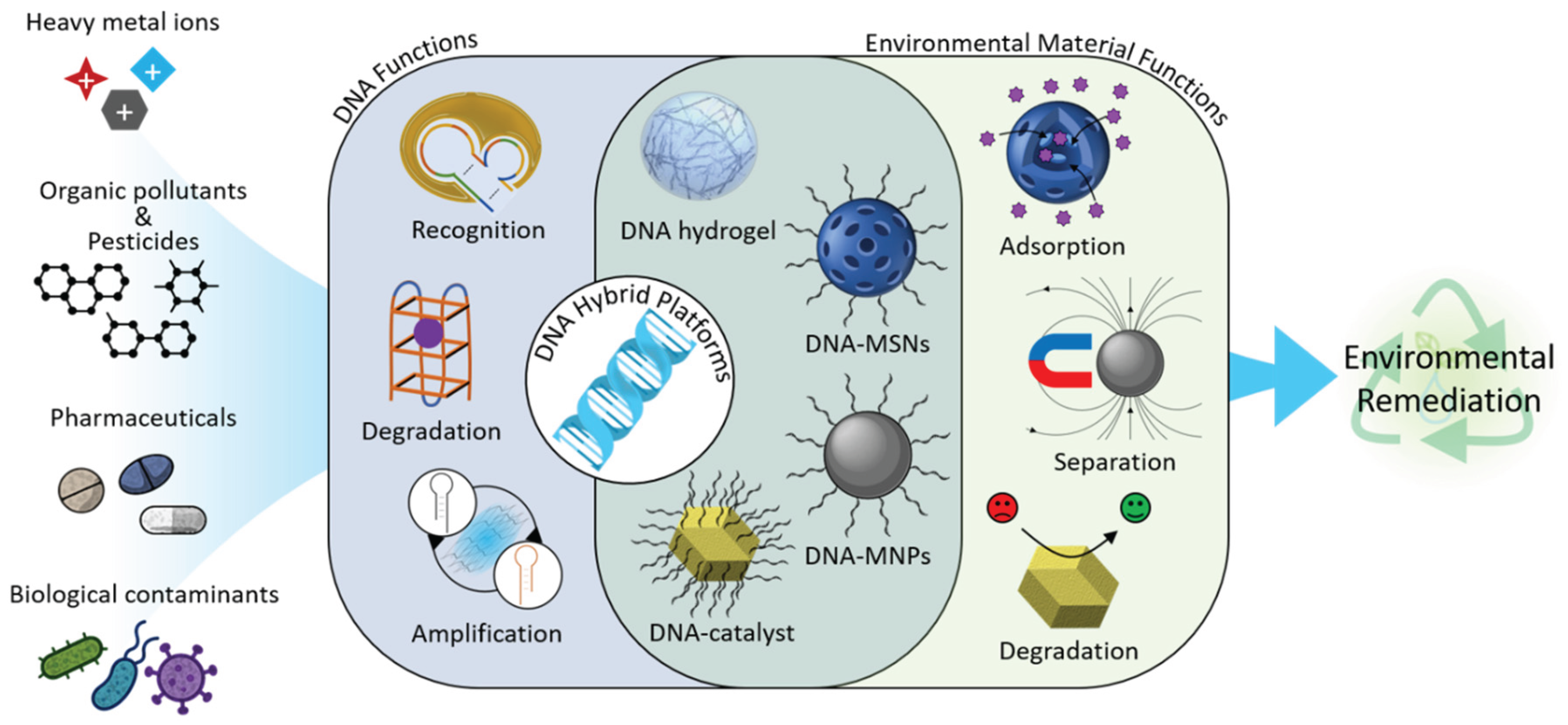
Figure 2.
Representative functional mechanisms enabled by DNA sequence programmability. (A) Sequence programmability of DNA. Distinct nucleotide sequences undergo sequence-dependent folding into diverse functional structures, including aptamers, DNAzymes, and hairpin motifs. (B) Aptamer-mediated target recognition through sequence-dependent folding and conformational switching. (C) Catalytic transformation of organic pollutants by DNAzymes. (D) Enzyme-free amplification and structural assembly through Clamped-HCR.
Figure 2.
Representative functional mechanisms enabled by DNA sequence programmability. (A) Sequence programmability of DNA. Distinct nucleotide sequences undergo sequence-dependent folding into diverse functional structures, including aptamers, DNAzymes, and hairpin motifs. (B) Aptamer-mediated target recognition through sequence-dependent folding and conformational switching. (C) Catalytic transformation of organic pollutants by DNAzymes. (D) Enzyme-free amplification and structural assembly through Clamped-HCR.
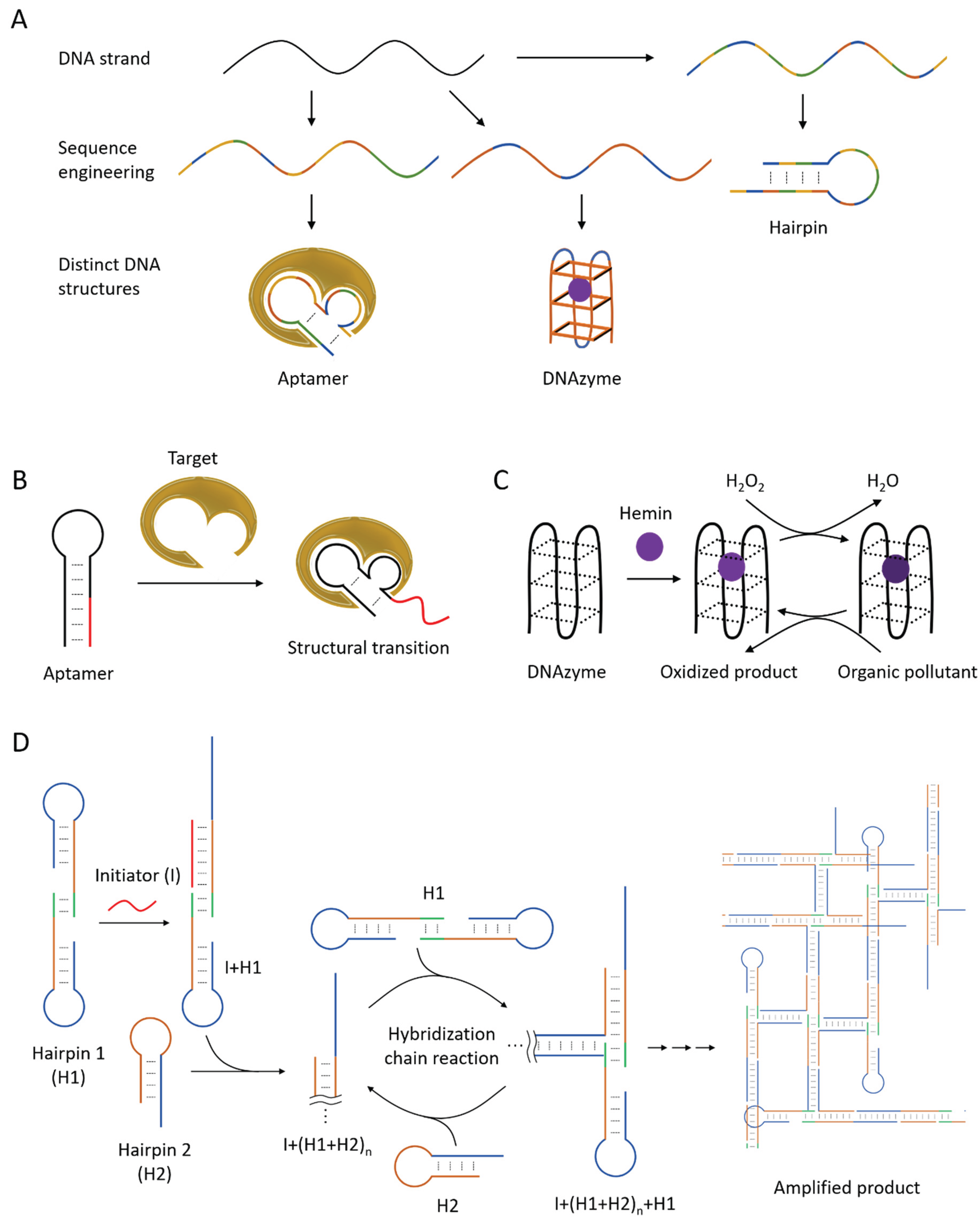
Figure 3.
DNA hydrogel-based platforms for environmental remediation. (A) Functional DNA hydrogel for the selective recognition, detection, and removal of Hg2+ via T–Hg2+–T coordination chemistry. (B) Highly porous DNA/CNT composite hydrogel fabricated using a carbon nanotube-assisted strategy to regulate pore architecture, thereby enhancing the adsorption efficiency toward carcinogenic polycyclic aromatic hydrocarbons (PAHs). (C) Cellulose/DNA hybrid hydrogel enabling the hydrogen bond-assisted immobilization of enzymes (e.g., laccase) for the efficient capture and catalytic degradation of organic pollutants. (Adapted from [54,56,57]).
Figure 3.
DNA hydrogel-based platforms for environmental remediation. (A) Functional DNA hydrogel for the selective recognition, detection, and removal of Hg2+ via T–Hg2+–T coordination chemistry. (B) Highly porous DNA/CNT composite hydrogel fabricated using a carbon nanotube-assisted strategy to regulate pore architecture, thereby enhancing the adsorption efficiency toward carcinogenic polycyclic aromatic hydrocarbons (PAHs). (C) Cellulose/DNA hybrid hydrogel enabling the hydrogen bond-assisted immobilization of enzymes (e.g., laccase) for the efficient capture and catalytic degradation of organic pollutants. (Adapted from [54,56,57]).
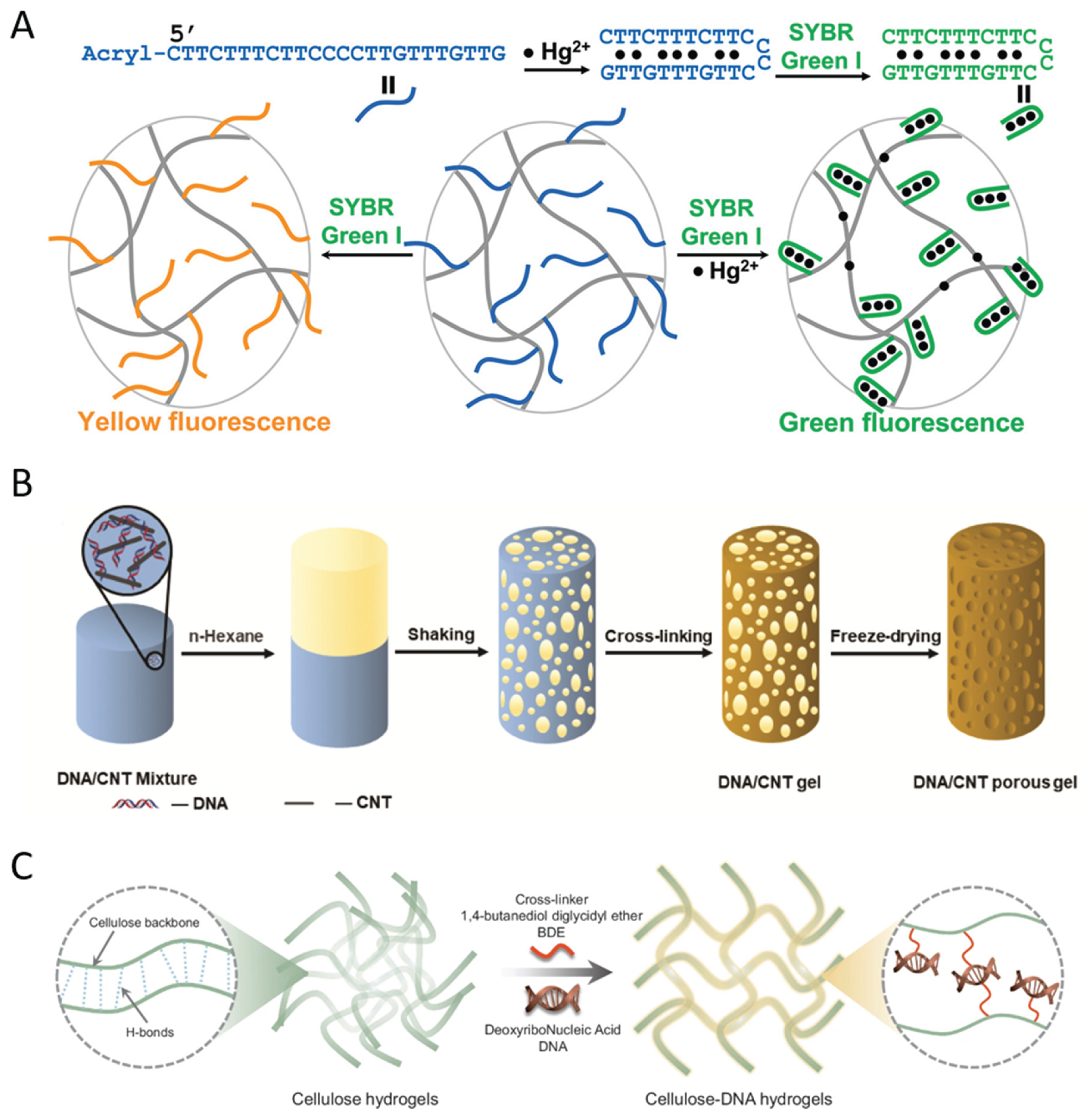
Figure 4.
DNA hybrid material platforms integrating the molecular recognition capability of DNA with functional nanomaterials for environmental remediation. (A) DNA-functionalized mesoporous silica nanocomposite for the selective detection and removal of Hg2+. (B) Aptamer-functionalized ultrafiltration membrane for selective sequestration and removal of small-molecule contaminants from wastewater. (C) A multifunctional Janus nanoparticle platform combining bisphenol A (BPA)-bound aptamer-functionalized MNPs, Hg2+-affinity thymine-rich DNA-functionalized silver-based antimicrobial nanoparticles, and for the simultaneous capture and removal of multiple pollutants. (Adapted from [66,73,77]).
Figure 4.
DNA hybrid material platforms integrating the molecular recognition capability of DNA with functional nanomaterials for environmental remediation. (A) DNA-functionalized mesoporous silica nanocomposite for the selective detection and removal of Hg2+. (B) Aptamer-functionalized ultrafiltration membrane for selective sequestration and removal of small-molecule contaminants from wastewater. (C) A multifunctional Janus nanoparticle platform combining bisphenol A (BPA)-bound aptamer-functionalized MNPs, Hg2+-affinity thymine-rich DNA-functionalized silver-based antimicrobial nanoparticles, and for the simultaneous capture and removal of multiple pollutants. (Adapted from [66,73,77]).
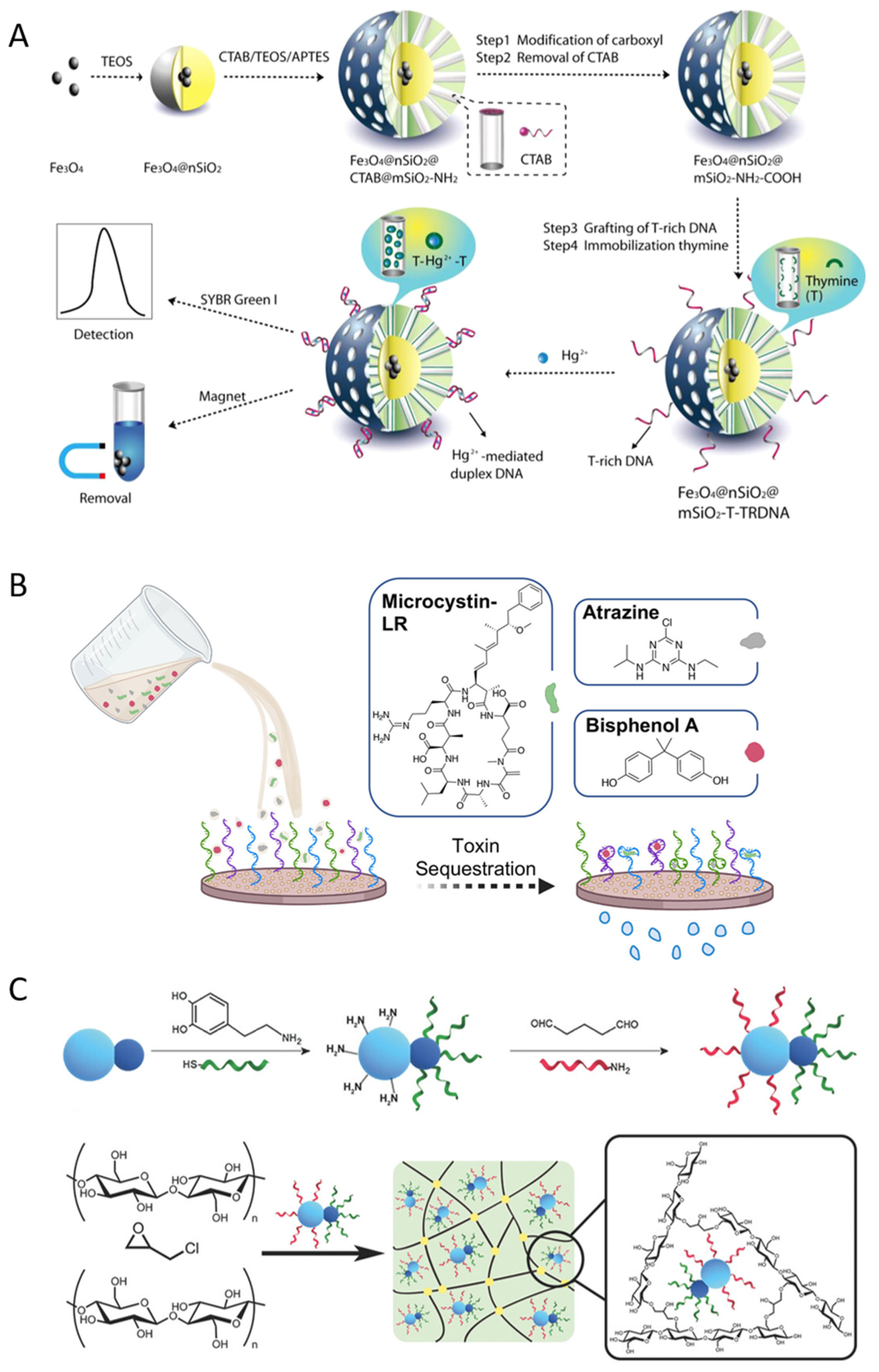
Figure 5.
Advanced DNA-based catalytic platforms for environmental remediation. DNA-functionalized catalytic platforms improve contaminant removal (A) by enhancing mass transport through catalytic self-propulsion or (B) by promoting photocatalytic degradation via reactive oxygen species generation. (C) G-quadruplex/hemin DNAzyme immobilized on amino-functionalized carbon nanotubes to create a recyclable catalytic platform for the degradation of phenolic contaminants. (Panel C adapted from [85]).
Figure 5.
Advanced DNA-based catalytic platforms for environmental remediation. DNA-functionalized catalytic platforms improve contaminant removal (A) by enhancing mass transport through catalytic self-propulsion or (B) by promoting photocatalytic degradation via reactive oxygen species generation. (C) G-quadruplex/hemin DNAzyme immobilized on amino-functionalized carbon nanotubes to create a recyclable catalytic platform for the degradation of phenolic contaminants. (Panel C adapted from [85]).
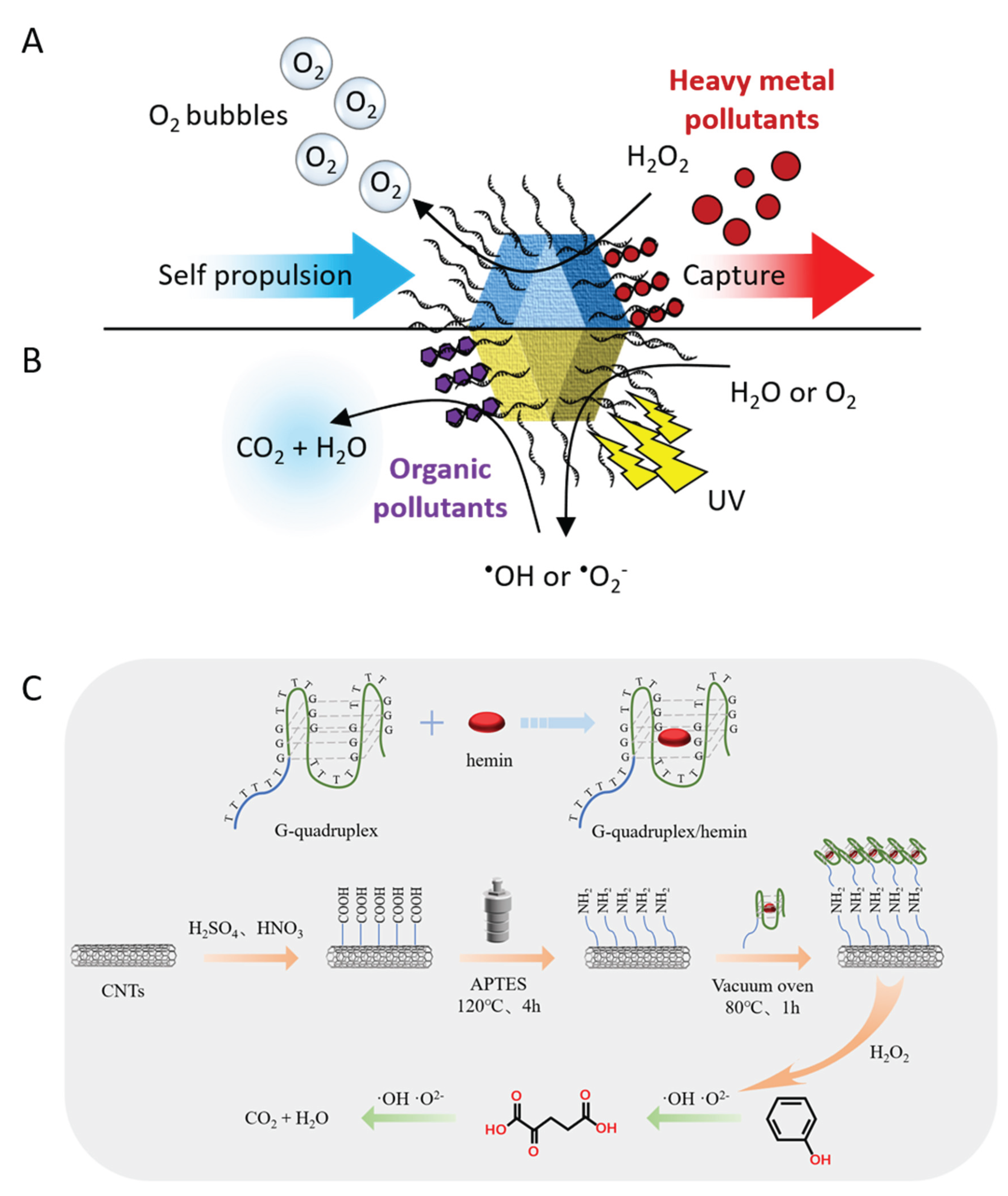

Table 1.
Summary of representative DNA-based heavy metal remediation studies.
| Binding mechanism | Target Heavy metal ions | Function | References |
|---|---|---|---|
| Electrostatic adsorption | Hg2+, Cu2+, Pb2+, Cd2+ etc. | Broad spectrum adsorption | [55,61,92] |
| Metal-mediated base pairing | Hg2+ | Selective capture | [54,66,77,78,81,93] |
| Structure-dependent recognition | Mn2+ | [94] | |
| As(III), As(V) | [95] | ||
| Pb2+ | [96] | ||
| Co2+ | Material recovery | [97] | |
| UO22+ | [98,99,100,101] |
Table 2.
Summary of representative DNA-based organic pollutant remediation studies.
| Remediation mechanism | Target organic pollutant category | Function | References |
|---|---|---|---|
| Broad-spectrum adsorption (π–π stacking, Intercalation, Electrostatic interaction) |
PAHs | Affinity adsorbent | [52,56] |
| Organic dyes | [55,57,92,109,110] | ||
| HAAs | [53], | ||
| Pharmaceuticals | [55] | ||
| Selective recognition | Pesticides | Aptamer | [73] |
| EDCs (e.g., BPA and 17β-estradiol) | [73,77,80,113,114] | ||
| Biotoxins | [73,111,112,115,116] | ||
| Pharmaceuticals | [62,80] | ||
| Illicit drugs | [62] | ||
| Catalytic degradation | PAHs, PFAS, Pharmaceuticals | Affinity adsorbent | [57] |
| Organic dyes | [82] | ||
| BPA, OTC, DBP | Aptamer | [83] | |
| AFB1 | [84] | ||
| Phenols | DNAzyme | [85] |
Table 3.
Summary of representative DNA-based biological contaminant remediation studies.
| Target biological contaminants | The role of DNA | Remediation mechanism | References |
|---|---|---|---|
| Hepatitis C virus (HCV) | Aptamer | Selective capture and removal | [120] |
| Hepatitis B virus surface antigen (HBsAg) | [121] | ||
| Listeria monocytogenes | Targeted antimicrobial delivery | [67] | |
| Escherichia coli (E. coli) | Selective recognition and photocatalytic therapy | [122] | |
| Methicillin-resistant Staphylococcus aureus (MRSA) | Magnetic separation and photothermal therapy | [123] |
Disclaimer/Publisher’s Note: The statements, opinions and data contained in all publications are solely those of the individual author(s) and contributor(s) and not of MDPI and/or the editor(s). MDPI and/or the editor(s) disclaim responsibility for any injury to people or property resulting from any ideas, methods, instructions or products referred to in the content. |
© 2026 by the authors. Licensee MDPI, Basel, Switzerland. This article is an open access article distributed under the terms and conditions of the Creative Commons Attribution (CC BY) license (http://creativecommons.org/licenses/by/4.0/).
Copyright: This open access article is published under a Creative Commons CC BY 4.0 license, which permit the free download, distribution, and reuse, provided that the author and preprint are cited in any reuse.


