

Submitted:
29 July 2026
Posted:
31 July 2026
You are already at the latest version
Abstract
Clements, Kriezis, and Humphreys [1] (CKH) recently detected, characterized, and attributed powerful transient wide-area GNSS interference over Europe—identifying Cosmos 2546 (NORAD 45608) as the source of the February 2026 event captured in raw IQ—using a Bayesian generalized-likelihood-ratio framework over an elevation-vetted candidate set. We apply a framework with disjoint foundational commitments—possibilistic, open-world, falsification-first, and non-normalizing (the Theory of Epis- temic Abductive Geometry, TEAG [2], and the Epistemic Support-Point Filter, ESPF [3–5])—and it converges on the same attribution and the same prior-sensitivity profile: recomputed in CKH’s own calibrated metric, our admissible set reproduces their ∼500 km ephemeris-inflation result and collapses to Cosmos 2546 alone under elevation masking. We argue this convergence is itself substantive—robustness under method variation, since the two frameworks do not share failure modes—and we are precise about its kind: it is convergence of two inference calculi on shared evidence (the same two-station TDOA residuals; the two are the ℓ1 and ℓ∞ ends of one Hölder family of the same admissibility energies, Cosmos’s residual scatter here, 1.19 m, matching CKH’s 1.2 m), not independent triangu-lation from disjoint data. The agreement is not automatic: the commitment point—the whitened minimax medoid, the hypothesis most shielded from the falsification boundary—is fixed, but it re-turns the source only when the surprisal geometry carries the per-hypothesis ephemeris-tolerancechannel; score compatibility by measurement scatter alone and the most-shielded hypothesis is instead a low-scatter, high-bias fragment. The method thus has a falsifiable failure mode (in the surprisal geometry, not the commitment rule) it must pass rather than a tautology. We then add two independent evidential channels CKH did not analyze. First, an absolute-power bound (EIRP of order 106 W) that is strongly inconsistent with incidental leakage and points to a directed, operated emitter. Second, a code-level identification: the 1558.5 MHz/255.8 μs waveform is the GPS C/A G1 maximal-length sequence (x10 + x3 + 1) at 4 Mcps, matching no GPS PRN—favoring ranging/sensing or denial-by-in-band-power and disfavoring matched-code spoofing. We intend this as constructive corroboration and extension, not correction.
Keywords:
GNSS interference
; space-based emitter
; Cosmos 2546
; time difference of arrival
; possibilistic inference
; open-world attribution
; maximal-length sequence
; GPS C/A code
; EIRP
; waveform identification
; Theory of Epistemic Abductive Geometry
; falsification
1. Introduction
Clements, Kriezis, and Humphreys [1] (hereafter CKH) contributed a thorough study of a novel and consequential phenomenon: transient, wide-area GNSS interference, originating from space, that has degraded the GPS L1 band over Europe, Greenland, and Canada on dozens of days since 2019. They develop a received-power detection framework over a 165-station network, characterize the events’ spatial/temporal/spectral structure, and identify the source of the February 11, 2026 event—through a combination of elevation masking, CNR-based association, and a two-station time-difference-of-arrival (TDOA) analysis—as Cosmos 2546, one of six Russian EKS satellites in Molniya orbits, with the constellation collectively responsible for the broader pattern. We independently corroborate their identification of Cosmos 2546 for that event.
CKH are also careful about the limits of a single short capture, and state them plainly: a two-station TDOA history “narrow[s] the possibilities to a manageable few” rather than uniquely localizing (four or more stations would be needed for instantaneous position and velocity); opening the candidate set to the full catalogue admits exactly one additional object (a Starlink), excluded only by geometry; and the TLE-error standard deviation must be inflated from 10 to 500 before any second object becomes consistent. Our purpose is therefore not to correct an overclaim—there is none—but to ask a different question: does the attribution survive a change of inferential framework? We apply a possibilistic, open-world, falsification-first calculus (TEAG [2] and the ESPF [3,4,5]) whose foundational commitments are disjoint from the Bayesian GLRT—no normalization, an explicit “none-of-the-catalogue” element, and confidence earned by survival under contradiction rather than by posterior mass—and find that it recovers the same attribution and the same prior-sensitivity profile.
We take this convergence as a contribution in its own right: agreement between methods that do not share failure modes is robustness under method variation, and recovering an independently-derived operational result is a validation of the framework on a case whose answer is agreed. We are, however, precise about its kind. The convergence on the attribution is of two inference calculi applied to shared evidence—the same two-station TDOA residuals, the two being the and members of one Hölder family of the same admissibility energies, with Cosmos’s residual scatter, , matching CKH’s (Prop. 2)—so it certifies that the conclusion is not an artifact of Bayesian normalization, not that two independent observations agree. Independent confirmation of the underlying fact requires disjoint evidential channels, which we supply separately (the power bound and the code identity). And the convergence is not guaranteed by construction. The commitment point is fixed—the whitened minimax medoid, a catalogued support point most shielded from the falsification boundary, never a free geometric center—but it returns the source only when the surprisal geometry carries the per-hypothesis ephemeris-tolerance channel. Omit that channel—score compatibility by measurement scatter alone—and the most-shielded hypothesis is a low-scatter, high-bias fragment; restore it (a step statable independent of this case: the cross-hypothesis prediction spread is not a single state’s uncertainty) and the medoid is Cosmos 2546. The fragility is the surprisal geometry, not the commitment rule; the method thus has a falsifiable failure mode that it passes. The mathematics is developed in place (Section 3); no prior reading is assumed. Contributions:
- 1.
- Convergent validation of the attribution (Section 3 and Section 4). A possibilistic, open-world, non-normalizing treatment recovers Cosmos 2546 and, in CKH’s own calibrated metric, their prior-sensitivity profile—convergence of inference calculi on shared evidence, with the one point of possible divergence (the whitening metric) made explicit.
- 2.
- An absolute-power bound (Section 5)—an independent evidential channel CKH did not attempt (front-end loss is uncalibrated): EIRP of order 10 , strongly inconsistent with incidental leakage and pointing to a directed, operated emitter.
- 3.
- A code-level identification (Section 6)—a second independent channel: the waveform (its regime) is the GPS C/A G1 m-sequence at 4 Mcps, matching no GPS PRN.
Principle 1
(Robustness under method variation). A conclusion reached by two inferential frameworks with disjoint foundational commitments—here a normalized Bayesian posterior over a vetted set, and a non-normalizing possibilistic admissibility over an open set with confidence earned by survival under contradiction—is more credible than one reached by either alone, to the degree the frameworks do not share failure modes. Where the evidence is common to both, such convergence validates the inference; independent confirmation of the underlying fact additionally requires disjoint evidential channels.
2. What CKH Establish
CKH model the reported per-station detection statistic and, for the February 2026 event, form a two-station TDOA measurement vector ( epochs over 2 ). For each candidate s they treat the TLE ephemeris error as a TDOA bias (with the 10 position prior projected through the two-station baseline), absorb it by maximum-a-posteriori estimation, and score the cost
with (a half-sample over-bound at 75 ). Under the true hypothesis , giving a threshold at a chosen false-association rate. For the event, only Cosmos 2546 satisfies within the elevation-vetted candidate set, and its association probability is numerically indistinguishable from unity. The estimated bias is against a projected prior (i.e. about half a sigma—wholly consistent), with a TDOA residual standard deviation of . Crucially, CKH already report that opening the catalogue admits only a geometrically-excluded Starlink, and that reaching a second viable object requires inflating the ephemeris prior to ∼ 500 . These are the facts we build on.
3. A Possibilistic Lens: TEAG and the ESPF
The possibilistic reading is a complement to Eq. (1): instead of a normalized posterior over a vetted set, it carries an ordinal admissibility over an open set and commits by survival under contradiction. We develop the needed objects.
3.1. Possibility, the Impossibility Field, and Dominance
A possibility distribution () induces and its -cuts . A probability P is consistent with iff for all A, so possibility is the conservative upper envelope of a family of probabilities,
and a standing element (“none of the catalogue/known hypotheses”) may carry until evidence reduces it. We work in the impossibility field , whose sublevel sets are exactly the -cuts.
3.2. Conditioning, and Falsification as Elimination
For a measurement y with model g and a positive-definite innovation metric —a shape matrix that sets the admissibility scale, not a covariance—the surprisal is half the squared whitened distance between measured and predicted observation—the Euclidean distance after the metric isometry that renders isotropic, a purely geometric normalization importing no probability model—and compatibility is its log-link image (a possibility value, not a likelihood):
Conjunctive revision becomes, in impossibility coordinates, the tropical (max-plus) update
since . Falsification is elimination (h leaves the -cut when ); nothing is renormalized.
Proposition 1
(Two bookkeeping facts). (i) For , the closed-set posterior is an upper bound on the open-set posterior: for , with equality iff the excluded likelihood mass vanishes. (ii) Under (4), depends only on h and the measurements, not on the candidate set, so retained possibilistic values are invariant to which other hypotheses are considered.
Proof. (i) and . (ii) depends on alone and (4) never divides by a sum over . □
Proposition 1 is not a critique of CKH: it formalizes precisely why their explicit open-world check (Starlink) and their refusal to read “” as set-independent are the right instincts. The possibilistic value of Cosmos is a property of Cosmos and the data; the open element keeps the uncatalogued-emitter hypothesis on the books.
3.3. Surprisal Geometry and the Commitment Point
Two roles must be kept distinct. Compatibility and surprisal over the whole support are read off the least-committed enclosing geometry—the free-center minimum-volume enclosing ellipsoid (MVEE; Löwner–John) of least log-volume, hence least Boltzmann ignorance [23]. This is a property of the support; it commits to no hypothesis and requires no point estimate. The whitening that defines surprisal carries the actual admissibility channels—a sensor-resolution floor and a per-hypothesis ephemeris tolerance,
with the range-difference resolution widened by the ephemeris tolerance and likewise for range-rate—admissibility tolerances (lengths and rates fixing how far a prediction may sit before a hypothesis becomes impossible), not variances, and not the cross-hypothesis prediction spread, which is hypothesis diversity rather than a single state’s uncertainty. Numerically these tolerances coincide with CKH’s standard deviations —the scale bridge, distinct from the combination bridge of Section 3.4. The commitment point, when one is required, is a separate question with a fixed answer: the whitened minimax medoid of the support,
the hypothesis whose worst-case surprisal is smallest—the support point most shielded from the falsification boundary. It is always an actual hypothesis, never a free geometric center (which for a degenerate set would return a centroid rather than any hypothesis).
Remark 1
(Two minimax structures, one commitment discipline). The ESPF corpus uses “whitened minimax medoid” for a related but distinct object: the survivor minimizing theworst-case whitened distance to the other survivors—a centrality guarantee against contraction from an unknown future direction, a 2-approximation of the Chebyshev radius [3]. Here, with a discrete catalogue and a single batch of epochs, the operative worst case is over the evidence channels in hand: is the minimum-impossibility survivor, the hypothesis deepest inside every α-cut—most shielded from the falsification boundary as the evidence has currently drawn it. The two rules share the properties this paper relies on (an actual catalogued hypothesis, never a free center; commitment by worst-case shielding under a fixed, case-independent criterion) and differ only in the adversary: the worst evidence channel already received, versus the worst direction the boundary may move next. For sequential tracking the corpus rule applies; for batch attribution over a catalogue, this one.
3.4. The Two Frameworks Are One Hölder Family
TEAG eliminates a nuisance parameter not by integration but by a sup–min projection. Treating the ephemeris bias as an epistemic co-hypothesis with quadratic impossibility —a Gaussian-shaped possibility kernel of tolerance (a fuzzy number, not a probability density)—combining it conjunctively (min t-norm) with the measurement compatibility and projecting it out gives
with the two impossibility energies the squared whitened misfit and the squared whitened bias,
CKH eliminate the same nuisance by maximum-a-posteriori estimation—the sum of the corresponding energies (their Eq. (1), with variances where TEAG carries tolerances ). The two are the and members of a single Hölder () family of the energy pair:
with the TEAG impossibility (max, worst-case) and CKH’s additive cost (sum, average-case).
Proposition 2
(Hölder invariance of the attribution). For nonnegative energies and , , hence for every hypothesis t and every . Consequently any hypothesis whose worst single energy () already exceeds the leader’s total energy () is excluded uniformly in p. The committed object is the joint minimizer of the two energies—a residual that, once its bias is absorbed within tolerance, has small scatter—so the attribution is invariant from average-case (, CKH) to worst-case (, TEAG): proven for any object excluded by a single channel, and verified numerically for the near-contenders below. Small scatter alone does not suffice: an object whose bias exceeds the tolerance is rejected through the bias energy at every p.
Proof.
The sandwich is the power-mean ordering. If then , so minimizes for all p; this disposes of every object excluded by one channel. Writing with and shows the misfit energy is minimized at with floor , while the bias energy grows from ; the leader minimizes both at once. □
The invariance holds numerically: for the committed object is Cosmos 2546 and the three lowest-impossibility objects are identical. The object of least scatter alone is a different satellite—a near-zero-misfit fragment carrying a ∼ 150 bias (Figure 1)—correctly rejected by the bias energy at every p; this is why the discriminant is the joint minimizer of misfit and bias, not the scatter.
Remark 2
(Average-case to worst-case; the failure mode is the operator, not the calculus). The Hölder order p dials the combination of the two admissibility constraints from average-case (, CKH’s additive least squares) to worst-case (, TEAG’s minimax shield, which commits only when even the worst constraint is met). Two bridges align the frameworks: a scale bridge—TEAG’s tolerances δ equal CKH’s standard deviations σ (Section 3)—and this combination bridge, the Hölder order p. The attribution survives both. The commitment rule is not in question either: TEAG commits by the whitened minimax medoid throughout. The lone point of fragility is the surprisal geometry—which channels the whitening carries: omit the per-hypothesis ephemeris tolerance and the most-shielded hypothesis is a low-scatter, high-bias fragment, whereas carrying the sensor-floor-plus-ephemeris channels returns Cosmos for every p. The fragility is the surprisal geometry—not the calculus, and not the commitment rule. The / pair is moreover not ad hoc to this problem: it is the two visible rungs of a Hölder (power-mean) ladder connecting aggregation regimes, on which the possibilistic entropy is the member, additive aggregation the member, and worst-case admissibility the member. The geometric mean of the impossibility level under the canonical admissibility weight equals (with the Euler–Mascheroni constant), so the ladder’s inter-rung gap at is exactly γ: a structural constant of the possibilistic framework, independent of the specific interference scenario.
4. Possibilistic Reading of the Association
4.1. Observability of a Single Short Capture
For source state and stations , each epoch supplies a range-difference and a range-rate-difference, , , so the per-epoch Jacobian has rank . Over a 2 arc the K blocks are nearly collinear, and the tolerance-normalized stacked H has effective rank 2 (singular spectrum ); the admissible set is, to first order, a -dimensional manifold . The per-epoch Jacobian has rank 2, so the surprisal field is the pullback of a 2-dimensional field through the state-to-measurement map, which is not injective: many states produce the same evidence. A rank-2 evidence system therefore deforms the impossibility field only on a 2-dimensional base, while the remaining four fiber directions are exactly conserved (no comparison, no information — a statement provable by Fubini factorization of the update). The information-deletion floor is with , not the state dimension 6, and it bounds how fast the admissible set can contract per epoch. This is the geometric content of CKH’s own statement that a single short two-station capture must be fused with elevation and CNR priors — and that four or more stations would be needed for instantaneous localization: spanning the state space with accumulated row spaces is the falsifiability–observability condition (a direction is falsifiable only when some observation, pulled back through the dynamics, compares along it), and stations beyond spanning buy redundancy, which is what makes evidence-versus-evidence falsification — integrity, bias, and spoof detection — geometrically possible at all.
4.2. The Admissible Set in CKH’s Metric
Re-running the impossibility recursion (4) over the catalogue with the cost (1)—i.e. in CKH’s calibrated metric (, , at )—reproduces their findings (Figure 2). Cosmos 2546 sits alone near the cost floor (, residual scatter , reproducing their ); the falsification-shield estimate is Cosmos at every prior level. (The discrimination turns on the surprisal geometry, not the commitment rule: scored by scatter alone the most-shielded hypothesis is a low-scatter, high-bias fragment, whereas carrying the sensor-floor-plus-ephemeris channels isolates Cosmos. The commitment point—the whitened minimax medoid—is fixed throughout.) The admissible count grows slowly with the ephemeris prior—4 payloads at 10 , ∼31 objects at 500 —and the handful at the nominal prior collapse to Cosmos alone once the elevation mask is applied (the same step that removes CKH’s Starlink). The possibilistic and probabilistic analyses thus agree: the attribution is robust, and it is robust because two priors do real work—an ephemeris-accuracy prior and an emitter-plausibility prior (an inert fragment cannot radiate). The honest, conditional identity statement is: Cosmos 2546 is the unique catalogued object on the measured manifold at its catalogued position to within payload-grade ephemeris error, above the elevation mask of every detecting station, and a plausible emitter. Figure 1 places this against the whole catalogue: in the plane of absorbed ephemeris bias versus residual scatter, Cosmos 2546 sits alone in the low-bias, low-scatter corner, while the object of least scatter alone carries a 158 bias and is rejected by the bias channel.
5. An Absolute-Power Bound
CKH report relative power only, noting that the antenna-to-front-end loss is uncalibrated. An order-of-magnitude absolute bound is nonetheless available from the observed degradation. With a drop (dB), gives , and Friis loss yields
For the largest reported drop (LAMA, Poland), apogee slant range ( at ), , and dBi, Eq. (7) gives to —of order 10 , above a GPS satellite. The estimate is sensitive to the uncalibrated front-end loss, antenna gain, and beam shape, but those assumptions move it by , not the that would be needed to reach an incidental-leakage budget. The bound is therefore strongly inconsistent with incidental leakage or passive malfunction and most consistent with a directed, operated transmission architecture, independent of purpose. A refinement from follow-on discussion: because the transmit-gain pattern can be inferred from the spatial footprint of drops across the station network, transmitter power is range-independent (slant range cancels between path loss and footprint-derived gain), so for the Baltic-core footprint (∼1500–2000 km) the transmit power is of order tens to a few hundred watts, with the megawatt EIRP arising overwhelmingly from directivity rather than raw power – the signature of a high-gain, operated payload.
6. Code-Level Waveform Identification
CKH report that the interference (the band associated with BeiDou B1I degradation) is cyclostationary, repeating at and later at , but do not identify the underlying code. We recover it from the same February 2026 IQ capture. After downconversion, residual-Doppler removal, and phase-aligned coherent averaging over the ∼195 periods of the regime, the 1023-chip sequence is recovered consistently across disjoint windows (our period reproduces CKH’s ; at 4 Mcps this is exactly 1023 chips). For with normalized cyclic auto/cross-correlation and , an m-sequence () is two-valued, ; a Gold code is three-valued with (). GPS C/A PRNs are with
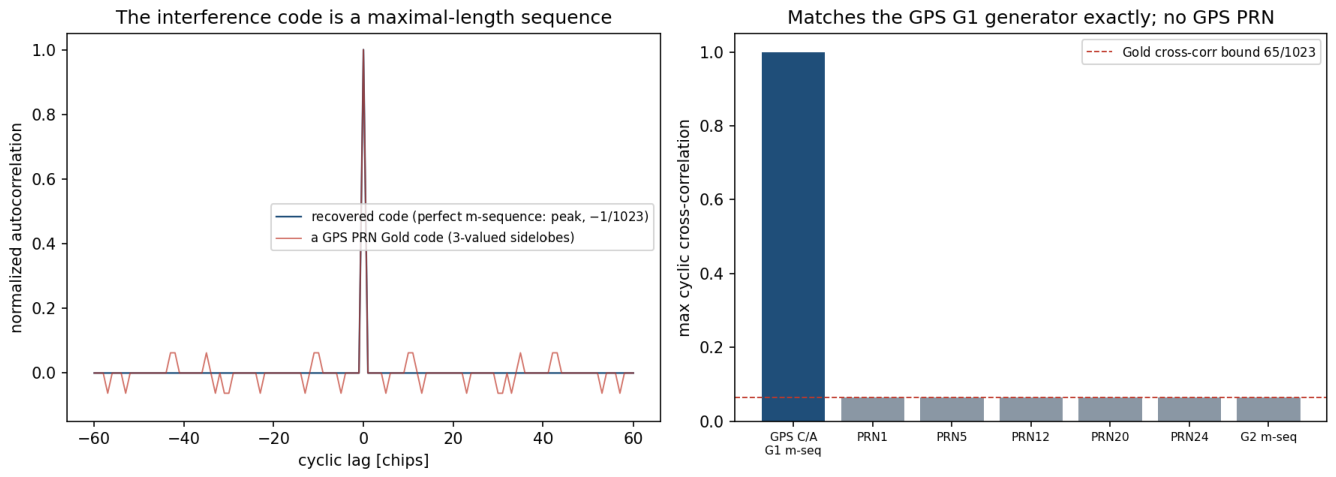
The recovered code satisfies (Figure 4): (two-valued—an m-sequence); for all 32 GPS PRNs (no match); and , . The waveform is the GPS C/A maximal-length sequence at 4 Mcps: GPS code-generator infrastructure, but the bare ranging m-sequence rather than a navigation PRN.
This discriminates function. An m-sequence has ideal (thumbtack) autocorrelation—the optimal waveform for unambiguous ranging—and the 4 Mcps rate gives finer range resolution than GPS C/A; a Gold/PRN code instead trades autocorrelation purity for low mutual cross-correlation to support multiple-access navigation. The choice of the bare m-sequence is that of a single high-quality ranging/sensing emitter, and matching no GPS PRN at the wrong chip rate means no victim receiver can acquire it as a GPS satellite. The function lattice (Table 1) therefore disfavors matched-code spoofing; ranging/sensing and denial-by-in-band-power remain, alongside . Scope: this identifies only the regime of the band. Subsequent work by Clements (personal communication) has found that G1 is modulated by a second deterministic code in a later segment; the regime and the (GPS-L1-affecting) band remain outside this analysis and are reserved for the DLR-led follow-on paper.
Robustness of the identification. The match is a perfect correlation, , reproduced independently in each disjoint 50 window against a floor of for all 32 GPS PRNs and for ; the discriminating margin () is large enough that the result is insensitive to the coherent-averaging length and to residual Doppler-wipe error, which scale the noise pedestal but not the two-valued autocorrelation signature. As to whether some other shift-register construction could masquerade as : a maximal-length sequence of period 1023 is fixed, up to cyclic shift, by its generating primitive polynomial, of which degree 10 admits exactly . A unit correlation thus identifies the sequence uniquely—across all 60, the recovered code matches the specific GPS polynomial at while the worst-case of the other 59 reaches only (an identification margin of ). The match is to the specific generator, not to “an m-sequence” generically.
Figure 3.
Spectrum of the 50 IQ slice: a ∼5 -wide structure over the noise floor near , consistent with CKH’s Figure 9.
Figure 3.
Spectrum of the 50 IQ slice: a ∼5 -wide structure over the noise floor near , consistent with CKH’s Figure 9.
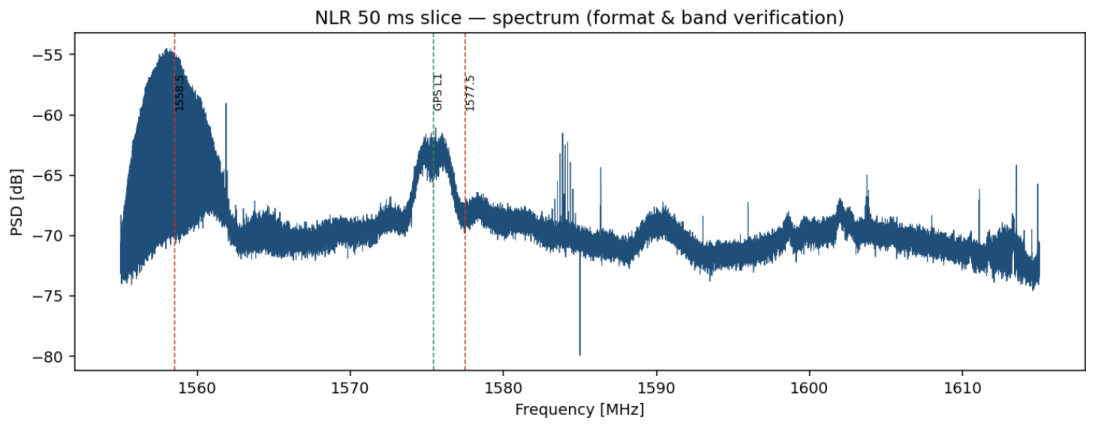
Figure 4.
Identification of the recovered code. Left: two-valued autocorrelation (peak, uniform floor)—a maximal-length sequence—versus the three-valued sidelobes of a GPS PRN Gold code. Right: the code matches the GPS C/A generator m-sequence at 1.000, and every GPS PRN only at the Gold bound .
Figure 4.
Identification of the recovered code. Left: two-valued autocorrelation (peak, uniform floor)—a maximal-length sequence—versus the three-valued sidelobes of a GPS PRN Gold code. Right: the code matches the GPS C/A generator m-sequence at 1.000, and every GPS PRN only at the Gold bound .
7. What the Possibilistic Lens Adds
Offered as complement, not correction, the lens contributes: (1) an explicit open element and, by Proposition 1, values invariant to the candidate set—formalizing the instinct behind CKH’s own open-world check; (2) the dominance (2), , as a conservative envelope on “the source may be uncatalogued”; (3) confidence by survival rather than normalization, the tropical update (4); and (4) the rank-deficiency (Section 4) and the priors made first-class objects rather than buried parameters. None of these overturns CKH; they re-express, in a falsification-first calculus, a robustness that CKH establish probabilistically.
8. Conclusions
We corroborate CKH’s identification of Cosmos 2546 as the source of the February 2026 event and extend their analysis with: an absolute-power bound of order 10 EIRP, strongly inconsistent with incidental leakage and pointing to a directed, operated emitter; a code-level identification of the / waveform as the GPS C/A maximal-length sequence at 4 Mcps, which favors a ranging/sensing function and disfavors matched-code spoofing; and a possibilistic reading that, recomputed in CKH’s own calibrated metric, reproduces their robustness while making the ephemeris and emitter priors explicit. Together these findings are most consistent with an intentional, directed, operated emitter—the coherent GPS- ranging code being the more assumption-light of the two channels—with its precise purpose between ranging/sensing and denial-by-power, and covert sub-noise transmission excluded.
- Limitations.
The code identification rests on a single 50 , single-station, single-band capture of one of (at least) two temporal regimes; a longer coherent capture could test for a secondary-code or data overlay, and the band is unexamined. Multi-station or multi-pass geometry would lift the rank-2 degeneracy and localize the source without an ephemeris prior — adding falsifiable directions (rank) and, beyond spanning, the redundancy that lets observations falsify one another. We offer this in the collegial spirit of building on CKH’s contribution.
- Outlook.
Robust attribution of space-based RF interference will only grow in importance as the population of emitting satellites increases and as states field more capable sensing, navigation, and counter-space systems. Two points generalize beyond this event. First, an attribution that survives a change of inferential calculus—not merely a re-run of the same one—is more defensible in exactly the contested, adversarial settings where attribution carries the highest stakes; robustness under inferential transformation is a property worth demanding of any space-domain attribution claim, not a philosophical luxury. Second, because a single short capture is observability-limited (Section 4), confident attribution benefits from independent evidential channels—here absolute power and waveform identity—rather than from a single posterior, however sharp. As space-domain awareness shades into space-domain decision intelligence, methods that make their priors explicit, carry an open “none-of-the-catalogue” hypothesis, and fuse independent channels will matter more than any single estimator.
Acknowledgments
The author thanks Zachary L. Clements, Argyris Kriezis, and Todd E. Humphreys for their original analysis [1] and for making the measurements and methods public, without which this extension would not have been possible. This study was conducted independently, without external funding or sponsorship, out of the author’s own scientific curiosity.
Conflicts of Interest
M.K. Jah is Founder and Chief Scientist of GaiaVerse, Ltd., which holds commercial license rights to intellectual property related to the TEAG and ESPF frameworks described in this paper. The author declares no other competing financial interests.
Use of AI-Assisted Tools
During the preparation of this work the author used Anthropic’s Claude to assist with literature synthesis, technical exposition, figure generation, and generation. After using these tools, the author reviewed, validated, and edited all content and takes full responsibility for the publication.
Data Availability
The IQ capture analyzed in Section 4, Section 5 and Section 6 was obtained from the same February 2026 event data reported by Clements, Kriezis, and Humphreys [1]. Derived quantities (correlation results, power estimates) are reported in full in the paper. Code used to reproduce the analysis is available on request.
References
- Clements, Z. L.; Kriezis, A.; Humphreys, T. E. Chasing Lightning: Detecting, Characterizing, and Identifying a Powerful Space-Based GNSS Interference Source. arXiv [eess.SP]. 2026, arXiv:2606.03673v1. [Google Scholar]
- Jah, M. K. Theory of Epistemic Abductive Geometry (TEAG). Preprints.org 2026. [Google Scholar] [CrossRef]
- Jah, M. K. The Epistemic Support-Point Filter: Jaynesian Maximum Entropy Meets Popperian Falsification. arXiv 2026, arXiv:2603.10065. [Google Scholar]
- Jah, M. K. The Epistemic Support-Point Filter as a Tropical Hamilton–Jacobi System. Preprints.org 2026. [Google Scholar] [CrossRef]
- Jah, M. K.; Haslett, V. The Epistemic Support-Point Filter (ESPF): A Bounded Possibilistic Framework for Ordinal State Estimation. arXiv 2026, arXiv:2508.20806. [Google Scholar]
- Jah, M. K. Probability is Earned. Preprints.org 2026. [Google Scholar] [CrossRef]
- Kaplan, E. D.; Hegarty, C. J. (Eds.) Understanding GPS/GNSS: Principles and Applications, 3rd ed.; Artech House, 2017. [Google Scholar]
- Misra, P.; Enge, P. Global Positioning System: Signals, Measurements, and Performance, 2nd ed.; Ganga-Jamuna Press, 2006. [Google Scholar]
- Humphreys, T. E.; Ledvina, B. M.; Psiaki, M. L.; Kintner, P. M. Assessing the Spoofing Threat: Development of a Portable GPS Civilian Spoofer. Proc. ION GNSS, 2008. [Google Scholar]
- Psiaki, M. L.; Humphreys, T. E. GNSS spoofing and detection. Proc. IEEE 2016, vol. 104(no. 6), 1258–1270. [Google Scholar] [CrossRef]
- Betz, J. W. Engineering Satellite-Based Navigation and Timing: Global Navigation Satellite Systems, Signals, and Receivers; Wiley-IEEE Press, 2016. [Google Scholar]
- Proakis, J. G.; Salehi, M. Digital Communications, 5th ed.; McGraw-Hill, 2007. [Google Scholar]
- Knapp, C. H.; Carter, G. C. The generalized correlation method for estimation of time delay. IEEE Trans. Acoust. Speech Signal Process. 1976, vol. 24(no. 4), 320–327. [Google Scholar] [CrossRef]
- Spilker, J. J., Jr. GPS signal structure and performance characteristics. In Global Positioning System: Papers Published in Navigation; Institute of Navigation, 1980. [Google Scholar]
- Choquet, G. Theory of capacities. Ann. De l’Institut Fourier 1953, vol. 5, 131–295. [Google Scholar]
- Cai, H.; Houssineau, J.; Jones, B. A.; Jah, M.; Zhang, J. Possibility generalized labeled multi-Bernoulli filter for multitarget tracking under epistemic uncertainty. IEEE Trans. Aerosp. Electron. Syst. 2022, vol. 59, 1312–1326. [Google Scholar]
- Delande, E. D.; Jones, B. A.; Jah, M. K. Exploring an alternative approach to the assessment of collision risk. J. Guid. Control Dyn. 2023, vol. 46, 467–482. [Google Scholar] [CrossRef]
- Chen, Z.; Ristic, B.; Kim, D. Y. A possibilistic formulation of autonomous search for targets. Entropy 2024, vol. 26(no. 6), 520. [Google Scholar]
- Eldar, Y. C. On the constrained Cramér–Rao bound with a singular Fisher information matrix. IEEE Signal Process. Lett. 2004, vol. 11(no. 6), 523–527. [Google Scholar]
- Wax, M.; Kailath, T. Optimum localization of multiple sources by passive arrays. IEEE Trans. Acoust. Speech Signal Process. 1983, vol. 31(no. 5), 1210–1217. [Google Scholar] [CrossRef]
- Zadeh, L. A. Fuzzy sets as a basis for a theory of possibility. Fuzzy Sets Syst. 1978, 1, 3–28. [Google Scholar] [CrossRef]
- Dubois, D.; Prade, H. Possibility Theory; Plenum, 1988. [Google Scholar]
- John, F. Extremum problems with inequalities as subsidiary conditions; 1948. [Google Scholar]
- K. R. Popper, The Logic of Scientific Discovery; Hutchinson, 1959.
- Gold, R. Optimal binary sequences for spread spectrum multiplexing. IEEE Trans. Inf. Theory 1967, 13(4), 619–621. [Google Scholar] [CrossRef]
- Stein, S. Algorithms for ambiguity function processing. IEEE Trans. ASSP 1981, 29(3), 588–599. [Google Scholar] [CrossRef]
Figure 1.
All 29287 catalogued objects on the two-station TDOA manifold, in the plane of absorbed ephemeris bias (the MAP/medoid-estimated TLE error) against residual scatter (the bias-invariant misfit). Cosmos 2546 (star) is the joint minimizer—alone in the low-bias, low-scatter corner. The least-scatter object (diamond) has comparable scatter but a 158 ephemeris bias, so scoring by scatter alone would select it; carrying the ephemeris-tolerance channel rejects it. The bulk of the catalogue sits at , far off the manifold.
Figure 1.
All 29287 catalogued objects on the two-station TDOA manifold, in the plane of absorbed ephemeris bias (the MAP/medoid-estimated TLE error) against residual scatter (the bias-invariant misfit). Cosmos 2546 (star) is the joint minimizer—alone in the low-bias, low-scatter corner. The least-scatter object (diamond) has comparable scatter but a 158 ephemeris bias, so scoring by scatter alone would select it; carrying the ephemeris-tolerance channel rejects it. The bulk of the catalogue sits at , far off the manifold.
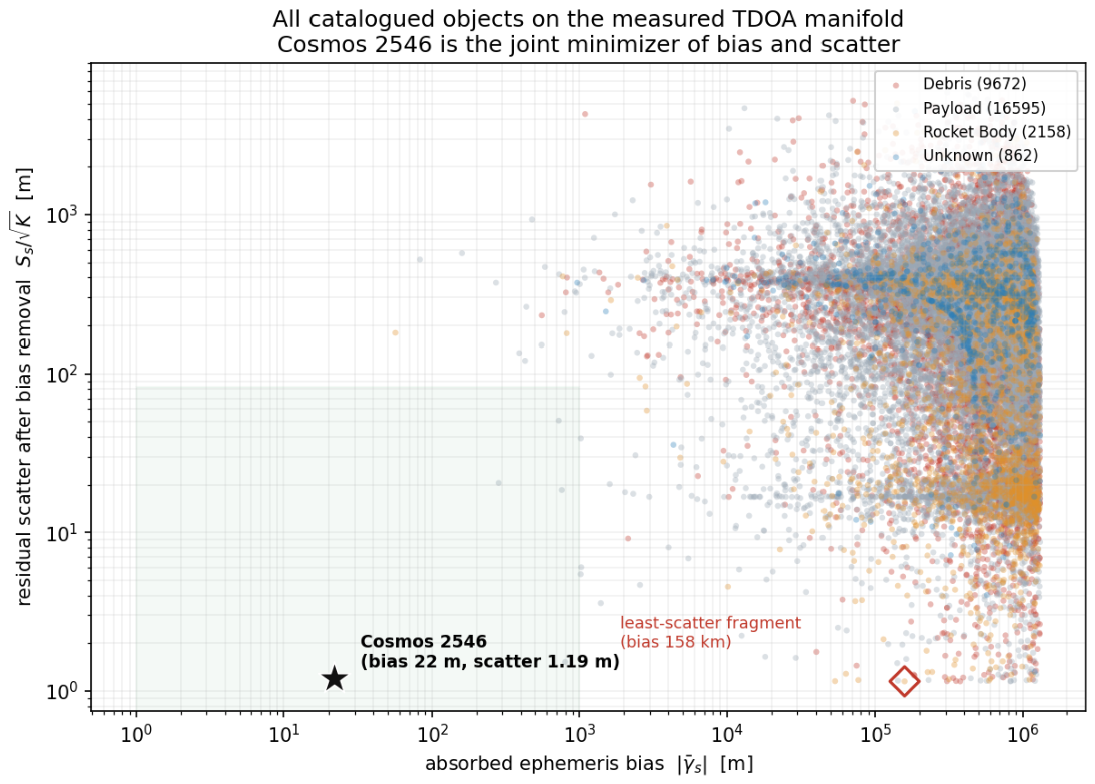
Figure 2.
Possibilistic reading in CKH’s calibrated metric. Left: the association cost (CKH Eq. (1)) over the catalogue; Cosmos 2546 alone lies near the floor, far below the threshold. Right: the admissible-object count vs. the ephemeris-accuracy prior, reproducing CKH’s sensitivity result; with elevation masking and the nominal prior, the set is Cosmos alone.
Figure 2.
Possibilistic reading in CKH’s calibrated metric. Left: the association cost (CKH Eq. (1)) over the catalogue; Cosmos 2546 alone lies near the floor, far below the threshold. Right: the admissible-object count vs. the ephemeris-accuracy prior, reproducing CKH’s sensitivity result; with elevation masking and the nominal prior, the set is Cosmos alone.
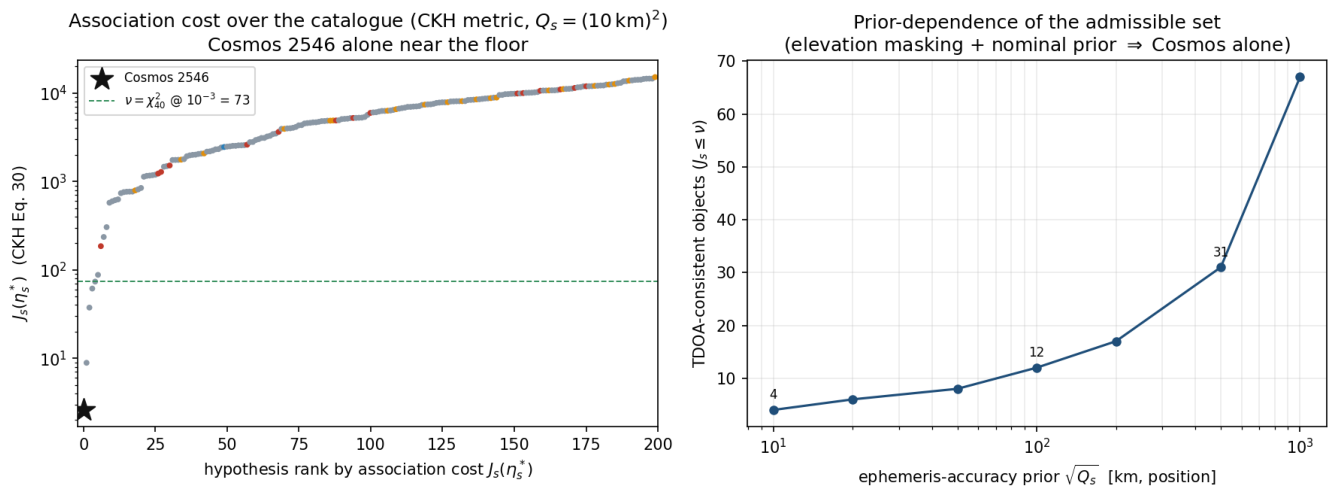

Table 1.
Function possibility lattice (ordinal, abductive). is never excluded.
| Candidate function | Binding observable | |
| Incidental RF leakage | 0.05 | directed ∼ 60 dBW EIRP, Eq. (7) |
| Broadband noise jamming | 0.05 | coherent m-sequence (not noise) |
| Covert signal below noise floor | 0.20 | , conspicuous |
| High-rate covert/comms data link | 0.20 | code repeats; no data payload (255.8 s regime) |
| Matched-code GPS spoofing (PRN replication) | 0.20 | no GPS PRN match; not a Gold code; 4 Mcps |
| GNSS-band denial by in-band power | 0.70 | up-to- 10 drop from in-band power |
| Ranging/navigation/sensing (m-sequence beacon) | 1.00 | ideal-autocorr. GPS- m-seq at 4 Mcps |
| Unknown / undisclosed function () | 1.00 | never excluded |
Disclaimer/Publisher’s Note: The statements, opinions and data contained in all publications are solely those of the individual author(s) and contributor(s) and not of MDPI and/or the editor(s). MDPI and/or the editor(s) disclaim responsibility for any injury to people or property resulting from any ideas, methods, instructions or products referred to in the content. |
© 2026 by the authors. Licensee MDPI, Basel, Switzerland. This article is an open access article distributed under the terms and conditions of the Creative Commons Attribution (CC BY) license (http://creativecommons.org/licenses/by/4.0/).
Copyright: This open access article is published under a Creative Commons CC BY 4.0 license, which permit the free download, distribution, and reuse, provided that the author and preprint are cited in any reuse.


