

Submitted:
28 July 2026
Posted:
30 July 2026
You are already at the latest version
Abstract
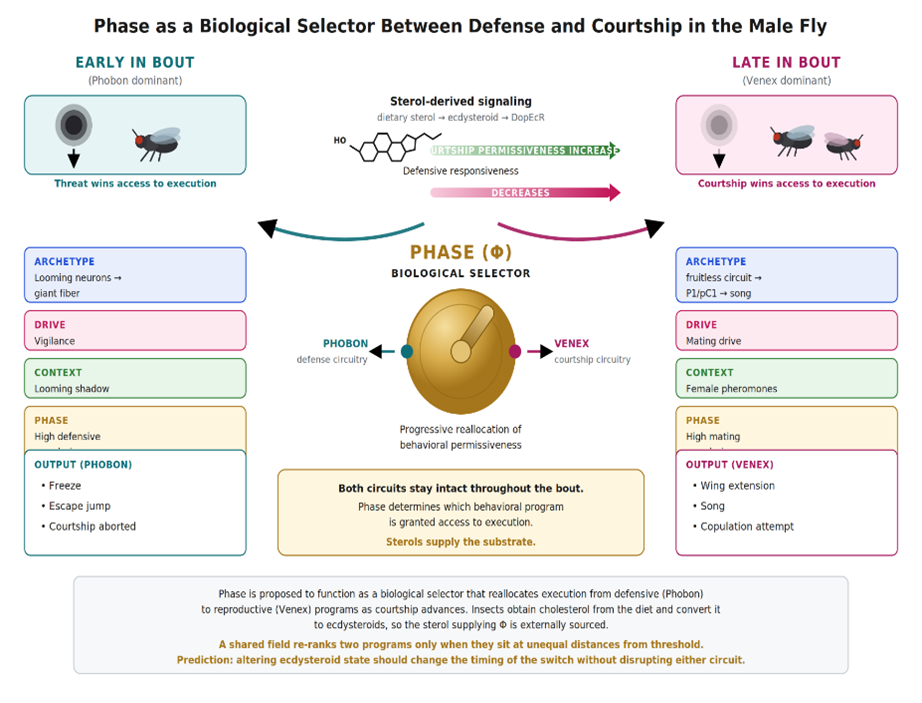
Behavioral execution is not simply a graded response to one variable. It occurs when several independent requirements are satisfied simultaneously, and their combined readiness crosses the threshold. The ARCH × Φ framework formalizes this relation asR = A × D × C × Φ,where Archetype (A) is the assembled structural substrate, Drive (D) the internal motivational or endocrine bias, Context (C) the effective releasing and modulating conditions, and Φ a permissive physiological state. Execution occurs when R reaches a system-specific threshold, θ.The framework is tested in a tractable case: arbitration between courtship and defense in male Drosophila melanogaster. As courtship progresses, a male with intact escape circuitry becomes increasingly resistant to interruption by a looming visual threat. In a single-behavior model, this presents no special difficulty. In a two-channel model, however, a shared Φ between courtship and defense cancels out in their relative allocation, while both remain within a linear operating range. The established mechanism—a dopaminergic filter that attenuates threat-responsive visual input—is therefore best classified as an option-specific change in defensive Context. As currently characterized, the courtship–defense switch requires no permissive field.A narrower role for Φ remains possible. Ecdysteroid signaling and the dual dopamine–ecdysteroid receptor DopEcR influence both courtship-related plasticity and escape habituation, suggesting that they regulate the operating range of multiple behavioral channels. This possibility is treated as a testable hypothesis rather than an established mechanism. The analysis therefore yields both a three-term explanation of the known arbitration and a set of experiments to determine whether a shared fourth term is present at all.
Keywords:
ARCH × Φ
; behavioral execution
; conjunctive gating
; threshold dynamics
; behavioral arbitration
; Drosophila melanogaster
; courtship
; escape behavior
; ecdysteroids
; DopEcR
; archetype
; systema behavorum
1. Introduction
Watch a male fruit fly court. He follows the female, taps her, extends one wing, and sings. Then a dark disc expands overhead—the visual signature of an approaching predator. Early in courtship, he stops: he freezes or jumps. Later, the same male, facing the same female and the same threat, keeps courting (Cazalé-Debat et al., 2024).
Nothing has failed. His photoreceptors still see the shadow. His escape circuitry remains intact. Nor has his behavioral output collapsed; he is doing roughly as much as before, only differently. What has changed is not his ability to escape, but the arbitration between two complete behavioral programs.
This miniature conflict exposes a general biological problem. Organisms often possess the machinery, motivation, and stimulus for an action—and still do not act. A rattlesnake holds its strike with prey in range. A chick imprints during a brief developmental window but not days later. A hormonally primed rodent fails to display lordosis when one critical hypothalamic node is silenced. In each case, execution depends on something beyond circuitry, energy, or cue strength.
The ARCH × Φ framework formalizes that dependence:
R = A × D × C × Φ
Archetype supplies the constructed machinery; Drive supplies the internal bias; Context supplies the effective releasing conditions; and Φ determines whether the system is presently permitted to execute. Behavior occurs only when their product crosses the threshold. A strong drive cannot compensate for absent circuitry. A perfect stimulus cannot open a closed gate.
The courting fly is therefore more than an illustration. It is a stress test. If Φ is a permissive field shared by courtship and defense, it should influence both channels—and, within the linear regime, cancel the competition between them. The observed switch may instead be produced locally: courtship-related drive suppresses the effective threat context reaching the defensive channel. The fly thus forces the framework to distinguish a shared gate from a channel-specific actuator.
That distinction is the subject of this paper. ARCH × Φ has previously been applied to DNA replication initiation, Venus flytrap closure, rodent lordosis, socially regulated sex change in clownfish, and broader problems of behavioral execution (Rahman, 2025, 2026a, 2026b; Rahman et al., 2025; Rahman and Zorumski, 2026). Here, Drosophila asks the harder question: not whether the framework can explain a behavior, but whether it can say precisely when one of its own terms is unnecessary.
2.1. Archetype (A): Can the Behavior Occur?
Lorenz’s greylag goose retrieves a displaced egg with a stereotyped sweep of the bill. The egg releases the program; it does not build it. Without the necessary neural and musculoskeletal organization, no stimulus—however compelling—can produce the behavior (Tinbergen, 1951).
Archetype is that latent structural capacity: the neurons, connections, effectors, and inhibitory architecture required for execution. It describes not what the organism is doing, but what it is capable of doing. Among the four domains, Archetype usually changes most slowly. It is largely assembled during development and remains comparatively stable thereafter. It is also behavior-specific: circuitry constructed for one program cannot simply substitute for another, even when the programs overlap anatomically. Importantly, Archetype includes inhibition. A behavior may be structurally unavailable because a necessary component was never built—or because a suppressive component cannot be released. In either case, the program cannot run.
2.2. Drive (D): Is There an Internal Reason?
Place food before a satiated animal. The feeding machinery is intact and the stimulus is present, yet the animal does not eat. What is missing is not capacity but motive. Drive is the endocrine, metabolic, and neuromodulatory bias toward using a behavioral program. Hunger, sexual arousal, vigilance, and reproductive state belong here. Drive is graded, dynamic, and commonly varies over timescales ranging from hours to days. It is also the domain most often mistaken for the whole explanation. Hormones and neuromodulators are experimentally accessible, and removing them often abolishes behavior. But necessity is not sufficiency. Showing that a hormone is required does not show that the hormone constitutes the decision.
2.3. Context or Cue (C): Can the Relevant Conditions Reach the Circuit?
Now place the hungry animal before food—but also before a predator. The feeding machinery remains intact and the motivation remains high. Feeding nevertheless stops because the circumstances are wrong. Context comprises the immediate conditions that permit initiation: sensory stimuli, social setting, opportunity, safety, and the effective access of those signals to the relevant circuitry. It generally operates on the shortest timescale of the four domains. Context is therefore more than the stimulus itself. A cue matters only to the extent that it reaches and influences the behavioral channel that can act on it. Sensory gain is modulable. If a manipulation changes how strongly one signal enters one behavioral pathway, it changes C for that channel; it does not necessarily alter a global permissive field.
This distinction will do much of the analytical work in the fly. A dopaminergic filter that weakens the transmission of looming threat into the defensive pathway changes the effective Context for defence. It need not change the animal’s general permission to act.
2.4. 4Φ:. Is Execution Currently Permitted?
Φ represents a permissive physiological condition that determines whether an otherwise prepared behavioral system can execute. The structural machinery may be intact, motivation may be high, and the relevant cues may be present, yet behavior may still remain unavailable because the system is in the wrong phase or state.
The post-ejaculatory refractory period provides a simple example. Copulatory circuitry persists, a partner may remain present, and motivation may begin to recover, but execution is temporarily blocked. Comparable constraints may arise from circadian phase, reproductive state, developmental critical periods, or sterol- and neurosteroid-dependent changes in membrane and circuit excitability (Rahman and Zorumski, 2026). These phenomena are grouped under Φ because they regulate the operating range within which prepared circuits can act.
Φ is distinct from Drive. Drive biases the organism toward a particular behavior; Φ determines whether execution is physiologically available. The distinction is functional rather than chemical: the same molecule could contribute to Drive in one setting and to Φ in another, depending on when, where, and how it acts.
The distinction is also experimentally testable. Manipulating Drive should preferentially alter behaviors linked to the relevant motivational system. Manipulating a genuinely shared Φ should change the operating range of several downstream behaviors, with the largest effects occurring in those closest to threshold.
That prediction is the framework’s most vulnerable claim—and the one tested here.
2.5. Why Multiplication?
The operation is not decorative. It is the model’s principal empirical commitment.
Under an additive model, strengths can compensate for weaknesses. Sufficient Drive and Context might overcome a severely impaired Archetype. Under multiplication, they cannot:
R = A × D × C × Φ
If each term is reduced to one-half of baseline, an additive intuition suggests roughly half the original output. The multiplicative model gives:
0.5⁴ = 0.0625
Only 6.25 percent of baseline readiness remains. That difference can be tested with graded factorial perturbations.
Five principles follow:
Zero-term veto. If any term approaches zero, R approaches zero regardless of the others. No amount of hunger rescues absent feeding circuitry.
Supra-additivity. Partial impairments in two different domains should suppress execution more strongly together than expected from the sum of their separate effects.
Joint sufficiency. Two individually ineffective interventions may become effective when combined if each supplies a different missing requirement.
Margin-dependent necessity. Whether a component appears necessary depends on the reserve carried by the remaining terms. The same perturbation may abolish behavior in one preparation and have little effect in another without any change in its underlying biological role.
Unequal effects of a shared multiplier. Lowering Φ should reduce every behavior that depends on it, but not necessarily to the same visible degree. Each behavior begins at a different distance from its own threshold. The channel nearest threshold fails first; another may remain nearly intact. Selective behavioral loss is therefore compatible with a shared gate—but only if the ordering follows independently measured threshold margins.
2.6. Interpretive Constraints
Three constraints govern how the equation might best be read. First, the four domains are functional positions, not molecular categories. The same signal may occupy different positions at different times. Estradiol, for example, may help construct reproductive circuitry during development and later serve as an adult motivational signal. Its assignment depends on what it does, when it acts, and where it enters the control architecture—not on its chemical identity. Second, the equation is a snapshot of a dynamic system. Archetype generally changes over development, Drive over minutes to days, and Context over milliseconds to minutes. The timescale of Φ depends on the gate in question, ranging from rapid changes in circuit excitability to prolonged reproductive or developmental states. Where these dynamics matter, each term must be treated as time-dependent. Execution then depends not only on the instantaneous product, but also on how quickly the terms rise, decay, and interact.
Third, multiplicativity cannot be inferred from every behavioral pattern. A thresholded additive model with clipping can approximate a multiplicative product over a substantial range of parameters. Allocation data alone may therefore be unable to distinguish the two architectures.
The framework might instead be tested where its alternatives diverge: through graded factorial perturbations, independent estimates of threshold margins, and predictions specified before the outcome is known. The aim is not simply to fit behavior after the fact. It is to state what the system must do if the equation is correct—and what result would show that it is not.
2.7. From One Behavior to Two
So far, the framework has described one behavior approaching one threshold. Animals rarely enjoy that simplicity. Feeding, defense, courtship, aggression, and exploration may all be available at once, each with its own machinery, motivation, and cues.
The framework therefore assigns an equation to each behavioral channel:
Rᵢ = Aᵢ × Dᵢ × Cᵢ × Φ
Behavior i becomes eligible when Rᵢ ≥ θᵢ. Among eligible channels, the winner is the one with the larger margin above its own threshold. This extension—Dynamic Archetypal Coordination—applies the same execution logic across an entire behavioral repertoire (Rahman et al., 2025).
It also creates an immediate problem for Φ.
If Φ is genuinely shared—one permissive field acting on both courtship and defense—it multiplies both channels. In any relative comparison, it appears on both sides and cancels. A shared multiplier can change how much behavior is produced, but within a linear operating range it cannot, by itself, determine which behavior wins.
That result is algebraic, not empirical.
Thresholds complicate the picture. Suppose defense lies close to its threshold while courtship has a wider margin. Lowering the same shared Φ can push defense below threshold while leaving courtship executable. The surviving behavior may then occupy the time released by its competitor, making total activity appear almost unchanged.
A shared gate can therefore masquerade as a local redistribution—but only when the channels begin at unequal threshold margins.
This is the analytical hinge of the paper. If Φ merely scales both channels, it cannot explain their re-ranking. If it removes one channel because that channel lies closer to threshold, then the rank order of failure should be predictable in advance. The fly is being asked to decide between those possibilities.
3. Why the Male Fruit Fly?
Drosophila melanogaster is an unusually severe test of a conjunctive model of execution.
First, the machinery is known at cellular resolution. Male courtship is organized by the sex-determination genes fruitless and doublesex, which specify a largely dedicated pathway from sensory input through command-like interneurons to song-producing motor output (Hall, 1994; Stockinger et al., 2005; von Philipsborn et al., 2011). The defensive pathway is comparably well mapped: looming-sensitive visual projection neurons feed descending circuits that generate freezing or escape. Both systems can be manipulated in the adult with cell-type specificity, allowing Archetype to be altered without necessarily changing Drive or Context.
Second, the behaviors are discrete. Courtship unfolds through recognizable acts—orientation, following, tapping, wing extension, song, licking, and attempted copulation. Defense appears as freezing or jumping. These are not vague shifts in mood or activity. They are countable executions, close enough to all-or-none events that threshold language describes the biology rather than merely simplifying it.
Third, the programs are genuinely incompatible. A fly cannot court and escape at the same instant. It must arbitrate, and that arbitration changes systematically as courtship progresses (Cazalé-Debat et al., 2024).
A framework that claims to explain behavioral execution must therefore explain not only whether a program can run, but why one complete program defeats another. In the fly, that claim can be tested neuron by neuron.
4. Mapping the Four Domains Onto Male Courtship
4.1. Archetype
The courtship Archetype is the fruitless-expressing circuit.
It begins with peripheral sensory neurons detecting female cuticular hydrocarbons and other courtship cues. These signals ascend to the central brain, including the male-specific P1/pC1 population, whose activation can initiate courtship even without a female. Descending and thoracic circuits then generate wing extension, song, and the remaining motor sequence (Stockinger et al., 2005; von Philipsborn et al., 2011).
Feminizing or silencing essential elements of this circuit abolishes courtship in a male who may remain active, motivated, and surrounded by the appropriate cues. The result is a zero-term veto in A, demonstrated at cell-type resolution.
The stimulus can release the program. It cannot replace the program.
4.2. Drive
Drive determines how readily the courtship circuit engages.
Mating history, nutritional state, social experience, and neuromodulatory tone all contribute. A recently mated male courts less. A starved male reallocates behavior among feeding, courtship, and other competing demands.
P1/pC1 neurons also carry a persistent internal state that outlasts the stimulus that produced it—an arousal-like signal that decays over minutes and shapes subsequent sensory processing (Hindmarsh Sten et al., 2021). After courtship, roughly 300 genes alter their expression in these neurons, including DopEcR (Ahmed et al., 2023).
Drive is therefore not merely delivered to the courtship circuit. It may be written into the same cells that interpret the world and decide whether to court.
4.3. Context
For courtship, Context is supplied by the female, but not merely by her presence. It includes her cuticular hydrocarbons, movement, contact chemosensory signature, and behavioral responses to the male, as well as the gain with which those cues are transmitted into the courtship circuit.
That gain is itself subject to modulation. During starvation, dopamine increases the effective strength of sugar signals at gustatory receptor terminals without altering the sugar concentration, and this effect involves DopEcR (Inagaki et al., 2012). Ecdysteroid signaling, acting through ecdysis-triggering hormone on primary gustatory neurons, likewise changes male pheromone sensitivity and courtship target choice without causing a general reduction in activity (Meiselman et al., 2017, 2022).
These are changes in Context rather than Φ because they selectively alter the value of a particular stimulus to a particular behavioral channel. A molecule does not become a global gate simply because it modulates behavior; when its effect is to regulate sensory access to one pathway, it belongs to C for the channel whose input it modifies.
4.4Φ
The fourth term is the most difficult to assign and, for that reason, the most informative.
The broader case for a sterol-based Φ begins with biophysics. Sterols and their derivatives influence membrane order, dipole potential, ion-channel kinetics, receptor function, and circuit excitability across timescales ranging from milliseconds to days. In principle, these effects could determine whether electrochemical drive is expressed without themselves constituting that drive (Rahman and Zorumski, 2026).
Insects make this hypothesis unusually tractable because they cannot synthesize cholesterol de novo. Instead, they obtain sterols from the diet and convert them through oxygen-dependent cytochrome P450 pathways into ecdysteroids that govern major developmental transitions (Yamanaka et al., 2013). The proposed substrate for Φ is therefore externally supplied, raising the possibility that permissiveness in the fly may depend directly on dietary sterol availability.
Ecdysteroids are not confined to development. In adult Drosophila, 20-hydroxyecdysone is induced by behaviorally relevant experience and is required for long-term courtship memory (Ishimoto et al., 2009), while experimental manipulation of ecdysteroid signaling also alters male courtship directly (Ganter et al., 2011). Adult ecdysteroid state therefore has several formal properties expected of Φ: it changes more slowly than the acts it may gate, is separable from the immediate stimulus, and can influence more than one behavioral system.
DopEcR is a plausible molecular reader of that state. This G-protein-coupled receptor responds to both dopamine and ecdysteroids (Srivastava et al., 2005) and has effects across several behavioral domains. It is required for courtship-conditioning memory and for habituation of the giant-fiber escape response (Ishimoto et al., 2013), modulates neuronal excitability in the mushroom body in a region-dependent manner (Lark et al., 2017), and contributes to ethanol-induced sedation and physiological responses to stressors (Petruccelli et al., 2016, 2020).
This breadth makes DopEcR an attractive candidate, but it does not by itself establish that the receptor implements Φ. A shared gate must do more than influence several behaviors in separate experiments; it must alter the operating range of multiple channels in a manner that can be distinguished from local sensory modulation, motor impairment, developmental disruption, or receptor-specific routing.
DopEcR therefore identifies a plausible mechanism, while the fly provides a system in which its status as Φ can be tested.
5. The competing Program: Defense
The male’s second channel is defense against an aerial predator.
Its Archetype is the looming-detection system: visual projection neurons responsive to rapidly expanding dark objects, coupled to descending pathways that produce either a jump or a freeze. Drive consists of vigilance and the energetic capacity to respond. Context is the looming stimulus itself, weighted by variables such as expansion speed and angular size.
One complication matters for the arithmetic. Freezing and jumping are distinct defensive acts, not interchangeable expressions of a single output. Their relative frequency also varies markedly among individuals. A pooled “defense score” may therefore change even when the animal’s underlying threat threshold does not.
Any serious test of the framework must separately score freezing and escape.
6. The conflict—And What the Equation Says About It
The central finding is captured by the phrase mating proximity blinds threat perception. Early in courtship, looming-sensitive visual neurons recruit serotonergic pathways that inhibit central courtship nodes, causing the male to abandon courtship when danger approaches. As the bout progresses, however, a dopaminergic filter attenuates the visual threat response and shifts behavioral allocation from defence toward mating (Cazalé-Debat et al., 2024). The reciprocal organization is also established: sexual arousal alters visual processing, with the internal state of P1/pC1 neurons determining how strongly visual information influences behavior (Hindmarsh Sten et al., 2021).
Applied without forcing the evidence to support every term, ARCH × Φ gives a straightforward interpretation. A dopaminergic filter acting on a threat-responsive visual pathway changes the effectiveness with which the looming stimulus reaches the defensive channel. In the terminology of Section 2.3, it modifies defensive Context:
C_flee = C_flee⁰ × g(D_court),
where g decreases as courtship Drive increases.
Because this modulation is channel-specific, it weakens the effective threat signal entering defence without altering the threshold for courtship or scaling both programs together. It is therefore best classified as C rather than Φ. This conclusion does not represent a failure of ARCH × Φ. It shows the framework returning a three-term explanation when a fourth term is not required. As the mechanism is currently characterized,
R = A × D × C
is sufficient to describe the arbitration between courtship and defence.
The framework’s own algebra supports this interpretation. A genuinely shared Φ multiplies both channels and, while they remain within a linear operating range, cancels from their relative allocation. If the observed transition primarily changes which behavior wins rather than how much behavior is produced overall, a shared multiplier cannot by itself re-rank the channels. Some option-specific variable must tilt the competition.
This yields a useful diagnostic distinction. A marked redistribution of behavior with little change in total output argues against simple shared-gain control. Reducing a common permissive field should lower all dependent outputs, although those closest to threshold would fail first. By contrast, preserved total activity accompanied by altered allocation is more consistent with competition between channels, in which one program expands into the time released by another.
A shared Φ could nevertheless remain relevant if the two channels begin at unequal distances from threshold. If defence lies closer to its threshold than courtship, a modest reduction in common permissiveness could suppress defence while leaving courtship executable. Courtship could then occupy the vacated behavioral time, making total output appear preserved despite the action of a shared gate.
Under this interpretation, the dopaminergic filter determines where the bias is expressed, whereas Φ determines whether either channel remains capable of crossing threshold. The local actuator and the shared gate would therefore operate at different levels of the same control architecture rather than serving as mutually exclusive explanations.
Both interpretations remain compatible with the published behavior. Distinguishing them requires direct manipulation of the proposed shared term.
6.1. GABA(_A) as a Prototypical Local Actuator
The distinction between a local actuator and a shared permissive field is not unique to Drosophila. Vertebrate reproductive circuitry provides a useful example because the effect of GABA(_A) inhibition depends strongly on where it occurs.
Fast synaptic and tonic GABA(_A) inhibition can determine whether upstream drive and sensory input are expressed as reproductive, defensive, or exploratory behavior. By suppressing selected neuronal populations while leaving competing programs relatively intact, it changes the effective access of inputs to a particular behavioral channel. In ARCH terms, this is a local alteration of Context or functional threshold rather than a global change in Φ.
The lordosis circuit illustrates the distinction particularly clearly. Increasing GABAergic transmission in the medial hypothalamus facilitates lordosis, whereas the same manipulation in the preoptic area suppresses it (McCarthy et al., 1990). In the midbrain central gray, a region involved in reproductive, defensive, and escape responses, GABA(_A) receptor activation enhances receptivity, while receptor blockade reduces it. Parallel measures of nociception and general movement argue against the possibility that these effects simply reflect impaired motor capacity (McCarthy et al., 1991).
Thus, the same transmitter acting through the same receptor class can produce opposite effects on the same behavior, depending on the neuronal population affected. This location dependence is the signature of a local actuator. A genuinely shared permissive multiplier should not reverse sign across anatomical sites, because its role is to scale the operating range of the behaviors that depend on it. GABA(_A) inhibition instead alters (R_i) for a particular channel, either by reducing the effective input reaching that channel or by shifting its functional threshold, while the broader structural substrate, endocrine state, and eliciting stimulus remain available.
The result is a redistribution of behavior under approximately preserved total capacity. In this respect, vertebrate GABA(_A) inhibition provides a close analogue of the dopaminergic threat filter in the fly.
This distinction does not exclude the existence of a slower shared gate; rather, it defines the experimental signature that such a gate would need to display. A local actuator should change which behavior wins, preserve overall behavioral output, and produce effects whose direction depends on anatomical location. A shared Φ should instead alter several dependent behaviors, change total executable output, and affect channels according to their independently measured distances from threshold, while retaining the same directional influence wherever it acts as the common multiplier.
The same dissociation can be tested in Drosophila. Courtship and escape pathways can be targeted separately, and the fly possesses its own GABA(_A) receptor machinery. A channel-restricted GABAergic manipulation should therefore resemble the known dopaminergic visual filter: it should redistribute behavioral allocation locally rather than behave as a shared Φ.
7. Epistemic Status of the Principal Claims
The argument now contains four different kinds of statement: findings demonstrated in Drosophila, evidence imported from related systems, consequences derived from the framework, and hypotheses proposed for experimental test.
Table 1 keeps those categories separate.
This matters because mechanistic evidence for a local dopaminergic filter is not evidence for a shared sterol-sensitive gate. The former is demonstrated; the latter remains a candidate explanation. Readers who dispute the argument should therefore be able to identify not only which claim they reject, but also whether they dispute the evidence, the analogy, the algebra, or the speculation.
8. Predictions
The competing interpretations separate only when the proposed shared term is manipulated directly.
Existing courtship–threat experiments altered neither sterol supply, ecdysteroid tone, nor DopEcR function. They therefore cannot distinguish a purely local mechanism from a local mechanism embedded within a shared gate.
Five tests follow. Each can fail.
Prediction 1: local actuator or shared gate?
Manipulating dopamine receptors specifically on looming-responsive terminals should alter threat suppression while leaving the courtship threshold largely unchanged.
Manipulating DopEcR or adult ecdysteroid state should do something broader. If either implements Φ, it should shift the operating range of both courtship and defence.
If DopEcR manipulation proves as channel-specific as the known dopaminergic threat filter, the shared-gate hypothesis fails.
Prediction 2: multiplicative interaction
Courtship-related dopaminergic signaling and ecdysteroid state should be varied factorially at graded, submaximal levels.
Under the multiplicative model, their joint effect should exceed the sum of their separate effects. If the interaction is merely additive—or absent—then the multiplicative description fails for this pair of variables.
The crucial experiment is not complete removal. It is partial perturbation, where the competing models diverge.
Prediction 3: threshold order
If Φ is shared, lowering it should eliminate the channel nearest threshold first.
That ordering must be predicted before the experiment from independently measured margins, not reconstructed afterward to fit the result. Freezing, jumping, courtship, and locomotion must therefore be scored separately. Looming-neuron calcium responses and giant-fiber excitability should be measured in parallel so that behavioral failure can be distinguished from sensory or circuit failure.
A shared gate predicts an ordered collapse of intact behaviors.
Prediction 4: adult rescue
Adult-specific restoration of DopEcR—or controlled replacement of 20-hydroxyecdysone—should restore normal stage-dependent switching.
The adult restriction is essential. Sterols and ecdysteroids also shape development; chronic manipulation could alter the construction of the circuit itself. That would be a change in Archetype, not evidence for an adult permissive field.
The gate must be rescued without rebuilding the machine.
Prediction 5: change the diet, move the threshold
Insects offer an experiment unavailable in vertebrates: their sterols come from food.
Altering dietary sterol supply should shift behavioral thresholds without changing the physical strength of the looming stimulus. This would directly dissociate Context from Φ in a system where both can be manipulated independently (Yamanaka et al., 2013).
The prediction is simple. Change the substrate of permissiveness, leave the cue unchanged, and ask whether the animal’s operating range moves.
9. Limitations
Four limitations define what the current argument can—and cannot—establish.
Identifiability
Multiplicative and thresholded-additive models can generate similar patterns of behavioral allocation. This is a structural problem, not one solved automatically by increasing sample size.
The framework should therefore be tested through controlled perturbations, interaction structure, and prospectively measured threshold order—not by fitting observational allocation data alone.
Localization
The strongest evidence concerning DopEcR in the escape pathway places its action on the afferent side of the giant-fiber system. That is the same general location occupied by the dopaminergic filter on looming-sensitive terminals and by ecdysteroid modulation of gustatory neurons.
Across these examples, behavioral modulation in Drosophila appears peripheral and channel-specific (Inagaki et al., 2012; Ishimoto et al., 2013; Meiselman et al., 2022).
If that pattern proves general, the fly may arbitrate chiefly by regulating sensory admission to individual channels. In that case, a shared permissive field would solve a problem the animal does not have.
DopEcR may route rather than multiply
Dopamine and ecdysteroids do not appear to provide interchangeable gain through DopEcR.
Dopamine engages adenylyl cyclase and phosphoinositide 3-kinase signaling. Ecdysteroids bind with high affinity, oppose some dopaminergic effects, and recruit mitogen-activated protein kinase pathways (Srivastava et al., 2005). Region-specific and even opposite effects on neuronal calcium have also been reported (Lark et al., 2017).
DopEcR may therefore function less like a volume control than a switchboard.
If its ligands route signals into different downstream pathways, Φ would no longer be a simple gain term. A routing variable would not cancel from behavioral allocation in the manner derived in Section 2.7. The framework would not necessarily fail, but its two-channel algebra would have to be rebuilt.
The existing ligand-selective findings also derive largely from heterologous systems. How dopamine and ecdysteroids interact at physiological concentrations in the intact fly remains uncertain.
Manipulation specificity
DopEcR is broadly expressed. Its loss affects locomotion, ethanol-induced sedation, and physiological responses to stressors (Lark et al., 2017; Petruccelli et al., 2016, 2020).
A reduction in courtship or escape after DopEcR manipulation could therefore reflect motor impairment, altered arousal, or general physiological dysfunction rather than loss of permissiveness.
Every behavioral test must include locomotion and direct measures of circuit integrity. A gate cannot be inferred from an animal that simply cannot move.
10. Conclusions
The equation
R = A × D × C × Φ ≥ θ
makes a simple claim: biological execution is conjunctive. Structure, motivation, context, and permissiveness do not freely compensate for one another. If one term collapses, the program fails. Partial deficits should interact more strongly than their isolated effects predict, and a shared multiplier should alter multiple behaviors in an order determined by their distances from threshold. These are not metaphors. They are constraints that the biology can violate.
Applied to the male fruit fly, ARCH × Φ yields a firm three-term account and a fourth term that remains unproven. The known dopaminergic mechanism is channel-specific: it weakens the transmission of looming threat into the defensive pathway and therefore belongs to Context. Nothing in the existing courtship–threat experiments requires a shared permissive field.
The case for Φ rests instead on a narrower possibility. Ecdysteroid signaling and DopEcR affect both courtship-related plasticity and escape habituation, and may therefore regulate the operating range of more than one behavioral channel. That possibility is testable. Adult-restricted DopEcR manipulation, acute control of ecdysteroid state, dietary sterol perturbation, graded factorial designs, and simultaneous measures of behavior, locomotion, sensory responses, and circuit integrity can determine whether these signals act globally or remain channel-specific.
The value of the framework lies in forcing that distinction. A theory of execution should not merely accommodate every mechanism after the fact; it should specify which term a mechanism occupies, when an additional term is unnecessary, and what result would falsify the assignment.
For now, dopamine explains why the courting fly discounts the shadow. Sterols may prove that they determine whether either behavioral program can cross the threshold at all.
Conflicts of Interest
The author declares no competing interests. No funding sources.
AI Disclosure
Language and formatting were refined using AI language tools under author supervision. All scientific interpretations, research, and conclusions are original and verified by the author. Illustrations were conceived by the author and formatted with AI assistance.
References
- Ahmed, O.M.; Crocker, A.; Murthy, M. Transcriptional profiling of Drosophila male-specific P1 (pC1) neurons. bioRxiv 2023 2023, 11, 07.566045. [Google Scholar] [CrossRef] [PubMed]
- Cazalé-Debat, L.; Scheunemann, L.; Day, M.; Fernandez-d.V. Alquicira, T.; Dimtsi, A.; Zhang, Y.; Blackburn, L.A.; Ballardini, C.; Greenin-Whitehead, K.; Reynolds, E.; Lin, A.C.; Owald, D.; Rezaval, C. Mating proximity blinds threat perception. Nature 2024, 634(8034), 635–643. [Google Scholar] [CrossRef] [PubMed]
- Ganter, G.K.; Panaitiu, A.E.; Desilets, J.; Davis-Heim, J.; Fisher, E.A.; Tan, L.C.H.; Heinrich, R.; Buchanan, E.B.; Brooks, K.M.; Kenney, M.T.; et al. Drosophila male courtship behavior is modulated by ecdysteroids. J. Insect Physiol. 2011, 57, 1179–1184. [Google Scholar] [CrossRef] [PubMed]
- Hall, J.C. The mating of a fly. Science 1994, 264, 1702–1714. [Google Scholar] [CrossRef] [PubMed]
- Hindmarsh Sten, T.; Li, R.; Otopalik, A.; Ruta, V. Sexual arousal gates visual processing during Drosophila courtship. Nature 2021, 595, 549–553. [Google Scholar] [CrossRef] [PubMed]
- Inagaki, H.K.; Ben-Tabou de-Leon, S.; Wong, A.M.; Jagadish, S.; Ishimoto, H.; Barnea, G.; Kitamoto, T.; Axel, R.; Anderson, D.J. Visualizing neuromodulation in vivo: TANGO-mapping of dopamine signaling reveals appetite control of sugar sensing. Cell 2012, 148, 583–595. [Google Scholar] [CrossRef] [PubMed]
- Ishimoto, H.; Sakai, T.; Kitamoto, T. Ecdysone signaling regulates the formation of long-term courtship memory in adult Drosophila melanogaster. Proc. Natl. Acad. Sci. USA 2009, 106, 6381–6386. [Google Scholar] [CrossRef] [PubMed]
- Ishimoto, H.; Wang, Z.; Rao, Y.; Wu, C.-F.; Kitamoto, T. A novel role for ecdysone in Drosophila conditioned behavior: linking GPCR-mediated non-canonical steroid action to cAMP signaling in the adult brain. PLoS Genet. 2013, 9(10), e1003843. [Google Scholar] [CrossRef] [PubMed]
- Lark, A.; Kitamoto, T.; Martin, J.-R. Modulation of neuronal activity in the Drosophila mushroom body by DopEcR, a unique dual receptor for ecdysone and dopamine. Biochim. Et. Biophys. Acta — Mol. Cell Res. 2017, 1864(10), 1578–1588. [Google Scholar] [CrossRef] [PubMed]
- McCarthy, M.M.; Malik, K.F.; Feder, H.H. Increased GABAergic transmission in medial hypothalamus facilitates lordosis but has the opposite effect in preoptic area. Brain Res. 1990, 507, 40–44. [Google Scholar] [CrossRef] [PubMed]
- McCarthy, M.M.; Pfaff, D.W.; Schwartz-Giblin, S. Midbrain central gray GABAA receptor activation enhances and blockade reduces sexual behavior in the female rat. Exp. Brain Res. 1991, 86, 108–116. [Google Scholar] [CrossRef] [PubMed]
- Meiselman, M.; Lee, S.S.; Tran, R.-T.; Dai, H.; Ding, Y.; Rivera-Perez, C.; Wijesekera, T.P.; Dauwalder, B.; Noriega, F.G.; Adams, M.E. Endocrine network essential for reproductive success in Drosophila melanogaster. Proc. Natl. Acad. Sci. USA 2017, 114, E3849–E3858. [Google Scholar] [CrossRef] [PubMed]
- Meiselman, M.R.; Ganguly, A.; Dahanukar, A.; Adams, M.E. Endocrine modulation of primary chemosensory neurons regulates Drosophila courtship behavior. PLoS Genet. 2022, 18, e1010357. [Google Scholar] [CrossRef] [PubMed]
- Petruccelli, E.; Lark, A.; Mrkvicka, J.A.; Kitamoto, T. Significance of DopEcR, a G-protein coupled dopamine/ecdysteroid receptor, in physiological and behavioral response to stressors. J. Neurogenet. 2020, 34(1), 55–68. [Google Scholar] [CrossRef] [PubMed]
- Petruccelli, E.; Li, Q.; Rao, Y.; Kitamoto, T. The unique dopamine/ecdysteroid receptor modulates ethanol-induced sedation in Drosophila. J. Neurosci. 2016, 36(16), 4647–4657. [Google Scholar] [CrossRef] [PubMed]
- Rahman, T. A multiplicative behavioral model of DNA replication initiation in cells. Open Life Sci. 2025, 20, 20251229. [Google Scholar] [CrossRef] [PubMed]
- Rahman, T. Threshold decision-making in the Venus flytrap. Plant Sci. 2026a, 365, 113010. [Google Scholar] [CrossRef] [PubMed]
- Rahman, T. Sex change in clownfish as an ARCH-governed biological decision. Horm. Behav. 2026b, 180, 105907. [Google Scholar] [CrossRef] [PubMed]
- Rahman, T.; Meloy, J.R. Archetype killers. J. Threat Assess. Manag. 2025. [Google Scholar] [CrossRef]
- Rahman, T.; Zorumski, C.F. ARCH × Φ: Sterols and the evolution of gated biological execution. BioSystems 2026, 265, 105812. [Google Scholar] [CrossRef] [PubMed]
- Rahman, T.; Zorumski, C.F.; Meloy, J.R. The ARCH model: a neuroevolutionary framework for behavioral execution. Front. Psychiatry 2025, 16, 1669530. [Google Scholar] [CrossRef] [PubMed]
- Srivastava, D.P.; Yu, E.J.; Kennedy, K.; Chatwin, H.; Reale, V.; Hamon, M.; Smith, T.; Evans, P.D. Rapid, nongenomic responses to ecdysteroids and catecholamines mediated by a novel Drosophila G-protein-coupled receptor. J. Neurosci. 2005, 25(26), 6145–6155. [Google Scholar] [CrossRef] [PubMed]
- Stockinger, P.; Kvitsiani, D.; Rotkopf, S.; Tirián, L.; Dickson, B.J. Neural circuitry that governs Drosophila courtship. Cell 2005, 121, 795–807. [Google Scholar] [CrossRef] [PubMed]
- Tinbergen, N. The Study of Instinct; Oxford University Press: Oxford, 1951. [Google Scholar]
- von Philipsborn, A.C.; Liu, T.; Yu, J.Y.; Masser, C.; Bidaye, S.S.; Dickson, B.J. Neuronal control of Drosophila courtship song. Neuron 2011, 69, 509–522. [Google Scholar] [CrossRef] [PubMed]
- Yamanaka, N.; Rewitz, K.F.; O'Connor, M.B. Ecdysone control of developmental transitions: lessons from Drosophila research. Annu. Rev. Entomol. 2013, 58, 497–516. [Google Scholar] [CrossRef] [PubMed]

Table 1.
Epistemic status of the principal claims. D demonstrated in the system discussed; C corroborated in a related system or by convergent indirect evidence; P a structural or interpretive claim of this framework; S speculative, raised to be tested.
Table 1.
Epistemic status of the principal claims. D demonstrated in the system discussed; C corroborated in a related system or by convergent indirect evidence; P a structural or interpretive claim of this framework; S speculative, raised to be tested.
| Claim | Tag | Basis |
|---|---|---|
| Courtship becomes progressively less interruptible by looming threat as a bout advances; the mechanism includes early serotonergic inhibition of courtship nodes and a later dopaminergic filter on visual threat responses | D | Cazalé-Debat et al. (2024) |
| Silencing fruitless-expressing courtship circuitry abolishes courtship in a motivated, stimulated male | D | Stockinger et al. (2005); von Philipsborn et al. (2011) |
| Sensory gain into a single behavioral channel is modulated peripherally and channel-specifically in this animal | D | Inagaki et al. (2012); Ishimoto et al. (2013); Meiselman et al. (2017, 2022) |
| GABAA-mediated inhibition suppresses one behavioral program while sparing competitors, with the sign of the effect depending on the site of manipulation | C | McCarthy et al. (1990, 1991); vertebrate lordosis and midbrain central gray |
| Adult 20-hydroxyecdysone signaling is required for long-term courtship memory; ecdysteroid manipulation alters male courtship | D | Ishimoto et al. (2009); Ganter et al. (2011) |
| DopEcR is activated by both dopamine and ecdysteroids, with ligand-specific downstream coupling | D | Srivastava et al. (2005) |
| DopEcR is required for courtship-conditioning memory and for giant-fiber habituation | D | Ishimoto et al. (2013) |
| DopEcR loss affects locomotion, ethanol sedation, and stress responses, so its manipulation is not behaviorally specific | D | Lark et al. (2017); Petruccelli et al. (2016, 2020) |
| Execution requires conjunctive satisfaction of four domains combining multiplicatively | P | Framework claim (Rahman et al., 2025; Rahman and Zorumski, 2026) |
| A shared Φ cancels from relative allocation between two channels within a linear range | P | Algebraic consequence of the shared-field assumption (§ 2.7) |
| The courtship-progressive dopaminergic filter is an option-specific C term rather than Φ | P | Interpretation of Cazalé-Debat et al. (2024) under § 2.3 |
| Preserved total output with re-ranked allocation is evidence against a simple shared gain control | P | Follows from the cancellation result (§ 2.7, § 6) |
| Sterol-dependent membrane and circuit modulation constitutes a permissiveness variable separable from drive | C | Biophysical and vertebrate literature reviewed in Rahman and Zorumski (2026) |
| Multiplicative and thresholded-additive models are difficult to separate using allocation data alone | C | Model-recovery reasoning; not tested on this system |
| DopEcR implements Φ in the adult fly | S | No direct test; proposed here |
| Defense lies closer to its threshold than courtship, so a common reduction in Φ removes defence first | S | No independent margin measurements exist |
| Dietary sterol manipulation shifts behavioral thresholds independently of stimulus strength | S | Follows from insect sterol auxotrophy (Yamanaka et al., 2013); untested for these behaviours |
Disclaimer/Publisher’s Note: The statements, opinions and data contained in all publications are solely those of the individual author(s) and contributor(s) and not of MDPI and/or the editor(s). MDPI and/or the editor(s) disclaim responsibility for any injury to people or property resulting from any ideas, methods, instructions or products referred to in the content. |
© 2026 by the authors. Licensee MDPI, Basel, Switzerland. This article is an open access article distributed under the terms and conditions of the Creative Commons Attribution (CC BY) license (http://creativecommons.org/licenses/by/4.0/).
Copyright: This open access article is published under a Creative Commons CC BY 4.0 license, which permit the free download, distribution, and reuse, provided that the author and preprint are cited in any reuse.