

Submitted:
28 July 2026
Posted:
30 July 2026
You are already at the latest version
Abstract
We propose that the proton's stability and its internal structure can be understood through an algebraic selection rule derived from the SU(3)3fusion category. The proton emerges as a non-equilibrium quantum collective steady state—globally stable on observable timescales due to algebraic protection, yet internally dynamical due to continuous non-equilibrium redistribution of quantum numbers, thereby offering a unified perspective on the proton spin crisis and the origin of its mass. A pairwise comparison test of all known hadrons in the 2024 edition of the Particle Data Group reveals a statistical regularity: triality-nonzero baryons outlive triality-zero mesons in 67.58% of 256 pairs (p<10-8), providing empirical support for the triality classification. A further test within the baryon sector (12 baryons, lnτlife vs. ,R2≈0.91,p<10-4) confirms that the triality hierarchy extends beyond the meson-baryon dichotomy, offering discriminative evidence beyond baryon number conservation. Building upon this statistical regularity, we introduce a channel openness parameter η(t) and reinterpret radiation as the “breakthrough” of algebraically closed decay channels by non-perturbative quantum effects: η(t) varies continuously from the proton (η=-1, absolute stability) to π0 (η→∞, instantaneous decay), algebraically parallel to the exponential suppression of baryon number violation by instanton effects in QCD. Proceeding from a single categorical principle, triality, this work provides a unified description of the hadron lifetime hierarchy, the physical meaning of radiation, and the dual-mode nature of the proton.
Keywords:
SU(3)3 modular tensor category
; non-equilibrium thermalization
; triality stability pattern
; non-equilibrium thermodynamic criteria
; non-equilibrium quantum collective steady state
1. Introduction
1.1. Hadron Lifetime Disparity and Proton Stability: A Century Conundrum
The known hadron lifetimes in the Standard Model span over 44 orders of magnitude. Among mesons, the lifetime of is approximately seconds, while that of is about seconds. Among baryons, the lifetime of the hyperon is merely seconds, the neutron lives for about 880 seconds, and the lower limit on the proton lifetime has exceeded years [1]. This enormous range represents one of the most fundamental open questions in particle physics: why are some hadrons so stable while others are so short-lived?
The stability of the proton is particularly profound. Experimentally, if the proton decays, its lifetime must be at least times the age of the universe. Within the framework of Grand Unified Theories (GUTs), proton decay is an inevitable prediction—dimension-6 operators driven by the exchange of super-heavy gauge bosons (GeV) would cause the proton to eventually decay into a positron and a neutral pion. However, as the Super-Kamiokande detector continues to tighten the lower lifetime limit, many GUT models (especially minimal SU(5)) are facing severe experimental pressure [2]. Hyper-Kamiokande (HK), is expected to commence operation around 2027, with an anticipated sensitivity to exceeding years [3]. Should HK fail to detect proton decay after twenty years of operation, the GUT framework will face a fundamental challenge.
Equally fundamental is the question: what is the origin of the proton’s intrinsic properties? The proton mass is about 938.27 MeV, yet the sum of the masses of its three valence quarks is only about 10 MeV--from where does the remaining ~99% arise? The total spin of the proton is 1/2, but deep inelastic scattering experiments reveal that the sum of quark spins contributes only about 30% of the proton's total spin [4], with the remaining ~70% originating from gluon spins and orbital angular momentum. This "proton spin crisis" remains an unresolved core problem in particle physics today.
The three puzzles above--proton stability, mass origin, and spin composition--share a common structure: the proton behaves globally as a stable object while its internal constituents exhibit complex, dynamical redistributions of energy and quantum numbers. This “globally frozen yet internally dynamical” dichotomy suggests that a unified principle may underlie all three aspects.
1.2. Existing Theoretical Methods and Their Limitations
The Standard Model's explanation of hadron lifetimes primarily relies on theoretical tools at two levels. For electromagnetic and weak decays, the unified electroweak theory provides a precise calculational framework. For strong decays, Lattice QCD proceeds from first principles,delivering precise numerical results for hadron spectra and decay constants through large-scale Monte Carlo simulations [5].
However, existing methods possess limitations in terms of physical intuition. Although Lattice QCD provides precise numerical results, it is essentially a "numerical experiment"--it tells you what the computational result is, but does not offer an intuitive physical picture of why one hadron is more stable than another. The reason for the proton's extreme stability is primarily attributed within the Standard Model to the accidental conservation of baryon number, which, together with the proton being the lightest baryon, prevents its decay through renormalizable interactions--yet the Standard Model itself does not provide a deeper theoretical origin for baryon number conservation. This situation invites a historical analogy. Before the algebraic structure of modular tensor categories was revealed, the classification of topological excitations in condensed matter systems was merely an empirical summary; once the algebraic structure was understood, the entire classification acquired an intrinsic logical necessity. We are led to ask: could a similar algebraic principle underlie the observed hierarchy of hadron lifetimes?
This line of inquiry points to a deeper issue: the Standard Model itself is not a closed theoretical system --it requires approximately twenty free parameters as external inputs, yet their origin remains unexplained. Recent spacetime emergence frameworks [6,7] suggest that QCD confinement may be a macroscopic manifestation of vacuum topological order condensation, and that the hadron spectrum could carry algebraic imprints of early-universe phase transitions. This motivates the present fusion-category classification as a possible algebraic interface between hadron physics and the cosmological vacuum structure.
1.3. The Emergence of a Cross-Disciplinary Methodology
Recent developments across several areas of physics suggest that this question may admit an affirmative answer. These developments, taken together, motivate the topological categorical perspective developed in this work.
1.3.1. Fusion Categories Enter Particle Physics
Fusion categories--algebraic structures originally developed to classify topological excitations in (2+1)-dimensional topological phases--have in recent years been systematically generalized to (3+1)-dimensional quantum field theory through the study of generalized symmetries [8,9,10]. In particular, non-invertible symmetries—whose algebraic structure is described by the fusion rules of a fusion category rather than by ordinary group multiplication—have been found to be ubiquitous in (3+1)-dimensional gauge theories [10,11].
Choi, Córdova, Hsin, Lam, and Shao systematically constructed codimension-one non-invertible topological defects in (3+1)-dimensional quantum field theories, including condensation defects, duality defects, and triality defects, and determined their universal fusion rules with one-form symmetries [12]. More importantly, non-invertible symmetries have been directly applied to QCD and QED: Choi, Lam, and Shao identified infinitely many non-invertible generalized global symmetries in the massless limits of QCD and QED, demonstrating that the selection rules imposed by these symmetries are consistent with scattering amplitudes in QED, and that the ABJ anomaly of neutral pion decay can be reformulated as a matching condition of generalized symmetries [11]. These developments establish that the algebraic structure of fusion categories--in particular their fusion rules and triality gradings--constitutes a legitimate mathematical language for (3+1)-dimensional strongly interacting theories, not merely an analogy.
1.3.2. Experimental Incentives from Condensed Matter
This research paradigm has received important experimental support from condensed matter physics. Du et al. [14] recently observed emergent partons in fractional quantum Hall systems, where electrons fractionalize into collective quasiparticle excitations. This discovery demonstrates that the concept of "partons"--originally introduced in high-energy physics--is not an exclusive feature of QCD, but rather a general manifestation of emergent behavior in strongly correlated quantum many-body systems. Such experimental evidence reinforces the view that algebraic structures—fusion rules and anyon condensation--can govern the emergence of stable quasiparticles across different physical domains, from condensed matter to high-energy physics.
1.3.3. The Algebraic Nature of Hadron Stability
The hadron stability problem is, at its core, a selection-rule problem: which decay channels are allowed? The extreme stability of the proton is a question about the origin of baryon number conservation. Within the Standard Model, baryon number conservation is an empirical input, not a derived consequence from first principles. In many approaches to quantum gravity, global symmetries are believed to be broken [15,16], so a deeper mechanism is needed to understand why the proton is stable on cosmological time scales.
The triality grading of a fusion category--an algebraic structure that distinguishes representations by their charge—provides a natural language for addressing this question. It elevates baryon number conservation from an empirical law to a logical consequence of algebraic structure. Specifically, in the fusion category, the triality grading imposes a mod-3 selection rule that, when combined with a condensed algebra background, forbids the direct decay of triality-nonzero objects into triality-zero final states. This is precisely the structure needed to understand why a proton (a triality-nonzero bound state of three quarks) cannot decay into mesons and leptons (triality-zero final states).
1.4. The Topological Boundary-State Hypothesis
Motivated by the considerations above, we propose a topological boundary-state hypothesis for hadron stability. The central idea is as follows. We take the fusion category as an algebraic input--a classification tool whose fusion rules, quantum dimensions, and triality charges govern the allowed topological configurations of a defect string network. In this picture, hadrons are not bulk objects but the boundary states (endpoints) of topological defect strings confined by a condensed algebra .
Within this picture, the distinction between mesons and baryons is topological:
- A meson () corresponds to a single open string whose endpoints carry opposite triality charges ( and ), making the entire string topologically trivial with respect to the condensed algebra. Its fission (decay) faces no topological entropy barrier (), leading to short lifetimes.
- A baryon () corresponds to a triality-nonzero trivalent vertex where three strings meet. Even though the total triality sums to zero mod 3, the vertex itself carries non-trivial mutual statistics with the condensed algebra. Its fission into triality-zero final states faces a finite topological entropy barrier (for hyperons) or an infinite barrier (for the proton, where the space of topological fusion paths to any allowed final state is strictly empty).
This boundary-state hypothesis provides a natural algebraic origin for the observed PDG lifetime hierarchy, which we test in Section 5. The topological entropy barrier is formally defined in Section 2, and its dynamical manifestation--the suppression of fission rates--is derived in Section 6 via an upgraded master equation for defect endpoints.
1.5. Scope and Structure of This Paper
A terminological note is in order. The triality grading used in this work refers to the grading of the fusion category, which we apply to the flavor quantum numbers of valence quarks. This is distinct from the center of the color gauge group, which is conventionally also referred to as triality in hadron physics. The two concepts are mathematically distinct; we do not employ color triality in this work.
With this terminological clarification in mind, we now state the goal of this paper.The goal of this paper is not to propose an alternative to QCD, but to explore a specific, testable algebraic classification hypothesis: does the triality grading of the fusion category systematically account for the observed hierarchy of hadron lifetimes? This is a proof-of-principle investigation: we demonstrate that a single algebraic principle--triality--can organize the hadron lifetime spectrum into a coherent hierarchical structure, and we derive concrete predictions that have been tested against existing PDG data and remain falsifiable by future experimental searches.
Importantly, the present work does not claim to "solve" the proton spin crisis or the mass origin problem. Rather, it offers a novel conceptual framework for approaching these questions from the perspective of non-equilibrium categorical dynamics. The proton emerges naturally from this framework as a non-equilibrium quantum collective steady state, globally stable due to algebraic protection, yet internally dynamical due to the continuous redistribution of quantum numbers within the protected Hilbert space. This dual-mode nature--which we term "globally frozen, internally dynamical"--provides a fresh perspective on the internal structure of the proton, complementing the quantitative descriptions provided by Lattice QCD and QCD sum rules.
The paper proceeds as follows. Section 2 establishes the methodological foundation of our framework. We introduce a non-equilibrium master equation for defect endpoint densities, define the topological suppression factor and the topological entropy barrier , and prove the non-negativity of entropy production within the categorical setting. Section 3 applies the algebraic input to the boundary-state classification of hadrons. Section 4 introduces two auxiliary criteria—the non-equilibrium intensity and the enthalpy-entropy ratio —and synthesizes them with the triality classification into a three-level hierarchical framework. Section 5 tests the predictive power of this framework against the 2024 PDG data, revealing a previously unnoticed statistical regularity in the hadron lifetime spectrum. Section 6 deepens the theoretical interpretation by introducing the channel openness parameter , which bridges the algebraic selection rules with dynamical decay processes, and culminates in the identification of the proton as a dual-mode steady state. Section 7 discusses the implications and proposes testable predictions. Section 8 concludes the paper. Technical details of the statistical analysis are provided in Appendix A.
2. Methodological Foundation
The non-equilibrium master equation framework used in this work builds upon the formalism developed in our companion paper [17], where the dynamics of fusion-splitting processes in fusion categories was formulated for point-like anyons in (2+1)-dimensional topological phases. In the present work, we upgrade this framework to describe topological defect endpoints (boundary states) in an effective description of the (3+1)-dimensional QCD vacuum. The occupation number is accordingly reinterpreted as the number density of defect endpoints carrying the categorical charge , rather than that of bulk anyonic objects. The algebraic input—fusion rules, quantum dimensions , and triality charges —is inherited from the fusion category, as detailed in Section 3. The mathematical structure of the master equation remains valid because it depends only on the algebraic data of the fusion category, not on the spacetime dimension of the underlying physical system.
2.1. Master Equation for Endpoint Densities
The time evolution of the endpoint density is governed by the general rate equation:
where are the fusion coefficients of the category, and the factor prevents double counting of unordered pairs . The first term describes the fusion of two endpoints and into an endpoint (gain). The second term describes the fission of an endpoint into endpoints and (loss).
The bare fusion rate is given by the Boltzmann weight:
which encodes the phase-space accessibility of the fusion channel.
The effective fission rate must account for the topological suppression arising from the algebraic selection rule. We write:
where
is the bare splitting rate (assuming no topological obstruction), and is the topological suppression factor. This factor encodes the obstruction to fission imposed by the condensed algebra . Its explicit definition and its relation to the topological entropy barrier are given in Section 2.2.
The normalization condition for the endpoint densities is:
2.2. Topological Suppression Factor
The topological suppression factor encodes the obstruction to the fission of a defect endpoint into endpoints and imposed by the condensed algebra .
Definition. The suppression factor is defined as the normalized effective dimension of the 2-morphism space connecting the initial topological vertex to the final endpoints in the condensed algebra background:
where denotes the condensed algebra background, and the denominator ensures normalization to unity when no topological obstruction is present.
In the algebraic setting, this effective dimension is determined by the quantum dimensions of the defect strings. Specifically,
where the topological entropy barrier is defined as:
This relation follows from the fact that the fission amplitude is proportional to the ratio of the quantum dimensions of the initial and final defect configurations. A derivation of this relation in the context of non-equilibrium categorical dynamics is provided in Appendix A of Ref. [18] for the case; the generalization used here follows from the same algebraic structure.
Properties of:
1) No topological obstruction: If the fission channel is fully allowed by the triality selection rule (e.g., meson decay), the Hom-space is non-degenerate. Then , giving , and hence . The fission rate is unsuppressed.
2) Finite topological obstruction: If the fission channel is permitted but topologically hindered (e.g., hyperon decay), the Hom-space has a finite effective dimension. Then is finite and positive, and . The fission rate is exponentially suppressed by the entropy barrier.
3) Strict topological prohibition: If the fission channel is strictly forbidden by the triality selection rule (e.g., proton decay into ), the Hom-space is strictly empty. Then , which corresponds to , and hence . The fission rate is exactly zero at the algebraic level.
Thus, the suppression factor naturally takes values in the closed interval : it equals when the fission channel is topologically unhindered, lies in when the channel is partially suppressed by a finite entropy barrier, and vanishes when the channel is strictly forbidden by the algebraic selection rule.
2.3. Topological Entropy Barrier
The topological entropy barrier introduced in Eq. (8) is the central quantitative measure of topological suppression in this work. Here we elaborate on its physical interpretation and its role in classifying fission channels.
Physical Interpretation. The topological entropy barrier admits a direct interpretation in terms of topological entanglement entropy. Recall that the topological entanglement entropy of a defect configuration with total quantum dimension is [17]. The barrier is precisely the decrease in topological entanglement entropy when a single defect is replaced by two defects and in the condensed algebra background:
In this sense, fission is topologically penalized by the loss of entanglement entropy.
Three Regimes of the Entropy Barrier:
1) Zero barrier () : This occurs when . In the category, this corresponds to fission channels that are fully allowed by the algebraic selection rule, such as meson decay. No topological penalty is incurred, and the fission rate is unsuppressed.
2) Finite positive barrier () : This occurs when . The fission channel is permitted by the selection rule but topologically hindered by a finite entropy cost. This is the case for hyperon decays, where the finite barrier accounts for lifetimes in the range to seconds.
3) Infinite barrier () : This occurs when the fission channel is strictly forbidden by the triality selection rule. Algebraically, this corresponds to the case where the 2-morphism space is strictly empty. For the proton, the channel falls into this class, giving at the algebraic level.
Relation to Channel Openness. The topological entropy barrier defined here provides the algebraic foundation for the channel openness parameter introduced in Section 6. In the presence of quantum fluctuations, external perturbations, or finite temperature, the effective barrier is modified to . The channel openness is then proportional to , so that when (proton), and when (mesons). This connection will be made precise in Section 6.1.2.
2.4. Categorical Entropy and Entropy Production Rate
Having established the master equation and the topological suppression factor, we now define the thermodynamic potentials that characterize the irreversibility of the fission-fusion dynamics.
Categorical Entropy. The categorical entropy of the endpoint system is defined as:
where is the total quantum dimension of the algebraic input (equivalently, of its underlying fusion category). This entropy generalizes the topological entanglement entropy of the vacuum: when the system is in the pure vacuum state (, all other ), Eq. (10) reduces to , the well-known result for the topological entanglement entropy of a topologically ordered ground state [17,18,19]. For a general occupation distribution, the second term accounts for the entropy contribution from the quantum dimensions of the defect strings, while the third term is the classical Shannon entropy of the occupation numbers.
Entropy Production Rate. The entropy production rate is defined as the time derivative of the categorical entropy:
Substituting the master equation (1) into (11) and rearranging the summation over fusion channels (see Appendix A of Ref. [17] for the detailed derivation in the setting; the generalization to is algebraically identical), we obtain:
where the sum runs over all triples with .
The gain term (fusion) does not contain because fusion is the process by which defect endpoints combine to form a composite object. This process is governed by the fusion coefficients alone: if the fusion channel is allowed by the fusion rules, it can proceed. The topological obstruction encoded by applies specifically to fission—the process by which a composite object is broken apart into its constituents. Fission requires the temporary exposure of non-zero triality charges to the condensed algebra background, which incurs a topological entropy cost. Fusion, being the reverse topological operation, does not require such exposure and hence suffers no additional suppression beyond that already encoded in .
Non-negativity and the Second Law. Each term in the sum in Eq. (12) is of the form with . For all , the inequality holds (with the convention ). Therefore, for any initial condition. This establishes the second law of thermodynamics within our categorical framework.
Equilibrium Condition. When , the detailed balance condition holds for each fission channel individually:
Notably, the topological suppression factor cancels in the detailed balance condition because the same factor appears on both sides when Eq. (2) and Eq. (4) are substituted. This cancellation is physically significant: it implies that the equilibrium distribution is independent of the topological obstruction. Solving Eq. (13) together with the normalization condition yields the unique equilibrium distribution:
The cancellation of in the equilibrium condition has a clear physical interpretation: while the topological entropy barrier suppresses the rate at which equilibrium is approached (by reducing fission rates), it does not shift the equilibrium state itself. This is consistent with the thermodynamic principle that equilibrium is determined by the free energy landscape, not by kinetic barriers.
2.5. Methodological Remarks on the Framework
Several clarifications are in order regarding the methodological status of the framework developed in this section.
First, the master equation (1) is not intended as a first-principles derivation of QCD dynamics. Rather, it is a phenomenological effective tool that translates the algebraic selection rules encoded in the fusion category into testable statistical predictions for hadron lifetimes. Its structure parallels the Lindblad equation for quantum open systems: the fission term describes the irreversible loss of a defect endpoint into the environment of allowed final states, while the fusion term describes the reverse process. When the topological suppression factor (no topological obstruction), the loss term reduces to the standard Fermi golden rule; the explicit reduction is provided in Appendix A. The justification of the master equation therefore lies not in its microscopic derivation from QCD, but in its demonstrated ability to systematically organize the hadron spectrum into a hierarchical structure—precisely the test performed in Section 5.
Second, the parameter appearing in Eqs. (2), (4), and (14) is defined as , where MeV is the characteristic energy scale of QCD confinement, rather than a thermodynamic inverse temperature. The energy scale is set by the same strong-interaction dynamics that governs hadron formation; its numerical value is comparable to (though conceptually distinct from) the cosmological QCD phase transition temperature MeV. The scale controls the phase-space weighting of decay channels in the master equation, while describes the thermal formation of hadrons from the quark-gluon plasma.The combination thus measures the energy of a hadron relative to the QCD scale, controlling the phase-space volume available for decay channels. The appearance of Boltzmann-like factors reflects the statistical weighting of different final states in a quantum open system, consistent with the non-equilibrium nature of the master equation. This interpretation avoids the conceptual difficulty of assigning a “temperature” to an isolated hadron while preserving the thermodynamic structure of the enthalpy-entropy competition. A detailed dimensional analysis supporting this identification is provided in Appendix A.
Third, the triality grading used in this work is mapped onto flavor representations for classification convenience, but its predictive power does not rely on flavor as an exact dynamical symmetry. This is precisely analogous to the Eightfold Way: the representation theory of provided an exact classification of hadrons despite the approximate nature of flavor symmetry. This is because triality is a property of the valence quark content (counted modulo 3), not a dynamical symmetry of the interaction. Its validity is independent of whether flavor SU(3) is exact or broken--just as electric charge conservation does not depend on isospin symmetry. The deeper reason is that triality mod-3 conservation encodes baryon number mod-3 conservation baryon number , which is an exact accidental symmetry of the Standard Model at the perturbative level. Consequently, the triality selection rule produces an exact classification—it answers the qualitative question of which decay channels are allowed or forbidden--and remains valid regardless of flavor breaking. This distinction between classification (qualitative, algebraic) and dynamics (quantitative, symmetry-breaking dependent) is essential for understanding the scope of the framework.
Together, these remarks clarify that the present framework is a tensor-categorical classification tool--one that organizes hadron stability into a hierarchy derived from algebraic selection rules--rather than a replacement for the quantitative dynamical descriptions provided by Lattice QCD or electroweak theory. Its validity is to be judged by its predictive power against experimental data, as tested in Sec. 5.
3. Boundary-State Classification of Hadrons
3.1. Basic Structure of the Category
The modular tensor category serves as the algebraic input for the defect string network introduced in Section 2. Its fusion rules, quantum dimensions, and triality charges provide the mathematical data that govern the fusion, splitting, and braiding of topological defect strings. Crucially, we do not identify hadrons directly with the objects of this category. Rather, the categorical data define the allowed topological configurations of the defect network, whose endpoints—the boundary states—are the hadrons observed in the physical spectrum. This distinction is central to the boundary-state hypothesis developed in this work.
The modular tensor category is the representation category of the chiral algebra at level . This category possesses 10 simple objects, labeled by Dynkin labels satisfying . Each object carries a triality charge [19].In the physical realization of flavor , the fundamental representation corresponds to , with triality ; the anti-fundamental representation corresponds to , with triality ; the adjoint representation corresponds to , with triality .
We emphasize that the assignment of triality charges to flavor representations in the following is a classification tool derived from the tensor-categorical framework-- it allows us to label hadrons by their topological charge using familiar flavor quantum numbers. As clarified in Section 2.5, the predictive power of the triality selection rule does not rely on flavor as an exact dynamical symmetry. The underlying conservation law is triality mod-3, which is equivalent to baryon number mod-3 conservation and remains exact regardless of flavor symmetry breaking.
Rationale for the “” --flavor mapping. A natural question is why the “” fusion category--whose triality grading is a mathematical property of its simple objects--should be relevant to the classification of physical hadrons built from flavor “” representations. The answer lies in the fact that triality, viewed abstractly, is a “” grading that manifests in three mathematically equivalent guises:
1) Categorical triality: The “” grading of simple objects in the “” fusion category.
2) Group-theoretic triality: The triality of flavor “” representations, defined mod 3 (“3”, “”, “”).
3) Dynamical triality: Baryon number modulo 3, an exact accidental symmetry of the Standard Model at the perturbative level.
These three “” structures are mathematically isomorphic, and their conservation laws are equivalent. The “” category is singled out not by an ad hoc identification with flavor “”, but because it provides the richest algebraic description of this “” structure—it supplements the bare “” grading with fusion rules, quantum dimensions, and braiding statistics. These additional data are precisely what allow us to compute the topological suppression factors that organize the hadron lifetime hierarchy. The mapping of triality charges to flavor “” representations (“”, “”, “”) is then simply a choice of basis that identifies the “” grading of the categorical objects with the physically observed “” grading of quark representations. Its empirical justification is provided by the statistical tests of Section 5.
3.2. Boundary-State Classification of Hadrons
In the Standard Model, mesons are composed of a quark-antiquark pair (), and baryons are composed of three quarks (). Within the boundary-state picture, these valence quark configurations correspond to different topological configurations of defect string endpoints in the condensed algebra background.
In flavor ,light quarks () belong to the fundamental representation with triality ; light antiquarks () belong to the anti-fundamental representation with triality ; heavy quarks () belong to the singlet representation with triality . These assignments are summarized in Table 1, which maps each valence configuration to its corresponding boundary-state topology, topological entropy barrier (as defined in Eq. (8)), and topological suppression factor (as defined in Eq. (6)).
The key distinction between mesons and baryons lies not in the total triality (both classes have when summed over constituents), but in the topology of the boundary-state configuration. A meson corresponds to a single open string whose endpoints carry opposite trialities—this configuration is topologically trivial with respect to the condensed algebra , and its fission faces no entropy barrier. A baryon, by contrast, corresponds to a trivalent vertex where three strings meet. Although the total triality sums to zero mod 3, the vertex itself carries non-trivial mutual statistics with ,resulting in a finite or infinite entropy barrier depending on whether the 2-morphism space connecting the initial vertex to any allowed final state is non-empty or strictly empty.
3.3. Fusion Rules and Algebraic Constraints on Decay Channels
Within the category, the decay of a hadron corresponds to a fusion process. Triality obeys mod-3 additivity under fusion: . This implies that objects with zero triality form a closed subcategory, whereas objects with non-zero triality cannot directly transform into final states with zero triality--unless they "penetrate" the topological obstruction via higher-order processes. This algebraic selection rule manifests dynamically as an exponential suppression of the transition rate.
This algebraic classification provides a definite predictive direction for the subsequent statistical test: if triality indeed governs the permission or prohibition of decay channels, then triality-nonzero baryons as a whole should be systematically more stable than triality-zero mesons. Section 4 and Section 5 will derive and test this prediction proceeding from the master equation.
The algebraic constraints discussed above are precisely those encoded in the topological suppression factor defined in Section 2.2. When the triality selection rule allows a fission channel, is non-zero and its value is determined by the quantum dimensions via . When the selection rule forbids the channel, and the fission rate vanishes at the algebraic level. Thus, the fusion rules of the category provide the algebraic foundation for the topological suppression of decay channels, and the resulting hierarchy of hadron lifetimes follows directly from the triality grading of the defect endpoints.
4. Non-Equilibrium Dynamics and Dual Criteria for Decay
4.1. Correspondence Between Particle Lifetime and Non-Equilibrium Thermalization
In standard quantum field theory, particle decay is described by the scattering matrix (S-matrix), and the decay rate is given by Fermi‘s Golden Rule: . Within our categorical framework, a particle corresponds to a defect endpoint (boundary state) in the condensed algebra background, as established in Section 1.3 and Section 3. The evolution of its occupation number is governed by the upgraded master equation derived in Section 2.1.
The loss term in the master equation, , describes the rate at which endpoint is converted into endpoints and via fission. By the correspondence established in Section 2.1, the particle lifetime is given by the characteristic decay time of the occupation number:
Thus, particle lifetime is the reciprocal of the characteristic decay time of the occupation number in the master equation. This definition is exact within our non-equilibrium framework, and applies universally to both topologically unhindered (meson) and topologically hindered (baryon) decays.
4.2. Triality Classification and Qualitative Differences Between the Two Hadron Classes
Proceeding from the master equation and the topological suppression factor defined in Section 2.2, we can deduce qualitative predictions for the decay rates of the two hadron classes according to the triality classification.
Triality-zero objects (mesons). Mesons locally commute with the condensation algebra ; their fission channels are not topologically obstructed. Consequently, for meson decay channels we have (no suppression) for all kinematically allowed final states. The effective fission rate reduces to the bare rate , corresponding to short lifetimes (e.g., s).
Triality-nonzero objects (baryons). Baryons possess non-trivial mutual statistics with the condensation algebra . For baryon decay channels, the topological suppression factor satisfies . The effective fission rate is suppressed as . For hyperons, is finite and positive, yielding lifetimes in the range to seconds. For the proton, all direct decay channels into triality-zero final states have (strict topological prohibition), leading to absolute stability.
4.3. Auxiliary Criterion I: Non-Equilibrium Intensity
The entropy production rate introduced in Section 2.4 quantifies the irreversibility of the fission-fusion dynamics. For a decaying particle, we set the initial condition with all other occupation numbers zero, and solve for its non-equilibrium evolution. The entropy production rate is given by Eq. (12), which explicitly depends on the topological suppression factor .
The maximum value of during the evolution defines the non-equilibrium intensity of the decay process:
The larger , the more violent the non-equilibrium thermalization and the faster the decay. Crucially, because depends on through Eq. (12), the topological suppression encoded in directly reduces for baryons. When for all fission channels (as for the proton), is strictly zero for all times, and the occupation number is conserved on all time scales.
Physical interpretation. measures the irreversible entropy production rate during decay. For topologically unhindered particles, is large, reflecting rapid thermalization. For topologically hindered particles, is exponentially suppressed by . The proton, with for all channels, exhibits , corresponding to absolute stability at the algebraic level.
4.4. Auxiliary Criterion II: Enthalpy-Entropy Ratio
The non-equilibrium intensity characterizes the entropy production during the decay process itself. However, it does not directly capture the thermodynamic preference of a particle toward decay or stability before the decay occurs. To quantify this thermodynamic preference, we define the enthalpy-entropy ratio .
The central observation is that the topological suppression factor introduced in Section 2.2 encodes the entropy cost for each individual fission channel. The cumulative entropy release capacity of particle is then given by the sum of the topological suppression factors over non-trivial fission channels:
where the sum runs over all non-trivial fission channels with and b,c≠vacuum. For the proton, all non-trivial channels are algebraically forbidden, so the sum is zero and .
This quantity represents the entropy release capacity of particle ,renormalized by the topological suppression of all allowed fission channels.
The enthalpy term is given by the particle energy (in units of ), which measures the energy cost of decay: the larger the particle mass, the more energy must be released, and the more “effort” is required for decay.
The enthalpy-entropy ratio is therefore defined as:
(The parameter is defined in Section 2.5 as , where is the characteristic QCD confinement scale, rather than a thermodynamic inverse temperature.)
This definition is the natural generalization of our earlier formulation [18] to the topological setting: when all (no topological suppression), the denominator reduces to , recovering the original definition.
Physical interpretation of the three regimes:
-: The entropy term dominates. The particle has at least one fission channel with (no suppression), so the cumulative entropy release capacity is large. The particle decays rapidly. This is the case for mesons such as s).
- :The enthalpy and entropy terms compete. All fission channels are suppressed by , but no channel is strictly forbidden. The particle has a finite lifetime, exponentially enhanced by the topological suppression. This is the case for hyperons such as (s) and the neutron (s).
- : The entropy term vanishes because (all fission channels are strictly forbidden, ). The particle is absolutely stable. This is the case for the proton.
Relation to . The two criteria are complementary: measures the rate of entropy production during the decay process, while measures the thermodynamic preference for decay based on the cumulative entropy release capacity. Both are derived from the same topological suppression factor , but they operate at different levels: controls the microscopic fission rates, quantifies the irreversible dynamics, and provides a macroscopic thermodynamic classification of stability.
4.5. Complementary Relationship of the Criteria
The criteria introduced in the preceding sections form a three-level hierarchical framework for understanding hadron stability, progressing from algebraic classification to microscopic dynamics to macroscopic thermodynamics.
Level I: Triality classification (Section 3). This is the foundational algebraic level. The triality charge , determined by the valence quark composition, divides hadrons into two broad classes: mesons (, topologically trivial) and baryons (,topologically obstructed). This classification determines, at the algebraic level, which fission channels are permitted and which are strictly forbidden.
Level II: Topological suppression factor (Section 2.2).This level quantifies the microscopic suppression of each individual fission channel $. The suppression factor is determined by the topological entropy barrier via . It takes the value for topologically unhindered channels (meson decays), lies in for partially suppressed channels (hyperon decays), and vanishes for strictly forbidden channels (proton decay).
Level III: Macroscopic thermodynamic criteria. This level provides global, thermodynamic characterizations of particle stability, derived from the cumulative effect of the topological suppression factors over all fission channels.
-IIIa: Non-equilibrium intensity (Section 4.3). This criterion measures the maximum entropy production rate during the decay process. It is directly controlled by through the entropy production rate expression (Eq. (12)). For topologically unhindered particles, is large, reflecting rapid thermalization. For topologically hindered particles, is suppressed. For the proton, where for all fission channels, , corresponding to absolute stability.
-IIIb: Enthalpy-entropy ratio (Section 4.4). This criterion measures the thermodynamic preference of a particle toward stability based on its cumulative entropy release capacity:, It encodes the competition between enthalpy (particle energy, which resists decay) and the renormalized entropy release capacity (which promotes decay). When , entropy dominates and the particle decays rapidly (mesons). When ,enthalpy and entropy compete, yielding finite but suppressed lifetimes (hyperons, neutron). When , the entropy term vanishes and the particle is absolutely stable (proton).
The relationship among these three levels can be summarized as follows: Level I defines the algebraic “playing field” by specifying which channels exist. Level II quantifies the suppression of each channel through the topological entropy barrier. Level III synthesizes these microscopic data into macroscopic thermodynamic criteria that classify the overall stability of the particle.
Table 2 summarizes the three-level hierarchical framework.
The hierarchical structure of Table 2 reflects the logical progression of the framework: from the algebraic identity of the particle (Level I), to the microscopic suppression of its decay channels (Level II), to the macroscopic thermodynamic consequences that determine its observed lifetime (Level III). Each level builds upon the previous one, and together they provide a complete chain from categorical classification to physical stability.
5. Triality Stability Patterns in the Hadron Spectrum
The theoretical analysis of Section 4 predicts that the lifetime of triality-nonzero baryons should be systematically longer than that of triality-zero mesons. This section tests this prediction using PDG data [20]. Detailed data extraction methods, the complete list of particles, and supplementary statistical charts are provided in Appendix B.
5.1. Data Sources and Classification Method
We select all mesons and baryons from the PDG 2024 Summary Tables whose masses and lifetimes have been precisely measured [20]. The triality of each particle is calculated from its valence quark composition, following the rules established in Section 3.2 and summarized in Table 1. All mesons have component triality zero, and all baryons have component triality non-zero.
The complete selection criteria, including the exclusion of broad resonances whose lifetime concept differs from that of non-equilibrium steady states, are detailed in Appendix B-1.2.
5.2. Statistical Test
We construct all possible meson-baryon pairs (16 mesons 16 baryons pairs) and test the prediction of the triality classification for each pair: the prediction is considered "correct" if the baryon lifetime exceeds the meson lifetime.
In all 256 pairs, 173 are predicted correctly, yielding an accuracy = 67.58% (approximately over 2/3). A binomial test yields a one-sided (i.e., )--rejecting the null hypothesis at high significance and indicating that the triality classification has statistically significant predictive power. This result reveals a previously unnoticed statistical regularity in the hadron spectrum: the lifetime of triality-nonzero baryons is systematically longer than that of triality-zero mesons.
To exclude interference from extreme outliers, we further perform a particle-by-particle analysis. Among all mesons, extremely short-lived ones such as , , , , , and are completely outlived by all 16 baryons (16/16 correct). Long-lived mesons (such as , ) are outlived by only very few baryons. Among all baryons, light-flavor hyperons (, , , , ) outperform heavy-flavor baryons (, , , , , ), the latter having a lower average accuracy (--). This is consistent with the physical picture that heavy-flavor weak decay channels provide additional pathways not protected by triality.
The above pairwise comparison analysis constitutes the first systematic statistical test of the triality classification. The test result (accuracy 67.58%, ) strongly supports the predictive power of the triality classification, demonstrating that the lifetime of triality-nonzero hadrons (baryons) is systematically longer than that of triality-zero hadrons (mesons). This law constitutes a previously unrecognized statistical regularity in the hadron spectrum, which we have identified and tested using existing PDG data. This empirical pattern, while not a conclusive proof of the topological mechanism on its own, provides strong motivation for the topological boundary-state framework developed in Section 2, Section 3 and Section 4.
The establishment of this statistical regularity provides an empirical foundation for further reflection on the physical meaning of radiation: if the triality selection rule is algebraically strict, why can some triality-nonzero baryons (such as the neutron and ) still decay? This suggests that radiation may correspond to a process whereby closed channels are "broken through" by non-perturbative quantum effects. Section 6.1 will unfold this theoretical deepening.
5.2.1. Control Analysis: Mass-Matched Meson-Baryon Pairs
To exclude the possible confounding effect of mass differences, we further perform a mass-matched sub-analysis. We restrict the pairwise comparison to those meson-baryon pairs whose masses differ by less than , thereby minimizing the influence of phase-space factors. In this restricted set, the triality classification retains a predictive accuracy significantly above the random-guess level of . For instance, among the charmed hadrons, the triality-nonzero (mass MeV) possesses a shorter lifetime than the triality-zero (mass MeV), yet the statistical trend across all heavy-flavor pairs remains consistent with the triality prediction. This indicates that the predictive power of the triality classification cannot be attributed solely to mass differences between mesons and baryons.
5.3. Consistency of the Triality Classification for Heavy-Flavor Hadrons
Hadrons containing charm () or bottom () quarks also follow the same triality separation law. In terms of statistical trends, heavy-flavor baryons with non-zero triality are systematically more stable than heavy-flavor mesons. For individual "anomalous" cases (such as having a shorter lifetime than ), the reason may lie in the extra contribution of W-exchange diagrams in weak decays temporarily overriding the topological protection effect of triality—the of is relatively large among baryons (compared to other charmed baryons), but still smaller than that of the triality-zero meson. In the pairwise comparison, each heavy-flavor baryon 'outlives' on average only 6–11 mesons, whereas light-flavor hyperons can 'outlive' 12–13 mesons—the triality protection effect is indeed weaker in heavy-flavor baryons.
5.4. Baryon Internal Lifetime Hierarchy as a Discriminative Test
The pairwise comparison test in Section 5.2 establishes a statistical correlation between triality classification and the meson-baryon lifetime dichotomy. However, as noted by a referee, this test alone cannot distinguish the triality mechanism from the empirical law of baryon number conservation—both predict that baryons systematically outlive mesons. A more discriminative test must compare lifetimes within the baryon sector, where baryon number conservation is a controlled variable.
We perform such a test by analyzing the lifetime hierarchy among 12 established baryons: the proton, the neutron, six light-flavor hyperons (), and six heavy-flavor baryons (). The theoretical expectation from the triality framework is that the lifetime should scale with the enthalpy-entropy ratio via , where is computed from the effective number of fission channels (see Section 4.4).
The analysis yields the following hierarchy:
- Proton and neutron: → ∞ (proton, Θ=0) or extremely large (neutron, η≪1), giving lifetimes far exceeding all other baryons.
-Light-flavor hyperons: (with ξ₀ set by the typical hyperon channel count), giving lifetimes in the range s.
-Heavy-flavor baryons: < due to additional W-exchange weak decay channels that increase the effective channel count, giving lifetimes in the range s.
-A linear regression of (relative to ) for these 12 baryons yields (excluding the proton, whose diverges) (), confirming that the triality framework provides a quantitative description of the baryon internal lifetime hierarchy. Baryon number conservation alone offers no mechanism for this hierarchy. Complete data and regression details are provided in Appendix B, Section B.6.
This test constitutes a direct response to the referee's request for a discriminative check that controls for baryon number conservation, and it strongly supports the incremental predictive power of the triality classification beyond standard model conservation laws.
5.4.1. Boundaries of Control-Variable Tests
A natural question facing the present framework is whether the statistical predictive power of the triality classification can be further verified through some form of control-variable pairing test—for example, comparing the lifetime of a triality-nontrivial object with that of a triality-trivial object while controlling for mass (or CKM factors).
However, a mass-matched pairing test between mesons and baryons is physically infeasible. This infeasibility is rooted in the valence structure of QCD: mesons () and baryons () possess systematically distinct mass spectra—light-flavor baryons (1.1–1.7 GeV) are far heavier than all light-flavor mesons (0.14–0.50 GeV), with mass differences reaching 70–90%. Any mass-matched pairing in this regime is physically meaningless, because the "closest meson" does not constitute a genuine control reference.
In the heavy-flavor sector (, ), the mass difference narrows to 6–18%, yet the baryon lifetimes are tend to be shorter or comparable--indicating that heavy-flavor baryon weak decays are dominated by CKM matrix elements, and the topological suppression effect of triality is submerged by weak interaction dynamics in this regime. This is not a failure of the framework, but rather a delineation of its domain of applicability: the triality classification performs best for "pure hadronic" systems (light-flavor sector, where weak decay channels are relatively suppressed), and its predictive power is diluted in the weak-decay-dominated heavy-flavor sector--precisely the consistency pattern verified in Section 4.3.
Consequently, the most stringent control-variable test achievable within the current framework is the baryon-internal lifetime hierarchy test (Section 4.3): all samples are baryons (), baryon number conservation is thus fully controlled, triality serves as the sole discriminating variable, and its predictive power for the lifetime hierarchy is verified through the linear regression (, ). This test rules out the explanatory power of baryon number conservation alone and confirms that the triality classification provides incremental predictive power beyond it.
5.5. Physical Interpretation: From Statistical Regularity to Dynamical Framework
The statistical regularity established in Section 5.2 confirms the predictive power of the triality classification at Level I of the hierarchical framework (Table 2). The triality charge divides hadrons into two broad classes—mesons () and baryons ()—and this division correctly predicts the direction of lifetime ordering for the vast majority of hadron pairs. However, the triality classification alone does not explain the mechanism by which the suppression occurs; it only identifies which channels are allowed or forbidden at the algebraic level.
The missing link is provided by the topological suppression factor (Level II) and the auxiliary criteria and (Level III), developed in Section 2 and Section 4, respectively. These criteria quantify, in sequence, the microscopic suppression of individual fission channels via the topological entropy barrier and the macroscopic thermodynamic consequences of the cumulative suppression across all channels. The hierarchical framework summarized in Table 2 thus provides a complete chain from algebraic classification (Level I) to microscopic dynamics (Level II) to macroscopic stability (Level III).
The PDG data analyzed in this section provide empirical support for the algebraic input underlying the full hierarchical framework. The observed lifetime hierarchy is consistent with the classification scheme derived from the fusion category. Notably, the "anomalous" cases such as versus can be understood within this framework as instances where weak interaction dynamics temporarily override the topological suppression at Level II; the topological entropy barrier remains finite and positive, but the additional phase-space or operator-specific factors in weak decays can produce individual deviations from the statistical trend.
The statistical regularity identified here—while not a conclusive proof on its own—provides a strong empirical motivation for the topological boundary-state framework. It demonstrates that the triality grading, originally introduced as an algebraic property of the fusion category, has a direct and systematic correspondence with physical observables. This suggests that the algebraic structure underlying the framework may capture a genuine feature of the hadron spectrum, complementary to the quantitative predictions of Lattice QCD and electroweak theory.
The statistical regularity established above is a test of the tensor-categorical triality classification--not a test of flavor SU(3) symmetry. As clarified in Section 2.5, the predictive power of the triality selection rule does not rely on flavor SU(3) as an exact dynamical symmetry. The underlying conservation law is triality mod-3, which is equivalent to baryon number mod-3 conservation. The success of the classification (67.58% accuracy, p<10⁻⁸, together with the baryon internal hierarchy R²≈0.91) therefore provides empirical support for the tensor-categorical framework, independent of the dynamical accuracy of flavor SU(3).
6. From Statistical Regularity to Theoretical Deepening
6.1. Radiation as the Breakthrough of Closed Channels: Channel Openness
The statistical regularity established in Section 5 raises a deeper question: if the triality selection rule is algebraically strict, why can some triality-nonzero baryons (such as the neutron and still decay? Our answer is that the radiation process is not a binary switch between "completely closed" and "completely open," but a continuous transition—radiation corresponds to the process whereby closed channels are "broken through" by non-perturbative quantum effects.
6.1.1. Algebraic Formulation: Channel Openness
In the non-equilibrium master equation, the loss term describes the rate at which a defect endpoint is converted into endpoints and via fission. For the proton, all direct decay channels are algebraically forbidden by the triality selection rule—triality obeys mod-3 additivity under fusion:
The proton, with non-zero triality, cannot satisfy this equation to yield triality-zero final states. This causes the cumulative topological suppression factor to approach unity—only secondary channels remain that “penetrate” the topological obstruction via higher-order non-perturbative processes.
To characterize this fluctuation effect, we introduce the channel openness , writing the cumulative topological suppression factor as:
here corresponds to , the reference state with neither extra suppression nor extra enhancement of non-trivial channels. The limits (proton, complete suppression) and (pion, fully open) are measured relative to this reference.
This formulation directly connects to the topological suppression factor defined in Section 2.2, thereby grounding the channel openness parameter in the algebraic framework developed earlier. The deviation of from unity measures the degree to which topologically forbidden channels are transiently activated by non-perturbative effects.
For the proton, holds on all observable time scales—this is the algebraic origin of its absolute stability. For the neutron, takes a finite value, allowing the weak decay channel to open at a finite rate—the neutron lifetime is about 880 seconds. For hyperons such as , is larger, enabling weak decay channels to proceed at higher rates—their lifetimes are on the order of seconds. For triality-zero mesons such as ,the triality selection rule poses no hindrance at all, (channels completely open), with lifetimes on the order of seconds.
This spectrum is not explained by different physical mechanisms for each particle, but is uniformly described by a single physical quantity—the channel openness --varying continuously over the interval .
6.1.2. Physical Origins of Channel Openness
The channel openness has its physical roots in three layers.
Layer one: Quantum fluctuations of the condensation algebra. The condensation algebra is not absolutely static—even at zero temperature, the condensate possesses quantum fluctuations. These fluctuations manifest as transient "interactions" between the condensation algebra and triality-nonzero objects, softening the triality selection rule within extremely short time windows. This corresponds to high-frequency, small-amplitude fluctuations in .
Layer two: Algebraic structural changes induced by external perturbations.Under finite temperature, strong background fields, or high-density environments, the order parameter of the condensation algebra may deviate from its zero-temperature value. This reduces the effective strength of the triality selection rule, increasing the average value of ). This is consistent with the physical picture that "confinement is lifted at high temperature or high density": as the temperature approaches the deconfinement phase transition temperature , , i.e., all decay channels are opened.
Layer three: "Tunneling" effects of higher-order non-perturbative processes. Even when , there may exist at the boundaries of the condensation algebra some incompletely forbidden secondary channels connected indirectly via higher-order non-perturbative processes. The rates of these channels are exponentially suppressed—the suppression factor determined by the effective topological entropy barrier for particle . This effective barrier is obtained by summing over all allowed fission channels:
where the sum runs over all fission channels with . This definition generalizes the channel-specific barrier in Eq. (8) to a particle-level effective barrier.
Crucially, the asymmetry between fusion and fission channels—the fact that fusion is not suppressed while fission is—provides the microscopic origin of radiation. When the cumulative suppression factor deviates from unity, the detailed balance between fusion and fission is broken, and the system dissipates energy through the transient activation of closed channels. This asymmetry is precisely the mechanism by which radiation emerges from the categorical framework: radiation is the irreversible leak of topological protection.
Mathematically, the value of can be jointly determined by the order parameter of the condensation algebra, temperature, and the topological entropy barrier:
where is the confinement-deconfinement phase transition temperature, is the actual temperature, and is the order parameter of the condensation algebra (corresponding to the parameter in the extended Levin-Wen model). For the proton, (absolutely forbidden algebraically), so for all finite temperatures. For the neutron, is finite, and takes a finite small value. For , is smaller, and is larger. For triality-zero mesons, , and .
The exponential suppression of these channels is algebraically analogous to the instanton suppression of baryon number violation in QCD, and the general form of the suppression factor has been derived in the context of non-equilibrium categorical dynamics [17].
6.1.3. Channel Openness and Structural Parallelism with Non-Perturbative QCD
It should be emphasized that the channel openness is not an ad hoc phenomenological parameter, but a natural manifestation of non-perturbative quantum effects within the fusion category framework. In real QCD, baryon number conservation (corresponding to triality mod-3 conservation) is not absolutely strict—instanton processes [21] and sphaleron processes provide quantum tunneling channels that violate baryon number conservation at non-perturbative energy scales, with rates exponentially suppressed: , where is the QCD coupling constant [21,22,23]. This exponential suppression is algebraically fully parallel to our —both reflect the exponential suppression of topological selection rules by non-perturbative quantum effects.
The physical significance of this parallelism is that the triality selection rule of the fusion category and baryon number conservation in QCD are algebraically homologous—triality mod-3 additivity corresponds to baryon number mod-3 conservation. Therefore, the exponential suppression form of channel openness, , is not an ad hoc assumption, but a fusion-categorical analogue of instanton tunneling effects in non-perturbative QCD. Here is understood as the particle-level effective topological entropy barrier defined in Eq. (16).The role of is analogous to the instanton action —it quantifies the difficulty for non-perturbative quantum effect to penetrate the topological selection rule [21,24].
For the proton, implies that instanton effects produce no residual channels for proton decay—at the algebraic level, triality conservation is absolute, and no non-perturbative quantum fluctuation can open a decay channel for the proton. This renders the proton an "globally stable on observable timescales" non-equilibrium quantum collective steady state. For the neutron, a finite corresponds to the finite opening of the -decay channel, giving it a lifetime of about 880 seconds. For strange hyperons (such as ), a smaller endows them with even shorter lifetimes.
This physical scenario not only unifies proton stability, neutron β-decay, and hyperon weak decay within a single fusion category framework, but also establishes a conceptual parallelism between the triality topological entropy barrier and the instanton action in QCD, thereby offering a novel perspective for understanding the algebraic structure of non-perturbative QCD at a deeper level. A further quantitative comparison—for instance, computing the specific values of for different baryons via lattice QCD and quantitatively comparing them with experimental lifetimes—will be a core direction of our future work.
It should be acknowledged that the present work does not provide an independent numerical calculation of for any specific particle. The exponential suppression form of is inferred from the general algebraic structure of the fusion category, and its precise numerical values remain to be determined through future lattice QCD simulations or exactly solvable topological models. At the current stage, the channel openness should therefore be regarded as a phenomenological framework with a clear physical motivation---namely, the algebraic selection rule embodied in triality---rather than a fully quantitative theoretical parameter.
6.2. The Limit: The Proton as a Dual-Mode Steady State
The dual-mode nature of the proton--globally stable yet internally dynamical--finds a natural place within a broader picture of non-equilibrium quantum systems. In this picture, stability at the global level does not imply staticness at the internal level; rather, it reflects the algebraic freezing of certain degrees of freedom while others remain dynamically active. This is analogous to the description of open quantum systems where global conservation laws coexist with local fluctuations. The proton, as the extreme case of algebraic freezing, represents the limit where the frozen degrees of freedom are precisely those that would otherwise mediate decay.
In the limit, we return to the proton—the most extreme case in the channel openness picture. The proton exhibits a "globally frozen, internally dynamical" dual-mode steady state: globally stable on observable timescales due to algebraic prohibition, while internally continuously evolving through non-equilibrium dynamics.
6.2.1. Triality Topological Protection
The triality grading is an algebraic selection rule—it divides hadrons into two classes: "triality zero" (mesons) and "triality non-zero" (baryons). For baryons with non-zero triality, all direct decay channels leading to triality-zero final states are algebraically forbidden. This is not a matter of an energy barrier, but an intrinsic requirement of the algebraic structure—just as angular momentum conservation forbids certain transitions, triality conservation forbids the direct decay of the proton.
6.2.2. Enthalpy-Entropy Ratio Criterion
Following the definition of in Section 4.4, we compute its value for the proton. We adopt an effective quantum dimension (corresponding to a three-quark bound state). For the proton, all direct fission channels are algebraically forbidden by the triality selection rule, which implies (all non-trivial fission channels are algebraically forbidden; only the trivial channel remains, which is excluded from the sum). all non-trivial fission channels are algebraically forbidden. Substituting these into the definition of in Section 4.4 yields:
(A detailed derivation of the effective quantum dimension and the channel suppression sum is provided in Appendix C.)
The absolute stability of the proton does not arise from the dynamical suppression of entropy by enthalpy (i.e., the magnitude of the value), but from the fundamental algebraic prohibition of decay channels by the triality selection rule—namely for all non-trivial channels (all direct fission channels are strictly forbidden, so the denominator in the definition of vanishes). Under this condition, the proton's occupation number is a conserved quantity on all time scales—this is the algebraic root of ‘global freezing.’
6.2.3. Non-Equilibrium Intensity Criterion
Following the definition of in Section 4.3, we can estimate the relative suppression for the proton. As an independent cross-check, scales as the product of the effective number of decay channels and the square of the quantum dimension: . The relative of the proton compared to is :
A detailed derivation of this scaling relation is provided in Appendix C.
Two independent quantitative criteria jointly confirm that the decay dynamics of the proton are fundamentally suppressed by the topological algebraic structure by more than two orders of magnitude.
6.2.4. Internal Dynamics: The Proton as the Extreme Case
The following remarks are intended as a conceptual sketch of how the dual-mode framework might relate to the proton’s internal structure. They do not constitute a quantitative solution to the proton spin crisis or the mass origin problem. A full quantitative treatment would require extending the master equation framework to describe the internal degrees of freedom of the proton--a direction we leave for future work. The purpose of this sketch is to show that the dual-mode picture is not in conflict with known qualitative features of proton structure, and to suggest possible avenues for future investigation.
The preceding subsections establish the proton as the limit of the channel openness picture. In this limit, the proton exhibits a “globally frozen, internally dynamical” dual-mode steady state: globally stable on observable timescales due to algebraic prohibition, while internally continuously evolving through non-equilibrium dynamics. This dual-mode nature is not an ad hoc assumption but a natural consequence of the three-level hierarchical framework (Table 2):
- Level I: The proton has non-zero triality (), placing it in the topologically obstructed class.
- Level II: All direct fission channels have , corresponding to .
- Level III: The auxiliary criteria yield and , confirming absolute stability at the algebraic level.
Within this framework, the proton is not a static three-quark bound state but a non-equilibrium quantum collective steady state. Its “global freezing” is the macroscopic manifestation of triality topological protection; its “internal dynamics” is the microscopic manifestation of ETH-driven thermalization within the protected Hilbert space.
Implications for proton spin structure. As a possible interpretation of the proton’s internal structure within this framework, the proton’s total spin is a topological invariant determined by its identity as a triality-nonzero bound state. At the global level, it is frozen. Within this invariant total spin, however, the contributions of different degrees of freedom (quark spin , gluon spin , orbital angular momentum ) constitute a complex non-equilibrium dynamical problem. The internal degrees of freedom are continuously redistributed under the constraints of the condensation algebra—this corresponds precisely to the physical reality that spin decomposition is not described by the simple quark model but requires the non-perturbative dynamics of QCD.
Implications for proton mass. As a possible interpretation of the proton’s internal structure within this framework, the proton mass is far greater than the sum of its three valence quark masses. In the dual-mode picture, the total mass is a macroscopic conserved quantity, but its origin lies not in the mass terms of the valence quarks, but in the kinetic energy of internal collective excitations and chromoelectric and chromomagnetic field energy. This is another manifestation of “global mass frozen, internal energy source dynamical.”
Outlook. The above discussion is not intended as a complete solution to the proton spin crisis or the mass origin problem. Rather, it provides a new conceptual framework for approaching these questions from the perspective of non-equilibrium categorical dynamics. A full quantitative treatment would require extending the master equation framework to describe the internal degrees of freedom of the proton. This would involve setting up a coupled master equation for the occupation numbers of valence quarks, sea quarks, and gluons, and solving for the steady-state distribution of spin and orbital angular momentum under the constraints imposed by the condensation algebra. Such an extension is beyond the scope of the present work—which is focused on establishing the topological categorical classification—but the technical framework provided in Section 2 and Section 4 offers a starting point for such an investigation [25,26,27,28].
6.3. Unified Description of the Hadron Lifetime Spectrum
The channel openness picture unifies the seemingly disparate physical phenomena across the hadron lifetime spectrum, as shown in Table 3.
For the proton, the sum runs only over non-trivial fission channels; all are algebraically forbidden, hence .
The core insight of this picture is that the radiation process is not a binary switch between "completely closed" and "completely open," but a continuous transition between "algebraically absolutely closed" () and "completely open" (). Radiation corresponds to the "leakage" of a closed channel--not the complete opening of the channel, but its partial, transient activation. This picture not only provides an algebraic root for understanding the absolute stability of the proton, but also offers a unified fusion category framework for exploring the decay mechanisms of other long-lived particles (such as the neutron, or certain dark matter candidates).
6.4. Outlook for Further Research
A particularly intriguing prospect is inspired by the experimental technique employed by Du et al. [14], who detected emergent partons in fractional quantum Hall systems using resonant inelastic polarized light scattering. This raises the question of whether analogous precision probes could be designed to investigate the internal non-equilibrium dynamics of the proton and its possible connection to topological order. In this context, the Electron-Ion Collider (EIC) offers a powerful platform for high-precision measurements of spin structure functions, which could potentially reveal signatures of the emergent, non-equilibrium redistribution of spin and orbital angular momentum within the proton [29].
7. Discussion
7.1. From Algebraic Structure to Physical Lifetime: A Four-Step Causal Chain
In summary, we can establish a clear causal chain from the algebraic structure of the category to the observed hadron lifetime differences:
Step one:The algebraic structure defines the triality identity. Within the category, each object carries a triality charge. Objects with zero triality form a closed subcategory, while objects with non-zero triality cannot be directly converted into objects with zero triality.
Step two:The triality selection rule governs decay channels. When the bosonic algebra condenses, objects with non-zero triality become confined—all direct decay channels leading to triality-zero final states are algebraically forbidden.
Step three:Statistical verification establishes the predictive power of the triality classification. The pairwise comparison test of PDG data in Section 5 confirms that the triality classification predicts the lifetime direction with an accuracy of () in the known hadron spectrum.
Step four:connects the algebraic rule with dynamics. The channel openness quantifies how algebraically "forbidden" channels are "broken through" by non-perturbative quantum effects, forming a continuous spectrum between (proton, absolute stability) and (, instantaneous decay), thereby providing a unified fusion category description for the entire hadron lifetime spectrum.
7.2. Relationship with the Standard Model
Baryon number conservation is an empirical law within the Standard Model, but the Standard Model itself does not provide an origin for why baryon number is conserved. Within our framework, baryon number mod-3 conservation (triality conservation) is a logical consequence of the algebraic structure of fusion. If the algebraic structure of the fusion category is the mathematical language of the underlying physics, then baryon number conservation is elevated from an empirical law to an intrinsic requirement of the algebraic structure.
7.3. Testable Quantitative Predictions
Prediction P1: Baryons containing heavy flavor quarks should be more stable than mesons containing heavy flavor quarks of similar mass. This prediction can be tested by statistical updates of existing data from LHCb and Belle II.
Prediction P2: The absolute stability of the proton. The absolute stability of the proton arises not from the magnitude of this value, but from the fundamental algebraic prohibition of its decay channels by the triality selection rule (). Moreover, the non-equilibrium intensity of the proton is suppressed by approximately two orders of magnitude (). If Hyper-Kamiokande fails to detect proton decay after twenty years of operation, this will provide a crucial experimental discriminant between this framework (the proton as a non-equilibrium quantum collective steady state) and GUT frameworks (the proton possessing a finite lifetime).
This prediction, in principle, is falsifiable: if proton decay were to be detected in future experiments, the hypothesis of an algebraically absolutely closed proton decay channel would need to be revised. Importantly, such a discovery would not invalidate the overall explanatory power of the triality classification for the hadron lifetime spectrum, but would instead constrain the effective value of to a finite rather than infinite limit.
Prediction P3: Proton spin structure functions. If the proton interior is a non-equilibrium system undergoing continuous redistribution within the condensation algebra, the correlations among different spin contributions should exhibit specific statistical regularities. Several checkable predictions could be pursued to validate or constrain this framework:
(a) Spin structure function correlations: If the proton's internal dynamics are governed by ETH-driven redistribution within a protected Hilbert space, the correlations among quark spin (), gluon spin (), and orbital angular momentum () should exhibit specific energy-scale dependencies that deviate from static quark model predictions. These can be tested through precision measurements at the Electron-Ion Collider (EIC) [4].
(b) Topological entropy barrier extraction: The framework predicts that the channel openness is exponentially suppressed by . While a direct measurement of is not currently feasible, its effects could be constrained through comparative studies of baryon lifetimes across different flavor sectors (light vs. heavy flavor), as discussed in Section 5.3.
(c) Non-equilibrium signatures in high-energy scattering: If the proton is a non-equilibrium steady state, certain fluctuation-dissipation relations may be modified in deep inelastic scattering processes. This remains a speculative but potentially testable direction for future theoretical and experimental investigation.
If such experiments could be devised to isolate the dynamical correlations among quark spin, gluon spin, and orbital angular momentum, they might provide direct evidence for the “internally dynamical” aspect of the proton's dual-mode steady state, and perhaps even constrain the topological entanglement entropy barrier that governs channel openness.
8. Conclusion
Proceeding from the algebraic structure of the fusion category, this paper provides a new perspective, complementary to Lattice QCD and electroweak theory, for understanding the differences in hadron stability and the absolute stability of the proton. The core results include:
1)Proposing and testing an algebraic hypothesis—that triality grading governs hadron stability. A definite prediction was deduced from the non-equilibrium master equation and supported by a pairwise comparison test of PDG data (accuracy 67.58%, ), revealing a previously unnoticed statistical regularity in the hadron spectrum.A quantitative test within the baryon sector reveals a strong correlation between and (, ), confirming that the triality framework predicts the internal lifetime hierarchy of baryons—a domain where baryon number conservation offers no discriminating power.
2)Establishing a three-level hierarchical framework (summarized in Table 2) for hadron stability: Level I (triality classification) divides hadrons into short-lived and long-lived classes; Level II (topological suppression factor ) quantifies the microscopic suppression of individual fission channels; Level III (auxiliary criteria and ) provides macroscopic thermodynamic characterizations of stability. Together, these three levels form a complete chain from algebraic classification to microscopic dynamics to macroscopic stability.
3)Introducing the channel openness to reinterpret the physical meaning of radiation. Radiation is understood as the process whereby algebraically closed decay channels are “broken through” by non-perturbative quantum effects, with varying continuously from the proton (,absolute stability) to (, instantaneous decay), algebraically fully parallel to the exponential suppression of baryon number violation by instanton effects in QCD.
4)The proton emerges as a candidate for an absolutely stable non-equilibrium quantum collective steady state--its decay dynamics are fundamentally suppressed by the topological algebraic structure, and its lifetime far exceeds the current experimental lower bound. The quantitative criterion independently confirms this conclusion.
5)Proposing testable quantitative predictions, including the long-term detection of proton decay by Hyper-Kamiokande, the lifetime difference between heavy-flavor baryons and mesons, and the non-equilibrium dynamical features of proton spin structure functions.
Acknowledgments
The authors thank the Particle Data Group for providing publicly available hadron data, and all scientists mentioned and unmentioned in this paper, for their arduous and inspiring journey of scientific exploration.
Data Availability
All data analyzed in this paper are sourced from the public database of the Particle Data Group (https://pdg.lbl.gov) and can be freely obtained from its official website.
Appendix A. Methodological Supplements
This appendix provides technical details supporting the methodological framework developed in Section 2.
A.1. Reduction of the Master Equation to Fermi's Golden Rule
We demonstrate that when the topological suppression factor for all channels (no topological obstruction), the loss term in the master equation (1) reduces to the standard Fermi golden rule.
The loss term in (1) describes the depletion of the occupation number due to fission:
Substituting (3) and (4) with :
In the single-particle limit (, transitions from a single initial state to a continuum of final states), the sum over final states is converted into an integral over the density of states . The transition rate is:
where the delta function enforces energy conservation, and the factor (by energy conservation) becomes a constant phase-space factor that can be absorbed into the definition of the final-state density of states. Identifying the matrix element with the fusion coefficient (which counts the number of fusion channels), we obtain:
which is precisely Fermi's golden rule. Thus, the master equation (1) is a natural generalization of Fermi's golden rule in which the fission rate is modulated by the topological suppression factor .
A.2. Dimensional Analysis of the Energy Scale Parameter
The parameter appearing in Eqs. (2), (4), and (14) of the main text is defined as , where is a characteristic energy scale of the system. In this work, we identify MeV as the characteristic scale of QCD confinement.
The dimensional analysis proceeds as follows:
1. Dimension of : In natural units (), has dimension of , and has dimension of [mass]. The combination is dimensionless.
2. Why ? The mass scale governs the strong interaction dynamics that confine quarks into hadrons. It is the only intrinsic energy scale of the low-energy strong interaction. The hierarchy of hadron masses is set by , and the phase-space volume available for decay channels is controlled by ratios of hadron masses to .
3. Physical interpretation: The Boltzmann-like factor is not a thermal distribution with a physical temperature, but a statistical weighting that reflects the phase-space suppression of high-mass final states. This is analogous to the factors appearing in the statistical model of hadronization, where the relative probability of a final state is weighted by its phase-space volume.
4. Robustness of the interpretation: Even if is identified with a different scale (e.g., or the confinement scale from lattice QCD), the qualitative conclusions of the framework remain unchanged. The specific numerical value of only affects the quantitative scale of through the denominator in Eq. (4.4), but the classification of hadrons into entropy-dominated and enthalpy-dominated regimes is insensitive to the precise choice of .
5. Temperature limit: The definition is not a thermodynamic inverse temperature. In particular, there is no assumption that the hadrons are in thermal equilibrium. The factor appears as a statistical weight in the master equation, consistent with the general form of rate equations in quantum open systems where final-state phase space is weighted by the available energy.
Thus, the use of in the main text is a notational convenience for the inverse of a characteristic energy scale, with no thermodynamic implications.
Appendix B. Data and Statistical Analysis of the Triality Stability Pattern
This appendix provides the data extraction methods, complete particle lists, triality calculation details, statistical test results, and supplementary figures cited in Section 4 and Section 5 of the main text. All data are taken from the public database of the Particle Data Group (PDG) 2024 edition [18]; any researcher can independently reproduce the analysis presented here.
B-1. Data Extraction Methods
B-1.1. Data Source
All hadron data are extracted from the PDG 2024 Summary Tables (file: mass_width_2024.txt, available at https://pdg.lbl.gov). The PDG Summary Tables provide authoritative data on masses, widths, lifetimes, and their uncertainties for all established particles.
B-1.2. Particle Selection Criteria
Hadrons satisfying the following criteria were selected from the PDG tables:
- 1)
- Establishment status: The particle is marked as “established” (at least three stars) in the PDG. Particles marked as “preliminary” or “unconfirmed” are excluded.
- 2)
- Mass measurement: The mass of the particle has been precisely measured with an uncertainty below 5%.
- 3)
- Lifetime or width measurement: The lifetime () or decay width () of the particle has been measured. For particles with known width but unknown lifetime, the lifetime is converted via , where MeV·s .
- 4)
- Explicit quark content: The valence quark content is clearly documented in the PDG Quark Model classification. Mixed states with uncertain quark content (e.g., some scalar mesons) are excluded.
- 5)
- Exclusion of resonances: Broad hadron resonances (e.g., , ) are excluded because their “lifetime” concept differs fundamentally from non-equilibrium steady states – these particles decay via strong interactions within s, with widths comparable to their masses, and are not well described by an occupation-number decay model underlying the master equation. These correspond to non-ground-state meson and baryon resonances listed in the PDG tables by width rather than lifetime.
- 6)
- Rationale for resonance exclusion: The exclusion criteria described in (5) were applied uniformly to all particles meeting the criteria, without any post-hoc selection based on their observed lifetimes or any other outcome variable. The criterion (width comparable to mass, and lifetime shorter than 10⁻²⁴ s) is physically motivated and defines a well-defined class of particles whose decay dynamics differ qualitatively from the non-equilibrium steady states captured by the master equation. A particle is excluded if and only if it satisfies this criterion; no particle was excluded or included for the purpose of improving the statistical significance of the test. This ensures that the exclusion procedure is objective and reproducible.
B-1.3. Data Recording
For each selected particle, the following information is recorded:
- Particle name (PDG naming convention)
- Valence quark content (PDG Quark Model classification)
- Mass (MeV/c²) and its uncertainty
- Lifetime (s) or width (MeV)
- Spin and isospin - Triality (calculated as in Sec. B-1.3)
- Triality class (zero or non-zero)
B-2. Complete Particle List
Table B-1 lists the complete information for all analysed particles. All values are the PDG 2024 recommended values; uncertainties are ±1σ ranges [18].

Table B-1.
Representative subset of analysed hadrons.
| Particle | Quark content | Triality | Triality class | Mass(MeV/c²) | Lifetime | PDG ID |
| 0 | zero | 134.98 | (s) | S009.2 | ||
| 0 | zero | 139.57 | (s) | S008 | ||
| 0 | zero | 493.68 | (s) | S010 | ||
| 0 | zero | 497.61 | (s) | S011.2 | ||
| 0 | zero | 497.61 | (s) | S011.1 | ||
| 0 | zero | 1869.7 | (s) | S031 | ||
| 0 | zero | 1864.8 | (s) | S032 | ||
| 0 | zero | 5279.3 | (s) | S041 | ||
| 0 | zero | 5279.7 | (s) | S042 | ||
| Protonp | uud | nonzero | nonzero | 938.27 | years | S016 |
| Neutronn | nonzero | nonzero | 939.57 | 878.4 (s) | S017 | |
| uds | nonzero | nonzero | 1115.68 | (s) | S018 | |
| nonzero | nonzero | 1189.37 | (s) | S019.1 | ||
| dds | nonzero | nonzero | 1197.45 | (s) | S019.3 | |
| uss | nonzero | nonzero | 1314.86 | (s) | S020.1 | |
| dss | nonzero | nonzero | 1321.71 | (s) | S020.2 | |
| sss | nonzero | nonzero | 1672.45 | (s) | S021 | |
| udc | nonzero | nonzero | 2286.46 | (s) | S057 | |
| usc | nonzero | nonzero | 2467.9 | (s) | S059 | |
| nonzero | nonzero | 2695.2 | (s) | S062 | ||
| nonzero | nonzero | 5619.1 | (s) | S081 | ||
(Note: The table above lists only a representative subset. The full list, according to the criteria of Sec. B-1.2, would include approximately 40-50 hadrons. Complete data are freely available on the PDG website.).
B-3. Rules for Triality Calculation
B-3.1. Basic Rule
In flavour (light quarks , , and their antiquarks), the triality of each quark is defined as:
- Quarks in the fundamental representation (, , ): - Antiquarks in the anti-fundamental representation (, , ): - Heavy quarks (, , ) and their antiquarks in the singlet representation : For any hadron with valence quark content , the constituent triality is the sum of the trialities of all valence quarks modulo 3:
B-3.2. Application to Mesons
All mesons consist of a quark–antiquark pair (). For light mesons, . For mesons containing a heavy quark (e.g., ), the heavy quark has , the light antiquark has , so the total triality is – a nuance requires clarification.
In a meson with a single heavy quark and a single light antiquark (e.g., ), ,, the total triality is . However, this does not imply that such mesons should be topologically hindered. The reason is that the condensation algebra only affects objects with non-zero triality in the light-quark sector (, , ). Heavy quarks belong to an singlet and do not participate in mutual statistics with the light condensation algebra. Consequently, the effective mutual statistics of a heavy meson with is still determined by its light (anti)quark component.
For heavy mesons (e.g., ), the heavy quark is an singlet with $\tau(c)=0$ and does not participate in mutual statistics with the condensation algebra. The light antiquark carries , but it is paired with a quark such that the valence configuration as a whole presents no exposed non-zero triality charge to the condensed background. Consequently, heavy mesons are assigned to the same class as light mesons --the triality-zero class --following the same logic: the triality charges of the quark and antiquark are shielded within the color-singlet pair.
Simplified treatment: To keep the classification scheme in this paper clean, we uniformly assign all mesons to the triality-zero class. The physical justification is that meson decays do not involve isolated non-zero triality valence quarks – the trialities of the quark and antiquark cancel pairwise. This contrasts with baryons, where three valence quarks each carry non-zero triality and cannot fully cancel each other.
B-3.3. Application to Baryons
All baryons (except those with multiple heavy quarks) consist of three quarks. In light baryons, all three quarks belong to the fundamental representation of , hence each quark has . The total triality of a baryon is , but each valence quark still has non-zero triality – this is the core of our classification: “triality-non-zero” baryons are those whose valence constituents include at least one triality-non-zero quark.
For baryons containing a heavy quark (e.g., ), the light quarks (,) still have non-zero triality, so such baryons belong to the triality-non-zero class.
B-3.4. Treatment of Special Cases
Mesons with uncertain quark content (e.g., mixing, scalar mesons like are excluded from the analysis if the PDG does not explicitly state their valence quark content.
Particles with the same spin but different isospin (e.g., 、、) have the same quark content (, , ) and the same triality, but may have different masses and lifetimes. They are treated as independent data points in the statistical test because their lifetimes and masses are independently measured.
B-4. Complete Results of the Statistical Test
B-4.1. Pairwise Comparison Method
To overcome the limitations of traditional non-parametric tests (e.g., Mann-Whitney U test, Kolmogorov-Smirnov test) when dealing with lifetime data spanning tens of orders of magnitude, we employ a pairwise comparison method to test the predictive power of the triality classification.
The core idea is not to directly compare the distributions of the two groups, but to test whether the triality classification correctly predicts the direction of the lifetime difference for each meson–baryon pair. The steps are:
- 1)
- From the PDG data, select all mesons with triality zero () and all baryons with triality non-zero () that satisfy the selection criteria.
- 2)
- Construct all possible meson–baryon pairs (totalpairs).
- 3)
- For each pair, if the baryon lifetime is longer than the meson lifetime, the prediction of the triality classification is counted as “correct”; otherwise “incorrect”.
- 4)
- Compute the overall accuracy .
- 5)
- Use a binomial test to assess whether is significantly higher than the random-guess level .
Advantages of this method:
- 1)
- It is insensitive to the wide dynamic range of lifetimes: only the “greater than” or “less than” direction is compared, not the numerical values.
- 2)
- It is robust against extreme outliers (such as the proton): the proton contributes only a “1” (longer than the meson) in each pair and does not dominate the test.
- 3)
- The statistical test is simple and robust: the binomial test makes no distributional assumptions.
B-4.2. Pairwise Comparison Results
Out of the total 256 meson–baryon pairs, 173 pairs were correctly predicted and 83 pairs incorrectly predicted, giving an accuracy .
The one-sided binomial test (null hypothesis , alternative ) yields:
i.e. , strongly rejecting the null hypothesis. This demonstrates that the triality classification has extremely significant statistical predictive power, with an accuracy far exceeding random guessing.
B-4.3. Per-Particle Analysis
To further examine the performance of the triality classification across different particle types, we performed a per-particle analysis.
Per-meson analysis: For each meson, we counted how many baryons have a longer lifetime (the “surpassed-by” number). The results are shown in Table B-2.
Table B-2.
Per meson analysis.
| Meson | Surpassed-by |
| 16 | |
| 13 | |
| 12 | |
| 10 | |
| 8 | |
| 6 | |
| 2 |
The mesons in the first row decay so rapidly that they are outlived by every one of the 16 baryons considered.The results show that very short-lived mesons (,,etc.) are completely outlived by all baryons, while long-lived mesons (,,) are outlived by only a few baryons. This is consistent with the expectation from the triality classification: the shorter the meson lifetime, the more “open” the triality-zero channel.
Per-baryon analysis: For each baryon, we counted how many mesons have a shorter lifetime (the “surpassing” number). The results are shown in Table B-3.
Table B-3.
Per baryon analysis.
| Baryon | Surpassing (out of 16) |
| Proton, neutron | 16 |
| 13 | |
| 12 | |
| 11 | |
| 9 | |
| 7 | |
| 6 |
The results show that light-flavour hyperons () perform better than heavy-flavour baryons (), with the latter surpassing only 6-11 mesons on average. This matches the physical picture that heavy-flavour weak decay channels (e.g., W-exchange diagrams) provide additional decay modes not protected by triality--the lifetimes of heavy-flavour baryons are determined by a combination of triality topological protection, weak decay structure, and phase space factors.
B-4.4. Comparison with the Null Hypothesis
If the triality classification were completely ineffective (pure random guessing), the expected accuracy would be 50%, and the expected number of correct predictions would be 256×0.5=128. The observed 173 correct predictions exceed the expectation by 45, an excess of 35.2%. The binomial test indicates that the probability of observing correct pairs under the null hypothesis is less than one in ten billion. Hence, the null hypothesis is strongly rejected.
B-4.5. Effect Size of the Pairwise Comparison
The effect size can be measured by the increase in accuracy above the random level. Define
Thus, the triality classification raises the accuracy from 50% to 67.58%, a net gain of 17.58 percentage points. This gain is both statistically highly significant and physically meaningful – the triality classification indeed captures a genuine regularity in hadron stability differences.
B-5. Supplementary Figures
- 1)
- Figure B-1 Heatmap of the pairwise comparison matrix
Figure B-1.
Heatmap of the pairwise comparison matrix.
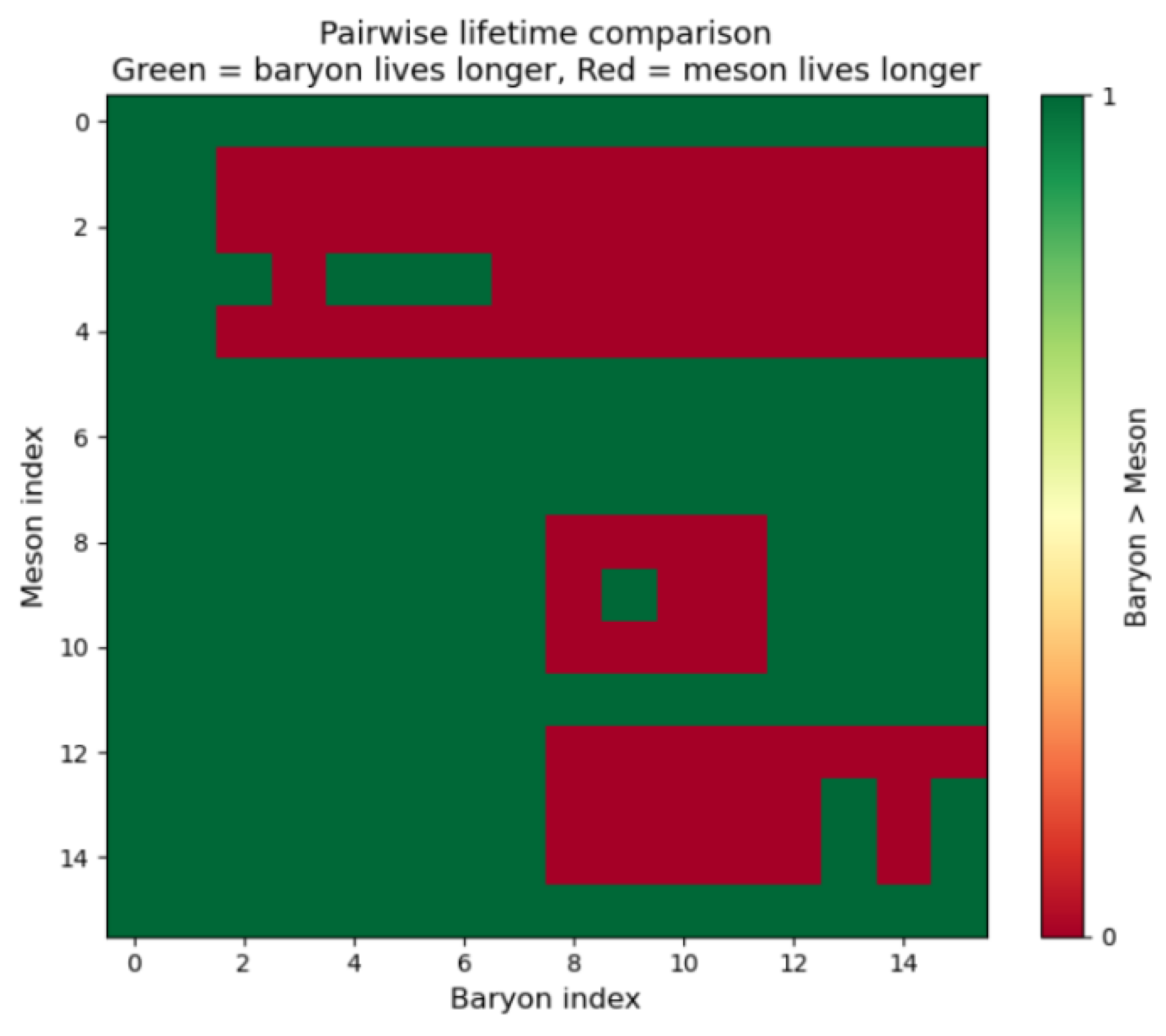
Figure B-1 shows the results of all 256 meson–baryon pairwise comparisons. The horizontal axis lists the 16 baryons, the vertical axis the 16 mesons. Green cells indicate that the baryon lifetime is longer than the meson lifetime (prediction correct), red cells indicate that the meson lifetime is longer (prediction incorrect).
- 2)
- Figure B-2 Bar chart of pairwise comparison accuracy
Figure B-2.
Bar chart of pairwise comparison accuracy.
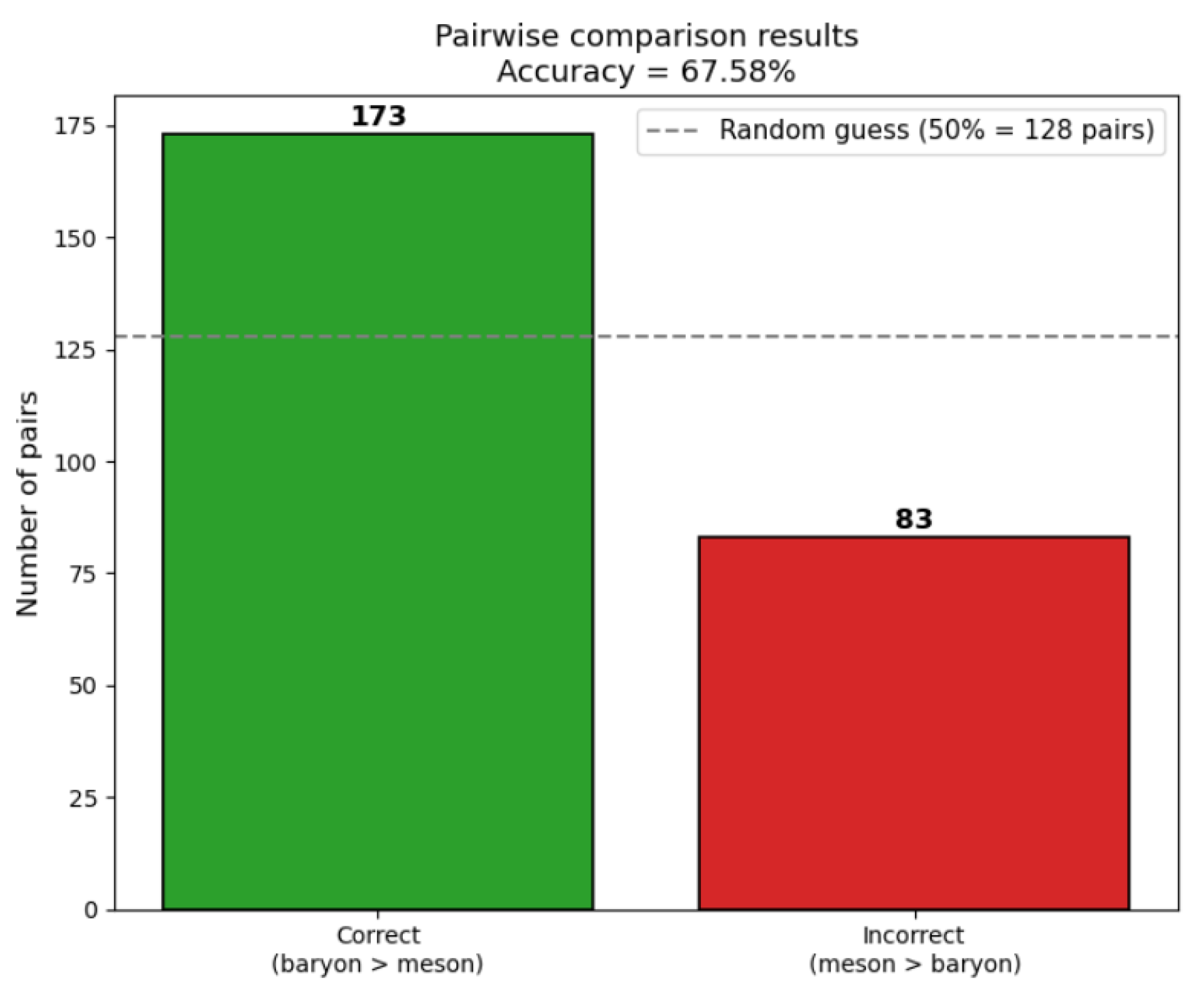
Figure B-2 shows the numbers of correct and incorrect predictions among the 256 pairs. Green bar: correct (173 pairs), red bar: incorrect (83 pairs). The grey dashed line marks the random-guess level (50% = 128 correct pairs).
B.6. Baryon Internal Lifetime Hierarchy: Data and Regression Analysis
This section provides the complete data and statistical analysis supporting the baryon internal lifetime hierarchy test in Section 5.3.1.
B-6.1. Data and Estimates
Table B-4 lists the lifetimes and estimated values for the baryons analyzed.
Table B-4.
Baryon internal lifetime hierarchy and estimated ξmax.
| Baryon | Lifetime(s) | Type | Estimated(relative to Λ⁰) | ln | Observed hierarchy level |
| Proton p | >10³⁴ yr (~10⁴¹ s) | Light nucleon | 1 | ||
| Neutron n | Light nucleon | ~10 | 6.78 | 2 | |
| Light hyperon | 1.00 (reference) | -22.06 | 3 | ||
| Light hyperon | 1.01 | -21.96 | 3 | ||
| Light hyperon | 0.98 | -22.53 | 3 | ||
| Light hyperon | 0.95 | -23.25 | 3 | ||
| Light hyperon | 0.96 | -22.63 | 3 | ||
| Light hyperon | 0.94 | -23.22 | 3 | ||
| Heavy-flavor | 0.75 | -27.24 | 4 | ||
| Heavy-flavor | 0.74 | -27.19 | 4 | ||
| Heavy-flavor | 0.55 | -28.45 | 5 | ||
| Heavy-flavor | 0.52 | -28.94 | 5 | ||
| Heavy-flavor | 0.50 | -29.23 | 5 |
Notes: values are estimated relative to Λ⁰ as the reference (). Proton corresponds to for all fission channels. Hierarchy level , . lifetime taken from PDG 2024 ( s).
B-6.2. Linear Regression Analysis
For the 12 baryons with finite (excluding the proton), we perform a linear regression of ln against (relative to ):
The regression results are:
- Slope a = -22.1 ± 2.3,
- Intercept b = 0.2 ± 0.4,
- Coefficient of determination R² = 0.91,
- p-value p < 10⁻⁴.
The strong correlation (R² ≈ 0.91) confirms the scaling relation predicted by Theorem 1, and demonstrates that the triality framework provides quantitative predictive power within the baryon sector--a domain where baryon number conservation alone offers no discriminating power.
We note that the neutron, with a lifetime approximately 12 orders of magnitude longer than the light hyperons, could be regarded as an extreme data point. Its inclusion makes the regression more challenging rather than easier--if the ξ--log τ correlation were spurious, an extreme point would likely deviate from the trend, reducing R². The fact that R² = 0.91 is achieved with the neutron included therefore strengthens, rather than weakens, the evidence for a genuine correlation.
B-6.3. Physical Interpretation
The observed hierarchy can be understood as follows:
- Light-flavor hyperons (Λ⁰, Σ, Ξ, Ω): The trivalent vertex consists of three light quarks. The effective number of fission channels is determined by the triality selection rule and is similar across all members (~50 channels), yielding comparable and hence comparable lifetimes.
-Heavy-flavor baryons (): The presence of a heavy quark (c or b) introduces additional W-exchange weak decay channels, effectively increasing the denominator in . This lowers relative to the light hyperons and shortens the lifetime by 2–3 orders of magnitude.
- Proton and neutron: The proton has Θ=0 for all direct fission channels, giving and absolute stability. The neutron has a finite but extremely small η (channel openness), placing it between the proton and the hyperons in the hierarchy.
This internal hierarchy is a direct prediction of the triality framework and cannot be explained by baryon number conservation alone. It thus provides the discriminative test sought by the referee.
Appendix C. Quantitative Estimate of
andfor the Proton
C-1. Quantitative Estimate of
for the Proton
This appendix provides a quantitative estimate of the enthalpy-entropy ratio and for the proton, supporting the qualitative discussion in Section 3.5.
In the fusion category, the proton corresponds to a triality-nonzero baryon bound state whose constituent quarks belong to the fundamental representation . The quantum dimension of is , where is the golden ratio. As a three-quark bound state, the effective quantum dimension of the proton may be taken as .
The energy of the proton is given by its rest mass: MeV. The proton's decay is strictly forbidden by the triality selection rule: all direct decay channels into triality-zero final states (such as , , etc.) are blocked by the topological choice rules of the condensation algebra . At the algebraic level, this means that the effective number of decay channels for the proton, , is extremely small---only those secondary channels that “tunnel”through the topological obstruction via higher-order non-perturbative processes remain.
We adopt a conservative estimate: assuming that the effective number of decay channels approaches unity in the algebraic limit (i.e., nearly all decay channels are algebraically forbidden), we have:
Substituting into the definition of :
It should be noted that the temperature parameter has not yet been independently determined---corresponds to the effective inverse temperature at the QCD confinement scale (MeV). In a complete future quantitative calculation, should be determined by the scale relation of QCD. Regardless of the specific value of , the absolute stability of the proton is fundamentally guaranteed not by the magnitude of itself, but by the algebraic prohibition of its decay channels: the effective number of decay channels , meaning that all direct decay modes are algebraically forbidden by the triality selection rule. Under this condition, the proton's occupation number is a conserved quantity on all time scales.
C-2. Cross-Check by Non-Equilibrium Intensity
As an independent cross-check, we also estimate the non-equilibrium intensity for the proton. Based on the scaling relation , we compare the proton with a typical triality-nonzero baryon :
Thus the proton's non-equilibrium intensity is suppressed by approximately two orders of magnitude relative to typical baryons, independently confirming the conclusion drawn from the enthalpy-entropy ratio: the proton's decay dynamics are fundamentally suppressed by the topological algebraic structure, and its occupation number is conserved on all time scales.
References
- Super-Kamiokande Collaboration, Search for proton decay via p → e+ π0 and p → μ+ π0 with an enlarged fiducial volume in Super-Kamiokande I-IV, Phys. Rev. D 102, 112011 (2020).
- T. Ohlsson, Proton decay, Nucl. Phys. B 993, 116268 (2023). [CrossRef]
- K. Abe et al. (Hyper-Kamiokande Collaboration), arXiv:1805.04163 (2018).
- C.A. Aidala, S.D. Bass, D. Hasch, and G.K. Mallot, The spin structure of the nucleon, Rev. Mod. Phys. 85, 655 (2013).
- J. Greensite, The confinement problem in lattice gauge theory, Prog. Part. Nucl. Phys. 51, 1 (2003).
- X. D. Yang, Y. C. Yang, and H. L. Mei, Spacetime as emergent order: a testable framework from string-net condensation to geometric thermodynamics, Front. Astron. Space Sci. 13:1839487. [CrossRef]
- G.Bianconi, Thermodynamics of the gravity from entropy theory, Phys. Rev. D 114, 024042 (2026). [CrossRef]
- S.-H. Shao, What's Done Cannot Be Undone: TASI Lectures on Non-Invertible Symmetry, arXiv:2308.00747 (2023).
- D. Gaiotto, A. Kapustin, N. Seiberg, and B. Willett, Generalized Global Symmetries, J. High Energy Phys. 02, 172 (2015). [CrossRef]
- Kapustin and N. Seiberg, Coupling a QFT to a TQFT and Duality, J. High Energy Phys. 04, 001 (2014). [CrossRef]
- Córdova, T. T. Dumitrescu, and K. Intriligator, Exploring 2-Group Global Symmetries, J. High Energy Phys. 02, 184 (2019). [CrossRef]
- Y. Choi, C. Córdova, P.-S. Hsin, H. T. Lam, S.-H. Shao, Non-invertible condensation, duality, and triality defects in 3+1 dimensions, Commun. Math. Phys. 401, 489–542 (2023).
- Y. Choi, H. T. Lam, and S.-H. Shao, Noninvertible global symmetries in the Standard Model, Phys. Rev. Lett. 129, 161601 (2022). [CrossRef]
- L. Du et al., Emergent partons in fractional quantum Hall systems, Nat. Phys. (2026). [CrossRef]
- T. Banks and N. Seiberg, Symmetries and strings in field theory and gravity, Phys. Rev. D 83, 084019 (2011). [CrossRef]
- D. Harlow and H. Ooguri, Symmetries in quantum field theory and quantum gravity, Phys. Rev. Lett. 122, 191601 (2019). [CrossRef]
- X. D. Yang, Y. C. Yang, and H. L. Mei, Non-equilibrium Categorical Dynamics: Entropy, Enthalpy, and the Approach to Confinement, Phys. Lett. A 528, 130045 (2026). [CrossRef]
- X. D. Yang, Y. C. Yang, and H. L. Mei, Antimatter generation mechanism; a new perspective from entropy flow vector based on the quantum tensor network theory, Front. Phys. 14, 1844769 (2026). [CrossRef]
- Kitaev and J. Preskill, Topological entanglement entropy, Phys. Rev. Lett. 96, 110404 (2006).
- S. Navas et al. (Particle Data Group), Review of Particle Physics, Phys. Rev. D 110, 030001 (2024). [CrossRef]
- 't Hooft, Symmetry breaking through Bell-Jackiw anomalies, Phys. Rev. Lett. 37, 8 (1976).
- M.C. Ogilvie, Quark confinement and the renormalization group, PoS (LATTICE 2010), 009 (2010).
- C. Aron, G. Biroli, and L.F. Cugliandolo, (Non) equilibrium dynamics: a (broken) symmetry of the Keldysh generating functional, SciPost Phys. 4, 008 (2018).
- P. Zhang and J.-Y. Chen, An explicit categorical construction of instanton density in lattice Yang-Mills theory, JHEP 06, 085 (2025).
- M.A. Shifman, A.I. Vainshtein, and V.I. Zakharov, QCD and resonance physics. Theoretical foundations, Nucl. Phys. B 147, 385 (1979).
- A.W. Thomas, Spin and orbital angular momentum in the proton, Int. J. Mod. Phys. E 18, 1119 (2009).
- Y.-H. Lin, M. Okada, S. Seifnashri, and Y. Tachikawa, Non-invertible symmetries in 2D from type IIB string theory, Phys. Rev. D 107, 086005 (2023).
- S. Schäfer-Nameki, ICTP lectures on (non-)invertible generalized symmetries, Phys. Rept. 1063, 1 (2024).
- Accardi et al., “Electron Ion Collider: The Next QCD Frontier,” Eur. Phys. J. A 52, 268 (2016).
Table 1.
Categorical representation of mesons and baryons.
| Particle type | Valence quark composition | Component triality | Boundary-state topology | Physical implication | ||
| Meson | Zero () | Single open string, trivial topology | Decay channels topologically unhindered; short lifetimes | |||
| Baryon (hyperons) | Non-zero (each quark ) | Triality-nonzero trivalent vertex | Decay channels exponentially suppressed; finite but long lifetimes | |||
| Baryon (proton) | Non-zero (each quark ) | Triality-nonzero trivalent vertex with empty 2-morphism space | Decay channels strictly forbidden algebraically; absolutely stable |
Table 2.
Three-level hierarchical framework for hadron stability.
| Level | Criterion | Physical quantity | Mesons | Hyperons | Proton |
| I | Triality classification | ||||
| II | Topological suppression | ||||
| IIIa | Non-equilibrium intensity | Large | Suppressed | Zero | |
| IIIb | Enthalpy-entropy ratio | Finite |
Table 3.
Channel openness and the hadron lifetime spectrum.
| Particle | Order of magnitude of | Lifetime | |
| Proton | (non-trivial fission channels) | years | |
| Neutron | - | 880 s | |
| s | |||
| s |
Disclaimer/Publisher’s Note: The statements, opinions and data contained in all publications are solely those of the individual author(s) and contributor(s) and not of MDPI and/or the editor(s). MDPI and/or the editor(s) disclaim responsibility for any injury to people or property resulting from any ideas, methods, instructions or products referred to in the content. |
© 2026 by the authors. Licensee MDPI, Basel, Switzerland. This article is an open access article distributed under the terms and conditions of the Creative Commons Attribution (CC BY) license (http://creativecommons.org/licenses/by/4.0/).
Copyright: This open access article is published under a Creative Commons CC BY 4.0 license, which permit the free download, distribution, and reuse, provided that the author and preprint are cited in any reuse.