
Submitted:
27 July 2026
Posted:
29 July 2026
You are already at the latest version
Abstract
Reliable heart rate variability (HRV) assessment in freely moving therapy dogs is challenging because movement degrades electrocardiographic (ECG) signal quality. This study evaluated ambulatory ECG monitoring during routine canine-assisted psychotherapy (CAP) and examined the influence of signal quality on HRV estimation. Ambulatory ECG recordings were obtained from two certified therapy dogs during 38 CAP sessions. HRV was calculated from 60-s sliding windows using both permissive and conservative preprocessing strategies. Behavioral activity was retrospectively coded from synchronized videos, and normalized signal quality index (SQI) was assessed. Cluster-robust regression models were used to evaluate data feasibility, SQI, and the root mean square of successive beat-to-beat differences (RMSSD) as marker of vagal HRV. The permissive strategy retained 10,075 analysis windows, whereas the strict strategy retained 4,529 windows. Under the permissive preprocessing strategy, inactivity was associated with slightly higher SQI, whereas no significant differences in SQI between activity states were observed under the conservative strategy. In both strategies, RMSSD was significantly higher during inactivity and increased with improving SQI. A significant interaction demonstrated that the association between SQI and RMSSD was stronger during active than inactive periods. These findings suggest that ambulatory ECG enables robust HRV assessment in therapy dogs under real-world conditions when ECG signal quality is explicitly considered. More important than a strict quality threshold, incorporating SQI into statistical analyses improves interpretation of autonomic measurements obtained during naturalistic CAP.
Keywords:
heart rate variability
; canine
; ambulatory ECG
; animal-assisted psychotherapy
; signal quality
Introduction
Canine-assisted psychotherapy (CAP) has been associated with a range of beneficial psychological and physiological outcomes in human participants, including reductions in stress and improvements in affective state [1,2,3]. Despite its widespread application, evaluation of CAP outcomes has largely relied on subjective reporting and behavioral observation of human participants, with comparatively limited emphasis on objective physiological monitoring of therapy animals during real-world sessions. As a result, the physiological state of therapy dogs during routine clinical work remains insufficiently characterized, particularly under naturalistic interaction conditions.
Heart rate variability (HRV) is widely used as a non-invasive marker of autonomic nervous system activity and vagal regulation, and has been proposed as an index of stress and emotional regulation in dogs [4,5,6]. In animals, and particularly in dogs, HRV has been studied in both laboratory and semi-controlled environments to evaluate responses to stressors, human interaction, and environmental changes (see review [7]). In dogs, higher HRV has frequently been associated with conditions of reduced arousal and greater parasympathetic dominance, for example during rest or sleep, whereas acute stressors such as separation, or exposure to unfamiliar environments are typically associated with HRV reductions [4,8,9,10].
RMSSD (root mean square of successive differences) is one of the most widely used time-domain indices of heart rate variability and is widely used as a proxy of parasympathetically mediated (vagal) cardiac control of the sinoatrial node [11,12]. Unlike global variability metrics, RMSSD is primarily driven by short-term beat-to-beat variability and is therefore particularly sensitive to respiratory sinus arrhythmia and rapid vagal fluctuations. This makes it especially suitable for short-term recordings and sliding-window analyses, as commonly applied in ambulatory settings. In contrast to frequency-domain measures, RMSSD does not require strict stationarity assumptions and is less affected by moderate non-stationarities in the signal, which are typical in freely moving human subjects [13].
In canine studies, RMSSD has been repeatedly used to quantify shifts in autonomic balance in response to social interaction, stress exposure, and environmental context, with higher values generally interpreted as reflecting increased vagal tone and reduced sympathetic dominance [8,14,15,16]. In the present study, RMSSD served as the primary outcome metric for autonomic activity across behavioral states and signal quality conditions, enabling the assessment of parasympathetic dynamics during naturalistic therapy sessions.
In contrast to controlled laboratory environments, real-world CAP sessions involve continuous movement, physical interaction, and changes in posture and activity state, all of which introduce substantial challenges for ambulatory electrocardiogram (ECG) acquisition. These conditions increase the likelihood of motion artifacts, electrode displacement, and R-peak detection errors, leading to missing or corrupted inter-beat interval series. As a result, the feasibility and reliability of deriving HRV metrics from ambulatory ECG recordings in such settings remain insufficiently characterized.
A central challenge in ambulatory HRV analysis is that behavioral state and measurement quality are intrinsically coupled. Activity-related movement may simultaneously reflect changes in physiological arousal and induce signal degradation, thereby confounding interpretation of HRV metrics [11,17]. In such contexts, reductions in signal quality may bias HRV estimates in either direction, depending on the nature and magnitude of artifact contamination and correction procedures [18,19]. Consequently, distinguishing true physiological variation from measurement-induced distortion requires explicit modeling of signal quality alongside behavioral state. A systematic evaluation of how signal quality influences HRV-derived measures is therefore necessary to ensure valid inference in ambulatory settings.
The present study evaluates the feasibility of deriving canine HRV metrics from ambulatory ECG recordings collected during routine CAP sessions. ECG segments are categorized according to behavioral state (activity versus inactivity), and signal quality is quantified using artifact-based indices and segment-level usability metrics. The study specifically investigates (i) how behavioral state influences the probability of obtaining valid HRV estimates, (ii) how signal quality differs across activity conditions, and (iii) how both factors jointly affect derived RMSSD values. Cluster-robust regression models are used to account for repeated measurements within subjects and to separate physiological effects from measurement-related variability. Given the repeated-measures structure and ecological nature of the data, the primary focus is on methodological and signal-related constraints rather than inter-individual generalizability.
2. Methods
2.1. Experimental Design
Ambulatory ECG recordings were collected from two certified therapy dogs during 38 routine CAP sessions conducted in a clinical setting. The dogs were two male Large Munsterlander aged 5 years (24 sessions) and 11 years (14 sessions). Sessions involved one therapist and varying patients and were performed without experimental manipulation or behavioral constraints, allowing spontaneous variation in movement, posture, and interaction behavior representative of routine therapeutic practice. Each session lasted 45 to 60 minutes. Raw ECG data is available at FigShare (https://doi.org/10.6084/m9.figshare.33080354).
Both therapy dogs underwent clinical veterinary assessment prior to the study and showed no evidence of cardiovascular abnormalities. All sessions were conducted by a licensed psychological psychotherapist with formal training and experience in dog-assisted psychotherapy. The therapeutic procedures followed the clinic’s routine practice and were not modified for the purposes of physiological recording. Prior to participation, all patients provided written informed consent for participation in the study and for audiovisual and physiological recordings. The study protocol was approved by the Ethics Committee of the Medical Faculty of Friedrich-Schiller University Jena (2025-3882_1-BO-A).
All sessions were video recorded using two synchronized digital cameras (HDR-CX240, Sony Corporation, Tokyo, Japan) positioned on opposite sides of the therapy room to ensure continuous visual coverage of both dogs throughout each session. Synchronization between video streams and physiological recordings was achieved using a light flash visible in both camera views and the ECG acquisition timeline.
2.2. Behavioral States
Behavioral state was coded retrospectively from the synchronized video recordings. One investigator (SS) performed the primary annotation, classifying each HRV analysis window as either active (walking, interacting with patients or therapist, or other overt movement) or inactive (lying, resting, or displaying minimal movement). All annotations were independently reviewed by a second investigator (AS), and disagreements (deviation by more than 30s) were resolved by consensus. Behavioral labels were subsequently aligned with the corresponding ECG analysis windows.
2.3. ECG Acquisition
ECG signals were acquired using a wireless recording system MP160 and RSPEC-R amplifier (BioNomadix, BIOPAC Systems Inc., Goleta, CA, USA). A three-channel ECG configuration was used to enhance signal robustness under ambulatory conditions. Data were sampled at a frequency of 1000 Hz.
2.4. ECG Processing and Beat Detection
ECG signals were preprocessed using the PhysioZoo toolbox implemented in MATLAB 2025b (The MathWorks Inc., Natick, MA, USA) which provides mammal-specific parameter sets for heart rate variability analysis and signal quality assessment [21]. To reduce baseline wander, muscle activity, and electrical interference, recordings were band-pass filtered between 3 and 45 Hz, thereby attenuating low-frequency drift and suppressing 50 Hz power-line noise. R-peaks were subsequently detected using two complementary algorithms with different sensitivities to noise [22,23]: ‘jqrs.m’, which has been shown to perform robustly in noisy recordings [24], and ‘gqrs.c’, which performs well under moderate-noise conditions [25]. Agreement between these independent detectors formed the basis for subsequent ECG signal quality assessment.
2.5. Signal Quality Assessment
ECG signal quality was quantified using the beat signal quality index, which estimates signal reliability based on the agreement between two independent R-peak detection algorithms with different sensitivities to noise [26]. The resulting signal quality index (SQI) was computed in rolling time window (10-s duration with a 1-s shift) throughout each recording, providing a quasi-continuous estimate of ECG quality over time. Based on these SQI values, ECG segments exceeding a predefined quality threshold can be identified and retained for subsequent HRV analysis, whereas segments below the threshold were excluded.
2.6. Sliding-Window HRV Estimation
Because standardized preprocessing criteria for ambulatory canine HRV recordings are currently lacking, physiologically plausible thresholds were defined a priori and applied consistently across all recordings. In addition to the minimal preprocessing parameter set for canine ECG [21], we excluded RR intervals outside the physiologically plausible range of 0.2 s – 2.0 s and successive RR intervals differing by more than 0.9 s. These thresholds were selected a priori based on the expected physiological heart-rate range of healthy dogs and visual inspection of representative recordings
The root mean square of successive RR interval differences (RMSSD), a time-domain measure of vagally mediated heart rate variability, was calculated in sliding windows of 60 s with a 10-s increment. RMSSD was computed only for windows meeting the predefined signal quality and preprocessing criteria described below.
2.7. Quality Regimes and Sensitivity Analysis
To evaluate the robustness of HRV estimates to preprocessing decisions, two quality regimes with different inclusion criteria were defined. The conservative regime prioritized signal fidelity by applying stringent quality thresholds (minimum SQI = 0.95) and excluding analysis windows containing more than 10 % missing or corrected R peaks. The permissive regime prioritized data retention by relaxing these criteria (minimum SQI = 0.80; maximum missing or corrected peak detections = 25 %), thereby allowing the inclusion of lower-quality ECG segments. Comparing results across both preprocessing regimes enabled assessment of the sensitivity of HRV estimates and statistical inferences to signal quality and artifact handling.
2.8. Statistical Analysis
Statistical analyses were performed in Python 3.15.3 (Python Software Foundation, Wilmington, DE, USA) using regression models with cluster-robust standard errors to account for repeated observations within therapy sessions. Data feasibility was evaluated using a generalized linear model with a binomial distribution and logit link, modeling the probability of obtaining a valid HRV estimate as a function of behavioral activity and therapy dog. Signal quality as measured by SQI was analyzed using linear regression with activity and therapy dog as fixed effects. The primary analysis modeled standardized RMSSD using linear regression including activity, standardized SQI, their interaction, and therapy dog as fixed effects. The interaction term was included to determine whether the association between SQI and HRV differed between activity states. All analyses were performed separately for the conservative and permissive preprocessing regimes to evaluate the robustness of the findings under different signal quality criteria.
3. Results
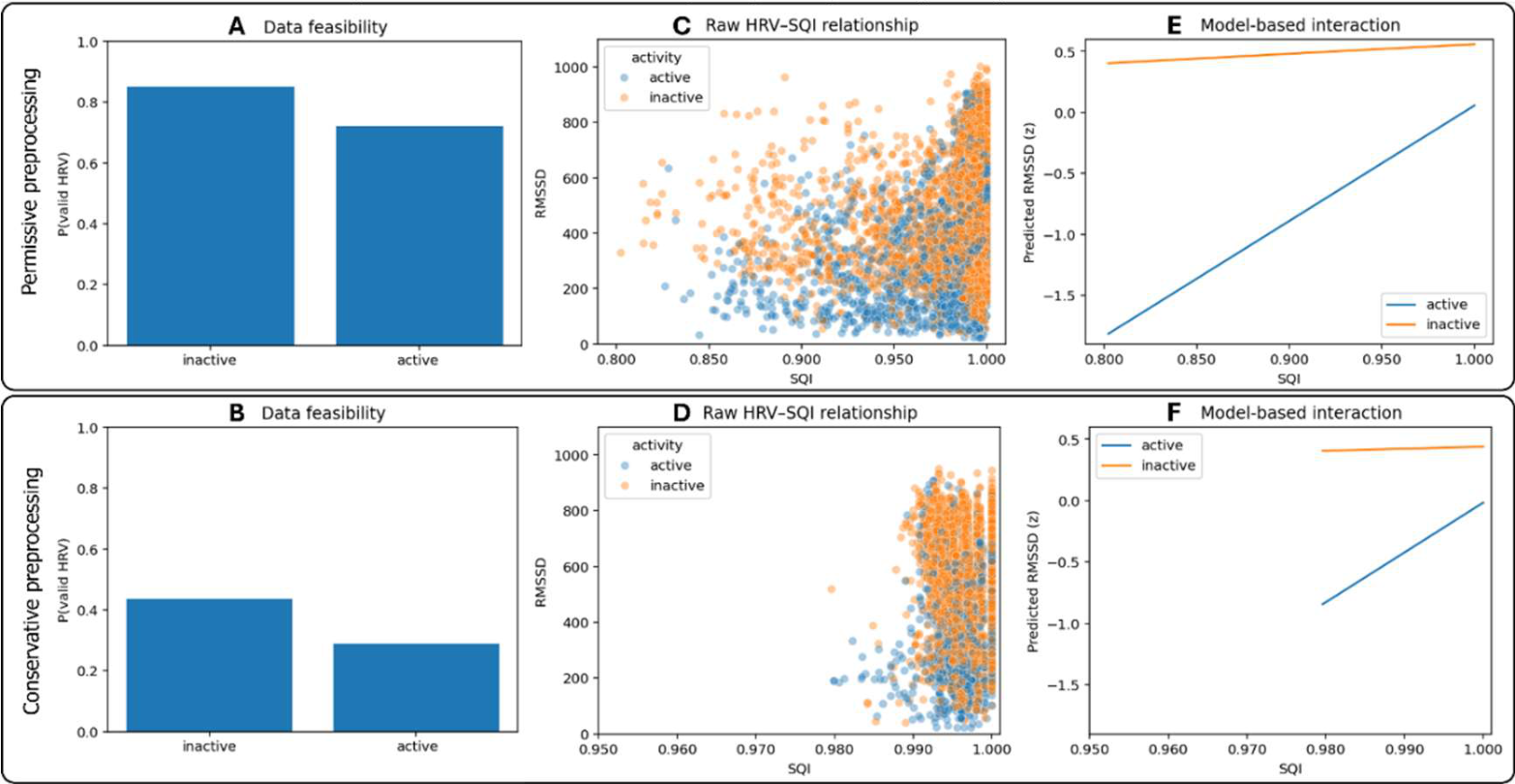
ECG recordings were obtained from 38 CAP sessions involving two certified therapy dogs (see one example in Figure 2). Application of the permissive preprocessing strategy yielded 10,075 valid one-minute HRV windows (71.0% of all candidate windows), whereas the strict preprocessing retained 4,529 valid windows (31.9%), illustrating the substantial impact of preprocessing criteria on data availability (Figure 3, A-B).
3.1. Data Feasibility
The probability of obtaining a valid HRV window was significantly influenced by behavioral state and dog identity. Under the permissive preprocessing strategy, active periods were associated with a lower likelihood of producing analyzable HRV data compared with active periods (β = - 0.789, 95% CI -1.175 to -0.402, p < 0.001). Dog identity also significantly affected recording feasibility (β = 1.107, 95% CI 0.536–1.678, p < 0.001).
The same pattern was observed using the strict preprocessing strategy. Active periods again reduced the probability of obtaining valid HRV estimates (β = -0.680, 95% CI -0.956 to -0.405, p < 0.001), while dog identity remained a significant predictor (β = 1.162, 95% CI 0.712–1.612, p < 0.001). These findings indicate that behavioral context systematically influences the feasibility of ambulatory canine ECG analysis regardless of preprocessing approach.
3.2. Signal Quality
Signal quality was evaluated using the average signal quality index (SQI). Under the permissive preprocessing strategy, SQI differed significantly between behavioral states (R² = 0.071). Inactive windows exhibited slightly higher SQI values than active windows (β = 0.271 standardized units, 95% CI 0.101–0.441, p = 0.002). A modest but significant difference between dogs was also observed (β = 0.503, 95% CI 0.120–0.886, p = 0.010).
In contrast, no significant effects of activity (β = 0.054, p = 0.412) or dog identity (β = 0.146, p = 0.173) were detected using the strict preprocessing strategy (R² = 0.004), indicating that nearly all retained windows already exhibited uniformly high signal quality.
3.3. Heart Rate Variability
The primary regression model examined standardized RMSSD as a function of behavioral state, SQI, their interaction, and dog identity. For the permissive dataset, the model explained 39.2% of the variance in RMSSD (R² = 0.392, p < 0.001). Inactive behavior was associated with substantially higher RMSSD than active behavior (β = 0.628 SD, 95% CI 0.519–0.736, p < 0.001). Dog identity exerted a similarly strong effect (β = 1.089 SD, 95% CI 0.838–1.339, p < 0.001).
SQI was positively associated with RMSSD during active behavior (β = 0.238 SD per one standard deviation increase in SQI, 95% CI 0.155–0.322, p < 0.001). However, this relationship was significantly moderated by behavioral state (interaction β = -0.218 SD, 95% CI -0.323 to -0.114, p < 0.001). Consequently, the association between SQI and RMSSD was largely absent during inactive periods, whereas increasing signal quality during active behavior was associated with progressively higher estimated HRV (Figure 3, C-F).
The strict preprocessing strategy produced highly consistent results despite retaining fewer observations. The model explained 42.1% of RMSSD variance (R² = 0.421, p < 0.001). Inactive behavior remained associated with higher HRV (β = 0.595 SD, 95% CI 0.444–0.745, p < 0.001), and dog identity continued to exert a strong effect (β = 1.377 SD, 95% CI 1.121–1.634, p < 0.001). Although the magnitude of the SQI effect was reduced compared with the permissive analysis, SQI remained a significant predictor (β = 0.111 SD, 95% CI 0.035–0.187, p = 0.004), and the interaction between SQI and behavioral state also remained significant (β = -0.107 SD, 95% CI -0.199 to -0.014, p = 0.024). Thus, the state-dependent influence of signal quality on HRV estimation proved robust across substantially different preprocessing strategies.
Overall, both analyses demonstrate that behavioral state is the dominant determinant of canine RMSSD during psychotherapy sessions, while signal quality primarily affects HRV estimates during periods of activity.
4. Discussion
The present study evaluated the feasibility of continuous ambulatory ECG monitoring for heart rate variability assessment during routine CAP sessions under naturalistic clinical conditions. Recordings were acquired while therapy dogs moved freely and interacted spontaneously with therapists and patients, introducing substantial motion-related challenges for ECG acquisition. Nevertheless, the wireless recording system combined with standardized signal processing yielded a large number of analyzable HRV segments across 38 therapy sessions. These findings demonstrate that reliable ECG-based HRV monitoring is feasible during routine clinical practice without restricting animal movement or altering therapeutic procedures.
A central objective of this study was to investigate how ECG preprocessing strategy influences both data availability and subsequent HRV analyses. The permissive preprocessing strategy retained approximately 71% of candidate analysis windows, whereas the strict strategy retained approximately 32%. Despite this more than twofold reduction in usable data, both approaches produced remarkably similar conclusions regarding the effects of behavioral state and the interaction between signal quality and HRV. This finding suggests that increasingly restrictive preprocessing primarily reduces statistical power rather than substantially changing the physiological interpretation of the recordings. From a practical perspective, this result is encouraging because ambulatory recordings inevitably contain movement-related artifacts that cannot be completely avoided in real-world applications. Rather than maximizing data rejection, an optimized balance between data retention and signal quality may therefore represent the most efficient approach for wearable physiological monitoring in freely moving dogs.
Behavioral state consistently emerged as the strongest predictor of HRV across both preprocessing strategies. Inactive periods were associated with higher RMSSD than active periods, reflecting increased parasympathetic modulation during resting behavior. This observation agrees with previous canine HRV studies reporting increased vagal activity during quiet resting conditions compared with periods of locomotion or behavioral engagement [4,5,6,7,8,9]. Importantly, the consistency of this effect across both preprocessing strategies supports the physiological validity of the proposed acquisition and processing pipeline and indicates that the observed autonomic differences are unlikely to be artifacts introduced by signal processing.
An important methodological finding concerns the role of the signal quality index (SQI). Under the permissive preprocessing strategy, higher SQI values were associated with higher RMSSD during active behavior, whereas this relationship was largely absent during inactivity. The same interaction remained statistically significant after application of the strict preprocessing criteria, although the effect size was reduced. This pattern suggests that signal quality is not merely a criterion for excluding poor-quality recordings but represents a context-dependent determinant of HRV estimation. During inactive periods, ECG quality is generally sufficient to permit stable R-peak detection and reliable RR interval estimation, resulting in only minimal influence of SQI on HRV. In contrast, during active behavior, movement-related disturbances increase the likelihood of detection errors, making HRV estimates more dependent on signal quality. Explicitly modelling SQI therefore provides additional information that would be lost if recordings were filtered solely using fixed quality thresholds [27].
These findings have practical implications for the development of wearable physiological monitoring systems for companion and working dogs. Long-term ECG monitoring outside laboratory environments requires acquisition systems that tolerate motion artifacts while maintaining reliable HRV estimation. The present results suggest that integrating objective signal quality measures into the statistical analysis may allow substantially greater data retention without compromising the validity of physiological conclusions. Such an approach may improve continuous welfare monitoring of therapy dogs, assistance dogs, service animals, and other working dogs operating under natural conditions [27,28].
The comparison between preprocessing strategies further illustrates the importance of evaluating signal processing choices explicitly. Although the strict preprocessing approach produced uniformly high-quality recordings, it substantially reduced the number of analyzable windows while providing only modest improvements in statistical model performance. Conversely, the permissive strategy preserved a much larger proportion of the recordings and yielded essentially identical conclusions regarding behavioral effects and the interaction between SQI and HRV. These observations indicate that moderate-quality ECG segments may still contain physiologically meaningful information when appropriate quality metrics are incorporated into the analysis. Consequently, future ambulatory HRV studies should consider combining objective SQI measures with statistical adjustment rather than relying exclusively on increasingly conservative exclusion criteria.
Several limitations should be acknowledged. First, recordings were obtained from only two certified therapy dogs, limiting the generalizability of the physiological findings to other breeds, ages, and working populations. Nevertheless, the study included 38 independent therapy sessions conducted under authentic clinical conditions, providing a large number of repeated observations across diverse therapeutic situations. Second, behavioral state was classified retrospectively into broad active and inactive categories. Although this approach was sufficient to demonstrate robust differences in HRV and signal quality, future studies could benefit from more detailed behavioral ethograms or automated video-based activity recognition to characterize the influence of specific behaviors on ECG quality and autonomic regulation. Third, cluster-robust regression accounted for repeated observations within therapy sessions but does not explicitly model the hierarchical structure of repeated measurements nested within individual dogs. Future investigations including larger numbers of animals should employ mixed-effects models with random effects for both dog and session to improve estimation of between-subject variability. Finally, only one time-domain HRV measure was examined in the present work. Additional evaluation of frequency-domain and nonlinear HRV indices under ambulatory conditions would provide a more comprehensive assessment of the robustness of wearable ECG monitoring.
In conclusion, continuous wireless ECG monitoring enables reliable HRV assessment in therapy dogs during routine CAP conducted under unrestricted clinical conditions. Behavioral state was the primary determinant of HRV, while signal quality exerted a behavior-dependent influence that was most pronounced during periods of activity. Importantly, similar physiological conclusions were obtained using markedly different preprocessing strategies, indicating that robust ambulatory HRV assessment is achievable without excessively restrictive data rejection. These findings support the use of objective signal quality metrics as an integral component of ambulatory ECG analysis and provide methodological guidance for future wearable sensing applications aimed at monitoring canine physiology and welfare in real-world environments.
Funding
This research was supported by the German Research Foundation (DFG, CR 994/2-1), and the Interdisciplinary Centre for Clinical Research Jena (IZKF, MSP27 and AMSP23).
Institutional Review Board Statement
This study was conducted according to the guidelines of the Declaration of Helsinki and approved by the Institutional Ethics Committee of the Medical Faculty of the Friedrich-Schiller University Jena (#).
Data Availability Statement
The raw data in terms of ECG recordings is available without restriction.
Conflicts of Interest
The funders had no role in the design of the study; in the collection, analyses or interpretation of data; in the writing of the manuscript, or in the decision to publish the results.
References
- Ein, N.; Li, L.; Vickers, K. The Effect of Pet Therapy on the Physiological and Subjective Stress Response: A Meta-Analysis. Stress Health 2018, 34, 477–489. [Google Scholar] [CrossRef] [PubMed]
- Odendaal, J.S.J.; Meintjes, R.A. Neurophysiological Correlates of Affiliative Behaviour between Humans and Dogs. Vet. J. 2003, 165, 296–301. [Google Scholar] [CrossRef] [PubMed]
- Beetz, A.; Uvnäs-Moberg, K.; Julius, H.; Kotrschal, K. Psychosocial and Psychophysiological Effects of Human-Animal Interactions: The Possible Role of Oxytocin. Front. Psychol. 2012, 3. [Google Scholar] [CrossRef] [PubMed]
- Katayama, M.; Kubo, T.; Mogi, K.; Ikeda, K.; Nagasawa, M.; Kikusui, T. Heart Rate Variability Predicts the Emotional State in Dogs. Behav. Process. 2016, 128, 108–112. [Google Scholar] [CrossRef] [PubMed]
- Zupan, M.; Buskas, J.; Altimiras, J.; Keeling, L.J. Assessing Positive Emotional States in Dogs Using Heart Rate and Heart Rate Variability. Physiol. Behav. 2016, 155, 102–111. [Google Scholar] [CrossRef] [PubMed]
- Palestrini, C.; Previde, E.P.; Spiezio, C.; Verga, M. Heart Rate and Behavioural Responses of Dogs in the Ainsworth’s Strange Situation: A Pilot Study. Appl. Anim. Behav. Sci. 2005, 94, 75–88. [Google Scholar] [CrossRef]
- Csoltova, E.; Mehinagic, E. Where Do We Stand in the Domestic Dog (Canis Familiaris) Positive-Emotion Assessment: A State-of-the-Art Review and Future Directions. Front. Psychol. 2020, 11, 2131. [Google Scholar] [CrossRef] [PubMed]
- Berg, P.; Koskela, A.; Lipponen, J.A.; Törnqvist, H.; Kujala, J.; Tarvainen, M.P.; Kujala, M.V. Behavior-Related Changes in Canine Heart Rate and Heart Rate Variability during Short-Term Measurement. Appl. Anim. Behav. Sci. 2026, 296, 106899. [Google Scholar] [CrossRef]
- Maros, K.; Dóka, A.; Miklósi, Á. Behavioural Correlation of Heart Rate Changes in Family Dogs. Appl. Anim. Behav. Sci. 2008, 109, 329–341. [Google Scholar] [CrossRef]
- Gácsi, M.; Maros, K.; Sernkvist, S.; Faragó, T.; Miklósi, Á. Human Analogue Safe Haven Effect of the Owner: Behavioural and Heart Rate Response to Stressful Social Stimuli in Dogs. PLoS ONE 2013, 8, e58475. [Google Scholar] [CrossRef] [PubMed]
- Malik, M. Heart Rate Variability: Standards of Measurement, Physiological Interpretation and Clinical Use. Task Force of the European Society of Cardiology and the North American Society of Pacing and Electrophysiology. Circulation 1996, 93, 1043–1065. [Google Scholar] [CrossRef]
- Shaffer, F.; Ginsberg, J.P. An Overview of Heart Rate Variability Metrics and Norms. Front. Public Health 2017, 5. [Google Scholar] [CrossRef] [PubMed]
- Penttilä, J.; Helminen, A.; Jartti, T.; Kuusela, T.; Huikuri, H.V.; Tulppo, M.P.; Coffeng, R.; Scheinin, H. Time Domain, Geometrical and Frequency Domain Analysis of Cardiac Vagal Outflow: Effects of Various Respiratory Patterns. Clin. Physiol. 2001, 21, 365–376. [Google Scholar] [CrossRef] [PubMed]
- Grigg, E.K.; Liu, S.; Dempsey, D.G.; Wong, K.; Bain, M.; Sollers, J.J.; Haddock, R.; Kogan, L.R.; Barnhard, J.A.; Tringali, A.A.; et al. Assessing the Relationship Between Emotional States of Dogs and Their Human Handlers, Using Simultaneous Behavioral and Cardiac Measures. Front. Vet. Sci. 2022, 9, 897287. [Google Scholar] [CrossRef] [PubMed]
- Matsushita, S.; Nagasawa, M.; Kikusui, T. Autonomic Nervous System Responses of Dogs to Human-Dog Interaction Videos. PLoS ONE 2022, 17, e0257788. [Google Scholar] [CrossRef] [PubMed]
- Katayama, M.; Kubo, T.; Yamakawa, T.; Fujiwara, K.; Nomoto, K.; Ikeda, K.; Mogi, K.; Nagasawa, M.; Kikusui, T. Emotional Contagion From Humans to Dogs Is Facilitated by Duration of Ownership. Front. Psychol. 2019, 10, 1678. [Google Scholar] [CrossRef] [PubMed]
- Laborde, S.; Mosley, E.; Thayer, J.F. Heart Rate Variability and Cardiac Vagal Tone in Psychophysiological Research – Recommendations for Experiment Planning, Data Analysis, and Data Reporting. Front. Psychol. 2017, 8. [Google Scholar] [CrossRef] [PubMed]
- Alcantara, J.M.A.; Plaza-Florido, A.; Amaro-Gahete, F.J.; Acosta, F.M.; Migueles, J.H.; Molina-Garcia, P.; Sacha, J.; Sanchez-Delgado, G.; Martinez-Tellez, B. Impact of Using Different Levels of Threshold-Based Artefact Correction on the Quantification of Heart Rate Variability in Three Independent Human Cohorts. J. Clin. Med. 2020, 9. [Google Scholar] [CrossRef] [PubMed]
- Sraitih, M.; Jabrane, Y. A Denoising Performance Comparison Based on ECG Signal Decomposition and Local Means Filtering. Biomed. Signal Process. Control 2021, 69, 102903. [Google Scholar] [CrossRef]
- Billman, G.E. The Effect of Heart Rate on the Heart Rate Variability Response to Autonomic Interventions. Front. Physiol. 2013, 4. [Google Scholar] [CrossRef] [PubMed]
- Behar, J.A.; Rosenberg, A.A.; Weiser-Bitoun, I.; Shemla, O.; Alexandrovich, A.; Konyukhov, E.; Yaniv, Y. PhysioZoo: A Novel Open Access Platform for Heart Rate Variability Analysis of Mammalian Electrocardiographic Data. Front. Physiol. 2018, 9. [Google Scholar] [CrossRef] [PubMed]
- Vest, A.N.; Da Poian, G.; Li, Q.; Liu, C.; Nemati, S.; Shah, A.J.; Clifford, G.D. An Open Source Benchmarked Toolbox for Cardiovascular Waveform and Interval Analysis. Physiol. Meas. 2018, 39, 105004. [Google Scholar] [CrossRef] [PubMed]
- Vest, A.N.; Li, Q.; Liu, C.; Nemati, S.; Shah, A.; Clifford, G.D. Benchmarking Heart Rate Variability Toolboxes. J. Electrocardiol. 2017, 50, 744–747. [Google Scholar] [CrossRef] [PubMed]
- Behar, J.; Oster, J.; Clifford, G.D. Combining and Benchmarking Methods of Foetal ECG Extraction without Maternal or Scalp Electrode Data. Physiol. Meas. 2014, 35, 1569. [Google Scholar] [CrossRef] [PubMed]
- Silva, I.; Moody, G. An Open-Source Toolbox for Analysing and Processing PhysioNet Databases in MATLAB and Octave. J. Open Res. Softw. 2014, 2. [Google Scholar] [CrossRef] [PubMed]
- Li, Q.; Mark, R.G.; Clifford, G.D. Robust Heart Rate Estimation from Multiple Asynchronous Noisy Sources Using Signal Quality Indices and a Kalman Filter. Physiol. Meas. 2007, 29, 15. [Google Scholar] [CrossRef] [PubMed]
- Bidoli, E.M.Y.; Erhard, M.H.; Döring, D. Heart Rate and Heart Rate Variability in School Dogs. Appl. Anim. Behav. Sci. 2022, 248, 105574. [Google Scholar] [CrossRef]
- Winkle, M.; Johnson, A.; Mills, D. Dog Welfare, Well-Being and Behavior: Considerations for Selection, Evaluation and Suitability for Animal-Assisted Therapy. Anim. Open Access J. MDPI 2020, 10. [Google Scholar] [CrossRef] [PubMed]
Figure 1.
Ambulatory ECG acquisition and electrode placement. Lateral (A) and dorsal view (B) of the electrode placement. Three-channel thoracic electrocardiography was performed with a reference electrode placed on the dorsal midline over the spine, just caudal to the shoulders at the cranial aspect of the thorax. Recording electrodes were positioned on the lateral thoracic walls, with RA in the 5th intercostal space and LA at the costochondral junction in the 6th intercostal space. The right panel shows a 5-s segment of the raw ECG signal (C), the effect of lowpass filtering (D), and the final preprocessed signal after baseline removal (E).
Figure 1.
Ambulatory ECG acquisition and electrode placement. Lateral (A) and dorsal view (B) of the electrode placement. Three-channel thoracic electrocardiography was performed with a reference electrode placed on the dorsal midline over the spine, just caudal to the shoulders at the cranial aspect of the thorax. Recording electrodes were positioned on the lateral thoracic walls, with RA in the 5th intercostal space and LA at the costochondral junction in the 6th intercostal space. The right panel shows a 5-s segment of the raw ECG signal (C), the effect of lowpass filtering (D), and the final preprocessed signal after baseline removal (E).
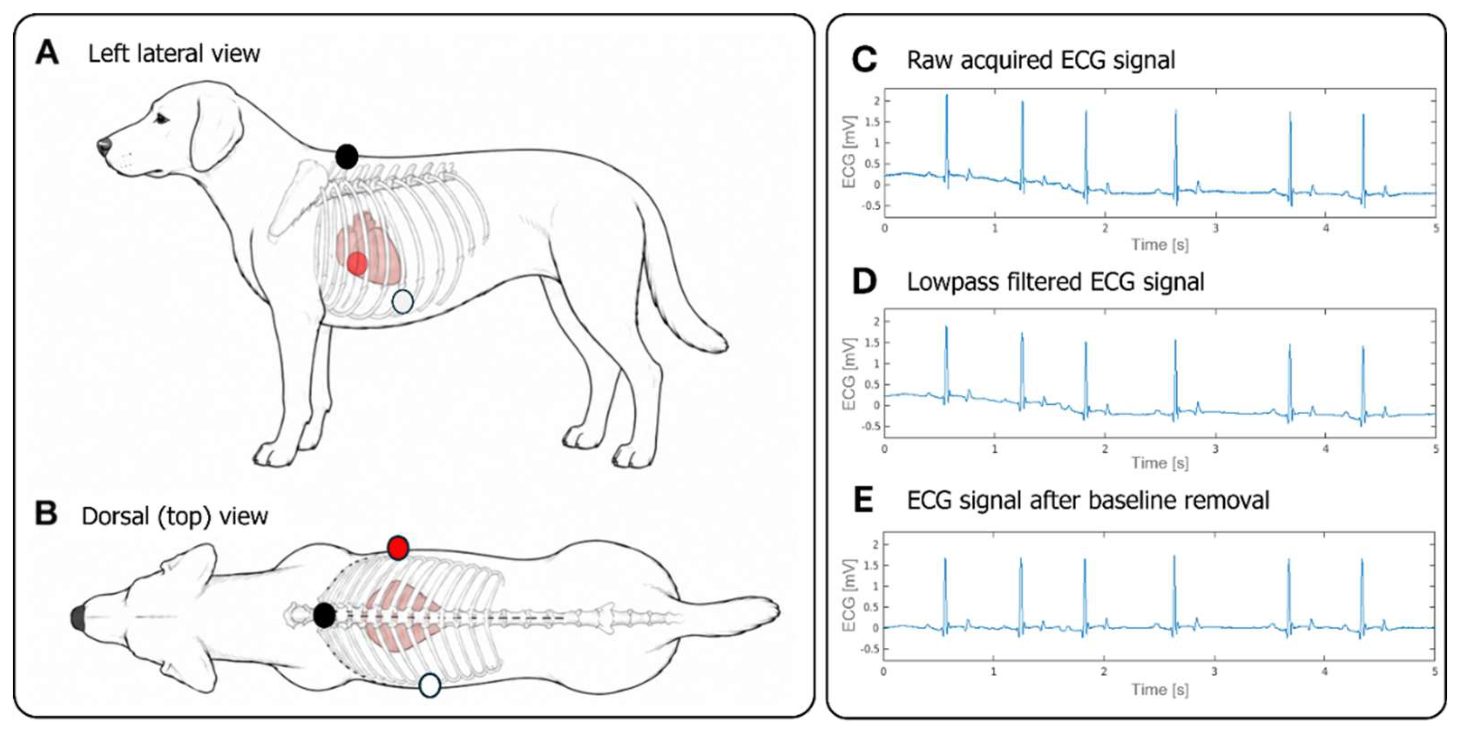
Figure 2.
Example heart rate changes (top), signal quality (SQI, middle) and vagal heart rate variability (RMSSD, bottom) during one canine-assisted psychotherapy session analyzed with permissive strategy. Phases of activity were marked as blue background while inactive segment are presented in orange color.
Figure 2.
Example heart rate changes (top), signal quality (SQI, middle) and vagal heart rate variability (RMSSD, bottom) during one canine-assisted psychotherapy session analyzed with permissive strategy. Phases of activity were marked as blue background while inactive segment are presented in orange color.
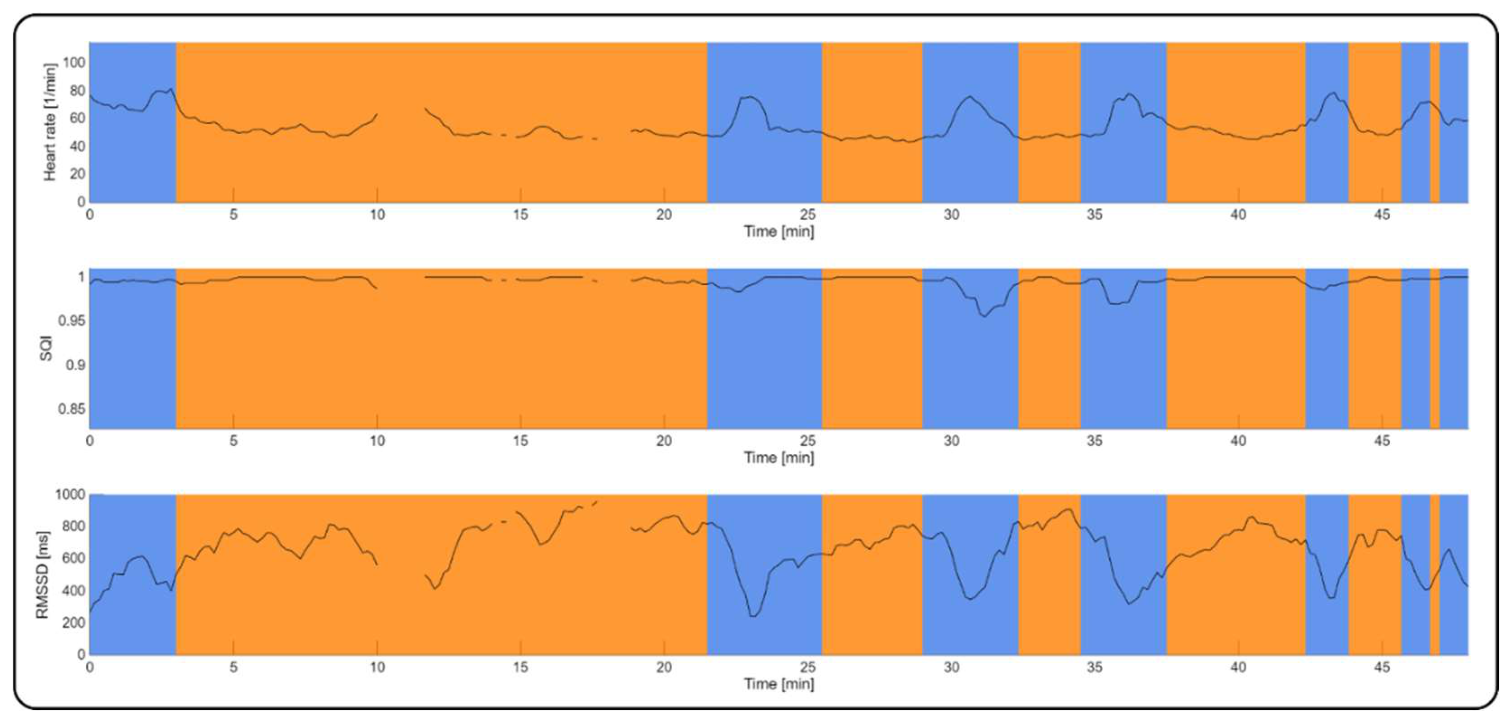
Figure 3.
Methodological comparison of data feasibility, raw data distribution, and model-based interactions between heart rate variability (HRV) and signal quality under permissive versus conservative preprocessing regimes. Data feasibility (A, B): Bar plots showing the probability of obtaining a valid HRV window, demonstrating a higher likelihood of producing analyzable data during inactive compared to inactive behavioral states across both regimes. Raw HRV-SQI relationship (B, E): Scatter plots detailing individual 60-second window measurements of RMSSD plotted against the Signal Quality Index (SQI), color-coded by behavioral state (blue: active; orange: inactive). Model-based interaction (C, F): Cluster-robust regression interaction profiles showing predicted standardized RMSSD (z-score) as a function of SQI. The steeper slopes for active periods (blue lines) versus the flat profiles for inactive periods (orange lines) demonstrate a significant, state-dependent interaction where signal quality predominantly impacts HRV estimation during periods of locomotion and physical interaction.
Figure 3.
Methodological comparison of data feasibility, raw data distribution, and model-based interactions between heart rate variability (HRV) and signal quality under permissive versus conservative preprocessing regimes. Data feasibility (A, B): Bar plots showing the probability of obtaining a valid HRV window, demonstrating a higher likelihood of producing analyzable data during inactive compared to inactive behavioral states across both regimes. Raw HRV-SQI relationship (B, E): Scatter plots detailing individual 60-second window measurements of RMSSD plotted against the Signal Quality Index (SQI), color-coded by behavioral state (blue: active; orange: inactive). Model-based interaction (C, F): Cluster-robust regression interaction profiles showing predicted standardized RMSSD (z-score) as a function of SQI. The steeper slopes for active periods (blue lines) versus the flat profiles for inactive periods (orange lines) demonstrate a significant, state-dependent interaction where signal quality predominantly impacts HRV estimation during periods of locomotion and physical interaction.
Disclaimer/Publisher’s Note: The statements, opinions and data contained in all publications are solely those of the individual author(s) and contributor(s) and not of MDPI and/or the editor(s). MDPI and/or the editor(s) disclaim responsibility for any injury to people or property resulting from any ideas, methods, instructions or products referred to in the content. |
© 2026 by the authors. Licensee MDPI, Basel, Switzerland. This article is an open access article distributed under the terms and conditions of the Creative Commons Attribution (CC BY) license (http://creativecommons.org/licenses/by/4.0/).
Copyright: This open access article is published under a Creative Commons CC BY 4.0 license, which permit the free download, distribution, and reuse, provided that the author and preprint are cited in any reuse.


