
Submitted:
28 July 2026
Posted:
29 July 2026
You are already at the latest version
Abstract
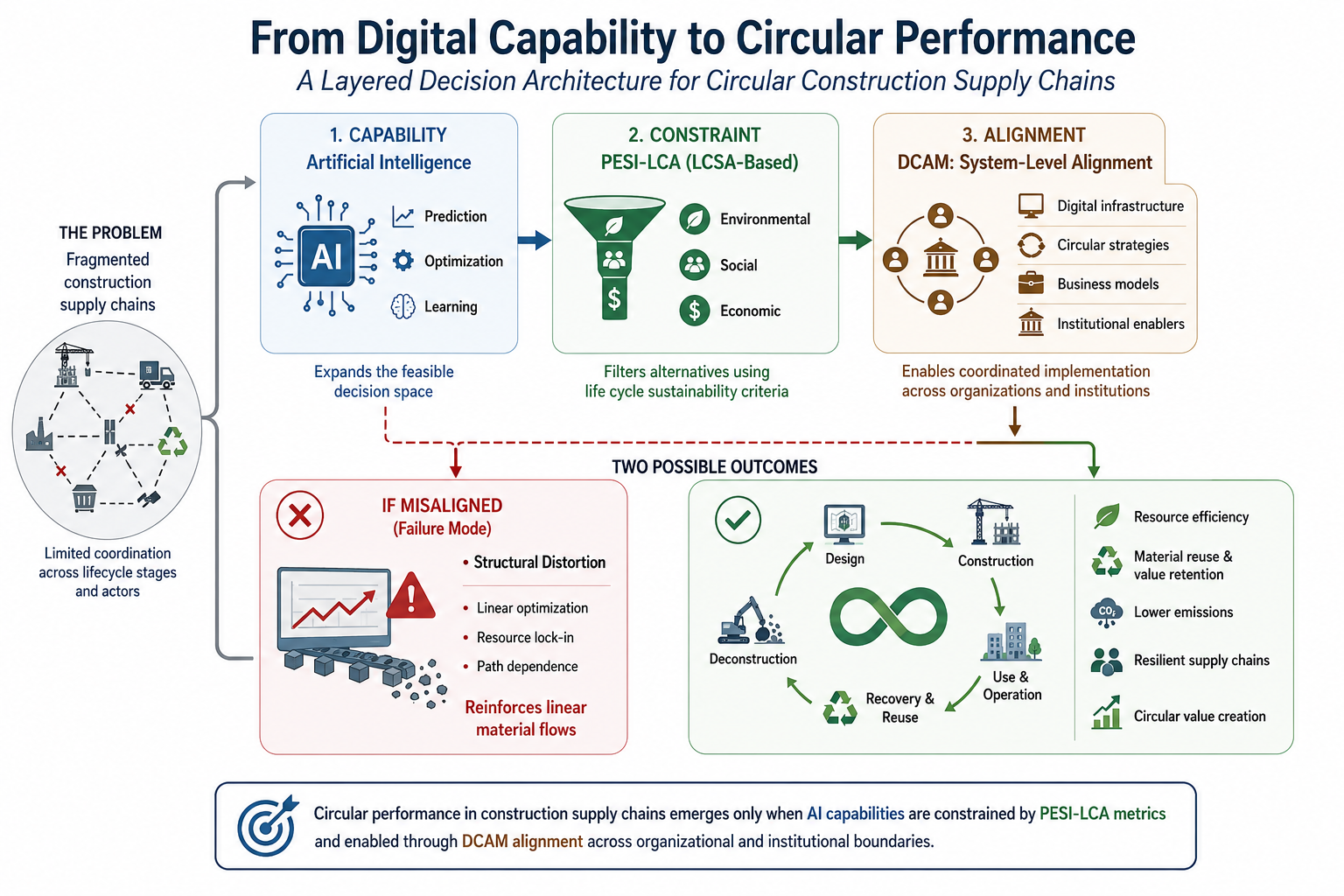
Construction supply chains are pivotal to circular economy (CE) transitions but remain structurally fragmented, limiting the scalability of resource-efficient solutions. At the same time, digital technologies and life cycle assessment are often deployed in isolation, constraining their ability to enable system-level circularity. Using a theory-building literature synthesis of 141 publications across circular economy, sustainable supply chain management, digitalization, and life cycle sustainability assessment, this study develops an integrated conceptual framework that explains how circular performance can be achieved through the interaction of artificial intelligence (AI), life cycle sustainability assessment (PESI-LCA), and system-level alignment (DCAM).
Drawing on an integrative synthesis of sustainable supply chain management, CE, and digitalization research, AI is conceptualized as a dynamic capability for prediction and optimization, while PESI-LCA is positioned as an operationalized LCSA-based con-straint system that embeds environmental, social, and economic criteria into decision architectures. DCAM defines the alignment conditions required across digital infra-structure, circular strategies, business models, and institutional enablers.
The framework advances a non-additive logic: circular outcomes emerge only when sustainability constraints shape AI-driven decision-making and when alignment enables coordinated implementation across supply chains. A key contribution is the identification of structural distortion as a failure mode in which digital optimization reinforces linear resource flows. The study advances sustainable supply chain theory and offers testable propositions and governance implications for scaling circular construction systems.
Keywords:
circular economy
; sustainable supply chain management
; closed-loop supply chains
; artificial intelligence
; life cycle assessment
; construction supply chains
Copyright: This open access article is published under a Creative Commons CC BY 4.0 license, which permit the free download, distribution, and reuse, provided that the author and preprint are cited in any reuse.


