

Submitted:
26 July 2026
Posted:
29 July 2026
You are already at the latest version
Abstract
This reply addresses Bird et al. (2027) and argues that their critique rests on a methodological confusion between prediction and test. We contend that models of Paleolithic foraging are not validated by computing their own outputs, but only by confronting their predictions with independent evidence. Applying that standard, we showed in our original paper and show here that the low ranking assigned to large prey in recent ethnographic return-rate datasets fails against Pleistocene faunal assemblages and actualistic cases in which large animals dominate biomass. We further argue that the ethnographic values entered behavioral-ecology models are drawn largely from ecological and technological contexts unlike those of the Paleolithic, especially rainforest and recent post-extinction environments depleted of megafauna. The paper also clarifies the limits of inferring trophic level from ethnographical or archaeological data alone and emphasizes the convergence of physiological, genetic, isotopic, and archaeological evidence for high human trophic levels through much of the Pleistocene. Specific issues concerning proboscidean hunting, fat and protein constraints, small prey, the Hadza analogy, and the Grandmother Hypothesis are addressed as secondary points. Overall, we argue that the evidentiary record supports large-prey-focused subsistence more strongly than the flexibility model defended by Bird et al.
Keywords:
ethnography
; human behavior
; optimization models
; prey-size
This is a reply to Bird et al. (2027) that the Journal of Archaeological Methods and Theory refused to publish, after publishing Bird et al. 2027 reply to our paper within 6 days of its submission, claiming in our subsequent correspondence that they do not publish replies but accept Bird et al. (2027) " because the editors and reviewers concluded that, "although it was framed around a critique of your article, it also made a broader methodological and theoretical contribution concerning archaeological inference, …". As can be seen from our reply, we found their reply to be of very doubtful scientific quality. We publish our paper here to allow due scientific process to take its course. It is a sorry state of affairs when a journal whose whole reason d'etre is discussing scientific rigor let non-scientific considerations affect its decisions.
We thank Bird et al. (2027) for their detailed engagement with our paper (Ben-Dor & Barkai, 2026). Their comment raises two kinds of issues. The first is methodological, concerning how the energetic returns and the trophic level of Paleolithic humans can, and cannot, be reconstructed. The second is a set of specific claims about the evidence. The methodological questions are the substance of our disagreement, and we address them first and at greatest length; the points of content follow. We also accept several specific corrections, which we note where they arise.
Part I. Methodological Considerations
1. The Conflation of Prediction and Test
The most consequential of our disagreements is not about any particular datum but about scientific method itself: the conflation of a prediction with its test. In science, a prediction is what a model asserts about the world, and a test is the confrontation of that assertion with evidence gathered independently of it. To compute a model’s outputs and then treat the computation as a confirmation is to omit the step on which the scientific standing of an empirical claim depends. This error runs through the treatment of the Morin et al. (2022) dataset, and we take it first because it underlies much of what follows.
Bird et al. call the Morin et al. (2022) dataset “the dataset that directly tests the model,” and fault us for dismissing it. We fail to see in it any test by Morin et al. of their predictions. They calculated return rates from ethnographic records and ranked prey by those rates, which is a computation of the model’s outputs rather than an examination of them. A test requires an independent comparison, the prediction set beside an outcome that was not used to produce it. Comparing the model’s outputs with themselves does not establish their bearing on the past.
We supplied the step that was missing. The flexibility position, and the low ranking it assigns to large prey, predicts that large prey should not dominate subsistence where higher-return alternatives were available. We tested that prediction against evidence the model had not touched: the Pleistocene faunal record and an actualistic case. In both, the prediction failed. Large prey contribute the majority of the biomass across the archaeological assemblages we examined in southern Africa and Europe, and in the Hadza sample the largest taxa supply the bulk of the biomass, with the giraffe alone, ranked among the lowest-return taxa by Morin et al. (2022) and by Lupo and Schmitt (2016), contributing 57% of it.
A failed test implicates either the model or the data placed into it, and we then examined the data. Fifty-three percent of the Morin et al. (2022) cases come from rainforest groups; the largest prey are almost absent, with two cases above 1,000 kg; and the recorded technologies, bows, firearms, and hunting dogs, have little in common with the spear-based record that spans most of the Paleolithic. Return rates assembled under these conditions describe the foragers who were observed. They do not describe hunters working open Pleistocene landscapes rich in large and very large prey. The model is sound; the values supplied to it are not the values the Paleolithic requires.
Bird et al. read our archaeological analysis as an attempt to test our own claims while creating the impression that we did not test Morin et al. The order of events was the reverse. Morin et al. did not test their conclusions against any independent record. We tested them in their stead, we found that they failed, and we identified in their data the reason for the failure.
2. Behavioral Ecology and the Location of the Analogy
Bird et al. assert, in several places, that we mischaracterize behavioral ecology, and foraging theory in particular, as an argument by analogy. We did not. We did not question the derivation of the prey-choice model from evolutionary first principles, and we did not reject behavioral ecology as a mode of reasoning. Our argument concerns the data that enter the model, not the model itself. A prey-choice model requires empirical values for post-encounter return rates, encounter rates, pursuit and failure probabilities, and macronutrient composition, and in every application to the Paleolithic these values are drawn from recent and historic foragers. The inference from those foragers to Pleistocene hominins is where the analogy resides, whatever the formal pedigree of the equations that receive it.
Bird et al. give the same exemption a second form. Contemporary foragers matter, they write, not as stand-ins for the Paleolithic but because the present is the only place where the dynamics of foraging can be directly observed. The past, however, cannot be observed, so any dynamic carried from the present into the past is transferred across an assumed similarity of conditions. That is an analogy, whether the thing transferred is a return rate, a trade-off, or an observed dynamic, and whether its pedigree is deductive or empirical.
Bird et al. reply that their models are tested against the widest possible array of ethnographic observations, and they treat the global range of the Morin et al. (2022) sample as an analytic strength. Breadth of this kind does not meet our concern. The contexts sampled differ in kind from the Paleolithic ones the model is asked to reconstruct, and enlarging a sample of such contexts does not change their character. The model is not in dispute; the representativeness of the data placed into it is.
3. The Trade-Offs are not Context-Free
Bird et al. locate the transferable content of the models in the trade-offs themselves, which, in their words, recur across foragers in rainforests, savannas, deserts, and tundra alike. A trade-off is set by the prey community and the habitat, not by the forager alone, and the Late Quaternary extinction transformed both. It removed 40 of the 48 megaherbivore species and more than half the species in the next two size classes (Svenning et al., 2024), and, by eliminating the ecosystem engineers that had kept landscapes open, it allowed woody vegetation to expand (Sinclair et al., 2003; Sondergaard et al., 2025). The direction of a trade-off need not reverse for its quantitative degree to change: thinner prey densities lengthen search, and closed vegetation lengthens pursuit. The low standing that recent data assign to large prey may therefore be an artifact of this collapse rather than a ranking that held when the same animals were common. To carry a trade-off measured in the depleted modern community back into the Pleistocene is itself an analogy, no different in kind from the ethnographic analogies Bird et al. believe they have moved beyond. They never test whether it survives the discontinuity. That too is a hypothesis, not a finding.
4. Trophic Level and the Limits of the Archaeological Record
Bird et al.’s picture of low-latitude foragers subsisting well below the protein ceiling is an ethnographic one, and it inherits the very limit our program was built to escape. A trophic level cannot be read from the archaeological record. That record shows which animals were eaten, and in what relative numbers, but not the proportion of plant to animal food, because plant remains rarely survive. The human trophic level must therefore be reconstructed from evidence that does persist. We have done so across several disciplines at once, drawing on physiology, genetics, morphology, dentition, life history, and stable isotopes, and they converge on a high trophic level through most of the Pleistocene (Ben-Dor et al., 2021). Reduced gut volume with an expanded small intestine, scavenger-grade gastric acidity, insulin-sparing metabolism, the CMAH deletion, lipase-gene evolution, and late and modest amylase amplification all point the same way, and the designation “omnivore” resolves little, since most mammals are omnivores and most omnivorous mammals draw over 70% of their calories from a single source (Pineda-Munoz and Alroy, 2014, calculated in Ben-Dor et al., 2021). Stable isotopes, the one direct measure of trophic position, reach back only some 50,000 years, and wherever they reach they indicate a consistently carnivorous trophic level. Bird et al. answer this multidisciplinary reconstruction with a single line of ethnographic inference, which is precisely the move whose validity is in question.
5. The Archaeological Test: the Kakwani Concentration Index
Bird et al. state that we calibrate our index (Kakwani Concentration Index – KCI, see Ben-Dor and Barkai, 2026)) with the same Hadza data we criticize, and they present this as a return to conventional analogy. We did not calibrate the index with ethnographic data. The Kakwani Concentration Index was calibrated against archaeological data: 184 Pleistocene faunal layers from southern Africa, each with NISP above 30, in which we anchored the index to the biomass share of the largest size classes. The Hadza enter our analysis at a single, later point, as one of two actualistic cases set beside the archaeological result, alongside the Ache of Paraguay. They are a test case, not the foundation of the index, and the index would stand unchanged without them. We did not select the Hadza for their agreement: we report the Ache beside them, the Ache do not agree, and the contrast is itself part of the result.
Bird et al. are right that a single assemblage’s size distribution can arise from many processes: site function, seasonality, transport, and disposal. That is precisely why the index is applied across many assemblages under formal statistical tests, not to individual sites. Such local processes vary from site to site and have no reason to align in one direction. To meet their concern about the reliability of the southern African record directly, we increase the minimum NISP to 100 and removed the Earlier Stone Age from the analysis, along with the Middle Stone Age assemblages whose faunal content is primarily carnivore-derived, among them Equus Cave, Swartkrans, Sterkfontein, and Elandsfontein, and recalculated the index across the three sub-phases of the Middle Stone Age and the Later Stone Age.
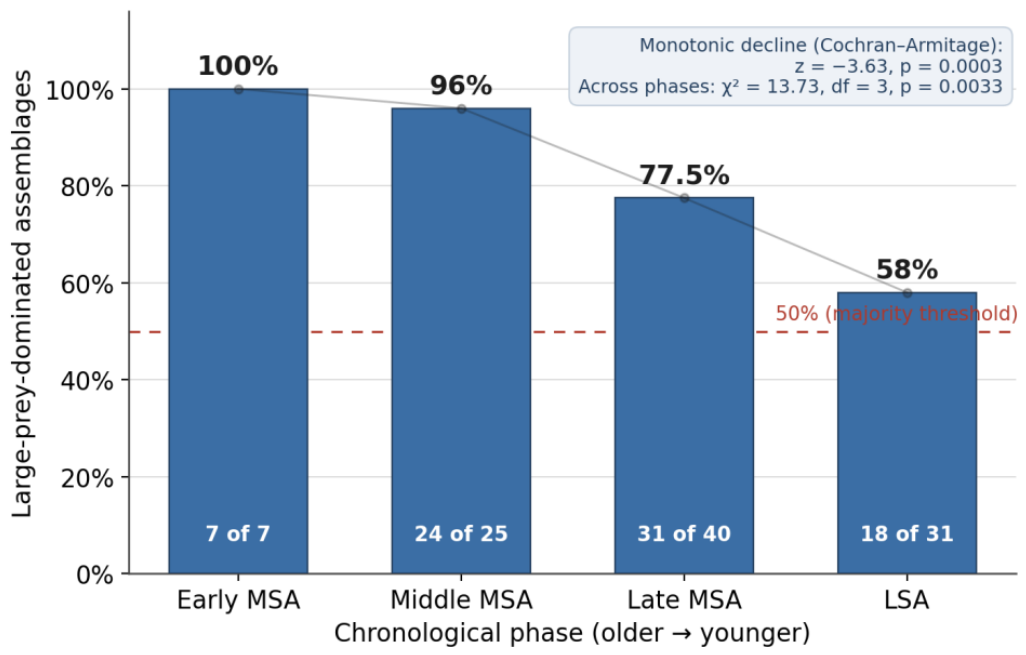
The concentration on large prey survives the removal. Across the 103 assemblages that remain, biomass is concentrated in the largest size classes in 78% of cases. Positive concentration appears in all seven Early MSA assemblages, in 96% of the Middle MSA (24 of 25), in 77.5% of the Late MSA (31 of 40), and in 58% of the LSA (18 of 31). The proportion of large-prey-dominated assemblages differs significantly across the four phases (χ² = 13.73, df = 3, p = 0.0033), and it declines monotonically from the Early MSA to the LSA (Cochran-Armitage trend test, z = −3.63, p = 0.0003). A taphonomic contaminant would not decline in step with time; seasonality and site function do not trend with time, but the concentration we recover does, in the direction our thesis predicts. Equifinality is a property of the single case; scale and statistics dissolve it, rather than ignore it.

Table 1.
Large-prey biomass concentration (positive KCI) by phase in the southern African record, after removal of the Earlier Stone Age and the carnivore-accumulated Middle Stone Age assemblages.
Table 1.
Large-prey biomass concentration (positive KCI) by phase in the southern African record, after removal of the Earlier Stone Age and the carnivore-accumulated Middle Stone Age assemblages.
| Phase | Assemblages (N) | Positive KCI (≥ 0) | % Positive |
| Early MSA | 7 | 7 | 100% |
| Middle MSA | 25 | 24 | 96% |
| Late MSA | 40 | 31 | 77.5% |
| LSA | 31 | 18 | 58% |
| Total | 103 | 80 | 78% |
Difference across phases: χ² = 13.73, df = 3, p = 0.0033. Monotonic decline (Cochran-Armitage trend test): z = −3.63, p = 0.0003.
Figure 1.
Proportion of southern African faunal assemblages showing large-prey biomass dominance (positive KCI) by chronological phase, after removal of the Earlier Stone Age and the carnivore-accumulated Middle Stone Age assemblages (n = 103). Dominance declines monotonically from the Early MSA to the LSA yet remains a majority in every phase.
Figure 1.
Proportion of southern African faunal assemblages showing large-prey biomass dominance (positive KCI) by chronological phase, after removal of the Earlier Stone Age and the carnivore-accumulated Middle Stone Age assemblages (n = 103). Dominance declines monotonically from the Early MSA to the LSA yet remains a majority in every phase.
Finally, small taxa can be abundant in number yet supply almost none of the edible mass. At Les Canalettes, rabbits (Oryctolagus cuniculus) account for 68% of the identified specimens but only 1% of the biomass (Cochard et al., 2012; our calculations). This is why we measure concentration by biomass, not by specimen count, and why the presence of small fauna in an assemblage, to which Bird et al. devote considerable attention, does not bear on the concentration of biomass on large prey. Presence in the record is not contribution to the diet, and the Kakwani index rests on that distinction.
We grant a point of principle. The dominance of large prey in the archaeological record is not, by itself, proof that large prey yielded higher returns; the processes Bird et al. list could in principle contribute to the same pattern. But the proof they demand cannot be supplied by any archaeological record. The return rates, encounter rates, pursuit costs, and success probabilities that would settle the question directly are not preserved, and assembling adequate proxies for even one region takes years. The realistic question is not whether the pattern has been established beyond every alternative, a standard no reconstruction of past behavior could meet, but whether, given the evidence we do have, those alternatives remain probable. We think they do not. A biomass concentration on large prey that holds across 103 assemblages, declines monotonically through time in the direction our thesis predicts, and coincides with independent physiological, genetic, and isotopic evidence for a high trophic level is not plausibly the joint product of taphonomy, transport, and site function. It is the convergence of these independent lines, not any one of them, that makes the alternative readings improbable and carries the conclusion.
6. Return-Rate Accounting: Corrections and Clarifications
We accept a correction from Bird et al. on one point. In comparing hunting times, we treated O’Connell et al.’s figure of 27 hours for 36 pursued animals as search-and-pursuit time, and set the resulting rate against the 213 hours estimated by Kraft et al. (2021). Bird et al. are right that O’Connell et al.’s 27 hours record pursuit alone, of animals already encountered, whereas Kraft et al.’s estimate includes search. The two are not commensurable, and the comparison should not have been drawn. This does not affect our archaeological results or the concentration of biomass on large prey, which rest on faunal assemblages rather than on ethnographic time budgets.
On a second point Bird et al. read us in reverse. Our zebra calculation was not an attempt to treat a post-encounter rate and an overall rate as commensurable. It was the opposite. We combined Morin et al.’s (2022) handling-only return of 6,495 cal/hr with Kraft et al.’s (2021) search-inclusive return of 982 cal/hr in order to show that they cannot both describe the same hunt. On the first figure, a 210,000-cal zebra takes 32 hours to handle; on the second, it takes 213 hours in all; the residual is 182 hours of search for a single animal. We offered that number as an absurdity, not as a measurement. Its purpose is to show that a handling rate from one ethnographic setting and an overall rate from another cannot be reconciled, which is the incompatibility our paper set out to demonstrate. Far from confusing the two quantities, the calculation depends on keeping them apart.
Bird et al. also reply that trapping is not costless. We did not say it was. We said it eliminates pursuit costs, and it does: a trap trades the construction and upkeep they note for the variable, failure-prone cost of pursuit. Those are real costs, but of a different kind..
7. Proboscideans — Methodology
Bird et al.’s proboscidean objections are of two kinds. The first is methodological: it concerns how the returns from elephant hunting are quantified, and in each instance the calculation leaves out what governed the decision to hunt.
Several of the objections concern our treatment of ivory-driven hunting, and they share an answer. When we wrote that increasingly costly individuals were targeted, we did not mean search time; we meant that a high reward, paid in a currency that meat calories do not measure, leads hunters to accept encounters with a lower probability of success. Bird et al. reply that the per-encounter risk of failure is the same whatever the motive, and that Lupo and Schmitt do discuss the influence of ivory. The per-encounter risk may be fixed, but the response to it is not: a hunter pursuing ivory takes on encounters a hunter pursuing meat would decline, and the aggregate failure rate rises with the reward. And discussing ivory is not the same as counting it: Lupo and Schmitt’s return estimates for elephant hunting count meat and fat alone, and on that basis conclude the activity was low-return, leaving out of the number the commodity that governed which animals were taken and at what risk. Returns calculated from ivory-driven hunts reflect a tolerance for failure, and an economics that subsistence hunting would not sustain.
Bird et al. object that pit traps had low efficacy because elephants often avoided them, and that traps were used mainly by sedentary food producers. Neither point removes the trap from the Paleolithic repertoire. A trap works without the hunter present, so the animals that avoid it cost nothing; effort falls only on those caught. What matters is not how many elephants evade the pit but the labor a captured elephant requires against what it yields, and the investment in digging and upkeep is modest against the return from an animal of several tons, paid once rather than at every encounter. The number of trapped elephants per pit is expected to rise with their higher relative abundance before the Late Quaternary extinctions. That recent trap-users were often sedentary does not bar Paleolithic use, and elephant pit-trapping is documented regardless (Agam & Barkai, 2018).
Bird et al. hold that body size predicts returns poorly, most poorly at the upper extreme where proboscideans sit, and that the Kakwani index therefore cannot rank large prey. Carried to its conclusion, this makes the largest animals the least attractive prey on the landscape. The record answers that directly: proboscideans were hunted and intensively processed from Olduvai to the North European plain to Clovis North America, across two million years. A framework that ranks as least attractive the animals hominins pursued most conspicuously is not describing their behavior but failing to. And the weakness cuts both ways: if size cannot show large prey to be high-return, it cannot show them to be low-return either.
Finally, our critique of the historical and ethnographic record has a specific target: the quantification of energetic returns from that record, not the use of its insights as such. That pit traps were used to take elephants is a documented behavior, one with no reason not to be analogical to Paleolithic conditions. It is not a return estimate, and citing it takes nothing from our case about returns. Recording what people did and measuring what it returned are different uses of the record, and only the second is at issue.
Part II. Points of Content
The Following Sections Turn to Specific Issues. They are Secondary to the General Methodological Argument of Part I
8. Proboscideans — Content
The content objection concerns the record itself, which is neither new nor thin. Human hunting and exploitation of proboscideans has been documented for decades and reviewed at length by Agam and Barkai (2018), and it is the subject of a volume devoted entirely to human-elephant interactions across the Pleistocene and beyond (Konidaris et al., 2021). The studies we set out below are only the most recent additions to that literature, and together they extend it across the full temporal and geographic range of the Paleolithic. At Olduvai Gorge, Domínguez-Rodrigo et al. (2026) report the earliest direct evidence of proboscidean butchery and find that megafaunal processing becomes frequent and widespread after 1.8 Ma in Bed II, which they read as a strategic adaptation to megafaunal resources rather than opportunistic scavenging. For the Last Interglacial of Europe the record is now particularly strong. Verheijen et al. (2026) provide the first systematic analysis of the Lehringen straight-tusked elephant, found with a 2.38 m wooden thrusting spear, and interpret it as a successful hunt with early carcass access at roughly 125,000 years ago. Gaudzinski-Windheuser et al. (2023) show, from Neumark-Nord together with Gröbern and Taubach, that the extended butchery of straight-tusked elephants was a widespread and recurring Neanderthal practice rather than a local anomaly. Armaroli et al. (2026), studying the more than 70 straight-tusked elephants accumulated by Neanderthal hunting and butchering at Neumark-Nord, reconstruct their life histories and show that some were killed at the site after ranging up to 300 km across the Last Interglacial landscape. On Sulawesi, Burhan et al. (2025) document a Pleistocene occupation whose earlier phase is associated with the butchery of a fauna that, alongside dwarf bovids, included now-extinct proboscideans. In the Americas, Potter et al. (2026) synthesize the Early Paleoindian record across Beringia, North America, and South America and find hemisphere-wide specialization on megaherbivores over 1,000 kg, while Chatters et al. (2024) report that mammoth featured heavily in the Western Clovis diet. Together these cases place proboscidean exploitation from the Early Pleistocene of East Africa to the terminal Pleistocene of the Americas, a distribution difficult to reconcile with the characterization of megafauna as an occasional and sporadic resource.
9. Rainforests as a Recently Exploited Biome
Bird et al. cite occupation of the central African rainforest over the last 100,000 to 120,000 years. We do not dispute it, but 100,000 years is about the last 4% of the Paleolithic, and a presence confined to that final fraction cannot stand for the setting of most of human evolution. Bird et al. themselves grant that rainforest prey is mostly small and not representative of what was hunted in the past. A biome entered near the end of the Paleolithic, and yielding mostly small prey, is not the source from which Paleolithic energetic returns should be reconstructed.
10. Protein, Fat, and Nutrition
Bird et al. are right that the protein ceiling is more precisely expressed as an amount, on the order of 300 g for a 70 kg individual and scaling with body size, than as a fixed share of calories. We accept the refinement. It does not weaken the argument; it reinforces it. Because protein intake is capped, the usable energy an animal yields depends largely on its fat. A lean animal carries protein that cannot all be used within the limit and supplies little of the non-protein energy the diet needs; much of it goes to waste. A fatty animal supplies that energy directly, so its protein can be eaten within the cap alongside the fat, and far more of the carcass becomes usable food. Large East African herbivores carry markedly more fat than small ones (Ledger, 1968, Calculated in Ben-Dor et al. 2011). A large, fatter animal is therefore worth pursuing beyond what a cal-per-hour return registers, because much of its value lies in the fat.
The ceiling also constrains the individual, not the animal. It limits how much protein one person can use in a day, but a large carcass feeds a group over many days, its protein spread across many people, each within the limit. The cap does not make a large animal wasteful; it makes sharing and storage necessary, which is precisely what the Neumark-Nord elephant assemblages record, where single carcasses imply large consumer groups and some form of food preservation (Gaudzinski-Windheuser et al., 2023; Armaroli et al., 2026). The behaviors Bird et al. detail at length, targeting fat, selecting prime animals, and transporting the fattest parts, are the means by which foragers manage the very constraint we identified, and they confirm the centrality of fat to prey value rather than bearing against our thesis.
11. Small Prey and Body Size
Bird et al. note that some small prey yield high returns: lizards, large shellfish, fossorial animals, and roosting or molting birds. This is correct, and we do not dispute it. Our statement concerned a narrower case. It described the difficulty of capturing small, evasive prey, the birds, squirrels, and rodents that fill the ethnographic datasets, with wooden spears and throwing sticks, before composite projectiles. The high-return small prey Bird et al. list are mostly gathered or mass-collected, taken by hand or in aggregations rather than pursued, and they do not require that technology. These resources are also minor in biomass, as the Les Canalettes figures above show, and strongly seasonal and geographically restricted. Our point holds for the prey we were describing, and their examples belong to a different mode of acquisition that we did not deny.
Bird et al. also charge us with misrepresenting Morin et al. by describing their data as showing no association between prey size and return. The charge inverts the exchange. Morin et al. built their study as a challenge to a view they attribute to us, citing two of our papers (Ben-Dor et al., 2011; Ben-Dor & Barkai, 2020) for the position that larger animals yield higher returns, and they rested that challenge on the weakness of the size-return association, concluding that body size is “a relatively poor predictor of Rprey.” Our description of that association followed their own use of it. A relationship that Morin et al. present as too weak to sustain a size-based ranking cannot become, when we describe it in the same terms, robust enough to convict us of misrepresentation. The figure they cite, r = 0.35, is a whole-sample correlation carried by small prey; in the large-prey strata that bear on the Paleolithic it is undetectable, resting on fifteen cases with body weight between 151 and 1,000 kg and two above it. It is there, at the large-prey end, that our statement was directed. Morin et al. themselves note the decisive limitation. Their study, co-authored by the present commenters, contains a single communal large-game hunt, and their own preliminary data suggest that the size-profitability relationship is stronger for animals taken cooperatively, the very mode by which large prey were most often acquired.
12. The Grandmother Hypothesis
We should be clear on the scope of our comment on the Grandmother Hypothesis. We do not dispute the hypothesis, its support across the ethnographic record (Sear and Mace, 2008), or its derivation from life-history theory. Our concern is the narrower one our paper raised: the reliance on the Hadza as the analog for the Paleolithic, justified by geographic proximity to early African sites. A model may be theory-derived and still reach the past only through a modern proxy, and the ecological and technological distance between the Hadza and Pleistocene Africa is what makes that proxy uncertain (Ben-Dor & Barkai, 2020; Faith et al., 2019). The hypothesis is not at issue; its Paleolithic calibration is.
Conclusion
Our disagreement with Bird et al. is, at its root, methodological. A prediction derived from an evolutionary first-principles model is not thereby validated for the Paleolithic; it is validated only when its inputs are shown to be representative of Paleolithic conditions, and for energetic returns and trophic level those inputs come from a present that the Late Quaternary extinction, and the technological and ecological distance of two million years, have made non-analogous. Applying basic scientific principles leads to the statement that a return rate is not tested by recomputing it, and a trophic level cannot be read from a faunal record that preserves what was eaten but not in what proportion. These are not incidental complaints about numbers; they concern what evidence can scientifically be made to show. On the content, the record as it now stands, proboscidean exploitation across the Pleistocene, the dominance of large prey by biomass wherever the record is sound, and the convergence of physiology, genetics, and stable isotopes on a high trophic level, runs against the picture Bird et al. defend. But it is the methodological question of how such a picture may legitimately be built, that we regard as decisive.
References
- Agam, A.; Barkai, R. Elephant and mammoth hunting during the Paleolithic: A review of the relevant archaeological, ethnographic and ethno-historical records. Quaternary 2018, 1(1), 3. [Google Scholar] [CrossRef]
- Armaroli, E.; Lugli, F.; Tacail, T.; Kindler, L.; Gaudzinski-Windheuser, S.; Scherjon, F.; Roebroeks, W.; Parker, G.; Vonhof, H.; Cipriani, A.; Tütken, T.; Müller, W. Life histories of straight-tusked elephants from the Last Interglacial Neanderthal site of Neumark-Nord (~125 ka). Sci. Adv. 2026, 12(11), eadz0114. [Google Scholar] [CrossRef] [PubMed]
- Ben-Dor, M.; Barkai, R. The importance of large prey animals during the Pleistocene and the implications of their extinction on the use of dietary ethnographic analogies. J. Anthropol. Archaeol. 2020, 59, 101192. [Google Scholar] [CrossRef]
- Ben-Dor, M.; Barkai, R. Paleolithic dietary flexibility? Methodological considerations in analogy-based reconstructions of Paleolithic energetic returns. J. Archaeol. Method Theory 2026, 33, 47. [Google Scholar] [CrossRef]
- Ben-Dor, M.; Gopher, A.; Hershkovitz, I.; Barkai, R. Man the fat hunter: The demise of Homo erectus and the emergence of a new hominin lineage in the Middle Pleistocene (ca. 400 kyr) Levant. PLoS ONE 2011, 6(12), e28689. [Google Scholar] [CrossRef] [PubMed]
- Ben-Dor, M.; Sirtoli, R.; Barkai, R. The evolution of the human trophic level during the Pleistocene. Am. J. Phys. Anthropol. 2021, 175 (Suppl. 72), 27–56. [Google Scholar] [CrossRef] [PubMed]
- Bird, D.; Bliege Bird, R.; Hawkes, K.; Lupo, K.; Morin, E.; O’Connell, J. F.; Speth, J. D.; Winterhalder, B. Analogy versus behavioral ecology in the study of human evolution. J. Archaeol. Method Theory 2027, 34, 6. [Google Scholar] [CrossRef]
- Burhan, B.; Hakim, B.; Sumantri, I.; Suryatman; Saiful, A. M.; Oktaviana, A. A.; Sardi, R.; Hasliana; Ramli, M.; Siagian, L.; Jusdi, A.; Abdullah; Syahdar, F. A.; Hamrullah; Ilyas, I.; Muhammad, P. H.; Budi, S. S.; Djindar, N. I.; Adhityatama, S.; Lebe, R.; Ririmasse, M. N. R.; Mahmud, I.; Duli, A.; Perston, Y. L.; Moore, M. W.; Sontag-González, M.; Li, B.; van den Bergh, G. D.; Aubert, M.; Grün, R.; McGahan, D. P.; Langley, M. C.; James, E. C.; Manne, T.; Moffat, I.; Jones, B.; Brumm, A. A near-continuous archaeological record of Pleistocene human occupation at Leang Bulu Bettue, Sulawesi, Indonesia. PLoS ONE 2025, 20, e0337993. [Google Scholar] [CrossRef] [PubMed]
- Chatters, J. C.; Potter, B. A.; Fiedel, S. J.; Morrow, J. E.; Jass, C. N.; Wooller, M. J. Mammoth featured heavily in Western Clovis diet. Sci. Adv. 2024, 10(49), eadr3814. [Google Scholar] [CrossRef] [PubMed]
- Churchill, S. E. Weapon technology, prey size selection, and hunting methods in modern hunter-gatherers: Implications for hunting in the Palaeolithic and Mesolithic. Archeol. Pap. Am. Anthropol. Assoc. 1993, 4(1), 11–24. [Google Scholar] [CrossRef]
- Cochard, D.; Brugal, J.-P.; Morin, E.; Meignen, L. Evidence of small fast game exploitation in the Middle Paleolithic of Les Canalettes, Aveyron, France. Quat. Int. 2012, 264, 32–51. [Google Scholar] [CrossRef]
- Domínguez-Rodrigo, M.; Baquedano, E.; Moclán, A.; Uribelarrea, D.; Correa-Cano, J. Á.; Diez-Martín, F.; Velázquez-Tello, A.; Organista, E.; Méndez-Quintas, E.; Vegara-Riquelme, M.; Gidna, A.; Mabulla, A. Earliest evidence of elephant butchery at Olduvai Gorge (Tanzania) reveals the evolutionary impact of early human megafaunal exploitation. eLife 2026, 14, RP108298. [Google Scholar] [CrossRef] [PubMed]
- Eren, M. I.; Bebber, M. R.; Walker, R. S.; Johnson, C. R.; Buchanan, B. Late Pleistocene Clovis atlatl hunting fails a chronological modeling test. Proc. Natl. Acad. Sci. 2026, 123(28), e2607964123. [Google Scholar] [CrossRef] [PubMed]
- Faith, J. T.; Rowan, J.; Du, A. Early hominins evolved within non-analog ecosystems. Proc. Natl. Acad. Sci. 2019, 116(43), 21478–21483. [Google Scholar] [CrossRef] [PubMed]
- Gaudzinski-Windheuser, S.; Kindler, L.; Roebroeks, W. Widespread evidence for elephant exploitation by Last Interglacial Neanderthals on the North European plain. Proc. Natl. Acad. Sci. 2023, 120(50), e2309427120. [Google Scholar] [CrossRef] [PubMed]
- Konidaris, G. E.; Barkai, R.; Tourloukis, V.; Harvati, K. (Eds.) Human–elephant interactions: From past to present; Tübingen University Press, 2021. [Google Scholar]
- Kraft, T. S.; Venkataraman, V. V.; Wallace, I. J.; Crittenden, A. N.; Holowka, N. B.; Stieglitz, J.; Harris, J.; Raichlen, D. A.; Wood, B.; Gurven, M.; Pontzer, H. The energetics of uniquely human subsistence strategies. Science 2021, 374(6575), eabf0130. [Google Scholar] [CrossRef] [PubMed]
- Ledger, H. P. Body composition as a basis for a comparative study of some East African mammals. Symp. Zool. Soc. Lond. 1968, 21, 289–310. [Google Scholar]
- Lupo, K. D.; Schmitt, D. N. When bigger is not better: The economics of hunting megafauna and its implications for Plio-Pleistocene hunter-gatherers. J. Anthropol. Archaeol. 2016, 44, 185–197. [Google Scholar] [CrossRef]
- Morin, E.; Bird, D.; Winterhalder, B.; Bliege Bird, R. Deconstructing hunting returns: Can we reconstruct and predict payoffs from pursuing prey? J. Archaeol. Method Theory 2022, 29(2), 561–623. [Google Scholar] [CrossRef]
- O’Connell, J. F.; Hawkes, K.; Blurton Jones, N. Hadza hunting, butchering, and bone transport and their archaeological implications. J. Anthropol. Res. 1988, 44(2), 113–161. [Google Scholar] [CrossRef]
- Pineda-Munoz, S.; Alroy, J. Dietary characterization of terrestrial mammals. Proc. R. Soc. B 2014, 281(1789), 20141173. [Google Scholar] [CrossRef] [PubMed]
- Potter, B. A.; Chatters, J. C.; Prates, L.; Perez, S. I.; Surovell, T.; Politis, G.; Wooller, M. J.; Kelly, R. L. Hemisphere-wide evidence of Early Paleoindian megaherbivore specialization. Sci. Adv. 2026, 12, eaef9628. [Google Scholar] [CrossRef] [PubMed]
- Sear, R.; Mace, R. Who keeps children alive? A review of the effects of kin on child survival. Evol. Hum. Behav. 2008, 29(1), 1–18. [Google Scholar] [CrossRef]
- Sinclair, A. R. E.; Mduma, S.; Brashares, J. S. Patterns of predation in a diverse predator–prey system. Nature 2003, 425(6955), 288–290. [Google Scholar] [CrossRef] [PubMed]
- Søndergaard, S. A.; Fløjgaard, C.; Ejrnæs, R.; Svenning, J.-C. Shifting baselines and the forgotten giants: Integrating megafauna into plant community ecology. Oikos 2025, e11134. [Google Scholar] [CrossRef]
- Svenning, J.-C.; Lemoine, R. T.; Bergman, J.; Buitenwerf, R.; Le Roux, E.; Lundgren, E.; Mungi, N.; Pedersen, R. Ø. The late-Quaternary megafauna extinctions: Patterns, causes, ecological consequences and implications for ecosystem management in the Anthropocene. Camb. Prism. Extinction 2024, 2, e5. [Google Scholar] [CrossRef] [PubMed]
- Verheijen, I.; Di Maida, G.; Russo, G.; Terberger, T. Faunal exploitation at the elephant hunting site of Lehringen, Germany, 125,000 years ago. Sci. Rep. 2026, 16(1), 9836. [Google Scholar] [CrossRef] [PubMed]
Disclaimer/Publisher’s Note: The statements, opinions and data contained in all publications are solely those of the individual author(s) and contributor(s) and not of MDPI and/or the editor(s). MDPI and/or the editor(s) disclaim responsibility for any injury to people or property resulting from any ideas, methods, instructions or products referred to in the content. |
© 2026 by the authors. Licensee MDPI, Basel, Switzerland. This article is an open access article distributed under the terms and conditions of the Creative Commons Attribution (CC BY) license (http://creativecommons.org/licenses/by/4.0/).
Copyright: This open access article is published under a Creative Commons CC BY 4.0 license, which permit the free download, distribution, and reuse, provided that the author and preprint are cited in any reuse.


