

Submitted:
27 July 2026
Posted:
29 July 2026
You are already at the latest version
Abstract
The Concealed Information Test (CIT) detects whether an individual recognizes crime-relevant information, and eye tracking has been proposed as a non-invasive method for detecting this recognition. It remains unclear, however, whether individuals who are motivated to conceal their knowledge can strategically modulate their gaze and thereby undermine the test validity. We developed a novel free-viewing, parallel-presentation eye-movement-based CIT and administered it to 75 participants randomly assigned to three groups: Innocent, Informed Innocent, and Guilty. For each participant, twelve eye-tracking measures were calculated as differential (crime-relevant minus control) scores and analyzed using four supervised classifiers under a participant-wise, leave-two-out cross-validation, with accuracy reported at both the trial and participant levels. Cumulative dwell- and duration-based measures, together with glance and fixation counts, carried most of the discriminative signal. The classification model demonstrated high accuracy when distinguishing between the naive and knowledgeable but non-concealing individuals, as well as between knowledgeable non-concealing individuals and culpable individuals. However, classification performance fell to chance-level probability when distinguishing naive and culpable individuals. Thus, participants who were motivated to avoid detection markedly reduced their distinctive eye-movement signature with voluntary gaze control, becoming indistinguishable from truly naive individuals. We discuss methodological implications for designing eye-movement-based CITs that exhibit greater resilience against strategic, voluntary gaze modulation.
Keywords:
eye-tracking
; deception detection
; concealed information test
; recognition memory
; eye-movement strategies
; oculomotor control
; mock crime
; machine learning
1. Introduction
Establishing whether an individual holds knowledge that they are attempting to hide is a central problem in forensic practice. The Concealed Information Test (CIT), originally introduced as the Guilty Knowledge Test [1,2], was developed to address this problem. Instead of evaluating whether an individual is lying, the CIT presents multiple-choice questions where one critical item (the real detail from the crime; i.e. the probe) is hidden among several plausible but crime-irrelevant alternatives chosen such that an innocent individual cannot distinguish them from the critical item. Consistently enhanced responses to the probe indicate that the individual recognizes it and therefore possesses information that only a knowledgeable individual would have.
Compared to other detection paradigms, the CIT possesses a well-established theoretical foundation, substantial empirical validity evidence and minimizes the risk of falsely classifying innocent suspects [3,4]. Meta-analyses of autonomic measures (most notably the skin conductance response, together with respiration and heart rate) and of the P300 event-related potential report large effect sizes and high discrimination between knowledgeable and naive examinees [4,5,6]. Theoretically, responses to crime-relevant items are driven by two distinct mechanisms: an orienting response triggered by personal significance of the item and arousal- and inhibition-related processes engaged when an individual attempts to withhold critical knowledge and suppresses recognition. These mechanisms are partially dissociable and appear to drive different physiological measures [7,8]. The CIT is currently established as the most scientifically validated paradigm for memory-based deception detection.
A persistent threat to the CIT, however, is the use of deliberate strategies by examinees attempting to evade detection. Autonomic CITs can be substantially weakened when knowledgeable examinees perform covert physical or mental manipulations during neutral items [9], and early P300 protocols proved similarly vulnerable [10]. These findings motivated the development of more manipulation-resistant procedures, such as the P300-based complex trial protocol, which was explicitly designed to detect or withstand such strategies [11]. The general lesson is that any measure under partial voluntary control can, in principle, be modulated by a motivated examinee, and that the robustness of a detection method cannot be assumed but must be tested directly.
Against this background, eye tracking has emerged as a promising channel for memory detection. In addition to being less invasive and allowing the simultaneous presentation of multiple stimuli, eye movements provide a more direct index of cognitive processing, exhibit shorter response latencies, and are less susceptible to individual variability than traditional autonomic measures [12]. Accumulating evidence indicates that eye movement patterns can reveal prior exposure and memory. For example, familiar faces and scenes are scanned with fewer and more focused fixations than novel ones, and these eye-movement memory effects can arise even in the absence of explicit recognition [13]. In the context of deception detection, various oculomotor metrics are utilized to reveal concealed, crime-related memories in mock-crime paradigms. Specifically, fixation-related (e.g., number and duration of fixations) [14], saccade-related (e.g., oculomotor inhibition) [15], blink-related (e.g., decreased blink rate) [16], pupil-related (e.g., increased pupil dilation) [17], and scanpath measures (e.g., altered gaze transitions and exploration patterns) [18] have all demonstrated the capacity to successfully differentiate recognized from unrecognized items.
Researchers are increasingly working to map out exactly when and why eye-movement-based CITs work, and under what specific conditions they reliably detect concealed recognition, focusing on factors such as task instructions (free viewing vs. memorization vs. search), stimulus layout (sequential vs. simultaneous presentation), type of stimuli (faces, objects, words) and presence or absence of countermeasures. Gaze behavior toward familiar faces distinguishes knowledgeable from naive viewers [19], and the magnitude of these effects depends strongly on the task that participants perform while viewing, with short-term memory tasks yielding more diagnostic gaze behavior than simple detection tasks [20]. Empirical evidence indicates that distinct deceptive intentions produce distinguishable oculomotor behavior, whereby unique fixation patterns distinguish acts of concealment from those of response fabrication [21]. Alongside this, recent investigation distinguished two sources of deception-related changes in gaze - an involuntary component, reflecting deception-induced cognitive load and a deliberate component, reflecting strategic gaze modulation and demonstrated that their balance and even the direction of fixation effects shifts depending on how stimuli are displayed (sequential versus simultaneous display) [22]. Reviews of current literature highlight the substantial potential of eye-movement-based CIT for memory detection applications, while cautioning that its resistance to deliberate gaze control is not yet well established, and further research is needed [23].
The extent to which eye movements can be strategically modulated within eye-movement-based CIT frameworks remains a critical, yet largely unresolved question. Oculomotor behavior is not merely reflexive, rather, the visual system supports robust top-down control. This capacity is clearly demonstrated by an individual’s ability to suppress reflexive saccades and voluntarily direct or maintain fixation, as evidenced in paradigms such as the antisaccade task [24]. If an individual who recognizes the probe can voluntarily suppress or alter the oculomotor response typically elicited by such recognition, the discriminative power of an eye-movement-based CIT could be significantly reduced. While existing demonstrations of oculomotor control have predominantly relied on facial stimuli or externally imposed, rule-based scanning instructions, empirical understanding remains limited regarding spontaneous gaze regulation. Specifically, far less is known about how motivated concealment influences free-viewing behavior toward object stimuli within realistic mock-crime scenarios.
The present study addresses this question by implementing a newly developed eye-movement-based CIT, wherein crime-relevant, control, and neutral object images are presented simultaneously and viewed freely. To separate the contribution of crime-relevant knowledge from the motivation to avoid detection, we compared three distinct experimental groups: an Innocent group, with no knowledge of the crime-relevant details, only aware that a crime had been committed; an Informed Innocent group, that memorized the crime-related knowledge, but did not execute the mock crime, and thus viewed the eye-movement-based CIT stimuli under explicit instructions to respond naturally without concealment; and a Guilty group, that committed the mock crime and was explicitly instructed to conceal recognition of critical items to avoid detection during the eye-movement-based CIT. Including an Informed Innocent group is also important from an ecological perspective, as crime-relevant details can inadvertently leak to genuinely innocent individuals who may then exhibit recognition-like gaze patterns despite their lack of involvement in the crime [25]. This design allows the effect of crime-relevant knowledge alone (Innocent versus Informed Innocent) to be distinguished from the effect of motivated concealment (Informed Innocent versus Guilty). The objectives of the present study were exploratory in nature: first, to identify which eye-tracking measures discriminate among the experimental groups, and second, to assess whether participants motivated to avoid detection can systematically reduce their detectability relative to equally knowledgeable, but non-concealing participants. The resulting findings are interpreted in terms of their methodological implications for designing eye-movement-based CITs that exhibit greater resilience against strategic, voluntary gaze modulation.
2. Materials and Methods
2.1. Participants
Seventy-five second-year undergraduate psychology students (58 female) with normal or corrected-to-normal vision from the University of Belgrade participated in the study, in exchange for course credits. Participants were randomly assigned to one of three groups: Innocent, Informed Innocent and Guilty. Each group consisted of 25 participants.
2.2. Mock Crime Scenario
The mock crime scenario was designed to resemble the real-life crime situation as much as possible. Participants assigned to the Guilty group were given a background story with step-by-step instructions on how to commit theft. The scenario included explicit description of the motivation for committing the crime, and a request for the participants to enter a professor’s office and steal the stamp and the envelope with checks. For relevant items, we chose objects that were directly related to the crime and had been in physical contact with the perpetrator, since the central details of the crime are more likely to be remembered than the peripheral ones, according to previous studies [26,27,28]. Items in eye-movement-based CIT chosen to be pictorial because images are better remembered than words [29]. In order to be as realistic as possible, images were created by taking photos of objects from the mock crime scene and of real objects at the faculty. We carefully selected control and neutral items to ensure that crime-relevant items could be easily distinguished from them. While the individual visual stimuli within each crime-relevant category were matched for visual and cognitive complexity, these parameters varied across different categories of crime-relevant items.
A pilot study was conducted to make sure that our mock crime procedure worked properly, and to check whether the instructions were sufficiently clear and whether the participants could successfully carry out the theft based on them, as well as to check the appropriateness of chosen control and neutral items. The sample consisted of 16 psychology students (12 females). Participants were presented with a list of items, and asked to guess which of them were the critical details from the theft. Then they performed the mock crime and answered pre-determined open-ended questions. Twelve participants successfully committed the mock crime, which suggested that it was necessary to replace one crime-relevant item and to make certain adjustments to the experimental setting (e.g. hiding objects in the purse made it impossible for some participants to locate them). We set a time limit to 6 minutes, based on the median of time that was required to commit the theft successfully. The selected control and irrelevant items proved to be appropriate – the participants could not guess which item was related to the theft, with choice being at the level of the guessing probability. The mock crime scenario was corrected and simplified in accordance with the feedback we received from the participants.
2.3. Eye-Movement-Based CIT Design
We aimed to develop a new eye-movement–based paradigm for detecting concealed knowledge. This novel experimental test examines whether the individual recognizes crime-relevant items. It was hypothesized that guilty participants would demonstrate recognition of specific crime details, manifested as distinct response patterns to critical versus control stimuli, whereas innocent participants were expected to exhibit uniform responding across stimulus conditions due to a lack of crime-specific knowledge. For each of four crime-relevant items (envelope, folder, keys, location), two priming sentences in the first-person singular were created: one referring to the perpetrator’s action during the crime (e.g.,”From the professor’s office, I stole”), and the other pertaining to the item’s location during the crime (e.g.,”Before the theft, the keys were hidden in”). As illustrated in Figure 1, one corresponding control item was developed for each of the four crime-relevant items (totaling four control images). In addition, two sets of three neutral images were created per crime-relevant item, resulting in 24 neutral images. Therefore, eye-movement-based CIT consisted of eight priming sentences and 32 images of items (four criminal-relevant-items x eight images: 4 crime-relevant, 4 control and 2 x 12 neutral images). For the complete list of images used in our eye-movement-based CIT, see Supplementary Images S1.
Control and neutral items shared the same object categories as the crime-relevant items but were entirely unrelated to the crime. Control items were presented in the same manner as crime-relevant items: each one was displayed on the screen simultaneously with one set of three neutral items. Consequently, in half of the trials, participants viewed a parallel display of four images consisting of one crime-relevant item and three neutral items, and in the other half, containing one control item and three neutral items. The presentation of both crime-relevant and control items was fully counterbalanced. These stimuli appeared with equal frequency across the four screen quadrants, thereby eliminating any potential confounding effects related to image positioning. For instance, prior research [30] has demonstrated that item positioning significantly influences eye-tracking metrics; specifically, adults exhibit an upper-left bias during initial saccades, which directly impacts both Entry Time and Time to First Saccade.
There were a total of 32 trials - four crime-relevant-item categories x two priming sentences x two crime-relevant/control conditions x two sets of neutral items. The trial order was quasi-randomized and remained identical across all participants, due to the absence of a built-in trial randomization feature within the SMI Experiment Center 3.7 software (SensoMotoric Instruments, Germany). Participants were given these instructions:
“This test is being conducted to determine whether you were involved in the theft that occurred in the professor’s office.
Your every eye movement will be continuously tracked and recorded throughout the test.
Just as in the practice session, a sentence will first be presented on the screen. Your task is to press the “SPACE” bar as soon as you have silently read the sentence.
Following this, four images will be displayed on the screen. Only one of these images correctly completes the previously shown sentence. Your task is to observe what is presented on the screen. After a while, the images will automatically disappear from the screen.”
Each trial began with 1) a blank screen on which the central fixation point was presented for a randomly selected duration of time that varied between 500 and 1000 ms, after which 2) the priming sentence appeared at the center of the screen. Participants read the priming sentence silently, and pressed the SPACE key as soon as they had read it. Again, 3) the blank screen with a central fixation point was presented for a random duration of time, between 500 ms and 1000 ms. 4) Four images then appeared simultaneously on the screen for 5000 ms, and participants were instructed simply to look at the images while they were on the screen. Afterwards, a 5) blank screen was presented for 1000 ms.
2.4. Procedure
Each session began with a condition-specific phase, after which all participants immediately completed the same eye-movement-based CIT developed specifically for this study. Participants assigned to the Guilty condition, first read the background story and retained step-by-step mock crime instructions, then committed a mock crime which involved stealing an envelope with checks from a professor’s office (therefore held first-hand, episodic knowledge of all the crime-relevant items). After committing the theft, they handed the stolen items to a research assistant and then were instructed to conceal their involvement in the crime and to avoid detection, without receiving any explicit guidance how to do so or which concealment strategies to use. Participants from the Informed innocent group read a newspaper article containing images of all the crime-relevant items alongside a detailed description of the theft (acquired identical crime-relevant knowledge as the Guilty group); their recall of these details was verified prior to testing. Finally, Innocent participants read a newspaper article describing only the publicly known, general details of the theft that occurred at the faculty and they were naive to any crime-relevant information.
Participants were tested individually in the Laboratory for Neurocognition and Applied Cognition at the University of Belgrade. The eye movements were recorded using an SMI RED-m portable remote eye-tracker ((SensoMotoric Instruments, Germany, sampling rate: 60 Hz) mounted below a 24-inch monitor (resolution: 1920 × 1080) on which the stimuli were presented. The viewing distance was held constant across all participants at approximately 60 cm. A chin rest was used to prevent unintended shifts in head and eye position relative to the monitor. The stimuli were presented using SMI Experiment Center 3.7 software; raw data were collected with SMI iView RED-m software (SensoMotoric Instruments, Germany). Each participant underwent the standard five-point calibration and validation procedure provided by the eye-tracker, after which they completed practice trials to familiarize themselves with the experimental protocol. The practice trials utilized a distinct set of priming sentences and images pertaining to the academic faculty the participants attended. During the testing phase, each participant viewed 32 four-image displays. In half of these trials, one image correctly completed the preceding sentence (relevant stimulus condition); in the remaining half, none of the images completed the sentence correctly (control stimulus condition). The experimental session lasted for approximately 30 minutes in total.
2.5. Eye-Tracking Measures and Data Analysis
Twelve eye-tracking metrics were extracted for each four-image screens per participant using SMI BeGaze software version 3.7 (SensoMotoric Instruments, Germany). These metrics included: Entry Time, Net Dwell Time [%], Dwell Time [%], Glance Duration, Diversion Duration, First Fixation Duration, Glances Count, Revisits, Fixation Count, Fixation Time [%], Average Fixation Duration, and Time to First Saccade. Pupillometry metrics were excluded from analysis due to an inability to control and keep constant ambient lighting conditions, monitor illumination and contrast, and stimulus brightness.
Each participant viewed 32 trials (16 crime-relevant and 16 control stimulus condition). There were a total of 2400 four-image screens viewed by participants (75 participants x 32 trials). For each participant, the 32 trials were paired based on the spatial position of the relevant and control items within the four-image display. Differential measures for each eye-tracking metric were subsequently calculated by subtracting values of four-image screen with control item from those of four-image screen with relevant item. The subtraction process yielded a final dataset of 1200 differential trials. In total, 800 differential trials data was available as the input to the three binary classifiers (16 differential trials x 50 participants). Prior to model training, missing values were handled within each cross-validation fold using mean imputation and the z-score normalization was applied. Three separate classification tasks were performed: Informed Innocent vs. Guilty, Innocent vs. Guilty, and Informed Innocent vs. Innocent. Four supervised classification algorithms – k-nearest neighbors (KNN), Random Forest (RF), Logistic Regression (LR), and Support Vector Machine (SVM) were trained on the 12 differential (crime-relevant minus control) eye-tracking features. Hyperparameter values are given in Appendix A, Table A.1. Classification performance was evaluated using a participant-wise, leave-two-out stratified cross-validation procedure, in which two participants (stratified to preserve group balance) were held out as the test set on each fold while the model was trained on the remaining participants; this was repeated until each participant had served in the test set exactly once. Classification was performed using both the full set of 12 differential (crime-relevant minus control) eye-tracking metrics and an optimized feature-selected subset containing only the best-performing features for each classification. Feature selection for each of the three group-pair classifications was assessed using recursive feature elimination with cross-validation (RFECV) with a logistic regression base estimator and L2 regularization, applied within the same participant-wise, leave-two-out stratified cross-validation procedure (625 folds per classification, corresponding to all possible pairings of one held-out participant from each of the two groups being classified, 25 × 25). Within each fold, RFECV selected the subset of the 12 differential eye-tracking features that optimized cross-validated classification performance for that fold. For each feature, a selection frequency was computed as the percentage of the 625 folds in which that feature was retained in the selected subset. Higher selection frequency indicates a feature that was more consistently useful for discriminating between the two groups across resampled training sets. Performance metrics were assessed at the trial level as well as the participant level. The Trial-Level Accuracy reflects the baseline classification accuracy achieved at the level of the individual trial, prior to any aggregation of decisions to the participant level. The Participant-Level Accuracy was derived using a majority-decision rule: a participant was considered correctly classified if the model classified more than 50% of that participant’s trials correctly.
Statistical analyses were conducted using JASP 0.97 and the implementation of the classification was performed via Spyder 6.1.5. in Python 3.12. programming language, using the scikit-learn library. The methodological framework of this study is illustrated in Figure 2.
3. Results
3.1. Eye-Tracking Metrics
Table 1 presents the descriptive statistics for each of the 12 eye-tracking measures across the three experimental groups (Innocent, Informed Innocent, Guilty) and both item categories (crime-relevant and control).
Across conditions, participants in the Informed Innocent group exhibited the longest mean glance and diversion durations, as well as the highest fixation counts and dwell/fixation time percentages (e.g., Net Dwell Time: M = 34.66%). In contrast, the Innocent (means ranging from 22.0% to 23.3%) and Guilty groups (means ranging from 22.6% to 24.0%) performed similarly to one another across these metrics. Entry Time and Time to First Saccade were shortest in the Informed Innocent group. Compared to control stimuli, crime-relevant items elicited longer glance, diversion, and first fixation durations, as well as higher dwell-time percentages. Furthermore, crime-relevant items were characterized by shorter times to the first saccade than control stimuli. The Informed Innocent group exhibited the greatest standard deviations across most measures, indicating substantially greater inter-individual variability within this condition. Furthermore, the SDs for crime-relevant items were markedly larger than those for control items across the majority of measures, revealing much greater variance in participant engagement with crime-relevant stimuli. These patterns indicate that visual attention was differentially allocated to crime-relevant versus control stimuli and that the eye-movement profile of the Informed Innocent group diverged from those of both the Innocent and Guilty groups.
3.2. Differences Between Innocent, Informed Innocent and Guilty Group in Eye-Tracking Metrics
A one-way MANOVA was conducted to test whether the 12 differential scores, considered jointly, differed as a function of Group (Innocent, Informed Innocent, Guilty), followed by 12 univariate one-way ANOVAs and Šidak-corrected pairwise post hoc comparisons for each measure individually. The multivariate effect of Group on the set of 12 differential eye-tracking measures was statistically significant, Pillai’s V = 0.821, F(24, 124) = 3.60, p < .001, indicating that the overall pattern of relevant-minus-control differences varied significantly across the Innocent, Informed Innocent, and Guilty groups. As shown in Table 2, univariate ANOVAs showed a significant Group effect for 10 of the 12 differential measures, whereas no significant group differences were detected for Glance Count and Revisits. Effect sizes ranging from small-to-moderate (ω2 = .18–.21 for Entry Time, First Fixation Duration, and Time to First Saccade) to very large (ω2 = .58–.59 for Glance Duration, Diversion Duration, Net Dwell Time, Dwell Time, and Fixation Time).
Across all 10 significant measures, the post hoc comparisons revealed a highly consistent pattern: the Innocent and Guilty groups did not differ significantly from one another, and both diverged significantly from the Informed Innocent group. Compared to the Innocent and Guilty group, the Informed Innocent group demonstrated significantly higher, positive differentials on all duration- and dwell-based metrics. For Entry Time and Time to First Saccade, the Informed Innocent group instead showed a substantial negative differential reflecting faster orientation and first fixation toward crime-relevant than control items.
3.3. Feature Selection
Selection frequencies for all 12 differential eye-tracking features, separately for each of the three classifications, are shown in Figure 3.
Two classifications involving the Informed Innocent group (vs Innocent, vs Guilty) converge on almost the similar largely overlapping set of features. Net Dwell Time, Dwell Time, Fixation Time, Glance Duration, and Glances Count were selected in nearly every fold for both classifications (≥ 97%). However, Fixation Count selected in only 10.6% of folds for Informed Innocent vs Guilty, but it was selected in the substantial majority of folds for Innocent vs. Informed Innocent (95.2%). That is consistent with ANOVA results, where those same measures had the largest effect sizes (ω² ≈ 0.58-0.59) for the Informed Innocent group’s distinctive differential signature. Diversion Duration and Time to First Saccade showed moderate-to-high selection frequency for Innocent vs Informed Innocent (81.4% and 89.6%, respectively) but lower frequency for Informed Innocent vs Guilty (61.8% and 41.4%).
The feature profile for Innocent vs. Guilty was significantly different. The two most consistently selected features were Fixation Count (99.8%) and Glances Count (99.5%), while every dwell- and duration-based measure that dominated the other two classifications fell to substantially lower selection frequency. No feature other than Fixation Count and Glances Count was selected in more than 58% of folds for this classification.
3.4. Classification Analyses
Two levels of classification accuracy, Trial-Level Accuracy and Participant-Level Accuracy are reported in Table 3. For each classification task, the second-named group was coded as the positive class. Sensitivity therefore reflects the true positive rate for the positive (second-named) group, and Specificity reflects the true negative rate for the first-named (reference) group, at both the trial and participant levels.
In distinguishing Innocent from Guilty participants, classification performance using both the full feature set and the optimized subset remained near chance levels across all four classification algorithms at both the Trial and the Participant levels, with LR showing the strongest, but still modest separation. For the highest-performing LR model using full feature set, Participant-level specificity reached 76% (correct identification of Innocent participants), whereas sensitivity was restricted to 56% (correct identification of Guilty participants). This discrepancy indicates that even the most robust model was considerably more effective at clearing Innocent participants than at detecting actual Guilty individuals. The other three algorithms showed a pronounced asymmetry between sensitivity and specificity: KNN with the optimized feature subset achieved Participant-level specificity of 100% (correctly clearing every Innocent participant) but sensitivity of only 4% (correctly identifying almost no Guilty participants), and RF and SVM showed a similar, but less extreme pattern. This indicates that, using the feature-selected subset, most algorithms defaulted toward classifying participants as Innocent rather than genuinely discriminating between the two groups, reinforcing that Guilty participants’ differential eye-movement profiles remained largely indistinguishable from Innocent participants’ profiles even after feature selection.
In contrast, for Innocent vs. Informed Innocent, classification using both the full feature set and the optimized subset performed well above chance for all four classification algorithms (accuracy = 72.4%-76.9%, AUC = 78%-85.2%), both at the Trial level and, more substantially, at the Participant level. LR and RF achieved the highest Participant-level accuracy (92% each), and LR achieved the highest Trial-level accuracy (76.9%) and AUC (85.2%). At the Participant level, correct identification of Innocent participants (96%–100%) was consistently higher than correct identification of Informed innocent participants (76%–88%) across algorithms using all features and the optimized subset. This indicates that the classifiers were more reliable at correctly clearing naive Innocent participants than at correctly detecting Informed innocent participants, though overall separability between the two groups remained high.
For Informed Innocent vs Guilty classification also performed consistently above chance whether the full-feature set or the optimized feature-selected subset was utilized, with the Trial-level accuracy ranging from 70.6% to 73.4% (AUC = 75.4%-80.8%) and the Participant-level accuracy ranging from 80% to 88% (AUC = 80%–88%). RF achieved the highest Participant-level accuracy (88%), while LR achieved the highest Trial-level accuracy (73.4%) and AUC (80.8%). At the Participant-level based on full set of features, correct identification of Guilty participants was identical across all four algorithms (92%), whereas correct identification of Informed Innocent participants was more variable and consistently lower (68%–84%), with RF showing the highest specificity (84%) and correspondingly the highest overall accuracy. In classifications using the optimized feature-selected subset three of the four algorithms (KNN, RF, and LR) converged on identical performance (accuracy = 84%, AUC = 84%, sensitivity = 92%, specificity = 76%), while SVM showed slightly lower accuracy (82%) driven by lower specificity (72%). This pattern suggests that while all four classifiers reliably identified Guilty participants, their performance differed mainly in how often they mistakenly classified Informed Innocent participants as guilty.
While feature selection maintained relatively stable Trial-level accuracy and AUC metrics across all three classifications (varying by only 1%–2% percentage points), it introduced substantial variability to Participant-level performance in the Innocent vs Guilty classification. Specifically, both the KNN and RF models suffered a clear decline in participant-level accuracy - dropping from 58% and 52% to 52% and 48%, respectively - due to a reduction in classification sensitivity. In contrast, the performance metrics for the other two classifications remained highly consistent regardless of whether the full-feature set or the optimized feature-selected subset was utilized. Across all three group-pair classifications, no single algorithm was uniformly superior. LR provided the strongest or near-strongest Trial-level performance, while LR and RF were the strongest participant-level performers depending on the classification; KNN and SVM generally performed somewhat less well, though differences among algorithms were modest relative to the differences among classifications. Taken together, these classification results align with the trends observed in the univariate and multivariate analyses of the differential eye-tracking measures. While machine learning classifiers trained on gaze-based features easily distinguished the Informed Innocent group from the other two groups, the Innocent and Guilty groups remain difficult to distinguish from one another using the same feature set.
4. Discussion
4.1. Recognition Without Concealment: The Eye-Movement-Based CIT Diagnostic Validity
The present study examined which eye-tracking measures effectively differentiate individuals who recognize crime-relevant information from those who do not, while testing whether the motivation to conceal that recognition to avoid detection compromises the diagnostic validity of the test. Cumulative dwell- and duration-based metrics (Net Dwell Time, Dwell Time, Fixation Time, and Glance Durations, each selected in ≥97% of cross-validation folds) produced the largest group effects and dominated the discriminative signal, alongside glance and fixation counts. In contrast, early markers like time to first saccade and first fixation duration contributed to a lesser extent. That recognition manifested in gaze behavior is consistent with a broad literature showing that memory automatically shapes viewing behavior [12,13] and with previous eye-movement-based CIT studies reporting reliable differences between recognized and unrecognized items [14,15,16,17,18,19]. In our data this is seen most clearly in the Informed Innocent group, which held crime-relevant knowledge but had no reason to hide it and which produced the most distinctive eye-movement signature of the three groups. The Informed Innocent group allocated markedly more and longer Dwell Time, produced more and longer fixations, and oriented faster to crime-relevant than to control items. This pattern was captured with large effect sizes (ω² ≈ .58-.59 for the dwell- and duration-based measures) and was classified against genuinely naive Innocents with participant-level accuracies of up to 92%. This is the classic preferential-viewing, recognition-memory pattern: familiar or personally significant stimuli are prioritized by the oculomotor system, attracting earlier and more sustained fixation [13,19,20]. The negative Entry Time and Time to First Saccade differentials indicate an early reflexive orientation toward the item that completed the primed sentence, consistent with the orienting-response account of the CIT, in which personally significant items automatically capture attention [7,8]. The large inter-individual variability we observed within the Informed Innocent group, whose standard deviations were the largest across nearly all measures, suggests that when participants are not instructed to regulate their gaze, the physiological expression of recognition in eye movements varies widely between individuals. Taken together these results demonstrate that in the absence of concealment motives, this novel eye-movement-based CIT, as intended, operates effectively as a direct measure of recognition memory.
4.2. Motivated Concealment Can Suppress Eye-Movement Recognition Responses
While the eye-movement-based CIT successfully differentiated knowledgeable but non-concealing participants from naive participants and distinguished also knowledgeable concealing participants from non-concealing ones, it failed entirely to discriminate between the Guilty and Innocent groups. Classifiers achieved strong participant-level performance whenever the Informed Innocent group was one of the two classes being distinguished (accuracy = 80–92% for Innocent vs. Informed Innocent and Informed Innocent vs. Guilty, across all four algorithms), but performed at only marginally-above-chance levels for Innocent vs. Guilty (Participant-level accuracy = 50–66%). This suggests that eye-movement recognition responses of crime-related details, reflected in cumulative dwell- and duration-based metrics, can be successfully suppressed by top-down strategic gaze modulation as consequence of avoiding detection in a free-viewing, object-based eye-movement CIT to the point of becoming indistinguishable from an Innocent examinee. Despite possessing first-hand episodic knowledge of the crime-relevant items, the Guilty group produced differential scores (computed relative to control items) clustered around zero and were statistically indistinguishable from those of the truly naive Innocent group. Consequently, classifiers trained to separate Innocent from Guilty individuals performed at or near chance (Participant-level accuracy 48–66%; Trial-level AUCs of 0.46-0.53), whereas the same feature set separated the Informed Innocent group from both other groups well above chance.
For Innocent vs. Guilty, by contrast, the only features that retained any residual discriminative value between Innocent and Guilty individuals were the two count-based measures, Fixation Count and Glances Count, which were selected in 99.5–99.8% of folds. However, Glances Count failed to reach statistical significance in the univariate analyses. The dwell- and duration-based measures that dominated the other two classifications collapsed to low selection frequency here. Duration-based measures, indexing how long one looks, are under direct and continuous voluntary control, because one can simply choose to look away; by contrast, the number of discrete fixations and glances reflects a more automatic behavior of the oculomotor system that may be harder to consciously regulate.
The central result of this study is that the recognition signature so clearly present in the Informed Innocent group was essentially absent in the Guilty group, even though guilty individuals had encoded the crime-relevant items through active, first-hand participation in the mock crime. Two distinct mechanisms that distinguish an involuntary orienting response from voluntary, inhibition-related processes [7,8] offer a potential explanation. In the Informed Innocent group, no inhibitory demand was placed on the examinee, so the orienting response was expressed unopposed and generated the strong signature. In the Guilty group, the same orienting tendency was presumably elicited, but examinees were explicitly motivated to conceal recognition and they were able free to deploy their gaze as they wanted and leverage top-down oculomotor control to counteract it during a five-second unconstrained viewing window. It is well established that the human oculomotor system supports this type of voluntary control over automatic orienting behaviors. Humans can suppress reflexive, stimulus-driven saccades and voluntarily redirect gaze on instruction [24]. Our results indicate that this capacity extends to spontaneous, self-generated concealment of recognition toward realistic object stimuli.
Two design characteristics of our experimental paradigm likely maximized the efficacy of this strategic control. First, the free-viewing instruction imposed no secondary task; examinees were simply asked to look at the display, leaving the allocation of gaze almost entirely to their autonomy without external constraints, rules, or instructions.. Second, the relatively long five-second presentation window provided sufficient time for participants to redistribute fixations away from the crime-relevant item and toward neutral items after any initial capture. Under these conditions, the cumulative, whole-trial measures that carried most of the signal, such as Dwell Time, Glance Duration, and Fixation Time, are precisely the measures most susceptible to voluntary regulation, because they integrate over a window long enough for compensatory looking to erase an early bias. It is therefore plausible that an involuntary orienting toward the probe still occurred in the first few hundred milliseconds of each trial in the Guilty group, as has been reported for familiar faces, where an initial orienting precedes deliberate avoidance [19,31], but that it was masked by our aggregation over the full trial.
4.3. Comparison with Previous Studies
The findings of the present study support the general lesson from autonomic and P300 CIT research that any measure under partial voluntary control can be modulated by a motivated individual, and that countermeasure resistance must be demonstrated rather than assumed [9,10,11]. Gaze direction is under fine-grained voluntary control, so it is unsurprising that a free-viewing design proved highly vulnerable.
Our results contrast instructively with the face-recognition CIT literature, in which adding a short-term memory or search task renders the test comparatively robust to voluntary manipulation, because an involuntary early orienting toward the familiar face, and a subsequent overt avoidance of it, still leak through despite concealment instructions [19,20,31]. The critical difference in our paradigm is the absence of any such task: with no memory or search demand, examinees had the degrees of freedom to equalize their viewing, and the signature vanished.
Our results align with recent machine-learning work by Foucher and colleagues [32], who found that concealing versus revealing could be classified at roughly 74% but that adding a faking condition drove three-way accuracy down toward chance, precisely because concealing and faking induce similar, strategically managed eye-movement patterns. In both their data and ours, once examinees actively manage their gaze, the discriminability of deceptive intent collapses.
The findings in present study diverge from a recent study by Celniak and colleagues [14]. Using a parallel-presentation, mock-crime eye-movement-based CIT paradigm methodologically similar to our own, those authors reported high discriminative accuracy (roughly 95% via their optimal classifier) between naive innocent and motivated guilty participants. In contrast, the equivalent comparison between naive and concealing conditions in our dataset yielded near-chance performance. This divergence in outcomes may be reasonably attributed to several key differences in experimental design.
First, the most diagnostic features in the earlier study were cumulative dwell measures aggregated over a longer (7.5 s) viewing window together with baseline-corrected pupil diameter. Due to the inability to standardize confounding visual factors (ambient lighting, display illumination, and stimulus brightness) pupillometry data were not analyzed in the current study. Since participants completed the experimental task at varying times of the day, it was not technically feasible to fully standardize the ambient lighting conditions in the testing room. Pupil metrics are difficult to modulate intentionally, as personally significant probes elicit pupillary responses even when an individual attempts voluntarily to divert their gaze. Thereby, the inclusion of these ocular metrics more resistant to top-down modulation likely contributed to the higher classification accuracy reported in the previous study.
Second, the previous study implemented a repetitive design wherein all trials were presented three times and subsequently aggregated, whereas in the current study we presented trials only once, without trial aggregation. Averaging across trials typically improves the signal-to-noise ratio by reducing trial-by-trial variability. In the present study we reduced noise by calculating differential metrics, specifically subtracting control stimulus trials from relevant stimulus trials, whereas Celniak and colleagues calculated differential measure of target AOI value and median value of Non-targets AOIs.
Third, while our unconstrained free-viewing paradigm instructed participants to simply look at the screen, their protocol mandated that participants inspect and familiarize themselves with all four stimuli. This design likely enhanced orienting responses toward the probe and restricted the natural gaze equalization facilitated by our unconstrained free-viewing paradigm. This interpretation aligns with their findings, where the guilty group exhibited increased, rather than decreased, fixation durations on relevant items.
Fourth, the composition of the participant samples may account for the observed differences in strategic control. Participants in the current study were second-year undergraduate psychology students who were highly habituated to experimental settings. Their educational background coupled with familiarity with the participant role likely enhanced their ability to execute deliberate gaze manipulation. In contrast, the sample recruited by Celniak et al. was more heterogeneous, aged 19–60 years, and including non-student employees whose lack of specialized experimental familiarity may have limited deliberate modulation.
4.4. Methodological and Forensic Implications
The Informed Innocent group is not merely a methodological control, it represents a highly realistic and critical challenge in forensic practice. Crime-relevant details often leak to innocent individuals through media coverage, interrogation, or rumor, and such individuals will, as our data show, produce a strong recognition signature that an eye-movement-based CIT would may read as guilt [25]. The eye-movement-based CITs, for all their considerable promise [23], should not be deployed in high-stakes forensic contexts until their resistance to both information leakage and voluntary countermeasures has been established directly. From an applied perspective, findings of this study provide several critical insights for developing a more robust eye-movement-based CIT.
First, the diagnostic architecture of the test should preferentially rely on metrics that are least susceptible to deliberate modulation. Including pupillometric responses [14,17,32] under properly controlled luminance, oculomotor inhibition and microsaccade dynamics [15], and high-resolution first-saccade latency.
Second, the test should impose a concurrent task that forces processing of item identity or competes for oculomotor resources and limits the degree to which participants can freely regulate their gaze, thereby increasing diagnostic accuracy [17]. Paradigm variants that incorporated a short-term memory or recognition task, approaches that have consistently demonstrated countermeasure resistance in faces recognition literature [19,20,31] by restricting where examinees can look and driving involuntary orienting and avoidance behaviors may offer enhanced resistance to strategic top-down gaze modulation compared to standard detection tasks.
Third, analyses should target the temporal dynamics of gaze rather than only cumulative, whole-trial measures: the first several hundred milliseconds after stimulus onset may contain an involuntary orienting response that precedes, and is not fully nullified by subsequent strategic avoidance [19,31]. It is also important to capture early attentional responses before strategic gaze modulation can be deployed. Shortening or segmenting the viewing window, and considering rapid or sequential presentation, would ensure that items are processed before gaze can be strategically redistributed. Measures such as the probability of a first fixation on the probe or the gaze trajectory across the first second, may recover signals that aggregate dwell measures lose. Stimulus presentation parameters should be optimized to limit participants’ capacity for strategic regulation.
Forth, where feasible eye-tracking measures should be combined with autonomic or electrophysiological measures [11,31] within frameworks explicitly designed to detect or resist manipulation, such as the Complex Trial Protocol [10].
Fifth, atypical, over-regulated or specific gaze patterns such as unnaturally uniform scanning across all stimuli should be operationalized as potential behavioral signatures of attempted manipulation [18].
4.5. Study Limitations and Future Directions
The present findings must be interpreted in light of several limitations. Critically, none of these limitations undermines the core conclusions of this study. Instead, they outline the boundaries of the current design and offer direct lessons for constructing more robust tests.
First, the sample was highly homogenous, consisting of 75 second-year psychology undergraduates. As psychology students, these individuals frequently participate in empirical research, are highly accustomed to laboratory conditions, and are exceptionally adept at adhering to experimental instructions. Consequently, their performance may systematically differ from that of naive, lay populations in real-world forensic contexts.
Second, the sample was modest (n = 25 per group), which limits statistical power for the classification analyses and renders participant-level estimates from leave-two-out cross-validation sensitive to the behavior of individual participants; the combination of near-perfect specificity and very low sensitivity observed for some classifiers in the Innocent vs Guilty contrast illustrates this instability.
Third, as in all mock-crime research, ecological validity is limited. Participants faced no real stakes or consequences, the emotional arousal accompanying a genuine crime was absent, and guilt was instructed rather than self-initiated.
Fourth, guilty examinees were instructed to avoid detection but were given no strategy, and we did not collect self-report data on the strategies they actually used. We therefore cannot characterize whether they spread their gaze evenly, fixated neutral items, actively avoided the probe, or simply disengaged from the task, strategies that may carry different and potentially detectable signatures. Relatedly, our design cannot fully distinguish successful active countermeasure usage from mere reduced engagement. Both may produce the near-zero differentials we observed, yet they differ in theoretical meaning.
Fifth, pupillometry, probably the eye-tracking metric least susceptible to voluntary control, was excluded because ambient lighting, monitor illumination, and stimulus brightness could not be held constant.
Sixth, the SMI Experiment Center software did not permit trial randomization, so trial order, although quasi-randomized, was fixed and identical across participants, leaving potential sequence, practice, and fatigue effects uncontrolled.
Seventh, several of the twelve measures are strongly collinear (for example, Dwell Time, Net Dwell Time, and Fixation Time; and Glance and Diversion Duration), so the feature set does not constitute twelve independent dimensions.
Finally, visual and cognitive complexity were matched within but not across crime-relevant categories, introducing between-category variance into the differential scores.
Future studies should directly assess the specific gaze modulation strategies deployed by participants. For example through post-test interviews, contrasting instructed countermeasure conditions directly against spontaneous concealment, or trial-by-trial analyses of gaze regulation - so that strategic gaze modulation can be measured.
Furthermore, to mitigate the efficacy of voluntary gaze control, future research should investigate task variants that structurally restrict an examinee’s opportunity to manipulate their gaze: incorporating concurrent working memory or recognition tasks to deplete cognitive resources, manipulating spatial and temporal stimuli presentation (e.g., sequential versus parallel displays, or rapid serial visual presentation) to systematically restrict the examinee’s capacity for strategic gaze equalization or using pupillometric and microsaccadic measures.
Applying machine-learning models to features pre-selected for their inherent resistance to manipulation would further clarify the extent to which the cognitive recognition signal can be recovered when examinees are highly motivated to conceal it.
Given that no single modality proved immune to strategic countermeasures, there is a clear need to systematically evaluate multimodal protocols that integrate eye-tracking metrics with autonomic or electrocortical indices within countermeasure-resistant designs.
Incentivized study, in which examinees are explicitly trained in countermeasures and rewarded for evading detection, would provide a significantly more rigorous test of robustness than the spontaneous concealment examined here.
Replication with larger, more diverse samples and eventual field evaluation, will be needed before eye-movement-based CITs can be considered for applied forensic contexts.
5. Conclusions
Using a newly developed free-viewing, parallel-presentation eye-movement-based CIT administered to naive innocent, informed-innocent, and guilty individuals, we found that crime-relevant knowledge produces a strong and classifiable eye-movement signature, comprising longer dwell and fixation times and faster orienting toward crime-relevant items, but only when the individual has no motive to conceal it. When knowledgeable individuals were motivated to avoid detection, they voluntarily modulated their gaze so effectively that their eye-movement profiles became statistically indistinguishable from those of genuinely innocent individuals, driving classification performance to chance. Strategic voluntary control of eye movements can substantially reduce the discriminative power of a free-viewing eye-movement-based CIT and caution against their forensic deployment in their current form. Developing a resilient test will require designs that constrain voluntary eye-movement control. This can be achieved by implementing concurrent memory load, brief or rapidly stimulus presentation, or visual search tasks that constrain gaze, and reliance on markers that are least susceptible to voluntary control such as pupillary. Optimally, these behavioral methods should be combined with physiological and electrocortical measures within protocols explicitly developed to detect or resist manipulation. Prioritizing resistance to deliberate gaze modulation as a core design criterion, rather than a post-hoc consideration, is essential for eye tracking methodology to achieve full potential within concealed information detection paradigms.
Supplementary Materials
The following supporting information can be downloaded at: https://doi.org/10.5281/zenodo.21441483 Supplementary Images S1: 32 images used in eye-movement-based CIT.
Author Contributions
Conceptualization, N.M. and V.K.; methodology, N.M. and V.K.; software, N.M., M.P. and M.J.; validation, M.J. and V.K.; formal analysis, N.M., M.P., M.J. and V.K; investigation, N.M.; resources, V.K.; data curation, N.M.; writing—original draft preparation, N.M.; writing—review and editing, N.M., M.P., M.J. and V.K.; visualization, N.M.; supervision, V.K.; project administration, N.M. and V.K.; funding acquisition, V.K. and M.J. All authors have read and agreed to the published version of the manuscript.
Funding
This research was funded by the Ministry of Science, Technological Development and Innovation of the Republic of Serbia [Grant No. 451-03-137/2025-03/200096 аnd 451-03-34/2026-03/200103]. The research was partially conducted in the premises of the Palace of Science, Miodrag Kostić Endowment.
Institutional Review Board Statement
The study was conducted in accordance with the Declaration of Helsinki, and approved by the Institutional Review Board of Department of Psychology, Faculty of Philosophy, University of Belgrade, Serbia (#2020-46, 17.07.2020).
Informed Consent Statement
Written informed consent was obtained from all participants involved in the study. Participants were informed of their right to withdraw from the study at any time. After completing the experiment, the study’s aims were fully disclosed.
Data Availability Statement
The datasets presented in this article are not readily available because the data are part of an ongoing study. Requests to access the datasets should be directed to the corresponding author.
Conflicts of Interest
The authors declare no conflicts of interest.
Abbreviations
The following abbreviations are used in this manuscript:
| ANOVA | Analysis of Variance |
| AOI | Area of Interest |
| AUC | Area Under the Curve |
| CIT | Concealed Information Test |
| CTP | Complex Trial Protocol |
| KNN | K-Nearest Neighbors |
| LR | Logistic Regression |
| MANOVA | Multivariate Analysis of Variance |
| RF | Random Forest |
| RFECV | Recursive Feature Elimination with Cross-Validation |
| SVM | Support Vector Machine |
Appendix A

Table A1.
Hyperparameter values for all applied classifiers: k-nearest neighbors (KNN), Random Forest (RF), Logistic Regression (LR), Support Vector Machine (SVM).
Table A1.
Hyperparameter values for all applied classifiers: k-nearest neighbors (KNN), Random Forest (RF), Logistic Regression (LR), Support Vector Machine (SVM).
| Classifier | Hyperparametar | Value |
|---|---|---|
| KNN | leaf_size | 30 |
| metric | minkowski | |
| n_neighbors | 5 | |
| weights | uniform | |
| RF | max_depth | 9 |
| n_estimators | 33 | |
| random_state | None | |
| verbose | 0 | |
| warm_start | FALSE | |
| LR | C | 0.1 |
| l1_ratio | None | |
| max_iter | 100 | |
| penalty | l2 | |
| random_state | None | |
| solver | saga | |
| tol | 0.0001 | |
| verbose | 0 | |
| warm_start | FALSE | |
| SVM | C | 1 |
| gamma | scale | |
| kernel | rbf | |
| max_iter | -1 | |
| probability | TRUE | |
| random_state | None | |
| tol | 0.001 | |
| verbose | FALSE |
References
- Lykken, D.T. The GSR in the detection of guilt. J. Appl. Psychol. 1959, 43, 385–388. [Google Scholar] [CrossRef]
- Lykken, D.T. The validity of the guilty knowledge technique: The effects of faking. J. Appl. Psychol. 1960, 44, 258–262. [Google Scholar] [CrossRef]
- klein Selle, N.; Verschuere, B.; Ben-Shakhar, G. Concealed information test: Theoretical background. In Detecting concealed information and deception, Recent Developments, 1st ed.; Rosenfeld, J. P., Ed.; Academic Press: London, UK, 2018; pp. 35–57. [Google Scholar] [CrossRef]
- Ben-Shakhar, G. Current research and potential applications of the Concealed Information Test: An overview. Front. Psychol. 2012, 3, 342. [Google Scholar] [CrossRef] [PubMed]
- Ben-Shakhar, G.; Elaad, E. The validity of psychophysiological detection of information with the Guilty Knowledge Test: A meta-analytic review. J. Appl. Psychol. 2003, 88, 131–151. [Google Scholar] [CrossRef] [PubMed]
- Meijer, E.H.; klein Selle, N.; Elber, L.; Ben-Shakhar, G. Memory detection with the Concealed Information Test: A meta-analysis of skin conductance, respiration, heart rate, and P300 data. Psychophysiol. 2014, 51, 879–904. [Google Scholar] [CrossRef] [PubMed]
- klein Selle, N.; Verschuere, B.; Kindt, M.; Meijer, E.; Ben-Shakhar, G. Orienting versus inhibition in the Concealed Information Test: Different cognitive processes drive different physiological measures. Psychophysiol. 2016, 53, 579–590. [Google Scholar] [CrossRef] [PubMed]
- klein Selle, N.; Verschuere, B.; Kindt, M.; Meijer, E.; Ben-Shakhar, G. Unraveling the roles of orienting and inhibition in the Concealed Information Test. Psychophysiol. 2017, 54, 628–639. [Google Scholar] [CrossRef] [PubMed]
- Ben-Shakhar, G. Countermeasures. In Memory Detection: Theory and Application of the Concealed Information Test, 1st ed.; Verschuere, B., Ben-Shakhar, G., Meijer, E., Eds.; Cambridge University Press: Cambridge, UK, 2011; pp. 200–214. [Google Scholar] [CrossRef]
- Rosenfeld, J.P.; Soskins, M.; Bosh, G.; Ryan, A. Simple, effective countermeasures to P300-based tests of detection of concealed information. Psychophysiol. 2004, 41, 205–219. [Google Scholar] [CrossRef] [PubMed]
- Rosenfeld, J.P.; Labkovsky, E.; Winograd, M.; Lui, M.A.; Vandenboom, C.; Chedid, E. The Complex Trial Protocol (CTP): A new, countermeasure-resistant, accurate, P300-based method for detection of concealed information. Psychophysiol. 2008, 45, 906–919. [Google Scholar] [CrossRef] [PubMed]
- Celniak, W.; Słapczyńska, D.; Pająk, A.; Przybyło, J.; Augustyniak, P. Intelligent Eye-Tracker-Based Methods for Detection of Deception: A Survey. Electronics 2023, 12, 4627. [Google Scholar] [CrossRef]
- Hannula, D.E.; Althoff, R.R.; Warren, D.E.; Riggs, L.; Cohen, N.J.; Ryan, J.D. Worth a glance: Using eye movements to investigate the cognitive neuroscience of memory. Front. Hum. Neurosci. 2010, 4, 166. [Google Scholar] [CrossRef] [PubMed]
- Celniak, W.; et al. Evaluating eye-tracking as a method for deception detection against the polygraph as deployed in practice. Sci. Rep. 2026; (In Press / Advance Online Publication). [CrossRef] [PubMed]
- Rosenzweig, G.; Bonneh, Y.S. Concealed information revealed by involuntary eye movements on the fringe of awareness in a mock terror experiment. Sci. Rep. 2020, 10, 14355. [Google Scholar] [CrossRef] [PubMed]
- Leal, S.; Vrij, A. The occurrence of eye blinks during a guilty knowledge test. Psychol. Crime. Law. 2010, 16, 349–357. [Google Scholar] [CrossRef]
- Webb, A.K.; Honts, C.R.; Kircher, J.C.; Bernhardt, P.; Cook, A.E. Effectiveness of pupil diameter in a probable-lie comparison question test for deception. Leg. Criminol. Psychol. 2009, 14, 279–292. [Google Scholar] [CrossRef]
- Celniak, W.; Słapczyńska, D.; Augustyniak, P. Pre-stimulus oculomotor signatures of deception in the Concealed Information Test. Comput. Methods Programs Biomed. 2026, 285, 109472. [Google Scholar] [CrossRef] [PubMed]
- Lancry-Dayan, O.C.; Nahari, T.; Ben-Shakhar, G.; Pertzov, Y. Do you know him? Gaze dynamics toward familiar faces on a Concealed Information Test. J. Appl. Res. Mem. Cogn. 2018, 7, 291–302. [Google Scholar] [CrossRef]
- Nahari, T.; Lancry-Dayan, O.C.; Ben-Shakhar, G.; Pertzov, Y. Detecting concealed familiarity using eye movements: The role of task demands. Cogn. Res. Princ. Implic. 2019, 4, 10. [Google Scholar] [CrossRef] [PubMed]
- Foucher, V.; Huckauf, A. Unveiling deceptive intentions: Insights from eye movements and pupil size. Proc. ACM Hum.-Comput. Interact. 2024, 8(ETRA, Article 230), 1–17. [Google Scholar] [CrossRef]
- Foucher, V.; Huckauf, A. Influence of stimulus layout and social presence on deception-related eye movements and blinks in the Concealed Information Test. J. Eye Mov. Res. 2026, 19, 21. [Google Scholar] [CrossRef] [PubMed]
- Lancry-Dayan, O.C.; Ben-Shakhar, G.; Pertzov, Y. The promise of eye-tracking in the detection of concealed memories. Trends Cogn. Sci. 2023, 27, 13–16. [Google Scholar] [CrossRef] [PubMed]
- Munoz, D.P.; Everling, S. Look away: The anti-saccade task and the voluntary control of eye movement. Nat. Rev. Neurosci. 2004, 5, 218–228. [Google Scholar] [CrossRef] [PubMed]
- Van der Cruyssen, I.; Ben-Shakhar, G.; Pertzov, Y.; Verschuere, B. Detecting concealed familiarity using eye movements: The effect of leakage of mock crime details to innocents. J. Appl. Res. Mem. Cogn. 2024, 13, 516–525. [Google Scholar] [CrossRef]
- Carmel, D.; Dayan, E.; Naveh, A.; Raveh, O.; Ben-Shakhar, G. Estimating the Validity of the Guilty Knowledge Test From Simulated Experiments: The External Validity of Mock Crime Studies. J. Exp. Psychol. Appl. 2003, 9, 261–269. [Google Scholar] [CrossRef] [PubMed]
- Gamer, M.; Kosiol, D.; Vossel, G. Strength of memory encoding affects physiological responses in the Concealed Information Test. Biol. Psychol. 2010, 83, 101–107. [Google Scholar] [CrossRef] [PubMed]
- Nahari, G.; Ben-Shakhar, G. Psychophysiological and behavioral measures for detecting concealed information: The role of memory for crime details. Psychophysiol. 2011, 48, 733–744. [Google Scholar] [CrossRef] [PubMed]
- Noldy, N.E.; Stelmack, R.M.; Campbell, K.B. Event-related potentials and recognition memory for pictures and words: The effect of intentional and incidental learning. Psychophysiol. 1990, 27, 417–428. [Google Scholar] [CrossRef] [PubMed]
- Van Renswoude, D.; Raijmakers, M. E.; Visser, I. Looking (for) patterns: Similarities and differences between infant and adult free scene-viewing patterns. J. Eye Mov. Res. 2020, 13(1), 1–20. [Google Scholar] [CrossRef] [PubMed]
- Delmas, H.; Ciocan, C.; Novopashyna, M.; Paeye, C. Resistance of a short-term memory concealed information test with famous faces to countermeasures. Mem. Cogn. 2024, 52, 543–559. [Google Scholar] [CrossRef] [PubMed]
- Foucher, V.; de Leon-Martinez, S.; Moro, R. Eye movements as indicators of deception: A machine learning approach. In Proceedings of the 2025 Symposium on Eye Tracking Research and Applications (ETRA ‘25), Tokyo, Japan, 26-29 May 2025; ACM: New York, NY, USA, 2025. [Google Scholar] [CrossRef]
Figure 1.
Priming sentences with corresponding crime-relevant and control items.
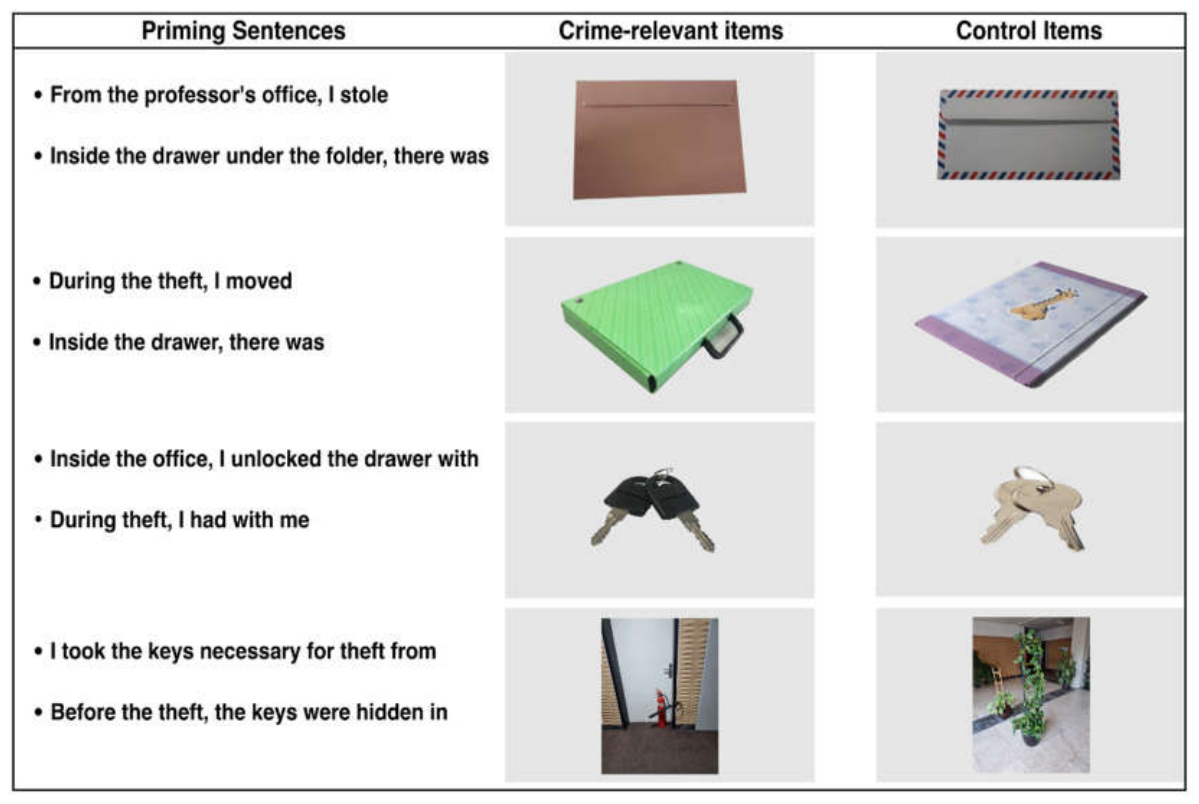
Figure 2.
A graphical illustration of the methodological framework of this study. CLF – classifier; CV – crossvalidation.
Figure 2.
A graphical illustration of the methodological framework of this study. CLF – classifier; CV – crossvalidation.
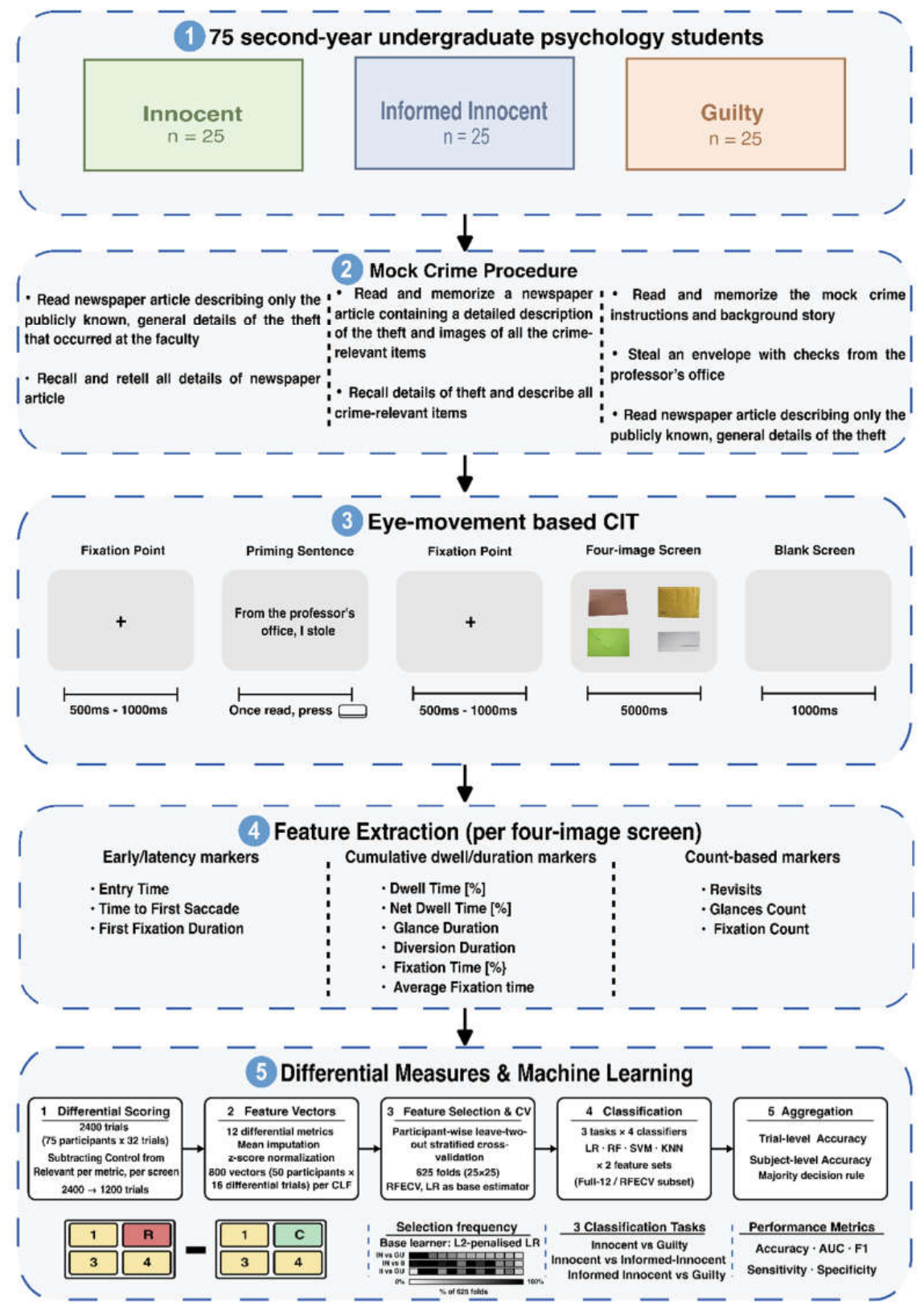
Figure 3.
RFECV Feature Selection Frequency (%) Across 625 Leave-Two-Out Folds, by Group-Pair Classification.
Figure 3.
RFECV Feature Selection Frequency (%) Across 625 Leave-Two-Out Folds, by Group-Pair Classification.
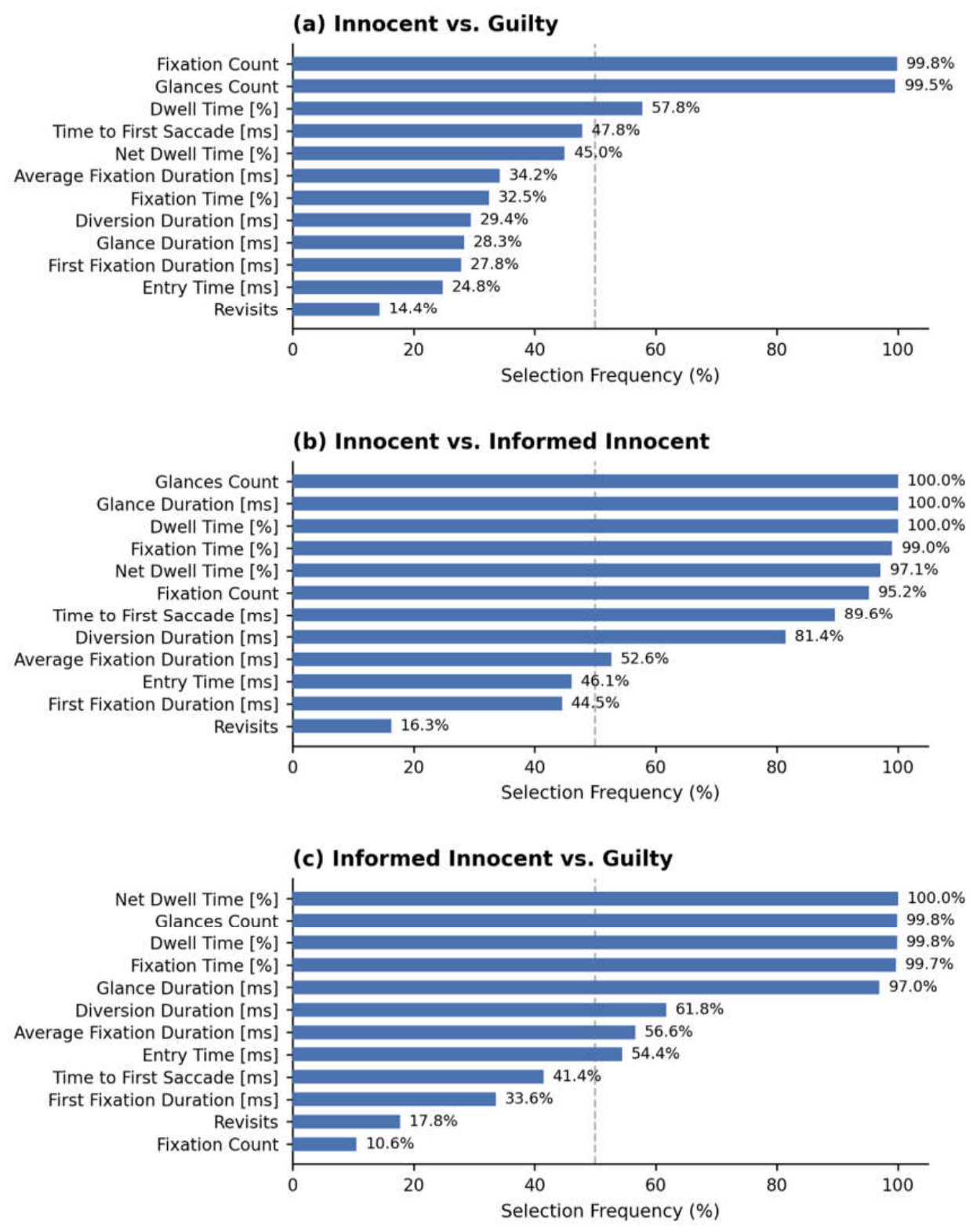
Table 1.
Descriptive Statistics for Eye-Tracking Measures by Group and Type of Items.
| Eye-tracking measure | Innocent M (SD) |
Informed Innocent M (SD) |
Guilty M (SD) |
Relevant Items M (SD) |
Control Items M (SD) |
|---|---|---|---|---|---|
| Entry Time (ms) | 1041 (347.2) |
687 (229.3) |
987.9 (335.2) |
925.9 (385) |
884.8 (298.7) |
| Glance Duration (ms) | 1158 (202.5) |
1716 (847.2) |
1192 (312.4) |
1538 (772.1) |
1172 (188.3) |
| Diversion Duration (ms) | 1214 (207.8) |
1773 (840.6) |
1255 (317.5) |
1594 (769.2) |
1234 (191.6) |
| First Fixation Duration (ms) | 361.9 (117.5) |
372.2 (164) |
377.3 (111.2) |
414.8 (144.2) |
326.1 (102.2) |
| Glances Count | 1.9 (0.438) |
2.1 (0.397) |
1.9 (0.430) |
1.9 (0.448) |
2 (0.423) |
| Revisits | 0.946 (0.427) |
1.2 (0.382) |
0.939 (0.414) |
0.976 (0.427) |
1 (0.411) |
| Fixation Count | 2.776 (0.604) |
3.6 (1) |
2.8 (0.670) |
3.2 (1.1) |
2.9 (0.524) |
| Net Dwell Time (%) | 23.33 (3.9) |
34.7 (16.9) |
24 (6.2) |
31 (15.4) |
23.7 (3.6) |
| Dwell Time (%) | 22 (3.9) |
33.1 (16.7) |
22.6 (6.1) |
29.6 (15.4) |
22.2 (3.7) |
| Fixation Time (%) | 21.7 (3.9) |
32.6 (16.7) |
22.2 (5.9) |
29.1 (15.2) |
21.9 (3.6) |
| Average Fixation Duration (ms) | 423.6 (112.5) |
475.8 (224.4) |
422.7 (111.7) |
483.9 (190.6) |
397.5 (105.5) |
| Time to First Saccade (ms) | 1563 (436.5) |
1014 (348.1) |
1432 (404.8) |
1285 (498.6) |
1388 (414.9) |
Note. M = Mean; SD = Standard Deviation.
Table 2.
Differences between Innocent, Informed Innocent and Guilty in differential eye-tracking scores.
Table 2.
Differences between Innocent, Informed Innocent and Guilty in differential eye-tracking scores.
| Eye-tracking differential score | Innocent | Informed Innocent |
Guilty | F(2, 72) | p | ω2 |
|---|---|---|---|---|---|---|
| Entry Time (ms) | 180.5a (291.3) |
-146.2b (244.5) |
89.6a (254.1) |
10.19 | <.001 | .197 |
| Glance Duration (ms) | -127.2a (255.4) |
1248b (753.2) |
-23.0a (441.4) |
53.13 | <.001 | .582 |
| Diversion Duration (ms) | -129.1a (259.2) |
1237b (748.5) |
-26.4a (447.8) |
52.41 | <.001 | .578 |
| First Fixation Duration (ms) | 38.02a (107.7) |
194.5b (191.6) |
33.8a (103.5) |
10.66 | <.001 | .205 |
| Glances Count | -0.075 (0.271) |
-0.047 (0.3987) |
-0.122 (0.3821) |
0.29 | .752 | .000 |
| Revisits | -0.084 (0.294) |
-0.045 (0.3762) |
-0.118 (0.3804) |
0.27 | .767 | .000 |
| Fixation Count | -0.267a (0.620) |
1.3b (0.8817) |
-0.032a (0.7417) |
33.14 | <.001 | .462 |
| Net Dwell Time (%) | -2.51a (4.9) |
24.9b (15.1) |
-0.682a (8.792) |
53.51 | <.001 | .583 |
| Dwell Time (%) | -2.6a (5.0) |
25.0b (15.04) |
-0.406a (8.571) |
54.48 | <.001 | .588 |
| Fixation Time (%) | -2.4a (4.9) |
24.7b (14.9) |
-0.409a (8.419) |
53.88 | <.001 | .585 |
| Average Fixation Duration (ms) | 4.5a (110.4) |
252.7b (248.1) |
2.1a (95.84) |
18.74 | <.001 | .321 |
| Time to First Saccade (ms) | 68.2a (321.6) |
-323b (294.8) |
-47.6a (376.5) |
9.12 | <.001 | .178 |
Note. n = 25 per group; means with different superscripts differed significantly (p< .05) in Šidak-corrected pairwise post hoc comparisons.
Table 3.
Trial-Level and Subject-Level Classification Performance without and with feature selection.
Table 3.
Trial-Level and Subject-Level Classification Performance without and with feature selection.
| Classification without feature selection | Trial Level | Participant Level | |||||||||
|---|---|---|---|---|---|---|---|---|---|---|---|
| Accuracy | AUC | Sensitivity | Specificity | F1-score | Accuracy | AUC | Sensitivity | Specificity | F1-score | ||
| Innocent vs. Guilty |
KNN | 50.1% | 48.1% | 48.5% | 48.0% | 48.4% | 58.0% | 58.0% | 56.0% | 60.0% | 57.1% |
| RF | 50.3% | 49.4% | 53.7% | 47.7% | 52.2% | 52.0% | 52.0% | 52.0% | 52.0% | 52.0% | |
| LR | 52.9% | 52.6% | 52.5% | 53.2% | 52.7% | 66.0% | 66.0% | 56.0% | 76.0% | 62.2% | |
| SVM | 48.8% | 47.5% | 57.5% | 38.5% | 52.5% | 50.0% | 50.0% | 44.0% | 56.0% | 46.8% | |
| Innocent vs. Informed Innocent |
KNN | 72.4% | 78.0% | 68.2% | 75.0% | 70.6% | 90.0% | 90.0% | 84.0% | 96.0% | 89.4% |
| RF | 74.6% | 82.5% | 70.5% | 79.5% | 73.8% | 92.0% | 92.0% | 88.0% | 96.0% | 91.7% | |
| LR | 76.9% | 85.2% | 70.7% | 82.7% | 75.3% | 92.0% | 92.0% | 84.0% | 100.0% | 91.3% | |
| SVM | 76.1% | 84.4% | 72.2% | 79.0% | 74.8% | 88.0% | 88.0% | 76.0% | 100.0% | 86.4% | |
| Informed Innocent vs. Guilty |
KNN | 70.8% | 75.4% | 75.5% | 64.5% | 71.6% | 84.0% | 84.0% | 92.0% | 76.0% | 85.2% |
| RF | 70.6% | 77.0% | 76.2% | 66.0% | 72.5% | 88.0% | 88.0% | 92.0% | 84.0% | 88.5% | |
| LR | 73.4% | 80.8% | 80.5% | 66.5% | 75.2% | 86.0% | 86.0% | 92.0% | 80.0% | 86.8% | |
| SVM | 72.8% | 79.3% | 80.2% | 66.7% | 75.2% | 80.0% | 80.0% | 92.0% | 68.0% | 82.1% | |
| Classification with feature selection | |||||||||||
| Innocent vs. Guilty |
KNN | 49.3% | 47.6% | 27.7% | 69.2% | 35.0% | 52.0% | 52.0% | 4.0% | 100.0% | 7.7% |
| RF | 49.7% | 49.0% | 47.0% | 53.5% | 48.6% | 48.0% | 48.0% | 28.0% | 68.0% | 35.0% | |
| LR | 51.9% | 51.1% | 49.5% | 52.2% | 50.2% | 60.0% | 60.0% | 60.0% | 60.0% | 60.0% | |
| SVM | 50.0% | 46.0% | 60.0% | 35.7% | 53.51% | 54.0% | 54.0% | 28.0% | 80.0% | 37.8% | |
| Innocent vs. Informed Innocent |
KNN | 72.4% | 79.2% | 68.2% | 75.5% | 70.8% | 92.0% | 92.0% | 84.0% | 100.0% | 91.3% |
| RF | 75.4% | 82.9% | 72.7% | 80.7% | 75.8% | 92.0% | 92.0% | 88.0% | 96.0% | 91.7% | |
| LR | 76.3% | 84.9% | 71.2% | 81.7% | 75.2% | 92.0% | 92.0% | 84.0% | 100.0% | 91.3% | |
| SVM | 76.2% | 83.7% | 73.5% | 79.0% | 75.6% | 92.0% | 92.0% | 84.0% | 100.0% | 91.3% | |
| Informed Innocent vs. Guilty |
KNN | 70.6% | 77.3% | 77.7% | 65.7% | 73.3% | 84.0% | 84.0% | 92.0% | 76.0% | 85.2% |
| RF | 70.7% | 78.0% | 76.7% | 66.2% | 72.9% | 84.0% | 84.0% | 92.0% | 76.0% | 85.2% | |
| LR | 72.4% | 80.4% | 79.0% | 64.0% | 73.5% | 84.0% | 84.0% | 92.0% | 76.0% | 85.2% | |
| SVM | 73.2% | 79.3% | 80.7% | 66.5% | 75.4% | 82.0% | 82.0% | 92.0% | 72.0% | 83.6% | |
Note. Trial Level = accuracy at the individual-trial level; Participant Level = accuracy after applying a majority-decision rule (a participant was classified correctly if more than 50% of their trials were classified correctly). KNN = k-Nearest Neighbors; RF = Random Forest; LR = Logistic Regression; SVM = Support Vector Machine.
Disclaimer/Publisher’s Note: The statements, opinions and data contained in all publications are solely those of the individual author(s) and contributor(s) and not of MDPI and/or the editor(s). MDPI and/or the editor(s) disclaim responsibility for any injury to people or property resulting from any ideas, methods, instructions or products referred to in the content. |
© 2026 by the authors. Licensee MDPI, Basel, Switzerland. This article is an open access article distributed under the terms and conditions of the Creative Commons Attribution (CC BY) license (http://creativecommons.org/licenses/by/4.0/).
Copyright: This open access article is published under a Creative Commons CC BY 4.0 license, which permit the free download, distribution, and reuse, provided that the author and preprint are cited in any reuse.