

Submitted:
23 July 2026
Posted:
28 July 2026
You are already at the latest version
Abstract
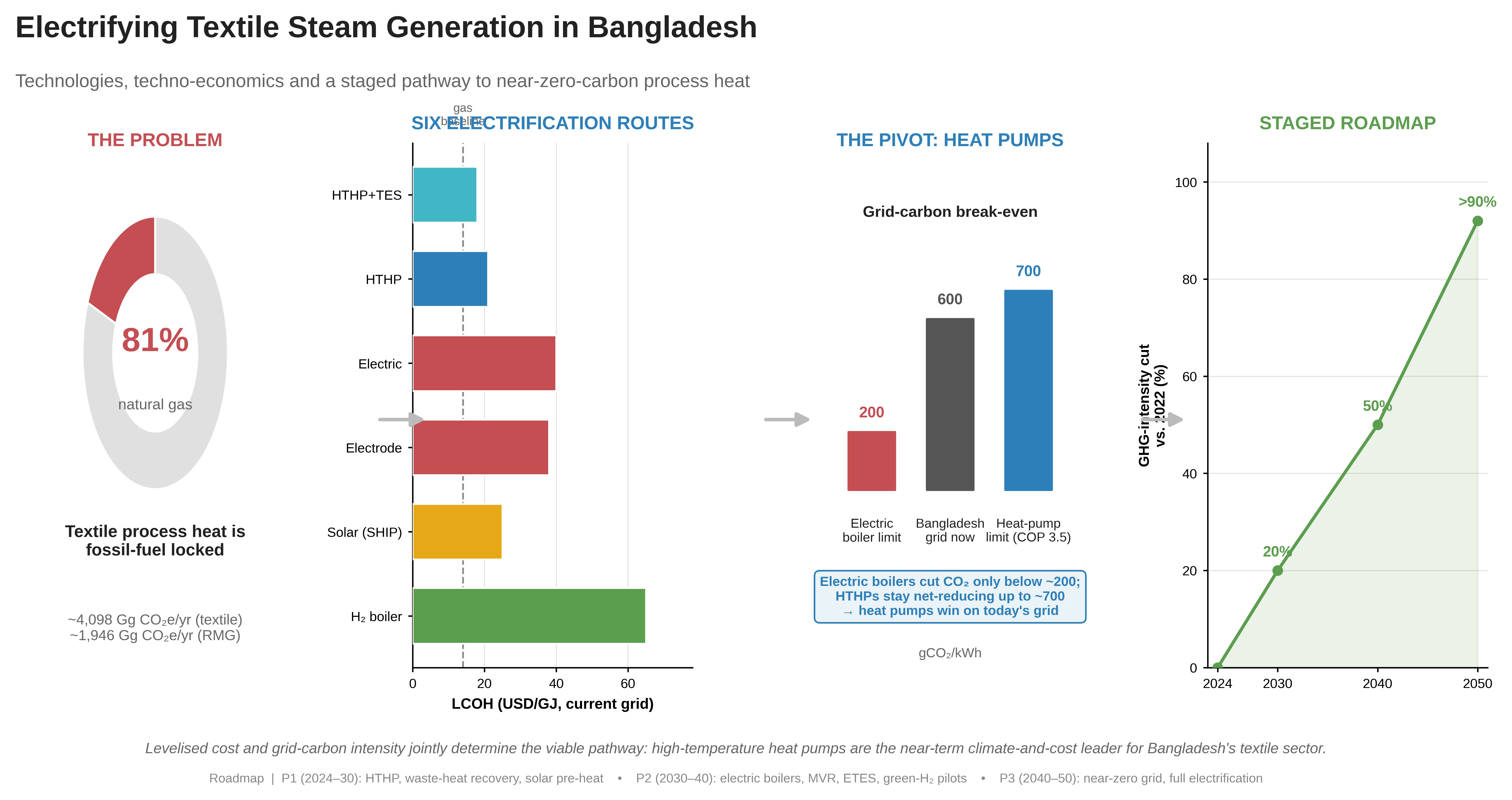
Industrial steam generation is the single largest source of fossil fuel consumption in the textile industry and a major contributor to its greenhouse gas (GHG) footprint. In Bangladesh, whose textile and ready-made garment (RMG) sector supplies more than 84% of national export revenue, the two sub-sectors together emitted approximately 6,044 Gg CO₂e in 2022, of which natural gas combustion in steam boilers accounted for about 81%. Converting fossil-fired steam generation to electrified alternatives is therefore one of the highest-leverage decarbonisation options available to the sector. This review synthesises evidence from peer-reviewed studies, techno-economic modelling, and institutional reports to evaluate the technical performance, economic feasibility, CO₂ abatement potential, and implementation barriers of six electrification pathways: electric resistance boilers, electrode boilers, high-temperature heat pumps (HTHPs), mechanical vapour recompression (MVR), solar heat for industrial processes (SHIP), and green hydrogen boilers, together with electro-thermal energy storage (ETES) as an enabling technology. HTHPs offer the lowest levelised cost of heat (LCOH), at roughly USD 12–30/GJ under current grid conditions with a coefficient of performance (COP) of 2.5–5.0, while electric boilers (95–99% efficiency) provide a technologically mature, drop-in option that is penalised by high electricity-to-gas price ratios. A distinctive feature of the analysis is a grid-carbon-intensity break-even framing, which shows why heat pumps, but not electric boilers, already cut emissions against Bangladesh's present grid (around 550–650 gCO₂/kWh). A phased, grid-aligned roadmap combining near-term HTHP deployment, waste-heat recovery, and thermal storage, followed by full electric-boiler and hydrogen deployment as the grid decarbonises, could eliminate more than 90% of process-heat GHG intensity by 2050. Financial access gaps, grid-reliability constraints, and the absence of carbon pricing are identified as binding barriers, for which targeted green financing, buyer-driven incentives, and efficiency mandates are proposed as enabling conditions.
Keywords:
electrification
; steam boiler
; heat pump
; textile industry
; decarbonisation
; Bangladesh
; techno-economic analysis
; solar thermal
; process heat
1. Introduction
The textile industry is among the most energy-intensive manufacturing sectors, consuming an estimated 4 exajoules (EJ) of energy annually, with process heating typically accounting for 50–70% of total energy demand [1,2]. Within this demand structure, steam generation for dyeing, bleaching, finishing, drying, and heat-setting is the dominant end use, and it is predominantly supplied by fossil-fired boilers burning natural gas, coal, heavy fuel oil, or biomass. This reliance on combustion-based steam is a systemic obstacle to the sector's net-zero ambitions under the Paris Agreement.
Global efforts to decarbonise industry have increasingly centred on the electrification of low- and medium-temperature process heat. Commercially mature electric technologies, including heat pumps, electric boilers, and resistance heaters, can already meet most heat demands in the textile sub-sector, which rarely exceeds 200 °C [1,3,4]. The International Energy Agency projects that widespread electrification of low-temperature industrial heat, coupled with rapid renewable electricity deployment, can deliver reduced GHG emissions, improved energy security, and lower exposure to volatile fossil fuel prices.
Bangladesh provides a particularly instructive case. As the world's second-largest garment exporter after China, its textile and RMG sector employs over 4.5 million workers and generates roughly USD 47 billion in export earnings each year [5]. Yet the sector bears a disproportionate share of the country's environmental burden: the RMG and textile sectors together emitted about 6,044 Gg CO₂e in 2022, with natural gas combustion in steam boilers as the primary driver [5]. Bangladesh has committed to a 22% unconditional GHG reduction by 2030 under its Nationally Determined Contribution (NDC), making industrial decarbonisation both urgent and export-relevant.
Despite a growing literature on electrification technologies, a comprehensive, evidence-based review that explicitly examines the feasibility of steam-system electrification in the textile industry, and does so from the perspective of a developing economy such as Bangladesh, remains absent. This paper addresses that gap by (i) characterising the steam-demand profile of the textile industry; (ii) systematically evaluating six electrification pathways; (iii) presenting a comparative techno-economic assessment of LCOH and CO₂ abatement, including an explicit grid-carbon-intensity break-even analysis; (iv) contextualising the findings within Bangladesh's RMG sector; and (v) identifying the policy, regulatory, and financial enablers needed to accelerate the transition.
The review draws on peer-reviewed journal articles, techno-economic modelling studies, and institutional reports published mainly between 2016 and 2025, identified through structured searches of Scopus, Web of Science, and Google Scholar for combinations of the terms electrification, industrial heat, steam, heat pump, textile, and Bangladesh, and supplemented by agency reports (IEA, IRENA, LBNL) and manufacturer data. Sources were retained where they reported quantitative performance, cost, or emission data relevant to low- and medium-temperature process heat.
2. Steam Demand Profile of the Textile Industry
2.1. Process-Heat Temperature Distribution
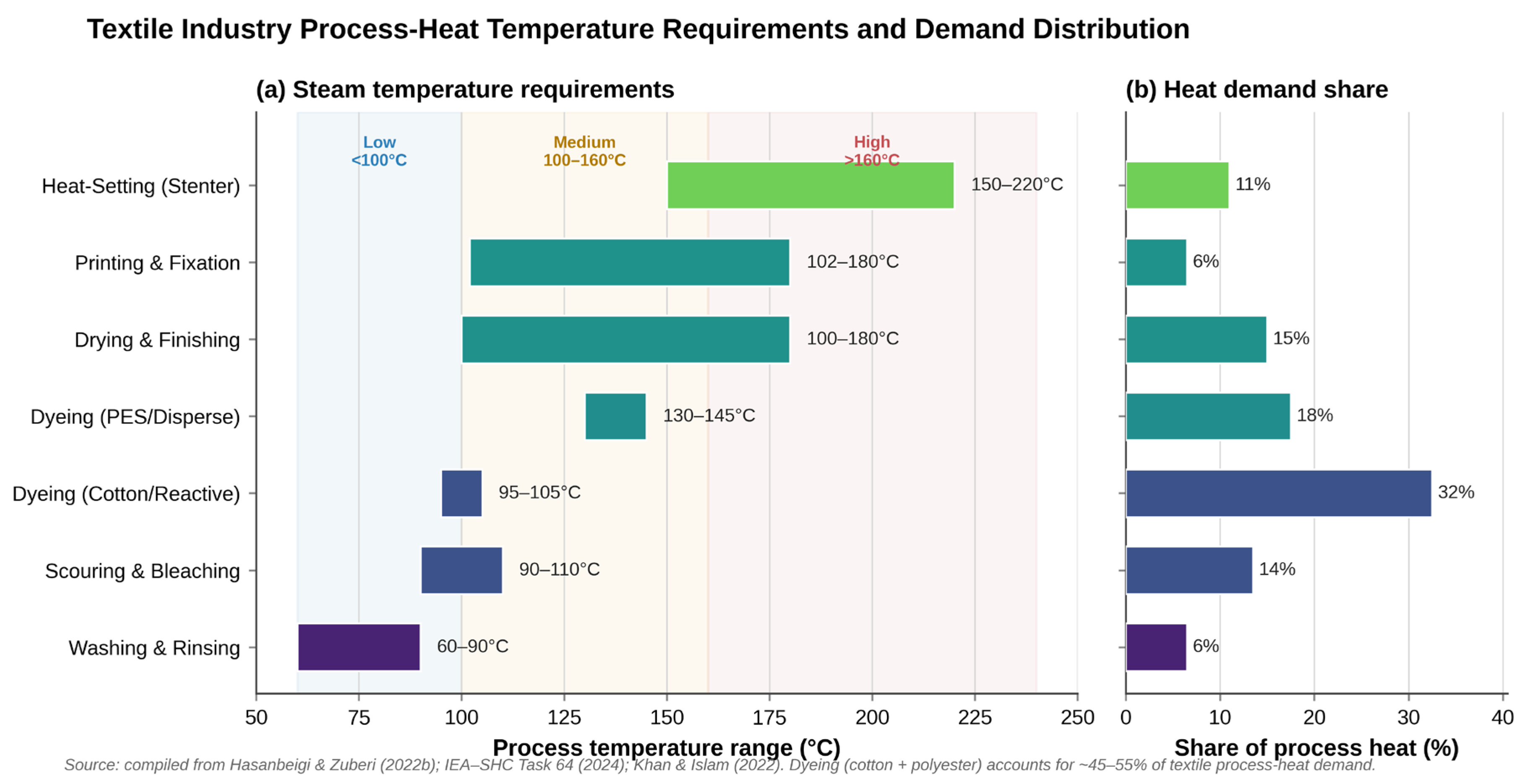
Understanding the thermal requirements of individual textile processes is a prerequisite to selecting an appropriate electrification pathway. Unlike steel or cement, which require temperatures exceeding 1,000 °C, textile wet processing operates predominantly in the low-to-medium range of 60–220 °C, which makes it highly amenable to electrification [6,7]. Matching the thermodynamic quality of the heat source to the process temperature is central to efficient electrification: supplying a 90 °C wash with 180 °C boiler steam wastes exergy that a heat pump or solar collector could deliver at far lower energy cost. The wide spread of process temperatures summarised in Table 1 therefore favours a portfolio of electrified sources matched to each end use, rather than a single like-for-like boiler swap.
Dyeing is consistently the most energy-intensive process in textile manufacturing, driven by sustained, controlled heat across extended batch cycles [10]. A Bangladeshi factory study found dyeing to be the highest thermal-energy consumer, followed by pre-treatment and finishing [10]. Most of this thermal energy is delivered as steam from on-site natural-gas-fired boilers, which in composite mills can individually consume upwards of 15,000 m³ of natural gas and emit tens of tonnes of CO₂ per day [11]. Heat-setting on stenter frames requires the highest temperatures (150–220 °C) and is conventionally supplied by thermal oil heated with gas burners. Washing, rinsing, and auxiliary uses (condensate return, space heating, chemical dilution) operate below 100 °C and are ideal candidates for early electrification through heat pumps or solar thermal systems [12].
Figure 1.
Textile industry process-heat temperature requirements and demand distribution.
2.2. Fossil-Fuel Dependence and GHG Emission Intensity
Globally, textile process heating remains overwhelmingly fossil-fuel dependent; IRENA [13] reports that natural gas and coal together supply over 85% of industrial process heat below 400 °C in emerging economies. In Bangladesh this dependence is near total: grid natural gas supplies roughly 81% of the thermal energy consumed by the RMG and textile sectors, with the remainder met by heavy fuel oil, coal (particularly in northern spinning mills), and, marginally, biomass [5].
A steam-system performance audit of Bangladeshi garment industries found that older fire-tube and water-tube boilers, many operating below their 70–85% design efficiency, generate substantial stack, condensate, and distribution losses that together represent 20–30% avoidable energy waste [9,15]. Evaluating barriers to sustainable boiler operation, Siraj et al. [14] identified inadequate maintenance, a shortage of trained operators, and the absence of performance monitoring as systemic contributors to sub-optimal steam-system efficiency. These inefficiencies matter for electrification because they inflate the baseline against which any electrified system competes: a well-maintained gas plant is a harder economic target than a poorly maintained one.
The aggregate consequence is severe. The combined 2022 RMG and textile emission of about 6,044 Gg CO₂e places Bangladesh among the top five countries with the highest potential for GHG reductions in the apparel and textile supply chain [16]. Industrial CO₂ emissions have grown by roughly 8% per year over the past two decades [17], a trajectory that is structurally incompatible with the country's NDC commitments unless steam-system electrification is scaled rapidly.
3. Electrification Technologies for Textile Steam Generation
Six electrification pathways are relevant to textile steam generation, ranging from mature commercial technologies (electric boilers) to emerging solutions (green hydrogen boilers, ETES). A technology assessment for the European Union concluded that most industrial heat below 200 °C can be directly electrified with commercially available equipment [3], and low-carbon thermal technologies now span the full textile temperature range [4]. Table 2 compares operating parameters, technological readiness, and key constraints.
3.1. Electric Resistance and Electrode Boilers
Electric resistance boilers convert electricity to steam heat through resistance elements, achieving thermal efficiencies of 95–99%, well above the 70–85% typical of well-maintained fossil boilers [19]. Electrode boilers pass current directly through conductive water between submerged electrodes, generating heat by ohmic resistance; they are commercially available up to 70 MWe and can supply steam at up to 350 °C and 70 bar [7,19]. Both are mature (TRL 9–10), require minimal retrofitting of existing steam distribution, and start up within minutes, which enables demand-responsive operation [18]. By 2024, over 6,200 industrial electric-boiler systems were operational worldwide, electric steam boilers held a 52% share of installations, and plant-level efficiency gains of up to 25% were documented for retrofits [20].
For the saturated steam at 100–160 °C that dominates textile demand, electric and electrode boilers are the most technically straightforward near-term option [7]. Hasanbeigi and Zuberi [2,21] estimated that full adoption of electric steam boilers in the Chinese textile industry could reduce final energy demand for steam generation by approximately 92 PJ by 2050, about 19% of total boiler energy demand, largely because electrified systems avoid the combustion and distribution losses of conventional boilers. The decisive barrier is the unit cost of electricity relative to gas: in Bangladesh, grid electricity costs roughly three to four times the energy-equivalent price of subsidised industrial gas [2]. A plant-level case study of an Indian textile facility reached the same conclusion, finding electrified heating technically feasible across the wet-processing chain but economically contingent on the local power tariff [22].
3.2. High-Temperature Heat Pumps (HTHPs)
HTHPs are the most energy-efficient electrification pathway for textile steam because they exploit low-grade waste heat, from dyebaths, rinse water, and cooling circuits abundant in textile facilities, to raise process steam to 120–160 °C [12,23]. Whereas an electric boiler consumes electricity and heat output at a 1:1 ratio, an HTHP delivers 2.5–5.0 units of heat per unit of electricity (COP 2.5–5.0), which radically lowers operating cost [24]. This multiplier is the single most important variable in electrified-heat economics and emissions, as Section 4.1 and Section 4.2 quantify.
A thermodynamic analysis of a high-temperature cascade heat pump showed that the working-fluid pair R1234ze(E)–R1233zd(Z) achieves competitive COP with short payback, making it promising for industrial wastewater heat recovery in steam-intensive facilities [25]. A 4E (energy, exergy, economic, environmental) analysis confirmed that compression HTHP steam systems are more efficient than electric, coal-fired, and gas boilers for steam production [24], and a systems-level study demonstrated that optimised multi-stage architectures valorising 60 °C waste heat can generate 200 °C steam with superior exergy performance [23]. Comprehensive evaluation of steam-generating heat pumps further supports their feasibility as coal-boiler replacements in industrial settings [26].
IEA HPT Annex 58 projections indicate that HTHPs of 200 kW–10 MW capacity, with supply temperatures up to about 120 °C, are transitioning from limited commercial adoption (2022–2023) toward becoming a preferred industrial process-heating technology by 2026 [27]. Klute et al. [12], reviewing steam-generating heat pumps across supply temperatures of 120–350 °C, showed that integrating thermal energy storage (TES) can cut LCOH by up to 15% for heat pumps and 27% for electric boilers. Full HTHP adoption in the Chinese textile industry is projected to reduce annual CO₂ emissions by about 24.9 Mt by 2050 [6].
3.3. Mechanical Vapour Recompression (MVR)
MVR recompresses low-pressure waste steam, particularly from evaporative dyebath operations, condensate flashing, and effluent treatment, to higher pressure and temperature for reuse, at an energy efficiency far above conventional steam generation [12]. Effective COPs of 5–20 make MVR the most efficient option where a sufficient vapour source exists for compression. It is especially valuable within the zero liquid discharge (ZLD) systems increasingly adopted by Bangladeshi mills facing tighter effluent standards, because it simultaneously reduces wastewater volume and recovers thermal energy from hot effluent, creating dual environmental and economic benefits. Coupled with electric drives, MVR constitutes a fully electrified pathway that eliminates fossil fuel entirely [28]. A thermo-economic analysis of a two-effect MVR system applied to industrial wastewater achieved up to 29.2% reductions in specific heat-energy consumption [29].
The principal limitation is that MVR requires an existing steam or vapour source and cannot generate steam from ambient conditions. It is therefore best deployed as a complement to electric boilers or heat pumps rather than as a primary steam source.
3.4. Solar Heat for Industrial Processes (SHIP)
Solar thermal collectors, particularly linear Fresnel collectors (LFCs) and parabolic trough collectors, offer a renewable pathway for steam generation. At the end of 2023, global operational SHIP capacity reached 951 MWth across roughly 1,200 systems, with textiles among the fastest-growing application areas alongside food and beverage and machinery [8,30]. Properly sized SHIP systems delivering 100–200 °C steam can achieve solar fractions above 50% and, combined with other renewable heat, can substantially decarbonise industrial thermal demand [8]. A techno-economic study of LFC and PV-driven HTHP hybrid systems for 120–200 °C steam found economic viability where direct normal irradiance exceeds 1,400 kWh/m²/year, with payback periods of 4–5 years [30].
Bangladesh receives mean annual irradiance of roughly 1,700–1,900 kWh/m², above the SHIP viability threshold [31]. However, land scarcity in the industrial zones around Dhaka and Chittagong, solar intermittency, and the need for thermal storage constrain large-scale deployment. Rooftop flat-plate and evacuated-tube collectors can supplement lower-temperature demand (below 100 °C) and are already deployed at several LEED-certified Bangladeshi factories.
3.5. Green Hydrogen Boilers
Boilers burning green hydrogen, produced by water electrolysis powered by renewable electricity, are an emerging, high-temperature-capable pathway with near-zero combustion emissions. Green hydrogen currently costs roughly USD 3.5–6.0/kg, and considerably more in high-cost, low-utilisation settings, against grey hydrogen at USD 1.5–2.5/kg, owing to high renewable-electricity prices and electrolyser capital costs above USD 2,000/kW [32,33]. Techno-economic analyses show that hydrogen boilers remain markedly less competitive than HTHPs and biomass for low-to-medium-temperature heat even under optimistic 2030 assumptions: HTHPs leveraging waste heat achieve LCOH 30–60% below hydrogen boilers and up to 37% below biomass boilers [34].
Green hydrogen nonetheless offers a route for the high-temperature applications above 200 °C, such as stenter heat-setting, that heat pumps cannot currently reach, and it is expected to become more cost-competitive by 2040–2050 as electrolyser costs and renewable-electricity prices fall. For Bangladesh, given the current energy mix, limited renewable deployment, and absence of hydrogen infrastructure, near-term adoption is neither technically nor economically feasible without substantial government support and international financing.
3.6. Electro-Thermal Energy Storage (ETES)
ETES stores electrical energy as high-temperature heat in solid or molten media (molten salts, refractory bricks, phase-change materials) and is an enabling technology that improves the economics of electric steam generation. By charging during low-price periods, particularly from surplus solar and wind, and discharging as process steam during peak demand, facilities can sharply reduce their effective electricity cost [35]. Meeting just 10% of European industrial heat demand through thermal storage has been estimated to unlock 80 GW of demand-side flexibility, about 2.5 times Europe's total installed electricity storage capacity in 2024 [35]. For electric-boiler applications, integrating daily TES cuts LCOH by up to 27%, fundamentally improving competitiveness against gas [34], and the TES market is expected to grow at roughly 10% per year as decarbonisation initiatives advance and heat-battery costs fall [36].
For Bangladesh, where industrial grid tariffs are largely time-invariant, the short-term case for ETES is weaker. As the country moves toward time-of-use pricing and expands solar capacity (currently around 0.7 GW installed), ETES will become increasingly attractive.
4. Techno-Economic Analysis and Comparative Assessment
4.1. Levelised Cost of Heat (LCOH)
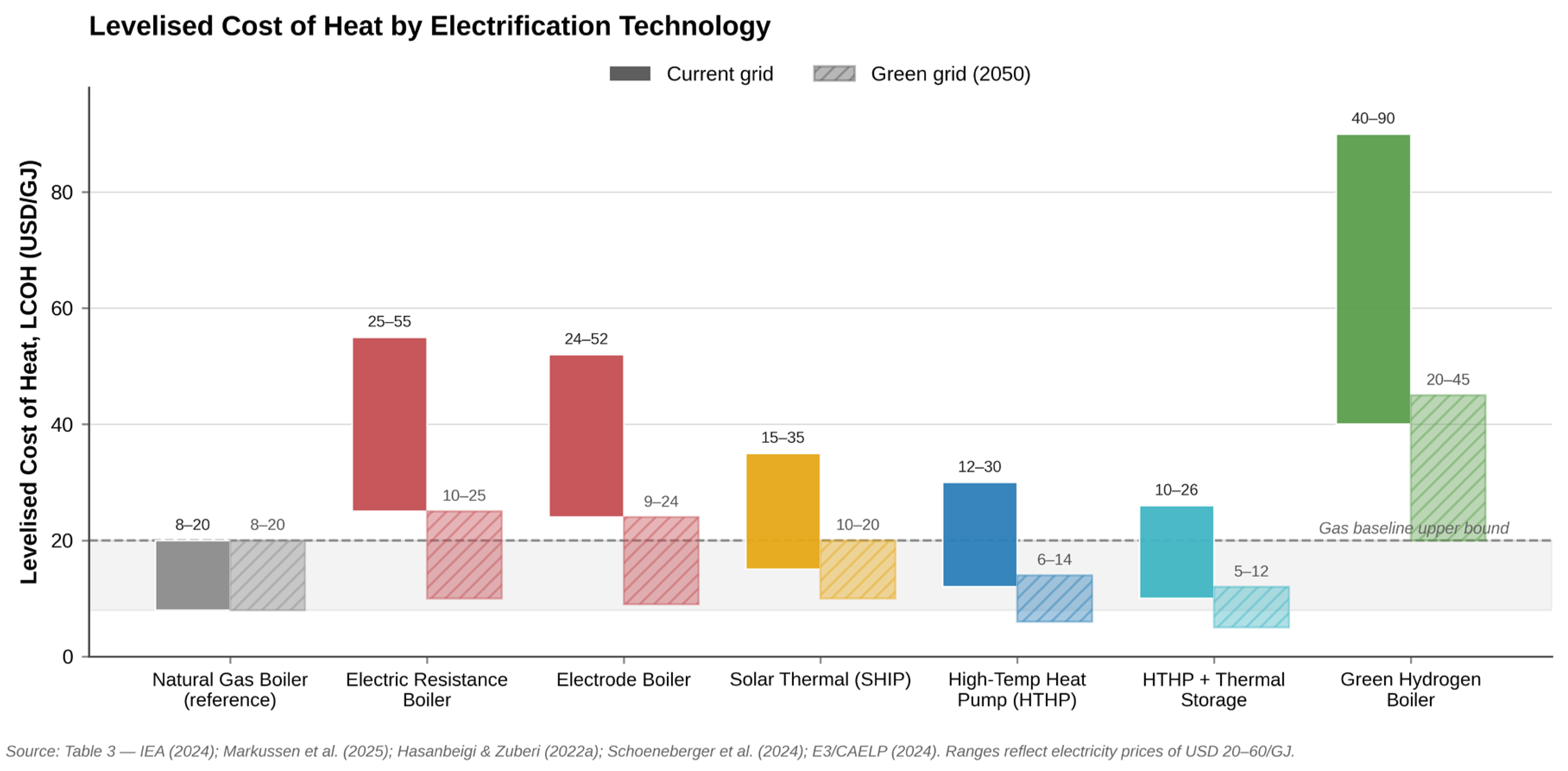
The LCOH is the standard metric for comparing the lifecycle cost of steam-generation technologies, accounting for capital expenditure, operation and maintenance, fuel or electricity cost, and the discount rate over an asset life of typically 15–25 years [37]. Table 3 presents LCOH estimates under current and projected 2050 decarbonised-grid conditions.
Under current global electricity prices, gas boilers remain the lowest-cost option at USD 8–20/GJ. Electric and electrode boilers carry an LCOH penalty of roughly threefold, whereas HTHPs, by exploiting waste heat, close most of that gap to USD 12–30/GJ, only 1.5–2 times the gas baseline, and are the most economically competitive electrification pathway under current grid conditions [34,39].
The economics of boiler electrification are governed less by capital cost than by the ratio of electricity to gas prices per unit of delivered heat, which can be termed the spark gap. Because a resistance boiler converts electricity to heat at near-unity efficiency, its fuel-related operating cost tracks that price ratio almost linearly, so in Bangladesh, where gas is subsidised and electricity costs three to four times the energy-equivalent gas price, the ratio alone imposes an LCOH penalty of similar magnitude. A heat pump breaks this linearity: delivering a COP of units of heat per unit of electricity, it tolerates an electricity-to-gas price ratio up to its COP before losing parity, which is precisely why the COP, not the capital cost, is the dominant determinant of electrified-heat economics.
A further insight is that under time-of-use tariffs, integrating ETES lowers LCOH by up to 27% for electric boilers and up to 15% for HTHPs, making these hybrids competitive with gas even at current prices [34]. Under a 2050 decarbonised grid, all pathways show substantially lower LCOH, with HTHPs the clear leader at USD 5–12/GJ. A US comparison of PVC and ethylene facilities found that with a decarbonised grid, heat pumps are only 15–22% more expensive than gas boilers, against 46–49% more expensive on the current grid, whereas electric boilers remain roughly twice as costly as gas even on a clean grid because they lack the heat pump's efficiency premium [38]. The pace of grid decarbonisation is therefore as decisive as the technology choice itself.
Figure 2.
Levelised cost of heat by electrification technology.
4.2. CO₂ Abatement Potential and the Grid Break-Even
The emission benefit of electrification depends critically on the carbon intensity of the electricity used, which couples industrial electrification programmes to parallel grid-decarbonisation policy [2,6]. The direction of the effect can be stated as a simple break-even condition. An electric boiler of efficiency η that displaces a gas boiler reduces emissions only where the grid carbon intensity satisfies I_grid < EF_gas × η, in which EF_gas is the carbon intensity of the delivered gas heat. With η ≈ 0.98 and EF_gas ≈ 200 gCO₂/kWh of delivered heat, the electric-boiler break-even grid intensity is about 195–200 gCO₂/kWh. A heat pump of coefficient COP shifts this threshold to I_grid < EF_gas × COP, that is, roughly 700 gCO₂/kWh at COP 3.5.
Figure 3.
CO₂ abatement potential by electrification technology.
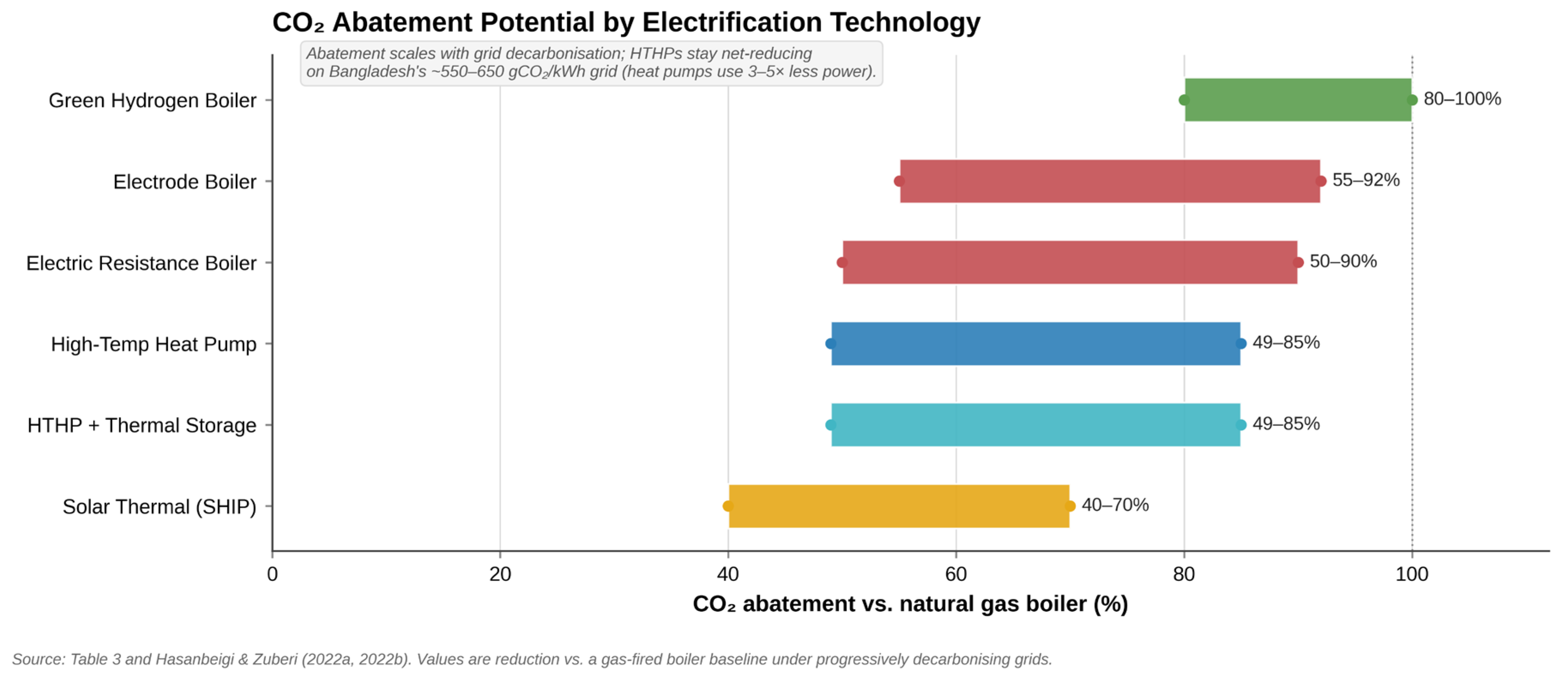
Bangladesh's 2022 grid intensity of about 550–650 gCO₂/kWh therefore sits above the electric-boiler threshold but below the HTHP threshold. In other words, replacing a gas boiler with an electric boiler on today's grid would increase emissions, whereas a heat pump already reduces them. This is the quantitative basis for prioritising heat pumps in the near term and deferring electric boilers until the grid decarbonises. The finding is consistent with Hasanbeigi and Zuberi [6], who showed that only HTHP adoption yields net CO₂ reductions across China, Japan, and Taiwan in 2030, and with a national assessment of US industrial boilers and heat pumps reaching the same conclusion that boiler electrification delivers net GHG benefits only once grid intensity falls below the intensity of the displaced fuel [40,41]. Discrete-event simulation of boiler electrification similarly finds that the timing of electrification relative to grid decarbonisation, rather than the retrofit itself, dominates the lifetime emission outcome [42]. In China's textile industry, full HTHP adoption reduces annual CO₂ by about 24.9 Mt, roughly 49% of fuel-related CO₂ from Chinese textiles in 2021, while full electric-boiler adoption reduces annual CO₂ by about 29.8 Mt only once the 2050 grid is near-zero [6].
4.3. Bangladesh-Specific GHG and Energy Context
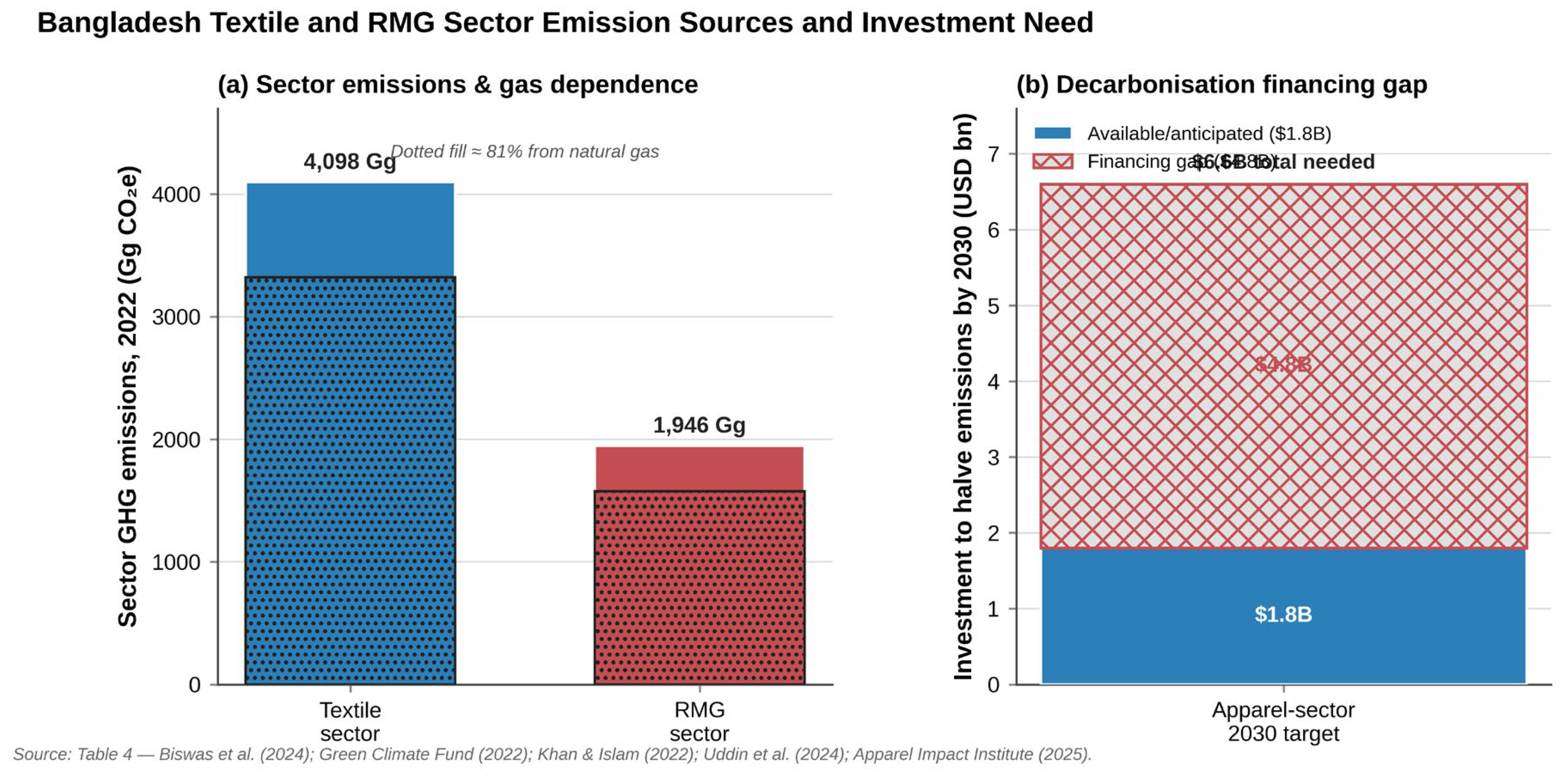
As Table 4 shows, the required reduction is substantial. Halving the apparel sector's emissions by 2030 needs about USD 6.6 billion, but only USD 1.8 billion is currently available or anticipated, leaving a USD 4.8 billion financing gap [16]. The Green Climate Fund, with IDCOL Bangladesh, committed financing for large-scale energy-saving technology in the sector under an agreement signed in July 2022 [17]. Such mechanisms are critical because electrification paybacks (Table 3) of 3–12 years exceed the planning horizons typical of Bangladeshi SME manufacturers.
A plant-level study of T-shirt production in Bangladesh attributed on the order of 56 tonnes of CO₂ per day to a single factory's combined gas, oil, and electricity use, illustrating the reduction achievable at facility scale through steam-system electrification [11]. Consistent with the process profile in Section 2, that study identified dyeing as the dominant energy consumer and steam as the dominant energy vector, which directly establishes boiler electrification as the key decarbonisation lever [11].
Figure 4.
Bangladesh textile and RMG sector emission sources.
5. Barriers and Challenges to Electrification
5.1. Techno-Operational Barriers
Although electric boilers are operationally simple, high-steam-demand facilities face a fundamental constraint: the electricity supply required at a single mill can exceed 5–20 MW, placing heavy demands on local grid infrastructure and requiring costly connection upgrades [39]. Grid-connection costs are excluded from most LCOH analyses yet can be a decisive investment barrier, particularly in Bangladeshi industrial zones where power infrastructure is already strained [44].
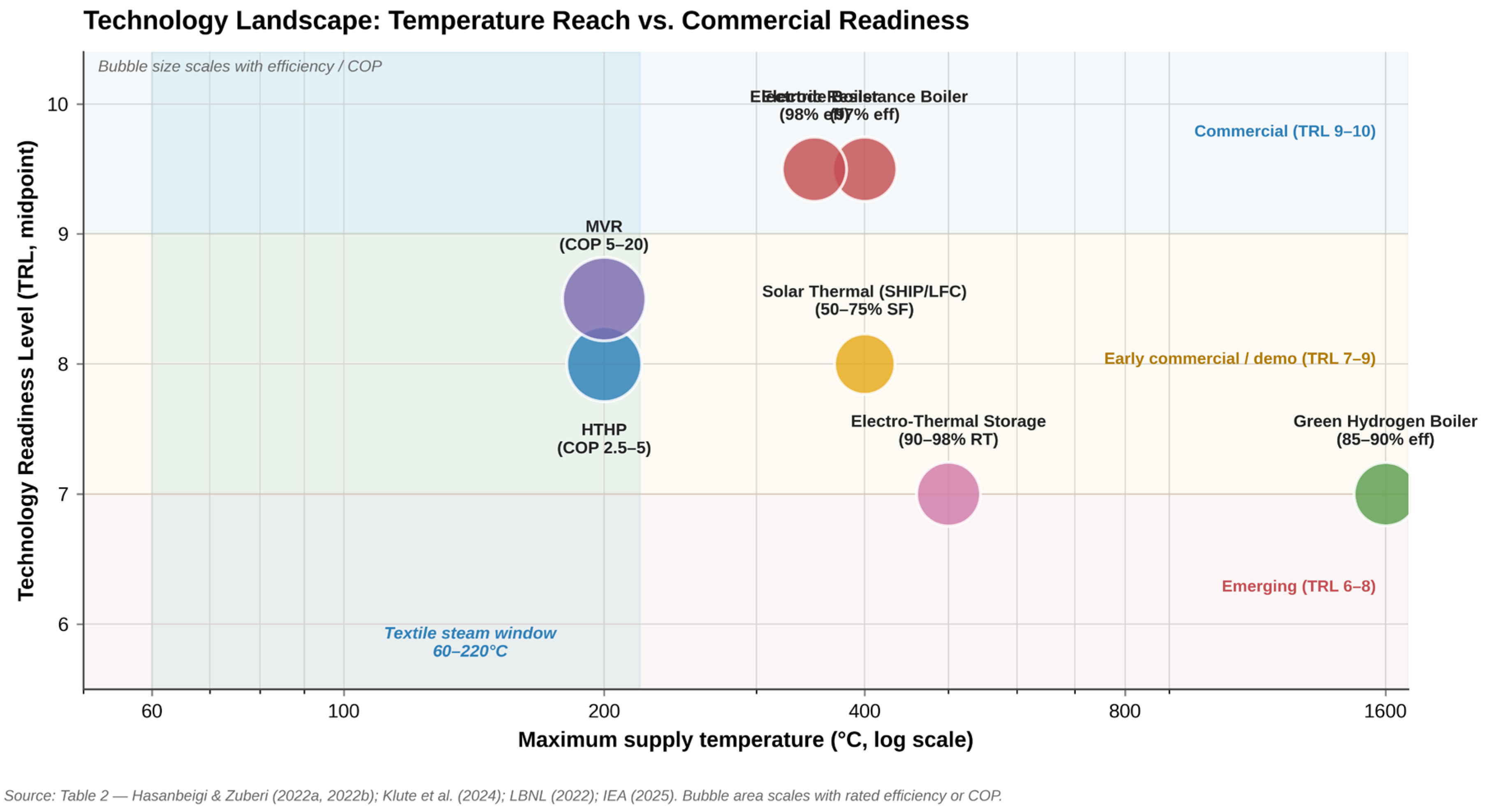
Figure 5.
Technology landscape: positioning of electrification options by temperature range and readiness.
Figure 5.
Technology landscape: positioning of electrification options by temperature range and readiness.
HTHPs, though efficient, require access to sufficient low-grade waste heat at 40–80 °C. Textile facilities generating large volumes of hot dyebath effluent and cooling water are ideal hosts, but integrating and commissioning HTHP systems within existing steam infrastructure is technically complex, and existing piping, heat exchangers, and controls may need substantial modification. IEA HPT Annex 58 noted that HTHPs above 120 °C supply remained in limited commercial adoption in 2022–2023, with broader deployment expected by 2026 [27]. Bangladesh faces additional challenges of frequent load shedding, voltage fluctuations, and limited expertise for operating HTHP and MVR systems. The Power System Master Plan targets near-zero load shedding by 2030, but current reliability remains a concern for continuous-process industries that depend on stable steam [45].
5.2. Economic and Financial Barriers
The higher CAPEX of electrified systems relative to gas boilers, ranging from USD 80 to 1,000/kW depending on technology, forces manufacturers to accept longer paybacks and higher financing costs, which is especially difficult for SME garment factories with limited access to green finance [16]. McKinsey [46] notes that although electrification technologies are available, no single winning technology has yet emerged, creating investment uncertainty that delays capital commitment. Electricity-to-gas price ratios are the central economic determinant: in Bangladesh, industrial gas is subsidised well below cost recovery while electricity tariffs for large consumers have been rising, a distortion that structurally disadvantages electrification [44,45]. Because lifecycle metrics that favour electrification over long asset lives are routinely discounted by managers who use simple payback as their investment criterion, an institutional as well as economic barrier perpetuates fossil-fuel lock-in [47].
5.3. Regulatory and Policy Barriers
Bangladesh's regulatory framework for industrial energy lacks strong mandates for steam electrification or GHG performance standards for boilers. The Energy Efficiency and Conservation Master Plan to 2030 sets energy-intensity targets but does not explicitly incentivise electrification [48], and the absence of carbon pricing removes a market signal that would otherwise improve the relative economics of electric steam. The country's dependence on imported LNG, which supplied about 40% of total energy in 2022 [44], creates price-volatility and security risks that would in principle favour electrification. Meanwhile the EU's Carbon Border Adjustment Mechanism, in its transitional phase from October 2023 for steel, cement, and aluminium, is expected to extend to apparel by the mid-2030s, creating a trade-policy incentive for Bangladeshi exporters to decarbonise process heat ahead of regulatory deadlines.
6. Decarbonisation Roadmap for Bangladesh's Textile Sector
6.1. Phased Electrification Strategy
A technically grounded, economically staged roadmap can be structured across three phases aligned with grid-decarbonisation trajectories and technology maturity, as illustrated in Figure 6.
Phase 1 (2024–2030), near-term actions. Priorities are: immediate deployment of waste-heat recovery and steam-trap maintenance to cut current fossil steam demand by 15–20%; installation of HTHPs at large composite mills (above 5 MW steam demand) with adequate waste-heat sources, targeting 40–60% CO₂ reductions relative to gas; rooftop solar thermal for feedwater pre-heating and low-temperature auxiliary heat; and electric boilers as backup and peak-shaving units where grid connections are reliable. Target: a 20% reduction in process-steam GHG intensity against the 2022 baseline.
Phase 2 (2030–2040), grid-linked scaling. As renewable capacity expands toward the 40% government target and grid intensity falls, full electric-boiler deployment becomes environmentally justified. MVR integration in dyeing and finishing adds 15–25% energy savings, ETES pilots in export processing zones enable demand-response participation and lower electricity costs, and green-hydrogen pilots are introduced for high-temperature heat-setting at flagship units. Target: a 50% reduction in process-steam GHG intensity against 2022.
Phase 3 (2040–2050), full decarbonisation. This phase involves full electrification of steam generation, supported by a near-zero-carbon grid, wide HTHP deployment, and cost-competitive green hydrogen for residual high-temperature needs. Compliance with international carbon-border mechanisms sustains market demand for low-carbon production. Target: more than 90% reduction in process-steam GHG intensity, enabling net-zero steam generation in leading facilities.
6.2. Enabling Conditions
Realising this roadmap requires converging enablers. On financing, dedicated instruments, including concessional loans through the Green Climate Fund and IDCOL, buyer-funded sustainability capex from apparel brands, and green-bond issuance, are essential to bridge the USD 4.8 billion gap [16]. International buyers such as H&M, Zara, and Marks & Spencer have committed to net-zero supply chains by 2050, creating a market pull that supplier-development programmes can harness through capital co-financing for electrification.
On policy, Bangladesh needs time-of-use tariffs that reward flexible demand, mandatory energy auditing and GHG reporting for large facilities, minimum efficiency standards for new boiler installations, and alignment of the forthcoming National Energy Efficiency Action Plan with electrification targets. The EU's Ecodesign for Sustainable Products Regulation, which introduces carbon-footprint requirements for textiles sold in European markets, adds a compliance driver for exporters [44]. Technology transfer and capacity building are equally critical: training for industrial energy managers and boiler operators in HTHP and electric-steam operation should be institutionalised through the Bangladesh Energy Regulatory Commission, BUET, and BGMEA, and international partnerships with Japanese and European HTHP manufacturers, drawing on IEA Heat Pump Annex frameworks, can accelerate technology access and localise maintenance expertise.
7. Conclusions and Future Research
This review has examined the electrification of steam generation in the textile industry, with particular depth on techno-economic feasibility and the decarbonisation imperative facing Bangladesh's RMG and textile sector. Four conclusions stand out.
First, the textile steam-demand profile, concentrated in 60–220 °C with dyeing as the dominant heat consumer, is well suited to electrification through commercially available technologies. Electric boilers (95–99% efficiency), HTHPs (COP 2.5–5.0), and MVR can collectively address the full spectrum of textile steam needs without radical process redesign.
Second, the economic case is strongly technology- and context-dependent. HTHPs integrated with waste-heat recovery and thermal storage present the most favourable case under current conditions (LCOH about USD 10–26/GJ with TES), whereas electric boilers face a two- to threefold LCOH premium over gas that narrows only as grids decarbonise. The COP, through its effect on the tolerable electricity-to-gas price ratio, is the pivotal economic variable.
Third, for Bangladesh the near-term priority is HTHP deployment rather than electric boilers. The grid break-even analysis shows that at about 550–650 gCO₂/kWh, electric boilers would raise emissions while heat pumps already cut them, so a phased, grid-aligned roadmap over 2024–2050 can achieve more than 90% reduction in process-steam GHG intensity relative to 2022.
Fourth, non-technical barriers, a USD 4.8 billion investment shortfall, distortive energy pricing, the absence of carbon pricing, and institutional-capacity deficits, are at least as constraining as technological ones. Green financing, international buyer mandates, and a supportive regulatory framework are prerequisites for industry-scale transition.
Future research should prioritise: facility-level techno-economic modelling of HTHP integration in Bangladeshi composite mills, including site-specific waste-heat mapping; life-cycle assessment of electrification pathways accounting for upstream electricity emissions; evaluation of demand-side flexibility through thermal storage in textile clusters; socio-economic analysis of just-transition impacts on workers and small manufacturers; and the feasibility of district-scale electric-steam networks in export processing zones. The electrification of textile steam is not only an environmental imperative but increasingly an economic necessity in an era of volatile fossil markets, tightening trade-related environmental standards, and falling renewable-electricity costs. For Bangladesh, acting early and strategically is both a climate obligation and a competitive opportunity.
Author Contributions
The author confirms sole responsibility for the conceptualization, methodology, literature review, formal analysis, writing, review, editing, visualization, and final approval of the manuscript.
Funding
This research received no external funding.
Institutional Review Board Statement
Not applicable. This review article did not involve human participants or animals.
Informed Consent Statement
Not applicable. This review article did not involve human participants.
Data Availability Statement
No new data were created or analyzed in this study. All information discussed in this review was obtained from published literature, institutional reports, and publicly available sources cited in the reference list.
Acknowledgments
Not applicable.
Conflicts of Interest
The author declares no conflict of interest.
Abbreviations
The following abbreviations are used in this manuscript:
BGMEA, Bangladesh Garment Manufacturers and Exporters Association;
BUP, Bangladesh University of Professionals;
BUET, Bangladesh University of Engineering and Technology;
CAPEX, Capital Expenditure;
CBAM, Carbon Border Adjustment Mechanism;
CHSR, Centre for Higher Studies and Research;
COP, Coefficient of Performance;
CO₂, Carbon Dioxide;
CO₂e, Carbon Dioxide Equivalent;
EF, Emission Factor;
EJ, Exajoule;
ESG, Environmental, Social, and Governance;
ETES, Electro-Thermal Energy Storage;
EU, European Union;
GCF, Green Climate Fund;
GHG, Greenhouse Gas;
GJ, Gigajoule;
H₂, Hydrogen;
HTHP, High-Temperature Heat Pump;
IDCOL, Infrastructure Development Company Limited;
IEA, International Energy Agency;
IRENA, International Renewable Energy Agency;
kWh, Kilowatt-hour;
LBNL, Lawrence Berkeley National Laboratory;
LCOH, Levelised Cost of Heat;
LFC, Linear Fresnel Collector;
LNG, Liquefied Natural Gas;
MVR, Mechanical Vapour Recompression;
MW, Megawatt;
MWe, Megawatt electric;
MWth, Megawatt thermal;
NDC, Nationally Determined Contribution;
PJ, Petajoule;
PV, Photovoltaic;
RMG, Ready-Made Garment;
SHIP, Solar Heat for Industrial Processes;
SME, Small and Medium-sized Enterprise;
SREDA, Sustainable and Renewable Energy Development Authority;
TES, Thermal Energy Storage;
TRL, Technology Readiness Level;
USD, United States Dollar;
ZLD, Zero Liquid Discharge.
References
- International Energy Agency (IEA). Renewables for industry: Expanding the role of renewable energy in the industrial heat mix; IEA: Paris, France, 2025. [Google Scholar]
- Hasanbeigi, A.; Zuberi, M.J.S. Electrification of steam and thermal oil boilers in the textile industry: Techno-economic analysis for China, Japan, and Taiwan. Energies 2022, 15, 9179. [Google Scholar] [CrossRef]
- Fraunhofer, I.S.I. Direct electrification of industrial process heat: A technology assessment, potential and future prospects for the EU; Study for Agora Industry: Berlin, Germany, 2024. [Google Scholar]
- Hasanbeigi, A.; Springer, C.; Wei, D. Low-carbon thermal energy technologies for the textile industry; Global Efficiency Intelligence: San Francisco, CA, USA, 2024. [Google Scholar]
- Biswas, M.K.; Azad, A.K.; Datta, A.; Dutta, S.; Roy, S.; Chopra, S.S. Navigating sustainability through greenhouse gas emission inventory: ESG practices and energy shift in Bangladesh's textile and readymade garment industries. Environ. Pollut. 2024, 345, 123392. [Google Scholar] [CrossRef] [PubMed]
- Hasanbeigi, A.; Zuberi, M.J.S. Electrified process heating in textile wet-processing industry: A techno-economic analysis for China, Japan, and Taiwan. Energies 2022, 15, 8939. [Google Scholar] [CrossRef]
- Action Library - The Climate Drive. Switch to industrial electric boilers. Available online: https://www.theclimatedrive.org/action-library/switch-to-industrial-electric-boilers (accessed on 23 July 2026).
- IEA-SHC Task 64. Technology position paper: Solar heat for industrial processes (SHIP); IEA Solar Heating and Cooling Programme, 2024.
- Khan, S.I.; Islam, A.; Islam, M. Auditing and energy efficiency of a ready-made garment factory in Bangladesh: A case study. Energy Power Eng. 2022, 14, 387–403. [Google Scholar] [CrossRef]
- LightCastle Partners. Energy efficiency in the RMG sector: Sustainable solutions. Available online: https://lightcastlepartners.com/insights/2024/11/energy-efficiency-rmg-sector/ (accessed on 23 July 2026).
- Uddin, M.; Bhuiya, K.M.S.; Udoy, S.A.; Ahmed, M.M.; Hossan, M.N. Investigation of the energy consumption and emission for a readymade garment production and assessment of the saving potential. Energy Effic. 2024, 17, 100. [Google Scholar] [CrossRef]
- Klute, S.; Budt, M.; van Beek, M.; Doetsch, C. Steam generating heat pumps: Overview, classification, economics, and basic modeling principles. Energy Convers. Manag. 2024, 299, 117882. [Google Scholar] [CrossRef]
- IRENA. Innovation landscape for smart electrification: Decarbonisation of the end-user sector with renewable power; International Renewable Energy Agency: Abu Dhabi, United Arab Emirates, 2023. [Google Scholar]
- Siraj, M.T.; Debnath, B.; Kumar, A.; Bari, A.B.M.M.; Samadhiya, A.; Payel, S.B. Evaluating barriers to sustainable boiler operation in the apparel manufacturing industry: Implications for mitigating operational hazards in emerging economies. PLoS ONE 2023, 18, e0284423. [Google Scholar] [CrossRef] [PubMed]
- Arifeen, H.M.; Islam, M.R.; Habib, M.A. Overall performance of steam system used in garment industries in Bangladesh: A case study-based approach. Energy Effic. 2021, 14, 8. [Google Scholar] [CrossRef]
- Apparel Impact Institute. Landscape and opportunities to finance the decarbonization of Bangladesh's apparel manufacturing sector; Development Finance International, 2025. [Google Scholar]
- Green Climate Fund. FP150: Promoting private sector investment through large scale adoption of energy saving technologies and equipment for textile and readymade garment (RMG) sectors of Bangladesh. Available online: https://www.greenclimate.fund/project/fp150 (accessed on 23 July 2026).
- Genless Government of New Zealand. Electrode, electric resistance steam generators and hot water heaters for low carbon process heating; MBIE NZ: Wellington, New Zealand, 2022. [Google Scholar]
- Lawrence Berkeley National Laboratory (LBNL). Replace conventional boiler with electric boiler (Tipsheet 3); Industrial Efficiency and Decarbonization Office: Berkeley, CA, USA, 2022. [Google Scholar]
- Reports, Market Growth. Industrial electric boiler market report: Global insights. Available online: https://www.marketgrowthreports.com/market-reports/industrial-electric-boiler-market-113412 (accessed on 23 July 2026).
- Hasanbeigi, A.; Zuberi, M.J.S. Electrification of heating in the textile industry; Global Efficiency Intelligence: San Francisco, CA, USA, 2022. [Google Scholar]
- Hasanbeigi, A.; Springer, C. Electrification of heating in a textile plant in India: A case study; Global Efficiency Intelligence: San Francisco, CA, USA, 2024. [Google Scholar]
- Jouni, W.; Beucher, Y.; Zoughaib, A. Thermodynamic architecture for steam generation using heat pump systems valorizing industrial waste heat. Int. J. Refrig. 2025, 172, 295–308. [Google Scholar] [CrossRef]
- Ma, X.; Du, Y.; Lei, B.; Wu, Y. Energy, exergy, economic, and environmental analysis of a high-temperature heat pump steam system. Int. J. Refrig. 2024, 160, 423–436. [Google Scholar] [CrossRef]
- Lu, Z.; Yao, Y.; Liu, G.; Ma, W.; Gong, Y. Thermodynamic and economic analysis of a high temperature cascade heat pump system for steam generation. Processes 2022, 10, 1862. [Google Scholar] [CrossRef]
- Ma, X.; Wu, Y.; Du, Y.; Zhang, C.; Lei, B.; Lu, Y. Comprehensive performance evaluation of steam generating heat pumps for industrial waste heat recovery. Carbon Neutrality 2024, 3, 35. [Google Scholar] [CrossRef]
- Wu, J.; Yang, L.; Zhang, C. High-temperature heat pumps: Key technologies and industrial applications toward carbon-neutral process heating. Carbon Neutr. Syst. 2025, 1, 21. [Google Scholar] [CrossRef]
- Copco, Atlas. Mechanical vapor recompression (MVR). Available online: https://www.atlascopco.com/en-us/vacuum-solutions/products/mechanical-vapor-recompression (accessed on 23 July 2026).
- Li, J.; Si, Z.; Han, D.; Zhang, Z. Thermo-economic performance enhancement in batch evaporation process via mechanical vapor recompression system coupled with steam accumulator. Desalination 2022, 532, 115735. [Google Scholar] [CrossRef]
- Famiglietti, A.; Abbas Cámara, R. Steam generation for industry using linear Fresnel solar collectors and PV-driven high-temperature heat pumps: Techno-economic analysis. Solar 2025, 5, 27. [Google Scholar] [CrossRef]
- Habib, M.A.; Hasanuzzaman, M.; Hosenuzzaman, M.; Salman, A.; Mehadi, U.R. Energy consumption, energy saving and emission reduction of a garment industrial building in Bangladesh. Energy 2016, 112, 91–100. [Google Scholar] [CrossRef]
- Curcio, E. Techno-economic analysis of hydrogen production: Costs, policies, and scalability in the transition to net-zero. Int. J. Hydrogen Energy 2025, 128, 473–487. [Google Scholar] [CrossRef]
- Elazab, M.A.; Elgohr, A.T.; Bassyouni, M.; Kabeel, A.E.; Attia, M.E.H.; Elshaarawy, M.K.; Hamed, A.K.; Alzahrani, H.A.H. Green hydrogen: Unleashing the potential for sustainable energy generation. Results Eng. 2025, 27, 106031. [Google Scholar] [CrossRef]
- Markussen, W.B.; Rosenow, J.; Christensen, M.H.; Zühlsdorf, B.; Elmegaard, B. Techno-economic analysis of technologies for decarbonizing low- and medium-temperature industrial heat. Cell Rep. Sustain. 2025, 2, 100560. [Google Scholar] [CrossRef]
- Oxenaar, S.; Roberts, D.; Pusceddu, E. Flexing industrial muscle: Electrifying process heat with electro-thermal energy storage; Regulatory Assistance Project, 2025. [Google Scholar]
- Kwasi-Effah, C.C.; Okpako, O. Comprehensive review of emerging trends in thermal energy storage mechanisms, materials and applications. Front. Energy Res. 2025, 13, 1651471. [Google Scholar] [CrossRef]
- E3; CAELP. Decarbonizing industrial heat: Measuring economic potential; Prepared for the California Air Resources Board, 2024. [Google Scholar]
- Schoeneberger, C.; Dunn, J.B.; Masanet, E. Technical, environmental, and economic analysis comparing low-carbon industrial process heat options in U.S. poly(vinyl chloride) and ethylene manufacturing facilities. Environ. Sci. Technol. 2024, 58, 4957–4967. [Google Scholar] [CrossRef] [PubMed]
- International Energy Agency (IEA). Can low-temperature heat in factories be electrified competitively? IEA Comment. 2024. [Google Scholar] [CrossRef]
- Schoeneberger, C.; Zhang, J.; McMillan, C.; Dunn, J.B.; Masanet, E. Electrification potential of U.S. industrial boilers and assessment of the GHG emissions impact. Adv. Appl. Energy 2022, 5, 100089. [Google Scholar] [CrossRef]
- Zuberi, M.J.S.; Hasanbeigi, A.; Morrow, W.R. Electrification of industrial boilers in the USA: Potentials, challenges, and policy implications. Energy Effic. 2022, 15, 70. [Google Scholar] [CrossRef]
- Chowdhury, N.I.; Gopalakrishnan, B.; Adhikari, N.; Li, H.; Liu, Z. Evaluating electrification of fossil-fuel-fired boilers for decarbonization using discrete-event simulation. Energies 2024, 17, 2882. [Google Scholar] [CrossRef]
- Bangladesh Garment Manufacturers and Exporters Association (BGMEA). Export performance 2022-23. In BGMEA Annual Report; BGMEA: Dhaka, Bangladesh, 2023. [Google Scholar]
- LightCastle Partners. Renewable energy imperative in Bangladesh apparel sector. Available online: https://lightcastlepartners.com/insights/2024/02/renewable-energy-in-apparel-industry/ (accessed on 23 July 2026).
- SREDA. National energy balance preliminary report; Sustainable and Renewable Energy Development Authority: Dhaka, Bangladesh, 2021. [Google Scholar]
- McKinsey; Company. Tackling heat electrification to decarbonize industry. Available online: https://www.mckinsey.com/industries/industrials/our-insights/tackling-heat-electrification-to-decarbonize-industry (accessed on 23 July 2026).
- Global Efficiency Intelligence. The payback paradox: When cheaper, cleaner steam heat pumps lose to short-term thinking. Available online: https://www.globalefficiencyintel.com/new-blog/2026/3/3/the-payback-paradox (accessed on 23 July 2026).
- SREDA. Energy efficiency and conservation master plan up to 2030; Sustainable and Renewable Energy Development Authority and Power Division: Dhaka, Bangladesh, 2015. [Google Scholar]
Figure 6.
Phased roadmap for steam-system electrification in Bangladesh's textile sector (2024–2050).
Figure 6.
Phased roadmap for steam-system electrification in Bangladesh's textile sector (2024–2050).
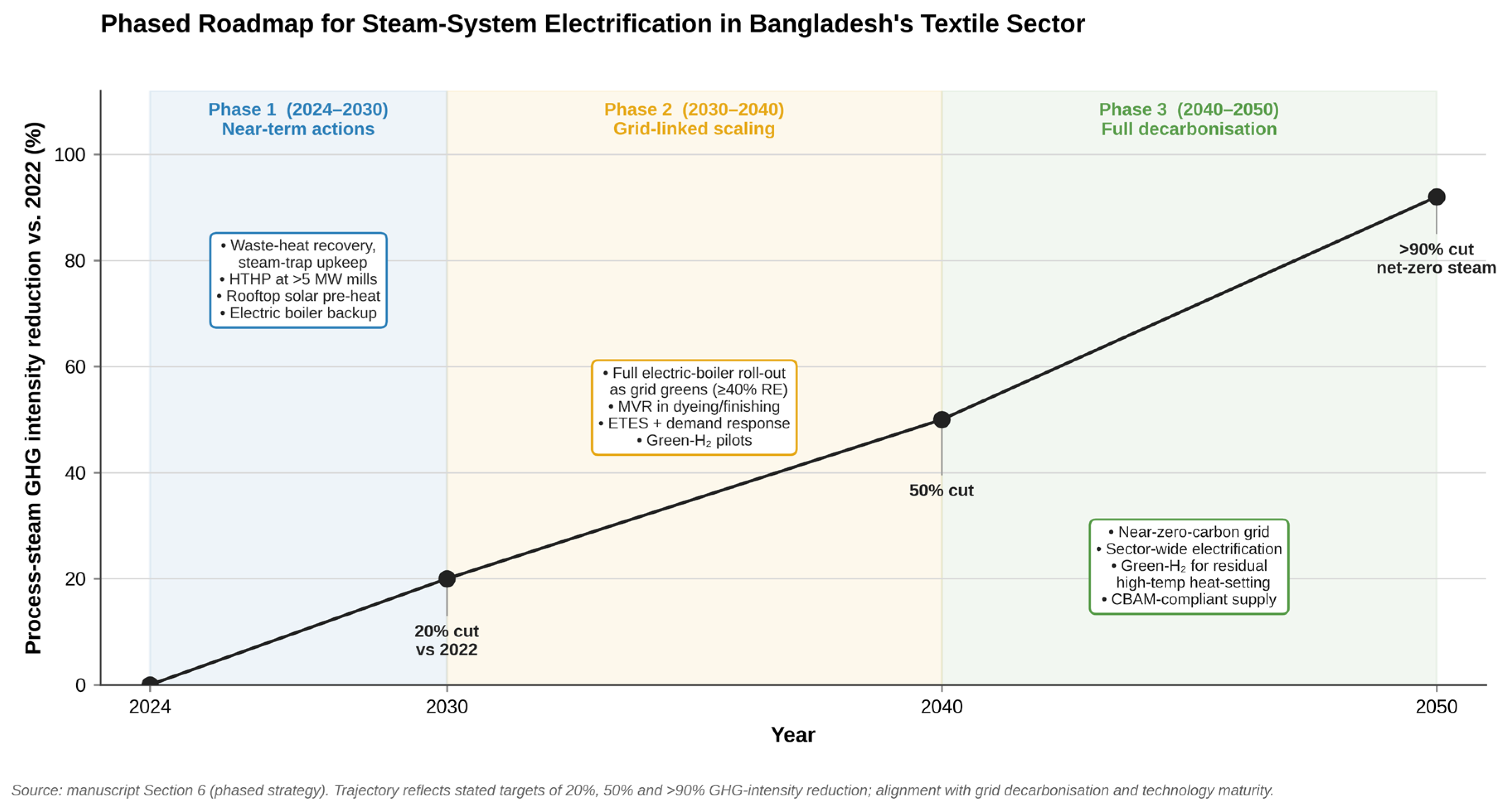

Table 1.
Steam temperature, pressure, and demand distribution across key textile processes.
| Process | Temperature (°C) | Pressure (bar) | Steam quality | Heat share (%) |
|---|---|---|---|---|
| Scouring & bleaching | 90–110 | 1–2 | Saturated | 12–15 |
| Dyeing (cotton/reactive) | 95–105 | 1–2 | Saturated | 30–35 |
| Dyeing (polyester/disperse) | 130–145 | 2.7–4.3 | Saturated/pressurised | 15–20 |
| Printing & fixation | 102–180 | 1.0–7.0 | Saturated/superheated | 5–8 |
| Heat-setting (stenter) | 150–220 | n/a (hot air) | Indirect/hot oil | 10–12 |
| Drying & finishing | 100–180 | 1–7 | Saturated | 12–18 |
| Washing & rinsing | 60–90 | <1 | Hot water | 5–8 |
Table 2.
Comparative assessment of electrification technologies for textile steam generation.
| Technology | Temp. range (°C) | Efficiency / COP | TRL | CAPEX (USD/kW) | Key limitation |
|---|---|---|---|---|---|
| Electric resistance boiler | up to 400 | 95–99% | 9–10 | 80–200 | High electricity cost |
| Electrode boiler | up to 350 | 98–99% | 9–10 | 100–250 | Water-conductivity control |
| Industrial heat pump (HTHP) | up to 160–200 | COP 2.5–5.0 | 7–9 | 300–800 | Waste-heat source required |
| Mechanical vapour recompression | up to 200 | COP 5–20 | 8–9 | 400–1000 | Needs a steam/vapour source |
| Solar thermal (SHIP/LFC) | 80–400 | 50–75% solar fraction | 7–9 | 500–1500 | Intermittency; land |
| Green hydrogen boiler | up to 1600 | 85–90% | 6–8 | 200–600 | High H₂ cost |
| Electro-thermal energy storage | up to 500 | 90–98% round-trip | 6–8 | 150–500 | Emerging; regulatory gaps |
Table 3.
Levelised cost of heat and key economic parameters for electrification technologies.
| Technology | LCOH (USD/GJ), current grid | LCOH (USD/GJ), green grid 2050 | Payback (yr) | CO₂ reduction vs. gas boiler |
|---|---|---|---|---|
| Natural gas boiler (reference) | 8–20 | 8–20 | n/a | Baseline |
| Electric resistance boiler | 25–55 | 10–25 | 5–12 | 50–90% |
| Electrode boiler | 24–52 | 9–24 | 5–10 | 55–92% |
| High-temperature heat pump | 12–30 | 6–14 | 3–8 | 49–85% |
| HTHP + thermal storage | 10–26 | 5–12 | 3–7 | 49–85% |
| Solar thermal (SHIP) | 15–35 | 10–20 | 4–8 | 40–70% |
| Green hydrogen boiler | 40–90 | 20–45 | 10–20+ | 80–100% |
Table 4.
Key GHG and energy statistics for Bangladesh's textile and RMG sector.
| Indicator | RMG sector | Textile sector | Source / year |
|---|---|---|---|
| GHG share (% national industrial) | 15.4% | 12.4% | [17] |
| Total sector GHG (2022) | ~1,946 Gg CO₂e | ~4,098 Gg CO₂e | [5] |
| Natural gas share of GHG | ~81% | ~81% | [5] |
| Export revenue share | 84.58% of total export | (combined) | [43] |
| Industrial energy-consumption share | 22.7% (garment) | 19.5% (textile) | [9] |
| Investment for 50% emission cut by 2030 | USD 6.6 billion | (combined) | [16] |
Disclaimer/Publisher’s Note: The statements, opinions and data contained in all publications are solely those of the individual author(s) and contributor(s) and not of MDPI and/or the editor(s). MDPI and/or the editor(s) disclaim responsibility for any injury to people or property resulting from any ideas, methods, instructions or products referred to in the content. |
© 2026 by the authors. Licensee MDPI, Basel, Switzerland. This article is an open access article distributed under the terms and conditions of the Creative Commons Attribution (CC BY) license (http://creativecommons.org/licenses/by/4.0/).
Copyright: This open access article is published under a Creative Commons CC BY 4.0 license, which permit the free download, distribution, and reuse, provided that the author and preprint are cited in any reuse.