
Submitted:
24 July 2026
Posted:
28 July 2026
You are already at the latest version
Abstract
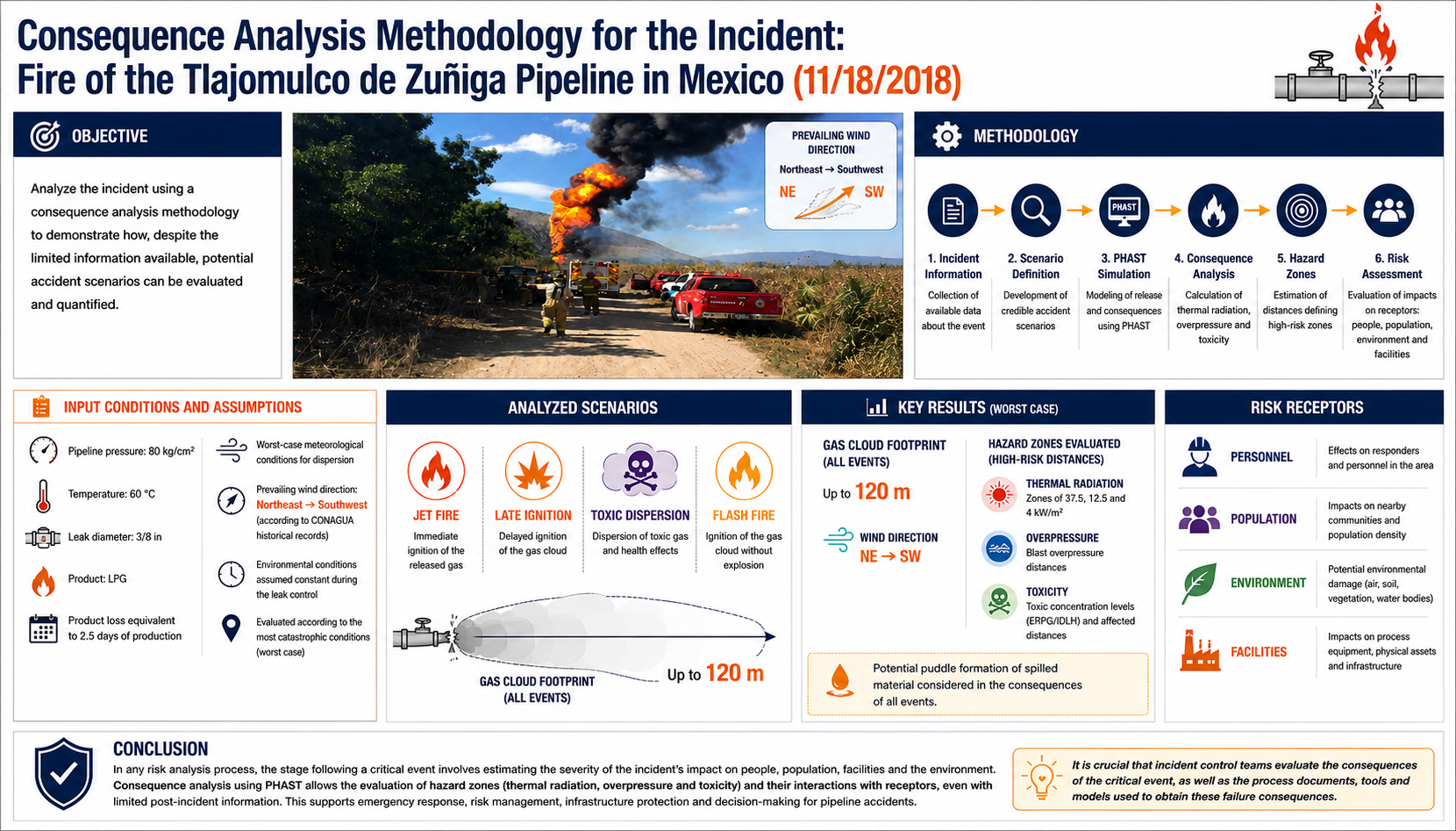
In recent years, numerous incidents and accidents have occurred in PEMEX's national pipeline system in Mexico, resulting in adverse environmental impacts and fatalities. Using an intermediate methodology for quantitative and qualitative analysis, known as consequence analysis, the risk analysis was developed based on a news article dated November 26, 2018, regarding the incident on the LPG pipeline at kilometer 2.5 of Avenida 8 de Julio, in Tlajomulco de Zuñiga, Jalisco, Mexico, caused by an illegal tap. This is because, in this event, Petroleos Mexicanos withheld information, considering it likely to compromise the actions taken, and reported only the incident. This paper analyzes the incident using a consequence analysis methodology, demonstrating how, based on the limited information available, this approach enables the analysis and evaluation of potential events. This facilitates the design and implementation of preventative controls to avoid the crucial event: an explosion followed by a fire caused by a jet fire in the pipeline. The paper identifies appropriate protective barriers and mitigation actions following the onset of the incident, as well as the environmental effects of the resulting leak, using a consequence analysis methodology, with simulations of the unwanted event in the software PHASTâ and ALOHAâ.
Keywords:
fire
; explosion
; jet fire
; consequence analysis
; LPG Accident
; risk analysis
; risk assessment
; ALOHA software
; PHASTâ software
Copyright: This open access article is published under a Creative Commons CC BY 4.0 license, which permit the free download, distribution, and reuse, provided that the author and preprint are cited in any reuse.


