

Submitted:
24 July 2026
Posted:
27 July 2026
You are already at the latest version
Abstract
This paper presents photographic records of butterflies and moths observed along the Bagay Trail of Mt. Napulak, Igbaras, Panay Island, Philippines. The documentation was conducted during a mycological fieldwork in January 2026 and highlights the value of photography as a tool for biodiversity documentation, eco-tourism activities and ecosystem monitoring. Several species were identified through expert consultations, contributing to baseline data for the region. These records emphasize the role of citizen science and photographic documentation in supporting conservation awareness and ecological studies in understudied mountain habitats.
Keywords:
Central Panay mountains
; conservation
; insects
; mobile photography
; citizen science
1. Introduction
Lepidopterans, which includes butterflies and moths, are among the most recognizable insect groups and serve as indicators of ecological health and habitat quality [1]. The Philippines, a megadiverse archipelago, hosts a rich assemblage of lepidopterans [2], yet many areas remain poorly studied. Panay Island, located in the Western Visayas, contains several mountain ranges but lacks comprehensive faunal inventories.
Photographic records have become increasingly valuable in biodiversity research, offering accessible means for documenting species occurrence and distribution. In regions where formal surveys are limited, such visual records can provide verifiable evidence of species presence and habitat associations [3,4]. Because of their charismatic appearance, striking looks, and ease with which they can be observed and photographed, lepidopterans enjoy strong public appeal [5,6,7]. Therefore, citizen science data have provided reliable and important photographic records on conservation status, geographic distribution and even in the discovery of species new to science [7,8,9,10,11,12,13,14].
Mt. Napulak, situated in Igbaras, Iloilo Province, forms part of the Central Panay Mountain Range. Despite its ecological significance, published biodiversity research in this area is scarce. In January 2026, during a mycological fieldwork along the Bagay Trail (Figure 1), various species of butterflies and moths were photographed. The images were later sent for identification to Bukad Project, a Philippine butterfly conservation initiative. These were later verified by Jade Aster T. Badon and Leana Lahom-Cristobal of the Philippine Lepidoptera Butterflies and Moths, Inc. (PhiLep).
2. Lepidopterans in Mt. Napulak, Panay Island
Photographic documentation revealed several butterfly and moth species inhabiting the open shrubland and forest edges along the Bagay Trail. Photographic records show at least eight butterfly species (four endemic: end.) were observed (Figure 2), such as Papilio polytes (Linnaeus, 1758), Mycalesis teatus teatus (Fruhstorfer, 1911) (end.), Eurema sarilata risa (Morishita, 1981) (end.), Lexias satrapes amlana (Jumalon, 1970) (end.), Cepora aspasia rhemia (Fruhstorfer, 1910), Notocrypta feisthamelii alinkara (Fruhstorfer, 1911), and Faunis phaon carfinia (Fruhstorfer, 1911) (end.).
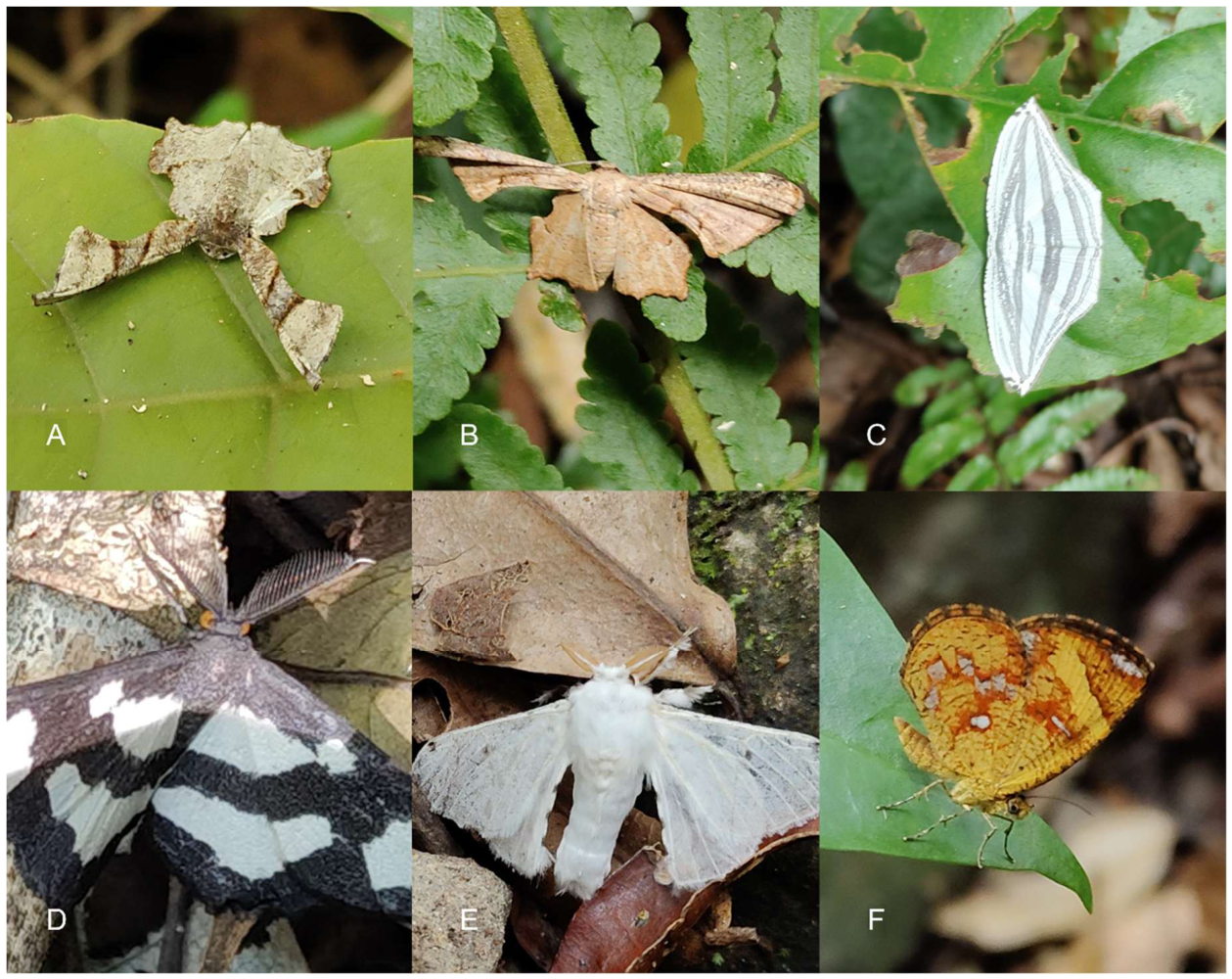
At least six species of moths were also recorded (Figure 3), namely Monobolodes sp., Monobolodes cf. prunaria (Moore, 1887), Acropteris cf. rectinervata Guenée, Hyposidra leucomela (Walker, 1866), Penicillifera apicalis (Walker, 1862), and Callidula cf. sumatrensis (Pagenstecher, 1887).
These records contribute to the growing dataset of lepidopteran diversity in Panay Island and highlight the importance of integrating opportunistic field observations into citizen science, eco-tourism initiatives and conservation planning. More comprehensive surveys and conservation assessment for these species should also be conducted to provide wider inventory and threat documentation in Mt. Napulak and the rest of Central Panay mountains.
Author Contributions
K.A., conceptualization, methodology, formal analysis, investigation, resources, writing—original draft preparation, writing—review and editing, visualization; R.A.O., investigation, resources, writing—review and editing, visualization
Funding
This research received no external funding
Institutional Review Board Statement
No specimen collection done. Not applicable.
Informed Consent Statement
Not applicable.
Data Availability Statement
Data are available upon request.
Acknowledgments
We extend our sincere appreciation to the Bukad Project for their efforts in promoting Philippine butterflies and for assisting in the identification of specimens. We are grateful to Jade Aster T. Badon and Leana Lahom-Cristobal for their invaluable support in verifying and identifying our photographic records. Our thanks also go to Patrice Anne Patria, Vladimir Amadeus Mercado, Ino Shaun Ayon, Ryden T. Palermo, Drizzle Marie Dela Cruz, Fountain Marie Tolentino, Lawrence Francis Garcia, Mel Vevien Flores, Recsan Triumfante, Sir James Nim, Nong Raphael De la Rosa, Sir Chris Eriman, and the other guides who generously accompanied us during the hike.
Conflicts of Interest
The authors declare no conflict of interest.
References
- Yen, A.L. Conservation of Lepidoptera used as human food and medicine. Curr. Opin. Insect Sci. 2015, 12, 102–108. [Google Scholar] [CrossRef]
- Hardy, P.B.; Lawrence, J.M. Field guide to butterflies of the Philippines; Siri Scientific Press: Rochdale, England, 2017. [Google Scholar]
- Jiménez-Valverde, A.; Peña-Aguilera, P.; Barve, V.; Burguillo-Madrid, L. Photo-sharing platforms key for characterising niche and distribution in poorly studied taxa. Insect Conserv. Divers. 2019, 12(5), 389–403. [Google Scholar] [CrossRef]
- Fontaine, A.; Simard, A.; Brunet, N.; Elliott, K. H. Scientific contributions of Citizen science applied to rare or threatened animals. Conserv. Biol. 2022, 36(6). [Google Scholar] [CrossRef] [PubMed]
- Herremans, M.; Gielen, K.; Van Kerckhoven, J.; Vanormelingen, P.; Veraghtert, W.; Swinnen, K.R.R.; Maes, D. Abundant citizen science data reveal that the peacock butterfly Aglais io recently became bivoltine in Belgium. Insects 2021, 12(8), 683. [Google Scholar] [CrossRef] [PubMed]
- Cohn, J.P. Citizen science: Can volunteers do real research? BioScience 2008, 58(3), 192–197. [Google Scholar] [CrossRef]
- Rosa, A.H.B.; Freitas, A.V.L. The role of Citizens in Conservation science: A case study with threatened brazilian butterflies. J. Insect Conserv. 2024, 28, 1149–1160. [Google Scholar] [CrossRef]
- Prudic, K.; McFarland, K.; Oliver, J.; Hutchinson, R.; Long, E.; Kerr, J.; Larrivée, M. eButterfly: Leveraging massive online citizen science for butterfly conservation. Insects 2017, 8(2), 53. [Google Scholar] [CrossRef] [PubMed]
- Lewandowski, E.J.; Oberhauser, K.S. Butterfly citizen scientists in the United States increase their engagement in Conservation. Biol. Conserv. 2017, 208, 106–112. [Google Scholar] [CrossRef]
- Mesaglio, T.; Soh, A.; Kurniawidjaja, S.; Sexton, C. ‘First known photographs of Living specimens’: The power of iNaturalist for Recording rare tropical butterflies. J. Insect Conserv. 2021, 25(5–6), 905–911. [Google Scholar] [CrossRef]
- Sanderson, C.; Braby, M.F.; Bond, S. Butterflies Australia: A national citizen science database for Monitoring changes in the distribution and abundance of Australian butterflies. Austral Entomol. 2021, 60(1), 111–127. [Google Scholar] [CrossRef]
- Plummer, K.E.; Dadam, D.; Brereton, T.; Dennis, E.B.; Massimino, D.; Risely, K.; Siriwardena, G.M.; Toms, M.P. Trends in Butterfly populations in UK gardens—New evidence from Citizen science monitoring. Insect Conserv. Divers. 2023, 17(2). [Google Scholar] [CrossRef]
- Alberti, S.; Pollo, A.; Cerrato, C.; Viterbi, R.; Balletto, E.; Dapporto, L.; Bonelli, S.; Piccini, I. Unrecorded butterfly species and potential local extinctions: The role of Citizen science and sampling. Ecol. Evol. 2025, 15(2). [Google Scholar] [CrossRef] [PubMed]
- Büermann, A.; Peters, B.; Henkel, S.; Schnor, L.; Sánchez-Alandete, P.; Bonn, A.; Pe’er, G. Citizen science helps reveal how urban land management shapes butterfly communities. Basic Appl. Ecol. 2026, 93, 21–32. [Google Scholar] [CrossRef]
Figure 1.
Bagay Trail of Mt. Napulak, Igbaras, Panay Island: (A) Iconic rock peak of Mt. Napulak; (B) Upland shrubland; (C-D) Closed forest areas; (E) Riparian area.
Figure 1.
Bagay Trail of Mt. Napulak, Igbaras, Panay Island: (A) Iconic rock peak of Mt. Napulak; (B) Upland shrubland; (C-D) Closed forest areas; (E) Riparian area.
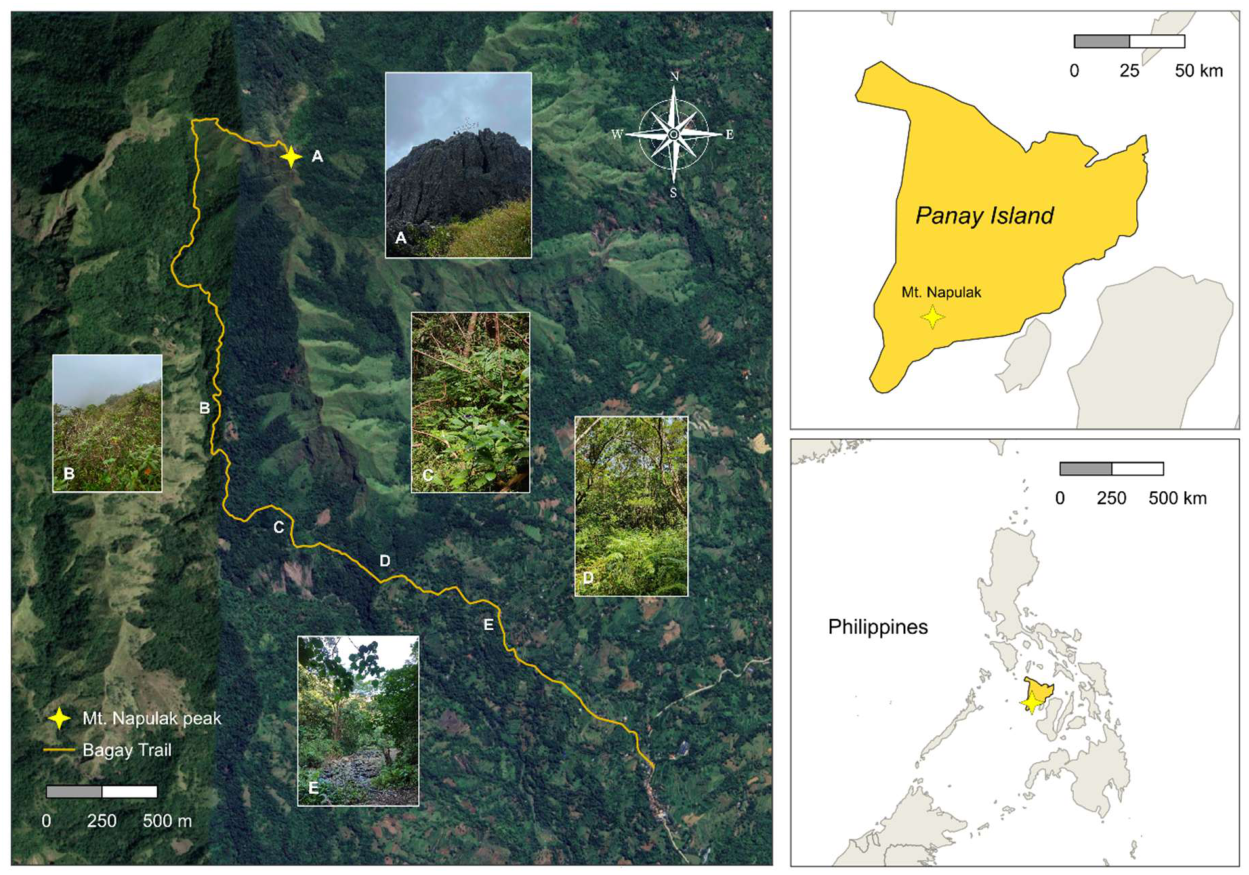
Figure 2.
Butterflies along the Bagay Trail, Mt. Napulak, Panay Island: (A) Common Mormon (Papilio polytes); (B) Mycalesis teatus teatus; (C) Chocolate Grass Yellow (Eurema sarilata risa); (D) Mountain Blue Archduke (Lexias satrapes amlana); (E) Orange Gull (Cepora aspasia rhemia); (F) Spotted Demon (Notocrypta feisthamelii alinkara); (G-H) Faun (Faunis phaon carfinia).
Figure 2.
Butterflies along the Bagay Trail, Mt. Napulak, Panay Island: (A) Common Mormon (Papilio polytes); (B) Mycalesis teatus teatus; (C) Chocolate Grass Yellow (Eurema sarilata risa); (D) Mountain Blue Archduke (Lexias satrapes amlana); (E) Orange Gull (Cepora aspasia rhemia); (F) Spotted Demon (Notocrypta feisthamelii alinkara); (G-H) Faun (Faunis phaon carfinia).
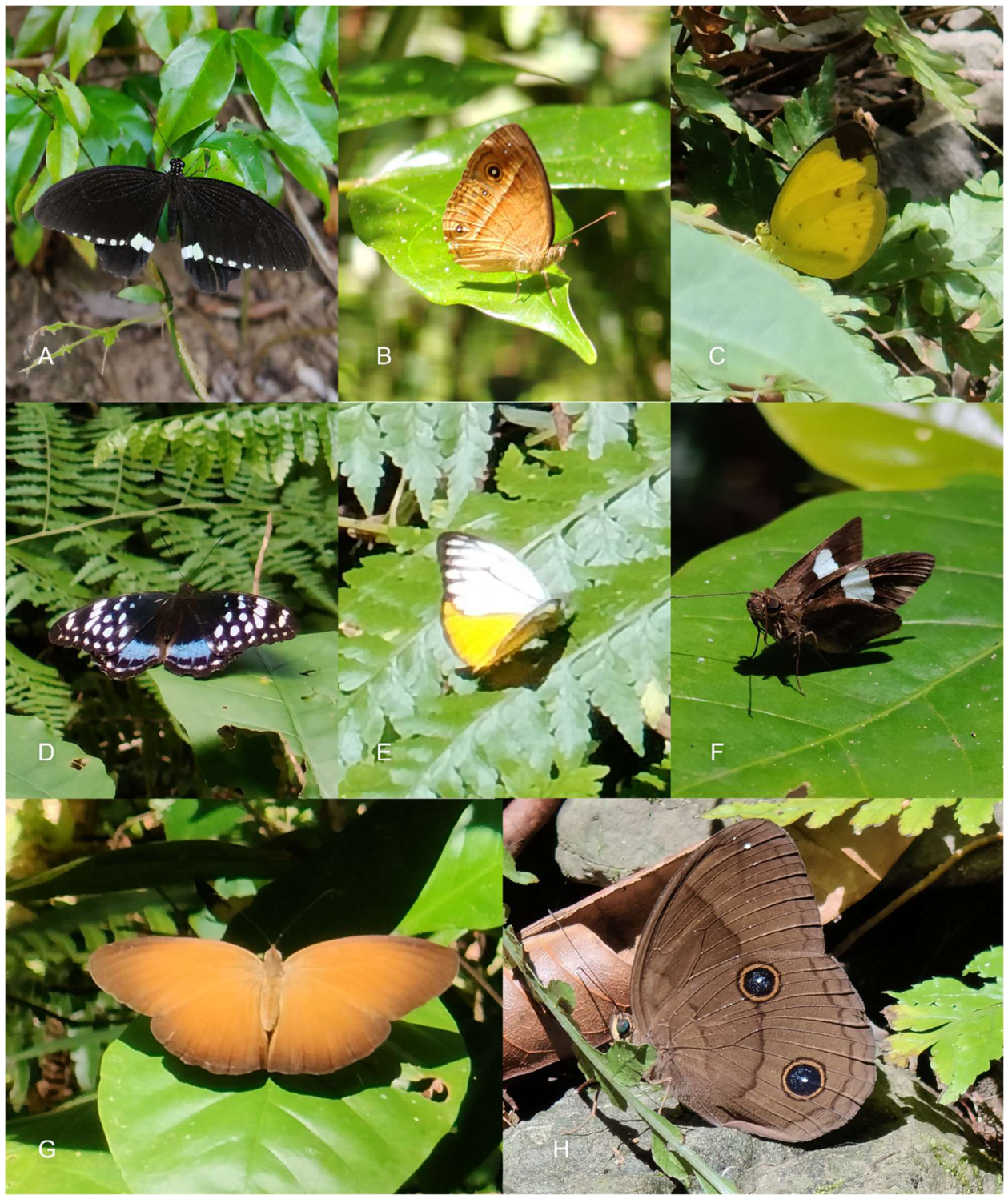
Figure 3.
Moths along the Bagay Trail, Mt. Napulak, Panay Island: (A) Monobolodes sp.; B. Monobolodes cf. prunaria; C. Songgon Moth (Acropteris cf. rectinervata); D. Geometer Moth (Hyposidra leucomela); E. Oriental White Silk Moth (Penicillifera apicalis); F. Sumatran Butterfly-Moth (Callidula cf. sumatrensis).
Figure 3.
Moths along the Bagay Trail, Mt. Napulak, Panay Island: (A) Monobolodes sp.; B. Monobolodes cf. prunaria; C. Songgon Moth (Acropteris cf. rectinervata); D. Geometer Moth (Hyposidra leucomela); E. Oriental White Silk Moth (Penicillifera apicalis); F. Sumatran Butterfly-Moth (Callidula cf. sumatrensis).
Disclaimer/Publisher’s Note: The statements, opinions and data contained in all publications are solely those of the individual author(s) and contributor(s) and not of MDPI and/or the editor(s). MDPI and/or the editor(s) disclaim responsibility for any injury to people or property resulting from any ideas, methods, instructions or products referred to in the content. |
© 2026 by the authors. Licensee MDPI, Basel, Switzerland. This article is an open access article distributed under the terms and conditions of the Creative Commons Attribution (CC BY) license (http://creativecommons.org/licenses/by/4.0/).
Copyright: This open access article is published under a Creative Commons CC BY 4.0 license, which permit the free download, distribution, and reuse, provided that the author and preprint are cited in any reuse.