

Submitted:
23 July 2026
Posted:
24 July 2026
You are already at the latest version
Abstract
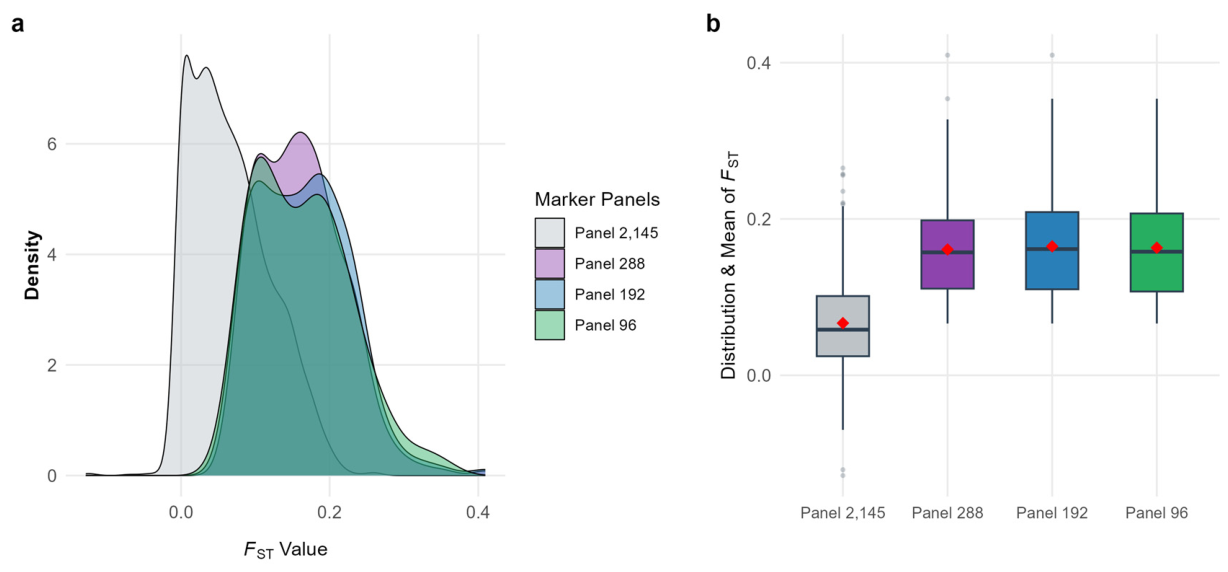
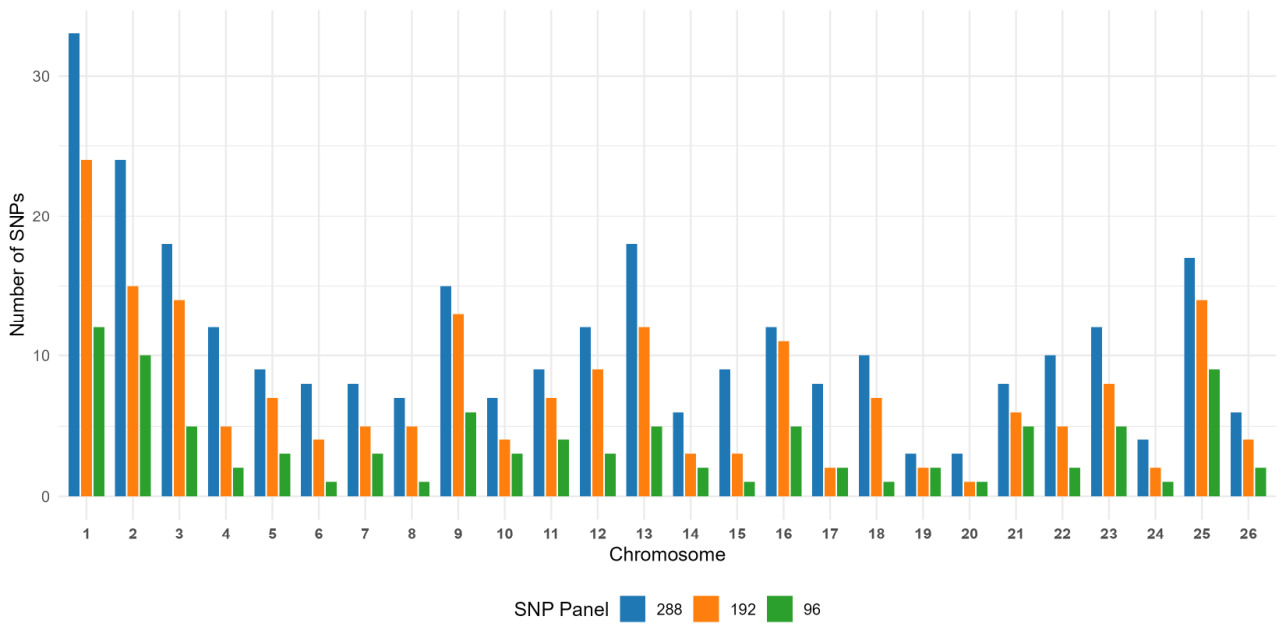
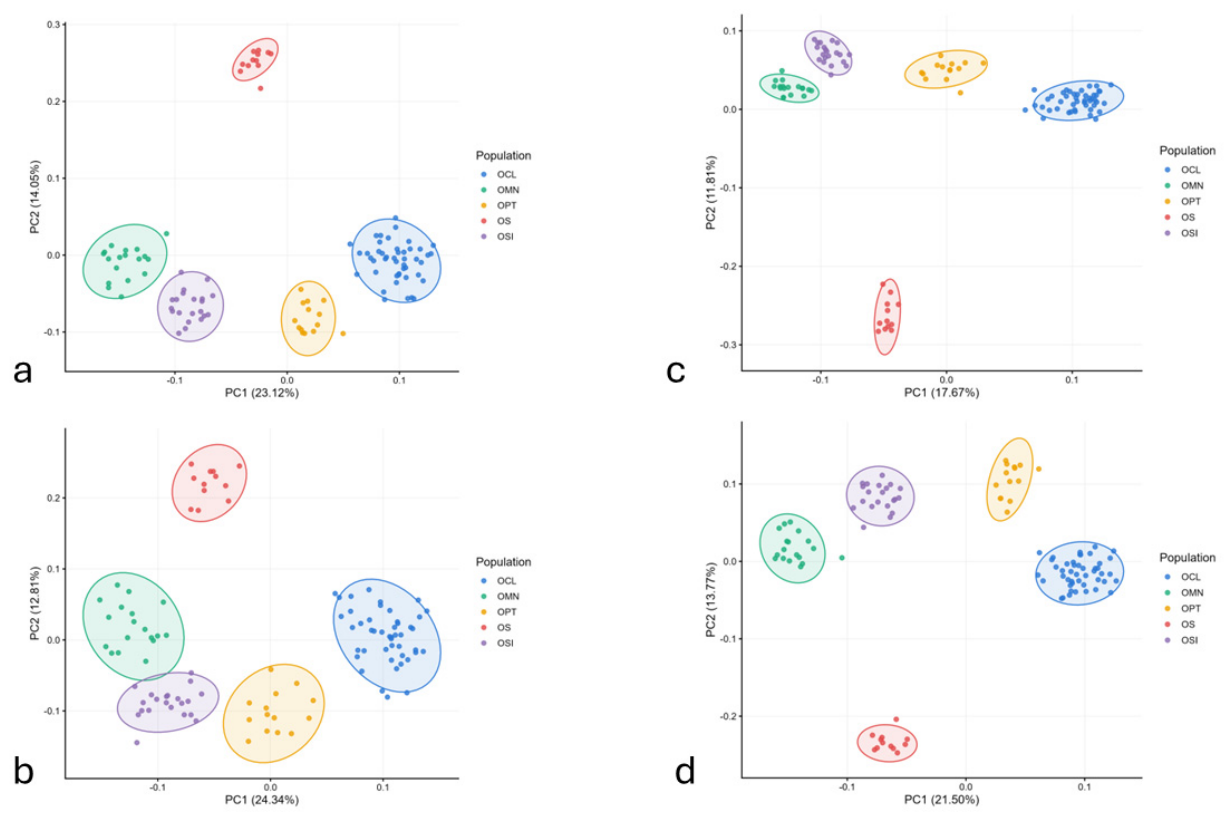
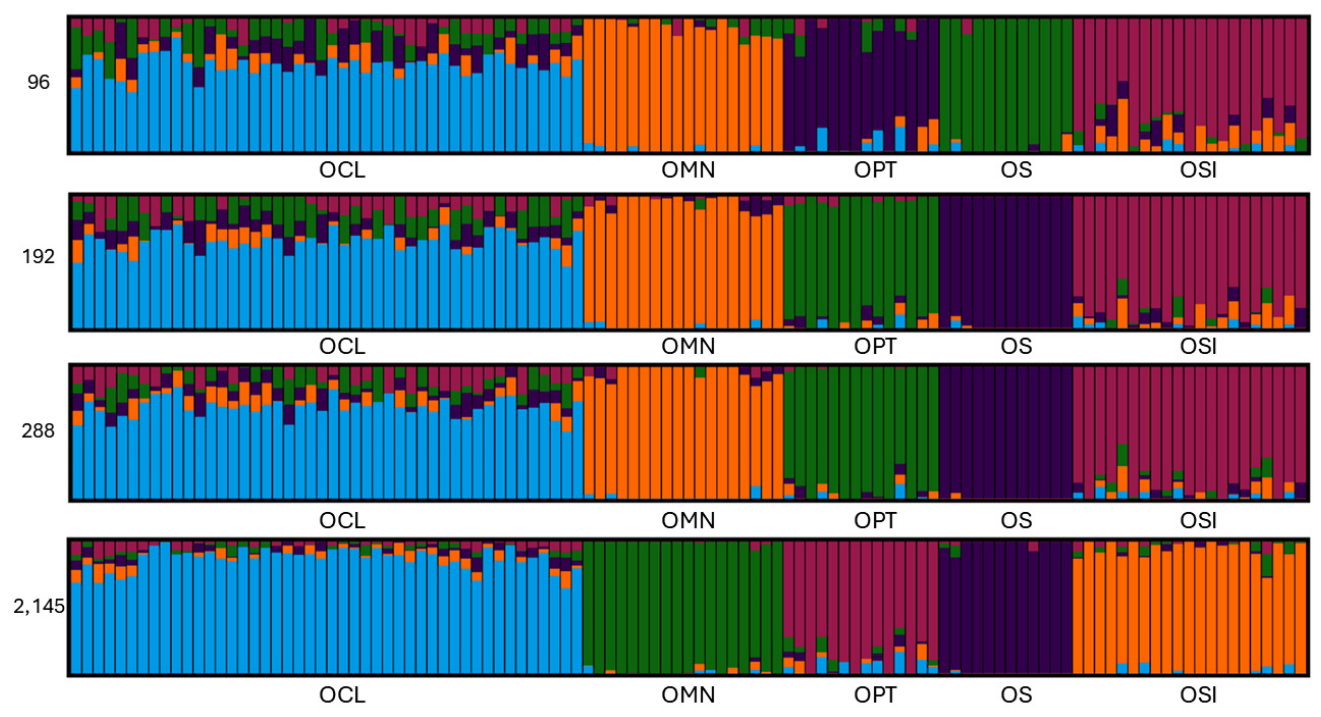
Background/Objectives: Brazilian locally adapted sheep breeds represent valuable genetic resources. However, market appreciation of these breeds depends on genetic certification that ensures traceability, thereby qualifying their products as originating from sustainable production models. This study aimed to identify and evaluate the minimum set of highly informative SNPs for accurate and efficient breed assignment across five Brazilian sheep breeds. Methods: A total of 677 animal samples were used, the SNPs were selected from the Embrapa Multispecies 65K Illumina Infinium 1 chip, which contains 2,926 markers for Ovis aries. The dataset was randomly partitioned into training (80%) and testing (20%) sets. Markers were prioritized based on genetic differentiation using Pairwise Wright's fixation index (FST), implemented in the Toolbox for Ranking and Evaluation of SNPs (TRES), generating three nested reduced panels of 288, 192, and 96 SNPs. Finally, panel performance and preservation of population structure were evaluated using Random Forest classification, Principal Component Analysis (PCA), and ADMIXTURE. Results: The 96-SNP panel maintained high classification accuracy, comparable to larger subsets. This indicates that targeted marker selection is more effective than simply increasing marker density for breed assignment. Conclusions: While the development and analytical validation of a dedicated low-density genotyping assay remain necessary before routine implementation, the 96-SNP panel identified here provides a solid foundation for an efficient, cost-effective genomic tool. This panel will support breed certification, traceability, and the conservation of Brazilian locally adapted sheep genetic resources.
Keywords:
1. Introduction
2. Materials and Methods
2.1. Biological Samples
2.2. Genotyping and Quality Control (QC)
2.3. SNP Selection
2.4. Breed Classification and Statistical Analysis
3. Results
3.1. Selection of Informative Markers and Genomic Distribution
3.2. Principal Component Analysis (PCA)
3.3. Population Structure Inferred by Admixture
3.4. Random Forest Classification
3.5. Comparative Evaluation of SNP Panels
4. Discussion
5. Conclusions
Supplementary Materials
Author Contributions
Funding
Data Availability Statement
Acknowledgments
Conflicts of Interest
Institutional Review Board Statement
Abbreviations
| AIMs | Ancestry-informative markers |
| CI | Confidence interval |
| CV | Cross validation |
| EDTA | Ethylenediaminetetraacetic acid |
| FST | Pairwise Wright's fixation index |
| LD | Linkage disequilibrium |
| NPV | Negative predictive value |
| OOB | Out-of-bag |
| PCA | Principal Component Analysis |
| PPV | Positive predictive value |
| QC | Quality control |
| SNP | Single-nucleotide polymorphism |
References
- Kijas, J.W.; Lenstra, J.A.; Hayes, B.; Boitard, S.; Porto Neto, L.R.; San Cristobal, M.; Servin, B.; McCulloch, R.; Whan, V.; Gietzen, K.; Paiva, S.; Stothard, P.; Moore, S.S.; Gore, K.P.; Bowman, P.J.; Lamara, A.; Cockett, N.; Georges, M.; International Sheep Genomics Consortium. Genome-wide analysis of the world's sheep breeds reveals high levels of population structure and adaptive variation. PLoS Biol. 2012, 10, e1001258. [Google Scholar] [CrossRef] [PubMed]
- Groeneveld, L.F.; Lenstra, J.A.; Eding, H.; Toro, M.A.; Scherf, B.; Pilling, D.; Negrini, R.; Finlay, E.K.; Jianlin, H.; Groeneveld, E.; Weigend, S.; The GLOBALDIV Consortium. Genetic diversity in farm animals: A review. Anim. Genet. 2010, 41 (Suppl. 1), 6–31. [Google Scholar] [CrossRef] [PubMed]
- Paim, T.P.; Paiva, S.R.; Toledo, N.M.; Yamagishi, M.E.B.; Carneiro, P.L.S.; Facó, O.; Araújo, A.M.; Azevedo, H.C.; Caetano, A.R.; Braga, R.M.; et al. Origin and population structure of Brazilian hair sheep breeds. Anim. Genet. 2021, 52, 492–504. [Google Scholar] [CrossRef] [PubMed]
- McManus, C.; Paiva, S.R.; Caetano, A.R.; Hermuche, P.; Guimarães, R.F.; Carvalho, O.A., Jr.; Braga, R.; Carneiro, P.L.S.; Ferrugem-Moraes, J.; Hoff De Souza, C.J.; et al. Landscape genetics of sheep in Brazil using SNP markers. Small Rumin. Res. 2020, 192, 106239. [Google Scholar] [CrossRef]
- Crispim, B.A.; Banari, A.C.; Oliveira, J.A.; Fernandes, J.S.; Grisolia, A.B. Naturalized breeds in Brazil: Reports on the origin and genetic diversity of the Pantaneiro sheep. In Livestock Science; InTech: Rijeka, Croatia, 2017. [Google Scholar] [CrossRef]
- de Azambuja Ribeiro, E.L.; González-García, E. Indigenous sheep breeds in Brazil: Potential role for contributing to the sustainability of production systems. Trop. Anim. Health Prod. 2016, 48, 1305–1313. [Google Scholar] [CrossRef] [PubMed]
- Moreira, G.R.P. Conservation status of Creole sheep flocks in Brazil. Genet. Resour. 2022, 3, 68–74. [Google Scholar] [CrossRef]
- McManus, C.; Paiva, S.R.; Araújo, R.O. Genetics and breeding of sheep in Brazil. Rev. Bras. Zootec. 2010, 39 (Suppl. spe), 236–246. [Google Scholar] [CrossRef]
- McManus, C.; Hermuche, P.; Paiva, S.R.; Moraes, J.C.F.; Melo, C.B.; Mendes, C. Geographical distribution of sheep breeds in Brazil and their relationship with climatic and environmental factors as risk classification for conservation. Braz. J. Sci. Technol. 2014, 1, 3. [Google Scholar] [CrossRef]
- McManus, C.; Paiva, S.R.; Pimentel, F.; Pimentel, D.; Peripolli, V.; Paim, T.P. Bibliometric analysis of the Santa Ines sheep breed. Appl. Vet. Res. 2025, 3, 2024010. [Google Scholar] [CrossRef]
- Powell, O.; Mrode, R.; Gaynor, R.C.; Johnsson, M.; Gorjanc, G.; Hickey, J.M. Genomic evaluations using data recorded on smallholder dairy farms in low- to middle-income countries. JDS Commun. 2021, 2, 366–370. [Google Scholar] [CrossRef] [PubMed]
- Gizaw, S.; Abebe, A.; Goshme, S.; Getachew, T.; Bisrat, A.; Abebe, A.; Besufikad, S. Evaluating the accuracy of smallholder farmers’ sire identification for introducing genetic evaluation in community-based sheep breeding programs. Livest. Sci. 2022, 255, 104804. [Google Scholar] [CrossRef]
- Negrini, R.; Nicoloso, L.; Crepaldi, P.; Milanesi, E.; Colli, L.; Chegdani, F.; Pariset, L.; Dunner, S.; Leveziel, H.; Williams, J.L.; et al. Assessing SNP markers for assigning individuals to cattle populations. Anim. Genet. 2009, 40, 18–26. [Google Scholar] [CrossRef] [PubMed]
- Strucken, E.M.; Al-Mamun, H.A.; Esquivelzeta-Rabell, C.; Gondro, C.; Mwai, O.A.; Gibson, J.P. Genetic tests for estimating dairy breed proportion and parentage assignment in East African crossbred cattle. Genet. Sel. Evol. 2017, 49, 67. [Google Scholar] [CrossRef] [PubMed]
- He, J.; Guo, Y.; Xu, J.; Li, H.; Fuller, A.; Tait, R.G., Jr.; Bauck, S.; Wu, X.L. Comparing SNP panels and statistical methods for estimating genomic breed composition of individual animals in ten cattle breeds. BMC Genet. 2018, 19, 56. [Google Scholar] [CrossRef] [PubMed]
- Gebrehiwot, N.Z.; Strucken, E.M.; Marshall, K.; Gibson, J.P.; Al-Mamun, H.A. SNP panels for the estimation of dairy breed proportion and parentage assignment in African crossbred dairy cattle. Genet. Sel. Evol. 2021, 53, 21. [Google Scholar] [CrossRef] [PubMed]
- Kumar, H.; Panigrahi, M.; Saravanan, K.A.; Parida, S.; Bhushan, B.; Gaur, G.K.; Dutt, T.; Mishra, B.P.; Singh, R.K. SNPs with intermediate minor allele frequencies facilitate accurate breed assignment of Indian Tharparkar cattle. Gene 2021, 777, 145473. [Google Scholar] [CrossRef] [PubMed]
- Wilmot, H.; Bormann, J.; Soyeurt, H.; Hubin, X.; Glorieux, G.; Mayeres, P.; Bertozzi, C.; Gengler, N. Development of a genomic tool for breed assignment by comparison of different classification models: Application to three local cattle breeds. J. Anim. Breed. Genet. 2022, 139, 40–61. [Google Scholar] [CrossRef] [PubMed]
- Jasielczuk, I.; Gurgul, A.; Szmatoła, T.; Radko, A.; Majewska, A.; Sosin, E.; Litwińczuk, Z.; Rubiś, D.; Ząbek, T. The use of SNP markers for cattle breed identification. J. Appl. Genet. 2024, 65, 575–589. [Google Scholar] [CrossRef] [PubMed]
- Zayas, G.A.; Rodriguez, E.; Hernandez, A.; Martinez, R.; Thomas, M.G.; Speidel, S.E.; Enns, R.M.; Canovas, A. Breed of origin analysis in genome-wide association studies: Enhancing SNP-based insights into production traits in a commercial Brangus population. BMC Genom. 2024, 25, 654. [Google Scholar] [CrossRef] [PubMed]
- Zhao, C.H.; Wang, D.; Yang, C.; Chen, Y.; Teng, J.; Zhang, X.Y.; Cao, Z.; Wei, X.M.; Ning, C.; Yang, Q.E.; et al. Population structure and breed identification of Chinese indigenous sheep breeds using whole genome SNPs and InDels. Genet. Sel. Evol. 2024, 56, 60. [Google Scholar] [CrossRef] [PubMed]
- Wilmot, H.; Gengler, N. Good practice for assignment of breeds and populations: A review. Front. Anim. Sci. 2025, 6, 1508081. [Google Scholar] [CrossRef]
- Ducrocq, V.; Laloe, D.; Swaminathan, M.; Rognon, X.; Tixier-Boichard, M.; Zerjal, T. Genomics for ruminants in developing countries: From principles to practice. Front. Genet. 2018, 9, 251. [Google Scholar] [CrossRef] [PubMed]
- Liang, Z.; Bu, L.; Qin, Y.; Peng, Y.; Yang, R.; Zhao, Y. Selection of optimal ancestry informative markers for classification and ancestry proportion estimation in pigs. Front. Genet. 2019, 10, 183. [Google Scholar] [CrossRef] [PubMed]
- Chhotaray, S.; Panigrahi, M.; Pal, D.; Ahmad, S.F.; Bhushan, B.; Gaur, G.K.; Mishra, B.P.; Singh, R.K. Ancestry informative markers derived from discriminant analysis of principal components provide important insights into the composition of crossbred cattle. Genomics 2020, 112, 1726–1733. [Google Scholar] [CrossRef] [PubMed]
- Gangwar, M.; Ahmad, S.F.; Ali, A.B.; Kumar, H.; Panigrahi, M.; Bhushan, B.; Dutt, T. Identifying low-density, ancestry-informative SNP markers through whole genome resequencing in Indian, Chinese, and wild yak. BMC Genom. 2024, 25, 1043. [Google Scholar] [CrossRef] [PubMed]
- Somenzi, E.; Ajmone-Marsan, P.; Barbato, M. Identification of ancestry informative marker (AIM) panels to assess hybridisation between feral and domestic sheep. Animals 2020, 10, 582. [Google Scholar] [CrossRef] [PubMed]
- Heaton, M.P.; Leymaster, K.A.; Kalbfleisch, T.S.; Kijas, J.W.; Clarke, S.M.; McEwan, J.; Maddox, J.F.; Basnayake, V.; Petrik, D.T.; Simpson, B.; et al. SNPs for parentage testing and traceability in globally diverse breeds of sheep. PLoS ONE 2014, 9, e94851. [Google Scholar] [CrossRef] [PubMed]
- Kumar, H.; Panigrahi, M.; Seo, D.; Cho, S.; Bhushan, B.; Dutt, T. Machine learning-aided ultra-low-density single nucleotide polymorphism panel helps to identify the Tharparkar cattle breed: Lessons for digital transformation in livestock genomics. OMICS J. Integr. Biol. 2024, 28, 514–525. [Google Scholar] [CrossRef] [PubMed]
- Moradi, M.; Khaltabadi-Farahani, A.; Khodaei-Motlagh, M.; Kazemi-Bonchenari, M.; McEwan, J. Genome-wide selection of discriminant SNP markers for breed assignment in indigenous sheep breeds. In Bioeconomy Science Institute; AgResearch Group, 2021; Available online: https://hdl.handle.net/11440/8409 (accessed on 20 July 2026).
- Rodrigues, C.S.; Faria, D.A.d.; Azevedo, H.C.; Silva, K.d.M.; Facó, O.; Santos, S.A.; Braga, R.M.; Caetano, A.R.; Moraes, J.C.F.; Souza, C.J.H.d.; et al. Assessment of a Reduced SNP Panel Targeting Prolificacy and Coat Color Genes in Brazilian Sheep Breeds. Animals 2026, 16, 2008. [Google Scholar] [CrossRef] [PubMed]
- Lopes, U.V.; Pires, J.L.; Gramacho, K.P.; Grattapaglia, D. Genome-wide SNP genotyping as a simple and practical tool to accelerate the development of inbred lines in outbred tree species: An example in cacao (Theobroma cacao L.). PLoS ONE 2022, 17, e0270437. [Google Scholar] [CrossRef] [PubMed]
- Rodrigues, C.S.; Faria, D.A.d.; Ramos, A.F.; McManus, C.; Paiva, S.R. Uso de ferramenta genômica no manejo genético das raças conservadas in situ na Embrapa Recursos Genéticos e Biotecnologia; Boletim de Pesquisa e Desenvolvimento, 385; Embrapa Recursos Genéticos e Biotecnologia: Brasília, DF, Brazil, 2025; Available online: http://www.infoteca.cnptia.embrapa.br/infoteca/handle/doc/1176023.
- Guazzeli, L.d.M.; Araujo, A.M.d.; Santos, S.A.; Juliano, R.S.; Rodrigues, C.S.; Faria, D.A.d.; Paiva, S.R. Uso de ferramentas genômicas no manejo do Núcleo de Conservação Animal da Embrapa Pantanal; Boletim de Pesquisa e Desenvolvimento, 386; Embrapa Recursos Genéticos e Biotecnologia: Brasília, DF, Brazil, 2025; Available online: http://www.infoteca.cnptia.embrapa.br/infoteca/handle/doc/1179430.
- Purcell, S.; Neale, B.; Todd-Brown, K.; Thomas, L.; Ferreira, M.A.; Bender, D.; Maller, J.; Sklar, P.; de Bakker, P.I.; Daly, M.J.; et al. PLINK: A tool set for whole-genome association and population-based linkage analyses. Am. J. Hum. Genet. 2007, 81, 559–575. [Google Scholar] [CrossRef] [PubMed]
- Kavakiotis, I.; Triantafyllidis, A.; Ntelidou, D.; Alexandri, P.; Megens, H.J.; Crooijmans, R.P.M.A.; Groenen, M.A.M.; Tsoumakas, G.; Vlahavas, I. TRES: Identification of discriminatory and informative SNPs from population genomic data. J. Hered. 2015, 106, 672–676. [Google Scholar] [CrossRef] [PubMed]
- Wright, M.N.; Ziegler, A. ranger: A Fast Implementation of Random Forests for High Dimensional Data in C++ and R. J. Stat. Softw. 2017, 77, 1–17. [Google Scholar] [CrossRef]
- Kuhn, M. Building Predictive Models in R Using the caret Package. J. Stat. Softw. 2008, 28, 1–26. [Google Scholar] [CrossRef]
- R Core Team. R: A Language and Environment for Statistical Computing; R Foundation for Statistical Computing: Vienna, Austria, 2025; Available online: https://www.r-project.org/ (accessed on 20 June 2026).
- Alexander, D.H.; Novembre, J.; Lange, K. Fast model-based estimation of ancestry in unrelated individuals. Genome Res. 2009, 19, 1655–1664. [Google Scholar] [CrossRef] [PubMed]
- Kopelman, N.M.; Mayzel, J.; Jakobsson, M.; Rosenberg, N.A.; Mayrose, I. Clumpak: a program for identifying clustering modes and packaging population structure inferences across K. Mol. Ecol. Resour. 2015, 15, 1179–1191. [Google Scholar] [CrossRef] [PubMed]
- Wickham, H. ggplot2: Elegant Graphics for Data Analysis; Springer-Verlag: New York, NY, USA, 2016. [Google Scholar]
- Cochran, W.G. The Comparison of Percentages in Matched Samples. Biometrika 1950, 37, 256–266. [Google Scholar] [CrossRef]
- Wilkinson, S.; Wiener, P.; Archibald, A.L.; Law, A.; Schnabel, R.D.; McKay, S.D.; Taylor, J.F.; Ogden, R. Evaluation of approaches for identifying population informative markers from high density SNP chips. BMC Genet. 2011, 12, 45. [Google Scholar] [CrossRef] [PubMed]
- Sottile, G.; Sardina, M.T.; Mastrangelo, S.; Di Gerlando, R.; Tolone, M.; Chiodi, M.; Portolano, B. Penalized classification for optimal statistical selection of markers from high-throughput genotyping: application in sheep breeds. Animal 2018, 12, 1118–1125. [Google Scholar] [CrossRef] [PubMed]
- Zhao, Y.; Adedze, Y.M.N.; Dong, J.; Zhang, R.; Zheng, S.; Lan, H.; Li, Y.; Liu, S.; Xu, Y.; Zhang, J. Optimization of commercial SNP arrays and the generation of a high-efficiency GenoBaits Peanut 10K panel. Sci. Rep. 2025, 15, 9995. [Google Scholar] [CrossRef] [PubMed]
- Dimauro, C.; Nicoloso, L.; Cellesi, M.; Macciotta, N.P.P.; Ciani, E.; Moioli, B.; Pilla, F.; Crepaldi, P. Selection of discriminant SNP markers for breed and geographic assignment of Italian sheep. Small Rumin. Res. 2015, 128, 27–33. [Google Scholar] [CrossRef]
- O’Brien, A.C.; Purfield, D.C.; Judge, M.M.; Long, C.; Fair, S.; Berry, D.P. Population structure and breed composition prediction in a multi-breed sheep population using genome-wide single nucleotide polymorphism genotypes. Animal 2020, 14, 464–474. [Google Scholar] [CrossRef] [PubMed]
- Vieira, F.D.; Oliveira, S.R.M.; Paiva, S.R. Metodologia baseada em técnicas de mineração de dados para suporte à certificação de raças de ovinos. Eng. Agríc. 2015, 35, 1172–1186. [Google Scholar] [CrossRef]
- Paim, T.P.; McManus, C.; Vieira, F.D.; Oliveira, S.R.M.; Facó, O.; Azevedo, H.C.; Araújo, A.M.; Moraes, J.C.F.; Yamagishi, M.E.B.; Carneiro, P.L.S.; et al. Validation of a customized subset of SNPs for sheep breed assignment in Brazil. Pesq. Agropec. Bras. 2019, 54, e00506. [Google Scholar] [CrossRef]
- Guilherme, R.F.; Lima, A.M.C.; Alves, J.R.A.; Costa, D.F.; Pinheiro, R.R.; Alves, F.S.F.; Azevedo, S.S.; Alves, C.J. Characterization and typology of sheep and goat production systems in the State of Paraíba, a semi-arid region of northeastern Brazil. Semin. Ciênc. Agrár. 2017, 38, 2163–2178. [Google Scholar] [CrossRef]
- Debortoli, E.C.; Monteiro, A.L.G.; Gameiro, A.H.; Saraiva, L.C.V.F. Meat sheep farming systems according to economic and productive indicators: A case study in Southern Brazil. Rev. Bras. Zootec. 2021, 50, e20200216. [Google Scholar] [CrossRef]
- Sousa, R.T.; Gonçalves, J.L.; Fonteles, N.L.O.; Santos, C.M.; Ricci, G.D.; Albuquerque, F.H.M.A.R.; Fernandes, F.E.P.; Bomfim, M.A.D. Reproductive characteristics of Morada Nova and Brazilian Somalis sheep breeds. Pubvet 2015, 9, 495–501. [Google Scholar] [CrossRef]
- Sá, H.A.O.M.; Fluck, A.C.; Cardinal, K.M.; Costa, O.A.D.; Lemes, J.S.; Debo, E.C.; Vaz, R.Z. Physical characteristics of meat from native Brazilian sheep breeds: A systematic review and meta-analysis. Semin. Ciênc. Agrár. 2025, 46, 1485–1508. [Google Scholar] [CrossRef]
- Costa, J.A.A.; Egito, A.A.; Barbosa-Ferreira, M.; Reis, F.A.; Vargas Junior, F.M.; Santos, S.A.; Catto, J.B.; Juliano, R.S.; Feijó, G.L.D.; Ítavo, C.C.B.F.; et al. Ovelha Pantaneira, um grupamento genético naturalizado do estado de Mato Grosso do Sul. Palestras do VIII Congreso Latinoamericano de Especialistas en Pequeños Rumiantes y Camélidos Sudamericanos, Campo Grande, MS, Brazil, 2013; pp. 25–43. Available online: http://www.alice.cnptia.embrapa.br/alice/handle/doc/982438 (accessed on 20 July 2026).
- Longo, M.L.; Vargas Junior, F.M.; Cansian, K.; Souza, M.R.; Burim, P.C.; Silva, A.L.A.; Costa, C.M.; Seno, L.O. Environmental factors that influence milk production of Pantaneiro ewes and the weight gain of their lambs during the pre-weaning period. Trop. Anim. Health Prod. 2018, 50, 1493–1497. [Google Scholar] [CrossRef] [PubMed]
- Monteschio, J.O.; Burin, P.C.; Leonardo, A.P.; Fausto, D.A.; Silva, A.L.A.; Ricardo, H.A.; Vargas Junior, F.M. Different physiological stages and breeding systems related to the variability of meat quality of indigenous Pantaneiro sheep. PLoS ONE 2018, 13, e0191668. [Google Scholar] [CrossRef] [PubMed]
- Silva, G.A.; Santos, S.A.; Meirelles, P.R.L.; Pinheiro, R.S.B.; Gôlo, M.P.S.; Franco, J.L.; Péres, I.A.H.F.S.; Moura, L.F.; Costa, C. Tracking free-ranging Pantaneiro sheep during extreme drought in the Pantanal through precision technologies. Agriculture 2024, 14, 1154. [Google Scholar] [CrossRef]
- Gurgul, A.; Rubiś, D.; Ząbek, T.; Żukowski, K.; Pawlina, K.; Semik, E.; Bugno-Poniewierska, M. The evaluation of the usefulness of pedigree verification-dedicated SNPs for breed assignment in three Polish cattle populations. Mol. Biol. Rep. 2013, 40, 6803–6809. [Google Scholar] [CrossRef] [PubMed]

| Breed | Breed Code | Sample Size Train / Test | Type | Economic Relevance |
| Crioula | OCL | 190/46 | Wool | Triple-Purpose (Meat, Wool and Skin) |
| Morada Nova | OMN | 69/18 | Hair | Dual-Purpose (Meat/Skin) |
| Pantaneiro | OPT | 55/14 | Wool | Triple-Purpose (Meat, Milk and Wool) |
| Brazilian Somali | OS | 58/12 | Hair | Dual-Purpose (Meat/Skin) |
| Santa Inês | OSI | 194/21 | Hair | Dual-Purpose (Meat/Skin) |
| SNP Panel | Accuracy (95% CI)1 |
Balanced Accuracy (%) |
Kappa Coefficient |
10-fold CV Balanced Accuracy (%)2 |
OOB Brier score3 |
| 96 SNPs | 99.1 (95.08 - 99.98) | 99.17 | 0.988 | 95.39 | 0.085 |
| 192 SNPs | 100 (96.73 - 100) | 100 | 1.000 | 95.52 | 0.092 |
| 288 SNPs | 100 (96.73 - 100) | 100 | 1.000 | 95.87 | 0.091 |
| 2145 SNPs (Baseline) |
97.3 (92.30-99.44) | 97.4 | 0.963 | 96.13 | 0.096 |
| SNP Panel | Breed | Sensitivity | Specificity | PPV¹ | NPV² |
| 96 SNPs | OCL | 1.000 | 1.000 | 1.000 | 1.000 |
| OMN | 1.000 | 1.000 | 1.000 | 1.000 | |
| OPT | 0.929 | 1.000 | 1.000 | 0.990 | |
| OS | 1.000 | 1.000 | 1.000 | 1.000 | |
| OSI | 1.000 | 0.989 | 0.955 | 1.000 | |
| Mean | 0.986 | 0.998 | 0.991 | 0.998 | |
| 192 SNPs | OCL | 1.000 | 1.000 | 1.000 | 1.000 |
| OMN | 1.000 | 1.000 | 1.000 | 1.000 | |
| OPT | 1.000 | 1.000 | 1.000 | 1.000 | |
| OS | 1.000 | 1.000 | 1.000 | 1.000 | |
| OSI | 1.000 | 1.000 | 1.000 | 1.000 | |
| Mean | 1.000 | 1.000 | 1.000 | 1.000 | |
| 288 SNPs | OCL | 1.000 | 1.000 | 1.000 | 1.000 |
| OMN | 1.000 | 1.000 | 1.000 | 1.000 | |
| OPT | 1.000 | 1.000 | 1.000 | 1.000 | |
| OS | 1.000 | 1.000 | 1.000 | 1.000 | |
| OSI | 1.000 | 1.000 | 1.000 | 1.000 | |
| Mean | 1.000 | 1.000 | 1.000 | 1.000 | |
| 2,145 SNPs (Baseline) |
OCL | 1.000 | 0.954 | 0.939 | 1.000 |
| OMN | 1.000 | 1.000 | 1.000 | 1.000 | |
| OPT | 0.786 | 1.000 | 1.000 | 0.970 | |
| OS | 1.000 | 1.000 | 1.000 | 1.000 | |
| OSI | 1.000 | 1.000 | 1.000 | 1.000 | |
| Mean | 0.957 | 0.991 | 0.988 | 0.994 |
Disclaimer/Publisher’s Note: The statements, opinions and data contained in all publications are solely those of the individual author(s) and contributor(s) and not of MDPI and/or the editor(s). MDPI and/or the editor(s) disclaim responsibility for any injury to people or property resulting from any ideas, methods, instructions or products referred to in the content. |
© 2026 by the authors. Licensee MDPI, Basel, Switzerland. This article is an open access article distributed under the terms and conditions of the Creative Commons Attribution (CC BY) license (http://creativecommons.org/licenses/by/4.0/).


