

Submitted:
22 July 2026
Posted:
23 July 2026
You are already at the latest version
Abstract
Purslane (Portulaca oleracea L.) is an annual plant widely distributed throughout the world and has long been used as both food and medicinal plant. In recent years, it has attracted attention as potential functional food and sustainable plant resources. Its tolerance to drought, high temperature, and salt stress has also increased interest in its use as an alternative leafy vegetable under climate change. This review summarizes the compositional diversity of purslane, starting from comparisons between wild and cultivated types. Based on previous reports, the components found in wild and cultivated purslane are compared, and factors that may explain their differences are dis-cussed. Also, their traditional food uses, safety, and current evidence from human studies are introduced. Available evidence suggests that some differences can be observed between wild and cultivated purslane, but these differences are not always consistent. They may also be affected by plant part, growth stage, harvest time, fertilization, growing environment, and processing methods. Overall, comparative studies that consider genetic background, cultivation conditions, plant part, harvest stage, and processing conditions together are important for using purslane as a food and for evaluating its functional properties and safety.
Keywords:
agrobiodiversity
; α-linolenic acid
; bioactive compounds
; food composition
; functional food
; polyphenol
; purslane
; sustainable food resources
; underutilized crops
; wild edible plant
1. Introduction
Purslane (Portulaca oleracea L.) is an annual plant belonging to the family Portulacaceae and the genus Portulaca. It is widely distributed throughout the world, from temperate to subtropical regions (Figure 1A–D).
There are several theories about the origin of the Portulaca genus. One explanation is that it comes from the Latin words “porto” meaning “to carry,” and “lac” meaning “milk,” referring to the milky sap of the plant. Another explanation is that it comes from the Latin word portula, meaning “little door,” referring to the characteristic way in which the fruit opens like a small door to release the seeds [1]. The specific epithet oleracea is considered to mean a vegetable or herb. These origins may suggest that purslane has long been recognized not merely as a wild plant, but as a plant used by humans.
Purslane has long been used as an edible plant with a history of consumption in many regions of the world. It can be eaten raw, boiled, stir-fried, or used in stewed dishes, depending on local food practices [2]. Ethnobotanical records from various parts of East Asia also show that purslane has long been recognized as a medicinal plant [3].
From the perspective of research field of food function, purslane has attracted attention as a source of α-linolenic acid and vitamin E [4]. More recently, it has become clear that purslane contains a wide range of bioactive compounds beyond these components, and research on this plant has expanded accordingly [5,6,7]. The number of papers published about purslane has been increasing steadily over the past decade, rising from 94 in 2015 to 146 in 2020 and 297 in 2025 (Figure 2A). By country, China, Iran, and Egypt were the top three contributors in terms of the number of publications (Figure 2B). In terms of subject area, “Agricultural and Biological Sciences,” “Biochemistry, Genetics and Molecular Biology,” “Pharmacology, Toxicology and Pharmaceutics,” and “Medicine” together accounted for more than 60 % of the total (Figure 2C).
Research on purslane is growing, and an important perspective to consider is the distinction between wild and cultivated types. In recent years, when evaluating the composition of edible plants, it has become increasingly important to compare not only widely cultivated varieties, but also wild types. This is because understanding the nutritional value and food functions of plants properly requires attention to compositional differences within the same species. Studies on the relationship between biodiversity and food composition have pointed out that the accumulation of food composition data, including data from local varieties and wild resources, provides a basis for nutritional evaluation and sustainable food use [8]. It is also known that the components contained in crops are affected by cultivation and breeding [9,10]. Based on this perspective, focusing only on cultivated purslane may not be enough to understand the diversity of functional components in wild purslane or the nutritional characteristics that may have been lost during domestication. Wild edible plants may therefore contain components and secondary metabolites that differ from those of cultivated types, and they have attracted attention as potential sources of new functional components [11]. For example, the use of genomic data to improve purslane has been proposed as a way to support agriculture that is better adapted to climate change [12]. From this point of view, recent studies on local and cultivated types of wheat and walnut suggest that comparing the composition of wild and cultivated types could help in understanding food functions, utilizing genetic resources and considering future breeding and applications [13,14].
Comparing wild and cultivated purslane may also have practical value. In breeding and the search for new plant resources, traits retained in wild populations are often re-evaluated [15]. Purslane is also regarded as a nutritious underutilized plant, and as a candidate alternative leafy vegetable under climate change [16]. In particular, its adaptation to saline conditions and low-quality water use, its potential as a microgreen, and its connection to the use of wild plants and the preservation of local food culture may be characteristic advantages of purslane.
Based on this background, this review summarized previous studies on the composition of purslane from the perspective of comparisons between wild and cultivated types. It also examined how far the factors responsible for differences between the two types have been clarified. In addition, this review addressed the food culture surrounding purslane, safety, human studies, and future research issues of purslane, with the aim of presenting the current state of purslane research from the perspective of food function research.
2. Historical Background and Traditional Food Uses of Purslane
Purslane is considered to be a plant that has been used since ancient times as both food and medicine in many parts of the world. Its presence was also recorded early in Chinese traditional medical texts. For example, the Shennong Bencao Jing (Compendium of Materia Medica) dating to around the 1st to 2nd century, mentioned effects such as improving eyesight, removing harmful influences, and promoting urination. Later, in the Bencao Gangmu (Compendium of Materia Medica), written by Li Shizhen in 1596, purslane was described for use in conditions such as dysentery, abdominal pain, nausea, urinary tract infections, and skin lesions [3,17].
In Japan, purslane is commonly found in fields and along roadsides, and today it is often treated as a weed. However, it is actually a plant with a long history of use as both food and medicine. For example, plant remains have been detected at archaeological sites from the Jomon period, suggesting that purslane has been associated with human life since ancient times [18]. During the Edo period, repeated famines led to the use of famine-relief plants. Purslane is listed in Katemono, a food guide that was compiled in the Yonezawa Domain [19]. Even today, boiled and dried purslane is used as a preserved food in Yamagata Prefecture. After rehydration, it is prepared in dishes such as ohitashi, dressed dishes, vinegared dishes, stir-fried simmered dishes, simmered dishes, and soups (Figure 3A-C).
Purslane is still used in a wide range of dishes around the world. In the Mediterranean region, it is eaten in salads or as a cooked vegetable and is often combined with calcium-containing foods such as yogurt and cheese [20,21]. In Greece, it has been used in salads with feta cheese, tomato, onion, garlic, and oregano. In Turkey, it is mixed with yogurt. In Mexico, it is stewed with meat. In various parts of Asia, it is prepared as stir-fried dishes or soups. A common feature of these food uses is that purslane is often eaten together with other foods, such as dairy products, oils, spices, meat, fish, and grains, rather than being consumed in large amounts on their own. These examples suggest that purslane is not a special plant limited to a particular culture but has been flexibly incorporated into local food systems.
Here again, the perspective of comparing wild and cultivated types might be important. Many traditional food cultures were probably not based only on uniform cultivated types, as is often the case today. They may also have included local wild populations and local lines. Thus, discussing the value of purslane only in terms of modern cultivated types may not be sufficient for understanding the history of its food use. Considering both wild and cultivated types may help connect the history of past use with current food use.
On the other hand, the cultural value of purslane as a food is not limited to its use in traditional dishes. In recent years, there has also been growing interest in its potential use as a microgreen. For example, studies have investigated how to optimize the yield and quality of purslane microgreens by combining salt stress with LED light conditions [22]. It has also been reported that differences in varieties or lines, together with the type of growing medium, affect the growth and phytochemical composition of purslane microgreens [23]. These findings indicate that purslane microgreens may represent a useful edible form of this plant. The next section introduces the nutritional characteristics of purslane.
3. Comparative Nutritional and Functional Composition of Wild and Cultivated Purslane
3.1. General Composition
To introduce the nutritional characteristics of purslane, the general composition of this species is shown in Table 1. Among leafy vegetables, purslane is characterized by its high water content. The contents of ash, crude fat, crude protein, and carbohydrates have been reported to vary depending not only on whether the plant is wild or cultivated, but also on growing conditions and harvest time [30]. Purslane also has a relatively high ash content and may be considered a possible source of minerals [24]. Although its crude fat content itself is not high, its fatty acid composition is characteristic, especially because of its α-linolenic acid content [4]. In addition, its protein content is relatively high for a leafy vegetable, with a tendency to be higher in the leaves. Petropoulos et al. reported that the total protein content of purslane leaves increased with growth. In their study, the total protein content reached its highest value on day 52, with 2.96 g/100 g FW (fresh weight) in the leaves and 1.44 g/100 g FW in the stems on the same day [27]. Cultivated purslane has the advantage of being easy to cultivate and producing a high yield of edible parts. Conversely, wild purslane may exhibit characteristic responses to the environment, such as the accumulation of certain components. Therefore, the aim of comparing the general composition of wild and cultivated purslane is not to determine which is superior. Rather, this comparison is useful for understanding the compositional diversity of purslane and the changes that may have occurred through cultivation. The following sections introduce individual functional components.
3.2. Fatty acids
As mentioned above, the total lipid content of purslane is not high among leafy vegetables, but its fatty acid composition is characteristic (Table 2). In particular, purslane has attracted attention as a source of ω-3 fatty acids because it contains a relatively high amount of α-linolenic acid [4]. Siriamornpun et al. investigated the fatty acid composition of the leaves, flowers, and stems of wild purslane [32]. They reported that α-linolenic acid accounted for 49.70% of total fatty acids in the leaves, with a content of 523 mg/100 g DW. In the flowers, α-linolenic acid accounted for 18.99 % of total fatty acids, with a content of 216.17 mg/100 g DW. In the stems, it accounted for 15.62 % of total fatty acids, with a content of 148.87 mg/100 g DW. Thus, α-linolenic acid was the major fatty acid in all plant parts and was most abundant in the leaves.
Palaniswamy et al. harvested and compared leaves at the six leaf, 10 leaf, and 14 leaf stages to clarify differences in fatty acid content during the growth of cultivated purslane [31]. They reported that the content of polyunsaturated essential fatty acids was about two times higher in leaves harvested at the six leaf stage and about 1.7 times higher in leaves harvested at the 14 leaf stage. Based on leaf area and the concentration of polyunsaturated essential fatty acids, the 14 leaf stage was considered to be the most suitable harvest stage. These findings indicate that fatty acid content also changes with growth stage.
The value of purslane for food use and breeding may depend on whether future studies show that cultivated purslane has a more stable and reproducible fatty acid composition, or wild purslane has higher α-linolenic acid contents or favorable n-6/n-3 ratios. In addition, comparisons of lipids and fatty acids may need to consider both genetic background and cultivation period. This is because, as described above, some reports have suggested that variation in α-linolenic acid content in purslane is affected by both genetic background and cultivation period [33,34].
3.3. Amino Acids
Because the nutritional value of purslane cannot be fully understood from total protein content alone, information on amino acid content is also important (Table 3). Nemzer et al. compared wild and cultivated purslane and reported that several amino acids tended to be higher in cultivated purslane [30]. For example, aspartic acid was approximately 1,640 mg/100 g DW in cultivated purslane and 1,387 mg/100 g DW in wild purslane. Glutamic acid was 2,187 mg/100 g DW in cultivated purslane and 1,843 mg/100 g DW in wild purslane. Leucine was 1,463 mg/100 g DW in cultivated purslane and 1,123 mg/100 g DW in wild purslane. Lysine was 978 mg/100 g DW in cultivated purslane and 872 mg/100 g DW in wild purslane. These differences may suggest that some aspects of the amino acid profile have changed with the cultivation of purslane. Rayan et al. also reported that purslane powder showed a relatively high oil absorption capacity [36]. This may be related to interactions between oil and hydrophobic regions of proteins in the powder, as well as oil retention within the powder structure. In future studies, comparing these processing properties between wild and cultivated purslane may help clarify whether cultivation has also affected traits related to practical food use.
3.4. Vitamins
Vitamin E (α-tocopherol) is one of the functional components of purslane that has attracted attention because its content is relatively high compared with other edible plants (Table 4) [4]. Nemzer et al. compared the vitamin E content of cultivated and wild purslane and reported values of 11.97 mg/100 g DW in cultivated purslane and 7.79 mg/100 g DW in wild purslane [30]. Thus, in this report, cultivated purslane tended to have a higher vitamin E content than wild purslane.
The vitamin E content of purslane may not be determined only by whether it is wild or cultivated. Simopoulos et al. compared the vitamin E content of wild purslane grown under controlled conditions with that of wild purslane grown in a natural environment and reported values of 12.2 mg/100 g FW and 8.2 mg/100 g FW, respectively [4]. This finding indicates that the vitamin E content of purslane is also affected by the growing environment. Petropoulos et al. harvested and compared stems and leaves on days 29, 43, and 52 to clarify changes in vitamin E content during the growth of cultivated purslane [27]. In the stems, total tocopherol content was 44.7 µg/100 g FW on day 29, 31.0 µg/100 g FW on day 43, and 17.4 µg/100 g FW on day 52, showing a decreasing trend as growth progressed. In the leaves, total tocopherol content was 380 µg/100 g FW on day 29, 302 µg/100 g FW on day 43, and 481 µg/100 g FW on day 52, showing a tendency to increase again as growth progressed. These results indicate that changes in vitamin E content with harvest time differ between leaves and stems. Szalai et al. reported that the vitamin E content of purslane varies depending on nitrogen fertilization conditions [39]. Using two wild purslane varieties and one cultivated purslane variety, they examined the effects of the ratio of nitrate nitrogen (NO₃⁻) to ammonium nitrogen (NH₄⁺) on vitamin E content. Under fertilization conditions with an NO₃⁻/NH₄⁺ ratio of 100:0, there were no large differences among varieties in total vitamin E content or γ-tocopherol content. In contrast, when the proportion of NH₄⁺ was increased to 75:25 and 50:50, total vitamin E content and γ-tocopherol content increased in all varieties. However, the extent of this increase differed among varieties. For other vitamins, Siriamornpun et al. reported that β-carotene and ascorbic acid were highest in the leaves [32]. β-Carotene content was 58 mg/100 g DW in the leaves, 55 mg/100 g DW in the flowers, and 29 mg/100 g DW in the stems. Ascorbic acid content was 399 mg/100 g DW in the leaves, 227 mg/100 g DW in the stems, and 232 mg/100 g DW in the flowers. These results suggest that, when evaluating the vitamin content of purslane, it is necessary to consider not only comparisons between wild and cultivated types, but also fertilization conditions and plant parts.
3.5. Phenolic Compounds
Phenolic compounds are often discussed in relation to the antioxidant and anti-inflammatory activities of purslane (Table 5). Siriamornpun et al. compared total phenolic content among different plant parts of wild purslane and reported that it was highest in the flowers, followed by the stems and leaves [32]. They also compared total flavonoid content and reported values of 7414 mg/100g DW in the leaves, 3400 mg/100g DW in the flowers, and 2816 mg/100g DW in the stems, with particularly high levels in the leaves. Nemzer et al. also investigated whole plants, leaves, and stems from cultivated and wild purslane and found that total phenolic content differed according to plant part and genotype [30]. Sdouga et al. reported kaempferol, apigenin, myricetin, and quercetin as major flavonoids in purslane and showed that their distribution differed among plant parts [42]. Based on these reports, analysis of phenolic compounds in the whole plant alone may not fully describe the characteristics of purslane. Further studies are needed to clarify which polyphenol species are abundant in each plant part of wild and cultivated purslane.
As an applied example, Makangali et al. used the antioxidant properties of polyphenols contained in purslane [44]. They reported that adding dried purslane powder or ethanol extract to honey improved the oxidative stability of honey and maintained better color stability for 90 days compared with the untreated control group. These findings suggest that the use of dried purslane powder or ethanol extract may help improve the stability of foods. These findings also suggest that future studies should examine whether dried powders or extracts prepared from wild and cultivated purslane differ in their effects on oxidative stability, color stability, and other properties relevant to food use.
3.6. Mineral
Minerals are among the components that contribute to the nutritional value of purslane (Table 6). Alam et al. compared the mineral contents of 45 purslane accessions collected from seven states in Peninsular Malaysia and reported that major minerals and trace elements were detected in all accessions [46]. Mohamed et al. reported that the contents of potassium (K), calcium (Ca), iron (Fe), manganese (Mn), and other minerals varied markedly depending on plant part and harvest time [47]. Petropoulos et al. also compared purslane from Greece and Iran with United States Department of Agriculture (USDA) purslane data and reported that the Mg and Ca contents were more than twice the values reported by the USDA [45]. These reports suggest that the mineral content of purslane may vary greatly not only depending on whether it is wild or cultivated, but also according to growth stage and plant part. Although purslane appears to be a source of minerals across different growing conditions, it is still necessary to consider the effects of regional differences and soil conditions.
4. Safety, Toxicity, and Human Clinical Evidence
4.1. Safety and Toxicity
As mentioned in the introduction, purslane is a plant that has been used as food for a long time. It is generally considered relatively safe when consumed in normal dietary amounts [48]. However, its safety can depend on the form it is consumed in, and the health of the person consuming it. For these reasons, fresh leaves should be considered separately from dried powder, concentrated extracts and supplements.
Oxalate is a component that is often discussed in relation to the safety of purslane. However, traditional cooking and processing methods such as pickling, boiling and drying are known to reduce its content. These processes make purslane more suitable for consumption [49,50,51]. In recent years, studies have also investigated the impact of such methods on the nutritional profile of purslane [38,52]. Moreau et al. reported that combining purslane with yogurt reduced the soluble oxalate content [53].
However, consuming large amounts of purslane needs to be carefully considered. Wang et al. reported two cases of acute kidney injury following high consumption of purslane [54]. In one case, the individual consumed approximately 0.75 kg of purslane. In the other case, the total intake was approximately 1 kg. Following consumption, symptoms such as vomiting, oliguria and increased serum creatinine levels were observed. Oxalate crystal deposits were also found in the renal tubules in one case. These findings suggest that the consumption of purslane as part of a normal diet should be considered separately from extremely high intake. In particular, people with a history of kidney stones, chronic kidney disease, or reduced kidney function should pay attention to the amount of purslane they eat and how it is cooked [20,48]. It may also require caution when used during pregnancy. Some traditional medicinal texts describe purslane as a plant that should be used with caution during pregnancy [3,17]. Therefore, frequent or high-dose intake should probably be avoided. Based on these findings, it is important to compare wild and cultivated purslane not only to understand differences in function, but also to evaluate safety in more detail.
In addition, the safety evaluation should consider not only the plant's components, but also the risks associated with its collection and production environment. Purslane grows in many different environments. Therefore, for plants collected in the wild, the environment in which they are collected may affect quality evaluation. For this reason, it may be more appropriate to distinguish between the safety of plants collected in urban areas or along roadsides and the general food safety experience. However, studies that have evaluated these issues in an integrated way are still limited, and further research is needed.
4.2. Human Clinical Evidence
Because purslane contains many different components, it has attracted attention in clinical studies that examine its effects on human health. However, it is important to note that the materials used differ among studies. Some studies have used purslane seeds, while others have used extracts or powder. Therefore, it remains unclear whether findings obtained with a specific material can be applied to purslane as a whole.
Regarding lipid metabolism, Sabzghabaee et al. conducted a triple-blind randomized controlled trial with 37 obese adolescents [55]. In the study, the participants were given purslane seeds at a dose of 500 mg twice daily for four weeks. Compared with the control group, Low-density lipoprotein (LDL) cholesterol and triglyceride levels decreased. Although the sample size was small, these results suggest that purslane seed intake may affect abnormal lipid metabolism in obese young people.
Regarding glucose metabolism, Wainstein et al. conducted a double-blind placebo controlled trial with 63 adults with type 2 diabetes [56]. In their study, participants received 180 mg of purslane extract per day for 12 weeks. As a result, systolic blood pressure and Hemoglobin A1c (HbA1c) levels decreased. However, insulin levels did not change significantly, and no marked increase in hypoglycemic events was observed. These results suggest that purslane may affect metabolism while maintaining a relatively favorable safety profile.
Regarding nonalcoholic fatty liver disease, Damavandi et al. reported a randomized double-blind clinical trial in 74 patients with nonalcoholic fatty liver disease (NAFLD) [57]. In their study, participants took purslane extract at 300 mg per day for 12 weeks. As a result, significant improvements in alanine aminotransferase (ALT), aspartate aminotransferase (AST), gamma-glutamyl transferase (GGT), fasting blood glucose, insulin resistance, triglycerides, and LDL cholesterol were observed compared with the placebo group. In addition, Milkarizi et al. conducted a randomized double blind clinical trial in 70 patients with NAFLD. In this study, participants took purslane extract at 700 mg per day for 12 weeks. Compared with the placebo group, significant increases were observed in superoxide dismutase (SOD), glutathione peroxidases (GPXs), and catalase, which are markers related to oxidative stress. Significant decreases were also observed in interleukin-6 (IL-6), high-sensitivity C-reactive protein (hs-CRP), and erythrocyte sedimentation rate (ESR) [58].
These results may suggest that purslane intake may have some beneficial effects on humans. However, the studies had relatively small sample sizes, and the intervention periods were also short, ranging from about 4 to 12 weeks. Additionally, the studies differed in terms of the origin of the material, the plant part used, the extraction conditions, and the component content. Therefore, it is still difficult to determine which components contributed to which effects.
5. Factors Influencing Compositional Differences
As this review organized the available findings from the viewpoint of comparing wild and cultivated purslane, one point became clear. The compositional differences in purslane cannot be fully explained by a simple comparison between these two groups alone. Previous studies indicate that the factors include differences in plant part, growth stage, harvest time, cultivation environment, fertilization conditions, and processing method.
Differences between plant parts are especially important. Leaves contain relatively high levels of α-linolenic acid, β-carotene, ascorbic acid, and crude protein. In contrast, flowers and stems show characteristic accumulation of phenolic compounds [32,41]. Therefore, if studies using leaves are directly compared with studies using the whole plant, apparent differences between wild and cultivated purslane may be overestimated.
Growth stage and harvest time are also important factors. The fatty acid, vitamin E, and protein content change depending on the harvest time [27,31]. Additionally, differences in nitrogen levels in the growing environment affect the nutritional value of purslane [37]. A recent study using nuclear magnetic resonance (NMR) metabolomics showed that differences in fertilization conditions for nitrogen (N), phosphorus (P), and potassium (K) affect the overall metabolic profile of purslane [59].
It has also been suggested that purslane shows changes in reproductive traits with urbanization. Furukawa et al. reported that the open-flower types (CH) and closed-flower types (CL) in purslane may have a genetic basis [60]. Fujita et al. also conducted a common garden experiment using 10 urban populations and 10 rural populations around Tokyo. They reported that urban populations had a lower proportion of CH type purslane than rural populations, and that CL type purslane tended to be dominant in urban populations [61]. CL type purslane formed flower buds and mature fruits more quickly than CH type purslane. They also produced heavier seeds. These findings suggest that CL type purslane may thrive in hot, dry urban environments. Future studies should compare the composition of components after distinguishing between rural and urban populations or between CH and CL type purslane.
The cooking and processing used for purslane also needs attention. Purslane is prepared and processed in many ways, including raw consumption, boiling, drying, rehydration, and stewing. Heating and soaking in water can help reduce water-soluble antinutritional components, such as oxalic acid. At the same time, these methods may cause the loss of water-soluble vitamins [50,51]. In recent years, studies have investigated how fermentation, boiling, and drying affect the phenolic content and other components of purslane [52]. These findings suggest that the composition of purslane varies depending on its properties, as well as how it is processed and used.
Overall, it is insufficient to explain the compositional differences in purslane by distinguishing between wild and cultivated types. Future studies will need comparative designs that consider genetic background, plant part, growth stage, cultivation environment, fertilization conditions, harvest time, and processing and cooking conditions together. Such approaches may clarify whether compositional differences between wild and cultivated purslane are essential, derived from genetic background, or apparent, caused by environmental, management, and use conditions.
6. Future Perspectives for Utilization
This review confirmed the value of organizing purslane components from the perspective of comparing wild and cultivated types. However, the review of previous studies also revealed that compositional differences in purslane cannot be fully explained by simply dividing it into wild and cultivated types. Differences in plant part, growth stage, harvest time, fertilization conditions, salt stress, light conditions, climate zone, and processing method play a significant role. Therefore, comparative data must be interpreted carefully.
In practical use, purslane is expected to be developed as dried vegetables, powdered food components, functional food components, microgreens, and other products [62,63]. Because purslane can adapt to dry conditions, high temperature, and salt stress, it may also be considered as a candidate crop for low input agriculture and leaf vegetable production under limited resources [37,59,64]. For example, studies are being conducted to optimize selenium (Se) and zinc (Zn) conditions in fertilizers used for hydroponic purslane cultivation. These studies aim to link improved nutritional value with cultivation design. Additionally, recent analyses of drought response have reported that interactions between purslane-associated microbes and metabolites affect adaptation to water stress [65,66]. Recent studies have also shown that interactions among purslane associated microbes, metabolites, and drought response mechanisms may contribute to adaptation to water stress [67]. In addition, studies on purslane microgreen production using different salt and LED light conditions, as well as studies on differences in nutritional characteristics at different growth stages, are being carried out toward practical use [22,23].
Nevertheless, the wider use of purslane should not be promoted based solely on its nutritional value and function. Purslane has been discussed as a naturalized non-native plant in urban areas, and in some regions, it is included in lists of invasive alien species [68,69]. Therefore, while purslane is a useful plant, its cultivation should be managed carefully to prevent escape from fields and possible effects on local ecosystems.
7. Conclusions
This review started mainly from the viewpoint of organizing the compositional differences in purslane by comparing wild and cultivated types. Previous studies included reports showing certain differences between wild and cultivated types in fatty acids, vitamins, amino acids, minerals, and other components. These findings suggest that comparing wild and cultivated purslane is a useful viewpoint for understanding the compositional diversity of purslane. However, the review of previous studies also made clear that these differences cannot be fully explained by a simple division into wild and cultivated types. In practice, plant part, growth stage, harvest time, cultivation environment, fertilization conditions, and processing method also have large effects. Some of the differences reported in previous studies may reflect these factors, rather than essential differences between wild and cultivated purslane. This review found that a multifactorial approach is necessary to understand the compositional differences in purslane. While the comparison between wild and cultivated types is an important starting point, other factors must also be considered. Based on the currently available information, the materials compared, cultivation conditions, collected plant parts, and measurement criteria have not been sufficiently standardized. At present, the available evidence is insufficient to clearly distinguish the differences between wild and cultivated types. Future studies should clearly define both wild and cultivated purslane and conduct comparative research that integrates these factors. The accumulation of such studies will make it possible to evaluate the nutritional value, function, safety, food use, and value of purslane as a local resource in a more reliable way.
Author Contributions
Conceptualization, R.F. and Ta.M.; writing—original draft preparation, R.F. and Ta.M.; writing—review and editing, R.S., C.-Y. H., M.T.; supervision, M.T., Te.M.. All authors have read and agreed to the published version of the manuscript.
Funding
This work was supported by the Tohoku University Fund.
Institutional Review Board Statement
Not applicable.
Informed Consent Statement
Not applicable. This review article did not involve any new studies with human participants performed by the authors.
Data Availability Statement
No new data were created or analyzed in this study.
Acknowledgments
Not applicable.
Conflicts of Interest
The authors declare no conflicts of interest.
Abbreviations
The following abbreviations are used in this manuscript:
| ALT | Alanine aminotransferase |
| AST | Aspartate aminotransferase |
| CH | Chasmogamous |
| CL | Cleistogamous |
| DW | Dry weight |
| ESR | Erythrocyte sedimentation rate |
| FW | Fresh weight |
| GGT | Gamma-glutamyl transferase |
| GPXs | Glutathione peroxidases |
| HbA1c | Hemoglobin A1c |
| hs-CRP | High-sensitivity C-reactive protein |
| IL-6 | Interleukin-6 |
| LDL | Low-density lipoprotein |
| NAFLD | Nonalcoholic fatty liver disease |
| NMR | Nuclear magnetic resonance |
| SOD | Superoxide dismutase |
| USDA | United States Department of Agriculture |
References
- Liew, Y.C.; Lim, L.W.T.; Lau, S.-E.; Tan, B.C. Resilience of Portulaca plants to environmental stresses and the economic potential of their bioactive compounds. Planta 2025, 262, 53. [Google Scholar] [CrossRef] [PubMed]
- Kureshi, A.A.; Tripathi, S.K.; Kumari, P. An updated review on phytochemical and pharmacological potential of Portulaca oleracea L. Med. Chem. Res. 2025, 34, 2008–2051. [Google Scholar] [CrossRef]
- Li, K.; Xia, T.; Jiang, Y.; Wang, N.; Lai, L.; Xu, S.; Yue, X.; Xin, H. A review on ethnopharmacology, phytochemistry, pharmacology and potential uses of Portulaca oleracea L. J. Ethnopharmacol. 2024, 319, 117211. [Google Scholar] [CrossRef] [PubMed]
- Simopoulos, A.P.; Norman, H.A.; Gillaspy, J.E.; Duke, J.A. Common purslane: A source of omega-3 fatty acids and antioxidants. J. Am. Coll. Nutr. 1992, 11, 374–382. [Google Scholar] [CrossRef] [PubMed]
- Al-Quwaie, D.A.; Allohibi, A.; Aljadani, M.; Alghamdi, A.M.; Alharbi, A.A.; Baty, R.S.; Qahl, S.H.; Saleh, O.; Shakak, A.O.; Alqahtani, F.S.; et al. Characterization of Portulaca oleracea whole plant: Evaluating antioxidant, anticancer, antibacterial, and antiviral activities and application as quality enhancer in yogurt. Molecules 2023, 28, 5859. [Google Scholar] [CrossRef] [PubMed]
- Bilušić, T.; Runtić, D.; Šola, I.; Benković, M.; Bilušić, A.; Ćosić, M.; Đorđević, D. The effect of grinding techniques on the microstructural properties of purslane (Portulaca oleracea L.) powder, its total phenolics before and after in vitro simulated gastrointestinal digestion, and its antioxidant capacity. Appl. Sci. 2025, 15, 7448. [Google Scholar] [CrossRef]
- Geier, C.; Micklewright, R.; Barrow, R.; Jamie, J.F.; Prenzler, P.D.; Ryan, D.; Schwarz, L. Bioactivity and compound identification in extracts from three Australian populations of Portulaca oleracea: Full NMR structural characterisation of oleracein Australis 1. Molecules 2025, 30, 4147. [Google Scholar] [CrossRef] [PubMed]
- Burlingame, B.; Charrondiere, R.; Mouille, B. Food composition is fundamental to the cross-cutting initiative on biodiversity for food and nutrition. J. Food Compos. Anal. 2009, 22, 361–365. [Google Scholar] [CrossRef]
- Fernie, A.R.; Yan, J. De novo domestication: An alternative route toward new crops for the future. Mol. Plant 2019, 12, 615–631. [Google Scholar] [CrossRef] [PubMed]
- Meyer, R.S.; DuVal, A.E.; Jensen, H.R. Patterns and processes in crop domestication: An historical review and quantitative analysis of 203 global food crops. New Phytol. 2012, 196, 29–48. [Google Scholar] [CrossRef] [PubMed]
- Pinela, J.; Carvalho, A.M.; Ferreira, I.C.F.R. Wild edible plants: Nutritional and toxicological characteristics, retrieval strategies and importance for today's society. Food Chem. Toxicol. 2017, 110, 165–188. [Google Scholar] [CrossRef] [PubMed]
- Kumar, A.; Sreedharan, S.; Singh, P.; Achigan-Dako, E.G.; Ramchiary, N. Improvement of a traditional orphan food crop, Portulaca oleracea L. (purslane), using genomics for sustainable food security and climate-resilient agriculture. Front. Sustain. Food Syst. 2021, 5, 711820. [Google Scholar] [CrossRef]
- Cetiner, B.; Tömösközi, S.; Schall, E.; Salantur, A.; Koksel, H. Bile acid binding capacity, dietary fibre and phenolic contents of modern and old bread wheat varieties and landraces: A comparison over the course of around one century. Eur. Food Res. Technol. 2022, 248, 589–598. [Google Scholar] [CrossRef]
- Fukasawa, R.; Miyazawa, T.; Abe, C.; Bhaswant, M.; Toda, M. Functional components of walnuts: A review focusing on native and cultivated species. Food Sci. Technol. Res. 2024, 30, 1–12. [Google Scholar] [CrossRef]
- Jamnadass, R.; Mumm, R.H.; Hale, I.; Hendre, P.; Muchugi, A.; Dawson, I.K.; Powell, W.; Graudal, L.; Yana-Shapiro, H.; Simons, A.J.; et al. Enhancing African orphan crops with genomics. Nat. Genet. 2020, 52, 356–360. [Google Scholar] [CrossRef] [PubMed]
- Warschefsky, E.; Penmetsa, R.V.; Cook, D.R.; von Wettberg, E.J.B. Back to the wilds: Tapping evolutionary adaptations for resilient crops through systematic hybridization with crop wild relatives. Am. J. Bot. 2014, 101, 1791–1800. [Google Scholar] [CrossRef] [PubMed]
- Chen, D.; Yao, J.-N.; Liu, T.; Zhang, H.-Y.; Li, R.-R.; Zhang, Z.-J.; Gu, X.-Z. Research and application of Portulaca oleracea in pharmaceutical area. Chin. Herb. Med. 2019, 11, 150–159. [Google Scholar] [CrossRef]
- Nakayama, S. Yamanashi-ken ni okeru Jomon jidai no shokubutsushitsu shokuryo no riyo ni tsuite [Use of plant based foods during the Jomon period in Yamanashi Prefecture]. In Nikkan ni okeru Kokumotsu Noko no Kigen [Origin of grain agriculture in the Japanese archipelago and the Korean peninsula]; (In Japanese). Museum, Yamanashi Prefectural, Ed.; Yamanashi Prefectural Museum: Fuefuki, Japan, 2014; pp. 304–309. [Google Scholar] [CrossRef]
- Osawa, Y. Ethnobotanical review of traditional use of wild food plants in Japan. J. Ethnobiol. Ethnomed. 2024, 20, 100. [Google Scholar] [CrossRef] [PubMed]
- Zhou, Y.-X.; Xin, H.-L.; Rahman, K.; Wang, S.-J.; Peng, C.; Zhang, H. Portulaca oleracea L.: A review of phytochemistry and pharmacological effects. BioMed Res. Int. 2015, 2015, 925631. [Google Scholar] [CrossRef] [PubMed]
- Uddin, M.K.; Juraimi, A.S.; Hossain, M.S.; Nahar, M.A.U.; Ali, M.E.; Rahman, M.M. Purslane weed (Portulaca oleracea): A prospective plant source of nutrition, omega-3 fatty acid, and antioxidant attributes. Sci. World J. 2014, 2014, 951019. [Google Scholar] [CrossRef] [PubMed]
- Giménez, A.; Martínez-Ballesta, M.D.; Egea-Gilabert, C.; Gómez, P.A.; Artés-Hernández, F.; Pennisi, G.; Orsini, F.; Crepaldi, A.; Fernández, J.A. Combined effect of salinity and LED lights on the yield and quality of purslane (Portulaca oleracea L.) microgreens. Horticulturae 2021, 7, 180. [Google Scholar] [CrossRef]
- Mallor, C.; Bertolín, J.R.; Paracuellos, P.; Juan, T. Nutraceutical potential of leafy vegetables landraces at microgreen, baby, and adult stages of development. Foods 2023, 12, 3173. [Google Scholar] [CrossRef] [PubMed]
- U.S. Department of Agriculture. Purslane, raw. Available online: https://fdc.nal.usda.gov/food-details/169274/nutrients (accessed on 7 July 2026).
- Odhav, B.; Beekrum, S.; Akula, U.; Baijnath, H. Preliminary assessment of nutritional value of traditional leafy vegetables in KwaZulu-Natal, South Africa. J. Food Compos. Anal. 2007, 20, 430–435. [Google Scholar] [CrossRef]
- Fukalova Fukalova, T.; García-Martínez, M.D.; Raigón, M.D. Nutritional composition, bioactive compounds, and volatiles profile characterization of two edible undervalued plants: Portulaca oleracea L. and Porophyllum ruderale (Jacq.) Cass. Plants 2022, 11, 377. [Google Scholar] [CrossRef] [PubMed]
- Petropoulos, S.A.; Fernandes, Â.; Dias, M.I.; Vasilakoglou, I.B.; Petrotos, K.; Barros, L.; Ferreira, I.C.F.R. Nutritional value, chemical composition and cytotoxic properties of common purslane (Portulaca oleracea L.) in relation to harvesting stage and plant part. Antioxidants 2019, 8, 293. [Google Scholar] [CrossRef] [PubMed]
- Petropoulos, S.A.; Fernandes, Â.; Arampatzis, D.A.; Tsiropoulos, N.G.; Petrović, J.; Soković, M.; Barros, L.; Ferreira, I.C.F.R. Seed oil and seed oil byproducts of common purslane (Portulaca oleracea L.): A new insight to plant-based sources rich in omega-3 fatty acids. LWT 2020, 123, 109099. [Google Scholar] [CrossRef]
- Younis, M.; Afzal, K.; Sultan, M.T.; Rabail, R.; Akhtar, S.; Ismail, T.; Khalid, M.U.; Shabbir, M.A.; Aadil, R.M. Quality characteristics of purslane (Portulaca oleracea L.) leaf and stem powder-supplemented cupcakes. J. Food Qual. 2023, 2023, 1329249. [Google Scholar] [CrossRef]
- Nemzer, B.; Al-Taher, F.; Abshiru, N. Phytochemical composition and nutritional value of different plant parts in two cultivated and wild purslane (Portulaca oleracea L.) genotypes. Food Chem. 2020, 320, 126621. [Google Scholar] [CrossRef] [PubMed]
- Palaniswamy, U.R.; McAvoy, R.J.; Bible, B.B. Stage of harvest and polyunsaturated essential fatty acid concentrations in purslane (Portulaca oleraceae) leaves. J. Agric. Food Chem. 2001, 49, 3490–3493. [Google Scholar] [CrossRef] [PubMed]
- Siriamornpun, S.; Suttajit, M. Microchemical components and antioxidant activity of different morphological parts of Thai wild purslane (Portulaca oleracea). Weed Sci. 2010, 58, 182–188. [Google Scholar] [CrossRef]
- Liu, L.; Howe, P.; Zhou, Y.-F.; Xu, Z.-Q.; Hocart, C.; Zhang, R. Fatty acids and β-carotene in Australian purslane (Portulaca oleracea) varieties. J. Chromatogr. A 2000, 893, 207–213. [Google Scholar] [CrossRef] [PubMed]
- Ezekwe, M.O.; Omara-Alwala, T.R.; Membrahtu, T. Nutritive characterization of purslane accessions as influenced by planting date. Plant Foods Hum. Nutr. 1999, 54, 183–191. [Google Scholar] [CrossRef] [PubMed]
- Ahmed, G.; El Gazzar, M.; Hashem, M.; Galal, W. Evaluation of some bakery products enriched with purslane. Food Technol. Res. J. 2023, 2, 98–109. [Google Scholar] [CrossRef]
- Rayan, A.M.; Swailam, H.M.; Hamed, Y.S. Composition, structure, and techno-functional characteristics of the flour, protein concentrate, and protein isolate from purslane (Portulaca oleracea L.) seeds. Plant Foods Hum. Nutr. 2023, 78, 117–123. [Google Scholar] [CrossRef] [PubMed]
- Chrysargyris, A.; Xylia, P.; Zengin, G.; Tzortzakis, N. Purslane (Portulaca oleracea L.) growth, nutritional, and antioxidant status under different nitrogen levels in hydroponics. Horticulturae 2024, 10, 1007. [Google Scholar] [CrossRef]
- Zherkova, Z.; Todorova, M.; Grozeva, N.; Tzanova, M.; Petrova, A.; Veleva, P.; Atanassova, S. Assessment of purslane (Portulaca oleracea L.) total oxalate content, ascorbic acid, and total organic acids using near-infrared spectroscopy. Plants 2025, 14, 3426. [Google Scholar] [CrossRef] [PubMed]
- Szalai, G.; Dai, N.; Danin, A.; Dudai, N.; Barazani, O. Effect of nitrogen source in the fertilizing solution on nutritional quality of three members of the Portulaca oleracea aggregate. J. Sci. Food Agric. 2010, 90, 2039–2045. [Google Scholar] [CrossRef] [PubMed]
- Fernández-Poyatos, M.D.; Llorent-Martínez, E.J.; Ruiz-Medina, A. Phytochemical composition and antioxidant activity of Portulaca oleracea: Influence of the steaming cooking process. Foods 2021, 10, 94. [Google Scholar] [CrossRef] [PubMed]
- Mohamed Ahmed, I.A.; AlJuhaimi, F.; Özcan, M.M.; Uslu, N.; Karrar, E. Determination of the distribution of bioactive compounds, antioxidant activities, polyphenols and macro and microelement contents in different parts of wild and cultivated purslane (Portulaca oleracea L.) plants. J. Food Meas. Charact. 2025, 19, 3714–3724. [Google Scholar] [CrossRef]
- Sdouga, D.; Branca, F.; Kabtni, S.; Di Bella, M.C.; Trifi-Farah, N.; Marghali, S. Morphological traits and phenolic compounds in Tunisian wild populations and cultivated varieties of Portulaca oleracea L. Agronomy 2020, 10, 948. [Google Scholar] [CrossRef]
- Zhu, H.; Wang, Y.; Liu, Y.; Xia, Y.; Tang, T. Analysis of flavonoids in Portulaca oleracea L. by UV–Vis spectrophotometry with comparative study on different extraction technologies. Food Anal. Methods 2010, 3, 90–97. [Google Scholar] [CrossRef]
- Makangali, K.; Tultabayeva, T.; Tokysheva, G.; Muldasheva, A.; Shoman, A.; Sagandyk, A.; Zhakupova, G.; Dairova, K.; Battalova, N. Natural antioxidant boosters for honey: Effects of Portulaca oleracea and Salicornia perennans powders and extracts. Appl. Sci. 2025, 15, 11440. [Google Scholar] [CrossRef]
- Petropoulos, S.A.; Karkanis, A.; Fernandes, Â.; Barros, L.; Ferreira, I.C.F.R.; Ntatsi, G.; Petrotos, K.; Lykas, C.; Khah, E. Chemical composition and yield of six genotypes of common purslane (Portulaca oleracea L.): An alternative source of omega-3 fatty acids. Plant Foods Hum. Nutr. 2015, 70, 420–426. [Google Scholar] [CrossRef] [PubMed]
- Alam, A.; Juraimi, A.S.; Yusop, M.R.; Hamid, A.A.; Hakim, A. Morpho-physiological and mineral nutrient characterization of 45 collected purslane (Portulaca oleracea L.) accessions. Bragantia 2014, 73, 426–437. [Google Scholar] [CrossRef]
- Mohamed, A.I.; Hussein, A.S. Chemical composition of purslane (Portulaca oleracea). Plant Foods Hum. Nutr. 1994, 45, 1–9. [Google Scholar] [CrossRef] [PubMed]
- Iranshahy, M.; Javadi, B.; Iranshahi, M.; Jahanbakhsh, S.P.; Mahyari, S.; Hassani, F.V.; Karimi, G. A review of traditional uses, phytochemistry and pharmacology of Portulaca oleracea L. J. Ethnopharmacol. 2017, 205, 158–172. [Google Scholar] [CrossRef] [PubMed]
- Ministry of Agriculture; Forestry and Fisheries. Hyo-boshi no nimono/Hyo-boshi ni, Yamagata-ken. Available online: https://www.maff.go.jp/e/policies/market/k_ryouri/search_menu/4543/index.html.
- Savage, G.P.; Vanhanen, L.; Mason, S.M.; Ross, A.B. Effect of cooking on the soluble and insoluble oxalate content of some New Zealand foods. J. Food Compos. Anal. 2000, 13, 201–206. [Google Scholar] [CrossRef]
- Chai, W.; Liebman, M. Effect of different cooking methods on vegetable oxalate content. J. Agric. Food Chem. 2005, 53, 3027–3030. [Google Scholar] [CrossRef] [PubMed]
- AlJuhaimi, F.; Mohamed Ahmed, I.A.; Özcan, M.M.; Uslu, N. Effects of fermentation, boiling, and drying methods on bioactive properties, phenolic and nutrient profiles of aerial parts of purslane (Portulaca oleracea L.) plants. Int. J. Food Sci. Technol. 2023, 58, 5809–5818. [Google Scholar] [CrossRef]
- Moreau, A.G.; Savage, G.P. Oxalate content of purslane leaves and the effect of combining them with yoghurt or coconut products. J. Food Compos. Anal. 2009, 22, 303–306. [Google Scholar] [CrossRef]
- Wang, X.; Zhang, X.; Wang, L.; Zhang, R.; Zhang, Y.; Cao, L. Purslane-induced oxalate nephropathy: Case report and literature review. BMC Nephrol. 2023, 24, 207. [Google Scholar] [CrossRef] [PubMed]
- Sabzghabaee, A.M.; Kelishadi, R.; Jelokhanian, H.; Asgary, S.; Ghannadi, A.; Badri, S. Clinical effects of Portulaca oleracea seeds on dyslipidemia in obese adolescents: A triple-blinded randomized controlled trial. Med. Arch. 2014, 68, 195–199. [Google Scholar] [CrossRef] [PubMed]
- Wainstein, J.; Landau, Z.; Bar Dayan, Y.; Jakubowicz, D.; Grothe, T.; Perrinjaquet-Moccetti, T.; Boaz, M. Purslane extract and glucose homeostasis in adults with type 2 diabetes: A double-blind, placebo-controlled clinical trial of efficacy and safety. J. Med. Food 2016, 19, 133–140. [Google Scholar] [CrossRef] [PubMed]
- Darvish Damavandi, R.; Shidfar, F.; Najafi, M.; Janani, L.; Masoodi, M.; Akbari-Fakhrabadi, M.; Dehnad, A. Effect of Portulaca oleracea extract on liver enzymes, lipid profile, and glycemic status in nonalcoholic fatty liver disease: A randomized, double-blind clinical trial. Phytother. Res. 2021, 35, 3145–3156. [Google Scholar] [CrossRef] [PubMed]
- Milkarizi, N.; Barghchi, H.; Belyani, S.; Bahari, H.; Rajabzade, F.; Ostad, A.N.; Goshayeshi, L.; Nematy, M.; Askari, V.R. Effects of Portulaca oleracea (purslane) on liver function tests, metabolic profile, oxidative stress and inflammatory biomarkers in patients with non-alcoholic fatty liver disease: A randomized, double-blind clinical trial. Front. Nutr. 2024, 11, 1371137. [Google Scholar] [CrossRef] [PubMed]
- Montoya-García, C.O.; Hidalgo-Martínez, D.; Becerra-Martínez, E.; Reyes-López, C.A.; Enciso-Maldonado, G.A.; Volke-Haller, V.H. Impact of NPK fertilization on the metabolomic profile and nutritional quality of Portulaca oleracea L. using nuclear magnetic resonance analysis. Plant Physiol. Biochem. 2025, 220, 109464. [Google Scholar] [CrossRef]
- Furukawa, T.; Itagaki, T.; Murakoshi, N.; Sakai, S. Inherited dimorphism in cleistogamous flower production in Portulaca oleracea: A comparison of 16 populations growing under different environmental conditions. Ann. Bot. 2020, 125, 423–431. [Google Scholar] [CrossRef] [PubMed]
- Fujita, T.; Tsuda, N.; Koide, D.; Fukano, Y.; Inoue, T. The flower does not open in the city: Evolution of plant reproductive traits of Portulaca oleracea in urban populations. Ann. Bot. 2025, 135, 269–276. [Google Scholar] [CrossRef] [PubMed]
- Kollárová, I.; Mezeyová, I.; Mezey, J.; Selnekovič, A. Potential of purslane (Portulaca spp.) as a functional ingredient in vegetable juice production. J. Food Compos. Anal. 2025, 148, 108117. [Google Scholar] [CrossRef]
- Kollárová, I.; Mezeyová, I.; Galovičová, L.; Žiarovská, J.; Farkasová, S.; Pencák, P.; Golian, M. Substrate–genotype interaction influences growth and phytochemical composition of wild and commercial purslane (Portulaca oleracea L.) microgreens. Agronomy 2025, 15, 2141. [Google Scholar] [CrossRef]
- Kumar, A.; Sreedharan, S.; Kashyap, A.K.; Singh, P.; Ramchiary, N. A review on bioactive phytochemicals and ethnopharmacological potential of purslane (Portulaca oleracea L.). Heliyon 2022, 8, e08669. [Google Scholar] [CrossRef] [PubMed]
- Spyrou, G.P.; Ntanasi, T.; Karavidas, I.; Marka, S.; Giannothanasis, E.; Vultaggio, L.; Gohari, G.; Sabatino, L.; Ntatsi, G. Enhancing nutritional and functional properties of hydroponically grown underutilised leafy greens through selenium biofortification. Plants 2025, 14, 2716. [Google Scholar] [CrossRef] [PubMed]
- D'Imperio, M.; Durante, M.; Gonnella, M.; Renna, M.; Montesano, F.F.; Parente, A.; Mita, G.; Serio, F. Enhancing the nutritional value of Portulaca oleracea L. by using soilless agronomic biofortification with zinc. Food Res. Int. 2022, 155, 111057. [Google Scholar] [CrossRef] [PubMed]
- Zhao, X.; Liang, L.; Qi, S.; Fang, J.; Li, P.; Xu, M.; Yan, J. Integrated analysis of 16S endophytic bacteria and non-targeted metabolomics reveals the drought response mechanisms of Portulaca oleracea L. BMC Plant Biol. 2025, 25, 1139. [Google Scholar] [CrossRef] [PubMed]
- Richardson, D.M.; Trotta, L.B.; Aronson, M.F.J.; Baiser, B.; Cadotte, M.W.; Carboni, M.; Celesti-Grapow, L.; Knapp, S.; Kühn, I.; de Matos, A.C.L.; et al. Here, there and everywhere: Widespread non-native plants in the world's urban ecosystems. Glob. Ecol. Biogeogr. 2025, 34, e70159. [Google Scholar] [CrossRef]
- Makhkamov, T.; Kortz, A.; Hejda, M.; Brundu, G.; Pyšek, P. Naturalized alien flora of Uzbekistan: Species richness, origin and habitats. Biol. Invasions 2024, 26, 2819–2830. [Google Scholar] [CrossRef]
Figure 1.
Photo of purslane. A: Appearance of wild purslane. B: Appearance of cultivated purslane. C: Left panel shows close-up images of the fruits and seeds of cultivated purslane. Right panel shows close-up images of the stem, leaves, circumscissile capsules, and seeds. In mature circumscissile capsules, the upper part of the fruit opens in a cup-like manner, allowing the seeds to be released. D: Appearance of cultivated purslane seeds, microgreens at the cotyledon stage, and microgreens at the four-leaf stage. The ruler in the photo represents 1 cm.
Figure 1.
Photo of purslane. A: Appearance of wild purslane. B: Appearance of cultivated purslane. C: Left panel shows close-up images of the fruits and seeds of cultivated purslane. Right panel shows close-up images of the stem, leaves, circumscissile capsules, and seeds. In mature circumscissile capsules, the upper part of the fruit opens in a cup-like manner, allowing the seeds to be released. D: Appearance of cultivated purslane seeds, microgreens at the cotyledon stage, and microgreens at the four-leaf stage. The ruler in the photo represents 1 cm.
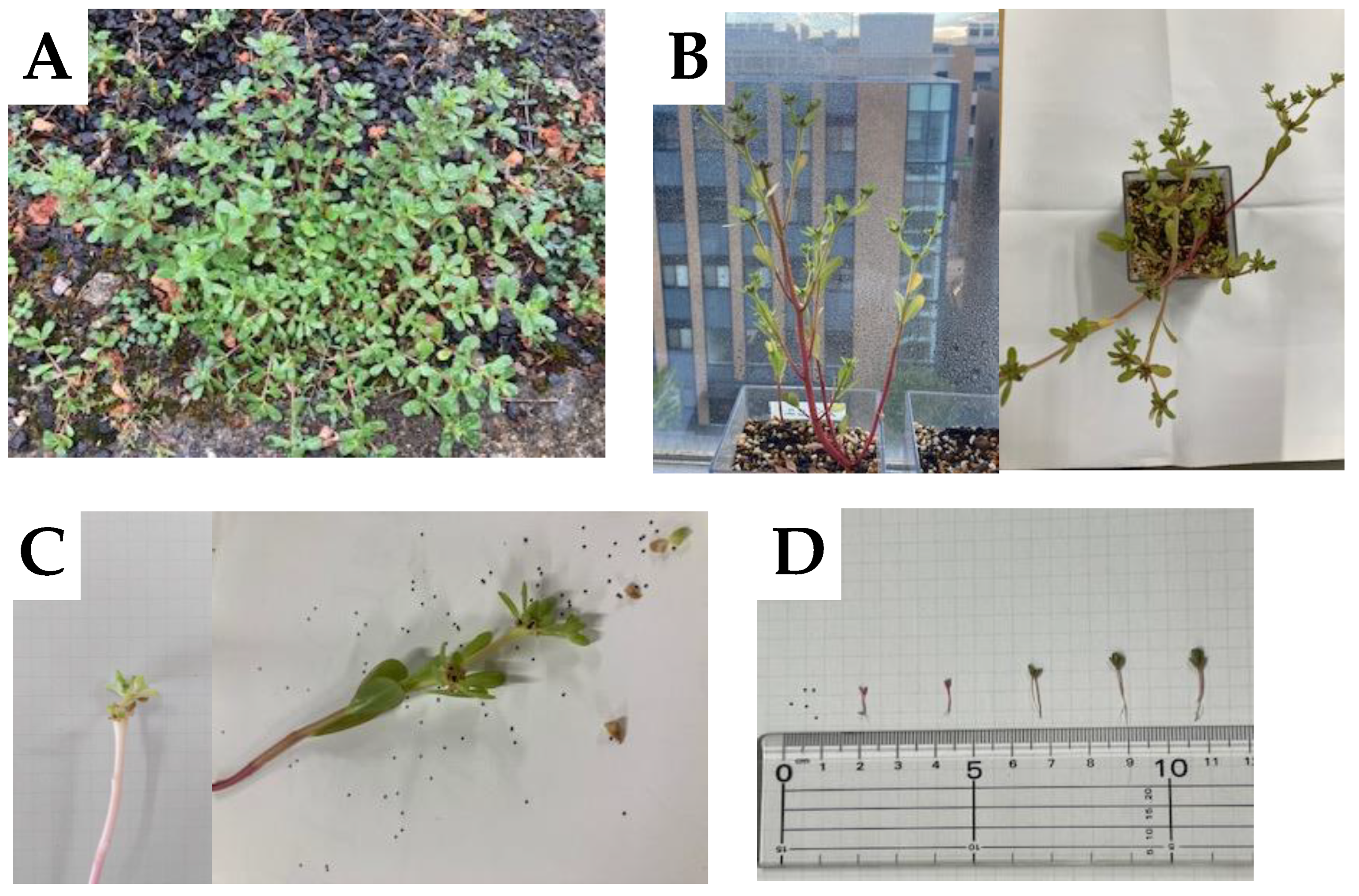
Figure 2.
Bibliometric analysis of research articles on purslane using the Scopus database. A: Changes in the annual number of original research articles published from 2015 to 2025, identified using “Portulaca oleracea” or “purslane” as search terms. B: Country-wise distribution of articles identified using the same search conditions. C: Distribution of articles by subject area identified using the same search conditions.
Figure 2.
Bibliometric analysis of research articles on purslane using the Scopus database. A: Changes in the annual number of original research articles published from 2015 to 2025, identified using “Portulaca oleracea” or “purslane” as search terms. B: Country-wise distribution of articles identified using the same search conditions. C: Distribution of articles by subject area identified using the same search conditions.
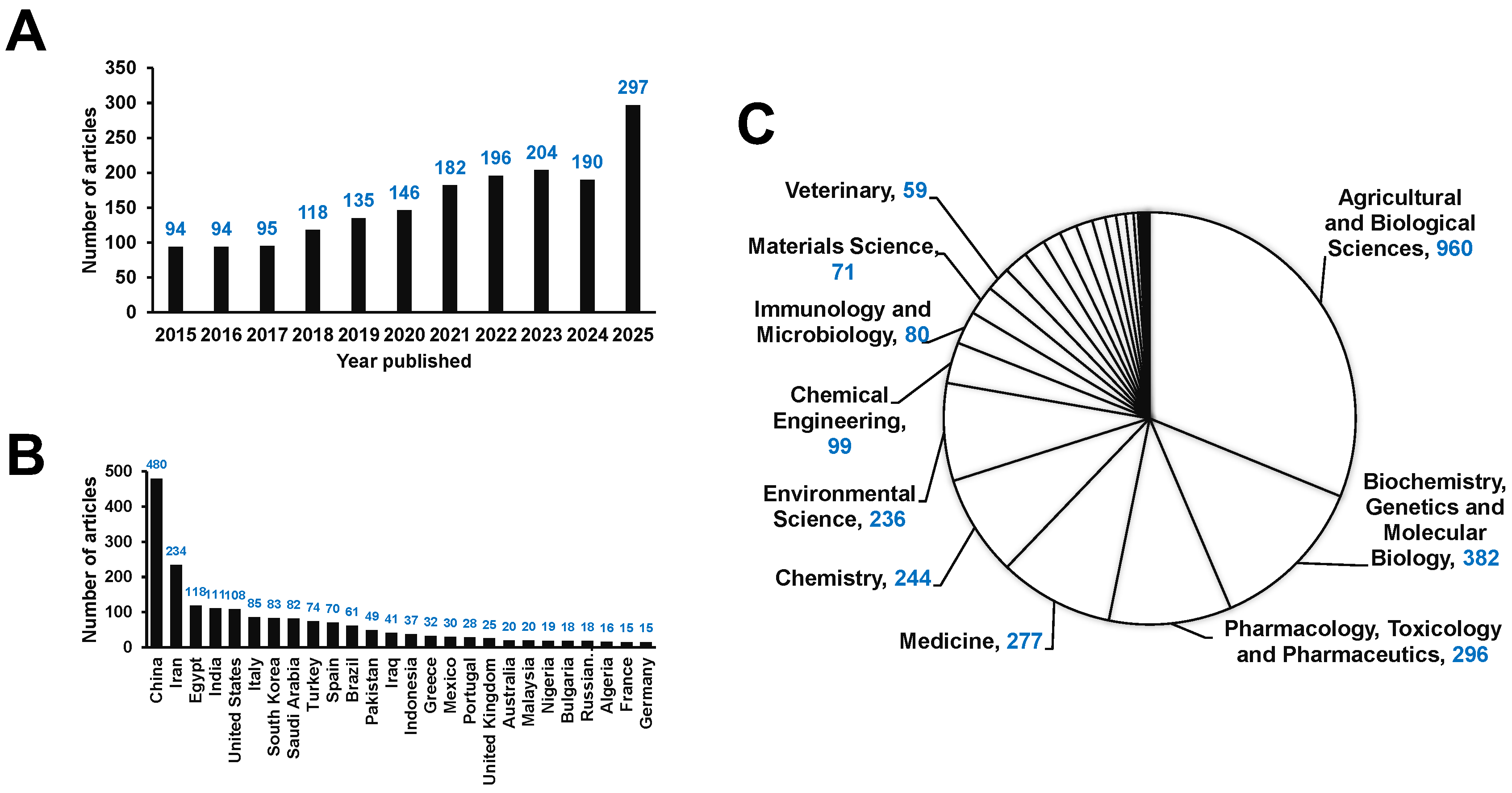
Figure 3.
Dried purslane as a preserved food and examples of prepared dishes. A: Appearance of dried purslane (Hyo) used as a preserved food. The left panel shows the whole sample, and the right panel shows a single stem. B: Appearance of the dried purslane shown in “A” after rehydration and boiling. The left panel shows the whole sample, and the right panel shows a single stem. C: Simmered Hyo-boshi, a traditional dish (ohitashi) eaten in Yamagata Prefecture. This dish was prepared using the rehydrated purslane shown in B. Each division on the ruler represents 1 cm.
Figure 3.
Dried purslane as a preserved food and examples of prepared dishes. A: Appearance of dried purslane (Hyo) used as a preserved food. The left panel shows the whole sample, and the right panel shows a single stem. B: Appearance of the dried purslane shown in “A” after rehydration and boiling. The left panel shows the whole sample, and the right panel shows a single stem. C: Simmered Hyo-boshi, a traditional dish (ohitashi) eaten in Yamagata Prefecture. This dish was prepared using the rehydrated purslane shown in B. Each division on the ruler represents 1 cm.
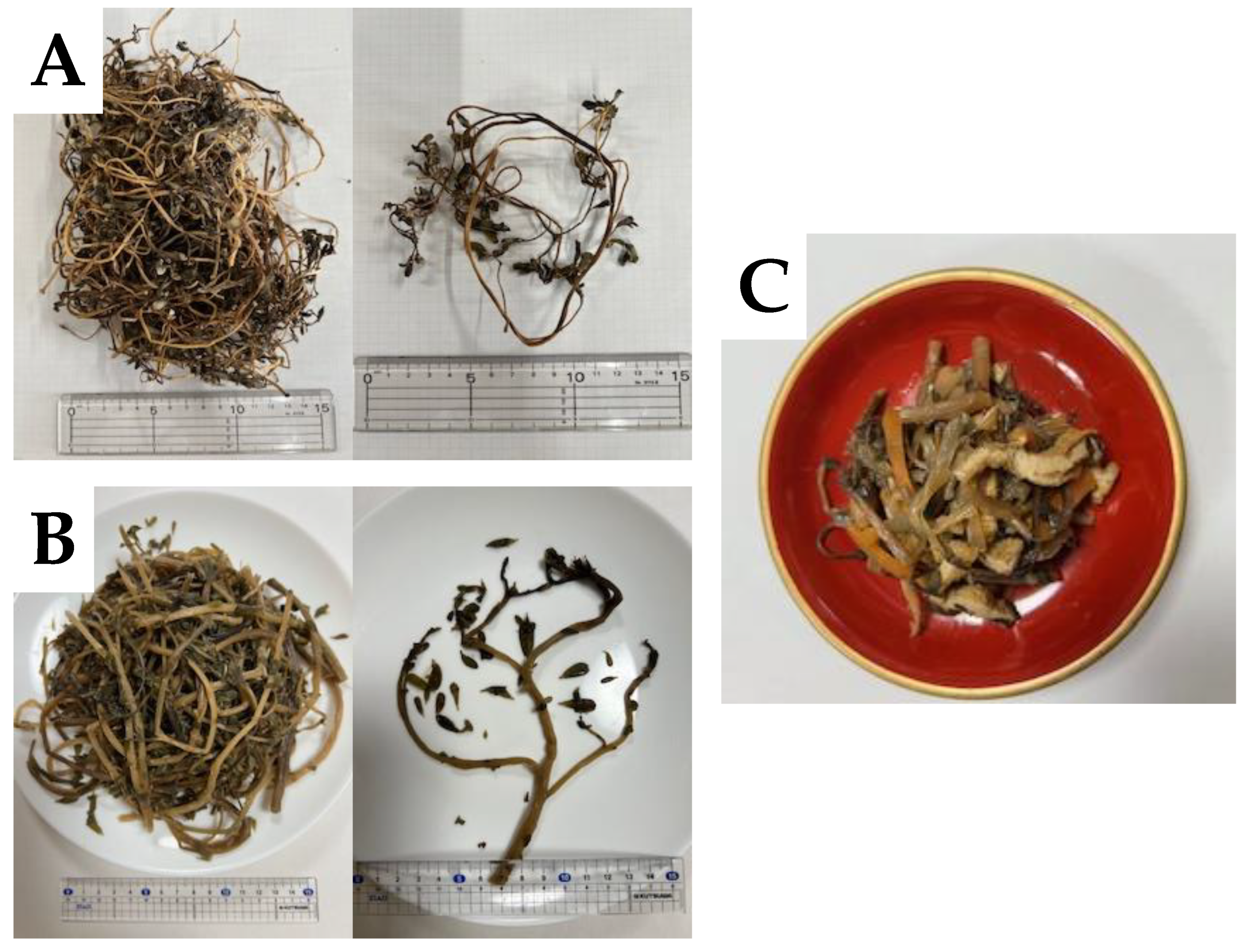

Table 1.
General composition of wild and cultivated purslane.
| Growth status | Plant part | Unit | Water | Carbo hydrates |
Protein | Fat | Ash | Ref. |
|---|---|---|---|---|---|---|---|---|
| Cultivated | Whole | g/100g FW | 92.9 | 3.39 | 2.03 | 0.36 | 1.36 | [24] |
| Cultivated | Whole | g/100g FW | 93 | 2.65 | 3 | 1.21 | 1.86 | [25] |
| Cultivated | Whole | g/100g FW (n=3) |
83.12 ± 1.09 |
8.41 ± 0.90 |
1.49 ± 0.00 |
0.99 ± 0.00 |
3.39 ± 0.06 |
[26] |
| Cultivated | Leaves | g/100g FW (n=3) |
88.16 ± 0.41 |
6.2 ± 0.1 |
2.96 ± 0.04 |
0.230 ± 0.001 |
2.40 ± 0.06 |
[27] |
| Cultivated | Stems | g/100g FW (n=3) |
91.31 ± 0.1 |
5.39 ± 0.03 |
1.44 ± 0.01 |
0.111 ± 0.003 |
1.74 ± 0.04 |
[27] |
| Cultivated | Seeds | g/100g DW (n=3) |
9.65 ± 0.03 |
53.43 ± 0.04 |
27.58 ± 0.01 |
15.03 ± 0.06 |
4.0 ± 0.1 |
[28] |
| Cultivated | Seed cake | g/100g DW (n=3) |
6.58 ± 0.03 |
57.2 ± 0.3 |
30.8 ± 0.3 |
8.16 ± 0.06 |
3.92 ± 0.05 |
[28] |
| Wild | Whole | g/100g FW (n=3) |
88.39 ± 0.24 |
4.72 ± 0.21 |
1.56 ± 0.00 |
0.32 ± 0.00 |
2.62 ± 0.02 |
[26] |
| Wild | Leaves | g/100g DW (n=3) |
4.14 ± 0.64 |
- | 18.04 ± 0.61 |
3.97 ± 0.23 |
19.70 ± 0.15 |
[29] |
| Wild | Stems | g/100g DW (n=3) |
6.90 ± 0.56 |
- | 15.62 ± 1.63 |
3.06 ± 0.34 |
14.74 ± 0.33 |
[29] |
| DW, dry weight; FW, fresh weight. Plant part analyzed refers to the plant tissue or material used for analysis, such as whole aerial parts, leaves, stems, seeds, or seed cake. | ||||||||
Table 2.
Major fatty acid contents of wild and cultivated purslane.
| Growth status | Plant part | Unit | C16:0 (Palmitic acid) |
C18:0 (Stearic acid) |
C18:1 (cis-9 Oleic acid) |
C18:2 (cis-9,12 Linoleic acid) |
C18:3 (cis-9,12,15 Linolenic acid) |
Ref. |
|---|---|---|---|---|---|---|---|---|
| Cultivated | Whole | mg/100g FW (n=10) |
25.7 ± 2.2 |
2.9 ± 0.2 |
7.2 ± 0.7 |
24.0 ± 2.2 |
124.7 ± 11.3 |
[31] |
| Cultivated | Whole | mg/100g DW (n=4) |
34.05 ± 1.91 |
6.46 ± 0.48 |
15.19 ± 1.55 |
37.78 ± 1.97 |
98.35 ± 6.78 |
[30] |
| Cultivated | Leaves | mg/100g DW (n=4) |
54.48 ± 8.74 |
9.63 ± 1.30 |
20.59 ± 3.56 |
51.19 ± 7.17 |
189.16 ± 25.52 |
[30] |
| Cultivated | Stems | mg/100g DW (n=4) |
13.45 ± 1.35 |
2.68 ± 0.48 |
6.12 ± 0.78 |
21.92 ± 2.09 |
18.09 ± 1.82 |
[30] |
| Wild | Whole | mg/100g FW | 71.3 | 4.8 | 10.8 | 70.4 | 322.1 | [4] |
| Wild | Whole | mg/100g DW (n=4) |
33.32 ± 0.54 |
6.19 ± 0.61 |
10.52 ± 0.42 |
49.79 ± 0.77 |
82.69 ± 2.34 |
[30] |
| Wild | Leaves | mg/100g DW (n=3) |
137.35 ± 1.64 |
30.94 ± 2.17 |
45.15 ± 1.75 |
152.20 ± 1.39 |
523.14 ± 2.29 |
[32] |
| Wild | Leaves | mg/100g DW (n=4) |
52.34 ± 2.59 |
8.10 ± 0.67 |
14.68 ± 0.88 |
56.09 ± 2.90 |
188.48 ± 6.35 |
[30] |
| Wild | Stems | mg/100g DW (n=3) |
161.03 ± 1.43 |
73.83 ± 0.27 |
32.19 ± 0.30 |
92.47 ± 0.01 |
148.87 ± 3.30 |
[32] |
| Wild | Stems | mg/100g DW (n=4) |
19.61 ± 0.65 |
5.23 ± 0.05 |
6.40 ± 0.21 |
34.67 ± 0.64 |
29.86 ± 1.93 |
[30] |
| Wild | Flowers | mg/100g DW (n=3) |
232.24 ± 16.55 |
41.44 ± 5.79 |
157.48 ± 3.66 |
356.51 ± 1.39 |
216.17 ± 1.16 |
[32] |
Table 3.
Amino acid contents of wild and cultivated purslane.
| Growth status | Cultivated | Cultivated | Cultivated | Cultivated | Wild | |||
|---|---|---|---|---|---|---|---|---|
| Plant part | Whole | Leaves | Seeds | Defatted flour | Whole | |||
| Unit | mg/100g DW (n=3) |
mg/100g FW | mg/100g FW | mg/100g DW | mg/100g DW (n=3) |
|||
| Aspartic acid | 1640 ± 0 | 348.02 | 262.65 | 6311 | 1387 ± 15.28 | |||
| Threonine | 759 ± 5.51 | 135.63 | 111.54 | 2545 | 591 ± 5.03 | |||
| Serine | 756 ± 5.29 | 135.63 | 113.34 | 3262 | 614 ± 5.57 | |||
| Glutamic acid | 2187 ± 11.55 | 665.34 | 424.56 | 9950 | 1843 ± 15.28 | |||
| Proline | 824 ± 2.08 | 133.07 | 131.33 | 703 | 652 ± 16.77 | |||
| Glycine | 918 ± 7.55 | 319.88 | 156.51 | 4332 | 744 ± 4.58 | |||
| Alanine | 1213 ± 15.28 | 150.98 | 151.12 | 2896 | 912 ± 28.57 | |||
| Valine | 976 ± 9.85 | 168.89 | 142.12 | 2183 | 766 ± 3.51 | |||
| Isoleucine | 801 ± 9.17 | 138.19 | 116.93 | 1990 | 672 ± 5.20 | |||
| Leucine | 1463 ± 5.77 | 230.31 | 214.08 | 4667 | 1123 ± 11.55 | |||
| Tyrosine | 677 ± 1.73 | 181.69 | 52.17 | 3232 | 544 ± 7.00 | |||
| Phenylalanine | 853 ± 7.51 | 166.34 | 161.91 | 5469 | 661 ± 7.81 | |||
| Lysine | 978 ± 13.50 | 150.98 | 140.32 | 892 | 872 ± 17.35 | |||
| Histidine | 346 ± 3.21 | 110.04 | 84.55 | 1641 | 296 ± 6.66 | |||
| Arginine | 957 ± 2.00 | 388.97 * | 142.12 * | 6883 | 780 ± 10.02 | |||
| Cystine | 290 ± 13.75 | - | - | - | 138 ± 13.08 | |||
| Methionine | 316 ± 27.68 | 184.25* | 102.54* | 2242 | 215 ± 8.39 | |||
| Ref. | [30] | [35] | [35] | [36] | [30] | |||
| * Values were converted from mg/100 g protein to mg/100 g sample using the reported protein contents of purslane leaves (25.59 g/100 g) and seeds (17.99 g/100 g). | ||||||||
Table 4.
Vitamin contents of wild and cultivated purslane.
| Growth status | Plant part | Unit | Vitamin A related compounds | Vitamin C | Vitamin E | Vitamin K | Ref. |
|---|---|---|---|---|---|---|---|
| Cultivated | Whole | mg/100g FW | 0.792 a | 21 | - | - | [24] |
| Cultivated | Whole | mg/100g FW (n=6) |
- | 0.411 ± 0.036 |
- | - | [37] |
| Cultivated | Whole | mg/100g FW (n=3) |
1.9 ± 0.08 b |
26.6 ± 0.8 |
12.2 ± 0.4 |
- | [4] |
| Cultivated | Whole | mg/100g DW (n=3) |
38.2 ± 2.4 b |
506 ± 17 |
230 ± 9 |
- | [4] |
| Cultivated | Whole | mg/100g DW (n=3) |
< 0.06 a | 152 ± 9.3 |
11.97 ± 0.06 |
1.383 ± 0.0351 |
[30] |
| Cultivated | Leaves | mg/100g FW (n=6) |
5.4 ± 0.3 c |
- | - | - | [37] |
| Cultivated | Leaves | mg/100g FW (n=3) |
2.1 - 3.0 b | - | - | - | [33] |
| Cultivated | Stems | mg/100g FW (n=3) |
0.36-0.65 b | - | - | - | [33] |
| Wild | Whole | mg/100g FW |
- | 8.86 - 30.50 | - | - | [38] |
| Wild | Whole | mg/100g DW (n=3) |
< 0.06 a | 140 ± 12.9 |
7.79 ± 0.04 |
0.907 ± 0.0352 |
[30] |
| Wild | Leaves | mg/100g DW (n=3) |
58 ± 1 b |
399 ± 79 |
- | - | [32] |
| Wild | Stems | mg/100g DW (n=3) |
29 ± 9 b |
227 ± 68 |
- | - | [32] |
| Wild | Flowers | mg/100g DW (n=3) |
55 ± 5 b |
232 ± 28 |
- | - | [32] |
a: values were originally reported as IU. For comparison with carotenoid values, IU values were converted to β-carotene equivalents using 1 IU = 0.6 µg β-carotene. b: expressed as β-carotene content. c: expressed as total carotenoid content.
Table 5.
Phenolic compound contents of wild and cultivated purslane.
| Growth status | Plant part | Unit | Total phenols |
Total flavonoids |
Gallic acid |
Caffeic acid |
Syringic acid |
p-Coumaric acid |
Ferulic acid |
Sinapic acid |
Ref. |
|---|---|---|---|---|---|---|---|---|---|---|---|
| Cultivated | Whole | mg /100g FW (n=6) |
29 ± 1 |
- | - | - | - | - | - | - | [37] |
| Cultivated | Whole | mg /100g DW | 57 | - | - | - | - | - | - | - | [40] |
| Cultivated | Whole | mg /100g DW (n=3) |
117.42 ± 0.14 |
- | - | - | - | - | - | - | [30] |
| Cultivated | Leaves | mg/100g FW (n=3) |
63.29 ± 0.49 |
179.10 ± 4.55 |
2.73 ± 0.61 |
1.74 ± 0.53 |
1.54 ± 0.99 |
0.64 ± 0.05 |
0.71 ± 0.02 |
- | [41] |
| Cultivated | Leaves | mg/100g DW (n=10) |
- | - | 4.213 ± 0.191 |
36.373 ± 0.240 |
2.121 ± 0.483 |
32.093 ± 0.294 |
- | 122.920 ± 1.089 |
[42] |
| Cultivated | Leaves | mg/100g DW (n=3) |
29.3 ± 0.4 |
- | - | - | - | - | - | - | [27] |
| Cultivated | Leaves | mg /100g DW (n=3) |
155.91 ± 12.52 |
- | - | - | - | - | - | - | [30] |
| Cultivated | Stems | mg/100g FW (n=3) |
29.40 ± 0.43 |
53.29 ± 0.84 |
3.67 ± 0.00 |
0.94 ± 0.17 |
0.68 ± 0.06 |
0.03 ± 0.01 |
0.03 ± 0.01 |
- | [41] |
| Cultivated | Stems | mg/100 DW (n=10) |
- | - | 2.123 ± 0.185 |
4.957 ± 0.750 |
14.313 ± 0.446 |
6.003 ± 0.233 |
- | 3.862 ± 0.172 |
[42] |
| Cultivated | Stems | mg/100g DW (n=3) |
12.2 ± 0.1 |
- | - | 0.45 ± 0.01 |
- | - | - | 4.3 ± 0.2 |
[27] |
| Cultivated | Stems | mg /100g DW (n=3) |
59.86 ± 1.49 |
- | - | - | - | - | - | - | [30] |
| Cultivated | Roots | mg/100g FW (n=3) |
75.83 ± 0.85 |
281.86 ± 9.83 |
0.89 ± 0.08 |
0.36 ± 0.01 |
0.29 ± 0.03 |
0.01 ± 0.00 |
0.04 ± 0.01 |
- | [41] |
| Cultivated | Flowers | mg/100g FW (n=3) |
102.42 ± 4.63 |
402.71 ± 13.14 |
0.43 ± 0.04 |
0.28 ± 0.08 |
0.41 ± 0.07 |
0.30 ± 0.05 |
3.24 ± 0.98 |
- | [41] |
| Wild | Whole | mg /100g DW (n=3) |
142.08 ± 1.14 |
- | - | - | - | - | - | - | [30] |
| Wild | Whole | mg/100g DW | - | 682 | - | - | - | - | - | - | [43] |
| Wild | Leaves | mg/100g FW (n=3) |
60.12 ± 0.85 |
141.10 ± 3.94 |
2.51 ± 0.72 |
1.08 ± 0.37 |
0.88 ± 0.40 |
0.13 ± 0.02 |
0.22 ± 0.04 |
- | [41] |
| Wild a | Leaves | mg/100g DW (n=10) |
- | - | 2.630 ± 0.217 |
15.700 ± 0.250 |
86.937 ± 0.205 |
38.367 ± 0.467 |
- | 113.863 ± 1.967 |
[42] |
| Wild a | Leaves | mg/100g DW (n=10) |
- | - | 3.057 ± 0.229 |
28.037 ± 0.350 |
36.377 ± 0.464 |
28.840 ± 0.980 |
- | 128.187 ± 1.742 |
[42] |
| Wild a | Leaves | mg/100g DW (n=10) |
- | - | 44.617 ± 0.350 |
66.883 ± 0.261 |
64.250 ± 0.217 |
33.312 ± 0.336 |
87.713 ± 0.940 |
[42] | |
| Wild | Leaves | mg/100g DW (n=3) |
3041 ± 157 |
7414± 84 |
278 ± 28 |
247 ± 59 |
238 ± 33 |
182 ± 57 |
- | - | [32] |
| Wild | Leaves | mg /100g DW (n=3) |
136.05 ± 7.46 |
- | - | - | - | - | - | - | [30] |
| Wild b | Leaves | mg/100g DW | - | 176 | - | - | - | - | - | - | [43] |
| Wild | Stems | mg/100g FW (n=3) |
37.17 ± 0.28 |
87.57 ± 1.93 |
2.46 ± 0.29 |
0.64 ± 0.03 |
0.33 ± 0.06 |
0.03 ± 0.01 |
0.05 ± 0.01 |
- | [41] |
| Wild a | Stems | mg/100g DW (n=10) |
- | - | 2.923 ± 0.155 |
3.297 ± 0.448 |
2.437 ± 0.360 |
4.567 ± 0.684 |
- | 13.717 ± 0.536 |
[42] |
| Wild a | Stems | mg/100g DW (n=10) | - | - | 3.877 ± 0.047 |
8.137 ± 0.597 |
8.380 ± 0.428 |
9.590 ± 0.816 |
- | 44.913 ± 0.254 |
[42] |
| Wild a | Stems | mg/100g DW (n=10) |
- | - | 1.750 ± 0.121 |
2.467 ± 0.042 |
3.153 ± 0.072 |
2.953 ± 0.094 |
- | 14.117 ± 0.462 |
[42] |
| Wild | Stems | mg/100g DW (n=3) |
3139 ± 128 |
2816 ± 22 |
415 ± 32 |
297 ± 36 |
209 ± 32 |
191 ± 31 |
- | - | [32] |
| Wild | Stems | mg /100g DW (n=3) |
110.56 ± 3.88 |
- | - | - | - | - | - | - | [30] |
| Wild b | Stems | mg/100g DW | - | 512 | - | - | - | - | - | - | [43] |
| Wild | Roots | mg/100g FW (n=3) |
42.42 ± 1.76 |
126.52 ± 2.75 |
3.45 ± 0.99 |
1.80 ± 0.53 |
1.35 ± 0.58 |
0.51 ± 0.04 |
0.27 ± 0.08 |
- | [41] |
| Wild b | Roots | mg/100g DW | - | 1136 | - | - | - | - | - | - | [43] |
| Wild | Flowers | mg/100g FW (n=3) |
64.56 ± 0.68 |
153.95 ± 1.10 |
3.62 ± 0.36 |
0.84 ± 0.05 |
1.83 ± 0.61 |
0.37 ± 0.18 |
0.30 ± 0.08 |
- | [41] |
| Wild | Flowers | mg/100g DW (n=3) |
3753 ± 20 |
3400 ± 21 |
311 ± 35 |
368 ± 25 |
249 ± 6 |
223 ± 6 |
- | - | [32] |
a: samples derived from mutually distinct geographical populations. b: data obtained from defatted sample. Total phenols and total flavonoids are expressed according to the standards used in the original reports and are not directly comparable with individual phenolic compounds.
Table 6.
Mineral contents of wild and cultivated purslanes.
| Growth status | Plant part | Unit | Ca | Mg | K | P | Na | Fe | Cu | Zn | Mn | Ref. |
|---|---|---|---|---|---|---|---|---|---|---|---|---|
| Cultivated | Whole | mg/100g FW (n=3) |
110.59 ± 16.02 |
91.68 ± 18.91 |
271.91 ± 34.37 |
58.73 ± 7.56 |
0.81 ± 0.06 |
1.35 ± 0.18 |
0.36 ± 0.05 |
1.08 ± 0.14 |
- | [26] |
| Cultivated a | Whole | mg/100g FW (n=3) |
154.5 ± 13.41 |
120.0 ± 4.05 |
523.6 ± 69.86 |
- | - | 0.93 ± 0.25 |
- | 0.27 ± 0.04 |
0.51 ± 0.01 |
[45] |
| Cultivated a | Whole | mg/100g FW (n=3) |
160.0 ± 7.80 |
125.5 ± 13.30 |
633.64 ± 28.91 |
- | - | 1.73 ± 0.93 |
- | 0.33 ± 0.08 |
0.53 ± 0.01 |
[45] |
| Cultivated | Whole | mg/100g DW | 1361 | 1037 | - | 333 | 148 | 42 | 3 | 34 | 24 | [25] |
| Cultivated | Whole | mg/100g DW (n=3) |
914.33 ± 17.95 |
1266.67 ± 20.82 |
6400 ± 141.07 |
281.67 ± 3.21 |
35.07 ± 1.72 |
41.73 ± 0.67 |
1.18 ± 0.02 |
6.62 ± 0.18 |
6.77 ± 0.12 |
[30] |
| Cultivated | Flowers | mg/100g DW (n=3) |
510.44 ± 2.18 |
616.42 ± 9.59 |
2834.12 ± 159.85 |
303.91 ± 16.84 |
- | 14.27 ± 0.03 |
1.38 ± 0.09 |
3.26 ± 0.08 |
4.34 ± 0.08 |
[41] |
| Cultivated | Leaves | mg/100g DW (n=3) |
1960.08 ± 9.21 |
1453.90 ± 82.57 |
7131.22 ± 90.1 |
284.11 ± 10.58 |
- | 34.96 ± 0.23 |
1.16 ± 0.09 |
2.54 ± 0.07 |
9.45 ± 0.11 |
[41] |
| Cultivated | Stems | mg/100g DW (n=3) |
1780.32 ± 137.82 |
717.40 ± 9.64 |
8564.50 ± 103.35 |
106.73 ± 5.97 |
- | 6.46 ± 0.16 |
0.62 ± 0.03 |
1.07 ± 0.08 |
1.75 ± 0.06 |
[41] |
| Cultivated | Roots | mg/100g DW (n=3) |
1349.47 ± 133.95 |
636.40 ± 10.87 |
4679.80 ± 50.30 |
105.94 ± 7.41 |
- | 60.84 ± 0.14 |
0.86 ± 0.08 |
1.33 ± 0.19 |
2.44 ± 0.10 |
[41] |
| Wild a | Whole | mg/100g FW (n=3) |
233.6 ± 24.01 a |
144.18 ± 4.53 |
704.88 ± 0.00 |
- | - | 0.28 ± 0.04 |
- | 0.32 ± 0.04 |
0.39 ± 0.08 |
[45] |
| Wild a | Whole | mg/100g FW (n=3) |
225.0 ± 45.28 a |
161.2 ± 0.78 |
653.7 ± 47.01 |
- | - | 0.16 ± 0.08 |
- | 0.30 ± 0.05 |
0.45 ± 0.05 |
[45] |
| Wild a | Whole | mg/100g FW (n=3) |
216.38 ± 51.08 a |
173.0 ± 5.29 |
654.6 ± 0.00 |
- | - | 1.06 ± 0.00 |
- | 0.29 ± 0.01 |
0.48 ± 0.00 |
[45] |
| Wild a | Whole | mg/100g FW (n=3) |
179.1 ± 6.66 a |
121.3 ± 3.79 |
396.3 ± 15.15 |
- | - | 2.34 ± 0.00 |
- | 0.21 ± 0.02 |
0.59 ± 0.19 |
[45] |
| Wild | Whole | mg/100g DW (n=3) |
1033.33 ± 23.09 |
916.33 ± 5.69 |
6690 ± 95.39 |
580.33 ± 7.09 |
15.57 ± 1.45 |
121.67 ± 2.08 |
1.20 ± 0.01 |
5.26 ± 0.04 |
6.08 ± 0.08 |
[30] |
| Wild | Whole | mg/100g FW (n=3) |
186.67 ± 28.36 |
165.33 ± 9.50 |
776.67 ± 171.50 |
33.67 ± 0.93 |
16.60 ± 0.03 |
1.80 ± 0.18 |
0.14 ± 0.01 |
0.99 ± 0.06 |
- | [26] |
| Wild | Flowers | mg/100g DW (n=3) |
1175.52 ± 153.71 |
1229.59 ± 12.18 |
3680.89 ± 50.62 |
307.81 ± 9.61 |
- | 39.63 ± 0.09 |
1.68 ± 0.05 |
2.43 ± 0.19 |
5.06 ± 0.17 |
[41] |
| Wild | Leaves | mg/100g DW (n=3) |
1863.88 ± 50.11 |
1575.25 ± 124.13 |
4149.84 ± 14.11 |
292.76 ± 5.13 |
- | 59.21 ± 0.19 |
1.58 ± 0.16 |
1.66 ± 0.10 |
7.39 ± 0.17 |
[41] |
| Wild | Stems | mg/100g DW (n=3) |
1346.20 ± 105.75 |
837.09 ± 14.62 |
5928.16 ± 141.27 |
120.77 ± 0.49 |
- | 13.47 ± 0.06 |
0.89 ± 0.01 |
0.76 ± 0.13 |
1.36 ± 0.09 |
[41] |
| Wild | Roots | mg/100g DW (n=3) |
753.60 ± 9.09 |
374.56 ± 6.19 |
2721.32 ± 63.69 |
117.75 ± 4.08 |
- | 52.75 ± 0.24 |
1.27 ± 0.13 |
0.94 ± 0.13 |
2.17 ± 0.06 |
[41] |
a: samples derived from mutually distinct geographical populations. Ca, calcium; Mg, magnesium; K, potassium; P, phosphorus; Na, sodium; Fe, iron; Cu, copper; Zn, zinc; Mn, manganese.
Disclaimer/Publisher’s Note: The statements, opinions and data contained in all publications are solely those of the individual author(s) and contributor(s) and not of MDPI and/or the editor(s). MDPI and/or the editor(s) disclaim responsibility for any injury to people or property resulting from any ideas, methods, instructions or products referred to in the content. |
© 2026 by the authors. Licensee MDPI, Basel, Switzerland. This article is an open access article distributed under the terms and conditions of the Creative Commons Attribution (CC BY) license (http://creativecommons.org/licenses/by/4.0/).
Copyright: This open access article is published under a Creative Commons CC BY 4.0 license, which permit the free download, distribution, and reuse, provided that the author and preprint are cited in any reuse.


