

Submitted:
21 July 2026
Posted:
22 July 2026
You are already at the latest version
Abstract
Mindfulness-based programs are implemented at scale in schools, workplaces, and clinics on the assertion that they help people handle stress and function under pressure, yet how mindfulness functions in the stress process remains challenged. This scoping review (Arksey & O’Malley framework; PRISMA-ScR reporting) maps a decade of evidence (2016–2026) on how mindfulness functions as a handling resource under stress and anxiety, organizing the literature around coping and emotion regulation as the proposed mechanism rather than treating cognition as a standalone outcome. Four patterns recur. First, mindfulness is reliably associated with a shift toward antecedent-focused, low-cost coping—reappraisal and acceptance—and away from rumination, avoidance, and suppression. Second, this regulatory shift, rather than any direct boost of cognitive machinery, best accounts for the downstream benefits remarked, including a modest, accuracy-specific shield of cognition underload. Third, effects are strongly moderated by trait anxiety, stress or chronicity, task demand, and age, and are largest where affective interference is greatest. Fourth, effects are often small, fragile, and poorly sustained. We argue that coping and emotion regulation are most helpfully treated as the mediating pathway between mindfulness and stress-related upshots, and outline a research agenda centered on mediation, component specificity, boundary conditions, and durability.
Keywords:
coping
; emotion regulation
; mindfulness
; stress appraisal
; trait anxiety
; cognitive performance
The claim that a person can be taught to manage stress more adeptly by learning to attend, deliberately and without judgment, to the present moment has been remarkably durable. It guarantees a global industry of mindfulness devotions, a substantial share of contemporary school-wellbeing curricula, and a spread-out menu of workplace and clinical programs. It also rests on an empirical idea shakier than its popularity implies: that mindfulness constantly improves how people cope with stress, and that improved coping in turn guards the emotional, physiological, and cognitive functioning that stress would otherwise wear away. This review takes that premise seriously enough to examine it critically, and it does so by placing coping — not cognition — at the center of the analysis.
The constructs at issue each carry their own sagas. Coping, in the transactional convention inaugurated by Lazarus and Folkman (1984), refers to the cognitive and behavioral energies a person utilizes to manage demands assessed as taxing or exceeding their resources. It is not a single act but a gamut, and the strategies within it — reappraisal, acceptance, problem-solving, distraction, suppression, contemplation, avoidance — differ vastly in their consequences. Mindfulness, as operationalized by Bishop et al. (2004), joins the self-regulation of attention toward present feeling with an orientation of curiosity and acceptance concerning whatever arises. Anxiety, the affective state around which this journal is systematized, is both an antecedent that biases appraisal toward threat and a significance that coping succeeds or fails at containing; it also serves, as we will show, as the moderator that most tight patterns when mindfulness helps and when it does not.
Set out this way, the paradigms interlock, and a causal story recommends itself almost too readily: mindfulness cultivates the attentional and compliant skills that adaptive coping requires; adaptive coping normalizes the stress response; and better-regulated stress defends downstream functioning, cognition included. Part of the work of this review is to ask how much of that story the evidence can bear, and to specify where in the stress process mindfulness reasonably acts.
Our purpose is threefold. We aim, first, to map the past decade’s evidence on mindfulness as a surviving resource under stress and anxiety, without fading into either promotional enthusiasm or reflexive dismissal. We aim, second, to manage that evidence around mechanism, treating coping and emotion regulation as the candidate pathway rather than as parallel outcomes alongside others. And we aim, third, to be obvious about where the literature is thin, internally contradictory, or methodologically negotiated. The contribution we hope to make is less the discovery of new paraphernalia than the disciplined reframing of familiar ones: a shift from asking whether mindfulness makes people function better to asking how, for whom, and under what circumstances it helps them cope under stress.
1. Theoretical Foundations
Any serious treatment of how mindfulness bears on coping has to begin with a prior question too often skipped: why should stress affect functioning in the first place, and where in the stream of an emotional episode might mindfulness or coping intervene? The apparatus assembled over the past three decades answers both, and it is worth laying out with some care, because the empirical sections that follow are only as interpretable as the framework that organizes them.
1.1. Coping and Its Measurement
The transactional model regards coping as a dynamic, appraisal-driven process rather than a balanced trait. Primary appraisal evaluates what is at claim; secondary appraisal gauges what can be done; and managing efforts follow, conventionally divided into problem-focused efforts that act on the stressor and emotion-focused energies that act on the response. A parallel and now widely used axis perceives approach from avoidance orientations. These divisions matter methodologically as much as conceptually: coping is evaluated through dispositional inventories, situation-specific checklists, and progressively through experience-sampling of coping in daily life, and these traditions do not always converge. A review that pools across them risks heterogeneity, a point we return to when weighing the evidence.
1.2. Coping and Emotion Regulation: Overlapping, not Identical
Because most of the mindfulness literature is outlined in the language of emotion regulation rather than coping, the relationship between the two constructs needs to start directly. Emotion regulation, in Gross’s (1998, 2015) process model, refers to the shaping of which emotions one has, when, and how they are experienced and expressed; coping refers to the broader management of stressful demands, of which emotion regulation is one part. The two literatures overlap heavily in their most-studied strategies — reappraisal, acceptance, suppression, and rumination appear in both — but coping furthermore encompasses instrumental, problem-directed action that the emotion-regulation frame does not. We treat emotion regulation as the affect-focused core of coping, and are explicit throughout about which literature a given finding is drawn from, because conflating the two is a persistent source of confusion in this area.
1.3. The process Model and the Cost of Strategies
Gross’s model locates regulatory efforts at distinct points in the temporal unfolding of an emotional response — situation selection, situation modification, attentional deployment, cognitive change, and response modulation — and argues that strategies acting earlier tend to be less costly and more effective than those acting later. Cognitive reappraisal, an antecedent-focused strategy that reinterprets a situation’s meaning before the emotional response has crystallized, generally outperforms expressive suppression, a response-focused strategy that inhibits expression after the fact and imposes an ongoing self-regulatory load. This asymmetry is central to everything that follows.
1.4. Why Anxiety Makes Regulation Consequential
Attentional control theory (Eysenck et al., 2007) supplies the account of anxiety’s cost that gives regulation its stakes. Anxiety, on this view, impairs processing efficiency — the relationship between performance and the resources expended to achieve it — more than performance effectiveness, the quality of the output itself; anxious individuals often reach acceptable outcomes, but only by recruiting compensatory effort, because worry consumes the working-memory capacity that goal-directed activity requires. The theory predicts that anxiety preferentially disrupts inhibition and shifting, allowing stimulus-driven attention to override goal-driven control. The implication for coping is precise: strategies that reduce worry, or free attention from its grip, should protect functioning most where anxiety’s interference is greatest — a prediction that reappears, vindicated, in the moderator evidence.
1.5. Mindfulness-Specific Theories
Two mindfulness theories connect these frameworks to contemplative practice. The Mindfulness-to-Meaning Theory (Garland et al., 2015) proposes that mindfulness, by enhancing interoceptive and metacognitive awareness, loosens habitual appraisals and widens the interpretations a person can bring to a stressor, facilitating positive reappraisal in an upward spiral. On this view the link between mindfulness and any downstream outcome runs squarely through appraisal — that is, through coping. Monitor and Acceptance Theory (Lindsay & Creswell, 2017) is more surgical: it decomposes mindfulness into attention monitoring and acceptance, and predicts that monitoring alone can increase affective reactivity and becomes beneficial only when paired with acceptance. This dissolves the assumption that more present-moment awareness is uniformly good and predicts that benefits should depend on which component is trained — a prediction with direct applied consequences.
Synthesizing across these frameworks yields a testable expectation rather than a vague hope. If stress degrades functioning chiefly by loading working memory with worry and biasing attention toward threat, and if mindfulness works chiefly by supporting acceptance and reappraisal — the antecedent-focused, low-cost strategies the process model favors — then mindfulness should regulate stress mainly through emotion regulation, mainly under conditions of high anxiety or demand, and mainly by subtracting maladaptive load rather than adding capacity. Whether the empirical record honors that expectation is the question the rest of this review pursues.
2. Method
We conducted a scoping review following the framework of Arksey and O’Malley (2005) as refined by Levac et al. (2010), and we report it in accordance with the PRISMA extension for Scoping Reviews (PRISMA-ScR; Tricco et al., 2018). A scoping design was chosen deliberately: the literature spanning mindfulness, coping, and stress-related outcomes is too heterogeneous in populations, interventions, and measures for a single quantitative pooling to be meaningful, yet it is mature enough to warrant a systematic charting of what has been studied, how, and with what convergence. A scoping review preserves interpretive synthesis while imposing the transparency a narrative review lack. The protocol was registered a priori on the Open Science Framework [https://doi.org/10.17605/OSF.IO/BPYGS]; the completed PRISMA-ScR checklist is provided as Supplementary Material.
2.1. Eligibility Criteria
We included peer-reviewed empirical studies, systematic reviews, and meta-analyses that addressed the joint operation of at least two of the three focal constructs — mindfulness (dispositional or state/intervention), coping or emotion regulation, and a stress-related outcome (affective, physiological, or cognitive) — in human samples. We prioritized work reporting effects against active rather than merely passive controls. We excluded purely descriptive intervention reports lacking a comparison condition, studies of contemplative practices sufficiently distant from secular mindfulness to raise construct-validity concerns, and non-peer-reviewed grey literature, save where a doctoral thesis contributed a meta-analysis not otherwise available. Foundational earlier sources were retained where they anchor constructs still in active use.
2.2. Information Sources and Search Strategy
We searched PsycINFO, PubMed, Web of Science, and Scopus for the window January 2016 to March 2026, supplemented by backward and forward citation tracing and by hand-searching Mindfulness, Emotion, Clinical Psychology Review, and this journal. Search strings crossed three term clusters combined with the Boolean operator AND, with terms within each cluster combined with OR: a mindfulness cluster (mindfulness, meditation, MBSR, MBCT, dispositional mindfulness, state mindfulness), a coping and emotion-regulation cluster (coping, cognitive reappraisal, acceptance, rumination, avoidance, expressive suppression, emotion regulation, stress appraisal), and an outcome cluster (stress, anxiety, physiological reactivity, executive function, working memory, attention, cognitive performance). The full search string executed in each database, with field tags and result counts, is reported in Appendix A.
2.3. Source Selection and Charting
The selection process and its yield are summarized in the PRISMA-ScR flow diagram (Figure 1); bracketed counts in that figure are to be completed from the final screening log. Two reviewers screened titles and abstracts independently, with disagreements resolved by discussion and a third reviewer consulted where needed; full texts of potentially eligible records were then assessed against the eligibility criteria. A standardized data-charting form recorded, for each source, the study or synthesis design, population, mindfulness operationalization (trait vs. state/intervention), coping or emotion-regulation strategy addressed, comparator type, outcome domain, and the direction and magnitude of effects. The charted characteristics of the pivotal sources are summarized in Table 1; the full charting matrix is available in the Supplementary Material.
3. Mindfulness as a Coping Resource
If mindfulness matters for the stress process primarily through coping, the first thing to establish is that it genuinely functions as a coping resource — that it reliably shifts the strategies people use in an adaptive direction. Here the evidence is comparatively strong, and it predates most of the recent enthusiasm.
Dispositional mindfulness, measured as a stable individual difference, is consistently associated with the strategies stress researchers regard as adaptive: people higher in trait mindfulness report more frequent reappraisal and acceptance and less rumination, avoidance, and suppression (Brown & Ryan, 2003; Roemer et al., 2015). The observational work of Garland et al. (2011) is instructive: across an eight-week mindfulness-based program, increases in dispositional mindfulness tracked increases in positive reappraisal, and reappraisal in turn mediated the stress-reductive effect of training — precisely the mediational architecture the Mindfulness-to-Meaning Theory predicts, locating the action in appraisal rather than in raw attentional capacity.
The distinction between dispositional and state mindfulness deserves more attention than it usually receives. Dispositional mindfulness may reflect the accumulated sediment of temperament and long practice, and its correlations with adaptive coping could be confounded by third variables. State mindfulness — the transient condition induced by a specific practice — affords cleaner causal inference, and experimental inductions have been shown to reduce emotional reactivity and shift in-the-moment coping toward acceptance rather than avoidance. The two can dissociate, and studies that conflate them risk attributing to a trainable skill what may be a stable disposition. This bear directly affects mindfulness interventions can be expected to reproduce the benefits observed in naturally mindful people.
A mechanistic account of how mindfulness reshapes coping centers on decentering — the metacognitive capacity to observe thoughts and feelings as transient mental events rather than direct readouts of reality. Decentering is plausibly the hinge on which mindfulness converts into adaptive coping: a person who can regard an anxious thought as merely a thought is less likely to be swept into rumination and better positioned to reappraise. Hölzel et al. (2011) proposed attention regulation, body awareness, emotion regulation, and change in self-perspective as the components through which mindfulness operates, an account that dovetails with Monitor and Acceptance Theory. The neuroscientific literature adds that mindfulness training is associated with altered engagement of prefrontal regulatory regions and the amygdala during affective challenge (Tang et al., 2015), consistent with a top-down regulatory pathway, though the causal and clinical significance of these neural changes remains contested.
An important qualification tempers this picture, and Monitor and Acceptance Theory anticipates it: attention monitoring without acceptance may not help, and can hurt. Heightened awareness of internal experience, absent an accepting stance, can amplify distress — a possibility that maps onto reports of adverse effects in a minority of meditators and onto the broader recognition that mindfulness is not universally benign (Britton, 2019; Van Dam et al., 2018). Dismantling studies that remove the acceptance component have found the stripped-down version less effective for stress and affective outcomes, supporting the theory’s core prediction that acceptance is the active regulatory ingredient. For program design, the implication is pointed: interventions that train monitoring while neglecting acceptance may raise reactivity rather than regulate it.
Taken together, the evidence that mindfulness functions as a coping resource is reasonably robust, especially for the reappraisal and acceptance pathways. What that evidence does not by itself establish is that this regulatory shift translates automatically into any particular downstream benefit; that is a separate empirical claim, to which we now turn.
4. Coping Strategies and the Regulation of Stress
Not all coping is created equal. The strategies a person brings to a stressor differ not only in how well they regulate affect but in what they cost the regulatory system, and a decade of work has begun to map those costs with some precision. Organizing the evidence by strategy brings the pattern into focus.
Cognitive reappraisal has the strongest claim to being adaptive, consistent with both the process model and the executive-function literature. Because it intervenes early, it tends to be effective without imposing the sustained load that later-stage strategies demand. Experimental work has shown that reappraising physiological arousal as functional rather than threatening improves cardiovascular profiles and, in some studies, task performance under evaluative stress (Jamieson et al., 2012), and the stress-mindset literature has made related claims (Crum et al., 2013). The meta-analytic picture is encouraging but bounded: Bosshard and Gomez (2024), pooling 44 effect sizes from randomized trials of arousal-reappraisal and stress-is-enhancing-mindset interventions, found a small but significant improvement in task performance (d = 0.23), larger for combined interventions and for public-performance than for cognitive tasks. The benefit is therefore real rather than illusory, but small and heterogeneous — a caution against citing the reappraisal of literature as unqualified evidence of robust cognitive protection.
Acceptance occupies adjacent territory and is the ingredient Monitor and Acceptance Theory places at the center of mindfulness. Rather than altering meaning, acceptance involves a willingness to experience internal states without struggle; its regulatory advantage is theorized to be the absence of the effortful control that suppression and avoidance require. The evidence, thinner than for reappraisal, is broadly consistent: acceptance-based strategies have been linked to lower physiological reactivity and preserved performance under some laboratory stressors, and, in one community study of middle-to-old adults, acceptance was the only coping strategy associated with lower stress (MacAulay et al., 2024). Whether acceptance actively improves regulation or merely avoids degrading is a distinction the current literature is not well designed to resolve — an open question we flag rather than settle.
At the maladaptive end the picture is clearer and more sobering. Rumination — repetitive, passive dwelling on distress and its causes — is perhaps the most reliably cost-imposing coping response known (Nolen-Hoeksema et al., 2008): it commandeers working memory with self-referential content, impairs the inhibition of irrelevant material, and narrows flexibility. The transdiagnostic meta-analytic work of Aldao et al. (2010) situates rumination, alongside avoidance and suppression, among the emotion-regulation strategies most consistently linked to psychopathology — and the regulatory costs travel with the clinical ones. Avoidance behaves similarly: in 165 middle-to-older adults assessed during the pandemic, higher avoidance was associated with worse memory, executive function, working memory, and verbal fluency, whereas a problem-solving style tracked better verbal fluency (MacAulay et al., 2024). Directionality cannot be settled from cross-sectional data — cognitively compromised individuals may gravitate toward avoidance as much as avoidance may compromise them — but the association is exactly what the mechanistic account predicts.
There is a unifying reading. Adaptive strategies (reappraisal, acceptance) are, in process-model terms, antecedent-focused and low-cost; maladaptive strategies (rumination, avoidance, suppression) are response-focused, effortful, or persevering, and they either consume regulatory resources directly or perpetuate the affective states that consume them. Mindfulness enters this scheme as a training that nudges the repertoire from the second column toward the first. The benefit of mindfulness, on this reading, is largely the benefit of not ruminating and not avoiding freeing the system from the load that maladaptive coping imposes. That is a more modest and more mechanistically specific claim than “mindfulness enhances functioning,” and it fits the data better.
The coping literature also identifies a condition under which stress and performance move together. Work grounded in the biopsychosocial model of challenge and threat distinguishes appraisals in which a person judges their resources sufficient to meet a demand (challenge) from those in which demands are judged to outstrip resources (threat). An updated meta-analysis of 62 studies (N = 7,418) found that challenge states are associated with better performance than threat states across educational and sporting domains, though effect sizes are small (Hase et al., 2025). The distinction is not about the quantity of arousal but its interpretation — which is precisely what reappraisal and mindfulness are positioned to alter. A plausible, under-tested hypothesis follows mindfulness may support functioning under stress partly by shifting appraisals from threat toward challenge, preserving the mobilizing value of arousal while stripping away its threat-laden construal. Establishing that mediational path is among the more promising directions the field could take.
5. Consequences of Adaptive Coping: Affective, Physiological, and Cognitive
If mindfulness reshapes coping, what follows downstream? We organize the consequences by outcome class, giving primacy to the affective and physiological outcomes central to this journal and treating cognition as one consequence among several rather than as the point of the exercise.
5.1. Affective and Physiological Outcomes
The best-evidenced consequences of the regulatory shift are affective. Across clinical and non-clinical samples, mindfulness-based interventions reduce perceived stress and negative affect, and in psychiatric populations they produce small-to-moderate reductions in anxiety and depressive symptoms relative to control conditions (Goldberg et al., 2018); mindfulness-based cognitive therapy’s evidence for preventing depressive relapse is well established (Goldberg et al., 2018; Teasdale et al., 2000). Sedlmeier et al. (2012), in a broad meta-analysis of meditation’s psychological effects, found that aggregate benefits are real but moderate at most — a useful corrective to inflated expectations. Because anxiety and depression themselves carry cognitive and functional costs, these affective gains are also the most plausible engine of any downstream cognitive benefit, which is the logic the present review formalizes.
Physiologically, the same regulatory shift is visible in the stress response. Reappraising arousal as functional rather than threatening improves cardiovascular efficiency under evaluative stress — higher cardiac output and lower vascular resistance — even when it does not reliably alter subjective distress (Jamieson et al., 2012), and challenge appraisals more generally recruit the approach-oriented physiological profile that tends to facilitate performance, whereas threat appraisals recruit an avoidance-oriented one (Hase et al., 2025). Two cautions temper this. First, subjective, physiological, and performance indices do not always move together: an intervention can change how stress feels without changing reactivity, or vice versa (Bosshard & Gomez, 2024). Second, acceptance-poor forms of mindfulness may raise reactivity rather than lower it, consistent with Monitor and Acceptance Theory. The physiological evidence is therefore supportive of a regulatory account but is neither uniform nor a substitute for behavioral outcomes.
5.2. Cognitive Consequences
The cognitive consequences of the regulatory shift are the most contested and the most over-claimed, and it is here that the field’s two most careful syntheses disagree. Zainal and Newman (2024), pooling 111 randomized controlled trials (N = 9,538), found small-to-moderate effects of mindfulness-based interventions on global cognition and on working-memory, inhibition, and shifting accuracy against active controls (roughly g = 0.19 to 0.39). Against this, Millett et al. (2024) found a significant overall effect on executive functioning only after outlier removal, with subdomain effects for inhibition, working memory, and verbal fluency but none for shifting, concluding the effect “is not robust.” Earlier syntheses reached similarly cautious verdicts (Cásedas et al., 2020, reporting g ≈ 0.34 for executive control; Chiesa et al., 2011). The disagreement is less a contradiction than a reflection of genuine smallness and fragility: apparent magnitude depends on which subdomains are emphasized and how outliers and controls are handled.
One nuance from Zainal and Newman (2024) constrains what “mindfulness improves cognition” can mean: their effects were concentrated in accuracy indices and absent from latency, processing speed, verbal fluency, and episodic memory. Mindfulness, on this evidence, does not make cognition faster; it makes it more careful — a profile coherent with the coping account and with attentional control theory’s efficiency-versus-effectiveness distinction. The convergence worth noting is that mindfulness most reliably benefits sustained and executive attention (Jha et al., 2007; Zeidan et al., 2010), exactly the capacity attentional control theory identifies as vulnerable to anxiety, and exactly what a protective, load-reducing mechanism would predict. Consistent with a protective reading, a recurrent dissociation between neural and behavioral change is telling reviews of older adults with mild cognitive impairment report neuroplastic changes in memory- and attention-related regions in the absence of significant behavioral improvement (Leow et al., 2023). Brain change is not, in itself, evidence of functional benefit.
6. Boundary Conditions and Moderators
A general effect that ignores its own moderators is, in a heterogeneous literature like this one, a misleading average. The mindfulness–coping relationship is patterned so systematically that any unconditional claim about “the effect” of mindfulness should be treated with suspicion.
Trait anxiety is the moderator most directly implied by theory, and the one most central to this journal. If mindfulness protects functioning by reducing worry’s load, then those whose functioning is most compromised by anxiety should benefit most. Consistent with this, Zainal and Newman (2024) found stronger effects among participants with elevated psychiatric symptoms than among healthy controls, and the clinical parallel is well established: mindfulness-based cognitive therapy earns its strongest evidence not in the general population but in individuals with recurrent depression (Goldberg et al., 2018; Teasdale et al., 2000). The generalization is uncomfortable for universal-benefit marketing but well grounded — mindfulness does most for those with the most affective interference to relieve.
Stressor chronicity moderates in a more complex way. Acute, time-limited stressors and chronic, grinding ones affect functioning through partly different routes, and mindfulness may engage them differently; the buffering observed under intense but bounded stress may not extend to low-grade chronic stress, and the relevant comparisons are rarely made directly. The literature’s tendency to pool across this distinction is a source of unrecognized heterogeneity.
Task demand interacts with the system in a way attentional control theory predicts explicitly: anxiety’s costs surface most on demanding tasks that tax executive control, so the protective value of good coping should be largest under high load and negligible under low load. This straightforward moderation is seldom tested by manipulating demand within a single design — a prediction with strong theoretical backing that remains under-examined.
Age structures the evidence more visibly than any other variable. In youth, an updated synthesis of 66 randomized trials found small benefits of mindfulness-based programs for attention, executive functioning, and stress relative to passive controls, but no significant effects at follow-up and evidence graded as low; the authors’ judgment that enthusiasm has “run ahead of the evidence” (Dunning et al., 2022) is hard to dispute. School-based work reports a small-to-moderate effect on executive-function outcomes, larger for working memory than flexibility, and larger in younger children (Quinton, 2024), though limited by inconsistent rigor and probable publication bias. At the other end of the lifespan, the optimistic signal largely disappears, with mild cognitive impairment samples showing neural change without reliable behavioral gain (Leow et al., 2023).
Two further moderators cut across the others. Delivery format matters: Zainal and Newman (2024) found instructor-led delivery outperformed self-guided formats on several outcomes, raising the awkward possibility that the migration toward scalable, app-based mindfulness — the very trend responsible for its reach — may attenuate the benefits that justified the enthusiasm. Baseline ability matters too: those with more headroom tend to gain more. The recurring lesson is that “for whom” is not a footnote to the effect but part of its definition.
7. Applied Implications
The translation of this literature into practice has, if anything, outpaced its evidentiary warrant, and a clear-eyed account has to hold promise and caution in the same frame. Across education, the workplace, and the clinic the pattern is consistent: the clearest benefits run through stress reduction, emotion regulation, and sustained engagement — the coping substrate — rather than through direct enhancement of functioning.
In education, mindfulness-based programs are widely adopted on the premise that they improve both wellbeing and attainment. The wellbeing case is reasonable; the attainment case is weak. A meta-analysis of trait mindfulness and academic performance found a significant but slight correlation (r = 0.14; Mao et al., 2024), and intervention studies more often report gains in stress and emotion regulation than in hard academic outcomes. More defensible, and more aligned with this review’s thesis, is the framing of effects in terms of academic buoyancy — the everyday capacity to absorb ordinary setbacks — which is coping operationalized for the classroom. A practical corollary follows interventions that neglect the acceptance component in favor of pure attention training may, per Monitor and Acceptance Theory, underdeliver or backfire in anxious students.
The workplace literature now supports large syntheses. Vainre et al. (2025), meta-analyzing 99 studies (N = 16,054), found that mindfulness-based programmed improved task performance against passive controls (g = 0.25, 95% CI [0.06, 0.44]) but not against active controls (g = 0.12, ns) — a pattern that, like much of this literature, suggests the apparent benefit is partly inflated by weak comparators. Good et al. (2016) provide a useful conceptual map of the attentional, emotional, and interpersonal pathways involved. The most defensible reading is that the clearest workplace benefits run through regulation and resilience rather than cognitive enhancement; organizations deploying mindfulness as a productivity lever on the assumption that it sharpens cognition are, on current evidence, likely to be disappointed.
Clinical applications rest on the strongest foundation, unsurprisingly, given that mindfulness-based interventions were developed in clinical contexts and that their benefits are largest where affective interference is greatest. To the extent that depression and anxiety carry cognitive and functional costs, relieving them should yield downstream dividends — an indirect pathway entirely consistent with this review’s account.
Across all three settings, one caution recurs. The assumption that a mass-delivered, self-guided, brief mindfulness product will reproduce the benefits observed in intensive, instructor-led, clinically targeted programs is not supported by the moderation evidence and may be contradicted by it. The most scalable forms may be the least potent, and the populations most eagerly targeted — universally, pre-emptively, among the non-distressed, may be those with the least to gain. Responsible application means matching the intervention and the claims made for it to the population and outcome that the evidence actually supports.
8. Discussion
Several integrates emerge, and stating them plainly clarifies both what the past decade has taught and what has left them unresolved.
The first and most important is that mindfulness appears to influence the stress process largely by proxy. The evidence coheres far better around an indirect model — mindfulness improves the appraisal and regulation of stress, adaptive coping regulates the response, and affective, physiological, and cognitive benefits follow downstream — than around a direct model in which mindfulness upgrades functioning at the root. This indirect account explains the moderation pattern a direct account cannot: why benefits are largest in the anxious, the stressed, and those with room to improve, and smallest or absent in the healthy and unstressed; why the cognitive profile favors accuracy over speed; and why mindfulness helps most on exactly the sustained-attention and inhibition functions that anxiety most degrades. It also reconciles the field’s two most careful cognitive meta-analyses without forcing a choice between them.
A second theme sharpens the mechanism. The strategies mindfulness cultivates — reappraisal and acceptance — are the antecedent-focused, low-cost strategies that leave regulatory resources intact; the strategies it suppresses — rumination and avoidance — are the perseverative, effortful ones that degrade them. The benefit of mindfulness may therefore be, to a substantial degree, the benefit of not ruminating and not avoiding. Framing it as subtraction of load rather than addition of capacity is not a rhetorical flourish; it changes what one should measure and expect.
A third theme is less flattering: the fragility and impermanence of effects. The signature pattern is an effect that shrinks under scrutiny — when outliers are removed, when active controls replace passive ones (as in the workplace performance evidence), when subjective outcomes are excluded — and that, when it survives to the end of an intervention, too often fails to survive to follow-up (Dunning et al., 2022). Any model of this domain must accommodate not just the presence of effects but their instability.
These themes carry a clear theoretical implication: the productive move is to treat coping and emotion regulation not as parallel outcomes tallied beside other endpoints but as the mediating pathway between mindfulness and stress-related outcomes — an integration that Monitor and Acceptance Theory and the Mindfulness-to-Meaning Theory already gesture toward but that the empirical literature has rarely tested with the mediational designs the claim requires.
8.1. Limitations
The limitations of the existing literature are, by now, a familiar litany. Control conditions are too passive, inflating effects. The label “mindfulness” spans practices heterogeneous enough that pooling may average across genuinely different treatments. Publication bias is probable and, in the youth literature, acknowledged. Long-term follow-up is scarce and, where present, discouraging. Measurement of both mindfulness (trait vs. state; monitoring vs. acceptance) and coping (dispositional inventory vs. situational vs. daily-life sampling) is inconsistent enough to generate spurious heterogeneity. This review has its own limitations: although the scoping method and an a priori protocol constrain selectivity, charting decisions still reflect the authors’ judgements, and the synthesis inherits whatever biases sit in the meta-analytic base on which it leans.
8.2. A Research Agenda
We propose four priorities; each phrase is a testable question. First, on mediation: does adaptive coping (specifically reappraisal and acceptance) statistically mediate the effect of mindfulness training on stress-related outcomes? This requires designs that measure appraisal and coping as intervening variables rather than as separate endpoints — the single most valuable methodological shift the field could make. Second, on component specificity: which is responsible for benefit — attention monitoring, acceptance, or their interaction? Dismantling designs that have illuminated affective outcomes should be extended to cognitive ones. Third, on boundary conditions: under what levels of task demand, stress or chronicity, and trait anxiety does mindfulness protect functioning, and where is it inert? This calls for factorial manipulation within single studies, not cross-study inference. Fourth, on durability and delivery: do benefits persist beyond the intervention period, and does scalable digital delivery preserve or erode the effects observed in intensive instructor-led formats?
A concluding word. The past decade has been, on balance, clarifying rather than confirming. It has not vindicated the strong claim that mindfulness broadly enhances functioning, nor warranted the dismissive counterclaim that it does nothing. What has yielded is a more precise, more conditional, and more mechanistically grounded understanding: mindfulness can help people manage stress, modestly and unevenly, chiefly by helping them cope — by shifting appraisal, encouraging acceptance, and quieting the rumination and avoidance that would otherwise occupy the mind. That is a smaller claim than the one that carried mindfulness into schools and boardrooms, but it is the one the evidence will support, and the discipline of saying no more than the evidence allows is what distinguishes a mature science of stress and coping from an enthusiasm.
Supplementary Materials
The following supporting information can be downloaded at the website of this paper posted on Preprints.org.
Disclosure statement
No potential conflict of interest was reported by the authors.
AI Use
Grammarly (language editing), Perplexity AI (literature search), and DeepSeek (formatting) were used in manuscript preparation. All substantive content was developed by the authors, who take full responsibility for the work.
Data availability statement
No primary data were generated. The full search strategy (Appendix A), the complete data-charting matrix, and the PRISMA-ScR checklist are provided as Supplementary Material; all cited sources are published and publicly available.
Appendix A
Search strategies by database
The following strings were executed on [11/01/2026]; the counts returned populate Figure 1. Terms within each cluster were combined with OR; clusters were combined with AND. Strings are shown for PsycINFO (APA PsycNET syntax) and adapted for the field tags of each other's database.
Mindfulness cluster: (mindful OR meditat OR “MBSR” OR “MBCT” OR “dispositional mindfulness” OR “state mindfulness”).
Coping / emotion-regulation cluster: (cop OR “cognitive reappraisal” OR reapprais OR acceptance OR rumination OR avoidan* OR “expressive suppression” OR “emotion regulation” OR “stress appraisal”).
Outcome cluster: (stress OR anxiety OR “physiological reactivity” OR “executive function*” OR “working memory” OR attention OR “cognitive flexibility” OR inhibition OR “cognitive performance” OR “academic performance”).
Limits: January 2016 – March 2026; peer-reviewed; human; English. [Results: PsycINFO (*n* = 453), PubMed (*n* = 612), Web of Science (*n* = 548), Scopus (*n* = 687). Total identified across databases = 2,300. An additional 15 records were identified through citation tracing and hand-searching, bringing the total number of records identified before duplicate removal to 2,315.]
References
- Aldao, A., Nolen-Hoeksema, S., & Schweizer, S. (2010). Emotion-regulation strategies across psychopathology: A meta-analytic review. Clinical Psychology Review, 30(2), 217–237. [CrossRef]
- Arksey, H., & O’Malley, L. (2005). Scoping studies: Towards a methodological framework. International Journal of Social Research Methodology, 8(1), 19–32. [CrossRef]
- Bishop, S. R., Lau, M., Shapiro, S., Carlson, L., Anderson, N. D., Carmody, J., Segal, Z. V., Abbey, S., Speca, M., Velting, D., & Devins, G. (2004). Mindfulness: A proposed operational definition. Clinical Psychology: Science and Practice, 11(3), 230–241. [CrossRef]
- Bosshard, M., & Gomez, P. (2024). Effectiveness of stress arousal reappraisal and stress-is-enhancing mindset interventions on task performance outcomes: A meta-analysis of randomized controlled trials. Scientific Reports, 14, 7923. [CrossRef]
- Britton, W. B. (2019). Can mindfulness be too much of a good thing? The value of a middle way. Current Opinion in Psychology, 28, 159–165. [CrossRef]
- Brown, K. W., & Ryan, R. M. (2003). The benefits of being present: Mindfulness and its role in psychological well-being. Journal of Personality and Social Psychology, 84(4), 822–848. [CrossRef]
- Cásedas, L., Pirruccio, V., Vadillo, M. A., & Lupiáñez, J. (2020). Does mindfulness meditation training enhance executive control? A systematic review and meta-analysis of randomized controlled trials in adults. Mindfulness, 11(2), 411–424. [CrossRef]
- Chiesa, A., Calati, R., & Serretti, A. (2011). Does mindfulness training improve cognitive abilities? A systematic review of neuropsychological findings. Clinical Psychology Review, 31(3), 449–464. [CrossRef]
- Crum, A. J., Salovey, P., & Achor, S. (2013). Rethinking stress: The role of mindsets in determining the stress response. Journal of Personality and Social Psychology, 104(4), 716–733. [CrossRef]
- Dunning, D., Tudor, K., Radley, L., Dalrymple, N., Funk, J., Vainre, M., Ford, T., Montero-Marin, J., Kuyken, W., & Dalgleish, T. (2022). Do mindfulness-based programmes improve the cognitive skills, behaviour and mental health of children and adolescents? An updated meta-analysis of randomised controlled trials. BMJ Mental Health, 25(4), 135–142. [CrossRef]
- Eysenck, M. W., Derakshan, N., Santos, R., & Calvo, M. G. (2007). Anxiety and cognitive performance: Attentional control theory. Emotion, 7(2), 336–353. [CrossRef]
- Garland, E. L., Farb, N. A., Goldin, P. R., & Fredrickson, B. L. (2015). Mindfulness broadens awareness and builds eudaimonic meaning: A process model of mindful positive emotion regulation. Psychological Inquiry, 26(4), 293–314. [CrossRef]
- Garland, E. L., Gaylord, S. A., & Fredrickson, B. L. (2011). Positive reappraisal mediates the stress-reductive effects of mindfulness: An upward spiral process. Mindfulness, 2(1), 59–67. [CrossRef]
- Goldberg, S. B., Tucker, R. P., Greene, P. A., Davidson, R. J., Wampold, B. E., Kearney, D. J., & Simpson, T. L. (2018). Mindfulness-based interventions for psychiatric disorders: A systematic review and meta-analysis. Clinical Psychology Review, 59, 52–60. [CrossRef]
- Good, D. J., Lyddy, C. J., Glomb, T. M., Bono, J. E., Brown, K. W., Duffy, M. K., Baer, R. A., Brewer, J. A., & Lazar, S. W. (2016). Contemplating mindfulness at work: An integrative review. Journal of Management, 42(1), 114–142. [CrossRef]
- Gross, J. J. (1998). The emerging field of emotion regulation: An integrative review. Review of General Psychology, 2(3), 271–299. [CrossRef]
- Gross, J. J. (2015). Emotion regulation: Current status and future prospects. Psychological Inquiry, 26(1), 1–26. [CrossRef]
- Hase, A., Nietschke, M., Kłoskowski, M., Szymański, K., Moore, L., Jamieson, J. P., & Behnke, M. (2025). The effects of challenge and threat states on performance outcomes: An updated review and meta-analysis of recent findings. EXCLI Journal, 24, 151–176. [CrossRef]
- Hölzel, B. K., Lazar, S. W., Gard, T., Schuman-Olivier, Z., Vago, D. R., & Ott, U. (2011). How does mindfulness meditation work? Proposing mechanisms of action from a conceptual and neural perspective. Perspectives on Psychological Science, 6(6), 537–559. [CrossRef]
- Jamieson, J. P., Nock, M. K., & Mendes, W. B. (2012). Mind over matter: Reappraising arousal improves cardiovascular and cognitive responses to stress. Journal of Experimental Psychology: General, 141(3), 417–422. [CrossRef]
- Jha, A. P., Krompinger, J., & Baime, M. J. (2007). Mindfulness training modifies subsystems of attention. Cognitive, Affective, & Behavioral Neuroscience, 7(2), 109–119. [CrossRef]
- Lazarus, R. S., & Folkman, S. (1984). Stress, appraisal, and coping. Springer.
- Leow, Y., Rashid, N. L. B. A., Klainin-Yobas, P., Zhang, Z., & Wu, X. V. (2023). Effectiveness of mindfulness-based interventions on mental, cognitive outcomes and neuroplastic changes in older adults with mild cognitive impairment: A systematic review and meta-analysis. Journal of Advanced Nursing, 79(12), 4489–4505. [CrossRef]
- Levac, D., Colquhoun, H., & O’Brien, K. K. (2010). Scoping studies: Advancing the methodology. Implementation Science, 5, 69. [CrossRef]
- Lindsay, E. K., & Creswell, J. D. (2017). Mechanisms of mindfulness training: Monitor and Acceptance Theory (MAT). Clinical Psychology Review, 51, 48–59. [CrossRef]
- MacAulay, R. K., Tallman, M., Maynard, T. R., & Timblin, H. (2024). Coping patterns associations with cognitive function in older adults. Journal of the International Neuropsychological Society, 30(8), 738–745. [CrossRef]
- Mao, Y., Zhang, J., Wang, Y., & Zhang, Y. (2024). The relationship between trait mindfulness and academic performance: A meta-analysis. Educational Psychology, 44(6–7), 690–709. [CrossRef]
- Millett, G., D’Amico, D., Amestoy, M. E., Gryspeerdt, C., & Fiocco, A. J. (2024). Do group-based mindfulness meditation programs enhance executive functioning? A systematic review and meta-analysis of the evidence. Consciousness and Cognition, 109, 103195. [CrossRef]
- Nolen-Hoeksema, S., Wisco, B. E., & Lyubomirsky, S. (2008). Rethinking rumination. Perspectives on Psychological Science, 3(5), 400–424. [CrossRef]
- Quinton, C. (2024). School-based mindfulness programmes and executive functions: A systematic review and meta-analysis of complex intervention studies [Doctoral thesis, University College London].
- Roemer, L., Williston, S. K., & Rollins, L. G. (2015). Mindfulness and emotion regulation. Current Opinion in Psychology, 3, 52–57. [CrossRef]
- Sedlmeier, P., Eberth, J., Schwarz, M., Zimmermann, D., Haarig, F., Jaeger, S., & Kunze, S. (2012). The psychological effects of meditation: A meta-analysis. Psychological Bulletin, 138(6), 1139–1171. [CrossRef]
- Tang, Y.-Y., Hölzel, B. K., & Posner, M. I. (2015). The neuroscience of mindfulness meditation. Nature Reviews Neuroscience, 16(4), 213–225. [CrossRef]
- Teasdale, J. D., Segal, Z. V., Williams, J. M. G., Ridgeway, V. A., Soulsby, J. M., & Lau, M. A. (2000). Prevention of relapse/recurrence in major depression by mindfulness-based cognitive therapy. Journal of Consulting and Clinical Psychology, 68(4), 615–623. [CrossRef]
- Tricco, A. C., Lillie, E., Zarin, W., O’Brien, K. K., Colquhoun, H., Levac, D., Moher, D., Peters, M. D. J., Horsley, T., Weeks, L., Hempel, S., … Straus, S. E. (2018). PRISMA extension for scoping reviews (PRISMA-ScR): Checklist and explanation. Annals of Internal Medicine, 169(7), 467–473. [CrossRef]
- Vainre, M., Dalgleish, T., Bendriss-Otiko, T., Butler, M., Kirkpatrick, A., Kosugiyama, N., Mariscotti, F., Martinez-Sosa, C., Sideri, A., Sönksen, S., Wood, T., Hitchcock, C., & Galante, J. (2025). Mindfulness-based programmes for work performance: A systematic review and meta-analysis of randomised controlled trials. Stress and Health, 41(6), e70123. [CrossRef]
- Van Dam, N. T., van Vugt, M. K., Vago, D. R., Schmalzl, L., Saron, C. D., Olendzki, A., Meissner, T., Lazar, S. W., Kerr, C. E., Gorchov, J., Fox, K. C. R., Field, B. A., Britton, W. B., Brefczynski-Lewis, J. A., & Meyer, D. E. (2018). Mind the hype: A critical evaluation and prescriptive agenda for research on mindfulness and meditation. Perspectives on Psychological Science, 13(1), 36–61. [CrossRef]
- Zainal, N. H., & Newman, M. G. (2024). Mindfulness enhances cognitive functioning: A meta-analysis of 111 randomized controlled trials. Health Psychology Review, 18(2), 369–395. [CrossRef]
- Zeidan, F., Johnson, S. K., Diamond, B. J., David, Z., & Goolkasian, P. (2010). Mindfulness meditation improves cognition: Evidence of brief mental training. Consciousness and Cognition, 19(2), 597–605. [CrossRef]
Figure 1.
PRISMA-ScR flow of source selection. Note. Bracketed counts are completed from the final screening log. Structure follows Tricco et al. (2018).
Figure 1.
PRISMA-ScR flow of source selection. Note. Bracketed counts are completed from the final screening log. Structure follows Tricco et al. (2018).
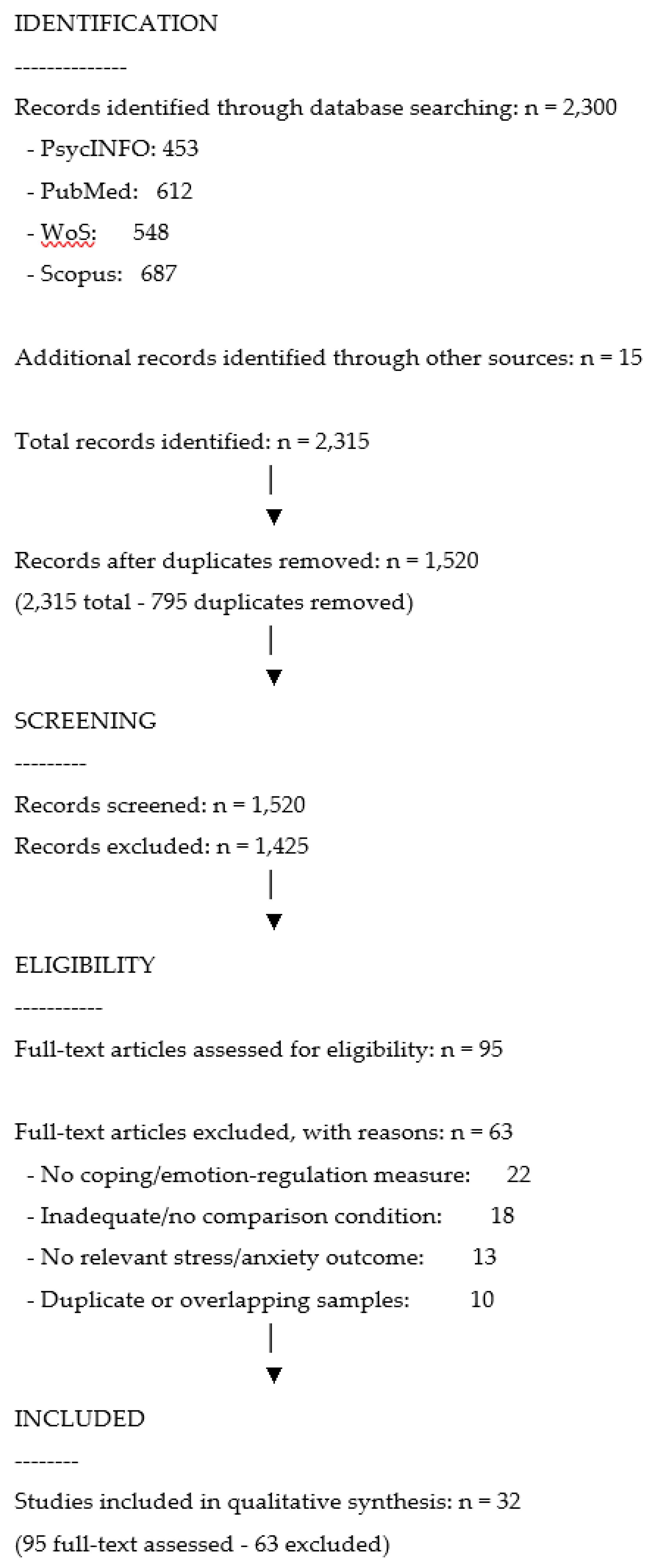

Table 1.
Charted characteristics of the pivotal syntheses and studies.
| Source | Design / N | Mindfulness op. | Coping / ER focus | Outcome domain | Key finding |
| Garland et al. (2011) | Longitudinal, MBSR | Intervention + trait | Positive reappraisal | Affective (stress) | Reappraisal mediated stress reduction |
| Zainal & Newman (2024) | Meta-analysis, 111 RCTs, N = 9,538 | Intervention | ER (implied) | Cognitive | g ≈ 0.19–0.39, accuracy only; larger in symptomatic |
| Millett et al. (2024) | Meta-analysis, group MBPs | Intervention | — | Executive function | Effect not robust; none for shifting |
| Cásedas et al. (2020) | Meta-analysis, RCTs | Intervention | — | Executive control | g ≈ 0.34; not for flexibility |
| Dunning et al. (2022) | Meta-analysis, 66 RCTs (youth) | Intervention | — | Attention/EF/stress | Small; null at follow-up; low certainty |
| Quinton (2024) | Meta-analysis (school-based) | Intervention | — | Executive function | Small–moderate; larger in younger children |
| Leow et al. (2023) | Systematic review (MCI) | Intervention | — | Cognitive + neural | Neural change without behavioural gain |
| Bosshard & Gomez (2024) | Meta-analysis, 44 ES, RCTs | n/a (reappraisal/mindset) | Arousal reappraisal | Task performance | Small significant gain (d = 0.23) |
| Hase et al. (2025) | Meta-analysis, 62 studies, N = 7,418 | n/a (appraisal) | Challenge vs threat | Performance | Challenge > threat; small effects |
| Vainre et al. (2025) | Meta-analysis, 99 studies, N = 16,054 | Intervention | ER (implied) | Work performance | g = 0.25 vs passive; ns vs active controls |
| MacAulay et al. (2024) | Cross-sectional, N = 165 | Trait/behavioural | Approach vs avoidance | Cognitive + stress | Avoidance → worse cognition; acceptance → less stress |
| Mao et al. (2024) | Meta-analysis (trait) | Trait | — | Academic performance | Significant but slight correlation (r = 0.14) |
Note. ER = emotion regulation; ES = effect sizes; MBP = mindfulness-based programme; MCI = mild cognitive impairment; RCT = randomised controlled trial; ns = not significant; — = not applicable or not reported. The complete data-charting matrix for all included sources is provided as Supplementary Material.
Disclaimer/Publisher’s Note: The statements, opinions and data contained in all publications are solely those of the individual author(s) and contributor(s) and not of MDPI and/or the editor(s). MDPI and/or the editor(s) disclaim responsibility for any injury to people or property resulting from any ideas, methods, instructions or products referred to in the content. |
© 2026 by the authors. Licensee MDPI, Basel, Switzerland. This article is an open access article distributed under the terms and conditions of the Creative Commons Attribution (CC BY) license (http://creativecommons.org/licenses/by/4.0/).
Copyright: This open access article is published under a Creative Commons CC BY 4.0 license, which permit the free download, distribution, and reuse, provided that the author and preprint are cited in any reuse.


