

Submitted:
21 July 2026
Posted:
21 July 2026
You are already at the latest version
Abstract
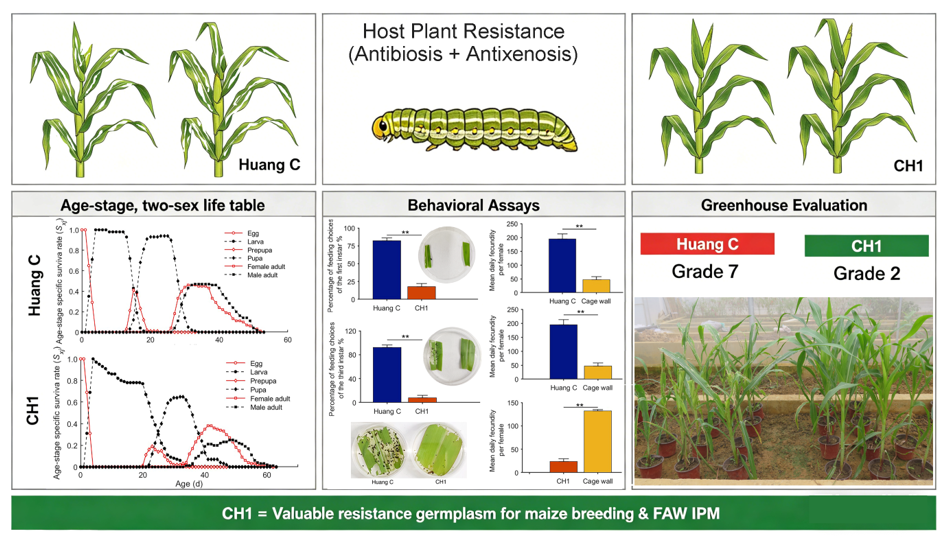
The fall armyworm (FAW), Spodoptera frugiperda, is a globally significant pest of maize, causing severe yield losses worldwide. Host plant resistance represents an environmentally sustainable strategy for FAW management. In this study, we assessed the resistance of a maize germplasm line, CH1, against FAW under laboratory and greenhouse conditions Using the age‑stage, two‑sex life table approach, we showed that FAW larvae reared on CH1 exhibited significantly prolonged larval development, reduced survival rates, shorter adult longevity, and lower fecundity compared to those reared on the susceptible control line Huang C. Population parameters including the intrinsic rate of increase (r), net reproductive rate (R₀), and finite rate of increase (λ) were significantly lower on CH1, while the mean generation time (T) was significantly extended. In dual‑choice behavioral assays, FAW larvae showed a strong feeding preference for Huang C over CH1, and female moths laid significantly more eggs on Huang C plants. Under controlled greenhouse infestation, CH1 plants displayed only minor leaf damage (Davis scale grade 2, classified as resistant), whereas Huang C plants sustained severe defoliation (grade 7, susceptible). Collectively, these results demonstrate that CH1 exerts multi‑dimensional resistance against FAW by impairing larval development and survival, reducing reproductive output, and deterring feeding and oviposition. This study identifies CH1 as a valuable genetic resource for breeding FAW‑resistant maize varieties and supports the development of integrated pest management (IPM) strategies to mitigate damage caused by this invasive pest.
Keywords:
Spodoptera frugiperda
; host plant resistance
; life table
; maize germplasm
1. Introduction
Maize is one of the world’s most important crops for grain, feed, and industrial raw material production, playing an irreplaceable role in ensuring global food security and stabilizing agricultural production [1]. However, maize production is frequently threatened by multiple pests and diseases. Among these, the fall armyworm (FAW), Spodoptera frugiperda, is a key pest causing significant yield losses and quality reduction in maize [2]. Native to tropical and subtropical regions of the Americas, FAW is a major migratory pest that has rapidly spread to many parts of the world in recent years [3]. In China, FAW has become the most important insect pest on maize since its first invasion in Yunnan Province in 2018, posing a serious threat to maize production [4].
Currently, FAW management still heavily relies on chemical insecticides and transgenic Bt maize technologies. However, the prolonged and irrational use of chemical insecticides has not only increased pest resistance but also raised concerns about environmental pollution and pesticide residues [5]. Meanwhile, the widespread cultivation of Bt maize has exerted strong selection pressure, leading to the development of resistance in FAW field populations to key Bt proteins such as Cry1F and Cry1Ab [6,7], thereby challenging the sustainability of this core control technology. Crop insect resistance has become an important component of pest management, as it can reduce crop damage at the source by affecting pest growth, development, reproduction, or repelling pest feeding, without relying on chemical pesticides or exogenous Bt genes [8]. Consequently, exploring and utilizing inherent host-plant resistance of maize is considered one of the most economical, effective, and environmentally friendly strategies for sustainable management of FAW [9]. Landrace germplasm and specific maize accessions, with their rich genetic diversity, serve as valuable resources for discovering resistance genes and breeding resistant varieties [10].
In the Americas, maize varieties with native genetic resistance to FAW, including Perola, Zapalote Chico 2451F, and GEMS-0100, have been developed and widely planted [11,12,13]. Additionally, a series of FAW-resistant maize germplasms, such as the CML lines CML370, CML372, and CML574, have been identified by the International Maize and Wheat Improvement Center (CIMMYT) [9]. Similarly, several resistant temperate maize inbred lines (e.g., Mp496, Mp701–Mp708, Mp713, Mp714, and Mp716), developed by the United States Department of Agriculture Agricultural Research Service (USDA-ARS), show relatively high resistance to FAW [14]. In general, resistant host plants significantly influence various aspects of insects, including growth, development, reproduction, physiology, and behavior [15,16]. The life table of an insect provides a detailed summary of survival and reproduction rates across developmental stages [17],offering valuable insights into its potential for population growth in specific environments [18]. In previous studies, life table parameters have been used to evaluate the adaptability of FAW on various resistant maize plants. For example, FAW fed on the resistant maize variety CML442 exhibited lower intrinsic rate of increase (r), finite rate of increase (λ), net reproductive rate (R₀), and gross reproductive rate (GRR), as well as a longer mean generation time (T), compared to those fed on non-resistant maize [19]. Similar results have been reported, with FAW showing longer developmental duration on the resistant variety Mp708 than on the susceptible one [20]. In China, several studies have evaluated the resistance of maize varieties to FAW [9,21]. However, only one maize inbred line, Xi502, has been found to exhibit moderate resistance to FAW [21]. Therefore, it is urgent to discover more maize resources with resistance to FAW.
In this study, we used the age-stage, two-sex life table method to analyze the population growth parameters of FAW fed on two maize germplasms (Huang C and CH1). Choice and no-choice assays were then conducted to determine FAW feeding and oviposition preferences. Finally, the resistance of the two maize germplasms against FAW larvae was evaluated under greenhouse conditions. By integrating population, behavioral, and greenhouse trial data, our study not only demonstrates that CH1 is highly resistant to FAW but also provides an excellent resistance source for breeding new FAW-resistant maize varieties.
2. Results
2.1. Development and Reproduction of FAW on Two Maize Plants
As shown in Table 1, no significant differences were observed in the egg duration, pupal duration, or pupal weight of FAW fed on the two maize leaves. However, FAW larvae fed on CH1 exhibited significantly prolonged larval and pre-pupal period and shortened adult lifespan as compared to those fed on Huang C. In addition, the two maize germplasms also influenced the longevity and reproduction of FAW adults. The longevity and oviposition duration of female adults fed on CH1 were shorter, but the pre-oviposition and total pre-oviposition periods were longer than those of larvae fed on Huang C. Also, the number of eggs laid by adults derived from CH1 was significantly lower than that laid by adults fed on Huang C. However, no significant difference was found in the longevity of male adults derived from the two kinds of corn plants.
2.2. Survival Rate and Fecundity of FAW on Two Maize Plants
Analysis of the sxj, lx, fx, mx, and lxmx curves revealed distinct impacts of the two maize germplasms on FAW survival and reproduction. The age-stage specific survival rate (sxj) curves showed consistently lower larval, pupal, and adult survival in the CH1-fed group over Huang C-fed group (Figure 1A, B). The age-specific survival (lx) curve indicated high, stable survival for Huang C-fed FAW until day 37, followed by a rapid decline. In contrast, the CH1 group exhibited an early, rapid decline from day 5, with complex mortality dynamics thereafter. Furthermore, analysis of the fx, mx, and lxmx curves showed that while Huang C-fed FAW reached a higher reproductive peak on day 33, the CH1-fed group peaked later with substantially lower value on day 41 (Figure 1C, D).
2.3. Population Parameters of FAW on Two Maize Plants
Population parameters were calculated based on data from the entire cohort. The intrinsic rate of increase (r), Finite rate of increase (λ), net reproductive rate (R0), and mean generation time (T) of FAW on two maize germplasms were calculated using the bootstrap method (Table 2). Results showed that the r, λ and R0 of FAW fed on CH1 were 0.12, 1.14 and 275.60, which were respectively lower than those fed on Huang C. However, the T value of FAW fed on CH1 (43.84 d) was significantly longer than those fed on Huang C (33.47d).
2.4. Feeding and Oviposition Preference of FAW on Two Maize Plants
In choice assays of feeding preference, both 1st and 3rd instar larvae of FAW exhibited significantly higher feeding preference for Huang C than CH1 (Figure 2A, B). In no-choice assays of feeding preference, the leaf area of Huang C consumed by 1st and 3rd instar larvae of FAW were significantly larger than those of CH1consumbed by FAW (Figure 2C, D).
In the choice assays of oviposition preference, FAW females significantly preferred to lay eggs on Huang C (177.89) over CH1 (3.33) (Figure 2E). In the no-choice assays, females deposited eggs on both the maize plants and the cage walls. However, more eggs were laid directly on Huang C plants (194.50) than on the cage walls (47.50), whereas the opposite pattern was observed for CH1, with more eggs being laid on the cage walls (132.25) (Figure 2F, G).
2.5. Resistance Evaluation of Two Maize Plants Against FAW
As shown in Figure 3, plant damage was observed on Huang C, with its whorl and unfolded leaves exhibiting irregular feeding holes. In contrast, CH1 plants were largely undamaged, showing only minor pinhole-like feeding marks on a few older leaves (Figure 3A). According to the Davis scale for damage rating, Huang C scored a grade 6-8. The median damage score was 7, categorizing it as susceptible (S). In contrast, CH1 scored between 1 and 2, with a median of 2, demonstrating resistance (R) (Figure 3B).
3. Discussion
Developing and planting insect-resistant maize represent a central strategy in the integrated management of FAW, while identification and assessment of insect-resistant germplasm are essential for breeding resistant varieties. In this study, we combined life table parameters and behavioral preference test in the laboratory and resistance observation under greenhouse conditions to evaluate the resistance of CH1 to FAW. Our results consistently demonstrate that the maize germplasm CH1 exhibits significant resistance to FAW across all three aspects of investigation.
Host plants have significant effects on the development, survival, and reproduction of phytophagous insects. It is commonly asserted that short development duration, high survival rate, and large reproduction capacity of phytophagous insects represent high host fitness on a certain plant species [16,22]. The age-stage, two-sex life table can reflect differences in the development rate between individuals and provide description of the performance of insect populations under experimental conditions [23,24,25]. In this study, FAW larvae reared on CH1 exhibited a significantly prolonged larval period, pre-pupal stage, a shortened adult lifespan and lower relative growth rate. Additionally, the sxj and lx curves further revealed markedly lower survival rates across all life stages for FAW on CH1, particularly during the early larval instars. This suggests that CH1 exerts its most detrimental effects during the critical establishment phase of FAW larvae, thereby effectively suppressing population initiation and buildup. More critically, FAW fed with CH1 had a lower population increase capacity (r, R₀, λ were substantially lower, while the T was longer). The R0, r, λ, T are bio-parameter statistics that integrate insect growth and development, reproduction and survival changes and indicate the capacity for population growth in a specific environment (Wu et al., 2006). A lower R₀ value indicates fewer offspring produced per generation, and a reduced r value signifies a slower population growth potential [23]. The difference of key population growth parameters suggests that CH1 impairs FAW population growth and fitness, providing robust evidence for the antibiosis effect of CH1 on FAW. These findings align with previous studies on resistant host plants. For instance, the maize landrace Pérola extended the larval development of FAW and drastically reduced its larval "Fitness Index" [11]. Similarly, the unsuitable host plants was observed that led to prolonged development and decreased fecundity in FAW (Peng et al., 2022; Wu et al., 2021)
Many herbivorous insects can qualitatively distinguish among host plants or diets, preferentially feeding and ovipositing on high-quality plants [29]. In this study, FAW larvae significantly preferred to feed on Huang C than CH1, consuming a much larger leaf area on Huang C. Visually, the feeding damage on CH1 was minimal, often limited to small notches, whereas Huang C leaves suffered extensive defoliation. Additionally, it is generally believed that insects will choose hosts that are more conducive to the growth and development of their offspring to oviposit [30,31]. In the oviposition choice tests, FAW females laid significantly more eggs on Huang C plants than on CH1 plants. In no-choice tests, females confined with CH1 laid the majority of their eggs on the cage walls rather than on the plants themselves. The preferences in oviposition selectivity showed that the female preferred Huang C over CH1, consistent with the preference performance hypothesis suggesting that females prefer to lay eggs on those hosts where larvae will thrive and actively avoid unsuitable hosts for egg-laying [32]. This finding is consistent with the study on potato tuber moth, where females also exhibited a clear preference for certain potato varieties over others, aligning with the subsequent performance of their offspring [33]. The combination of feeding and oviposition deterrence demonstrated a strong antixenosis effect of CH1 and makes CH1 an unattractive host, reducing the initial colonization and egg-load in the field,
FAW damage to maize germplasm is usually scored according to the Davis scale, which ranges from 0 (no visible damage) to 9 (whorl and furl leaves almost totally destroyed) based on leaf and whorl damage [34]. In our greenhouse experiment, CH1 plants sustained minimal damage (Davis Scale grade 2 - Resistant), whereas Huang C plants were severely damaged (grade 7 - Susceptible). Previous studies reported that most native or naturally occurring resistance is polygenic, exhibits partial resistance, and scores around 3-5 on the Davis scale, whereas transgenic lines exhibit scores of 1-2 [9]. However, CH1 as a native germplasm exhibits score of 2, which is much higher than that of the previously reported native germplasm, indicating that CH1 represents a valuable genetic resource for developing FAW-resistant varieties. However, further filed experiment are needed to verify the resistant level of CH1 against FAW.
Collectively, our studies demonstrated that FAW feed on CH1 exhibit prolonged development, reduced survival and fecundity as compared to Huang C. Behavior choice test showed that CH1 significantly inhibit feeding and oviposition behavior. Furthermore, greenhouse experiment indicated that CH1 show high resistance to FAW. Our results strongly support that the maize germplasm CH1 is highly resistant to FAW, and provide important recourse for breeding FAW- resistant maize varieties and further helpful for IPM of FAW.
4. Materials and Methods
4.1. Insect
FAW individuals were originally collected from maize field in Guizhou Academy of Agricultural Sciences, China in 2022. The insects were maintained in the laboratory with the following conditions: 26±1°C, 60-70% relative humidity, and photoperiod of 16L:8D. FAW larvae were reared individually on artificial diet in plastic cups (3.6 cm in height, 5 cm in upper diameter and 3.1 cm in lower diameter). After emergence, FAW adults were paired and transferred to a plastic bag (35 cm in length and 25 cm in width) and provided with 10% (w/v) honey-soaked cotton ball. Before experiment, FAW was continuously reared at least four generations under above conditions.
4.2. Plants
Based on our primary experiment, a maize germplasm CH1 was used to test its resistance to FAW, and a maize variety Huang C was used as control. These seeds were provided by Guizhou Drought Grain Sorghum Research Institute, China. Seeds were sown in plastic pots (10.5 cm in height, 12.7 cm in upper diameter and 9.5 cm in lower diameter), with a 1:1 mixture of nutrient soil and vermiculite. When the plant grew to 10-15 cm, fresh leaves were selected for the following experiments.
4.3. Biological Parameter of FAW Reared on Two Maize Plants
4.3.1. Larval Development Duration and Survival Rate
To investigate the effect of the maize germplasm CH1 on the growth and survival of FAW, newly hatched larvae were placed individually in plastic cups (3.6 cm in height, 5 cm in upper diameter and 3.1 cm in lower diameter) and fed with leaf sections (3 cm× 3 cm) of CH1, and the survival state of single larvae was recorded every day until pupation. The leaf sections were replaced regularly every 24 h. The FAW larvae reared on Huang C was used as control. Each treatment contained 100 larvae.
4.3.2. Pupal Period and Emergence Rate
After pupation, the 3-d-old pupa was sexed according to the morphological characteristics of the abdominal end and weighed using electronic balance. Meanwhile, the survival state of single pupal was observed and recorded daily until adult emergence.
4.3.3. Adult Lifespan and Egg Production
Upon emergence, one pair of adults derived from the same maize host was placed in a rearing bag and provided with 10% honey-soaked cotton ball. The number of eggs on the bag was observed daily, and the honey-soaked cotton ball was replaced every two days. Upon the initiation of lay eggs, the bag was changed daily until the female adults died. During this process, the same age male insect was supplied If the male insect died. Each treatment includes 30 pairs of adults.
4.3.4. Analysis of the Age-Stage, Two-Sex Life Table
Based on the age-stage, two-sex life table theory, raw data were analyzed by the TWO-SEX-MSChart program [23]. The parameters of the age-stage two-sex life tables were calculated according to the following equations [35]:
The age-stage-specific survival rate (sxj) represents the probability that a newly laid egg will survive to age x and stage j:
The age-specific survival rate (lx) represents the probability that a newborn egg will survive to age x:
The female age-stage-specific fecundity (fxj) represents daily number of eggs produced by a female at age x and stage j.
The age-specific fecundity (mx) represents the number of eggs per individual at age x:
The net reproductive rate (R0) was calculated as:
The intrinsic rate of increase (r):
The finite rate of increase (λ):
The mean generation time (T):
4.4. FAW Oviposition and Feeding Preference on Two Maize Plants
4.4.1. Feeding Preference
To evaluate the feeding preference of FAW between Huang C and CH1, we carried out choice and no-choice experiment referring to the leaf disc method. Leaves of two maize germplasms were cut into square leaf discs with equal area (1.0 cm × 1.0 cm). In the choice test, leaf discs of Huang C and CH1 were placed at two sides respectively with equal distance from the center of petri dish. In the no-choice test, only one maize disc from Huang C or CH1 was placed in the middle of petri dish. The bottom of the petri dish was coated with agar to moisturize. For both tests, newly hatched and third-instar larvae were collected and deprived of food for 3 h, and then transferred to petri dishes individually using a soft bristle brush. After 24 hours, the feeding selection of FAW in choice test was recorded and the consumed leaf area by FAW in no-choice test was photoed and measured using ImageJ software. Each treatment contained 10 replications.
4.4.2. Oviposition Preference
To determine the oviposition preference of FAW between Huang C and CH1, choice test and no-choice test were also conducted. In the choice test, Huang C and CH1 plants were enclosed in a nylon cage (length × width × height = 45 cm × 45 cm × 45 cm). In the no-choice test, one potted plant of Huang C or CH1 was enclosed individually in a nylon cage. For both tests, one pair of male and female adults that have emerged for 1 d are placed in each cage. The number of eggs laid on corn plants and the inner wall of the cages were recorded daily. The mean daily fecundity was subsequently calculated. Each treatment contained 10 replications.
4.5. Resistance Evaluation of Two Corn Plants Against FAW
In June 2023, a greenhouse experiment was conducted at Guizhou Academy of Agricultural Sciences, China, to evaluate the insect resistance of the two kinds of corn plants, Huang C and CH1. Seeds of each variety were individually sown in plastic pots (10.5 cm in height, 12.7 cm in upper diameter and 9.5 cm in lower diameter) filled with a 1:1 (v/v) mixture of nutrient soil and vermiculite. Plants were irrigated as needed to maintain optimal growth conditions. Each variety consisted of 10 biological replicates. Following the procedure described by Davis [36], 15 newly hatched larvae were inoculated into the whorl of each plant at the V3 (three-leaf) stage. Upon reaching the V6 (six-leaf ) stage, leaf damage was assessed for each plant using the modified Davis scale method [34]. The resistance level of each variety was then determined based on the median damage score.
4.6. Data Analyses
Data analysis was performed using MATLAB (R2024a; MathWorks). Results are presented as mean ± standard error (SE). Comparisons between the two groups (FAW fed on Huang C vs. FAW fed on CH1) were made using Student's t-test, with statistical significance indicated as P < 0.05 (*) and P ≤ 0.01 (**).
Author Contributions
Conceptualization, Lingling Li and Hongbo Li.; methodology, Lingling Li; software, Lingling Li; validation, Lingling Li, Peiying Li and Wenmeng Li; formal analysis, Peiying Li; investigation, Lingling Li ane Peiying Li.; resources, Hongbo Li.; data curation, Lingling Li and Wenmeng Li; writing—original draft preparation, Lingling Li; writing—review and editing, Hongbo Li.; visualization, Lingling Li.; supervision, Hongbo Li and Changgeng Dai; project administration, Hongbo Li; funding acquisition, Lingling Li.
Funding
This research was funded byYoung foundation for Guizhou academy of agricultural sciences [2024]03, Construction Foundation for Guizhou Key Laboratory of Agricultural Biosecurity (QiankeheZSYS(2025)024). Guizhou provincial major project for the transformation of scientific and technological achievements (Qiankehe Chengguo[2023] Major 004-2).
Data Availability Statement
The data that support the findings of this study are available from the corresponding author, upon reasonable request.
References
- Erenstein, O.; Jaleta, M.; Sonder, K.; Mottaleb, K. Global Maize Production, consumption and trade : trends and R & D implications. Food Secur. 2022, 14, 1295–1319. [Google Scholar] [CrossRef]
- Overton, K.; Maino, J.L.; Day, R.; Umina, P.A.; Bett, B.; Carnovale, D.; Ekesi, S.; Meagher, R.; Reynolds, O.L. Global crop impacts, yield losses and action thresholds for fall armyworm (Spodoptera frugiperda): A Review. Crop Prot. 2021, 145, 105641. [Google Scholar] [CrossRef]
- Kenis, M.; Benelli, G.; Biondi, A.; Calatayud, P.; Day, R.; Desneux, N.; Harrison, R.D.; Kriticos, D.; Rwomushana, I.; Carrière, Y.; et al. Invasiveness, biology, ecology, and management of the fall armyworm, Spodoptera frugiperda. Entomol. Gen. 2023, 43, 187–241. [Google Scholar] [CrossRef]
- Jiang, Y.Y.; Liu, J.; Xie, M.C.; Li, Y.H.; Yang, J.J.; Zhang, M.L. Observation on law of diffusion damage of Spodoptera frugiperda in China in 2019. Plant Prot. 2019, 45, 10–19. [Google Scholar]
- Carvalho, R.A.; Omoto, C.; Field, L.M.; Williamson, M.S.; Bass, C. Investigating the molecular mechanisms of organophosphate and pyrethroid resistance in the fall armyworm Spodoptera frugiperda. PLoS ONE 2013, 8, e62268. [Google Scholar] [CrossRef] [PubMed]
- Omoto, C.; Bernardi, O.; Salmeron, E.; Sorgatto, R.J.; Dourado, P.M.; Crivellari, A.; Carvalho, R.A.; Willse, A.; Martinelli, S.; Head, G.P. Field-evolved resistance to Cry1Ab maize by Spodoptera frugiperda in Brazil. Pest Manag. Sci. 2016, 72, 1727–1736. [Google Scholar] [CrossRef] [PubMed]
- Farias, J.R.; Andow, D.A.; Horikoshi, R.J.; Sorgatto, R.J.; Fresia, P.; dos Santos, A.C.; Omoto, C. Field-evolved resistance to Cry1F maize by Spodoptera frugiperda (Lepidoptera : Noctuidae) in Brazil. Crop Prot. 2014, 64, 150–158. [Google Scholar] [CrossRef]
- Douglas, A.E. Strategies for enhanced crop resistance to insect pests. Annu. Rev. Plant Biol. 2018, 69, 637–660. [Google Scholar] [CrossRef] [PubMed]
- Prasanna, B.M.; Bruce, A.; Beyene, Y.; Makumbi, D.; Gowda, M.; Asim, M.; Martinelli, S.; Head, G.P.; Parimi, S. Host plant resistance for fall armyworm management in maize relevance, status and prospects in Africa and Asia. Theor. Appl. Genet. 2022, 135, 3897–3916. [Google Scholar] [CrossRef] [PubMed]
- Van Heerwaarden, J.; Doebley, J.; Briggs, W.H.; Glaubitz, J.C.; Goodman, M.M.; De Jesus, J. Genetic signals of origin, spread, and introgression in a large sample of maize landraces. Proc. Natl. Acad. Sci. 2011, 108, 1088–1092. [Google Scholar] [PubMed]
- Nogueira, L.; Costa, E.N.; Marconato, M.; Bello, D.; Ferreira, J.; Diniz, S.; Ribeiro, Z.A.; Leal, A.; Júnior, B. Oviposition preference and antibiosis to Spodoptera frugiperda (Lepidoptera : Noctuidae) in Brazilian maize landraces. J. Econ. Entomol. 2019, 112, 939–947. [Google Scholar] [PubMed]
- Widstrom, N.W.; Wiseman, B.R.; Nuessly, G.S.; Snook, M.E.; Nuessly, G.S.; Scully, B.T. Registration of the maize population Zapalote Chico 2451F. Crop Sci. 2003, 43, 444–445. [Google Scholar] [CrossRef]
- Ni, X.; Xu, W.; Blanco, M.H.; Williams, W.P. Evaluation of fall armyworm resistance in maize germplasm lines using visual leaf injury rating and predator survey. Insect Sci. 2014, 21, 541–555. [Google Scholar] [CrossRef] [PubMed]
- Singh, G.M.; Xu, J.; Schaefer, D.; Day, R.; Wang, Z.; Zhang, F. Maize diversity for Fall armyworm resistance in a warming world. Crop Sci. 2022, 62, 1–19. [Google Scholar] [CrossRef]
- Zalucki, M.P.; Clarke, A.R.; Malcolm, B. Ecology and behavior of first instar larval Lepidoptera. Annu. Rev. Entomol. 2002, 47, 361–393. [Google Scholar] [CrossRef] [PubMed]
- Awmack, C.S.; Leather, S.R. Host plant quality and fecundity in herbivorous insects. Annu. Rev. Entomol. 2002, 47, 817–844. [Google Scholar] [CrossRef] [PubMed]
- Atlihan, R.; Kasap, I.; Özgökçe, M.S.; Polat-Akköprü, E.; Chi, H. Population growth of Dysaphis Pyri (Hemiptera: Aphididae) on different pear cultivars with discussion on curve fitting in life table studies. J. Econ. Entomol. 2017, 110, 1890–1898. [Google Scholar] [CrossRef] [PubMed]
- Wu, F.A.; Zhou, J.X.; Yu, M.D.; Wang, Q.L.; Xu, L.; Lu, C.; Jing, C.J. Statistical inference on the intrinsic rate of increase of the carmine spider mite, Tetranychus Cinnabarinus on different mulberry cultivars (Morus L.) under laboratory conditions. Acta Entomol. Sin. 2006, 49, 287–294. [Google Scholar]
- Ishwarya Lakshmi, K.; Dhillon, M.K.; Mukri, G.; Mahendra, K.; Gowtham, K.; Tanwar, A.K. Induced biochemical variations in maize parental lines affect the life table and age-specific reproductive potential of Spodoptera frugiperda. Front. Plant Sci. 2024, 15, 1517848. [Google Scholar] [CrossRef] [PubMed]
- Chang, Y.; Luthe, D.S.; Davis, F.M.; Williams, W.P. Influence of whorl region from resistant and susceptible corn genotypes on Fall armyworm (Lepidoptera : Noctuidae) growth. J. Econ. Entomol. 2000, 93, 477–483. [Google Scholar] [CrossRef] [PubMed]
- Malook, S.U.; Liu, X.F.; De Liu, W.; Qi, J.F.; Zhou, S.Q. The race goes on: a fall armyworm resistant maize inbred line influences insect oral secretion elicitation activity and nullifies herbivore suppression of plant defense. BioRxiv 2021. [Google Scholar] [CrossRef]
- Saeed, R.; Sayyed, A.H.; Shad, S.A.; Zaka, S.M. effect of different host plants on the fitness of diamond-back moth, Plutella xylostella (Lepidoptera: Plutellidae). Crop Prot. 2010, 29, 178–182. [Google Scholar] [CrossRef]
- Chi, H. Life-table analysis incorporating both sexes and variable development rates among individuals. Environ. Entomol. 1988, 17, 26–34. [Google Scholar] [CrossRef]
- Akca, I.; Ayvaz, T.; Yazici, E.; Smith, C.L.; H, C. Demography and population projection of Aphis fabae (Hemiptera: Aphididae): with additional comments on life table research criteria. J. Econ. Entomol. 2015, 108, 1466–1478. [Google Scholar] [CrossRef] [PubMed]
- Tuan, S.J.; Yeh, C.C.; Atlihan, R.; Chi, H.; Tang, L.C. Demography and consumption of Spodoptera litura (Lepidoptera: Noctuidae) reared on cabbage and taro. J. Econ. Entomol. 2016, 109, 732–739. [Google Scholar] [CrossRef] [PubMed]
- Liu, S.S. Several problems in making and analyzing insect life table. Chin. J. Appl. Entomol. 1986, 35, 43–45. [Google Scholar]
- Wu, L.H.; Zhou, C.; Long, G.Y.; Yang, X. Bin; Wei, Z.Y.; Liao, Y.J.; Yang, H.; Hu, C.X. Fitness of fall armyworm, Spodoptera frugiperda to three solanaceous vegetables. J. Integr. Agric. 2021, 20, 755–763. [Google Scholar] [CrossRef]
- Peng, S.; Ya, H.; Zhou, Y.; Wang, D.; Ju, Q.; Peng, Q.; Yun, S.; He, Z. Impact of host plants on biological characteristics and Vg / VgR expression of Spodoptera frugiperda. J. Pest Sci. (2004). 2022, 96, 1569–1577. [Google Scholar] [CrossRef]
- Rojas, J.C.; Kolomiets, M. V.; Bernal, J.S. Nonsensical choices? Fall armyworm moths choose seemingly best or worst hosts for their larvae, but neonate larvae make their own choices. PLoS ONE 2018, 13, e0197628. [Google Scholar] [CrossRef] [PubMed]
- Hilker, M.; Meiners, T. Early herbivore alert: insect eggs induce plant defense. J. Chem. Ecol. 2006, 32, 1379–1397. [Google Scholar] [CrossRef] [PubMed]
- Cameron, J.H.; Isman, M.B.; Upadhyaya, M.K. Trichoplusia Ni growth and preference on broccoli and eight common agricultural weeds. Can. J. Plant Sci. 2007, 87, 413–421. [Google Scholar] [CrossRef]
- Bernays, E.; Graham, M. On the evolution of host specificity in phytophagous arthropods. Ecology 1988, 69, 886–892. [Google Scholar] [CrossRef]
- Zhang, M.; Yan, J.; Gao, Y. Potato plant variety affects the performance and oviposition preference of Phthorimaea operculella zeller ( Lepidoptera : Gelechiidae ). Pest Manag. Sci. 2022, 78, 3912–3919. [Google Scholar] [PubMed]
- Toepfer, S.; Fallet, P.; Kajuga, J.; Bazagwira, D.; Mukundwa, I.P.; Szalai, M.; Turlings, T.C.J. Streamlining leaf damage rating scales for the fall armyworm on maize. J. Pest Sci. (2004). 2021, 94, 1075–1089. [Google Scholar] [CrossRef]
- Huang, Y.B.; Chi, H. Life tables of Bactrocera cucurbitae (Diptera: Tephritidae): with an invalidation of the jackknife technique. J. Appl. Entomol. 2013, 137, 327–339. [Google Scholar]
- Davis, F.M.; Wiseman, B.R.; Williams, W.P.; W, W.N. Insect colony, planting date, and plant growth stage effects on screening maizefor leaf-feeding resistance to Fall armyworm (Lepidoptera: Noctuidae). Fla. Entomol. 1996, 79, 317–328. [Google Scholar] [CrossRef]
Figure 1.
Age-stage specific survival rate (sxj) of FAW fed on HuangC (A), CH1(B) and Age-specific survival rate(lx), female age-specific fecundity(fx), age-specifie fecundity of total population(mx), and age-specific maternity (lxmx) of FAW fed on HuangC (C), CH1(D).
Figure 1.
Age-stage specific survival rate (sxj) of FAW fed on HuangC (A), CH1(B) and Age-specific survival rate(lx), female age-specific fecundity(fx), age-specifie fecundity of total population(mx), and age-specific maternity (lxmx) of FAW fed on HuangC (C), CH1(D).
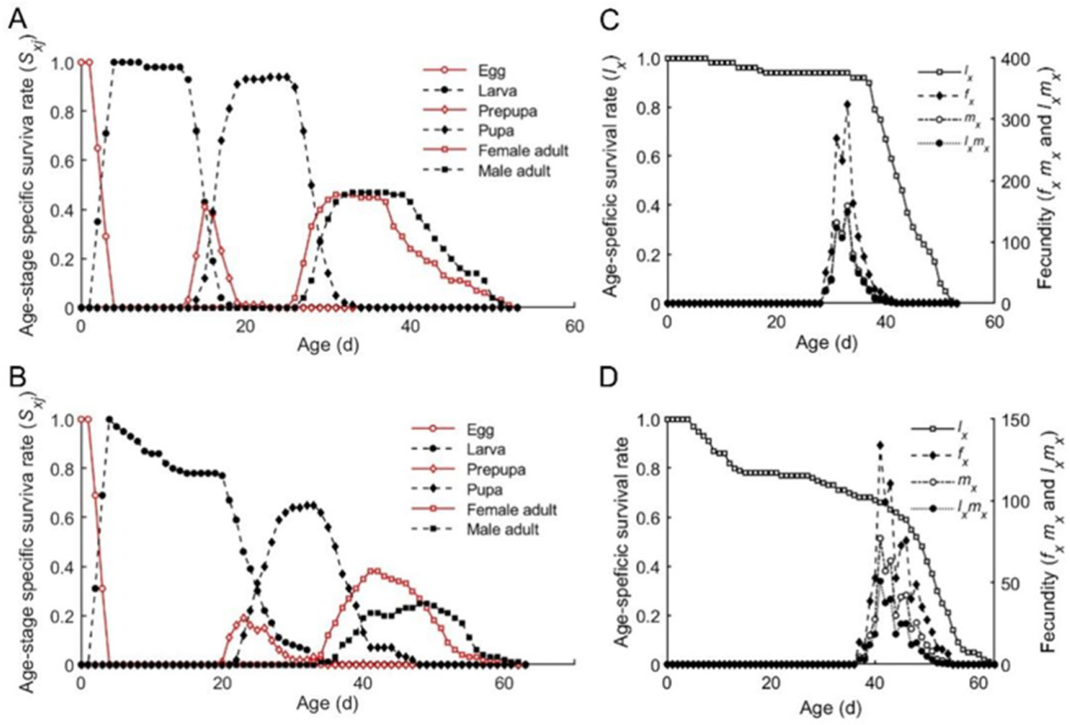
Figure 2.
Feeding and oviposition preference of FAW on two maize germplasms. Data are expressed as mean ± SE. Asterisks (*) and (**) indicate significant differences between Huang C and CH1 varieties at P < 0.05 and P < 0.01, respectively, as calculated by Student’s t-test.
Figure 2.
Feeding and oviposition preference of FAW on two maize germplasms. Data are expressed as mean ± SE. Asterisks (*) and (**) indicate significant differences between Huang C and CH1 varieties at P < 0.05 and P < 0.01, respectively, as calculated by Student’s t-test.
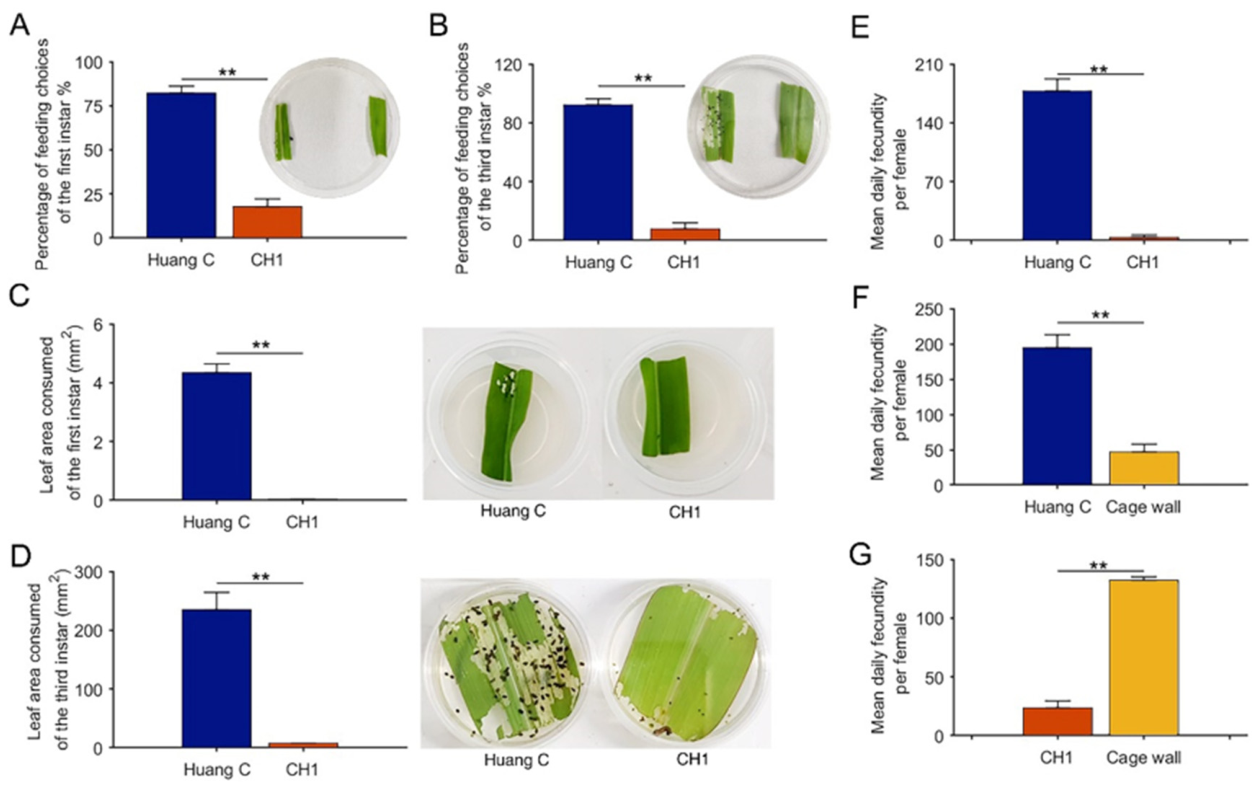
Figure 3.
Photographs and resistance level of two maize cultivars from a screenhouse trial. (A) Photograph from greenhouse trial. (B) Damaging and resistance level. HR stands for high resistance, R stands for resistance, MR stands for neutral resistance, S stands for susceptibility,HS stands for high susceptibility.
Figure 3.
Photographs and resistance level of two maize cultivars from a screenhouse trial. (A) Photograph from greenhouse trial. (B) Damaging and resistance level. HR stands for high resistance, R stands for resistance, MR stands for neutral resistance, S stands for susceptibility,HS stands for high susceptibility.
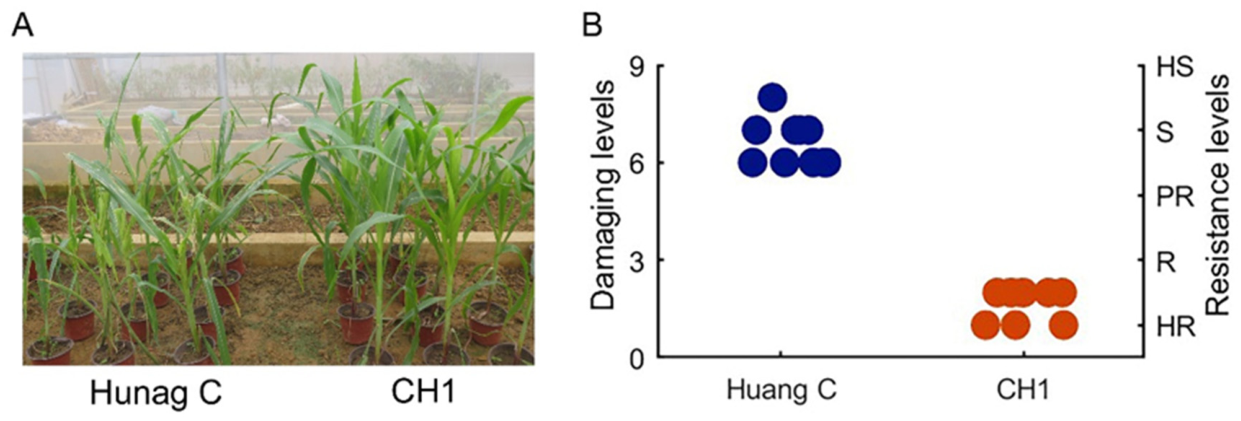

Table 1.
Development duration, pupal weight, adult longevity and reproduction of FAW fed on two maize leaves.
Table 1.
Development duration, pupal weight, adult longevity and reproduction of FAW fed on two maize leaves.
| Parameter | HuangC | CH1 |
|---|---|---|
| Egg (d) | 2.94±0.08 | 3.00±0.08 |
| Larva (d) | 12.49±0.10 | 21.61±0.36** |
| Pre-pupa (d) | 1.49±0.05 | 1.71±0.06** |
| Pupa (d) | 11.86±0.09 | 12.37±0.16 |
| Adult (d) | 14.96±0.43 | 13.24±0.47* |
| Female pupal weight (g) | 0.16±0.00 | 0.15±0.00 |
| Male pupal weight (g) | 0.16±0.00 | 0.17±0.00 |
| Female longevity (d) | 14.81±0.46 | 12.89±0.51* |
| Male longevity (d) | 15.42±0.59 | 13.89±0.86 |
| Pre-oviposition (d) | 3.24±0.17 | 4.38±0.26* |
| Total pre-oviposition (d) | 31.22±0.20 | 41.77±0.37** |
| Oviposition period (d) | 8.52±0.35 | 6.62±0.36* |
| Fecundity (eggs/female) | 1368.93±40.62 | 689±39.09** |
Data are mean±SE. Asterisks (*) and (**) indicate significant differences between Huang C and CH1 varieties at P < 0.05 and P < 0.01, respectively, as calculated by Student’s t-test.
Table 2.
Population parameters of FAW feed on two maize plants.
| Parameter | HuangC | CH1 |
|---|---|---|
| Intrinsic rate of increase (r) | 0.19±0.0037 | 0.12±0.0034* |
| Finite rate of increase (λ) | 1.21±0.0044 | 1.14±0.0038* |
| Net reproductive rate (R0) | 629.71±70.90 | 275.60±37.01** |
| Mean generation time(T) | 33.47±0.18 | 43.84±0.36** |
Data are mean±SE. Asterisks (*) and (**) indicate significant differences between Huang C and CH1 varieties at P < 0.05 and P < 0.01, respectively, as calculated by Student’s t-test.
Disclaimer/Publisher’s Note: The statements, opinions and data contained in all publications are solely those of the individual author(s) and contributor(s) and not of MDPI and/or the editor(s). MDPI and/or the editor(s) disclaim responsibility for any injury to people or property resulting from any ideas, methods, instructions or products referred to in the content. |
© 2026 by the authors. Licensee MDPI, Basel, Switzerland. This article is an open access article distributed under the terms and conditions of the Creative Commons Attribution (CC BY) license (http://creativecommons.org/licenses/by/4.0/).
Copyright: This open access article is published under a Creative Commons CC BY 4.0 license, which permit the free download, distribution, and reuse, provided that the author and preprint are cited in any reuse.