

Submitted:
20 July 2026
Posted:
21 July 2026
You are already at the latest version
Abstract
Genotype-to-phenotype (G2P) research in farmed animals has entered a phase in which deep genome annotation, multi-omics and AI-enabled prediction can nominate variants, regulatory mechanisms and cellular pathways at scale, but causal validation remains a major bottleneck. In vitro cellular systems, from tractable primary cells to organoids and other advanced models, provide experimentally controlled contexts in which massively parallel reporter assays and CRISPR-based perturbations can test variant effects and define cellular phenotypes. Here, we examine how in vitro approaches can be deployed across host–pathogen interactions, genotype-by-environment responses, nutrition, adaptation and One Health research, and outline priorities for integrating in vivo, in vitro and in silico data into mechanistic G2P workflows.
Keywords:
farmed animals
; complex traits
; functional genomic screens
; in vitro cellular systems
; in vivo–in vitro–in silico integration
1. Introduction
Although farmed animals are essential to global food systems, they face many challenges, including those associated with climate change, emerging diseases, limited resources and changing societal expectations. Understanding genotype-to-phenotype (G2P) relationships underlying complex traits is therefore critical for improving resilience, sustainability, biodiversity conservation, and resource efficiency in livestock and aquaculture production systems [1].
In vitro cellular systems encompass a broad spectrum of models, ranging from traditional primary cells and immortalised cell lines to advanced and increasingly physiologically relevant systems such as organoids derived from induced pluripotent stem cells (iPSCs), embryonic stem cells (ESCs), or adult stem cells (ASCs), as well as microphysiological systems (MPS) including organ-on-chip (OoC) and body-on-chip (BoC) platforms. Recent advances in human and biomedical research, together with the development of associated genetic and engineering toolboxes [2], are accelerating the implementation of these technologies in farmed species. Organoids are already being applied to disease modelling, vaccine development, food safety, and drug residue monitoring [3], while OoCs are beginning to emerge as promising platforms for veterinary and translational research [4].
Recent advances in genome annotation, multi-omics profiling, functional genomics, deep learning, and artificial intelligence are generating unprecedented opportunities to investigate G2P relationships. Together, these approaches are transforming our ability to predict the functional consequences of genetic variation and to generate increasingly sophisticated hypotheses linking genotype to phenotype. However, establishing causal relationships and understanding the biological mechanisms underlying these predictions remain major challenges. In vitro systems offer a unique opportunity to bridge this gap by enabling controlled perturbation experiments in biologically relevant cellular contexts. Within integrated G2P frameworks combining in vivo, in vitro, and in silico approaches, cellular systems can serve as experimental platforms for validating computational predictions of variant effects, identifying and characterising cellular phenotypes underlying complex animal traits, and supporting precompetitive evaluation of genetic, nutritional, environmental, or pharmacological interventions. For example, an individual animal may be characterised through sensor-derived phenotypes, physiological measurements, and multi-omics data collected in vivo, while complementary cellular models are generated from tissue biopsies. These systems can then be experimentally perturbed in vitro, enabling functional investigation of candidate mechanisms while reducing the need for costly or ethically challenging in vivo experiments.
Despite this potential, the application of in vitro systems to G2P research remains limited in farmed animals. Traits central to sustainable farmed-animal production, including health, resource efficiency, and resilience to environmental challenges, are shaped by complex genetic architectures and regulatory variation whose effects can depend on tissue, developmental stage, and environmental context [5]. Furthermore, large-scale G2P studies require reproducible and scalable experimental systems, whereas advanced cellular models still face challenges related to standardisation, throughput, reproducibility, and cost-effectiveness [3]. Nevertheless, rapid advances in cellular systems, functional genomics, phenotyping technologies, and computational approaches are progressively transforming this landscape.
Here, we outline how functional genomic screens and advanced in vitro systems can accelerate G2P research in farmed animals. We discuss opportunities and challenges for integrating in vitro, in vivo, and in silico approaches across major areas of farmed-animal biology and provide an outlook on future developments towards more mechanistic G2P research.
2. In Vitro Functional Screens for G2P Research
Haplotype-resolved telomere-to-telomere (T2T) assemblies and pangenome resources are revealing breed- and population-specific structural variants, novel sequences, and complex haplotypes [6,7,8]. Building on these resources, genome annotation, multi-omic profiling, and predictive modelling are expanding the catalogue of candidate causal variants and regulatory mechanisms. The Farm Animal Genotype–Tissue Expression (FarmGTEx) project further supports this process by integrating genetic variation with multi-omic data across multiple tissues and environmental contexts, providing resources for prioritising coding and regulatory variants and defining gene regulatory networks underlying complex phenotypes [5]. However, experimentally validating the causal effects of predicted regulatory variants and mechanisms remains a major challenge. Functional genomic screens provide a scalable framework for testing the molecular and cellular consequences of these predictions, while generating data that can improve future predictive models. Combined with increasingly sophisticated in vitro systems, they offer new opportunities to move from association-based studies towards mechanistic G2P research.
In vitro experimental platforms to validate predictions of regulatory function currently rely on two main classes of high-throughput assays: massively parallel reporter assays (MPRAs) and CRISPR-based endogenous perturbations. MPRAs enable the validation of thousands of non-coding sequences by coupling barcoded elements with RNA sequencing to generate quantitative sequence-to-function maps [6,7], while CRISPR-based approaches, including CRISPR activation and interference (CRISPRa/i), enable direct assessment of regulatory effects through perturbation of genes or regulatory elements within their endogenous chromatin environment [8]. MPRA and CRISPR-based perturbations therefore provide complementary information: MPRA quantifies the regulatory potential encoded by DNA sequence, whereas CRISPR perturbations assess regulatory function in its genomic context. Both technologies have evolved considerably in recent years, including in their ability to characterise cellular systems of increasing complexity, and provide rich training and benchmarking data for deep learning and AI models.
These technologies are now emerging in farmed species, with current applications still relying largely on relatively simple cellular or reporter systems. Charles et al. [9] combined high-throughput reporter assays, including Vex-seq [10], with deep learning splice predictors to identify candidate splice-disrupting variants within cattle GWAS loci. A pilot MPRA in chicken DF-1 cells identified regulatory activity and allele-specific effects among eQTL variants, providing a proof of concept for scalable regulatory variant validation in avian cells [11]. Targeted CRISPR activation approaches have enabled the functional characterisation of individual non-coding SNPs in chickens, linking GWAS signals directly to regulatory effects [12,13]. A high-resolution atlas of cattle regulatory variation was recently generated using the Survey of Regulatory Elements (SuRE) MPRA platform [14]. Combined with graph-based genomics, the resulting SuRE data provided a framework for prioritising candidate causal non-coding variants for cattle trait improvement [15].
For breeding applications, in vitro functional screens focused on variants or haplotypes segregating in proprietary breeding populations could provide a targeted and cost-effective approach to variant prioritisation (Figure 1). This is particularly relevant because many trait-associated variants lie in non-coding regions, and marker effects do not always directly capture causal variation. By linking candidate variants to effects on gene regulation or relevant cellular phenotypes, such approaches could support the derivation of more informative genetic markers, the refinement of genomic selection strategies, and the management of genetic diversity in commercial animal populations.
2.1. Massively Parallel Reporter Assays
Several MPRA methodologies have been developed, each offering unique design advantages or context-specific limitations [16,17]. For example, lentiMPRA facilitates studies in primary cells and more complex in vitro systems, including organoids, by integrating reporters into the chromatin context [18]. Single-cell MPRA approaches enable simultaneous quantification of regulatory activity and cell identity, facilitating the analysis of heterogeneous cellular systems [19]. Similar strategies are increasingly being applied to organoid systems for cell-type-specific regulatory analysis, for example in cortical organoids [20]. Recent saturation mutagenesis MPRA designs further enable systematic quantification of the effects of thousands of nucleotide substitutions within individual regulatory elements, generating high-resolution sequence-to-function maps that provide valuable training and benchmarking datasets for computational models predicting the effects of non-coding variation [21,22].
These developments are progressively extending functional interrogation from simple cell systems to increasingly physiologically relevant models. For example, Deng et al. [23] combined lentiMPRA with deep learning in cortical cells and cerebral organoids to identify active enhancers and disease-associated regulatory variants. In parallel, in vivo and tissue-specific MPRA approaches provide important benchmarks for evaluating the biological relevance of in vitro models and their responses to environmental perturbations [24,25]. Combining MPRA with single-cell transcriptomics, spatial profiling, and increasingly complex organoid systems is likely to enable functional characterisation of regulatory variants in tissue- and cell-state-specific contexts relevant to complex farmed-animal traits.
2.2. CRISPR-Based Perturbations
Modern CRISPR technologies provide a versatile toolkit for investigating gene regulation and epigenetic control [26]. Initially developed for causal enhancer–gene mapping [27], CRISPR-based approaches have evolved into genome-wide and single-cell screening platforms capable of systematically interrogating coding and non-coding variation [28]. Recent developments combine CRISPR perturbations with multimodal single-cell and spatial profiling to reconstruct complex regulatory networks and cellular interactions [29,30,31].
Organoids are increasingly being used for CRISPRi/a and mutation-screening approaches, although challenges remain regarding guide design, chromatin accessibility, and incomplete annotation of regulatory elements [2,32]. Nevertheless, these technologies are evolving rapidly, particularly with regard to well-established organoid systems. As an example, large-scale CRISPR-based genetic screens, including knockout and CRISPRi/a at single-cell resolution, were performed in human gastric organoids to systematically characterise gene-drug interactions [33].
Genome-wide perturbation screens, combined with in vivo association studies, multi-omics data, and deep learning approaches for variant prioritisation, are progressively transforming the capacity to establish causal G2P relationships. By linking genetic perturbations to molecular and cellular phenotypes, these frameworks generate high-confidence hypotheses that can subsequently be validated in increasingly sophisticated in vitro systems, including organoids. Similar integrated strategies are being developed by large-scale initiatives such as the Molecular Phenotypes of Null Alleles in Cells (MorPhiC) Consortium, which aims to systematically connect gene perturbations in multicellular in vitro systems with molecular and disease phenotypes in humans through coordinated experimental and computational pipelines [34].
3. Deploying In Vitro G2P Approaches Across Biological Contexts in Farmed Animals
Functional genomic screens and advanced in vitro systems are creating new opportunities to investigate the biological mechanisms underlying complex traits in farmed animals. These opportunities extend across a broad range of questions relevant to farmed-animal biology, including host–pathogen interactions, genotype-by-environment responses, nutrition, adaptation, resilience, and One Health research.
3.1. Host–Pathogen Interactions
Genome-wide CRISPR knockout screens have emerged as a powerful approach for identifying host factors underlying pathogen entry, replication, and immune evasion across major infectious diseases of farmed species — questions that are difficult to address in vivo due to ethical, logistical, and economic constraints. Genome-wide screens in farmed animals have recently been reviewed for viral pathogens [35]. For example, host factors involved in BoHV-1 infection have been identified in cattle [36,37]. Approximately 700 putative host factors involved in avian influenza virus infection have been identified in chickens [38], and sorting-based screening strategies have captured host factors influencing multiple stages of the IAV life cycle [39]. Beyond their immediate relevance for vaccine and therapeutic development, these studies illustrate the value of in vitro knockout screens for generating mechanistic hypotheses linking host genetic variation to disease-related phenotypes.
Most studies have relied on simple cellular systems with limited cell-type, cell-state, and genetic diversity, limiting their ability to capture context-dependent regulatory effects, host–pathogen responses, and gene dependencies. Recent perturbation technologies, including arrayed CRISPR formats and miniaturised delivery platforms, now enable screening in primary cells and donor-derived models [40], thus expanding the range of biological questions and phenotypes that can be investigated in vitro. Arrayed CRISPR libraries support knockout, activation, and epigenetic silencing screens with increased phenotypic resolution [41]. Combined with the growing repertoire of delivery modalities, these approaches facilitate the manipulation of hard-to-transfect cells and organoids [32,42].
Together, these developments are paving the way for moving from the discovery of disease-associated loci to the assessment of the functional impact of their genetic variation. Candidate loci identified through association studies or large-scale host-factor screens can then guide variant-level prioritisation and functional interrogation through in silico-in vitro workflows. For example, in pigs, edited jejunal organoids could help model the functional effects of candidate host-factor variants associated with susceptibility to coronaviruses [43].
3.2. Genotype-by-Environment Interactions
Genotype-by-environment (G×E) interactions are key determinants of complex traits in farmed animals and are central to efforts to breed resilient animals with reduced environmental sensitivity and to identify genotypes adapted to specific conditions, including heat stress [44]. Because they are exposed to diverse dietary, climatic, and pathogen pressures at population scale, farmed animals provide relevant systems for investigating the biological mechanisms underlying G×E interactions. Most G×E studies use gene expression as a primary molecular readout because it represents a dynamic and environmentally responsive phenotype that can be measured at high throughput. Building on large-scale resources such as FarmGTEx [5], the next challenge is to extend genetically informed gene-expression maps beyond tissue and developmental variation to include diverse environmental contexts.
The value of in vitro systems for studying G×E interactions lies in their ability to provide precise environmental control and scalable application of well-defined perturbations [45]. Because G×E studies often require large cohorts and involve adverse environmental conditions such as heat stress or pathogen exposure, in vitro cellular systems provide a scientifically relevant and ethically favourable approach that is fully consistent with the 3Rs (Replacement, Reduction, and Refinement) principles. In human genetics, in vitro cellular models have already been widely applied to investigate G×E interactions, particularly in pharmacogenomics [46]. Early studies relied primarily on relatively simple systems such as primary cells and lymphoblastoid cell lines [45], whereas more recent work has expanded to advanced cellular systems including brain organoids [47]. In contrast, comparable studies in farmed animals remain limited and still largely rely on primary-cell-based systems [48].
Future in vitro G×E studies in farmed animals will benefit from advanced cellular models guided by the deconvolution of complex environmental responses into defined molecular signals and target cell types, ideally through the integration of in vivo single-cell transcriptomic approaches with matched in vitro systems. Incorporating additional molecular and cellular phenotypes, including chromatin accessibility, DNA methylation, and cellular bioenergetics, together with high-throughput functional genomic platforms, will enable more precise dissection of causal variants and regulatory mechanisms. Human studies already illustrate this potential. Population-scale phenotyping of human liver organoids under insulin-insensitive conditions has shown how metabolic state can modify genotype–phenotype relationships, revealing context-dependent effects of the GCKR rs1260326 variant on steatohepatitis-related phenotypes [49]. Other studies have combined MPRA and CRISPR-based perturbation screens with environmental or metabolic challenges, for example to investigate the effects of protective and risk-associated dietary metabolites on colorectal cancer [50] or to functionally characterise human SLC25 transporters under different metabolic conditions [51]. Similar approaches could ultimately provide the experimental framework required to functionally validate and mechanistically interpret large-scale G×E resources [5].
3.3. Modelling Nutrition and Host–Microbiota Interactions
Nutrition and host–microbiota interactions are major determinants of animal health, productivity, and feed efficiency. Selective breeding has produced cumulative improvements in feed efficiency in farmed species, as illustrated by long-term selection experiments in pigs and aquaculture [52,53]. Livestock studies increasingly show that host genetics contributes to variation in microbiota-associated traits relevant to feed and digestive efficiency, supporting a holobiont perspective in which nutrition-related phenotypes are shaped by interactions between the host and its associated microbiota [54,55]. This perspective highlights the need for in vitro G2P approaches able to capture host-intrinsic genetic effects and their modulation by diet and microbiota-derived signals.
Organotypic systems have opened up new possibilities for modelling these traits. In aquaculture, a three-dimensional intestinal platform in rainbow trout reproduces key structural and functional properties of native intestinal tissue and generates physiologically relevant responses to commercial aquafeeds, demonstrating the utility of organotypic systems for modelling nutritional phenotypes in vitro [56,57]. Similarly, colon organoids derived from pigs divergently selected for feed efficiency displayed distinct genotype-associated immune responses following a bacterial challenge despite highly similar basal transcriptomic profiles [58]. This finding illustrates how organoid systems can reveal phenotypic differences associated with the genetic background of individual animals and highlights their potential for investigating mechanisms underlying complex production traits.
Although applications remain limited, combining advanced cellular systems with functional genomic perturbation approaches offers opportunities to investigate how genetic variation influences nutrient utilisation, metabolic adaptation, and responses to microbiota-derived signals. Future developments will increasingly focus on incorporating microbial and immune components into organoids and organ-on-chip systems to better reproduce key features of host–microbiota interactions [59]. By providing more physiologically relevant contexts for selected perturbations, these systems could help translate functional-screen outputs into mechanistic models of nutrition-related host–microbiota phenotypes.
3.3.1. Integrated Animal Systems for Translational Medicine and One Health
Genetically modified animals, including genome-edited, transgenic, and targeted-mutation lines, as well as naturally occurring disease models, provide powerful systems for investigating disease and other complex traits in a mechanistic, scalable, and ethically sustainable manner. In parallel, these models have enabled the establishment of advanced in vitro systems and cellular resources that are scalable, tractable, and can be leveraged for G2P research in farmed animals.
Several studies have demonstrated the translational relevance of these approaches for both human and veterinary medicine. For example, pigs expressing human ACE2 are permissive to SARS-CoV-2 infection and develop pathological features resembling severe human COVID-19 [60]. Similarly, the Crohn’s-like inflammatory bowel disease pig model (TNFΔARE) provides a tractable system for investigating immune regulation, mucosal barrier function, and host–microbe interactions [61]. The EU-funded NHPig project [62] exemplifies an integrated cross-species approach. By combining porcine in vitro systems—including primary hepatocytes, immune assays and organoid-based methodologies—with in vivo and multi-omics datasets from genetically modified and wild-type minipig models, the project will enable systematic comparison of pig, non-human primate and human responses, thereby supporting the development of scientifically robust alternatives to non-human-primate use in non-clinical safety testing.
Complementing engineered models, naturally occurring animal disease models arise in immunocompetent and genetically diverse populations exposed to environments similar to those experienced by humans. This combination of shared exposures and structured genetic architecture makes these models particularly valuable within One Health approaches, which recognise the interconnected determinants of human, animal, and ecosystem health [63]. Several spontaneous disease models have been described in companion animals; for example, canine and feline diabetes recapitulate autoimmune and insulin-resistant phenotypes, respectively, enabling investigation of interactions among genetic susceptibility, diet, obesity, and inflammatory signalling pathways [64,65].
Together, these examples illustrate how cellular resources and experimental systems originally developed for veterinary medicine and translational research, including both engineered and spontaneous models, provide a strong foundation for investigating molecular and genetic mechanisms underlying complex traits in farmed animals.
3.3.2. Comparative In Vitro Approaches to Adaptation, Resilience and One Health
The versatility of in vitro systems, from fibroblasts to organoids, makes them valuable tools for comparative studies of cellular stress responses and resilience across species. By comparing species that differ in environmental tolerance, in vitro systems can reveal conserved and species-specific stress-response programmes that inform the study of adaptation and resilience in farmed animals. Fibroblasts derived from marine mammals can recapitulate cytoprotective pathways observed in vivo and reveal cellular programmes associated with tolerance to heat, hypoxia, and other environmental challenges [66,67]. Comparative fibroblast datasets from extreme-adapted species have further enabled modelling of conserved and species-specific gene-expression responses to environmental perturbations [68]. Extending this approach to advanced models, liver organoids established from multiple turtle species have been used to investigate freeze tolerance, hypoxia resistance, and oxidative-stress resilience, highlighting the potential of organoid systems for studying adaptive mechanisms across distant vertebrates [69]. Ongoing efforts to leverage stem-cell technologies for wildlife conservation are further extending the scope of comparative in vitro biology [70], and could provide experimental platforms for testing hypotheses generated by large-scale comparative genomic initiatives such as Zoonomia [71] and the Earth BioGenome Project [72].
Comparative in vitro systems also have important translational and regulatory applications within a One Health framework. Recent advances in ecotoxicology increasingly rely on mechanistic approaches integrating data from multiple species to improve prediction of toxicological responses across organisms. In vitro approaches targeting conserved pathways have demonstrated that mechanistic insights obtained in one species can often be extrapolated to others, thereby improving hazard characterisation for both human and environmental safety [73]. More broadly, adverse-outcome-pathway frameworks provide a structured way to connect molecular initiating events, cellular responses, and organism-level outcomes across taxa, supporting the interpretation of conserved mechanisms relevant to environmental, veterinary, and human health.
3.4. Key Priorities for Accelerating In Vitro G2P Research in Farmed Animals
Recent advances in cellular systems, including organoids and MPS, functional genomic perturbation technologies, high-dimensional phenotyping, and artificial intelligence are creating unprecedented opportunities to investigate the mechanisms linking genetic variation to complex phenotypes in farmed animals. The examples reviewed here illustrate how these innovations are expanding the range of biological questions that can be addressed through in vitro approaches. Fully exploiting this potential will require progress across several interconnected areas.
3.4.1. Leveraging Cell Atlases to Develop Biologically Relevant Cellular Systems
A major challenge for in vitro G2P research is the development of robust and biologically relevant cellular systems across diverse farmed species. Differences in developmental programmes, tissue organisation, and cell-state regulation often limit the direct transfer of differentiation and culture protocols established in human and biomedical model systems, creating a need for species-specific approaches to the generation and validation of advanced cellular models. Recent efforts to generate single-cell and multi-omic atlases across farmed species are providing increasingly detailed maps of cell identities, developmental trajectories, and tissue organisation. These resources create new opportunities to develop, refine, and benchmark cellular protocols that more accurately reproduce the biological contexts in which phenotypic variation arises. Because these contexts differ across tissues, developmental stages, and species, cell atlases will also be essential for matching the most suitable in vitro systems to the biological question being addressed.
Comparative single-cell atlases of early embryonic development provide reference maps for designing, validating, and benchmarking differentiation protocols for pluripotent stem cell (PSC)-derived organoids. Such atlases support the study of developmental mechanisms and the identification of heterochronic patterns of tissue organisation across mammals [74,75,76,77]. Together with emerging stem-cell-based models of embryogenesis [78], these resources can guide species-specific differentiation protocols for generating PSC-derived cellular systems representative of early developmental stages.
Single-cell atlases covering later developmental stages will similarly support the benchmarking of adult stem cell (ASC)-derived organoids against their tissues of origin. This is important because ASC-derived organoids may retain aspects of the molecular history of the tissue from which they originate. For example, intestinal stem cells can retain an epigenetic memory of inflammation during long-term culture [79], while porcine intestinal organoids from market-weight pigs can retain animal-specific molecular signatures from the donor tissue context in addition to regional epithelial programmes [80]. These features add complexity to the interpretation of in vitro phenotypes, but may also help establish closer links between physiological states observed in vivo and responses measured in vitro.
As these reference datasets expand, G2P studies will increasingly benefit from stage- and tissue-appropriate cellular systems underpinned by improved species-specific protocols. Depending on the question being addressed, this may require systems representative of embryonic, foetal, postnatal, or adult stages, enabling more accurate modelling of the developmental and physiological processes underlying complex phenotypes.
3.4.2. Expanding Functional Perturbation and Phenotyping Frameworks
Advances in functional perturbation technologies, high-dimensional phenotyping, and artificial intelligence are creating new opportunities to move from descriptive analyses towards predictive and mechanistic models of genotype-to-phenotype relationships. In farmed animals, exploiting this potential will require large-scale functional datasets and biologically informative phenotypes measured at scale. While MPRA and CRISPR-based approaches now enable systematic investigation of regulatory elements and gene function, their application in farmed-animal research remains limited.
In human studies, large MPRA and CRISPR perturbation datasets are increasingly used to benchmark foundation models that predict regulatory activity across cell types and biological contexts from limited genomic information [81]. Similarly, integration of multiple MPRA and CRISPR datasets within the ENCODE project has enabled functional characterisation of many candidate cis-regulatory elements and revealed extensive context-dependent regulatory activity, including elements that switch between enhancer and silencer functions depending on cellular state [82]. These examples highlight the value of generating comparable perturbation datasets in farmed species, both to support functional genome annotation and to facilitate predictive models tailored to farmed-animal genomes. Such resources could also support transfer learning from human and model-organism datasets, particularly where species-specific functional data remain limited.
Future progress will also depend on expanding phenotypic readouts beyond gene expression. As discussed above, CRISPR perturbations combined with multimodal single-cell, spatial and imaging-based profiling can capture cellular morphology, tissue organisation and cell–cell interactions at scale [30]. Applied to organoid and organ-on-chip systems, these approaches could help reveal functional consequences of genetic variation that are not detectable through transcriptomic readouts alone.
Complementary strategies may further expand the scalability of in vitro G2P approaches in farmed animals, particularly in the short term. Fibroblasts represent accessible cellular resources that are relatively easy to culture, genetically modify, and biobank [83]. For example, primary foot-skin fibroblasts from heifers differing in genomic estimated breeding values for digital dermatitis resistance showed distinct basal and Treponema-induced transcriptional responses, suggesting that fibroblasts can capture genotype-associated host–pathogen response phenotypes [84]. Once edited genotypes are established, selected lines could be reprogrammed or transdifferentiated into relevant cell types [85,86], enabling scalable comparison of multiple genotypes and loci, including for traits involving more than one tissue. While such approaches do not reproduce the physiological complexity of advanced cellular systems, they may provide pragmatic and cost-effective platforms for functional interrogation of large numbers of variants, complementing the ongoing development of organoid- and stem-cell-based models in farmed species.
3.4.3. Standardisation, Reproducibility, and Scalability
Despite rapid technological progress, reproducibility and scalability remain major challenges for advanced in vitro systems. Variability in cellular composition, culture conditions, species-specific adaptations, and analytical pipelines can limit comparability across studies and reduce confidence in biological conclusions. Similar challenges have been identified across human biomedical research and are increasingly recognised within veterinary and agricultural sciences [3].
Efforts underway in regenerative medicine, toxicology, and organ-on-chip research provide valuable frameworks for addressing these limitations. Harmonised protocols, quality-control metrics, qualification procedures, and shared reference materials are progressively improving the reproducibility and regulatory acceptance of advanced in vitro systems [87,88,89]. This agenda is reinforced by the European Commission’s 2026 Roadmap towards phasing out animal testing for chemical safety assessments [90], which emphasises the development, validation, qualification, standardisation, and application of non-animal approaches, consistent with the 3Rs. Similar efforts in farmed animals will be essential to support large-scale functional studies and facilitate comparisons across laboratories, species, and experimental platforms. Animal biobanks could contribute to this goal by storing and distributing well-characterised stem-cell lines and cellular models together with derivation protocols and quality-control information needed for their reliable reuse.
Establishing community standards for characterisation, benchmarking, and data integration will therefore be critical for ensuring that increasingly complex in vitro models can reliably support mechanistic G2P research. In this context, ongoing efforts by the ELIXIR Domestic Animal Genome and Phenome Community to promote harmonised resources and analytical frameworks for integrated G2P research provide an important foundation for the development, benchmarking, and reuse of advanced in vitro models, as well as for developing concepts linking data from in vivo, in vitro, and in silico models, such as digital twins [91].
4. Outlook
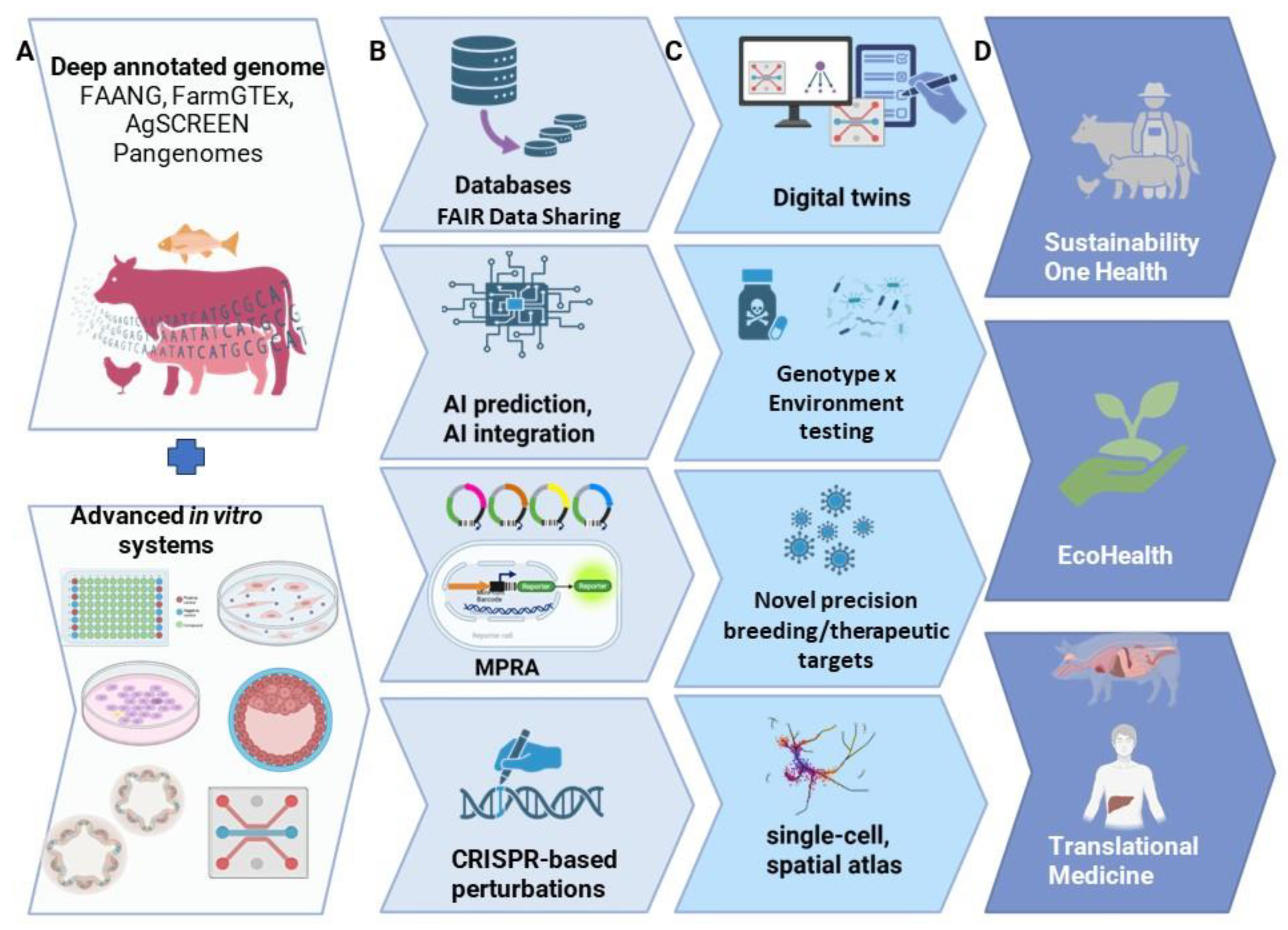
The examples presented throughout this review illustrate how recent advances in in vitro biology are progressively transforming the contribution that cellular systems can make to farmed-animal G2P research. Together with advances in functional genomics, high-dimensional phenotyping, and predictive computational approaches, these developments are creating unprecedented opportunities to move from the identification of statistical associations towards causal and mechanistic understanding of complex traits, strengthening the contribution of in vitro approaches within integrated in vivo–in vitro–in silico G2P research (Figure 2).
By enabling experimental interrogation of biological processes that have traditionally remained difficult to access in farmed animals, in vitro systems are opening new opportunities to understand the mechanisms underlying resilience, adaptation, health, and productivity. Realising this vision will require continued investment not only in technologies, but also in shared infrastructure, data and metadata standards, and the community and funding resources needed to support integrated G2P research.
Author Contributions
E.G., H.Z. and E.L.C. conceived the manuscript. E.G. coordinated contributions from co-authors and led the drafting and finalisation of the manuscript. All authors contributed to sections of the manuscript according to their specific expertise, reviewed the manuscript and approved the submitted version.
Funding
Activities informing this review were supported by the Horizon Europe INFRA-DEV EuroFAANG Research Infrastructure (EuroFAANG RI) concept development project (Grant Agreement No. 101094718).
Acknowledgments
This work summarises the outcomes of activities carried out between 2023 and 2025 within the Horizon Europe INFRA-DEV EuroFAANG Research Infrastructure (EuroFAANG RI) concept development project (https://eurofaang.eu; Grant Agreement No. 101094718), which aimed to strengthen communities developing and using in vitro models and tools for G2P research in farmed animals. We thank Arnaud Boulling for critical reading of the manuscript.
References
- Clark, E.L.; Archibald, A.L.; Daetwyler, H.D.; Groenen, M.A.M.; Harrison, P.W.; Houston, R.D.; et al. From FAANG to fork: application of highly annotated genomes to improve farmed animal production. Genome Biol. 2020, 21, 285. [Google Scholar] [CrossRef] [PubMed]
- Klompstra, T.M.; Yoon, K.-J.; Koo, B.-K. Evolution of organoid genetics. Eur. J. Cell Biol. 2025, 104, 151481. [Google Scholar] [CrossRef] [PubMed]
- Kwon, D.-H.; Kwon, H.; Jang, G. Organoid-based platforms in livestock: Current advances and future prospects. Res. Vet. Sci. 2026, 198, 105985. [Google Scholar] [CrossRef] [PubMed]
- Surina, S.; Chmielewska, A.; Pratscher, B.; Freund, P.; Rodríguez-Rojas, A.; Burgener, I.A. Organ-on-a-Chip: A Roadmap for Translational Research in Human and Veterinary Medicine. Int. J. Mol. Sci. 2025, 26, 10753. [Google Scholar] [CrossRef] [PubMed]
- Fang, L.; Teng, J.; Lin, Q.; Bai, Z.; Liu, S.; Guan, D.; et al. The Farm Animal Genotype-Tissue Expression (FarmGTEx) Project. Nat. Genet. 2025, 57, 786–96. [Google Scholar] [CrossRef] [PubMed]
- Melnikov, A.; Murugan, A.; Zhang, X.; Tesileanu, T.; Wang, L.; Rogov, P.; et al. Systematic dissection and optimization of inducible enhancers in human cells using a massively parallel reporter assay. Nat. Biotechnol. 2012, 30, 271–7. [Google Scholar] [CrossRef] [PubMed]
- Ernst, J.; Melnikov, A.; Zhang, X.; Wang, L.; Rogov, P.; Mikkelsen, T.S.; et al. Genome-scale high-resolution mapping of activating and repressive nucleotides in regulatory regions. Nat. Biotechnol. 2016, 34, 1180–90. [Google Scholar] [CrossRef] [PubMed]
- Gilbert, L.A.; Horlbeck, M.A.; Adamson, B.; Villalta, J.E.; Chen, Y.; Whitehead, E.H.; et al. Genome-Scale CRISPR-Mediated Control of Gene Repression and Activation. Cell 2014, 159, 647–61. [Google Scholar] [CrossRef] [PubMed]
- Charles, M.; Gaiani, N.; Sanchez, M.-P.; Boussaha, M.; Hozé, C.; Boichard, D.; et al. Functional impact of splicing variants in the elaboration of complex traits in cattle. Nat. Commun. 2025, 16, 3893. [Google Scholar] [CrossRef] [PubMed]
- Adamson, S.I.; Zhan, L.; Graveley, B.R. Vex-seq: high-throughput identification of the impact of genetic variation on pre-mRNA splicing efficiency. Genome Biol. 2018, 19, 71. [Google Scholar] [CrossRef] [PubMed]
- An, L.; Wang, Y.; Guan, D.; Zhou, H. Functional Validation and Predictive Modeling of Chicken Enhancers and Regulatory Variants Using Massively Parallel Reporter Assays; ISU Digital Press: Madison (WI), 2026. [Google Scholar]
- Kim, J.; Han, J.H.; Kim, M.; Schmidt, G.; Cho, E.; Lee, J.H.; et al. From GWAS signal to function: targeted CRISPR activation enables functional characterization of non-coding SNPs in chickens. Front Genome Ed. 2025, 7, 1662152. [Google Scholar] [CrossRef] [PubMed]
- Zhou, H.; McCarthy, F.M.; Kim, T.H.; Warren, W.; Zhang, G. Emerging technologies in poultry genomics: Unlocking innovation for the future of sustainable production. Poult. Sci. 2026, 105, 106240. [Google Scholar] [CrossRef] [PubMed]
- Van Arensbergen, J.; Pagie, L.; FitzPatrick, V.D.; De Haas, M.; Baltissen, M.P.; Comoglio, F.; et al. High-throughput identification of human SNPs affecting regulatory element activity. Nat. Genet. 2019, 51, 1160–9. [Google Scholar] [CrossRef] [PubMed]
- Zhao, R.; Plenderleith, L.; Debnath, T.; Owen, R.; Pagie, L.; Bisht, V.; et al. A high-resolution atlas of cattle regulatory variants and their cross-species activity in matched human cells [Internet]. Genetics 2026. [Google Scholar] [CrossRef]
- Klein, J.C.; Agarwal, V.; Inoue, F.; Keith, A.; Martin, B.; Kircher, M.; et al. A systematic evaluation of the design and context dependencies of massively parallel reporter assays. Nat. Methods 2020, 17, 1083–91. [Google Scholar] [CrossRef] [PubMed]
- Gallego Romero, I.; Lea, A.J. Leveraging massively parallel reporter assays for evolutionary questions. Genome Biol. 2023, 24, 26. [Google Scholar] [CrossRef] [PubMed]
- Gordon, M.G.; Inoue, F.; Martin, B.; Schubach, M.; Agarwal, V.; Whalen, S.; et al. lentiMPRA and MPRAflow for high-throughput functional characterization of gene regulatory elements. Nat. Protoc. 2020, 15, 2387–412. [Google Scholar] [CrossRef] [PubMed]
- Zhao, S.; Hong, C.K.Y.; Myers, C.A.; Granas, D.M.; White, M.A.; Corbo, J.C.; et al. A single-cell massively parallel reporter assay detects cell-type-specific gene regulation. Nat. Genet. 2023, 55, 346–54. [Google Scholar] [CrossRef] [PubMed]
- Schütze, T.M.; Bölicke, N.; Sameith, K.; Albert, M. Profiling Cell Type-Specific Gene Regulatory Regions in Human Cortical Organoids. In Brain Organoid Res [Internet]; Gopalakrishnan, J., Ed.; Springer US: New York, NY, 2023; pp. 17–41. [Google Scholar] [CrossRef]
- Kircher, M.; Xiong, C.; Martin, B.; Schubach, M.; Inoue, F.; Bell, R.J.A.; et al. Saturation mutagenesis of twenty disease-associated regulatory elements at single base-pair resolution. Nat. Commun. 2019, 10, 3583. [Google Scholar] [CrossRef] [PubMed]
- La Fleur, A.; Shi, Y.; Seelig, G. Decoding biology with massively parallel reporter assays and machine learning. Genes Dev. 2024, 38, 843–65. [Google Scholar] [CrossRef] [PubMed]
- Deng, C.; Whalen, S.; Steyert, M.; Ziffra, R.; Przytycki, P.F.; Inoue, F.; et al. Massively parallel characterization of regulatory elements in the developing human cortex. Science 2024, 384, eadh0559. [Google Scholar] [CrossRef] [PubMed]
- Brown, A.R.; Fox, G.A.; Kaplow, I.M.; Lawler, A.J.; Phan, B.N.; Gadey, L.; et al. An in vivo systemic massively parallel platform for deciphering animal tissue-specific regulatory function. Front Genet. 2025, 16, 1533900. [Google Scholar] [CrossRef] [PubMed]
- Lagunas, T.; Plassmeyer, S.P.; Fischer, A.D.; Friedman, R.Z.; Rieger, M.A.; Selmanovic, D.; et al. A Cre-dependent massively parallel reporter assay allows for cell-type specific assessment of the functional effects of non-coding elements in vivo. Commun. Biol. 2023, 6, 1151. [Google Scholar] [CrossRef] [PubMed]
- Dominguez, A.A.; Lim, W.A.; Qi, L.S. Beyond editing: repurposing CRISPR–Cas9 for precision genome regulation and interrogation. Nat. Rev. Mol. Cell Biol. 2016, 17, 5–15. [Google Scholar] [CrossRef] [PubMed]
- Fulco, C.P.; Munschauer, M.; Anyoha, R.; Munson, G.; Grossman, S.R.; Perez, E.M.; et al. Systematic mapping of functional enhancer–promoter connections with CRISPR interference. Science 2016, 354, 769–73. [Google Scholar] [CrossRef] [PubMed]
- Gasperini, M.; Hill, A.J.; McFaline-Figueroa, J.L.; Martin, B.; Kim, S.; Zhang, M.D.; et al. A Genome-wide Framework for Mapping Gene Regulation via Cellular Genetic Screens. Cell 2019, 176, 377–390.e19. [Google Scholar] [CrossRef] [PubMed]
- Morris, J.A.; Caragine, C.; Daniloski, Z.; Domingo, J.; Barry, T.; Lu, L.; et al. Discovery of target genes and pathways at GWAS loci by pooled single-cell CRISPR screens. Science 2023, 380, eadh7699. [Google Scholar] [CrossRef] [PubMed]
- Binan, L.; Jiang, A.; Danquah, S.A.; Valakh, V.; Simonton, B.; Bezney, J.; et al. Simultaneous CRISPR screening and spatial transcriptomics reveal intracellular, intercellular, and functional transcriptional circuits. Cell 2025, 188, 2141–2158.e18. [Google Scholar] [CrossRef] [PubMed]
- Schwämmle, T.; Noviello, G.; Kanata, E.; Froehlich, J.J.; Bothe, M.; Martitz, A.; et al. Reporter CRISPR screens decipher cis-regulatory and trans-regulatory principles at the Xist locus. Nat. Struct. Mol. Biol. 2025, 32, 2465–75. [Google Scholar] [CrossRef] [PubMed]
- Andreatta, F.; Hendriks, D.; Artegiani, B. Human Organoids as an Emerging Tool for Genome Screenings. Annu Rev. BioMed Eng. 2025, 27, 157–83. [Google Scholar] [CrossRef] [PubMed]
- Lo, Y.-H.; Horn, H.T.; Huang, M.-F.; Yu, W.-C.; Young, C.-M.; Liu, Q.; et al. Large-scale CRISPR screening in primary human 3D gastric organoids enables comprehensive dissection of gene-drug interactions. Nat. Commun. 2025, 16, 7566. [Google Scholar] [CrossRef] [PubMed]
- Adli, M.; Przybyla, L.; Burdett, T.; Burridge, P.W.; Cacheiro, P.; Chang, H.Y.; et al. MorPhiC Consortium: towards functional characterization of all human genes. Nature 2025, 638, 351–9. [Google Scholar] [CrossRef] [PubMed]
- Hu, S.; Gan, M.; Wei, Z.; Shang, P.; Song, L.; Feng, J.; et al. Identification of host factors for livestock and poultry viruses: genome-wide screening technology based on the CRISPR system. Front Microbiol. 2024, 15, 1498641. [Google Scholar] [CrossRef] [PubMed]
- Tan, W.S.; Rong, E.; Dry, I.; Lillico, S.G.; Law, A.; Digard, P.; et al. GARP and EARP are required for efficient BoHV-1 replication as identified by a genome wide CRISPR knockout screen. In PLOS Pathog.; Gewurz, B.E., Ed.; 2023; Volume 19. [Google Scholar] [CrossRef] [PubMed]
- Rong, E.; Dry, I.; Dalziel, R.G.; Tan, W.S. Bovine Transcription Factor POU Class 2 Homeobox 1 (POU2F1/Oct1) Protein Promotes BoHV-1 Replication in MDBK Cells. Viruses 2024, 16, 1549. [Google Scholar] [CrossRef] [PubMed]
- Jin, Z.; Yi, C.; Zhou, D.; Wang, X.; Xie, M.; Zhou, H.; et al. Chicken genome-wide CRISPR library screen identifies potential candidates associated with Avian influenza virus infection. Int. J. Biol. Macromol. 2025, 293, 139267. [Google Scholar] [CrossRef] [PubMed]
- Blake, R.A.; Lee, A.; Parkinson, N.; Tan, S.; Drampa, V.; Bailie, K.; et al. Identification of key host genes for influenza A virus in avian cells using a genome-wide CRISPR-Cas9 screen. bioRxiv 2025, 2025, 10.03.680283. [Google Scholar] [CrossRef]
- Turner, R.J.; Golz, S.; Wollnik, C.; Burkhardt, N.; Sternberger, I.; Andag, U.; et al. A Whole Genome-Wide Arrayed CRISPR Screen in Primary Organ Fibroblasts to Identify Regulators of Kidney Fibrosis. SLAS Discov. 2020, 25, 591–604. [Google Scholar] [CrossRef] [PubMed]
- Yin, J.-A.; Frick, L.; Scheidmann, M.C.; Liu, T.; Trevisan, C.; Dhingra, A.; et al. Arrayed CRISPR libraries for the genome-wide activation, deletion and silencing of human protein-coding genes. Nat. BioMed Eng. 2024, 9, 127–48. [Google Scholar] [CrossRef] [PubMed]
- Meier, S.; Larsen, A.S.G.; Wanke, F.; Mercado, N.; Mei, A.; Takacs, L.; et al. An efficient, non-viral arrayed CRISPR screening platform for iPSC-derived myeloid and microglia models. Stem Cell Rep. 2025, 20, 102420. [Google Scholar] [CrossRef] [PubMed]
- Egidy, Giorgia; Charles, M.; Carbonne, C.; Coville, J.-L.; Boulling, A.; Delmas, B.; et al. An in silico-in vitro workflow to validate useful genomic variants against intestinal infectious diseases in pigs; ISU Digital Press: Madison (WI), 2026. [Google Scholar]
- Murani, E.; Gilbert, H.; Rauw, W.M. Editorial: Genotype-by-environment interaction in farm animals: from measuring to understanding. Front Genet. 2023, 14, 1267334. [Google Scholar] [CrossRef] [PubMed]
- Moyerbrailean, G.A.; Richards, A.L.; Kurtz, D.; Kalita, C.A.; Davis, G.O.; Harvey, C.T.; et al. High-throughput allele-specific expression across 250 environmental conditions. Genome Res. 2016, 26, 1627–38. [Google Scholar] [CrossRef] [PubMed]
- Boye, C.; Nirmalan, S.; Ranjbaran, A.; Luca, F. Genotype × environment interactions in gene regulation and complex traits. Nat. Genet. 2024, 56, 1057–68. [Google Scholar] [CrossRef] [PubMed]
- Umans, B.D.; Gilad, Y. Oxygen-induced stress reveals context-specific gene regulatory effects in human brain organoids. Genome Res. 2025, 35, 1689–700. [Google Scholar] [CrossRef] [PubMed]
- Murani, E.; Hadlich, F. Exploration of genotype-by-environment interactions affecting gene expression responses in porcine immune cells. Front Genet. 2023, 14, 1157267. [Google Scholar] [CrossRef] [PubMed]
- Kimura, M.; Iguchi, T.; Iwasawa, K.; Dunn, A.; Thompson, W.L.; Yoneyama, Y.; et al. En masse organoid phenotyping informs metabolic-associated genetic susceptibility to NASH. Cell 2022, 185, 4216–4232.e16. [Google Scholar] [CrossRef] [PubMed]
- Fabo, T.N.; Meyers, R.M.; Padhi, E.; Kellman, L.N.; Zhao, Y.; Kundu, S.; et al. Interactions Between Dietary Metabolites and Regulatory Risk Variants for Human Colon Cancer [Internet]. Genomics 2025. [Google Scholar] [CrossRef] [PubMed]
- Shi, X.; Reinstadler, B.; Shah, H.; To, T.-L.; Byrne, K.; Summer, L.; et al. Combinatorial GxGxE CRISPR screen identifies SLC25A39 in mitochondrial glutathione transport linking iron homeostasis to OXPHOS. Nat. Commun. 2022, 13, 2483. [Google Scholar] [CrossRef] [PubMed]
- Gilbert, H.; Billon, Y.; Brossard, L.; Faure, J.; Gatellier, P.; Gondret, F.; et al. Review: divergent selection for residual feed intake in the growing pig. Animal 2017, 11, 1427–39. [Google Scholar] [CrossRef] [PubMed]
- Kause, A.; Nousiainen, A.; Koskinen, H. Improvement in feed efficiency and reduction in nutrient loading from rainbow trout farms: the role of selective breeding. J. Anim. Sci. 2022, 100, skac214. [Google Scholar] [CrossRef] [PubMed]
- Bordenstein, S.R.; Theis, K.R. Host Biology in Light of the Microbiome: Ten Principles of Holobionts and Hologenomes. In PLOS Biol.; Waldor, M.K., Ed.; 2015; Volume 13. [Google Scholar] [CrossRef] [PubMed]
- Marie-Etancelin, C.; Déru, V.; Carillier-Jacquin, C.; Brulin, L.; Estellé, J.; Sanchez, M.P.; et al. Review: The genetic architecture of host-microbiota interactions in livestock: A comprehensive review and critical appraisal. animal 2026, 20, 101816. [Google Scholar] [CrossRef] [PubMed]
- Verdile, N.; Camin, F.; Pavlovic, R.; Pasquariello, R.; Stuknytė, M.; De Noni, I.; et al. Distinct Organotypic Platforms Modulate Rainbow Trout (Oncorhynchus mykiss) Intestinal Cell Differentiation In Vitro. Cells 2023, 12, 1843. [Google Scholar] [CrossRef] [PubMed]
- Verdile, N.; Cattaneo, N.; Camin, F.; Zarantoniello, M.; Conti, F.; Cardinaletti, G.; et al. New Insights in Microplastic Cellular Uptake Through a Cell-Based Organotypic Rainbow-Trout (Oncorhynchus mykiss) Intestinal Platform. Cells 2025, 14, 44. [Google Scholar] [CrossRef] [PubMed]
- Madsen, O.; Rikkers, R.S.C.; Wells, J.M.; Bergsma, R.; Kar, S.K.; Taverne, N.; et al. Transcriptomic analysis of intestinal organoids, derived from pigs divergent in feed efficiency, and their response to Escherichia coli. BMC Genom. 2024, 25, 173. [Google Scholar] [CrossRef] [PubMed]
- Goetz, C.; Payros, D.; Knudsen, C.; Grundy, M.M.-L.; Lacroix-Lamandé, S.; Lalmanach, A.-C.; et al. Review: In vitro and ex vivo models advancing the study of host-microbiota interactions across organ systems in farm animals. animal 2026, 101810. [Google Scholar] [CrossRef] [PubMed]
- Chau, L.F.; Lillico, S.; Opriessnig, T.; Blake, R.; Tardy, L.; Lee, C.-H.; et al. Human ACE2 transgenic pigs are susceptible to SARS-CoV-2 and develop COVID-19-like disease. Nat. Commun. 2025, 16, 766. [Google Scholar] [CrossRef] [PubMed]
- Winogrodzki, T.; Metwaly, A.; Grodziecki, A.; Liang, W.; Klinger, B.; Flisikowska, T.; et al. TNF ΔARE Pigs: A Translational Crohn’s Disease Model. J. Crohns Colitis 2023, 17, 1128–38. [Google Scholar] [CrossRef] [PubMed]
- Home - NHPig project [Internet]. 2024 [cited 2026 July 8. Available online: https://www.nhpig.eu/ (accessed on 8 July 2026).
- Nabarro, D.; Wannous, C. The potential contribution of livestock to food and nutrition security: the application of the One Health approach in livestock policy and practice: -EN- The potential contribution of livestock to food and nutrition security: the application of the One Health approach in livestock policy and practice -FR- La contribution potentielle de l’élevage à la sécurité alimentaire et nutritionnelle: la méthode « Une seule santé » appliquée aux politiques et aux pratiques de l’élevage -ES- Posible contribución del ganado a la seguridad alimentaria y nutricional: aplicación de los planteamientos de «Una sola salud» a las políticas y praxis ganaderas. Rev. Sci. Tech OIE 2014, 33, 475–85. [Google Scholar] [CrossRef] [PubMed]
- Chandler, M.; Cunningham, S.; Lund, E.M.; Khanna, C.; Naramore, R.; Patel, A.; et al. Obesity and Associated Comorbidities in People and Companion Animals: A One Health Perspective. J. Comp. Pathol. 2017, 156, 296–309. [Google Scholar] [CrossRef] [PubMed]
- Kim, I.; Yun, J.-H. Comparative Pharmacological and Pharmaceutical Perspectives on Antidiabetic Therapies in Humans, Dogs, and Cats. Pharmaceutics 2025, 17, 1098. [Google Scholar] [CrossRef] [PubMed]
- Madelaire, C.B.; Klink, A.C.; Israelsen, W.J.; Hindle, A.G. Fibroblasts as an experimental model system for the study of comparative physiology. Comp. Biochem Physiol. B Biochem Mol. Biol. 2022, 260, 110735. [Google Scholar] [CrossRef] [PubMed]
- Vazquez, J.M.; Khudyakov, J.I.; Madelaire, C.B.; Godard-Codding, C.A.; Routti, H.; Lam, E.K.; et al. Ex vivo and in vitro methods as a platform for studying anthropogenic effects on marine mammals: four challenges and how to meet them. Front Mar. Sci. 2024, 11, 1466968. [Google Scholar] [CrossRef]
- Gonzalez, J.; Genereux, D.P.; Crouse, K.; Frishman, B.; G. Hindle, A.; Karlsson, E.; et al. New approaches to discovering epigenetic rules of homeostasis in diverse mammal species. BMC Genom. 2026, 27, 478. [Google Scholar] [CrossRef] [PubMed]
- Zdyrski, C.; Gabriel, V.; Gessler, T.B.; Ralston, A.; Sifuentes-Romero, I.; Kundu, D.; et al. Establishment and characterization of turtle liver organoids provides a potential model to decode their unique adaptations. Commun. Biol. 2024, 7, 218. [Google Scholar] [CrossRef] [PubMed]
- Hutchinson, A.M.; Appeltant, R.; Burdon, T.; Bao, Q.; Bargaje, R.; Bodnar, A.; et al. Advancing stem cell technologies for conservation of wildlife biodiversity. Development 2024, 151, dev203116. [Google Scholar] [CrossRef] [PubMed]
- Christmas, M.J.; Kaplow, I.M.; Genereux, D.P.; Dong, M.X.; Hughes, G.M.; Li, X.; et al. Evolutionary constraint and innovation across hundreds of placental mammals. Science 2023, 380, eabn3943. [Google Scholar] [CrossRef] [PubMed]
- Blaxter, M.; Lewin, H.A.; DiPalma, F.; Challis, R.; Da Silva, M.; Durbin, R.; et al. The Earth BioGenome Project Phase II: illuminating the eukaryotic tree of life. Front Sci. 2025, 3, 1514835. [Google Scholar] [CrossRef] [PubMed]
- Tarazona, J.V.; Fernandez-Agudo, A.; Adamovsky, O.; Baccaro, M.; Burden, N.; Campos, B.; et al. Use of alternatives to animal testing for Environmental Safety Assessment (ESA): Report from the 2023 EPAA partners’ forum. Regul. Toxicol. Pharmacol. 2025, 156, 105774. [Google Scholar] [CrossRef] [PubMed]
- Simpson, L.; Alberio, R. Interspecies control of development during mammalian gastrulation. Emerg. Top. Life Sci. 2023, 7, 397–408. [Google Scholar] [CrossRef] [PubMed]
- Lázaro, J.; Costanzo, M.; Sanaki-Matsumiya, M.; Girardot, C.; Hayashi, M.; Hayashi, K.; et al. A stem cell zoo uncovers intracellular scaling of developmental tempo across mammals. Cell Stem Cell 2023, 30, 938–949.e7. [Google Scholar] [CrossRef] [PubMed]
- Simpson, L.; Strange, A.; Klisch, D.; Kraunsoe, S.; Azami, T.; Goszczynski, D.; et al. A single-cell atlas of pig gastrulation as a resource for comparative embryology. Nat. Commun. 2024, 15, 5210. [Google Scholar] [CrossRef] [PubMed]
- Dufour, A.; Rossignol, M.-N.; Manceau, P.; Bailly, Y.; Ferchaud, S.; Mercat, M.-J.; et al. Single-cell omics uncover gene dynamics shaping embryonic and extra embryonic lineages in pig blastocysts. iScience 2026, 29, 114519. [Google Scholar] [CrossRef] [PubMed]
- Shahbazi, M.N.; Pasque, V. Early human development and stem cell-based human embryo models. Cell Stem Cell 2024, 31, 1398–418. [Google Scholar] [CrossRef] [PubMed]
- Hamdan, F.H.; Farhadipour, M.; Perez, I.; Kossick, K.; Smith, H.; Edwinson, A.; et al. Intestinal Stem Cells From Patients With Inflammatory Bowel Disease Retain an Epigenetic Memory of Inflammation. Cell Mol. Gastroenterol. Hepatol. 2026, 20, 101774. [Google Scholar] [CrossRef] [PubMed]
- Blanc, F.; Chalabi, S.; Pepke, F.; Mongellaz, M.; Rau, A.; Djebali, S.; et al. Porcine Intestinal Organoids as Models of Regional Gut and Animal Identities: a Transcriptomic Approach [Internet]. Genomics 2025. [Google Scholar] [CrossRef]
- Fu, X.; Mo, S.; Buendia, A.; Laurent, A.P.; Shao, A.; Alvarez-Torres, M.D.M.; et al. A foundation model of transcription across human cell types. Nature 2025, 637, 965–73. [Google Scholar] [CrossRef] [PubMed]
- Moore, J.E.; Pratt, H.E.; Fan, K.; Phalke, N.; Fisher, J.; Elhajjajy, S.I.; et al. An expanded registry of candidate cis-regulatory elements. Nature [Internet] 2026. [Google Scholar] [CrossRef] [PubMed]
- Plikus, M.V.; Wang, X.; Sinha, S.; Forte, E.; Thompson, S.M.; Herzog, E.L.; et al. Fibroblasts: Origins, definitions, and functions in health and disease. Cell 2021, 184, 3852–72. [Google Scholar] [CrossRef] [PubMed]
- Sato, A.; Bao, K.; Anagnostopoulos, A.; Kaya, B.; Siachos, N.; Gillespie, A.; et al. Gene expression analysis in fibroblast cultures from heifers with different genetic merit for digital dermatitis resistance; ISU Digital Press: Madison (WI), 2026. [Google Scholar]
- Pennarossa, G.; Maffei, S.; Campagnol, M.; Tarantini, L.; Gandolfi, F.; Brevini, T.A.L. Brief demethylation step allows the conversion of adult human skin fibroblasts into insulin-secreting cells. Proc. Natl. Acad. Sci. 2013, 110, 8948–53. [Google Scholar] [CrossRef] [PubMed]
- Merrell, A.J.; Stanger, B.Z. Adult cell plasticity in vivo: de-differentiation and transdifferentiation are back in style. Nat. Rev. Mol. Cell Biol. 2016, 17, 413–25. [Google Scholar] [CrossRef] [PubMed]
- Malinowska, J.M.; Whelan, M. The important role of standards for the uptake of transcriptomics and metabolomics based in vitro methods in regulatory toxicology. Arch. Toxicol. 2025, 99, 3865–75. [Google Scholar] [CrossRef] [PubMed]
- Selfa Aspiroz, L.; Mennecozzi, M.; Batlle, L.; Corneo, B.; Healy, L.; Kotter, M.; et al. Promoting the adoption of best practices and standards to enhance quality and reproducibility of stem cell research. Stem Cell Rep. 2025, 20, 102531. [Google Scholar] [CrossRef] [PubMed]
- Heads on! Designing a Qualification Framework for Organ-on-Chip. In ALTEX [Internet]; 2024. [CrossRef] [PubMed]
- European Commission. Roadmap towards phasing out animal testing for chemical safety assessments [Internet] Report No.: C(2026) 3497. European Commission, June 2026. Available online: https://single-market-economy.ec.europa.eu/publications/roadmap-towards-phasing-out-animal-testing-chemical-safety-assessments_en.
- Clark, E.L.; Amaral, A.; Baranasic, D.; Barta, E.; Cartick, G.; Chua, P.; et al. Establishing the ELIXIR Domestic Animals Genome and Phenome Community. F1000Research 2026, 15, 339. [Google Scholar] [CrossRef]
Figure 1.
In vitro functional screens for variant prioritisation in farmed animals. (A) Schematic representation of an MPRA workflow, in which genomic fragments are assembled into barcoded libraries, introduced into relevant cellular systems, and quantified to identify regions of interest and candidate causal variants. (B) Example of how genome-wide MPRA data in farmed-animal subspecies (red and blue tracks) can identify expression-modulating variants (emVars, green track) at a locus associated with multiple traits, thereby narrowing the relevant genomic window (grey bar) compared with GWAS data alone (yellow track). Figure adapted from Zhao et al. 2026 [15] with permission. (C) Integration of functionally prioritised variants into downstream applications, including their incorporation as markers in genotyping platforms and their use to guide the selection of genome-editing targets.
Figure 1.
In vitro functional screens for variant prioritisation in farmed animals. (A) Schematic representation of an MPRA workflow, in which genomic fragments are assembled into barcoded libraries, introduced into relevant cellular systems, and quantified to identify regions of interest and candidate causal variants. (B) Example of how genome-wide MPRA data in farmed-animal subspecies (red and blue tracks) can identify expression-modulating variants (emVars, green track) at a locus associated with multiple traits, thereby narrowing the relevant genomic window (grey bar) compared with GWAS data alone (yellow track). Figure adapted from Zhao et al. 2026 [15] with permission. (C) Integration of functionally prioritised variants into downstream applications, including their incorporation as markers in genotyping platforms and their use to guide the selection of genome-editing targets.
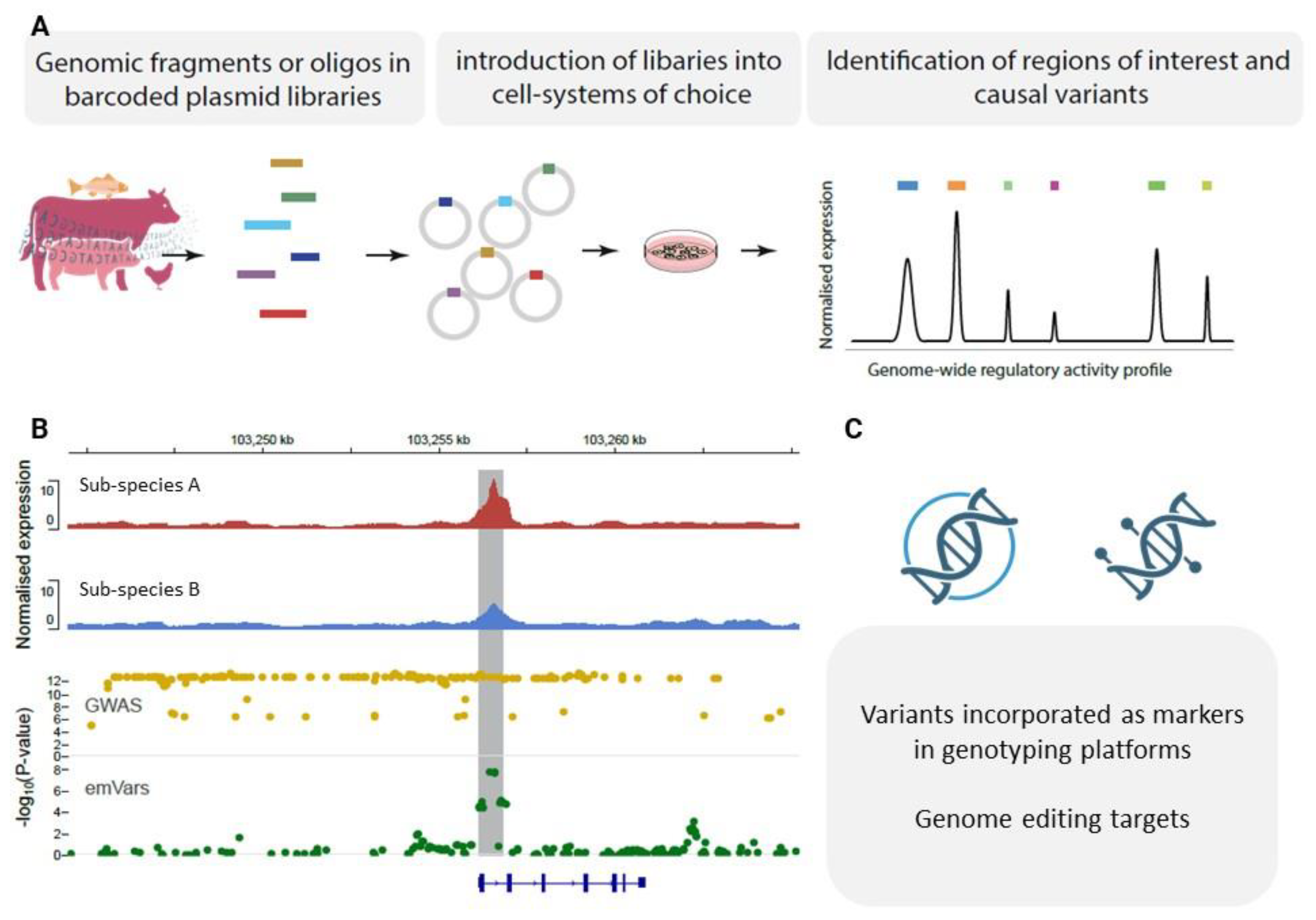
Figure 2.
Vision for in vitro G2P workflows in farmed-animal research. (A) Deeply annotated genomes, pangenome resources and diverse in vitro systems provide the foundation for mechanistic G2P studies. (B) In silico prioritisation and in vitro functional screens enable candidate variants, regulatory elements and cellular mechanisms to be tested at scale. (C) Key priorities include improved cellular models, scalable perturbation and phenotyping, standardisation, data integration and cross-species benchmarking. (D) Integrated in vivo–in vitro–in silico workflows can support discovery and translation across breeding, resilience, health, nutrition, welfare and One Health. Created with BioRender.com.
Figure 2.
Vision for in vitro G2P workflows in farmed-animal research. (A) Deeply annotated genomes, pangenome resources and diverse in vitro systems provide the foundation for mechanistic G2P studies. (B) In silico prioritisation and in vitro functional screens enable candidate variants, regulatory elements and cellular mechanisms to be tested at scale. (C) Key priorities include improved cellular models, scalable perturbation and phenotyping, standardisation, data integration and cross-species benchmarking. (D) Integrated in vivo–in vitro–in silico workflows can support discovery and translation across breeding, resilience, health, nutrition, welfare and One Health. Created with BioRender.com.
Disclaimer/Publisher’s Note: The statements, opinions and data contained in all publications are solely those of the individual author(s) and contributor(s) and not of MDPI and/or the editor(s). MDPI and/or the editor(s) disclaim responsibility for any injury to people or property resulting from any ideas, methods, instructions or products referred to in the content. |
© 2026 by the authors. Licensee MDPI, Basel, Switzerland. This article is an open access article distributed under the terms and conditions of the Creative Commons Attribution (CC BY) license (http://creativecommons.org/licenses/by/4.0/).
Copyright: This open access article is published under a Creative Commons CC BY 4.0 license, which permit the free download, distribution, and reuse, provided that the author and preprint are cited in any reuse.


