

Submitted:
20 July 2026
Posted:
21 July 2026
You are already at the latest version
Abstract
Accuracy and speed are essential in handball throwing, and players show distinctive responses to complex perceptual-motor stimuli. Virtual reality (VR) technologies create controlled conditions for training and assessing sport-specific cognitive skills. The objective of the study is to develop and validate the VR Handball environment for assessing and training perceptual-motor skills and inhibitory control in handball players. The study included 29 participants: 10 professional handball players (100% male, average age 22.1±1.8) and 19 controls (47% male, average age 21±1.8). The VR system modeled a realistic 3D handball court with correctly scaled goalposts and balls. Participants completed tasks of varying difficulty, deflecting yellow target balls while inhibiting responses to red non-target balls. Reaction speed and ball trajectory were recorded using controllers. Professional handball players showed significantly better overall performance than controls, with higher accuracy and stronger inhibitory control, especially in trials with red balls at Easy and Medium levels. Unlike controls, their accuracy did not decline with increased task difficulty; instead, their reaction times became faster. Professional handball players demonstrated more efficient perceptual-motor and cognitive control mechanisms. The VR Handball paradigm appears to be an ecologically valid tool for assessing sport-specific skills.
Keywords:
VR
; virtual sport
; handball
; psychomotor functions
; Pico
; unity
; movement analysis
1. Introduction
Handball is an Olympic sport of high intensity showing permanent alternation of offence and defense, and a complex game play. The main purpose of the game is to score goals, which is realized through well-coordinated efforts of both individual players and team. Players perform short and high-speed movements, quick direction changes, one-on-one battles, throws, passes, and blocks. All the above requires comprehensive physical fitness [1,2,3,4].
Performance in handball is predetermined by a broad spectrum of inter-related factors [2]:
– physical and coordinative qualities including specific throwing technique (considering proximal-distal sequence of muscle activation), jump training, starting speed, and ability to quickly change direction (agility);
– strength capabilities and morphological features, including muscle, upper and lower limb strength which directly correlate with throwing speed. Anthropometric indicators (height, weight, body composition) also significantly affect throwing and one-on-one battles efficiency and vary by playing position;
– endurance. Elite handball players tend to have a maximum oxygen uptake (VO₂ max) of 55–60 ml/kg/min and high peak blood lactate concentration, which explains their ability to sustain high intensity during the entire game.
Apart from the above physical and technical aspects, contemporary research has paid increasingly more attention to psychology[1]. Particularly, cognitive skills such as selective attention, speed and accuracy of decision-making, concentration, and stress resistance are acknowledged as critical for successful performance in limited time and competing pressure [5]. It has been well established that these skills are graded according to playing position.
Social and psychological factors such as team cohesion (both task-oriented and social), leadership, role clarity within the team, and motivational climate are found to be significant for team dynamics and general success [2,6]. Carron et al. [7], in a comprehensive meta-analysis, established a significant moderate-to-large positive relationship between team cohesion and performance in sport. They differentiated between task cohesion (unity in pursuing instrumental goals) and social cohesion (satisfaction with interpersonal relationships), demonstrating that both dimensions are independently associated with team success. The analysis revealed no significant moderating effect of sport type, indicating that high cohesion is equally important for interactive sports (e.g., handball, basketball) and coactive sports (e.g., swimming, golf). Nevertheless, the absolute level of cohesion is typically higher in interactive teams, where coaches naturally employ strategies to foster it [8].
Accuracy and Speed Parameters in Handball
Handball has a highly dynamic environment where successful play, especially as a goalkeeper, directly depends on ability to quickly and accurately process sensory information and convert it into effective motor actions. In handball, there are two teams of seven players each on a court at one time: a goalkeeper, a playmaker, a left/right back, a left/right winger, and a pivot. The goalkeeper is the last line of defense and also the first line of offense. As the ball flies towards the goal at a very high speed (about 115 km/h) he rarely manages to catch it. He usually defends the goal by covering it with his body, using trained techniques. Therefore, a goalkeeper is expected to be flexible, agile, courageous, and to have high pain tolerance [9].
Accuracy and speed are essential aspects of throwing speed in handball [10]. Therefore, speed-accuracy trade-off has been explored by a number of researchers [11,12,13,14]. There are numerous theoretical concepts used to explain the speed-accuracy trade-off in the study of human movement. Thus, Fitts' law [15] states that the faster the movement, the less accurate it is. The speed-accuracy trade-off in handball has been studied by a number of researchers [12,13,14,16]. Based on these studies, several possible interpretations of this trade-off were developed. Van Den Tillaar & Ettema [13] carried out a study with professional handball players, which revealed that instruction type affects throw speed but not accuracy. Therefore, speed increase or decrease does not necessarily result in increased or decreased accuracy. Accuracy did not decrease at the highest speeds, but neither did it improve when the speed was significantly lower. Thus, this inverse correlation is not applicable to the complex movement.
Similar findings discovered for skilled players were later seen in beginners [14]. This work shows that skilled handball players and beginners use the same coordination pattern when throwing. However skilled players optimize their throwing technique and do not demonstrate a speed-accuracy trade-off, while beginners do. The authors attribute this to the lack of optimized throwing technique in beginners.
Virtual Reality (VR) for Evaluation of Psychomotor Parameters in Handball
Conventional training and analytical methods for this skill face limited standardization and condition control. This complicates unbiased assessment and targeted development of athletes' perceptual skills [17].
Virtual reality (VR) technologies hold new promise by enabling identification and training of selected cognitive subcomponents of sport skills under controlled conditions. That in turn contributes to a more accurate assessment of athletes' skill levels and allows for a comparative analysis of different players. It also allows training these cognitive subcomponents [18,19,20,21]. Through VR, researchers can control virtual environment by manipulating parameters unavailable in reality (e.g., ball trajectory or movement biomechanics), changing conditions and complexity of simulated tasks [18,19,20,21,22].
There are series of fundamental technical and methodological challenges in the design of VR environments. To solve these challenges is to ensure the effectiveness of these VR environments. Yet, VR usage efficiency is critically dependent on how methodological and technical issues are tackled. These include ensuring feelings of presence in virtual reality, minimizing system delays, creating a rich visual environment, and proper tactile feedback [18,23,24]. Another critical issue is to prove that athlete's behavior in virtual environment properly reflects their behavior in real game [17,25,26,27,28].
The study by Vignais and his colleagues[27] made a clear case that handball-goalkeepers are better able to handle throws when they actually attempt to deflect the ball rather than just assessing its trajectory. The results revealed that goalkeeper’s accuracy was significantly higher when perception and action were linked. This confirms that in order to assess and train athletic skills, it is essential to create conditions that preserve this link.
Bideau and his colleagues [17,25] pioneered the design of VR environments for handball, creating and validating a highly accurate kinematic model of handball throws. Their results suggested that the goalkeepers’ motor reactions to virtual shots generated by this model did not differ statistically from their reactions to real players’ shots. This confirmed the ecological validity of the VR technique they used.
In 2010, Bolte and colleagues [29] designed a virtual reality (VR) system to analyze and train handball goalkeepers. The aim was to explore decision-making and motor performance under time constraints. The system comprised two testing stages – a visual stimulus and reaction detection.
During the first stage, the goalkeeper was shown a pre-recorded clip of a handball player throwing the ball to one of the goal post corners. This simulated a real game situation and triggered the goalkeeper’s reaction. During the second stage, the system analyzed the goalkeeper’s movements exploiting the area in front of him, which was furnished with a homogeneous backdrop.
Thus, the literature still lacks sufficient evidence on whether a virtual environment can reliably reproduce and assess handball-specific perceptual-motor and inhibitory components, as well as differentiate athletes across levels of expertise. Most existing studies either focus on isolated motor characteristics or use general cognitive tasks that are not directly embedded in the game context. The present study addresses this gap by proposing and validating VR Handball as an ecologically valid tool for assessing sport-specific cognitive-motor skills in handball players.
This study is aimed at developing and testing virtual reality (VR) as a tool to assess perceptual-motor skills of handball players. The following hypotheses were stated in this study: 1) professional handball players will demonstrate a statistically relevant higher performance, which would be manifested in a greater number of successfully deflected shots; 2) increasing task difficulty (from easy to hard) does not result in a significant decrease in accuracy among handball players.
2. Materials and Methods
Participants
The study involved 29 individuals: 10 professional handball players (100% male, 22.1 ±1.8 y.o.) playing at the super league level; masters of sports (6 people) and candidates for masters of sports (4 people), average handball experience 13.2±3 years; 19 non-athlete controls (47% male, 21±1.8 y.o.) with no experience in handball.
Simulating Psychomotor Functions of Handball Players in a VR Environment. Methodology and VR Environment Description
Perceptual-motor tasks adapted for handball players are simulated in a virtual reality environment. The virtual environment's visual features precisely reproduce a real-life handball court. Ball size and weight, and goal post dimensions match their real-life counterparts.
The VR environment is a 3D space in which a handball court is simulated (Figure 1). Perceptual-motor tasks for handball players are simulated in a VR environment, with precise reproduction of real-life court parameters: ball size and weight, and goal post dimensions match their real-life counterparts. The test subject is on the goal line. There are no other players on the court. Virtual gates appear behind the test subject. The goal area where ball throws will be directed at depends on the selected level of difficulty (Figure 2). The interface allows to select one of the uploaded test configurations (here – easy, medium, or difficult). The subject’s movements are recorded while throwing, including hand reaction speed and ball trajectory, which allows motor functions to be assessed. The subject holds controllers that locate their hands. Their task is to deflect as many balls (yellow) as possible by placing their hand with a controller in front of them. The interface allows to introduce an additional factor, i.e., false stimuli – different colored balls. When they are presented, the reaction should be delayed and the ball left undeflected. The current study had 15% false (red) balls in all three configurations.
Creating the VR Handball Interface
While designing the VR Handball environment, the primary focus was put on the accurate simulation of actual sports situations. The balls in virtual environment are presented in a highly realistic manner, matching real sports equipment. No other players are present on the virtual court. However, when the ball emerges, animation is played to signal an upcoming shot. Throwing position is determined based on actual statistics. Similarly set is the throwing target, i.e., goal post point toward which the ball is directed [30].
We have developed an automated configuration assembly and loading via graphical interface written in Python. Configuration is a .txt file containing the test parameters:
(1) number of throws (stimuli);
(2) available speeds set by two numbers that mark the range from which speeds are uniformly distributed and selected for each successive throw;
(3) dimensions of the emergence zone set by five numbers: maximum angle from center, nearest and farthest boundary from the goal post, minimum and maximum height. The departure point is determined by the normal distribution of these parameters for the configuration where a stimulus is more likely to appear in the central zone at an average distance and height. Below is the normal distribution in the C# programming language;
(4) dimensions of the target area set by four numbers: left, right, bottom, and top goal post boundaries. A reverse normal distribution was introduced to increase the number of shots in the corners of the goal post and reduce their quantity in the central area;
(5) time between throws which has a uniform distribution between the two set boundaries;
(6) delay time before stimulus which determines the speed of the ball's animation. Has a uniform distribution between the two set boundaries;
(7) activation and deactivation of false stimuli;
(8) false stimulus frequency (red balls to be deliberately skipped by the subject);
(9) ball size;
(10) physical parameters, such as gravity and mass;
(11) dynamic increase in stimulus speed during the test (coefficient that will be gradually applied to the speed; when the value reaches 2, the final throw will have double average speed of the first throw).
In order to conveniently generate configuration files, we created a separate module as a computer application which generates a configuration file via visual interface and uploads it to the VR headset. The same application contains an option to download data from the VR headset (Table 1).
For the pilot testing of the VR environment, three configurations of different complexity were made: easy, medium, and hard (Table 2).
Choosing a VR Headset
The Pico 4 Pro VR headset was chosen for the tests. This VR headset can operate autonomously with no computer required for calculations or base tracking stations. It also features a compact design (304 g), making it ideal for conducting tests on athletes. Pico 4 logs the headset and controllers position at 200 Hz and delivers images at 90 Hz with a 2160 pixels resolution per eye. This makes it one of the top mobile VR headsets currently available. The Pro version of the headset is fitted with a built-in eye tracker that records eye position and gaze direction at 90 Hz frequency. It also features an optional connection of additional leg trackers and a whole-body position calculation system, which is expected to be included in future endeavors.
VR Application Development
The VR application was developed on the Unity 3D engine (C# programming language used) with the Pico XR software module developed by Pico, the manufacturer of the VR headsets for the best user experience and full functionality. The configuration file generator is a Python script built as a separate application. Its graphical interface was designed with the help of the open-source Tkinter library.
Throughout the test, the VR application records data on the subject's actions. This data is stored in the VR headset's internal memory until downloaded to a computer using configuration software (manual data download is also possible). Raw recorded data includes the position of the subject's head and both arms in each frame (90 Hz frequency), eye position and gaze direction (90 Hz), data on each stimulus (initial parameters of each specific ball; if the speed in the configuration was indicated 35 to 50 km/h, then the exact value, for example, 44 km/h, will be saved to the corresponding file), the position of the stimulus for each frame (90 Hz). While it was possible to record head and arm positions, and application refresh rates were higher than 90 Hz, it was however decided to synchronize recordings with eye data and display refresh rates. Therefore, frame rate in the application is limited to the above-mentioned 90 Hz.
Such recording format gives extensive opportunities for further processing, identification of movement dynamics, comparison of groups of subjects with different handball skills, correlation between eye tracking and motor skills data, and determination of the frontal and peripheral vision ratios among different groups of subjects. Currently, a pilot study is underway to identify the most promising hypotheses concerning the motor and eye movement strategies of handball players.
Description of the Virtual Environment and the Subjects' Tasks
The VR environment provides a 3D space in which a handball court is modelled. Within the VR environment, perceptual-motor tasks for handball players are simulated, with precise replication of the real court’s parameters: the dimensions and mass of the ball, as well as the goal dimensions, correspond to their real-world counterparts. The participant is positioned at the goal line. There are no other players on the court. Virtual “goals” appear behind the participant, towards which the balls will be thrown. The interface allows the selection of one of the preloaded experimental configurations (in this case, easy, medium, or hard). During the throws, data on the participant’s movements are recorded, including hand reaction speed and ball flight trajectory, which enables the assessment of motor functions. The participant holds controllers that determine the position of their hands; their task is to block as many balls (yellow) as possible by positioning the hand with the controller. The interface also allows the introduction of an additional factor — namely, the presence of false stimuli, i.e., balls of a different color; when these appear, the participant must inhibit their reaction and not attempt to block them. In this study, false balls (red) accounted for 15 % of the total.
Data Analysis
Benchmarking was performed using Jamovi 2.4.1. Since the Shapiro-Wilk normality test showed the absence of a normal distribution, we therefore used the nonparametric U Mann-Whitney criterion (α = 0.05) to compare the group of handball players and the control group. A one-way ANOVA was also conducted to test the second hypothesis, which posits that increasing task difficulty (from easy to hard) does not result in a significant decrease in accuracy among handball players.
3. Results
Table 3 shows the results of a statistical analysis conducted using the Mann-Whitney U-test to compare female and male control groups. The following primary variables were analyzed: 1) ball deflection efficiency and 2) reaction speed, both overall and for each of the three configuration programs (easy, medium, difficult).
Table 4 shows the results of statistical analysis performed with the Mann-Whitney U test to compare handball players and controls (male). The following primary variables were analyzed: 1) ball deflection efficiency and 2) reaction speed, both overall and for each of the three configuration programs (easy, medium, difficult).
Handball players showed higher overall accuracy compared to the control group across tasks (Overall result, Yellow deflected, Yellow missed, Red deflected). The key differences emerged in inhibitory control for red balls at Easy and Medium difficulty levels, indicating better inhibition of responses to these stimuli. No differences were found for the main task (deflecting yellow balls) or for reaction speed.
To test the second hypothesis, which posits that increasing task difficulty (from easy to hard) does not result in a significant decrease in accuracy among handball players, a one-way ANOVA was conducted. The results are presented in Table 5.
According to the findings, the control group showed no significant changes in accuracy or reaction speed as task difficulty increased. In contrast, the handball player group demonstrated a significant increase in reaction speed across all reaction types as task difficulty escalated (Left hand reaction time, Right hand reaction time, Reaction time to yellow balls, Reaction time to red balls).
Regarding accuracy, no significant effects of task difficulty were observed for the «Yellow deflected» and «Yellow missed» measures. However, significant differences emerged for the «Overall result» metric. Post-hoc analysis revealed that these significant differences were specifically observed between the Medium and Hard difficulty levels.
4. Discussion
The statistical analysis revealed that professional handball players exhibit considerably higher task performance in the VR Handball environment. The observed higher overall accuracy in handball players compared to the control group (across measures including Overall result, Yellow deflected, Yellow missed, and Red deflected) may reflect enhanced cognitive control mechanisms in athletes. Notably, the most pronounced differences emerged in inhibitory control tasks involving red balls at Easy and Medium difficulty levels, suggesting that handball players exhibit superior ability to suppress inappropriate responses to non-target stimuli. The absence of group differences in the primary task (deflecting yellow balls) and in reaction speed implies that the advantage is specific to inhibitory processes rather than to basic motor or perceptual skills. These findings are consistent with previous studies by Fleddermann et al. [31], who reported that elite handball players demonstrate more effective response inhibition and better suppression of motor actions, as well as with the results of Simonet, Beltrami, and Barral [32] and Dannerbo et al. [33].
To summarise, the hypothesis that professional handball players would demonstrate statistically significant higher performance (as measured by the number of successfully deflected shots) is largely validated by the empirical data.
Handball players exhibited higher overall accuracy compared to controls, with particularly pronounced advantages in inhibitory control for red balls at the Easy and Medium difficulty levels. An increase in task difficulty did not compromise their accuracy, but was associated with a significant acceleration of reaction speed across all response types. In contrast, the control group showed no meaningful changes in performance as a function of task difficulty. Significant differences in the Overall result emerged between the Medium and Hard levels (Table 4), underscoring the modulating effect of increasing task difficulty on inhibitory performance. Our results are consistent with the existing literature. The study by García et al. [12] showed that experienced handball players are capable of throwing at maximum speed (more than 90% of their individual maximum) without a statistically relevant accuracy loss, while beginners showed a distinct negative trade-off between these parameters.
Additionally, our results are consistent with the findings of van Den Tillaar & Ettema [13] stating that instruction type impacts throwing speed in handball but not accuracy. We also found that handball players maintain high efficiency when the task gets more difficult (89% for an easy task, 92% for medium, 84% for a hard one). At the same time, their reaction speed increases (302 ms for easy tasks, 272 ms for medium, and 263 ms for hard ones). This testifies to the fact that the professionals' motor skills have developed to such a level of automatism as to avoid the classic trade-off.
In Vila & Ferragut's [10] systematic review, researchers highlight that throwing for skilled handball players should be practiced at high speeds, since it does not harm accuracy and helps reinforce proper biomechanics. We extend this finding by showing that a similar pattern applies not only to performance, but also to reactions to complex perceptual stimuli that require prompt decision making.
Limitations
The following are possible limitations to this study. Due to the identified gender differences in this study, we were required to reduce the sample size, retaining only male participants. Future plans include expanding the sample size to include handball players of different skill levels and athletes of various specializations, as well as enlarging the control group. A separate study on female handball players is also planned, with results to be compared to both a female control group and male handball players.
5. Conclusions
The present findings demonstrate that professional handball players attain significantly higher task performance in the VR Handball environment, characterized by superior overall accuracy – particularly in inhibitory control trials with red balls at Easy and Medium difficulty – without a decline in performance as task difficulty increases. The absence of group differences in the primary task (deflecting yellow balls) and in basic reaction speed suggests that the advantage is specific to higher-order inhibitory processes rather than to fundamental motor or perceptual abilities. Handball players maintained high efficiency across all difficulty levels (approximately 90%) while simultaneously increasing reaction speed, indicating well-automatized motor skills and efficient cognitive control, whereas controls showed no meaningful adaptation to increasing demands. These results are consistent with prior evidence of enhanced response inhibition in elite handball players [31,32,33] and with studies showing that experienced players can operate at high speed without sacrificing accuracy [10,12,13], thereby supporting the hypothesis that long-term handball expertise shapes not only motor performance but also the underlying cognitive control architecture, enabling athletes to sustain high-quality decision-making under complex, dynamic conditions.
Author Contributions
S.L. and I.S. conceived the idea. A.K., M.O. and A.G. developed the theory and performed the computations. A.K. and E.P. verified analytical methods. I.P. and A.K. supervised the findings. All authors discussed the results and contributed to the final manuscript. All authors have read and agreed to the published version of the manuscript. All authors have read and agreed to the published version of the manuscript.
Funding
The study was supported by The Ministry of Science and Higher Education of the Russian Federation (the research project 075-15-2024-526).
Institutional Review Board Statement
The study was conducted in accordance with the Declaration of Helsinki and approved by the Ethics Committee and consent procedures of the Faculty of Psychology at Lomonosov Moscow State University (the approval No: 2025/07).
Informed Consent Statement
Informed consent was obtained from all subjects involved in the study.
Conflicts of Interest
The authors declare no conflict of interest.
References
- Michalsik, L.; Aagaard, P.; Madsen, K. Locomotion Characteristics and Match-Induced Impairments in Physical Performance in Male Elite Team Handball Players. Int. J. Sports Med. 2012, 34, 590–599. [Google Scholar] [CrossRef] [PubMed]
- Wagner, D.D.; Haxby, J.V.; Heatherton, T.F. The Representation of Self and Person Knowledge in the Medial Prefrontal Cortex. WIRES Cogn. Sci. 2012, 3, 451–470. [Google Scholar] [CrossRef] [PubMed]
- Miasnikof, P.; Shestopaloff, A.Y.; Pitsoulis, L.; Ponomarenko, A. An Empirical Comparison of Connectivity-Based Distances on a Graph and Their Computational Scalability. J. Complex Netw. 2022, 10. [Google Scholar] [CrossRef]
- Póvoas, S.C.A.; Seabra, A.F.T.; Ascensão, A.A.M.R.; Magalhães, J.; Soares, J.M.C.; Rebelo, A.N.C. Physical and Physiological Demands of Elite Team Handball. J. Strength Cond. Res. 2012, 26, 3365–3375. [Google Scholar] [CrossRef] [PubMed]
- Kibitov, A.A.; Chumakov, E.M.; Petrova, N.N.; Vetrova, M.V.; Nechaeva, A.I.; Sorokin, M.Y. Professional Values and Educational Needs among Mental Health Specialists in Russia: Survey Results. Consort. Psychiatr. 2022, 3, 36–45. [Google Scholar] [CrossRef] [PubMed]
- Kleinert, J.; Ohlert, J.; Carron, B.; Eys, M.; Feltz, D.; Harwood, C.; Linz, L.; Seiler, R.; Sulprizio, M. Group Dynamics in Sports: An Overview and Recommendations on Diagnostic and Intervention. Sport Psychol. 2012, 26, 412–434. [Google Scholar] [CrossRef]
- Carron, A.V.; Colman, M.M.; Wheeler, J.; Stevens, D. Cohesion and Performance in Sport: A Meta Analysis. J. Sport Exerc. Psychol. 2002, 24, 168–188. [Google Scholar] [CrossRef]
- Carron, A.V.; Bray, S.R.; Eys, M.A. Team Cohesion and Team Success in Sport. J. Sports Sci. 2002, 20, 119–126. [Google Scholar] [CrossRef] [PubMed]
- Silva, J.M. Psychological Aspects in the Training and Performance of Team Handball Athletes. In The Sport Psychologist’s Handbook; Dosil, J., Ed.; Wiley, 2005; pp. 211–243. ISBN 978-0-470-86355-8. [Google Scholar]
- Vila, H.; Ferragut, C. Throwing Speed in Team Handball: A Systematic Review. Int. J. Perform. Anal. Sport 2019, 19, 724–736. [Google Scholar] [CrossRef]
- Etnyre, B.R. Accuracy Characteristics of Throwing as a Result of Maximum Force Effort. Percept. Mot. Ski. 1998, 86, 1211–1217. [Google Scholar] [CrossRef] [PubMed]
- García, J.A.; Sabido, R.; Barbado, D.; Moreno, F.J. Analysis of the Relation between Throwing Speed and Throwing Accuracy in Team-handball According to Instruction. Eur. J. Sport Sci. 2013, 13, 149–154. [Google Scholar] [CrossRef]
- Van Den Tillaar, R.; Ettema, G. Influence of Instruction on Velocity and Accuracy of Overarm Throwing. Percept. Mot. Ski. 2003, 96, 423–434. [Google Scholar] [CrossRef] [PubMed]
- Van Den Tillaar, R.; Ettema, G. A Comparison between Novices and Experts of the Velocity-Accuracy Trade-Off in Overarm Throwing. Percept. Mot. Ski. 2006, 103, 503–514. [Google Scholar] [CrossRef] [PubMed]
- Mickevičienė, D.; Motiejūnaitė, K.; Skurvydas, A.; Darbutas, T.; Karanauskienė, D. How Do Reaction Time and Movement Speed Depend on the Complexity of the Task? BJSHS 2018, 2. [Google Scholar] [CrossRef]
- Nuño, A.; Chirosa, I.J.; Van Den Tillaar, R.; Guisado, R.; Martín, I.; Martinez, I.; Chirosa, L.J. Effects of Fatigue on Throwing Performance in Experienced Team Handball Players. J. Hum. Kinet. 2016, 54, 103–113. [Google Scholar] [CrossRef] [PubMed]
- Bideau, B.; Kulpa, R.; Ménardais, S.; Fradet, L.; Multon, F.; Delamarche, P.; Arnaldi, B. Real Handball Goalkeeper vs. Virtual Handball Thrower. Presence Teleoperators Virtual Environ. 2003, 12, 411–421. [Google Scholar] [CrossRef]
- Polikanova, I.; Yakushina, A.; Leonov, S.; Kruchinina, A.; Chertopolokhov, V.; Liutsko, L. What Differences Exist in Professional Ice Hockey Performance Using Virtual Reality (VR) Technology between Professional Hockey Players and Freestyle Wrestlers? (A Pilot Study). Sports 2022, 10. [Google Scholar] [CrossRef] [PubMed]
- Gasanov, A.A.; Odintsov, M.A.; Leonov, S.V.; Sukhochev, P.Yu.; Sedogin, E.A.; Belousova, M.D.; Polikanova, I.S. Modeling Shooting Skills in Adaptive Biathlon for Athletes of Varying Skill Levels Using Virtual Reality Technologies. npj 2025, 20, 130–149. [Google Scholar] [CrossRef]
- Federal Scientific Center for Psychological and Interdisciplinary Research; Polikanova, I.; Gasanov, A.; Federal Scientific Center for Psychological and Interdisciplinary Research; Leonov, S. Federal Scientific Center for Psychological and Interdisciplinary Research Use of Virtual Reality Technology for Training Standing Shooting, Postural Balance, and Rifle Stability in Biathlon: A Pilot Study. psychology 2025, 22, 434–448. [Google Scholar] [CrossRef]
- Polikanova, I.S.; Ksenzov, M.Yu.; Melikov, R.T. Space Perception in Virtual Reality in Individuals after Lower Limb Amputation. MUPB 2025, 48, 158–197. [Google Scholar] [CrossRef]
- Bobkov, S.G.; Ulyanov, V.V. THE CHEBYSHEV–EDGEWORTH CORRECTION IN THE CENTRAL LIMIT THEOREM FOR INTEGER-VALUED INDEPENDENT SUMMANDS. Theory Probab. Its Appl. 2022, 66, 537–549. [Google Scholar] [CrossRef]
- Leonov, S.V. , Polikanova, I.S. , Natalia I. Bulaeva, Klimenko, V.A. Using Virtual Reality in Sports Practice. npsyj 2020, 13, 18–30. [CrossRef]
- Polikanova, I.S.; Leonov, S.V. Investigation of EEG Parameters in Virtual Reality Puck Shooting Task in Hockey Players and Freestyle Wrestlers. MUPB 2024, 47, 249–280. [Google Scholar] [CrossRef]
- Bideau, B.; Multon, F.; Kulpa, R.; Fradet, L.; Arnaldi, B. Virtual Reality Applied to Sports: Do Handball Goalkeepers React Realistically to Simulated Synthetic Opponents? In Proceedings of the Proceedings of the 2004 ACM SIGGRAPH international conference on Virtual Reality continuum and its applications in industry - VRCAI ’04; ACM Press: Singapore, 2004; p. 210. [Google Scholar]
- Covaci, A.; Olivier, A.-H.; Multon, F. Third Person View and Guidance for More Natural Motor Behaviour in Immersive Basketball Playing. In Proceedings of the Proceedings of the 20th ACM Symposium on Virtual Reality Software and Technology; ACM: Edinburgh Scotland, November 11 2014. pp. 55–64.
- Vignais, N.; Bideau, B.; Craig, C.; Brault, S.; Multon, F.; Kulpa, R. Virtual Environments for Sport Analysis: Perception-Action Coupling in Handball Goalkeeping. IJVR 2009, 8, 43–48. [Google Scholar] [CrossRef]
- Petri, K.; Emmermacher, P.; Danneberg, M.; Masik, S.; Eckardt, F.; Weichelt, S.; Bandow, N.; Witte, K. Training Using Virtual Reality Improves Response Behavior in Karate Kumite. Sports Eng. 2019, 22, 2. [Google Scholar] [CrossRef]
- Bolte, B.; Zeidler, F.; Bruder, G.; Steinicke, F.; Hinrichs, K.; Fischer, L.; Schorer, J. A Virtual Reality Handball Goalkeeper Analysis System. [CrossRef] [PubMed]
- Pueo, B.; Tortosa-Martínez, J.; Chirosa-Rios, L.; Manchado, C. On-Court Throwing Activity of Male Handball Players during the European Championship 2020. bs 2023, 40, 531–541. [Google Scholar] [CrossRef] [PubMed]
- Fleddermann, M.-T.; Reichert, L.; Wieland, B.; Zentgraf, K. Stop It! Relationship between Sport Expertise and Response Inhibition in Elite Athletes. Front. Psychol. 2023, 14, 1192483. [Google Scholar] [CrossRef] [PubMed]
- Simonet, M.; Beltrami, D.; Barral, J. Inhibitory Control Expertise through Sports Practice: A Scoping Review. J. Sports Sci. 2023, 41, 616–630. [Google Scholar] [CrossRef] [PubMed]
- Dannerbo, C.; Andersson, A.; Wolffsohn, D.; Sanchez, X. Regulatory Focus in Elite Handball. 2024. [Google Scholar]
- Zinchenko, Y.P.; Menshikova, G.Y.; Bayakovsky, Y.M.; Chernorizov, A.M.; Voiskounsky, A.E. Technologies of virtual reality in the context of worldwide and Russian psychology: Methodology, comparison with traditional methods, achievements and perspectives. Psychol. Russ. State Art. 2010, 3, 12–45. [Google Scholar] [CrossRef]
Figure 1.
VR Handball virtual content.
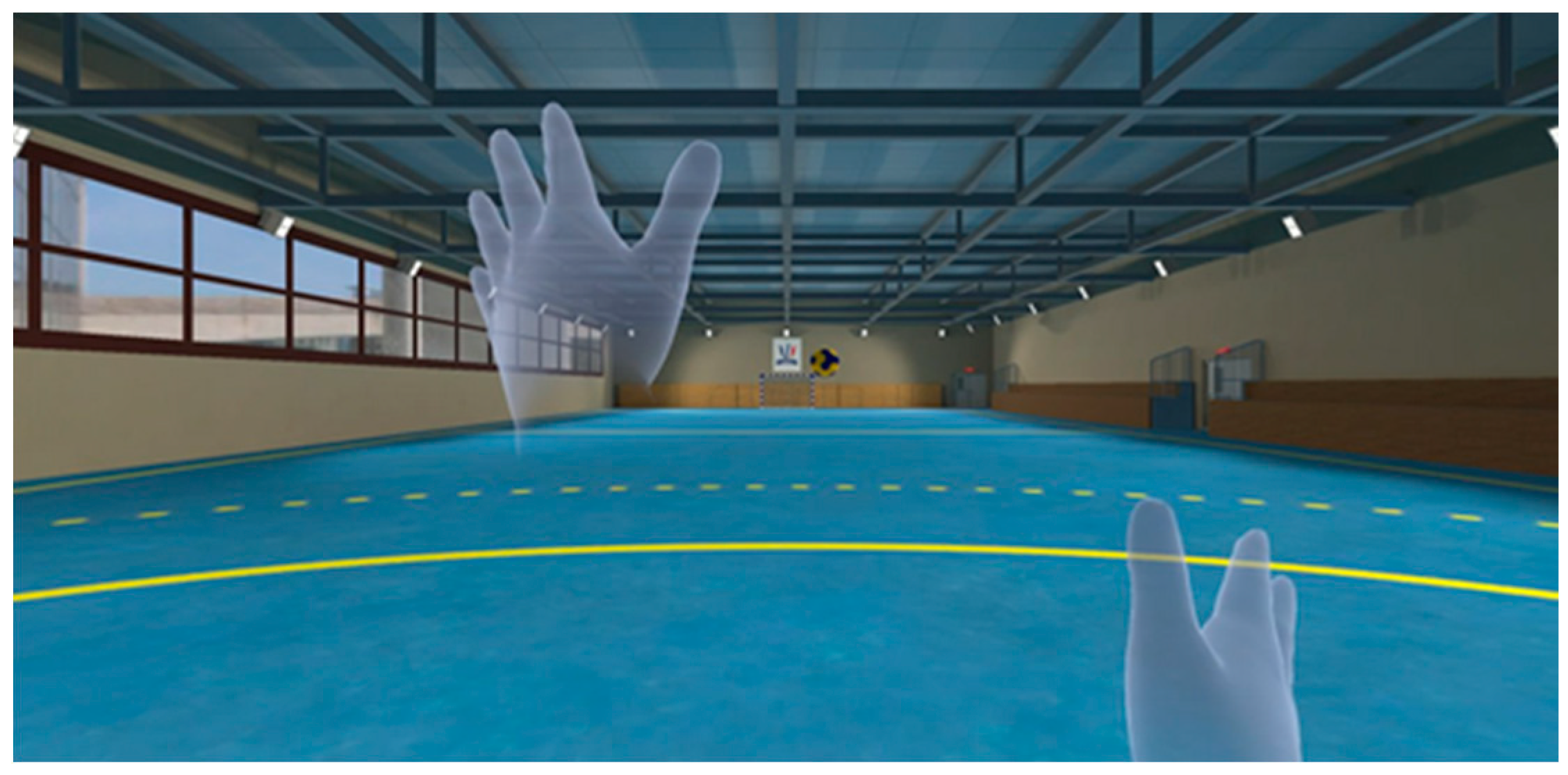
Figure 2.
Virtual goal post areas for complex (left) and simple (right) configurations.
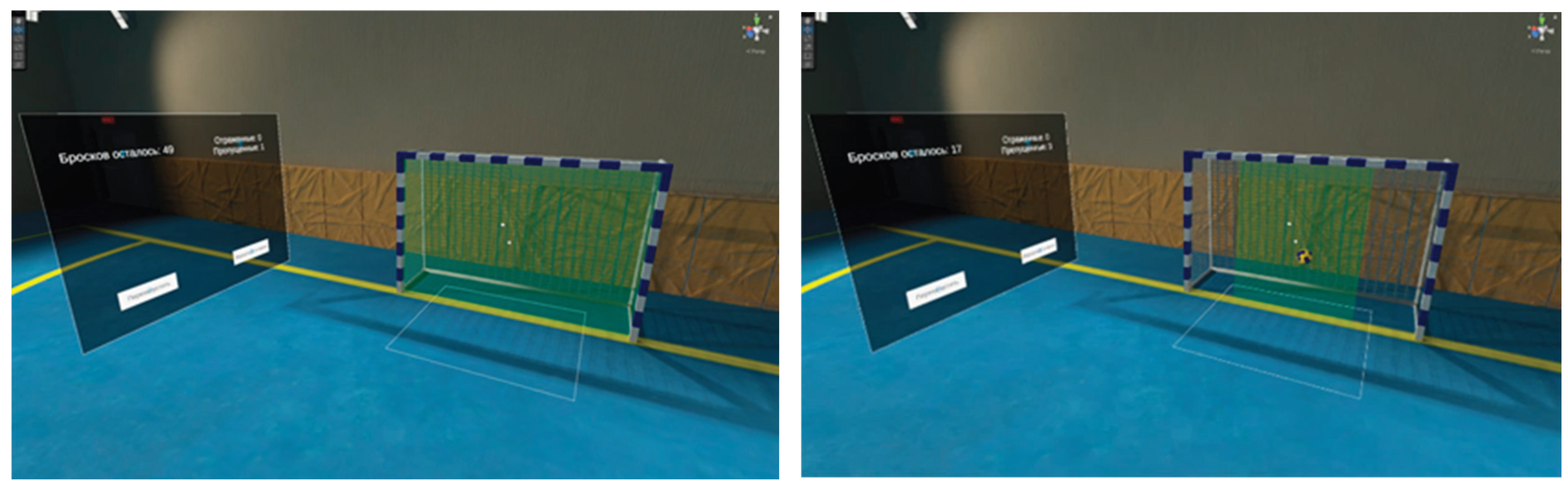

Table 1.
Configuration generation interface and one of the applied configurations.
| Handball Config Manager | ||||
|---|---|---|---|---|
| Configuration File Name | 1 | Default | Save | Help |
| Configuration Name | Medium | Default | Save | Help |
| Emergence Area | 45 1 2 6 9 | Default | Save | Help |
| Stimuli Number | 10 | Default | Save | Help |
| Target Area | 0.7 0 2 0.5 | Default | Save | Help |
| Delay Between Throws | 3 4 | Default | Save | Help |
| Stimulus Emergence Time | 1.5 2 | Default | Save | Help |
| False Stimuli Activated | True | Default | Save | Help |
| False Stimuli Percentage | 15 | Default | Save | Help |
| Stimuli Speed | 35 50 | Default | Save | Help |
| Speed Increase Coefficient | 1.1 | Default | Save | Help |
| Gravity Activated | False | Default | Save | Help |
| Stimuli Mass | 0.44 | Default | Save | Help |
| Stimuli Diameter | 17 | Default | Save | Help |
|
Upload Configuration File Clear All Parameters Download Data Clear Paths | ||||
| Configuration and data v1.0 manager is ready. Insert required configuration into corresponding fields and press ‘Upload Configuration File’ or download data from VR-headset by pressing ‘Download Data.’ VR Headset should be turned on and connected to the computer by USB. | ||||
Table 2.
Configuration program used to test the VR Handball environment.
| 1 | #Name_of_difficulty# | ||
|---|---|---|---|
| easy | medium | hard | |
| 2 | #throw_area#: Allowed area to create an object with stimulus; 5 numbers: ring sector angle from center to sides, symmetrical, in degrees; lower boundary, upper boundary in m; nearest and farthest boundaries in m. | ||
| 45 1 2 6 9 | 45 1 2 6 9 | 45 1 2 6 9 | |
| 3 | #number_of_stimuls# : Number of stimuli in the test | ||
| 20 | 20 | 20 | |
| 4 | #target_area#: Allowed area for stimuli impact; 4 numbers: center to left and right side distance, symmetrical, in m; lower boundary, upper boundary in m; extent of area behind the player in m | ||
| 0.5 0 2 0.5 | 0.7 0 2 0.5 | 0.8 0 2 0.5 | |
| 5 | #delta_t#: Delay between stimuli; 2 numbers: lower and upper delay limits in seconds | ||
| 3 4 | 3 4 | 3 4 | |
| 6 | #delta_before_shoot#: Delay between setting throw point and the throw; 2 numbers: lower and upper delay limits in seconds | ||
| 2 3 | 1.5 2 | 1 1.5 | |
| 7 | #is_false_stimuls_exists#: False stimuli to skip (False, True) | ||
| True | True | True | |
| 8 | #false_stimuls_percentage#: Probability of false stimuli (from 0 to 100 in %) | ||
| 15 | 15 | 15 | |
| 9 | #stimuls_velocity#: Possible stimuli speed in km/h | ||
| 30 40 | 35 50 | 45 55 | |
| 10 | #value_of_velocity_increase#: Value of speed increase during the test (last stimulus travels this number of times as fast; previous ones are interpolated linearly to this coefficient value.) | ||
| 1.1 | 1.1 | 1.1 | |
| 11 | #use_gravity#: Is gravity activated when creating the ball trajectory (False, True) | ||
| False | False | False | |
| 12 | #mass_of_stimul#: Ball (stimulus) mass in kilos (only has an effect when the gravity parameter (use_gravity) is activated.) | ||
| 0.44 | 0.44 | 0.44 | |
| 13 | #diameter_of_stimul#: Ball (stimulus) diameter in cm | ||
| 17 | 17 | 17 | |
| 14 | #reflection_percentage# : % probability of a bounce throw | ||
| 0 | 0 | 0 | |
Table 3.
Results of the statistical analysis (Mann-Whitney U test) comparing female and male control groups.
Table 3.
Results of the statistical analysis (Mann-Whitney U test) comparing female and male control groups.
| Variable | Group | All samples (M±SD) |
U, р | ES |
| Overall result (%) | F | 0.54±0.12 | 13, 0.003** | 0.764 |
| M | 0.77±0.15 | |||
| Yellow deflected (%) | F | 0.53±0.14 | 14.5, 0.005** | 0.736 |
| M | 0.76±0.19 | |||
| Yellow missed (%) | F | 0.48±0.14 | 14.5, 0.005** | 0.736 |
| M | 0.24±0.19 | |||
| Red deflected (false) (%) | F | 0.34±0.38 | 43.5, 0.402 | 0.209 |
| M | 0.22±0.28 | |||
| Red skipped (false) (%) | F | 0.57±0.41 | 36.5, 0.179 | 0.336 |
| M | 0.78±0.28 | |||
| Left hand reaction time | F | 282.44±44 | 45, 0.512 | 0.182 |
| M | 274.66±19 | |||
| Right hand reaction time | F | 291.66±40 | 54, 0.973 | 0.019 |
| M | 295.31±41 | |||
| Reaction time to yellow balls | F | 293.79±46 | 52, 0.863 | 0.055 |
| M | 288.50±28 | |||
| Reaction time to red balls | F | 236.46±62 | 41, 0.529 | 0.18 |
| M | 262.14±28 |
Notes: F – female control, M – male control group; ES – effect size (Rank-biserial correlation), **p< .001.
Table 4.
Results of statistical analysis (Mann-Whitney U test) to compare handball players and controls.
Table 4.
Results of statistical analysis (Mann-Whitney U test) to compare handball players and controls.
| Variable | Group | All samples (M±SD) |
U, p | ES | Easy (M±SD) |
U, p | ES | Medium (M±SD) |
U, p | ES | Hard (M±SD) |
U, p | ES |
| Overall result (%) | H | 0.88±0.10 | 131, 0.004** | 0.56 | 0.89±0.09 | 8, 0.180 | -0.60 |
0.92±0.07 | 2.5, 0.052 | 0.85 | 0.84±0.12 | 18.5, 0.203 | 0.46 |
| C | 0.77±0.15 | 0.83±0.04 | 0.78±0.11 | 0.80±0.05 | |||||||||
| Yellow deflected (%) | H | 0.87±0.11 | 185, 0.054 | 0.38 | 0.88±0.11 | 19, 0.954 | 0.05 | 0.91±0.079 | 8.5, 0.286 | 0.50 | 0.84±0.12 | 13, 0.091 | 0.62 |
| C | 0.76±0.19 | 0.89±0.08 | 0.81±0.18 | 0.74±0.09 | |||||||||
| Yellow missed (%) | H | 0.13±0.11 | 185, 0.054 | 0.38 | 0.12±0.11 | 19, 0.954 | -0.05 | 0.09±0.08 | 8.5, 0.286 | 0.50 | 0.16±0.12 | 13, 0.091 | 0.62 |
| C | 0.24±0.19 | 0.11±0.08 | 0.19±0.18 | 0.26±0.09 | |||||||||
| Red deflected (false) (%) | H | 0.054±0.13 | 213, 0.038* | 0.29 | 0.06±0.14 | 0.5, 0.006** | 0.98 | 0±0 | 8.5, 0.006** | 0.50 | 0.09±0.16 | 25.5, 0.355 | 0.26 |
| C | 0.22±0.28 | 0.58±0.12 | 0.25±0.35 | - | |||||||||
| Red skipped (false) (%) | H | 0.93±0.18 | 220, 0.063 | 0.27 | 0.94±0.14 | 0.5, 0.006** | -0.98 | 1.00±0.00 | 8.5, 0.006** | 0.50 | 0.87±0.25 | 24, 0.304 | 0.30 |
| C | 0.78±0.28 | 0.42±0.12 | 0.75±0.35 | 1.0±0.00 | |||||||||
| Left hand reaction time | H | 280.19±32 | 268, 0.597 | 0.11 | 298.03±29 | 18, 0.866 | -0.10 | 276.00±30 | 11, 0.491 | 0.35 | 267.76±31 | 33, 0.940 | 0.04 |
| C | 274.66±19 | 292.52±31 | 263.44±25 | 267.33±9 | |||||||||
| Right hand reaction time | H | 280.77±34 | 251, 0.416 | 0.16 | 302.92±31 | 17, 0.779 | 0.15 | 278.42±25 | 15, 0.842 | 0.12 | 263.25±32 | 18, 0.211 | 0.48 |
| C | 295.31±41 | 329.41±77 | 293.59±42 | 294.74±41 | |||||||||
| Reaction time to yellow balls | H | 282.37±27 | 283, 0.782 | 0.06 | 301.53±20 | 15, 0.623 | 0.25 | 278.47±26 | 16, 0.947 | 0.06 | 268.59±25 | 20, 0.275 | 0.4203 |
| C | 288.50±27 | 322.44±47 | 280.18±28 | 284.59±20 | |||||||||
| Reaction time to red balls | H | 265.43±62 | 282, 0.763 | 0.06 | 298.29±45 | 7, 0.173 | -0.65 | 270.61±43 | 10, 0.421 | 0.41 | 233.01±73 | 20, 0.261 | 0.4203 |
| C | 262.14±28 | 256.46±5 | 249.25±10 | 275.17±15 |
Notes: H – handball players, C – control group; ES – effect size (Rank-biserial correlation), *p< .01, **p< .001.
Table 5.
Results of statistical analysis (One-Way ANOVA) to compare accuracy and speed in Handball players and controls.
Table 5.
Results of statistical analysis (One-Way ANOVA) to compare accuracy and speed in Handball players and controls.
| Variable | Complexity levels | Handball players | Control group | |||||
| (M±SD) | F | р | PostHoc (Tukey) | (M±SD) | F | р | ||
| Overall result (%) | Easy | 0.89±0.09 | 3.95 | 0.028* | M vs H, p=0.023 | 0.70±0.21 | 0.1846 | 0.839 |
| Medium | 0.92±0.07 | 0.78±0.11 | ||||||
| Hard | 0.84±0.12 | 0.75±0.11 | ||||||
| Yellow deflected (%) | Easy | 0.88±0.11 | 2.84 | 0.071 | 0.72±0.24 | 0.2693 | 0.781 | |
| Medium | 0.91±0.08 | 0.81±0.18 | ||||||
| Hard | 0.84±0.12 | 0.70±0.12 | ||||||
| Yellow missed (%) | Easy | 0.12±0.11 | 2.84 | 0.071 | 0.28±0.24 | 0.2693 | 0.781 | |
| Medium | 0.09±0.08 | 0.19±0.18 | ||||||
| Hard | 0.16±0.12 | 0.30±0.12 | ||||||
| Left hand reaction time | Easy | 298.03±29 | 5.57 | 0.008** | E vs H, p=0.005 | 292.10±27 | 1.9578 | 0.308 |
| Medium | 276.00±30 | 263.44±25 | ||||||
| Hard | 267.76±31 | 265.29±8 | ||||||
| Right hand reaction time | Easy | 302.92±30 | 8.50 | < .001** |
E vs M, 0.0043, E vs H, p< .001 |
297.39±44 | 0.070 | 0.934 |
| Medium | 278.42±25 | 293.59±42 | ||||||
| Hard | 263.25±32 | 286.58±38 | ||||||
| Reaction time to yellow balls | Easy | 301.53±19 | 12.13 | < .001** |
E vs M, 0.014, E vs H, p< .001 |
302.15±37 | 0.6236 | 0.595 |
| Medium | 278.47±26 | 280.18±28 | ||||||
| Hard | 268.59±25 | 280.88±19 | ||||||
| Reaction time to red balls | Easy | 298.29±44 | 6.39 | 0.004** | E vs H, p=0.001 | 249.97±42 | 1.2481 | 0.359 |
| Medium | 270.61±43 | 249.25±10 | ||||||
| Hard | 233.01±73 | 268.50±18 | ||||||
Notes: E – easy level, M – medium level, H – hard level, *p< .01, **p< .001.
Disclaimer/Publisher’s Note: The statements, opinions and data contained in all publications are solely those of the individual author(s) and contributor(s) and not of MDPI and/or the editor(s). MDPI and/or the editor(s) disclaim responsibility for any injury to people or property resulting from any ideas, methods, instructions or products referred to in the content. |
© 2026 by the authors. Licensee MDPI, Basel, Switzerland. This article is an open access article distributed under the terms and conditions of the Creative Commons Attribution (CC BY) license (http://creativecommons.org/licenses/by/4.0/).
Copyright: This open access article is published under a Creative Commons CC BY 4.0 license, which permit the free download, distribution, and reuse, provided that the author and preprint are cited in any reuse.


