
Submitted:
20 July 2026
Posted:
21 July 2026
You are already at the latest version
Abstract
Turkish ambling horses represent an important component of Türkiye’s indigenous equine genetic resources. However, available morphometric information on these horses remains relatively limited. This study aimed to characterize morphometric traits of Turkish ambling horses by breeding origin, age, and sex, thereby providing baseline phenotypic data for future conservation and breeding programs. The findings provide novel insights into the phenotypic variation in Turkish ambling horses by integrating multiple breeding origins and evaluating the combined effects of breeding origin, age, and sex within a single analytical framework. A total of 102 Turkish ambling horses were evaluated, including indigenous horses raised in Bursa (n = 28), indigenous horses raised in Nazilli, Aydın Province (n = 65), and Afghan-origin ambling horses raised in Bursa (n = 9). Morphometric measurements of the head, body, and limbs were recorded, and the effects of breeding origin, age, and sex were analyzed using a general linear model. Significant differences among breeding origins were observed for several body and limb traits (p < 0.05), with Afghan horses exhibiting great-er body dimensions, particularly withers height, body length, chest depth, chest width, and heart girth, than the indigenous horse populations. Many body measurements showed a tendency to stabilize after four years of age, although some traits continued to vary among adult age groups. Males generally exhibited larger morphometric measurements than females. Correlation analysis revealed strong positive relationships among the principal body measurements, particularly between withers height and croup height (r = 0.84, p < 0.001), indicating a high degree of proportionality among major skeletal traits. Overall, this study offers one of the most comprehensive morphometric assessments of Turkish ambling horses from different breeding origins and establishes valuable baseline phenotypic data for indigenous Turkish horse populations. The findings contribute to the conservation and sustainable utilization of indigenous equine genetic resources and provide a scientific foundation for future phenotypic characterization, genetic studies, and breeding programs.
Keywords:
Turkish ambling horses
; morphometric characterization
; indigenous equine genetic resources
; phenotypic characterization
; morphometry
1. Introduction
The horse has been one of the most important domesticated animal species throughout human history, playing a vital role in transportation, agriculture, warfare, and human subsistence from approximately 5500 BC until the widespread mechanization of agriculture and transportation during the 1950s and 1960s [1]. Throughout history, horses occupied a central position in the social, economic, and military life of many civilizations and were indispensable for hunting, transportation, herd management, agricultural activities, and warfare [2,3].
Horse breeding has long been an important component of animal production in Türkiye [4]; however, the national horse population has declined markedly over the past century. According to FAO statistics, horse numbers decreased from approximately 309,000 in the early 2000s to 114,047 in 2017 and 70,360 in 2024 [5], largely due to the mechanization of agriculture and transportation.
Recent advances in equine genetics have demonstrated that the ability to perform ambling gaits is strongly associated with a mutation in the DMRT3 gene, a major determinant of locomotor coordination and alternative gaits [6,7]. Wutke et al. [8]. showed the earliest known occurrence in England (850–900 AD), but did not definitively prove it originated there. Although genetic variation was not investigated in the present study, documenting the morphometric characteristics of Turkish ambling horses provides essential baseline information for future studies integrating phenotypic, gait, and molecular genetic analyses.
In addition to the three basic gaits (walk, trot, and gallop), several alternative gaits, including the ambling gait, occur naturally in specific horse breeds. Among Turkish horse populations, the Ayvacık Pony and the Canik Horse are recognized for their natural ambling gait [9,10,11]. Historical records indicate that gaited horses were introduced into Anatolia during the migration of Turkic peoples and were preserved throughout the Seljuk and Ottoman periods. Today, traditional ambling horse races continue under the Traditional Sports Federation, helping to preserve this cultural heritage.
Phenotypic characterization is a fundamental step in the identification, conservation, and sustainable utilization of animal genetic resources [12]. Morphometric measurements are widely used to characterize horse populations, evaluate body conformation, and support breeding and conservation programs because body size and conformation traits provide valuable information for population classification and breed differentiation [13]. During their interpretation, however, skeletal maturity should be considered rather than chonological age alone [14]. Previous studies have reported mean values of 141.8 ± 0.62 cm for withers height, 140.1 ± 0.63 cm for croup height, 140.8 ± 0.86 cm for body length, 166.1 ± 0.95 cm for chest circumference, 64.3 ± 0.55 cm for chest depth, 17.9 ± 0.11 cm for cannon circumference, 57.3 ± 0.39 cm for head length, and 13.4 ± 0.12 cm for ear length in Turkish ambling horses [15]. Moreover, Rahvan horses appear to form a genetically distinct population that clusters separately from other native Turkish horse populations [16].
Despite their historical and cultural importance, Turkish ambling horses are threatened by declining population size, uncontrolled crossbreeding, and changes in breeding practices. Nevertheless, conservation efforts by breeders, including the establishment of the Association for the Preservation and Development of Anatolian Horse Breeds in 1992 and the introduction of official ambling horse competition regulations in 1998, have helped to maintain these valuable genetic resources. Seasonal ambling horse races continue to support both traditional equestrian culture and the conservation of indigenous horse populations. The identification and conservation of local horse populations remain essential for preserving genetic diversity and supporting future breeding programs [17,18].
Despite increasing interest in conserving indigenous horse genetic resources, comprehensive morphometric studies on Turkish ambling horses remain limited. This study provides a comprehensive phenotypic evaluation of indigenous Turkish ambling horses from the Bursa and Nazilli populations, as well as Afghan-origin horses maintained in Bursa, within a unified morphometric framework. In addition, the effects of breeding origin, age, and sex were evaluated using a unified statistical approach, and a comprehensive correlation matrix was established to describe relationships among major morphometric traits. These findings provide valuable baseline phenotypic data for Turkish ambling horses and support future conservation, breeding, and genetic improvement programs.
2. Materials and Methods
The study was conducted in Bursa (40°11′50″ N, 29°03′44″ E) and the Nazilli district of Aydın Province (37°54′45″ N, 28°19′14″ E), Türkiye. A total of 102 Turkish ambling horses maintained on private breeding farms in these two regions were included in the study. The study population comprised indigenous Turkish ambling horses from Bursa and Nazilli and Afghan-origin ambling horses maintained in Bursa. All horses were evaluated under field conditions using identical measurement procedures, allowing direct comparison of morphometric traits among breeding-origin groups. The horses were classified into three breeding-origin groups: indigenous horses from Bursa (n = 28), indigenous horses from Nazilli (n = 65), and Afghan-origin horses maintained in Bursa (n = 9) The study population consisted of 38 females and 64 males. Based on age, the horses were divided into four categories: 0–3 years (n = 49), 4–6 years (n = 31), 7–9 years (n = 14), and ≥10 years (n = 8) (Figure 1).
The breeders were visited on-site, and all morphometric measurements were obtained directly from the horses using standard zoometric measurement procedures. The effects of breeding origin, age, and sex on the morphological characteristics of the Turkish ambling horses were subsequently evaluated.
The Turkish ambling horses included in this study naturally perform the ambling (rahvan) gait, an alternative gait found in only a few horse breeds. This gait is characterized by coordinated lateral limb movement, resulting in a smooth, comfortable ride with minimal vertical displacement. Consequently, it has traditionally been preferred for riding and long-distance travel in Türkiye (Figure 2) [19].
Accordingly, all horses included in the present study naturally performed the ambling (rahvan) gait, which constituted the principal criterion for their selection as the study material. According to Yücel [1], the terms rahvan, yorga, and eşkin describe closely related forms of ambling gait. While eşkin is of Turkish origin, rahvan is of Persian origin. The ambling gait is characterized as a four-beat gait in which the ipsilateral forelimb and hindlimb strike the ground simultaneously. As a result of this limb movement pattern, the horse’s body alternately sways to the right and left, producing a smooth and comfortable ride that minimizes rider fatigue.
Morphometric measurements were grouped into three categories: head, body, and limb traits. Head measurements included head length (HL) and head width (HWi). Body measurements comprised withers height (WH), croup height (CH), back height (BH), tailhead height (TH), ischial tuberosity height (ITH), body length (BL), chest depth (CD), chest width (CW), heart girth (HG), ischial width (IW), and hip width (HW). Limb measurements included cannon girth (CG), cannon length (CL), hoof height (HH), and limb length (LL). Height measurements were obtained with a Lydtin (Hauptner, Solingen, Germany) measuring stick, whereas width, length, and circumference were recorded with a flexible measuring tape (Figure 4). All morphometric measurements were performed by the same two experienced researchers using a standardized measurement protocol to ensure consistency and reduce observer-related variation (Figure 3).
To minimize the effects of diurnal variation, all horses were measured between 09:00 and 11:30 a.m. under standardized field conditions. Measurements were obtained on a flat, level surface, with each horse standing squarely in a natural posture. As all horses were uniformly shod at the time of measurement, any potential effect of shoeing on height measurements was considered consistent across the study population. All horses were measured while shod with standard shoes; therefore, height measurements include shoe thickness and are not directly comparable to unshod horse data.
Phenotypic relationships among morphometric traits were assessed using Pearson's correlation analysis in JMP® Pro version 17 (SAS Institute Inc., Cary, NC, USA). Statistical significance was set at p < 0.05, p < 0.01, and p < 0.001. Differences among groups were evaluated using Tukey’s multiple comparison test. The following linear model was used to evaluate the effects of the investigated factors on morphometric traits:
where
: observed value of the dependent variable;
: overall population mean;
: fixed effect of the ith origin;
: fixed effect of the ith age;
: fixed effect of sex;
: random residual error.
Figure 4.
Schematic diagram of the morphometric measurements used in this study.
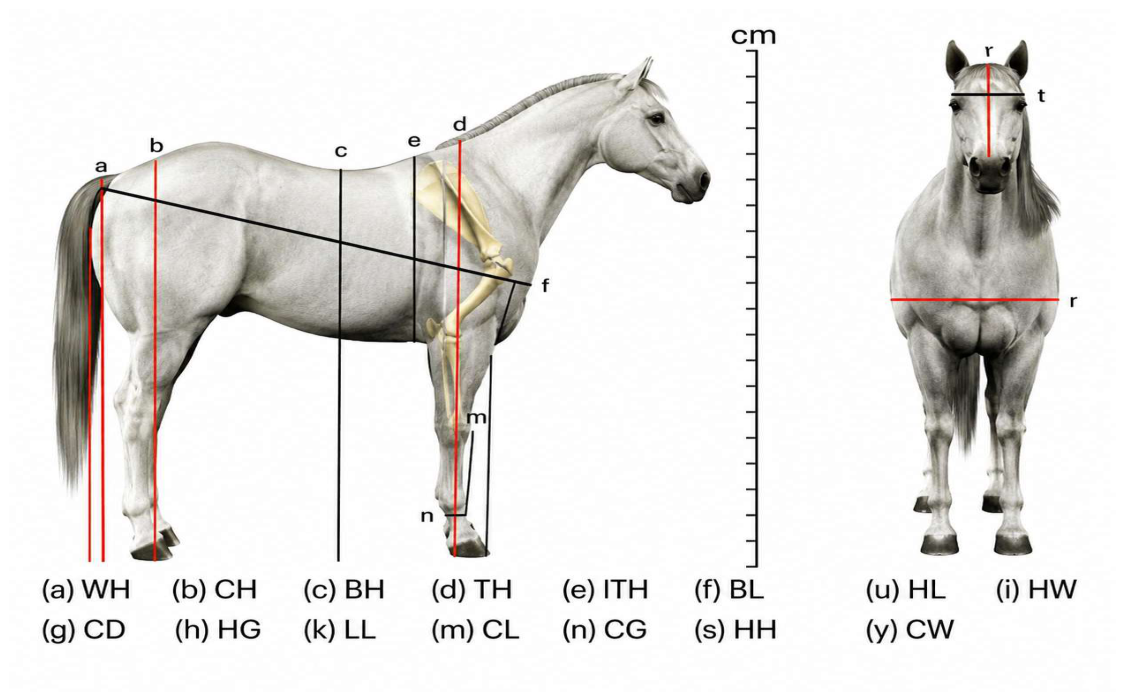
Head traits
- HL (Head Length): Distance from the poll (occipital crest) to the most anterior point of the upper lip
- HdW (Head Width): Maximum distance between the lateral borders of the zygomatic arches.
Body traits
- WH (Withers Height): Vertical distance from the highest point of the withers to the ground.
- CH (Croup Height): Vertical distance from the highest point of the croup (tuber sacrale) to the ground.
- BH (Back Height): Vertical distance from the midpoint of the back to the ground.
- TH (Tailhead Height): Vertical distance from the tailhead (base of the tail) to the ground.
- ITH (Ischial Tuberosity Height): Vertical distance from the ischial tuberosity (pin bone) to the ground.
- BL (Body Length): Horizontal distance from the point of the shoulder (cranial aspect of the humerus) to the ischial tuberosity.
- CD (Chest Depth): Vertical distance from the highest point of the withers to the sternum immediately behind the forelimbs.
- CW (Chest Width): Horizontal distance between the medial borders of the shoulder joints immediately behind the forelimbs.
- HG (Heart Girth): Thoracic circumference measured immediately behind the withers and elbows.
- IW (Ischial Width): Distance between the left and right ischial tuberosities.
- HW (Hip Width): Distance between the left and right tubera coxarum
Limb traits
- CG (Cannon Girth): Circumference measured at the midpoint of the metacarpus (cannon bone) of the forelimb.
- CL (Cannon Length): Distance from the distal margin of the carpal joint to the proximal margin of the fetlock joint.
- HH (Hoof Height): Vertical distance from the coronary band to the ground at the dorsal hoof wall.
- LL (Leg Length): Vertical distance from the elbow to the ground.
3. Results
The descriptive statistics for the morphometric body measurements of the Turkish ambling horses included in the study are presented in Table 1.
The overall mean values of the morphometric traits are presented in Table 1. The mean body measurements were 143.72 cm for WH, 134.44 cm for CH, 135.76 cm for BH, 128.68 cm for TH, 123.11 cm for ITH, 137.56 cm for BL, 64.53 cm for CD, 34.84 cm for CW, 156.92 cm for HG, 22.68 cm for IW, and 41.66 cm for HW. The corresponding mean values for the limb traits were 18.81 cm for CG, 36.88 cm for CL, 83.53 cm for LL, and 8.31 cm for HH. The mean head measurements were 54.76 cm for HL and 21.53 cm for HdW (Table 1).
The effects of breeding origin (Afghan, Bursa, and Nazilli), age (0–3, 4–6, 7–9, and ≥10 years), and sex (male and female) on the morphometric traits of Turkish ambling horses are presented in this section.
The effects of breeding origin on body, limb, and head morphometric traits are presented in Table 2. Breeding origin significantly affected several body measurements, including WH, BL, and IW (p < 0.05), and HW, CD, CW, and HG (p < 0.01). In contrast, CH, BH, and ITH did not differ significantly among breeding-origin groups (p > 0.05). Afghan-origin horses tended to exhibit greater values for several body measurements than the indigenous Bursa and Nazilli populations, suggesting a relatively larger body frame. With the exception of ischial tuberosity height, the significant differences observed among breeding origins were largely associated with the comparatively larger body size of the Afghan-origin horses, whereas the Bursa and Nazilli populations exhibited broadly similar morphometric characteristics. However, these findings should be interpreted with caution because the Afghan-origin group comprised a relatively small number of horses (n = 9). In addition, body length showed positive correlations with several morphometric traits, particularly heart girth, indicating that this measurement may serve as a useful indicator of overall body conformation in Turkish ambling horses.
Among limb traits, breeding origin significantly influenced CG (p < 0.05) and CL (p < 0.001), whereas HH and LL were not significantly affected (p > 0.05). Afghan and Nazilli horses showed comparable values for both cannon girth and cannon length. In contrast, Bursa horses exhibited significantly lower values, suggesting relatively minor differences in limb conformation between Afghan and Nazilli horses (Table 2).
For head measurements, significant differences were observed for HL (p < 0.05) and HdW (p < 0.001). Afghan and Nazilli horses displayed similar head dimensions, whereas Bursa horses had significantly smaller head measurements than the other two groups. Overall, these findings indicate that the Nazilli population shows greater morphological similarity to Afghan horses than the Bursa population, particularly in limb and head conformation, despite retaining body dimensions characteristic of indigenous Turkish ambling horses.
The effects of age on body, limb, and head morphometric traits are presented in Table 3. Age-specific analyses within each breeding-origin group were not performed due to limited sample sizes in some subclasses. Nevertheless, the overall distribution of horses among age groups enabled the evaluation of age-related changes in morphometric characteristics.
Age significantly affected most body measurements. Horses aged 4 years and older exhibited similar values for WH, CH, BH, BL, CD, CW, HG, and HW (p > 0.05), suggesting that most body measurements tend to stabilize after approximately four years of age in Turkish ambling horses. The significant differences observed among age groups were primarily attributable to horses in the 0–3-year age group, representing the active growth phase. Highly significant age effects were detected for WH, BL, CD, CW, and HG (p < 0.001), whereas ITH showed a significant effect at p < 0.01. CH, BH, IW, and HW also showed significant age-related differences (p < 0.05). The absence of significant differences among horses older than four years suggests that skeletal growth is largely completed by this age. However, longitudinal studies are required to confirm the precise pattern of skeletal maturation.
Age also significantly influenced limb measurements. CG showed the strongest age effect (p < 0.001), whereas CL (p < 0.05), HH (p < 0.01), and LL (p < 0.05) were also affected by age. Horses in the 4–6, 7–9, and ≥10-year age groups exhibited similar values for cannon girth, cannon length, and hoof height, while horses aged 0–3 years differed significantly from the older groups, reflecting the continued development of the appendicular skeleton during early growth.
Head measurements likewise exhibited age-related variation. Horses aged four years and older showed similar HL, whereas the 0–3-year age group had significantly smaller values (p < 0.05). A comparable pattern was observed for HdW, although Tukey’s multiple comparison test indicated no significant differences between the 0–3- and 7–9-year groups or between the 4–6- and ≥10-year groups. Overall, these findings suggest that many body, limb, and head dimensions approach adult proportions by approximately four years of age, although some morphometric traits continue to vary among adult age groups. The effects of sex on body, limb, and head morphometric traits are presented in Table 4. Sex significantly affected several morphometric traits, although most body measurements did not differ between males and females. Significant differences were observed for TH, CD, CW (p < 0.01), and HG (p < 0.05), with males exhibiting larger values than females. In contrast, WH, CH, BH, BL, IW, and HW were not significantly influenced by sex.
Sex was associated with variation in all evaluated limb measurements. Males generally exhibited greater values for CG, CL, HH, and LL than females, with the strongest effect observed for CL (p < 0.001), followed by CG, HH (p < 0.01), and LL (p < 0.05). Head measurements were also significantly affected by sex. Male horses exhibited greater HL and HdW than females, with significant differences for head length (p < 0.01) and highly significant differences for head width (p < 0.001). Overall, these findings suggest that male Turkish ambling horses generally possess larger cranial and appendicular dimensions than females. However, not all body and pelvic-related traits exhibited sexual dimorphism, as ischial tuberosity height (ITH) did not differ significantly between sexes.
Phenotypic Correlations Among Morphometric Traits
The strongest correlations were observed among body height measurements, particularly between CH and BH (r = 0.913, p < 0.01), followed by WH with CH (r = 0.843, p < 0.01) and BH (r = 0.827, p < 0.01). Likewise, ITH showed strong positive correlations with WH, CH, and BH (r = 0.713–0.823, p < 0.01), indicating coordinated skeletal development. BL was positively correlated with CD (r = 0.637, p < 0.01) and HG (r = 0.693, p < 0.01), suggesting a proportional increase in body size and thoracic capacity. Similarly, chest depth was strongly associated with heart girth (r = 0.772, p < 0.01), reflecting the close relationship between thoracic dimensions. HL and HdW exhibited moderate positive correlations with most body measurements, indicating that head development generally paralleled overall body growth. In contrast, the distance between the IW showed weak or non-significant correlations with several traits, including TH, CW, CG, CL, HH, and LL. Overall, these results indicate that the morphometric traits of Anatolian ambling horses are highly integrated, reflecting a harmonious pattern of skeletal and body development.

Table 5.
Phenotypic correlation coefficients among morphometric traits.
| WH | CH | BH | TH | ITH | BL | CD | CW | HG | IW | HW | CG | CL | HL | HdW | HH | LL | |
|---|---|---|---|---|---|---|---|---|---|---|---|---|---|---|---|---|---|
| WH | 1.000 | ||||||||||||||||
| CH | 0.843 ** | 1.000 | |||||||||||||||
| BH | 0.827 ** | 0.913 ** | 1.000 | ||||||||||||||
| TH | 0.414 ** | 0.512 ** | 0.510 ** | 1.000 | |||||||||||||
| ITH | 0.713** | 0.812 ** | 0.823 ** | 0.473 ** | 1.000 | ||||||||||||
| BL | 0.499 ** | 0.504 ** | 0.475 ** | 0.548 ** | 0.464 ** | 1.000 | |||||||||||
| CD | 0.459 ** | 0.449 ** | 0.445 ** | 0.672 ** | 0.356 ** | 0.637 ** | 1.000 | ||||||||||
| CW | 0.438 ** | 0.457 ** | 0.420 ** | 0.548 ** | 0.423 ** | 0.603 ** | 0.575 ** | 1.000 | |||||||||
| HG | 0.534 ** | 0.436 ** | 0.456 ** | 0.630 ** | 0.404 ** | 0.693 ** | 0.772 ** | 0.537 ** | 1.000 | ||||||||
| IW | 0.366 ** | 0.304 ** | 0.249 * | 0.139 | 0.234 * | 0.337 ** | 0.376 ** | 0.142 | 0.413 ** | 1.000 | |||||||
| HW | 0.471 ** | 0.355 ** | 0.203 * | 0.379 ** | 0.339 ** | 0.450 ** | 0.565 ** | 0.415 ** | 0.542 ** | 0.509 ** | 1.000 | ||||||
| CG | 0.412 ** | 0.432 ** | 0.412 ** | 0.477 ** | 0.474 ** | 0.580 ** | 0.528 ** | 0.457 ** | 0.445 ** | 0.161 | 0.337 ** | 1.000 | |||||
| CL | 0.196 * | 0.203 * | 0.296 ** | 0.512 ** | 0.242 * | 0.405 ** | 0.373 ** | 0.510 ** | 0.320 ** | 0.073 | 0.210 * | 0.246 * | 1.000 | ||||
| HL | 0.511 ** | 0.501 ** | 0.481 ** | 0.383 ** | 0.522 ** | 0.453 ** | 0.353 ** | 0.374 ** | 0.427 ** | 0.322 ** | 0.216 * | 0.478 ** | 0.122 | 1.000 | |||
| HdW | 0.515 ** | 0.496 ** | 0.533 ** | 0.475 ** | 0.486 ** | 0.462 ** | 0.438 ** | 0.420 ** | 0.458 ** | 0.106 | 0.336 ** | 0.485 ** | 0.337 ** | 0.486 ** | 1.000 | ||
| HH | 0.328 ** | 0.318 ** | 0.330 ** | 0.581 ** | 0.265 ** | 0.599 ** | 0.631 ** | 0.503 ** | 0.561 ** | 0.186 | 0.411 ** | 0.371 ** | 0.430 ** | 0.417 ** | 0.423 ** | 1.000 | |
| LL | 0.153 | 0.252 * | 0.305 ** | 0.396 ** | 0.256 ** | 0.437 ** | 0.426 ** | 0.501 ** | 0.336 ** | 0.050 | 0.262 ** | 0.334 ** | 0.569 ** | 0.187 | 0.295 ** | 0.428 ** | 1.000 |
* p < 0.05; ** p < 0.01.
4. Discussion
The present study provides a comprehensive morphometric characterization of Turkish ambling horses from two major breeding regions (Bursa and Nazilli) together with Afghan-origin horses maintained under similar management conditions. Overall, the horses exhibited a medium-sized body frame with balanced proportions typical of Turkish ambling horses. The morphometric values were generally consistent with those previously reported for indigenous Turkish horse populations [9,10,16,20,21], although back height and body length tended to exceed values reported in earlier studies. These differences may reflect improvements in nutrition, management practices, and selective breeding rather than genetic background alone.
Morphometric variation among horse populations is shaped by both genetic and environmental factors. Ecological adaptation, management systems, nutrition, and breeding objectives collectively contribute to phenotypic diversity. Consistent with Mousavi et al. [22], horses raised under different ecological and breeding conditions may develop distinct morphometric characteristics while retaining the general conformation of their population. Similarly, Ribeiro et al. [13] demonstrated that sexual dimorphism significantly affects several morphometric traits, including withers height, croup height, chest depth, body length, and cannon circumference. The present results support these findings, as males generally exhibited larger body dimensions than females, particularly in thoracic and limb measurements, underscoring the importance of considering sex in equine conformation assessment and breeding programs.
Collectively, these findings indicate that Turkish ambling horses possess a well-balanced morphometric structure while retaining measurable variation associated with breeding origin, age, and sex. Such variation provides valuable information for phenotypic characterization, conservation, and breeding strategies aimed at preserving the genetic diversity and functional conformation of indigenous Turkish horse populations.
Skeletal height and body dimensions are among the most informative traits for evaluating body conformation, growth, and functional performance in horses. Height-related measurements, including WH, TH, BH, and ITH, together with BL, CD, CW, and HG, comprehensively described body conformation in the studied population. Their values were generally consistent with those previously reported for indigenous Turkish horse populations [9,10,15,19,20], indicating that Turkish ambling horses have retained the characteristic conformation of native Turkish horses despite differences in breeding origin and management systems.
Among the evaluated skeletal measurements, WH is widely regarded as one of the most reliable indicators of overall body size and skeletal development. Rogers et al. [14] reported that Thoroughbred horses attain approximately 98% of their mature withers height by 24 months of age, suggesting that this trait reaches structural maturity relatively early. Similarly, Batu [9] indicated that skeletal height and thoracic development continue until approximately four to five years of age. Consistent with these observations, horses older than four years showed no significant differences in withers height, indicating that skeletal growth had largely stabilized by this age. Although genetic background is the primary determinant of withers height, environmental factors such as nutrition, management practices, and the early use of horses for work may also influence phenotypic variation. This observation is also consistent with current breeding practices, in which withers height remains one of the principal selection criteria for breeding and riding horses, supporting Batu’s observations [9] regarding its importance for riding ability and load-carrying capacity.
TH and BH exhibited patterns similar to those of WH and were strongly correlated, indicating coordinated development of the axial skeleton and proportional skeletal growth. Previous studies have likewise shown that croup conformation is closely associated with locomotor efficiency because the propulsive forces generated by the hindquarters are transmitted through the pelvic region to the forequarters [9]. Accordingly, in conventional riding horses, a croup that is slightly lower than the withers is generally considered desirable because it helps maintain the center of gravity toward the forequarters. However, this conformation should not be regarded as a universal functional ideal, particularly for gaited horse breeds such as Turkish ambling horses, in which pelvic conformation may be associated with the specific biomechanical requirements of the ambling gait. Therefore, the proportional relationships among the principal skeletal height measurements should be interpreted within the functional context of the breed and its characteristic gait. BL, CD, CW, and HG are important indicators of body development and thoracic capacity. Afghan-origin horses tended to exhibit larger values for several body measurements than the indigenous Turkish populations, suggesting a relatively larger body frame. In addition, body length showed positive correlations with several morphometric traits, particularly heart girth. In contrast, chest depth and chest width were positively correlated with most body measurements, indicating coordinated body and thoracic development. These findings are consistent with those of Padilha et al. [23], who reported significant positive relationships among croup height, body length, head dimensions, and other skeletal measurements, supporting the close structural integration of major body regions.
Heart girth showed the strongest correlation with the remaining body measurements, particularly chest depth, confirming its value as an indicator of thoracic development and body capacity. Because heart girth is closely related to thoracic cavity size, it has long been used as an indirect indicator of respiratory capacity, body development and, in some cases, live weight estimation. Similarly, chest depth is considered a functional trait associated with cardiopulmonary capacity, whereas relatively shallow chests are generally associated with longer limbs and reduced structural robustness [9,10]. Collectively, these relationships indicate harmonious body development and structural balance in Turkish ambling horses.
Collectively, these findings demonstrate that the principal skeletal and thoracic measurements develop in a coordinated manner, providing valuable selection criteria for breeding programs aimed at improving structural soundness, locomotor performance, and long-term functional durability.
Limb and head measurements are also important indicators of skeletal robustness, locomotor ability, and breed identity in horses. CG, CL, HH, LL, HL, and HdW varied according to breeding origin, age, and sex, indicating that these traits are influenced by both genetic and environmental factors. The observed values were generally consistent with those previously reported for indigenous Turkish horse populations, although differences among breeding groups reflected variation in body size and conformation.
Among the limb traits, CG is widely regarded as an indicator of skeletal strength and structural soundness because the cannon bone withstands substantial mechanical loading during standing and locomotion. Cannon girth was positively associated with nearly all morphometric traits, indicating that horses with larger body dimensions generally possess a more robust appendicular skeleton. Similarly, Ribeiro et al. [13] reported significantly greater cannon circumference in males than in females, suggesting that sexual dimorphism contributes to increased skeletal robustness and may enhance athletic performance and physical durability. Likewise, Batu [9,10] emphasized that relatively short and robust cannon bones are desirable because they improve weight-bearing capacity and reduce mechanical stress during movement.
CL, HH, and LL also varied with age and sex. The results suggest that limb measurements tend to approach relatively stable values from approximately four years of age onward, whereas younger animals generally exhibited smaller values, reflecting the continued development of the appendicular skeleton during growth. Although leg length increased slightly with age, differences among adult horses were minimal, indicating that limb proportions become established early in life. Excessive hoof height is generally considered an undesirable conformational trait because it may alter limb biomechanics and increase the risk of hoof disorders, particularly in the forelimbs [9,10]. Therefore, these findings suggest that maintaining appropriate hoof conformation may be beneficial in breeding and management programs. Sexual dimorphism was evident in both limb and head measurements, with males generally exhibiting greater cannon girth, cannon length, leg length, head length, and head width than females. Similar patterns were reported by Ribeiro et al. [13], who demonstrated significant sex effects on several limb and body measurements. The larger appendicular and cranial dimensions observed in males are consistent with their greater body size and normal skeletal development. Collectively, these findings highlight the value of limb and head morphometric traits for evaluating structural soundness, locomotor capacity, and breed characteristics, supporting their use in future breeding and conservation programs.
Phenotypic correlation analysis showed that most morphometric traits were positively associated, indicating coordinated growth and proportional development of the skeletal, thoracic, appendicular, and cranial regions in Turkish ambling horses.
Among the body measurements, WH, TH, BH, BL, CD, CW, and HG exhibited strong positive correlations. These relationships indicate that increases in skeletal height are accompanied by proportional development of body length and the thoracic region. Similar findings were reported by Padilha et al. [23], who observed significant positive correlations among croup height, body length, and head dimensions, supporting the close structural integration of major body regions.
Head morphology is traditionally regarded as one of the most distinctive characteristics of breed identity. In the present study, head length was greater than values reported in some previous studies on Turkish horse populations [16,24,25]. However, further comparative studies, including breed standards and statistical comparisons, are needed to determine whether this reflects a characteristic feature of Turkish ambling horses. Together, these findings support the use of head measurements as complementary indicators for phenotypic characterization and population evaluation.
WH was positively correlated with HG (p < 0.001), indicating that taller horses generally possess greater thoracic capacity. Similar relationships between height-related measurements and thoracic development have been reported in several horse breeds, supporting the use of these traits as reliable indicators of overall body size and conformation [26,27]. Likewise, BL was positively correlated with CD (p < 0.001), suggesting that longitudinal body growth is accompanied by proportional thoracic development, a characteristic associated with functional performance and endurance [28,29]. Body length differentiated the Afghan-origin horses from the indigenous Turkish populations but showed no significant difference between the Bursa and Nazilli populations. Therefore, body length alone appears to have limited utility for distinguishing breeding origins within the indigenous Turkish ambling horse populations. Furthermore, the strong positive correlation between CH and BH (p < 0.001) reflects coordinated development of the vertebral column and pelvic region, contributing to postural stability and efficient locomotion, as previously reported in studies of equine conformation [26,30].
Positive correlations were also observed between limb measurements and body dimensions. CG, CL, and LL were positively associated with most morphometric traits, indicating that horses with larger body dimensions generally possessed more robust limbs. Male horses generally exhibited a more robust body conformation, with greater values for several body measurements. However, no significant sex difference was observed for Ischial Tuberosity Height (ITH), indicating that this pelvic trait was an exception to the overall trend.
Batu [9,10] emphasized that relatively short and robust cannon bones are desirable because they improve weight-bearing capacity, structural soundness, and locomotor performance. Similarly, Ribeiro et al. [13] reported significantly greater cannon circumference in males than in females, suggesting that sexual dimorphism contributes to increased skeletal robustness and functional performance.
Head measurements were positively correlated with most body traits. In particular, head length showed significant positive relationships with almost all morphometric measurements, especially chest depth. These associations suggest that cranial dimensions tend to increase in parallel with overall body development in Turkish ambling horses. Only a few non-significant correlations were observed, mainly involving pelvic width and selected distal limb measurements, which may indicate greater individual variation in these traits than in the principal body dimensions.
Overall, the predominance of positive correlations among morphometric traits suggests coordinated variation among body measurements in Turkish ambling horses. These relationships may provide useful information for phenotypic characterization and could assist breeding programs by identifying groups of correlated traits. However, further studies integrating functional, biomechanical, and genetic analyses are required to determine whether these associations are related to locomotor performance or structural functionality.
5. Conclusions
The present study provides a comprehensive morphometric characterization of Turkish ambling horses from different breeding origins by evaluating the effects of breeding origin, age, and sex within a unified analytical framework. Afghan-origin horses exhibited larger body dimensions than the indigenous Turkish populations, particularly for withers height, body length, chest depth, chest width, and heart girth. Most major body measurements tended to stabilize after four years of age, whereas males generally exhibited larger body measurements than females. Strong positive correlations among major morphometric traits suggest coordinated skeletal development and support the potential use of morphometric measurements for evaluating body conformation in Turkish ambling horses. These findings provide valuable baseline phenotypic data for one of Türkiye's important indigenous equine genetic resources and may contribute to population characterization, breeding strategies, and conservation planning. However, because the Afghan-origin group consisted of only nine horses, the observed differences should be interpreted with caution, and further studies including larger sample sizes are needed to confirm these findings. Consistent with the recommendations of [31], the long-term conservation of indigenous horse populations requires integrated phenotypic and genetic characterization. Future studies integrating morphometric measurements with detailed gait analysis, quantitative gait parameters, and molecular genetic analyses within a national database will strengthen conservation strategies and provide a robust scientific basis for sustainable breeding and genetic improvement programs.
Author Contributions
Conceptualization, Y.T.T.; methodology, Y.T.T.; software, Y.T.T.; validation, Y.T.T. and B.B.; formal analysis, Y.T.T. and B.B.; investigation, Y.T.T. and B.B.; data curation, Y.T.T. and B.B.; writing—original draft preparation, Y.T.T. and B.B.; writing—review and editing, Y.T.T.; visualization, Y.T.T. and B.B.; supervision, Y.T.T. All authors have read and agreed to the published version of the manuscript.
Funding
This research received no external funding.
Data Availability Statement
All data generated or analyzed during this study are included in this published article. The datasets generated and/or analyzed during the current study are available from the corresponding author upon reasonable request.
Acknowledgments
This article was derived from the Master’s thesis of Burcu Bayramoğlu.
Conflicts of Interest
The authors declare no conflicts of interest.
References
- Yücel, R. Orthopaedic Diseases of Horses; Akif Press: Istanbul, Turkey, 2005; 60p.
- Sümer, F. The Horse in Turkish History and Culture; Turkish Historical Society Press: Ankara, Türkiye, 1983.
- Gür, İ. The Past and Present of the Turkish Ambling Horse in Bursa; Bursa Metropolitan Municipality: Bursa, Turkey, 2009.
- Emiroğlu, M.; Yüksel, N. Domestic Animal Breeds; Ankara University Press: Ankara, Türkiye, 2002.
- FAO. FAOSTAT. Available online: https://www.fao.org/faostat/ (accessed on 26 June 2026).
- Andersson, L.S.; Lachammar, M.; Memic, F.; Wootz, H.; Schwochow, D.; Rubin, C.J.; Patra, K.; Arnason, T.; Wellbring, L.; Hjälm, G.; et al. Mutations in DMRT3 affect locomotion in horses and spinal circuit function in mice. Nature 2012, 488, 642–646. [CrossRef]
- Promerová, M.; Andersson, L.S.; Juras, R.; Penedo, M.C.T.; Reissmann, M.; Tozaki, T.; Bellone, R.; Dunner, S.; Horín, P.; Imsland, F.; et al. Worldwide frequency distribution of the “gait keeper” mutation in the DMRT3 gene. Anim. Genet. 2014, 45, 274–282. [CrossRef]
- Wutke, S.; Andersson, L.; Benecke, N.; Castellanos, E.S.; Gonzalez, J.; Hallson, J.H.; Lougas, L.; Magnell, O.; Muniz, A.M.; Orlando, L.; et al. The origin of ambling horses. Curr. Biol. 2016, 26, R697–R699. [CrossRef]
- Batu, S. The Horse and Horse Breeding; Ankara University Faculty of Veterinary Medicine Publications: Ankara, Türkiye, 1951.
- Arıtürk, E. Horse Breeding Knowledge; Ankara University Faculty of Veterinary Medicine Publications: Ankara, Türkiye, 1956.
- Akçapınar, H.; Özbeyaz, C. Animal Breeding; İsmat Press: Ankara, Türkiye, 2005.
- FAO. Phenotypic Characterization of Animal Genetic Resources; FAO Animal Production and Health Guidelines No. 11; Food and Agriculture Organization of the United Nations: Rome, Italy, 2012.
- Ribeiro, N.L.; de Medeiros, G.R.; da Silva, N.M.V.; Soares, K.O.; Arandas, J.K.G.; Nascimento, G.V.D.; Ribeiro, M.N. Phenotypic characterisation and production system of the Nordestino horse from a multivariate perspective. Sci. Rep. 2024, 14, 1173. [CrossRef]
- Rogers, C.W.; Gee, E.K.; Dittmer, K.E. Growth and Bone Development in the Horse: When Is a Horse Skeletally Mature? Animals 2021, 11, 3402. [CrossRef]
- Yılmaz, O. Some Phenotypic Traits of Turkish Pace (Rahvan) Horses Raised in Turkey. International IVth European Conference on Science, Art & Culture, 18-21 Nisan 2019, Antalya, Türkiye.
- Yüceer, B.; Özarslan, B.; Özbeyaz, C. Phenotypic diversity between pacing horses in Turkey. Ank. Univ. Vet. Fak. Derg. 2016, 63, 195–199. [CrossRef]
- Güleç, E. The Establishment of the Ambling Equestrian Federation; Ankara, Türkiye, 2016; ISBN 978-975-6846-56-7.
- Guyo, M.; Tareke, M.; Tonamo, A.; Bediye, D.; Defar, G. Evaluations of Morphometric Traits and Body Conformation Indices of Horse Ecotypes Reared in the Highlands of Bale Eco-Region, Ethiopia. Vet. Med. Sci. 2024, 10, e70114. [CrossRef]
- Arpacık, R. Horse Breeding; Published by the author İstanbul, Turkey, 1994; ISBN 975-95817-0-1.
- Çelik, Ş.; Yılmaz, O.; Coşkun, F. Evaluation of body measurements of Turkish Piebald horses across different age Gaziosmanpaşa Üniv. Agric. Fac.. Journal. 2015, 32, 10–16.
- Akyol, E. Morphological Characteristics of Turkish Ambling Horses. Master’s Thesis, Ankara University, Ankara, Türkiye, 2017; 37p.
- Mousavi, S.F.; Razmkabir, M.; Rostamzadeh, J.; Seyedabadi, H.-R.; Naboulsi, R.; Petersen, J.L.; Lindgren, G. Genetic diversity and signatures of selection in four indigenous horse breeds of Iran. Heredity 2023, 131, 96–108. [CrossRef]
- Padilha, F.G.F.; Andrade, A.M.; Fonseca, A.B.M.; Godoi, F.N.; Almeida, F.Q.; Ferreira, A.M.R. Morphometric Measurements and Animal-Performance Indices in a Study of Racial Forms of Brazilian Sport Horses Undergoing Training for Eventing. Rev. Bras. De Zootec. 2017, 46, 25–32. [CrossRef]
- Yılmazer, Ö. Ayvacık Pony. Master’s Thesis, Çanakkale Onsekiz Mart University, Faculty of Agriculture, Department of Animal Science, Çanakkale, Türkiye, 2007.
- Yıldırım, F.; Yıldız, A. Body Measurements of Jereed Horses. Kafkas Univ. Vet. Fac. J. 2013, 19, 693–698. [CrossRef]
- Druml, T.; Baumung, R.; Sölkner, J. Morphological analysis and effect of selection for conformation in the Lipizzan horse population. Livest. Sci. 2008, 115, 190–199. [CrossRef]
- Pimentel, A.M.H.; de Souza, J.R.M.; Boligon, A.A.; Moreira, H.L.M.; Pimentel, C.A.; Martins, C.F. Biometric evaluation of Criollo horses participating in the Freio de Ouro competition, Brazil. Rev. Bras. Zootec. 2018, 47, e20170294. [CrossRef]
- McManus, C.; Falcão, R.A.; Spritze, A.; Costa, D.; Louvandini, H.; Dias, L.T.; Teixeira, R.d.A.; Rezende, M.J.d.M.; Garcia, J.A.S. Morphological Characterization of Campeiro Breed Horses. Rev. Bras. Zootec. 2005, 34, 1553–1562. [CrossRef]
- Miserani, M.G.; McManus, C.; Santos, S.A.; Silva, J.A.; Mariante, A.S.; Abreu, U.G.P. Factors That Influence the Linear Measurements of the Pantaneiro Horse. Rev. Bras. Zootec. 2002, 31, 335–341. [CrossRef]
- Holmström, M.; Magnusson, L.E.; Philipsson, J. Variation in conformation of Swedish warmblood horses and conformational Characteristics of élite sport horses. Equine Vet. J. 1990, 22, 186–193. [CrossRef] [PubMed]
- FAO. The Second Report on the State of the World’s Animal Genetic Resources for Food and Agriculture; Food and Agriculture Organization of the United Nations: Rome, Italy, 2023.
Figure 1.
Distribution of Turkish ambling horses by breeding origin (A), age (B) and sex (C).
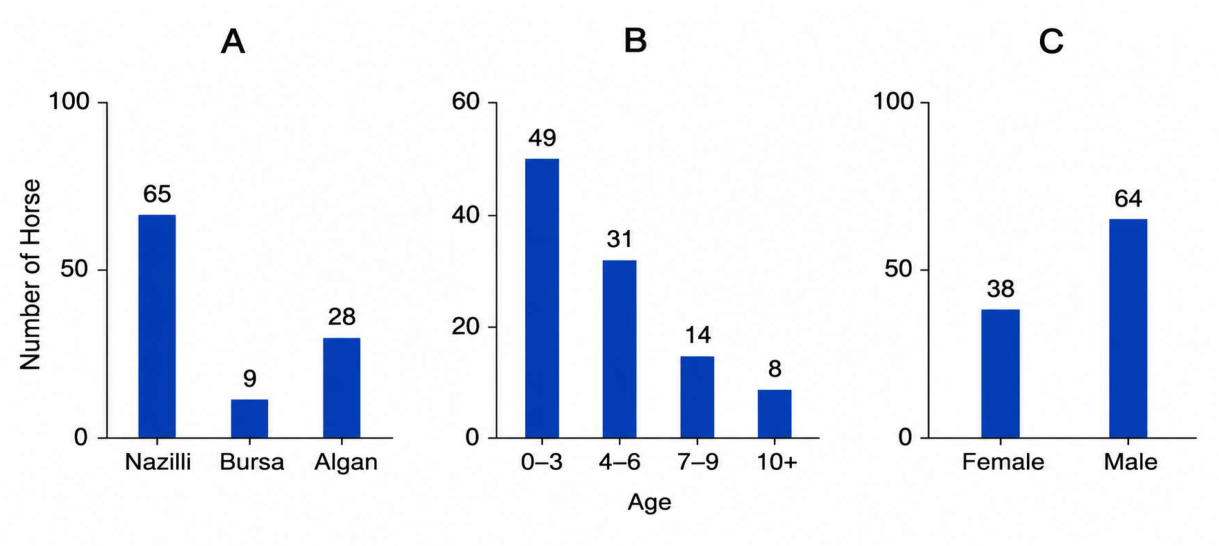
Figure 2.
Demonstration of the ambling gait in horses.

Figure 3.
Researchers conducting morphometric measurements on a horse.
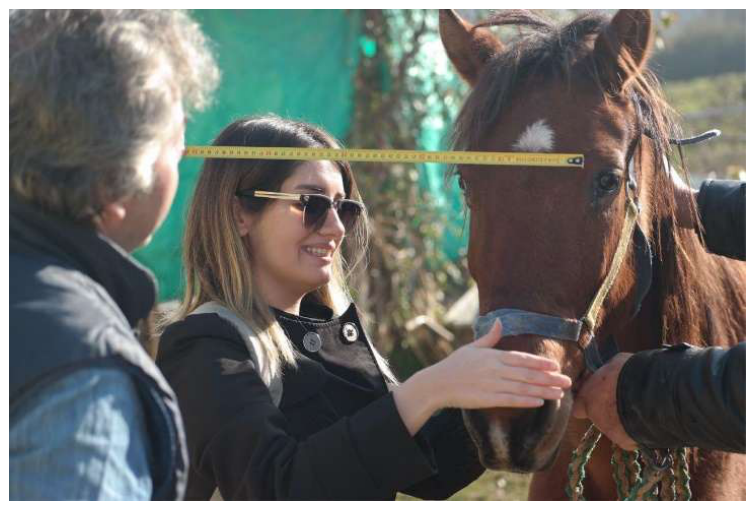
Table 1.
Descriptive statistics of the morphometric body measurements of Turkish ambling horses (cm).
Table 1.
Descriptive statistics of the morphometric body measurements of Turkish ambling horses (cm).
| Trait | N | SS | VK | Range | Min | Max | ||
|---|---|---|---|---|---|---|---|---|
| WH | 102 | 143.72 | 0.71 | 7.15 | 5.16 | 52 | 117 | 169 |
| CH | 102 | 134.44 | 0.65 | 6.63 | 4.93 | 48.5 | 116 | 164.5 |
| BH | 102 | 135.76 | 0.63 | 6.43 | 4.73 | 51 | 116 | 167 |
| TH | 102 | 128.68 | 0.53 | 5.37 | 4.17 | 28.5 | 112 | 140.5 |
| ITH | 102 | 123.11 | 0.67 | 6.81 | 5.53 | 58 | 103 | 161 |
| BL | 102 | 137.56 | 0.81 | 8.21 | 5.96 | 42 | 116 | 158 |
| CD | 102 | 64.53 | 0.41 | 4.10 | 6.35 | 21 | 55 | 76 |
| CW | 102 | 34.84 | 0.41 | 4.22 | 12.13 | 23 | 25 | 48 |
| HG | 102 | 156.92 | 0.79 | 8.07 | 5.14 | 44 | 136 | 180 |
| IW | 102 | 22.68 | 0.19 | 2.01 | 8.83 | 11 | 18 | 29 |
| HW | 102 | 41.66 | 0.43 | 4.40 | 10.57 | 23 | 29 | 52 |
| CG | 102 | 18.81 | 0.21 | 2.11 | 11.24 | 16 | 8 | 24 |
| CL | 102 | 36.88 | 0.29 | 3.01 | 8.14 | 13 | 29 | 42 |
| HL | 102 | 54.76 | 0.29 | 2.98 | 5.44 | 14 | 48 | 62 |
| HdW | 102 | 21.53 | 0.17 | 1.78 | 8.30 | 10 | 15 | 25 |
| HH | 102 | 8.31 | 0.15 | 1.52 | 18.33 | 8 | 4 | 12 |
| LL | 102 | 83.53 | 0.49 | 4.96 | 5.94 | 28 | 72 | 100 |
Withers height (WH), croup height (CH), back height (BH), tailhead height (TH), ischial tuberosity height (ITH), body length (BL), chest depth (CD), chest width (CW), heart girth (HG), ischial width (IW), hip width (HW), cannon girth (CG), cannon length (CL), head length (HL), head width (HdW), hoof height (HH), and leg length (LL).
Table 2.
Least squares means (LSM ± SE) of morphometric traits according to breeding origin.
| Trait | Afghan (n = 9) | Bursa (n = 28) | Nazilli (n = 65) | p-Value |
|---|---|---|---|---|
| Body measurements | ||||
| WH | 148.5 ± 2.25 a | 144.12 ± 2.03 ab | 142.89 ± 0.58 b | * |
| CH | 135.38 ± 1.42 | 133.48 ± 2.01 | 134.73 ± 0.54 | |
| BH | 136.44 ± 1.41 | 134.26 ± 1.91 | 136.31 ± 0.52 | |
| TH | 129.27 ± 1.46 a | 125.23 ± 1.11 b | 130.08 ± 0.57 a | *** |
| ITH | 122.50 ± 1.30 | 122.07 ± 1.91 | 123.65 ± 0.64 | |
| BL | 144.11 ± 2.26 a | 136.21 ± 1.65 b | 137.24 ± 0.97 b | * |
| CD | 68.67 ± 0.95 a | 62.69 ± 0.91 c | 64.75 ± 0.42 b | ** |
| CW | 38.67 ± 1.30 a | 33.30 ± 0.78 b | 34.98 ± 0.49 b | ** |
| HG | 163.22 ± 2.80 a | 154.30 ± 1.73 b | 157.17 ± 0.87 b | ** |
| IW | 23.89 ± 0.53 a | 23.25 ± 0.47 a | 22.27 ± 0.21 b | * |
| HW | 46.22 ± 0.99 a | 41.32 ± 1.06 b | 41.18 ± 0.44 b | ** |
| Limb measurements | ||||
| CG | 19.50 ± 0.73 a | 17.89 ± 0.51 b | 19.10 ± 0.21 a | * |
| CL | 38.11 ± 0.58 a | 35.00 ± 0.64 b | 37.52 ± 0.32 a | *** |
| HH | 8.22 ± 0.27 | 7.82 ± 0.32 | 8.53 ± 0.18 | |
| LL | 85.66 ± 1.26 | 82.50 ± 1.02 | 83.69 ± 0.60 | |
| Head measurements | ||||
| HL | 56.66 ± 1.05 a | 53.50 ± 0.55 b | 55.04 ± 0.34 a | * |
| HdW | 22.88 ± 0.38 a | 20.39 ± 0.44 b | 21.84 ± 0.15 a | *** |
Different letters indicate significant differences among groups (p < 0.05), * p < 0.05; **, p < 0.01; ***, p < 0.001.
Table 3.
Least squares means (LSM ± SE) of morphometric traits according to age.
| Trait | 0–3 yr (n = 49) | 4–6 yr (n = 31) | 7–9 yr (n = 14) | ≥10 yr (n = 8) | p-Value |
|---|---|---|---|---|---|
| Body measurements | |||||
| WH | 140.66 ± 0.90 b | 145.51 ± 0.78 a | 146.60 ± 2.13 a | 145.50 ± 3.75 a | *** |
| CH | 132.15 ± 0.76 b | 136.01 ± 0.88 a | 136.32 ± 2.24 a | 139.12 ± 3.89 a | * |
| BH | 133.60 ± 0.74 b | 137.14 ± 0.89 a | 137.42 ± 2.01 a | 140.75 ± 3.90 a | * |
| TH | 126.97 ± 0.71 b | 130.98 ± 0.96 a | 128.82 ± 1.38 ab | 129.93 ± 1.76 ab | ** |
| ITH | 121.03 ± 0.74 b | 124.30 ± 0.98 ab | 124.53 ± 2.01 ab | 128.81 ± 4.64 a | * |
| BL | 133.06 ± 1.02 b | 140.87 ± 1.14 a | 141.50 ± 1.96 a | 145.50 ± 2.45 a | *** |
| CD | 62.30 ± 0.47 b | 66.61 ± 0.67 a | 65.96 ± 1.11 a | 67.62 ± 0.86 a | *** |
| CW | 32.72 ± 0.45 b | 36.12 ± 0.65 a | 37.14 ± 1.23 a | 38.87 ± 1.74 a | *** |
| HG | 152.36 ± 1.08 b | 161.20 ± 2.07 a | 160.07 ± 1.68 a | 162.68 ± 2.10 a | *** |
| IW | 22.10 ± 0.25 b | 23.16 ± 0.37 a | 22.92 ± 0.48 ab | 24.00 ± 0.84 a | * |
| HW | 40.10 ± 0.61 b | 42.90 ± 0.60 a | 43.35 ± 1.51 a | 43.50 ± 1.16 a | * |
| Limb measurements | |||||
| CG | 17.61 ± 0.27 b | 19.54 ± 0.24 a | 20.39 ± 0.44 a | 20.50 ± 0.76 a | *** |
| CL | 36.08 ± 0.41 b | 38.22 ± 0.46 a | 36.14 ± 0.84 ab | 37.87 ± 1.17 ab | * |
| HH | 7.69 ± 0.21 b | 9.04 ± 0.21 a | 8.35 ± 0.41 ab | 9.12 ± 0.54 a | ** |
| LL | 82.22 ± 0.69 b | 84.67 ± 0.83 ab | 82.71 ± 1.18 b | 88.62 ± 1.32 a | * |
| Head measurements | |||||
| HL | 53.71 ± 0.34 b | 55.54 ± 0.53 a | 55.78 ± 0.82 a | 56.37 ± 1.42 a | * |
| HdW | 21.00 ± 0.22 b | 22.32 ± 0.23 a | 21.00 ± 0.67 b | 22.75 ± 0.59 a | * |
Different letters indicate significant differences among groups (p < 0.05)*, p < 0.05; **, p < 0.01; ***, p < 0.001.
Table 4.
Least squares means (LSM ± SE) of morphometric traits according to sex.
| Trait | Female (n = 38) | Male (n = 64) | p-Value |
|---|---|---|---|
| Body measurements | |||
| WH | 142.90 ± 1.56 | 144.21 ± 0.64 | |
| CH | 133.90 ± 1.41 | 134.76 ± 0.63 | |
| BH | 135.15 ± 1.44 | 136.12 ± 0.55 | |
| TH | 126.59 ± 0.92 | 129.92 ± 0.60 | ** |
| ITH | 121.82 ± 1.54 | 123.88 ± 0.55 | |
| BL | 135.86 ± 1.55 | 138.57 ± 0.89 | |
| CD | 62.98 ± 0.66 | 65.45 ± 0.48 | ** |
| CW | 32.75 ± 0.64 | 36.09 ± 0.48 | ** |
| HG | 154.52 ± 1.55 | 158.34 ± 0.83 | * |
| IW | 22.84 ± 0.39 | 22.59 ± 0.21 | |
| HW | 40.89 ± 0.81 | 42.12 ± 0.49 | |
| Limb measurements | |||
| CG | 17.94 ± 0.37 | 19.32 ± 0.22 | ** |
| CL | 35.57 ± 0.47 | 37.65 ± 0.34 | *** |
| HH | 7.76 ± 0.25 | 8.63 ± 0.17 | ** |
| LL | 82.00 ± 0.86 | 84.45 ± 0.56 | * |
| Head measurements | |||
| HL | 53.55 ± 0.45 | 55.48 ± 0.35 | ** |
| HdW | 20.55 ± 0.33 | 22.12 ± 0.16 | *** |
*, p < 0.05; **, p < 0.01; ***, p < 0.001.
Disclaimer/Publisher’s Note: The statements, opinions and data contained in all publications are solely those of the individual author(s) and contributor(s) and not of MDPI and/or the editor(s). MDPI and/or the editor(s) disclaim responsibility for any injury to people or property resulting from any ideas, methods, instructions or products referred to in the content. |
© 2026 by the authors. Licensee MDPI, Basel, Switzerland. This article is an open access article distributed under the terms and conditions of the Creative Commons Attribution (CC BY) license (http://creativecommons.org/licenses/by/4.0/).
Copyright: This open access article is published under a Creative Commons CC BY 4.0 license, which permit the free download, distribution, and reuse, provided that the author and preprint are cited in any reuse.


