

Submitted:
20 July 2026
Posted:
20 July 2026
You are already at the latest version
Abstract
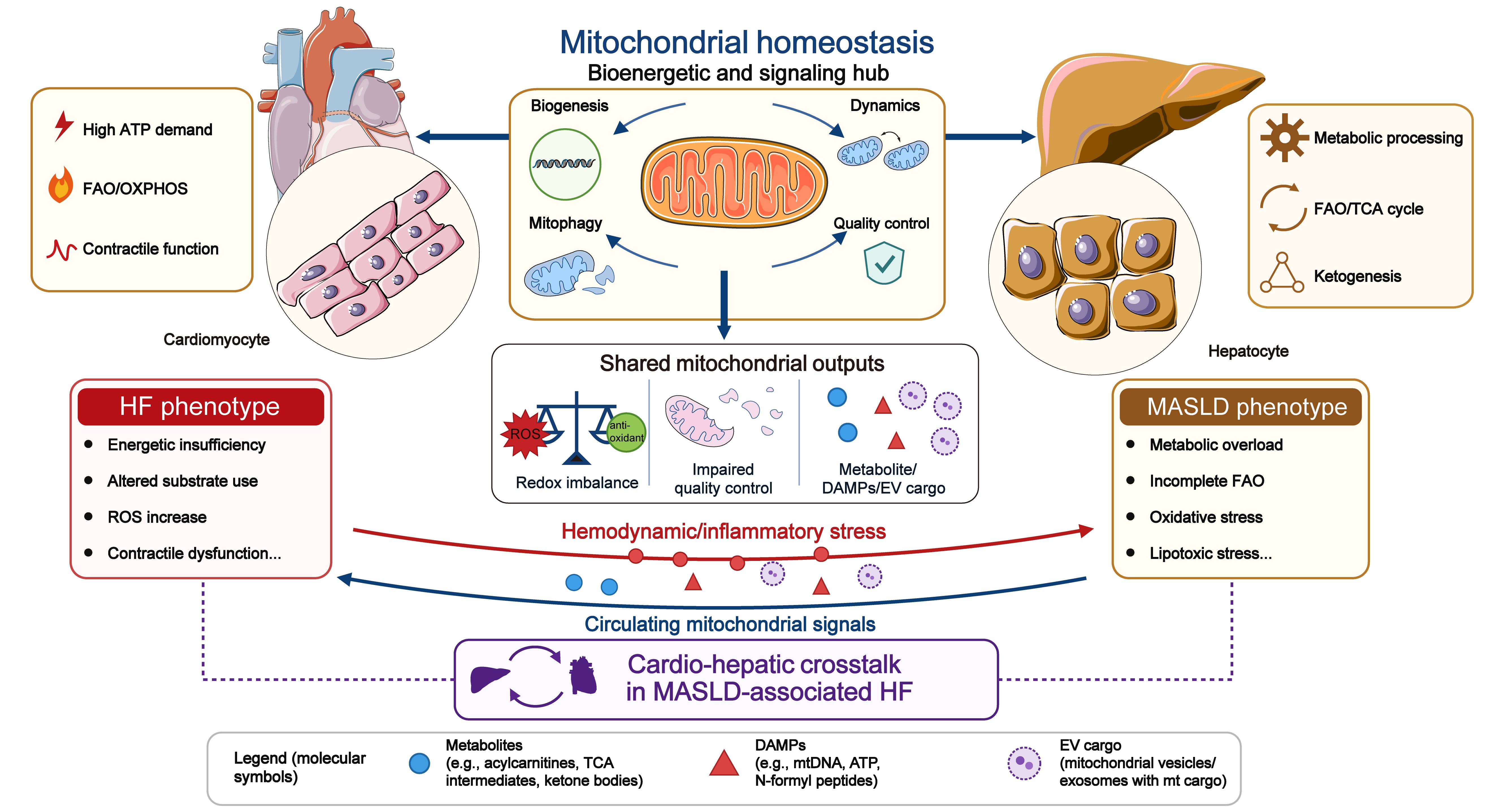
Mitochondrial distress signaling provides a mechanistic link between local organelle dysfunction and systemic cardio-hepatic remodeling. In metabolic dysfunction-associated steatotic liver disease (MASLD) and heart failure (HF), hepatic nutrient overload and cardiac energy-demand mismatch generate distinct but convergent disturbances in oxidative metabolism, mitochondrial dynamics, mitophagy, and redox control. These changes alter the production, localization, and release of mitochondria-linked metabolites, mitochondrial damage-associated molecular patterns, and extracellular vesicle-associated mitochondrial cargo, enabling stressed tissues to influence distant organs. This review examines how stage-dependent bioenergetic remodeling and defective mitochondrial quality control shape distress-signal generation in MASLD and HF. We further discuss the context-dependent roles of succinate, β-hydroxybutyrate, mitochondrial DNA-dependent innate immune signaling, and extracellular vesicle-mediated cargo transport in heart–liver communication. Finally, we summarize established cardiometabolic therapies and emerging mitochondria-centered strategies that reduce substrate overload, restore organelle resilience, or limit inflammatory signal propagation. Integrating these mechanisms positions mitochondrial distress signaling as a unifying framework for understanding the bidirectional relationship between MASLD and HF and for identifying biomarkers and therapeutic targets at the heart-liver interface.
Keywords:
metabolic dysfunction-associated steatotic liver disease
; heart failure
; mitochondrial distress signaling
; cardio-hepatic crosstalk
; mitochondrial dysfunction
Copyright: This open access article is published under a Creative Commons CC BY 4.0 license, which permit the free download, distribution, and reuse, provided that the author and preprint are cited in any reuse.


