

Submitted:
18 July 2026
Posted:
20 July 2026
You are already at the latest version
Abstract
Physics is intrinsically a complex subject. We review some of the results coming from researchers in physics education, who identified several common patterns in how pupils learn physics and how they differently apply the relative concepts when solving classroom problems with respect to dealing with everyday situations. As pointed out by some researches, a correct and fruitful approach to teaching physics should be based on a validated cognitive model of a student, which is however not still available. In this paper we propose to consider the origin of “intuitive physics” as due to the cognitive mapping of concept on the physical body (embodiment), which is particularly relevant for the concept of force, and also the role of the “knowledge illusion”, i.e., the undervaluation of the complexity of a concept that is perceived as “well known”. We profited of an existing extensive survey, based on the Force Concept Inventory, on first-year university students in scientific and technological disciplines by which we confirm previous findings and show that the non-Galilean concepts are not organized in a coherent structure. We also develop a conceptual model of cognitive conflicting structures in students, and extract, by stochastic optimization, a Boolean circuit mimicking the expected behavior of a “physics-aware” student.
Keywords:
physics complexity
; student model
; cognitive dynamics
; learning Boolean circuits
1. Introduction: Why Physics Is Intrinsically Complex
The research in education is mainly driven by experimental observations and practices, but the cognitive model of the student is rarely the subject of investigation. We shall focus here on the practice of learning and teaching physics, in particular mechanics and the concept of force, since it constitutes an ideal example of a complex topic that shows many conflicting elements [1].
Physics is widely recognized as one of the most complex disciplines within the STEM landscape, consistently exhibiting higher levels of difficulty compared to other academic domains [2].
One of the reasons is that physics, unlike mathematics, is a mix of experimental observation and deductive derivations, so it is felt as a “dirt” and sometimes irrational version of mathematics. But, differently from other scientific topic like chemistry, rather sophisticated mathematics is often demanded to quantitatively solve physics problems, which in many cases require the application of a few basic concepts, but through different approaches from those seen in the classroom or illustrated in the book.
So, one of the reasons for the perceived difficulty of physics is the lack of a deductive character, coupled with the required flexibility in the application of the basic laws, so that students are not able to easily remember the resolutive “formula” (or find it in the book) for a given problem. In other words, the solution of physics problems cannot be simply reduced to the application of standard approaches, but in many cases it requires an original combination of standard pieces of knowledge, like many challenging games like chess or go.
If this were the only obstacle, the solution, as in practicing games, would simply be that of doing more exercises with many possible variations. However, researchers in physics education have pointed out other cognitive elements that can hinder the learning of physical concepts, and, more important, the main problem is that, even students that have learned how to solve physics problem in classroom, fail to apply the relative concepts in everyday contexts.
Actually, the complexity of physics, in particular mechanics, is demonstrated by the fact that its present form (Galilean/Newtonian) is relatively recent, much more recent than mathematics, not to speak of music, literature, history. There are more recent disciplines, like other fields of physics, chemistry, engineering, evolutionary biology, genetics and so on, but this is due to the advancement of technology and knowledge and to the emergence of quantitative approaches, rather than, as we shall show, to cognitive obstacles.
The introductory study of mechanics does not require sophisticated equipments, and indeed also Aristotle performed fundamental experiments and his physics is a scientific treatise, although of little predictive capacity [3]. Only at Galileo time (and then with Newton) a critical rethinking of the whole subject has started.
Another “advantage” of using physics as a testbed for the cognitive implication of teaching and learning, is that in many cases pupils do not have much previous knowledge of the topic from a normative point of view, but, as stated in Ref. [4], students enter physics classrooms with strong beliefs about how the world works. These believes are innate and impossible to remove, as we shall argue in the following, and therefore one has to develop alternative teaching procedures, differently from disciplines in which the only possible misconceptions are based on acquired knowledge.
2. The Student’s Cognitive Dynamics
The most elementary cognitive model of a student is that of the “empty vase”, or better the percolation one. In this model the order to arguments is not important, they just have to be memorized. Clearly, each topic, beyond furnishing pieces of information, is generally based on prerequisites that in this model are not solved at the moment of memorization. Only after a sufficient number of items have been memorized, they start to “join”, forming clusters of coherent knowledge until, hopefully, a “giant component” emerges, as in (direct) percolation models.
This scheme is applicable to the cases in which there is no planned teaching procedure, for instance when collecting sparse pieces of information. However, it is clearly not an efficient method since human memory is essentially associative, so that memorized concepts are more easily retrieved if they chain together. Isolated pieces of information are easily forgotten or may become unreachable. This process is roughly related to behaviorism (automatic innate or learned reactions to stimuli [5]). An example of this process is how children learn their mother tongue, without a scheduled teaching process.
A more effective teaching procedure is that based on scaffolding, in which the emphasis is on the structure of the knowledge [6]. The teaching of deductive topics like mathematics, and often also physics, is deeply based on such a concept.
A step further is given by the contribution of cognitive psychology to education, due to the works by Piaget, Wygotskij and Ausubel [7]. This approach is based on the idea that learning is the product of a dynamical cognitive processes, in which not only the sequence of concepts is important, but that also pre-existing concepts play a fundamental role.
However, as noted by Bachelard [8], the learning of scientific topics may be in contrast with spontaneous thinking, since it is often counter-intuitive and in contrast with appearance, in particular for physics.
Here then is the philosophical argument we shall be advancing: the scientific mind must be formed against nature, against all that comes from nature’s impetus and instruction, within us and outside us, against natural allurements and colourful, diverse facts. The scientific mind must be formed by being reformed. It can only learn from nature by purifying natural substances and by bringing order to a jumble of phenomena [9], p.33.
This intuition has been confirmed by researches in cognitive sciences. Recent studies highlight that all animals, including humans from early infancy, possess an innate understanding of the behavior of the physical world, referred to as “intuitive physics” [10,11,12].
This form of knowledge has an evolutionary origin, stemming from the necessity to rapidly distinguish between inanimate objects (which for instance fall downward or come to rest if not pushed) and potentially dangerous animate beings [11]. This cognitive framework vaguely resembles Aristotelian physics, i.e., a world dominated by viscous friction in which motion is strictly linked to the action of a constant force and rest is considered the natural state of objects [3].
One teaching approach is that of simply showing the inconsistency of Aristotelian physics vs. the Galilean one [13,14,15], but this knowledge, if not supported by extensive applications to everyday cases, is simply used in classroom context and quickly forgotten, as if it were a formal knowledge disconnected to reality.
The interplay between this mental architecture and the acquired knowledge can be interpreted through Kahneman’s dual-system model of cognition [16]. System 1 is automatic, analogical, fast, and operates outside rational control, directly drawing upon intuitive physics. In contrast, Galilean and Newtonian physics require the engagement of System 2, which is rational, slow, effortful, and under conscious control. The difficulty lies in the fact that System 1 provides immediate and cognitively economical responses to physical problems, creating an often irresistible temptation that hinders the activation of the formal reasoning processes of System 2 [12].
Another way of introducing a similar approach is through diSessa’s phenomenological primitives, or p-prims [17,18,19]. P-prims are small, intuitive, and pre-conscious knowledge structures, innate or developed from everyday experience, that help individuals understand and predict the world, for instance the liner relationship between cause and effect (Ohm’s p-prim). Learning, therefore, does not consist in replacing incorrect theories, but in the dynamic reorganization of these elements into more stable and integrated structures (coordination classes), where contextual sensitivity determines which resources are activated at any given moment [20]
Is is almost impossible to eradicate such structures, since they are used in common situations. Actually, even experts use heuristics, shortcuts or p-prims when dealing with mathematical and physical problems, rather than always restarting from the basic principles; the only difference is the range of their application.
However, there are other complications. First of all, the education process involves the coding of teacher’s ideas into a message, to be decoded by students, i.e., it has a semiotic contents [21], and, since physics uses many concepts that also belongs to everyday experience, particular attention has to be put in specifying the meaning of each term and in using them in the proper context [22].
The transmission of knowledge is also related to the cognitive distance between acquired knowledge and the content of the message. As in other situations, the message is easily decoded and acquired if it conveys a few new pieces of information (many entertainment activities simply repeat the same message over and over), but the main problem is that the teacher has little tools to understand how the emitted messages is decoded and received by students. This is one of the main reasons for the development of techniques related to peer instructions [23].
Another aspect is the role of attention, which has at least two components. The first is simply related to the cognitive load: if the messages convey too much information and/or the lesson lasts too long, the attention diminishes. There are established communication techniques that are valid to calibrate the length of each portion, use attentive stimuli and body language to stimulate physical identification with the teacher, exploit surprise effects (for instance using “magic tricks” [24]), and so on.
The second component is related to the cognitive filtering of information. Our input system has to filter out the most of incoming information, that would otherwise overload our cognitive systems. So, we use active filters to select a conversation in a noisy environment, focus the sight when looking for a given pattern, and so on. However, the same filtering can induce a “cognitive blindness” [25], which is also exploited by magicians and scammers. So, it is important to “pre-tune” the expectations of pupils (or to exploit this effect to surprise them).
These attentive mechanisms are in contrast with the fact that in many cases students in classroom (especially at the university level) are in a “passive” modality, occupied in taking notes (transcribing the teacher’s messages), a situation quite similar to watching a TV show [26]. Only at study and rehearsal times they elaborate the content of the message (that can be lost due to attentive blindness). This process, moreover, implies the use of the “heavy” system 2, and is hindered by the knowledge illusion [27], that often affects also teachers while preparing the lesson.
Finally, students may use alternate knowledge frameworks, switching from normative knowledge (what teachers communicated) to intuitive physics (how they think the world works) also in the same conversation [17,28]. As pointed out by scholars proposing an approach based on quantum formalism (quantum cognition [29]), experimental evidence shows that the common expectations do not obey classical Bayesian probability theory, but there are both examples of interference among contrasting concepts, influence by past information (kind of entanglement) and a Zeno effect in decision-making, so that a intermediate judgments can inhibit opinion change.
Actually, studies in cognitive science involving mirror neurons [30], suggest that we often exploit the motor cortex not only to implement decisions, but also to evaluate intentions and emotions by (reverse) mapping actions: “to achieve a given goal I would activate some muscle sequence; supposing that I have also learned the opposite correspondence, when I see others activating this muscle sequence I can derive their intentions”. Moreover, such muscle mapping can also explain why classical statue can induce emotional feelings [31].
This mapping can illustrate why the force concept is so difficult to learn and apply: it is unconsciously mapped on the motor cortex and therefore associated to muscular force and intention.
Therefore, even students that have learned how to apply Galilean physics to solve classroom problems may “switch” to intuitive physics if the context is not that of the “formal” school situation, especially in cases involving the concept of force and inertia. This switch can happen also during a conversation or a formal exposition [32], appearing as a “schizophrenic” behavior. DiSessa formulated the concepts of “knowledge in pieces” [33], implying that the knowledge is divided into weakly connected pieces. As a result, different contexts (that can vary also for internal reasons, for instance due to a previous reasoning) can easily induce different responses, although in general a particular “piece” is reliably activated in the same situation.
Summarizing, some of the cognitive elements of learning and teaching physics concepts that are worth investigations are:
- Coding and decoding of messages.
- Incremental knowledge (scaffolding).
- Peer help in identifying the effective reception of messages
- System 1 (rational) vs system 2 (heuristics) conflicts, usage of p-prims.
- Dual use of the same terms.
- Cognitive load and fatigue.
- Cognitive filtering of information.
- Passive and active modes.
- Embodiment.
- Alternate knowledge (conceptual change e.g., from Aristotelian to Galilean physics).
- Quantum cognition effects, interference.
- Context-dependent processing of information (context shift).
3. The Student’s Cognitive Dynamical Model
One of the first and most influent “tools” to check the student effective usage of learned physics in everyday situations is the Force Concept Inventory (FCI) [34], a suite of 30 multiple-choice questions about kinematics and dynamics formulated in plain terms. The possible answers have been extrapolated from an initial open-answer administering of the questions. It is therefore plausible that the items reflect “pieces” of knowledge, while the alternative interpretation is that they represent alternative coherent and complete “knowledge systems”.
What generally surprises teachers is the low total score accumulated by students, even after that they have studied and understood the material from a formal point of view, and are able to apply the correct methods to solve standard problems, presented in a classroom context.
Teachers usually use the FCI just looking to the total score, and, as illustrate in Section 4, we have been able to analyze a FCI dataset collected by some teachers of mechanics in many first-year courses of the University of Florence (Italy) in the years 2018-2021. The data have been anonymously collected for monitoring the acquisition level of the force concept.
As pointed out in Ref. [28], it is possible to use such data to extract the coherence of the students’ mental state, i.e., whether they use a coherent (albeit wrong) interpretative model of reality, or they use different “pieces” in different environment.
We also profited by a pre-survey about self-estimation of the previous knowledge about the topics investigated by the FCI survey to estimate the influence of the knowledge illusion.
However, the model underlying such analysis is a stochastic one. In spite of the evidence of context-induced interpretative switch, the interpretative model presented in Ref. [28] is based on a vector representation of the knowledge, in which the knowledge space is organized along orthogonal directions, and the “mental state” of a student is given by a vector in such space, whose components represent the probability of applying a given interpretative model.
A real dynamical model of a students should rather take the form of a (hidden) Markov model, with transition probabilities substantially different from , N being the possible choices, approaching a deterministic model if one of these probabilities approaches the unity. Clearly, such a model should be student-dependent and therefore much more complex to identify, needing repeated observations on the same subject.
In order to test the possibility of identifying a completely deterministic model, we implemented a “learning” procedure applied to a simple model of the awareness of the physics context from synthetic data, see Section 5. We show that it is possible to extract a Boolean circuit that reproduces the proposed patterns, much in the spirit of Ref. [35].
4. Analysis of FCI Responses and the Test of the Knowledge Illusion
Hestenes and Halloun developed the Force Concept Inventory (FCI) [34], a tool that has become a standard in educational research. The FCI is designed to probe the understanding of fundamental concepts of Newtonian mechanics, organized into six conceptual dimensions (such as kinematics and Newton’s laws). The effectiveness of the FCI lies in its structure: each question presents a single correct (Newtonian) option contrasted with powerful distractors derived from the most common incorrect responses provided by students during interviews. The total FCI score measures the extent to which a student has internalized the concept of force; a threshold of 60% is considered the entry point into Newtonian reasoning, while 85% indicates mastery of the concept. Analyses conducted using the FCI have outlined the nature of misconceptions (or alternative conceptions), revealing that students’ beliefs rarely form coherent systems, but rather consist of “packages” of loosely connected, inconsistent, and context-dependent concepts. These misconceptions primarily involve the inability to distinguish between velocity and acceleration, the lack of a unified concept of force, and the belief that influences on motion exist beyond forces. Such errors are highly resistant to traditional instruction because they are deeply rooted in sensory experience and embodiment (with forces perceived as muscular effort), thus requiring instructional approaches that begin with the identification of these incorrect cognitive pathways in order to effectively address them [27,36].
The shift from viewing misconceptions as an “organized” system of thought—almost a modern version of Aristotelian or medieval physics—to a perspective based on context-driven, conflicting responses represents one of the most significant epistemological transitions in educational research. Initially, it was hypothesized that students possessed a coherent “alternative theory”; however, data derived from analyses of the Force Concept Inventory (FCI) have demonstrated that naive knowledge is instead a collection of incoherent, vague conceptual “packages” closely tied to the specific context of a given problem [34]. This new perspective interprets learning as a dynamic interaction between System 1, which generates intuitive, fast, and Aristotelian-like responses rooted in evolution, and System 2, which governs formal and rational reasoning [37]. The difficulty therefore lies not in replacing one structured theory with another, but in managing the “irresistible temptation” to rely on the intuitive heuristics of System 1.
Teaching physics thus entails promoting a process of contextualization, guiding students to distinguish between everyday heuristics and the scientific approach. This dynamic model highlights how scientific competence emerges not from the disappearance of error, but from the ability to resolve the cognitive conflict between analogical intuition and Newtonian rigor [2]. However, instruction often suffers from teachers’ inability to anticipate students’ incorrect reasoning pathways, as their consolidated expertise renders concepts “obvious,” preventing them from recognizing the epistemological obstacles faced by novices [38]. As a result, knowledge becomes fragmented, often reduced to a collection of decontextualized equations, reflecting the inherently challenging nature of transmitting this discipline [2,39].
4.1. Procedure
Participants were undergraduate students about to attend an introductory physics course. They were first asked to provide demographic and educational information, including their year of study, their educational background (scientific, technical, humanities, professional, or other), and the degree program in which they were enrolled. Degree programs were grouped into broader disciplinary areas: Engineering, Technology (including Computer Science, Diagnostics and Materials for Conservation and Restoration, Food Technologies, and Laboratory Technologies), Science (Physics and Astrophysics, Chemistry, Mathematics, Natural Sciences, Geology, and Biological Sciences), and Life Sciences (Medicine, Pharmaceutical Sciences, Viticulture and Enology, and Biotechnology). Following the collection of this information, the students were asked a set of self-evaluation questions covering seven domain of fisics (i.e., Forces, Falling bodies, Trajectiories, Circular motion, Rockets, Collision, Friction); they were then given the Force Concept Inventory [34] in order to assess their initial level of understanding and to identify potential misconceptions related to fundamental physics concepts. The survey was created using the Google Forms platform, in accordance with the privacy laws of Italy (Law Decree DL-101/2018) and EU regulations (2016/679). Data are completely anonymous and have been collected by teachers for monitoring scopes, after having obtained the informed consensus by participating students.
The final sample consisted of students enrolled in different academic programs. With respect to the year of study, the majority of participants were in their first year (86.6%), followed by second-year (4.7%) and third-year students (1.6%), with only a small proportion enrolled in more advanced years. This indicates that the sample is largely composed of early-stage university students. Regarding educational background, the distribution shows that most students had a scientific background (49.6%), followed by a technical background (31.6%). With respect to the enrolled courses, most participants belonged to engineering programs (78.7%), whereas all other courses were represented by substantially smaller proportions (science area = 17%).
4.2. Results from the Force Concept Inventory
Firstly, we calculated the descriptive statistics for the collected variables. Table 1 provides the range of scores, mean, standard deviation, and the values for skewness and kurtosis for the total score on the Force Concept Inventory, that shows a mean of 11.00 (SD = 6.71) and a median of 10, indicating a relatively low average performance compared to the maximum possible score (30). The distribution exhibits moderate positive skewness (skewness = 0.755), suggesting a higher concentration of students with low-to-medium scores and a tail extending toward higher values. Overall, the data reveal a generally low level of initial conceptual understanding, with substantial variability across participants.
Descriptive statistics for total scores across courses are reported in the Appendix (Appendix A1), suggesting that students enrolled in Science Course showed the highest mean score (M = 13.29, SD = 7.34), followed by Engineering Course (M = 10.75, SD = 6.50), whereas lower mean scores were observed for Technology Course (M = 7.00, SD = 5.14) and Life Science/Health (M = 6.44, SD = 5.13).
Responses to the Force Concept Inventory were recoded into six cognitive profiles: uncertainty, Newtonian model, impetus model, Aristotelian/naive model, specific errors, and improbable responses (see Table 2). For each student, the proportion of responses belonging to each profile was calculated. This procedure made it possible to analyze the test not only in terms of correctness, but also in terms of the organization of the underlying cognitive models. For each FCI item, responses were recoded into indicators of cognitive systems. These variables represent, for each student, the proportion of responses associated with each cognitive profile (see Table 3).
In Table 3, a descriptive analysis of the response proportions reveals a predominance of the Newtonian model within the sample, with a mean of (), indicating that, on average, approximately 39% of the students’ responses are consistent with the scientific reference model. However, this value is accompanied by relatively high variability, suggesting considerable heterogeneity in the levels of understanding of the students. Among the non-Newtonian profiles, the most represented is the Aristotelian/naive model (, ), followed by uncertainty (, ), which exhibits the highest standard deviation. This indicates a particularly dispersed distribution and the presence of students with widely varying levels of non-response or lack of conceptual structuring. Impetus-based models (, ), specific errors (, ), and improbable responses (, ) are less frequent, although they collectively contribute to outlining a complex pattern of conceptual difficulties. Overall, these results suggest that, prior to formal instruction, students exhibit a composite cognitive repertoire in which the scientific model coexists with different forms of misconception and varying levels of uncertainty, rather than emerging as a dominant and stabilized system. Detailed item-level results, including dominant cognitive patterns for each FCI question, are reported in Appendix (Section Table A2), .
A one-way analysis of variance (ANOVA) revealed a significant effect of educational background on FCI total scores, , , , indicating a moderate effect size. Table 4 shows that students with scientific backgrounds obtained the highest average score (, ), whereas students with humanities background showed the lowest performance (, ). However, the assumption of homogeneity of variances was violated, as indicated by Levene’s test, . The Tukey HSD post-hoc tests (see Table 5) indicate that the humanities background scored significantly higher than both scientific backgrounds (mean difference = 4.02, 95% CI [1.67, 6.38], ) and technical ones (mean difference = 2.96, 95% CI [1.23, 4.69], ). No significant differences were observed among the remaining groups.
We also examined whether FCI scores differed as a function of students’ course of study. A one-way analysis of variance (ANOVA) revealed a significant effect of academic course on FCI performance, , , . Descriptive statistics (Table 6) indicated that students enrolled in the Science course achieved the highest mean score (, ), followed by Engineering (, ), Technology (, ), and Life Sciences/Health (, ). Tukey HSD post-hoc comparisons (Table 7) showed that Science students scored significantly higher than Engineering (mean difference , ), Technology (mean difference , ), and Life Sciences/Health students (mean difference , ). No significant differences were observed among the remaining pairwise comparisons ().
Correlation analyses were conducted to examine the relationship between self-assessed competence and the distribution of cognitive response patterns. A small but significant positive association was found between self-assessment and the proportion of Newtonian responses (, ), indicating that students who relied more on the scientific pattern tended to perceive themselves as slightly more competent. No significant associations emerged between self-assessment and non-Newtonian patterns, including impetus pattern, Aristotelian/naive, specific error, and improbable responses (all ). Additionally, the relationship between self-assessment and uncertainty showed a negative but not-significant trend (, ). Detailed correlation results are reported in Appendix (Section Table A3). Overall, these findings suggest that only the scientific response pattern shows a modest degree of coherence with students’ perceived competence, whereas non-Newtonian patterns do not appear to be systematically associated with metacognitive judgments.
5. A Minimal Deterministic Model of Physics Awareness
Let us now try to obtain a fully deterministic model, starting from synthetic data. The idea is to generate a minimal model for the switch between intuitive physics and the use of Galilean/Newtonian physics. We do not model here the decoding phase of the message.
We assume that the input to the model can be expressed as a set of Boolean variables. We use two variables, and to schematically quantify the explicit physics contents of the message, and two output variables, (marginal physics contents) and (explicit physics contents) so that if the decoded message does not contain any detectable physics content (), if the physics contents are detectable, but minimal (; ), while if the physics contents are evident (). The presence of any detectable level of physics content should be able to trigger the “physics awareness”, i.e., the use of Galilean physics (output ) and inhibits the use of intuitive physics (), the reverse for the absence of physics content.
Another input variable, , represents the presence of other contents in the message, for instance “distractors” expressed in everyday language. Students should be able to ignore this input, although recognizing its presence (non-physics contents, ).
However, it is important to introduce also the physics classroom context (), that should be able to (at least) temporary trigger the usage of Galilean physics.
Students that consistently exploit what they have learned of Galilean physics should be able to keep the “physics awareness” variable on even if the “physics classroom” variable goes down or if the physics contents lowers (). This makes the model stateful, i.e., its outputs depends on the past input history, and this is necessary to model the dependence on the internal context. It also implies that the resulting Boolean circuit should be recurrent. However, as we shall see, this constitutes an obstacle to learning, which is much easily modeled using feed-forward networks. Therefore we use an additional input flag, “force Galilean awareness” or , which after learning will be joined to the Galilean physics () output, see Figure 1 for a schematic representation of the model.
5.1. Learning Boolean Model
We produced the whole dataset reported in Table 8, and used it to train a Boolean Network. The network is designed as in Figure 2. At beginning the are randomly chosen among the 16 Boolean functions of 2 inputs, see Table 9, and their input j chosen at random () among the previous gate-lines.
We want to condense the dynamics of scheme as a “mechanical” model, to be represented as a set of Boolean gates.
The error function E is defined as the difference between the expected output of Table 8 and the actual computation of the network given the output, on the whole dataset or a fraction of it. The network is then variated by choosing one of the gates and changing either its function or one of the inputs, with equal probability. The error is again computed and the variation is accepted following a Monte Carlo procedure, i.e., if or with a probability
where T represent the temperature, which is slowly lowered (simulated annealing [35,40]).
The procedure is stopped when the temperature reaches the minimum or if the error E drops to zero. The procedure is able to converge for a sufficient number of gates , and using at least 80% of the dataset (in this case about 50% of the runs do not converge to zero error). The listing of the C code is reported in Appendix A3.
The resulting circuit (examples can be found in Appendix A4) can be converted to standard disjunctive forms (using NOT, AND and OR gates), and the minimized circuit is reported in Figure 3. Finally, the stateful circuit (with a flip-flop loop) is reported in Figure 4.
6. Discussion
The present findings should be interpreted within the broader debate concerning the nature of learners’ cognitive organization. As highlighted in previous literature, no unified and definitive cognitive model of the learner is currently available, and most existing frameworks provide inferential descriptions of observable behaviors rather than direct representations of underlying cognitive processes [19,28,41].
In this context, approaches such as Knowledge-in-Pieces and the Resources Model have emphasized the possibility that learners’ reasoning emerges from the contextual activation of heterogeneous cognitive elements rather than from stable and internally consistent conceptual structures [17,20,41].
The results of the present study contribute to this discussion by examining how different conceptual patterns coexist within students’ responses to the Force Concept Inventory and how these patterns relate to students’ perceptions of their own competence. The distribution of cognitive profiles suggests that, although Newtonian reasoning represents the most frequent response pattern, it does not appear sufficiently dominant to characterize students’ conceptual understanding as consistently aligned with the scientific model.
Indeed, a substantial proportion of responses remained associated with Aristotelian/naive reasoning, uncertainty, and other non-Newtonian profiles. This pattern points to a conceptual landscape in which scientifically accurate conceptions coexist with alternative forms of reasoning, rather than fully replacing them. Furthermore, the marked variability observed across profiles indicates that students differ considerably in the extent to which Newtonian concepts are incorporated into their response patterns.
Taken together, these findings provide preliminary evidence of a heterogeneous conceptual repertoire, suggesting that students’ understanding of force may be characterized by the simultaneous presence of multiple reasoning patterns rather than by a single, uniformly applied conceptual framework. Although significant differences in FCI scores emerged across educational backgrounds, post-hoc comparisons revealed that these differences were limited to specific group contrasts rather than reflecting a systematic separation among all educational tracks. This suggests that educational background may influence the overall level of conceptual performance.
Indeed, despite variations in mean performance, Newtonian and non-Newtonian response patterns were found throughout the participant population, indicating that conceptual difficulties related to force are not confined to specific educational pathways. From this perspective, educational background may modulate the degree of conceptual mastery while leaving largely intact the coexistence of alternative forms of reasoning that characterize students’ understanding of fundamental physics concepts.
The analysis of academic courses revealed significant differences in FCI performance, with students enrolled in Science programs achieving higher scores than those from the other educational tracks. This finding suggests that disciplinary background may contribute to the development of conceptual understanding in physics, possibly reflecting differences in prior exposure to scientific content and modes of reasoning. However, the relatively small effect size indicates that course of study accounts for only a limited portion of the observed variability.
Importantly, the presence of substantial variability within each academic track, together with the distribution of both Newtonian and non-Newtonian response patterns across the sample, suggests that conceptual difficulties cannot be reduced solely to disciplinary affiliation. Rather, while scientific training may facilitate the acquisition of more accurate conceptual representations, the coexistence of alternative forms of reasoning appears to remain a broader characteristic of students’ understanding of force. These findings are therefore consistent with the view that intuitive conceptions of physical phenomena persist across educational contexts, although their relative prevalence may vary depending on students’ academic background.
The observed relationship between self-assessed competence and cognitive response patterns provides an interesting perspective on students’ awareness of their own conceptual understanding. Although students producing a greater proportion of Newtonian responses tended to report higher levels of perceived competence, the association was relatively weak, suggesting only a limited correspondence between actual conceptual performance and self-evaluation. At the same time, the absence of significant relationships between self-assessment and all non-Newtonian response patterns indicates that alternative forms of reasoning were not systematically reflected in students’ judgments of their own competence. Taken together, these findings point to a partial dissociation between metacognitive judgments and underlying conceptual patterns, with self-evaluations showing only a modest sensitivity to the presence of scientifically accurate reasoning.
This pattern may be interpreted as being consistent with the notion of a knowledge illusion, whereby students perceive themselves as understanding a concept more thoroughly than their response patterns would suggest. Rather than accurately tracking the structure of their underlying conceptions, self-assessments appear to capture only a limited portion of students’ actual conceptual organization, highlighting a potential gap between perceived and demonstrated understanding of fundamental physics concepts.
7. Conclusions
We have reported some argument supporting the idea that Physics is intrinsically a complex study subject.
One of the main obstacles in learning Galilean physics is the presence of innate intuitive physics modules (related to the cognitive mapping of concept on the physical body), that cannot be eliminated by education. One of the tools to put this presence into evidence is the Force Concept Inventory. We analyzed data collected in several yeas by physics teachers at the first-year university level. We show that the non-Galilean concepts are not organized in a coherent structures, and although the scientific training may promote the acquisition of accurate conceptual representations, the coexistence of alternative forms of reasoning appears to remain a broader characteristic of students’ understanding of force.
We also developed a conceptual model of the conflicting cognitive structures in students and obtained a Boolean circuit mimicking the expected behavior of a students that correctly identifies the “Galilean physics” context.
Author Contributions
Conceptualization, F.B. and F.N.; methodology, F.B. and M.M.F.; software, F.B.; validation, F.B., F.N. and M.M.F.; formal analysis, M.M.F.; investigation, F.N.; resources, F.B.; data curation, F.N.; writing—original draft preparation, F.B.; writing—review and editing, M.M.F.; visualization, F.B.; supervision, F.B.; project administration, F.B.; funding acquisition, F.B. All authors have read and agreed to the published version of the manuscript.
Funding
This research received no external funding.
Institutional Review Board Statement
The study was conducted in accordance with the principles of the Declaration of Helsinki, the Italian Legislative Decree 10 August 2018, No. 101 on data protection, and the EU General Data Protection Regulation (EU 2016/679). Ethical approval was not required, in accordance with applicable European and Italian data protection regulations for studies based on anonymous data and involving minimal risk (according to Recital 26 of the GDPR, such data do not constitute personal data). Data were collected in anonymous form by the teachers as part of routine educational activities, without the collection of identifying information and with no possibility of re-identification of participants. The study did not involve patients or any clinical procedures.
Informed Consent Statement
Informed consent was obtained from all subjects involved in the study.
Data Availability Statement
Data and software are available upon request to authors.
Conflicts of Interest
The authors declare no conflicts of interest.
Appendix A
Appendix A1. Descriptive Statistics

Table A1.
Descriptive statistics of total score by course.
| Course Area | N | M | SD |
|---|---|---|---|
| Engineering | 435 | 10.75 | 6.50 |
| Technology | 16 | 7.00 | 5.14 |
| Science | 94 | 13.29 | 7.34 |
| Life Science | 9 | 6.44 | 5.13 |
Table A2.
Item-level analysis of FCI responses: percentage of correct answers, dominant error, and dominant cognitive pattern.
Table A2.
Item-level analysis of FCI responses: percentage of correct answers, dominant error, and dominant cognitive pattern.
| Item | % Correct | Dominant Error | % Error | Dominant Pattern |
| Item | % Correct | Dominant Error | % Error | Dominant Pattern |
| Q01 | 59.2 | 4 | 16.2 | Newtonian |
| Q02 | 34.8 | 4 | 30.7 | Newtonian |
| Q03 | 50.0 | 0 | 19.0 | Newtonian |
| Q04 | 29.6 | 2 | 44.8 | Aristotelian/Naive |
| Q05 | 19.9 | 4 | 27.8 | Aristotelian/Naive |
| Q06 | 49.3 | 3 | 32.7 | Newtonian |
| Q07 | 58.7 | 5 | 13.7 | Newtonian |
| Q08 | 59.4 | 2 | 15.3 | Newtonian |
| Q09 | 50.0 | 0 | 30.1 | Newtonian |
| Q10 | 50.5 | 4 | 22.0 | Newtonian |
| Q11 | 23.6 | 4 | 31.6 | Aristotelian/Naive |
| Q12 | 88.6 | 3 | 5.6 | Newtonian |
| Q13 | 17.3 | 4 | 40.1 | Impetus |
| Q14 | 52.5 | 2 | 29.6 | Newtonian |
| Q15 | 17.0 | 3 | 45.8 | Improbable |
| Q16 | 33.0 | 0 | 30.3 | Newtonian |
| Q17 | 13.4 | 2 | 48.6 | Aristotelian/Naive |
| Q18 | 25.3 | 4 | 28.7 | Impetus |
| Q19 | 42.1 | 0 | 26.5 | Newtonian |
| Q20 | 33.8 | 0 | 29.2 | Newtonian |
| Q21 | 41.0 | 4 | 22.2 | Newtonian |
| Q22 | 37.2 | 4 | 22.0 | Newtonian |
| Q23 | 42.6 | 5 | 16.6 | Newtonian |
| Q24 | 54.5 | 3 | 16.6 | Newtonian |
| Q25 | 19.5 | 4 | 52.5 | Aristotelian/Naive |
| Q26 | 12.1 | 0 | 27.6 | Uncertainty |
| Q27 | 40.3 | 2 | 25.6 | Newtonian |
| Q28 | 28.7 | 4 | 32.1 | Specific Error |
| Q29 | 53.6 | 0 | 22.4 | Newtonian |
| Q30 | 16.8 | 5 | 50.5 | Specific Error |
Appendix A2. Correlation
Table A3.
Correlations between self-assessed competence and cognitive response patterns.
| Variable | r | p | 95% CI |
|---|---|---|---|
| Newtonian_prop | 0.138** | .002 | [0.053, 0.222] |
| Impetus_prop | -0.060 | .175 | [-0.145, 0.027] |
| Aristotelic_prop | -0.026 | .554 | [-0.112, 0.060] |
| SpecError_prop | -0.024 | .586 | [-0.110, 0.062] |
| Improbable_prop | -0.031 | .487 | [-0.117, 0.056] |
| incert_prep | -0.079 | .072 | [-0.165, 0.007] |
| Note. * p < .05, ** p < .01. | |||
Appendix A3. Simulation Code
Here the C source code for the simulated annealing procedure.
#include <stdio.h>
#include <stdlib.h>
#include <math.h>
#include <time.h>
// utilities
#define pow2(n) (1<<(n))
#define bitget(x,i) (((x) >> (i)) & 1)
#define bitset(x, i, b) ((x) |= ((b & 1) << (i)))
#define random(n) ((int)(drand48() * (n)))
// A gate
typedef struct {
int f; // function
int l; // left input index
int r; // right input index
} gate_s;
// converts a decimal number to an array of bits
void dec2bit(int d, int * b, int n) {
for (int i=0; i<n; i++) b[i] = bitget(d, i);
}
// converts an array of bits to a decimal number
int bit2dec(int * b, int n) {
int d = 0;
for (int i=0; i<n; i++) bitset(d, i, b[i]);
return(d);
}
// Applies a boolean function (array of bits)
// bf as bitarray :
//[f(1,1)=f(3); f(1,0)=f(2),
//f(0,1)=f(1), f(0,0)=f(0)]
int apply(int bf, int l, int r) {
int i = (r & 1) * 2 + (l & 1); // (r,l)
return bitget(bf, i);
}
void printstack(int ex);
int compute_error(void);
int compute_result(int ex);
int NBI; // number of input bits
int NBO; // number of output bits
int NG; // number of gates
int NE; // number of examples
int error; // error
gate_s * gate;
int * example_list;
int * stack;
int * data;
int _i[32]; // max NBI
int _o[32]; // max NBO
// student function
int function (int i) {
dec2bit(i, _i, NBI); // NBI = 5, NBO = 5
int pm1 = _i[0]; // physics message 1
int pm2 = _i[1]; // physics message 2
int om = _i[2]; // other message
int pc = _i[3]; // physics class
int fgp = _i[4]; // force galilean physics
int ep = pm1 && pm2; // evident physics
int mp = (pm1 || pm2) &&
(! ep); // marginal physics
int np = om; // non-physics contents
int gpa = ep || pc ||
(fgp && (pm1 || pm2)); // Galilean physics aware
int ip = (om || pm1 || pm2) &&
(! gpa); // intuitive physics
_o[0] = mp;
_o[1] = ep;
_o[2] = np;
_o[3] = ip;
_o[4] = gpa;
int r = bit2dec(_o, 5);
return(r);
}
int main() {
double T0,TF;
int nMC; // number of steps for MC
double dt; // temperature step
NBI = 5;
NBO = 5;
NG = 10;
NE = pow2(NBI); // try with *3/4;
T0 = 1;
TF = 0.001;
dt = 0.0001;
nMC = 10000;
printf("NBI=%d, NBO=%d, NG=%d, NE=%d",
NBI, NBO, NG, NE);
// stack: s[i] with i<0 = inputs
stack = calloc(NBI + NG, sizeof(int)) + NBI;
srand48(time(NULL));
// examples: all possible inputs (index) with output
data = calloc(pow2(NBI), sizeof(int));
for (int i=0; i<pow2(NBI); i++) data[i] = function(i);
// example_list: init and shuffle example list
example_list = calloc(pow2(NBI), sizeof(int));
for (int n=0; n<pow2(NBI); n++) example_list[n] = n;
// shuffling
for (int n=0; n<pow2(NBI); n++) {
int i = random(pow2(NBI));
int j = random(pow2(NBI));
int tmp = example_list[i];
example_list[i] = example_list[j];
example_list[j] = tmp;
}
// gate: 3 numbers: functions,
// index of left input, index of right inpus
gate = calloc(NG, sizeof(gate_s));
for (int i=0; i<NG; i++) {
gate[i].f = random(16);
gate[i].l = random(i+NBI) - NBI;
gate[i].r = random(i+NBI) - NBI;
}
// Temperature annealing
error = pow2(NBI);
for (double t = T0; t >= TF; t -= dt) {
// MC loop
for (int i=0; i<nMC; i++) {
// flip
int n = random(NG); // gate to be changed
gate_s oldgate = gate[n];
int w = random(3);
// 0: change gate, 1: change left inp., 2: change right inp.
switch (w) {
case 0:
gate[n].f = random(16);
break;
case 1:
gate[n].l = random(n+NBI) - NBI;
break;
case 2:
gate[n].r = random(n+NBI) - NBI;
break;
default:
printf("error in changing gate\n");
exit(1);
}
int olderror = error;
error = compute_error();
if (error > olderror &&
drand48() > exp(-(error-olderror)/t)) {
// rejected
error = olderror;
gate[n] = oldgate;
}
}
printf("t=%f e=%d \r", t, error);
if (error==0) break;
}
printf("\n");
for (int n=0; n<NG; n++) {
printf("gate[%d] : %d %d %d\n", n,
gate[n].f, gate[n].l, gate[n].r);
}
printf("error: %d %d\n", error, compute_error());
for (int x = 0; x < pow2(NBI); x++) {
int res = compute_result(x);
printf("%2d [", x);
dec2bit(x, _i, NBI);
for (int i=0; i<NBI; i++) printf("%d ", _i[i]);
printf("] -> %2d [", res);
dec2bit(res, _i, NBI);
for (int i=0; i<NBO; i++) printf("%d ", _i[i]);
printf("] (%d) %c\n", data[x], res != data[x]? ’*’: ’ ’);
}
}
// MC step
int compute_error(void) {
int ei = 0;
for (int i=0; i<NE; i++) { // for all examples
int ex = example_list[i]; // example
int res = compute_result(ex);
if (res != data[ex]) ei ++;
}
return(ei);
}
int compute_result(int ex) {
dec2bit(ex, stack - NBI, NBI); // populate the stack -- inputs
for (int k=0; k<NG; k++) { // results of computations
stack[k] = apply(gate[k].f, stack[gate[k].l], stack[gate[k].r]);
}
int res = 0;
for (int k=0; k<NBO; k++) bitset(res, k, stack[NG-NBO+k]);
return(res);
}
void printstack(int ex) {
printf("\n=============== ex: %d => %d\n", ex, data[ex]);
for (int i=-NBI; i<0; i++) {
printf("%3d: i(%1d) | %1d\n", i, i+NBI, stack[i]);
}
printf("-------------------|------\n");
for (int i=0; i<NG; i++) {
printf("%3d: %2d %2d %2d ", i, gate[i].f, gate[i].r, gate[i].l);
if (i >= NG-NBO) printf("o(%1d) ", i-NG +NBO);
else printf(" ");
printf("| %1d ", stack[i]);
if (i >= NG-NBO) {
if (stack[i] != bitget(data[ex], i-NG+NBO)) printf("*");
else printf("OK");
}
printf("\n");
}
}
Appendix A4. Example Resulting Circuits
Here are some outputs of the program for the initial temperature ; final temperature , linear annealing , number of Monte Carlo steps for temperature value . The success rate for a total error is about 50%.
Table A4.
Output with 10 gates, all examples (NE=32).
| gate n. | function | right inp. | left inp. |
|---|---|---|---|
| 0 | 9 | -4 | -5 |
| 1 | 13 | 0 | -3 |
| 2 | 13 | -1 | 0 |
| 3 | 13 | 2 | -2 |
| 4 | 2 | 1 | 3 |
| 5 | 7 | 2 | 0 |
| 6 | 8 | -5 | -4 |
| 7 | 10 | -3 | -5 |
| 8 | 4 | 6 | 4 |
| 9 | 14 | 3 | 6 |
Table A5.
Output with 12 gates, 3/4 of examples (NE=24).
| gate n. | function | right inp. | left inp. |
|---|---|---|---|
| 0 | 9 | -5 | -4 |
| 1 | 13 | -3 | -5 |
| 2 | 11 | 0 | -1 |
| 3 | 12 | 1 | 0 |
| 4 | 8 | 1 | 3 |
| 5 | 12 | 2 | 0 |
| 6 | 13 | 2 | -2 |
| 7 | 5 | 5 | -1 |
| 8 | 8 | -5 | 4 |
| 9 | 10 | -3 | 6 |
| 10 | 1 | 4 | 6 |
| 11 | 14 | 6 | 8 |
References
- Bagnoli, F.; Gronchi, G.; et al. Perché la fisica è così difficile? Why is physics so difficult? PH 2019, 2, 23–41. [Google Scholar]
- Coe, R.; Searle, J.; Barmby, P.; Jones, K.; Higgins, S. Relative difficulty of examinations in different subjects. In Durham: CEM centre; 2008. [Google Scholar]
- ROVELLI, C. Aristotle’s Physics: A Physicist’s Look. J. Am. Philos. Assoc. 2015, 1, 23–40. [Google Scholar] [CrossRef]
- Mestre, J.; Thaden-Koch, T.; Dufresne, R.; Gerace, W. The dependence of knowledge deployment on context among physics novices. In Research on Physics Education; IOS Press, 2004; pp. 367–407. [Google Scholar]
- Watson, J.B. Psychology as the behaviorist views it. Psychol. Rev. 1913, 20, 158–177. [Google Scholar] [CrossRef]
- Bruner, J. The process of education, 2 ed.; Harvard University Press: London, England, 1960. [Google Scholar]
- Ausubel, D.P. A cognitive theory of school learning. Psychol. Sch. 1969, 6, 331–335. [Google Scholar] [CrossRef]
- Bachelard, G. LA Formation De L’Esprit Scientifique (1938); Librairie J: Paris, France, 1993. [Google Scholar]
- Bachelard, G. New Scientific Spirit; Beacon Press, 1986. [Google Scholar]
- Baillargeon, R.; Carey, S. Core cognition and beyond: The acquisition of physical and numerical knowledge. Early Child. Dev. Later Outcome 2012, 1. [Google Scholar]
- Chiandetti, C.; G., V. The Origins of Physics, Number and Space Cognition: Insights from a Chick’s Brain. Hum. Evol. 2013, 28, 1–12. [Google Scholar]
- Hespos, S.J.; VanMarle, K. Physics for infants: Characterizing the origins of knowledge about objects, substances, and number. Wiley Interdiscip. Rev. Cogn. Sci. 2012, 3, 19–27. [Google Scholar] [PubMed]
- McCloskey, M. Intuitive Physics. Sci. Am. 1983, 248, 122–131. [Google Scholar] [CrossRef]
- Caramazza, A.; McCloskey, M.; Green, B. Naive beliefs in “sophisticated” subjects: misconceptions about trajectories of objects. Cognition 1981, 9, 117–123. [Google Scholar] [CrossRef] [PubMed]
- Vosniadou, S. Capturing and modeling the process of conceptual change. Learn. Instr. 1994, 4, 45–69. [Google Scholar] [CrossRef]
- Kahnneman, D. Thinking, Fast and Slow; Penguin, 2012. [Google Scholar]
- diSessa, A.A. Toward an Epistemology of Physics. Cogn. Instr. 1993, 10, 105–225. [Google Scholar] [CrossRef]
- diSessa, A.A.; Gillespie, N.M.; Esterly, J.B. Coherence versus fragmentation in the development of the concept of force. Cogn. Sci. 2004, 28, 843–900. [Google Scholar] [CrossRef] [PubMed]
- Tuminaro, J.; Redish, E.F. Elements of a cognitive model of physics problem solving: Epistemic games. Phys. Rev. Spec. Top.-Phys. Educ. Res. 2007, 3. [Google Scholar] [CrossRef]
- diSessa, A.A. A friendly introduction to “knowledge in pieces”: Modeling types of knowledge and their roles in learning. In Proceedings of the Invited lectures from the 13th international congress on mathematical education, 2018; Springer; pp. 65–84. [Google Scholar]
- Tuveri, M.; Steri, A.; Fanti, V. Semiotic problem framing: a new framework to guide students and teachers in conceptual understanding and teaching of physics. Eur. J. Phys. 2026, 47, 015712. [Google Scholar] [CrossRef]
- Besson, U. Didattica della fisica; Carocci: Roma, 2015. [Google Scholar]
- Crouch, C.H.; Mazur, E. Peer instruction: Ten years of experience and results. Am. J. Phys. 2001, 69, 970–977. [Google Scholar] [CrossRef]
- Bagnoli, F.; et al. Il taccuino del Dr. Watson: ovvero: dove si nasconde la fisica nella vita di tutti i giorni? . In Apice libri; 2018. [Google Scholar]
- Simons, D.J.; Chabris, C.F. Gorillas in Our Midst: Sustained Inattentional Blindness for Dynamic Events. Perception 1999, 28, 1059–1074. [Google Scholar] [CrossRef] [PubMed]
- Poh, M.; Swenson, N.C.; Picard, R.W. A Wearable Sensor for Unobtrusive, Long-Term Assessment of Electrodermal Activity. IEEE Trans. Biomed. Eng. 2010, 57, 1243–1252. [Google Scholar] [CrossRef] [PubMed]
- Sloman, S.; Fernbach, P. The knowledge illusion: The myth of individual thought and the power of collective wisdom; Pan Macmillan, 2017. [Google Scholar]
- Bao, L.; Redish, E.F. Model analysis: Representing and assessing the dynamics of student learning. Phys. Rev. Spec. Top.-Phys. Educ. Res. 2006, 2. [Google Scholar] [CrossRef]
- Pothos, E.M.; Busemeyer, J.R. Quantum Cognition. Annu. Rev. Psychol. 2022, 73, 749–778. [Google Scholar] [CrossRef] [PubMed]
- Rizzolatti, G.; Craighero, L. The mirror-neuron system. Annu. Rev. Neurosci. 2004, 27, 169–192. [Google Scholar] [CrossRef] [PubMed]
- Di Dio, C.; Macaluso, E.; Rizzolatti, G. The Golden Beauty: Brain Response to Classical and Renaissance Sculptures. PLoS ONE 2007, 2, e1201. [Google Scholar] [CrossRef] [PubMed]
- diSessa, A.A. Unlearning Aristotelian Physics: A Study of Knowledge-Based Learning. Cogn. Sci. 1982, 6, 37–75. [Google Scholar] [CrossRef] [PubMed]
- Harlow, D.B.; Bianchini, J.A. Knowledge-in-Pieces—Andrea A. diSessa, David Hammer. In Science Education in Theory and Practice; Springer International Publishing, 2020; pp. 389–401. [Google Scholar] [CrossRef]
- Hestenes, D.; Wells, M.; Swackhamer, G. Force Concept Inventory. Phys. Teach. 1992, 30, 141. [Google Scholar] [CrossRef]
- Patarnello, S.; Carnevali, P. Learning Networks of Neurons with Boolean Logic. Europhys. Lett. (EPL) 1987, 4, 503–508. [Google Scholar] [CrossRef]
- Hestenes, D.; Halloun, I.; et al. Interpreting the force concept inventory. Phys. Teach. 1995, 33, 502–506. [Google Scholar] [CrossRef]
- Hong, W.; Li, T.; Wang, L.; Dai, R.; Bao, L.; Yu, K.; Xiao, Y. Overcoming the more measurements, the better intuitive heuristic in physics data evaluation: The role of inhibitory control. Phys. Rev. Phys. Educ. Res. 2025, 21. [Google Scholar] [CrossRef]
- Angell, C.; Guttersrud; Henriksen, E.K.; Isnes, A. Physics: Frightful, but fun. Pupils’ and teachers’ views of physics and physics teaching. Sci. Educ. 2004, 88, 683–706. [Google Scholar] [CrossRef]
- Fitz-Gibbon, C.; Vincent, L. Candidates’ performance in science and mathematics at A-level. In London: School Curriculum and Assessment Authority; 1994. [Google Scholar]
- Kirkpatrick, D.L. Techniques for evaluating training programs: Part 4-Results. J. ASTD 1960, 14, 28–32. [Google Scholar]
- Redish, E. A theoretical framework for physics education research: Modeling student thinking. In Research on Physics Education; IOS Press, 2004; pp. 1–63. [Google Scholar]
Figure 1.
The input/output scheme of the Boolean student model. and represent the physics contents of the message, other contents (distractors), represent the physics classroom context and , force Galilean awareness, is a pseudo-input variable used to make the student model feed-forward. The output variables are for marginal physics content, for essential physics contents, for non-physics content, for intuitive physics and for Galilean/Newtonian physics.
Figure 1.
The input/output scheme of the Boolean student model. and represent the physics contents of the message, other contents (distractors), represent the physics classroom context and , force Galilean awareness, is a pseudo-input variable used to make the student model feed-forward. The output variables are for marginal physics content, for essential physics contents, for non-physics content, for intuitive physics and for Galilean/Newtonian physics.
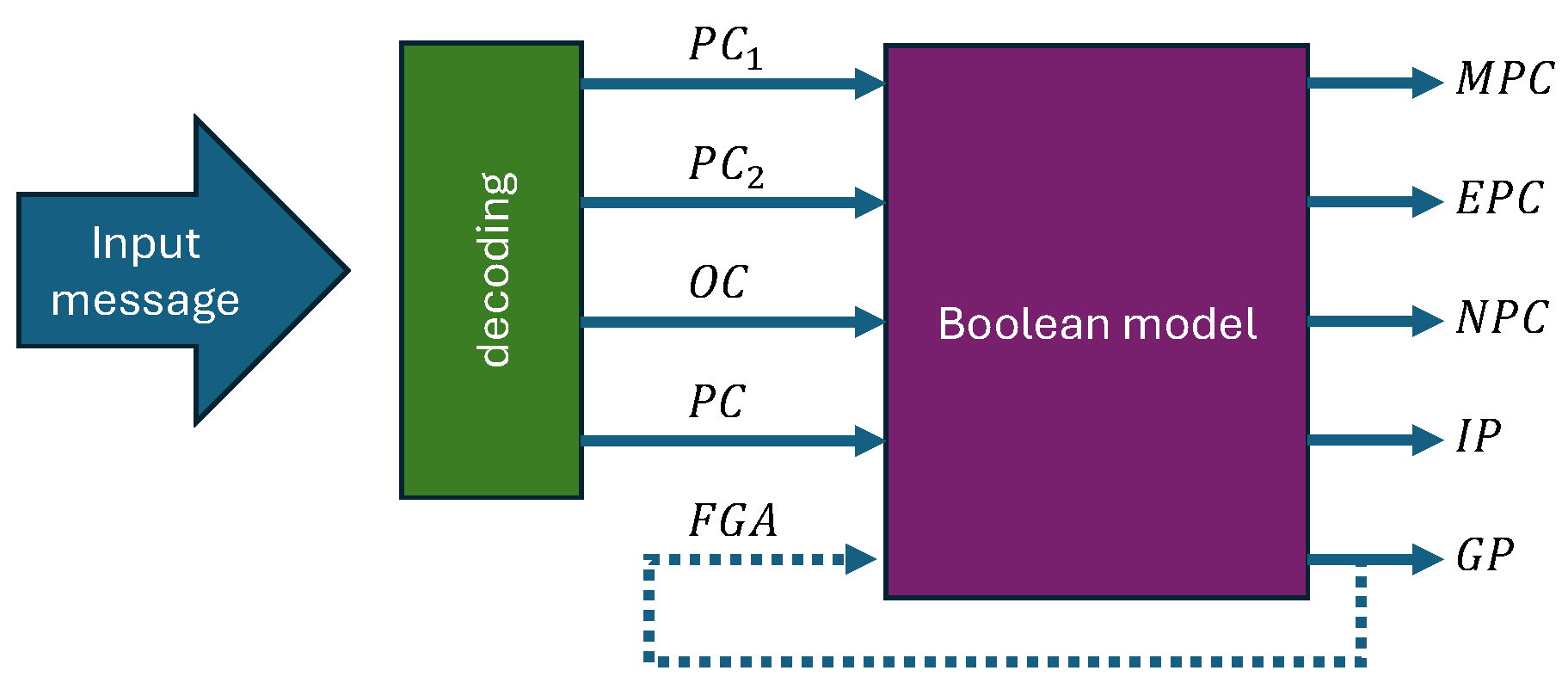
Figure 2.
The scheme of the Boolean network. Each gate , contains a Boolean function of two inputs, chosen among the nodes with index ( corresponds to input signals).
Figure 2.
The scheme of the Boolean network. Each gate , contains a Boolean function of two inputs, chosen among the nodes with index ( corresponds to input signals).
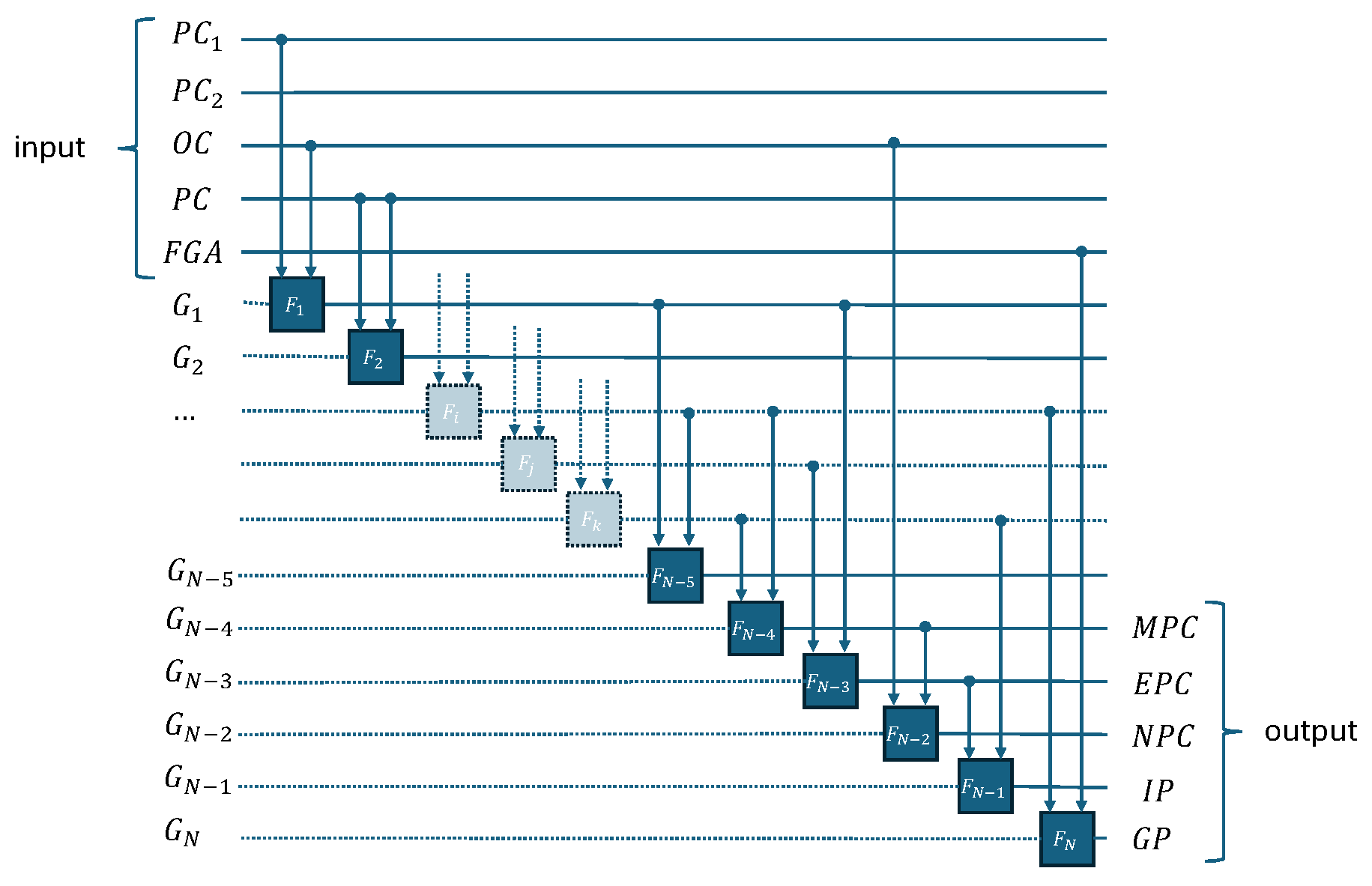
Figure 3.
The resulting feed-forward Boolean circuit of the student after training.
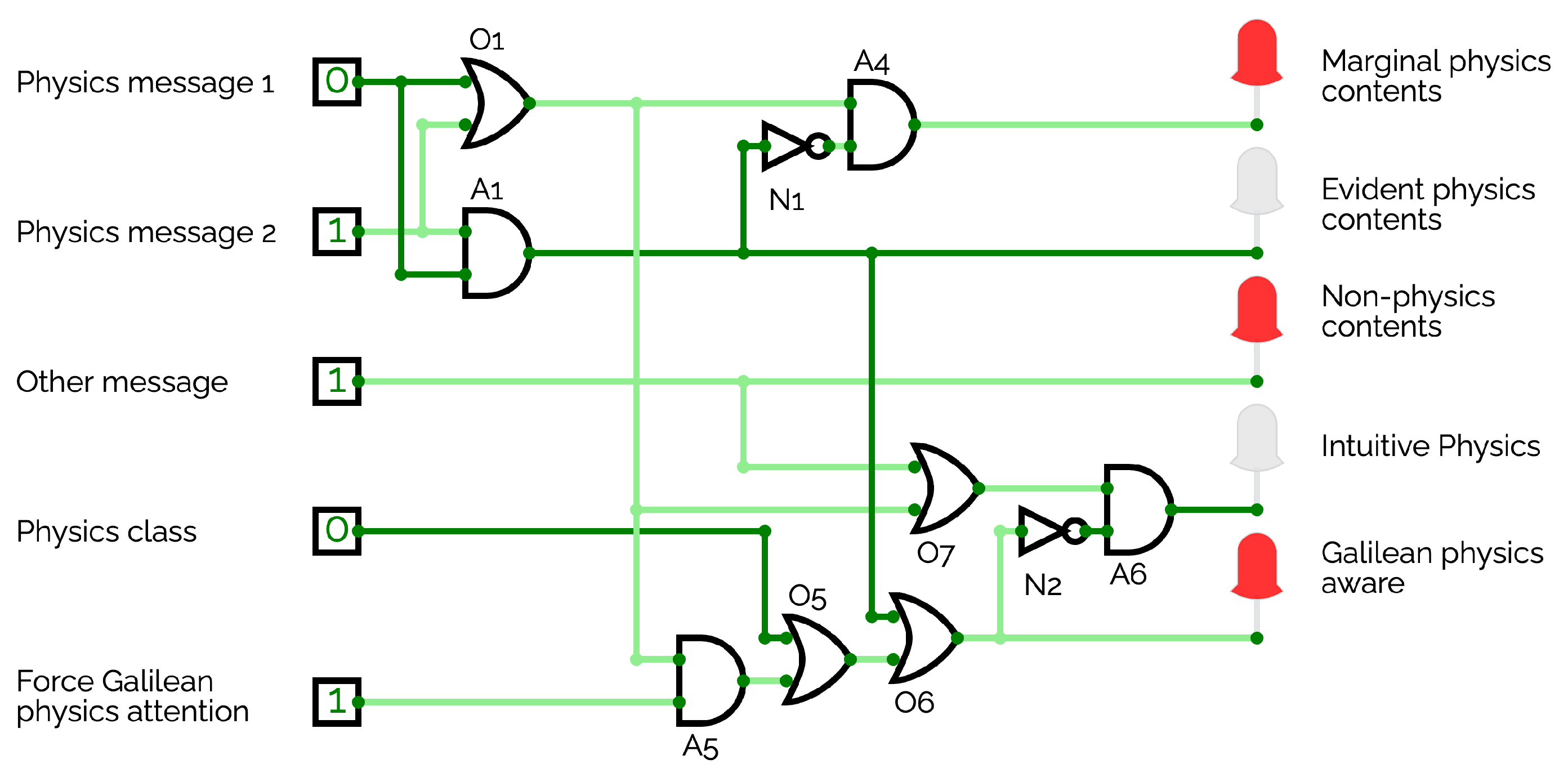
Figure 4.
The stateful Boolean circuit of a student, with a flip-flop loop.
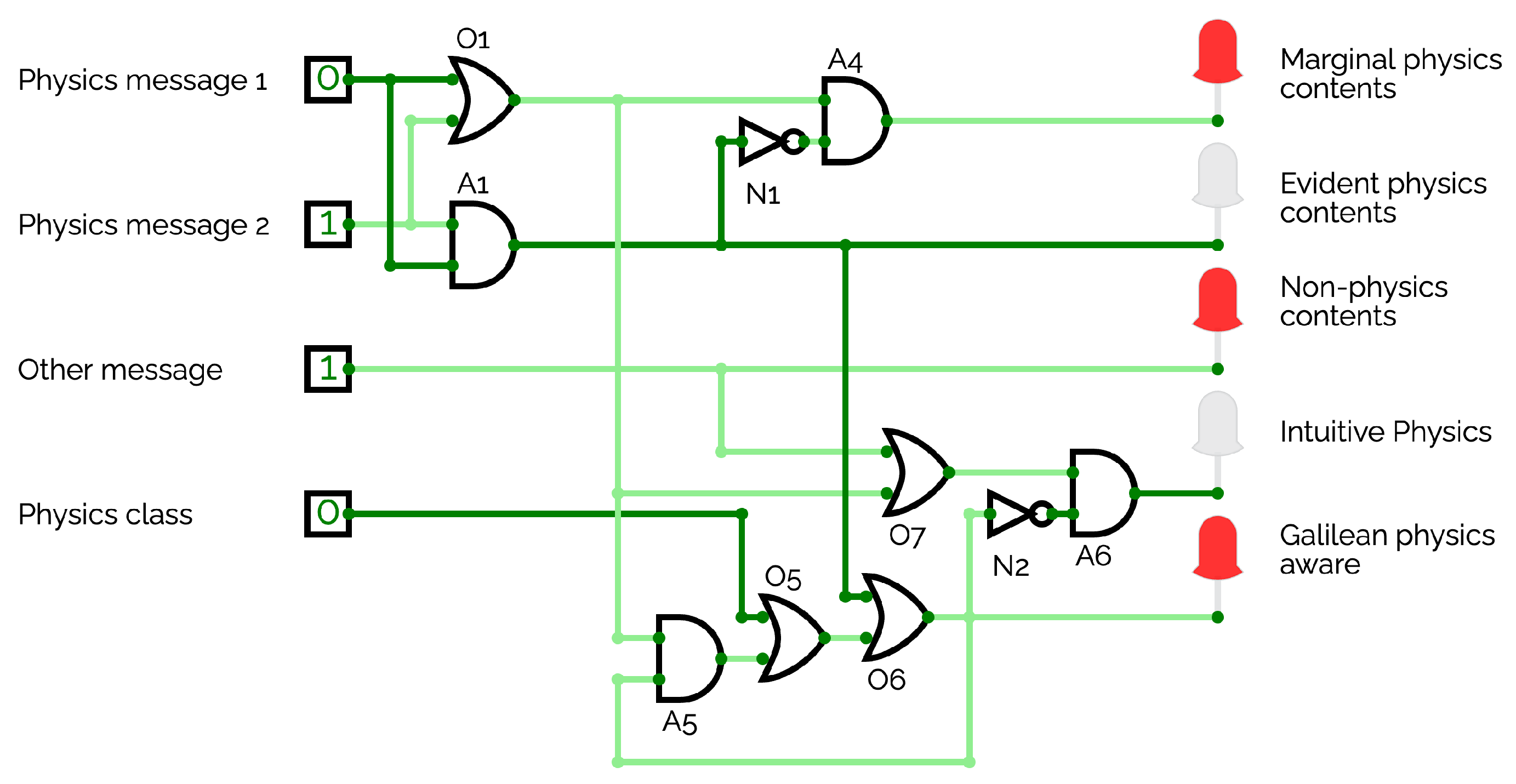
Table 1.
Descriptive statistics for the total FCI score.
| Score Tot | |
|---|---|
| Valid (N) | 554 |
| Missing | 0 |
| Median | 10.00 |
| Mean (M) | 11.00 |
| Standard Deviation (SD) | 6.71 |
| Skewness | 0.76 |
| SE Skewness | 0.10 |
| Kurtosis | -0.13 |
| SE Kurtosis | 0.21 |
| Minimum | 0.00 |
| Maximum | 30.00 |
Table 2.
Coding scheme of cognitive patterns for response alternatives. Patterns were assigned based on response coding of FCI items.
Table 2.
Coding scheme of cognitive patterns for response alternatives. Patterns were assigned based on response coding of FCI items.
| ID | Pattern | Description |
|---|---|---|
| 1 | Newtonian | Scientifically correct model |
| 2 | Impetus | Coherent alternative model |
| 3 | Aristotelian/Naive | Intuitive model |
| 4 | Specific Error | Fragmented knowledge |
| 5 | Improbable | Random response |
| 0 | Uncertainty | Absence of a coherent model |
Table 3.
Descriptive statistics of response pattern proportions. Variables: N, number of valid records; M, missing responses; A, average; SD, standard deviation; Min., minimum; Max., maximum.
Table 3.
Descriptive statistics of response pattern proportions. Variables: N, number of valid records; M, missing responses; A, average; SD, standard deviation; Min., minimum; Max., maximum.
| Var | Newtonian | Impetus | Aristotelian | Spec. Error | Improbable | Uncertainty |
|---|---|---|---|---|---|---|
| N | 524 | 524 | 524 | 524 | 524 | 524 |
| M | 30 | 30 | 30 | 30 | 30 | 30 |
| A | 0.391 | 0.098 | 0.159 | 0.085 | 0.085 | 0.182 |
| SD | 0.226 | 0.067 | 0.103 | 0.065 | 0.063 | 0.268 |
| Min. | 0.000 | 0.000 | 0.000 | 0.000 | 0.000 | 0.000 |
| Max. | 1.000 | 0.300 | 0.433 | 0.333 | 0.300 | 1.000 |
Table 4.
Descriptive statistics of FCI total score by educational background. N: number of valid records, SD: standard deviation
Table 4.
Descriptive statistics of FCI total score by educational background. N: number of valid records, SD: standard deviation
| Education | N | Mean | SD |
|---|---|---|---|
| Humanities | 73 | 8.58 | 5.44 |
| Scientific | 275 | 12.60 | 7.28 |
| Technical | 175 | 9.64 | 5.70 |
| Professional | 26 | 10.15 | 6.15 |
| Other | 5 | 10.60 | 7.20 |
Table 5.
Significant Tukey HSD post-hoc comparisons for FCI total scores across educational backgrounds. M.D. stands for Mean Difference, Lower and Upper refers to 95% CI for Mean Difference.
Table 5.
Significant Tukey HSD post-hoc comparisons for FCI total scores across educational backgrounds. M.D. stands for Mean Difference, Lower and Upper refers to 95% CI for Mean Difference.
| M.D. | Lower | Upper | SE | df | t | |||
|---|---|---|---|---|---|---|---|---|
| Humanities | Scientific | 0.860 | 549 | |||||
| Technical | 0.910 | 549 | ||||||
| Professional | 1.492 | 549 | ||||||
| Other | 3.021 | 549 | ||||||
| Scientific | Technical | 0.632 | 549 | |||||
| Professional | 1.341 | 549 | ||||||
| Other | 2.949 | 549 | ||||||
| Technical | Professional | 1.373 | 549 | |||||
| Other | 2.964 | 549 | ||||||
| Professional | Other | 3.191 | 549 | |||||
| Note. P-value and confidence intervals adjusted for comparing a family of 5 estimates (confidence intervals corrected using the Tukey method). | ||||||||
Table 6.
Descriptive statistics of FCI total score by academic courses.
| Course | N | Mean | SD | SE | Coefficient of variation |
|---|---|---|---|---|---|
| Engineering | 436 | 10.76 | 6.498 | 0.311 | 0.604 |
| Technology | 16 | 7.000 | 5.138 | 1.285 | 0.734 |
| Science | 93 | 13.26 | 7.372 | 0.764 | 0.556 |
| Life Sciences / Health | 9 | 6.444 | 5.126 | 1.709 | 0.795 |
Table 7.
Significant Tukey HSD post-hoc comparisons for FCI total scores across academic courses.
| Mean Difference | SE | df | t | |||
|---|---|---|---|---|---|---|
| Engineering | Technology | 1.681 | 550 | |||
| Science | 0.754 | 550 | ||||
| Life Sciences / Health | 2.223 | 550 | ||||
| Technology | Science | 1.787 | 550 | |||
| Life Sciences / Health | 2.751 | 550 | ||||
| Science | Life Sciences / Health | 2.305 | 550 | |||
| Note. P-value adjusted for comparing a family of 4 estimates. | ||||||
Table 8.
The complete dataset of the minimal model. Symbols and represent the physics contents of message, other non-physics contents. Symbol represents the physics classroom context, and represents the forcing of Galilean physics awareness. The outputs are for recognition of a marginal physics content, for essential physics content, and for absolute non-physics content. Output represent the use of intuitive physics, while stands for Galilean physics.
Table 8.
The complete dataset of the minimal model. Symbols and represent the physics contents of message, other non-physics contents. Symbol represents the physics classroom context, and represents the forcing of Galilean physics awareness. The outputs are for recognition of a marginal physics content, for essential physics content, and for absolute non-physics content. Output represent the use of intuitive physics, while stands for Galilean physics.
| comment | ||||||||||
|---|---|---|---|---|---|---|---|---|---|---|
| 0 | 0 | 0 | 0 | 0 | 0 | 0 | 0 | 0 | 0 | default state |
| 1 | 0 | 0 | 0 | 0 | 1 | 0 | 0 | 1 | 0 | MPC → IP |
| 0 | 1 | 0 | 0 | 0 | 1 | 0 | 0 | 1 | 0 | MPC → IP |
| 1 | 1 | 0 | 0 | 0 | 0 | 1 | 0 | 0 | 1 | EPC → GP |
| 0 | 0 | 1 | 0 | 0 | 0 | 0 | 1 | 1 | 0 | NPC → IP |
| 1 | 0 | 1 | 0 | 0 | 1 | 0 | 1 | 1 | 0 | NPC and MPC → IP |
| 0 | 1 | 1 | 0 | 0 | 1 | 0 | 1 | 1 | 0 | NPC and MPC → IP |
| 1 | 1 | 1 | 0 | 0 | 0 | 1 | 1 | 0 | 1 | NPC and EPC → GP |
| 0 | 0 | 0 | 1 | 0 | 0 | 0 | 0 | 0 | 1 | PC → GP |
| 1 | 0 | 0 | 1 | 0 | 1 | 0 | 0 | 0 | 1 | MPC and PC → GP |
| 0 | 1 | 0 | 1 | 0 | 1 | 0 | 0 | 0 | 1 | MPC and PC → GP |
| 1 | 1 | 0 | 1 | 0 | 0 | 1 | 0 | 0 | 1 | EPC and PC → GP |
| 0 | 0 | 1 | 1 | 0 | 0 | 0 | 1 | 0 | 1 | NPC and PC → GP |
| 1 | 0 | 1 | 1 | 0 | 1 | 0 | 1 | 0 | 1 | MPC, NPC and PC → GP |
| 0 | 1 | 1 | 1 | 0 | 1 | 0 | 1 | 0 | 1 | MPC, NPC and PC → GP |
| 1 | 1 | 1 | 1 | 0 | 0 | 1 | 1 | 0 | 1 | EPC, NPC and PC → GP |
| 0 | 0 | 0 | 0 | 1 | 0 | 0 | 0 | 0 | 0 | FGA → IP |
| 1 | 0 | 0 | 0 | 1 | 1 | 0 | 0 | 0 | 1 | MPC and FGA → GP |
| 0 | 1 | 0 | 0 | 1 | 1 | 0 | 0 | 0 | 1 | MPC and FGA → GP |
| 1 | 1 | 0 | 0 | 1 | 0 | 1 | 0 | 0 | 1 | EPC and FGA → GP |
| 0 | 0 | 1 | 0 | 1 | 0 | 0 | 1 | 1 | 0 | NPC and FGA → GP |
| 1 | 0 | 1 | 0 | 1 | 1 | 0 | 1 | 0 | 1 | MPC, NPC and FGA → GP |
| 0 | 1 | 1 | 0 | 1 | 1 | 0 | 1 | 0 | 1 | MPC, NPC and FGA → GP |
| 1 | 1 | 1 | 0 | 1 | 0 | 1 | 1 | 0 | 1 | EPC, NPC and FGA → GP |
| 0 | 0 | 0 | 1 | 1 | 0 | 0 | 0 | 0 | 1 | NPC, PC and FGA → GP |
| 1 | 0 | 0 | 1 | 1 | 1 | 0 | 0 | 0 | 1 | MPC, PC and FGA → GP |
| 0 | 1 | 0 | 1 | 1 | 1 | 0 | 0 | 0 | 1 | MPC, PC and FGA → GP |
| 1 | 1 | 0 | 1 | 1 | 0 | 1 | 0 | 0 | 1 | EPC, PC and FGA → GP |
| 0 | 0 | 1 | 1 | 1 | 0 | 0 | 1 | 0 | 1 | NPC, PC and FGA → GP |
| 1 | 0 | 1 | 1 | 1 | 1 | 0 | 1 | 0 | 1 | MPC, NPC, PC and FGA → GP |
| 0 | 1 | 1 | 1 | 1 | 1 | 0 | 1 | 0 | 1 | MPC, NPC, PC and FGA → GP |
| 1 | 1 | 1 | 1 | 1 | 0 | 1 | 1 | 0 | 1 | EPC, NPC, PC and FGA → GP |
Table 9.
All 16 Boolean functions of two arguments L and R, truth table (results of the four combinations of L and R variables, Disjunctive Normal Form (DNF) of the function, expressed as a combination of NOT (¬), AND (∧) and OR (∨), and the Ring Sum Normal Form (RSNF), expressed as polynomials using the AND (multiplication) and XOR (⊕).
Table 9.
All 16 Boolean functions of two arguments L and R, truth table (results of the four combinations of L and R variables, Disjunctive Normal Form (DNF) of the function, expressed as a combination of NOT (¬), AND (∧) and OR (∨), and the Ring Sum Normal Form (RSNF), expressed as polynomials using the AND (multiplication) and XOR (⊕).
| f | DNF | RSNF | ||||
|---|---|---|---|---|---|---|
| 11 | 10 | 01 | 00 | |||
| 0 | 0 | 0 | 0 | 0 | false | 0 |
| 1 | 0 | 0 | 0 | 1 | ||
| 2 | 0 | 0 | 1 | 0 | ||
| 3 | 0 | 0 | 1 | 1 | ||
| 4 | 0 | 1 | 0 | 0 | ||
| 5 | 0 | 1 | 0 | 1 | ||
| 6 | 0 | 1 | 1 | 0 | ||
| 7 | 0 | 1 | 1 | 1 | ||
| 8 | 1 | 0 | 0 | 0 | ||
| 9 | 1 | 0 | 0 | 1 | ||
| A | 1 | 0 | 1 | 0 | R | R |
| B | 1 | 0 | 1 | 1 | ||
| C | 1 | 1 | 0 | 0 | L | L |
| D | 1 | 1 | 0 | 1 | ||
| E | 1 | 1 | 1 | 0 | ||
| F | 1 | 1 | 1 | 1 | true | 1 |
Disclaimer/Publisher’s Note: The statements, opinions and data contained in all publications are solely those of the individual author(s) and contributor(s) and not of MDPI and/or the editor(s). MDPI and/or the editor(s) disclaim responsibility for any injury to people or property resulting from any ideas, methods, instructions or products referred to in the content. |
© 2026 by the authors. Licensee MDPI, Basel, Switzerland. This article is an open access article distributed under the terms and conditions of the Creative Commons Attribution (CC BY) license.
Copyright: This open access article is published under a Creative Commons CC BY 4.0 license, which permit the free download, distribution, and reuse, provided that the author and preprint are cited in any reuse.


