
Submitted:
17 July 2026
Posted:
20 July 2026
You are already at the latest version
Abstract
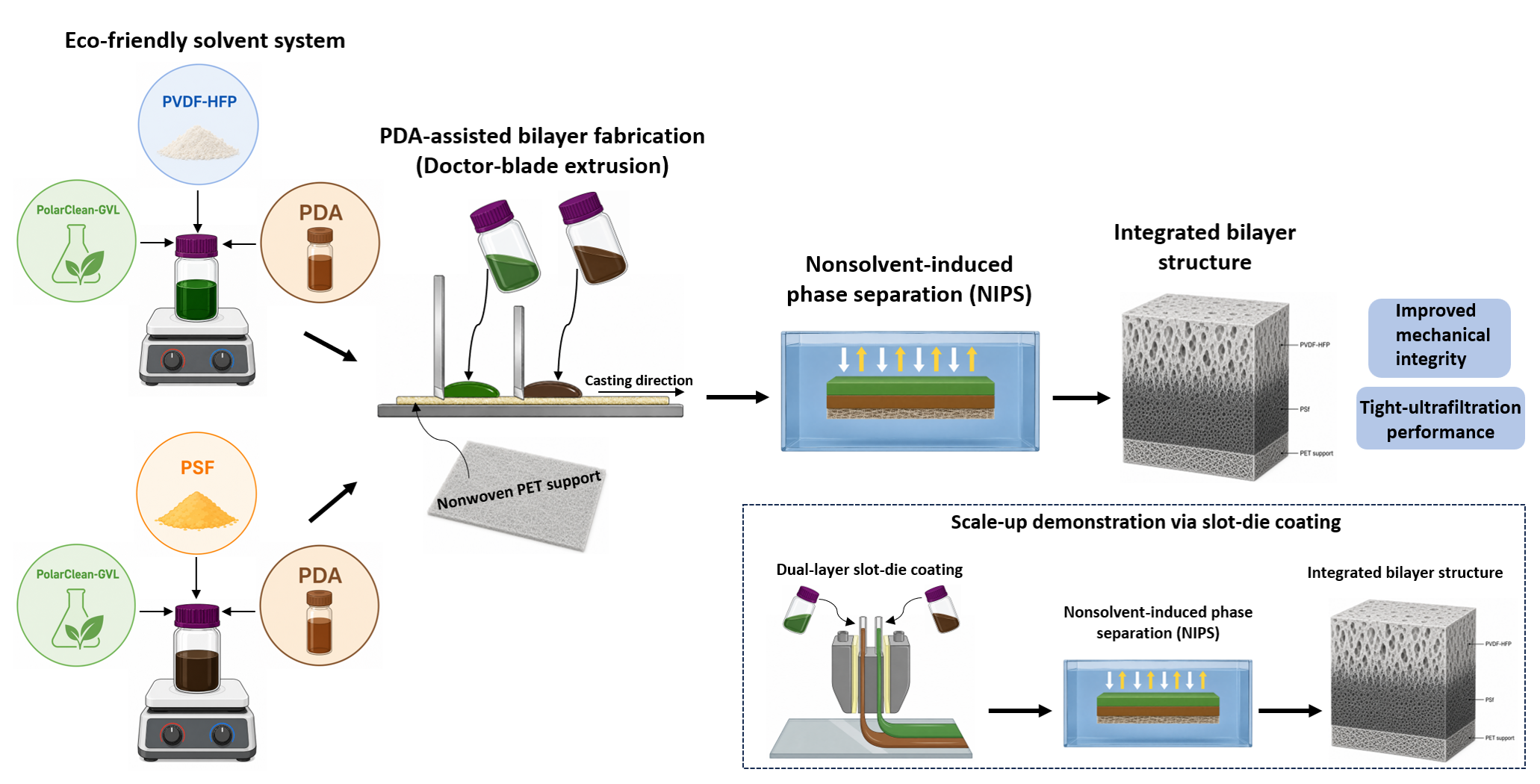
Polymeric membrane systems have emerged as an effective approach for water separa-tions due to their high separation efficiency, simplicity, and adaptability to a wide range of water treatment applications. However, traditional membrane fabrication processes often rely on toxic organic solvents, such as N-methyl-2-pyrrolidone (NMP) and dime-thylacetamide (DMAc), which pose environmental and health risks. Eco-friendly solvents have been investigated as an alternative to traditional toxic solvents. This study inves-tigates the fabrication and performance of polymeric membranes using eco-friendly solvent systems, with a focus on bilayer membranes designed to improve separation performance over traditional single-layer membranes. Membranes were fabricated using eco-friendly solvents, Rhodiasolv© PolarClean and gamma-valerolactone in combination with polymers polysulfone (PSf) and poly(vinylidene fluoride-co-hexafluoropropylene) (PVDF-HFP). Membranes were fabricated using non-solvent induced phase separation (NIPS) through doctor blade extrusion (DBE) and slot-die coating (SDC) methods in order to compare traditional laboratory-scale casting methods (DBE) with scalable fabrication techniques (SDC). Bilayer membranes were found to overcome the inherent limitations presented by single-layer membranes, such as mechanical stability, with polydopamine (PDA) being incorporated as an adhesion-promoting additive to enhance bonding be-tween polymer layers. Membrane characterization included scanning electron micros-copy (SEM), contact angle measurements, and tensile strength tests, along with per-meability and solute rejection tests to investigate membrane performance. Results showed that membranes fabricated at higher concentrations and through the SDC method per-formed at a higher level than the other membranes, exhibiting improved solute rejection rates and less variability in pore structure distribution.
Keywords:
bilayer membranes
; membrane fabrication
; slot-die coating
; eco-friendly solvents
; scale-up
Copyright: This open access article is published under a Creative Commons CC BY 4.0 license, which permit the free download, distribution, and reuse, provided that the author and preprint are cited in any reuse.


