
Submitted:
15 July 2026
Posted:
16 July 2026
You are already at the latest version
Abstract
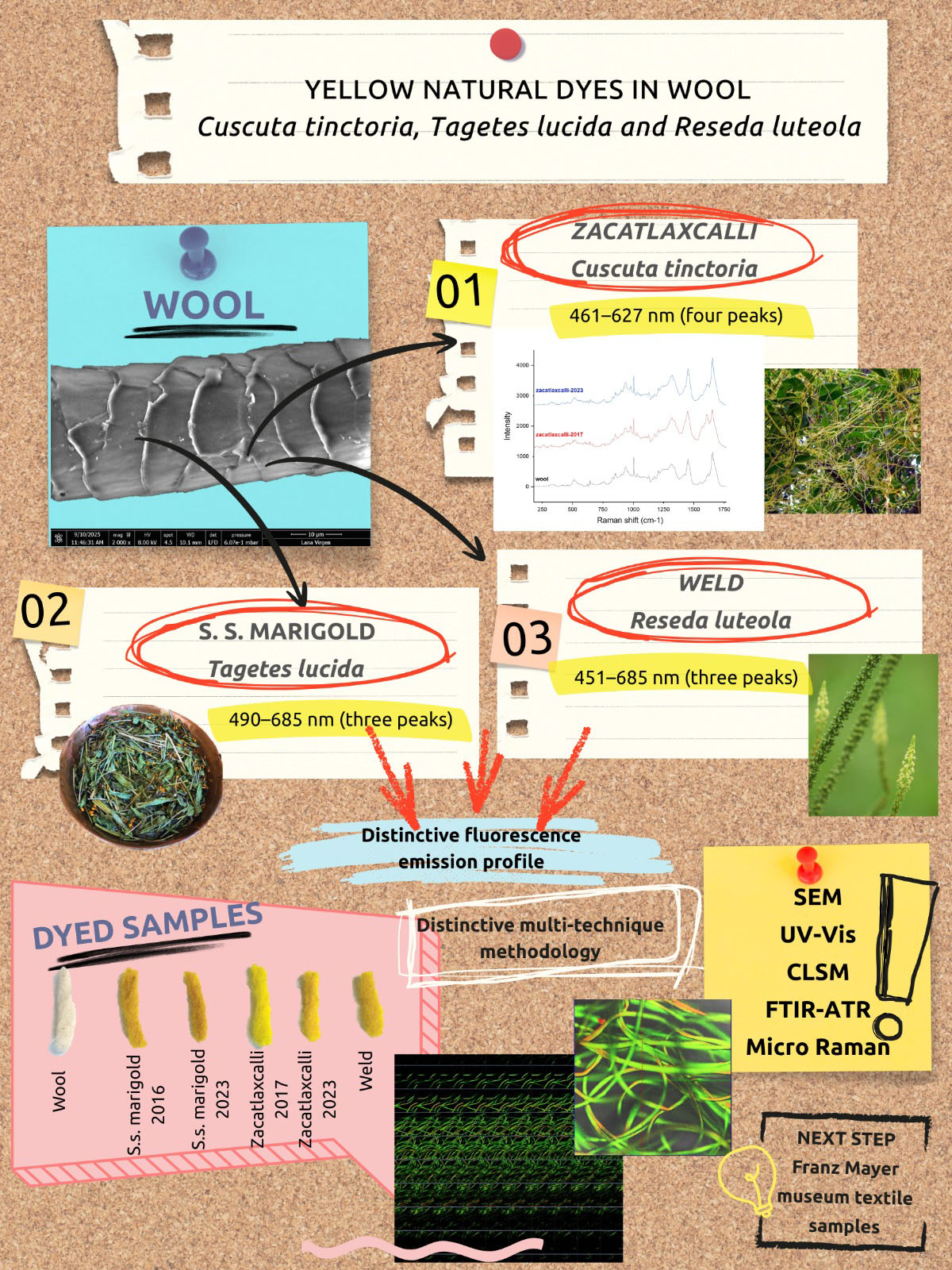
The identification of natural yellow dyes in ancient textiles is complicated, regardless of whether destructive or non-destructive techniques are used. The main limitation is the need for sampling, followed by deterioration and interference by the materials used in consolidation and restoration processes. In addition, different yellow dye sources share the same main fluorophores or components such as luteolin, kaempferol, and quercetin-based chromophores. We propose a minimally invasive methodology to identify sweet-scented marigold (Tagetes lucida), zacatlaxcalli (Cuscuta tinctoria), and weld (Reseda luteola). This methodology was tested on yellow wool samples that were dyed in an artisan workshop in the last 3 to 10 years. Another two samples of yellow wool fibres were obtained from the textile collection of the Franz Mayer Museum in Mexico City. Confocal scanning laser microscopy (CSLM), micro-Raman spectroscopy, attenuated total reflectance Fourier transformed infrared spectroscopy (ATR-FTIR), and variable pressure environmental scanning electron microscopy (VP-ESEM) were used to analyse the samples. The CLSM results showed that dyes are absorbed into the matrix of the fibres. The wool and dyes presented different emission spectra, which can be associated with the main groups of autofluorescent compounds in plants. The FTIR-ATR results supported the proteinaceous origin of the fibres, and the chemical composition and molecular structure of the autofluorescence phytocompounds were identified by micro-Raman spectroscopy. The findings indicate that the proposed methodology is adequate for identifying natural yellow dyes in wool fibres and can be applied to cultural heritage textiles.
Keywords:
ancient textiles
; CSLM
; micro-Raman
; Tagetes lucida
; Cuscuta tinctoria
; Reseda luteola
Copyright: This open access article is published under a Creative Commons CC BY 4.0 license, which permit the free download, distribution, and reuse, provided that the author and preprint are cited in any reuse.


