

Submitted:
15 July 2026
Posted:
16 July 2026
You are already at the latest version
Abstract
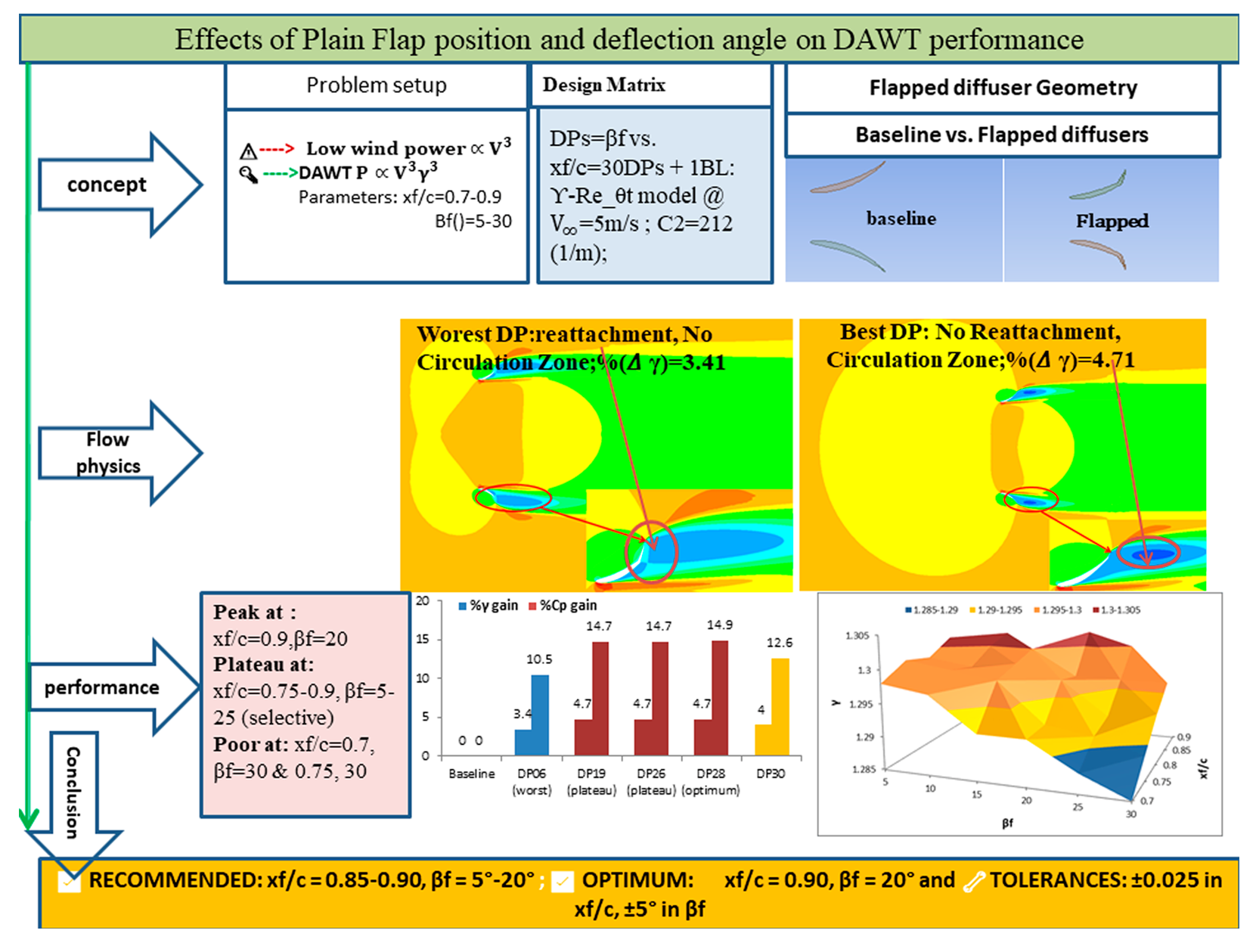
Diffuser-augmented wind turbines present a compelling solution for power extraction in low-wind-speed regions. However, the systematic optimization of plain flaps for compact diffusers has remained largely unexplored. This study conducts a comprehensive parametric CFD investigation of a plain flap integrated into an already optimized compact diffuser, utilizing a validated high-lift airfoil at a 5 m/s freestream velocity. Thirty design points were evaluated across five flap bend locations and six deflection angles using 2D axisymmetric steady RANS simulations with the γ-Re_θt transition turbulence model and an actuator disc rotor representation. Results identify a global optimum at xf/c = 0.90 and βf = 20°, delivering a velocity augmentation ratio of γ = 1.302, a 4.71% improvement over the baseline, and a corresponding 14.9% gain in power coefficient. A wide performance plateau (γ ≥ 1.30) exists for xf/c = 0.85–0.90 and βf = 5°–20°, demonstrating excellent robustness to geometric variations. Flow visualization and wall shear stress analysis reveal that optimal performance does not rely on flow reattachment; instead, a stabilized circulation zone functions as a virtual aerodynamic surface. These findings offer clear, practical design guidelines: integrating a plain flap with xf/c = 0.85–0.90 and βf = 5°–20° into compact diffusers achieves near-optimal performance while allowing generous manufacturing tolerances.
Keywords:
γ-Re_θt transient model
; plain flap
; velocity augmentation
; compact diffuser
; parametric CFD optimization
; high-lift airfoil
Copyright: This open access article is published under a Creative Commons CC BY 4.0 license, which permit the free download, distribution, and reuse, provided that the author and preprint are cited in any reuse.


