

Submitted:
14 July 2026
Posted:
16 July 2026
You are already at the latest version
Abstract
Warm-season annual forages are highly digestible and commonly used to complement perennial grass pastures during the summer. This study evaluated in vitro and in situ di-gestibility and digestion kinetics of mixtures composed of crabgrass (Digitaria sanguinalis [L.] Scop.) and pearl millet (Pennisetum glaucum [L.] R. Br.) grown alone (G) or combined with 30% forage soybean (Glycine max (L.) Merr.) (G+L) across the growing season. Digest-ibility was assessed through in vitro true digestibility (IVTD) and in situ ruminal incuba-tion. A treatment × month interaction (P < 0.01) affected IVTD, with both treatments de-clining from July to September and no differences between G and G+L across months. A treatment × incubation time interaction (P < 0.01) was also detected. The G mixture reached a digestion plateau between 48 and 72 h, whereas G+L did not stabilize during the evalu-ated period, with differences between treatments observed only at 72 h, when G+L showed greater in vitro digestibility. In situ analysis showed that G had a greater disappearance fraction (D₀), whereas G+L had a greater indigestible fraction (U) throughout the season. The inclusion of 30% forage soybean did not improve overall digestibility, indicating that this strategy alone is insufficient to offset forage maturation effects.
Keywords:
in vitro
; in situ
; warm-season
; annual forages
; digestibility
1. Introduction
Warm-season annual forages play an important role in grazing systems by providing high forage yield and good nutritive value. In the southeastern United States, these forages are commonly used to complement perennial pastures during the summer months, helping to sustain animal performance [1]. Among warm-season annuals, crabgrass (Digitaria sanguinalis [L.] Scop.) and pearl millet (Pennisetum glaucum [L.] R. Br.) are widely adopted due to their adaptability, drought tolerance, and potential to produce large amounts of biomass across diverse environmental conditions.
Despite their agronomic advantages, the nutritional value of warm-season grasses is strongly influenced by forage maturity [2]. As plants advance in their phenological development, structural carbohydrates increase and cell wall lignification intensifies, resulting in reduced digestibility and slower ruminal degradation. The use of forage mixtures has been proposed as a strategy to mitigate the decline in forage quality associated with plant maturation [3]. Combining species with contrasting growth patterns and chemical compositions may alter the proportions of structural and non-structural tissues, potentially improving ruminal degradation characteristics.
The inclusion of legumes in grass-based systems has received considerable attention due to their typically higher crude protein concentration and potential to enhance forage quality [4]. Forage soybean (Glycine max (L.) Merr.) has been suggested as a candidate legume for warm-season mixtures because of its adaptability and biomass production [5]. However, its effects on digestibility and ruminal degradation dynamics when combined with grasses remain poorly explored in the literature.
While several studies have evaluated the nutritive value of individual warm-season grasses or grass–legume associations [6,7,8], limited information is available on mixtures specifically composed of crabgrass, pearl millet, and soybean, particularly under conditions typical of the southeastern United States. Even less is known about how the inclusion of legumes in these mixtures influences digestibility and ruminal degradation dynamics across the growing season. Also, a few studies have evaluated in vitro digestibility dynamics with in situ degradation parameters simultaneously to assess how forage maturity and mixture composition interact to affect ruminal fermentation patterns over time [9].
Therefore, this study evaluated the in vitro and in situ digestibility and digestion kinetics of crabgrass and pearl millet, grown alone or in combination with 30% forage soybean throughout the growing season. We hypothesized that the inclusion of a legume could improve the digestibility of warm-season grass mixtures, providing evidence to support their use as alternative forage options for livestock producers.
2. Materials and Methods
2.1. Sample Management
Procedures used for sample collections were approved by the Institutional Animal Care and Use Committee (IACUC) of Auburn University under Animal Use Protocol #2023-5325. Forage samples consisted of two grass species (Digitaria sanguinalis [L.] Scop. and Pennisetum glaucum [L.] R. Br.), and a legume (Glycine max (L.) Merr.). The experimental area included nine paddocks, each measuring 0.8 ha. Pastures were planted on April 26, 2021, and May 17, 2022, at seeding rates of 4.5 kg pure live seed (PLS)/ha, 16.8 kg PLS/ha, and 28.0 kg PLS/ha for crabgrass, pearl millet, and forage soybean, respectively, in each year of the study. Following planting, pastures were fertilized with 56 kg of N/ha, and P and K were applied according to Auburn University soil test recommendations.
Forage samples were collected in July, August, and September by clipping forage to a 2 cm stubble height for digestibility analysis. For the grass-only (G), forage samples from each paddock were composited within sampling month for both years of the study. For the grass–legume treatment (G+L), forage soybean was added to the grass samples at 30% of the total dry matter prior to incubation and digestibility analyses. To assess forage digestibility, two methods were employed: in vitro true digestibility and in situ dry matter digestibility. For both digestibility methods, samples were incubated for 0, 2, 4, 8, 12, 24, 48, and 72 h.
2.2. In Vitro Incubations
Procedures used for the in vitro assessment were approved by the Institutional Animal Care and Use Committee (IACUC) of Auburn University under Animal Use Protocol #2021-3978.
Forage in vitro true digestibility (IVTD) assessment followed the procedures described by [10]. Approximately 1,000 mL of rumen inoculum (fluid and digesta) was collected from two ruminally-fistulated steers (~3 years of age and ~492 kg BW) located at the Auburn University Stanley P. Wilson Beef Teaching Center (Auburn, AL). Donor steers were consuming a primarily perennial warm-season forage-based diet with 50/50 soyhull and corn gluten supplementation prior to collection. Digestibility was measured at eight incubation time points (0, 2, 4, 8, 12, 24, 48, and 72 h) using the ANKOM DaisyII incubator (ANKOM Technologies, Macedon, NY, USA).
2.3. In-Situ Incubations
Procedures used for the in situ assessment were approved by the Institutional Animal Care and Use Committee (IACUC) of Auburn University under Animal Use Protocol #2021-3978.
Forage in situ digestibility assessment was conducted using the methods of [11,12]. This experiment was conducted at the Auburn University Stanley P. Wilson Beef Teaching Center (Auburn, AL), utilizing two ruminally fistulated steers (~3 years of age and ~492 kg BW). Donor steers were consuming a tall fescue (Festuca arundinacea Schreb.) and red clover (Trifolium pratense L.) diet during this assessment.
Forage samples (0.5 g) were placed in labeled acetone-washed ANKOM F57 filter bags and then grouped into nylon zipper bags according to time point [12]. Digestibility was evaluated at eight incubation time points (0, 2, 4, 8, 12, 24, 48, and 72 h), with duplicate samples per steer. On May 20, 2024, the samples were inserted into the rumen in reverse order, beginning with the longest incubation period (72 h) and ending with the shortest (2 h). The 0 h sample was not placed in the rumen with the other samples, but otherwise was treated the same as the other timepoints. Sample bags were attached to a 0.6 m chain, which was secured to the rumen cannula port and submerged in rumen fluid below the rumen forage mat.
On May 23, 2024, all samples were retrieved simultaneously, immediately submerged in ice water, and rinsed according to the procedure described in [11]. The washing process was conducted using a Comfee’ 0.9-cu ft High-Efficiency Portable Impeller Top-Load Washer (Midea America, Parsippany, NJ). The washer settings were adjusted to five cold-water rinse cycles, with each cycle consisting of 2-minute spins and 1-minute agitation until the rinse water appeared clear. Post-incubation, samples were frozen at -18°C for further processing.
Neutral detergent fiber analysis was performed using the ANKOM2000 Fiber Analyzer (ANKOM Technologies) to determine digestibility. Following NDF analysis, the samples were rinsed in acetone, dried at 105°C for approximately 2 h, and weighed to determine digestibility.
2.4. Statistical Analysis
Data from the in vitro study were analyzed using the PROC GLIMMIX procedure of SAS 9.4 (SAS Institute Inc., Cary, NC). The model included forage treatment (G and G+L), month, incubation time, and their interactions as fixed effects. Steer, year, and paddock were included as random effects to account for repeated measures and subject-level variability. Degrees of freedom for fixed effects were adjusted using the second-order Kenward–Roger approximation. Least squares means were compared using the Tukey–Kramer adjustment, and statistical significance was declared at P < 0.05.
For in situ digestibility, disappearance parameters, including the readily available fraction (D₀), indigestible fraction (U), and fractional degradation rate (kd), were estimated using the NLIN procedure in SAS 9.4, based on the McDonald modification of the Ørskov and McDonald model. Subsequently, each parameter was analyzed using PROC GLIMMIX to evaluate the effects of forage treatment, month, and their interaction. Steer, year, and paddock were included as random effects, and degrees of freedom were adjusted using the second-order Kenward–Roger approximation. Least-squares means were compared using the Tukey–Kramer adjustment, with significance set at P < 0.05.
3. Results
The three-way interaction among treatment, month, and incubation hour was not significant (P = 1.00) and was therefore excluded from the final model. However, an interaction between treatment and month was detected for IVTD (P < 0.01) (Figure 1). Mean separations for the treatment × month interaction indicated a progressive reduction in IVTD throughout the growing season. The greatest values were observed in July (51.6% and 53.7% for G and G+L, respectively), followed by August (49.2% and 47.5%), and September (46.2% and 43.2%). No differences were detected between treatments within the same month (P > 0.05)
There was an interaction between treatment and incubation time for IVTD (P < 0.01; Figure 2). Estimates remained stable between 0 and 8 h and, from 12 h onward, increased in both treatments, characterizing an initial period of reduced degradation (lag time) followed by effective digestion of the potentially degradable fraction. A difference between treatments was observed only at 72 h of incubation, when G+L demonstrated greater digestibility than G (P < 0.01). In treatment G, the values at 48 and 72 h did not differ, indicating a plateau in the digestive process. In contrast, G+L did not show stabilization up to 72 h.
In the evaluation of in situ dry matter digestibility, no interaction was detected for the evaluated fractions (P > 0.05). Differences between mixtures and month effects were observed for D₀, U, and kd (Table 1). Mixture effects on in situ digestibility parameters were observed across the growing season (Table 1). Mixture G consistently showed a greater readily available fraction (D₀), whereas mixture G+L exhibited a greater indigestible fraction (U) across all evaluated months (P < 0.05). No differences in the degradation rate (kd) were observed between treatments.
Seasonal progression affected all digestibility parameters. Across both mixtures, the indigestible fraction increased, and the degradation rate decreased as forage maturity advanced (P < 0.05). In mixture G, the D₀ fraction remained constant between July and September (P > 0.05), whereas in mixture G+L, D₀ declined over the same period (P < 0.05).
4. Discussion
The reduction in dry matter digestibility over the growing season aligns with the expected decrease in digestibility as forage matures [13]. The lowered digestibility observed is consistent with the typical physiological pattern of grasses, which show a greater proportion of structural tissues and lignification as maturity advances [14], and may have been the main factor modulating the nutritional quality of the evaluated mixtures.
Crabgrass and pearl millet are two grasses with distinct plant architectures, maturation dynamics, and fiber compositions, and the association of plants at different physiological stages can modify feed digestibility by altering the proportion of structural tissues and, consequently, the ruminal degradation pattern [15]. Crabgrass has a digestibility of approximately 65.8% [7], while pearl millet can range between 45.4% and 60% in the first cut and at the heading stage [16,17,18], with a continuous reduction in digestibility from the second cut onward [19]. Although the digestibility values observed in G were less than those reported in the literature for grasses evaluated individually, the D0 parameter remained stable from July to September (Table 1). In this scenario, the initial phase of fermentation tends to be more consistent, and any nutritional interventions become more focused on supporting the degradation of the fibrous fraction [20].
Among the grasses present in the mixture, crabgrass is characterized by relatively small changes in NDF and ADF concentrations over time [21], whereas pearl millet shows more pronounced changes in the fiber fraction and digestibility as maturity advances [22]. Thus, our results suggest that the presence of crabgrass in the mixture was not sufficient to compensate for the increase in fiber fractions associated with the maturation of pearl millet, corroborating [9], who also did not observe an increase in digestibility of pearl millet + crabgrass compared to pearl millet alone. Therefore, although the initial digestion potential of mixture G remained constant, the combination of a lower degradation rate and a higher indigestible fraction makes it more likely that animal performance at the end of the season will depend on nutritional interventions and supplementation strategies aimed at optimizing the degradation of the fibrous fraction when the mixture of the two grasses is offered.
Contrary to expectations, the addition of 30% legume in G+L was not sufficient to increase feed digestibility. Although legumes are frequently associated with improved diet quality [23,24,25], the soluble fraction D0 decreased over time. This behavior is likely a result of forage soybean maturation, which, as it advances in the phenological stage, reduces the proportion of cellular tissue and increases the proportion of structural tissues, redirecting carbohydrates to fractions less accessible to ruminal fermentation [26], compromising the initial availability of readily fermentable substrate in the mixture.
The addition of the legume also caused an increase in the indigestible fraction, which may intensify physical fill limitations in the rumen [27]. An increase in this fraction in ruminant feeds results in lower availability of fermentable substrate and lower energy density of the feed [28]. The absence of positive effects from mixing legumes and grasses was also reported in a meta-analysis conducted by [29]. After evaluating 61 trials, [29] concluded that the mixture of cereals and legumes increases the fibrous fraction of the mixture, but, when combined with other nutritional factors, it neither improves nor worsens the quality of the produced feed. In the present study, although the inclusion of 30% legume could be expected to improve the digestibility of the mixture, the addition resulted in decreased digestibility parameters compared to pure grasses. In future research, other factors such as dry matter production, crude protein, and animal performance parameters need to be considered.
The in vitro digestibility results provided a temporal view of the average digestion dynamics of treatments G and G+L throughout the season. The stability of digestibility observed in both mixtures during the first hours of the trial has been widely reported in previous studies [30,31,32]. [33] suggest that there is an initial adaptation period between the environment and the feed, related to particle hydration and microbial colonization that occurs before the effective degradation of the potentially degradable fraction in the rumen begins. In this study, this phase was captured in the 0 to 8-hour window. From 12 h onward, the progressive increase in digestibility suggests a greater contribution from the degradation of cell walls and fractions that were previously not readily accessible.
The integrated analysis of in situ and in vitro trials provided a more consistent understanding of how the digestibility and digestion kinetics of the grasses were modified throughout the season and according to the composition of the mixtures. While the in situ parameters evidenced changes in the proportions of digestible and indigestible fractions, associated with advancing maturity and the inclusion of the legume, the in vitro evaluation showed how these changes were reflected in the temporal dynamics of digestion. The main difference between the two mixtures in IVTD was the plateau effect observed in mixture G from 48 hours onward, indicating that most of the digestible material had been decomposed during this period, leaving only indigestible material [34]. In contrast, the absence of stabilization in G+L up to 72 h suggests that part of the material remained potentially degradable, but with a slower degradation rate or more restricted microbial access. This response is consistent with the effect of forage soybean inclusion on the structural characteristics of the mixture.
According to [35], legume plants have a lower fiber concentration, and the fiber digestibility of these plants is generally lower than that of grasses, while [36,37] state that, as the maturity stage advances, legumes develop a denser cell wall that is less accessible to ruminal degradation. Therefore, we believe that the absence of a plateau in G+L after 72 hours of incubation does not indicate higher digestibility of the mixture, but rather that the potentially degradable fraction was not fully accessed during the experimental period due to physical barriers and low microbial accessibility.
5. Conclusions
The evaluated mixtures can be used as forage for ruminants, especially at the beginning and middle of the growing season. Advancing maturity reduced digestibility and altered the digestion kinetics, decreasing feed utilization efficiency at the end of the season. Grass alone showed earlier digestion stabilization, whereas the inclusion of the legume did not increase digestibility but altered degradation dynamics, delaying the time required for in vitro dry matter digestibility to reach a plateau. The inclusion of 30% legume did not improve digestibility, indicating that this strategy alone is insufficient to offset the limitations associated with grass maturation. The provision of these mixtures should be accompanied by proper harvest management and, when offered at later stages, by strategies that minimize nutritional constraints arising from increased fibrous fractions.
Author Contributions
Conceptualization, S.L.D. and M.K.M..; methodology, S.L.D. and M.K.M.; software, S.L.D. and M.K.M.; validation, S.L.D., M.K.M., and W.B.S.; formal analysis, S.L.D. and W.B.S.; investigation, A.J.H., S.L.D., and M.K.M.; resources, S.L.D. and M.K.M.; data curation, S.L.D., M.K.M., W.B.S., and C.E.S.S.; writing—original draft preparation, A.J.H., C.E.S.S., S.L.D. and M.K.M.; writing—review and editing, A.J.H, C.E.S.S., W.B.S., S.M.J., J.E., M.K.M., and S.L.D.; visualization, C.E.S.S., S.L.D. and M.K.M.; supervision, S.L.D. and M.K.M.; project administration, S.L.D., M.K.M., and W.B.S.; funding acquisition, S.L.D. and M.K.M. All authors have read and agreed to the published version of the manuscript.
Funding
This research was funded by the Alabama State Beef Checkoff Program, the National Needs Fellowship (2021-38420-34060), and the USDA Agricultural Research Service under Agreement No. 58-6010-1-005.
Institutional Review Board Statement
Activities were approved by the Institutional Animal Care and Use Committee (IACUC) of Auburn University under Animal Use Protocols #2021-3978 and #2023-5325.
Informed Consent Statement
Not applicable.
Data Availability Statement
The original contributions presented in this study are included in the article. Further inquiries can be directed to the corresponding author.
Conflicts of Interest
The authors declare no conflicts of interest. The funders had no role in the design of the study; in the collection, analyses, or interpretation of data; in the writing of the manuscript; or in the decision to publish the results.
References
- Dillard, S.L.; Hancock, D.W.; Harmon, D.D.; Mullenix, M.K.; Beck, P.; Soder, K.J. Animal performance and environmental efficiency of cool- and warm-season annual grazing systems. J. Anim. Sci. 2018, 96, 3491–3502. [Google Scholar] [CrossRef]
- Vendramini, J. Warm-season perennial grass management in tropical and subtropical regions. J. Anim. Sci. 2019, 97, 37–37. [Google Scholar] [CrossRef]
- Guretzky, J.A.; Harmoney, K.R.; Moyer, J.L.; Volesky, J.D.; Stephenson, M.B. Interseeding annual warm-season grasses into pastures: forage nutritive value and yields. Agron. J. 2021, 113, 2544–2556. [Google Scholar] [CrossRef]
- Tahir, M.; Li, C.; Zeng, T.; Xin, Y.; Chen, C.; Javed, H.H.; Yang, W.; Yan, Y. Mixture composition influenced the biomass yield and nutritional quality of legume–grass pastures. Agronomy 2022, 12, 1449. [Google Scholar] [CrossRef]
- Baral, R.; Kim, J.; Bhattarai, B.; Koirala, H.; Massigoge, I.; Denson, E.; Guareschi, C.; Cominelli, S.; Rud, J.P.; Oliveira, J.B. Cropping potential of forage soybean as a summer forage in Midwest U.S. rainfed systems. Front. Agron. 2025, 7, 1570567. [Google Scholar] [CrossRef]
- Andrade, C.A.O.; Borghi, E.; Bortolon, L.; Bortolon, E.S.O.; Camargo, F.P.; Avanzi, J.C.; Guarda, V.D.A.; Cunha, M.K.; Silva, R.R.; Fidelis, R.R. Forage production and bromatological composition of forage species intercropped with soybean. J. Agric. Sci. 2020, 12(1), 84–94. [Google Scholar]
- Aguerre, M.J.; Peña, O.M.; Velasquez, C.; Ferreira, G. Nutritional composition and in vitro ruminal digestibility of crabgrass (Digitaria sanguinalis (L.) Scop.) in monoculture or interseeded with cowpea (Vigna unguiculata (L.) Walp.) and lablab (Lablab purpureus (L.) Sweet). Animals 2023, 13, 2305. [Google Scholar] [CrossRef] [PubMed]
- Guretzky, J.A.; Harmoney, K.R.; Moyer, J.L.; Volesky, J.D.; Stephenson, M.B. Interseeding annual warm-season grasses into pastures: forage nutritive value and yields. Agron. J. 2021, 113, 2544–2556. [Google Scholar] [CrossRef]
- Harmon, D.D.; Hancock, D.W.; Stewart, R.L.; Lacey, J.L.; McKee, R.W.; Hale, J.D.; Thomas, C.L.; Ford, E.; Segers, J.R. Warm-season annual forages in forage-finishing beef systems: I. Forage yield and quality. Transl. Anim. Sci. 2019, 3, 911–926. [Google Scholar] [CrossRef] [PubMed]
- Vogel, K.P.; Pedersen, J.F.; Masterson, S.D.; Toy, J.J. Evaluation of a filter bag system for NDF, ADF, and IVDMD forage analysis. Crop Sci. 1999, 39, 276–279. [Google Scholar] [CrossRef]
- Vanzant, E.S.; Cochran, R.C.; Titgemeyer, E.C. Standardization of in situ techniques for ruminant feedstuff evaluation. J. Anim. Sci. 1998, 76, 2717–2729. [Google Scholar] [CrossRef] [PubMed]
- Norris, A.B.; Tedeschi, L.O.; Muir, J.P. Assessment of in situ techniques to determine indigestible components in the feed and feces of cattle receiving supplemental condensed tannins. J. Anim. Sci. 2019, 97, 5016–5026. [Google Scholar] [CrossRef] [PubMed]
- Cherney, D.J.R.; Cherney, J.H.; Lucey, R.F. In vitro digestion kinetics and quality of perennial grasses as influenced by forage maturity. J. Dairy Sci. 1993, 76, 790–797. [Google Scholar] [CrossRef]
- Jung, H.G. Forage digestibility: The intersection of cell wall lignification and plant tissue anatomy. In Proceedings of the 23rd Annual Florida Ruminant Nutrition Symposium; University of Florida: Gainesville, FL, USA, 2012. [Google Scholar]
- Bruinenberg, M.H.; Valk, H.; Korevaar, H.; Struik, P.C. Factors affecting digestibility of temperate forages from semi-natural grasslands: A review. Grass Forage Sci. 2002, 57, 292–301. [Google Scholar] [CrossRef]
- Bosworth, S.C.; Hoveland, C.S.; Buchanan, G.A.; Anthony, W.B. Forage quality of selected warm-season weed species. Agron. J. 1980, 72, 1050–1054. [Google Scholar] [CrossRef]
- Joshi, U.N.; Arora, R.N.; Phogat, D.S.; Jhorar, B.S.; Avtar, R.; Sheoran, R.S. Emerging trends in forage research and livestock production. In Emerging Trends in Forage Research and Livestock Production; Pahuja, S.K., et al., Eds.; 2009; pp. 146–153. [Google Scholar]
- Harinarayana, G.; Melkania, N.P.; Reddy, B.V.S.; Gupta, S.K.; Rai, K.N.; Kumar, P.S. Forage potential of sorghum and pearl millet. In Proceedings of the Seventh International Conference on the Development of Drylands: Sustainable Development and Management of Drylands in the Twenty-First Century; ICARDA: Aleppo, Syria, 2005; pp. 14–17. [Google Scholar]
- Tenakwa, E.A.; Ansah, T.; Cudjoe, S.; Yamasaki, S. Effects of pearl millet (Pennisetum glaucum) forage cropping pattern on biomass yield and in vitro NDF digestibility. West Afr. J. Appl. Ecol. 2023, 31, 20–34. [Google Scholar]
- Ørskov, E.R. Manipulation of fiber digestion in the rumen. Proc. Nutr. Soc. 1991, 50, 187–196. [Google Scholar] [PubMed]
- Beck, P.A.; Hutchison, S.; Stewart, C.B.; Shockey, J.D.; Gunter, S.A. Effect of crabgrass (Digitaria ciliaris) hay harvest interval on forage quality and performance of growing calves fed mixed diets. J. Anim. Sci. 2007, 85, 527–535. [Google Scholar] [CrossRef] [PubMed]
- Oskey, M.; Velasquez, C.; Peña, O.M.; Andrae, J.; Bridges, W.; Ferreira, G.; Aguerre, M.J. Yield, nutritional composition, and digestibility of conventional and brown midrib (BMR) pearl millet as affected by planting and harvesting dates and interseeded cowpea. Animals 2023, 13, 260. [Google Scholar] [CrossRef] [PubMed]
- Hassen, A.; Talore, D.G.; Tesfamariam, E.H.; Friend, M.A.; Mpanza, T.D.E.M. Potential use of forage-legume intercropping technologies to adapt to climate-change impacts on mixed crop-livestock systems in Africa: A review. Reg. Environ. Change 2017, 17, 1713–1724. [Google Scholar] [CrossRef]
- Lagrange, S.P.; MacAdam, J.W.; Villalba, J.J. The use of temperate tannin-containing forage legumes to improve sustainability in forage–livestock production. Agronomy 2021, 11, 2264. [Google Scholar] [CrossRef]
- Talla, V.V.R.; Sandal, S.S.; Walia, P.; Vidya, A.S. Quality enhancement in forage crops of cereals and legumes. Int. J. Plant Soil Sci. 2023, 35, 166–179. [Google Scholar] [CrossRef]
- Verdecia, D.M.; Herrera, R.S.; Ramírez, J.L.; Leonard, I.; Bodas, R.; Andrés, S.; Giráldez, F.J.; González, J.S.; Arceo, Y.; Álvarez, Y.; López, S. Effect of the re-growth age on the nutritive quality of Neonotonia wightii in the Cauto Valley, Cuba. Cuba. J. Agric. Sci. 2013, 47, 89–95. [Google Scholar]
- Fustini, M.; Palmonari, A.; Canestrari, G.; Bonfante, E.; Mammi, L.; Pacchioli, M.T.; Sniffen, G.C.; Grant, R.J.; Cotanch, K.W.; Formigoni, A. Effect of undigested neutral detergent fiber content of alfalfa hay on lactating dairy cows: Feeding behavior, fiber digestibility, and lactation performance. J. Dairy Sci. 2017, 100, 4475–4483. [Google Scholar] [CrossRef] [PubMed]
- Harper, K.; McNeill, D. The role iNDF in the regulation of feed intake and the importance of its assessment in subtropical ruminant systems. Agriculture 2015, 5, 778–790. [Google Scholar] [CrossRef]
- Liu, H.; Struik, P.C.; Zhang, Y.; Jing, J.; Stomph, T. Forage quality in cereal/legume intercropping: A meta-analysis. Field Crops Res. 2023, 304, 109174. [Google Scholar] [CrossRef]
- Foster, J.L.; Smith, W.B.; Rouquette, F.M.; Tedeschi, L.O. Forages and pastures symposium: An update on in vitro and in situ experimental techniques for approximation of ruminal fiber degradation. J. Anim. Sci. 2023, 101, 1–14. [Google Scholar] [CrossRef]
- Jacaúna, A.G.; Goes, R.H.T.B.; Seno, L.O.; Ítavo, L.C.V.; Gandra, J.R.; Silva, N.G.; Anschau, D.G.; Oliveira, R.T.; Bezerra, L.R.; Oliveira, R.L. Degradability, in vitro fermentation parameters, and kinetic degradation of diets with increasing levels of forage and chitosan. Transl. Anim. Sci. 2021, 5, 1–12. [Google Scholar] [CrossRef]
- Miller, J.R.; Hobbs, N.T. Effect of forage hydration on lag time during in vitro digestion of meadow hay. Grass Forage Sci. 1994, 49, 107–110. [Google Scholar] [CrossRef]
- Singh, B.; Makkar, H.P.S.; Negi, S.S. Rate and extent of digestion and potentially digestible dry matter and cell wall of various tree leaves. J. Dairy Sci. 1989, 72, 3233–3239. [Google Scholar] [CrossRef]
- Mellenberger, R.W.; Satter, L.D.; Millett, M.A.; Baker, A.J. An in vitro technique for estimating digestibility of treated and untreated wood. J. Anim. Sci. 1970, 30, 1005–1011. [Google Scholar] [CrossRef]
- Brown, A.N.; Ferreira, G.; Teets, C.L.; Thomason, W.E.; Teutsch, C.D. Nutritional composition and in vitro digestibility of grass and legume winter (cover) crops. J. Dairy Sci. 2018, 101, 2037–2047. [Google Scholar] [CrossRef] [PubMed]
- Wilson, J.R.; Hatfield, R.D. Structural and chemical changes of cell wall types during stem development: Consequences for fiber degradation by rumen microflora. Aust. J. Agric. Res. 1997, 48, 165–180. [Google Scholar] [CrossRef]
- Li, X. Plant cell wall chemistry: Implications for ruminant utilization. J. Appl. Anim. Nutr. 2021, 9, 31–56. [Google Scholar] [CrossRef]
Figure 1.
In vitro true digestibility (IVTD) of crabgrass and pearl millet mixtures (G) and a mixture with 30% inclusion of forage soybean (G + L) across the growing season. Error bars indicate the standard error of the mean (SEM). Means with the same letter do not differ (P > 0.05) based on the treatment × month interaction.
Figure 1.
In vitro true digestibility (IVTD) of crabgrass and pearl millet mixtures (G) and a mixture with 30% inclusion of forage soybean (G + L) across the growing season. Error bars indicate the standard error of the mean (SEM). Means with the same letter do not differ (P > 0.05) based on the treatment × month interaction.
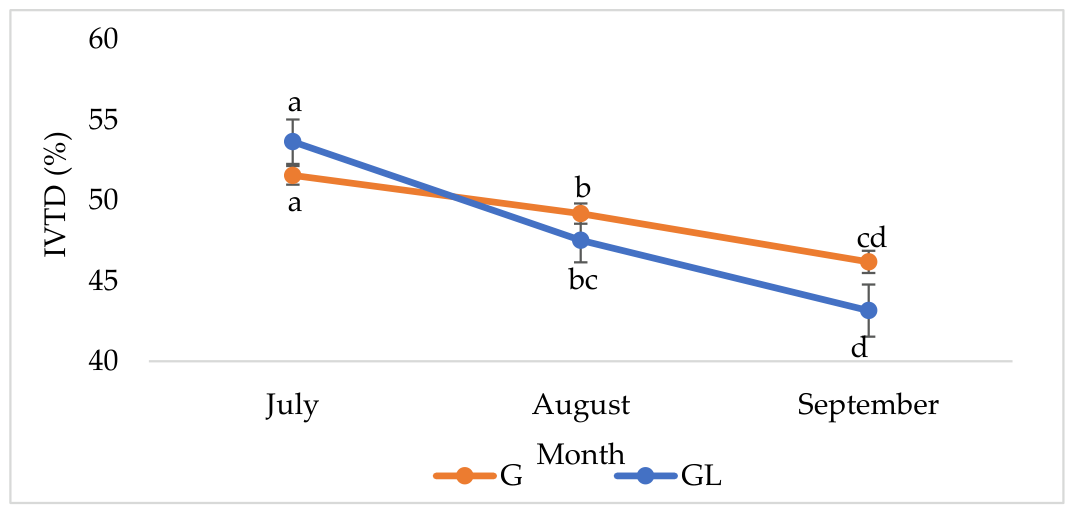
Figure 2.
In vitro true digestibility (IVTD) of crabgrass and pearl millet mixtures (G) and a mixture with 30% inclusion of forage soybean (G + L) in relation to incubation time. Error bars indicate the standard error of the mean (SEM). Means with the same letter do not differ (P > 0.05) based on the treatment × incubation time interaction.
Figure 2.
In vitro true digestibility (IVTD) of crabgrass and pearl millet mixtures (G) and a mixture with 30% inclusion of forage soybean (G + L) in relation to incubation time. Error bars indicate the standard error of the mean (SEM). Means with the same letter do not differ (P > 0.05) based on the treatment × incubation time interaction.
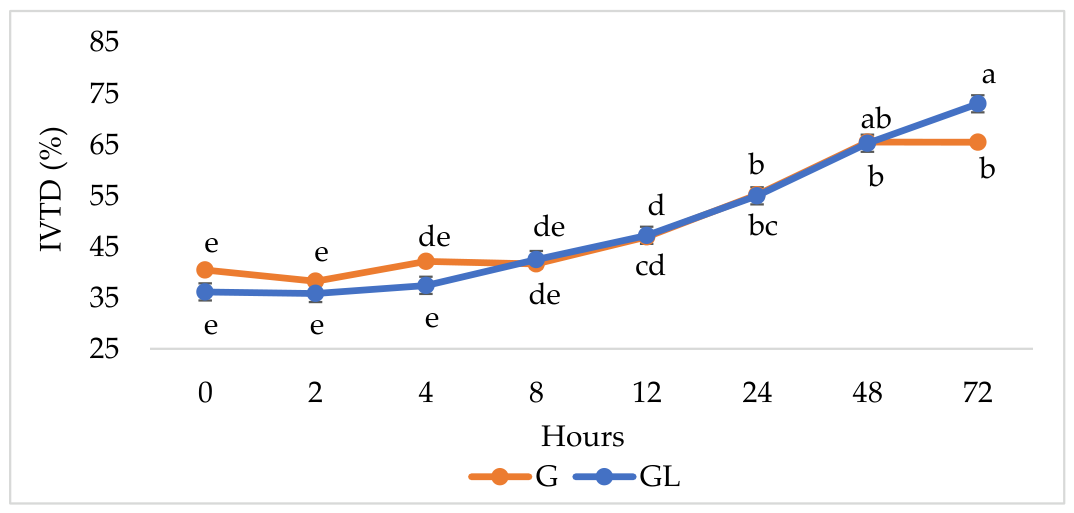

Table 1.
In situ digestibility model parameters of G and G + L mixtures across the growing season.
| Item | G | G+L | ||||
| July | August | September | July | August | September | |
| D0 | 51.7Aa ± 1.30 | 51.0Aa ± 1.38 | 47.7Aa ± 2.56 |
47.6Aa ± 2.85 |
41.1Bab ± 2.47 |
37.9Bb ± 3.02 |
| U | 15.5Bc ± 0.89 | 18.0Bb ± 0.91 | 21.5Ba ± 1.15 |
18.8Ac ± 1.81 |
23.9Ab ± 1.45 |
31.8Aa ± 2.03 |
| kd | 0.026Aa ± 0.0008 | 0.023Ab ± 0.0009 | 0.022Ab ± 0.0013 |
0.028Aa ± 0.0011 |
0.024Ab ± 0.0010 |
0.023Ab ± 0.0012 |
D0 = disappearance; U = undigestible fraction; kd = rate of digestion. SEM = standard error of the mean. Means within a row followed by different lowercase letters differ among months within the same treatment (P < 0.05). Means followed by different uppercase letters differ between treatments within the same month (P < 0.05).
Disclaimer/Publisher’s Note: The statements, opinions and data contained in all publications are solely those of the individual author(s) and contributor(s) and not of MDPI and/or the editor(s). MDPI and/or the editor(s) disclaim responsibility for any injury to people or property resulting from any ideas, methods, instructions or products referred to in the content. |
© 2026 by the authors. Licensee MDPI, Basel, Switzerland. This article is an open access article distributed under the terms and conditions of the Creative Commons Attribution (CC BY) license.
Copyright: This open access article is published under a Creative Commons CC BY 4.0 license, which permit the free download, distribution, and reuse, provided that the author and preprint are cited in any reuse.