

Submitted:
10 July 2026
Posted:
16 July 2026
You are already at the latest version
Abstract
The interaction between sound and plants (phytoacoustics) has been studied for nearly a century. During that period, hundreds of peer-reviewed publications have reported acoustically-induced physiological changes across a wide range of botanical taxa. Although existing review papers summarize recent developments, they stop short of a structured cross-study analysis of the documented experimental parameters. This work presents the first systematic parameter-level analysis of the phytoacoustics record, mapping 2,991 experimental conditions drawn from 404 publications spanning 1928--2025. Among other results, the study found that the field's choice of stimulus parameters may be heavily influenced by parameter inheritance from a small number of prolific research groups. It also found that physically incomparable delivery media (e.g., liquid sonication versus airborne and substrate delivery) are routinely treated as interchangeable evidence. Dose-determining parameters were also found to be chronically under-reported, gating meaningful meta-analysis. To aid future researchers, the publications analyzed in this review are enumerated in the references section, alongside the supporting methodological and contextual sources cited throughout.
Keywords:
phytoacoustics
; plant bioacoustics
; plant acoustics
; acoustic stimulation
; structured database
; delivery medium
; reporting standards
1. Introduction
1.1. A Field Without a Map
The physiological effects of acoustic and vibrational stimulation on plants have been a subject of scientific investigation since the late 1920s [1,2]. Since then, the field of phytoacoustics has grown substantially. While some researchers maintain that plants cannot perceive sound as an environmental signal [3], others have reported evidence to the contrary. The latter view is supported by hundreds of experiments and publications, encompassing a wide range of plant taxa exposed to varying acoustic frequencies, exposure durations, intensities, modalities, and propagation media.
As acoustic parameters have been varied, scientists have documented effects spanning multiple biological scales. At the molecular level, sound and vibration have been shown to alter gene expression [4,5,6,7,8,9,10,11,12], modulate hormone biosynthesis and signaling [13,14,15,16], and trigger mechanotransduction [17,18,19]. At the cellular level, treatments can shift enzyme activity [20,21,22,23] and cause cellular damage at sufficient intensities [24,25,26,27,28]. At the plant level, reported effects include accelerated germination [29,30,31,32,33,34], altered growth and biomass accumulation [35,36,37,38], changes in root architecture and phonotropic behavior [39,40,41,42], modulation of photosynthetic and stomatal activity [43,44,45,46], and induction of broader stress-tolerance traits [47,48,49,50,51]. Several rigorous studies have also reported null or marginal effects under conditions where positive responses might be expected [29,36,52,53,54], underscoring the inconsistency of outcomes across the parameter space.
Ironically, the breadth of acoustic and biological parameters available to researchers may actually impede the field’s progress. Despite nearly a century of investigation, no review has systematically mapped the combinations of species, frequencies, intensities, exposure durations, and delivery modalities that have been tested and those that have not. In the absence of such a map, the literature has accumulated unevenly causing certain parameter combinations to be revisited repeatedly across decades and laboratories, while adjacent spectro-temporal regions remain entirely unexplored. Replicated experiments provide phenomenological validation and are valuable in their own right, but they also stall exploration and broader coverage, trading coverage for confirmation. As a result, new research struggles to build meaningfully on what has come before and is less likely to expand into unexplored phytoacoustic territory.
1.2. Why a Structured Database?
Since Wood’s 1928 publication, phytoacoustic review papers have appeared at an average rate of one publication every 18 months [3,55,56,57,58,59,60,61,62,63,64,65,66,67,68,69,70,71,72,73,74,75,76,77,78,79,80,81,82,83,84,85,86,87,88,89,90,91,92,93,94,95,96,97,98,99,100,101,102,103,104,105,106,107,108,109,110,111,112,113,114,115,116], with publication rates accelerating in recent decades. While these reviews summarize recent work, none provide a systematic cross-study comparison of the experimental parameters used across the field. Without a machine-readable database of published parameters, meta-analysis remains prohibitively laborious, and researchers have no reliable means of determining which parameter combinations have already been tested.
This work establishes such a database. It is intended to complement, rather than replace, existing reviews. Whereas prior reviews synthesize findings, this database quantifies the structure of the experimental record itself (e.g., what has been tested, how thoroughly, where gaps remain) and is designed to be updated continuously as new studies are published. The initial literature search culminated in March 2026 after identifying 477 candidate publications. Of these, 404 met inclusion criteria and were entered into the database, parsed into 2,991 unique experimental conditions. The remaining 73 publications were deemed out-of-scope (e.g., architectural acoustics, non-scientific commentary, plant-animal sensory studies without direct acoustic treatment) and excluded.
1.3. Scope
The dataset covers acoustic and vibratory effects on plants, drawn from any academically rigorous study in which sound or vibration interacts with a living plant in a meaningful way. This includes externally applied treatments such as airborne sound from speakers [8,9,29,39,117,118,119,120,121], liquid sonication [27,35,122,123,124,125,126,127,128], organism-produced vibrations such as insect buzz pollination and herbivore chewing [69,129,130,131,132,133,134,135,136], and passive characterization of plant-emitted signals such as xylem cavitation acoustics [59,137,138,139,140,141,142,143,144,145]. The first three categories inform the parameter space of sound impinging on plants, while the fourth captures detected acoustic emissions from plants themselves, providing context for understanding stress responses and other physiological states.
2. Methods
2.1. Literature Identification and Inclusion Criteria
Relevant research publications were identified through systematic searches of academic databases including Google Scholar, PubMed, Web of Science, and Semantic Scholar. Search queries combined plant-related terms (plant, botany, agriculture, biology, phytoacoustics) with acoustic-related terms (acoustic, sound, sonic, ultrasonic, infrasonic, vibration, music). Additional publications were identified through backward citation chaining from retrieved articles.
Once identified, a paper was included in the database if its full text could be retrieved and it described at least one empirical interaction between sound or vibration and a living plant. Qualifying interactions fall into two groups (sound or vibration applied to a plant and sound or vibration emitted by a plant) comprising four categories in total. Sound or vibration applied to a plant includes externally applied acoustic treatments (e.g., airborne sound from speakers, liquid sonication), mechanically induced vibrations (e.g., direct contact, substrate-borne vibration), and organism-produced vibrations on plant tissue (e.g., insect buzz pollination, herbivore chewing). Alternatively, sound or vibration emitted by a plant includes passive detection of plant-emitted acoustic signals (e.g., xylem cavitation, ultrasonic stress emissions). Papers were excluded from the database if they lacked empirical data or if the acoustic component had no interaction with a living organism. For example, studies using plant material purely as an inert acoustic reflector or absorber [146,147,148,149] with no biological response measured would not be included.
Each paper matching the inclusion criteria is decomposed into one or more rows. Each row represents a single unique set of experimental conditions, preserving within-paper parameter variation that would otherwise be lost in a paper-level summary. For every row, publication metadata (year, author, title, journal) is recorded along with acoustic parameters (frequency, intensity, duration), experimental context (delivery medium, organism, tissue type, temperature), and a methodological quality score that captures the completeness and rigor of the original reporting.
The experimental parameters were compiled into a machine-readable database and analyzed. Because of the database’s complexity, detailed analysis cannot be presented in a single summary graphic; instead, the analysis proceeds through a series of targeted visualizations, each examining a different dimension of the field’s development and illustrating relationships between various experimental parameters.
2.2. Database Schema
Within the database, each unique parameter set is treated as a row-splitting criterion, characterizing each paper by its unique organism × treatment combinations. For instance, a report detailing the impact of four unique acoustic frequencies on one taxon of wheat [150] will produce four rows. In some cases, an additional row may be added to account for a control specimen. Units for treatment frequency, intensity, power, exposure duration, and temperature are recorded in hertz (Hz), decibels (dB), watts (W), minutes (min), and degrees Celsius, respectively.
Each row is further characterized by 24 columns: Year, Author, Title, Journal, Publication Type, Organism Common Name, Organism Latin Name, Organism Category, Tissue Type, Treatment Method, Low Frequency, High Frequency, Specific Frequencies, Frequency Description, Exposure Duration, Power, Intensity, Temperature, Sample Size, Parameter Quality, Study Type, Notes, Parameters, and Delivery Medium. Although some publications provide no data (e.g., review papers), they are still assigned one database row describing the review itself, but its metrics are not included in the analysis provided below. Each reference obtained from literature reviews is found and analyzed separately, ensuring completeness, eliminating duplication, and increasing overall database fidelity and transparency.
2.3. Controlled Vocabulary Definitions
Of the 24 columns used to characterize each entry, most are continuous or free-text fields. Metadata like publication year, title, journal, and the last name of the first author identify each unique source. Organism fields (common name, Latin name, and category) specify the specimen and its biological classification (e.g., plant, bacterium, fungus). Although only plant data were considered in this analysis, several survey-style publications applied the same acoustic apparatus to multiple kingdoms within a single study [2,151,152,153], with plant tissues tested alongside protozoa, blood cells, and microorganisms in the same experimental design. “Tissue type” characterizes which part of the organism was targeted (e.g., seed, whole plant, stem); acoustic parameters are captured in three frequency columns based on the low frequency bound, high frequency bound, and specific frequencies cited in the text. Sample size, experiment notes, and a summary of reported parameters round out the free-text fields. The remaining columns (Publication Type, Parameter Quality, Study Type, and Delivery Medium) are categorical with fixed definitions provided below.
Publication Type
This category describes the medium in which the information was published. Its labels include:
- Journal Article – Primary research published in a peer-reviewed scientific journal
- Review Article – A published synthesis paper with little to no unique experimental data
- Conference Proceedings – Information presented at a conference that may or may not mandate peer review
- Thesis/Dissertation – A graduate research document examined and approved by an academic committee
- Preprint – A manuscript posted to a preprint server without formal peer-review at time of retrieval
- Book Chapter – Information published in an edited volume or handbook
- Report – A technical, government, or institutional report published outside the journal system
- Other – Information published outside of the above definitions (e.g., patents)
Parameter Quality
This category describes the completeness of each publication’s parameter reporting. Its labels include:
- High – All parameters needed to replicate the acoustic or vibratory treatment are reported (frequency/range, intensity, duration, delivery, source-to-specimen distance, waveform). Instrument calibration is explicitly described.
- Medium – The paper reports some but not all key parameters, with common gaps including sonic intensity without calibration, substrate-vibration frequency reported without an acceleration amplitude, or vague delivery descriptions The treatment is partially reproducible.
- Low – Minimal experimental parameters are reported; the paper relies on vague descriptions, unverified or estimated values, or data from sources with known credibility concerns (e.g., low-tier conferences).
Study Type
This category describes the outcome observed during individual experiments. Its labels include:
- Stress/Damage – An acoustic or vibratory treatment is applied to a living organism and the primary measured outcome is injurious, destructive, or lethal (e.g., cell death or tissue damage).
- Stress/Stimulation – An acoustic or vibratory treatment is applied to a living organism and the primary measured outcome is positive or neutral (growth promotion, germination acceleration, yield increase, enhanced metabolic activity, etc.).
- Mechanistic – The paper investigates a cellular, molecular, or physiological mechanism (gene expression, enzyme activity, pollen-discharge mechanics).
- Emission Detection – An acoustic or vibratory signal originating from the living organism is detected (e.g., insect wing vibrations, xylem cavitation).
- Review – The paper presents no unique experimental data of its own; instead, it synthesizes, summarizes, or meta-analyzes existing literature.
- N/A – The paper presents no experimental data and is not a review (e.g., theoretical or computational pieces).
Delivery Medium
This category describes the medium through which the acoustic or vibratory treatment is delivered to the specimen. Its labels include:
- Airborne Acoustic – Sound is delivered to the organism through air, typically via loudspeakers positioned at a distance from the organism. The organism is not in physical contact with a vibrating surface or submerged in liquid.
- Substrate Vibration – Vibration is delivered through direct physical contact between a vibrating surface or object and the organism or its substrate (e.g., the vibration pathway is solid-contact rather than air pressure).
- Liquid Sonication – The organism or tissue is submerged or suspended in liquid and vibration is applied through the liquid medium, typically via ultrasonic bath or probe sonicator (commonly seen in seed germination experiments).
- Passive/Detection – The vibration or sound being measured is organism-produced and the apparatus is used to detect, record, or characterize it rather than to deliver a sonic treatment.
- Non-acoustic – The primary treatment is not acoustic or vibratory in nature (e.g., electromagnetic stimulation); the row appears in the database because it belongs to a multi-treatment study that also includes acoustic arms.
3. Results
Table 1 provides a numerical characterization of the analyzed dataset.
Of the 477 candidate publications, 404 met inclusion criteria; subsequent row parsing resulted in 2,991 unique experiment conditions. Three hundred forty-four of the qualifying publications focused on plants, 46 of which were reviews or otherwise reported no experimental parameters of their own and could not be rated.
3.1. Frequency and Duration
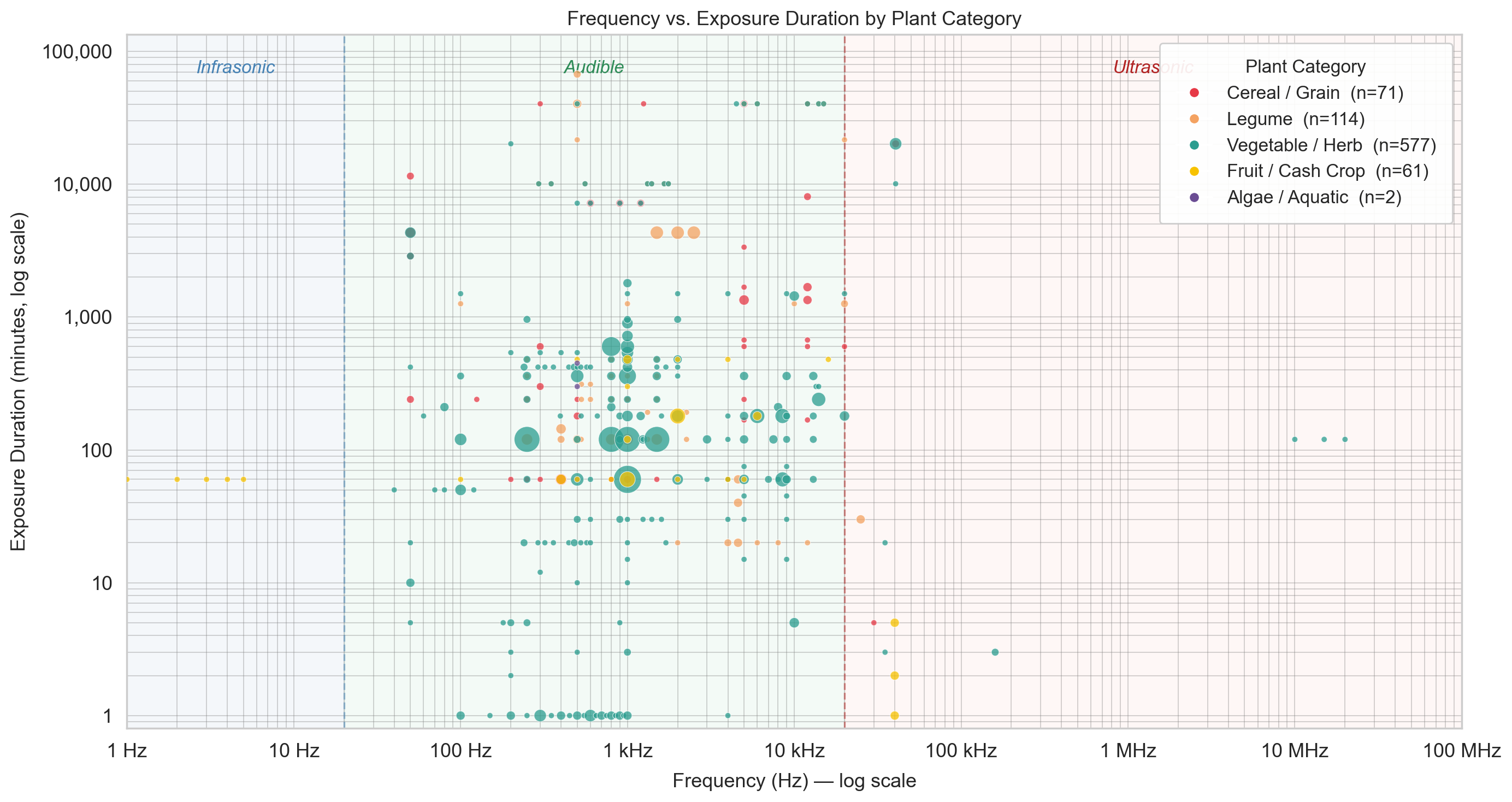
Figure 1 plots unique combinations of sonic frequency and exposure duration for five plant categories. Each dot is color-coded by taxonomic category and dot size scales linearly with the number of independent literature reports at that frequency-duration coordinate. Both axes are logarithmic, and the background delineates three acoustic regimes: infrasound (< 20 Hz), audible sound (20 Hz–20 kHz), and ultrasound (> 20 kHz).
In total, 825 reports were plotted across 277 unique frequency-duration coordinates. Of these, 577 reports are vegetable/herb taxa and only two are algal or aquatic, a marked imbalance that bounds any claim of cross-clade generality. The relatively empty 10–20 kHz band represents the seam between loudspeaker and piezoelectric hardware. In this database, no single study was found to bridge the audible-to-ultrasonic transition and mechanistic continuity across the gap remains assumed rather than tested.
The large number of data points represents all database rows containing a plant organism, acoustic frequencies greater than zero Hz, and non-zero exposure duration. However, there remains a large number of database rows that cannot be plotted due to incomplete reporting. For instance, 533 rows contain non-plant organisms, 693 rows characterize plant organisms but lack a parsable frequency (e.g., generically described musical playback), and 346 contain frequency data but have no recorded exposure duration. The smallest dots in the figure represent single experiments that were run with a particular frequency-duration combination and the largest dots indicate highly repeated parameter combinations.
Ultrasonic studies cluster at short exposure duration ( min) and at frequencies between 20–50 kHz, consisting almost entirely of liquid sonication experiments alongside a small number of plant emission studies and electromagnetic control conditions [121]. Similarly, the infrasonic regime is strikingly sparse despite wind-loading [89], seismic activity [154], thunder [155,156], and wind turbine vibrations [157] constituting the dominant low-frequency acoustic environment of living plants. Only five data points (1, 2, 3, 4, and 5 Hz, each at 60-minute duration) were identified in this regime.
3.2. Frequency Coverage
Figure 2 shows the distribution of stimulus frequencies across the dataset, with stacked colors in each bin to indicate study type. The low and high frequencies are found to be 1 Hz [158] and 20 MHz [159], respectively. The infrasonic, audible, and ultrasonic regimes are provided for reference.
Stress/stimulation studies dominate the dataset, followed closely by mechanistic studies, together creating the overwhelming majority of reported treatments. Emission detection is sparser, with both audible-range components (organism-produced sounds like chewing and buzzing) and ultrasonic components (xylem cavitation and plant-emitted ultrasonic signals). Stress/damage studies and reviews follow, while uncategorized entries are negligible. The vertical axis indicates counts of distinct publications, not database rows; this means a paper testing several frequencies contributes to multiple bins, and a paper spanning more than one study type (e.g., a dose-response study reporting both stimulation and damage) is counted under each type, so the category totals are not mutually exclusive and are not expected to sum to the length of the dataset. Three review publications report a frequency range drawn from the work they synthesize; these are plotted for completeness but contribute no experimental parameters of their own. The heaviest concentration of stimulation and mechanistic studies is centered near 500 Hz and 1 kHz. Damage-inducing stress, by contrast, is reported across a wide frequency range from 250 Hz to several MHz.
3.3. Taxonomic Coverage
Figure 3 shows the 20 most frequently studied plant taxa in the corpus ranked by paper count. Three taxa dominate the corpus: tomato (Solanum lycopersicum) [9,14,120,145,160,161,162,163,164,165,166,167,168,169,170,171], thale cress (Arabidopsis thaliana) [6,8,9,17,41,49,50,118,132,134,136,172,173,174,175,176,177,178], and chrysanthemum (Chrysanthemum morifolium) [4,10,11,13,18,19,20,21,22,179,180,181,182,183]. The next tier is dominated by globally important staple crops, including rice (Oryza sativa) [5,44,167,184,185,186,187,188,189,190,191,192,193,194], cucumber (Cucumis sativus) [53,162,163,185,195,196,197,198,199], soybean (Glycine max) [136,189,200,201,202,203,204,205,206], potato (Solanum tuberosum) [128,207,208,209,210,211], and wheat (Triticum aestivum) [29,53,145,150,189,196,212,213,214,215].
3.4. Treatment Delivery
Figure 4 illustrates the distribution of treatment modes within the dataset. The five categories together account for 284 of the 344 plant publications; the remaining 60 are reviews, commentaries, and studies for which no single delivery medium could be assigned. Airborne acoustic stimulation is the most common approach, followed by liquid sonication – a split that reflects two methodologically distinct research traditions based in agricultural and growth-promotion studies on intact plants, and ultrasonically mediated treatments of cells, tissues, and germinating seeds in suspension. Grouped by coupling physics rather than by label, mechanically driven delivery (airborne plus substrate) outweighs cavitation-driven liquid sonication by roughly two to one, yet conclusions about “sound” routinely pool the two. Here, “Non-acoustic” is a control/multi-treatment bucket rather than a treatment mode, so it is not commensurable with the other four delivery media. The same category also encompasses control experiments where no sonic treatment is applied to any experimental specimen. Papers applying multiple treatment methods to plant specimens also fall under this heading since the overall effect on the plant is likely coupled.
Passive detection represents a fundamentally different research orientation by characterizing organism-produced or stress-induced acoustic emissions (e.g. xylem cavitation in drought-stressed plants, or volatile-stress emissions of the kind used to remotely monitor crop water status [164]) rather than applying acoustic treatment to elicit a biological response. The presence of Passive/Detection alongside the larger stimulation-focused literature reflects an emerging research interest in observing and listening to plants as well as stimulating them.
The last group, substrate vibration, includes mechanical vibration from touch, wind, a shaker, direct contact, or piezoelectric stimulation. The generic nature of this category means it is almost certainly under-resolved in the figure. Pooling such a wide variety of stimulation sources under a single label merges stimuli with very different coupling and acceleration profiles, and a finer contact-delivery taxonomy would be required to separate them.
3.5. Intensity Distribution
Figure 5 shows the distribution of reported decibel sound pressure level (dB SPL) across plant treatment studies. The distribution spans 40 dB [162] to 120 dB [216] across 94 publications. The resulting distribution is sparse and broad, with a single conspicuous mode at 100 dB accounting for roughly one third of these publications, nearly twice as many as the next-largest bin at 80 dB. The remainder of the distribution is sparse and irregular, reflecting both the modest size of the experiment corpus and chronic under-reporting of acoustic parameters across the field. A relatively small number of airborne and music-playback studies report a sound-pressure level comparable enough to be placed on this axis, and intensity of any kind is reported in roughly one quarter of the 344 plant publications (Figure 9).
3.6. Duration Distribution
Figure 6 plots the exposure duration of treatments across the dataset. In total, durations span more than five orders of magnitude ranging from a 20-second airborne ultrasound exposure on tobacco cell cultures [28] to a 47-day chronic vibratory noise regimen on Arabidopsis [217]. The 141 papers shown here are those reporting a single, parsable numeric duration; papers providing exposure durations as ranges, “continuous,” or multi-session schedules that could not be reconstructed are counted among the duration-reporting corpus of Figure 9 but cannot be placed on the axis of this plot. The duration distribution is not symmetric and peaks between 50-200 minutes, reflecting the dominance of single-session or short-multi-session airborne speaker protocols. Roughly one fifth of the papers sit above 1,000 minutes, corresponding to multi-day and multi-week chronic-exposure regimens drawn primarily from substrate-vibration and music-playback studies.
3.7. Publication Timeline
Figure 7 plots the annual growth of phytoacoustics literature over the past century. Publication count remained low throughout the mid-20th century with fewer than 20 papers per decade through the 1980s. Early studies were isolated and dominated by two methodological threads (seed germination experiments and ultrasonic exposure studies) supplemented by a smaller body of work on music and continuous-tone playback. Activity grew modestly through the 1990s before expanding substantially in the 2000s and 2010s, with the 2010–2019 decade alone contributing more publications than the entire pre-2000 corpus combined. The apparent decline after 2023 reflects the lag between publication and indexing, together with the practical limits of the literature search underlying this database. Journal access limitations must also be kept in mind: not only were there fewer journals to publish in during earlier years, but accessing indexed articles from 90 years ago remains difficult in the modern day.
3.8. Report Quality
Matching the shape of Figure 7, Figure 8 presents the parameter-reporting quality of each paper as a stacked bar chart, with each segment colored by tier corresponding to the definitions in section 2.3.The two plots are constructed from nested subsets of the corpus: Figure 7 counts all 344 plant papers, while Figure 8 restricts these to the 298 that report experimental parameters of their own and could therefore be rated. The difference consists almost entirely of review articles and a small number of commentaries.
Two trends are visible across the time axis. First, high-quality parameter reporting has not scaled with the field’s growth; high-quality papers remain a minority of the rated corpus in every era examined, never approaching a majority, and absolute annual counts of high-quality papers have remained in the single digits since 2017. Second, the share of low-quality reporting rose across the 2000s and 2010s and has since held near that elevated level, so that growth in publication volume has been absorbed disproportionately by the lowest reporting tier.
3.9. Parameter Reporting Completeness
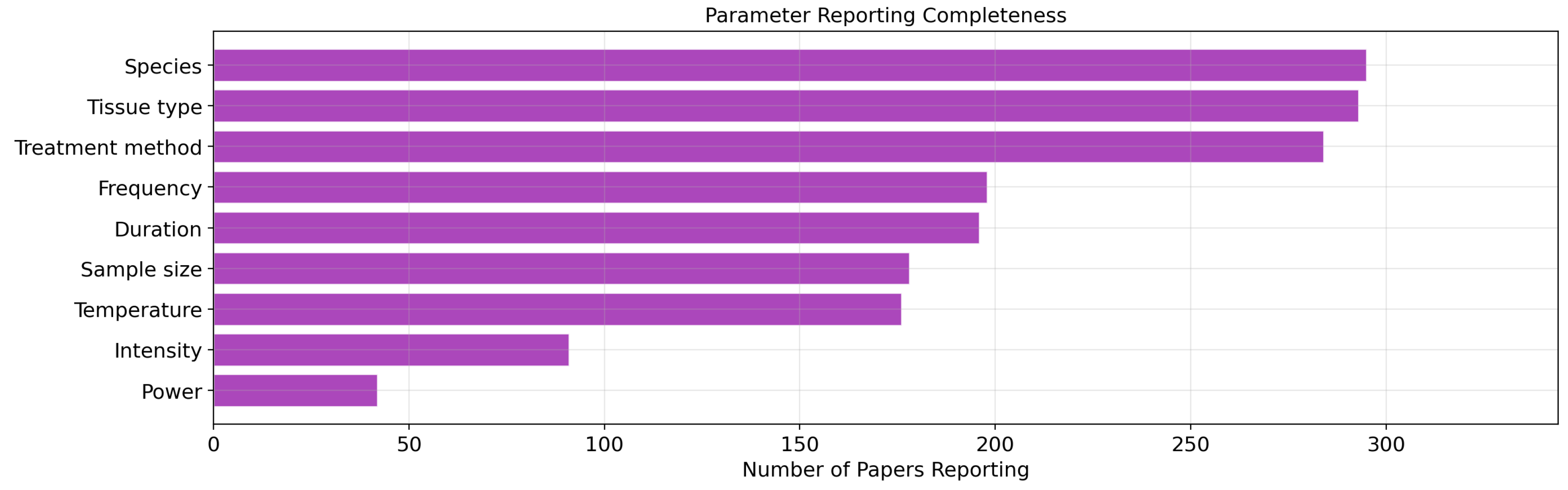
Figure 9 characterizes the reporting completeness of the corpus by parameter. Organism-level information is reliably reported since species, tissue type, and treatment method appear in the majority of publications. However, reporting drops noticeably for the acoustic and environmental parameters that define the stimulation the plants receive and drops sharply for the parameters most directly tied to delivered dose. Source intensity is described in roughly one quarter of the publications, and source power in roughly one paper in eight. The parameters reported most often are the least dose-determining, while those that define the stimulus dose are reported least. Undefined stimulus parameters also cause issues with comparative analyses because the experiments cannot easily be represented in each figure.
Figure 9.
Reported experiment parameters by paper count.
3.10. Delivery Medium
Similar in shape to Figure 2, Figure 10 shows the distribution of stimulus frequencies across the dataset, with stacked colors in each bin to indicate delivery medium. Unsurprisingly, airborne acoustic delivery dominates the audible regime while liquid sonication dominates the ultrasonic regime, though neither is exclusively confined to that region. Substrate vibration is found in each of the three sonic regimes. Passive/Detection and Non-acoustic are omitted here, since neither delivers a stimulus at a controlled frequency; the bin heights are therefore not directly comparable to those of Figure 2.
4. Discussion
The four principal findings of this review are as follows: (1) the field’s apparent parameter consensus is largely an artifact of inheritance, amplified by the disproportionate weight of a small number of prolific single-laboratory programs; (2) physically incomparable delivery media are routinely pooled; (3) dose-determining parameters are chronically under-reported; and (4) large regions of the stimulus space (the infrasonic regime, the sub-70 dB range, and the audible-to-ultrasonic seam) remain untested. None of the four is independent, since each arises from the same dynamic. A field that grows by replicating convenient parameter sets, rather than by systematically covering the stimulus space, concentrates its evidence where earlier work was performed, favors the groups that report most consistently, and treats any study labeled “sound” as comparable with any other. The first three also reinforce one another, since inherited parameters supply the baseline for replication, the prolific groups supply most of those replications, and the shared vocabulary of “sound” obscures the delivery-medium boundaries that would otherwise expose the mismatch; the fourth is their cumulative footprint on the parameter map. Each can be addressed directly through coverage-driven experimental design, calibrated dosimetry at the tissue, and meticulous reporting.
4.1. Frequency Selectivity
Publications in the phytoacoustics literature typically expose a given taxon to one or more frequencies, measure a set of plant responses, and conclude that a particular frequency, chord, or musical genre is more favorable than others for a desired outcome. The manner in which these frequencies are chosen introduces three structural problems.
First, airborne-acoustic studies overwhelmingly select round integer frequencies that are convenient for record-keeping rather than values motivated by the plant’s acoustic environment. Counted by publication, the four most common airborne stimulus frequencies are 1000 Hz, 500 Hz, 2000 Hz, and 5000 Hz. The ultrasonic regime concentrates near 40 kHz, contributed almost entirely by liquid sonication. Each of these frequency values falls on or near the grid lines of Figure 1 and bears no evident relationship to the frequencies a plant actually experiences in its surroundings, such as buzz-pollination vibrations near 374 Hz [218] or the broadband chewing vibrations of insect herbivores, whose energy extends to several kilohertz [134]. Direct mechanical evidence supports this point: the leaf trichomes of Arabidopsis thaliana preferentially resonate in the frequency band of their primary insect herbivore [177], and modeling of tomato trichomes identifies them as plausible structures for acoustic transduction at comparable frequencies [168]. The micro-structures most plausibly implicated in mechanoreception thus appear tuned to ecologically specific frequencies that the tonal and polyphonic literature has largely passed over.
Second, the stimuli are almost always steady single tones. Harmonics, frequency sweeps, and other polyphonic signals that dominate natural soundscapes are rarely tested, so researchers often characterize plant responses to a stimulus class that is itself ecologically uncommon. Visual data presentation further compounds the problem, since a broadband or polyphonic stimulus cannot be assigned a single frequency coordinate; such signals are therefore absent from Figure 1 and under-counted in Figure 2. Caterpillar chewing vibrations [134], bumblebee sonication [219], Vedic chant [220], Buddhist meditative and Pirith chanting [221,222], Quran recitation [183], Javanese gamelan [45], and “classical music” [223] all fall into this unplottable category. Because of this limitation, the frequency-analysis figures should be read as describing the tonal sub-literature rather than the field as a whole. Unlike the tonal, substrate, and cavitation work whose transduction pathways are hypothesized, a subset of the structured acoustic literature (Vedic and Buddhist chant [220,221,222], Quran recitation [183], mantra recitation [224], and Agnihotra fire-ritual studies [188]) proposes no physical mechanism by which the stimulus would couple to plant tissue. For completeness, each such publication is nonetheless retained in the database, but carries a low parameter-quality rating.
Third, the handful of discrete frequencies tested in any single study is far too sparse to reconstruct a frequency-response function. True response curves, such as twenty logarithmically spaced frequencies across a decade, are essentially absent from the literature. As a result, the recurring claim that a particular frequency is “optimal” for a given taxon rests on a comparison among a few convenient tones rather than on a resolved tuning curve, and cannot distinguish a genuine biological resonance from an arbitrary sampling artifact.
4.2. A Classical Problem
The imprecise characterization of acoustic signals presents a parallel limitation in the research comparing musical genres, which routinely concludes that plants benefit from one music genre more than another. The colloquial label “classical music”, for instance, is applied without distinguishing between the Baroque (c. 1600-1750), Classical (c. 1750-1820), and Romantic (c. 1820-1900) periods, which are acoustically non-equivalent due to the considerable variation in reference tuning standards across these eras. No universal pitch standard existed before the French diapason normal fixed A at 435 Hz in 1859, and the modern A = 440 Hz was not agreed internationally until 1939 [225]. Baroque performance pitch instead varied by city, instrument, and repertoire across roughly a semitone; the A = 415 Hz used in historically-informed performance today is a later convention adopted for convenience, not a period standard. Compositional pitch structure differs systematically across the "classical" periods as well; an analysis of 1,876 MIDI-encoded compositions from Bach through Chopin reported mean pitch values ranging from 314 Hz (Chopin) to 435 Hz (Mozart), with pitch-fluctuation magnitude increasing from the Baroque to the Romantic era [226].
These differences are not trivial, since they represent variation in dominant frequency content, dynamic range, and melodic-interval structure, each of which would independently influence a frequency-dependent biological response. Without the composer, period, piece, tempo, instrumentation, and playback conditions, a study citing "classical music" as a treatment can be neither meaningfully replicated nor compared with another. Because the treatment variable cannot be defined, this becomes a measurement-validity problem rather than a labeling inconvenience.
The same terminological hazard extends to the word “sonication”, which recurs across the corpus with at least three distinct meanings. In the pollination literature, the term refers to the buzz a bee produces to release pollen from poricidal anthers [69,135]; in transducer studies, “sonication” refers to the mechanical vibration a researcher applies to a flower to simulate that buzz, and in the seed- and cell-treatment literature, the same term indicates generic ultrasonic exposure in a liquid bath, a physically unrelated cavitation process. Considering the context-heavy variation in definitions, a reader who encounters “sonication” in a title may find it challenging to understand which of these was performed without consulting the methods. To make matters worse, a keyword search conflates all three.
4.3. Cavitation, Propagation Medium, and the Damage Threshold
Comparing delivery methods across the literature is difficult due to incompatibility between their reported intensities. Under ideal free-field conditions, airborne sound pressure falls by 6 dB per doubling of distance from a point source [227] – a stimulus reported as “100 dB at the speaker” may reach the tissue at 80-90 dB depending on the experiment geometry. The effective dose is further perturbed by enclosure reverberation, frequency-dependent atmospheric absorption, frequency-dependent speaker output, and the standing-wave structure typical of small chambers. Atmospheric absorption spans roughly three orders of magnitude between 500 Hz and 120 kHz [227], meaning airborne ultrasonic stimuli are attenuated over centimeter path lengths, along which audible-range tones are essentially unaffected. A reference-pressure and impedance mismatch further compounds the problem, since liquid-sonication studies use a different reference pressure (1 Pa versus 20 Pa in air, a 26 dB offset) and operate in a regime where the air-water impedance mismatch imposes roughly 30 dB of transmission loss at the interface [228]. Together, these factors make reported dB values from liquid- and airborne-acoustic studies difficult to compare directly, even before the distinguishing physical mechanism is considered.
One such mechanism is acoustic cavitation. In liquid media at sufficient intensity, the formation and collapse of micro-bubbles generate intense local shear, transient temperature and pressure spikes, and reactive oxygen species at the cavitation site, each of which may damage plant cells [58]. The dose-response framework for this regime, including the role of tissue gas bodies as cavitation nucleation sites, was developed in the ultrasound-biophysics literature of the 1970s and 1980s and applies directly to the plant sonication record [27]. These processes, however, have no direct analog in airborne- or substrate-coupled delivery at biologically relevant intensities where the dominant interaction is mechanical wave propagation through tissue rather than cavitation in a surrounding fluid. Damage is nonetheless not exclusive to the liquid regime, since short-duration airborne ultrasound has been shown to induce cell death and cell-wall remodeling in tobacco cell cultures [28].
The database compiled for this study flags 410 treatment conditions across all organisms (347 of them on plants) as “Cellular Damage Risk”, primarily based on liquid-media intensities reported at or above 1 or airborne-ultrasonic exposures of the kind characterized by [28]. Several publications in this category report a textbook dose-response relationship, in which growth stimulation occurs at sub-cavitation doses and inhibition or cell death occurs at supra-cavitation doses. Treating liquid-sonication and airborne studies as interchangeable lines of evidence for a single phenomenon (Figure 10), however, is a category error that may have shaped the field’s published claims and its replication failures. The separation is visible in the figures themselves: liquid sonication accounts for roughly a third of the acoustically delivered treatments (Figure 4) yet occupies almost exclusively the ultrasonic band above 20 kHz, which airborne and substrate work do not meaningfully reach. What a frequency-only projection renders as a frequency/study-type structure is largely a frequency/delivery-medium structure since airborne and liquid delivery barely share a frequency range.
4.4. Commercial Confounds and the Intensity Mode
Delivery media are not the only axis along which incomparable studies are pooled; commercial stimulation protocols present the same problem. Phytoacoustic Frequency Technology (PAFT) [229] and related commercial systems such as Sonic Bloom [204] and Agri-Wave [161] combine acoustic stimulation with the simultaneous application of nutrients or growth stimulants. In systems that vary two parameters at once, a growth response cannot be attributed to acoustic stimulation alone. The database contains 132 treatment arms in this category, tagged “Sonic Bloom/PAFT/Agri-Wave”. In nearly all of them the frequency is unreported and the intensity, where provided, is a nominal source level rather than a calibrated value. Nominal reporting contaminates the intensity axis of Figure 5, though not where one would expect: only a single paper in the 100 dB mode is a PAFT/Sonic Bloom study. The commercial systems that report an intensity level instead cluster near 80 dB, their median reported level, and account for several of the papers in the secondary 80 dB bin.
Further inspection reveals that the popular 100 dB and 1000 Hz parameter set does not come from a commercial signature, but rather an academic lineage responsible for half of the mode’s papers. Within this group, most papers report on chrysanthemum phytoacoustics, many at 1000 Hz. The dominant mode in Figure 5 is therefore substantially amplified by parameter inheritance (Section 4.1); 100 dB remains the modal value even when this lineage is excluded, so inheritance sharpens a pre-existing preference rather than creating it.
The intensity distribution is equally informative in what it omits. With a floor near 40 dB and almost all of its mass at or above 80 dB, the corpus has scarcely sampled the sub-70 dB range that characterizes most of a plant’s everyday acoustic environment. Through this lens, the tested range is not merely clustered but systematically loud by ecological standards, and the field’s dose-response picture is anchored well above the levels a plant ordinarily encounters.
4.5. Reproducibility
Underlying each of these issues is a documentation problem. Ideally, a complete report of a phytoacoustic experiment would include the acoustic stimulus (frequency content, waveform, intensity, and exposure schedule), the experiment geometry (source-to-tissue distance, propagation medium, and enclosure parameters), and the biological context (taxon, tissue type, ambient temperature, and sample size). As the analysis shows, omission of any one of these introduces an ambiguity that propagates into every downstream comparison. A study reporting only “periodic playing of classical music”, for instance, does not contain enough information to reproduce the experiment or to place its parameters on the same axis as any tonal study in Figures 1 through 5.
The published record is also a filtered one. As in any field, it represents the studies that passed peer review rather than all those conducted. Positive results tend to reach print more readily than null or marginal ones across the natural sciences, and null or marginal results appear in only a handful of studies in the present corpus. This publication pattern is worth bearing in mind when interpreting apparent consistencies of positive responses at a given frequency, and it is a limitation that no amount of parameter reporting within the published studies can address.
4.6. The Parameter Reporting Crisis
Constructing the database for this study provided a clear view of how often parameters are reported incompletely. Organism-level fields (taxon, tissue type, treatment method) are provided in the great majority of papers, but the parameters that determine what the plant actually experiences are not. Parameters like frequency, duration, sample size, and temperature are each reported in roughly half the corpus, source intensity in roughly one quarter, and source power in roughly one paper in eight (Figure 9). Part of the frequency gap is benign since polyphonic stimuli such as music and recorded soundscapes have no single meaningful frequency to report. The under-reporting of intensity and power is more troublesome, since both are straightforward to characterize and are the parameters most directly tied to whether a treatment falls in a stimulatory, neutral, or damaging regime.
A further difficulty is that documentation has not improved as the field has grown. The post-2010 expansion reflects both the rise of plant mechanosensory biology [63] and renewed agricultural interest in non-chemical growth stimulation, with annual output peaking in 2020 and the 2000s inflection tracking the emergence of a few model-system programs (Arabidopsis and Chrysanthemum callus). However, the field’s growth (Figure 7) has not been matched by a comparable rise in reporting quality (Figure 8). The proportional share of low-tier reporting rose from the pre-2010 era through the 2010s and has since remained near that elevated level. In terms of publication volume, the field appears to be growing by accretion of low- and mid-tier work rather than by a rise in rigor and meticulously detailed reporting, which places a binding constraint on future synthesis. In this sense, more publications do not translate into more usable evidence.
A more subtle distortion arises when a small number of prolific groups report their parameters consistently while the surrounding literature reports incompletely. When this occurs, well-documented work accrues disproportionate apparent weight in any parameter-level synthesis – set against sparse reporting elsewhere, detailed reporting by one academic program can establish experimental parameters that the field begins to accept as default. Incomplete reporting does not merely shrink the analyzable dataset, it biases the analysis toward the parameter choices of groups that happen to report their findings well.
Incomplete reporting also affects statistical power. Sample size is reported in just over half the corpus (Figure 9) and effect sizes are rarely given. In instances where a frequency-dependent difference is claimed, the reader may find it challenging to judge whether the result is statistically supported. A study that omits its sample size cannot readily sustain a quantitative claim about a physiological phytoacoustic effect. Likewise, without intensity data, it is impossible to determine whether two studies testing the same frequency are comparable, or whether one sits in a sub-threshold regime and the other in a cavitation regime. Exposure duration complicates the matter, since it is an incomplete proxy for delivered energy. Total dose depends on the product of intensity, exposure duration, and number of exposures, yet studies differ in whether they report a per-session duration or a cumulative total, and frequently do not say which.
Based on these findings, it is recommended that future plant acoustic studies adopt a minimum reporting standard, including: frequency, the delivered stimulus level measured at the tissue expressed in the unit appropriate to the medium (sound pressure level for airborne delivery, acceleration in for substrate delivery, and spatial-peak temporal-average intensity in for liquid delivery), waveform, exposure duration with an explicitly stated dosing convention (per-session versus cumulative), a labeled schematic of the experiment geometry, propagation medium, and equipment models. The responsibility of maintaining highly detailed publication records also rests with journal editors, since acceptance of under-specified methods allows non-reproducible work to enter the permanent academic record. Separately, the database reveals the absence of any shared positive control. A reference stimulus known to elicit a defined response would enable cross-calibration of apparatus and dosimetry between laboratories. Without such an anchor, even fully reported studies cannot be placed on a common effect scale, since there is no way to confirm that two experiments deliver the same dose.
4.7. Research Opportunities
The taxonomic landscape of Figure 3 is shaped by economics, research sociology, and biology. Setting aside the model organism Arabidopsis thaliana, tomato (Solanum lycopersicum) and chrysanthemum (Chrysanthemum spp.) are the two most-studied crops, but their popularity has different origins. The popularity of tomato plants in the literature likely reflects its economic and nutritional importance [120] and is split across mechanistic and airborne-acoustic work. Chrysanthemum’s popularity, on the other hand, rests largely on the output of a single sustained research program working in the airborne-acoustic regime with a focus on callus tissue. The two therefore carry different meanings despite adjacent bar heights – tomato’s papers span multiple groups and study types, while chrysanthemum’s issue almost entirely from one academic lineage. Read uncritically, Figure 3 implies a breadth of community interest in chrysanthemum that does not exist, again demonstrating the need to evaluate each plot beyond its face value. Rice is placed as the fourth leading taxa, despite its role as a staple for more than three billion people [44].
Similar gaps are found in other vegetation types. First, although legumes as a group are well represented in Figure 1, that total is carried almost entirely by soybean (Glycine max) and mung bean (Vigna radiata). Globally important food-security legumes such as cowpea (Vigna unguiculata), lentil (Lens culinaris), and chickpea (Cicer arietinum) are nearly absent, appearing in at most one or two studies each despite their physiological differences from both the well-studied legumes and the temperate cereals. Second, the infrasonic regime is nearly empty; only five infrasonic conditions were identified in this review, even though wind-loading [89], seismic activity [154], thunder [155,156], and wind-turbine vibration [157] constitute the dominant low-frequency acoustic environment of living plants. Data scarcity in this regime is understandable, since an infrasonic wavelength (roughly 17 meters at 20 Hz) vastly exceeds the dimensions of any bench-scale chamber, so a free-field pressure wave cannot be easily established. Substrate-coupled delivery sidesteps this constraint entirely. Third, aquatic-plant, fungal, and algal responses have been examined only in isolated studies and lack systematic frequency-response characterization. The gap here is not merely one of missing treatments but a substantial missed opportunity, since marine algae are known to produce sound during photosynthesis [230]. In this case, an acoustically active group of organisms sits almost wholly outside the corpus as both emitter and potential receiver.
4.8. Future Work
Beyond these biological gaps, the database itself defines a methodological program, creating a standardized parameter map that is easy to share, validate, and expand as the literature grows.
Frequency-response curves The absence of finely discretized frequency sweeps is a clear deficiency in the existing record, and a tractable one. A program of logarithmically spaced exposures across the audible decade, on a small number of well-characterized taxa, would convert the field’s scattered single-tone claims into resolved response curves. In principle, frequency sweeps could be drawn in Figure 1 as horizontal segments since the database records their lower and upper bounds. But a segment of uniform width would nonetheless misrepresent the unequal energy distribution across a swept band, and would occlude the dot-area encoding of replication. Polyphonic and broadband stimuli admit no such representation at all, and a separate spectral-coverage figure, keyed to the Frequency Description field, would be required to place them alongside the tonal literature.
Calibrated substrate-vibration delivery Substrate vibration is the smallest treatment category in Figure 4, yet with calibrated acceleration reporting it offers a cleaner dose definition than airborne delivery, which itself is complicated by distance, enclosure acoustics, and frequency-dependent speaker response. Controlled tactile-transducer platforms with closed-loop intensity verification at the tissue would enable the field to report dose in a medium-appropriate, reproducible unit, and directly test whether substrate and airborne delivery produce equivalent biological outcomes at matched effective dose.
Cross-medium dosimetry conventions The reference-pressure and transmission-loss differences quantified in Section 4.3 should be formalized into a conversion and reporting convention. This would enable airborne, substrate, and liquid studies to be placed on comparable axes, with cavitation-regime studies explicitly partitioned rather than silently pooled.
Standardized confound tagging and pre-registration The flags developed in this study (Sonic Bloom/PAFT/Agri-Wave, Cellular Damage Risk, Dual Outcome, Low-tier Venue), together with the three parameter-quality tiers, provide a starting vocabulary for machine-readable meta-analysis. Coupled with pre-registration of the minimum reporting standard above, standardized tagging would enable field growth by addition rather than by repetition.
5. Conclusions
This study presents a structured, machine-readable database of 2,991 experimental conditions drawn from 404 publications in plant acoustics, spanning nearly 100 years from 1928 to 2025. By decomposing each study into its constituent organism × treatment conditions, the database makes the parameter space of the field directly visualizable and reveals four principal findings.
First, the field’s apparent consensus on stimulus parameters is largely an artifact. The conspicuous 100 dB intensity mode and the clustering of treatments on round-number frequencies appear to reflect parameter inheritance and experimental convenience, amplified by the disproportionate output and consistent reporting of a small number of prolific single-laboratory programs, rather than independent convergence on a biological optimum. The substantial body of music and polyphonic-playback work cannot be placed on these axes and is treated separately; the frequency- and intensity-level findings therefore characterize the tonal, single-frequency sub-literature.
Second, the literature tends to pool physically incomparable delivery media. Liquid sonication, whose dominant mechanism is acoustic cavitation and whose reported intensities use a different reference pressure, is routinely cited alongside airborne and substrate delivery as evidence for a single phenomenon. This is a category error that may have shaped both the field’s published claims and its replication failures.
Third, methodological rigor has not scaled with the field’s growth. The parameters that determine delivered dose, namely calibrated intensity at the tissue, source-to-target distance, exposure schedule, and propagation medium, remain chronically under-reported, rendering most cross-study comparisons unsupportable and gating quantitative meta-analysis. Addressing methodological rigor through a minimum reporting standard, rather than through additional under-specified experiments, may be one of the most pressing near-term needs.
Fourth, the parameter space itself remains largely unexplored, and the database makes the unexplored regions enumerable rather than merely suspected. The infrasonic regime contains five experimental conditions in the entire century-long record, despite wind loading, seismic activity, thunder, and wind-turbine vibration constituting the dominant low-frequency acoustic environment of living plants; no study bridges the 10–20 kHz seam between loudspeaker and piezoelectric hardware; the sub-70 dB range that characterizes a plant’s ordinary acoustic surroundings is scarcely sampled; algal and aquatic taxa account for two of the 825 plotted reports; and finely discretized frequency-response curves are essentially absent, so no claim of an optimal frequency rests on a resolved tuning curve. These gaps are tractable rather than fundamental, since each can be addressed with existing instrumentation, and together they define a coverage-driven experimental program that would grow the field by addition rather than by repetition.
Data Availability:
The publications analyzed in this review are cited in the text and listed in the References, together with the supporting methodological sources (acoustics, music theory, and geophysics) drawn on for context. The structured database (organism × treatment conditions with all coded parameters), the analysis notebook, and the figure-generation code are openly available under a persistent identifier at https://doi.org/10.5281/zenodo.21171175. The dataset is released under a CC BY 4.0 license and the code under the MIT License.
Acknowledgments
Foremost, this work is indebted to the experimentalists whose century of careful measurement made this synthesis possible. It was assembled entirely with open-source tools (Python, Matplotlib, and LaTeX) maintained by communities that ask nothing in return. Equal thanks are owed to the bibliographic services Google Scholar, PubMed, Web of Science, Semantic Scholar, and others that made the literature navigable. Lastly, I thank in advance the readers and reviewers whose scrutiny will sharpen this work.
Funding:
This research received no specific grant from any funding agency in the public, commercial, or not-for-profit sectors.
Competing Interests:
The author declares no competing interests.
References
- Wood, R.W. The physical and biological effects of high-frequency sound-waves of great intensity. J. Frankl. Inst. 1928, 205, 151–153. [Google Scholar] [CrossRef]
- Harvey, E.N.; Loomis, A.L. High frequency sound waves of small intensity and their biological effects. Nature 1928, 121, 622–624. [Google Scholar] [CrossRef]
- Weiler, E.W. Sensory Principles of Higher Plants. Angew. Chem. Int. Ed. 2003, 42, 392–411. [Google Scholar] [CrossRef]
- Hongbo, S.; Biao, L.; Bochu, W.; Kun, T.; Yilong, L. A study on differentially expressed gene screening of chrysanthemum plants under sound stress. Comptes Rendus. Biol. 2008, 331, 329–333. [Google Scholar] [CrossRef]
- Jeong, M.J.; Shim, C.K.; Lee, J.O.; Kwon, H.B.; Kim, Y.H.; Lee, S.K.; Byun, M.O.; Park, S.C. Plant gene responses to frequency-specific sound signals. Mol. Breed. 2007, 21, 217–226. [Google Scholar] [CrossRef]
- Kwon, Y.S.; Jeong, M.J.; Cha, J.; Jeong, S.W.; Park, S.C.; Shin, S.C.; Chung, W.S.; Bae, H.; Bae, D.W. Comparative proteomic analysis of plant responses to sound waves in Arabidopsis. J. Plant Biotechnol. 2012, 39, 261–272. [Google Scholar] [CrossRef]
- Safari, M.; Ghanati, F.; Behmanesh, M.; Hajnorouzi, A.; Nahidian, B.; Mina, G. Enhancement of antioxidant enzymes activity and expression of cat and pal genes in Hazel (Corylus Avellana L.) cells in response to low-intensity ultrasound. Acta Physiol. Plant. 2013, 35, 2847–2855. [Google Scholar] [CrossRef]
- Ghosh, R.; Mishra, R.C.; Choi, B.; Kwon, Y.S.; Bae, D.W.; Park, S.C.; Jeong, M.J.; Bae, H. Exposure to sound vibrations lead to transcriptomic, Proteomic and hormonal changes in Arabidopsis. Sci. Rep. 2016, 6. [Google Scholar] [CrossRef] [PubMed]
- Kim, J.Y.; Ahn, H.R.; Kim, S.T.; Min, C.W.; Lee, S.I.; Kim, J.A.; Park, S.C.; Jeong, M.J. Sound wave affects the expression of ethylene biosynthesis-related genes through control of transcription factors RIN and HB-1. Plant Biotechnol. Rep. 2016, 10, 437–445. [Google Scholar] [CrossRef]
- Xiujuan, W.; Bochu, W.; Yi, J.; Defang, L.; Chuanren, D.; Xiaocheng, Y.; Sakanishi, A. Effects of sound stimulation on protective enzyme activities and peroxidase isoenzymes of chrysanthemum. Colloids Surf. B Biointerfaces 2003, 27, 59–63. [Google Scholar] [CrossRef]
- Xiujuan, W.; Bochu, W.; Yi, J.; Chuanren, D.; Sakanishi, A. Effect of sound wave on the synthesis of nucleic acid and protein in Chrysanthemum. Colloids Surf. B Biointerfaces 2003, 29, 99–102. [Google Scholar] [CrossRef]
- Zeng, Z.; Liu, X.; Deng, Q.; Ashraf, U.; Chen, J.; Shen, W. Transcriptome analysis revealed mechanisms involved in improved germination and growth of sugarcane by ultrasonic treatment. Ind. Crops Prod. 2023, 192. [Google Scholar] [CrossRef]
- Bochu, W.; Jiping, S.; Biao, L.; Jie, L.; Chuanren, D. Soundwave stimulation triggers the content change of the endogenous hormone of the chrysanthemum mature callus. Colloids Surf. B Biointerfaces 2004, 37, 107–112. [Google Scholar] [CrossRef] [PubMed]
- Kim, J.Y.; Lee, J.S.; Kwon, T.R.; Lee, S.I.; Kim, J.A.; Lee, G.M.; Park, S.C.; Jeong, M.J. Sound waves delay tomato fruit ripening by negatively regulating ethylene biosynthesis and signaling genes. Postharvest Biol. Technol. 2015, 110, 43–50. [Google Scholar] [CrossRef]
- Pinto, C.F.; Torrico-Bazoberry, D.; Penna, M.; Cossio-Rodríguez, R.; Cocroft, R.; Appel, H.; Niemeyer, H.M. Chemical responses of Nicotiana tabacum (Solanaceae) induced by vibrational signals of a generalist herbivore. J. Chem. Ecol. 2019, 45, 708–714. [Google Scholar] [CrossRef] [PubMed]
- Yamazaki, M.; Ishida, A.; Suzuki, Y.; Aoki, Y.; Suzuki, S.; Enoki, S. Ethylene induced by sound stimulation enhances anthocyanin accumulation in grape berry skin through direct upregulation of UDP-glucose: Flavonoid 3-O-glucosyltransferase. Cells 2021, 10. [Google Scholar] [CrossRef] [PubMed]
- Shih, H.W.; Miller, N.D.; Dai, C.; Spalding, E.P.; Monshausen, G.B. The receptor-like kinase Feronia is required for mechanical signal transduction in Arabidopsis seedlings. Curr. Biol. 2014, 24, 1887–1892. [Google Scholar] [CrossRef] [PubMed]
- Liu, Y.; Wang, B.; Zhao, H.; Duan, C.; Chen, X. Alternative stress effects on ca2+ localization in Chrysanthemum Callus cells. Colloids Surf. B Biointerfaces 2001, 22, 245–249. [Google Scholar] [CrossRef]
- Wang, B.; Zhao, H.; Duan, C.; Sakanishi, A. Effects of cell wall calcium on the growth of Chrysanthemum Callus under sound stimulation. Colloids Surf. B Biointerfaces 2002, 25, 189–195. [Google Scholar] [CrossRef]
- Wang, B.; Zhao, H.; Wang, X.; Duan, C.; Wang, D.; Sakanishi, A. Influence of sound stimulation on plasma membrane H+-ATPase activity. Colloids Surf. B Biointerfaces 2002, 25, 183–188. [Google Scholar] [CrossRef]
- Zhao, H.C.; Wang, B.C.; Cai, S.X.; Xi, B.S. Effect of Sound Stimulation on the Lipid Physical States and Metabolism of Plasma Membrane from Chrysanthemum Callus. Acta Botan. Sin. 2002, 44, 799–803. [Google Scholar]
- Zhao, H.; Zhu, T.; Wu, J.; Xi, B. Role of protein kinase in the effect of sound stimulation on the PM h+-atpase activity of Chrysanthemum Callus. Colloids Surf. B Biointerfaces 2002, 26, 335–340. [Google Scholar] [CrossRef]
- Liu, Y.; Yang, H.; Takatsuki, H.; Sakanishi, A. Effect of ultrasonic exposure on ca2+-atpase activity in plasma membrane from Aloe arborescens callus cells. Ultrason. Sonochemistry 2006, 13, 232–236. [Google Scholar] [CrossRef]
- Newcomer, E.H.; Wallace, R.H. Chromosomal and nuclear aberrations induced by Ultrasonic Vibrations. Am. J. Bot. 1949, 36, 230–236. [Google Scholar] [CrossRef] [PubMed]
- Goldman, D.E.; Lepeschkin, W.W. Injury to living cells in standing sound waves. J. Cell. Comp. Physiol. 1952, 40, 255–268. [Google Scholar] [CrossRef] [PubMed]
- Gregory, W.D.; Miller, M.W.; Carstensen, E.L.; Cataldo, F.L.; Reddy, M.M. Non-thermal effects of 2 mhz ultrasound on the growth and cytology of vicia faba roots. Br. J. Radiol. 1974, 47, 122–129. [Google Scholar] [CrossRef] [PubMed]
- Gemmell, H.G. A Study of the Mechanisms of Low Megahertz Ultrasonic Damage to Biological Systems with Particular Reference to the Primary Root Tip of Vicia faba. PhD thesis, University of Aberdeen, 1978. [Google Scholar]
- Sardari, M.; Ghanati, F.; Mobasheri, H.; Hajnorouzi, A. Short-term airborne ultrasound induced cell death in tobacco cells and changed their wall components. Sci. Rep. 2025, 15. [Google Scholar] [CrossRef] [PubMed]
- Weinberger, P.; Measures, M. The effect of two audible sound frequencies on the germination and growth of a spring and winter wheat. Can. J. Bot. 1968, 46, 1151–1158. [Google Scholar] [CrossRef]
- Hageseth, G.T. Effect of noise on the mathematical parameters that describe isothermal seed germination. Plant Physiol. 1974, 53, 641–643. [Google Scholar] [CrossRef] [PubMed]
- Chuanren, D.; Bochu, W.; Wanqian, L.; Jing, C.; Jie, L.; Huan, Z. Effect of chemical and physical factors to improve the germination rate of echinacea angustifolia seeds. Colloids Surf. B Biointerfaces 2004, 37, 101–105. [Google Scholar] [CrossRef] [PubMed]
- Sharififar, A.; Nazari, M.; Asghari, H.R. Effect of ultrasonic waves on seed germination of Atriplex lentiformis, cuminum cyminum, and Zygophyllum Eurypterum. J. Appl. Res. Med. Aromat. Plants 2015, 2, 102–104. [Google Scholar] [CrossRef]
- Liu, J.; Wang, Q.; Karagic, D.; Liu, X.; Cui, J.; Gui, J.; Gu, M.; Gao, W. Effects of ultrasonication on increased germination and improved seedling growth of aged grass seeds of tall fescue and Russian wildrye. Sci. Rep. 2016, 6. [Google Scholar] [CrossRef] [PubMed]
- Babaei, M.; Pirdashti, H.; Bakhshandeh, E. Ultrasonic waves improve aged seed germination of castor bean (Ricinus communis L.) under drought and salt stresses. Acta Physiol. Plant. 2023, 45. [Google Scholar] [CrossRef]
- Weinberger, P.; Anderson, P.; Donovan, L.S. Changes in production, yield, and chemical composition of corn (Zea mays) after ultrasound treatments of the seeds. Radiat. Environ. Biophys. 1979, 16, 81–88. [Google Scholar] [CrossRef] [PubMed]
- Collins, M.; Foreman, J.E. The effect of sound on the growth of plants. Can. Acoust. 2001, 29, 3–8. [Google Scholar]
- Qi, L.; Teng, G.; Hou, T.; Zhu, B.; Liu, X. Influence of sound wave stimulation on the growth of strawberry in Sunlight Greenhouse. IFIP Adv. Inf. Commun. Technol. 2010, 449–454. [Google Scholar] [CrossRef]
- Cai, W.; He, H.; Zhu, S.; Wang, N. Biological effect of audible sound control on mung bean (vigna radiate) sprout. BioMed Res. Int. 2014, 2014, 1–6. [Google Scholar] [CrossRef]
- Gagliano, M.; Grimonprez, M.; Depczynski, M.; Renton, M. Tuned in: Plant Roots use sound to locate water. Oecologia 2017, 184, 151–160. [Google Scholar] [CrossRef] [PubMed]
- Yi, J.; Bochu, W.; Xiujuan, W.; Chuanren, D.; Xiaocheng, Y. Effect of sound stimulation on roots growth and plasmalemma H+-ATPase activity of Chrysanthemum (gerbera jamesonii). Colloids Surf. B Biointerfaces 2003, 27, 65–69. [Google Scholar] [CrossRef]
- Rodrigo-Moreno, A.; Bazihizina, N.; Azzarello, E.; Masi, E.; Tran, D.; Bouteau, F.; Baluska, F.; Mancuso, S. Root phonotropism: Early signalling events following sound perception in Arabidopsis roots. Plant Sci. 2017, 264, 9–15. [Google Scholar] [CrossRef] [PubMed]
- Kim, J.Y.; Lee, H.J.; Kim, J.A.; Jeong, M.J. Sound waves promote Arabidopsis thaliana root growth by regulating root phytohormone content. Int. J. Mol. Sci. 2021, 22, 5739. [Google Scholar] [CrossRef] [PubMed]
- Kratochvil, H.G.; Pollirer, M. Acoustic effects during photosynthesis of aquatic plants enable new research opportunities. Sci. Rep. 2017, 7. [Google Scholar] [CrossRef] [PubMed]
- Jusoh, M.; Ramlee, S.I.; Pydi, F.I.; Mazlan, N.A.; Berahim, Z.; Muhamad Mujab, A.A.; Sinniah, U.R.; Yeoh, J.P.; Khalid, K.; Yaapar, M.N. Specific sound frequency improves intrinsic water efficiency in rice leaf by imparting changes in stomatal dimensions. Pertanika J. Trop. Agric. Sci. 2023, 46, 439–457. [Google Scholar] [CrossRef]
- Hendrawan, Y.; Rizky, A.; Susilo, B.; Prasetyo, J.; Damayanti, R. Effect of Javanese gamelan music on growth, chlorophyll content and stomatal conductance of mustard (Brassica juncea L.). Sci. Technol. 2020, 28. [Google Scholar] [CrossRef]
- Meng, Q.; Zhou, Q.; Zheng, S.; Gao, Y. Responses on photosynthesis and variable chlorophyll fluorescence of fragaria ananassa under sound wave. Energy Procedia 2012, 16, 346–352. [Google Scholar] [CrossRef]
- Jeong, M.J.; Cho, J.I.; Park, S.H.; Kim, K.H.; Lee, S.; Kwon, T.R.; Park, S.C.; Siddiqui, Z. Sound frequencies induce drought tolerance in rice plant. Pak. J. Bot. 2014, 46, 2015–2020. [Google Scholar] [CrossRef]
- Younesian, A.; Gholipoor, M.; Norouzi, H.A. Alleviation of drought stress effects on red bean by ultrasonication and foliar application of 24-epi-brassinolid. Int. J. Plant Prod. 2017, 11, 505–514. [Google Scholar] [CrossRef]
- López-Ribera, I.; Vicient, C.M. Drought tolerance induced by sound in arabidopsis plants. Plant Signal. Behav. 2017, 12. [Google Scholar] [CrossRef] [PubMed]
- Bhandawat, A.; Jayaswall, K.; Sharma, H.; Roy, J. Sound as a stimulus in associative learning for heat stress in Arabidopsis. Commun. Integr. Biol. 2020, 13, 1–5. [Google Scholar] [CrossRef] [PubMed]
- Heidari, S.; Kafi, M.; Kalatejari, S.; Mollakarimi, N. Effects of sound stimulation on physiological and biochemical responses of Salvia splendens. 2020. [Google Scholar] [CrossRef] [PubMed]
- Klein, R.M.; Edsall, P.C. On the reported effects of sound on the growth of plants. BioScience 1965, 15, 125–126. [Google Scholar] [CrossRef]
- Walton, M.D. The effect of audible sound on the germination and root elongation of selected seedlings. PhD thesis, 1975. [Google Scholar]
- Son, J.S.; Jang, S.; Mathevon, N.; Ryu, C.M. Is plant acoustic communication fact or fiction? New Phytol. 2024, 242, 1876–1880. [Google Scholar] [CrossRef] [PubMed]
- Gordon, A.G. The use of ultrasound in agriculture. Ultrasonics 1963, 1, 70–77. [Google Scholar] [CrossRef]
- Gordon, A. Beneficial effects of ultrasound on plants—a review. Ultrasonics 1971, 9, 81–84. [Google Scholar] [CrossRef]
- Nyborg, W.L.; Miller, D.L.; Gershoy, A. Physical consequences of ultrasound in plant tissues and other Bio-Systems. Fundam. Appl. Asp. Nonionizing Radiat. 1975, 277–299. [Google Scholar] [CrossRef]
- Miller, D.L. The botanical effects of ultrasound: A Review. Environ. Exp. Bot. 1983, 23, 1–27. [Google Scholar] [CrossRef]
- Tyree, M. Vulnerability of xylem to cavitation and embolism. Annu. Rev. Plant Physiol. Plant Mol. Biol. 1989, 40, 19–38. [Google Scholar] [CrossRef]
- Kirchner, W.H. Acoustical communication in Honeybees. Apidologie 1993, 24, 297–307. [Google Scholar] [CrossRef]
- Bennet-Clark, H.C. Resonators in insect sound production: How insects produce loud pure-tone songs. J. Exp. Biol. 1999, 202, 3347–3357. [Google Scholar] [CrossRef] [PubMed]
- Cocroft, R.; Rodriguez, R. The behavioral ecology of Insect Vibrational Communication. BioScience 2005, 55, 323. [Google Scholar] [CrossRef]
- Telewski, F.W. A unified hypothesis of mechanoperception in plants. Am. J. Bot. 2006, 93, 1466–1476. [Google Scholar] [CrossRef] [PubMed]
- Martin, E. The cellular Bioeffects of low intensity ultrasound. Ultrasound 2009, 17, 214–219. [Google Scholar] [CrossRef]
- Mankin, R.W.; Hagstrum, D.W.; Smith, M.T.; Roda, A.L.; Kairo, M.T. Perspective and promise: A century of insect acoustic detection and monitoring. Am. Entomol. 2011, 57, 30–44. [Google Scholar] [CrossRef]
- Gagliano, M.; Renton, M.; Duvdevani, N.; Timmins, M.; Mancuso, S. Acoustic and magnetic communication in plants. Plant Signal. Behav. 2012, 7, 1346–1348. [Google Scholar] [CrossRef] [PubMed]
- Gagliano, M. Green symphonies: A call for studies on acoustic communication in plants. Behav. Ecol. 2012, 24, 789–796. [Google Scholar] [CrossRef] [PubMed]
- Agarwal, P. Plant Response to music sound frequencies. Int. J. Music Ther. 2012, 2, 25–30. [Google Scholar] [CrossRef]
- De Luca, P.A.; Vallejo-Marín, M. What’s the ’Buzz’ about? the ecology and evolutionary significance of buzz-pollination. Curr. Opin. Plant Biol. 2013, 16, 429–435. [Google Scholar] [CrossRef] [PubMed]
- Chowdhury, M.E.; Lim, H.S.; Bae, H. Update on the effects of sound wave on plants. Res. Plant Dis. 2014, 20, 1–7. [Google Scholar] [CrossRef]
- Hassanien, R.H.; Hou, T.z.; LI, Y.f.; LI, B.m. Advances in effects of sound waves on plants. J. Integr. Agric. 2014, 13, 335–348. [Google Scholar] [CrossRef]
- Teixeira da Silva, J.A.; Dobránszki, J. Sonication and ultrasound: Impact on plant growth and development. Plant Cell Tissue Organ Cult. (PCTOC) 2014, 117, 131–143. [Google Scholar] [CrossRef]
- Chowdhury, A.R.; Gupta, A. Effect of Music on Plants ——– An Overview. Int. J. Integr. Sci. Innov. Technol. (IJIIT) 2015, 4. [Google Scholar]
- Jones, G. Sensory biology: Acoustic reflectors attract bats to roost in pitcher plants. Curr. Biol. 2015, 25. [Google Scholar] [CrossRef] [PubMed]
- Ndiritu, J. Applying acoustic frequency and meditation techniques to improve crop production-a review. 2015. [Google Scholar]
- De Roo, L.; Vergeynst, L.; De Baerdemaeker, N.; Steppe, K. Acoustic emissions to measure drought-induced cavitation in plants. Appl. Sci. 2016, 6, 71. [Google Scholar] [CrossRef]
- Mishra, R.C.; Ghosh, R.; Bae, H. Plant Acoustics: In the search of a sound mechanism for sound signaling in plants. J. Exp. Bot. 2016, 67, 4483–4494. [Google Scholar] [CrossRef] [PubMed]
- Schöner, M.G.; Simon, R.; Schöner, C.R. Acoustic communication in plant–animal interactions. Curr. Opin. Plant Biol. 2016, 32, 88–95. [Google Scholar] [CrossRef] [PubMed]
- Basu, D.; Haswell, E.S. Plant mechanosensitive ion channels: An ocean of possibilities. Curr. Opin. Plant Biol. 2017, 40, 43–48. [Google Scholar] [CrossRef] [PubMed]
- Hamant, O.; Haswell, E.S. Life behind the wall: Sensing mechanical cues in plants. BMC Biol. 2017, 15. [Google Scholar] [CrossRef] [PubMed]
- Fernandez-Jaramillo, A.A.; Duarte-Galvan, C.; Garcia-Mier, L.; Jimenez-Garcia, S.N.; Contreras-Medina, L.M. Effects of acoustic waves on plants: An agricultural, ecological, molecular and Biochemical Perspective. Sci. Hortic. 2018, 235, 340–348. [Google Scholar] [CrossRef]
- Jung, J.; Kim, S.K.; Kim, J.Y.; Jeong, M.J.; Ryu, C.M. Beyond chemical triggers: Evidence for sound-evoked physiological reactions in plants. Front. Plant Sci. 2018, 9. [Google Scholar] [CrossRef] [PubMed]
- Mankin, R.W.; Stanaland, D.; Haseeb, M.; Rohde, B.; Menocal, O.; Carrillo, D. Assessment of plant structural characteristics, health, and ecology using bioacoustic tools. Proceedings of Meetings on Acoustics, 2018; 33. [Google Scholar]
- Mohanta, T. Sound Wave in Plant Growth Regulation: A Review of Potential Biotechnological Applications. J. Anim. Plant Sci. 2018, 28, 1–9. [Google Scholar]
- Chandrakala, Y.; Trivedi, L. Role of music on seed germination: A mini review. Int. J. Agric. Plant Sci. 2019, 1, 01–03. [Google Scholar]
- Exbrayat, J.M.; Brun, C. Some effects of sound and music on organisms and cells: A Review. Annu. Res. Rev. Biol. 2019, 1–12. [Google Scholar] [CrossRef]
- Joshi, N.; Nautiyal, P.; Papnai, G.; Supyal, V.; Singh, K. Render a sound dose: Effects of implementing acoustic frequencies on plants’ physiology, biochemistry and genetic makeup. Int. J. Chem. Stud. 2019, 7, 2668–2678. [Google Scholar]
- Khait, I.; Obolski, U.; Yovel, Y.; Hadany, L. Sound perception in plants. Semin. Cell Dev. Biol. 2019, 92, 134–138. [Google Scholar] [CrossRef] [PubMed]
- de Langre, E. Plant Vibrations at all scales: A Review. J. Exp. Bot. 2019, 70, 3521–3531. [Google Scholar] [CrossRef] [PubMed]
- Rillig, M.C.; Bonneval, K.; Lehmann, J. Sounds of soil: A new world of interactions under our feet? Soil Syst. 2019, 3, 45. [Google Scholar] [CrossRef]
- Singh, P.; Srivastava, N.; Joshi, N.; Shastri, I. Impact of different musical nodes and vibrations on plant development. Plant Sci. Today 2019, 6, 639–644. [Google Scholar] [CrossRef]
- Thode, A.M. Bearing fruit: Plant bioacoustics is blossoming. Acoust. Today 2019, 15, 47. [Google Scholar] [CrossRef]
- Frongia, F.; Forti, L.; Arru, L. Sound perception and its effects in plants and algae. Plant Signal. Behav. 2020, 15. [Google Scholar] [CrossRef] [PubMed]
- Gorai, S. Plant Acoustic Frequency Technology: Sound Waves in Crop Improvement. 2020. [Google Scholar] [CrossRef] [PubMed]
- Allievi, S.; Arru, L.; Forti, L. A tuning point in plant acoustics investigation. Plant Signal. Behav. 2021, 16. [Google Scholar] [CrossRef] [PubMed]
- Behnami, S.; Bonetta, D. With an ear up against the wall: An update on mechanoperception in Arabidopsis. Plants 2021, 10. [Google Scholar] [CrossRef] [PubMed]
- Dalal, V.K. Understanding acoustic communication in plants. J. Biomed. Res. Environ. Sci. 2021, 2, 815–820. [Google Scholar] [CrossRef]
- Parlakova Karagoz, F.; Dursun, A. Ultra-sonic sound applications used in seed viability, seedling growth and plant development of ornamentals. Iğdır Üniversitesi Fen. Bilim. Enstitüsü Derg. 2021, 11, 3416–3428. [Google Scholar] [CrossRef]
- Bhandawat, A.; Jayaswall, K. Biological relevance of sound in plants. Environ. Exp. Bot. 2022, 200. [Google Scholar] [CrossRef]
- Brun, C.; Exbrayat, J.M. The effects of sounds and music on cells and organisms: A promising and developing area of research. Athens J. Sci. 2022, 9, 157–176. [Google Scholar] [CrossRef]
- Del Stabile, F.; Marsili, V.; Forti, L.; Arru, L. Is there a role for sound in plants? Plants 2022, 11. [Google Scholar] [CrossRef] [PubMed]
- Shivanna, K.R. Phytoacoustics —- plants can perceive ambient sound and respond. J. Indian Bot. Soc. 2022, 102, 1–5. [Google Scholar] [CrossRef]
- Appel, H.; Cocroft, R. Plant Ecoacoustics: A sensory ecology approach. Trends Ecol. Evol. 2023, 38, 623–630. [Google Scholar] [CrossRef] [PubMed]
- Das, M. Potential effects of audible sound signals including music on plants: A new trigger. Environ. Conserv. J. 2023, 24, 296–304. [Google Scholar] [CrossRef]
- Demey, M.L.; Mishra, R.C.; Van Der Straeten, D. Sound perception in plants: From ecological significance to molecular understanding. Trends Plant Sci. 2023, 28, 825–840. [Google Scholar] [CrossRef] [PubMed]
- de Melo, H.C. Plants detect and respond to sounds. Planta 2023, 257. [Google Scholar] [CrossRef] [PubMed]
- Nogueira, A.; Puga, H.; Gerós, H.; Teixeira, A. Seed germination and seedling development assisted by ultrasound: Gaps and future research directions. J. Sci. Food Agric. 2023, 104, 583–597. [Google Scholar] [CrossRef] [PubMed]
- Wu, L.; Yang, N.; Guo, M.; Zhang, D.; Ghiladi, R.A.; Bayram, H.; Wang, J. The role of sound stimulation in production of plant secondary metabolites. Nat. Prod. Bioprospecting 2023, 13. [Google Scholar] [CrossRef]
- Nakade, D.; Dhadse, S. Plant bioacoustics: A system of plant-sound relationship. Plan. Sci. 2024, 7, 1–8. [Google Scholar] [CrossRef]
- Pagano, M.; Del Prete, S. Symphonies of growth: Unveiling the impact of sound waves on plant physiology and productivity. Biology 2024, 13, 326. [Google Scholar] [CrossRef] [PubMed]
- Nardini, A.; Cochard, H.; Mayr, S. Talk is cheap: Rediscovering sounds made by plants. Trends Plant Sci. 2024, 29, 662–667. [Google Scholar] [CrossRef] [PubMed]
- Råberg, T. Soundscapes in Plant Cultivation: A Literature Review on Music’s Influence in Plant Growth. RISE Report 2024:58. RISE Research Institutes of Sweden AB: Lund, Sweden, 2024. [Google Scholar]
- Dobránszki, J.; Agius, D.R.; Berger, M.M.; Moschou, P.N.; Gallusci, P.; Martinelli, F. Plant Memory and communication of encounters. Trends Plant Sci. 2025, 30, 199–212. [Google Scholar] [CrossRef] [PubMed]
- Király, A.; Farkas, D.; Dobránszki, J. Ultrasound in plant life and its application perspectives in horticulture and Agriculture. Horticulturae 2025, 11, 318. [Google Scholar] [CrossRef]
- Meng, L. The effect of music and sound on plant growth: A comprehensive review. Adv. Eng. Technol. Res. 2025, 15, 968. [Google Scholar] [CrossRef]
- Sharma, S.; Yadav, N. Sonic stimuli and plant growth: A Comprehensive Review with emphasis on yogic sound frequencies. Int. J. Sci. Res. (IJSR) 2025, 807–816. [Google Scholar] [CrossRef]
- Vicient, C.M. The effect of frequency-specific sound signals on the germination of maize seeds. BMC Res. Notes 2017, 10. [Google Scholar] [CrossRef] [PubMed]
- López-Ribera, I.; Vicient, C.M. Use of ultrasonication to increase germination rates of Arabidopsis seeds. Plant Methods 2017, 13. [Google Scholar] [CrossRef] [PubMed]
- Ozkurt, H.; Altuntas, O. Quality parameter levels of strawberry fruit in response to different sound waves at 1000 Hz with different DB values (95, 100, 105 DB). Agronomy 2018, 8, 127. [Google Scholar] [CrossRef]
- Altuntas, O.; Ozkurt, H. The assessment of tomato fruit quality parameters under different sound waves. J. Food Sci. Technol. 2019, 56, 2186–2194. [Google Scholar] [CrossRef] [PubMed]
- Veits, M.; Khait, I.; Obolski, U.; Zinger, E.; Boonman, A.; Goldshtein, A.; Saban, K.; Seltzer, R.; Ben-Dor, U.; Estlein, P.; et al. Flowers respond to pollinator sound within minutes by increasing nectar sugar concentration. Ecol. Lett. 2019, 22, 1483–1492. [Google Scholar] [CrossRef] [PubMed]
- Haskell, G.; Selman, G.G. Studies with Sweet Corn III. Plant Soil 1950, 2, 359–373. [Google Scholar] [CrossRef]
- Bleaney, B.I.; Oliver, R. The effect of irradiation of Vicia faba roots with 1.5 MHz Ultrasound. Br. J. Radiol. 1972, 45, 358–361. [Google Scholar] [CrossRef] [PubMed]
- Böhm, H.; Anthony, P.; Garratt, L.C.; Briarty, L.G.; Lowe, K.C.; Power, J.B.; Benes, E.; Davey, M.R. Ultrasound-induced physiological changes in cultured cells of Petunia hybrida. Artif. Cells Blood Substit. Biotechnol. 2002, 30, 127–136. [Google Scholar] [CrossRef]
- Ananthakrishnan, G.; Xia, X.; Amutha, S.; Singer, S.; Muruganantham, M.; Yablonsky, S.; Fischer, E.; Gaba, V. Ultrasonic treatment stimulates multiple shoot regeneration and explant enlargement in recalcitrant squash cotyledon explants in vitro. Plant Cell Rep. 2006, 26, 267–276. [Google Scholar] [CrossRef] [PubMed]
- Wang, Q.; Chen, G.; Yersaiyiti, H.; Liu, Y.; Cui, J.; Wu, C.; Zhang, Y.; He, X. Modeling analysis on germination and Seedling Growth Using Ultrasound Seed Pretreatment in switchgrass. PLoS ONE 2012, 7. [Google Scholar] [CrossRef] [PubMed]
- Dobránszki, J.; Hidvégi, N.; Gulyás, A.; Teixeira da Silva, J.A. MRNA transcription profile of potato (solanum tuberosum L.) exposed to ultrasound during different stages of in vitro plantlet development. Plant Mol. Biol. 2019, 100, 511–525. [Google Scholar] [CrossRef] [PubMed]
- Pszczolkowski, P.; Barbas, P.; Sawicka, B. Toward enhanced seed potato yield: Ultrasonication techniques for Sustainable Agricultural Development. Sci. Rep. 2024, 15. [Google Scholar]
- Harder, L.D.; Barclay, R.M. The functional significance of poricidal anthers and buzz pollination: Controlled pollen removal from dodecatheon. Funct. Ecol. 1994, 8, 509. [Google Scholar] [CrossRef]
- King, M.J.; Buchmann, S.L. Floral sonication by bees: mesosomal vibration by Bombus and Xylocopa, but not Apis (Hymenoptera: Apidae), ejects pollen from poricidal anthers. J. Kans. Entomol. Soc. 2003, 76, 295–305. [Google Scholar]
- Hrncir, M.; Gravel, A.I.; Schorkopf, D.L.; Schmidt, V.M.; Zucchi, R.; Barth, F.G. Thoracic Vibrations in stingless bees (Melipona seminigra): resonances of the thorax influence vibrations associated with flight but not those associated with sound production. J. Exp. Biol. 2008, 211, 678–685. [Google Scholar] [CrossRef] [PubMed]
- Appel, H.M.; Cocroft, R.B. Plants respond to leaf vibrations caused by insect herbivore chewing. Oecologia 2014, 175. [Google Scholar] [CrossRef] [PubMed]
- Morgan, T.; Whitehorn, P.; Lye, G.C.; Vallejo-Marín, M. Floral Sonication is an innate behaviour in bumblebees that can be fine-tuned with experience in manipulating flowers. J. Insect Behav. 2016, 29, 233–241. [Google Scholar] [CrossRef] [PubMed]
- Body, M.J.; Neer, W.C.; Vore, C.; Lin, C.H.; Vu, D.C.; Schultz, J.C.; Cocroft, R.B.; Appel, H.M. Caterpillar chewing vibrations cause changes in plant hormones and volatile emissions in Arabidopsis thaliana. Front. Plant Sci. 2019, 10. [Google Scholar] [CrossRef] [PubMed]
- Pritchard, D.J.; Vallejo-Marín, M. Floral Vibrations by buzz-pollinating bees achieve higher frequency, velocity and acceleration than flight and Defence Vibrations. J. Exp. Biol. 2020, 223. [Google Scholar] [CrossRef] [PubMed]
- Kollasch, A.M.; Abdul-Kafi, A.R.; Body, M.J.; Pinto, C.F.; Appel, H.M.; Cocroft, R.B. Leaf vibrations produced by chewing provide a consistent acoustic target for plant recognition of herbivores. Oecologia 2020, 194, 1–13. [Google Scholar] [CrossRef] [PubMed]
- Milburn, J.A.; Johnson, R.P. The conduction of SAP. Planta 1966, 69, 43–52. [Google Scholar] [CrossRef] [PubMed]
- Tyree, M.T.; Dixon, M.A. Cavitation events in thuja occidentalis L.? Plant Physiol. 1983, 72, 1094–1099. [Google Scholar] [CrossRef] [PubMed]
- Ritman, K.T.; Milburn, J.A. Acoustic emissions from plants: Ultrasonic and audible compared. J. Exp. Bot. 1988, 39, 1237–1248. [Google Scholar] [CrossRef]
- Ritman, K.T.; Milburn, J.A. Monitoring of ultrasonic and audible emissions from plants with or without vessels. J. Exp. Bot. 1991, 42, 123–130. [Google Scholar] [CrossRef]
- Perks, M.P.; Irvine, J.; Grace, J. Xylem acoustic signals from mature pinus sylvestris during an extended drought. Ann. For. Sci. 2004, 61, 1–8. [Google Scholar] [CrossRef]
- Zweifel, R.; Zeugin, F. Ultrasonic acoustic emissions in drought-stressed trees ——– more than signals from cavitation? New Phytol. 2008, 179, 1070–1079. [Google Scholar] [CrossRef] [PubMed]
- Vergeynst, L.L.; Dierick, M.; Bogaerts, J.A.; Cnudde, V.; Steppe, K. Cavitation: A blessing in disguise? new method to establish vulnerability curves and assess hydraulic capacitance of woody tissues. Tree Physiol. 2014, 35, 400–409. [Google Scholar] [CrossRef] [PubMed]
- Lamacque, L.; Sabin, F.; Améglio, T.; Herbette, S.; Charrier, G. Detection of acoustic events in lavender for measuring xylem vulnerability to embolism and cellular damage. J. Exp. Bot. 2022, 73, 3699–3710. [Google Scholar] [CrossRef] [PubMed]
- Khait, I.; Lewin-Epstein, O.; Sharon, R.; Saban, K.; Goldstein, R.; Anikster, Y.; Zeron, Y.; Agassy, C.; Nizan, S.; Sharabi, G.; et al. Sounds emitted by plants under stress are airborne and informative. Cell 2023, 186. [Google Scholar] [CrossRef] [PubMed]
- Martens, M.J.; Michelsen, A. Absorption of acoustic energy by Plant Leaves. J. Acoust. Soc. Am. 1981, 69, 303–306. [Google Scholar] [CrossRef]
- Wilson, P.S.; Dunton, K.H. Laboratory investigation of the acoustic response of seagrass tissue in the frequency band 0.5–2.5 KHz. J. Acoust. Soc. Am. 2009, 125, 1951–1959. [Google Scholar] [CrossRef] [PubMed]
- Yovel, Y.; Stilz, P.; Franz, M.O.; Boonman, A.; Schnitzler, H.U. What a plant sounds like: The statistics of Vegetation echoes as received by echolocating bats. PLoS Comput. Biol. 2009, 5. [Google Scholar] [CrossRef] [PubMed]
- Baruah, N.; Sarkar, S.; Roy, B.C.; Sinha, R.C. Quantitative analysis of sound absorption properties of plants in indoor environment for enabling sustainable practices. Int. J. Environ. Technol. Manag. 2019, 22, 223. [Google Scholar] [CrossRef]
- Measures, M.; Weinberger, P. The effect of four audible sound frequencies on the growth of Marquis Spring Wheat. Can. J. Bot. 1970, 48, 659–662. [Google Scholar] [CrossRef]
- Harvey, E.N.; Harvey, E.B.; Loomis, A.L. Further observations on the effect of high frequency sound waves on living matter. Biol. Bull. 1928, 55, 459–469. [Google Scholar] [CrossRef]
- Harvey, E.N. Biological aspects of ultrasonic waves, a general survey. Biol. Bull. 1930, 59, 306–325. [Google Scholar] [CrossRef]
- Lloyd Hopwood, F. Ultrasonics: Some properties of inaudible sound. Nature 1931, 128, 748–751. [Google Scholar] [CrossRef]
- Rathje, E.; Faraj, F.; Russell, S.; Bray, J. Empirical Relationships for Frequency Content Parameters of Earthquake Ground Motions. Earthq. Spectra 2004, 20. [Google Scholar] [CrossRef]
- Few, A.A. Power spectrum of thunder. J. Geophys. Res. 1969, 74, 6926–6934. [Google Scholar] [CrossRef]
- Holmes, C.R.; Brook, M.; Krehbiel, P.; McCrory, R. On the power spectrum and mechanism of thunder. J. Geophys. Res. 1971, 76, 2106–2115. [Google Scholar] [CrossRef]
- Tronstad, L.M.; Weschler, M.; Storey, A.M.; Handley, J.; Tronstad, B.P. Vibrations from wind turbines increased self-pollination of native forbs, and white bases attracted pollinators: Evidence along a 28 km gradient in a Natural Area. Wind 2025, 5, 15. [Google Scholar] [CrossRef]
- Yang, X.; Wang, B.; Liu, Y.; Duan, C.; Dai, C. Biological effects of Actinidia chinensis callus on mechanical vibration. Colloids Surf. B Biointerfaces 2002, 25, 197–203. [Google Scholar] [CrossRef]
- Lee, S.J.; Kim, J.; Kim, H.; Ryu, J. Enhancement of plant leaf transpiration with effective use of surface acoustic waves: Effect of wave frequency. RSC Adv. 2018, 8, 15141–15148. [Google Scholar] [CrossRef] [PubMed]
- Coghlan, A. Good vibrations give plants excitations. New Sci. 1994. [Google Scholar] [PubMed]
- Hou, T.Z.; Mooneyham, R.E. Applied Studies of Plant Meridian System: I. The Effect of Agri-Wave Technology on Yield and Quality of Tomato. Am. J. Chin. Med. 1999, 27, 1–10. [Google Scholar] [CrossRef] [PubMed]
- Hou, T.; Li, B.; Teng, G.; Zhou, Q.; Xiao, Y.; Qi, L. Application of acoustic frequency technology to protected vegetable production. Nongye Gongcheng Xuebao/Transactions Chin. Soc. Agric. Eng. 2009, 25, 156–160. [Google Scholar] [CrossRef]
- Junru, Z.; Shiren, J.; LianQing, S. Effects of music acoustic frequency on indoleacetic acid in plants. 2011, 12, 1749–1752. [Google Scholar]
- Khait, I.; Sharon, R.; Perelman, R.; Boonman, A.; Yovel, Y.; Hadany, L. Plants emit remotely detectable ultrasounds that can reveal plant stress. bioRxiv 2018. [Google Scholar] [CrossRef]
- Kim, J.Y.; Kim, S.K.; Jung, J.; Jeong, M.J.; Ryu, C.M. Exploring the sound-modulated delay in tomato ripening through expression analysis of coding and non-coding RNAS. Ann. Bot. 2018. [Google Scholar] [CrossRef] [PubMed]
- Jamshidi, A.; Moghaddam, A.G.; Ommani, A.R. Effect of Ultrasonic Atomizer on the Yield and Yield Components of Tomato Grown in a Vertical Aeroponic Planting System. J. Hortic. Sci. 2019, 6, 237–246. [Google Scholar] [CrossRef]
- Kawakami, D.; Yoshida, T.; Kanemaru, Y.; Huarhua Zaquinaula, M.H.; Mizukami, T.; Arimoto, M.; Shibata, T.; Goto, A.; Enami, Y.; Amano, H.; et al. Induction of resistance to diseases in plant by aerial ultrasound irradiation. J. Pestic. Sci. 2019, 44, 41–47. [Google Scholar] [CrossRef] [PubMed]
- Peng, X.; Liu, Y.; He, W.; Hoppe, E.D.; Zhou, L.; Xin, F.; Haswell, E.S.; Pickard, B.G.; Genin, G.M.; Lu, T.J. Acoustic radiation force on a long cylinder, and potential sound transduction by Tomato Trichomes. Biophys. J. 2022, 121, 3917–3926. [Google Scholar] [CrossRef] [PubMed]
- Kim, J.Y.; Lee, H.J.; Jeong, M.J. Epigenetic regulation for delaying tomato fruit ripening through histone modification by specific sound wave treatment. Postharvest Biol. Technol. 2023, 197. [Google Scholar] [CrossRef]
- Anwar, S.; Happy; Angus Dingley, A.; Vinoth, T.; Liang, W.; Sindel, B.M.; George, L.; Wang, C.H.; Cazzonelli, C.I. Sonic-induced cellular vibrations unzip intertwined anther cone trichomes to trigger floral self-pollination and boost tomato fruit size. Hortic. Res. 2025. [Google Scholar] [CrossRef] [PubMed]
- Zahra, A.; Mulyono; Hartanto, T.; Budiyanto, G.; Isnawan, B.H. Effect of music types on growth and yield of Tomato (lycopersicon esculentum mill) using Sonic Bloom Technology. IOP Conf. Ser. Earth Environ. Sci. 2025, 1572. [Google Scholar] [CrossRef]
- Johnson, K.A.; Sistrunk, M.L.; Polisensky, D.H.; Braam, J. arabidopsis thaliana responses to mechanical stimulation do not require ETR1 or EIN2. Plant Physiol. 1998, 116, 643–649. [Google Scholar] [CrossRef] [PubMed]
- Uchida, A.; Yamamoto, K.T. Effects of mechanical vibration on seed germination of Arabidopsis thaliana (L.) heynh. Plant Cell Physiol. 2002, 43, 647–651. [Google Scholar] [CrossRef] [PubMed]
- Choi, B.; Ghosh, R.; Gururani, M.A.; Shanmugam, G.; Jeon, J.; Kim, J.; Park, S.C.; Jeong, M.J.; Han, K.H.; Bae, D.W.; et al. Positive regulatory role of sound vibration treatment in arabidopsis thaliana against botrytis cinerea infection. Sci. Rep. 2017, 7. [Google Scholar] [CrossRef] [PubMed]
- Ghosh, R.; Gururani, M.A.; Ponpandian, L.N.; Mishra, R.C.; Park, S.C.; Jeong, M.J.; Bae, H. Expression analysis of sound vibration-regulated genes by touch treatment in Arabidopsis. Front. Plant Sci. 2017, 8. [Google Scholar] [CrossRef] [PubMed]
- Jung, J.; Kim, S.K.; Jung, S.H.; Jeong, M.J.; Ryu, C.M. Sound vibration-triggered epigenetic modulation induces plant root immunity against Ralstonia Solanacearum. Front. Microbiol. 2020, 11. [Google Scholar] [CrossRef] [PubMed]
- Yin, J.; Liu, H.; Jiao, J.; Peng, X.; Pickard, B.G.; Genin, G.M.; Lu, T.J.; Liu, S. Ensembles of the leaf trichomes of Arabidopsis thaliana selectively vibrate in the frequency range of its primary insect herbivore. Extrem. Mech. Lett. 2021, 48. [Google Scholar] [CrossRef]
- Tyagi, A.; Ali, S.; Park, S.; Bae, H. Assessing the effect of sound vibrations on plant neurotransmitters in Arabidopsis. J. Plant Growth Regul. 2023, 42, 5216–5223. [Google Scholar] [CrossRef]
- Bochu, W.; Hucheng, Z.; Yiyao, L.; Yi, J.; Sakanishi, A. The effects of alternative stress on the cell membrane deformability of Chrysanthemum Callus cells. Colloids Surf. B Biointerfaces 2001, 20, 321–325. [Google Scholar] [CrossRef] [PubMed]
- Yiyao, L.; Wang, B.; Xuefeng, L.; Chuanren, D.; Sakanishi, A. Effects of sound field on the growth of Chrysanthemum Callus. Colloids Surf. B Biointerfaces 2002, 24, 321–326. [Google Scholar] [CrossRef]
- Zhao, H.C.; Wu, J.; Zheng, L.; Zhu, T.; Xi, B.S.; Wang, B.; Cai, S.; Younian, W. Effect of sound stimulation on Dendranthema morifolium callus growth. Colloids Surf. B Biointerfaces 2003, 29, 143–147. [Google Scholar] [CrossRef]
- Oku, T.; Kita, K.; Nakamura, Y. A Study on Effects of Natural Sounds on Plants; Journal of International Society of Life Information Science The 25th Symposium on Life Information Science: Tokyo Denki University, Tokyo, Japan, 2008; Volume 26, pp. 117–122. [Google Scholar]
- Chaidir, L.; Kamelia, L.; Rahman, A. Analysis of sound frequency exposure at growing phase of chrysanthemum sp. (case study: Exposure by quran recitation). J. Phys. Conf. Ser. 2019, 1402. [Google Scholar] [CrossRef]
- Halstead, E.H.; Vicario, B.T. Effect of ultrasonics on the germination of wild rice (zizania aquatica). Can. J. Bot. 1969, 47, 1638–1640. [Google Scholar] [CrossRef]
- Takahashi, H.; Suge, H.; Kato, T. Growth promotion by vibration at 50 Hz in rice and cucumber seedlings. Plant Cell Physiol. 1991, 32, 729–732. [Google Scholar] [CrossRef]
- Bochu, W.; Xin, C.; Zhen, W.; Qizhong, F.; Hao, Z.; Liang, R. Biological effect of sound field stimulation on Paddy Rice Seeds. Colloids Surf. B Biointerfaces 2003, 32, 29–34. [Google Scholar] [CrossRef]
- Liu, Y.; Yoshikoshi, A.; Wang, B.; Sakanishi, A. Influence of ultrasonic stimulation on the growth and proliferation of Oryza sativa Nipponbare callus cells. Colloids Surf. B Biointerfaces 2003, 27, 287–293. [Google Scholar] [CrossRef]
- Devi, H.J.; Swamy, N.; Nagendra, H.R. Effect of Agnihotra on the germination of rice seeds. Indian J. Tradit. Knowl. 2004, 3, 231–239. [Google Scholar]
- Reddy, G.; Geetha, K.V.; Ragavan, R. Classical ragas, a new protein supplement in plants. Indian J. Life Sci. 2013, 3. [Google Scholar]
- Yu, S.; Jiang, S.; Zhu, L.; Zhang, J.; Jin, Q. Effects of acoustic frequency technology on rice growth, yield and quality. Nongye Gongcheng Xuebao/Transactions Chin. Soc. Agric. Eng. 2013, 29, 141–147. [Google Scholar]
- Nadliroh, K.; Munawi, H.A. The Effect of Sound Wave in Frequency 3000 Hz–4000 Hz to Leaves of Rice Plant Logawa Variety. In Proceedings of the Seminar Nasional Inovasi Teknologi, Kediri, Indonesia, February 2018; pp. 107–112. [Google Scholar]
- Usui, K.; Kasama, T.; Godonoga, M.; Koide, T.; Ogawa, A.; Miyake, R. Development of a low-invasive sound-based Root Growth Detection System. IFAC-PapersOnLine 2019, 52, 225–230. [Google Scholar] [CrossRef]
- Xia, Q.; Tao, H.; Li, Y.; Pan, D.; Cao, J.; Liu, L.; Zhou, X.; Barba, F.J. Characterizing physicochemical, nutritional and quality attributes of wholegrain Oryza sativa L. subjected to high intensity ultrasound-stimulated pre-germination. Food Control 2020, 108. [Google Scholar] [CrossRef]
- Huang, S.; Ashraf, U.; Duan, M.; Ren, Y.; Xing, P.; Yan, Z.; Tang, X. Ultrasonic seed treatment improved seed germination, growth, and yield of rice by modulating associated physio-biochemical mechanisms. Ultrason. Sonochemistry 2024, 104. [Google Scholar] [CrossRef]
- Weinberger, P.; Graefe, U. The effect of variable-frequency sounds on plant growth. Can. J. Bot. 1973, 51, 1851–1856. [Google Scholar] [CrossRef]
- Gyimah, A. The Effect of 900 Hz and 1200 Hz Audible Sound on the Germination and Development of Seeds of Oats, Wheat and Cucumber. PhD thesis, 1975. [Google Scholar]
- Qin, Y.C.; Lee, W.C.; Choi, Y.C.; Kim, T.W. Biochemical and physiological changes in plants as a result of different sonic exposures. Ultrasonics 2003, 41, 407–411. [Google Scholar] [CrossRef] [PubMed]
- Koochani, M.; Majd, A.; Arbabian, S.; Ghanati, F.; Jafari Marandi, S. A comparative study on the effects of ultrasound and some growth factors on somatic embryogenesis and artificial seed production in cucumber (Cucumis sativus L.). Not. Bot. Horti Agrobot. Cluj.-Napoca 2020, 48, 1915–1928. [Google Scholar] [CrossRef]
- Melika, M.; Huang, S.Q.; Boumaki, T.; Zhu, J.; Wang, L. How does the sound of stream water affect the growth of cucumis sativus plants under drought? original article. SSRN Electron. J. 2024. [Google Scholar] [CrossRef]
- King, J.L.; Finer, J.J.; McHale, L.K. Development and optimization of agroinfiltration for soybean. Plant Cell Rep. 2014, 34, 133–140. [Google Scholar] [CrossRef] [PubMed]
- Pujiwati, I. The pattern of stomatal opening through the exposure of high-frequency sound wave with the different duration and age of soybeans (glycine max (L.) merril). Agric. Sci. 2014, 2, 69–77. [Google Scholar] [CrossRef]
- Zhang, Y.M.; Liu, Z.H.; Yang, R.J.; Li, G.L.; Guo, X.L.; Zhang, H.N.; Zhang, H.M.; Di, R.; Zhao, Q.S.; Zhang, M.C. Improvement of soybean transformation via agrobacterium tumefaciens methods involving α-aminooxyacetic acid and sonication treatments enlightened by gene expression profile analysis. Plant Cell Rep. 2016, 35, 1259–1271. [Google Scholar] [CrossRef] [PubMed]
- Lo Porto, C.; Ziuzina, D.; Los, A.; Boehm, D.; Palumbo, F.; Favia, P.; Tiwari, B.; Bourke, P.; Cullen, P.J. Plasma activated water and airborne ultrasound treatments for enhanced germination and growth of soybean. Innov. Food Sci. Emerg. Technol. 2018, 49, 13–19. [Google Scholar] [CrossRef]
- Pujiwati, I.; Guritno, B.; Aini, N.; Sakti, S.P. Examining use of Sonic Bloom technology on the stomata opening of drought-stressed soybean. Biosci. Biotechnol. Res. Asia 2018, 15, 861–869. [Google Scholar] [CrossRef]
- Pujiwati, I.; Aini, N.; Sakti, S.P.; Guritno, B. The Effect of Harmonic Frequency and Sound Intensity on the Opening of Stomata, Growth and Yield of Soybean (Glycine max (L.) Merrill). 2018. [Google Scholar] [CrossRef]
- Pujiwati, I.; Sholihah, A. Growth response and nitrogen uptake efficiency of three soybean varieties on the use of sonic bloom. Adv. Soc. Sci. Educ. Humanit. Res. 2023, 308–316. [Google Scholar] [CrossRef]
- Dobránszki, J.; Asbóth, G.; Homoki, D.; Bíró-Molnár, P.; Teixeira da Silva, J.A.; Remenyik, J. Ultrasonication of in vitro potato single node explants: Activation and recovery of antioxidant defence system and growth responses. Plant Physiol. Biochem. 2017, 121, 153–160. [Google Scholar] [CrossRef] [PubMed]
- Sawicka, B.; Pszczotkowski, P.; Danilcenko, H.; Jariene, E. Impact of ultrasounds on physicochemical characteristics of potato tubers. Agron. Sci. 2020, 75, 85–104. [Google Scholar] [CrossRef]
- Teixeira da Silva, J.A.; Hidvégi, N.; Gulyás, A.; Tóth, B.; Dobránszki, J. Transcriptomic response of in vitro potato (solanum tuberosum L.) to piezoelectric ultrasound. Plant Mol. Biol. Report. 2020, 38, 404–418. [Google Scholar] [CrossRef]
- Pesti-Asbóth, G.; Molnár-Bíróné, P.; Forgács, I.; Remenyik, J.; Dobránszki, J. Ultrasonication affects the melatonin and auxin levels and the antioxidant system in potato in vitro. Front. Plant Sci. 2022, 13. [Google Scholar] [CrossRef] [PubMed]
- Pszczółkowski, P.; Sawicka, B. Ultrasound application in potato cultivation: Potential for enhanced yield and sustainable agriculture. Sustainability 2023, 16. [Google Scholar] [CrossRef]
- Measures, M.; Weinberger, P. Effects of an audible sound frequency on total amino acids and major free alcohol-soluble amino acids of rideau wheat grains. Can. J. Plant Sci. 1973, 53, 737–742. [Google Scholar] [CrossRef]
- Rachieru, M.A.; Iacob, I.; Cristea, M.; Orțan, A. Studies regarding the influence of music on the wheat plants growth. 2017. [Google Scholar]
- Mihaylova, E.; Marcheva, M.; Peruhov, N. Ultrasound seed treatment for organic farming. Bulg. J. Agric. Sci. 2021, 27, 78–84. [Google Scholar] [CrossRef]
- Hidvégi, N.; Gulyás, A.; Dobránszki, J. Ultrasound, as a hypomethylating agent, remodels dna methylation and alters mrna transcription in winter wheat (triticum aestivum L.) seedlings. Physiol. Plant. 2022, 174. [Google Scholar] [CrossRef] [PubMed]
- Hou, T.; Li, B.; Wang, M.; Huang, W.; Teng, G.; Zhou, Q.; Li, Y. Influence of acoustic frequency technology on cotton production. Nongye Gongcheng Xuebao/Transactions Chin. Soc. Agric. Eng. 2010, 26, 170–174. [Google Scholar]
- Velilla, E.; Bellato, L.; Collinson, E.; Halfwerk, W. Effects of anthropogenic vibratory noise on Plant Development and herbivory. Acoustics 2025, 7, 45. [Google Scholar] [CrossRef]
- King, M.J. Buzz foraging mechanism of Bumble Bees. J. Apic. Res. 1993, 32, 41–49. [Google Scholar] [CrossRef]
- Switzer, C.M.; Combes, S.A. Bumblebee sonication behavior changes with plant species and environmental conditions. Apidologie 2016, 48, 223–233. [Google Scholar] [CrossRef]
- Chivukula, V.; Ramaswamy, S. Effect of different types of music on Rosa chinensis plants. Int. J. Environ. Sci. Dev. 2014, 5, 431–434. [Google Scholar] [CrossRef]
- Pereira, C. Frequencies of the Buddhist meditative chant. Int. J. Sci. Res. (IJSR) 2016, 5, 761–766. [Google Scholar] [CrossRef]
- Munasinghe, S.; Weerakoon, S.; Somaratne, S. The effect of Buddhist pirith chanting and Western pop music on growth performance of "Pranajeewa", Codariocalyx motorius (Houtt.) H. Ohashi. Ceylon J. Sci. 2018, 47, 357. [Google Scholar] [CrossRef]
- Pardo Salazar, F.M.; Mauricio Benavente, A.A.; Cabello Torres, R.; Valdiviezo-Gonzales, L. Sound waves of classical music optimize the performance of hydroponic lettuce cultivation. In Proceedings of the 22nd LACCEI International Multi-Conference for Engineering, Education and Technology (LACCEI 2024): "Sustainable Engineering for a Diverse, Equitable, and Inclusive Future at the Service of Education, Research, and Industry for a Society 5.0.", 2024. [Google Scholar]
- Karnick, C.R. Effect of mantras on human beings and plants. Anc. Sci. Life 1983, 2, 141–147. [Google Scholar] [PubMed]
- Haynes, B. A History of Performing Pitch: The Story of "A"; Scarecrow Press: Lanham, Maryland, 2002. [Google Scholar]
- Liu, L.; Wei, J.; Zhang, H.; Xin, J.; Huang, J. A statistical physics view of pitch fluctuations in the classical music from Bach to chopin: Evidence for scaling. PLoS ONE 2013, 8. [Google Scholar] [CrossRef] [PubMed]
- Kinsler, L.E.; Frey, A.R.; Coppens, A.B.; Sanders, J.V. Fundamentals of Acoustics, 4 ed.; Wiley: New York, 2000. [Google Scholar]
- Medwin, H.; Clay, C.S. Fundamentals of acoustical oceanography; Academic Press, 1998. [Google Scholar]
- Zakariya, F.H.; Rivai, M.; Aini, N. Effect of automatic plant acoustic frequency technology (PAFT) on Mustard Pakcoy (brassica rapa var. parachinensis) plant using temperature and humidity parameters. 2017 International Seminar on Intelligent Technology and Its Applications (ISITIA), 2017; pp. 334–339. [Google Scholar]
- Freeman, S.E.; Freeman, L.A.; Giorli, G.; Haas, A.F. Photosynthesis by marine algae produces sound, contributing to the daytime soundscape on coral reefs. PLoS ONE 2018, 13. [Google Scholar] [CrossRef] [PubMed]
- Shirzadian, M.; Gollob, E.; Reiter, C.; Rauter, U.; Paschinger, M.; Caballero, C.; Rinnerthaler, M.; Spiess, K. Is language a mechanical signal? Cytoskeletal responses to speech in yeast. bioRxiv 2025. [Google Scholar] [CrossRef]
- Martinec, T. Der Einfluss des Ultraschalles auf körner und Verschieden Alte Hirsepflanzen (Panicum). Planta 1943, 33, 546–557. [Google Scholar] [CrossRef]
- Schwabe, W.W.; Thornley, M.J. Vernalization of Winter Rye by Ultrasonics. Ann. Appl. Biol. 1950, 37, 19–22. [Google Scholar] [CrossRef]
- Findley, W.R.; Campbell, L.E. Ultrasonic treatments of dormant hybrid corn seed. Agron. J. 1953, 45, 357–358. [Google Scholar] [CrossRef]
- Currier, H.B.; Webster, D.H. Callose Formation and subsequent disappearance: Studies in ultrasound stimulation. Plant Physiol. 1964, 39, 843–847. [Google Scholar] [CrossRef] [PubMed]
- Dyer, H.J. Changes in behavior of mosses treated with ultrasound. J. Acoust. Soc. Am. 1965, 37, 1195–1196. [Google Scholar] [CrossRef]
- Timonin, M.I. Effect of ultrasound on the germination of white spruce and jack pine seeds. Can. J. Bot. 1966, 44, 113–115. [Google Scholar] [CrossRef]
- Pichon-Prum, N. Action des ultrasons sur les graines. Bull. Mens. De La Société Linnéenne De Lyon 1968, 37, 215–223. [Google Scholar] [CrossRef]
- Subramanian, S.; Chandrasekharan, P.; Madhavamenon, P.; Raman, V.S.; Ponnaiya, B. A study of the effect of music on the growth and yield of paddy. Madras Agric. J. 1969, 510–516. [Google Scholar] [CrossRef]
- Weinberger, P.; Das, G. The effect of an audible and low ultrasound frequency on the growth of synchronized cultures of scenedesmus obtusiusculus. Can. J. Bot. 1972, 50, 361–365. [Google Scholar] [CrossRef]
- Milburn, J.A. Cavitation in Ricinus by acoustic detection: Induction in excised leaves by various factors. Planta 1973, 110, 253–265. [Google Scholar] [CrossRef] [PubMed]
- Hageseth, G.T. Effect of sound on the germination rate of turnip seeds. J. Acoust. Soc. Am. 1974, 55, 886–887. [Google Scholar] [CrossRef]
- Miller, M.W.; Voorhees, S.M.; Carstensen, E.L.; Kaufman, G.E. The effect of 2 mhz ultrasound irradiation on Pisum sativum roots. Radiat. Res. 1976, 65, 451. [Google Scholar] [CrossRef] [PubMed]
- Weinberger, P.; Measures, M. Effects of the intensity of audible sound on the growth and development of Rideau Winter Wheat. Can. J. Bot. 1979, 57, 1036–1039. [Google Scholar] [CrossRef]
- Bell, P.D. Transmission of vibrations along plant stems: implications for insect communication. J. N. Y. Entomol. Soc. 1980, 88, 210–216. [Google Scholar]
- Morris, J.; Coakley, W. The non-thermal inhibition of growth and the detection of acoustic emissions from Bean roots exposed to 1 mhz ultrasound. Ultrasound Med. Biol. 1980, 6, 113–123. [Google Scholar] [CrossRef] [PubMed]
- Weinberger, P.; Burton, C. The effect of sonication on the growth of some tree seeds. Can. J. For. Res. 1981, 11, 840–844. [Google Scholar] [CrossRef]
- Martens, M.; Severens, P.; Van Wissen, H.; Van Der Heijden, L. Acoustic reflection characteristics of deciduous plant leaves. Environ. Exp. Bot. 1985, 25, 285–292. [Google Scholar] [CrossRef]
- Corbet, S.A.; Chapman, H.; Saville, N. Vibratory Pollen Collection and flower form: Bumble-bees on Actinidia, Symphytum, Borago and polygonatum. Funct. Ecol. 1988, 2, 147. [Google Scholar] [CrossRef]
- Miyoshi, K.; Mii, M. Ultrasonic treatment for enhancing seed germination of terrestrial orchid, calanthe discolor, in asymbiotic culture. Sci. Hortic. 1988, 35, 127–130. [Google Scholar] [CrossRef]
- Weiser, R.L.; Wallner, S.J. Freezing Woody plant stems produces acoustic emissions. J. Am. Soc. Hortic. Sci. 1988, 113, 636–639. [Google Scholar] [CrossRef]
- Borghetti, M.; Raschi, A.; Grace, J. Ultrasound emission after cycles of water stress in picea abies. Tree Physiol. 1989, 5, 229–237. [Google Scholar] [CrossRef] [PubMed]
- Raschi, A.; Mugnozza, G.S.; Surace, R.; Valentini, R.; Vazzana, C. The use of ultrasound technique to monitor freezing and thawing of water in plants. Agric. Ecol. Environ. 1989, 411–418. [Google Scholar] [CrossRef]
- Tyree, M.T.; Sperry, J.S. Characterization and propagation of acoustic emission signals in woody plants: Towards an improved acoustic emission counter. Plant Cell Environ. 1989, 12, 371–382. [Google Scholar] [CrossRef]
- Kilby, N.J.; Hunter, C. Repeated harvest of vacuole-located secondary product from in vitro grown plant cells using 1.02 MHz ultrasound. Appl. Microbiol. Biotechnol. 1990, 33. [Google Scholar] [CrossRef]
- Ikeda, T.; Ohtsu, M. Detection of xylem cavitation in field-grown pine trees using the acoustic emission technique. Ecol. Res. 1992, 7, 391–395. [Google Scholar] [CrossRef]
- Chida, M.; Ohdaira, E.; Masuzawa, N.; Ide, M. Effect of Ultrasonic Intensity on Sprouting. Jpn. J. Appl. Phys. 1993, 32. [Google Scholar] [CrossRef]
- Hou, T.Z.; Luan, J.Y.; Wang, J.; Li, M.D. Experimental evidence of a Plant Meridian System III: The sound characteristics of Phylodendron (alocasia) and effects of acupuncture on those properties. Am. J. Chin. Med. 1994, 22, 205–214. [Google Scholar] [CrossRef] [PubMed]
- Jackson, G.; Grace, J. Field measurements of xylem cavitation: Are acoustic emissions useful? J. Exp. Bot. 1996, 47, 1643–1650. [Google Scholar] [CrossRef]
- King, M.J.; Buchmann, S.L.; Spangler, H. Activity of asynchronous flight muscle from two bee families during sonication (buzzing). J. Exp. Biol. 1996, 199, 2317–2321. [Google Scholar] [CrossRef] [PubMed]
- King, M.J.; Buchmann, S.L. Sonication dispensing of pollen from solanum laciniatum flowers. Funct. Ecol. 1996, 10, 449. [Google Scholar] [CrossRef]
- Kikuta, S.B.; Lo Gullo, M.A.; Nardini, A.; Richter, H.; Salleo, S. Ultrasound acoustic emissions from dehydrating leaves of deciduous and evergreen trees. Plant Cell Environ. 1997, 20, 1381–1390. [Google Scholar] [CrossRef]
- Bochu, W.; Yoshikoshi, A.; Sakanishi, A. Carrot cell growth response in a stimulated ultrasonic environment. Colloids Surf. B Biointerfaces 1998, 12, 89–95. [Google Scholar] [CrossRef]
- Santarém, E.R.; Trick, H.N.; Essig, J.S.; Finer, J.J. Sonication-assisted agrobacterium- mediated transformation of soybean immature cotyledons: Optimization of transient expression. Plant Cell Rep. 1998, 17, 752–759. [Google Scholar] [CrossRef] [PubMed]
- Shimotashiro, T.; Inanaga, S.; Sugimoto, Y.; Matsuura, A.; Ashimori, M. Non-destructive method for root elongation measurement in soil using acoustic emission sensors: II. spatial measurement of single root elongation. Plant Prod. Sci. 1998, 1, 248–253. [Google Scholar] [CrossRef]
- Hou, T.; Mooneyham, R. Applied Studies of the Plant Meridian System: II. Agri-wave technology increases the yield and quality of spinach and lettuce and enhances the disease resistant properties of spinach. Am. J. Chin. Med. 1999, 27, 131–141. [Google Scholar] [CrossRef] [PubMed]
- von Helversen, D.; von Helversen, O. Acoustic guide in bat-pollinated flower. Nature 1999, 398, 759–760. [Google Scholar] [CrossRef]
- Lin, L.; Wu, J.; Ho, K.P.; Qi, S. Ultrasound-induced physiological effects and secondary metabolite (saponin) production in panax ginseng cell cultures. Ultrasound Med. Biol. 2001, 27, 1147–1152. [Google Scholar] [CrossRef] [PubMed]
- Zhao, H.; Wu, J.; Xi, B.; Wang, B. Effects of sound-wave stimulation on the secondary structure of plasma membrane protein of tobacco cells. Colloids Surf. B Biointerfaces 2002, 25, 29–32. [Google Scholar] [CrossRef]
- Zhao, H.; Wang, B.; Liu, B.; Cai, S.; Xi, B. The effects of sound stimulation on the permeability of k+ channel of Chrysanthemum Callus Plasma. Colloids Surf. B Biointerfaces 2002, 26, 329–333. [Google Scholar] [CrossRef]
- Helversen, D.v.; Holderied, M.W.; Helversen, O.v. Echoes of bat-pollinated bell-shaped flowers: Conspicuous for nectar-feeding bats? J. Exp. Biol. 2003, 206, 1025–1034. [Google Scholar] [CrossRef]
- Kikuta, S.B.; Richter, H. Ultrasound acoustic emissions from freezing xylem. Plant Cell Environ. 2003, 26, 383–388. [Google Scholar] [CrossRef]
- Liu, Y.; Takatsuki, H.; Yoshikoshi, A.; Wang, B.; Sakanishi, A. Effects of ultrasound on the growth and vacuolar h+-atpase activity of aloe arborescens callus cells. Colloids Surf. B Biointerfaces 2003, 32, 105–116. [Google Scholar] [CrossRef]
- Xiaocheng, Y.; Bochu, W.; Chuanren, D. Effects of sound stimulation on energy metabolism of Actinidia chinensis callus. Colloids Surf. B Biointerfaces 2003, 30, 67–72. [Google Scholar] [CrossRef]
- Yi, J.; Bochu, W.; Xiujuan, W.; Daohong, W.; Chuanren, D.; Toyama, Y.; Sakanishi, A. Effect of sound wave on the metabolism of chrysanthemum roots. Colloids Surf. B Biointerfaces 2003, 29, 115–118. [Google Scholar] [CrossRef]
- Yi, J.; Bochu, W.; Xiujuan, W.; Chuanren, D.; Toyama, Y.; Sakanishi, A. Influence of sound wave on the microstructure of plasmalemma of Chrysanthemum Roots. Colloids Surf. B Biointerfaces 2003, 29, 109–113. [Google Scholar] [CrossRef]
- Creath, K.; Schwartz, G.E. Measuring effects of music, noise, and healing energy using a seed germination bioassay. J. Altern. Complement. Med. 2004, 10, 113–122. [Google Scholar] [CrossRef] [PubMed]
- Hao, H.; Wu, M.; Chen, Y.; Tang, J.; Wu, Q. Cyanobacterial Bloom control by ultrasonic irradiation at 20 KHz and 1.7 MHz. J. Environ. Sci. Health Part A 2004, 39, 1435–1446. [Google Scholar] [CrossRef]
- Holtta, T.; Vesala, T.; Nikinmaa, E.; Peramaki, M.; Siivola, E.; Mencuccini, M. Field measurements of ultrasonic acoustic emissions and stem diameter variations. new insight into the relationship between xylem tensions and embolism. Tree Physiol. 2005, 25, 237–243. [Google Scholar] [CrossRef] [PubMed]
- Laschimke, R.; Burger, M.; Vallen, H. Acoustic emission analysis and experiments with physical model systems reveal a peculiar nature of the xylem tension. J. Plant Physiol. 2006, 163, 996–1007. [Google Scholar] [CrossRef] [PubMed]
- Hussain, S.S.; Husnain, T.; Riazuddin, S. Sonication Assisted Agrobacterium Mediated Transformation (SAAT): An Alternative Method for Cotton Transformation. Pak. J. Bot. 2007, 39. [Google Scholar]
- Rîşca, I.M. Ultrasonic Effects Contributions on the Norway Spruce Seeds Germination (Picea abies (L.) Karsten); 2007. [Google Scholar]
- Shrestha, B.R.; Chin, D.P.; Tokuhara, K.; Mii, M. Efficient production of transgenic plantlets of Vanda through sonication-assisted agrobacterium-mediated transformation of protocorm-like bodies. Plant Biotechnol. 2007, 24, 429–434. [Google Scholar] [CrossRef]
- Mankin, R.W.; Smith, M.T.; Tropp, J.M.; Atkinson, E.B.; Jong, D.Y. Detection of Anoplophora glabripennis (Coleoptera: Cerambycidae) larvae in different host trees and tissues by automated analyses of sound-impulse frequency and temporal patterns. J. Econ. Entomol. 2008, 101, 838–849. [Google Scholar] [CrossRef] [PubMed]
- Alvarez-Arenas, T.G.; Sancho-Knapik, D.; Peguero-Pina, J.J.; Gil-Pelegrin, E. Determination of plant leaves water status using air-coupled ultrasounds. 2009 IEEE International Ultrasonics Symposium, 2009; pp. 771–774. [Google Scholar]
- Wenninger, E.J.; Hall, D.G.; Mankin, R.W. Vibrational communication between the sexes in diaphorina citri (Hemiptera: Psyllidae). Ann. Entomol. Soc. Am. 2009, 102, 547–555. [Google Scholar] [CrossRef]
- Mayr, S.; Zublasing, V. Ultrasonic emissions from conifer xylem exposed to repeated freezing. J. Plant Physiol. 2010, 167, 34–40. [Google Scholar] [CrossRef] [PubMed]
- Shaobin, G.; Wu, Y.; Li, K.; Li, S.; Ma, S.; Wang, Q.; Wang, R. A pilot study of the effect of audible sound on the growth of escherichia coli. Colloids Surf. B Biointerfaces 2010, 78, 367–371. [Google Scholar] [CrossRef] [PubMed]
- Aggio, R.B.; Obolonkin, V.; Villas-Bôas, S.G. Sonic vibration affects the metabolism of yeast cells growing in liquid culture: A metabolomic study. Metabolomics 2011, 8, 670–678. [Google Scholar] [CrossRef]
- Jiang, S.; Huang, J.; Han, X.; Zeng, X. Influence of audio frequency mixing of music and cricket voice on growth of edible mushrooms. Nongye Gongcheng Xuebao/Transactions Chin. Soc. Agric. Eng. 2011, 27, 300–305. [Google Scholar]
- Jun, H.; Shiren, J. Effect of six different acoustic frequencies on growth of cowpea (Vigna unguiculata) during its seedling stage. Agric. Sci. Technol. Hunan 2011, 12, 847–851. [Google Scholar]
- Mayr, S.; Rosner, S. Cavitation in dehydrating xylem of picea abies: Energy properties of ultrasonic emissions reflect Tracheid dimensions. Tree Physiol. 2011, 31, 59–67. [Google Scholar] [CrossRef] [PubMed]
- Shin, Y.K.; Baque, M.A.; Elghamedi, S.; Paek, K. Effects of activated charcoal, plant growth regulators and ultrasonic pre-treatments on in vitro germination and protocorm formation of Calanthe hybrids. Aust. J. Crop Sci. 2011, 5, 582–588. [Google Scholar]
- Simon, R.; Holderied, M.W.; Koch, C.U.; von Helversen, O. Floral acoustics: Conspicuous echoes of a dish-shaped leaf attract bat pollinators. Science 2011, 333, 631–633. [Google Scholar] [CrossRef] [PubMed]
- Quan, Z.; Yongping, Z.; Guangdong, W.; Weiming, G. Sonication assisted Agrobacterium-mediated transformation of chalcone synthase (CHS) gene to Spring Dendrobium cultivar ’Sanya’. Afr. J. Biotechnol. 2011, 10, 11832–11838. [Google Scholar]
- Cai, W.; He, H.; Liu, P.; Zhu, S. The effect of audible sound on the germination and growth of Mung Bean; 2012 Dallas, Texas, July 29 —- August 1, 2012 2012. [Google Scholar]
- De Luca, P.A.; Bussière, L.F.; Souto-Vilaros, D.; Goulson, D.; Mason, A.C.; Vallejo-Marín, M. Variability in bumblebee pollination buzzes affects the quantity of pollen released from flowers. Oecologia 2012, 172, 805–816. [Google Scholar] [CrossRef] [PubMed]
- Jiang, S.; Liu, Y.; Che, M.; Zhang, H.; Ling, J.; Liu, M. Effects of sonic waves at different frequencies on propagation of Chlorella pyrenoidosa. Agric. Sci. Technol. 2012, 13, 2147–2150. [Google Scholar]
- Wei, M.; Yang, C.y.; Wei, S.h. Enhancement of the differentiation of protocorm-like bodies of dendrobium officinale to shoots by ultrasound treatment. J. Plant Physiol. 2012, 169, 770–774. [Google Scholar] [CrossRef] [PubMed]
- Wolkerstorfer, S.V.; Rosner, S.; Hietz, P. An improved method and data analysis for ultrasound acoustic emissions and xylem vulnerability in Conifer Wood. Physiol. Plant. 2012, 146, 184–191. [Google Scholar] [CrossRef] [PubMed]
- Acharya, O.; Gadani, M. Effects of Woofing Sound Vibrations on Seed Germination of Vigna aconitifolia. Int. J. Music Ther. 2013, 2. [Google Scholar] [CrossRef]
- Dutta, I.; Kottackal, M.; Tumimbang, E.; Tajima, H.; Zaid, A.; Blumwald, E. Sonication-assisted efficient agrobacterium-mediated genetic transformation of the multipurpose woody desert shrub Leptadenia Pyrotechnica. Plant Cell Tissue Organ Cult. (PCTOC) 2012, 112, 289–301. [Google Scholar] [CrossRef]
- Enenstein, G.; Dolder, C.; Wilson, P.S.; Hermand, J.P. Investigation of low-frequency acoustic tissue properties of seagrass. Proceedings of Meetings on Acoustics, 2013. [Google Scholar]
- Gagliano, M.; Renton, M. Love thy neighbour: Facilitation through an alternative signalling modality in plants. BMC Ecol. 2013, 13, 19. [Google Scholar] [CrossRef] [PubMed]
- Hofstetter, R.W.; Dunn, D.D.; McGuire, R.; Potter, K.A. Using acoustic technology to reduce bark beetle reproduction. Pest Manag. Sci. 2013, 70, 24–27. [Google Scholar] [CrossRef] [PubMed]
- Jeong, M.J.; Bae, D.W.; Bae, H.; Lee, S.I.; Kim, J.A.; Shin, S.C.; Park, S.H.; Park, S.C. Inhibition of Botrytis cinerea spore germination and mycelia growth by frequency-specific sound. J. Korean Soc. Appl. Biol. Chem. 2013, 56, 377–382. [Google Scholar] [CrossRef]
- Popescu, S.; Mocanu, R. The Effect of Music Produced by Winds Instruments on Cultivated Plants. Lucr. Științifice ——– Ser. Agron. 2013, 56, 127–129. [Google Scholar]
- Singh, A.; Jalan, A.; Chatterjee, J. Effect of sound on plant growth. Asian J. Plant Sci. Res. 2013, 3. [Google Scholar]
- Thomas, S.; Gadani, M. Effect of music on post-harvest shelf life of cut flowers of Hibiscus rosa-sinensis L. Int. J. Music Ther. 2013, 2. [Google Scholar]
- Tumova, L.; Tuma, J.; Hendrychova, H. Effect of ultrasound on the isoflavonoid production in Genista tinctoria L. Suspension cultures. Pharmacogn. Mag. 2014, 10, 425. [Google Scholar] [CrossRef]
- Cane, J.H. The oligolectic bee osmia brevis sonicates penstemon flowers for pollen: A newly documented behavior for the megachilidae. Apidologie 2014, 45, 678–684. [Google Scholar] [CrossRef]
- Klimek-Chodacka, M.; Baranski, R. A protocol for sonication-assisted agrobacterium rhizogenes-mediated transformation of haploid and diploid sugar beet (beta vulgaris L.) explants. Acta Biochim. Pol. 2014, 61. [Google Scholar] [CrossRef] [PubMed]
- Ponomarenko, A.; Vincent, O.; Pietriga, A.; Cochard, H.; Badel; Marmottant, P. Ultrasonic emissions reveal individual cavitation bubbles in water-stressed wood. J. R. Soc. Interface 2014, 11. [Google Scholar] [CrossRef] [PubMed]
- Manickavasagam, M.; Subramanyam, K.; Ishwarya, R.; Elayaraja, D.; Ganapathi, A. Assessment of factors influencing the tissue culture-independent agrobacterium-mediated in planta genetic transformation of okra (abelmoschus esculentus (L.) Moench). Plant Cell Tissue Organ Cult. (PCTOC) 2015, 123, 309–320. [Google Scholar] [CrossRef]
- Sarvaiya, N.; Kothari, V. Effect of audible sound in form of music on microbial growth and production of certain important metabolites. Microbiology 2015, 84, 227–235. [Google Scholar] [CrossRef]
- Sharma, D.; Gupta, D.U.; Fernandes, A.; Mankad, A.; Solanki, H. The effect of music on physico-chemical parameters of selected plants. Int. J. Plant Anim. Environ. Sci. (IJPAES) 2015, 5, 282–287. [Google Scholar] [CrossRef]
- Teixeira da Silva, J.A.; Dobránszki, J. Sonication (ultrasound) affects in vitro growth of hybrid cymbidium. Botan. Lith. 2015, 20, 121–130. [Google Scholar] [CrossRef]
- Cai, W.; Dunford, N.T.; Wang, N.; Zhu, S.; He, H. Audible sound treatment of the microalgae picochlorum oklahomensis for enhancing biomass productivity. Bioresour. Technol. 2016, 202, 226–230. [Google Scholar] [CrossRef] [PubMed]
- Shah, A.; Raval, A.; Kothari, V. Sound stimulation can influence microbial growth and production of certain key metabolites. J. Microbiol. Biotechnol. Food Sci. 2016, 5, 330–334. [Google Scholar] [CrossRef]
- Sivanandhan, G.; Kapil Dev, G.; Theboral, J.; Selvaraj, N.; Ganapathi, A.; Manickavasagam, M. Sonication, vacuum infiltration and thiol compounds enhance the agrobacterium-mediated transformation frequency of Withania somnifera (L.) Dunal. PLoS ONE 2015, 10. [Google Scholar] [CrossRef] [PubMed]
- Vergeynst, L.L.; Sause, M.G.; Hamstad, M.A.; Steppe, K. Deciphering acoustic emission signals in drought stressed branches: The missing link between source and sensor. Front. Plant Sci. 2015, 6. [Google Scholar] [CrossRef] [PubMed]
- Patel, A.; Sangeetha, S.; Narkhede, S. Effect of Sound on the Growth of Plant: Plants Pick Up the Vibrations, 2016. [CrossRef] [PubMed]
- Rajan Chopra, A.; Saini, R. Use of sonication and vacuum infiltration for agrobacterium ——– mediated transformation of an Indian lentil (Lens Culinaris Medik.) cultivar. Sci. Hortic. 2012, 143, 127–134. [Google Scholar] [CrossRef]
- Farrokhzad, Y.; Rezaei, A. Effects of Ultrasound, Tryptophan and Proline on embryogenesis and regeneration of grape (Vitis vinifera L.); 2016; pp. 112–118. [Google Scholar]
- Golub, N.; Levtun, I. Impact of sound irradiation on Chlorella vulgaris cell metabolism. East.-Eur. J. Enterp. Technol. 2016, 2, 27. [Google Scholar] [CrossRef]
- Gu, S.; Zhang, Y.; Wu, Y. Effects of sound exposure on the growth and intracellular macromolecular synthesis of E. coli K-12. PeerJ 2016, 4. [Google Scholar] [CrossRef] [PubMed]
- Lestard, N.R.; Capella, M.A. Exposure to music alters cell viability and cell motility of human nonauditory cells in culture. Evid.-Based Complement. Altern. Med. 2016. [Google Scholar] [CrossRef]
- Mohammed, T.; Murphy, M.F.; Lilley, F.; Burton, D.R.; Bezombes, F. The effects of acoustic vibration on fibroblast cell migration. Mater. Sci. Eng. C 2016, 69, 1256–1262. [Google Scholar] [CrossRef]
- Ozkurt, H.; Altuntas, O. The effect of sound waves at different frequencies upon the plant element nutritional uptake of snake plant (sansevieria trifasciata) plants. Indian J. Sci. Technol. 2016, 9. [Google Scholar] [CrossRef]
- Ramekar, U.V.; Gurjar, A.A. Emperical study for effect of music on plant growth. 2016 10th International Conference on Intelligent Systems and Control (ISCO), 2016; pp. 1–4. [Google Scholar]
- Sulong, N.A. Effect of Different Sound Genres on In Vitro Seed Germination of Grammatophyllum Hybrid and Grammatophyllum Stapeliiflorum Orchids. Open Conf. Proc. J. 2016, 7, 94–103. [Google Scholar] [CrossRef]
- Alam, P.; Khan, Z.A.; Abdin, M.Z.; Khan, J.A.; Ahmad, P.; Elkholy, S.F.; Sharaf-Eldin, M.A. Efficient regeneration and improved sonication-assisted agrobacterium transformation (SAAT) method for catharanthus roseus. 3 Biotech. 2017, 7. [Google Scholar] [CrossRef] [PubMed]
- Christwardana, M.; Hadiyanto, H. The effects of audible sound for enhancing the growth rate of microalgae haematococcus pluvialis in vegetative stage. HAYATI J. Biosci. 2018, 24, 149. [Google Scholar] [CrossRef]
- El-Rahman, H.S.M.A. Insight into the Effect of Types of Sound on Growth, Oil and Leaf Pigments of Salvia Officinalis, L Plants. 2017. [Google Scholar] [CrossRef] [PubMed]
- Firoozi, B.; Zare, N.; Sofalian, O.; Sheikhzade Mosadegh, P. In vitro indirect somatic embryogenesis and secondary metabolites production in the saffron: Emphasis on ultrasound and Plant Growth Regulators. Tarım Bilim. Derg. 2019, 25, 1–10. [Google Scholar] [CrossRef]
- Furriel, G.P.; Matias, C.A.; Calixto, W.P.; Oliveira, S.B.; da Silva, J.G.; Narciso, M.G. Acoustics applied in Precision Agriculture. 2017 Chilean Conference on Electrical, Electronics Engineering, Information and Communication Technologies (CHILECON), 2017; pp. 1–5. [Google Scholar]
- Kim, J.Y.; Lee, S.I.; Kim, J.A.; Park, S.C.; Jeong, M.J. Sound waves increases the ascorbic acid content of alfalfa sprouts by affecting the expression of ascorbic acid biosynthesis-related genes. Plant Biotechnol. Rep. 2017, 11, 355–364. [Google Scholar] [CrossRef]
- Koetle, M.; Baskaran, P.; Finnie, J.; Soos, V.; Balázs, E.; Van Staden, J. Optimization of transient GUS expression of agrobacterium-mediated transformation in Dierama Erectum Hilliard using sonication and agrobacterium. South Afr. J. Bot. 2017, 111, 307–312. [Google Scholar] [CrossRef]
- Sarvaiya, N.; Kothari, V. Audible sound in form of music can influence microbial growth, metabolism, and antibiotic susceptibility. J. Appl. Biotechnol. Bioeng. 2017, 2, 212–219. [Google Scholar] [CrossRef]
- Sutin, A.; Flynn, T.; Salloum, H.; Sedunov, N.; Sinelnikov, Y.; Hull-Sanders, H. Vibro-acoustic methods of insect detection in agricultural shipments and wood packing materials. 2017 IEEE International Symposium on Technologies for Homeland Security (HST), 2017; pp. 1–6. [Google Scholar]
- Ventura, C.; Gullà, D.; Graves, M.; Bergonzoni, A.; Tassinari, R.; Cavallini, C.; von Stietencron, J. Cell melodies: When sound speaks to stem cells. CellR4 2017, 5, 2331. [Google Scholar]
- Banerjee, S.; Goswami, A.; Datta, A.; Pyne, A.; Nikhat, A.; Ghosh, B. Effect of different sound frequencies on the growth and antibiotic susceptibility of escherichia coli. Int. J. Curr. Microbiol. Appl. Sci. 2018, 7, 1931–1939. [Google Scholar] [CrossRef]
- De Luca, P.A.; Giebink, N.; Mason, A.C.; Papaj, D.; Buchmann, S.L. How well do acoustic recordings characterize properties of Bee (anthophila) floral sonication vibrations? Bioacoustics 2018, 29, 1–14. [Google Scholar] [CrossRef]
- Joshi, C.; Patel, P.; Singh, A.; Sukhadiya, J.; Shah, V.; Kothari, V. Frequency-dependent response of chromobacterium violaceum to sonic stimulation and altered gene expression associated with enhanced Violacein production at 300 Hz. Curr. Sci. 2018, 115, 83. [Google Scholar] [CrossRef]
- Khait, I.; Lewin-Epstein, O.; Sharon, R.; Saban, K.; Perelman, R.; Boonman, A.; Yovel, Y.; Hadany, L. Plants emit informative airborne sounds under stress. Preprint. 2018. [Google Scholar] [CrossRef] [PubMed]
- Kothari, V.; Joshi, C.; Patel, P.; Mehta, M.; Dubey, S.; Mishra, B.; Sarvaiya, N. Influence of a mono-frequency sound on bacteria can be a function of the sound-level. Indian J. Sci. Technol. 2016, 11. [Google Scholar]
- Kumeta, M.; Takahashi, D.; Takeyasu, K.; Yoshimura, S.H. Cell type-specific suppression of mechanosensitive genes by audible sound stimulation. PLoS ONE 2018, 13. [Google Scholar] [CrossRef] [PubMed]
- Liu, X.; Chen, Z.; Liu, Q.; Gao, Y.; Zhou, W.; Cui, X.; Wang, Q. Effects of ultrasound on the germination and seedling growth of three aged forage seeds. Ying yong sheng tai xue bao = The journal of applied ecology / Zhongguo sheng tai xue xue hui, Zhongguo ke xue yuan Shenyang ying yong sheng tai yan jiu suo zhu ban 2018, 29, 1857–1866. [Google Scholar]
- Mankin, R.W.; Burman, H.; Menocal, O.; Carrillo, D. Acoustic detection of Mallodon dasystomus (coleoptera: Cerambycidae) in Persea americana (Laurales: Lauraceae) branch stumps. Fla. Entomol. 2018, 101, 321–323. [Google Scholar] [CrossRef]
- Mehrafsar, A.; Mokhtari, M.J. Effect of exposure to Quran recitation on cell viability, cell migration, and BCL2L12 gene expression of human prostate adenocarcinoma cell line in culture. Health Spiritual. Med. Ethics 2018, 5, 46–52. [Google Scholar] [CrossRef]
- Muratova, S.; Papikhin, R. The effect of ultrasound irradiation on induction of callus formation and morphogenesis from the leaf discs of apple clonal rootstocks. J. Pharm. Sci. Res. 2018, 10, 2592–2596. [Google Scholar]
- Abdullah, N.A.H.; Rani, K.A.; Rahiman, M.H.F.; Noor, A.M. The Effect of Acoustic Exposure on the Growth of Mung Beans (Vigna Radiata). Pertanika J. Sci. Technol. 2019, 27. [Google Scholar]
- Gordon, S.D.; Tiller, B.; Windmill, J.F.; Krugner, R.; Narins, P.M. Transmission of the frequency components of the vibrational signal of the glassy-winged sharpshooter, Homalodisca vitripennis, within and between grapevines. J. Comp. Physiol. A 2019, 205, 783–791. [Google Scholar] [CrossRef]
- Kim, J.Y.; Kang, Y.E.; Lee, S.I.; Kim, J.A.; Muthusamy, M.; Jeong, M.J. Sound waves affect the total flavonoid contents in medicago sativa, brassica oleracea and raphanus sativus sprouts. J. Sci. Food Agric. 2019, 100, 431–440. [Google Scholar] [CrossRef] [PubMed]
- Loughrin, J.H.; Lovanh, N.; Antle, S.W.; Bryant, M.D.; Berry, Z.P. Sound enhances wastewater degradation and improves anaerobic digester performance. SN Appl. Sci. 2019, 1. [Google Scholar] [CrossRef]
- Patel, P.; Joshi, C.; Kothari, V. Investigation on the effect of sonic stimulation on Xanthomonas campestris at the whole transcriptome level. bioRxiv 2019. [Google Scholar] [CrossRef]
- Patel, P.; Patel, H.; Vekariya, D.; Joshi, C.; Patel, P.; Muskal, S.; Kothari, V. Sonic stimulation and low power microwave radiation can modulate bacterial virulence towards caenorhabditis elegans. Anti-Infect. Agents 2019, 17, 150–162. [Google Scholar] [CrossRef]
- Altuntas, O.; Ozkurt, H. Effects of different DB sound levels on the plant growth, nutrient elements uptake and essential oil yield of mentha piperita. J. Essent. Oil Bear. Plants 2020, 23, 1345–1355. [Google Scholar] [CrossRef]
- Babaei-Ghaghelestany, A.; Alebrahim, M.T.; MacGregor, D.R.; Khatami, S.A.; Hasani Nasab Farzaneh, R. Evaluation of ultrasound technology to break seed dormancy of common lambsquarters (Chenopodium album). Food Sci. Nutr. 2020, 8, 2662–2669. [Google Scholar] [CrossRef] [PubMed]
- da Silva, M.L.; Paim Pinto, D.L.; Passos, A.B.; Marcelino-Guimarães, F.C.; Rossi, A.A.; Krause, W.; de Carvalho, I.F.; Batista, D.S.; Rocha, D.I.; Otoni, W.C. Novel and efficient transformation of Wild passion fruit (passiflora cincinnata mast.) using sonication-assisted agrobacterium-mediated transformation. Vitr. Cell. Dev. Biol. —-Plant 2020, 57, 380–386. [Google Scholar] [CrossRef]
- Dobránszki, J.; Hidvégi, N.; Gulyás, A.; Tóth, B.; Teixeira da Silva, J.A. Abiotic stress elements in in vitro potato (solanum tuberosum L.) exposed to air-based and liquid-based ultrasound: A Comparative Transcriptomic Assessment. Prog. Biophys. Mol. Biol. 2020, 158, 47–56. [Google Scholar] [CrossRef] [PubMed]
- Goldshtein, A.; Veits, M.; Khait, I.; Saban, K.; Sapir, Y.; Yovel, Y.; Hadany, L. Plants’ ability to sense and respond to airborne sound is likely to be adaptive: Reply to comment by Pyke et al. Ecol. Lett. 2020, 23, 1423–1425. [Google Scholar] [CrossRef] [PubMed]
- Hassanien, R.H.E.; Li, B. Dual Effect of Audible Sound Technology on the Growth and Endogenous Hormones of Strawberry. Agric. Eng. Int. CIGR J. 2020, 22, 262–273. [Google Scholar]
- Hendrawan, Y.; Anniza, K.N.; Prasetyo, J.; Damayanti, R.; Djoyowasito, G. Effect of plant sound wave technology to increase productivity of mustard greens (brassica juncea L.). IOP Conference Series: Earth and Environmental Science, 2020; 524. [Google Scholar]
- Hendrawan, Y.; Putra, A.H.; Sumarlan, S.H.; Djoyowasito, G. Plant acoustic frequency technology control system to increase vegetative growth in red-lettuce. Telkomnika (Telecommunication Computing Electronics and Control) 2020, 18. [Google Scholar] [CrossRef]
- Lai, Y.N.; Wu, H.C. Effects of different types of music on the germination and seedling growth of alfalfa and lettuce plants. AGRIVITA J. Agric. Sci. 2020, 42. [Google Scholar] [CrossRef]
- Li, M.; Kang, J. Influence of leaf physical properties on single-leaf vibrational response to sound. Forests 2020, 11, 115. [Google Scholar] [CrossRef]
- Munar, A.; Sembiring, M.; Tantawi, A.R.; Sabrina, T. Effect of sound treatment on phosphate solubilizing microbial activity. IOP Conference Series: Earth and Environmental Science, 2020; 454. [Google Scholar]
- Bala Naga Pranav, S.; Ganesan, M. Plant signal extraction and analysis with the influence of sound waves. 2020 5th International Conference on Communication and Electronics Systems (ICCES), 2020; pp. 542–547. [Google Scholar]
- Prévost, V.; David, K.; Ferrandiz, P.; Gallet, O.; Hindié, M. Diffusions of sound frequencies designed to target dehydrins induce hydric stress tolerance in Pisum sativum seedings. Heliyon 2020, 6. [Google Scholar] [CrossRef] [PubMed]
- Susilo, B.; Fitriani, Y.F. Effect of sonic bloom frequency on the growth of red amaranth (Alternanthera amoena Voss). IOP Conference Series: Earth and Environmental Science, 2020; 524. [Google Scholar]
- Vasudevan, V.; Siva, R.; Krishnan, V.; Manickavasagam, M. Polyamines, sonication and vacuum infiltration enhances the agrobacterium-mediated transformation in watermelon (Citrullus Lanatus Thunb.). South Afr. J. Bot. 2020, 128, 333–338. [Google Scholar] [CrossRef]
- Adadi, P.; Harris, A.; Bremer, P.; Silcock, P.; Ganley, A.R.; Jeffs, A.G.; Eyres, G.T. The effect of sound frequency and intensity on yeast growth, fermentation performance and volatile composition of Beer. Molecules 2021, 26. [Google Scholar] [CrossRef] [PubMed]
- Arlius, F.; Putri, R.E.; Putri, N.S.; Putri, I. Effect of acoustic waves on the growth and productivity of Sawi plants (brassica juncea L.). IOP Conference Series: Earth and Environmental Science, 2021; 757. [Google Scholar]
- Caicedo-Lopez, L.H.; Guevara-Gonzalez, R.G.; Andrade, J.E.; Esquivel-Delgado, A.; Perez-Matzumoto, A.E.; Torres-Pacheco, I.; Contreras-Medina, L.M. Effect of hydric stress-related acoustic emission on transcriptional and biochemical changes associated with a water deficit in capsicum Annuum L. Plant Physiol. Biochem. 2021, 165, 251–264. [Google Scholar] [CrossRef] [PubMed]
- Harris, A.; Lindsay, M.A.; Ganley, A.R.; Jeffs, A.; Villas-Boas, S.G. Sound stimulation can affect saccharomyces cerevisiae growth and production of volatile metabolites in liquid medium. Metabolites 2021, 11, 605. [Google Scholar] [CrossRef] [PubMed]
- Keramati, A.; Pajoum Shariati, F.; Tavakoli, O.; Akbari, Z.; Rezaei, M. The effect of audible sound frequency on the growth and beta-carotene production of Dunaliella Salina. South Afr. J. Bot. 2021, 141, 373–382. [Google Scholar] [CrossRef]
- Kim, J.Y.; Lee, S.I.; Kim, J.A.; Muthusamy, M.; Jeong, M.J. Specific audible sound waves improve flavonoid contents and antioxidative properties of sprouts. Sci. Hortic. 2021, 276. [Google Scholar] [CrossRef]
- Prasetyo, J.; Raju. Effect of violin sound exposure with pressure level variation to green mustard (brassica juncea L.) growth and productivity. IOP Conference Series: Earth and Environmental Science, 2021; 782. [Google Scholar]
- Sole, M.; Lenoir, M.; Durfort, M.; Jose-Manuel, F.; Van Der Schaar, M.; De Vreese, S.; Michel, A. Seagrass Posidonia is impaired by human-generated noise. Commun. Biol. 2021, 4. [Google Scholar] [CrossRef] [PubMed]
- Suhesti, S.; Putrada, A.G.; Pahlevi, R.R. The effectiveness of Automated Sonic Bloom method in an IOT-based hydroponic system. Int. J. Inf. Commun. Technol. (IJoICT) 2022, 7, 58–70. [Google Scholar] [CrossRef]
- Wassermann, B.; Korsten, L.; Berg, G. Plant Health and sound vibration: Analyzing implications of the microbiome in grape wine leaves. Pathogens 2021, 10, 63. [Google Scholar] [CrossRef] [PubMed]
- Bangun, I.H.; Munar, A.; Barus, W.A.; Kurniawan, D. Efektivitas penerapan sonic bloom dan tanaman refugia dalam meningkatkan pertumbuhan dan hasil sawi hijau (Brassica juncea L.). Ziraa’ah Maj. Ilm. Pertan. 2022, 47, 279–290. [Google Scholar] [CrossRef]
- Galina, M.; Safitri, C.; Bukhori, I.; Silitonga, A.; Suhartomo, A. An implementation of smart agriculture for optimizing growth using Sonic Bloom and IOT integrated. J. Infotel 2022, 14, 65–74. [Google Scholar] [CrossRef]
- Greenwell, L.L. Effects of pollinator sounds and fertilizer on fitness-related traits of brassica rapa plants. PhD thesis, Bowling Green State University, 2022. [Google Scholar]
- Gu, X.; Zhang, Q.; Jia, Y.; Cao, M.; Zhang, W.; Luo, J. Enhancement of the CD phytoremediation efficiency of Festuca arundinacea by Sonic Seed Treatment. Chemosphere 2022, 287. [Google Scholar] [CrossRef] [PubMed]
- Kafash, Z.H.; Khoramnejadian, S.; Ghotbi-Ravandi, A.A.; Dehghan, S.F. Traffic noise induces oxidative stress and phytohormone imbalance in two urban plant species. Basic Appl. Ecol. 2022, 60, 1–12. [Google Scholar] [CrossRef]
- Kwak, D.; Combriat, T.; Wang, C.; Scholz, H.; Danielsen, A.; Jensenius, A.R. Music for cells? A systematic review of studies investigating the effects of audible sound played through speaker-based systems on cell cultures. Music Sci. 2022, 5. [Google Scholar] [CrossRef]
- S, M.; P, T. The Effect of Sound Therapy on the Growth of Holy Basil (Ocimum Sanctum L). Adv. Appl. Sci. Res. 2022, 13, 1–4. [Google Scholar]
- Mawarni, L.; Lahay, R.R.; Fajari, A. The timing of Sonic Bloom application on cabbage (brassica oleraceae) for foliar fertilizer effectiveness. IOP Conference Series: Earth and Environmental Science, 2022; 977. [Google Scholar]
- Puertollano, L.P. Philippine copyright registration no. 2022-02752-A; Growth responses of Vigna radiata to sound waves, 2022. Self-published;No journal or institutional affiliation.
- Rout, P.P.; Swain, R.; Padhi, S. Effect of synchronized sound waves in the form of Indian classical ragaas on phytohormonal analysis of medicinal plant species. Sch. Acad. J. Biosci. 2022, 10, 26–32. [Google Scholar] [CrossRef]
- Singh, P.; Shastri, I.; Joshi, N. Changes in antioxidant enzyme activity and lipid peroxidation in brassica juncea (L.) czern., by the effect of Indian classical music on the Young Plant Stage. Ann. Phytomed. An. Int. J. 2023, 12. [Google Scholar] [CrossRef]
- Wang, S.; Shao, Y.; Duan, J.; He, H.; Xiao, Q. Effects of sound wave and water management on growth and CD accumulation by water spinach (Ipomoea aquatica Forsk.). Agronomy 2022, 12. [Google Scholar] [CrossRef]
- Azgomi, S.; Iranbakhsh, A.; Majd, A.; Ebadi, M.; Oraghi Ardebili, Z. The importance of sound rhythm: Music and noise elicit different biological responses in Satureja hortensis L. Theor. Exp. Plant Physiol. 2023. [Google Scholar] [CrossRef]
- Çig, A.; Kocak Mutlu, A.; Mikail, N. A different factor in the use of plants in Landscape Architecture: Sound (type, intensity and duration) in the example of Hyacinthus orientalis L. Not. Bot. Horti Agrobot. Cluj.-Napoca 2023, 51. [Google Scholar] [CrossRef]
- El-Sattar, A.M.; Tawfik, E. Effects of ultrasonic waves on seedling growth, biochemical constituents, genetic stability of fenugreek (trigonella foenum-graecum) under salinity stress. Vegetos 2022, 36, 1427–1436. [Google Scholar] [CrossRef]
- Gueguen, L.; Henry, S.; Delbos, M.; Lemasson, A.; Hausberger, M. Selected acoustic frequencies have a positive impact on behavioural and Physiological Welfare Indicators in thoroughbred racehorses. Animals 2023, 13. [Google Scholar] [CrossRef] [PubMed]
- Meydiyawati, E.; Linda, R.; Ifadatin, S. Vegetative growth of paprika plant (capsicum annum var grossum) at three Diferent sound frequencies. J. Biol. Trop. 2023, 23, 352–357. [Google Scholar] [CrossRef]
- Munar, A.; Widihastuty, W.; Susanti, R.; Hanafi, M.; Bangun, I.H. Increasing mustard (brassica juncea L.) yields through exposure sound and preventive pest management based on Refugia plants. Agro Bali Agric. J. 2023, 6, 264–277. [Google Scholar] [CrossRef]
- Rahman, R.; Salamah, U.; Fadila, M.A.; Wibowo, R.H. The response of dundubia manifera sound effects to changes in stomata density and stomata index of water spinach as information on the rate of photosynthesis. E3S Web Conf. 2023, 373. [Google Scholar] [CrossRef]
- Saputri, M.; Oktaria, Q.; Junaidi, A.; Ardiansyah, M.A. Effect of light intensity and sound intensity on the growth of various types of chili in indoor system. J. Penelit. Pendidik. IPA 2023, 9, 6330–6336. [Google Scholar] [CrossRef]
- Wang, S.; Xiao, Q. Effect of audio control technology on Lettuce Growth. Sustainability 2023, 15. [Google Scholar] [CrossRef]
- Yakupoğlu, G. Effects of magnetic field and ultrasound applications on endogenous melatonin content and drought stress tolerance of pepper seedlings. Horticulturae 2023, 9. [Google Scholar] [CrossRef]
- Ye, Z.; Yang, R.; Xue, Y.; Xu, Z.; He, Y.; Chen, X.; Ren, Q.; Sun, J.; Ma, X.; Hu, J.; et al. Evidence for the role of sound on the growth and signal response in Duckweed. Plant Signal. Behav. 2023, 18. [Google Scholar] [CrossRef] [PubMed]
- Abdeldaim, M.I.; Hamama, M.; Farha, O.; Gaafar, M. Investigating impact of sound frequencies and light exposure on Pepper Plant Growth 2024. [CrossRef]
- Hazama, S.; Omori, K.; Sakamoto, R.; Masugi, M. Study on effect of artificial periodic sound on the growth of radish. Environ. Control Biol. 2024, 62, 101–104. [Google Scholar] [CrossRef]
- Razavizadeh, B.M.; Shahrampour, D.; Niazmand, R. Investigating the effect of acoustic waves on spoilage fungal growth and shelf life of Strawberry Fruit. Fungal Biol. 2024, 128, 1705–1713. [Google Scholar] [CrossRef] [PubMed]
- Razavizadeh, B.M.; Ziaratnia, S.M. Ultrasound treatment on saffron (crocus sativus L.) corm: Impact on textural, morphological, and microbial properties and stigma-derived metabolite compositions. Heliyon 2024, 10. [Google Scholar] [CrossRef] [PubMed]
- Robinson, J.M.; Annells, A.; Cando-Dumancela, C.; Breed, M.F. Sonic restoration: Acoustic stimulation enhances plant growth-promoting fungi activity. Biol. Lett. 2024, 20. [Google Scholar] [CrossRef] [PubMed]
- Yeoh, J.; Zhang, Z.; Koh, K.; Sinniah, U.; Spence, C.; Beh, W.F. Music for plants? an investigation into the impact of exposure to acoustic stimulus in Bok Choy (brassica rapa) plants. Evol. Stud. Imaginative Cult. 2024, 129–143. [Google Scholar] [CrossRef]
- Yu, S.; Zhang, S.; Lu, L.; Liu, L.; Liang, J.; Lang, S.; Wang, C.; Wang, L.; Li, Z. Effects of combined ultrasound and calcium ion pretreatments on polyphenols during mung bean germination: Exploring underlying mechanisms. Food Res. Int. 2024, 195. [Google Scholar] [CrossRef] [PubMed]
- Yu, Z.; Gao, Y.; Duan, H.; Zheng, D.; Shang, Z.; Zhang, L.; Chen, Y. Ultrasound-assisted germination of red kidney beans: Enhancements in physicochemical and nutritional profiles. Food Chem. 2024, 454. [Google Scholar] [CrossRef] [PubMed]
- Zeng, Z.; Cai, H.; Chen, J.; Liu, X.; Li, Y.; Zhang, Y.; Chen, J.; Rao, D.; Shen, W. Improving sugarcane agronomy: Field evidence for ultrasonic treatment enhancing yield, growth, and physiological and biochemical characteristics. Ind. Crops Prod. 2024, 211. [Google Scholar] [CrossRef]
- Adadi, P.; Harris, A.; Bremer, P.; Silcock, P.; Ganley, A.R.; Jowett, T.; Jeffs, A.G.; Eyres, G.T. Audible sound decreased beer fermentation time with minimal effects on the abundance of volatile organic compound production. Food Res. Int. 2025, 212. [Google Scholar] [CrossRef] [PubMed]
- Rajagopalan, U.M.; Suzuki, A.; Baba, T.; Kono, T.; Yamada, J.; Kadono, H. Laser Biospeckles as a speedy tool to investigate the effects of sound on Lentil (lens esculenta puyensis) seeds. BMC Res. Notes 2025, 19. [Google Scholar] [CrossRef] [PubMed]
Figure 1.
Exposure duration versus frequency, separated by plant category.
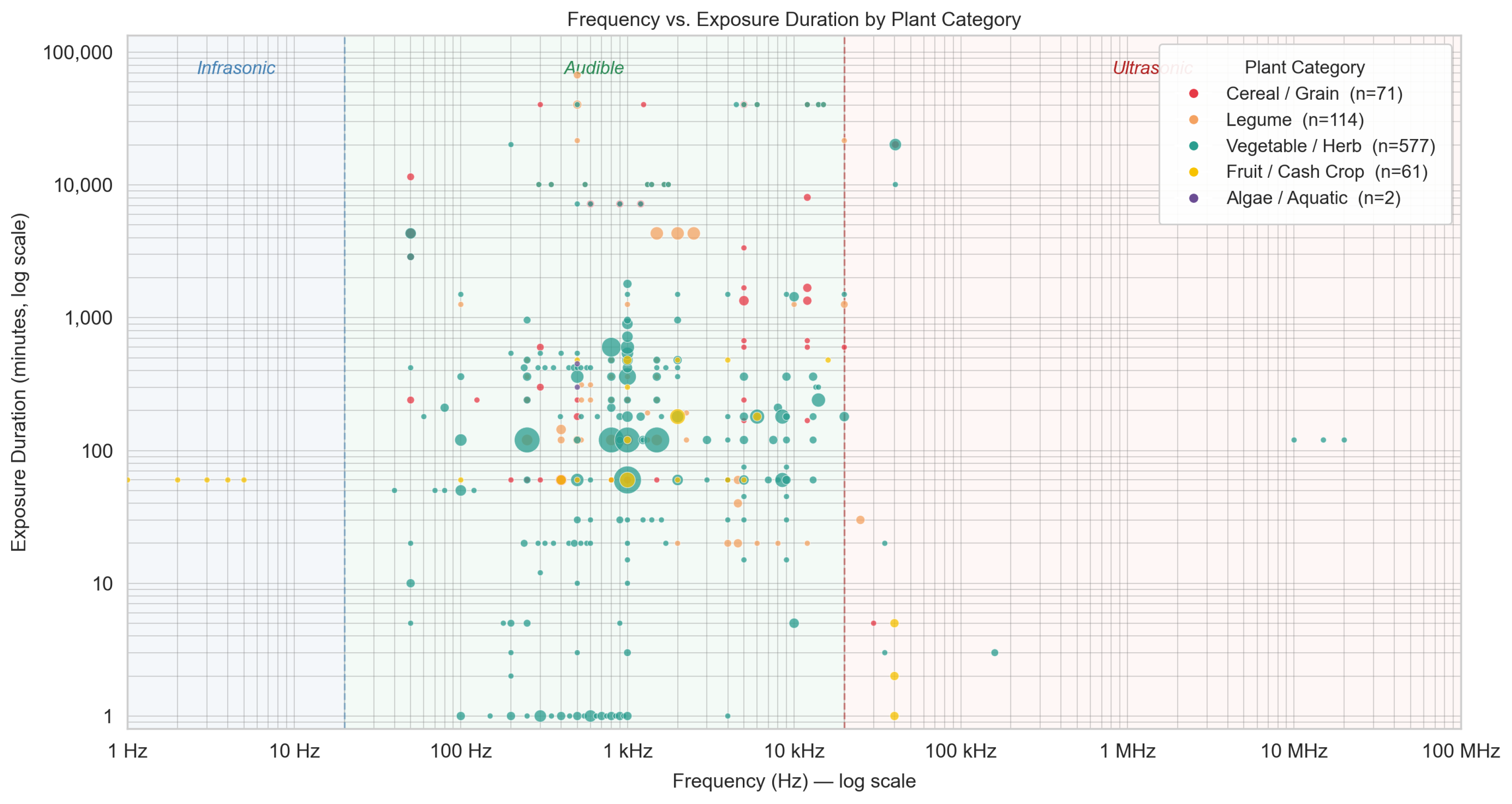
Figure 2.
Source frequency by paper count for multiple study types.
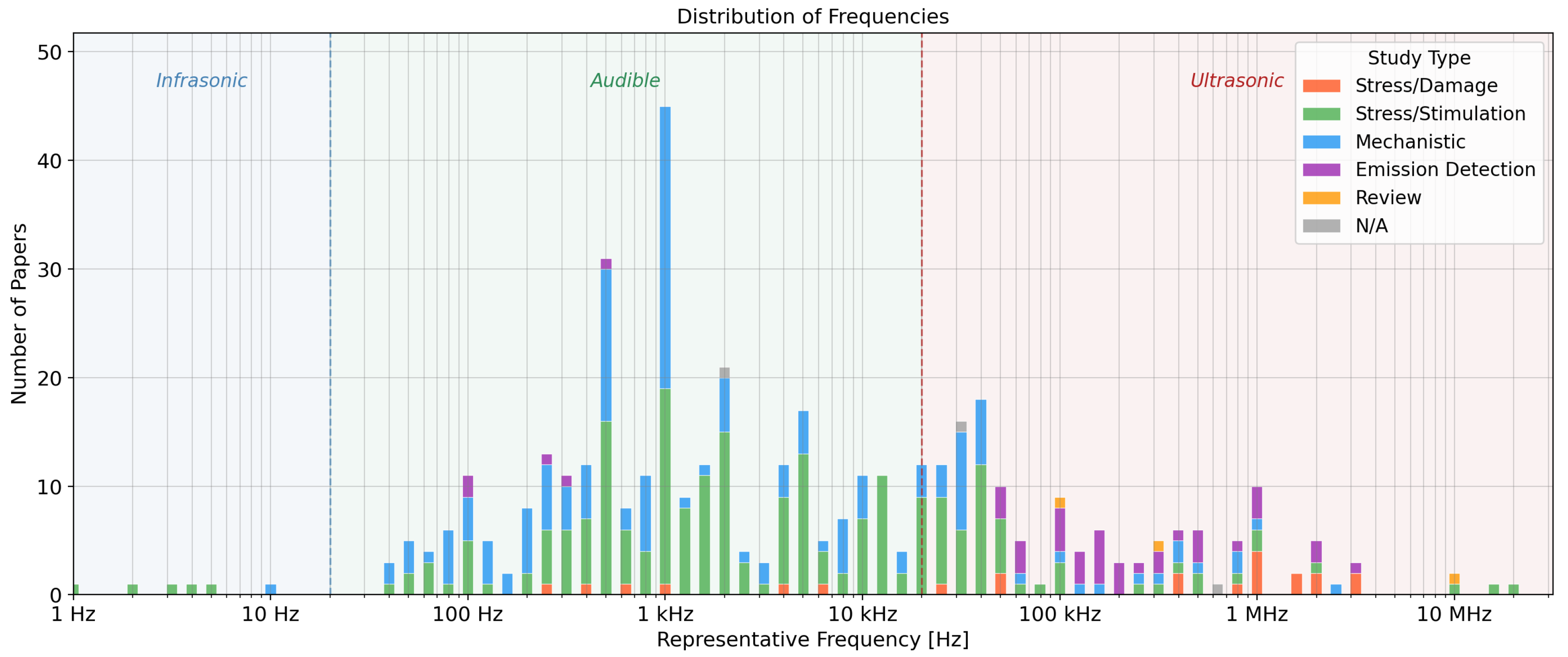
Figure 3.
Twenty most popular taxa by paper count.
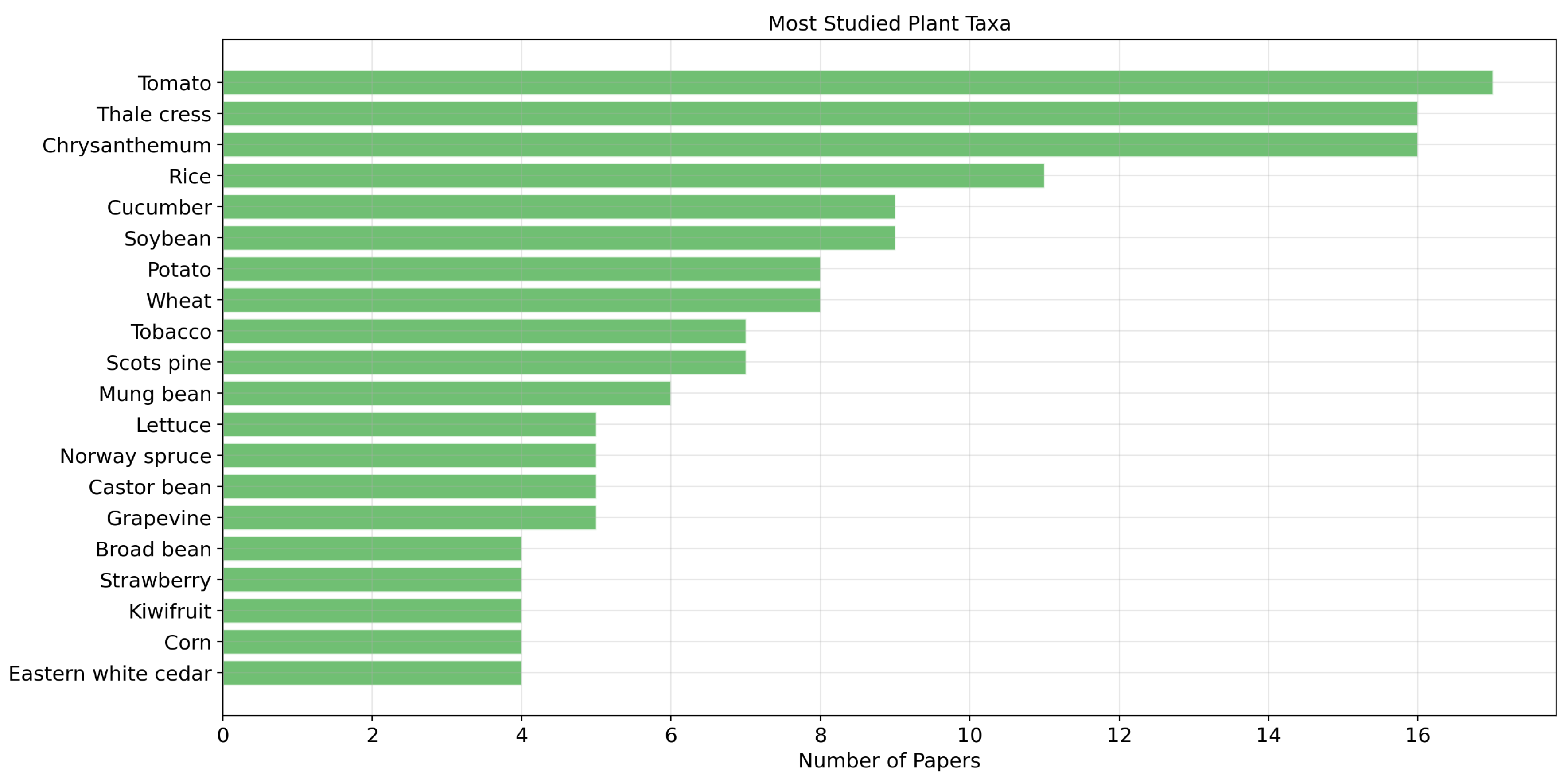
Figure 4.
Delivery medium by paper count.
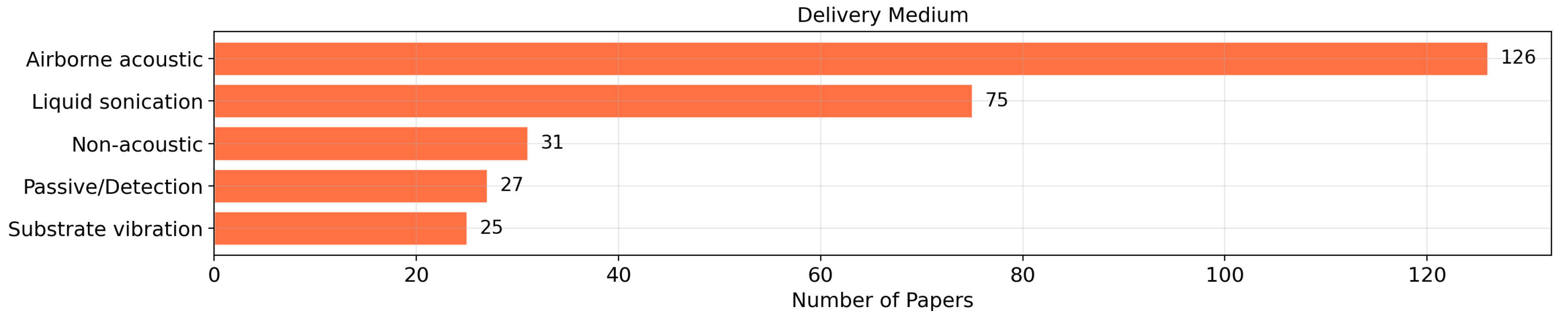
Figure 5.
Exposure intensity by paper count.
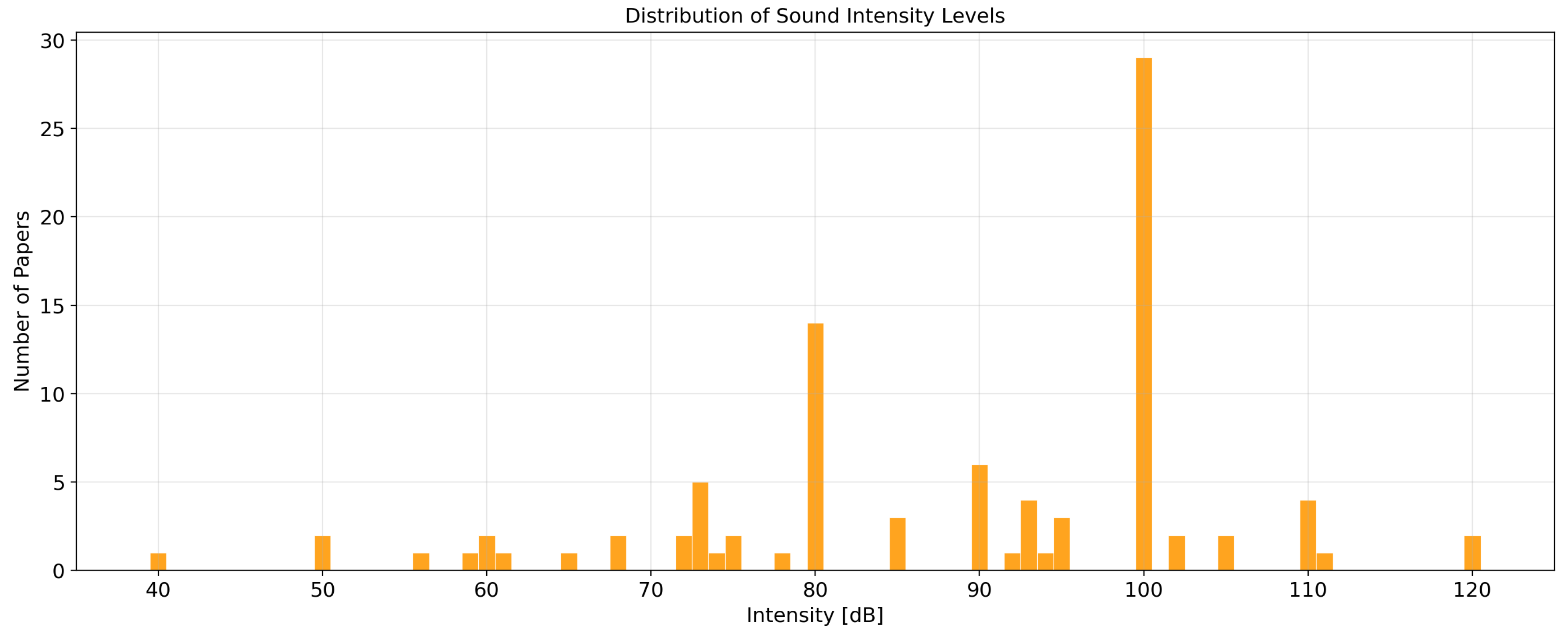
Figure 6.
Treatment duration by paper count.
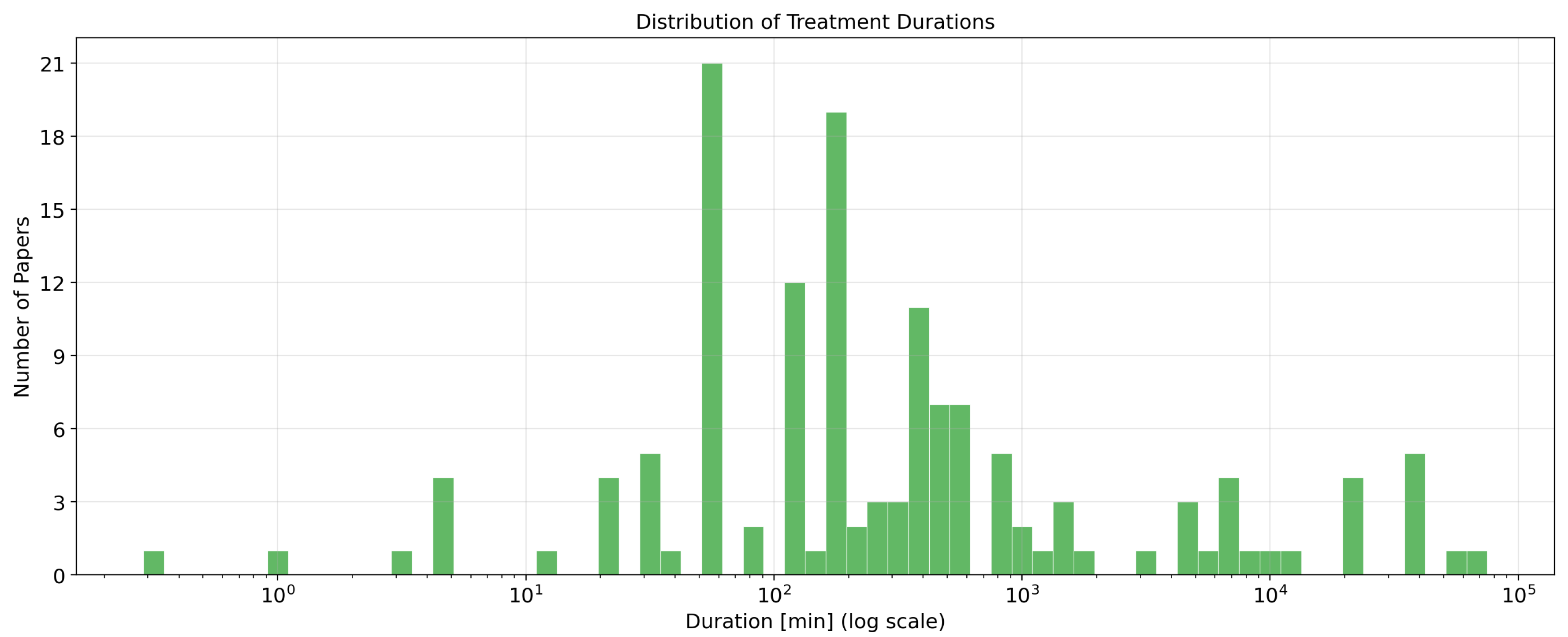
Figure 7.
Annual database publication count.
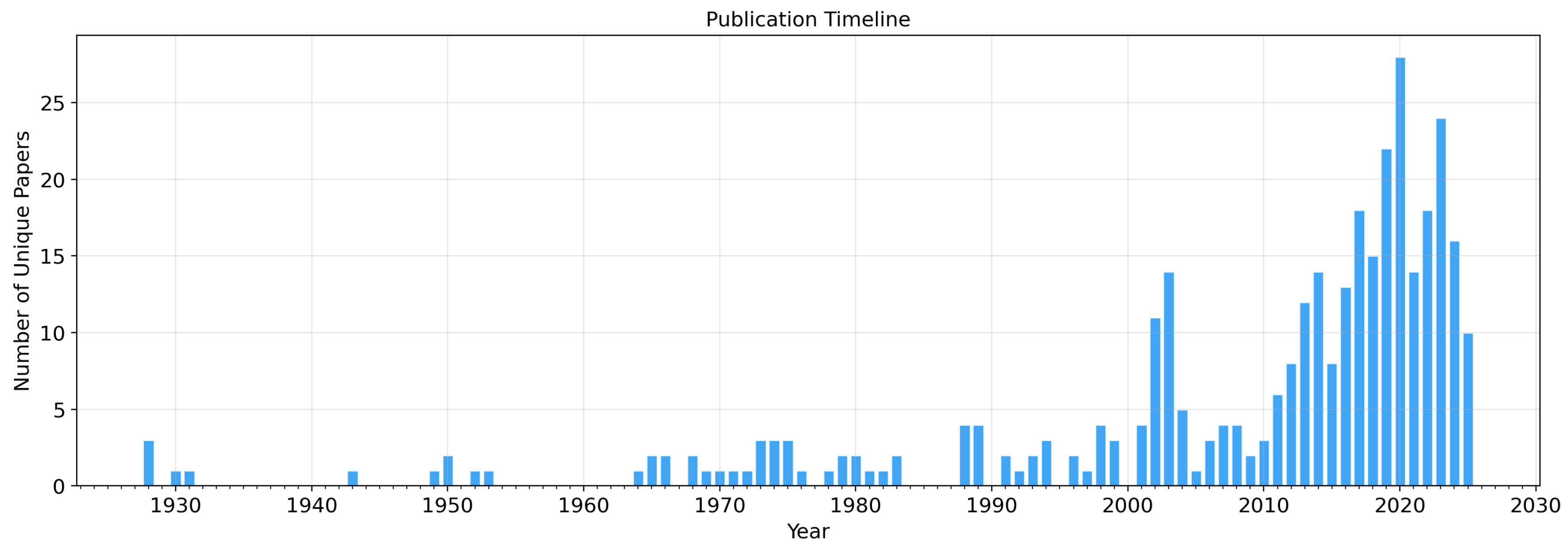
Figure 8.
Parameter report quality over time.
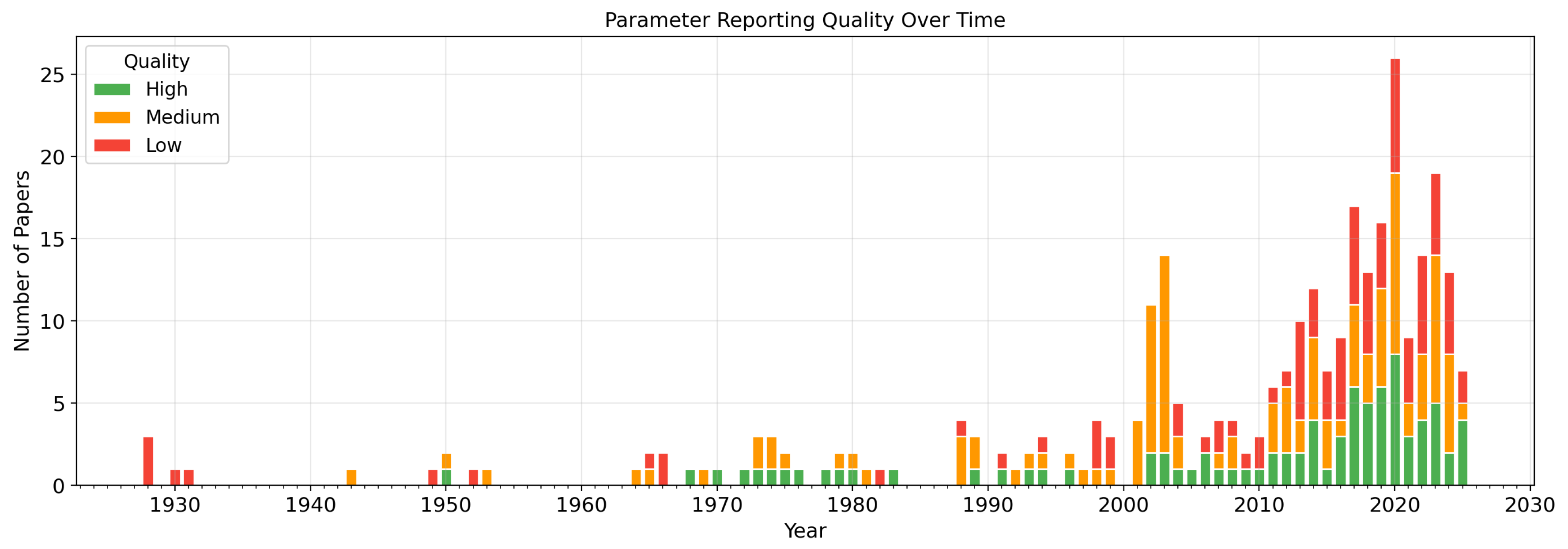
Figure 10.
Frequency distribution by paper count for the three treatment-delivery media.
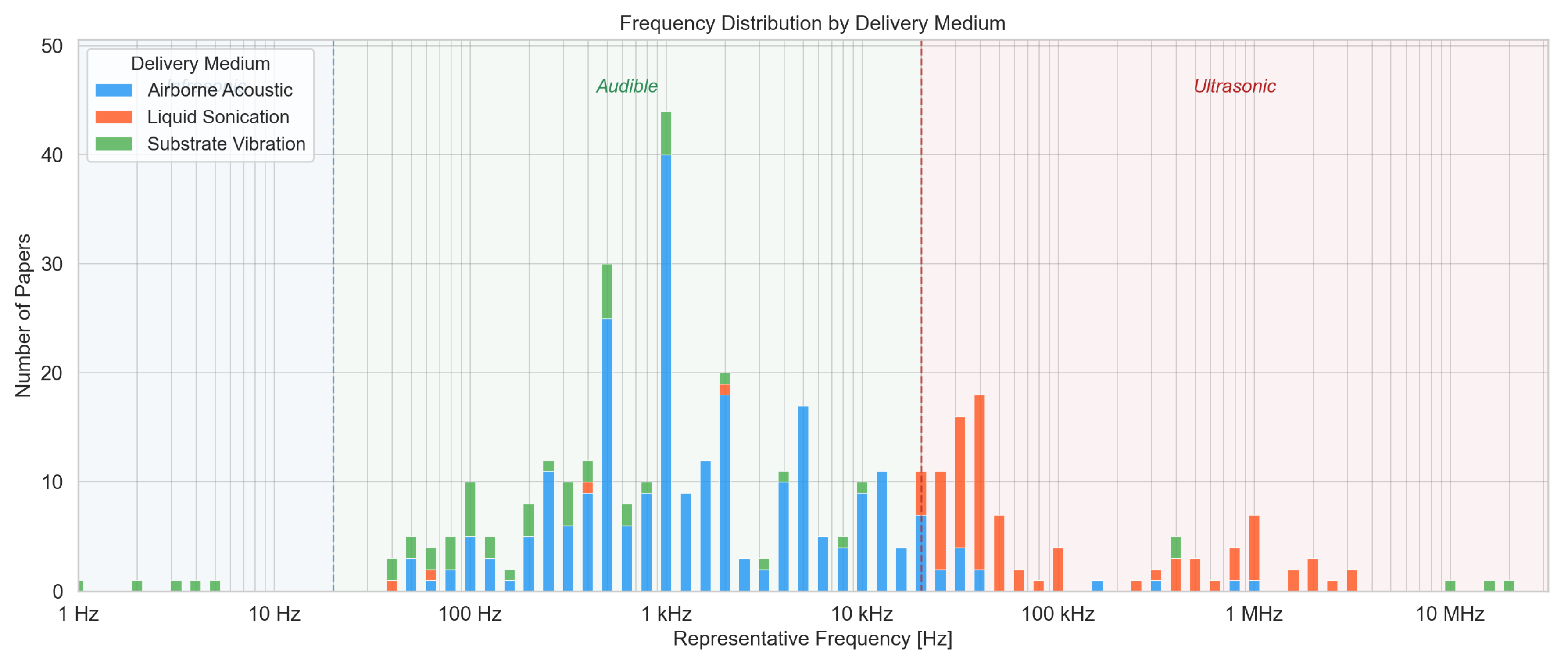

Table 1.
Numerical corpus characterization.
| Subset | Count |
|---|---|
| Candidate publications screened | 477 |
| Publications meeting inclusion criteria | 404 |
| Experimental conditions (database rows) | 2,991 |
| Rows with non-plant organisms (excluded from analysis) | 533 |
| Plant publications (Figure 7) | 344 |
| of which rated for parameter quality (Figure 8) | 298 |
| reviews/commentaries (unrated) | 46 |
| Plant rows lacking a parsable frequency | 693 |
| Plant rows with frequency but no duration | 346 |
| Publications on the intensity (SPL) distribution (Figure 5) | 94 |
| Publications with numerical duration (Figure 6) | 141 |
Disclaimer/Publisher’s Note: The statements, opinions and data contained in all publications are solely those of the individual author(s) and contributor(s) and not of MDPI and/or the editor(s). MDPI and/or the editor(s) disclaim responsibility for any injury to people or property resulting from any ideas, methods, instructions or products referred to in the content. |
© 2026 by the authors. Licensee MDPI, Basel, Switzerland. This article is an open access article distributed under the terms and conditions of the Creative Commons Attribution (CC BY) license (http://creativecommons.org/licenses/by/4.0/).
Copyright: This open access article is published under a Creative Commons CC BY 4.0 license, which permit the free download, distribution, and reuse, provided that the author and preprint are cited in any reuse.


