

Submitted:
15 July 2026
Posted:
16 July 2026
You are already at the latest version
Abstract
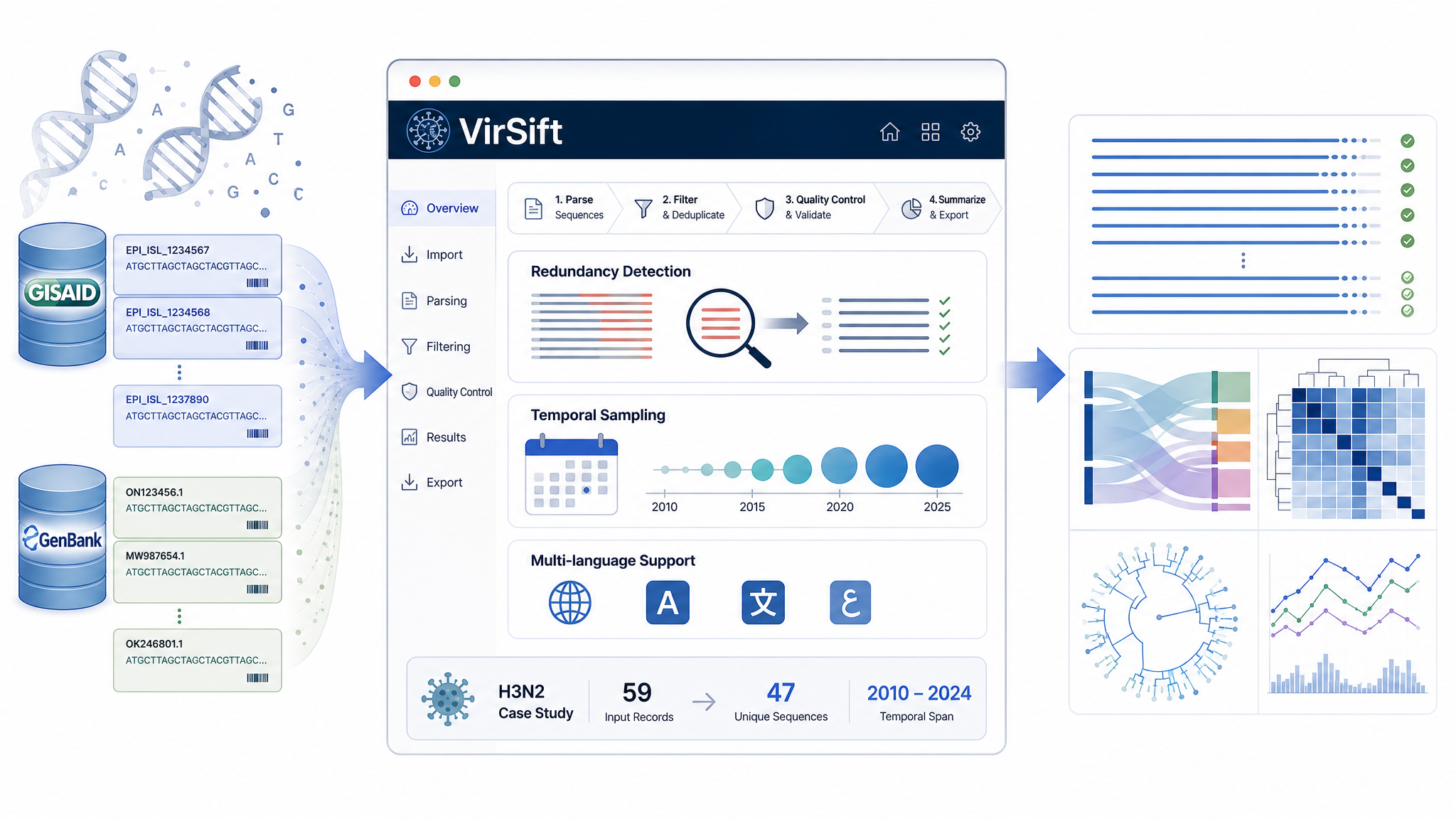
Background: Effective influenza molecular epidemiology depends on curated, temporally representative sequence datasets. The transition from raw GISAID or NCBI/GenBank batch downloads to analysis-ready FASTA often requires command-line pipeline configuration or custom scripting, which may be inaccessible to some field and clinical virologists. To our knowledge, a targeted, non-systematic comparison of widely used viral-genome tools did not identify a single browser-delivered workflow combining supported GISAID-style and NCBI/GenBank-compatible header parsing, interactive human-in-the-loop temporal subsampling, exact-sequence identity-group analysis, and six selectable language catalogues.Methods: We developed VirSift (Viral Sequence Intelligence and Filtering Toolkit), a seven-page Streamlit web application implementing: (1) a custom parser handling four supported GISAID-style and NCBI/GenBank-compatible FASTA header variants with host inference and species normalization; (2) vectorized quality filtering and MD5-based identification of exact-sequence redundancy; (3) five documented human-in-the-loop (HITL) temporal sampling strategies with an operational date-span recommendation; (4) ten Plotly visualization types, including a configurable N-level Sankey flow diagram and an exact-sequence persistence matrix; and (5) structured export to FASTA, CSV, and segment-organized ZIP bundles. The interface exposes six structurally aligned 817-key language catalogues, all of which contain complete native‑language values with no English fallback. This tool-description paper documents implemented functions and includes a limited H3N2 demonstration and multi-file round-trip check; comprehensive analytical, usability, performance, and multilingual validation is reserved for separate work.Results: Applied to 59 H3N2 haemagglutinin sequences from Novosibirsk, Russia, spanning October 2021 to April 2025, VirSift identified 12 records redundant by exact nucleotide identity (20.3% of records), retaining 47 unique sequences across 9 calendar months. The observed 1,279-day collection-date span was assigned to the software-defined long-span category (labelled "Endemic" in the version 1.0 interface), for which Custom Checkpoints was recommended. The Molecular Timeline reported 47 exact-sequence identity groups. Clade 3C.2a1b.2a.2a.3a.1 accounted for 69.5% of records. Multi-file ingestion and metadata-based split export were verified by reconciliation of record counts across five source files. All described operations were completed without programming.Conclusions: VirSift provides a reproducible and auditable browser-delivered workflow for pre-phylogenetic curation of influenza sequence datasets. Its six selectable language catalogues, supported parsing rules, HITL sampling options, visualization modules, and structured exports are described here as implemented capabilities. The H3N2 case study and count-reconciliation exercise demonstrate workflow operation but do not constitute comprehensive software validation. VirSift may support institutions seeking an accessible interface for documented sequence-data curation before downstream phylogenetic analysis.
Keywords:
influenza virus
; GISAID
; NCBI/GenBank
; bioinformatics tool
; epidemiological surveillance
; sequence quality control
; surveillance informatics
; molecular epidemiology
Copyright: This open access article is published under a Creative Commons CC BY 4.0 license, which permit the free download, distribution, and reuse, provided that the author and preprint are cited in any reuse.


