

Submitted:
13 July 2026
Posted:
15 July 2026
You are already at the latest version
Abstract
Among falcons, Eleonora’s Falcons (Falco eleonorae) have evolved unique traits: This species breeds in colonies in late summer to exploit the autumn migration of Passerines from Europe to Africa. The colonies are on rocky Mediterranean and Canary Islands, as well as on cliffs along the Mediterranean and Atlantic coasts, to facilitate hunting of migrating birds above the sea near the colonies. In addition, the falcons feed on airborne insects whenever available, especially above land during the pre-breeding and wintering periods. Eleonora’s Falcons winter mostly in Madagascar. This review summarizes and discusses new data published since the 1970s, when H. Walter (1979a) published his comprehensive monograph on the species. Such data are available for phylogeny, distribution, population size, migration (from satellite telemetry), and the genetics and ecology of the three color morphs (pale, dark, and melanistic). Additionally, new data have been published on its breeding biology and ecology, diet, pesticide impacts, and other challenges.
Keywords:
phylogeny
; trait evolution
; distribution
; plumage color morphs
; colonial breeding
; migration routes
; group hunting
; territorial behavior
; sociality
; insect diet
; bird prey
; passerine autumn migration
; nest site selection
; mating system
; clutch size
; breeding success
; wind conditions
; age of first breeding
; mortality
; philopatry
; siblicide
; vocalizations
; malaria
; ectoparasites
; pesticides
; and conservation
1. Introduction
Eleonora’s Falcon (Falco eleonorae) is unique among falcons. It is of medium size, showing sexual size dimorphism, and displaying three color morphs: melanistic, dark, and pale (Figure 1). Unlike most other falcon species, Eleonora’s Falcon breeds colonially on rocky islands (usually small and uninhabited) in the Mediterranean Sea and in the Canary Islands or at cliffs of Mediterranean and Atlantic coasts (Figure 2). The communal life in colonies could facilitate cooperative behavior while allowing for the territoriality of individual falcon pairs.
Since Eleonora’s Falcons are adapted to the autumn migration of birds crossing the Mediterranean Sea, a rich but yet transitory source of food for raising the offspring in late summer and early autumn, their breeding sites are usually located strategically along the migratory routes of smaller birds. The breeding biology of this species (timing of egg laying, hatching, and fledging) is highly synchronized to ensure that migrants are readily available during the brief period when young falcons require ample food (Figure 3).
Eleonora’s Falcons are migratory and winter mainly in Madagascar in or around open woodlands, forests, and wetlands at elevations of 600–1,500 m (Walter 1979a; Broedts 2010; Orta et al. 2020; Mayol 2024). The arrival of Eleonora’s Falcons in Madagascar coincides with the start of the rainy season, when there is an abundance of airborne insects, which constitute this species’ primary food source during the non-breeding period.
The fascinating life cycle of Eleonora’s Falcon, including its morphological, behavioral, and physiological traits, as well as its adaptation to a unique breeding season niche, has been summarized in a scientific monograph by H. Walter (1979a) and in two more general books by Papaconstantinou (2007) and Mayol (2024). Additionally, several comprehensive reviews and summaries have been published (Vaughan, 1961; Cramp & Simmons, 1980; Cade, 1982; Wink et al., 1993; Orta et al., 2020).
Hartmut Walter obtained a Ph.D. from Bonn University in 1967 for his Eleonora’s Falcon study (Walter 1968a) on Paximada (Crete, Greece) and Mogador (Morocco) (Table 1). Hartmut Walter and Dietrich Ristow began fieldwork on the bleak, rocky island of Paximada (Dionysades, off Crete) by camping in a colony for several weeks (Mayol 2024). Arthur Ludlow Clark (1934–2019) received his Ph.D. from Cornell University in 1981 for his falcon research in Morocco. However, his results have been published only in part (Clark 1981; Clark & Peakall 1977). Following the pioneering work of Hartmut Walter, Dietrich Ristow, and Arthur Ludlow Clark, research programs in Greece, Italy, Spain, and Morocco have addressed key questions about the biology, ecology, migration, and evolution of the Eleonora’s Falcon. Main findings which will be discussed in this review: Breeding ecology: Ristow et al. (1982, 1983a, b), Wink et al. (1980a, b, 1982a, b, 1985, 1993), Urios & Martínez-Abraín (2005), Kassara et al. (2012), Gangoso et al. (2013), Gutiérrez-López et al. (2015), Steen et al. (2016), Touati et al. (2017), Hadjikyriakou et al. (2020), Jemaa et al. (2021), and Xirouchakis et al. (2012, 2022, 2026). Migration studies: Gschweng et al. (2008, 2012), López-López et al. (2009), Mellone et al. (2011, 2013), Kassara et al. (2012a, b, 2014, 2017, 2021), Hadjikyriakou et al. (2020a, b), Vansteelant et al. (2021, 2023), and Monti et al. (2025). Hunting and prey studies: Ristow et al. (1983, 1986), Rosen et al. (1999), Hedenström et al. (1999), Hedenström and Rosen (2001), Rosen and Hedenström (2002), Buij and Gschweng (2017), Hadjikyriakou et al. (2020a, b), Bakour and Moulai (2019), Xirouchakis and Panuccio (2019), Samraoui et al. (2022), Ristow & Wink (2024), and Angelidou et al. (2025). Finally, DNA studies contributed to a better understanding of the biology, evolution, and ecology of Eleonora’s Falcon (Seibold et al., 1993; Helbig et al., 1994; Swatschek et al., 1993; Fuchs et al., 2015; Wink, 2018; Gangoso et al., 2011, 2015a, b, 2019a, b). Satellite and GPS telemetry helped to unravel the migration of Eleonora’s Falcons to Madagascar. (Gschweng et al., 2008, 2012; López-López et al., 2009; Mellone et al., 2011, 2013; Kassara et al., 2012a, b, 2014, 2017, 2023; Hadjikyriakou et al., 2020a, b; Vansteelant et al., 2021, 2023; Monti et al., 2025).
Why write yet another review? We aim to provide a thorough analysis and discussion of the new findings since the 1970s. For earlier literature, see Walter (1979a) and Cramp and & Simmons (1980). In this review, a particular bias towards our own results, obtained during almost 40 years of field study on Paximada and Crete, is inevitable. This review includes additional findings of our own studies, some of which had not been published earlier. Naturally, we could not discuss in depth all aspects of Eleonora’s Falcon’s biology. Topics which need further research are highlighted in this overview.
2. Phylogeny and Trait Evolution of the Hobby Falcon Clade
The order Falconiformes includes only falcons and their relatives but no longer other raptors, such as eagles, vultures, and buzzards (Prum et al., 2015). DNA studies (Hackett et al., 2008; Jarvis et al., 2014; Prum et al., 2015; Kraus & Wink, 2015; Wink, 2019, 2021; Stiller et al., 2024) indicate that the Falconiformes share a clade with the Psittaciformes (parrots) and the Passeriformes (songbirds). The order Falconiformes contains a single family, the Falconidae, which is divided into three subfamilies: Herpetotherinae, Polyborinae, and Falconinae. Three genera are recognized in the subfamily Falconinae: Microhierax, Polihierax, and Falco (del Hoyo et al., 1994; del Hoyo, 2020).
The genus Falco presently comprises 39 accepted species (del Hoyo et al., 1994; del Hoyo, 2020). According to DNA studies, the following clades are apparent: Old World kestrels cluster at the base of the Falco tree; further up are American Kestrels, Red-footed Falcons, Merlins, Hobby Falcons (including Eleonora’s Falcon), Prairie Falcons, Peregrine Falcons, and Hierofalcons (Fuchs et al., 2015; Wink, 2018).
All species of the genus Falco are aerial and/or terrestrial raptors that pursue their prey in open habitats. Only a few species typically breed in colonies (e.g., Eleonora’s Falcon, Red-footed Falcon, Amur Falcon, Lesser Kestrel), whilst a few other species breed both colonially and solitarily (e.g., Sooty Falcon, Eurasian Kestrel). The colonial species are all small- to medium-sized falcons, and the largest one of them is the Eleonora’s Falcon.
Eleonora’s Falcon is a monotypic member of a small group of Old-World falcons in the subgenus Hypotriorchis (Cramp, 1980; Del Hoyo et al., 1994; Del Hoyo, 2020), comprising the “Hobby Falcon clade” that shares many biological and ecological similarities (Figure 4). DNA analyses have unequivocally demonstrated that the subgenus Hypotriorchis includes the Eleonora’s Falcon and the Sooty Falcon (Falco concolor), as well as the Eurasian, Oriental, Australian, and African Hobbies (F. subbuteo, F. severus, F. longipennis, and F. cuvierii) (Seibold et al. 1993; Helbig et al. 1994; Fuchs et al. 2015; Wink & Ristow 2000; Wink 2018).
Fuchs et al. (2015) reconstructed a time-calibrated multigene phylogeny suggesting that the ancestor of the genus Falco evolved 15 million years ago and that most clades diversified about 5–6 million years ago. The ancestor of the Hypotriorchis clade probably lived in Australia 2.5 million years ago. The diversification of the Eurasian, Oriental, and African Hobbies and of the Eleonora’s and Sooty Falcons began even later—about 1.5 million years ago, when warm and cold climate periods alternated periodically. A speciation of Eleonora’s Falcon after the last glaciation, as proposed by Walter (1979a), is improbable.
The various glaciation cycles strongly influenced bird migration from Eurasia to Africa because most of Europe was covered in ice or lacked woodlands during the ice ages, making it unsuitable for insectivorous birds. Following the last glaciation, about 12,000 years ago, Europe rapidly became warmer. As a result, it became suitable again for many insect-feeding birds, thereby extending their range. However, to avoid food shortages during cold winters, these birds had to migrate to Africa. Consequently, seasonal food availability likely drove the evolution of the Palearctic migration system (Moreau, 1972; Bairlein, 2022) and was instrumental in the adaptation of Eleonora’s Falcons to bird migration and autumnal breeding.
Figure 4 shows a phylogenetic reconstruction of the Hobby Falcon clade (data from Fuchs et al., 2015; Wink & Ristow, 2000; Wink, 2018). This reconstruction indicates close phylogenetic similarity among members of the subgenus Hypotriorchis, all of which share several characteristic traits (Wink & Ristow, 2000): they feed on insects, birds, and sometimes bats, all of which are primarily captured in flight. The Eurasian Hobby Falcon, Eleonora’s Falcon, and the Sooty Falcon all breed in late summer. They are long-distance migrants that winter in sub-Saharan Africa. Additionally, Sooty and Eleonora’s Falcons have adjusted their breeding season to coincide with autumn bird migration. They also share common wintering grounds in Madagascar and the surrounding islands. Both Sooty and Eleonora’s Falcons have developed a colonial lifestyle. Unlike typical Hobbies, they nest on the ground in cliffs. Dark coloration exists only in females of the Sooty Falcon whilst dark and pale plumage occurs in both sexes of the Eleonora’s Falcon; the other four Hobby species only exhibit pale plumage (Frumkin, 1984, 1988; Clark et al., 2020; Debus et al., 2024; Kemp et al., 2020; Orta et al., 2020a, b, c) (see Section 4.2).
We have analyzed the nucleotide sequences of the mitochondrial cytochrome b genes of Eleonora’s Falcons from Crete, the Aegean Sea, Croatia, Sardinia, and Tunisia (Wink et al., unpublished). Genetic variability is very low, indicating recent phylogeographic diversification. Some falcons from the western Mediterranean (Sardinia and Tunisia) show a single nucleotide exchange compared with Eleonora’s Falcons from the Aegean Sea and Crete. Hopefully, an ongoing microsatellite study (J. Fric and & M. Wink, in preparation) will provide more information on the phylogeography of Eleonora’s Falcon.
3. Distribution and Population Trends
3.1. Breeding Distribution
Eleonora’s Falcons mostly breed in colonies on small, uninhabited rocky islands in the Mediterranean Sea and the Canary Islands, as well as on cliffs along the Mediterranean and North African Atlantic coasts. In several publications, their breeding sites, population sizes, ongoing trends, and threats have been documented (Vaughan, 1961; Walter, 1968b, 1979a, b; Schmalfuss, 1972, 1979a, b; Ristow, 1999; Dimalexis et al., 2008; Mayol, 2024) (Table 1). All breeding sites are by the sea (Figure 6). In this respect, Eleonora’s Falcon differs from its close relative, the Sooty Falcon: Sooty Falcons also breed in colonies along the Red Sea coast, but they breed inland as well; in small numbers in Israel and in larger numbers in the Libyan Desert. A recent distribution map of Eleonora’s Falcons was published in the European Bird Breeding Atlas 2 (EBBA2) (Keller et al., 2020) (Figure 5); it does not cover the North African coast. To cover all colonies, a modified distribution map based on the data in Table 1 includes the North African colonies (Figure 6).
Greece is the main center of Eleonora’s Falcon’s breeding distribution: the Aegean islands alone hold 75–80% of the world population (Dimalexis et al., 2008). Thus, Eleonora’s Falcon is the most important bird species in Greece; therefore, Greece has a special responsibility for this unique taxon. Greece has 9,838 islands, islets, and rocks (ranging in size from 1 to 8,261 km²), of which fewer than 100 are inhabited by humans. Greece’s mainland and islands comprise a coastline of about 15,000 km, most of which could potentially provide breeding habitats for Eleonora’s Falcons (Dimalexis et al., 2008). The Greek Ornithological Society monitored all Greek islands for Eleonora’s Falcons: Dimalexis et al. (2008) selected all islands with suitable topography for systematic monitoring. This survey was conducted from 2004 to 2006 in accordance with standard field protocols (International Species Action Plan; Ristow, 1999).
Of the 965 islands monitored (representing a total coastline of more than 6,000 km), 249 had at least one breeding colony of Eleonora’s Falcon. The total number of breeding pairs was approximately 12,300. Almost 20 years later, a subsequent census (still ongoing) recorded 13,262 breeding pairs in 2024 (Tsiopelas et al., 2025). Most colonies were located in the Aegean Sea, with only five in the Ionian Sea. Breeding distribution was concentrated on islands in the northeastern Aegean, the Sporades, the eastern Cyclades, Antikythera, the southwestern Dodecanese, and on small islets off Crete. Dimalexis et al.’s (2008) work represents the most comprehensive monitoring in Greece to date and complements earlier data summarized by Walter (1979b). Kassara et al. (2013) used these data to model the distribution of the Eleonora’s Falcon, taking into account the topography of the islands, particularly elevation, curvature, and slope. Furthermore, Kassara’s model could help to predict the potential distribution of Eleonora’s Falcons across their entire range.
Approximately 76% of all breeding colonies consist of 10–50 breeding pairs, though some are much larger, with 200 pairs or more (Dimalexis et al., 2008; Table 1; Figure 7). Together, small colonies (n = 190) account for only 23.3% of the Greek falcon population. At least 5,272 pairs of breeding falcons are concentrated in 14 large island colonies, including Dionysades, Antikythera, Psara, Skyros, Tilos, Kasos, Karpathos, Astypalaia, Anafi, and Alonnisos (Papaconstantinou, 2007; Dimalexis et al., 2008; Kassara et al., 2019).
Table 1 lists the known breeding colonies of Eleonora’s Falcon (approximately 350) and their corresponding population sizes (estimated number of breeding pairs) for the periods before and after 2000. Since the breeding sites are mostly on rocky, barely accessible islands, estimates of breeding numbers were often incomplete before 2000 (Walter 1979b). Many populations have been well studied and documented by now, such as those on the Atlantic coast of Morocco, the Mediterranean coasts of Algeria and Tunisia, as well as in Spain (Canary Islands, Columbretes Islands, and Balearic Islands), in Italy (Sardinia and Sicily), in Greece, and in Cyprus. However, population estimates for colonies in Croatia and Turkey are still incomplete or undocumented. Overall, there remains some uncertainty and a lack of data. To comprehensively protect this unique species, continuous monitoring of current conditions and potential changes in falcon numbers or distribution is necessary.
Based on the data in Table 1 and Table 2, the number of Eleonora’s Falcons ranged from 25,000 to 27,000 adults between 2000 and 2006 (Dimalexis et al., 2008; Portolou et al., 2008; Kassara et al., 2013; BirdLife International, 2024). This number is much higher than initial estimates by Vaughan (1961) and Walter (1968) (see Table 2). Furthermore, there is evidence that the population of Eleonora’s Falcon has increased in recent decades (see Section 3.2): If we take Mayol (2024) and new census data from Greece (an increase of 1000 pairs was reported for 2024; Tsiopelas et al., 2025) into account, the actual number of breeding pairs should be 17,500–17,600 pairs. Using this most recent estimate, the total number of breeding Eleonora’s Falcons currently in existence is 35,000–35,200 adult falcons. For a total estimate, we must add the number of non-breeding individuals: The mean productivity is about 1.5 fledglings per pair (which would add a total of 26,250–26,400 birds each year at the time of fledging). Since 84% of juveniles die before first breeding, we must add approximately 4,200–4,224 non-breeding falcons to the number of breeding falcons that visit the Mediterranean each year. According to this estimate, approximately 39,000 Eleonora’s Falcons visit the breeding colonies each year.
3.2. Population Trends
Vaughan (1961) had estimated a breeding population of 1,515–1,980 pairs before 1961. Walter (1979a, b) assumed 1,924–6,802 breeding birds (i.e., 962–3.401 pairs), and Ristow (1999) estimated 6,250 pairs before 2000. Table 1 indicates that the current population is substantially higher, with a breeding population exceeding 17,500 pairs.
We assume that a major part of the apparent population increase is due to better and more systematic monitoring over the last four to five decades. Although there is evidence of local population declines (see Section 3.3.2), increases in breeding populations have been documented in colonies in Spain, Morocco, Sardinia, and Greece. We assume that the protection of many breeding islands as Special Protected Areas (SPAs) or Ramsar sanctuaries, as well as the reduction of hunting and direct persecution, are responsible for this positive trend. On some Greek islands, the elimination of rats and the construction of nest boxes may have contributed to the population growth documented in 2024 (see Section 12.1 and Section 12.2; Fric et al., 2017a,b; Tsiopelas et al., 2025). It should be noted that in Greece, Italy, Spain, and Morocco, young falcons were traditionally collected by local fishermen and eaten as a delicacy (Ristow, 1999; Mayol, 2024). This tradition has now been widely abandoned (see Section 12.4).
Morocco: Walter (1968) reported 169 pairs in Mogador and 44 pairs in Sale in 1966. Clark (1974, 1981) found 87–92 breeding pairs in Mogador between 1972 and 1974. In Sale, the number of pairs ranged from 61 to 54, which was slightly higher than in 1966. Both colonies suffered greatly from human persecution, and in 1972, 10% of the clutches were lost. The number of breeding pairs decreased further in the Sale colony, which is easily accessible on coastal cliffs. There were 14 pairs in 2011 and 39 pairs in 2024. However, the Mogador colony experienced a substantial improvement following the island’s designation as a protected area: As early as 2011, about 830 pairs were recorded, increasing to 1,670 pairs by 2024 (Mayol, 2024).
Spain: The Columbretes Islands currently have four falcon colonies. In the 19th century, however, Eleonora’s Falcons did not breed there at all, due to the permanent presence of lighthouse keepers and their “falcon harvesting”. Since the archipelago was designated a protected area in 1988, the number of breeding falcons has increased from 16 pairs in 1985 to 34 pairs in 2003 (Martinez-Abrain et al., 2002). Currently, the population has grown to 60 pairs (Urios & López-López, 2019; Mayol, 2024). The breeding population on the Balearic Islands increased from approximately 250 pairs in the 1970s to 700–800 pairs after 2010 (Del Moral, 2008; López-Darias & Rumeu, 2010; Mayol, 2024). In the Canary Islands, Eleonora’s Falcons breed on four islands of the archipelago (Table 1). A population of 60–65 pairs was recorded during the 1970s and 1980s (Trujillo et al., 1994; Martín & Lorenz, 2001). However, 200 pairs were present by 2000, and more than 300 pairs by 2007, indicating rapid population growth (De León et al., 2007; Del Moral, 2008; Moreno & Rodríguez, 2007; López-Darias & Rumeu, 2010; Gangoso et al., 2020; Mayol, 2024).
Italy: Colonies of Eleonora’s Falcons were traditionally known in Sardinia and Sicily. In Sardinia, the population increased from 250 to 550 pairs (Spina & Leonardi, 2007; Peyré et al., 2018; Mayol, 2024). The small colonies near Sicily, on the Aeolian (Lipari) Islands, and in the Strait of Sicily (Lampedusa and Lampione) appear to be stable or possibly decreasing (Spina & Leonardi, 2007; Rguibi, 2012; Mayol, 2024).
Algeria: The Algerian colonies have experienced a substantial reduction due to human pressure, such as recreational activities, and the introduction of mammalian predators, e.g., cats, to control the rat population (see Section 12.1). These colonies have partially recovered (Peyré et al., 2018; Bakour & Moulai, 2019; Mayol, 2024).
Greece: According to Table 1 and Table 2, the Greek population has apparently increased during the last 60 years. However, we should not overlook that monitoring data for Greece were incomplete (Walter 1979b) prior to the Dimalexis et al. (2008) study (Table 2). Following the survey by Dimalexis et al. (2008) of the Greek population of Eleonora’s Falcon, a new survey 20 years later in 2024 reported an increase of 1000 breeding pairs. In 2024, a breeding population of at least 13,262 pairs existed. A substantial increase in breeding pairs is apparent in at least 10 colonies (mostly in the southern Aegean Sea) and a decrease in more than 5 colonies (Tsiopelas et al., 2025). A 30% decline in the breeding population on Paximada and other Dionysades islands (Crete) was recorded between 1980 and 2000 (Ristow, 2001). This was apparently caused by pesticide applications in Crete (see Section 11.2). The new 2024 census showed that these populations recovered, increasing from 587 pairs in 2006 to 1075 pairs in 2024 (Tsiopelas et al., 2025).
Madagascar: A decline in wintering populations of Eleonora’s Falcons has been reported (Thorstom & Rene de Roland, 2000), possibly due to ongoing locust eradication programs. However, quantitative data from Madagascar are lacking, and new surveys are urgently required.
Eleonora’s Falcon is listed in Annex I of the European Union’s Wild Birds Directive 79/409/EEC and is a priority species for conservation, as its global population is concentrated in Europe (Council of Europe, 1979; BirdLife International, 2024). Its conservation status has recently been classified as “Least Concern” because Eleonora’s Falcons are not currently threatened globally (BirdLife International, 2024).
3.3. Non-Breeding Distribution in the Mediterranean
3.3.1. Movements During the Non-Breeding Season (October to April)
Until 20 years ago, only a few sightings of Eleonora’s Falcon outside their breeding regions had been reported; in particular, sightings from November to April were rare. Single records stem from southern, central, northern, and eastern Europe (including Turkey), the Levant, the Middle East, Egypt, East Africa, the Cape Verde Islands, Madeira, as well as records of wintering falcons in Madagascar and further islands in the Indian Ocean, such as Mauritius, Réunion, the Seychelles, Socotra, and the Comoro Islands (Walter 1979a; Carp & Cheylan, 1979; Kasparek & Ristow, 1986; Ristow 2010, 2012; Ristow & Wink, 1992, and Pröhl & Baumgart, 2022).
This situation changed with the establishment of internet platforms, such as eBird and Ornitho, that collect observation data. Figure 8 shows that many observations are presently available on eBird documenting the distribution of Eleonora’s Falcons. These observations are from the birds’ breeding grounds in Spain, North Africa, Italy, and the eastern Mediterranean (see Figure 4 and Figure 5), as well as many other sites. The latter provide evidence of the falcons’ distribution during migration, winter, and the pre-breeding period (Figure 8). Eleonora’s Falcons apparently roam over vast areas of the Iberian Peninsula and other Mediterranean regions, including Turkey and the Levant. During migration, falcons were mainly recorded in Kenya, Tanzania, and Madagascar.
In general, observations in Europe outside the breeding regions were recorded from late May to late September (Figure 9). The extreme records, of course, span a larger period (Ornitho data assessed online in October 2024): First records per region: Spain: Catalonia, 20.04.2020, 25.04.21, and 18.04.24 - France: Provence 23.04.2020, 15.04.21, 16.04.22, 22.04.23, and 21.04.24; Languedoc-Roussillon 08.05.2020, 07.04.21, 15.04.22, 10.04.23, and 06.04.24. Last records per region: Spain: Catalonia 25.10.2020, 31.10.21, 22.10.22, and 06.11.23—France: Provence 04.10.20, 10.10.21, 06.10.22, 07.10.23, and 23.10.24; Languedoc-Roussillon 04.10.2020, 30.09.21, 02.10.22, 16.10.23, and 10.10.24.
3.3.2. Movements During the Pre-Breeding Season (April to July)
As shown in Figure 3, Eleonora’s Falcons start laying their eggs as late as July; however, the falcons are already present in the Mediterranean by the end of April/beginning of May (Figure 9; Section 3.4.2). Thus, the unusually long pre-breeding period lasts from the end of April into July (Section 6.1). When do the breeding birds actually arrive at their breeding grounds? On Paximada, at least 30–50% of the breeding population was present during the last two weeks of May in 1985 (Wink et al., 1993). Many adult falcons were on the island, and most of them rested in their traditional breeding territories. Of the 43 falcons that we studied in detail in May 1985, 23 were adult females, and 20 were adult males. Many pairs displayed courtship behavior, and a few copulated. These observations clearly indicate that at least some of the adult female and male falcons return directly to their breeding colony after their spring migration from Madagascar.
In May 1985, we observed that the falcons left Paximada every day to hunt on mainland Crete, where hunting flocks of typically one or two dozen birds can be regularly observed from May until October. From half an hour after sunrise onwards, some falcons departed towards mainland Crete; the majority followed over the next hour. Falcons left the island individually or in pairs, and traveled in short loose lines. The first birds returned from the mainland to Paximada in the afternoon, the majority around sunset, again singly or in small groups (Ristow & Wink, 1992; Ristow 2004c). When Eleonora’s Falcons breed on small islands or islets, they hunt in the vicinity of these sites if migrating prey species are present; otherwise, they undertake longer trips to larger islands or the mainland, where more food is available. An extreme case: A male falcon ringed on Paximada was found exhausted 500 km away in Turkey in its 7th year on 29th June, i.e., during the pre-breeding period (Ristow, 2010). Falcons that breed on larger Greek islands with an area of at least 2,000 hectares (such as Antikythera, Psara, Skyros, Tilos, Astypalaia, and Alonissos) hunt primarily on these islands during the pre-breeding period (Kassara et al., 2019). They visit areas with abundant food resources, such as flying insects and resident birds. These hunting sites are primarily located on cultivated land. During the pre-breeding period, the falcons forage in the morning and soar at midday (Kassara et al., 2019). On Antikythera, approximately 67% of the hunting falcons were male, while only 33% were female (Kassara et al., 2019).
Additional information on the pre-breeding movements of Eleonora’s Falcon became available from satellite telemetry (López-López et al., 2010; Mellone et al., 2012a, 2013a): In Spain, 18 falcons were captured and fitted with satellite transmitters in breeding colonies on the Dragonera and Columbretes Islands. Only three of the birds (two adult females and one second-calendar-year juvenile) returned the following season after wintering in Madagascar; one female was monitored during two consecutive summers. Thus, data from four falcons were available for analysis. Upon returning from Africa, the falcons briefly visited the breeding islands but also dispersed up to 400 km inland, away from the breeding colonies, before starting to breed in July. In mainland Spain and France, falcons were tracked in habitats with coniferous and broadleaved forests, shrub vegetation, and farmland (fruit plantations and vineyards). Since these satellite telemetry records contain valuable information about pre-breeding-season movements, additional details are provided here: Female #80399 arrived at the breeding colony on Dragonera (Mallorca, Balearic Islands) on May 20, 2009. She stayed there until June 13, then moved up to 400 km inland from the colony to the Spanish mainland. She returned to the colony in July to breed there. Female #80402 was monitored over two summers: She moved far inland, from northeastern Spain to southern France and Italy, and was absent from the breeding colony for several weeks. She returned to the Columbretes on July 17, 2009, to breed. In 2010, she visited Italy and Corsica from May 16 to 24, then moved to southern France. She visited the Columbretes briefly from June 15 to 17 and eventually settled there after July 1. However, from July 23 to 27, she made short trips to eastern Spain. The juvenile falcon #92532 arrived in Spain on June 24, 2011, having crossed the Sahara with short stopovers in northern Algeria. It moved to several areas on the mainland of Spain and even visited southern France before returning to the natal colony on the Columbretes on September 22, 2021. It started the winter journey on October 25, 2021. An adult falcon from San Pietro Island off the coast of Sardinia visited the Italian mainland for two months before returning to its breeding colony in mid-August (Gschweng et al., 2008).
In the southern Aegean Sea, Kassara et al. (2021) studied the breeding and pre-breeding movements and daily activity patterns of six adult female Eleonora’s Falcons which had been equipped with GPS transmitters. During the pre-breeding period, two adult falcons roamed over several hundred kilometers around their breeding island (Antikythera). These findings are consistent with the numerous sightings reported above from May to July (Figure 8 and Figure 9). One female visited the same area in Turkey in subsequent years, indicating some site tenacity even outside the breeding range.
A simplified summary of the long pre-breeding period is that experienced adult falcons return to their traditional nest territories in May, are probably absent in June, and reclaim their territories in July. This conclusion poses at least two questions. First, does the presence of established pairs in May reduce the effort of territory reclamation in July, or, as partners in a pair migrate separately, is May the period to confirm the pair bond in the first place? Second, although natal philopatry and breeding-site tenacity are well expressed (see Section 7.3), juveniles in their second and third calendar years rarely visit their natal colony; instead, they disperse throughout the region. By being absent from the colony, juveniles avoid territorial conflicts with breeding falcons. Furthermore, far-distant roaming helps discover new food sources and train landmark orientation.
3.3.3. Movements During the Breeding Season
The female falcons typically care for the nestlings, while the males hunt. As the nestlings grow older and no longer require a brooding adult for thermoregulation, the females join the hunting trips, especially when food supply is low (see Section 6.1).
GPS transmitter data from a study in Antikythera (Kassara et al., 2021) show that female falcons roam an average of 17 km (SD = 26.14) from their nests; however, some falcons also make longer trips. The study is limited by its small sample size, the inclusion of only adult females, and the fact that falcons were studied only in September, when the nestlings were already well developed. Differences in spatiotemporal roaming activities should be expected for both sexes and at that late stage of the breeding season. Mellone et al. (2012b) tracked two female falcons of a coastal colony in Morocco from mid-September to the beginning of migration in late October. During a single trip, the falcons would move away from the colony as far as 181 km, and stay away for up to two days (inland Morocco). Movements similar to those observed on the African mainland have been reported for falcons breeding on the Canary Islands (Gangoso et al., 2020).
3.4. Migration Routes and Wintering Areas
3.4.1. Ringing Results
Several ringing programs had been initiated in Greece, Spain, and Morocco. The authors of this review carried out the largest initiative: They ringed about 4,600 falcons in the Dionysades Islands (Crete, Greece) between 1965 and 2001, resulting in 35 recoveries outside the breeding area (Figure 10) (Ristow, 1975, 2010; Ristow & Wink, 1992) (Table S1). Most of these records were derived from falcons that were found dead or shot while migrating or dispersing around the Mediterranean and neighboring countries. Unfortunately, few of these records provided information on migration routes, with a few exceptions: One juvenile (born on Paximada in 2000) was shot 50 km north of Lake Victoria (East Africa) on November 17, 2000. Another falcon, ringed as a nestling in the Canary Islands in 1986, was killed in Mali three years later during spring migration, approximately 900 km west of Alegranza (Delgado & Quilis, 1990). Further Canarian birds were recovered in Algeria and Egypt (Godoy, 2000). There are a few notable records from East Africa, especially from Madagascar, where the falcons winter (Ristow, 1975, 2010; Ristow & Wink, 1992). Among these records are five falcons from Paximada (Crete) and a few from Cyprus that wintered in Madagascar (Cramp & Simmons, 1980; Figure 10). A nestling from the Mogador colony was found in Madagascar during its second year (Delgado & Quilis, 1990). Madagascar has been confirmed as the main wintering region through direct observations and satellite telemetry (see Section 3.4.2).
Approximately 55% of the distant recoveries from the Paximada colony (Dionysades, Crete) were falcons in their second year of life that were ringed as juveniles the previous year (Figure 10). An additional 16% were birds in their third year (Ristow, 1975, 2010; Ristow & Wink, 1992). These falcons did not breed (see Section 7.1). Still, they dispersed widely throughout the Mediterranean region (Figure 10). Numerous re-traps of falcons ringed on Paximada were important for first estimates of site tenacity, mortality, and longevity (see Section 7).
3.4.2. Results from Satellite and GPS Telemetry
The development and introduction of satellite and GPS telemetry after 2003 created a more efficient means of studying bird migration (Bairlein, 2022). Using these new technologies, it became possible to study the dispersal and migration of Eleonora’s Falcons in more detail and precision (Gschweng et al., 2008, 2012; López-López et al., 2009; Mellone et al., 2011, 2013; Kassara et al., 2012a, b, 2014, 2017, 2021; Hadjikyriakou et al., 2020a, b; Vansteelant et al., 2021, 2023; Monti et al., 2025). Even if these data (Table 3) are only based on a small number of falcons that could be monitored, they disprove the earlier assumption that the entire population of Eleonora’s Falcons would migrate to the eastern part of the Mediterranean Sea, then turn south to travel along the Red Sea to Madagascar (Stresemann, 1954; Walter, 1979a). Vaughan (1961), Terrasse (1963), and Ristow & Wink (1992) had already questioned this assumption and proposed that Eleonora’s Falcons would cross the Sahara directly, as many other raptors do. Telemetry data clearly show that falcons from Greece, Italy, Spain, and the Canary Islands cross the Sahara and turn east once they reach Central Africa. In contrast, falcons from Cyprus fly to East Africa via the shortest route, along the Red Sea, thereby mostly avoiding the Sahara (Hadjikyriakou et al., 2020a, b) (Figure 11).
As Eleonora’s Falcons do not rely on thermals, they can travel great distances in a single flight, even across oceans and deserts. By the time the juvenile birds embark on their 9,000- to 10,000-kilometer journey to East Africa and Madagascar, they are less than ten weeks old. Satellite studies revealed that most Eleonora’s Falcons winter in Madagascar, though some winter in continental East Africa, Tanzania, the Comoro Islands, Mauritius, and Réunion, which aligns with field observations (Figure 8). The variability of individual migration routes is definitely greater than expected, so our current understanding of this complex topic is just emerging. Satellite data suggest that adults and juveniles migrate individually and not in family groups. If migrant falcons in Africa are observed in groups, this is likely due to local conditions, such as geographic bottlenecks, weather, or food abundance, rather than to their traveling together as a social group.
These telemetry data are fundamental and are available in part on Movebank (www.movebank.org) (data from Spain and Sardinia). This review discusses and describes the new studies in more detail, as they provide a lot of valuable information (Gschweng et al., 2008, 2012; López-López et al., 2009; Mellone et al., 2011, 2013; Kassara et al., 2012a, b, 2014, 2017, 2021; Hadjikyriakou et al., 2020a, b; Vansteelant et al., 2021, 2023; Monti et al., 2025). The telemetry experiments are summarized in Table 3 and Figure 11. In the text, we present these studies in chronological order, thereby documenting the rapid improvement of tracking technologies.
The first satellite telemetry study included 13 falcons (six adults and seven nestlings) from two Sardinian colonies, tagged between 2003 and 2005 (Gschweng et al., 2008). All birds (both adults and juveniles) left their Sardinian colonies between October 20 and 31. In one case, a fledgling left the colony 2–3 days before the mother, indicating independent migration. The adult falcons migrated southeast, crossing the Sahara to reach Central and Eastern Africa. Then, about 22.4 ± 3.44 days after departing from Sardinia, they crossed the Mozambique Channel to reach their wintering grounds in Madagascar. While the routes were similar, they revealed individual-specific patterns, indicating that adult falcons travel independently. The 7 fledglings followed a similar route, headed directly south, crossed the Sahara, and reached West and Central Africa. Then, they turned east toward Eastern Africa and finally reached Madagascar or the Comoros Islands. One juvenile wintered in the Democratic Republic of the Congo. The juvenile falcons stopped in West Africa for 14 days. Overall, it took 64.4 ± 23.6 days for immature falcons to complete their journey, i.e., much longer than adult falcons.
Two adult female falcons were tracked as they returned from Madagascar to the Sardinian colonies. They left Madagascar on April 19 and 23, crossed the Mozambique Channel, and headed north to Ethiopia. Then, they turned west-northwest towards Central and West Africa. One female crossed the Sahara directly, reaching Sardinia on May 22 after 29 days of migration, covering 8,500 km; she bred successfully. A second female left Madagascar on April 19, headed to West Africa, and continued to Morocco. She then traveled north to Italy, reaching the breeding colony on September 13, too late to breed that year. Two juveniles exhibited substantial dispersal: one bird that wintered in the Democratic Republic of the Congo, migrated to Mali and Morocco until the signal was lost on August 16, 2006. Another juvenile left Madagascar on May 7, 2006. It flew north to Ethiopia and Somalia until the transmitter stopped working on June 19. However, some reservations exist regarding the results of these initial transmitter studies from Sardinia, as the authors used transmitters that exceeded the falcons’ tolerable weight limit.
Similar trans-Saharan migration routes of Eleonora’s Falcons to wintering grounds in Madagascar were reported for four adult, one subadult, and one juvenile falcon trapped on Dragonera and the Columbretes (Spain) and equipped with satellite transmitters in 2007 and 2008 (López-López et al., 2009), as well as for one adult male and one juvenile male from the Balearic Islands in 2007 (López-López et al., 2009). The mean travel time was 11.3 ± 4.6 hours over land, with longer flight periods over the Sahara and the Mozambique Channel. After crossing the Sahara, the falcons covered larger distances each day, ranging from 200 to 300 km/day. The longest flight, more than 1,000 km, occurred during the crossing of the Mozambique Channel to reach Madagascar (López-López et al., 2009). The falcons migrated during both the day and night.
Between 2007 and 2010, Mellone et al. (2013) equipped 18 Eleonora’s Falcons (eight adults from the Balearic and Columbretes Islands, two from Svetac Island in Croatia, and eight juveniles from Spain) with satellite transmitters. This study included the birds reported in López-López et al. (2009, 2010). Seven falcons could be tracked on their way back from Madagascar to Europe, and two adult females provided data for two consecutive seasons. The autumn migration to Madagascar took 31.3 ± 9.3 days for adult falcons and 51 ± 11.8 days for juveniles. The adult falcons from Spain traveled 9,319 km, and the juveniles traveled farther, approximately 12,000 km, to reach their wintering grounds in Madagascar. While adult falcons migrated south across the Sahara to Central Africa and then to Eastern Africa and Madagascar, juveniles crossed the Sahara farther west to reach West Africa. Some of the juveniles had extended stopovers in the Sahel zone, where insect food is abundant. Some juvenile falcons continued their migration via Central Africa, and two birds reached Madagascar; one juvenile wintered in continental Africa. Similar loop migrations and differences between adults and juveniles have been reported by Gschweng et al. (2008) and Kassara et al. (2012).
On the return flight in spring, the number of surviving falcons with functional satellite transmitters was much smaller. Three adult falcons tracked during two subsequent years did not follow the same routes or visit the same stopover sites during each migration. These falcons traveled from East Africa to West Africa before crossing the Sahara directly to Spanish breeding sites. This route was farther west than the autumn migration, indicating a looping migration for the Spanish birds. However, three falcons traveled to Ethiopia, then continued along the Nile Valley and the Red Sea coast, crossing the eastern Mediterranean. Two adult females flew on to Croatia, and an adult female flew via Italy to France, but did not reach the breeding colony.
Monti et al. (2025) fitted solar-powered GPS/GSM transmitters to 4 adults and 3 nestlings on Gallo Islet (Galite archipelago, Tunisia) in 2024 and tracked their autumn and spring migrations. The falcons left Tunisia and crossed the Sahara to Central and Eastern Africa. Then they crossed the Mozambique Channel to reach their wintering grounds in Madagascar. On the return flight, both adult and juvenile falcons first moved to eastern Africa, then turned west before crossing the Sahara. The migration routes are similar to those described for falcons from Sardinia (Gschweng et al., 2008), the Balearic and Columbretes Islands (Spain) (Mellone et al., 2013) (Figure 11).
From 2012 to 2018, Vansteelant et al. (2021, 2023) equipped 40 adult falcons from Alegranza (Canary Islands) with high-resolution GPS transmitters; however, only 19 falcons produced long-lasting, high-quality signals suitable for analysis. The falcons’ orientation and migration speed depended on prevailing winds, and they favored tailwinds. They tended to avoid areas with headwinds, unfavorable winds, and ecological barriers. During the fall, most of the falcons flew south, crossing the Sahara to reach the Sahel in West Africa. They continued their migration through Central Africa to Mozambique and Madagascar, covering 9,564 ± 1,220 km. On the return flight, the falcons moved toward East Africa before turning west toward the West African Sahel (distance: 11,170 ± 1,220 km). Several stopover events lasting from one to fourteen days were recorded. Departure and arrival times, as well as speeds, are shown in Table 3. The flight hours were 241 ± 34 hours in the fall and 250 ± 67 hours in the spring. The falcons flew on average 352 ± 36 km per day in the fall and 412 ± 64 km per day in the spring. Night migration accounted for 85 ± 13 hours in the fall and 71 ± 13 hours in the spring. Eight male and five female Eleonora’s Falcons were recorded on repeated migrations (Vansteelant et al., 2023). The authors determined the degree of variation within and between individuals in the repeatability of their seasonal routes and timing. The 13 individuals apparently selected similar routes and stopover sites and exhibited individual preferences for crossing barriers. More intra-individual variation was found during the longer spring migration due to stopover breaks and adverse wind conditions. Males exhibited greater route fidelity than females, whereas females exhibited higher timing repeatability.
Kassara et al. (2012) captured two adult females and two fledglings in an Aegean colony in 2009 and equipped them with satellite transmitters. The researchers were able to track the falcons’ migration across the Sahara and into Africa and Madagascar. The adult falcons left their colony between October 20 and 24, traveled south from Greece, crossed the eastern Mediterranean, and flew onward via Egypt and Sudan to East Africa and Mozambique. From there, they crossed the channel to Madagascar, arriving between November 5 and 12. The juveniles crossed the Sahara farther west through Chad and the Central African Republic. This migration route is farther east compared to that of Eleonora’s Falcons from Sardinia and Spain (Balearic and Columbretes Islands). The juveniles arrived in Madagascar between November 30 and December 16. The migration took the adults 15 to 24 days (7,000–8,000 km) and the juveniles 38 to 57 days (9,200–12,000 km), with some prolonged stopovers in Africa. These four falcons also provided information on their spring migration. The adults left Madagascar on April 13, and the juveniles left between April 15 and May 7. The adult falcons headed north along the Red Sea. One bird disappeared in Saudi Arabia and the other in Cyprus. The juveniles took a more westerly route. One bird was lost in Kenya, and the other traveled via Sudan to Chad, Libya, and finally Italy. The migration speed was calculated to be between 27.2 and 26.4 km/h in the fall and between 28.8 and 49.2 km/h in the spring, respectively. Speed increased during sea and desert crossings and decreased in foraging areas.
Hadjikyriakou et al. (2020) used solar-powered GPS transmitters to track 12 falcons from the Akrotiri colony in Cyprus (Table 1). Telemetry signals were obtained from five adult females, two adult males, and one juvenile. Several individuals could be monitored over several migration cycles between 2013 and 2016. Thus, 17 migratory events were available for analysis: 12 from autumn and 5 from spring. In autumn, the falcons crossed the Mediterranean directly south, then followed the Nile or the Red Sea en route to Mozambique, where they crossed the channel to Madagascar. During spring migration, the falcons followed a more easterly route along the Red Sea, exhibiting a less pronounced loop migration compared to falcons from Spain or Sardinia. The falcons preferred migration routes through areas rich in vegetation (e.g., the Sahel in autumn), where food was plentiful for refueling. Areas with little vegetation were quickly overflown, even at night. Most nights, the migrating falcons roosted at sites suitable for foraging.
Satellite data provide initial findings on how Eleonora’s Falcons cross the Strait of Madagascar from eastern Africa to Madagascar. The traveling speed during the uninterrupted crossing was 60–72 km/h, much higher than during the crossing of the Sahara. Routes differed markedly between individuals and years, indicating that falcons adapted their routes to local weather conditions, especially wind direction, to minimize the risk of the long sea passage (Mellone et al., 2011). The apparent variations in the travel routes of adult and inexperienced young falcons across the Strait of Madagascar to Madagascar, the Comoros, Reunion, Mauritius, and the Seychelles raise an intriguing question: How do these falcons find their way to those distant archipelagos? By chance, landmark orientation, or directed by “migration genes”?
3.4.3. Wintering in Madagascar
Satellite data unequivocally demonstrate that the vast majority of Eleonora’s Falcons retreat to Madagascar for the winter, which confirms earlier data from traditional ringing and field observations (Walter, 1979a; see Section 3.3 and Section 3.4.1). Assuming a breeding population of 17,500 pairs and a productivity rate of 1.5 young per pair, approximately 50,000 or more falcons must visit Madagascar and neighboring oceanic islands each year. Because Madagascar experiences environmental changes driven by deforestation, agricultural intensification, and increased pesticide use (Thorstom & Rene de Roland, 2000), information on the ecology and biology of Eleonora’s Falcons is urgently needed.
Available field observations indicated that falcons hunt in small groups (sometimes together with Sooty Falcons) above forest canopies and agricultural regions in central and northern Madagascar (Walter, 1979; Zefania, 2001; Gschweng et al., 2008; Mellone et al., 2012). Thanks to important pioneering studies using satellite telemetry over the past 15 years, our knowledge of the ecology of Eleonora’s Falcons in Madagascar has improved substantially: Gschweng et al. (2012) used satellite telemetry data to conduct an initial analysis of the falcon distribution in Madagascar. Most of the signals originated from forest areas at higher elevations in the northern part of the island. Similar results were recorded in Madagascar for three Spanish falcons (Mellone et al., 2012). Eleonora’s Falcons were mainly detected above cultivated areas and degraded, humid forests within pristine forest areas that still exist in the elevated regions of northern Madagascar. These habitats provide abundant insect prey during the rainy season. Two adult females, recorded in two consecutive winters, hunted in the same area, indicating site fidelity during the winter. In Madagascar, the four Greek falcons mostly roamed hillier areas with submontane forests in the north, similar to the previously tagged Italian and Spanish falcons. Their home ranges were quite large, estimated at 5,000 to 33,000 km² (Kassara et al., 2012). Kassara et al. (2014) modeled the distribution pattern using satellite telemetry data and Maxent, a niche-based technique. This analysis is important for the future of the species because these areas are subject to deforestation and intensive agricultural use.
In a more recent study, a new generation of satellite transmitters was employed on 22 Eleonora’s Falcons from colonies in Cyprus and the Aegean (Hadjikyriakou et al., 2020). These transmitters consisted of 5- and 9.5-g PTT transmitters (Microwave Telemetry) and high-resolution GPS technology (GPS–GSM–UHF loggers, Ecotone Telemetry). The authors analyzed the ecology, phenology, and spatiotemporal activity of falcons in Madagascar during winter. Two falcons foraged only during the morning and afternoon hours (accounting for 15% of daily activity), whereas five other falcons were active throughout the day (suggesting different prey?). The home ranges of each falcon, which remained relatively constant over the years, were identified and correlated with existing habitats.
In summary, several Eleonora’s Falcons were monitored for one or two wintering seasons. The birds originated from colonies in Greece, Cyprus, Italy, Tunisia, Croatia, the Canary Islands, the Columbretes, and the Balearic Islands (Mellone et al., 2012, 2013; Gschweng et al., 2012; Kassara et al., 2014; Hadjikyriakou et al., 2020; Vansteelant et al., 2021; Monti et al., 2025). The home range of each falcon was similar each year, suggesting a high degree of winter site fidelity (Kassara et al., 2017). The authors modeled the distribution in the context of potential climate change and projected the species’ future under such a scenario. They predict an increase in suitable habitats rich in insect food in the future, which would be good news for the conservation of this species.
The food spectrum of the Sooty Falcon resembles that of the Eleonora’s Falcon, but their breeding ranges are clearly separated. Sooty Falcons prefer desert habitats and Eleonora’s Falcons marine environments. During the pre-breeding period, Eleonora’s Falcons roam north of the breeding range of the Sooty Falcon (see Section 3.3.2), i.e., in areas with higher precipitation, different vegetation, and insect abundance. In Madagascar, prior information (Ristow & Wink, 1992) and new telemetry results show that Eleonora’s Falcons winter in the northeastern part of Madagascar, i.e., the region with higher precipitation than the southwest, which has more desert-like vegetation. Although mixed flocks of Eleonora’s and Sooty Falcons have been observed in Madagascar (Walter, 1979a; Zefania, 2001), it would be worth exploring the extent to which the wintering areas of the two species overlap, as Sooty Falcons prefer the drier southwest of Madagascar (M. Gschweng, pers. comm.).
Eleonora’s Falcons breed communally and often hunt in groups. Do they also live together in groups during the winter in Madagascar? Communal hunting flocks have been observed there (Walter, 1979a; Zefania, 2001). But do they share communal roost sites? A major food source of the falcons is flying insects, such as alates of ants and termites, which are often found in large local but short-lived concentrations. Under these conditions, falcons should stay and hunt together to exploit this local food patch. Common roost sites would be favorable under these conditions, at least as long as the swarm of alates is present. We assume that the falcons disperse when the food source is no longer available and no longer attend the roost site. We already know from telemetry that the falcons roam across large areas during this period. How does a falcon find a new concentration of alates? Probably, a falcon looks out for other falcons and can guess from their behavior whether food is abundant nearby. It would follow them to new food sources and probably to a new roost site. We expect that communal hunting of flying insects (especially alates) and common roost sites also exist during migration and the pre-breeding period. This topic has not been explored so far. At the breeding colony, which can be regarded as a specialized type of communal roost site, falcons are very vocal and noisy. Do noisy group flights also take place at a communal roost site elsewhere?
4. Morphology, Sexual Size Dimorphism and Plumage Polymorphism
4.1. Size and Body Mass of Adult Falcons and Fledglings
Superficially, Eleonora’s Falcons can be considered a larger version of Eurasian Hobbies (Falco subbuteo), measuring 36–42 cm in length, with a wingspan of 300–366 cm, and weighing 360 g (males) to 388 g (females) (Walter, 1979a; Cramp & Simmons, 1980; Cade, 1982; del Hoyo et al., 1994). Whilst males are 30–40% smaller than females in Peregrines and other large falcons that hunt large prey, sexual dimorphism is less apparent in Eleonora’s Falcons (less than 17%), similar to that of other small falcons. The Hobby, the Red-footed Falcon, and the Lesser Kestrel also have reduced sexual dimorphism, which seems to be related to the fact that these falcons and the Eleonora’s Falcon prey on insects for the major part of the year, whereas falcons with strong sexual dimorphism hunt mainly vertebrates year-round (Walter 1979a; Cade 1982).
Body mass and measurements of the tail, wings, legs, head, and bill have been documented for adult and fledgling falcons trapped on Paximada in Wink et al. (1982), as well as for museum specimens (Ristow, 2004). Earlier data were published in Vaughan (1961) and Walter (1979a). A selection of these measurements is documented in Table 5. As the data show, female falcons (both adults and fledglings) are typically heavier than males. The body mass of adult Eleonora’s Falcons varies with age: while males reach their maximum body mass at 6 years of age, females reach theirs at 2 years of age (third calendar year) (Wink et al., 1993). These authors compared the body masses of adult male and female falcons in pairs and found a positive correlation, indicating that heavy males select heavy females. This is plausible because body weight is associated with fitness and hunting success (see Section 6 and Section 8).
Sexual differences in adult falcons account for 17% of body mass, 3.3% for wing length, 4.9% for tail length, and 4.5% for head size (Wink et al., 1982). The bill is relatively larger than that of other falcons. Fledglings are substantially heavier than adult falcons. Female head shape is broad, while male head shape is slender. This difference was used to determine fledgling sex by comparing body mass and bill width (Wink et al., 1982). However, for the convenience of fieldwork, sexing should be performed based on color-pattern details (Ristow et al., 2004). Photographs and measurements of individual falcon feathers can be found at www.featherbase.info.2
The colors of the cere, orbital ring, and feet are independent of morph. Adult male falcons exhibit a yellow cere and an orbital ring, in contrast to females, which have a bluish grey cere and a blue orbital ring around the base of the beak and eyes. Cere color is more pronounced during the breeding season (Figure 1), suggesting that it plays a role in sexual selection. In Cramp and & Simmons (1980), the cere colors are incorrectly attributed: The ceres of juveniles do not show sexual dimorphism. The talons of adult falcons of both sexes are yellow in the dark and pale morphs, but greenish in juveniles.
4.2. Plumage Polymorphism
As illustrated in Figure 1 and Figure 3, three apparent color morphs can be distinguished in the field: a pale morph, a dark morph, and a rare melanistic morph (Walter, 1979a; Clark, 1981). Similar color polymorphisms with pale/light and dark morphs have been recorded in several other bird species, including geese (Anser caerulescens), raptors and falcons (Falco berigora, F. rusticolus, Hieraaetus pennatus, and Circus pygargus), owls (Strix aluco and Tyto alba), herons (several species in the genus Egretta), skuas (Stercorarius parasiticus, S. pomarinus, and S. longicaudatus), Cuckoo (Cuculus canorus), and Pied Flycatcher (Ficedula hypoleuca) (Roulin & Wink, 2004; Robinson et al., 2024).
The pale morph of the Eleonora’s Falcon resembles the Eurasian Hobby Falcon, which has dark brown or blue-black upperparts in contrast to its pale underparts and face. Pale Eleonora’s Falcons have a distinctive facial pattern with a whitish throat and cheeks; this area is smaller than that of Hobbies (Ristow & Wink, 1992, Figure 1 and Figure 3). Their breast and belly are cream-colored to reddish brown with dark streaks. The dark morph of the adult Eleonora’s Falcon is uniformly charcoal brown. The rare melanistic morph, in addition, has an entirely black bill, and despite its blackish overall appearance, the flight feathers show faint barring (see Ristow et al., 2000 for details). Adult dark and melanistic falcons look very similar. A melanistic falcon nestling is easily identifiable by its completely black plumage. In contrast, the pale and dark morph nestlings look almost alike and resemble a buffy, pale adult (Figure 13). Nestlings of pale and heterozygous falcons (for an explanation of the abbreviations of “p”, “D”, and their color genetics, see next Section 4.2.1) have dark brown coverts and grayish underparts with brown spots on the underwing coverts. Their flight feathers are barred (descriptions in Heinroth, 1899; Cramp & Simmons, 1980; Clark, 1981; del Hoyo et al., 1994).
The abundance of the dark and pale morphs appears to vary across the falcons’ distribution range. Data based on sightings of adults only show considerable variation (Table 6). However, more precise data were obtained on Paximada, where nestling morphs were determined by feather patterns (Ristow et al., 2004), and on Alegranza, where DNA tests were carried out on nestlings. An abundance of 25% for the dark morphs and up to 3% for melanistic birds appears to exist throughout the distribution range of Eleonora’s Falcons. The abundance of 2.0 to 3.7% “DD” individuals per year on Paximada (Table 6) indicates fairly stable morph ratios over the four years of the study.
A remark concerning Hobby Falcons: Despite serious efforts, the Hobby (Falco subbuteo) and pale Eleonora’s Falcon are sometimes confused when encountered far away from breeding sites (Ebert & Heinze, 2009; Ristow, 2010). In a few instances, a dark male Eleonora’s Falcon in his second calendar year was identified as a “dark Hobby” (Ristow, 2004a). Furthermore, an adult female Hobby should not be termed a “dark Hobby” solely because it shows duller plumage than the adult male Hobby Falcon (Ristow, 2004b). Forsmann (2016) perpetuated the myth of a “dark morph Hobby Falcon”. Additionally, although the Greek terms “phase” and “morph” are used in scientific classification to denote periods and structures, respectively, they are widely misused in the avian literature, further complicating the issue. Some authors do not distinguish between everyday language and technical terms when using the word “dark” in the context of morphs. This has led to errors and incorrect conclusions, which have even been perpetuated in standard bird reference books (Glutz von Blotzheim et al., 1971). Frumkin and Clark (1988) reached a false conclusion about Sooty Falcon morphs. William S. Clark (1999) also made another mistake in his field guide, this time regarding Eleonora’s Falcon morphs.
4.2.1. Pale and Dark Morphs and Their Inheritance
Since the pale phenotype is the most abundant morph (Table 6), one might naively expect the corresponding genes to be dominant and the genes for the dark phenotype to be recessive. However, morph analyses of parent falcons and their offspring, particularly those from mixed-morph pairs on Paximada and in Morocco, revealed that the dark morph (“D”) is dominant and the pale morph (“p”) is recessive (Wink et al., 1978; Clark, 1981). In a simplified Mendelian inheritance scheme, we can distinguish the following genotypes: “DD” = homozygous melanistic morph, “Dp” = heterozygous dark morph, and “pp” = homozygous pale morph. In the wild, a few intermediate forms were also observed, such as pale morphs with black bellies (Krüper, 1864; Heinroth, 1899; Vaughan, 1961; Wink et al., 1978; Clark, 1981; Ristow et al., 1998). Adequate descriptions and photos of the three morphs in adult and juvenile falcons can be found in Clark (1981), Ristow et al. (1998, 2000, 2004), and Ristow (2004a), whilst flight photographs were provided in Forsman (2016).
As predicted by Mendelian laws, the phenotypes of “DD” and “Dp” adult falcons look similar but not identical, although “D” is dominant (Ristow et al., 2000). “DD” falcons can be identified by their blacker plumage and, in particular, their black bill. Whilst in “Dp” juveniles, the dominant dark feather coloration is delayed until the first molt, “DD” juveniles already show the melanistic phenotype as nestlings. In a “DD” chick, the color of its bill changes from greyish-blue to black when the contour feathers begin to grow. Juvenile feathers have yellow-buffish tips; the change in this pigmentation to brown-black is quite abrupt (Figure 12). “DD” females show their black bills from 13 days of age onwards. In contrast, “DD” males do so from 16 days onwards; their bill color is a pitch lighter than that in females (Figure 12). This sexual bill color difference persists for life and in museum skins as well. In contrast, “Dp” and “pp” chicks retain their gray bills. At first glance, an inexperienced field worker might mistake the plumage of “Dp” and “pp” fledglings (Figure 12). However, “Dp” fledglings are more buff, and their undertail coverts show greater barring (Wink et al., 1978). Sex and morph can be determined by this method for any juvenile (Ristow et al., 2004).
From morph abundances, most pairs in a colony represent either pale x pale (“pp”) or dark x pale (“Dp”) genotypes (more about mate choice in Section 4.2.4). With a 3% abundance of melanistic individuals (“DD”), the likelihood of finding “DD” x “DD” pairs is 0.09%, or about 1 in 1,000 pairs. Such a pair would produce only “DD” chicks; thus, all siblings in an eyrie would be melanistic. Indeed, during the handling of about 4,200 falcon nestlings on Paximada, one “DD” x “DD” pair discovered produced two melanistic chicks in each of four consecutive years, from 1996 to 1999 (Ristow et al., 2000). A different “DD” x “DD” pair produced three chicks with the correct genotype, as well as two chicks and a broken egg in 2000–2001 (Ristow & Witte, unpublished).
Panel 1: A. pale “pp” phenotype. B. dark “Dp” phenotype. C. melanistic “DD” phenotype. D. Fledglings: “DD” female and “pp” male. Panel 2: Undertail coverts and tails from pale, dark, and melanistic phenotypes A-C. Undertail coverts of nest siblings. A. pale, B. dark, and C. melanistic phenotypes. D-F. Tail of pale, dark, and melanistic phenotype nestlings.
4.2.2. Biochemistry of Dark Coloration
The biochemical and physiological bases of dark and pale coloration have been investigated in some detail by Gangoso and colleagues (Galván et al., 2010; Gangoso et al., 2011). The black coloration in “Dp” and “DD” falcons is due to enhanced eumelanin production and, to a lesser extent, pheomelanin synthesis (Galván et al., 2010). To produce eumelanin, melanocortin peptide hormones (melanin-stimulating hormones and adrenocorticotropic hormone [ACTH]) must bind to the melanocortin 1 receptor (MC1R). Mutations in the MC1R gene appear to underlie the expression of blackish and melanistic phenotypes in many vertebrates: a gain-of-function mutation occurs when a few nucleotides encoding a few amino acids are added. This results in a constitutively active MC1R gene, which is responsible for increased synthesis and accumulation of eumelanin pigments, leading to melanistic blackish coloration (see reviews by Hoekstra, 2006, and Ducrest et al., 2008).
Gangoso et al. (2011) discovered an in-frame insertion of 12 base pairs (Mc1r D12) in Eleonora’s Falcons. The inserted codons at positions 114–117 code for methionine, aspartic acid, asparagine, and valine. This insertion of four amino acids was found in dark falcons with the “DD” and “Dp” genotypes, whereas homozygous pale morphs carried the wild type. The authors genotyped 554 individuals (adults and nestlings) from a breeding colony in the Canary Islands. They found that 427 individuals (77.1%) were pale morphs with homozygous wild-type (pale) Mc1r alleles. Furthermore, 123 falcons (22.2%) were dark heterozygous for the Mc1r D12 variant, and four individuals (0.7%) were melanistic homozygous for the insertion. These findings support the earlier conclusion that dark is dominant and pale is recessive, and that these traits are inherited in a Mendelian fashion (Wink et al., 1978).
4.2.3. Selection Against the Dominant Genotype?
Why is the dominant dark phenotype present in only 20–30% of falcons, rather than being the most abundant phenotype? One possible explanation is that Mc1r and Mc1r D12 genes are pleiotropic, influencing the expression of several traits. Negative properties of these additional traits could influence the fitness of a falcon and, consequently, the degree of polymorphism in nature, as selection against the dark phenotype could occur. Do we have any evidence for this hypothesis?
MC1R is expressed not only in feather buds and hair follicles but also in various immune cells. It has been suggested that MC1R could modulate an individual’s immune system by stimulating inflammatory processes and inducing the synthesis of pro-inflammatory molecules, thereby negatively influencing the immune response. Gangoso et al. (2011) tested this hypothesis by injecting the proinflammatory phytohemagglutinin (PHA) subcutaneously into the left patagium of 88 nestlings with either the dark or pale phenotype. In falcons with an active immune system, intense skin swelling should result. However, the authors found a reduced immune response in dark male falcons, but, surprisingly, not in dark females or pale morphs.
Gangoso et al. (2015a) expanded the study by measuring innate and adaptive immune responses. They did so by injecting PHA and Newcastle disease virus (NDV) vaccine into falcon nestlings, as in Gangoso et al. (2011). Ten days after vaccination, they determined the specific antibody response. The results showed reduced innate and adaptive immune responses in nestlings with the mutant dark allele. In conclusion, the cellular immune response was morph-specific. These findings suggest that the mutated MC1R gene impairs the immune competence of dark morphs. Reduced immune competence and increased vulnerability to pathogens could influence the evolution and maintenance of color polymorphism in Eleonora’s Falcons. Following up, Gangoso et al. (2016) investigated blood parasites in Eleonora’s Falcons on Alegranza. Consistent with the hypothesis that the immune response is compromised in dark falcons, they found a significantly higher prevalence of Plasmodium parasites in dark than in light-morph falcons. Additionally, ectoparasites appear to be more abundant on “Dp” and “DD” falcons (Ristow, unpublished; see Section 10.2).
The adaptive immune response is apparently controlled by genes of the major histocompatibility complex (MHC). These genes code for proteins that recognize and present antigenic peptides to T lymphocytes. The adaptive MHC complex exhibits extensive polymorphism, which is maintained by host–pathogen coevolution. Gangoso et al. (2012) studied MHC polymorphism in kestrels and falcons, including Eleonora’s Falcons. Intra- and interspecific MHC variability is high in the basal group of the genus Falco (i.e., the kestrels), but relatively low in all other falcons. They suggested that falcons must possess compensatory immune mechanisms that enable them to respond to emerging and continuously evolving pathogens.
Galvan et al. (2010) measured the concentration of the antioxidant glutathione (GSH) in the blood of dark and pale falcon nestlings. Melanistic females had lower GSH concentrations than pale females. The opposite trend was observed in males; however, when other antioxidants were considered, this trend was observed in both sexes. Low GSH levels may constitute a physiological constraint in dark falcons, affecting the evolution and maintenance of polymorphisms.
Gangoso et al. (2015b) examined how microhabitat and dominance behavior influence reproductive success in dark- and pale-morph individuals on Alegranza in the Canary Islands. Dark morphs mostly settled in elevated areas of Alegranza (mean ± SE for all years = 160.74 ± 8.82 m a.s.l.), which were less densely occupied; thus, their territory size was larger than that of pale morph pairs. Areas on top of the colony might be more advantageous than nest sites in the lower parts of the island (pale falcons: mean ± SE for all years = 75.68 ± 3.91 m a.s.l.). Higher elevations provide better lookout points for detecting intruders and potential prey. It has been suggested that pale morph falcons settle together in clusters. Thus, coloniality appears higher in the pale morph, whereas the dark morph is more territorial. This difference may explain why dark morphs exhibited higher breeding success in some years. Gangoso et al. (2015b) concluded that pale and dark Eleonora’s Falcons have different breeding strategies.
Decoy experiments using dummy Eleonora’s Falcons revealed that pale-morph males were more aggressive and dominant than dark-morph males. Pale males exhibited a higher attack rate toward a decoy (mean ± SE = 5.75 ± 2.58 attacks) compared to dark males (mean ± SE = 1.61 ± 0.54 attacks). Conversely, the dark decoy received more attacks than the pale decoy (Gangoso et al., 2015b).
Some biochemical factors mentioned above may impose constraints on the “DD” and “Dp” genotypes. To date, there is no apparent variation in morph ratios across the species’ vast range (Table 6; see Section 4.2). Ristow (2004b) argued that environmental factors could be excluded as the cause of the balance in morph abundances across these vast distances and that the search should focus on internal factors that impair the fitness of “DD” individuals. He formulated the hypothesis that an unknown negative genetic load (termed “De”) is associated with the “D” allele; this factor could negatively influence Mc1r D12 (Gangoso et al., 2011) or additional genes. In “DD” individuals, such an effect would be most potent. Is a genetic load an evil effect only? Not quite. If its abundance within a population is so low that losses can be tolerated similarly as losses to predators, then the ongoing presence of the load might be a stimulus to keep evolution going in the long run.
Studying the fate of captive “DD” individuals could be helpful to discover the potential negative genetic load for the rare melanistic “DD” cohort. We are aware of three cases in which “DD” nestlings were taken from the wild for study: Heinroth (1899) obtained a live juvenile melanistic female from Tinos/Greece for the Berlin Zoo in September 1897. Circumstantial evidence suggests that a skin in the Berlin Museum of Naturkunde3 is that of the Tinos individual, which lived in the zoo for seven years. No other information was handed down.
The following two cases concern melanistic female nestlings raised in captivity: As a falconer, A. L. Clark (pers. comm.) had extensive experience with other falcon species before handling Eleonora’s Falcons at Cornell University. He raised several juvenile Eleonora’s Falcons, which he had taken from the Mogador colony (Morocco) at the same time. He successfully raised all the juveniles except for a single melanistic individual that died suddenly when six months old. From its size, Clark guessed that it was female, which was correct, as could be verified retrospectively from the color photograph published in his thesis (Clark 1981). Clark did not dissect the carcass or preserve the skin because he erroneously believed there were sufficient specimens in European natural history collections.
A. Koehler (pers. comm.) raised several captive falcon species for behavioral studies at Freiburg University, including three juvenile Eleonora’s Falcons of Greek origin. She had no problem raising two of them, but the melanistic falcon died unexpectedly within two days on February 2, 1970. It was older than five months. A. K.’s protocol, translated from German, reads, “On the evening of the day before yesterday, the black falcon had red eye rings. Yesterday, it cowered on the floor, walked near the window, and breathed heavily. At the sites where it had sat, the feces were greenish, the same color sometimes used to dye feces. This morning, it was found dead, pressed against the wall. Its fresh weight was 405 g. From the dissection, it was determined that the black falcon was female, a fact later confirmed by photos. She was obese; her liver resembled that of a stuffed goose, albeit smaller. The stomach and intestines were empty except for a dark green, stiff pellet ball flooded with gall; however, the gallbladder was also full. There was some green in the intestines, too. Supposedly, this was the real cause of death.” This protocol allows us to draw some conclusions. The fat deposits just before the onset of the return migration phase were normal, indicating that this falcon was in good condition up until its death. The weight for a female was within normal limits. 4
Remarkably, the two deaths were probably not accidents, as indicated by circumstantial evidence. They occurred in the hands of experienced falconers during a life stage of the falcons when hormones stimulate the onset of the first molt, sexual development, and the return migration of these falcons from their wintering grounds in Madagascar. Since females are the heterozygous sex in birds (WZ system), and both deceased females were too young to reproduce, this finding could indicate the presence of an additional negative factor beyond the Mc1r D12 mutation. This newly postulated factor, “De,” could be activated by Mc1r D12 or other genes on the W sex chromosome in females, and Haldane’s rule could be involved. We could speculate that a small percentage of melanistic females carry the genetic load “De,” which mediates a fatal effect after six months of life through a triggering of hormone processes that activate W-linked genes. However, it may also cause a metabolic disorder in ill-fated individuals. In this context, it is important to recall that, to date, adult “DD” individuals exhibit normal behavior (Ristow et al., 2000), although the findings of Gangoso et al. (2015b) warrant consideration. All details of the two mysterious deaths, as well as field observations of melanistic adults, would align with Haldane’s rule (Haldane, 1922).
To better understand plumage colors and gene combinations that drive long-term evolution, it might be worthwhile to include additional species for comparison in a future study. Candidates would be, e.g., Sooty Falcon with “pale” male and “dark” female, Montagu’s Harrier with “pale” male and “dark” female as well as melanistic individuals, or the “pale” Red Kite plus the “dark” Black Kite.
4.2.4. Mate Choice — Assortative Mating
As discussed above, the coloration in Eleonora’s Falcons is a polygenic trait that produces pale, dark, and melanistic morphs, as well as a few intermittent types (Walter, 1979a; Ristow et al., 1998). Morph frequencies do not differ between adults and juveniles or between the sexes; however, annual fluctuations exist (Table 6). On Paximada, the percentage of dark morphs ranges from 23 to 39% (Ristow et al., 1989; 1998). On the Canary Islands, the average abundance of dark morphs was 34%, ranging from 27% to 38% (Gangoso et al., 2019).
The adult pairing system in Paximada appears to be random rather than assortative (Wink et al., 1978; Walter, 1979a; Ristow et al., 1989). Gangoso et al. (2019) reached the same conclusion for a breeding colony on the Canary Islands, and Walter (1979a) for Mogador. Summing up, Gangoso et al. (2019) correctly stated that Eleonora’s Falcons do not choose partners that resemble the color morph of their biological or foster parents.
5. Vocalization
As a colonial species, the Eleonora’s Falcon is rather vociferous. Its calls and screams can be heard throughout the day, especially at dusk and dawn, in the colony from July to October. In the evening, the falcons produce a kind of chorus during their perennial flights above neighboring territories. Alarm and begging calls for food or copulation resemble those of other falcon species. Sonagrams have been documented by Walter (1979a) and Ristow et al. (1982), and are available via the Macaulay Library at https://media.ebird.org/catalog.
Walter (1979a) distinguished 23 different types of calls for adult and young Eleonora’s Falcons and documented the respective sonagrams. The main calls of adult falcons include: Recognition calls, such as the “kyark-krew-it”; territorial calls, such as the “hey-kyerk” or “hey-kirk-kerk”; display calls, such as the “krok-krak-kuuk”; copulation calls, such as the “kirr”; greeting calls, such as the “eet-eat-yeet” when the male arrives at the nest; prey demand calls, such as the “ye-err” or “yee-eet” when the female calls to the male with prey; and prey arrival calls, such as the “dyett-dyett.” They also have chuckle and distress calls.
When migrating raptors or other intruders enter the breeding colony, Eleonora’s Falcons have a conspicuous repertoire of alarm and fright calls. The primary vocalization can be described as a grating and nasal “kyeh-kyeh-kyeh.” Alarm calls sound like “kak-kak” or “ke-ke-ke-ke” (Walter, 1979a; Ristow et al., 1982). See Section 8.2 for the functions of alarm calls.
Walter (1979a) has described in detail the development of vocalizations during the growth of young falcons. Young falcons use a specific peeping call to beg for food and a different call to indicate discomfort when begging to be brooded. Older nestlings produce a loud alarm call when an intruder approaches the nest or attempts to handle them.
6. Breeding Biology and Ecology
The Mediterranean Islands experience almost continuous sunshine (more than 400 hours), ambient temperatures exceeding 40 °C, and little to no rain or clouds during the breeding season from July to October. These conditions result in a semi-desert climate at the breeding sites of Eleonora’s Falcons (Wink et al., 1982), which influences their breeding success. The adaptation of the breeding season to autumn bird migration across the Mediterranean had apparent advantages (e.g., abundant food) but also disadvantages (e.g., a hot climate during the breeding season).
Several publications have reported on the breeding biology and ecology of Eleonora’s Falcons (Walter, 1968, 1979; Clark, 1981; Ristow et al., 1982, 1983a, b, 1986; Wink et al., 1980a, b, 1982a, b, 1985, 1993; Urios & Martínez-Abraín, 2005; Kassara et al., 2012; Gangoso et al., 2013; Gutiérrez-López et al., 2015; Steen et al., 2016; Touati et al., 2017; Jemaa et al., 2021; Xirouchakis et al., 2012, 2022).Buij & Gschweng, 2017; Hadjikyriakou et al., 2020a, b; Bakour & Moulai, 2019; Samraoui et al., 2022).
6.1. Phenology
As illustrated in Figure 3, the breeding cycle of the Eleonora’s Falcon is synchronized with bird migration across the Mediterranean Sea to Africa in late summer and autumn. The authors and their colleagues studied the phenology of Eleonora’s Falcons in detail on Paximada (Crete) for more than 35 years. Because we stayed on the island for extended periods, we could determine the timing of egg laying, hatching, and nestling development (Wink et al., 1993).
6.1.1. Return from Africa and Arrival at Breeding Colonies
Paximada colony: When Eleonora’s Falcons return from Africa in late April and May, they immediately occupy breeding territories within the colony (see Section 3.3.2). In the following weeks, most falcons leave the breeding cliffs to hunt on the mainland, 5 to 30 km away, where more food is available in the form of flying insects and non-migratory birds. In the afternoon or early evening, many falcons return to the breeding colony, where they roost in their territories.
Other colonies: In Morocco, the first falcons were observed at the colonies of Mogador and Sale between April 25 and 29 (Thevenot et al., 1981). In the Sardinian colony of San Pietro, most falcons returned in April, with the earliest arrival on March 18, 1990 (Badami, 1998).
Monitoring falcons equipped with satellite and GPS transmitters has demonstrated that some falcons can roam over vast areas during the pre-breeding period (see Section 3.3.1). The transmitter studies also provide information on when the falcons leave Madagascar and when they arrive in the Mediterranean (Table 4).
6.1.2. Egg-laying
Eleonora’s Falcons are the latest breeding species of Eurasian birds, raising a single brood per year. Egg laying starts around July 18 (±3 days) on Paximada and ends at the beginning of August (Wink et al., 1993; Figure 13). There is a 2-day gap between the laying of individual eggs within a clutch. In Moroccan colonies, egg-laying begins approximately 16 days earlier than on Paximada, peaking on July 16, and ending by the end of July. Experienced pairs begin laying eggs earlier than young, inexperienced pairs (Walter, 1968; Clark, 1981). In contrast, the first eggs were found on Sirigina Island on July 24, and the last eggs on August 27. The mean and median dates of egg laying were August 7 and 15, respectively (Telailia et al., 2013). On Kef Amor, egg laying began between July 20 and 22 (Touati et al., 2017). On San Pietro, the dates of egg laying varied by year (Badami, 1998): From 1989 to 1991, the first eggs were laid between July 16 and July 31, and egg laying ended between August 1 and August 7. Between 1993 and 1994, the first eggs were recorded from July 22 to August 8. Laying date, in relation to clutch size and geographic variation in breeding success, is addressed in Section 6.2 and Section 6.3.
6.1.3. Incubation and Hatching Period
The incubation and hatching periods last 28–30 days on Paximada (exceptionally 27–35 days), starting directly after the first egg is laid. The young falcons then hatch in the same sequence that the eggs were laid (Figure 13). Clark concluded that the incubation period in Morocco lasted 31 days (range 30 to 35 days) (Walter 1977a; Clark 1981). The second chick hatches one to three days after the first. In three-egg clutches, the third chick hatches 1 to 4 days after the second chick (Walter, 1968, 1977a; Wink et al., 1993; Badami, 1998). The chicks usually hatch within 24 hours after the eggshell is cracked near its equator. The incubation period is a few days longer than that of other falcons (27–31 days), regardless of their body size (Glutz et al., 1971).
Hatching is synchronized in falcon colonies, with most chicks hatching within 8 to 10 days. The median varies by 5 days from year to year (Ristow & Wink, 2004). On Paximada, the first chicks hatch around August 15, and most hatch around August 25 and 26. Almost all of the chicks have hatched by September 1, and the time of hatching remained consistent over a 30-year study period (Figure 13) (Walter 1968, 1979a; Wink et al. 1992). Hadjikyriakou et al. (2020b) reported that eggs in the Akrotiri colony hatched between August 15 and September 18, peaking on August 26. On San Pietro, hatching dates were similar from year to year (Badami, 1998): hatching occurred between August 18 and September 10. Since egg-laying was delayed on Sirigina (Algeria), the hatching period occurred later, during the first three weeks of September, peaking on September 4 (Telailia et al., 2013). At Kef Amor (Algeria), the mean hatching date was August 28 or September 2 (Touati et al., 2017). Gangoso et al. (2011) mentioned a mean hatching date of August 21 for Alegranza. Interestingly, in Mogador, hatching occurred 5–10 days earlier than on the Canary Islands or Paximada (peaking on August 19 or 20) because egg laying began in early July (Walter 1979a; Clark 1981).
The hatching dates of the first chicks appear to depend on clutch size. Generally, first chicks in larger clutches hatched 1–3 days earlier than those in one-egg clutches (Paximada) or two-egg clutches (Morocco) (Walter 1979a). As Wink et al. (1992) discussed, older and more experienced falcon pairs begin breeding earlier and produce larger clutches than young, inexperienced pairs. This finding could explain the differences in hatching dates for large and small clutches. These authors argue that fitter males are better food providers during courtship feeding, which promotes early egg laying plus larger clutch sizes. For more on this topic, see the end of Section 6.2.1.
6.1.4. Fledging
Between 30 and 50 days of age, young falcons can fly. On Mogador, the mean fledging time was 46 days (Clark, 1981). Parents feed the fledglings until they are 55 to 65 days old (Walter, 1968; Clark, 1981; Badami, 1998; Wink et al., 1992), at which point they begin to hunt independently, primarily eating flying insects (Clark, 1981). The post-nestling dependency period is remarkably short compared with that of other falcons (Cade, 1982). It is probably due to the need to be ready for the long flight to sub-Saharan Africa soon after. From October to early November, fledglings leave their breeding sites and migrate to Africa, particularly Madagascar (see Section 3.4.2).
In Morocco, the last falcons were seen on November 6, 1980, and November 5 and 10, 1970 (Thevenot et al., 1981). In Sardinia, falcons were observed until November 3 and December 13, 1970 (Mocci Demartis, 1973). In San Pietro, most birds leave the colony at the beginning of November, with November 10 being the latest recorded date (Badami, 1998). Adult females are the first to leave the colony (Clark, 1981) (see Section 3.4.2 for results from satellite transmitter studies).
6.2. Clutch Size and Egg Dimensions
6.2.1. Clutch Size
In some birds, clutch size is determined; in others, it is influenced by environmental factors (Rickleffs, 1973). Eleonora’s Falcons belong to the second group. Table 7 provides an overview of clutch size variation in different Eleonora’s Falcon colonies. Colonies in Morocco and in the Canary Islands produce clutches of up to four eggs, whereas colonies in the eastern Mediterranean produce clutches of one to three eggs, mainly two- and three-egg clutches (Wink et al., 1985; Figure 14). When clutch size is examined at the end of the incubation period, it may be significantly smaller due to partial egg loss from predation or accidental damage by the breeding adult. Additionally, inexperienced and young falcons produce more one-egg clutches than older pairs, and they start laying later, which increases the abundance of one-egg clutches at the end of the laying period. In the Paximada colony, for example, the initial clutch size was 2.28 eggs per clutch, decreasing to 1.97 eggs per clutch by the end of the laying period.
The largest clutch size was recorded in the Moroccan colony of Mogador: four-egg clutches were the norm, ranging from 9% in 1966 (Walter, 1979a) to 6% and 41% in 1972 and 1973, respectively. This was followed by three-egg clutches, which ranged from 77% in 1966 to 50%-55% in 1972 and 1973. One-egg clutches were only found in 1973, at 6% (Clark, 1974; Thevenot et al., 1981). Sale colony: In contrast to Mogador, only 15% of clutches consisted of four eggs; 60% consisted of three eggs; and 20% and 6% consisted of two and one eggs, respectively (Clark, 1974; Clark, 1981). Even one clutch with five eggs was found in the Sale colony in 1973 (Clark, 1981). One-egg clutches failed more often and were laid in open spaces, apparently by inexperienced falcons (Clark, 1981).
Touati et al. (2017) investigated clutch sizes on Kef Amor in Algeria, which ranged from 1 to 3 eggs. Clutch size was independent of hatching date, egg volume, and sun exposure, which differs from the findings of Wink et al. (1980), who had based their study on a larger data set. On Sirigina, the average clutch size was 2.39 ± 0.78 eggs; approximately 54% of nests contained three eggs (Telailia et al., 2013). Gangoso et al. (2019) reported that clutch size on Alegranza did not depend on the color morph of the corresponding adults. Xirouchakis et al. (2023) monitored breeding performance on Kavali (SE Crete) for 12 years. Of the 259 clutches observed, 146 (56.4%) contained three eggs, 108 (41.7%) contained two eggs, and only five (1.9%) contained one egg. Mean clutch size was negatively correlated with laying date; more three-egg clutches were produced at the beginning of the breeding period. In nine Aegean colonies, 6.1% of clutches were one-egg, 44% were two-egg, and 50% were three-egg (Xirouchakis et al., 2012). On Paximada, however, two-egg clutches were the dominant group at 58%. Notably, the proportion of one-egg clutches was much higher than in other Greek colonies (20.3%), while three-egg clutches were less prevalent (22.1%) (Wink et al., 1993; Table 8).
On San Pietro, clutch size varied slightly between years (2.28–2.86 eggs per clutch) (Badami, 1998): Three-egg clutches were the norm (57% of all clutches), whereas one-egg clutches were as low as 5.8%. Interestingly, two nests contained four eggs, and one contained five eggs. The five-egg clutch was likely due to egg dumping; that is, two females had laid eggs in the same nest.
Clutch size in many birds of prey and owls is strongly influenced by food availability (Cody, 1971; Newton, 2010). This also seems to be the case in Eleonora’s Falcons, whose clutch size appears to be correlated with food supply. Walter (1968) reported an average clutch size of 2.28 eggs per clutch and an average of 1.3 prey items, each weighing 30 g, per clutch per day for Paximada in Crete. In a Moroccan colony, the average clutch size was 3.05 eggs per clutch, and the average number of prey items per clutch per day was 3.06 (62 g).
Wink et al. (1980) investigated whether clutch size depends on male falcons’ hunting success and the provisioning of food for their female partners. During egg-laying and brooding, the female remains at the nest while the male hunts and provides food for her (courtship feeding) and the offspring. Before egg laying in July and early August, about 3 ± 1.9 prey items (226 ± 223 g) were found in the nests of males with 3-egg clutches, which was significantly higher than in clutches with 1 or 2 eggs (1.5 ± 0.7 prey items; 83.2 ± 81.3 g). These findings suggest that clutch size depends on the male’s hunting success. The body mass of adult falcons was considered a proxy for hunting capability, since body mass and prey size are correlated (Newton, 2010). Males with a body mass above 326 g produced more 3-egg clutches than males with a body mass below 326 g, who produced more 1- and 2-egg clutches. A positive correlation between the body weight of male falcons, clutch size, and total egg volume in a clutch could be established (Wink et al., 1980). Successful hunters should be efficient courtship feeders, a proxy for fitness and good food supply for their families. Females in such relationships obtain more energy and can produce larger clutches and hatchlings with higher body masses, improving their chances of survival (Wink et al., 1980). This behavior appears to have adaptive value. If females alone determined clutch size, they could produce 4-egg clutches (which are standard among other falcon species). If the male partner is a fit hunter, there would be no problem. However, if the male is younger and weaker, he may not provide adequate food, resulting in failure of the entire clutch. Thus, Wink et al. (1980, 1985) concluded that clutch size is optimally regulated and highly adaptive in Eleonora’s Falcons. In agreement with Wink et al.’s (1980) assumption, Xirouchakis et al. (2012) postulated that the availability of insects prior to egg-laying (estimated via plant biomass) was positively correlated with clutch size.
6.2.2. Egg Characteristics
On Paximada (Crete), the dimensions and characteristics of 240 eggs were studied in detail in the field (Wink et al., 1985), as documented in Table 9. Walter (1979a) provided similar data for 65 eggs measured in 1965. Compared with the first and second eggs, which are similar in size, the third egg is significantly smaller and more spherical. As compared to the first eggs, the second and especially the third eggs are darker (Figure 15). Consequently, egg dimensions are negatively correlated with laying dates (Table 9). A similar trend has been reported for Laridae (Lundberg & Väisänen, 1979), though the opposite trend exists among many passerines and waders, which begin incubation once the last egg has been laid (Pinkowsky, 1975; Väisänen et al., 1972; Miller, 1979).
Interclutch variations in egg dimensions were 15% higher for lengths and 52% higher for breadths, indicating that individual female anatomy and fitness play a role. Wink et al. (1985) found that female body mass and egg dimensions are positively correlated. This indicates that heavier (and probably fitter) individuals lay larger eggs, resulting in larger, and likely fitter, offspring.
Egg dimensions were also studied on Sirigina Island (Algeria) by Telailia et al. (2013) with a smaller sample size, as well as by Hartert (1912 - 1921). These authors obtained data similar to those of Wink et al. (1985): egg length, 42.57 ± 1.62 mm (n = 43); egg breadth, 33.48 ± 1.12 mm; and egg volume, 24.38 ± 2.14 cm³.
The third egg is the smallest, laid five to six days after the first. However, the third chick hatches only two to three days later than the firstborn chick. Wink et al. (1985) speculated that the shorter incubation time for the third chick is due to the remarkably darker brown color of the third egg, which absorbs more radiation energy, thereby shortening incubation time, which depends on incubation temperature.
During the 30-day incubation period, the eggs lose weight due to evaporation and metabolism, resulting in a daily weight loss of 116 mg (from an initial weight of 26.4 g to an average weight of 22.8 ± 2.09 g) (Wink et al., 1985).
6.2.3. Incubation Temperatures
Eleonora’s Falcons breed during the hot midsummer on Mediterranean rocky islands with little vegetation. On Paximada, we investigated how falcons cope with the semi-desert conditions of their breeding site. In particular, we monitored egg and incubation temperatures, as well as the development of thermoregulation in young falcons (Wink et al., 1980b). The rectal temperatures of seven male falcons averaged 41.6 ± 0.48 °C; the temperatures of five females averaged 41.36 ± 0.19 °C, which was not significantly different. By comparison, the body temperatures of other raptor species range from 40.5 to 41.2 °C (King & Farner, 1961).
Eleonora’s Falcons do not build an eyrie but instead lay their eggs in small depressions, often in rock crevices, in front of rocks, or under small bushes (see Section 6.3.2). During the breeding season (July–September), ambient temperatures (Ta values) can fluctuate between 23 °C and 45 °C within a day. In a cave nest where the eggs were half a meter from the entrance in semi-darkness, Ta fluctuated by only 4 °C (Wink et al., 1980b).
Regarding egg and incubation temperatures, the female and her eggs act as a thermoregulatory unit (Drent, 1975). The mean temperature of eggs (Te) that were continuously incubated was 38.58 ± 1.24 °C, which is only 2.8 °C lower than the female’s body temperature. Eggs in small caves displayed a temperature oscillation of only 1 °C, whereas Te varied by 3.5 °C in open, sun-exposed nests. Night incubation temperatures were 1 °C lower. Compared with incubation temperatures of other species (34.0–39.0 °C), the mean Te of Eleonora’s Falcon is relatively high (Drent, 1975). A parallel can be drawn when considering the eggs’ evaporative weight loss during incubation; it is 13.6% (Wink et al., 1981), which is somewhat higher than the 10–12% average in other birds (Drent, 1975). Higher incubation temperatures may be favorable in hot climates (Wink et al., 1980b).
To raise the temperature of cooled eggs by 7.5 °C, a female needs 50–60 minutes of incubation. To regulate the incubation temperature, the mean Te is first exceeded by 0.5 to 1 °C, and then adjusted to a lower value. At ambient temperatures between 33° and 38 °C, the female or male falcon stops incubating and shades the eggs for a few minutes. At ambient temperatures of 45 °C, unattended eggs reach lethal temperatures above 43 °C. To avoid unphysiological cooling or heating, continuous brooding is necessary immediately after the first egg is laid. The female incubates for 90% of the day and is fed by the male during this period (Wink et al., 1980b).
While nidifugous nestlings develop the ability to thermoregulate within the first 24 hours, altricial nestlings often take longer than a week (Myhre & Steen, 1979; Whittow, 1976). The ability to thermoregulate is acquired gradually during development. Young falcons acquire the ability to thermoregulate actively six days after hatching, by which time their feather fluff is well developed, providing thermal insulation. However, female brooding is important for a longer period to prevent the young from chilling at low ambient temperatures at night (Wink et al., 1980b). Females brood growing chicks at night while males rest nearby.
6.3. Factors Influencing Breeding Success
6.3.1. Geographic Variation of Breeding Success
The breeding success of Eleonora’s Falcons has been documented for most prominent breeding colonies, since data on breeding success, such as clutch size and the numbers of hatched and fledged falcons, can be easily collected in the field. Table 7 provides an overview of breeding success data across the entire range of Eleonora’s Falcons. In this table, older data and studies with small sample sizes were omitted. Breeding parameters vary geographically and among colonies. The potential factors influencing breeding success will be discussed in more detail in Section 6.3.2 and Section 6.3.3.
Clutch size: Xirouchakis et al. (2012) reported a significant negative correlation between colony-islet size and clutch size and a significant positive correlation between colony-islet size and breeding success in a study of nine falcon colonies in the Aegean Sea.
Chick mortality: Three to seven percent of nestlings failed to survive to the fledgling stage, and most chicks died within their first week after hatching in undisturbed nests (Walter, 1979a). In other falcon species, such as Kestrels, Lesser Kestrels, and Red-footed Falcons, chick mortality is much higher, mostly due to predation by natural predators. Depending on colony accessibility, substantial numbers of chicks or eggs were collected by both local and foreign humans, as described for Moroccan colonies (Walter 1979a; Clark 1981). The same situation existed at Mediterranean colonies, but details were not recorded (see Section 12.4).
Productivity: Since productivity depends on clutch size, it is higher in western colonies (Morocco and the Canary Islands) than in eastern colonies (Paximada and Cyprus). Walter (1977a) calculated the following productivity rates for undisturbed nest sites: 1.67 chicks per pair for Paximada, 2.48 chicks per pair for Mogador, and only 0.8–1.0 nestlings per pair for Cyprus. Forty years later, Hadjikyriakou et al. (2020) re-evaluated the situation in Cyprus and reported a productivity of 1.54 ± 0.85, similar to that found in other eastern Mediterranean colonies. Compared with other falcon species, Eleonora’s Falcon productivity is considered normal or high (Walter, 1979a). Breeding success differs between one-, two-, and three-egg clutches (see Wink et al., 1993; Walter, 1966; and Xirouchakis et al., 2012, Table 7 and Table 8 for details). A survey of Aegean falcon colonies revealed that the hatching success was lower in 1-egg clutches than in 2-egg and 3-egg clutches (Xirouchakis et al., 2012). In Moroccan colonies, one- and two-egg clutches had substantially lower hatching and fledging success than three- and four-egg clutches (Clark 1981), suggesting fitness differences between corresponding parents, with younger parents being less successful (Clark 1981). Approximately 12% of clutches were abandoned in Moroccan colonies during incubation. Mortality accounted for 8% up to 2–3 weeks of age and 4% during the remainder of nestling development in Morocco. Nestling mortality was higher in the first days after hatching and at 4–5 weeks of age, when young falcons cannot fly and are at risk of falling into the sea. There was a 5% mortality rate when they started flying (Clark, 1981). Foster parents can adopt fledglings that land away from their nests. Two out of fifteen nestlings in the Sale colony were adopted (Clark, 1981).
Influence of colony size: To what extent does breeding success depend on colony size and nest density? These two related topics could not be properly addressed in the past because naturally occurring conditions were unfavorable for separating the various factors involved in breeding success. Now, with the positive experience with nest boxes (see Section 12.2), field workers could manipulate nest site, nest quality, nest density, and the central or peripheral position of nests in a given area, and even provide a suitable nest location only for a single pair at an arbitrary distance from the colony.
Influence of morphs: No significant differences were observed in the breeding success of pale and dark falcons (Walter, 1979a). On Paximada, the breeding success of 182 pairs whose morphs could be determined did not differ between morphs. They accounted for 2.01 fledglings per pair for pp pairs, 1.99 fledglings per pair for “Dp” pairs, and two to three fledglings per pair for two “DD” pairs (Ristow, unpublished). However, nests with three fledglings were slightly more abundant in “Dp” and “DD” pairs (21.5% compared to 16.7% in pp pairs). Gangoso et al. (2015b, 2019) monitored breeding success on Alegranza (Canary Islands) from 2007 to 2017. Breeding success varied by year (ranging from 0 to 1 or 2 nestlings per nest); in some years, dark-morph males had significantly higher breeding success than pale-morph males (Table 7). It is difficult to decide whether this was a random effect or whether dark males are fitter than pale-morph males.
6.3.2. Influence of Nest Sites on Breeding Success
Many Aegean islands and sea cliffs consist of limestone, providing abundant ledges, boulders, small holes, and crevices (Walter, 1968; 1979a). The rocky islands in Morocco are made of eroded sandstone. Flat and steep slopes, as well as cliff ledges, serve as breeding sites. Using nest-site preference data, Kassara et al. (2013) modeled the potential breeding distribution of the Eleonora’s Falcon. Nest site quality and position within a colony are important for breeding success (Clark, 1981; Wink et al., 1982; Ristow & Wink, 1985; Badami, 1995; Bonnin, 2004; Kassara et al., 2013, 2022).
Nest density is usually high in colonies (2.5 pairs/ha on Paximada and 5.6 pairs/ha on Mogador). However, it can be higher in sub-colonies (up to 48 pairs/ha on Paximada and 68–148 pairs/ha on Mogador). Walter (1979a) reported a mean distance of 20–30 m (6.5–50 m) between nests on Paximada and 2–70 m (mean distance 10 m) on Mogador. Given a surplus of suitable nest sites, nests are spaced more or less evenly across the colony. However, there is a preference for an unobstructed view from the perch site in the nest territory. Thus, nests may be clustered somewhat close to the top of slopes and, to a lesser extent, near sea level. In this respect, Eleonora’s Falcons are similar to other falcon species that nest on church towers, high-rise buildings, and the upper edges of quarries.
As mentioned before, Eleonora’s Falcons do not build nests; they lay their eggs directly on the ground in shallow depressions (Figure 18). Usually, nests are not exposed directly to wind; but strong or regular winds less than a meter away are tolerated (mostly northerly winds with typical speeds of 10–20 km/h in the Aegean Sea; Ristow et al., 1982; see Section 8.3.3). Most such sheltered nest sites on the Dionysades Islands are found on southern, southeastern, and southwestern slopes. These slopes are exposed to strong sunlight and high temperatures. Nest sites are usually several meters above sea level to prevent losses to clutches and broods due to wave action (Bakaloudis et al., 2024).
In the following, we provide detailed information on nest site selection concerning breeding success in major falcon colonies:
Aegean Sea: Wink et al. (1982b) classified the nest sites on Paximada into six types (Figure 16), which are also representative of many other Mediterranean islands. Type A (7.8% frequency) is an open nest site that is barely protected from the sun by shrubs or rocks. Type B (18.3% frequency) nests are under small shrubs (Atriplex halimus, Salsola aegea, Sueda cretica, and Euphorbia dendroides) that provide limited shelter. Type C (31.2% frequency) is the most abundant nest site in small crevices or under rocks. Types D-F (44% frequency) are nest sites in small caves that are completely protected from strong winds and sun radiation; ambient temperatures are not critical for the clutch in these sites. Nest sites of types A, B, and sometimes C are exposed to direct sunlight so that ambient temperatures can be high. If clutches in these sites are left unattended by the female, the eggs will heat up to temperatures that will damage or kill the embryo (Wink et al., 1980b) (see Section 6.2.3). Therefore, these nests require continuous brooding, mostly by the female for more than 20 hours and by the male for two to three hours during the day. If such exposed nests are situated on a horizontal ledge, the young may walk more than 5 m away from the nest as soon as they are old enough to find a shady place.
Breeding success in open type A and B nest sites (20–30% of all nest sites belong to these types) is 0.8–1.3 hatchlings per nest, whereas type C-F nests produce 1.6–1.9 chicks per nest (Wink et al., 1982a). Approximately 50% of nests with failed eggs are exposed to the sun, whereas successful nests with three chicks are mostly in sun-protected type D to F nests. Failed eggs can also occur in sheltered nests, accounting for 10% of cases, a proportion typical of falcons. Wink et al. (1982b) speculated that unfavorable nest sites (types A and B) are mostly occupied by young pairs establishing a territory for the first time in densely populated colonies, since experienced pairs select good nest sites with caves and a good view and return to their territory early each year, defending it against newcomers (Wink et al., 1993; Ristow et al., 1982). Human disturbances, such as fishermen, tourists, and low-flying military jets, that can induce a brooding female to flee, can negatively affect breeding success if nests of types A through C are left unattended and exposed to sunlight for extended periods (see Section 12.4).
Xirouchakis et al. (2012) provided a detailed analysis of the breeding ecology of the Eleonora’s Falcon in nine colonies in the Aegean Sea from 2004 to 2007. The average distance between occupied nests was 33.5 ± 2.5 m (range 0.12–796.5 m). Most nests faced southeast, whereas nests in the northern Aegean colonies mostly faced north. Regarding nest-site (i.e., the vicinity around a nest) selection, falcons preferred nests sheltered from the sun, but exposed to wind. Breeding success showed yearly fluctuations. The location of the colonies, habitat degradation, and adverse weather conditions appeared to be responsible. A lack of wind (and consequently, migrants) negatively affected productivity, as discussed in Section 8.3.3. Additionally, distance from the mainland (where supplementary food could be obtained when migrants were lacking) and colony size negatively affected productivity during a few days of food scarcity.
Bakaloudis et al. (2024) described the situation for falcons in the Alonissos-Northern Sporades National Marine Park, where they mostly breed on vertical cliffs. Nests are often oriented to the northwest (26.1% of all nests), west (25.8%), and south, similar to other countries (e.g., Sardinia and Alegranza). Nest sites were generally located between 12 and 400 meters above sea level (a.s.l.), with higher frequencies at middle elevations, similar to the data reported by Xirouchakis et al. (2012) (mean elevation: 26.5 m a.s.l.). For comparison, the following elevations were reported for nest sites in other colonies: San Pietro Island: 5 to 110 m a.s.l.; Alegranza: 40–225 m a.s.l.; - Columbretes (Balearic Islands): 15–200 m a.s.l.; and Cyprus: 5–25 m and 40–80 m. Selecting breeding sites at higher elevations is important because it protects nests from high waves during heavy storms, which frequently occur in the fall and are accompanied by strong winds. Nesting in steep cliffs can protect against rats, which are abundant on most islands. Rats prey heavily on falcon eggs and young chicks (see Section 13.1), and they more readily find nests on rocks or slopes.
Cyprus: Hadjikyriakou et al. (2020b) studied Eleonora’s Falcon nests on Cyprus. They found that nests were mostly on near-vertical sea cliffs (1–100 m a.s.l.) and predominantly oriented toward the south. Sixty-seven percent of the nests were positioned on exposed ledges, 19.3% were within holes, 8.4% were in deep ledges, 2.6% were in crevices, 1.7% were under bushes, and 0.2% were in caves. Breeding success was higher for nests in caves than for nests in the open. Falcons that started breeding earlier were more successful. These nests were most likely started by older, more experienced falcons, who occupy the best territories and start breeding earlier than younger, less experienced falcons.
Tunisia: On the Galite Archipelago, Eleonora’s Falcons preferred protected crevices shielded from the sun and wind (Jemaa et al., 2021). Clutch size and the number of hatchlings and fledglings were higher in protected nests than in open nests.
Algeria: Touati et al. (2017) studied the ecology of nest sites on Kef Amor in Algeria in detail. Nests were mostly located on the southern slope at an elevation of 25–40 m a.s.l., away from the shoreline. Most nests were found in crevices (34.3%), between rocks (32.1%), or on ledges with tall rocks (26.4%). Only a small number of nests were found in the open on bare ground (7.1%). Nests on bare ground, as well as on rocks and ledges, suffered from sun radiation. Hatching dates were significantly earlier in nests in crevices and on ledges than in nests on rocks or in the open. This indicates that experienced falcons selected better territories than younger, less experienced birds.
Italy: On San Pietro, most nests were found in sheltered holes, cavities, and crevices (oriented west-northwest) in steep, vertical cliffs. However, 24% of the nests were on completely open ledges, exposed to the sun and wind. Most nest sites were used for many years, with distances ranging from 22 to 49 meters (minimum 1 meter; maximum 250 meters) between them (Badami, 1998). Badami (1995) documented the influence of shelter and orientation on breeding success.
Spain: Urios et al. (2005) investigated nest-site preferences in a small falcon colony on the Columbretes Islands using geographic information systems and high-quality, high-resolution digital terrain models (DTMs). They included the following parameters: elevation, slope, and curvature (geographic factors); wind exposure, solar insolation, and solar radiation (climatic factors); and human activities and vegetation cover. Eleonora’s Falcons prefer steep slopes for nesting, which may provide safety from humans and predators. Nests were positioned in places with negative curvature, which could provide visual protection against aerial predators such as raptors and gulls, as well as against neighboring falcon pairs (thus avoiding territorial conflicts). On the Columbretes Islands, the nests were oriented to the east. Since migrants arrive from northerly directions, an easterly orientation would not aid in detecting prey. Thus, the authors sought additional factors. This preference could help avoid thermal stress from sun exposure for embryos and chicks (see 6.2.3). Nests on Columbretes were exposed to wind. This positioning could help prevent overheating and facilitate flight departures. Nest sites were usually free from vegetation, so falcons did not face obstacles when entering or leaving their nests. On Columbretes, falcons avoided sites with a direct view of the lighthouse’s light beams.
Morocco: Clark (1981) distinguished six types of nest sites on Mogador and Sale. Protected sites: Nests in shelves (20.8% of all nest sites), horizontal crevices (21.5%), horizontal potholes (29.1%), vertical potholes (24.6%), and under rocks (2.1%); and open nests on the ground (1.9%). Breeding success (BS) and nest reuse (NR) in the following breeding period at Mogador and Sale depended on nest quality (Clark, 1981). Nests in shelves had BS of 75% and NR of 60%; nests in horizontal crevices had BS of 87% and NR of 83%; nests in horizontal potholes had BS of 76% and NR of 74%; nests in vertical potholes had BS of 50% and NR of 68%; and nests under rocks had BS of 67% and NR of 57%. Open nests on the ground had BS of 0% and NR of 25%. Thus, sheltered nests, especially those in horizontal crevices, had good breeding success, whereas open nests failed. Nests accessible to poachers had lower breeding success than inaccessible nests (Clark, 1981). Many nests were used in consecutive years, especially those where breeding had been successful. However, 30–40% of unsuccessful sites were also reused, compared to 87% of successful nests. Older, more experienced pairs started laying eggs earlier and reused successful nest sites, whereas new nest sites were started later and were probably occupied by younger, less experienced pairs (Clark, 1981).
At all locations, sun exposure of nests and corresponding experience of the adult falcons influence breeding success.
6.3.3. Negative Influences on Breeding Success
Predation
The main reason for egg loss during incubation on the Dionysades, and likely in many other colonies, is predation by rats (Rattus rattus). These rats are prevalent on most islands (Wink et al., 1982; Ristow & Wink, 1985; Samraoui & Samraoui, 2008; Touati et al., 2017). On Paximada, 20–29% of eggs were eaten by rats. As discussed in Section 12.1, successful rat eradication interventions were recently undertaken to control the rat population on the Dionysades and several other Aegean colonies. This significantly improved the breeding success of the now rat-free islands. In addition, cats introduced on Sirigina (Algeria) to control the rat population were detrimental to the Eleonora’s Falcon because they preyed on the falcons’ nestlings (Touati et al., 2017).
In the Moroccan colonies, predation on unattended eggs and chicks by Yellow-legged Gulls (Larus michahellis) was a significant factor, as was human interference, which caused the loss of more than 33% of broods (Clark, 1974, 1981). Approximately 6% of nestlings died from sun exposure, drowning, or unknown causes. There are no losses at Paximada from Yellow-legged Gulls, which breed there earlier in the year and have already departed by July when the falcons lay eggs (see Section 12.1).
Some young falcons are lost between hatching and fledging due to infanticide (see Section 9.4 for details), disease (see Section 10.3), and predation by migrating raptors (Ristow et al., 1983; Ristow & Wink, 1985, 2024) (Table 10). Carnivorous mammals such as foxes, martens, and cats were absent on the Dionysades but could pose a threat to some of the other 350 Eleonora’s Falcon colonies.
Infertility of Eggs and Heat Stress
Hatching failure was 9–11% on Paximada and 12% on Mogador, for an overall average of 11.5%. Thus, the infertility rate is similar to that of other falcon species (Walter 1979a). Eggs in which no chick developed were regarded as infertile (Walter, 1968; Ristow & Wink, 1985). Apparently, pesticide residues were not involved (see Section 11.1; Ristow et al., 1980). We assume that all eggs were fertilized, as most eggs contain embryos that died at an early developmental stage due to metabolic or developmental disorders probably caused by a genetic load. An additional 8% loss of eggs or complete clutches is due to falcons’ poor choice of breeding sites. These sites were exposed to direct sunlight and lacked narrow crevices or small caves (see Section 6.3.2).
It had been assumed that pairs having lost their clutch do not, in general, replace it (Clark, 1981; Ristow & Wink, 1985). It cannot be ruled out that a replacement clutch with a single egg is produced if the eggs are lost at the beginning of the egg-laying period. We observed a small number of late one-egg clutches at the end of the egg-laying period that might have been produced as a replacement.
Of the 259 clutches monitored on Kavali Island (Crete), 38.2% experienced egg loss, and a further 16.2% suffered a brood reduction. Overall, 18.9% of eggs laid and 5% of nestlings hatched were lost (Xirouchakis et al., 2023). Similar to the findings on Paximada, nests in open areas suffered from heat stress, resulting in significantly lower breeding success than nests in cool, shaded areas.
The mean clutch size in the Sirigina colony in Algeria was 2.39 ± 0.78 eggs, and hatching success was 53.5% (Telailia et al., 2013). Productivity per nest was very low, averaging only 0.39 ± 0.40 chicks, which is certainly lower than in previous publications from this location. Adverse weather conditions and avian predation appeared to be the primary causes of the high nestling mortality rate.
At Kef Amor in Algeria, Touati et al. (2017) studied the relationship between environmental conditions and breeding success. They found that breeding success and productivity were negatively affected by sun exposure; for example, open nests suffered a 100% loss due to thermal stress, as reported in most of the aforementioned studies, whereas shaded nests were more successful. Hatching dates and yearly differences appeared to be less important. During the same study period, the Algerian colonies experienced both population decline and growth (Table 1). The decline appears to be caused by human activities and the introduction of mammalian predators, such as cats.
6.4. Development and Growth of Young Falcons
The first data on nestling development were provided by Walter (1968): At hatching, a chick weighs 15–22 g. The body mass increases by 4 g between days 1 and 5; 18 g between days 6 and 10; 23 g between days 11 and 20; 14 g between days 21 and 25; and 4–8 g between days 26 and 35. After 36 days, young falcons weigh 470–510 g, which is significantly heavier by 40–100 g than adult falcons (see Section 4.1). Walter (1968, 1979a) illustrated growth curves of nestlings that differed in hatching order for Paximada and Mogador. Growth curves are approximately linear for the first 20–25 days but flatten thereafter. While growth curves were equal in broods of two, differences were seen in broods of three. Since the third nestling hatched two to four days later than its siblings, its development began later. Due to food competition, its growth was retarded; often, the smallest chick did not survive (see Section 9.4). Substantial variation was observed in individual-level growth, apparently depending on the chick’s health and sex, and on the parents’ ability to provide adequate food. There is a positive correlation between the number and mass of prey items and the age of young falcons in a nest (Ristow et al., 1983a; Ristow & Wink, 2024). The age of nestlings of both sexes can be estimated using the growth formula for wing chord instead of wing span (Ristow & Wink, 2004).
Figure 17 illustrates the growth of chicks in broods of one, two, and three nestlings (studied in detail on Paximada; Wink et al., 1982a, 1993). Young female falcons gain weight faster and end up with a higher body mass than males (Table 5). The third chick, which derives from the smallest egg in a clutch and hatches a few days after its siblings, is always the smallest, and its growth is often stunted. When the food supply is limited on windless days, and the young falcons are starving, the siblings or the mother sometimes kill the smaller third nestling (see Section 9.4; Ristow et al., 1983a). Approximately 12% of third chicks die from siblicide or infanticide in clutches of three (Wink et al., 1993; see Section 9.4). Figure 17C illustrates such an incident with terminated growth curves. Walter (1968) recorded five cases in which the third chick died and assumed that the chicks died from starvation, excluding siblicide as a cause. The third chick is usually smaller and weaker, making it an easy victim of sibling aggression and siblicide (see Section 9.4).
The growth of nestlings was also recorded by Telailia et al. (2013) in the Sirigina colony in Algeria, from 17 nestlings across 11 broods. A linear approximation each described growth curves for body mass and wing span length during the first 25 days of life (see also Wink et al., 1993). Ristow & Wink (2014) applied a two-segment linear approximation for wing chord to derive the date of hatching, the formula being valid for both sexes. The mean body mass of the chicks on day 0 was 22.9 ± 4.25 g (n = 8), and the mean wing span length was 101 ± 3.3 mm (n = 4). The chicks attained 50% of the adult wing span length on day 16. Similar to Wink et al.’s (1983a) findings, nestlings do not reach 100% of their adult wingspan before fledging, although their body mass exceeds 143% by day 22 (Telailia et al., 2013). Heavy fat deposits apparently help fledglings overcome the short time between learning to hunt for themselves and embarking on the long migration to Madagascar.
Tree-nesting raptor nestlings shoot a white stream of feces beyond the edge of the nest. Eleonora’s Falcon nestlings differ in this respect: They produce only a small amount of feces, which leaves white dots on the rock walls of their nests. Additionally, when the adults empty their bowels during flight above the colony, they produce only a tiny ball that drops down. This difference from typical raptors is apparently an adaptation to the hot climate and lack of accessible drinking water near the colony.
Figure 18 illustrates the development of young falcons. The eyes of hatchlings are closed during the first days after hatching, and the chicks have creamy white or grayish white down. Plumage begins to grow immediately, especially on the wings and tail, and the down turns greyish-brown. At 28–35 days of age, the young falcons are fully fledged. It is unknown how long fledged young falcons are fed by their parents before they migrate to Madagascar, or whether fathers continue to feed fledglings after the mothers have departed, as evidenced by telemetry studies of the European Hobby.
Xirouchakis et al. (2026) analyzed biochemical blood markers in 135 falcon nestlings from Eastern Crete. They found differences between years, as well as in the age and body condition of the nestlings. The levels of globulin, calcium, and phosphorus were higher, and glucose was lower, in nestlings of good body condition compared with stressed nestlings from low-quality nest sites.
6.5. Sex Ratios of Nestlings
Theoretically, an equal number of male and female young falcons could be expected. However, depending on species-specific or ecological factors, the primary and secondary sex ratios can deviate from parity (Bennett & Owens, 2002; Hardy, 2002). Theory predicts that birds with reversed size dimorphism, which is typical in falcons (e.g., the Eleonora’s Falcon; see Section 4.1) and other raptors, should overproduce the cheaper sex. Thus, the sex ratio deviates from parity in many raptors due to sex-biased survival or parental adjustments (Xirouchakis et al., 2023).
The primary sex ratio of 1,028 Eleonora’s Falcon nestlings sampled on Paximada (Crete) between 1997 and 2001 was analyzed using a molecular sexing method (PCR) (Ristow & Wink, 2004; Ristow et al., 2004). Overall, a slight tendency toward a higher percentage of sons (52.1%) was observed. A positive correlation was observed between the sex ratio and the date of hatching. During the first ten days of hatching, the percentage of daughters was approximately 60%. Sons, however, dominated during the middle and final hatching periods, accounting for 50–60% of the offspring. Ristow & Wink (2004) argued that the bias in favor of daughters among Eleonora’s Falcons during the first third of the hatching period could be related to parental fitness. Previous studies on the fitness of Eleonora’s Falcons indicated that older, fitter males produced larger clutches (e.g., three-egg clutches) than younger, slimmer males and began breeding earlier. Consequently, clutches that hatch early in the season are produced by experienced and successful parents. Successful, older, and fitter males can apparently invest more energy in the rarer sex, daughters, who are 15–20% heavier than sons and thus require a larger food supply (Wink et al., 1982, 1985, 1991).
Another study on Eleonora’s Falcons breeding on Kavali Island in southeastern Crete between 2009 and 2020 also examined sex allocation (Xirouchakis et al., 2023). Using a molecular sexing approach, 268 sons and 267 daughters were detected across 410 nests, indicating an unbiased sex ratio during those years. However, a slight tendency toward sons (52 ± 8%) was recorded when individual years were considered. The authors confirmed Ristow & Wink’s (2004) findings that daughters are more abundant early in the breeding season, whereas sons are favored later in the season. Daughters were more common among first-hatched nestlings, while sons were more common among second- and third-hatched nestlings. In years with good breeding success, more daughters were recorded in broods than in years with poor breeding success (55% versus 44%). In three-egg clutches, daughters exhibited better body condition than sons, and a similar pattern was observed in broods from the early and late breeding periods. Nests in good locations (those without direct sun exposure) produced more daughters than sons. These nest sites are usually occupied by fitter falcons (see section 6.2), whereas sun-exposed nests produced more sons. The authors provided evidence that the hatching sequence, food availability, habitat quality, and brood reduction were responsible for the observed sex allocations. Xirouchakis et al. (2023) assumed that overproducing daughters could be an adaptive evolutionary strategy in food-rich years “to maximize fitness returns per clutch and maintain a balanced offspring sex ratio in the population.” However, clutch size is determined by courtship feeding during egg production in July. At this phase, the falcons cannot anticipate the uniformity of wind conditions and, thus, the food supply in September, on which their breeding success depends. This would be an argument against the assumption of Xirouchakis et al. (2023).
Skewed sex allocations have been observed in Peregrines from Australia (Olsen & Cockburn, 1991), but not in Peregrines from North America or Germany (Burnham et al., 2003; Rockenbauch, 2002). Seasonal variations in sex ratios have also been observed in Eurasian Kestrels, American Kestrels, and Lesser Kestrels (Korpimäki et al., 2000; Griggo et al., 2002; Smallwood & Smallwood, 1998; Tella et al., 1996). Conclusion: Despite their exceptionally late breeding season, Eleonora’s Falcons exhibit typical falcon traits regarding seasonal sex allocation.
6.6. Mating System: Monogamy in a Colony?
Over 90% of bird species are considered monogamous (Birkhead & Möller, 1992; Wink & Dyrcz, 1999). However, careful analysis of parentage using DNA fingerprinting techniques (including microsatellite and single-nucleotide polymorphism [SNP] analyses) in monogamous birds suggests a substantial degree of promiscuity resulting in extra-pair young (EPY). Therefore, most birds are socially monogamous but not genetically monogamous (Birkhead & Möller, 1992; Wink & Dyrcz, 1999).
Eleonora’s Falcons live in high-density colonies. They are apparently monogamous and exhibit a high level of pair bonding (Ristow et al., 1979; see Section 7.3). Pairs occupy territories that are often only 10 to 50 meters apart. Since breeding pairs live in proximity and have identical home ranges, we should theoretically expect a high degree of extra-pair paternity.
The breeding system of 17 complete families of Eleonora’s Falcons from Paximada (sampled in 1991) was investigated using multi-locus fingerprinting (Swatschek et al., 1993, 1994). Surprisingly, no evidence of extra-pair young was obtained, as all DNA bands of the respective fathers and mothers matched perfectly with those of their offspring (n = 60). Additionally, no evidence of egg dumping by an unrelated female, as has been observed in other birds, was detected.
The DNA fingerprint study unequivocally showed that the parent birds attending the nestlings were the genetic fathers and mothers of the young. Thus, the mating system of the Eleonora’s Falcon can be described as genetic monogamy. This finding aligns with more than 25 years of fieldwork on Paximada; no extra-pair copulations were observed during this period (Ristow et al., 1991). This could be due to the falcons’ strict territoriality around their nests. Additionally, before egg-laying, Eleonora’s Falcons copulate frequently, often exceeding 10 matings per day. Thus, even if an extrapair copulation occurred in the absence of the territorial male, frequent copulations and subsequent sperm competition would favor fertilization by the territorial male’s sperm (Birkhead & Möller, 1992).
Eleonora’s Falcons are not the only colonial species with low or no extrapair paternity. Similar findings have been obtained for other falcon species, such as the Lesser Kestrel (Falco naumanni) and the Red-footed Falcon (F. vespertinus). Low promiscuity is normal in many long-lived, colonially breeding species, whereas higher extrapair paternity is common in short-lived birds, such as passerines (Wink & Dyrcz, 1999).
7. Age of First Breeding, Survival, and Mortality
7.1. Age of First Breeding
The age at which birds of prey first breed can range from 1 to 7 years. Smaller species, such as kestrels and sparrowhawks, reach breeding maturity at one year of age (i.e., the second calendar year), whereas larger species, such as eagles and vultures, need four to seven years to reach maturity (Newton, 1984, 2010; Newton et al., 2016).
Studies on Eleonora’s Falcons from Greece, Spain, and Italy (equipped with satellite transmitters) revealed that second-year birds return from Madagascar to the Mediterranean region. Most young falcons in their second year, and some in their third, appear to roam the Mediterranean region (Figure 10). Some of these birds visit their natal colony, but they usually do not breed (see Section 3.3).
First breeding of females:
Paximada: Between 1975 and 2001, we ringed about 4,200 Eleonora’s Falcon nestlings on Paximada (Crete), and more than 1,500 were additionally marked with color rings. Ring recoveries and monitoring of color-marked Eleonora’s Falcons showed that a few females were present in the natal colony at 1 year of age (2nd calendar year), but they did not breed (Wink et al., 1987). These falcons shared dust bathing sites with adult falcons (Wink et al., 1987). There are a few exceptions: On Paximada, two observations were made of a young female in her second year, paired with a third-year male. They did not produce eggs.
The first successful breeding occurs when females are two years old (i.e., the third calendar year), at which point they constitute 25% of the breeding population. However, first-time breeders often occupy poorer breeding sites than older female falcons and have lower breeding success (40% compared to 87% for older females) (Ristow et al., 1983). The majority of females have returned to their natal colony at age 3 (i.e., the fourth calendar year) to breed on Paximada (Wink et al., 1987; Ristow et al., 1991).
Morocco and Canary Islands: In Moroccan colonies, females begin breeding (egg-laying) at two years of age (the third calendar year). Yearling females (in their second calendar year) who still exhibited the plumage of immature birds were present on Mogador. They had territories, copulated with adult males, and attended nest sites, though they did not lay eggs (Clark, 1981). In one instance, the same young pair bred successfully in the same nest the following year when the female was in her 3rd calendar year. The age at first breeding could be confirmed on the Canary Islands (Gangoso et al., 2013): First-time breeders were in their third calendar year (3.12% in 2009 and 11.9% in 2011). Similar to Eleonora’s Falcons, females of Falco cherrug, F. peregrinus, and F. rusticolus also reach maturity at two years of age (third calendar year). In contrast, small falcons (e.g., Kestrels) breed in their second calendar year (Cramp & Simmons, 1980).
First breeding of males:
Males return to their natal colony and begin breeding earliest at two years of age (third calendar year); however, most start breeding in their fourth calendar year (Wink et al., 1987; Ristow et al., 1989, 1991). Clark (1981) concluded that males start breeding at two years of age, but he obtained only indirect evidence for this claim. On Alegranza, 6.25% of the males were in their third calendar year in 2009, and 3.57% in 2011 (Gangoso et al., 2013).
7.2. Survival and Mortality
Several adult and juvenile falcons ringed on Paximada were recaptured or recovered in subsequent years. These findings enabled estimates of mortality and longevity, which are usually difficult to obtain for falcons and other raptors (Newton, 1984, 2010; Newton et al., 2016).
The minimal juvenile mortality determined in 1983, 1985, and 1988, until the age of breeding in the fourth year (assuming all birds returned), was 7.5%, 7.3%, and 8.1%, respectively (Ristow et al., 1991). Using a different calculation method (Ristow et al., 1991), in which the number of re-sightings was inserted into a population model assuming a population of 275 pairs and a productivity rate of 1.2 fledglings per pair, the juvenile survival rates were found to be 22.4%, 9.15%, and 16.6% (mean: 16.03%). In Morocco, Clark observed 14 falcons in their 2nd calendar year (mostly females). He calculated a juvenile mortality rate of 89% (Clark, 1981). This value is close to the Paximada data. In the Canary Islands, 6.7% of ringed nestlings returned to their natal colony the following year.
On Paximada, annual adult mortality was assumed to be 12–13% (Ristow et al. 1989). However, a recalculation of the 1985 and 1988 data (Ristow et al. 1991) shows that adult mortality is closer to 9–11%. In Morocco, Clark re-sighted 49 of 60 adult falcons the following year. This suggests that annual mortality should be around 18% (Clark, 1981). However, because this finding was based solely on plumage features rather than on marked birds, the value is a preliminary estimate and likely an overestimate. An annual adult mortality rate of 9–11% for Eleonora’s Falcons is similar to the 10% rate for Peregrines (Newton, 1984).
Analysis of recovery data for Eleonora’s Falcons far from their breeding colony (Figure 19A), including data from Ristow et al. (1989) and additional data from 1988 to 2001 (Ristow, unpublished), suggests that most falcons were in their second or third calendar year. However, these data are misleading: Retrap and resighting data obtained from Paximada, the natal colony, indicate otherwise. A 1979 study revealed that the oldest known falcons were a six-year-old female and a nine-year-old male (Ristow et al., 1997). Later recaptures (Ristow et al., 1989) provided evidence of three eight-year-olds, two nine-year-olds, one ten-year-old, one fourteen-year-old, and one sixteen-year-old falcon among those ringed on Paximada (Table S1). Although our database is very small, it appears that males become older than females. The maximal life expectancy of wild Kestrels was 14 and 16 years, and of wild Peregrines, 13.5 and 15 years (Glutz et al., 1971). When comparing Falco and Accipiter species of the same size, falcons generally become older because they pursue prey in open habitat. In contrast, Accipiters do so by ambush in dense vegetation, which carries the risk of fatal injury.
The average age of falcons in the Paximada population was calculated to be 8.7 years (Ristow et al., 1989) (see Figure 19B,C). However, these data are also biased due to uneven retrapping activity on Paximada, with peak activity in 1991, when a DNA fingerprinting study was carried out that required DNA from nestlings & parent birds (Swatschek et al., 1993, 1994).
7.3. Site Tenacity and Natal Philopatry
Long-lived birds, such as raptors and falcons, are known for their high degree of philopatry, site tenacity, and lifelong pair bonds (Newton, 1984, 2010). This statement apparently also applies to Eleonora’s Falcons. As mentioned before, since 1975, about 4,200 juvenile falcons have been ringed on Paximada; from 1980 onwards, 80–90% of the young falcons (n = 1,500) have been additionally marked with color rings (Ristow et al., 1989). Furthermore, more than 185 adult falcons were trapped and ringed at their breeding site (Ristow et al., 1979). Based on this population and colonies on neighboring islands up to 5 km away, the degree of site tenacity, natal philopatry, and resulting gene flow between island populations was investigated (Ristow et al., 1979, 1983, 1987, 1989, 1991; Swatschek et al., 1993).
Young Eleonora’s Falcons settle on their island of birth when they are two to three years old (3rd or 4th calendar year) (see Section 7.1) (Ristow et al., 1983, 1987, 1991; Wink et al., 1987). In 1982, 10; in 1983, 38 (22% of all monitored falcons); in 1985, 68 (25%) and in 1988, 95 (39%) color-marked falcons were recorded as breeding birds in their natal population. On the adjacent island, Dragonada, with about 250 breeding pairs, no color ringing had been carried out. When we checked 150 adult falcons in 1985 for color rings by telescope, only one color-ringed female was spotted, who obviously did not breed. Based on this observation, we assume the immigration rate is low. Assuming an annual adult mortality rate of 9–11% (Ristow et al., 1983, 1987, 1991), 215 falcons must have replaced breeding birds since 1981. Even if one counts the two-year-old falcon as a possible breeding bird in later years, the immigration rate is still less than 0.5% for a distance of only five kilometers!
More than 35 recovery records of ringed falcons (nestlings) on the Dionysades Islands were obtained more than 10 km away (Table S1) (Ristow, 1975, 2010; Ristow et al., 1979). However, none of the birds were found to be breeding elsewhere.
The degree of natal philopatry is substantial in Eleonora’s Falcons (Figure 20A). By recapturing falcons at the breeding site that were ringed as nestlings, the degree of philopatry could be investigated (Swatschek et al., 1993). Male falcons settle very close to their birth site (an average of 192 ± 153 m), whereas females settle farther away (an average of 738 ± 1104 m). These data indicate that females exhibit a slightly higher degree of dispersal, a phenomenon observed in many other raptor species (Newton, 2010). Natal dispersal was also studied on the Canary Islands. Dispersal was 1,824.39 ± 246.52 m (mean ± SE) for females and 910.40 ± 120.90 m for males, and dispersal was independent of the morph of the recruits (Gangoso et al., 2019).
Several falcons, trapped as adults in their breeding territories, were recaptured in subsequent years, primarily near their former territory. This suggests a high level of site tenacity and pair fidelity (Ristow, 1975; Ristow et al., 1979) (Figure 20B). On Paximada, the greatest distance between two nest sites used by the same falcon after several breeding seasons was approximately 70 meters. Typically, falcons settle again in the same or adjacent territory. Recapture data showed that three males occupied their former territory in subsequent years. Six out of eight females were recaptured in their initial territory, while only two moved to a new territory (Ristow 1975; Ristow et al. 1979; Wink et al. 1987). A high degree of site tenacity was also recorded in Morocco: 82% of breeding falcons were seen in the same territory the following year (Clark 1981). However, identification relied on plumage characteristics rather than ringed birds; thus, this figure is somewhat ambiguous.
Pairs of Eleonora’s Falcons that have successfully raised their offspring usually stay together in subsequent years. Of five pairs trapped in 1975, all could be re-trapped in 1977. All maintained their respective partners and bred in the same territory. Two pairs even used the same nest (Ristow et al., 1979). These findings indicate a high degree of site tenacity and pair bond.
Birds from Paximada and other islands in the Dionysades were studied using multilocus DNA fingerprinting (Swatschek et al., 1993, 1994). Apparently, the degree of band sharing was substantial, indicating that approximately 24% of the breeding birds were genetically related (band-sharing coefficient >25%). Given the high degree of site tenacity and philopatry, one would expect genetic similarity (Swatschek et al., 1993, 1994). Do colony-specific traits exist? As discussed in Section 4.2, Eleonora’s Falcons exhibit dark and pale color morphs (Table 6). On Paximada, the proportion of dark morphs remained constant at 28% for 20 years. In Sardinia, the proportion was 15% (Spina et al., 1985), and 3% and 20% in two Moroccan colonies (Clark, 1981). This could indicate a colony-specific trait, but see the discussion in Section 4.2. Another colony-specific trait could be clutch size (Figure 15). It was 2.3 eggs per brood on Paximada (Wink et al., 1985; Ristow & Wink, 1985) and 2.98 eggs per brood in Morocco (Walter, 1979a). These differences appear to be primarily due to local food availability and courtship feeding. Walter (1979a), without mentioning courtship feeding, argued that early laying date and clutch size in Morocco are due to a higher density of migrating birds from July to October, resulting from the funneling effect of geographic constraints, including Spain, the Atlantic Ocean, and the Sahara Desert. Summing up, colony-specific traits exist, but they appear to be regulated by ecological factors and not genetics.
8. Adaptation to Coloniality and Autumn Migration of Eurasian Birds to Africa
8.1. Colonial Breeding
Ristow et al. (1982) assumed that Eleonora’s Falcons were originally solitary breeders, similar to Hobby Falcons. When Eleonora’s Falcons adapted their phenology to the autumn migration of birds across the Mediterranean - which probably evolved after the last glaciation, about 12,000 years ago (Walter, 1979a; Kirmse, 2010) - toward a superabundant food source, they started to breed in sites that were favorable for attracting migrating birds, such as islands. Large breeding colonies developed. These colonies are less densely packed than those of “real” colonial breeders, such as gulls, terns, gannets, and guillemots. Other raptors, such as Ospreys (Pandion haliaetus) in the Red Sea, Montagu’s Harriers (Circus pygargus), or Red-footed Falcons in Europe, sometimes breed in semi-colonies, where there is usually more nesting space than on small islands for Eleonora’s Falcons. Individual territories, communal defense, and communal hunting are major topics of colony life which are discussed below. Here, we first address some remaining aspects of social behavior.
Walter (1979a) described Eleonora’s Falcons’ behavior in detail, particularly their gregarious lifestyle. He paid special attention to male falcon displays, courtship, copulation, responses to disturbances, territorial and agonistic behaviors, vocalizations, and nestling behavior (see Walter 1979a for details). Overall, Eleonora’s Falcon behavior does not differ substantially from that of solitarily breeding falcon species (Glutz et al., 1971; Cade, 1982). The proximity of neighboring pairs, of course, causes more frequent displays of several of these traits, but the only obvious social actions of colony members are food acquisition and defense. As discussed below, for both traits a return on investment for falcon individuals is a matter of perspective. The colony rather seems to be a densely packed congregation of breeding pairs, whose solitary behavioral inheritance is adequate to reproduce in the narrow space available.
Species that breed in colonies often share communal roosting sites. Several migrating raptors—for example, Montagu’s Harrier, Lesser Kestrel, or Red-footed Falcon—roost communally in winter, when they feed primarily on arthropods and are colonial or semi-colonial breeding species as well. For comparison, Eleonora’s Falcon feeds primarily on winged insects outside of the breeding season (see Section 9.2) and migrates to Madagascar. They have been seen hunting in small groups, but no study of their roosting habits in Madagascar has been published. In the absence of better information and based on comparisons with the mentioned raptors, it is plausible that flocks assemble at roost sites during winter, similar to breeding colonies (see Section 3.4.3). Furthermore, the food requirements in the vicinity of a communal roost site are less stringent than those for a breeding colony. For example, Bonelli’s Eagle Aquila fasciata (Moleón et al. 2011), Red Kite Milvus milvus (Bairlein 2022), or Crested Caracara Caracara cheriway (Dwyer et al. 2018) can form communal roost sites outside of the breeding season, but they live solitarily when breeding. From such considerations, Ristow (2004c) suggested that Eleonora’s Falcon breeding colonies evolved from communal roosting behavior.
8.2. Individual and Social Defense Behavior
In a breeding colony of Eleonora’s Falcons, both individual and group defense behaviors coexist and can lead to conflicts of interest. The falcons are territorial at their nest sites (Walter, 1979a; Ristow et al., 1982), and their territory typically extends ten to twenty meters on the ground and up in the air (Ristow et al., 1982). The falcons do not have individual hunting territories as many other falcon and raptor species do; the airspace above a colony is used by all falcons (Ristow et al., 1982). Here, they hunt communally on days when northerly or easterly winds favor bird migration (see Section 8.3.3).
Eleonora’s Falcons might benefit from living in colonies when they exhibit group defense against predators. When an aerial or terrestrial predator approaches an individual nest site, a perched or airborne falcon produces a loud nagging, repetitive call (a family alarm call). This call obviously serves as an alarm for the partner and nestlings. It sounds “yek-yek-yek” (see sonagrams in Ristow et al., 1982). It also serves social functions for neighboring Eleonora’s Falcon families; however, interactions are constrained by conflicts of interest, which are described below. This alarm call is also known from, e.g., the Peregrine Falcon and the Kestrel. The Peregrine Falcon’s call is much deeper due to its larger body size than that of Eleonora’s Falcon, and the call of a male is a pitch higher than that of a female, matching the sexual size dimorphism. The sound frequency of the Eleonora’s Falcon call lies between those of these two species, matching its body size. When a brooding adult Eleonora’s Falcon is flushed from its clutch, it does not utter this call. However, when a falcon is flushed in the presence of its well-grown nestlings, the female calls loudly. This indicates that the call is indeed a family call. When nestlings are old enough to walk around the eyrie and hear this call from distant falcons, they become nervous and look for cover. This suggests an advantage from living in a colony.
This behavior at individual nest sites differs from aerial group defense: when a perching adult detects an aerial predator, such as a raptor or owl, passing by on migration (Table 10), it produces alarm calls and leaves the nest territory, flying toward the raptor and calling continuously. Immediately, the neighbors, who may rest in a shaded corner where they cannot see the raptor, fly up and head toward it, calling as they go, and a group of falcons begins to harass the flying raptor. During mobbing, the falcons continue to utter their alarm calls and repeatedly dive from 5 to 10 meters above the intruder, attempting to strike it with their talons from behind, at the shoulder, or even in the eye (Ristow et al., 1982). A photograph in Mayol (2024, page 21) shows this moment. When the raptor is about 300 meters from the first nest, the corresponding adult leaves the group and returns to the nest. However, new falcons join the mobbing group as the raptor typically flies along the border of the colony. Thus, the size of the mobbing group varies; there may be twenty or a hundred falcons in pursuit while the raptor continues to fly along the island’s coastline. In general, this social defense works, and potential intruders quickly make a getaway in a similar way as they would do when being molested by crows. It is a matter of perspective whether the social defense is cooperative and a real colonial social trait or rather an accumulation of individual activities. Sound-luring experiments at roost or nest sites to explore how falcons would respond to family alarm calls from other falcon species have not yet been conducted.
Herons and gulls, which regularly visit the islands, are rarely mobbed by groups of falcons, but sometimes elicit individual defensive behavior when landing in falcon territory (Ristow et al., 1982). In Moroccan colonies where Yellow-legged Gulls prey on eggs and young, Eleonora’s Falcons exhibit aggressive behavior toward them (Clark, 1981). Clark (1974) also witnessed that the falcons vigorously defended against a snake. When a terrestrial intruder (such as a marten, goat, or human) enters an individual nest territory, social mobbing is not elicited. Only the pair concerned responds with an alarm call. They circle above the intruder and stoop towards it. This behavior is similar to that of other falcons (Peregrines and Merlins) and Montagu’s Harrier towards terrestrial predators (Brown & Amadon, 1968).
Overall, individual and social defense behaviors are effective, resulting in very low rates of juvenile loss. Still, there are exceptions: When an approaching raptor is not deterred by the group defense (a rare case), it can land at a falcon nest to kill a young falcon. The parents’ continuous stoops prevent the raptor from plucking and flying away with its prey. In most cases, the prey is ultimately abandoned; the raptor is mobbed again by the group as soon as it leaves the nest territory; and the killed nestling can later be found near the nest (Ristow et al., 1982). The skeleton of a male Peregrine Falcon was found less than a meter away from an Eleonora’s Falcon nest on La Galite in Tunisia. Apparently, the parents killed him during a predation attempt (Azafzaf & Ristow, unpublished).
Various experiments have been conducted with decoys placed at falcon nests or within and outside the nest territory to examine individual defense behavior (for details, see Ristow et al., 1982). Only instances in which a falcon response was obtained are informative and are described here (Ristow et al., 1982): Stuffed specimens of a Common Buzzard (Buteo buteo), a Sparrowhawk (Accipiter nisus), a Long-eared Owl (Asio otus), and a Common Crow (Corvus corone), when placed at the nest or within the territory, were treated like terrestrial predators. The territorial adult pair stooped on them with alarm calls, while other falcons circled 20 meters or more above the scene but did not interfere. The attackers seemed to strike the decoys’ shoulders. However, close inspection after two or three hits revealed that the glass eyes had been chopped off. In only one of ten territories tested, a female repeatedly elicited a strong defensive response involving alarm calls and direct attacks toward a crow decoy (Corvus corone). Interestingly, the male of this pair perched nearby and observed his partner’s actions, but did not join in the attacks (Ristow et al., 1982).
Rats (Rattus rattus) have been unintentionally introduced by humans to many islands in recent centuries (see Section 12.1). Their population dynamics on barren islets depend on the vegetation and vary by location. In general, when food becomes scarce during the dry Mediterranean summer, the rats turn to alternative food sources, such as eggs of Eleonora’s Falcons. As mentioned before (see 6.3.3.1), on Paximada, about 29% of eggs were lost to rat predation. Surprisingly, the falcons have not yet evolved a defense response against them. Falcons do not react if a rat runs close to a nest or toward a decoy. Hatchlings are intensively cared for by the female; she does not join communal activities, such as dust bathing (see Section 13.1), so loss of young to rats does not occur at this stage. In summary, there is no specific defense against rats; thus, egg loss can be high (see Section 12.1) (Ristow et al., 1982).
8.3. Hunting Behavior
8.3.1. Individual and Communal Hunting
Several researchers have studied and described the flight and hunting behavior of Eleonora’s Falcons (Walter, 1979a; Clark, 1981; Ristow et al., 1983; Rosen et al., 1999; Hedenström et al., 1999; Hedenström & Rosen, 2001; Rosen & Hedenström, 2002; Xirouchakis & Panuccio, 2019). Spina et al. (2013) reported an automated data-recording technique for monitoring the hunting and feeding behavior of Eleonora’s Falcons and compared it with traditional direct observations. As previously mentioned, male falcons are responsible for providing food for the incubating female and, later, for the growing nestlings. However, only during the latter stage of nestling development, when the chicks are more than two weeks old and demand for food increases, most females join the hunting trips (Walter, 1968, 1979a; Clark, 1981).
Most raptors hunt individually or in pairs. Eleonora’s Falcons are an exception; they often hunt communally in groups when insects or migrating birds are abundant. During the breeding season, they typically hunt in the airspace above colonies or nearby open sea (Walter, 1979; Ristow et al., 1983). They perform an apparent energy-saving “standing” flight, more or less at a fixed spot, compensating only for headwind speed with 160–200 wing beats per minute (Walter, 1968). They are superior to other falcons (Peregrines, Lanners, and Kestrels) in this hunting strategy. Although the falcons are irregularly spaced in the air and do not fly in close vicinity, they form a barrier to intercept approaching migrants. Once prey is detected, one falcon starts stooping at it, and several other falcons follow right away. The successful hunter immediately returns to its nest territory to hand over the killed prey to the female. The final food transfer, from male to female, occurs on the ground at the nest. Aerial food transfer between a pair (common in other falcons) is very rare above the colony. It is executed directly from talon to talon, unlike solitary breeders like the Hobby Falcon, in which the male may drop the prey in flight, which falls a few meters before the female catches it. On days with an abundance of prey, dead birds are cached near the nest (see Section 9.1) and plucked later when the chicks get hungry. From a study of such cached prey, Clark (1981) investigated how falcons killed their prey, primarily by biting the neck or skull. He presented a detailed analysis of injuries on the prey’s body caused by falcon talons.
Clark (1981) examined whether group pursuits are more competitive than cooperative pursuits. He investigated hunting success in detail: Of 114 pursuits by individual falcons, 68% were successful, compared to 71% of the 87 pursuits by two or more falcons. Group hunts lasted 53 seconds and required 11.6 stoops per kill. In contrast, single falcons needed only 36 seconds and 5.8 stoops. This suggests that individuals within a pursuing group hinder each other. Since falcon groups detect potential prey earlier, one might expect communal hunting to have some advantage. However, the cost to the entire pursuing group for the final catch exceeds the efforts by a sole hunter.
In addition to hunting on their own, falcons try to steal prey from a successful hunter as he returns to the nest. This piracy behavior is common and successful 13% of the time, but less successful than direct hunting (Walter 1979a; Clark 1981). This low, unexpected ratio suggests an intriguing question: how does the success of a piracy attempt depend on the fitness of the males involved? Group hunting turns into group pursuit as soon as an individual falcon catches a migrant. To avoid the others, the successful hunter dives down right away to reach his nest territory quickly, where he will be safe from further harassment. On the way, he must outmaneuver the chasers and sometimes briefly turn around to display his talons to an attacker from above. At this moment, the attacker tries to grab the prey. If successful, both falcons wrestle with their interlocked talons, shrieking and whirling around until one succeeds in retaining the prey and diving home. If both falcons lose the prey, a third falcon immediately intervenes to catch the carcass as it falls. If the prey drops into the sea and a nearby seagull descends onto the water surface at the carcass, then the falcon gives up. Otherwise, the falcon flies in a low circle and, with its toes, lifts the prey out of the water. Food piracy is the explanation why plucking during flight is an extremely rare event above a colony. The best chance to observe this exceptional behavior is during a prolonged period of windless days when the overwhelming number of falcons are off for the mainland.
Walter (1979a) reports an exceptional case in which an adult falcon, probably after a distressing crowd pursuit, brought a live Woodchat Shrike to the nest and began plucking the shrieking prey without first biting the neck. Is there a behavioral inhibition to apply a fatal bite at the nest to prevent killing its own chick? (See also Section 9.3 on lizard killing and 9.4 on cannibalism).
Small waders fly very close to the water surface, and therefore, chasing them differs from pursuing a warbler with free space around the prey. Being attacked, waders try to reach the shore where they are safe from further molestation. In very few cases (n=3), we observed a single wader in pursuit miles away from the nearest land. The wader continued flying straight while a single falcon followed it at an altitude of about 5 m. When the falcon had caught up with the wader, it stooped down at it; the wader, in a short maneuver, avoided being caught, and the falcon swung up to its former altitude. Meanwhile, the wader got more than 10 m ahead, so the falcon needed 100 m to catch up again for its next stoop. These chases continued until the birds got out of sight.—The Storm Petrel, which is a prey species of Eleonora’s Falcon (Ristow & Wink, 2024), flies even closer to the water surface than a wader does, yet we did not have the opportunity to observe such a chase.
When alate ants are swarming, groups of falcons gather and hunt them communally. The larger a swarm of alate ants is and the higher up they are, the larger the group of hunting falcons becomes. When preying on such swarming insects, falcons exhibit an energy-saving flight with circling and gliding, i.e., calmly, without chasing or stooping. When the insect swarm has been exploited, the falcons disperse quickly and resume their individual search flights. This group hunting behavior is noncompetitive and thus differs from bird hunts above the sea. When searching for insects on its own, the falcon may fly in a straight line with a few wingbeats and extended glides towards a likely food source. This flight mode is typical when heading for the mainland in the morning. More typical during the day above the mainland is a casual sequence of varying numbers of wingbeats—accompanied by panting on windless, hot days—and interrupted by gliding stretches of varying duration or circling spells to make use of thermals or updrafts along slopes. These search flights for checking vast areas require energy-saving flight modes, and in this respect the Eleonora’s Falcon performs better than, for example, a Peregrine. At a location with likely food availability, such as a vineyard, an Eleonora’s Falcon flies around at a normal flight speed, about 5 m above the plantation. Upon spotting a flying locust or dragonfly, he stoops between the rows of vines, grabs it, and, in a swift, short pursuit, if necessary, swings back up to his former altitude, then, while gliding, bows his head to feed on the insect with his stretched-out talons. There may be half a dozen falcons simultaneously moving around, feeding in the same manner, apparently non-competitively. So, hunting for single large, fast-flying insects differs from exploiting airborne swarms by stooping and chasing, but again, there is no food piracy (see further discussion about insect diet in Section 3.4.2 and Section 9.2).
During the breeding season, the falcons hunt insects on the mainland in the described manner, especially on calm days, and return to the island colony from late afternoon onwards. Depending on the coastline of the mainland, there may be perhaps three peninsulas from where they prefer to start the sea passage, so that they return along regularly used paths above the sea. Then, single falcons, as well as small groups of up to a dozen individuals, fly straight about 10 m above the water, covering distances of up to 10 km to the colony. For this monotonous travel, they use two characteristic alternating periods of flight, a short one for a few quick wing beats and a long one for gliding, not synchronized within the group, which dissolves upon arrival at the colony.
Hunting follows a diurnal cycle, with activities occurring in the morning and afternoon: Males leave the nest site about an hour before sunrise and usually return to the nest with prey within the first hour after sunrise. After two hours, the feeding rate decreases and stops completely by noon (11 a.m. local time). At noon (or earlier) and at sunset, male falcons return to their territories to rest in shady places. A second hunting session may occur in the afternoon until sunset. Then, the males return for nighttime rest.
In some colonies, the falcons hunt extensively at dusk or at night and occasionally prey on pipistrelle bats (Pieper, 1977; Bakour & Moulai, 2019; Xirouchakis et al., 2019) or night-migrating birds. Buij and Gschweng (2017) studied Eleonora’s Falcons’ nocturnal hunting in detail in both the Mediterranean and Madagascar. In western Morocco, flocks of Eleonora’s Falcons successfully hunted together for 30–60 minutes after sunset and at night at sites illuminated by floodlights. Seventy-three percent of the prey items belonged to nocturnally migrating species, such as warblers (Sylvia and Acrocephalus). Kassara et al. (2021) studied the hunting activities of breeding female falcons in Antikythera (Aegean Sea) and found that nocturnal activity was not influenced by moonlight and occurred rarely near breeding sites. This finding differs from the data reported by Buji and Gschweng (2017); however, Kassara et al. (2021) studied only female falcons, who are not the primary food providers in a pair. In conclusion, the analysis of satellite transmitter data revealed that Eleonora’s Falcons actively hunt at night, even at sites without artificial light in Morocco, Italy, or in Madagascar. Nocturnal hunting was more common on moonlit nights.
8.3.2. Flight Altitude and Flight Speed
Xirouchakis and Panuccio (2019) investigated the flight altitudes of hunting Eleonora’s Falcons on Crete and nearby islands using a broadband marine surveillance radar. The average flight altitude over water was 1,292 ± 11 meters above sea level (m a.s.l.) (range 17 to 1,750 m a.s.l.). This altitude is higher than previous assumptions based on visual observations, an optical rangefinder, and satellite telemetry (Walter, 1968; Rosen et al., 1999). Hunting altitudes were higher in the morning than at noon or in the afternoon. The hunting altitude likely correlates with the altitudes of migrating passerines, as determined by other radar studies (see Bairlein, 2022, for more information). Lower altitudes in radar studies could indicate that the falcons also hunted flying insects later in the day during hours of increased air temperature when bird migration was less intense.
Hedenström et al. (1999) studied the flight characteristics and altitudes of Eleonora’s Falcons on Sardinia (Isola di San Pietro) using an optimal rangefinder. They distinguished three types of flight: transportation flights, during which falcons travel from the breeding colony to offshore hunting areas; transecting and searching flights, during which falcons search for prey. Airspeed was lower during searching flights than during transportation and transecting flights. When encountering headwinds and tailwinds, the falcons increased their speed. Hedenström et al. (1999) recorded a high mean climb rate of 1.4 ± 0.31 m/s, which would enable the falcons to hunt fast-flying migrants, such as swifts (Hedenström & Rosen, 2001). They determined a mean wingbeat frequency of 4.68 Hz. To gain altitude during hunting flights, the falcons performed slope soaring in onshore winds to minimize energy expenditure. Rosen and Hedenström (2002) obtained a similar result when they investigated the gliding and soaring flight behavior in the aforementioned Sardinian colony using the optical rangefinder methodology. The ability to use vertical winds for soaring, depending on local wind conditions, is considered a strategy to minimize transport costs and maximize hunting efficacy.
Rosen et al. (1999) reported additional findings from a falcon colony in Sardinia. They mainly measured the flight tracks of Eleonora’s Falcons within four kilometers of the colony. For offshore hunting above the sea, the falcons reached altitudes of more than 1000 meters above sea level (up to 1649 meters a.s.l.). They inferred a maximum distance of 24 km between the colony and the hunting grounds. This aligns with the prey analysis from Paximada, which revealed that some prey items originate from mainland Crete (Ristow & Wink, 2024). Eleonora’s Falcons exhibit diverse hunting tactics to prey on fast or slow-flying migrants. However, migrants have evolved strategies to escape raptor hunting, as discussed in detail by Hedenström and Rosen (2001).
8.3.3. Hunting Activity Depends on Wind Conditions
Wind speed and wind direction significantly impact hunting behavior and success (Walter, 1979a; Clark, 1981; Ristow et al., 1983a; Gangoso et al., 2020).
Situation on Paximada: On Paximada, Eleonora’s Falcons rely on a steady flow of migrants across the Mediterranean Sea to successfully hunt and feed their growing nestlings. It has been assumed that to cross the Aegean Sea, birds begin their migration in the early evening on the northeastern mainland of Greece and fly through the night to reach the Aegean Islands and Crete by morning (Casement, 1966; Cresswell, 2014). Apparently, migrants are attracted to the sight of the islands and are funneled toward them (Walter, 1968). Migrants that rest on Aegean islands during the day continue their migration in the late afternoon.
Except for wind, the climate in Greece remains rather constant during the summer months. Northerly winds are a regular feature in August and September, favoring bird migration that is very active on windy days and almost nonexistent on hot, windless days (Ristow et al., 1983a; Wink et al., 1993). On windy days, groups of falcons hunt communally above the breeding island and watch for approaching migrants. On windless days without migrants, male Eleonora’s Falcons hunt insects in the archipelago or leave the Paximada breeding colony in the early morning or afternoon to hunt local birds and airborne insects in Crete. Small flocks or individual Eleonora’s Falcons can regularly be observed performing soaring and gliding flights on Crete, but not standing flights, as on windy days on Paximada (Walter 1979a). A typical windless period lasts just a day or two. In rare instances when there is no wind for a longer period, the females also leave the colony in search of food. In instances of increased ambient temperatures, the nestlings, exposed to sunlight, shriek loudly and pant but remain unattended.
Monitoring pluckings and cached prey items on Paximada reveals that their abundance usually coincides with days of steady northerly winds (locally termed “meltemi,” with wind speeds of 10 to 30 km/h), which bring a steady flow of migrants (Ristow et al., 1983a; Wink et al., 1993). A positive correlation between the abundance of pluckings and wind activity could be established.
Situation on Alegranza: Gangoso et al. (2020) studied Eleonora’s Falcon on Alegranza, which has the most westerly breeding colony of the species. They analyzed the impact of wind intensity and direction on bird migration using radar and meteorological data. They concluded that easterly winds bring migrant birds toward Alegranza, which is important for a steady food supply during the breeding season. When migrants are present, Eleonora’s Falcons hunt as much prey as possible and cache it around the nest site for later use, similar to the situation in Aegean colonies (Ristow & Wink, 2024).
Gangoso et al. (2020) tagged 12 adult males with 7.5-gram solar-powered GPS trackers during the 2012, 2014, and 2017 breeding seasons to determine hunting strategies in relation to wind activity. On days with easterly winds, migrants were abundant, and falcons hunted above or near the breeding island. Conversely, on days with westerly winds, hardly any migrants arrived, and the falcons were active in a much wider area. Some even flew to the African mainland to hunt (Gangoso et al., 2020). Breeding success varied from 0 in 2014 to 2.21 fledged nestlings, depending on wind conditions and the amount of prey hunted in September (Gangoso et al., 2020). Breeding success was quite low in years when easterly winds were almost absent in September, the main feeding month (Gangoso et al., 2020). During periods of food scarcity, male falcons hunt on the African continent to survive, leaving their females and nestlings behind. Under these conditions, nestlings starve, and adult females kill nestlings in the neighborhood (Gangoso et al., 2015b; see Section 9.4). In September 2014, a 100% mortality rate among young falcons was recorded due to the absence of easterly winds and migrants, resulting in prolonged food shortages in the colony. On Mogador, located on the Moroccan coast, falcons hunted throughout the day, with peaks in the morning and afternoon. They also employed the “standing flight” technique, but unlike on Paximada, they did not form barriers. Soaring flights at low altitudes were more commonly observed on Mogador than on Paximada, apparently to hunt low-flying migrants (Walter, 1979a).
In conclusion, Eleonora’s Falcon depends on a climate with reliable northerly or easterly winds during the breeding season. Only regular winds can guarantee a steady supply of migrant birds. If climate change were to weaken or alter the prevailing wind system, the future of the Eleonora’s Falcon would be endangered.
9. Diet of Eleonora’s Falcons
9.1. Bird Prey During Breeding and Non-Breeding Seasons
As mentioned before, the Eleonora’s Falcon is well known for its ecological adaptation to the autumn migration of birds across the Mediterranean Sea to their wintering grounds in Africa (Walter, 1979a; Massa, 1978; Clark, 1981; Mayol, 1996; 2024; Gangoso et al., 2013; Ristow & Wink, 2024). This species exploits this temporally superabundant food source. By shifting their breeding period to autumn, Eleonora’s Falcons avoid competing with other raptors for food, most of which breed in the Eurasian spring. From August to October, the main diet of Eleonora’s Falcons consists of birds. During migration, wintering in Africa, and from May to July in the Mediterranean, flying insects are the main food items (see Section 9.2). About two to three weeks before laying eggs, when autumn migration starts, Eleonora’s Falcons also hunt early migrants, such as cuckoos, swifts, hoopoes, and shrikes (Clark, 1981).
Our knowledge of avian prey species is mostly derived from analyzing pluckings and cached dead birds at several breeding colonies (Table 11; Figure 21). As mentioned before, male falcons do the main hunting from July to mid-September; they return with prey to the nest, where they hand it over to the female, who plucks the prey at the nest. Since the nests are sheltered from the wind by rocks, the feathers remain there for a couple of days, allowing for a systematic collection. On days with northerly winds (Aegean Sea) or easterly winds (Morocco and the Canary Islands), many migrants are available to Eleonora’s Falcons. The falcons usually catch as many birds as possible. When the nestlings cannot eat all the food immediately, falcons cache intact dead birds in the shade of rocks or in a bush close to the nest (Figure 21). When the young falcons become hungry again, the female plucks the cached birds and feeds them to the brood. The cached birds also supplement the falcons’ food supply for windless days (unless rats loot them).
Cached prey is deposited within the nest territory where neighboring pairs do not steal it; therefore, there is no direct need to hide the booty. However, depositing it in the shade may appear intentional, as most dead prey was found in shaded places. Fledglings who are unfamiliar with the territory boundaries may wander into a neighboring territory in search of shade and then feed on cached prey there. This behavior seems to be more common in colonies with densely packed nests (Clark, 1981).
Eleonora’s Falcons catch small birds, such as Willow Warblers (9 g), as well as larger species, such as Corn Crakes or Little Bitterns (150 g) (Table 11). Overall, more than 125 bird species have been recorded as prey (Clark, 1981; Ristow & Wink, 2024)—Eleonora’s Falcons attempt to catch any approaching migrant of reasonable size. However, the success rate varies because flying speed and agility differ between species living in dense vegetation (e.g., reed warblers and nightingales, which are easy to catch) and those living in open habitats (e.g., swifts, swallows and wagtails, which are difficult to hunt). Thus, the falcon becomes a selective hunter, a fact to keep in mind when interpreting prey lists. Also, bats can be prey of Eleonora’s Falcons (see Section 8.3.1 on nocturnal activities).
From May to July, Eleonora’s Falcons primarily prey on flying insects (see Section 9.2), but they also capture migrating and resident birds on the mainland during spring migration (Ristow, 2004c): During more than six weeks of fieldwork in the spring between 1978 and 1993 only 60 pluckings were found (not systematically collected) on Paximada: The species spectrum was similar to that reported for the autumn migration (Ristow & Wink, 2024). The main groups were flycatchers (n = 15), warblers (n = 13), pipits (n = 5), swallows (n = 5), wheatears (n = 3), Moorhens (n = 3), Cuckoos (n = 3), Turtle Doves (n = 3), and shrikes (n = 2).
Systematic sampling of pluckings and cached dead birds enables the establishment of migration profiles for common migrants (Walter, 1968, 1979a; Ristow et al., 1983, 1986; de Leon et al., 2007; Wink et al., 1993; Samraoui et al., 2022; Ristow & Wink, 2024). Depending on the region of the Mediterranean, prey composition may differ substantially (Table 11), as migrants follow different routes during their autumn migration to Africa. For example, the Lesser Whitethroat (Curruca curruca; syn. Sylvia curruca) migrates east, while the Garden Warbler (Sylvia borin) crosses the Mediterranean in the west (Bairlein, 2022). The different timing of the prey’s migration and the falcon’s adaptation to the sea are the causes that the avian food spectrum is broad, broader than in the European Hobby.
The quality of prey lists depends on the intensity and completeness of sampling and the rigidity of prey identification (Ristow & Wink, 2024). Limited sampling was reported in the Balearic Islands (Araujo et al., 1977; Mayol, 1976), Italy (Steinbacher, 1972; Spina, 1981; Massa, 1978; Di Carlo, 1983), Tunisia (Afzafzaf, 2004), Algeria (Bakour & Moulai, 2019), and the Columbretes Islands (Belenguer et al., 2004). These data, along with those from earlier references in Vaughan (1961) and Walter (1979a), are not included in Table 11. Xirouchakis et al. (2019) collected over 2,000 bird prey items in Aegean colonies, and their prey list is similar to those of Walter (1968) and Ristow & Wink (2024), both of which stem from the same region. Since the Xirouchakis et al. study was conducted 25–30 years after our own studies (Ristow & Wink, 2024), some differences may also reveal indirect population trends of migrant bird species because they reflect potential increases or decreases in the abundance of European songbirds, which suffer from various environmental threats, including loss of breeding and wintering habitats, food shortages, and human predation (Xirouchakis et al., 2019; Samraoui et al., 2022; Ristow & Wink, 2024). Consequently, Eleonora’s Falcons may suffer from variations in the diversity and timing of migrating birds associated with climate change.
Several of the prey species are considered rare or endangered, including shrikes, orioles, and hoopoes (Ristow & Wink, 2024). Some authors have argued that Eleonora’s Falcons capture over 1.7 million migrants annually (Stresemann, 1968; Walter, 1968, 1977a; Pröhl & Baumgart, 2022). This calculation was based on a falcon population with fewer than 8000 falcons. Assuming a breeding population of 17,500 falcon pairs (see Section 3.2), more than three million migrants could fall victim to Eleonora’s Falcons each year (Ristow & Wink, 2024). Considering the 600 million migrants that pass through the Mediterranean each year, according to Moreau (1961), or the 2.1 billion migrants estimated by Hahn et al. (2009), the number of migrants captured by Eleonora’s Falcons amounts to less than 1%. Migrants face far more serious threats, primarily human-caused, such as hunting, mist-netting, and trapping during migration (Brochet et al., 2019; Bairlein, 2022).
Clark (1981) observed that many prey species exhibited feather defects, including missing feathers due to molting or damage caused by feather lice (Mallophaga). He suggested that these defects impaired the flight capability, making these migrants easier targets for falcons. A similar conclusion was published by Gangoso et al. (2024), who discovered that many migrants captured by Eleonora’s Falcons in the Canary Islands had avian malaria, which could also compromise their migratory fitness (see Section 10.2).
Jema et al. (2025) conducted isotope analyses (δ13C, δ15N, and δ34S) of feathers from Eleonora’s Falcons and selected prey species collected during the breeding season in the Galite Archipelago (Tunisia) to infer dietary and trophic relationships. The analysis confirms that birds account for 83.8% of the diet, whereas insects contribute only 16.2%.
Systematic prey analyses can supplement other methods used to assess bird migration, such as direct and systematic observations, radar analyses, standardized mist-netting and ringing, and new technologies, including radio-tracking, geolocators, GPS and satellite telemetry (Bairlein, 2022).
9.2. Insect Prey During Non-breeding, Pre-breeding, and Breeding Period
From late autumn to early summer (November to July), when small bird prey is scarce or simply hiding in the vegetation, Eleonora’s Falcons primarily feed on flying insects, as evidenced by regurgitated pellets (Vaughan, 1961; Walter, 1968, 1979a; Clark, 1981; Ristow, 2004c). During the breeding season, single large flying insects (cicadas, dragonflies, butterflies, locusts) or swarming ant alates are also hunted above the mainland, especially on windless days, when migrating birds are scarce. Eleonora’s Falcons hunt flying insects in a characteristic Hobby Falcon fashion (Cade, 1982), i.e., they catch the prey with a talon after a short upward swing, then continue with gliding until the head bows down to grasp the catch with the beak and eat it.
Ants (winged alates) are often swarming on windless days during their nuptial flight and form important food patches for Eleonora’s Falcons. Here, groups of slowly circling falcons can be observed in more or less large flocks hunting together. The communal feeding flocks at such a food patch appear peaceful, as if a form of social respect existed among hunting falcons. But falcons behave pragmatically at such a food patch. The effort to pick the nearest of the slowly flying alates is less stressful than competing with a neighbor. Since many insects (especially ants) swarm at dusk, group-hunting falcons are often crepuscular in their insectivorous feeding habits (Clark, 1981). Communal hunting is often associated with communal roosts, as discussed for Madagascar (Section 3.4.3). However, these ants (e.g., Camponotus spec. at Galite or Messor spec. above the Dionysades) cannot serve as a basis for feeding the young falcons in general, nor can similar insect swarms on the mainland, as the transportation would be ineffective. Since falcons do not carry food in their crops, only with their talons, insect prey is consumed on the spot.
In Algeria, hymenopterans were the most abundant insect prey (52.9%), followed by coleopterans (15.4%), hemipterans (5.3%), and orthopterans (4.8%) (Bakour & Moulai, 2019). Xirouchakis et al. (2019) identified and documented several insects in falcon pellets, including cicadas (44% of all pellets), ants (35.3%), scarab beetles (9.2%), and dragonflies, flies, moths, and locusts (all below 5%). To sum up: Relevant insect species include Coleoptera [e.g., Buprestidae (Julodis onopordi), Scarabaeidae (Amphimallon aria, Phyllognatus silenus, Oryctes nasicornis, and Scarabaeus sp.), Tenebrionidae, Elateridae, and Carabidae]; Hymenoptera (e.g., ants, including Camponotus, Pheidole, and Tetramorium); Orthoptera (e.g., Gryllus, Pamphagus ortolanii, Calliptamus, Oedalius, and Anacridium); Hemiptera (e.g., cicadas, including Coreidae and Lygaeidae); and Lepidoptera [e.g., Papilionidae (Vanessa cardui), Nymphalidae (Hyles lineata, Daphnis nerii, and Celerio lineata), Sphingidae (Acherontia atropos), and Erebidae (Lymantria dispar)]. Some data were published in Walter (1968), and extensive lists were produced by Ristow (2004c), Bakour and Moulai (2019), and Xirouchakis et al. (2019). Additional data can be found in Vaughan (1961), Araujo et al. (1977), Massa (1978), Di Carlo (1983), Ristow et al. (1983, 1986), Samraoui et al. (2022), Xirouchakis et al. (2019), and Londei (2024). A comprehensive review of the existing literature on insect diet in Eleonora’s Falcons was published by Angelidou et al. (2025). Falcon pellets are home to larvae of the moth Trichophaga abruptella (Roesler & Walter, 1966; Mocci Demartis, 1973), but these larvae are not part of the falcons’ diet.
Other falcons of the subgenus Hypotriorchis, such as F. subbuteo and F. concolor (Figure 3), as well as F. amurensis and F. vespertinus, share many biological and ecological similarities with Eleonora’s Falcons and feed on insects and other arthropods year-round, especially during the winter in Africa (Ristow, 2004c; Gschweng et al., 2008, 2012; López-López et al., 2009; Mellone et al., 2011, 2013; Kassara et al., 2012a, b, 2014, 2017, 2021; Hadjikyriakou et al., 2020a, b; Vansteelant et al., 2021, 2023¸ Angelidou et al. 2025).
In Madagascar, the widespread use of insecticides in locust control programs may cause food shortages for Eleonora’s Falcons (Thorstrom & Rene de Roland, 2000; Peveling et al., 2003). Deforestation and modern land-use practices can also reduce insect diversity and abundance, posing an additional threat to falcons (Walter 1979a). Although swarming termites could be an important food source in Africa, no study has focused specifically on this topic.
9.3. Are Mollusks and Reptiles Part of the Diet?
Pellets of the Eleonora’s Falcon often contain small stones that apparently had been ingested to aid digestion. Some reports claim that fish, mollusks, and lizards (including geckos and agamas; Walter 1968, 1979a) constitute part of the Eleonora’s Falcon diet (Bakour & Moulai, 2019; Xirouchakis et al., 2019; Samraoui et al., 2022). However, this seems unlikely since Eleonora’s Falcons rarely target ground-dwelling prey (Walter, 1979a; Ristow & Wink, 2024). It is more likely that snails and other mollusks were transported by rats into falcon nests in a wind-sheltered corner before falcons used them.
The treatment of reptiles as prey is more difficult to interpret because other falcons, e.g., kestrels or the Red-footed Falcons, prey on lizards. In contrast, Eleonora’s Falcons, as aerial predators, have never been observed to catch and consume one. But sometimes lizard carcasses are found at Eleonora’s Falcon nests, providing indirect evidence that they would occasionally prey on reptiles. How valid are such claims? Walter (1968, 1979a) found remains of Agama ruderata (now Trapelus ruderatus) in a falcon nest on Mogador, an agamid species which lives on the nearby mainland but not on Mogador; further, he cited two records of Short-toed Rock Agamas (Stellio vulgaris, now Laudakia vulgaris) found in nests on Tragonisi, where this reptile does not live. He suggested that the falcon hunted the reptiles elsewhere and transported them to the colony. In a single interesting case, interspecific food piracy was observed: after a Kestrel dropped its lizard prey in mid-air, an Eleonora’s Falcon caught the falling carcass. Unfortunately, the food pirate disappeared out of sight, so it could not be observed how he continued with his booty (Friemann & Ristow, unpublished). Probably, the prey was carried to the nest and treated like other lizard carcasses, i.e., left alone (see below). This latter interpretation is more realistic than the former one by H. Walter, but less likely to be confirmed during fieldwork.
For reptiles living close to falcon nests (such as Podarcis lizards, Chalcides ocellatus and Psammodromus algirus), accidental killing by breeding falcons could also have misled investigators (Walter, 1968, 1979a; Ristow & Wink, 2024). Remarkably, Podarcis lizards appear to live in a commensal symbiosis with Eleonora’s Falcons throughout the Mediterranean (Delaugerre et al., 2012). These lizards roam around falcon nest sites and are tolerated by the falcons. Lizards can be useful to the falcons because they sometimes remove their ectoparasites, such as louse flies (see Section 10.2). The lizards take pieces from unattended cached prey; they remove prey remains from nests with young, or even try to steal pieces of flesh from the prey when the female is feeding the nestlings. When brooding nestlings, the female also tolerates a lizard climbing onto her tail. However, a female falcon may snap at a visiting lizard and accidentally kill it (but not eat it). Depending on lizard abundance in a falcon colony, a dry lizard mummy can be found in up to 10% of nests. Of course, a lizard tries to avoid being bitten by keeping some distance but returns right away to participate in the bird prey (Ristow et al., 1982; Ristow & Wink, 2024). Is this merciful treatment of lizards an instinct to avoid confusion with their own young?
9.4. Victim, Killing of Conspecifics, Intraspecific Predation, and Siblicide
At their breeding sites, Eleonora’s Falcon may occasionally fall victim to Peregrines, which as a breeder at a colony island can be a permanent threat (Pieper & Ristow, 2002), but mostly suffer from intraspecific aggression: On July 15, 1994, a fresh dead adult male was observed drifting about fifty meters offshore in the sea at Paximada. The dead male falcon had a 1 cm long injury on the back of the skull, ranging from the neck towards the crown. The time of year suggests the falcon died in a fight with another male in the air. Presumably, the lower-flying falcon was stooped from above and struck by the attacking falcon’s hind claw, similar to how an approaching raptor might be treated (Borg & Ristow, unpublished). Similarly, four dead falcons were observed off the cliffs of Paximada in August or September of 1990, floating on the sea surface (Wink et al., unpublished). Such deaths may result from fatal disputes between falcons over food or territory. When two falcons interlock their talons in mid-air for reasons other than food piracy, they whirl, shriek, and drop. When they reach a height of 3–5 meters above the ground, they usually manage to separate and disperse in different directions. If such a dispute occurs offshore, a falcon may first drop back onto the water surface but manage to take off quickly. The frequency of such events may be higher than reported because field workers in a colony focus their attention on nests and not on rare events out at sea. This may also explain why the interesting question of whether the frequency of agonistic disputes depends on a colony’s nest density has not been addressed.
What do we know about aggression among and against nestling falcons? Although adult falcons do not loot cached prey in the neighbor’s territory, adult females can take a nestling out of the neighbor’s nest and feed it to their own chicks. Circumstantial evidence in the Cretan and Alegranza cases suggests that a male’s lack of food supply triggers the female’s action to enter the neighbor’s territory. In the Cretan case (1971), the male was missing in the following days. In the Alegranza case, the windless period was extremely long, so the males had left their island in search of food in Morocco, as was proved by simultaneous telemetry registrations. Steen et al. (2016) monitored feeding behavior in twelve nests on Anidro, an island in the eastern Aegean Sea, with wildlife cameras. In 2014, of these nests with three nestlings and, in 2015, two nests with two chicks were predated by a dark-morph female falcon from another territory. The authors suggested that the female fed the chicks to her own brood. Gangoso et al. (2015) obtained evidence of intraspecific predation on Alegranza: In a year with little wind (and thus a limited food supply), they found 21 rings from ringed young falcons in several nests that adult falcons from nearby nests had apparently predated. Although infanticide reduces overall breeding success in a colony, Gangoso et al. (2015) suggested that predation of young falcons from other nests may be advantageous for the predating female because it obtains additional food for its own nestlings. Furthermore, the authors suggested that fewer chicks in the colony would reduce competition for food during periods of extreme food scarcity. But this explanation seems unlikely. On Paximada, the recorded number of nestlings lost to raptors (Lanner, Sparrow Hawk, Bonelli’s Eagle) was six to one compared with neighboring Eleonora’s Falcons. Such ratios from other colonies are not available. We assume that nest guarding by the breeding female can suppress cannibalistic attempts.
In Cyprus, using a wildlife camera, Hadjikyriakou and Kirschel (2016) recorded an adult dark-morph female killing the youngest of her three nestlings (aged 7–9 days) and feeding it to the other two nestlings. On Paximada, we have evidence for siblicide: Dead young falcons were found in approximately 3% of nests (Ristow et al., 1983). During windless periods lasting several days, the food supply became critical. Under these conditions, the weakest chick in broods of two or three nestlings was sometimes apparently killed by its siblings (Figure 22). We cannot rule out the possibility that the smallest chick was killed by its mother, as reported by Hadjikyriakou and Kirschel (2016). Since the dead chick remained in the nest, interspecific infanticide can be excluded.
It is not the mother who decides to feed the oldest chick preferentially; it is the oldest chick that takes advantage of its bigger size and agility to snatch the torn piece of food from the mother’s bill first. When satisfied with a full crop, it drops asleep, and now the younger sibling gets its chance if anything is left. When the mother is absent, the elder sibling, less than two weeks old, is the first to walk around the nest and, when hungry, nibbles on anything, as if trying to learn about soft and hard pieces. This behavior changes into aggressive actions when it bites into the skin of a bare part of a sleeping younger sibling, which responds with pipping but then falls asleep again. After a minute, the elder sibling bites the same bare spot again. After more than a dozen bites, with long intervals between them, the younger sibling’s skin becomes injured, and a tiny drop of blood may appear. The reddish color stimulates the older chick to shorten the intervals between bites at this spot, thereby keeping the wound bleeding. The sleeping sibling is treated as if it were a dead passerine bird (see Section 6.4). Ultimately, the younger chick dies from starvation and exhaustion. At this age, the elder chick is incapable of biting off a piece of flesh. Typical spots for biting exercises are the humerus-ulna joint or a leg. An afflicted wound on the crop has only been observed once.
Siblicide is known in other birds of prey (Bortoloti et al., 1991; Margalida et al., 2004; Solaro & Sarasola, 2012). In some species, such as certain eagles and vultures, siblicide is obligate (Meyburg, 1974; Margalida et al., 2004). In other species, such as Eleonora’s Falcons, it is facultative.
10. Parasites and Infections
10.1. Ectoparasites
Adult and young Eleonora’s Falcons are infested by several ectoparasites, including ticks (Haemaphysalis hoodi and Argas spec., Ixodidae), louse flies (Ornithophila gestroi, Hippoboscidae), and feather lice (Laemobothrion tinnunculi and Degeeriella rufa, Mallophaga) (Wink et al., 1979). Of 31 adult and 20 young falcons, only 3% had no apparent ectoparasite infestation (Wink et al., 1979). Adult falcons harbored more ectoparasites than nestlings. Females, which incubate the eggs and care for the young most of the time, exhibit higher parasitemia than males (Wink et al., 1979). Apparently, nestlings become infested via their parents.
Haemaphysalis hoodi, a tick that parasitizes small mammals in the Mediterranean region and the Near East, lives in small crevices or caves. This common ectoparasite of Eleonora’s Falcons was originally identified as H. numidiana (Wink et al., 1979), but Harry Hoogstraal corrected it to H. hoodi in 1981 (pers. comm.). Hoogstraal had also identified this tick species on Eleonora’s Falcons in Algeria. Ticks from Eleonora’s Falcons have recently been reevaluated using detailed morphological and DNA studies by Chitimia-Dobler et al. (2024). The authors conclude that the ticks of Eleonora’s Falcon collected on Antikythira (Greece) are genetically distinct but closely related to H. hoodi (e.g., a sister taxon). Therefore, a new species, Haemaphysalis eleonorae, was postulated. It is likely that the ticks reported by Wink et al. (1979) also belong to this new species. Since Eleonora’s Falcons also breed in small crevices, they may obtain these parasites from the environment or from rats (Rattus rattus), which are abundant on the islands. Ticks are most commonly observed on the skin around the eye ring and at the ear entrance in adult falcons, and on the wings of juvenile birds (Wink et al., 1979).
Louse flies (Ornithophila gestroi, Hippoboscidae), which are typical blood-sucking ectoparasites of Eleonora’s Falcons, were monitored on nestlings and adult falcons on Paximada. Wink et al. (1979) found that over 90% of adult falcons were infested. Usually, two to four louse flies were found on adult and young falcons; among the latter, their abundance increased with feather development (Wink et al., 1979). Differences in infestation appear to be related to the falcon morphs (Ristow, unpublished): Pale and heterozygote dark morphs (n = 233) of nestlings carried 0.7% louse flies per individual. The incidence was higher in homozygous “DD” morphs (n = 5) at 1.6 louse flies per individual. Among adult falcons, there were 1.45 louse flies per individual for the “pp” and “Dp” morphs (n = 27), while a single “DD” female carried four louse flies (see 4.2.3) (Ristow unpublished). Although numbers are small, this finding would support the hypothesis that the immune system is weaker in homozygous “DD” falcons than in falcons of the pale morph (see discussion in Section 4.2.3).
Approximately 60–100% of adult falcons harbored bird lice (Mallophaga), which were abundant in their plumage. Laemobothrion tinnunculi was more prevalent (65% of all bird lice collected) than Degeeriella rufa (35%). In nestlings, infestation became evident when feathers developed, and the number of ectoparasites increased with age (Wink et al., 1979).
In theory, blood-sucking louse flies and other non-Culicine ectoparasites could also transmit West Nile Virus (WNV), which is prevalent in birds and is typically transmitted by blood-sucking insects. Gangoso et al. (2010) analyzed blood samples from adult Eleonora’s Falcons breeding on the Canary Islands for WNV-specific neutralizing antibodies. Antibodies were detected in 14.8% of the adult falcons but not in nestlings. This suggests that the falcons do not become infected with the virus at their breeding sites, but rather in their Madagascar wintering grounds or during migration.
Although plausible, no evidence was found that ectoparasite infections negatively affected the falcons’ fitness or survival. However, a four-day-old falcon in poor health had more than 30 biting lice (Wink et al., 1979), and another chick, covered with hundreds of ticks, died a few days later due to poor health (Walter, 1979a). These cases align with the general observation that sick birds or birds with deformed bills exhibit high levels of Mallophaga infestation (Klockenhoff et al., 1973). These observations suggest that healthy birds with an active immune system can control parasitemia.
10.2. Blood Parasites
On Paximada (Crete), blood samples were taken from 16 adult and 20 young falcons to investigate the presence of blood parasites using light microscopy (Wink et al., 1979). The blood parasite Leucocytozoon toddi (Haemosporida, Leucocytozoidae) was only detected in two (13%) adult falcons; the young falcons were malaria-free. A follow-up study on Paximada and Antikythera using DNA analyses confirmed the absence of malaria parasites in 107 nestlings and a low parasitemia (11 distinct lineages of Plasmodium, Haemoproteus, and Leucocytozoon) in 217 adult falcons (infection rates between 14 and 18.8%) (Chakarov et al., 2026). These findings align with the absence of black flies (Simuliidae) and mosquitoes, which are vectors for avian blood parasites, at the marine breeding site. Since adult falcons winter in tropical Africa, particularly Madagascar (where avian malaria and its vectors are frequently present), they are likely to contract malaria there. Leucocytozoon toddi is a characteristic blood parasite of raptors (Accipitriformes) and falcons (Falconiformes) (Valkiūnas et al., 2010).
When blood samples from 42 nestlings from the Columbretes Islands in Spain were analyzed, no evidence of blood parasites was found either (Martinez-Abrain & Urios, 2002). Blood samples from five colonies (in the Canary Islands, Algeria, Spain, and Greece) were checked for blood parasites using PCR (Gutiérrez-López et al., 2015). None of the 282 nestlings were infected. Only 7 (20%) of 35 adult falcons were infected with Haemoproteus, Plasmodium, and Leucocytozoon, supporting the earlier findings and conclusions of Wink et al. (1979). Gangoso et al. (2016) investigated whether Eleonora’s Falcon morphs or sexes were equally infected by blood parasites. Interestingly, dark-morph falcons had a significantly higher prevalence of Plasmodium parasites than pale-morph falcons, whereas Haemoproteus was equally prevalent in both groups. The authors suggested that dark morphs exhibit a poorer immune response than pale morphs, which might explain their greater susceptibility to malaria parasites (see Section 4.2.3).
Migrant passerines captured by Eleonora’s Falcons on the Canary Islands had a higher incidence of blood parasites (Plasmodium and Haemoproteus) than “normal” migrants from the Iberian Peninsula. This indicates that malaria infection can compromise migratory fitness, making infected migrant birds easier prey for the falcons (Gangoso et al., 2024).
Gangoso et al. (2019) investigated the prevalence of blood parasites in louse flies that live on Eleonora’s Falcons (see Section 10.1). They identified the haemosporidians in louse flies that infest falcons, but also discovered 16 Haemoproteus and 6 Plasmodium lineages that were not identical to those of falcon malaria parasites. These new lineages appear to have derived from migratory passerines captured by the falcons, suggesting that the louse flies also fed on the cached prey the falcons brought back to their nests or directly from prey left in the nest for the young. However, the louse flies apparently did not transmit the new malaria parasites to their falcon hosts or to the young falcons in the nests.
10.3. Diseases and Accidents
Only a few direct observations of sick Eleonora’s Falcons could be obtained in nature (Walter, 1979a). However, Walter mentioned one dead adult falcon with a blind eye and a chick with paralyzed talons. More recent findings from Paximada include a fledgling with a blind eye that was recaptured after traveling 100 meters from its eyrie. Another nestling was missing a hind claw (this injury may have been caused by sibling aggression). One nestling was strangled by a twig bifurcation in an Euphorbia bush at its nest, where it may have been searching for shade. An exceptional fatal accident occurred to an adult female: a small chick had walked through a narrow horizontal opening at the back of the nest, went through a few centimeters of sunlit ground, and reached the nearest shady corner. From there, it kept peeping. The female then squeezed into the opening to reach the chick and got stuck. When found, she was dead, but the chick was still alive and peeping in its corner (Ristow, unpublished).
Adult Eleonora’s Falcons rarely die in accidents involving collisions with obstacles. The discovery of a dead male right below a vertical cliff suggests that it was driven into the cliff wall by a blast of wind or during aggressive interactions with another male. There have been no reported cases of electrocution at a pylon or car collision. Such cases have been reported for Peregrines, which can be explained by differences in aerial prey pursuit between these two falcon species in rural areas, as well as by the absence of power lines in most falcon colonies. However, young falcons can fall from cliffs into the sea and drown (Walter, 1979a; Clark, 1981). On Paximada, such an accident was observed only once in 25 years of fieldwork (Ristow & Wink, unpublished).
11. Pesticide and Heavy Metal Residues
11.1. Pesticide Residues in Eggs of Eleonora’s Falcons and Their Prey
Many birds of prey have been, and continue to be, exposed to environmental pesticides through feeding on contaminated prey; these pesticides include organochlorine and other halogenated compounds and their metabolites (Peakall et al., 1975). Organochlorine residues can cause eggshell thinning and, consequently, hatching failure. DDT has caused dramatic declines in raptors (e.g., Peregrine Falcons) and seabirds (Carson, 1962). Since DDT and other organochlorine pesticides were banned 50 years ago, the environmental threat has decreased, and many raptor and seabird populations have recovered. However, organochlorine and halogenated compounds are stable and can persist in ecosystems for long periods.
Was Eleonora’s Falcon affected by pesticides? Clark & Peakall (1977) and Clark (1981) conducted a preliminary investigation of organochlorine residues in 11 failed eggs, five adult falcons, and 13 species of bird prey from a Moroccan colony of Eleonora’s Falcons. Compared with Peregrine eggs, samples from Eleonora’s Falcons showed low organochlorine contamination.
In 1977, 26 failed eggs were collected on Paximada among 319 eggs laid (140 clutches). This proportion of 8% is comparable to published values of 16% (Walter, 1968) and 13% (Clark & Peakall, 1977) for Eleonora’s Falcons. Ristow et al. (1980) conducted a pesticide investigation of thirteen failed eggs collected on Paximada (Crete). Contamination with DDE and PCBs was much lower than in eggs from Morocco or in eggs from Peregrines. Clark and Peakall (1977) found a positive correlation between pesticide contamination and eggshell index. Eggshell thinning could not be detected in falcon eggs from Paximada (collected in 1977) compared to eggs collected before the DDT era. Even when eggshell thickness was compared with historical samples from eggs curated at the Zoologisches Forschungsmuseum Alexander Koenig in Bonn, Germany, no significant differences in thickness or thickness index were found. This indicates that Aegean Eleonora’s Falcons were not negatively affected by organochlorine pesticides (Ristow et al., 1980). The differences between Morocco and Crete are surprising, as both areas host Eleonora’s Falcons that prey on migrating songbirds, which are known to be affected by pesticides. Pesticide levels in Moroccan prey were higher (Clark, 1981). Ristow et al. (1980) argued that the prey species of Aegean falcons mostly consist of migrants from eastern and northern Eurasia, where pesticide applications were less extensive than in central and western Europe, and that the Moroccan migrants originated there (see Section 9.1).
Gschweng et al. (2011) studied pesticide residues in 21 failed eggs from a breeding colony in Sardinia (Italy). They found a high number of dead embryos and concluded that the embryos were intoxicated. However, the overall concentrations of pesticides (DDT, PCBs, and heavy metals) were low, falling within the range found in other raptors. These concentrations were much lower than those found 30 years earlier in failed eggs from Paximada or Morocco (Clark & Peakall, 1977; Ristow et al., 1980). In this case, it would have been useful to determine the sex and morph genotype of the embryos using biomolecular methods to assess whether Haldane’s rule applies, as suggested by Ristow (2004b) (see Section 4.2.2).
Bianchi et al. (2008) analyzed feathers from migrant birds collected by plucking in a colony of Eleonora’s Falcons in Sardinia. The feathers enabled the researchers to analyze cadmium, mercury, and lead contamination in migrating birds.
11.2. Poisoning of Eleonora’s Falcons
Another type of environmental poisoning was discovered in Eleonora’s Falcons in Crete (Ristow, 2001a). During the summers of 1997 to 2000, 21 dying or dead falcons were discovered on the Dionysades Island, a breeding site, while 18 exhausted falcons were found in fields near Heraklion in 1999 and brought to the city’s Natural History Museum (Ristow & Xirouchakis, 2000).
What had happened? Eleonora’s Falcons regularly visit freshwater sites to bathe and drink in the summer (Walter, 1979; Ristow et al., 1980; Ristow & Wink, 1992; Kassara et al., 2023; see Section 13.1). A serious intoxication event occurred in Crete when farmers illegally placed bowls of drinking water containing a potent poison [Lannate (DuPont) or Nudrin (Shell)] in their fields and vineyards. Lannate is a nerve poison and an anticoagulant rodenticide (AR) used locally to kill rats, cats, martens, and birds that visit vineyards. Apparently, Eleonora’s Falcons detected such drinking sites: By bathing and drinking the poisoned water, the falcons became intoxicated. Apparently, poisoned falcons did not exhibit defensive reflexes; they appeared dizzy or unable to coordinate their wings. Of the falcons taken into care, about half died within a few days, while the others made a full recovery (Ristow & Xirouchakis, 2000; Ristow, 2001a; Tsatsakis et al., 2001). Samples were collected from two Cretan falcons and analyzed by HPLC. The samples contained 0.8–1.3 mg/kg of methomyl, a neurotoxic carbamate insecticide (Lannate). Ristow (2001a) argued that, as aerial predators, Eleonora’s Falcons do not obtain methomyl from their food but rather from drinking poisoned water. If the dose consumed is low, the falcon becomes weakened but may recover. If the dose is high, it causes instant death. The summer of 1999 was extremely hot and dry, which explains why most of the poisoned falcons were discovered in July and August of that year.
Methomyl is no longer in use and was banned in the European Union in 2007. Thus, methomyl poisoning of Eleonora’s Falcons is hopefully a deadly threat of the past. Ristow (2001a,b; Tsatsakis et al. 2001) reported that the breeding population of Eleonora’s Falcons on Paximada decreased from over 200 pairs between 1980 and 1990 to fewer than 140 pairs after 1996, and the number of successful fledglings dropped accordingly; recent reports indicate that the Paximada population has recovered (Fric & Evangelidis, 2017; Fric et al., 2017) (see Section 3.2).
Rial-Berriel et al. (2021) studied the influence of anticoagulant rodenticides (ARs) on birds in the Canary Islands. ARs are used on livestock farms to control rats and other rodents. The authors detected high levels of ARs in the livers of 831 animal carcasses from 2011 to May 2020. Approximately 60% of the dead raptors (n = 308) contained AR; these included the Common Kestrel, the Eleonora’s Falcon (n = 4), and the Barbary Falcon (n = 13).
Tsarpali et al. (2020) investigated several biomarkers in the peripheral blood of wild Eleonora’s Falcons that appear to be associated with cytogenetic (i.e., cellular and nuclear abnormalities) and neurological health conditions, such as cholinesterase (ChE) activities (e.g., acetylcholinesterase [AChE] and butyrylcholinesterase [BChE]). The study suggests that Eleonora’s Falcons are exposed to environmental toxins during the breeding period, potentially adversely affecting their biochemistry, physiology, and health. It is important to closely monitor this potential risk in their breeding and wintering areas.
12. Protection and Management Activities
12.1. Removal of Rat Populations on Breeding Islands
Ristow & Wink (1985) discussed the problem that introduced rats (mostly Black Rats, Rattus rattus) regularly destroyed 20–29% of eggs and preyed on young nestlings in the Dionysades and probably in many other colonies as well (see Section 6.3). The authors concluded that extensive rat eradication programs should be implemented to improve the breeding success of Eleonora’s Falcons. Similar programs were successful in other island bird colonies (Wink 2025a). The Hellenic Ornithological Society successfully implemented such a program on 42 uninhabited breeding islands in the Aegean Sea between 2005 and 2017 (Fric & Evangelidis, 2017; Fric et al., 2017). Bait stations containing the rodenticide brodifacoum (a 4-hydroxycoumarin derivative that causes internal bleeding in rats and other animals) were placed on the islands during the winter months when the falcons were absent. The bait stations were monitored until the rats stopped taking the bait. Rats could be completely removed from most of the smaller islands, but not from larger ones. As expected, the productivity of Eleonora’s Falcons increased on rat-free islands (from 1.5 to 2.1 nestlings per pair). It is advisable to continue these efforts on other rat-infested islands. In addition, long-term monitoring is important for sustainable rat eradication.
The rat eradication program provided a benefit not only for Eleonora’s Falcons but also for other endangered birds that breed on the islands, such as the Mediterranean Shag (Phalacrocorax aristotelis desmarestii), the Audouin’s Gull (Larus audouinii), the Yelkouan Shearwater (Puffinus yelkouan), the Scopoli’s Shearwater (Calonectris diomedea diomedea), and the European Storm Petrel (Hydrobates pelagicus). Local lizard and plant populations also benefited from the rat eradication.
As already mentioned in Section 6.3.3.1, the introduction of cats into Algerian colonies to control rat populations caused a substantial decline in Eleonora’s Falcon populations because cats also preyed on falcon nestlings (Touati et al., 2017). Walter (1979a) speculated that domestic goats (Capra hircus), which are sometimes released on islands with falcon colonies, could accidentally destroy nest sites and clutches. Mammalian predators such as foxes, badgers, and weasels are usually absent from falcon islands and thus do not endanger the falcons. Nevertheless, when present, mammal predators should be eliminated.
The situation is different for aerial predators such as eagles, harriers, owls, and skuas that pass the colonies during migration. These predators try to prey on falcon nestlings, but they are usually mobbed and driven away by groups of adult falcons (see Section 8.2). On Mogador, Yellow-legged Gulls (Larus michahellis), which breed there in large numbers, apparently prey on falcon eggs and young chicks (Clark, 1981). These gulls also breed on Paximada; however, their breeding season usually ends before Eleonora’s Falcons start laying eggs, so no evidence of egg-robbing was obtained there. Some Mediterranean falcon islands harbor breeding colonies of Scopoli’s Shearwaters, which compete with falcons for nesting sites in shaded crevices and caves. If falcons select such occupied sites for breeding, shearwaters can disturb incubating falcons or even kill nestlings (Walter 1979a; Ristow & Wink 1985).
12.2. Installation of Nest Boxes
Falcons do not build nests, but they accept artificial nest substitutes. Nest boxes have been successfully used by rock-nesting species, e.g., Peregrines, as well as tree-nesting species, such as Red-footed Falcons, which normally use corvid nests. Since the breeding success of Eleonora’s Falcons is impaired by sun exposure to nests (see Section 6.3), the population could be strengthened by installing nest boxes that provide shade. An exploratory experiment was carried out in a large breeding colony of Eleonora’s Falcons on Paximada (Crete), where four primitive nest boxes (essentially wooden crates covered with stones) were constructed and placed on the ground (Ristow et al., 1988). The boxes were not used the first summer; however, the second summer, one of the boxes was occupied by an Eleonora’s Falcon, and a pair successfully raised a brood. This nest box had been placed outside occupied territories, which may be important for first-time breeding males who may have difficulty establishing a territory in an area already occupied by older pairs.
In early 2017, the Hellenic Ornithological Society installed artificial nests on four islands of the Dionysades with falcon colonies (J. Fric, via email on November 2, 2024; Fric & Evangelidis, 2017), in accordance with the Action Plan (Ristow, 1999). In 2018, a year later, 18% of active nests were in nest boxes on Paximada, and 65% were in nest boxes on the much smaller flat islet of Prasonisi. This indicates that Eleonora’s Falcons accept artificial nests, especially on rocky islands such as Prasonisi, where sheltered nest sites are rare. The nest box experiment indicates that the availability of adequate nest sites can be a limiting factor for colony size. Thus, nest boxes can help manage breeding success in Eleonora’s Falcon colonies.
12.3. Adoption of Nestlings and Captive Breeding
Sibling aggression and infanticide impact the breeding success of Eleonora’s Falcons. In nests with three or more chicks, the youngest nestling is usually the smallest. During periods of food scarcity, it is often killed by its siblings or the mother (Wink et al., 1993; Steen et al., 2016) (see Section 9.4). One strategy to prevent this loss is to transfer weaker chicks to another falcon nest containing a single nestling of similar age. Walter (1968) conducted a few experimental chick transfers into foster nests; the foster siblings and parents accepted the foster young. Even when a tiny chick is placed in a nest containing only eggs, the foster parents will care for it (Ristow, unpublished).
A. L. Clark demonstrated that captive breeding of Eleonora’s Falcons is feasible, similar to the situation in Peregrines and other falcons. Captive breeding and reintroduction of Eleonora’s Falcon could become a solution under certain conditions. However, at present it is more important to improve breeding success within existing colonies. Note that “double clutching” and “egg pulling,” methods that work with Peregrines, are ineffective with Eleonora’s Falcons because clutch size is determined by the male’s hunting success, not by the females. Furthermore, the time margin in the breeding season is too short for such manipulations (Wink et al., 1980; see Section 6.2.1).
12.4. Human Impacts
Since most Eleonora’s Falcon breeding colonies are on rocky islands without human settlements, in general, human interference should be negligible. Additionally, strong, violent winds often occur in September, when falcons are rearing their nestlings (e.g., the meltemi in the Aegean Sea), making landing on the barren breeding cliffs difficult.
However, Ristow & Wink (1985) listed several instances in which humans negatively affected the breeding success of Eleonora’s Falcons: Traditionally, local fishermen visited the breeding islands to collect young falcons for food. These falcons were considered a delicacy (Vaughan, 1961; Walter, 1979a; Clark, 1981; Ristow & Wink, 1985; Mayol, 2024). It was estimated that each year, up to 20% of young falcons were harvested in the Dionysades, Karpathos, and the Cyclades, as well as in colonies in Italy. In Morocco, a loss exceeding 30% was recorded, attributable to human predation (Clark, 1981; Ristow & Wink, 1985). Hunting, taxidermy, and egg collecting can also lead to losses. The autumnal breeding season of Eleonora’s Falcons coincides with the hunting season, when hunters target hares, Chukar Partridges, and Turtle Doves. Hunters visit the islands with falcon colonies and sometimes kill adult falcons for sport or roast young falcons over campfires. In Morocco, young falcons were killed with slingshots (Clark, 1981). Ristow & Wink (1985) documented five instances of foreigners collecting eggs or chicks.
Tourists, photographers, and nature lovers may inadvertently harm falcons when visiting the colonies (Martínez-Abraín et al., 2002; Mayol, 2024). If visitors rest near falcon breeding sites, the falcons may leave their nests, exposing a clutch to direct sunlight and overheating (see Section 6.2.3). However, Martínez-Abraín et al. (2002) found that the presence of tourists did not affect the overall number of breeding pairs or productivity of Eleonora’s Falcons on the Columbretes Islands in Spain. The archipelago has been protected as a nature reserve since 1988 and as a marine reserve since 1990. Most tourists arrive by boat in July and August, when the falcons begin to lay and incubate eggs. The authors did not observe an overall population decline; however, the falcons moved to less touristic islets in the archipelago. As Table 1 shows, the falcon population on the Columbretes Islands has increased to over 60 breeding pairs in recent decades.
Human activities can have a dramatic impact on a colony. For example, as noted earlier, a Moroccan colony experienced a 50% population decline between 1969 and 1972 due to human interference (Clark, 1974). Walter (1979a) aptly summarized that “man is the greatest enemy of the Eleonora’s Falcon.”
12.5. Collision Risk Due to Wind Farms
The Aegean Islands are attractive sites for establishing wind farms because they are often barren and exposed to regular winds. However, if these islands harbor a colony of Eleonora’s Falcons, a conservation problem becomes imminent, as falcons risk deadly collisions with wind turbines, a regular fate of other birds of prey in many countries. From a Nature Protection perspective, wind farms should be banned on islands with breeding colonies of Eleonora’s Falcons. Furthermore, most breeding sites are already protected under the NATURA 2000, SPA, and IBA designations in Greece. If a government ignores these regulations, the following measures should be implemented to reduce the risk of collisions for this protected species, according to the Hellenic Ornithological Society (HOS)/BirdLife Greece:
- Installation of an automated collision avoidance system in all wind turbines.
- Ceasing operation of wind turbines from the end of September to the end of October.
- Periodically cease operation of wind turbines from early April to late September when the mean wind speed is above 5 m/s and Eleonora’s Falcons hunt extensively above the islands.
12.6. General Management Activities
The Eleonora’s Falcon is listed in Annex I of Directive 2009/147/EC, making it a priority species for conservation (BirdLife International, 2010). Ristow & Wink (1995) published a report for the Greek Ornithological Society with recommendations to protect the Dionysades. Fieldwork on the Dionysades helped establish a protected area (i.e., IBA Gr 192) and, consequently, a Special Protection Area (SPA).
Several authors have published recommendations for the protection and management of Eleonora’s Falcons (Papadakis et al., 1978; Ristow & Wink, 1985, 1995; Ristow, 1999; Rguibi et al., 2012; Mayol, 2024).
- For the sustainable protection of the Eleonora’s Falcon, it is necessary to systematically monitor the breeding success and population size of breeding colonies regularly to detect threats or declines and their causes.
- Eradicate domestic animals, mainly rats, as well as cats, other domestic carnivores, and livestock on islands holding Eleonora’s Falcon breeding colonies.
- Provide a water supply for drinking and bathing.
- Protect all Important Bird Areas (IBAs) with falcon colonies through legal national and international instruments (Ristow, 1999).
- Endangered colonies should be protected by wardens.
- Promote projects that develop sustainable tourism where tourists can observe and photograph the falcons. Video cameras should be installed so the public can observe the life of Eleonora’s Falcons (as has been done for many other flagship species). Creating awareness and sensitizing the public is instrumental to the sustainable protection of the species.
- The hunting season should be limited to months without the presence of falcons (e.g., November to April).
- Sensitive coastal habitats should be excluded from tourism, and access should be prohibited from the beginning of July to the end of October.
- The construction of hotels, other tourist attractions, and wind farms should be prohibited on the breeding islands, most of which are protected areas.
- Eleonora’s Falcons also need protection during migration and wintering in Madagascar (no hunting, no insecticides, no rodenticides, and no habitat alteration).
- Studies to monitor falcon migration using satellite and GPS transmitters should be supported to identify potential threats.
- When measuring colony performance, hatching distribution and sex & morph of the nestlings should be included as standards by applying wing cord formula and stretch criterion, respectively (Ristow & Wink, 2004; Ristow et al. 2004).
13. Miscellaneous Findings
13.1. Bathing Behavior
Eleonora’s Falcons like to bathe and drink in shallow water when available (Walter, 1979a; Ristow et al., 1980; Kassara et al., 2002). They also enjoy “taking showers” in the rain: They stand on an exposed rock with their wings stretched horizontally and try to keep their balance in the wind, which makes them look like they are dancing. They may do this for up to 15 minutes. If it rains briefly, for just a minute, and there are trees nearby, the falcons may rub their plumage on wet leaves or glide down a twig to touch as many leaves as possible (Ristow et al., 1980). This type of bathing has also been observed in Hobbies and Red-footed Falcons (Becker, 1983; Grünhagen, 1983).
Eleonora’s Falcons regularly bathe in dust on the ground, a behavior also seen in many ground-dwelling birds, such as partridges, bustards, and larks. The dust-bathing behavior of the Eleonora’s Falcon resembles that of galliform birds but differs from that of columbiform birds. Dust bathing occurs mostly outside a pair’s breeding territory, and dust bathing sites are therefore used by several falcons (Ristow et al., 1980). Additionally, adult and juvenile falcons regularly sunbathe with their wings outstretched in the early morning, followed by extensive preening and oiling of their plumage. The main purpose of bathing appears to be cleaning the plumage and reducing ectoparasite loads (see Section 10.2).
Kassara et al. (2002) systematically studied the bathing and drinking behavior of Eleonora’s Falcons on Antikythira, Greece, which holds one of the largest falcon colonies in the Aegean Sea with more than 480 pairs (see 3.1). On this island, small natural freshwater ponds were monitored visually and using wildlife cameras. Individuals or small groups of falcons regularly visited the ponds from spring to autumn. Male falcons were more abundant at the ponds in spring, and females were more abundant in autumn. In total, 595 falcon visits were recorded in spring and 1,050 in autumn. Usually, four to six falcons visited the ponds in the morning (three to four hours after sunrise) for about five minutes. Since suitable freshwater sites are rare around falcon colonies, the birds can fly far from their breeding grounds to find places to bathe. When they did so in the Cretan Islands, they encountered freshwater sources on the mainland of Crete that were poisoned with methomyl to solve crop losses caused by wild animals. Several falcons were killed by drinking the poisoned water (see Section 11.2).
13.2. Behavior During an Earthquake
While conducting fieldwork on Eleonora’s Falcons on Paximada, a strong earthquake (4 degrees on the Richter scale) struck on August 12, 1979, around midnight on a moonlit night. The falcons had been quiet during the night, but seconds after the quake, they woke up and began calling extensively and flying above the colony. Thirty minutes of alarm and begging calls followed until nightly calm was restored. It is often said that animals show unrest before earthquakes. In this case, both the falcons and the human observers were surprised by the earthquake (Wink & Wink, 1980).
13.3. Molt
The molting of the Eleonora’s Falcon has not been investigated in detail. Initial findings include: Postnuptial molting begins at the end of the breeding season. Many adults lose the fourth primaries, which is typical at the beginning of molting in other falcon species. Fewer adults lose central tail feathers, but the falcons must be able to hunt effectively, so they can only shed one feather at a time. Molting continues in the wintering quarters and finishes in March when the falcons begin their return flight to their Mediterranean breeding sites (Forsman, 2016). In captivity, adult falcons molted their flight feathers quickly at the end of the breeding season in October (Clark 1981). Young falcons transition from juvenile to adult plumage after their first full molt in their second calendar year. In captivity, subadults molted in April or May (Clark 1981). The tertials and rectrices are molted last among the flight feathers. Thus, the light tips of the tertials and the barring on both webs of the tail feathers are diagnostic for aging this cohort in their second year (Ristow & Wink, 1992).
13.4. Etymological and Historical Note
Alberto Della Marmora discovered Eleonora’s Falcons on the islet of Toro in Sardinia in 1836. This falcon was named by Giuseppe Gené in 1839 in honor of Eleonora di Arborea (1350–1403) of Sardinia. She initiated a legal code to protect raptors, the “Carta de Logu,” in the 14th century (Vaughan, 1961; Walter, 1968a, 1979a).
Surprisingly, Eleonora’s Falcon, with its spectacular breeding biology and behavior, was not described by the great Greek or Roman naturalists, such as Aristotle or Pliny the Elder (Pieper, 1990). It is also remarkable that Emperor Frederick II of Hohenstaufen, who published the scholarly book De arte venandi cum avibus, in which he detailed falconry and bird migration, does not mention Eleonora’s Falcons (Walter, 1979a). The first unquestionable mention is by the Italian traveler Cristoforo Buondelmonti, who wrote that in September 1627, his captain climbed a rock on the Aegean islet of Kalogeri to collect a falcon nestling for the pot (Pieper 1990). Also in 1627, Charles d’Arcussia de Capre mentioned Eleonora’s Falcons breeding on the Iles d’Hyères in Provence (Walter 1979a).
Niehaus and Wink (2022) have speculated that this species must have been known in antiquity, particularly among fishermen and sailors. In the Odyssey, Homer describes rocky islands inhabited by sirens with human heads and falcon bodies. Sailors were attracted to the islands by the sirens’ song. However, approaching the islands was hazardous, as ships were wrecked, and landing was extremely dangerous due to cliffs and rocks in shallow water. These authors speculated that the sirens were Eleonora’s Falcons, which produce a loud vocal concert in the evening (see Section 5) and share some similarities with siren drawings on antique vases.
14. Conclusions
Eleonora’s Falcon stands out among falcons by two characteristics: breeding in colonies and exhibiting distinct color morphs. Eleonora’s Falcons differ from most other falcons by breeding in colonies in late summer and autumn on rocky islands in the Mediterranean Sea and the Canary Islands, and in addition at coastal cliffs along the Mediterranean and Atlantic coasts. The present breeding population comprises more than 17,500 pairs. The Eleonora’s Falcon is notable for its exclusive affinity to the sea; however, this is only true for less than half of the year during the breeding season. In fact, this seasonal shift out to islands evolved to exploit a temporary and abundant food patch available in the open space above the sea; this is the autumn migrant flow from Europe to Africa. As this migration takes place in late summer and early autumn, the Eleonora’s Falcon becomes the latest breeding species in Europe. However, breeding in late summer and autumn (when it is sunny and hot in the Mediterranean) has the disadvantage that high temperatures at the breeding sites can disrupt embryo development if the eggs are exposed to direct sunlight and are not continuously brooded by the female falcon.
The breeding biology of Eleonora’s Falcon is highly synchronized with the autumn migration of passerines. Egg production occurs from the second half of July, and nestling development from mid-August to the end of October. Fledglings become independent in a short period, at the end of September and early October. Then, adults and juveniles embark on their long journey to Madagascar individually, and the breeding sites are deserted from November until mid-April or early May. For two months after their return from Madagascar, adult falcons intermittently visit their breeding colony, and some of them may roam up to 500 km away. However, only a few immature falcons appear at colony sites, typically within the breeding range but sometimes as far as 1000 km from their native colony. The majority of Eleonora’s Falcons start breeding within 1 km of their birthplace in their third to fifth calendar year. They exhibit pronounced natal philopatry, site tenacity, and long-term pair bonding.
The behavior of Eleonora’s Falcon in a breeding colony is generally very similar to that of solitary falcon species. Nests in a colony are densely packed, but colony life is competitive, and pairs are territorial. Productivity appears to be similar for falcons breeding in large colonies, alone, or in small groups. Coloniality is not a limiting factor in the first place because food is abundant nearby. A few traits of colonial life might be adaptive and cooperative: Cooperativity can be seen when the falcons ward off aerial intruders, such as migrating raptors and owls, by group defense. Eleonora’s Falcons hunt together on migrating birds; although this is done in a group, the overall hunting behavior shows many aspects of competition.
During the breeding season, a supplementary diet consists of flying insects whenever they become available. Outside the breeding season, this falcon, an aerial feeder, feeds primarily on airborne insects. It is a migratory bird that spends most of its winter in tropical Madagascar, where flying insects are the primary food source. Communal hunting of ant alates is regularly observed in Madagascar (and in the Mediterranean). We assume that communal roosts also exist there (as would be expected for a social species), implying that sociality is part of the species’ evolutionary history and that it apparently evolved much earlier than later, when the species began breeding in colonies.
Substantial progress has been made in field studies on the Eleonora’s Falcon since 1979, when H. Walter published his scholarly monograph on this exceptional species. DNA analyses have elucidated the phylogenetic position and evolution of Eleonora’s Falcons and related species in the Hypotriorchis clade. Based on genetic evidence, a close relationship exists within this small falcon clade with two larger species that winter in Madagascar: Sooty and Eleonora’s Falcon. Molecular analyses have helped establish the biochemical basis of the three morphs (pale, dark, and melanistic) and partly explain why the dark and melanistic morphs, despite being dominant traits, are rare in nature. The picture is probably incomplete, and we need more detailed studies on the fitness of melanistic “DD” falcons. DNA fingerprint analyses revealed that Eleonora’s Falcons exhibit social and genetic monogamy despite living in colonies that could facilitate extra-pair paternity.
Powerful satellite and GPS transmitters helped trace the migration routes of adult and young falcons from their breeding colonies across the Sahara to their wintering grounds in Madagascar and back to the Mediterranean. The GPS transmitters elucidated in greater detail the falcons’ roaming across wide areas of Northern Africa and the Mediterranean during the pre-breeding and breeding periods, and in Madagascar during winter, findings already evidenced by field observations and ringing data. As the number of monitored falcons remains quite low, it is important to continue this line of research, especially with young falcons and longer-lasting GPS transmitters.
Author Contributions
MW drafted a first version of the review, which was revised by CW and DR. All authors agreed with the final manuscript.
Acknowledgments
Several friends and colleagues participated in the fieldwork on Paximada and Dragonada between 1969 and 2001. We would especially like to thank the following persons: Winfried Scharlau (who died in 2020), Jutta Ristow, Till Ristow, Astrid Scharlau, Eberhard Holtappels, Harald Friemann, Falko Feldmann, Ludger Witte (who died in 2001 while conducting fieldwork on Paximada), Ingrid Swatschek, John Borg, Stavros Xirouchakis, and Georgios Handrinos. D.R. is especially grateful to Amélie Koehler and Ludlow Clark for sharing their experience regarding captive juvenile melanistic females of the Eleonora’s Falcon. Byron Antipas, the Hon. Secretary of the Hellenic Society for the Protection of Nature, arranged the permit from the Greek government for our fieldwork in the Aegean. The Hellenic Society for the Protection of the Monk Seal provided logistical support for field studies in the Northern Sporades, and the Hellenic Ornithological Society for studies in the Cyclades and the Dodecanese. Rings for the fieldwork were obtained from Vogelwarte Helgoland in Germany during the early years of the study and later from the Hellenic Bird Ringing Center. We thank Jakob Fric for providing information on the Hellenic Ornithological Society’s rat eradication project. Angelika Pillukat (SNSB—Zoologische Staatssammlung München) created a PDF of A. L. Clark’s (1981) dissertation for us.
| 1 | This publication is part 31 of a series on the biology of Eleonora’s Falcon |
| 2 | A pale male with a leucistic tail feather was present in 1977 in the Paximada colony (Ristow &Wink unpublished). |
| 3 | In the Museum für Naturkunde Berlin (Germany) a skin specimen Nr. B 488/No.1 of an adult melanistic female bears the entry 15.09.1904 on its label. |
| 4 | The skin was deposited at the Zoological Institute at Freiburg University (Germany) (Präparat Eleonorenfalke Katalog-Nr. 2774). |
References
- Angelidou, I.; Hadjikyriakou, T.; Kirschel, A.N.G.; Martinou, A.F.; Roy, H.E.; Saratsis, A.; Karris, G. Eleonora’s falcon trophic interactions with insects within its breeding range: A systematic review. Open Life Sci. 2025, 20, 20251187. [CrossRef]
- Araujo, J.; Munoz-Cobo, J.; Purroy, F.J. Las rapaces y aves marinas del archipelago de Cabrera. Naturalia Hispanica 1977, 12, 1–94.
- Azafzaf, H. Numbers of Falco eleonorae breeding in Tunisia in 2004. Technical Report; ResearchGate, 2004.
- Badami, A. Relazioni tra fattori ecologici e reproduzione nel Falco della Regina (Falco eleonorae). Suppl. Ric. Selvaggina 1995, XXII, 115–119.
- Badami, A. Breeding biology and conservation of Eleonora’s Falcon Falco eleonorae in south-west Sardinia, Italy. In Holarctic birds of prey: Proceedings of an International Conference; Chancellor, R.D., Meyburg, B.-U., Ferrero, J.J., Eds.; 1998, pp. 149–156. ADENEX—WWGBP.
- Bairlein, F. Das große Buch vom Vogelzug: Eine umfassende Gesamtdarstellung. Aula, Wiebelsheim, 2022.
- Bakour, S.; Moulai, R. Dietary analysis across breeding seasons of Eleonora’s Falcon Falco eleonorae on the western coast of Algeria. Ostrich 2019, 90, 63–72. [CrossRef]
- Bakaloudis, D.E.; Kotsonas, E.G.; Saxoni, S.P. Population status and colony characteristics of Eleonora’s Falcon (Falco eleonorae) in the National Marine Park of Alonissos—Northern Sporades, Greece. Birds 2024, 5, 90–101. [CrossRef]
- Becker, P. Zum Komfortverhalten des Rotfußfalken (Falco vespertinus). Mitteilungen der Ornithologischen Arbeitsgruppe Windhoek, SWA. (1983), 19: 1- 2.
- Belenguer, R.; Tena, V.; Ménez, J. Halcón de Eleonora: el pirata de Columbretes. Quercus 2004, 24, 9–16.
- Bennet, P.M.; Owens, J.P.F. Evolutionary Ecology Of Birds; Oxford Univ. Press, Oxford, U.K, 2002.
- Bianchi, N.P.; Ancora, S.; di Fazio, N.; Leonzio, C. Cadmium, lead, and mercury levels in feathers of small passerine birds: Noninvasive sampling strategy. Environmental Toxicology and Chemistry 2008, 27.
- BirdLife International. European Birds of Conservation Concern: Populations, Trends and National Responsibilities. Available online: https://new.datazone.birdlife.org/publications/european-birds-of-conservation-concern-populations-trends-and-national-responsibilities on 2025-01-11.
- BirdLife International. Species factsheet: Falco eleonorae. Available online: http://datazone.birdlife.org/species/factsheet/eleonoras-falcon-falco-eleonorae on 23/01/2024.
- Birkhead, T.R.; Möller, A.P. Sperm competition in birds: Evolutionary causes and consequences. London, 1992.
- Boedts, B. Observations du Faucon concolore (Falco concolor) dans les environs d’Antananarivo, Madagascar. Bulletin ABC 2010, 17, 220–224.
- Bortolotti, G.R.; Wiebe, K.L.; Iko, W.M. Cannibalism of nestling American Kestrels by their parents and siblings. Canadian Journal of Zoology 1991, 69, 1447–1453.
- Brochet, A.-L. et al. Illegal killing and taking of birds in Europe outside the Mediterranean: assessing the scope and scale of a complex issue. Bird Conservation International 2019, 29, 10–40. [CrossRef]
- Brown, L.; Amadon, D. Eagles, Hawks, and Falcons of the World; McGraw-Hill: New York, NY, USA, 1968.
- Buij, R.; Gschweng, M. Nocturnal hunting by Eleonora’s Falcons Falco eleonorae on their breeding and non-breeding grounds. Acta Ornithol 2017, 52, 35–49.
- Burnham, W.; Sandfort, C.; Belthoff, J.R. Peregrine Falcon eggs: egg size, hatchling sex, and clutch sex ratios. Condor 2003, 105, 327–335.
- Cade, T.J. The Falcons of the World; London, 1982.
- Chakarov, N., Kassara, C., Shurulinkov, P., Wink, M., Barboutis, C. Blood parasites in Eleonora’s Falcon revisited: new insights from the eastern Mediterranean support transmission outside the breeding niche. J Ornithol 2026. [CrossRef]
- Carp, E.; Cheilan, G. Les observations de Faucon d’Éléonorae (Falco eleonorae) dans le Sud de la France. Nos oiseaux 1979, 35, 31–35.
- Carson, R. Silent Spring; Penguin Books: Bristol, UK, 1962.
- Casement, M.B. Migration across the Mediterranean observed by radar. Ibis 1966, 108, 461–491.
- Chitimia-Dobler L, Barboutis C, Bounas A, Kassara C, Mans BJ, Saratsis, A. Discovery of a novel Mediterranean Haemaphysalis (Ornithophysalis) doenitzi group tick species infesting Falco eleonorae on Antikythira Island, Greece. Parasitology 2024, 15, 933–945. [CrossRef]
- Clark, A.L. The population and reproduction of the Eleonora’s Falcon in Morocco. Bull. Soc. Sci. Nat. et Phys. Maroc 1974, 54, 61–69.
- Clark, A.L. Ecology of Eleonora’s Falcon in Morocco. PhD Thesis, Cornell University, 1981.
- Clark, A.L.; Peakall, D.B. Organochlorine residues in Eleonora’s Falcon Falco eleonorae, its eggs and its prey. Ibis 1977, 119, 353–358.
- Clark, W.S. A Field Guide to the Raptors of Europe, the Middle East, and North Africa; Oxford University Press: Oxford, UK, 1999.
- Clark, W.S.; Boesman, P.F.D.; Marks, J.S. Oriental Hobby (Falco severus), version 1.0. In Birds of the World; del Hoyo, J., Elliott, A., Sargatal, J., Christie, D.A., de Juana, E., Eds.; Cornell Lab of Ornithology: Ithaca, NY, USA, 2020. [CrossRef]
- Cody, M.L. Ecological aspects of reproduction. In Avian Biology (D. S. Farner & J. R. King, Eds) Vol. 1, 461— 511, 1971.
- Contant, M., de Naurois, R. Observations sur les espèces nicheuses des Îles de Mogador. Alauda 1958, 26, 196--198.
- Corso, A.; Monterosso, G. Eine unbeschriebene dunkle Variante des Baumfalken Falco subbuteo und ihre Unterscheidung vom Eleonorenfalken, F. eleonorae. Limicola 2000, 14, 209–215.
- Cramp, S.; Simmons, K.E.L. Handbook of the Birds of Europe, the Middle East and North Africa. Vol. 2, Hawks to Bustards. Oxford University Press, Oxford, 1980.
- Cresswell, W. Migratory connectivity of Palaearctic-African migratory birds and their responses to environmental change: the serial residency hypothesis. Ibis 2014, 156, 493–510.
- Darwin, C. On the Origin of Species by Means of Natural Selection or the Preservation of Favored Races in the Struggle for Life. London, 1859.
- Debus, S.; Kirwan, G.M. Australian Hobby (Falco longipennis), version 1.1. In Birds of the World (J. del Hoyo, A. Elliott, J. Sargatal, D.A. Christie, E. de Juana, and B. K. Keeney, Editors). Cornell Lab of Ornithology, Ithaca, NY, USA. 2024. [CrossRef]
- De León, L.; Rodríguez, B.; Martín, A.; Nogales, M.; Alonso, J.; Izquierdo, C. Status, distribution and diet of Eleonora’s Falcon (Falco eleonorae) in the Canary Islands. J Raptor Res 2007, 41, 334–339.
- del Hoyo, J.; Ellitt, J.; Sargatal, J. (eds) Handbook of the Birds of the World. Vol. 2. New World Vultures to Guineafowl. Lynx Edicions, Barcelona, 1994.
- Del Hoyo, J. (ed.) All Birds of the World. Lynx Edicions, Barcelona, 2020.
- Delaugerre, M.; Grita, F.; Lo Cascio, P.; Ouni, R. Lizards and Eleonora’s falcon (Falco eleonorae Gené, 1839), a Mediterranean micro-insular commensalism. Biodivers J 2012, 3, 3–12.
- Delgado, G.; Quilis, V. New data concerning the migration of Eleonora’s falcon Falco eleonorae. Ringing Migration 1990, 11, 111–112.
- Del Moral, J.C. El halcón de Eleonora en España: población en 2004–2007 y método de censo. Madrid, SEO/BirdLife, 2008, 19–24.
- Di Carlo, E.A. Appunti sul comportamento alimentare del Falco della regina, Falco eleonorae. Gli uccelli ital. 1983, 8, 137–139.
- Dimalexis, A.; Xirouchakis, S.M.; Portolou, D.; Latsoudis, P.; Karris, G.; Fric, J.; Georgiakakis, P.; Barboutis, C.; Bourdakis, S.; Ivovi, M.; Kominos, T.; Kakalis, E. The status of Eleonora’s Falcon (Falco eleonorae) in Greece. J Ornithology 2007, 149, 23–30.
- Dolc García, J.C.; Jambrino, N.D. El Halcón de Eleonor (Falco eleonorae, Gené) en las islas Columbretes. in L.A. Alonso, J.L. Carretero, and A.M. García-Carracosa [EDS.], Islas Columbretes: contribución al estudio de su medio natural. 1987, 241–262. Generalitat Valenciana, Valencia, Spain.
- Drent, R. Incubation. In Avian Biology (D. S. Farner & J. R. King, Eds). Vol. 5, 333–420, 1975.
- Ducrest, A.L.; Keller, L.; Roulin, A. Pleiotropy in the melanocortin system, coloration and behavioural syndromes. Trends in Ecology & Evolution 2008, 23, 502–510.
- Dwyer, J.F., Fraser, J.D., Morrison, JL. Evolution of communal roosting: a social refuge-territory prospecting hypothesis. Journal of Raptor Research 2018, 52, 407–419.
- Ebert, A.; Heinze, G.-M. Eleonorenfalke oder nicht? Der Falke 2009, 56, 38–39.
- European Parliament. Directive 2009/147/EC of the European Parliament and the Council of 30 November 2009 on the conservation of wild birds. Official Journal L20:7–25.
- Ferguson-Lees, J.; Christie, D.A. Raptors of the World. Christopher Helm, London, 2001.
- Foers, R. An interim report on the 1977 census of Eleonora’s Falcon. The Cyprus Orn. Society, 8th Bird Report 1983, 55–57.
- Forsman, D. Flight identification of Raptors of Europe, North Africa and the Middle East. Christopher Helm Bloomsbury Publishing Plc, London, 2016.
- Fric, J.; Evangelidis, A. A review of 12 years of rat eradication operations for the conservation of priority island nesting birds in Greece. Poster: Island Invasives Conference 2017, 10–14 July, 2017, Dundee, Scotland.
- Fric, J.; Evangelidis, A.; Dimalexis, T.; Tsiopelas, N.; Xirouchakis, S.; Kassara, C.; Giokas, S. Improving nesting habitats for the Eleonora’s Falcon and seabirds. Poster: Island Invasives Conference 2017, 10–14 July, 2017, Dundee, Scotland.
- Frumkin, R. The Sooty Falcon in Israel. Israel—Land and Nature 1984, 9,138–143.
- Frumkin, R. Biologie und Bestimmung des Schieferfalken Falco concolor. Limicola 1988, 2, 83–109.
- Frumkin, R.; Clark, W.S. Is there a dark morph of the Sooty Falcon Falco concolor? Ibis 1988, 130, 569–571.
- Fuchs, J.; Johnson, J.A.; Mindell, D.P. Rapid diversification of falcons (Aves: Falconidae) due to expansion of open habitats in the Late Miocene. Molecular Phylogenetics and Evolution, 2015 2015, 82, 166–182.
- Galván, I.; Gangoso, L.; Grande, J.M.; Negro, J.J., Rodríguez, A., Figuerola, J., Alonso Alvarez, C. Antioxidant machinery differs between melanic and light nestlings of two polymorphic raptors. PLOS ONE 2010, 5(10): e13369. [CrossRef]
- Gangoso, L.; Grande, J.M.; Llorente, F.; Jiménez-Clavero, M.Á.; Pérez, J.M.; Figuerola, J. Prevalence of neutralizing antibodies to West Nile Virus in Eleonora’s Falcons in the Canary Islands. Journal of Wildlife Diseases 2010, 46, 1321–1324.
- Gangoso, L.; Grande, J.M.; Ducrest, A.L.; Figuerola, J.; Bortolotti, G.R.; Andrés, J.A.; Roulin, A. MC1R-dependent, melanin-based colour polymorphism is associated with cell-mediated response in the Eleonora’s falcon. Journal of Evolutionary Biology 2011, 24, 2055–2063.
- Gangoso, L.; Alcaide, M.; Grande, J.M.; Muñoz, J.; Talbot, S.L.; Sonsthagen, S.A.; Sage, G.K.; Figuerola, J. Colonizing the world in spite of reduced MHC variation. J Evol Biol 2012, 25(7):1438–47. [CrossRef] [PubMed]
- Gangoso, L.; López-López, P.; Grande, J.M.; Mellone, U.; Limiñana, R.; Urios, V.; Ferrer, M. Ecological specialization to fluctuating resources prevents long-distance migratory raptors from becoming sedentary on islands. PloS one 2013, 8(4): e61615.
- Gangoso, L.; Roulin, A.; Ducrest, A.L.; Grande, J.M.; Figuerola, J. Morph-specific genetic and environmental variation in innate and acquired immune response in a color polymorphic raptor. Oecologia 2025a, 178, 1113–1123.
- Gangoso, L.; Afán, I.; Grande, J.M.; Figuerola, J. Sociospatial structuration of alternative breeding strategies in a color polymorphic raptor. Behavioral Ecology 2025b, 26, 1119–1130.
- Gangoso, L.; Gutiérrez-López, R.; Martínez-de la Puente, J.; Figuerola, J. Genetic colour polymorphism is associated with avian malarial infections. Biology Letters 2016, 12, 20160839.
- Gangoso, L.; Gutiérrez-López, R.; Martínez-de la Puente, J.; Figuerola, J. Louse flies of Eleonora’s falcons that also feed on their prey are evolutionary dead-end hosts for blood parasites. Molecular Ecology 2019a, 28, 1812–1825.
- Gangoso, L.; Figuerola, J. Breeding success but not mate choice is phenotype- and context-dependent in a color polymorphic raptor. Behavioral Ecology 2019b, 30, 763–769.
- Gangoso, L.; Viana, D.S.; Dokter, A.M.; Shamoun-Baranes, J.; Figuerola, J.; Barbosa, S.A.; Bouten, W. Cascading effects of climate variability on the breeding success of an edge population of an apex predator. J Anim Ecol 2020, 11, 2631–2643. [CrossRef]
- Gangoso, L.; Santamaría-Cervantes, C.; Martínez-de la Puente, J.; Ruiz López, M.J.; Figuerola, J. Does malaria infection increase the risk of predation-related mortality during bird migration? iScience 2024, 27, 111358. [CrossRef]
- Glutz v. Blotzheim, U.; Bauer, K.; Bezzel, E. Handbuch der Vögel Mitteleuropas. Vol 4. Aula Verlag, Wiesbaden, 1971.
- Godoy, F.R. Anillamientos y recuperaciones de halcón de Eleonora (Falco eleonorae) en Canarias. Revista de anillamiento 2000, 6, 24–27.
- Griggo, M.; Hamerstrom, F.; Rosenfield, R.N.; Tavecchia, G. Seasonal variation in sex ratio of fledgling American Kestrels: a long term study. Willson Bull. 2002, 114, 474–478.
- Grünhagen, H. Laubbadende Baumfalken (Falco subbuteo). Charadrius 1983, 19, 124–125.
- Gschweng, M.; Kalko, E.; Querner, U.; Fiedler, W.; Berthold, P. All across Africa: highly individual migration routes of Eleonora’s falcon. Proc. R. Soc. B. 2008, 2752887–2896; http://doi.org/10.1098/rspb.2008.0575.
- Gschweng, M.; Kalko, E.; Querner, U.; Fiedler, W.; Berthold, P.; Fahr, J. Multi-temporal distribution modelling with satellite tracking data: predicting responses of a long-distance migrant to changing environmental conditions. Journal of Applied Ecology 2012, 49, 803–813. [CrossRef]
- Gschweng, M.; Tataruch, F.; Fröhlich, O.; Kalko, E.K.V., Dead embryos despite low contaminant loads in eggs of Eleonora’s falcon. International Scholarly Research Network ISRN Zool 2011. [CrossRef]
- Gutiérrez-López, R.; Gangoso, L.; Martínez-de la Puente, J.; Fric, J.; López-López, P.; Mailleux, M.; Muñoz, J.; Touati, L.; Samraoui, B.; Figuerola, J. Low prevalence of blood parasites in a long-distance migratory raptor: the importance of host habitat. Parasites & Vectors 2015, 8, 189. [CrossRef]
- Haartman van, L. Population dynamics. In Avian Biology (D. S. Farner & J. R. King, Eds) 1971, Vol. 1: 391–459.
- Hackett SJ et al. A phylogenomic study of birds reveals their evolutionary history. Science 2008, 320: 1763–1768.
- Hadjikyriakou, T.G.; Kassara, C.; de Roland, L.A.R. et al. Phenology, variation in habitat use, and daily activity patterns of Eleonora’s falcon overwintering in Madagascar. Landscape Ecol 2020c, 35, 159–172. [CrossRef]
- Hadjikyriakou, T.G.; Kassinis, N.; Skarlatos, D.; Charilaou, P.; Kirschel, A.N. Breeding success of Eleonora’s Falcon in Cyprus revisited using survey techniques for cliff-nesting species. The Condor 2020b, 122, 1–13.
- Hadjikyriakou, T.G.; Nwankwo, E.C.; Virani, M.Z.; Kirschel, A.N.G. Habitat availability influences migration speed, refueling patterns, and seasonal flyways of a fly-and-forage migrant. Movement Ecol 2020a, 8, 10. [CrossRef]
- Hadjikyriakou, T.G.; A. N. G. Kirschel. Video evidence confirms cannibalism in Eleonora’s Falcon. Journal of Raptor Research 2016, 50,220–223.
- Hahn, S.; Bauer, S.; Liechti, F. The natural link between Europe and Africa: 2.1 billion birds on migration. Oikos 2009, 118, 624–626.
- Haldane, J.B. Sex ratio and unisexual sterility in hybrid animals. J. Genet. 1922, 12, 101–109.
- Hardy, C.W. Sex ratios: concepts and research methods. Cambridge Univ. Press, Cambridge, U.K., 2002.
- Hartert, E. Die Vögel der paläarktischen Fauna. Berlin, 1912–1921.
- Hedenström, A.; Rosen, M. Predator versus prey: on aerial hunting and escape strategies in birds. Behavioral Ecology 2001, 12, 150–156.
- Hedenström, A.; Rosén, M.; Åkesson, S.; Spina, F. Flight performance during hunting excursions in Eleonora’s falcon Falco eleonorae. J. Exp. Biol. 1999, 202, 2029–2039.
- Heinroth, O. Über die Kleider des Eleonorenfalken (Falco eleonorae Gené). Ornith. Monatsberichte 1899, 7, 19–23.
- Helbig, A.J.; Seibold, I.; Bednarek, W.; Brüning, H.; Gaucher, P.; Ristow, D.; Scharlau, W.; Schmidl, D.; Wink, M. Phylogenetic relationships among falcon species (genus Falco) according to DNA sequence variation of the cytochrome b gene. in Raptor conservation today (B. -U. Meyburg & R. D. Chancellor), 593–599, 1994.
- Hoekstra, H.E. Genetics, development, and evolution of adaptive pigmentation in vertebrates. Heredity 2006, 97, 222–234.
- Jarvis, E.D. et al. Whole-genome analyses resolve early branches in the tree of life of modern birds. Science 2024, 346, 1320–1331.
- Jemaa, H.B.; Nefla, A.; Bouragaoui, Z.; Nouira, S. Breeding biology of the Eleonora’s falcon, Falco eleonorae, within the Galite archipelago. Biologia 2021, 76, 1491–1499.
- Jemaa, H.B., Nouira, S., Fourel, F. et al. Stable isotope analysis reveals seasonal dietary patterns of Eleonora’s Falcons in the Galite Archipelago in Tunisia. J Ornithol 2025. [CrossRef]
- Karaardic, H. New breeding site of Eleonora’s Falcon (Falco eleonorae) and Peregrine Falcon (Falco peregrinus) in Southern Turkey. ADYU J Sci 2020, 10, 22–28.
- Kassara, C.; Bairaktaridou, K.; Maximiadi, M.; Akriotis, T.; Giokas, S.; Psiloglou, B.E.; Barboutis, C. Water. Visitation patterns by Eleonora’s falcon at its breeding grounds: a case study using visual observations and camera traps. Ethology Ecology & Evolution 2023, 35, 698–715.
- Kassara, C.; Bairaktaridou, K.; Kakalis, E.; Tsiopelas, N.; Giokas, S.; Barboutis, C. Activity patterns of Eleonora’s falcons during the pre-breeding period: the role of habitat composition on the island of Antikythira. Avocetta 2019, 43, 5–11. [CrossRef]
- Kassara, C.; Dimalexis, A.; Fric, J. et al. Nest-site preferences of Eleonora’s Falcon (Falco eleonorae) on uninhabited islets of the Aegean Sea using GIS and species distribution models. J Ornithol 2012, 153, 663–675. [CrossRef]
- Kassara, C.; Evangelidis, A.; Tsiopelas, N.; Barboutis, C.; Giokas, S. Seasonal and daily activity patterns by Eleonora’s Falcon Falco eleonorae based on GPS telemetry: a contribution to the species’ movement ecology at its breeding grounds. Bird Conservation International 2021, 32, 154- 171.
- Kassara, C.; Fric, J.; Gschweng, M.; Sfenthourakis, S. Complementing the puzzle of Eleonora’s Falcon (Falco eleonorae) migration: new evidence from an eastern colony in the Aegean Sea. J Ornithol 2012, 153, 839–848.
- Kassara, C.; Fric, J.; Sfenthourakis, S. Distribution modelling of Eleonora’s Falcon Falco eleonorae Géné, 1839 occurrence in its wintering grounds: a niche-based approach with satellite telemetry data. Bird Conservation International 2014, 24, 100–113. [CrossRef]
- Kassara, C.; Fric, J.; Sfenthourakis, S. Factors influencing the occurrence of Eleonora’s falcon Falco eleonorae breeding colonies on Greek islands. Wildlife Biology 2013, 19, 202–209,https://doi.org/10.2981/12-040.
- Kassara, C.; Gangoso, L.; Mellone, U.; Piasevoli, G.; Hadjikyriakou, T.G.; Tsiopelas, N.; Giokas, S.; López-López, P.; Urios, V.; Figuerola, J.; Silva, R.; Bouten, W.; Kirschel, A.N.G.; Virani, M.Z.; Fiedler, W.; Berthold, P.; Gschweng, M. Current and future suitability of wintering grounds for a long-distance migratory raptor. Sci. Rep. 2017, 18, 7(1):8798. [CrossRef]
- Keller, V.; Herrando, S.; Voříšek, P. et al. European Breeding Bird Atlas 2 2020: Distribution, Abundance and Change. European Bird Census Council & Lynx Edicions, Barcelona, 2020.
- Kemp, A.C.; Kirwan, G.M. African Hobby (Falco cuvierii), version 1.0. In Birds of the World (J. del Hoyo, A. Elliott, J. Sargatal, D.A. Christie, and E. de Juana, Editors). Cornell Lab of Ornithology, Ithaca, NY, USA. 2020. [CrossRef]
- King, J.R.; Farner, D.S. Energy metabolism, thermoregulation and body temperature. In „Biology and Comparative Physiology of Birds” (Marshall, Ed.): 215–279, 1961.
- Kirmse, W. Schnelle Evolution differenter Arten durch morpho-funktionelle Spezialisierung nach der letzten Eiszeit am Beispiel von Baumfalke (Falco subbuteo), Eleonorenfalke (Falco eleonorae) und Schieferfalke (Falco concolor). Greifvögel und Falknerei 2009/2010, 200–202.
- Klockenhoff, H.; Rheinwald, G.; Wink, M. Mallophagenbefall bei Vögeln: Massenbefall als Folge von Schäden an den Wirten. Bonn. Zool. Beitr. 1973, 24, 122–133.
- Korpimaki, E.; May, C.A.; Parkin, D.T.; Welton, J.H.; Wiehn, J. Environmental and parental-condition related variation in sex ratio of kestrel broods. J Avian Biol 2000, 31, 128–134.
- Kraus, R.H.; Wink, M. Avian genomics: fledging into the wild! J Ornithol 2015, 56, 851–865.
- Krüper, T. Beitrag zur Naturgeschichte des Eleonorenfalken, Falco eleonorae Gené. J. Ornithol 1864, 12, 1–23.
- Legan, S.V.; Piasevoli, G. The spread and population dynamics of Eleonora’s falcon (Falco eleonarae Géné 1839) on the Middle Dalmatian Islands. Ekology 2005, 14, 26–29.
- Lopez-Darias, M.; Rumeu, B. Status and population trend of Eleonora’s Falcon Falco eleonorae in the Canary Islands. Ornis Fennica 2010, 87, 35–40.
- López-Darias, M.; del Moral, J.C. El halcón de Eleonora en España. Población en 2004–2007 y método de censo. SEO/BirdLife, Madrid, Spain, 2008.
- López-López, P.; Limiñana, R.; Urios, V. Autumn migration of Eleonora’s Falcon Falco eleonorae tracked by satellite telemetry. Zoological Studies 2009, 48, 485–491.
- López-López, P.; Limiñana, R.; Mellone, U.; Urios, V. From the Mediterranean Sea to Madagascar. Are there ecological barriers for the long-distance migrant Eleonora’s falcon? Landscape Ecol 2010, 25, 803–813.
- Lundberg, C.A.; Väisänen, R.A. Selective correlation of egg size with chick mortality in the Blackheaded Gull (Larus ridibundus). Condor 1979, 81, 145–156.
- Margalida, A.; Bertran, J.; Boudet, J.; Heredia, R. Hatching asynchrony, sibling aggression and cannibalism in the Bearded Vulture Gypaetus barbatus. Ibis 2004, 146, 386–393.
- Martín, A.; Lorenzo, J.A. Aves del archipiélago canario. Lemus Editor, La Laguna, 2001.
- Martínez-Abraín, A.; Urios, G. Absence of blood parasites in nestlings of the Eleonora’s Falcon (Falco eleonorae). J Raptor Res 2002, 36, 139–40.
- Martínez-Abraín, A.; Ferris, V.; Belenguer, R. Is growing tourist activity affecting the distribution or number of breeding pairs in a small colony of the Eleonora’s Falcon? Animal Biodiversity and Conservation 2002, 25, 47–51.
- Massa, B. Observations on Eleonora’s falcon (Falco eleonorae) in Sicily and surrounding islets. Ibis 1978, 120, 531–534. [CrossRef]
- Mayol, J. Estudios sobre el halcón de Eleonor, Falco eleonorae, en las islas Baleares. Ardeola 1976, 23, 104—136.
- Mayol, J. El halcón de Eleonora. Monografías Zoológicas, Serie Ibérica, Vol. 11. Tundra Ediciones, Almería, 2024.
- Mellone, U.; López-López, P.; Limiñana, R.; Piasevoli, G.; Urios, V. The trans-equatorial loop migration system of Eleonora’s falcon: differences in migration patterns between age classes, regions and seasons. J Avian Biol. 2022, 44, 417–426.
- Mellone, U.; López-López, P.; Limiñana, R.; Urios, V. Summer pre-breeding movements of Eleonora’s Falcon Falco eleonorae revealed by satellite telemetry: Implications for conservation. Bird Conservation International 2022, 23, 487–494.
- Mellone, U.; López-López, P.; Limiñana, R.; Urios. V. Weather conditions promote route flexibility during open ocean crossing in a long-distance migratory raptor. Int J Biometeorol 2011, 55, 463–468. [CrossRef]
- Mellone, U.; López-López, P.; Limiñana, R.; Urios, V. Wintering habitats of Eleonora’s Falcons Falco eleonorae in Madagascar. Bird Study 2012a, 59, 29–36.
- Mellone, U.; Urios, V.; Rguibi-Idrisi, H.; Limiñana, R.; Benhoussa, A.; López-López, P. Ranging behaviour of Eleonora’s Falcons Falco eleonorae during chick-rearing. Acta Orn 2012b, 47, 195–198.
- Mellone, U.; Klaassen, R.H.G.; García-Ripollés, C.; Limiñana, R.; López-López, P.; Pavón, D.; Strandberg, R.; Urios, V.; Vardakis, M.; Alerstam, T. Interspecific comparison of the performance of soaring migrants in relation to morphology, meteorological conditions, and migration strategies. PLoS one 2012c, 7(7): e39833.
- Meyburg, B.U. Sibling aggression and mortality among nesting eagles. Ibis 1974, 116,224–228.
- Miller, E.H. Egg size in the Least Sandpiper, Calidris minutella, on Sable Island, Nova Scotia, Canada. Ornis. Scand. 1979, 10, 10–16.
- Mocci Demartis, A. Recensement de la colonie de faucon d’Éléonore Falco eleonorae de l’Île de San Pietro (Sardaigne). Alauda 1973, 41, 385–402.
- Moleón, M., Bautista, J., Maero, A. Communal roosting in young Bonelli’s Eagles (Aquila fasciata). Journal of Raptor Research 2011, 45, 353–356.
- Monti, F., Ouni, R., Tillo, S., Shaiek, M., Dorai, S., Zaghdoudi, H., Mayol, J., Croizé, N., Tankovic, E., & Chaumont, J. 2025. Coast to coast: Annual cycle movements, habitat use and ranging behaviour of GPS -tracked Eleonora’s Falcons (Falco eleonorae) from the Galite Archipelago, Tunisia. African Journal of Ecology, 2025; 63:e70131. [CrossRef]
- Moreau, R.E. Problems of Mediterranean-Saharan migration. Ibis 1961, 103, 373–427, 580–623.
- Moreno, Á.C.; Rodríguez, F. Halcón de Eleonora, Falco eleonorae. In: Lorenzo, J.A.(Ed.): Atlas de las aves nidificantes en el archipiélago canario (1997–2003), 2007, 179–182. Dirección General de Conservación de la Naturaleza–Sociedad Española de Ornitología. Madrid.
- Moulai, R.; Bakour, S.; Telailia, S.; Boutabia, L.; Si Bachir, A. Breeding status of Eleonora’s Falcon (Falco eleonorae) and irruptions of Razorbill (Alca torda) on the Mediterranean coast of Algeria. 3rd Mediterranean Symposium on Ecology and Conservation of Marine and Coastal Bird Species. RAC-SPA. 2004. Djerba. https://act4med-marinebirds.org/documents-resources/.
- Muntaner, J. Le statut des rapaces diurnes nicheurs des Baleares. In Rapaces Mediterraneens, 1981, 62–65. PNR. Corse et CRO.
- Myhre, K.; Steen, J.B. Body temperature and aspects of behavioural temperature regulation in some neonate subarctic and arctic birds. Ornis Scand 1979, 10, 1–9.
- Newton, I. Mortality and population turnover in raptors. In Mendelsohn, H. & Sapsford, eds; Proc. Sec. Symp. African Predatory Birds. Durban, Natal Bird Club, 1984.
- Newton, I. Population Ecology of Raptors. Bloomsbury Publishing, London, UK, 2010.
- Newton, I. The migration ecology of birds. London, UK: Academic Press, Elsevier, 2009.
- Newton, I.; McGrady, M.J.; Oli, M.K. A review of survival estimates for raptors and owls. Ibis 2016, 158, 227–248.
- Olsen, P.; Cockburn, A. Female-biased sex allocation in Peregrine Falcon and other raptors. Behav. Ecol. Sociolbiol 1991, 28, 417–423.
- Orta, J.; Kirwan, G.M.; Garcia, E.F.J.; Marks, J.S. Eleonora’s Falcon (Falco eleonorae), version 1.0. In Birds of the World 2020a Cornell Lab of Ornithology, Ithaca, NY, USA. [CrossRef]
- Orta, J.; Kirwan, G.M.; Boesman, P.F.D.; Marks, J.S.; Sharpe, C.J. Sooty Falcon (Falco concolor), version 1.0. In Birds of the World (J. del Hoyo, A. Elliott, J. Sargatal, D.A. Christie, and E. de Juana, Editors), 2020b. Cornell Lab of Ornithology, Ithaca, NY, USA. [CrossRef]
- Orta, J.; Kirwan, G.M.; Marks, J.S. Eurasian Hobby (Falco subbuteo), version 1.0. In Birds of the World (J. del Hoyo, A. Elliott, J. Sargatal, D.A. Christie, and E. de Juana, Editors), 2020c. Cornell Lab of Ornithology, Ithaca, NY, USA. [CrossRef]
- Papaconstantinou, C. Eleonora’s Falcon. Ruling the Aegean Skies. Hellenic Ornithological Society. 2007.
- Papadakis, N.; Ristow, D.; Wink, M. The necessity for the protection of the Falco eleonorae on the Dionysades Islands of Crete. Physis 1978, 15, 33–35.
- Peakall, D.B.; Cade, T.J.; White, C.M.; Haugh, J.R. Organochlorine residues in Alaskan Peregrines. Pestic. Monit. J 1975, 8, 225–259.
- Peveling, R.; McWilliam, A.N.; Nagel, P.; Rasolomanana, H.; Raholijaona Rakotomianina, L.; Ravoninjatovo, A.; Dewhurst, C.F.; Gibson, G.; Rafanomezana, S.; Tingle, C.C.D. Impact of locust control on harvest termites and endemic vertebrate predators in Madagascar. J Appl Ecol 2003, 40,729–741. [CrossRef]
- Peyre, O.; Telailia, S.; Benhartiga, S.; Beddek, M. Le faucon d’Éléonore Falco eleonorae en Algérie: Statut, effectifs et répartition mondiale. Alauda 2018, 86, 109–116.
- Piasevoli, G.; Scetaric, V. Eleonora’s Falcon (Falco eleonorae Gené 1839) in Croatia: range threats and the proposal of an action and management plan. Annales ser. Hist. Nat. 2001, 11, 81–86.
- Piasevoli, G.; Scetaric, V. Eleonora’s Falcon in the Croatian Part of Adriatic. Sveucilisna knjizica u Splitu; Udruge Vila Velebita, Split, 2002.
- Pieper, H. Historische Betrachtungen zum Vorkommen des Eleonorenfalken (Falco eleonorae) auf den Ägäischen Inseln. Kartierung mediterraner Brutvögel 1990, 4, 23–26.
- Pieper, H. Fledermäuse aus Schleiereulengewöllen von der Insel Kreta. Z. Säugetierk. 1977, 42, 7–12.
- Pieper, H.; Ristow, D. Prey of a Peregrine Falco peregrinus pair off Crete. Il-Merill 2002, 30, 29–31.
- Portolou, D.; Karris, G.; Dimalexis, A. Status of the breeding population of Eleonora’s Falcon (Falco eleonorae) UNEP–MAP–RAC/SPA, 2006. Proceedings of the first symposium on the Mediterranean action plan for the conservation of marine and coastal birds. Aransay N. edit., Vilanova i la Geltrú, (Spain), 17–19 November 2005, RAC/SPA pub. Tunis: 2014, 103.
- Pröhl, T.; Baumgart, W. Weniger Bekanntes vom Eleonorenfalken (Falco eleonorae) und Küstenwanderfalken (F. peregrinus brookei) im Mittelmeerraum. Greifvögel und Falknerei 2021/2022, 83–99.
- Prum, R.O.; Berv, J.S.; Dornburg, A.; Field, D.J.; Townsend, J.P.; Lemmon, E.M.; Lemmon, A.R. A comprehensive phylogeny of birds (Aves) using targeted next-generation DNA sequencing. Nature 2015, 526, 569–573.
- Rguibi, H.; Qninba, A.; Benjoussa, A. Eleonora’s falcon (Falco eleonorae). Updated state of knowledge and conservation of the nesting populations of the Mediterranean small islands. Albatros Project Monograph. Conservatoire du Littoral. Rochefort et París, 2012.
- Rial-Berriel, C.; Acosta-Dacal, A.; Cabrera Pérez, M.Á.; Suárez-Pérez, A.; Melián, A.; Zumbado, M.; Henríquez Hernández, L.A.; Ruiz-Suárez, N.; Rodriguez Hernández, Á.; Boada, L.D.; Macías Montes, A.; Luzardo, O.P. Intensive livestock farming as a major determinant of the exposure to anticoagulant rodenticides in raptors of the Canary Islands (Spain). Sci Total Environ 2021, 768.144386. [CrossRef]
- Rickleffs, R.E. Fecundity, mortality, and avian demography. In Breeding Biology of Birds (D. S. Farner Ed.) 1973, 366–447.
- Ristow, D. International species action plan, Eleonora’s Falcon (Falco eleonorae). Birdlife International, Council of Europe, Cambridge, UK, 1999.
- Ristow, D. Poison is causing the sudden population decline of Eleonora’s Falcon. International Hawkwatcher 2001a, 3, 10–17.
- Ristow, D. Whodunnit? The case of the disappearing Eleonora’s Falcons. World Birdwatch 2001b, 23, 25–27.
- Ristow, D. Exceptionally dark-plumaged Hobbies or normal Eleonora’s Falcons? Brit. Birds 2004a, 97, 406–411.
- Ristow, D. Sex, age, and evolution criteria to be derived from dark feather patterns in the Hobby & Red-footed Falcon group. In Chancellor[i] R.D. & U. Meyburg, eds. Raptors Worldwide. WWGP/MME. 2004b, 713–730.
- Ristow, D. On the insect diet of Eleonora’s Falcon Falco eleonorae and its importance for coloniality. In Chancellor R.D. & U. Meyburg, eds. WWGP/MME. p. 2004c, 705–712.
- Ristow, D. Update on breeding status and review of Eleonora’s Falcon, Falco eleonorae, when away from the breeding sites. Il Merill 2010, 32, 1–5.
- Ristow, D.; Conrad, B.; Wink, C.; Wink, M. Pesticide residues of failed eggs of Eleonora’s Falcon, Falco eleonorae, from an Aegean colony. Ibis 1980, 122, 74–76.
- Ristow, D.; Feldmann, F.; Scharlau, W.; Wink, C.; Wink, M. Population dynamics of Cory’s Shearwater (Calonectris diomedea) and Eleonora’s Falcon (Falco eleonorae) in the Eastern Mediterranean. In: Species conservation: A population-biological approach (Edt. A. Seitz, V. Loeschcke, Birkhäuser Verlag, Basel) 1991, 199–212.
- Ristow, D.; Ristow, T.; Wink, M. Use of nest box by Eleonora’s falcon. Falco eleonorae. Hellen. Orn. Soc. Newsletter 1988, 4, 22–24.
- Ristow, D.; Scharlau, W.; Wink, M. Population structure and mortality of Eleonora’s Falcon Falco eleonorae. In: B.-U. Meyburg, R. Chancellor, eds., 1989, 321–326 Raptors in the Modern World, WWGBP: Berlin, London, Paris.
- Ristow, D.; Wink, M. Breeding success of the Eleonora’s Falcon and conservation management. In: Conservation studies on raptors (Eds. I. Newton, R.D. Chancellor). ICBP Technical publication No. 5, 1985, 147–152.
- Ristow, D.; Wink, M. Distribution of non-breeding Eleonora’s Falcons. Il-Meril 1992, 28, 1–10.
- Ristow, D.; Wink, M. Recommendations for bird protection on the Dionysades archipelago. Report for the Greek Ornithological Society, 1995.
- Ristow, D.; Wink, M. Seasonal variation in sex ratio of nestling Eleonora’s falcons. J Raptor Res 2004, 38, 320–325.
- Ristow, D.; Wink, M. The diet of Eleonora’s Falcons (Falco eleonorae) during the autumn migration of passerine birds across the Aegean Sea. Diversity 2024, 16, 538. [CrossRef]
- Ristow, D.; Wink, C.; Wink, M. Site tenacity and pair bond of the Eleonora’s Falcon. Il-Merill 1979, 20, 16–18.
- Ristow, D.; Wink, C.; Wink, M. On the bathing behaviour of Eleonoras Falcon, Falco eleonorae. Bird Study 1980, 27, 54–56.
- Ristow, D.; Wink, C.; Wink, M.Biology of Eleonora’s Falcon. 1. Individual and social defense behavior. Raptor Research 1982, 16, 65–70.
- Ristow, D.; Wink, C.; Wink, M. Biologie des Eleonorenfalken 12. Die Anpassung des Jagdverhaltens an die vom Wind abhängigen Zugvogelhäufigkeiten. Vogelwarte 1983a, 32, 7–13.
- Ristow, D.; Wink, C.; Wink, M.; Friemann, H. Biologie des Eleonorenfalken. 14. Das Brutreifealter der Weibchen. J Ornithol 1983b, 124, 291–293.
- Ristow, D.; Wink, C.; Wink, M. Assessment of Mediterranean autumn migration by prey analysis of Eleonora’s Falcon. In: First conference on birds wintering in the Mediterranean region. (A. Farina, Ed.), Suppl. Ric. Biol. Selv. X, pp. 285–295, 1986.
- Ristow, D.; Wink, C.; Wink, M.; Scharlau, W. Colour polymorphism in Eleonora’s Falcon, Falco eleonorae. Sandgrouse 1998, 20, 56–64.
- Ristow, D.; Witte, L.; Wink, M. A characterization of the homozygous dark morph of Eleonora’s Falcon. Sandgrouse 2000, 22, 118–121.
- Ristow, D.; Witte, L.; Wink, M. Sex determination of nestlings in Eleonora’s Falcon (Falco eleonorae): Plumage characteristics and molecular sexing. In: Raptors Worldwide (R. D. Chancellor, B. -U. Meyburg, eds.), 2004, 459–466, WWGBP, Berlin.
- Ristow, D.; Xirouchakis, S. What is killing Eleonora’s falcon? World Birdwatch 2000, 22, 14–15.
- Robinson, B.W.; Lovette, I.J.; Walsh, J. Plumage polymorphism in raptors. Ornithology 2024, 141, 1–15. [CrossRef]
- Rockenbauch, D. Der Wanderfalke in Deutschland und umliegenden Gebieten. C. Hölzinger, Ludwigsburg, Germany, 2002.
- Rosén, M.; Hedenström, A. Soaring Flight in the Eleonora’s Falcon (Falco eleonorae). The Auk 2002, 119, 835–840.
- Rosén, M.; Hedenström, A.; Badami, A.; Spina, F.; Åkesson, S. Hunting flight behaviour of the Eleonora’s Falcon Falco eleonorae. Journal of Avian Biology 1999, 30, 342–350.
- Roesler, U.; Walter, H. Der Falter Trichophaga abruptella (Woll., 1858) (Tineidae) und seine Abhängigkeit vom Eleonorenfalken. Bonn. Zool. Beiträge 1966, 17, 135–140.
- Roulin, A.; Wink, M. Predator-prey polymorphism: relationships and the evolution of colour a comparative analysis in diurnal raptors. Biological Journal of the Linnean Society 2004, 81, 565–578.
- Roulin, A.; Ducrest, A-L. Association between melanism, physiology and behaviour: a role for the melanocortin system. Eur J Pharmacol 2011, 660, 226–233. [CrossRef]
- Roulin, A.; Ducrest, A-L.Genetics of colouration in birds. Semin Cell Dev Biol 2013, 24, 594–608.
- Samraoui, B.; Kayser, Y.; Touati, L.; Samraoui, F.; Boucheker, A.; El-Serehy, H.A.; Samraoui, K.R. Diet of breeding Eleonora’s falcon Falco eleonorae in Algeria: Insights for the autumn trans-Mediterranean avian migration. Ecology and Evolution 2022, 12, e9065. [CrossRef]
- Samraoui, B.; Samraoui, F. An ornithological survey of the wetlands of Algeria: Important Bird Areas, Ramsar sites and threatened species. Wildfowl 2008, 58, 71–98.
- Seibold, I.; Helbig, A.; Wink, M. Molecular systematics of falcons (family Falconidae). Naturwissenschaften–The Science of Nature 1993, 80, 87–90.
- Schmalfuß, H. Notizen zum Bestand des Eleonorenfalkens (Falco eleonorae) in der Südägäis. J. Ornithol 1972, 113, 336–337.
- Smallwood, P.D.; Smallwood, J.A. Seasonal shifts in sex ratios of fledgling American Kestrels(Falco sparverius): the early bird hypothesis. Evol. Ecol. 1998, 12, 839–853.
- Solaro, C.; Sarasola, J.H. First observation of infanticide and cannibalism in the nest of Chimango Caracara (Milvago chimango). Journal of Raptor Research 2012, 46, 412–413.
- Spina, F.; Baillie, S.R.; Bairlein, F.; Fiedler, W.; Thorup, K. (Eds).The Eurasian-African Bird Migration Atlas. https://migrationatlas.org. EURING/CMS, 2022.
- Spina, F.; Focardi, S.; Magagnoli, P.; Scappi, A. Autumn migration through the Mediterranean and the hunting activity of Eleonora’s falcon Falco eleonorae (Gené) (Aves Falconidae): a comparison between two methods of data collection. Monitore Zoologico Italiano 2013, 22, 307–313. (Italian).
- Spina F.; Leonardi G. Quaderni di Conservazione della Natura. NUMERO 26. Piano d’azione nazionale per il falco della regina, 2007.
- Spina, F.; Scappi, A.; Berthemy, B.; Pinna, G. The diet of Eleonora’s Falcon (Falco eleonorae) in a colony of the western coast of Sardinia with some remarks on the migration of small passerines through the Mediterranean. Suppl. alle Ric. Biol. della Selvaggina 1982, 12, 235–252.
- Steen, R.; Miliou, A.; Tsimpidis, T.; Selås, V.; Sonerud, G.A. Nonparental infanticide in colonial Eleonora’s Falcons (Falco eleonorae). Journal of Raptor Research 2016, 50, 217–220.
- Steinbacher, J. Lebensbild eines ungewöhnlichen Vogels. Zur Brutbiologie und Ökologie des Eleonorenfalkens. Natur und Museum 1972, 102, 321–330.
- Stiller, J. et al. Complexity of avian evolution revealed by family-level genomes. Nature 2024, 629, 851–860.
- Stresemann, E. Zur Frage der Wanderungen des Eleonorenfalken. Vogelwarte 1954, 17, 182–183.
- Stresemann, E. Der Eingriff der Eleonorenfalken in den herbstlichen Vogelzug. J Ornithol 1968, 109, 472–474.
- Swatschek, I.; Feldmann, F.; Ristow, D.; Scharlau, W.; Wink, C.; Wink, M. DNA-Fingerprinting of Eleonora’s Falcon. In Raptor conservation today (B. -U. Meyburg, R.D. Chancellor), 1994, 677–682.
- Swatschek, I.; Ristow, D.; Scharlau, W.; Wink, C.; Wink, M. Populationsgenetik und Vaterschaftsanalyse beim Eleonorenfalken (Falco eleonorae). J Ornithol 1993, 134, 137–143.
- Tella, J.L.; Donazar, J.A.; Negro, J.J.; Hiralod, F. Seasonal and interannual variation in the sex-ratio of Lesser Kestrel Falco naumanni broods. Ibis 1996, 138, 342–345.
- Télailia, S.; Saheb, M.; Boutabia, L.; Bensouilah, M.-A.; Houhamdi, M. Breeding biology of Eleonora’s Falcon Falco eleonorae in Northeast Algeria at Seregina’s Island. Biodivers. J 2013, 4, 117–124.
- Terrasse, J.F. À propos de deux reprises de Falco eleonorae. L’Oiseaux et R.F.O 1963, 33, 56–60.
- Thevenot, M.; Beaubrun. P.; Bergier, P. Statut et évolution de la population de Faucon d’Éléonore Falco eleonorae au Maroc. Annales du Crop 1981, 1, 111–115.
- Thorstom, R.; Rene de Roland, L.A. Status and conservation of raptors on the Masoala peninsula, Madagascar. In: R.D. Chancellor & B.U. Meyburg (eds), Raptors at Risk. World Working Group on Birds of Prey. Hancock House, Blaine, WA, 2000, 35–41.
- Touati, L.; Nedjah, R.; Samraoui, F., et al. On the brink: status and breeding ecology of Eleonora’s Falcon Falco eleonorae in Algeria. Bird Conservation International 2017, 27, 594–606. [CrossRef]
- Trujillo, O.; Carrillo, J.; Nogales, M.; Quilis, V. Distribución y status del halcón de Eleonor (Falco eleonorae) en las Islas Canarias. Vieraea 1994, 23, 149–153.
- Tsarpali, V.; Kassara, C.; Barboutis, C. et al. Assessing the seasonal and intrinsic variability of neurotoxic and cyto-genotoxic biomarkers in the blood of free-living Eleonora’s falcons. The Science of the Total Environment 2020, 711:135101. [CrossRef]
- Tsatsakis , A.; Christakis-Hampsas, M.; Xirouchakis, S.; Baum, F.; Ristow, D. Whodunnit? The case of the disappearing Eleonora’s Falcons. World Birdwatch 2001, 23, 25–27.
- Tsiopelas, N. et al. Twenty years later: Revisiting the status of Eleonora’s Falcon (Falco eleonorae) in Greece. Poster 16th ICZEGAR (International Congress on the Zoogeography and Ecology of Greece and adjacent Regions) Athens, 2025.
- Urios, G.; Martínez-Abraín, A. The study of nest-site preferences in Eleonora’s falcon, Falco eleonorae, through digital terrain models on a western Mediterranean island. J Ornithol 2005, 147, 13–23.
- Urios, G.; López-López, P. Falco eleonorae. In Rapaces diurnas de la Comunidad Valenciana. Generalitat Valenciana y Universitat de Valencia. 2019, 304–308.
- Väisänen, R.A.; Hilden, O.; Soikkeli, M.; Vuolanto, S. Egg dimension variation in five wader species: the role of heredity. Ornis Fenn 1972, 14, 1–25.
- Valkiūnas, G.; Sehgal, R.N.; Iezhova, T.A.; Hull, A.C. Identification of Leucocytozoon toddi group (Haemosporida: Leucocytozoidae), with remarks on the species taxonomy of leucocytozoids. J Parasitol 2010, 96, 170–177. [CrossRef]
- Vansteelant, W.; Gangoso, L.; Bouten, W.; Viana, D.S.; Figuerola, J. Adaptive drift and barrier-avoidance by a fly-forage migrant along a climate-driven flyway. Movement Ecol 2021, 9, 37. [CrossRef]
- Vansteelant, W.; Gangoso, L.; Viana, D.S.; Shamoun-Baranes, J.Z.; Figuerola, J. A trans-African migrant shows repeatable route choice in males and repeatable timing in females—Journal of Avian Biology 2023, e03050.
- Vaughan, K. Falco eleonorae. Ibis 1961, 103, 114–128.
- Viana, D.S.; Gangoso, L.; Bouten, W.; Figuerola, J. Overseas seed dispersal by migratory birds. Proc. R. Soc. B 2016, 283(1822), 2015–2406.
- Walter, H. Zur Abhängigkeit des Eleonorenfalken (Falco eleonorae) vom mediterranen Vogelzug. Doctoral Dissertation at the University of Bonn (Germany), 1968a.
- Walter, H. Zur Abhängigkeit des Eleonorenfalken (Falco eleonorae) vom mediterranen Vogelzug. J Ornithol 1968b, 109, 323–365.
- Walter, H. Eleonora’s falcon: adaptations to prey and habitat in a social raptor. The University of Chicago Press, Chicago, 1979a.
- Walter, H. Breeding locations of Falco eleonorae: a world directory. University of California, Los Angeles, 1979b.
- Walter, H.; Deetjen, H. Une nouvelle colonie du faucon d’Éléonore (Falco eleonorae) au Maroc. Alauda 1967, 35, 106–107.
- Whittow, G.C. Regulation of body temperature. In Avian Physiology (P. D. Sturkie, Ed.), 1976, 146–173.
- Wilcox, J.J.; Boissinot, S.; Idaghdour, Y. Falcon genomics in the context of conservation, speciation, and human culture. Ecology and Evolution 2019, 9, 14523–14537.
- Wink, M. Falco eleonorae. In Birds in Europe—Their conservation status” (G. M. Tucker, M.F. Heath, eds), 1995, 194–195, Birdlife International, Cambridge.
- Wink, M. Phylogeny of Falconidae and phylogeography of Peregrine Falcons. Ornis Hungarica 2018, 26, 27–37. [CrossRef]
- Wink, M. A historical perspective of avian genomics. In: Kraus R, Hgb: Avian Genomics in Ecology and Evolution. Cham: Springer; 2019, 7–19. [CrossRef]
- Wink, M. DNA analyses have revolutionized studies on the taxonomy and evolution in birds. In H. Mikkola ed. Birds - Challenges and Opportunities for Business, Conservation and Research. IntechOpen 2021. [CrossRef]
- Wink, M.; Biebach, H.; Feldmann, F.; Scharlau, W.; Swatschek, I.; Wink, C.; Ristow, D. Contribution to the breeding biology of Eleonora’s falcon (Falco eleonorae). In: Biology of small falcons (M. K. Nicholls, R. Clarke, eds), The Hawk & Owl Trust, London, 59–72, 1993.
- Wink, M.; Dyrcz, A. Mating systems in birds: a review of molecular studies. Acta Ornithologica 1999, 34, 91-109.
- Wink, M.; Ristow, D. Biology and molecular genetics of Eleonora’s Falcon (Falco eleonorae), a colonial raptor of Mediterranean islands. In Raptors at Risk, R.D. Chancellor B. -U. Meyburg, eds. WWGBP/Hancock House. 2000, 653–668.
- Wink, M.; Ristow, D.; Wink, C. Biologie des Eleonorenfalken. 3. Parasitenentwicklung während der Brutzeit und der Jugendentwicklung. J Ornithol 1979, 120, 64–68.
- Wink, M.; Scharlau, W.; Ristow, D. Population structure in a colony of Eleonora’s Falcon (Falco eleonorae). Suppl. Ric. Biol. Selvaggina 1987, 12, 301–305.
- Wink, M.; Wink, C. Verhalten des Eleonorenfalkens bei einem nächtlichen Erdbeben. Vogelwelt 1980, 101, 200.
- Wink, M.; Wink, C.; Ristow, D. Biologie des Eleonorenfalken (Falco eleonorae). 2. Zur Vererbung der Gefiederphasen (hell - dunkel). J Ornithol 1978, 119, 421–428.
- Wink, M.; Wink, C.; Ristow, D. Biologie des Eleonorenfalken: 8. Die Gelegegröße in Relation zum Nahrungsangebot, zum Jagderfolg und zum Gewicht der Altfalken. J Ornithol 1980a, 121, 387–390.
- Wink, M.; Wink, C.; Ristow, D. Biologie des Eleonorenfalken. 9. Eitemperaturen und Körpertemperaturen juveniler und adulter Falken. Vogelwarte 1980b, 30, 320–325.
- Wink, M.; Wink, C.; Ristow, D. Biologie des Eleonorenfalken. 11. Biometrie des Sexualdimorphismus adulter und flügger Falken. Vogelwelt 1982a, 103, 225–229.
- Wink, M.; Wink, C.; Ristow, D. Biologie des Eleonorenfalken: 10. Einfluss der Horstlage auf den Bruterfolg. J Ornithol 1982b, 123, 401–408.
- Wink, M.; Wink, C.; Ristow, D. Biology of Eleonora’s Falcon. 7. Variability of clutch size, egg dimensions, and egg colouring. Raptor Research 1985, 19, 8–14.
- Wink, M.; Wink, C.; Scharlau, W.; Ristow, D. Ortstreue und Genfluss bei Inselvogelarten: Eleonorenfalke (Falco eleonorae) und Gelbschnabelsturmtaucher (Calonectris diomedea). J Ornithol 1987, 128, 485–488.
- Xirouchakis, S.M.; Alivizatos, H.; Georgopoulou, E.; Dimalexis, A.; Latsoudis, P.; Portolou, D.; Karris, G.; Georgiakis, P.; Fric, J.; Saravia, V.; Barboutis, C.; Bourdakis, S.; Kakalis, E.; Kominos, T.; Simaiakis, S. The diet of the Eleonora’s falcon (Falco eleonorae) in the Aegean archipelago (Greece). J Natural History 2019, 53, 1767–1785.
- Xirouchakis SM, Baxevani, K.; Kardamaki, A.; Perodaskalaki, A.; Anagnostopoulou, A.; Damianakis, K. Blood chemistry and health status of Eleonora’s falcon (Falco eleonorae) nestlings. Zoology (Jena). 2026, 174, 126317. [CrossRef]
- Xirouchakis, S.M.; Botsidou, P.; Baxevani, K.; Andreou, G.; Tsaparis, D. Brood sex ratio variation in a colonial raptor, the Eleonora’s falcon, Falco eleonorae. Animal Behaviour 2023, 195, 93–106. [CrossRef]
- Xirouchakis, S.M.; Fric, B.J.; Kassara, B.C.; Portolou, D.; Dimalexis, B.A.; Karris, B.G.; Barboutis, C.; Latsoudis, B.P.; Bourdakis, B.S.; Kakalis, E.; Sfenthourakis, B.S. Variation in breeding parameters of Eleonora’s falcon (Falco eleonorae) and factors affecting its reproductive performance. Ecological Research 2012, 27, 407–416.
- Xirouchakis, S.M.; Panuccio, M. Hunting altitude of Eleonora’s Falcon (Falco eleonorae) over a breeding colony. Journal of Raptor Research 2019, 53, 56–65.
- Xirouchakis S. Causes of raptor mortality in Crete. In: Chancellor RD, Meyburg B.-U., editors. Raptors worldwide. Berlin: WWGBP/MME; 2004, 849–860.
- Zefania, S. Observation of Sooty and Eleonora’s Falcons in Madagascar. In Leshem, Y., Froneman, A., Mundy, P. & Shamir, H. (eds), Wings Over Africa. Proceedings of the International Seminar on Bird Migration: Research, Conservation, Education, and Flight Safety: 2001, 151–159. Tel Aviv, Israel.
Figure 1.
Portraits of adult falcons, from left to right: Male pale morph, female pale morph, male dark morph, and female dark morph. The color differences of eye rings and nostrils in male and female falcons do not depend on morph (photos: M. Wink, D. Ristow).
Figure 1.
Portraits of adult falcons, from left to right: Male pale morph, female pale morph, male dark morph, and female dark morph. The color differences of eye rings and nostrils in male and female falcons do not depend on morph (photos: M. Wink, D. Ristow).
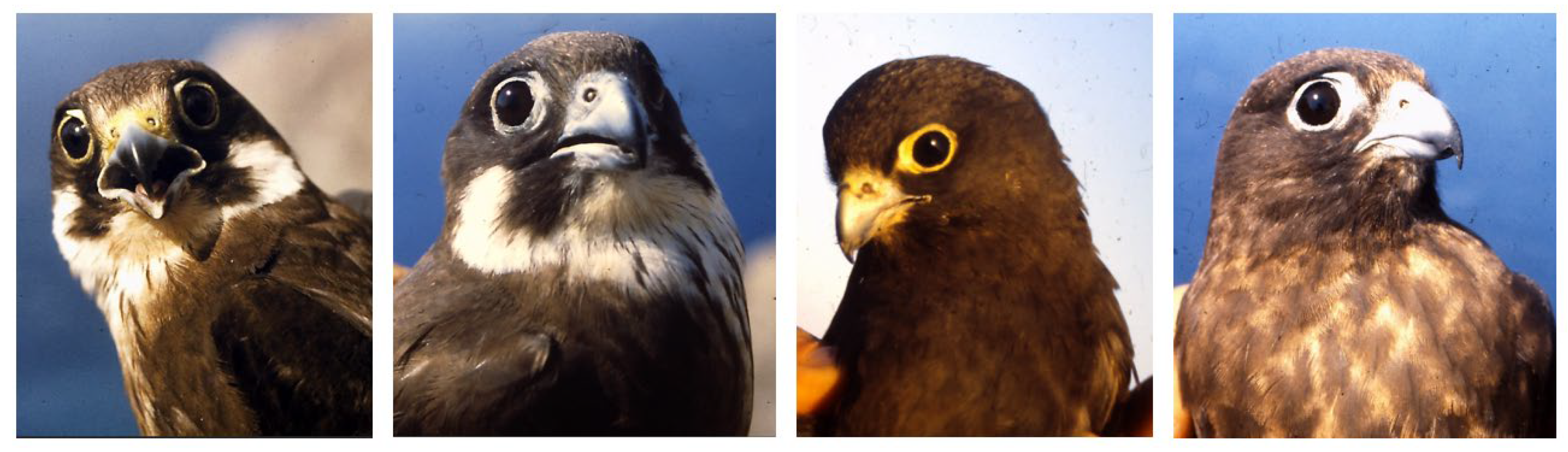
Figure 2.
Some impressions of Eleonora’s Falcon breeding sites: A. Breeding islands with their typical breeding habitat in the foreground, B. an adult male at its nest site, C. a clutch of two eggs, and D. three nestlings in September; quite often the third one is retarded (photos: M. Wink, D. Ristow).
Figure 2.
Some impressions of Eleonora’s Falcon breeding sites: A. Breeding islands with their typical breeding habitat in the foreground, B. an adult male at its nest site, C. a clutch of two eggs, and D. three nestlings in September; quite often the third one is retarded (photos: M. Wink, D. Ristow).
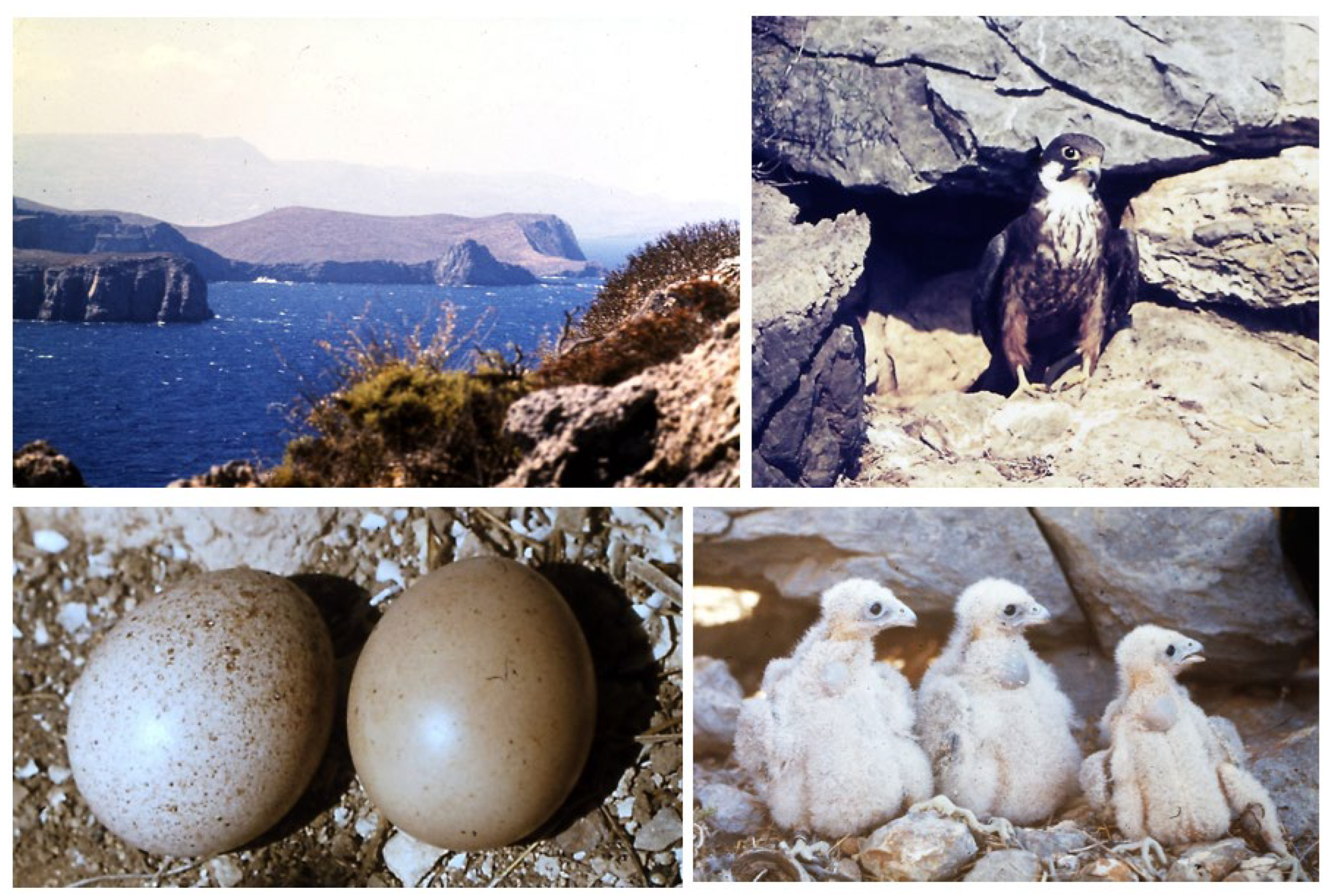
Figure 3.
Simplified phenology of Eleonora’s Falcon in the Aegean Sea (adapted from Ristow et al., 1983; Ristow & Wink, 2024). Green bars indicate the non-breeding season, and red bars the breeding season.
Figure 3.
Simplified phenology of Eleonora’s Falcon in the Aegean Sea (adapted from Ristow et al., 1983; Ristow & Wink, 2024). Green bars indicate the non-breeding season, and red bars the breeding season.
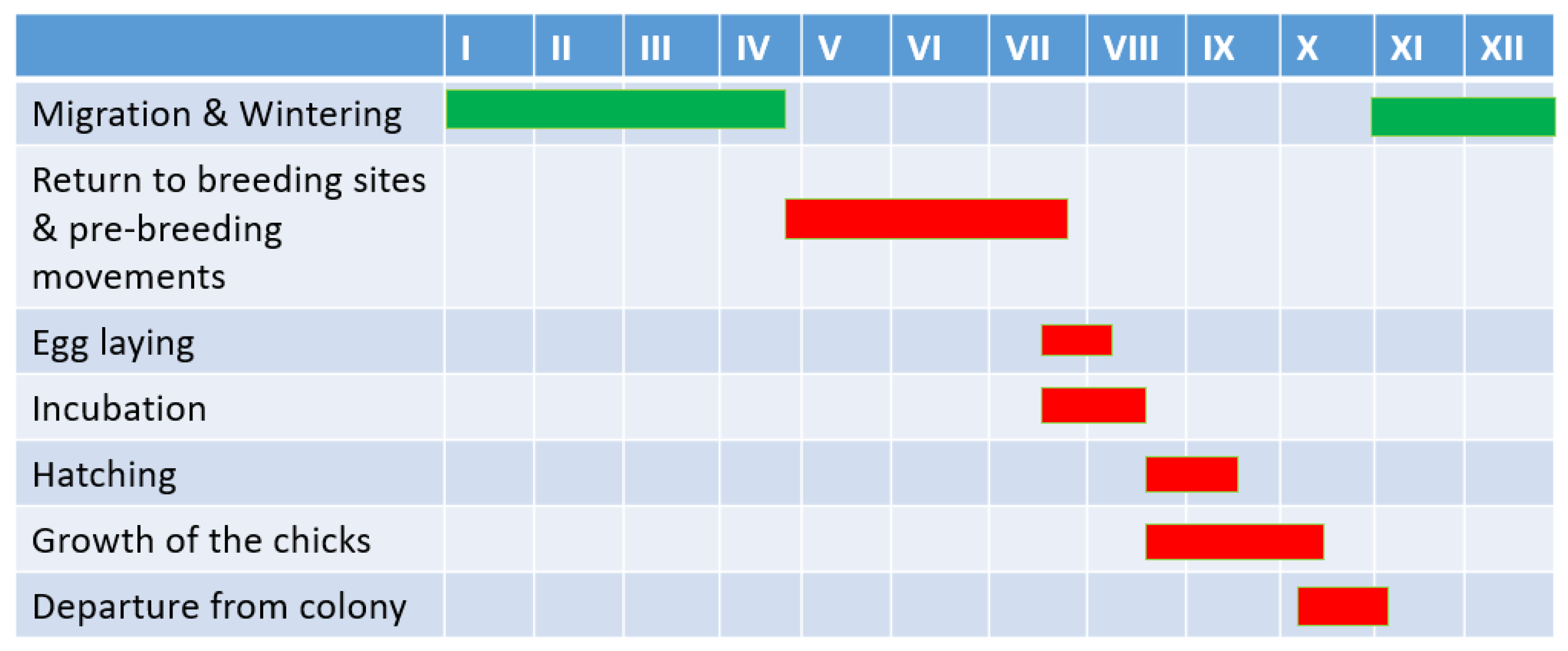
Figure 4.
Molecular phylogeny and character evolution of Eleonora’s Falcon and related species. Tree reconstruction after Fuchs et al. (2015), Wink & Ristow (2010), and Wink (2018). Data for traits are from Clark et al. (2020), Debus et al. (2024), Kemp et al. (2020), and Orta et al. (2020a, b, c). D = dark coloration; p = pale coloration. Photos from Wikimedia.
Figure 4.
Molecular phylogeny and character evolution of Eleonora’s Falcon and related species. Tree reconstruction after Fuchs et al. (2015), Wink & Ristow (2010), and Wink (2018). Data for traits are from Clark et al. (2020), Debus et al. (2024), Kemp et al. (2020), and Orta et al. (2020a, b, c). D = dark coloration; p = pale coloration. Photos from Wikimedia.
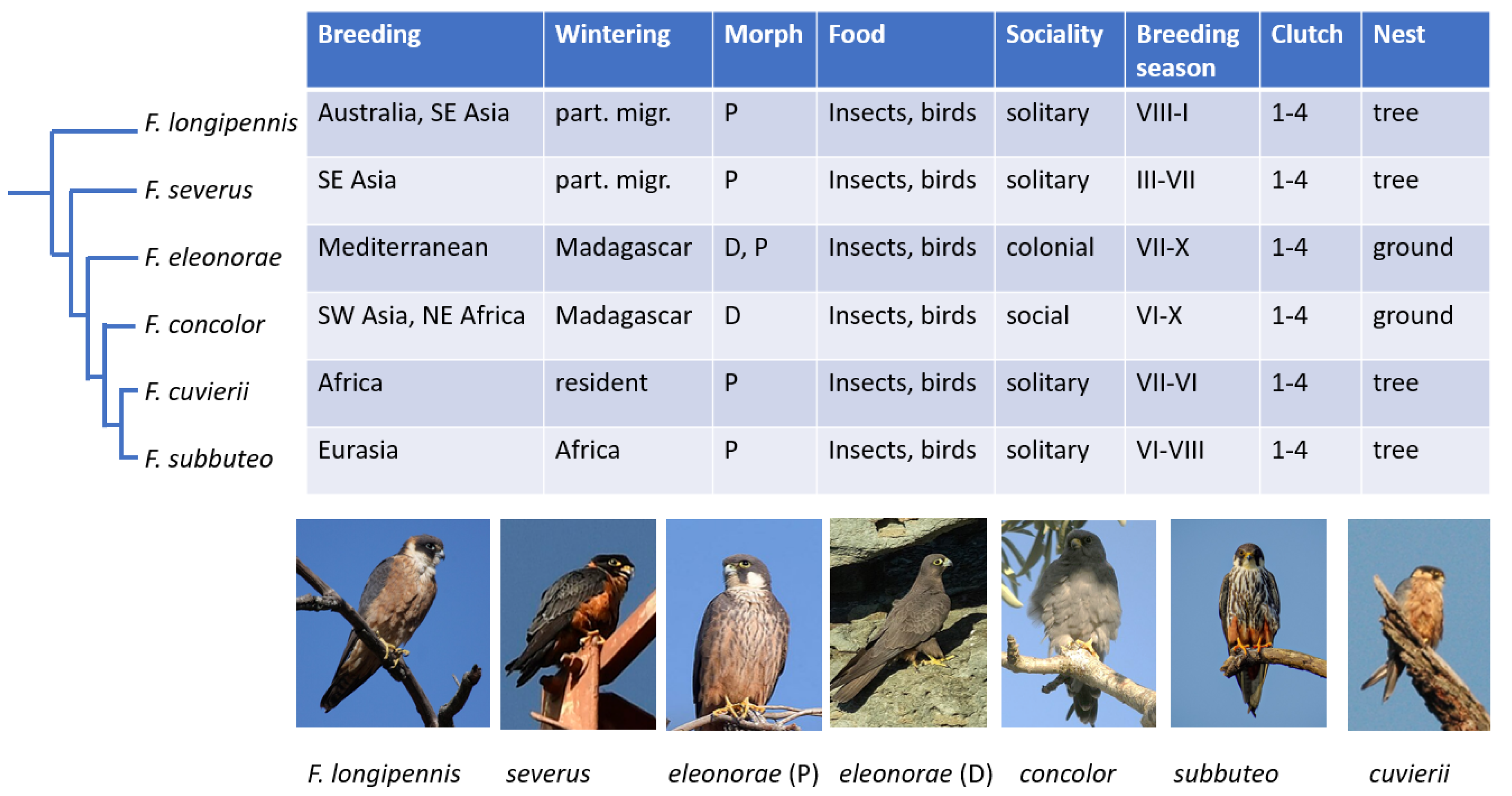
Figure 5.
Breeding distribution of Eleonora’s Falcon in the European Bird Breeding Atlas 2 (EBBA2) (Keller et al., 2020). Some squares in Spain and Italy were mapped as “possible breeding,” even though active colonies are in fact present (Table 1).
Figure 5.
Breeding distribution of Eleonora’s Falcon in the European Bird Breeding Atlas 2 (EBBA2) (Keller et al., 2020). Some squares in Spain and Italy were mapped as “possible breeding,” even though active colonies are in fact present (Table 1).
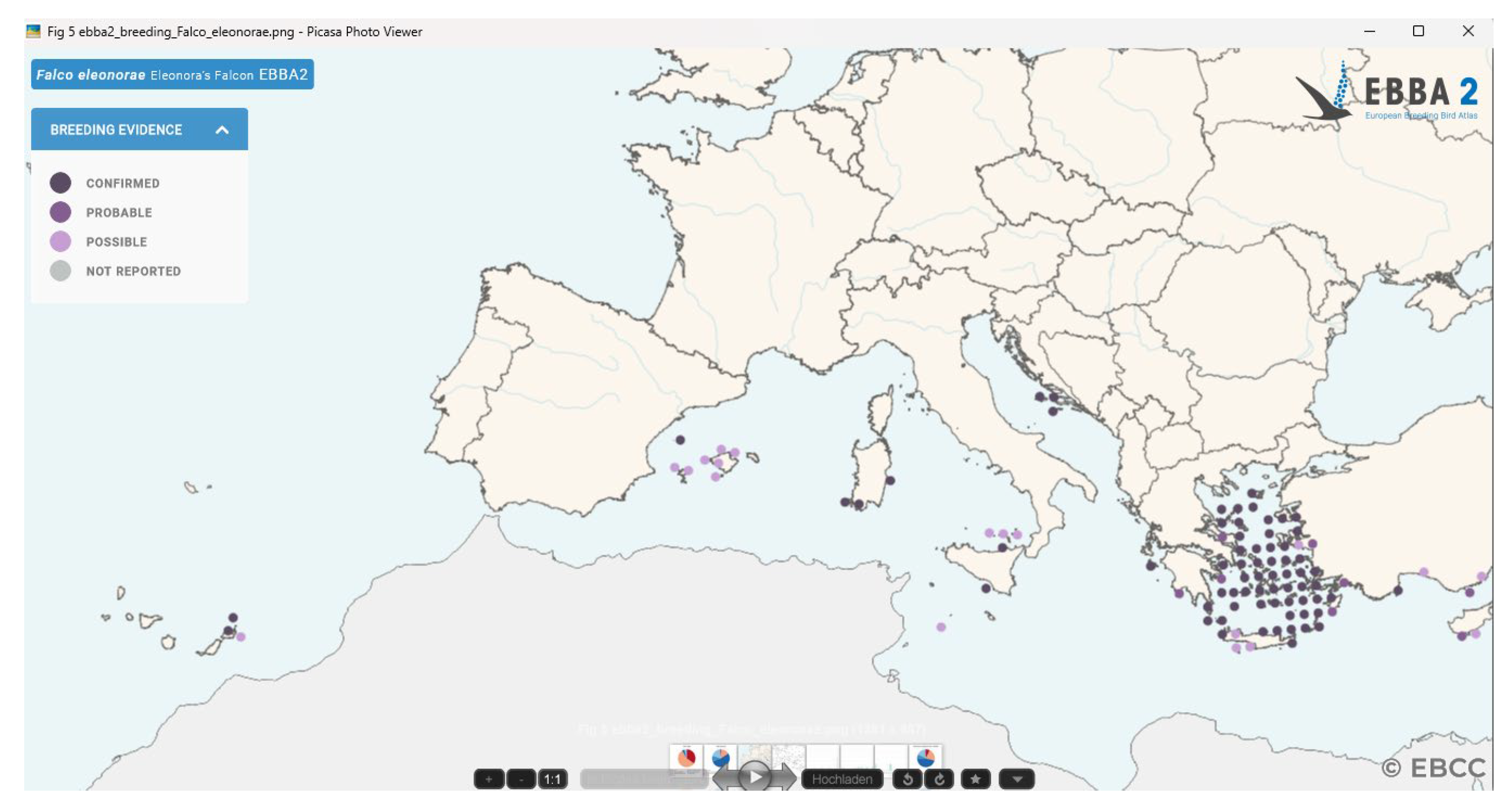
Figure 6.
Localization of known and existing breeding colonies of Eleonora’s Falcon incorporating data from Table 1. (Raw map: https://d-maps.com/). As there are many colonies in the Aegean Sea (Table 1), individual colonies are not marked but represented by a larger circle.
Figure 6.
Localization of known and existing breeding colonies of Eleonora’s Falcon incorporating data from Table 1. (Raw map: https://d-maps.com/). As there are many colonies in the Aegean Sea (Table 1), individual colonies are not marked but represented by a larger circle.
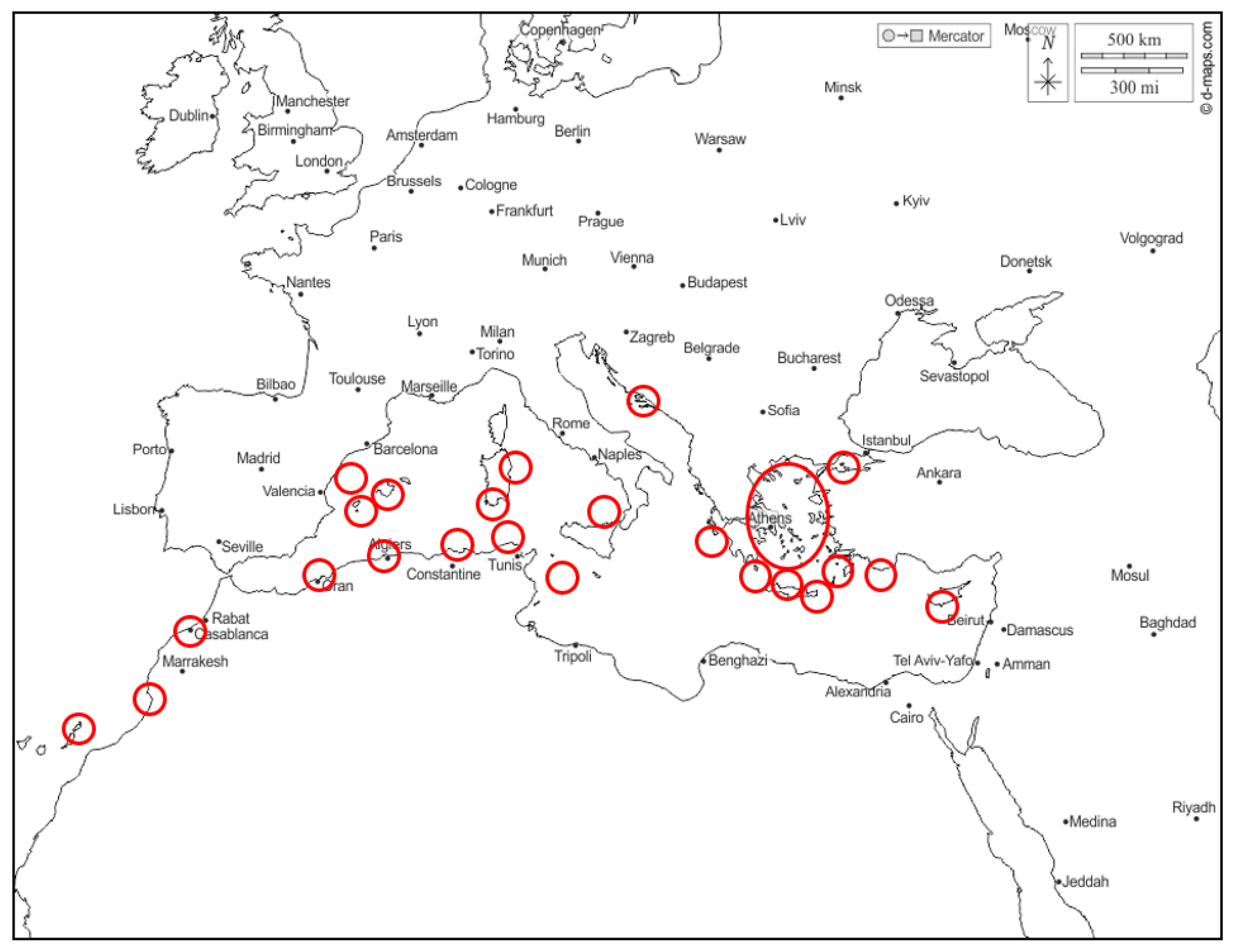
Figure 7.
Size classes of breeding colonies of Eleonora’s Falcon in Greece (Modified from Dimalexis et al., 2008).
Figure 7.
Size classes of breeding colonies of Eleonora’s Falcon in Greece (Modified from Dimalexis et al., 2008).
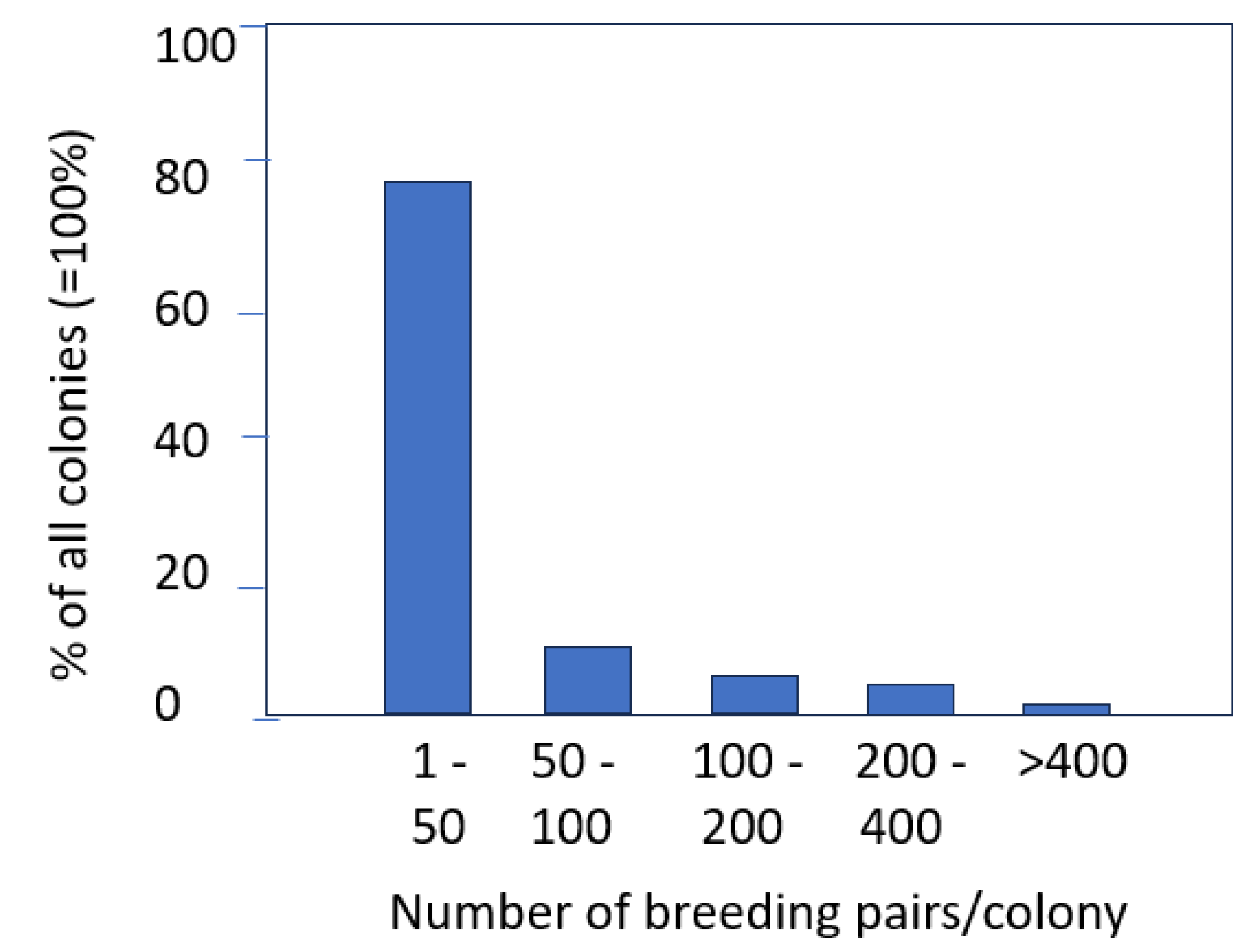
Figure 8.
Observations of Eleonora’s Falcons documented in eBird.org from January to December, 2014–2026. Violet squares represent observation data. Inexperienced birders may have difficulty distinguishing Hobby Falcons (Falco subbuteo) from pale-morph Eleonora’s Falcons, though the dark morph is usually identified correctly (Ristow & Wink, 1992). Thus, there may be ambiguity in the observation data, particularly in records from Northern Europe.
Figure 8.
Observations of Eleonora’s Falcons documented in eBird.org from January to December, 2014–2026. Violet squares represent observation data. Inexperienced birders may have difficulty distinguishing Hobby Falcons (Falco subbuteo) from pale-morph Eleonora’s Falcons, though the dark morph is usually identified correctly (Ristow & Wink, 1992). Thus, there may be ambiguity in the observation data, particularly in records from Northern Europe.
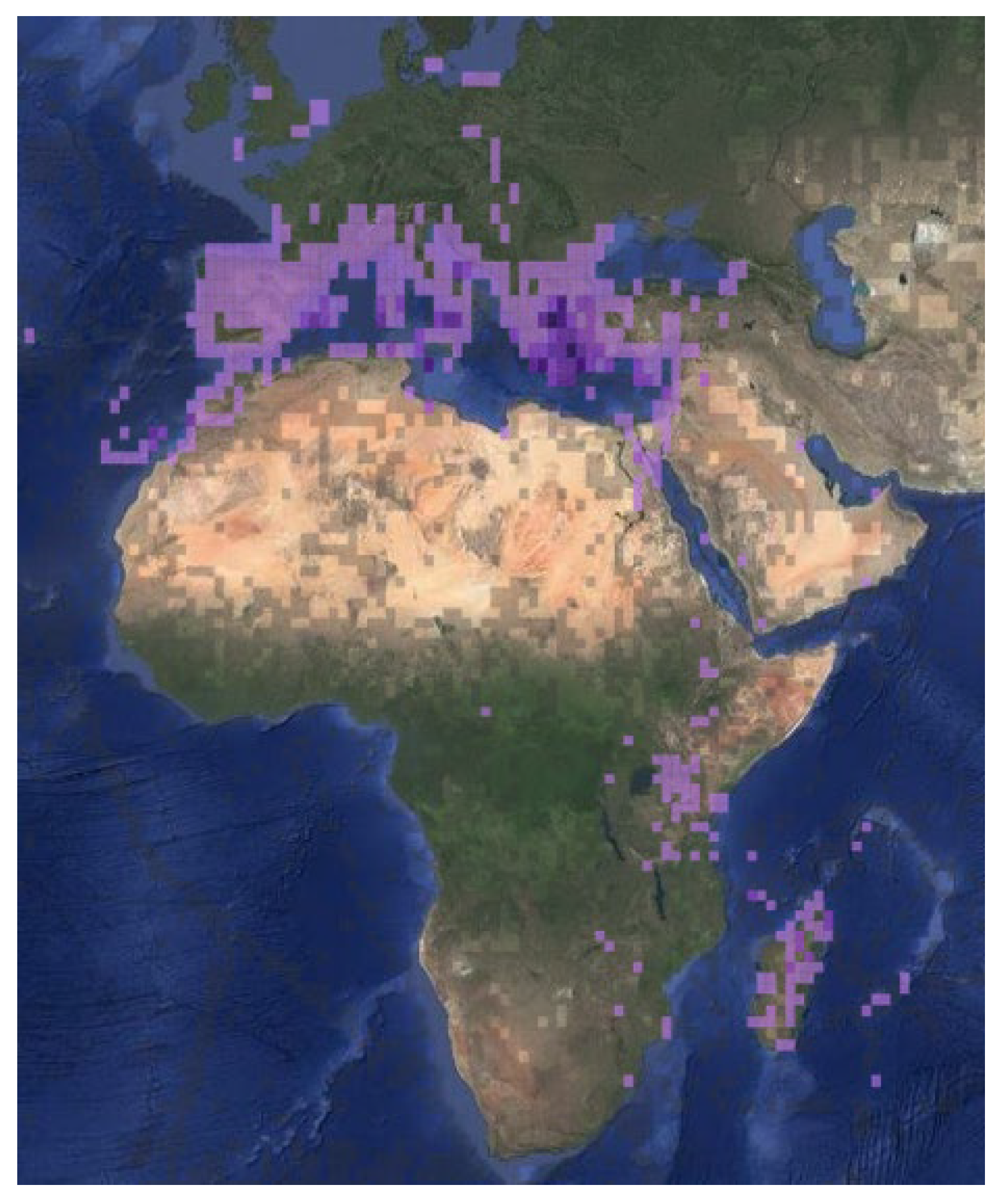
Figure 9.
Observations of Eleonora’s Falcons outside their breeding regions. Data from Ornitho, Kasparek & Ristow (1986), Ristow (2010), and Ristow & Wink (1992).
Figure 9.
Observations of Eleonora’s Falcons outside their breeding regions. Data from Ornitho, Kasparek & Ristow (1986), Ristow (2010), and Ristow & Wink (1992).
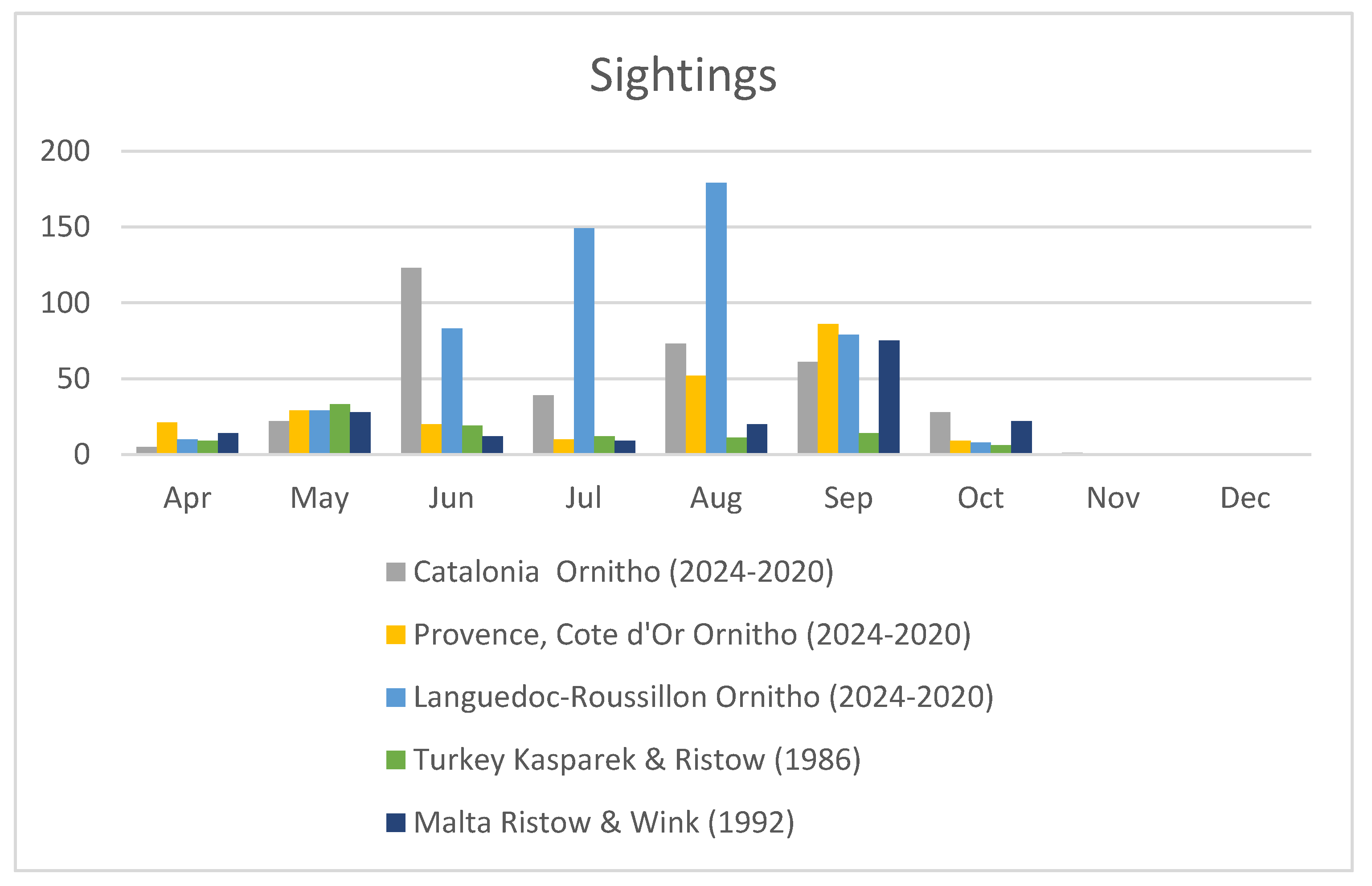
Figure 10.
Overview of recoveries of Eleonora’s Falcons ringed on Alegranza, the Columbretes, Paximada, and Cyprus. For clarity, tracks leading to similar recovery sites (e.g., Madagascar) or sites within 100 km of the ringing site have been omitted. Data are from Ristow (1975, 2010) and Ristow & Wink (1992) (Paximada), as well as the Euring Atlas (Spain and Cyprus) (Spina et al., 2022). (Raw map: https://d-maps.com).
Figure 10.
Overview of recoveries of Eleonora’s Falcons ringed on Alegranza, the Columbretes, Paximada, and Cyprus. For clarity, tracks leading to similar recovery sites (e.g., Madagascar) or sites within 100 km of the ringing site have been omitted. Data are from Ristow (1975, 2010) and Ristow & Wink (1992) (Paximada), as well as the Euring Atlas (Spain and Cyprus) (Spina et al., 2022). (Raw map: https://d-maps.com).
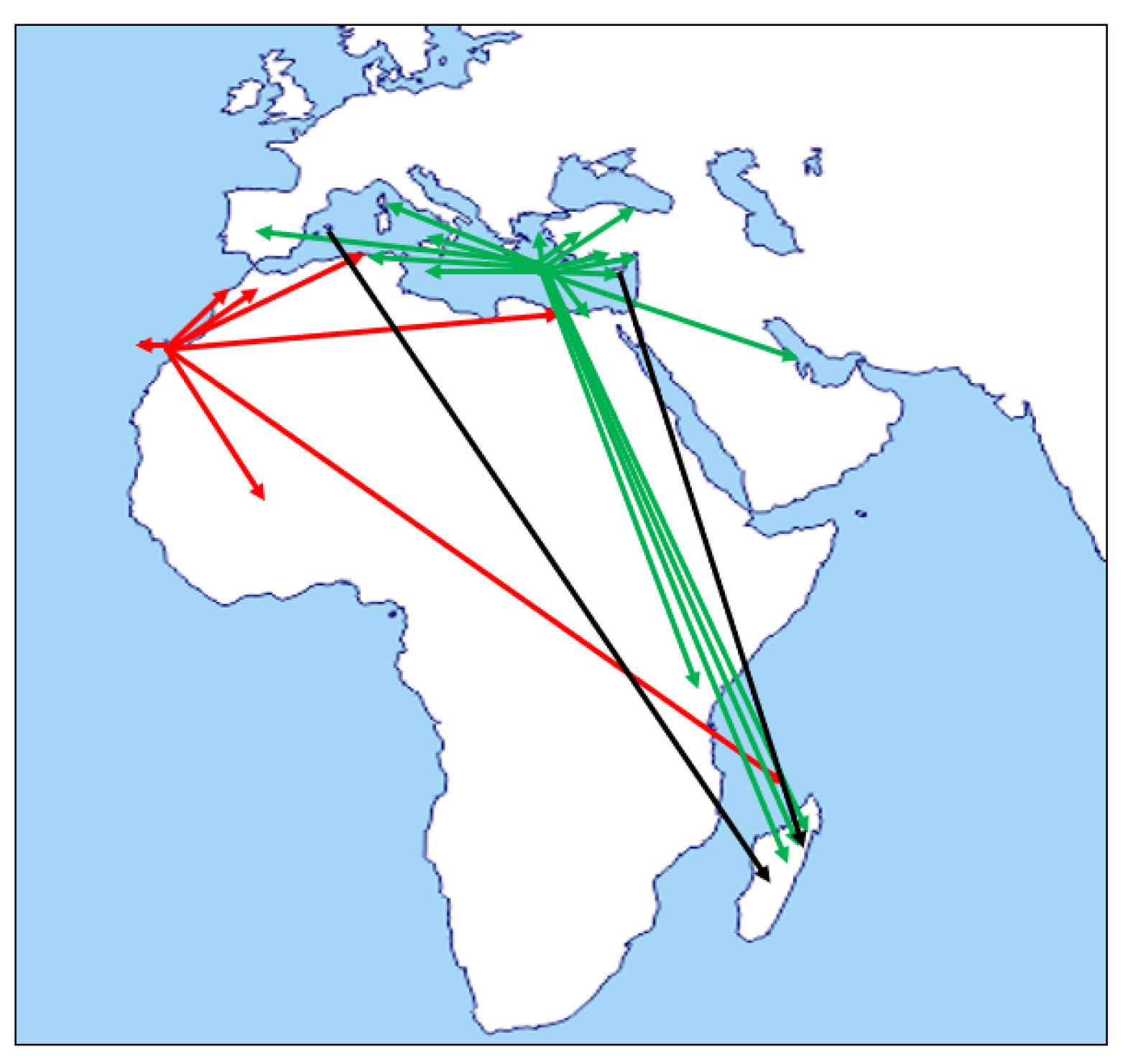
Figure 11.
Simplified illustration of the migration routes of Eleonora’s Falcons from their breeding colonies in the Canary Islands, the Balearic Islands, Sardinia, Tunisia, the Aegean Sea, and Cyprus to Madagascar. These routes were derived from studies that used satellite and GPS telemetry. Autumn migration: red lines for adults, green lines for juveniles (first-year). Spring migration: Yellow lines represent adult falcons, and green lines represent juveniles in their second calendar year. (Raw map: http://www.ginkgomaps.com/en/rl2c_xf_africa_map_satbmngtb08_jg_mres.jpg).
Figure 11.
Simplified illustration of the migration routes of Eleonora’s Falcons from their breeding colonies in the Canary Islands, the Balearic Islands, Sardinia, Tunisia, the Aegean Sea, and Cyprus to Madagascar. These routes were derived from studies that used satellite and GPS telemetry. Autumn migration: red lines for adults, green lines for juveniles (first-year). Spring migration: Yellow lines represent adult falcons, and green lines represent juveniles in their second calendar year. (Raw map: http://www.ginkgomaps.com/en/rl2c_xf_africa_map_satbmngtb08_jg_mres.jpg).
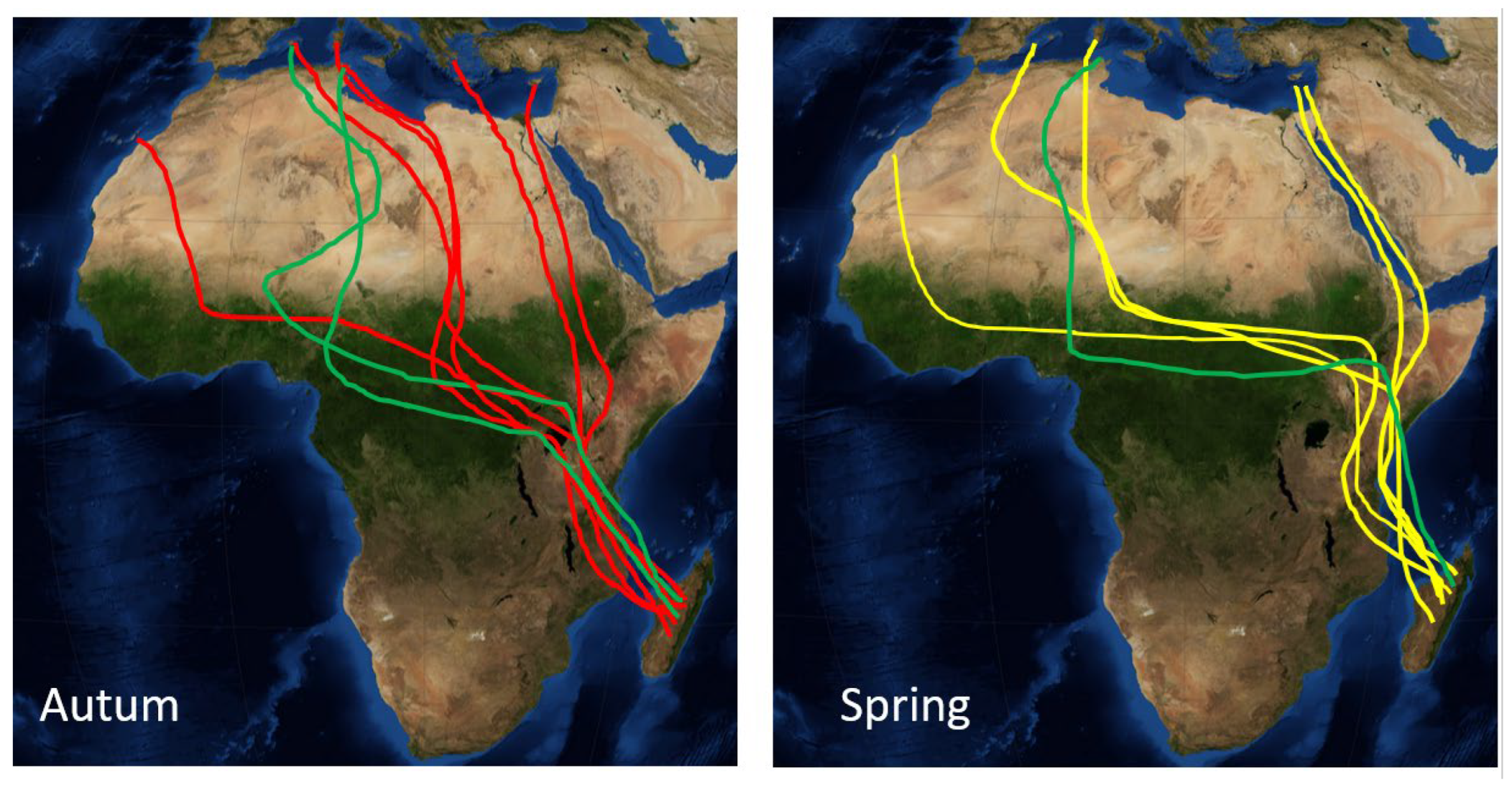
Figure 12.
Nest siblings of the “DD,” “Dp,” and “pp” genotypes; female on the left and male on the right (photos: D. Ristow).
Figure 12.
Nest siblings of the “DD,” “Dp,” and “pp” genotypes; female on the left and male on the right (photos: D. Ristow).
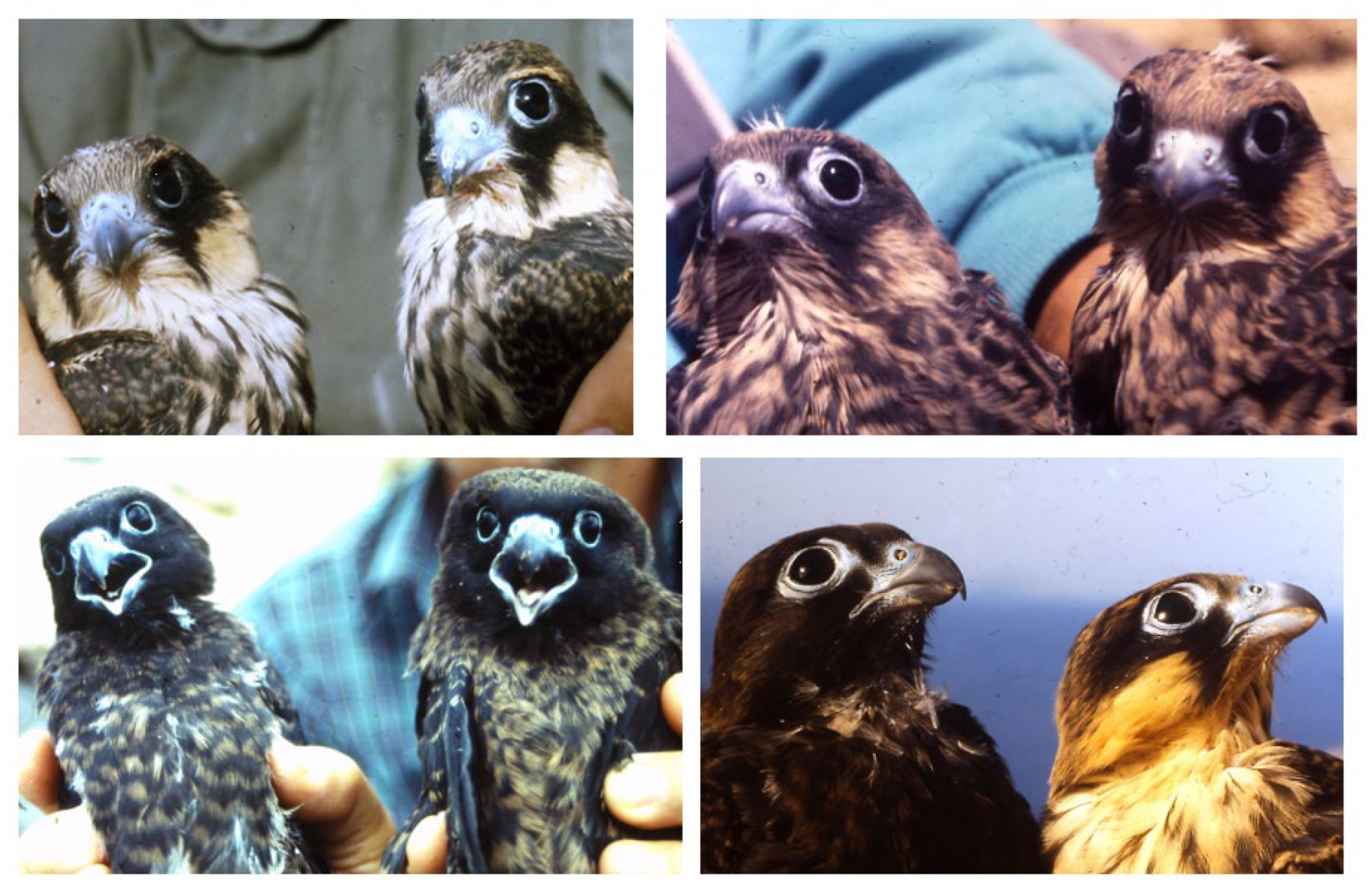
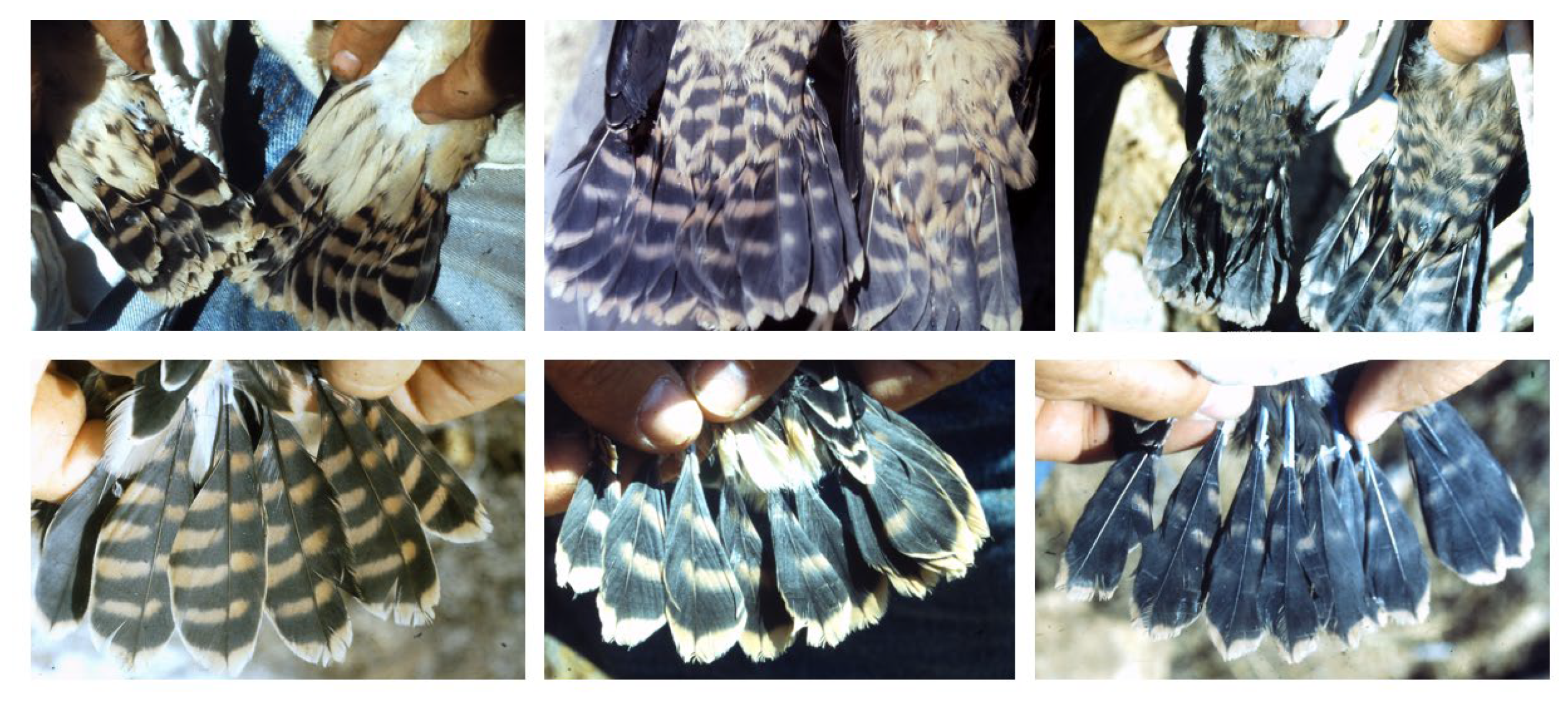
Figure 13.
Synchronization of egg laying and hatching on Paximada. A. Egg laying; blue line: dates of first eggs in a clutch; orange line: dates of egg laying (all eggs). B. Hatching: dates of hatching for 1977, 1981, and 1982.
Figure 13.
Synchronization of egg laying and hatching on Paximada. A. Egg laying; blue line: dates of first eggs in a clutch; orange line: dates of egg laying (all eggs). B. Hatching: dates of hatching for 1977, 1981, and 1982.
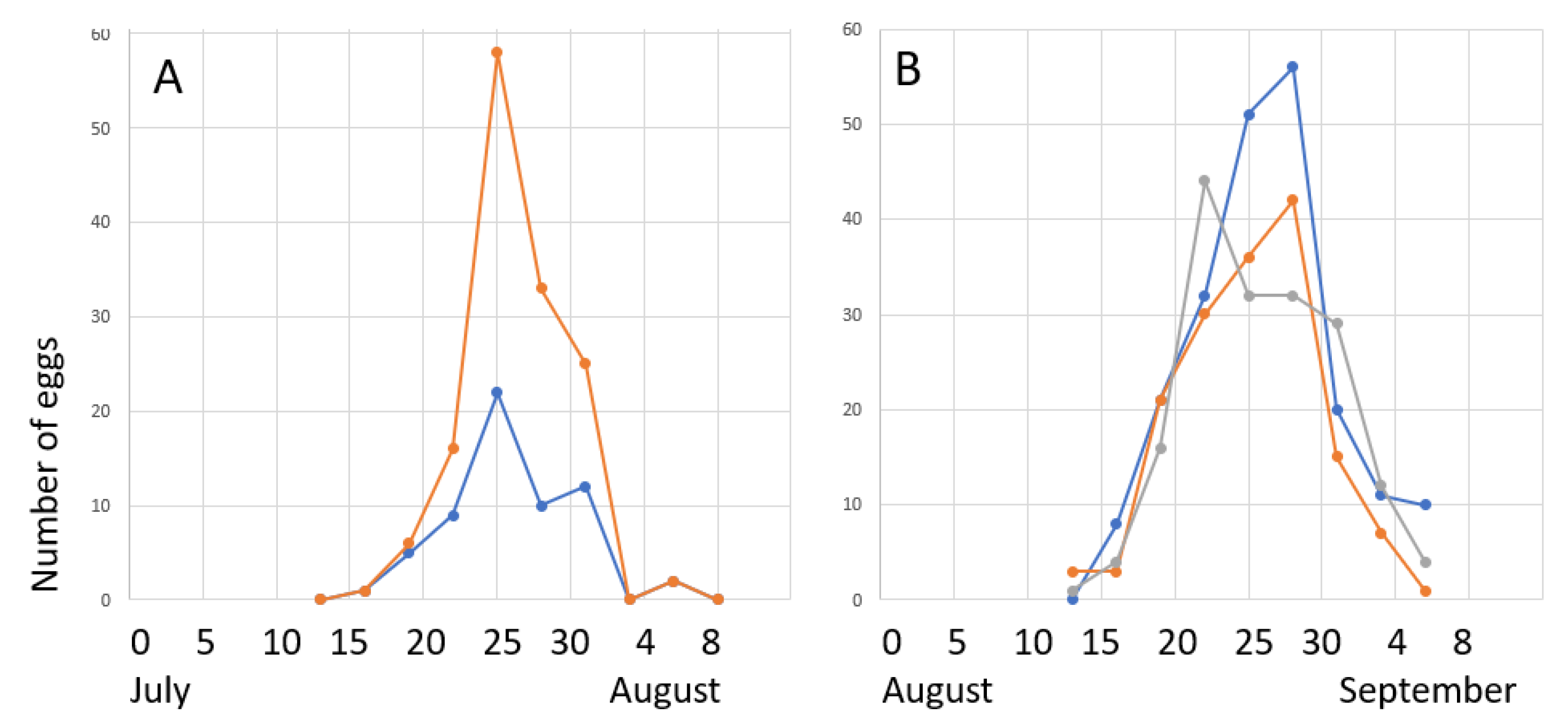
Figure 14.
Geographical variation of clutch size.
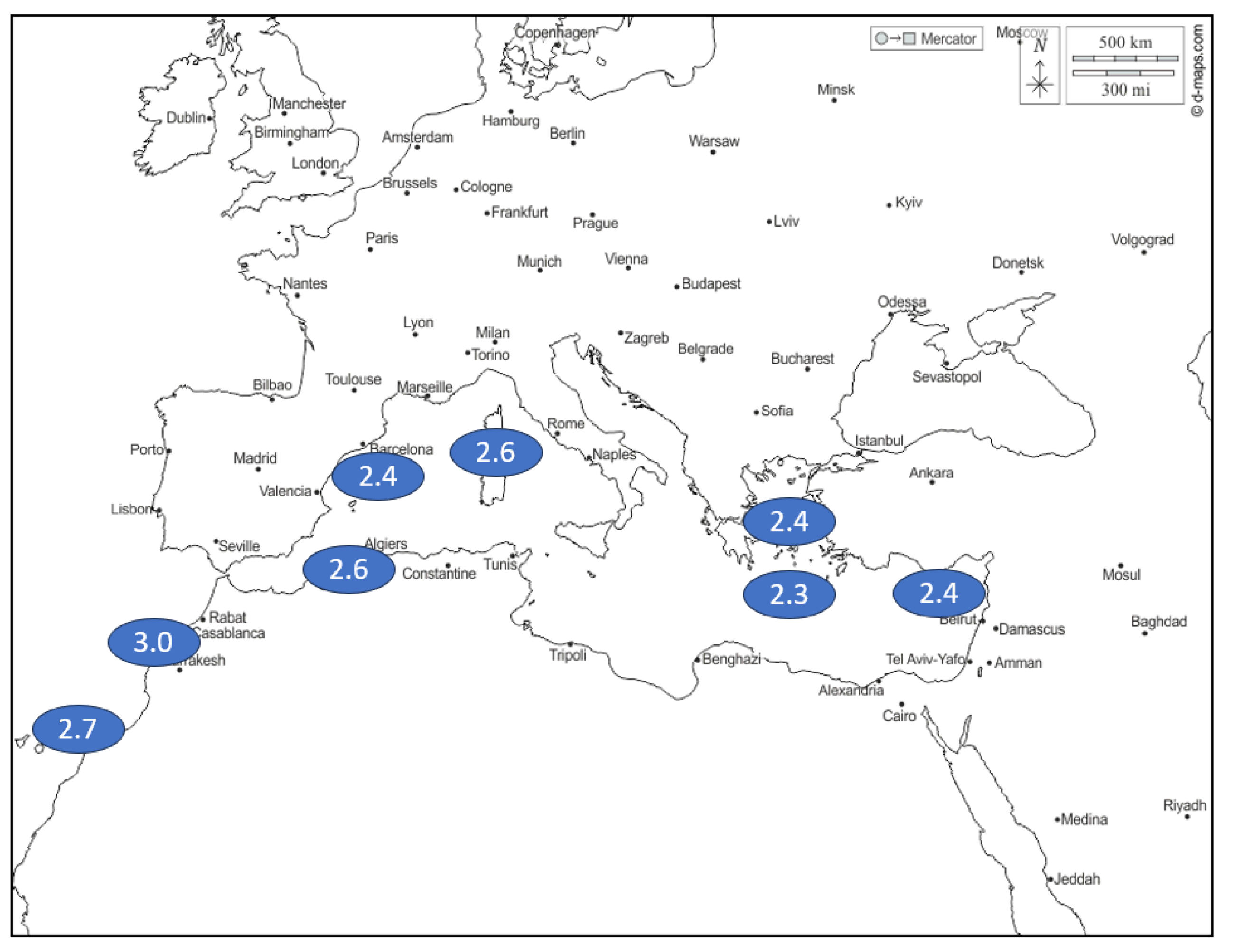
Figure 15.
Size and coloring of eggs from Eleonora’s Falcon on Paximada, Crete (photos: M. Wink).
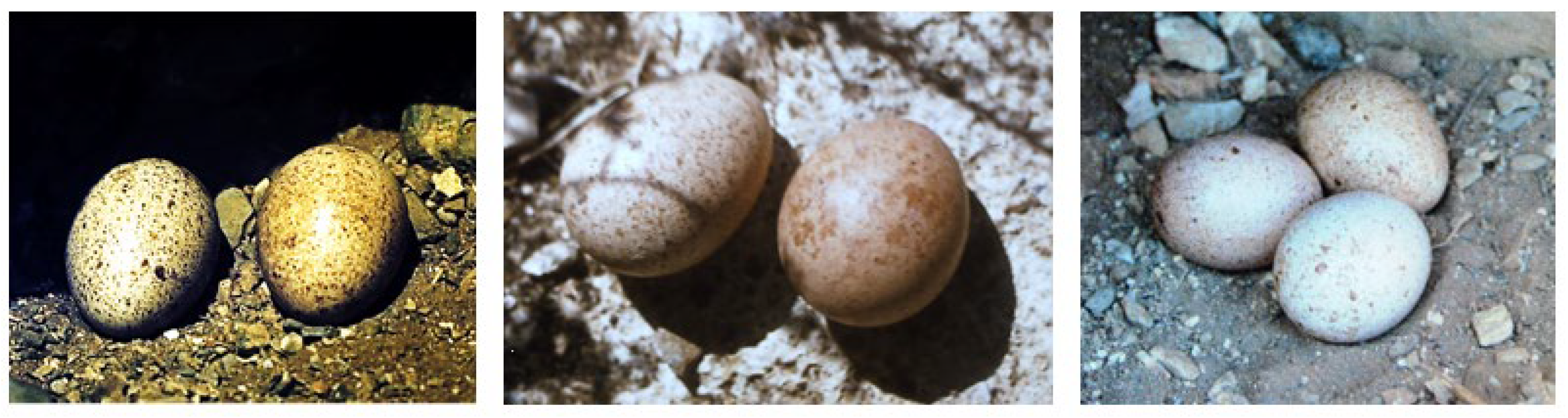
Figure 16.
Types of nest sites on Paximada, with indication of ambient temperatures and relative humidity (Redrawn from Wink et al., 1982b), and breeding success (proportion of successful broods within the colony).
Figure 16.
Types of nest sites on Paximada, with indication of ambient temperatures and relative humidity (Redrawn from Wink et al., 1982b), and breeding success (proportion of successful broods within the colony).
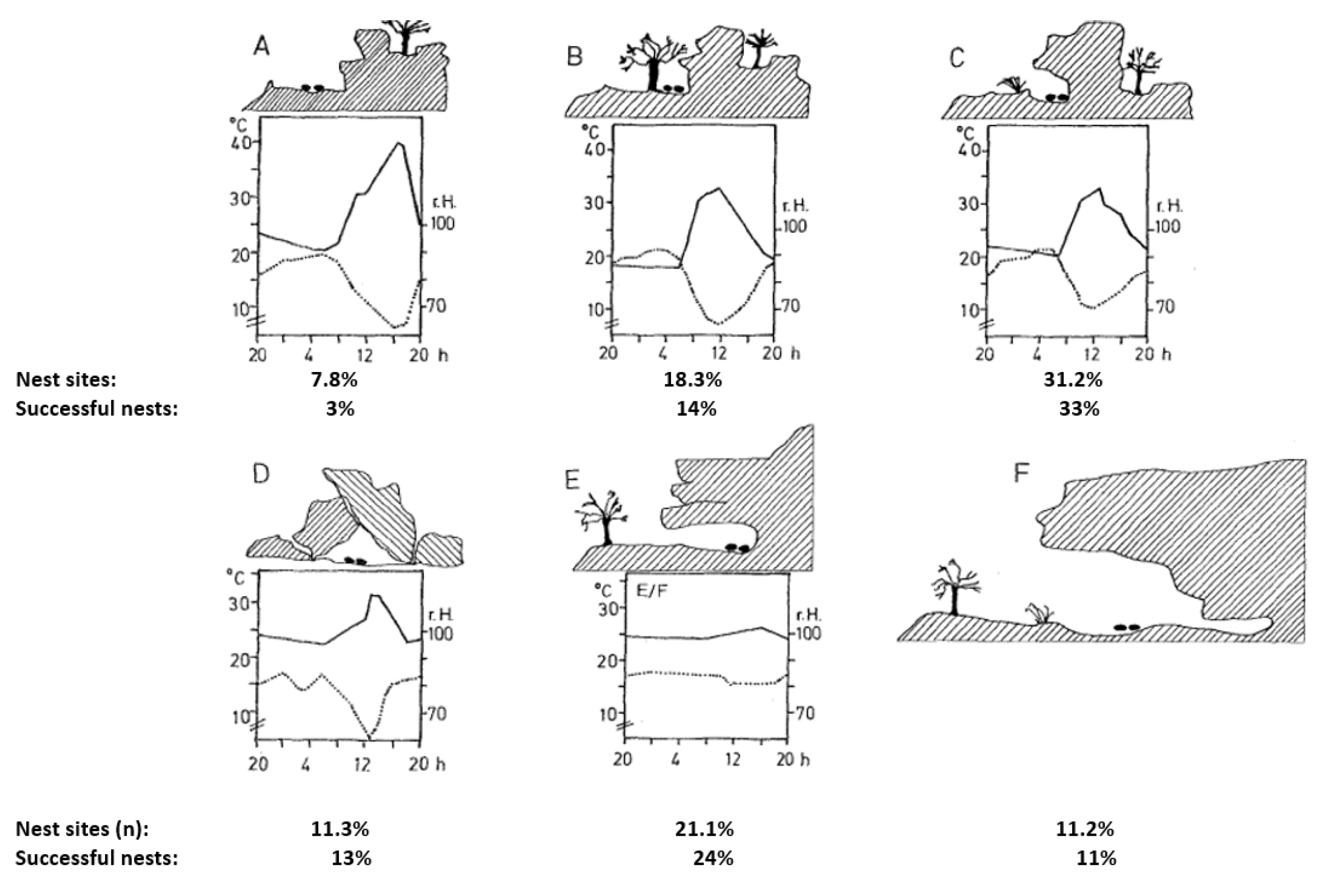
Figure 17.
Growth curves of young falcons (from Wink et al., 1993). A. Broods with two chicks; B. Broods with one nestling; C. Broods with three chicks.
Figure 17.
Growth curves of young falcons (from Wink et al., 1993). A. Broods with two chicks; B. Broods with one nestling; C. Broods with three chicks.
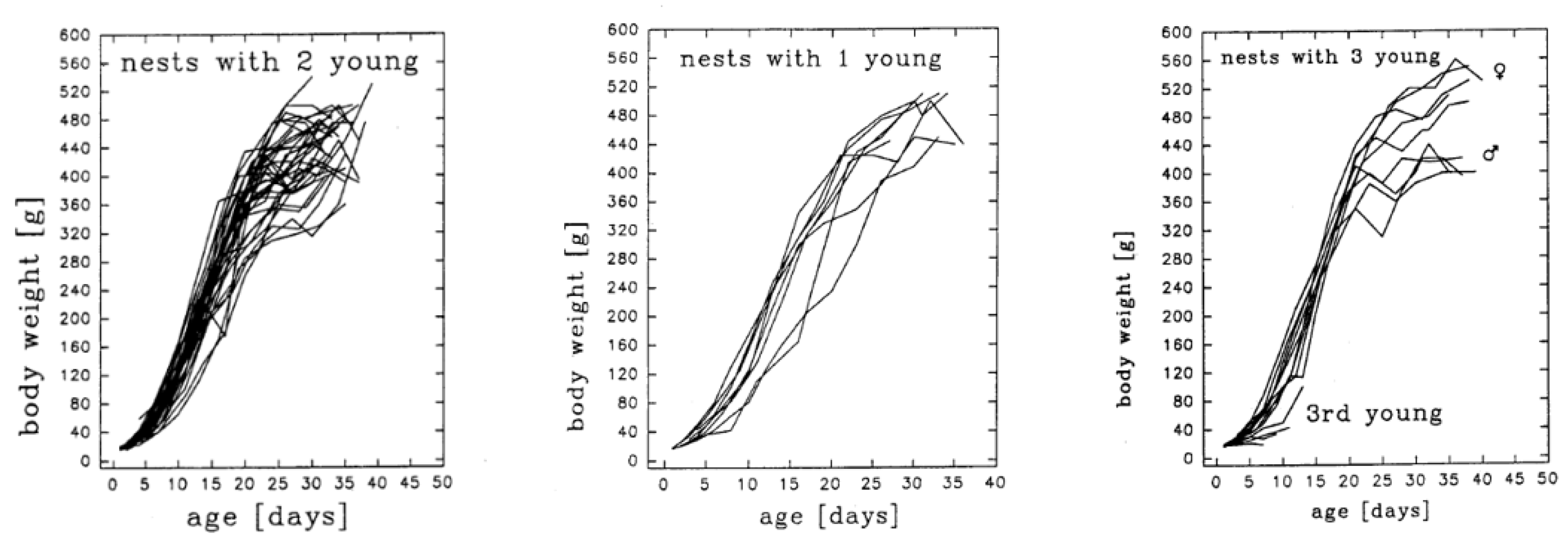
Figure 18.
Images of growing nestlings, from hatching to fledging (photos: M. Wink, D. Ristow).
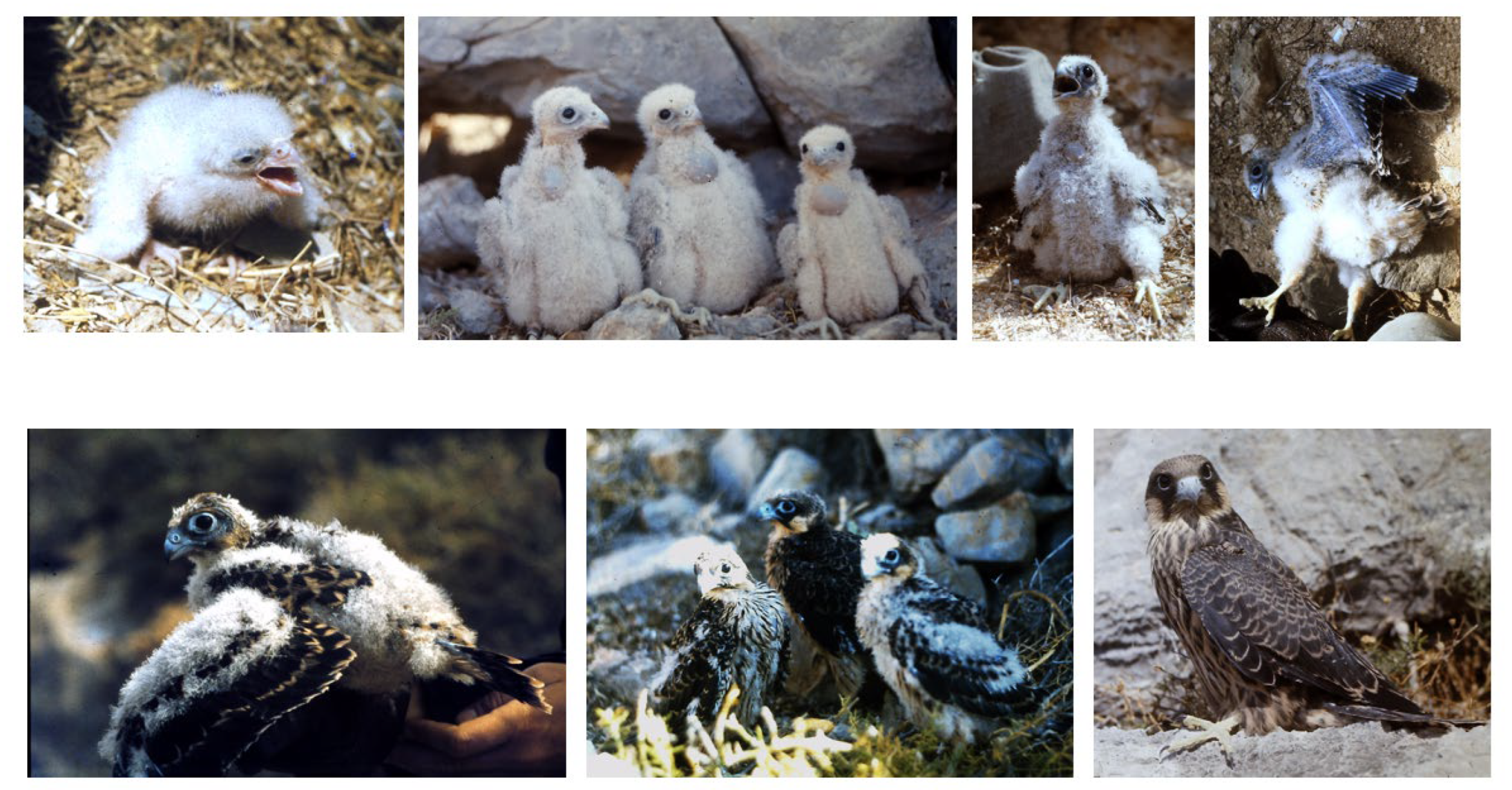
Figure 19.
Age of Eleonora’s Falcons on Paximada. A. Recoveries of falcons ringed as nestlings on Paximada outside the natal colony (Ristow, 1975, 2010; Ristow & Wink, 1992). A. Recoveries of falcons ringed as nestlings on Paximada in the natal colony. B. Re-sightings of falcons on Paximada that were color-ringed since 1980 (Ristow et al., 1991). C. Age class model based on re-sightings of color-ringed nestlings (after Ristow et al., 1991). Numbers refer to the percentage of an age class in the breeding population. Only data for eight age classes are given; the percentages for birds older than 9 years were summed up.
Figure 19.
Age of Eleonora’s Falcons on Paximada. A. Recoveries of falcons ringed as nestlings on Paximada outside the natal colony (Ristow, 1975, 2010; Ristow & Wink, 1992). A. Recoveries of falcons ringed as nestlings on Paximada in the natal colony. B. Re-sightings of falcons on Paximada that were color-ringed since 1980 (Ristow et al., 1991). C. Age class model based on re-sightings of color-ringed nestlings (after Ristow et al., 1991). Numbers refer to the percentage of an age class in the breeding population. Only data for eight age classes are given; the percentages for birds older than 9 years were summed up.
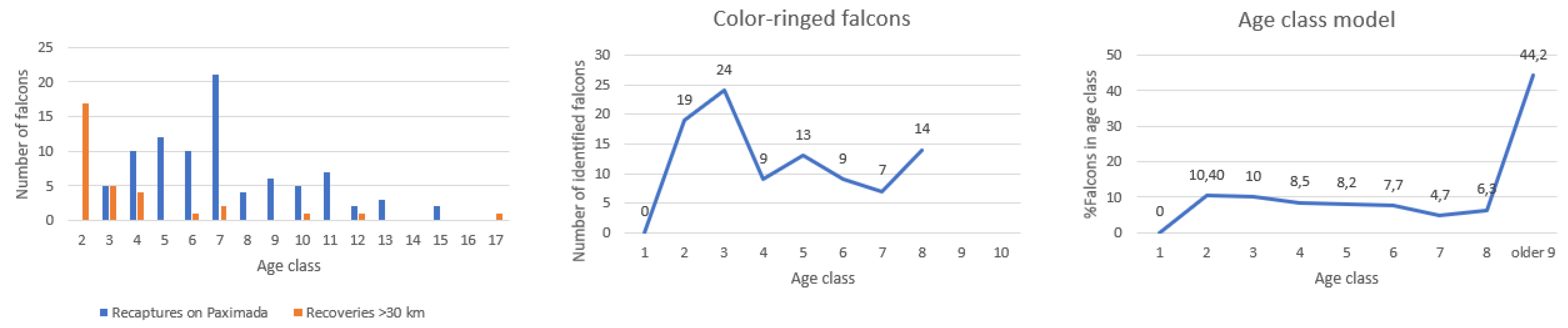
Figure 20.
Site fidelity and philopatry of Eleonora’s Falcons. A. Natal philopatry of falcons ringed as nestlings on Paximada: distance (meters) between the nest site and the later breeding territory. B. Site fidelity of adult falcons trapped and retrapped in consecutive years.
Figure 20.
Site fidelity and philopatry of Eleonora’s Falcons. A. Natal philopatry of falcons ringed as nestlings on Paximada: distance (meters) between the nest site and the later breeding territory. B. Site fidelity of adult falcons trapped and retrapped in consecutive years.
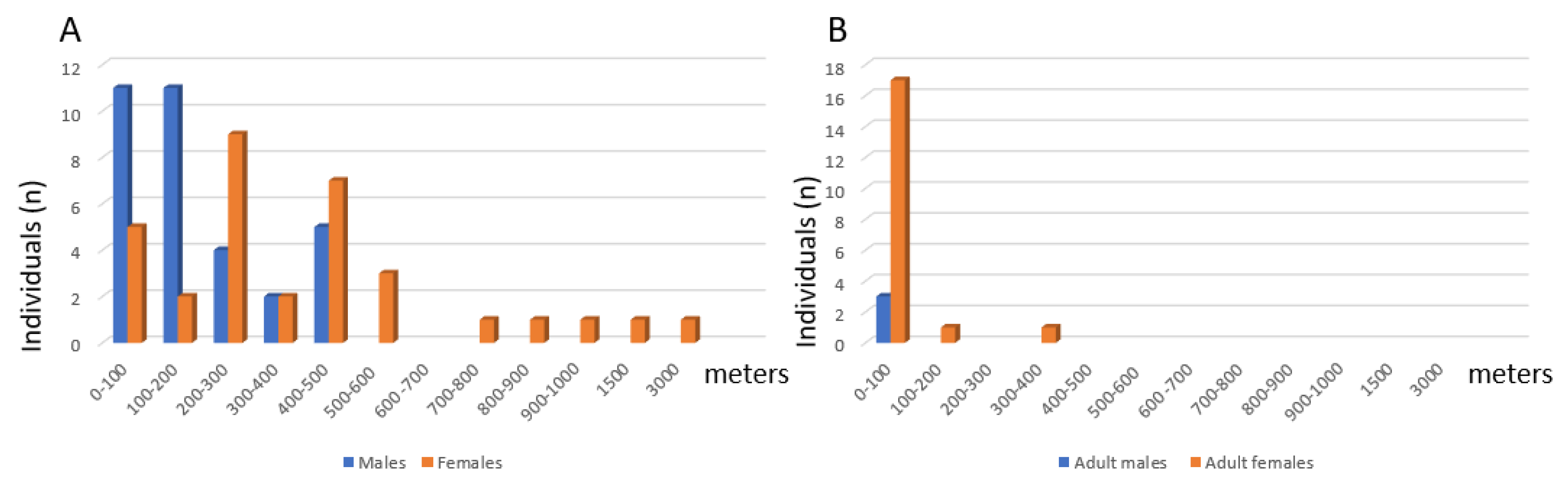
Figure 21.
Cached dead birds (Oriole, left) and plucked birds (Hoopoe, right) in or near a nest of Eleonora’s Falcon (photos: M. Wink).
Figure 21.
Cached dead birds (Oriole, left) and plucked birds (Hoopoe, right) in or near a nest of Eleonora’s Falcon (photos: M. Wink).
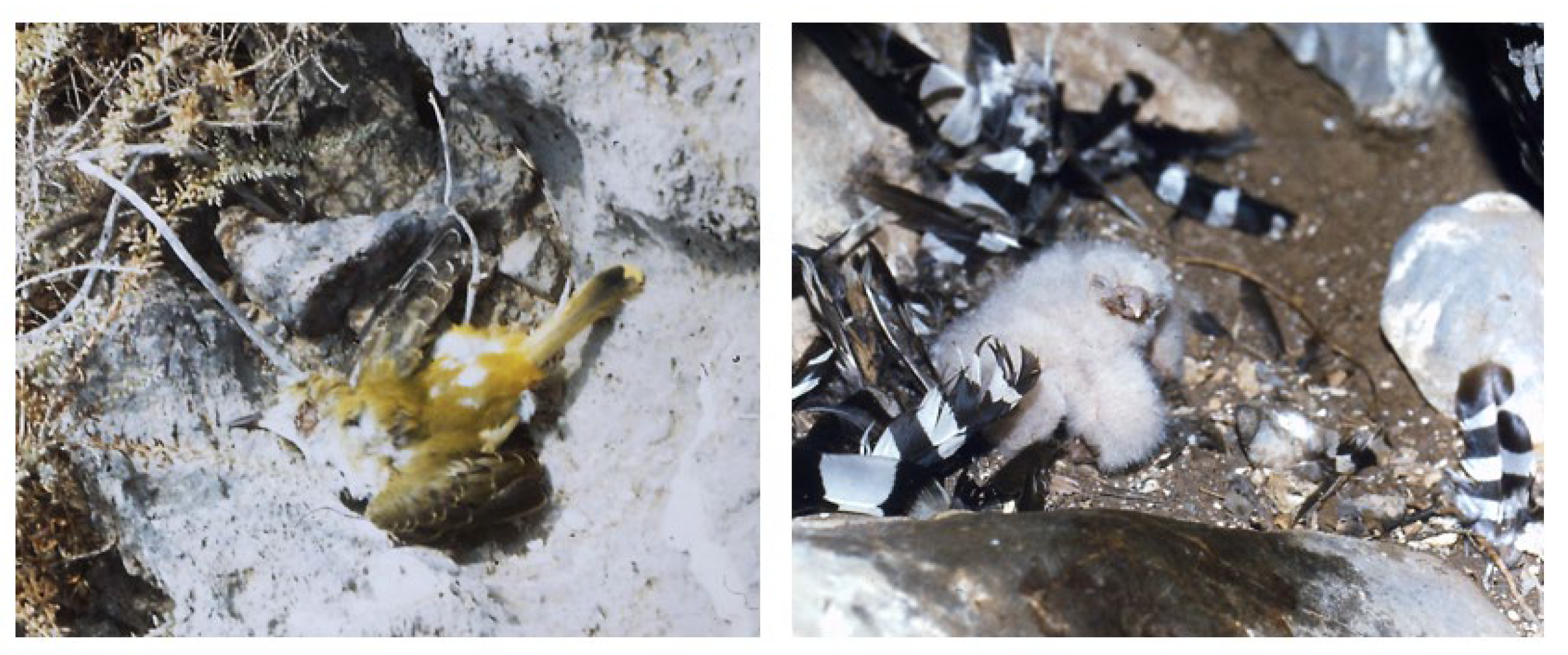
Figure 22.
The youngest and weakest chick in a brood of two or three nestlings is sometimes killed and eaten by the stronger siblings. Three young with full crops (left); two nestlings with empty crops and the smallest sibling, dead, with fresh wounds on the leg (right) (in a different nest) (photos: M. Wink).
Figure 22.
The youngest and weakest chick in a brood of two or three nestlings is sometimes killed and eaten by the stronger siblings. Three young with full crops (left); two nestlings with empty crops and the smallest sibling, dead, with fresh wounds on the leg (right) (in a different nest) (photos: M. Wink).
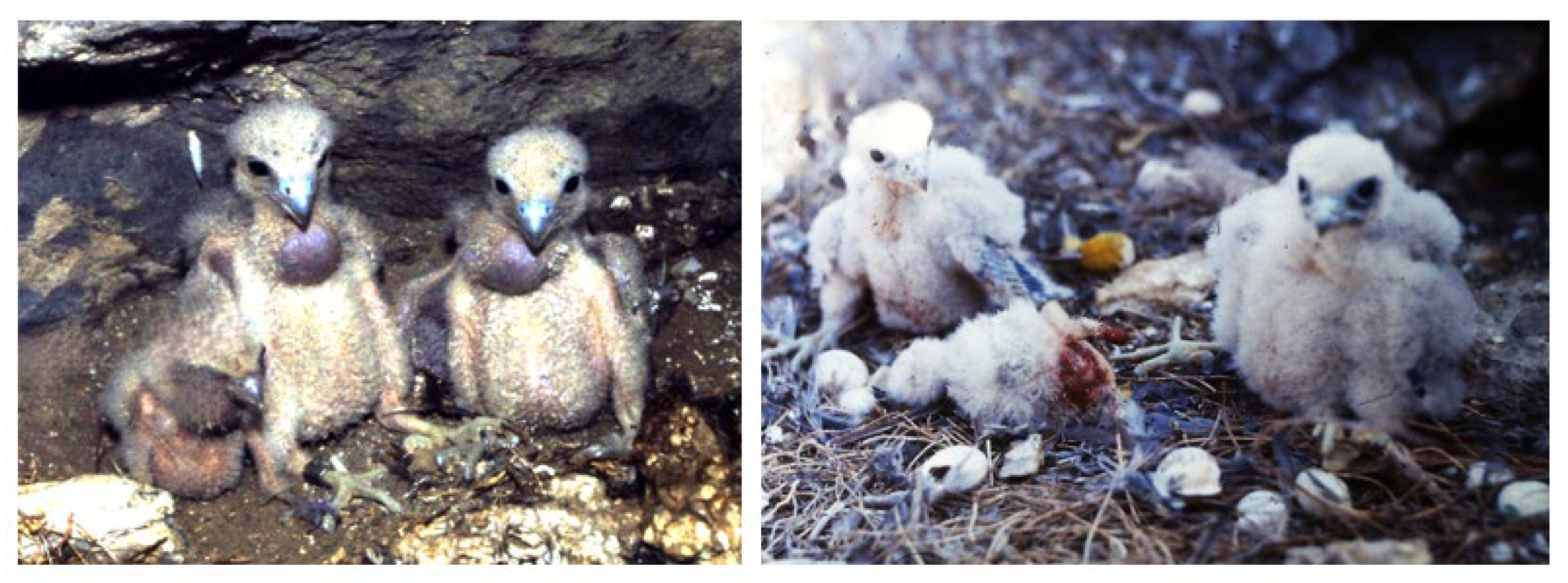

Table 1.
List of known breeding colonies and estimated numbers of breeding pairs of Eleonora’s Falcon.
Table 1.
List of known breeding colonies and estimated numbers of breeding pairs of Eleonora’s Falcon.
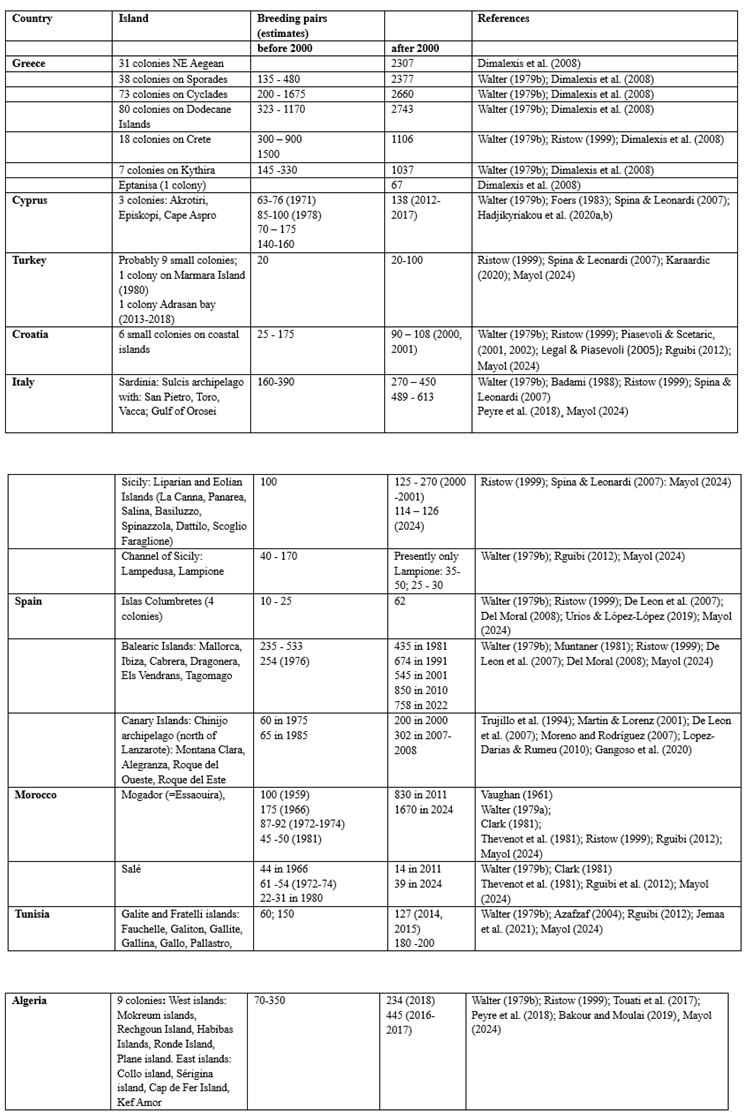 |
Table 2.
Historical and recent population estimates for Eleonora’s Falcon according to Walter (1979b), Portolou et al. (2008), Dimalexis et al. (2008), and Mayol (2024) + = increase; ++ = substantial increase.
Table 2.
Historical and recent population estimates for Eleonora’s Falcon according to Walter (1979b), Portolou et al. (2008), Dimalexis et al. (2008), and Mayol (2024) + = increase; ++ = substantial increase.
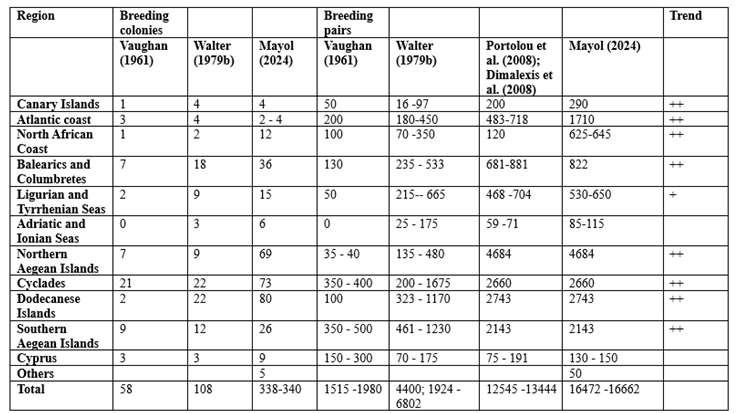 |
Table 3.
Summary of GPS and satellite telemetry studies.
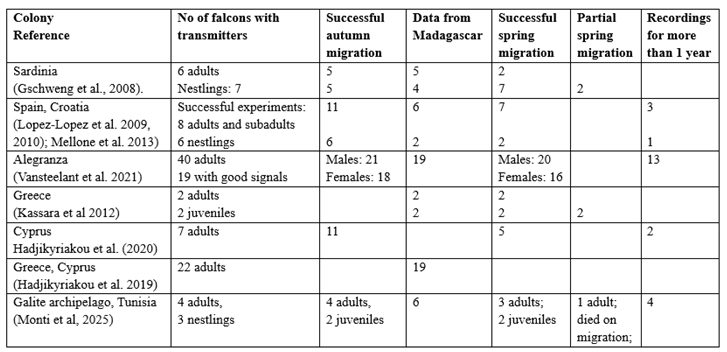 |
Table 4.
Phenology and characteristics of the autumn and spring migration of Eleonora’s Falcons equipped with satellite or GPS transmitters.
Table 4.
Phenology and characteristics of the autumn and spring migration of Eleonora’s Falcons equipped with satellite or GPS transmitters.
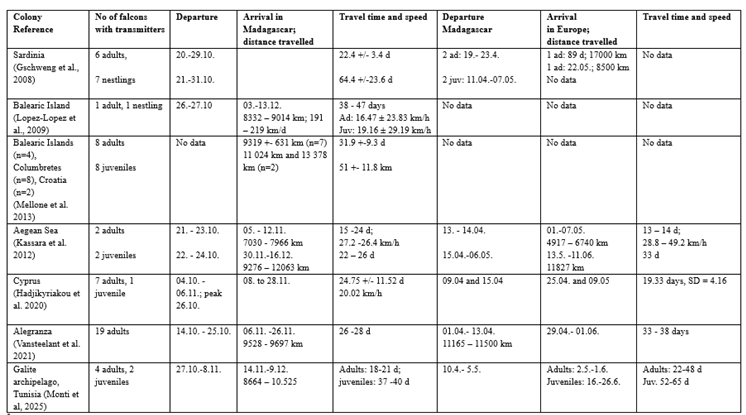 |
Table 5.
Documentation of the body mass, wing length, tail length, and bill length of adult falcons and fledglings (from Cramp & Simmons, 1980, and Wink et al., 1982).
Table 5.
Documentation of the body mass, wing length, tail length, and bill length of adult falcons and fledglings (from Cramp & Simmons, 1980, and Wink et al., 1982).
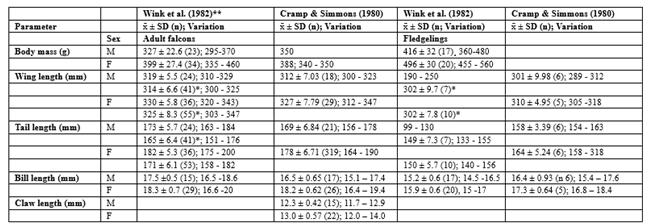 |
Table 6.
Geographical variation of the abundance of Eleonora’s Falcon morphs. N. a. = not distinguished; was included in “Dp” phenotype counts.
Table 6.
Geographical variation of the abundance of Eleonora’s Falcon morphs. N. a. = not distinguished; was included in “Dp” phenotype counts.
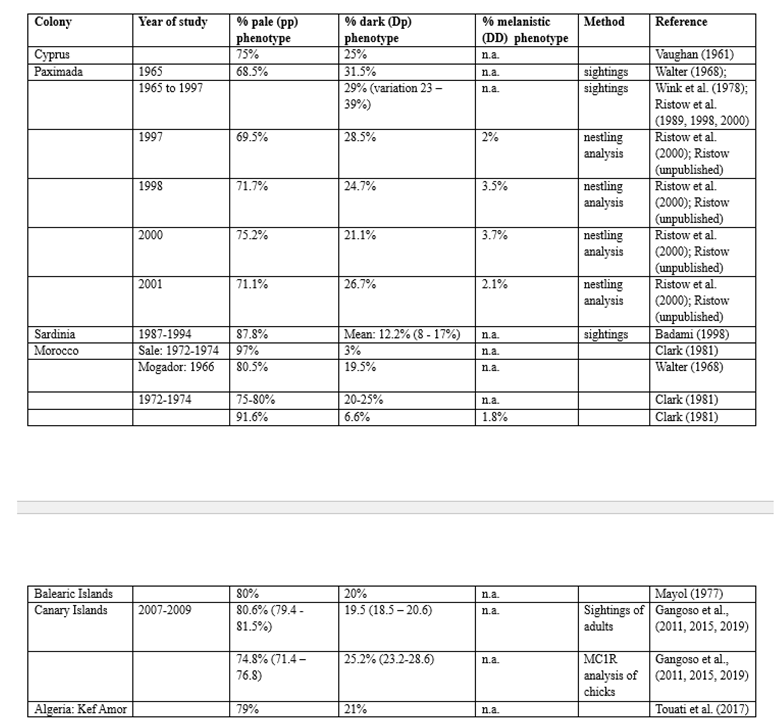 |
Table 7.
Breeding success in different colonies of Eleonora’s Falcon.
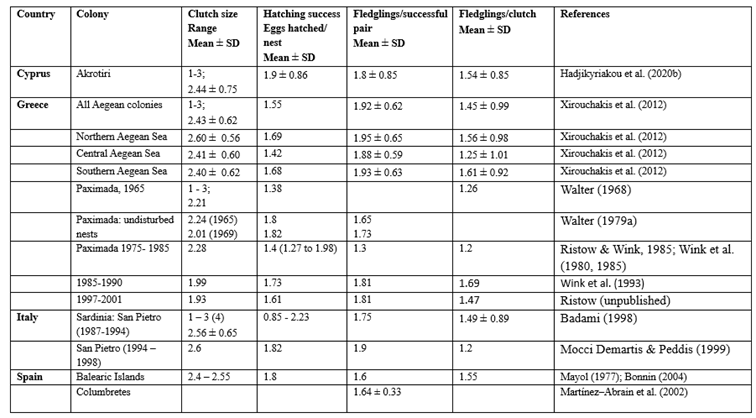 |
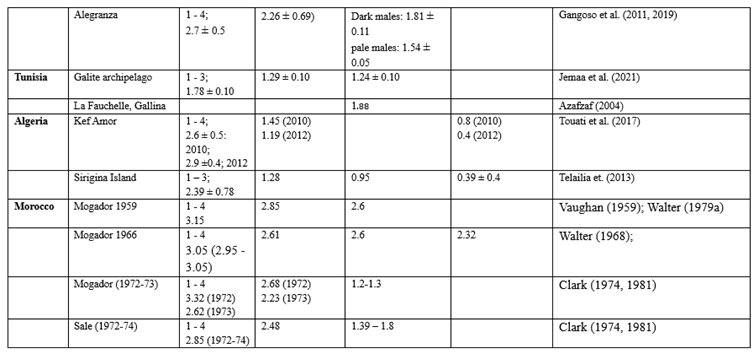 |
Table 8.
Variation in clutch size, hatching success, fledging success, and productivity across clutches of different sizes.
Table 8.
Variation in clutch size, hatching success, fledging success, and productivity across clutches of different sizes.
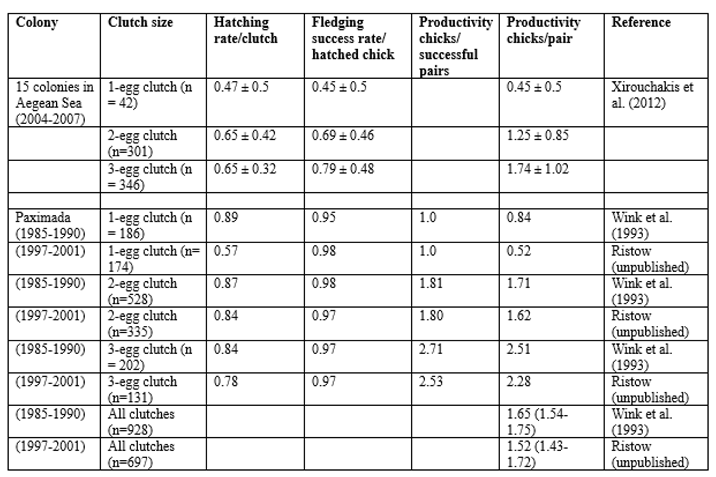 |
Table 9.
Egg dimensions and parameters from 240 eggs of the Paximada colony (Crete), sampled between 1975 and 1977 (Wink et al., 1985).
Table 9.
Egg dimensions and parameters from 240 eggs of the Paximada colony (Crete), sampled between 1975 and 1977 (Wink et al., 1985).
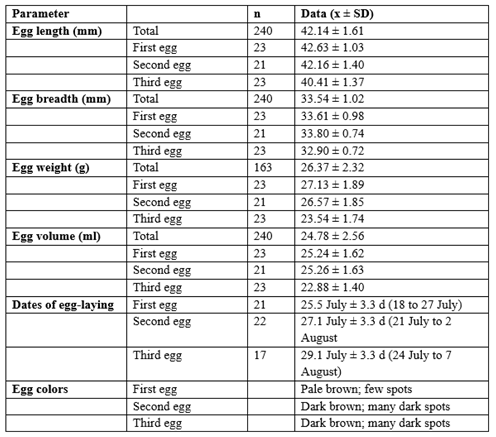 |
Table 10.
Observations of migrating raptors on Paximada during 35 years of fieldwork (1975–2001) and recorded mobbing reactions by Eleonora’s Falcons (Ristow et al., 1982; Wink & Ristow, 2000; Ristow & Wink, 2024).
Table 10.
Observations of migrating raptors on Paximada during 35 years of fieldwork (1975–2001) and recorded mobbing reactions by Eleonora’s Falcons (Ristow et al., 1982; Wink & Ristow, 2000; Ristow & Wink, 2024).
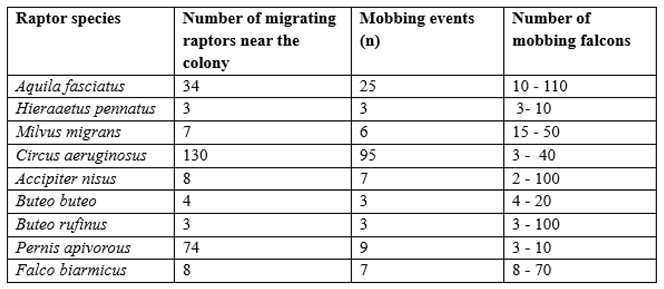 |
Table 11.
Main prey items identified in different Eleonora’s Falcon breeding colonies during summer and autumn.
Table 11.
Main prey items identified in different Eleonora’s Falcon breeding colonies during summer and autumn.
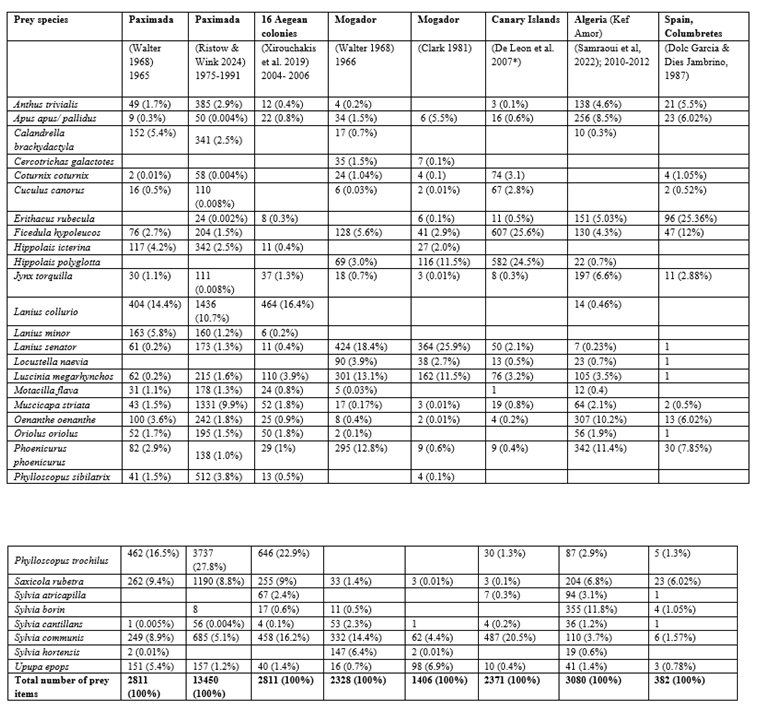 |
Disclaimer/Publisher’s Note: The statements, opinions and data contained in all publications are solely those of the individual author(s) and contributor(s) and not of MDPI and/or the editor(s). MDPI and/or the editor(s) disclaim responsibility for any injury to people or property resulting from any ideas, methods, instructions or products referred to in the content. |
© 2026 by the authors. Licensee MDPI, Basel, Switzerland. This article is an open access article distributed under the terms and conditions of the Creative Commons Attribution (CC BY) license.
Copyright: This open access article is published under a Creative Commons CC BY 4.0 license, which permit the free download, distribution, and reuse, provided that the author and preprint are cited in any reuse.


