
Submitted:
13 July 2026
Posted:
15 July 2026
You are already at the latest version
Abstract
Mental healthcare systems face increasing pressure from rising demand, fragmented services, limited resources, and models still organized around episodic clinical encounters. This article examines whether artificial intelligence (AI) can be conceptualized not pri-marily as a digital therapy, chatbot, or substitute for professionals, but as a supervised infrastructural layer supporting continuity of care within distributed mental healthcare communities. The study adopts a conceptual, systems-oriented design informed by structured evidence mapping of recent literature on AI in mental health. The evidence map was based on a structured PubMed search from January 2022 to March 2026, from which 33 analytically relevant studies were selected and classified according to clinical function, study type, clinical context, level of clinical integration, and systemic relevance. The analysis applies a systems lens focused on actors, boundaries, data and information flows, decision and escalation points, feedback loops, and governance conditions. The mapped literature is reorganized around five emerging clinical functions: longitudinal observation, conversational orientation and support, functional inference, clinical decision support, and assisted interventions. Read systemically, these functions may help address discontinuities between visits, support interpretation of patient trajectories, and connect everyday environments, professional judgment, and care responses. However, the field remains clinically immature, with limited integration into real workflows and persistent risks related to accountability, surveillance, bias, and overdependence on poorly vali-dated systems. The article argues that AI can contribute to trajectory-based mental healthcare only when embedded in human-led workflows, escalation protocols, com-munity-based care architectures, and institutional governance.
Keywords:
artificial intelligence
; mental health systems
; systems thinking
; clinical infrastructure
; clinical decision support
; longitudinal monitoring
; evidence mapping
; continuity of care
1. Introduction
1.1. Mental Healthcare Systems Are Under Structural Pressure
Mental healthcare systems operate under increasing structural pressure, driven by sustained growth in demand, the high population burden of psychological distress and mental disorders, persistent inequalities in access, and shortages of professionals and resources. This situation is further intensified by fragmentation across levels of care, services, and moments of intervention, which makes it difficult to coordinate sustained responses over time [1,2,3].
These pressures may be particularly intensified among migrant and culturally and linguistically diverse populations, where expressions of distress, expectations regarding care, language barriers, displacement, administrative precarity, and institutional mistrust may complicate access, continuity, and clinical interpretation [4]. This reinforces the need for care systems capable of sustaining contextualized trajectories rather than responding only to isolated episodes.
These tensions do not translate only into increased workload. They also reduce the system’s capacity to absorb demand and provide responses that are sufficient, continuous, and scalable. This limitation is reflected in delayed access, discontinuities in follow-up, and reduced capacity to adapt interventions to the real evolution of patients [1,2,3].
In this context, mental health cannot be understood only as a field of diagnostic or therapeutic complexity. It must also be approached as a problem of organization, systemic capacity, and care design. This shifts the question from whether a given tool performs well in a specific task to which structural tensions within the system it may realistically help address within a care ecosystem based on coordination between actors, services, settings, and temporalities of care [1,2].
1.2. The Care Model Remains Organized Around Episodes Rather Than Trajectories
Despite the heterogeneity of mental disorders and care settings, much mental healthcare remains organized around discrete clinical contacts. Assessment, decision-making, and a substantial part of follow-up are concentrated in specific visits, often separated by intervals during which clinical observation is limited or absent. This episodic model has been useful for structuring care activity, but it shows important limitations when addressing problems characterized by temporal fluctuations, recurrence, progressive deterioration, or relevant intraindividual variability [1,2,5,6].
In mental health, this limitation is particularly significant because a central part of clinical information depends on the patient’s retrospective account, the specific timing of the interview, and the professional interpretation made during a particular encounter. As a result, the system tends to capture already expressed episodes better than processes of change developing between visits. Everyday variations, subclinical changes, or the onset of relapse may therefore remain partly outside the field of clinical observation [7,8].
This loss of information is not only temporal, but also contextual. The clinical visit tends to capture only a limited part of the patient’s life and may leave insufficiently represented the family, work-related, economic, social, community, and relational factors that influence distress, adherence, functioning, and clinical evolution. Consequently, the episodic model not only makes it difficult to observe the temporal trajectory of the patient, but also to understand the person as a whole within their real-life environment [1,2,4].
This loss of context may also amplify coordination problems between services. When information is distributed across health, social, community, or educational services without an integrated view of the situation, contradictory recommendations, redundant interventions, or excessively psychologized interpretations of problems with non-strictly clinical components may emerge. Fragmentation therefore not only weakens continuity of care, but may also generate hidden duplication, inefficient use of resources, and responses poorly aligned with the patient’s actual trajectory [1,2,9].
This suggests that, in many cases, the clinically relevant unit is not only the visit, but the patient trajectory within a broader care ecosystem. Understanding mental health in these terms implies shifting attention from the isolated episode to the patient’s temporal evolution and to the interdependencies between professionals, services, channels of care, everyday environments, and support resources. This shift is important because it allows the gap between clinical contacts to be reformulated and prepares the ground for considering whether AI may act, in a clinically useful and supervised way, as a support for continuity and coordination within a distributed care ecosystem [5,9,10].
1.3. Mental Health Requires a Systems and Ecosystem Perspective
In mental health, this shift requires care to be understood not merely as a sequence of clinical encounters, but as a problem of systemic coordination. Continuity of care depends not only on the frequency of visits, but also on the capacity of the system to articulate observation, interpretation, and response over time [2,9].
For the purposes of this study, the mental healthcare system is understood as a sociotechnical and community-based care system. It includes patients and their everyday environments, families and caregivers where relevant, primary care, specialized mental health services, social and community supports, digital infrastructures, data flows, professional decision points, escalation mechanisms, and governance rules. From this perspective, continuity of care is not produced by any single actor or technology, but by the coordinated functioning of this distributed healthcare community over time.
This justifies a systems thinking approach, oriented toward analyzing interdependencies, points of disconnection, and coordination deficits between actors, services, and moments of care [11]. From this perspective, the relevant question about technology is no longer only whether a tool improves a specific task, but how it may contribute to strengthening continuity and coordination within a complex care ecosystem.
In this article, the term distributed mental healthcare communities refers to the network of patients, professionals, services, organizations, technologies, policies, and community resources involved in sustaining mental healthcare within a given population or territory. The term ecosystem is used analytically to emphasize the interdependencies, flows, feedback loops, and governance conditions that shape the functioning of these communities.
1.4. The Literature on AI in Mental Health Is Abundant but Conceptually Fragmented
The literature on artificial intelligence in mental health has grown rapidly in recent years, driven by the development of machine learning applied to clinical and behavioral data, smartphone and wearable-based digital phenotyping, and, more recently, large language models and conversational agents. This growth has considerably expanded the range of applications described, including risk detection, clinical decision support, monitoring platforms, and assisted digital interventions. In this context, AI does not appear as a single technology, but as a heterogeneous field of systems with different functions, degrees of maturity, and levels of clinical integration [5,8,12,13].
However, this development has not been accompanied by an equally robust conceptual framework. Much of the literature continues to organize the field around technological categories or partial uses. This makes it possible to describe specific capacities, but makes it more difficult to understand what role these tools may play within the real continuity of care and within the organization of the healthcare system [12,14,15,16].
Thus, the problem is not only one of accumulating evidence, but also of conceptual fragmentation. The literature describes what different tools can do, but offers less clarity on how these functions should be interpreted together in relation to care architecture, clinical supervision, and care coordination.
1.5. Objective and Contribution of This Study
The objective of this study is to develop a functional and systems-oriented framework for interpreting recent AI applications in mental health as potential components of clinical infrastructure for continuity of care, rather than as isolated technologies or autonomous digital interventions [9,12,15,17].
In this article, clinical infrastructure is understood as a supervised sociotechnical layer that supports recurrent care functions across the patient trajectory, including observation, interpretation, prioritization, communication, documentation, escalation, and low-intensity support. Unlike digital interventions or standalone clinical decision-support tools, infrastructure is defined here by its position within the care architecture: it connects actors, data flows, decision points, and response mechanisms over time, while preserving professional responsibility and institutional accountability [17,18].
This perspective differs from approaches that classify AI mainly by technology, application type, or therapeutic modality [12,13,14,15,16]. It also differs from conventional clinical decision-support framings, which usually focus on discrete decision points [18,19]. The proposed framework instead asks how AI-supported functions may be distributed across the care trajectory and connected to supervision, escalation, and governance within a mental healthcare ecosystem [9,15,17].
Based on a structured evidence mapping, the article proposes a taxonomy of five emerging functions: longitudinal observation, conversational orientation and support, functional inference, clinical decision support, and assisted interventions [12,15].
This reorganization makes it possible to analyze what these tools do, what clinical boundaries they present, what degree of care integration they show, and what relevance they may have for the functioning of the system [9,15,17].
The contribution of the article is therefore threefold. First, it provides an operational definition of AI as clinical infrastructure in mental healthcare. Second, it reorganizes recent AI applications into five care functions according to their position within the patient trajectory rather than according to technology type alone. Third, it links these functions to clinical boundaries, system architecture, and governance conditions required for safe integration into distributed mental healthcare systems [9,15,17].
The framework is organized around four analytical propositions. First, the clinical relevance of AI in mental health depends less on technological autonomy than on its capacity to support continuity across patient trajectories [9,12,15,17]. Second, AI-supported functions acquire systemic value only when they are connected to human interpretation, escalation protocols, and response capacity [17,18]. Third, functional boundaries–between inference and diagnosis, assistance and therapy, support and delegation–are necessary conditions for safe integration [12,13,15,18]. Fourth, governance should be understood not only as regulatory compliance, but as an operational layer that defines permissible use, accountability, monitoring, and correction within the care system [17,18,20].
2. Materials and Methods
2.1. Study Design
This study was conceived as a conceptual study guided by systems thinking and informed by a structured evidence mapping of recent literature on AI in mental health. Its aim is not to quantify the effectiveness of a homogeneous intervention, but to build an analytical synthesis capable of organizing a heterogeneous field according to clinical functions, operational boundaries, levels of integration, and systemic relevance [12,15,21]. Accordingly, the study did not follow a systematic review logic aimed at exhaustive retrieval, risk-of-bias assessment, or estimation of pooled effects. Instead, it used structured evidence mapping as an empirical support for conceptual synthesis across heterogeneous AI-related functions in mental healthcare.
This methodological choice responds to the nature of the research question, which is not primarily concerned with whether a specific tool is effective under controlled conditions, but with how the literature distributes and conceptualizes the functions attributed to AI in mental health, what degree of real clinical integration the described systems show, and what limits condition their incorporation into care [15,17,21].
Within this framework, the study is positioned as a conceptual synthesis with a structured empirical basis. It allows issues often addressed separately–monitoring, prediction, decision support, assisted conversation, and digital intervention–to be reread within a single analytical framework in relation to continuity of care, coordination, and the functional architecture of the system [12,17,21].
The systems analytical lens was applied by examining each AI-related function according to its position within the care system rather than according to the technology used alone. The analysis considered five system dimensions: the actors involved, the boundaries between formal services and everyday environments, the flows of data and clinical information, the decision and escalation points activated by each function, and the governance conditions required to preserve accountability, safety, and continuity of care. This approach allowed the evidence mapping to be translated into a functional interpretation of AI as part of a distributed mental healthcare system.
2.2. Search Strategy and Study Selection
The search was conducted in PubMed to identify recent biomedical and clinical literature on AI applications in mental health relevant to the analytical framework of the study. PubMed was selected because the aim was to map clinically and biomedically relevant AI applications in mental health rather than to conduct a comprehensive bibliometric review across computer science, engineering, or social science databases.
Although PubMed-only strategies are less common in broad systematic reviews of AI in mental health, they have been used in previous scoping reviews focused on clinically oriented digital mental health applications and in adjacent areas of AI translation and governance in healthcare. For example, Milne-Ives et al. used PubMed as the systematic source in a scoping review of artificial intelligence and machine learning in mobile apps for mental health, while Brereton et al. used a PubMed-based scoping strategy to examine AI model documentation in translational science [22,23]. PubMed was therefore selected as the sole systematic database in the present study because it provides an open, reproducible, and clinically anchored biomedical corpus, consistent with the conceptual and evidence-mapping nature of the review.
This choice should not be interpreted as a claim of exhaustive coverage of the broader interdisciplinary field. Rather, it defines the scope of the evidence map as clinically and biomedically oriented. Relevant literature indexed primarily in PsycINFO, Scopus, Web of Science, IEEE Xplore, ACM Digital Library, or policy databases may therefore fall outside the systematic corpus and is acknowledged as a limitation.
Since the study was designed as a conceptual synthesis informed by evidence mapping rather than as a systematic effectiveness review [21], the search and selection strategy aimed to identify a sufficiently diverse and analytically relevant corpus rather than to exhaustively estimate effects across homogeneous interventions. The search was restricted to the period from January 2022 to March 2026 in order to capture the recent expansion of digital phenotyping, machine-learning prediction models, conversational agents, and large language model-based applications in mental health.
The strategy combined descriptors related to mental health, psychology, and psychiatry with terms linked to artificial intelligence, machine learning, digital phenotyping, passive sensing, large language models, chatbots, prediction, clinical decision support, triage, and assisted digital interventions [12,15]. The search string was structured around three conceptual domains: mental health, AI methods, and clinical functions. The base formulation was: (“mental health” OR psychiatry OR depression OR anxiety OR “mental disorder*” OR suicide OR schizophrenia OR bipolar) AND (“artificial intelligence” OR “machine learning” OR “large language model*” OR chatbot* OR “digital phenotyping” OR “passive sensing”) AND (monitoring OR prediction OR “risk prediction” OR “clinical decision support” OR triage OR intervention OR therapy OR treatment) NOT (imaging OR radiology OR MRI OR fMRI OR EEG OR genetics). The search was limited to title and abstract fields and adapted to PubMed syntax.
PubMed records were exported and organized to support title and abstract screening, bibliographic verification, and subsequent functional classification.
Bibliographic metadata, abstracts, publication type, and PubMed identifiers were used for title and abstract screening. Functional categories, level of clinical integration, and systemic relevance were then coded by the reviewers according to the predefined analytical framework described below.
The initial PubMed search yielded 2,442 records for the period from January 2022 to March 2026. To increase the clinical relevance and conceptual manageability of the corpus, PubMed publication-type filters and manual document-type screening were applied to prioritize review articles, scoping reviews, systematic reviews, meta-analyses, clinical trials, randomized trials, observational studies, validation studies, and evaluation studies. Records clearly outside the scope of the study were excluded at this stage. After this preliminary filtering, 734 records were retained for structured title screening. The selection process is summarized in Figure 1, which reports the progressive reduction of records from the initial PubMed search to the final evidence-mapping corpus.
The selection process was conducted progressively in three phases. First, titles were screened to exclude records clearly outside the scope of the study, including studies unrelated to mental health, studies without AI methods, non-clinical domains, studies mainly focused on non-related areas, and editorials or opinion articles without sufficient analytical specificity. Inclusion decisions during title screening were based on three predefined criteria: (1) relevance to mental health, psychiatry, clinical psychology, mental disorders, risk, intervention, monitoring, or follow-up; (2) explicit use or analysis of AI-related methods, including machine learning, large language models, chatbots, natural language processing, digital phenotyping, passive sensing, or clinical decision support systems; and (3) relevance to at least one of the analytical functions of the study, namely longitudinal observation, conversational orientation and support, functional inference or prediction, clinical decision support, assisted intervention, governance, or implementation. This phase reduced the set to 343 records.
Second, abstracts were screened. Each study was classified as included, excluded, or uncertain. Studies were retained when they addressed at least one of the following areas: AI applications in mental health, clinical risk prediction or symptomatic trajectories, digital phenotyping or passive monitoring, conversational agents or chatbots, clinical decision support systems, and assisted interventions. Greater analytical weight was assigned to systematic reviews, meta-analyses, clinical trials, large observational cohorts, validation studies, and digital systems implemented in clinical contexts. Small pilots, overly specific applications with low generalizability, and purely technical developments without clear clinical relevance were deprioritized. After this phase, the corpus was reduced to 157 potentially relevant studies.
Third, the remaining 157 studies underwent a focused review of the full text or of the available methodological content. The final selection did not aim for statistical exhaustiveness across all AI applications in mental health, but for conceptual sufficiency in representing the main emerging clinical functions identifiable in recent literature. Studies were assessed according to three criteria: relevance to care processes, the extent to which they provided sufficiently described methods, validation procedures, or implementation context, and conceptual contribution to understanding the systemic role of AI. The selection also sought to ensure that each functional domain–longitudinal observation, conversational orientation and support, functional inference, clinical decision support, and assisted interventions–was represented by studies with sufficient clinical and systemic relevance, while avoiding overrepresentation of redundant research lines. The final selection led to a corpus of 33 studies included in the evidence mapping. References used to frame the background, systems perspective, governance discussion, or methodological positioning were not necessarily part of the 33-study evidence mapping corpus. The included corpus refers only to the studies classified in Table 1, which reports the main analytical variables used for the evidence mapping.
Studies were included when they simultaneously met four conditions: (1) they addressed applications of AI in mental health, psychology, or psychiatry; (2) they allowed at least one relevant clinical function within the care process to be identified; (3) they provided useful information for analyzing clinical integration, methodological limits, risks, care coordination, or governance; and (4) they contained sufficient information in the abstract or full text to allow reasoned functional and systemic classification. The size of the final corpus reflects the conceptual purpose of the study: to support functional and systemic synthesis across major AI-related clinical functions, rather than to provide an exhaustive inventory of all available applications.
Screening and classification were conducted by two reviewers. Disagreements and uncertain cases were resolved through discussion until consensus was reached. Records were organized in a structured screening and classification table. No formal risk-of-bias assessment was conducted because the study was not designed to estimate intervention effectiveness, compare effect sizes, or produce graded recommendations. Instead, methodological robustness was considered indirectly through the study type, validation status, clinical integration level, implementation context, and systemic relevance coded in the screening and classification matrix. This approach was considered more appropriate for the purpose of evidence mapping and conceptual synthesis, although it does not replace formal quality appraisal and is acknowledged as a limitation. A generative AI tool was used only as an auxiliary instrument to organize records, summarize abstracts, and standardize preliminary labels according to predefined categories. It did not make inclusion, exclusion, or classification decisions. All final decisions were made by the reviewers and checked for consistency against the analytical framework. In this way, the selection sought to preserve clinical and technological heterogeneity without losing analytical consistency. The corpus should therefore be interpreted as an analytically selected evidence map rather than as an exhaustive systematic review of all AI applications in mental health. All AI-assisted outputs were reviewed by the authors and were not used as evidence unless verified against the original bibliographic record, abstract, or full text.
The screening and classification process was documented internally to support consistency in the evidence-mapping procedure. The main classification variables used for the final corpus are reported in Table 1, while the methodological criteria guiding screening, inclusion, and functional classification are described in the present section.
2.3. Analytical Framework for Corpus Classification
To classify the corpus consistently, an analytical framework was established based on five dimensions: (1) core clinical function or functions and, where relevant, secondary function or functions; (2) type of study; (3) clinical context; (4) level of clinical integration; and (5) systemic relevance [9,12,17,21]. Regarding clinical function, five categories were distinguished: longitudinal observation (F1), conversational orientation and support (F2), functional inference or prediction (F3), clinical decision support or stratification (F4), and assisted interventions (F5). Core functions were assigned when a study explicitly addressed a given AI-supported function as a central component of its objective, design, analysis, or clinical interpretation. More than one core function could be assigned when the study substantially addressed several functions within the care process, for example longitudinal observation combined with functional inference or clinical decision support. Secondary functions were assigned when an additional function was present but played a less central role in the study. When a study described several AI capacities, core functions were assigned according to the functions most directly linked to the stated clinical purpose, main outcome, intended use, or main analytical contribution of the study. Secondary functions were assigned only when they were explicitly described as part of the system’s clinical use, and not merely as possible indirect implications. In studies combining several capacities, priority was given to the function that structured the main clinical use of the system, rather than simply to the technique used [12,13,15].
Regarding the type of study, the design reported by the authors was recorded and, where necessary, harmonized into comparable categories, including systematic reviews, meta-analyses, observational studies, validation studies, clinical trials, pilots, and implementation studies.
Regarding clinical context, each study was coded according to the main problem or disorder addressed and, where possible, according to the predominant care setting, with the aim of preserving the clinical specificity of the corpus.
Regarding the clinical integration level, three categories were distinguished: conceptual (C), validated (V), and implemented (I). A study was coded as conceptual when its contribution was mainly theoretical, review-based, exploratory, or proof-of-concept without robust clinical validation; as validated when it presented formal comparison, empirical validation, or structured performance evaluation; and as implemented when the function or tool had been inserted into a clinical workflow or real care setting [15,17,19].
Regarding systemic relevance, four levels were distinguished: individual task (IT), workflow support (WS), service integration (SI), and ecosystem-level relevance (ER). A study was coded as individual task when it focused on a discrete task; as workflow support when it affected a clinical work process; as service integration when the function was articulated within a care service; and as ecosystem-level relevance when the article provided implications for coordination between actors, levels, or care settings [9,11,17,18].
Coding was conducted iteratively on the basis of full-text reading. In ambiguous cases, classification was resolved by jointly reviewing the stated clinical purpose, the type of use described, the degree of insertion into practice, and the organizational scope of the analyzed function. The aim was not to eliminate all interpretation, but to reduce arbitrariness through explicit and consistent classification rules.
3. Results
3.1. Structural Tensions and Limits of the Current Mental Healthcare Model
3.1.1. Growing Systemic Pressure
The reviewed corpus situates the recent development of AI in mental health within a sustained context of pressure on care systems. This pressure is recurrently associated with rising demand, insufficient resources, inequalities in access, and coverage gaps, in a context where response capacity was already limited [1,2,3]. Several studies also link this context to the need to strengthen mental healthcare systems through more coordinated, scalable forms of organization capable of incorporating digital supports [9].
Read from this perspective, AI does not appear merely as a technological innovation, but as a possible response–still uneven and often preliminary–to pre-existing system tensions. In particular, the literature associates interest in digital tools and AI systems with persistent difficulties of access, service discontinuity, and the need to expand capacities for detection, follow-up, or support without relying exclusively on face-to-face contacts or scarce professional resources [9,12].
3.1.2. Intermittent Clinical Observation and Discontinuity Between Contacts
A second cross-cutting finding is that observational discontinuity emerges as a central limitation of the current care model. In many of the reviewed studies, especially in depression, suicide risk, and digital phenotyping, the starting assumption is that conventional clinical assessment is too intermittent to adequately capture the real evolution of patients [5,6,7,8,10]. Dependence on discrete clinical interviews, retrospective self-reports, and contacts separated by relatively long intervals leaves outside the clinical field of view a relevant part of the behavioral, affective, and functional changes that may precede relapse, deterioration, or crisis [6,7,8].
The corpus therefore reinforces the idea that the gap between contacts is not only an absence of treatment, but also an absence of sufficiently fine-grained, continuous, and contextualized observation. It is therefore not incidental that a substantial part of the reviewed literature–especially work based on passive sensing, smartphone data, wearables, and longitudinal records–is organized precisely around the possibility of reducing this discontinuity and capturing clinically relevant signals in temporal and ecological spaces that conventional care covers only partially [5,6,7,8,10].
3.1.3. Clinical Trajectory and Everyday Context as Insufficiently Addressed Objects
A third element emerging from the corpus is the insufficiency of a model centered mainly on episodes for addressing mental health problems characterized by longitudinal course, intraindividual variability, and strong dependence on everyday context. Several studies suggest that the relevant clinical object is not only the episode expressed during a visit, but the patient trajectory over time, including patterns of change, windows of deterioration, periods of relative stability, relapse, and unequal responses to treatment [5,6,8,10].
The reviewed literature does not always formulate this shift in explicitly systemic terms, but it does provide consistent elements to support it: the relevance of within-person variability, the weight of everyday life contexts, the need for longitudinal follow-up, and the difficulty of coordinating observation, interpretation, and response across different moments of care [5,6,8,9,10,11]. Taken together, these findings reinforce the idea that the potential value of AI does not lie only in adding isolated functions, but in addressing a structural deficit of observational continuity and coordination that the current care model resolves only partially [8,9,10,11].
Table 1 summarizes the evidence mapping of the included corpus and shows, for each study, the type of design, clinical context, core and secondary clinical function attributed to AI, level of clinical integration, and systemic relevance. The table is not intended to provide an exhaustive inventory of all AI applications in mental health, but to make explicit the analytical corpus on which the conceptual synthesis is based.
Across the final corpus, the most recurrent functional assignments were functional inference or prediction and clinical decision support, either as core or secondary functions. These were often associated with risk stratification, symptom trajectory modeling, triage, or treatment planning. Longitudinal observation was mainly represented by digital phenotyping, passive sensing, smartphone-based monitoring, wearable data, and electronic health record trajectories. Conversational orientation and support and assisted interventions were less frequently represented as implemented workflow components and appeared more often in chatbot, generative AI, iCBT, and digital support studies. Overall, the evidence map showed a marked imbalance between functional innovation and clinical integration: most studies remained conceptual, review-based, exploratory, or validated at the model level, while only a minority described implementation within real clinical workflows or service-level settings.
This distribution supports the interpretation of the field as clinically promising but still organizationally immature. The following results should be read as an analytical synthesis of the mapped corpus rather than as a quantitative estimate of prevalence in the whole field.
ST Study Type; CIL, Clinical Integration Level; SR, Systemic Relevance. For clinical functions, P indicates the core function, S indicates a secondary function, and – indicates the absence of that function in the study. When a study described several AI capacities, core functions were assigned to those functions directly linked to the stated clinical purpose, main outcome, intended use, or main analytical contribution of the study. Secondary functions were assigned only when they were explicitly described as part of the system’s clinical use or interpretation, but were not central to the study’s objective or design.
The clinical functions are defined as follows: F1, longitudinal observation; F2, conversational orientation and support; F3, functional inference or prediction; F4, clinical decision support or stratification; and F5, assisted interventions. The level of clinical integration is coded as C (conceptual), when the contribution is mainly theoretical or review-based; V (validated), when it presents empirical validation or formal comparison; and I (implemented), when the function or tool has been inserted into a clinical workflow or real care setting. Systemic relevance is coded as IT (individual task), when the study focuses on a discrete task; WS (workflow support), when it affects a clinical work process; SI (service integration), when it is articulated within a service or care setting; and ER (ecosystem-level relevance), when it provides implications for coordination between actors, levels, or care settings. Table 2 summarizes the distribution of functional assignments, clinical integration levels, and systemic relevance across the 33 included studies. Because functional classification was non-mutually exclusive, a single study could be assigned more than one core or secondary function when several AI-supported functions were central to its objective, design, or clinical interpretation.
3.2. Five Emerging Clinical Functions of AI in the Mental Healthcare Ecosystem
The evidence mapping of the reviewed corpus makes it possible to identify the five emerging clinical functions of AI in mental health, presented in figure 2: longitudinal observation, conversational orientation and support, functional inference, clinical decision support, and assisted interventions. Rather than describing homogeneous technologies, this classification allows different systems to be compared according to the function they occupy within the care process and their possible fit within continuity of care [12,13,14,15,16].
Figure 2.
Functional taxonomy of AI in distributed mental healthcare ecosystems.
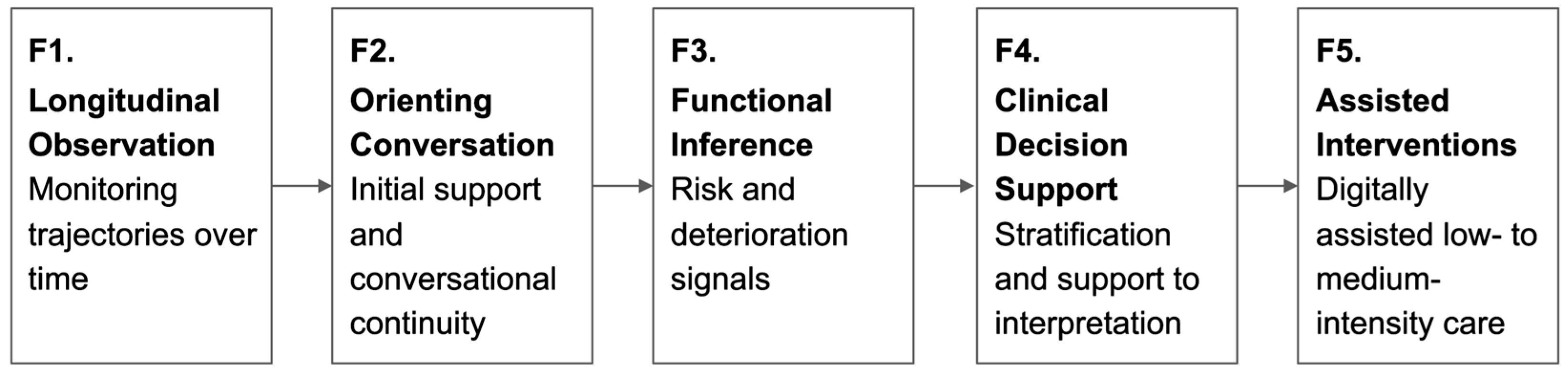
3.2.1. F1. Longitudinal Observation
The function that emerges most strongly from the corpus is longitudinal observation. It brings together systems oriented toward capturing the patient’s evolution over time beyond the information available from single visits or isolated clinical episodes. It mainly includes studies on digital phenotyping, passive sensing, monitoring with smartphones and wearables, as well as studies based on longitudinal trajectories extracted from electronic health records [5,8,10,25,40].
This function is especially relevant because it strengthens observational continuity between clinical contacts. Many of the included studies show that variables related to mobility, activity, phone use, sleep, circadian rhythms, communication, or healthcare use may provide useful information for following clinical trajectories and detecting patterns of change [7,8,10,41,42]. Its value lies not only in the amount of data generated, but in the possibility of capturing ecologically situated signals that are sensitive to the patient’s evolution.
However, the literature also shows substantial heterogeneity in sensors, variables, analytical strategies, handling of missing data, and levels of validation, which limits comparability and direct translation into clinical practice [30,41,42,45]. For this reason, longitudinal observation appears both as one of the most promising functions and as one of the most dependent on improvements in standardization, validation, and care integration.
3.2.2. F2. Conversational Orientation and Support
The second identified function is conversational orientation and support: AI systems that facilitate conversational interactions which do not amount to formal therapy, but may provide initial orientation, accessible support, demand channeling, and a degree of continuity outside conventional clinical contact. This category mainly includes conversational agents, chatbots, and other natural language-based tools that act as interfaces for support or initial information [13,14,28].
Its relevance lies in its capacity to cover intermediate spaces that the system addresses irregularly: moments before the first contact, intervals between visits, periods of uncertainty about the need for help, or immediate needs not resolved by ordinary care pathways. In this sense, these systems may facilitate the expression of demand, initial orientation, and connection with other resources [28,46,47].
However, it is also one of the most clinically ambiguous functions. These systems may be perceived as useful, accessible, or empathic, but their capacity to manage complex contexts or risk situations is highly variable. Their value should therefore be understood primarily in terms of intermediate support and orientation, under clinical limits, escalation protocols, and supervision [46,48].
3.2.3. F3. Functional Inference and Prediction
The third emerging function is functional inference and prediction. It includes studies that use clinical, behavioral, textual, or multimodal data to detect risk, infer functional states, or predict deterioration, relapse, symptom severity, suicidal ideation, and other clinically relevant outcomes. It includes models trained on EHRs, machine learning applied to digital phenotyping, text analysis, and systems oriented toward risk stratification or the anticipation of trajectories [6,10,26,27,29,31,36,43,45].
This function is relevant because it introduces an inferential layer that attempts to convert dispersed data into clinically interpretable signals. In areas such as suicide risk, depression, or other high-risk trajectories, the literature shows sustained interest in detecting patterns of vulnerability, anticipating adverse events, and concentrating attention on higher-risk subgroups. This places functional inference in an intermediate position between observation and decision [10,26,27,29,31,43].
However, the literature also reinforces an important boundary: functional inference is not equivalent to clinical diagnosis. Many models operate with indirect variables, proxies, or outcomes defined more by data availability than by comprehensive clinical assessment. In addition, methodological variability and limited external validation in part of the field restrict its translational robustness. This function should therefore be understood as a potentially useful inferential layer, but not as a substitute for clinical judgment [27,36,45].
3.2.4. F4. Clinical Decision Support
The fourth function identified is clinical decision support, which includes systems oriented toward stratification, triage, prioritization, treatment planning, data review, and support for clinical interpretation. This function is especially visible in the literature on clinical decision support systems (CDSS), in predictive studies with an intended operational use, and in assistive tools for professionals. Unlike the inferential function, the focus here is not only on prediction, but on inserting this information at some point in the care process to support human decisions [18,20,32,38,39,49,50].
From a systemic perspective, this function is central because it makes visible the transition of AI from an analytical capacity to its articulation with real clinical workflows. The reviewed corpus suggests that it becomes especially relevant in contexts of risk, personalized treatment, follow-up coordination, and management of limited resources, where decision-making depends on the ability to synthesize heterogeneous information at an operationally useful moment [17,35,38,39,49].
However, the literature shows that demonstrating potential utility under controlled conditions is not the same as integrating a system into a real clinical workflow. Moreover, the presence of support does not eliminate the risk of excessive dependence, interpretive opacity, or improper delegation of decisions. Its value therefore depends less on the abstract performance of the model than on its articulation with professional supervision, protocols of use, and organizational fit [17,18,20,32].
3.2.5. F5. Assisted Interventions
The fifth emerging function is assisted interventions, which brings together digital tools aimed at providing low to medium intensity psychological, psychoeducational, or therapeutic support, often in hybrid or partially guided formats. It mainly includes iCBT, support chatbots, digital assistants, and guided conversational interventions that do not formally replace clinical treatment but may operate as an assisted extension of support or self-management strategies [24,34,44,51,52].
Its relevance derives from the possibility of occupying low-intensity spaces that the system often covers insufficiently, especially between visits, in early phases of distress, or in contexts of restricted access. This makes these tools potentially useful for expanding coverage, sustaining symptomatic support, offering psychoeducation, and reinforcing structured strategies outside the face-to-face care setting. In this sense, they may be understood as a functional extension of the care system rather than as a complete alternative to professional care [12,16,24,51,52].
However, the literature also shows that this function does not in itself justify the idea of autonomous therapy. Results are variable, response quality is not stable, and the management of complex or high-risk cases remains an important limitation. The value of assisted interventions should therefore be read as partial, complementary, and contextualized support, not as a replacement for specialized therapeutic work [15,44,46,48,52].
3.3. Clinical Boundaries Identified in the Literature
These boundaries are not merely ethical distinctions. They define operational limits for safe clinical integration: what the system may infer, what it may communicate, when it must escalate, and which decisions must remain under professional responsibility.
3.3.1. Functional Inference Is Not Equivalent to Clinical Diagnosis
A first clear clinical boundary is the distinction between functional inference and clinical diagnosis. The reviewed literature shows that AI systems can detect patterns, estimate probabilities, or classify risk, deterioration, and symptom severity from clinical, behavioral, or textual data. However, these outputs do not in themselves amount to a robust diagnosis, since they are often based on indirect variables, proxies, or algorithmic definitions of the problem, rather than on a comprehensive, contextualized, and relational clinical assessment of the patient [27,29,31,41,42,43,45].
This distinction is especially relevant in mental health, where diagnosis often depends on trajectories, contexts, and clinical nuances that are not fully represented in the available data. Therefore, even when a system shows good predictive performance, its output should be interpreted as a functional inference useful for strengthening clinical observation or vigilance, but not as a replacement for professional diagnostic judgment [27,36,45].
This boundary is consistent with a conception of evidence-based clinical practice in which decision-making integrates the best available scientific information, professional expertise, and the characteristics, values, preferences, and context of the patient. Algorithmic outputs may expand the informational basis of the decision, but they cannot replace this process of clinical integration. This is especially important in mental health, because the clinical meaning of a signal often depends on the patient’s life history, relational context, social situation, and subjective trajectory [53].
3.3.2. Assisted Intervention Is Not Equivalent to Autonomous Therapy
A second recurrent boundary is the distinction between assisted intervention and autonomous therapy. The literature describes tools capable of offering psychoeducational support, symptom-oriented guidance, self-help, or guided conversation with potential utility in low- to medium-intensity contexts, but it does not support a simple equivalence with autonomous therapeutic practice [15,24,34,44,51,52].
Clinical complexity, contextual adjustment, risk management, and the capacity to modify the strategy in real time remain beyond what most of these systems can reliably provide. Their value should therefore be situated as a partial complement within a broader care system, and not as a full substitute for the therapeutic relationship or for specialized clinical work [44,46,47,48,52].
3.3.3. Decision Support Is Not Equivalent to Delegation of Decisions
A third critical boundary is the distinction between decision support and delegation of decisions. The literature shows that AI can stratify risk, prioritize cases, synthesize information, and generate useful recommendations for clinical practice, but this does not eliminate the need for professional supervision or legitimize an automatic transfer of responsibility to the system [18,20,32,35,38,39,49,50].
In mental health, clinical decisions continue to depend on uncertainty, relational context, ethical considerations, and situated judgments that cannot easily be reduced to an algorithmic output. The relevant question is not only whether the system is accurate, but under what conditions it is inserted into decision-making, who retains interpretive control, and how clinical responsibility is distributed [17,18,20,49].
3.3.4. Conversational Interaction Is Not Equivalent to Therapeutic Relationship
The fourth clinical boundary is the distinction between conversational interaction and therapeutic relationship. Several studies show that conversational agents and other language-based tools may provide responses perceived as accessible, nonjudgmental, or even empathic, with functional utility in moments of initial orientation, accessible support, or specific accompaniment [13,14,28,46,47,48].
However, a useful conversation is not automatically equivalent to a therapeutic relationship in the clinical sense. Such a relationship involves not only language exchange, but also trust, alliance, situated adjustment, responsibility, and progressive understanding of the patient over time. Conversational systems may therefore occupy intermediate spaces of support and orientation, but they do not by themselves reproduce the relational, ethical, and clinical dimensions of a robust therapeutic relationship [44,46,47,48,52].
Taken together, these four boundaries show that the clinical relevance of AI in mental health does not depend only on its technical capacity, but on the precision with which its functional scope is defined. The value of the field does not lie in erasing boundaries between observation, inference, support, assistance, and clinical relationship, but in defining them more clearly. In this sense, AI can only be understood as potentially useful clinical infrastructure if its functions are embedded within clear frameworks of supervision, coordination, and responsibility. These operational distinctions are summarized in Table 3.
3.4. Persistently Low Maturity of Real Clinical Integration
3.4.1. Predominance of Proof-of-Concept and Exploratory Studies
A cross-cutting finding of the evidence mapping is that, despite the recent expansion of the literature on AI in mental health, the field remains dominated by reviews, exploratory studies, proof-of-concept work, and initial validations. The corpus often shows the technical feasibility of identifying patterns, generating predictions, sustaining conversational interactions, or assisting certain interventions, but studies describing robust and sustained incorporation of these functions within real clinical settings are less frequent [12,13,14,15,17,45].
This asymmetry configures a field with high functional innovation but low organizational consolidation. Many studies are based on selected data, experimental contexts, specific samples, or partial validations that do not necessarily reflect the conditions of everyday care. The low maturity of the field should therefore not be interpreted only as a quantitative issue, but as the expression of a persistent distance between technological development and care implementation [12,15,17,18,20,45].
3.4.2. Mismatch Between Technical Capacity, Clinical Integration, and Systemic Relevance
The classification of the corpus according to level of clinical integration and systemic relevance reinforces this interpretation. Demonstrating that a system can better observe a trajectory, predict an outcome, orient a conversation, or provide support is one thing; inserting that function into a clinical workflow, a specific service, or a care ecosystem with defined mechanisms of supervision, responsibility, and coordination is another [9,17,18,20].
The field therefore shows a recurrent mismatch between the functional promise of tools and their actual insertion into workflows, roles, and care settings. This mismatch becomes especially visible when studies focused on discrete tasks are compared with those reaching levels of workflow support, service integration, or ecosystem-level relevance: the former are more abundant and tend to operate on more delimited problems, whereas the latter require a much more complex articulation between technology, clinical practice, and organization [9,17,18,20,49].
Taken together, these findings suggest that the central question is not only whether AI can develop clinically useful capacities, but under what conditions these capacities can be translated into stable forms of integration within the mental healthcare system. The literature thus describes a field with significant potential, but still marked by a persistent gap between functional innovation and effective transformation of care [9,12,17,18,20,45].
4. Discussion
4.1. Reinterpreting AI in Mental Health: From a Set of Tools to Clinical Infrastructure
The joint reading of the corpus suggests that the main contribution of AI in mental health should not be interpreted only in terms of isolated tools, but in terms of functions capable of strengthening weak points in the care system [9,12,15,17]. This shift is relevant because the evidence mapping shows that the potential value of the field lies not so much in the abstract performance of each technology as in its possible contribution to longitudinal follow-up, the detection of changes outside formal contact, the connection between dispersed information and clinical decision-making, and the availability of intermediate supports [9,12,15,17,18,20].
In this sense, AI may be reinterpreted as a possible clinical infrastructure for continuity: not as a form of therapeutic or decisional autonomy, but as a functional layer capable of better sustaining observation, coordination, and response capacity within the care system. As defined above, clinical infrastructure refers here to a supervised sociotechnical layer embedded within care architecture rather than to an autonomous therapeutic or decisional system.
This reading does not deny the heterogeneity or low maturity of the field, but it allows its relevance to be situated in the domain of care architecture rather than in the sum of partial applications [9,12,15,17].
Speaking of clinical infrastructure, therefore, does not mean attributing substitutive capacity to AI, but asking under what conditions its functions can be inserted in a clinically useful way into continuity of care. This shifts the discussion from technology considered in isolation to the care model into which it is integrated, which is precisely the analytical step required to think about mental health in terms of trajectories rather than episodes [9,10,17,18].
4.2. From an Episode-Based Care Model to a Trajectory-Based Care Model
The reinterpretation of AI in mental health only becomes meaningful if the care model into which it is inserted is first reformulated. The underlying issue is not primarily technological, but clinical and organizational: in a relevant part of mental health problems, the appropriate unit of care can no longer be only the isolated visit, but the patient trajectory over time [1,2,3]. This shift is especially relevant in situations characterized by temporal fluctuations, recurrence, progressive deterioration, intraindividual variability, and dependence on everyday context, dimensions that a model centered mainly on single contacts captures only partially [5,6,10].
Understanding trajectory as the unit of care implies a change in frame: it is no longer only a matter of assessing what happens at a specific moment, but of following patterns of evolution, windows of deterioration, periods of relative stability, relapses, and unequal responses to treatment [5,6,10]. This requires articulating information from different moments, contexts, and actors, and situating continuity of care not as a desirable but accessory quality, but as an explicit function of the system that must be organized and sustained [1,2,9].
This change also redefines the central problem of care discontinuities. In an episodic model, the main gap appears between visits. In a trajectory-based model, by contrast, this gap is better described as a deficit of coordination between longitudinal observation, clinical interpretation, intermediate response, and escalation capacity according to the evolution of the case [3,9]. The relevant question therefore ceases to be only when the patient is seen and becomes who observes changes, who interprets them, with what information, and under which response mechanisms.
This issue is especially relevant in contexts of high care pressure, prolonged waiting lists, or rural and territorially dispersed settings, where face-to-face access and frequency of follow-up may be limited. In these scenarios, the problem is not only the low frequency of clinical contact, but the absence of an architecture capable of sustaining observation, orientation, and escalation capacity while the patient remains outside the formal care setting [1,2,3,9].
From this perspective, the transition from an episode-based model to a trajectory-based model is not a theoretical appendix, but the necessary condition for rethinking the architecture of mental healthcare. Only when continuity becomes a structured property of the system is it possible to rigorously assess which functions may be distributed, strengthened, or sustained by technological layers without confusing clinical support with replacement of professional judgment [1,2,5,6,9,10]. The comparison between both models makes visible that the change affects not only the frequency of follow-up, but the very architecture of care, as shown in Table 4.
4.3. AI as Clinical Infrastructure for Continuity of Care
Once this change of model has been established, the question becomes what kind of role AI can play within a care architecture oriented toward trajectories. In light of the results, its potential value does not lie primarily in acting as an isolated tool, but in the possibility of strengthening points of discontinuity in the system: observation between contacts, detection of clinically relevant changes, intermediate response, synthesis of information for decision-making, and support for low to medium intensity interventions [9,10,12,15,17,18].
AI does not, by itself, produce continuity of care. It may only support specific continuity functions when these are institutionally organized, clinically supervised, and connected to actual response capacities.
Understood in these terms, the notion of clinical infrastructure does not refer to full therapeutic autonomy, but to a system-sustaining function. AI may acquire clinical relevance when it helps connect moments, channels, and actors of care that currently operate discontinuously, and when it does so without generating a parallel layer disconnected from care practice [5,9,11,12,15,17,18].
This reinterpretation, however, requires the functional scope of the technology to be precisely delimited. The infrastructure does not decide by itself, does not diagnose by itself, and does not establish a therapeutic relationship by itself. Its value depends on how its functions are inserted into supervised circuits, with escalation protocols, criteria for use and non-use, and clear mechanisms of clinical responsibility [17,18,20,37,48,49]. For this reason, speaking of clinical infrastructure also means speaking of functional architecture, professional supervision, and operational governance [17,18,20,37].
In this sense, the relevance of AI is measured not so much by the abstract performance of a specific tool as by its capacity to fit into real trajectories of care, increase the response capacity of the system, and preserve the centrality of professional judgment at decision points [9,10,17,18,20,49]. This is what makes it possible to understand AI not as a general promise about the future of mental health, but as a precise architectural hypothesis about how care might be better reorganized in distributed ecosystems [9,11,17,20].
4.4. Functional Model of an AI-Augmented Mental Healthcare System
Figure 3 summarizes the sociotechnical architecture proposed in this study. The model does not represent AI as the center of the mental healthcare system, but as a supervised functional layer embedded within a distributed care community. At the center of the architecture is the patient trajectory over time, situated within everyday environments and connected to primary care, specialized mental health services, social and community supports, and crisis or emergency pathways when needed. Within this configuration, AI-supported functions may contribute to continuity only if they are connected to professional interpretation, escalation mechanisms, and governance rules.
The value of the model does not lie in proposing five separate technologies, but in showing how AI-supported functions may redistribute and connect system capacities that are currently fragmented: observation, orientation, inference, decision support, and low to medium intensity assistance. In architectural terms, these functions are relevant only insofar as they strengthen flows between everyday life, clinical services, professional decision points, and supervised response pathways. The model therefore interprets AI not as an autonomous care provider, but as an infrastructural layer that may support continuity when embedded in human-led workflows and institutional governance [5,9,11,12,17,18,20].
This articulation is what gives the model clinical and systemic meaning. The value of AI is not defined by the degree of autonomy it achieves, but by its capacity to be inserted into a supervised, community-based architecture that strengthens continuity, coordination, and scalable response without displacing clinical responsibility [9,11,17,20].
This model should be understood as a functional and interpretive proposal, not as an already resolved implementation scheme. The reviewed literature shows highly uneven levels of validation, deployment, and maturity, and still limited integration into real services [12,15,17,45]. For this reason, Figure 3 does not describe a homogeneous or consolidated field, but a possible architecture for thinking about what AI may mean when placed at the service of a trajectory-based and community-oriented model of mental healthcare.
4.5. Implications for System Design
If AI is to be understood as clinical infrastructure for continuity, the main challenge is not to add new tools to the system, but to define the conditions under which its functions can be usefully inserted into care practice. This requires observation, inference, support, and assistance not to operate as independent modules, but as articulated components within real clinical workflows, with defined points of entry, interpretation, response, and escalation [17,18,20,49]. Their usefulness depends less on the isolated performance of a model than on its capacity to fit into practice without increasing fragmentation, opacity, or unnecessary burden [17,20,45].
A trajectory-based architecture also requires explicit feedback loops. In system terms, AI-supported observation and inference only acquire clinical value when their outputs are returned to the care process through professional interpretation, documented decisions, care adjustments, or escalation. The response then modifies the patient trajectory, generating new information that may reopen the cycle of observation, interpretation, and action. This loop should not be understood as autonomous algorithmic adaptation, but as a supervised clinical and organizational feedback mechanism embedded in human-led care pathways.
This model also requires an architecture capable of sustaining distributed continuity. This means coordinating longitudinal observation, intermediate interaction, triage, decision-making, and support across home, primary care, specialized services, and community resources, and not only within a single service or setting [2,9,17,18]. In this framework, interoperability is not only a technical issue, but a functional condition for continuity of care: information must circulate in a clinically meaningful way across layers, actors, and moments of care [9,17,20].
In addition, system design must incorporate explicit protocols for supervision and escalation. If AI functions operate between visits and at intermediate points in the system, it is necessary to define what each layer detects, who interprets the signals, when professional response is activated, and how clinical responsibility is preserved [17,18,20,49]. In mental health, this requirement is especially important because the usefulness of a function is measured not only by its accuracy, but by its insertion into safe and clinically governable care circuits [17,20,45,49].
The evaluation of such an architecture should therefore include system-level performance criteria, not only model-level metrics. Relevant criteria include continuity of care, time to detection of deterioration, appropriateness of escalation, coordination between services, professional workload, equity of access, traceability of decisions, patient safety, and organizational sustainability. These criteria are important because an AI-supported function may be technically accurate while still failing to improve the functioning of the care system if it increases fragmentation, burden, or inequity [9,17,20,45].
Taken together, these implications show that system design cannot separate care architecture from operational governance. A trajectory-based model is viable only if continuity becomes an explicit function of the system and if AI is integrated into it as distributed support, not as a substitute for clinical judgment or as a parallel layer disconnected from care [9,11,17,20,49,53].
4.6. Governance and Systemic Risk
If AI is integrated as clinical infrastructure for continuity, governance ceases to be a merely regulatory issue and becomes a structural condition of the system. This implies establishing explicit frameworks of supervision, defining admissible margins of autonomy, regulating escalation mechanisms, and clarifying the distribution of responsibilities between tools, professionals, and organizations [17,20,49,54]. In mental health, this requirement is especially relevant because many functions operate on sensitive data, ambiguous signals, and decisions that are strongly dependent on clinical and relational context [14,15,37].
In the European context, this implies alignment with the EU Artificial Intelligence Act and the General Data Protection Regulation. AI-supported mental health functions that influence triage, risk stratification, monitoring, or therapeutic support should be treated as high-stakes sociotechnical components requiring documented risk management, data protection safeguards, human oversight, traceability, cybersecurity, and post-deployment monitoring [37,54].
In systems terms, governance operates as a control layer: it defines the permissible scope of AI-supported functions, the thresholds for escalation, the conditions for human review, and the mechanisms through which errors, bias, and unintended consequences are detected and corrected.
Within this framework, data protection cannot be understood as an external requirement added to system design, but as a condition of possibility for clinical infrastructure. The functions of longitudinal monitoring, functional inference, and decision support may involve particularly sensitive data, often generated outside the visit and linked to habits, behavior, language, mobility, or service use. For this reason, the system must incorporate data minimization, purpose limitation, access control, traceability, security, governance of secondary data use, and transparent mechanisms for patient information and participation [19,20,37,54].
However, governance cannot be reduced to security, formal compliance, or technical control. It must also address systemic risks such as excessive medicalization of distress, the normalization of forms of continuous surveillance, the reproduction of bias and access inequalities, or dependence on opaque and unevenly validated systems [1,4,15,37,45].
In a distributed care ecosystem, these risks do not affect only the relationship between patient and tool, but the way the system observes, prioritizes, interprets, and responds.
For this reason, the central question is not only whether AI is effective, but under what governance regime it can be clinically acceptable and systemically sustainable. This requires meaningful human supervision, clear criteria for use and non-use, functional traceability, review protocols, and an institutional architecture capable of absorbing errors, uncertainty, and variability without improperly shifting responsibility to the technical system [17,20,49,53,54].
4.7. Limitations of the Field and of the Review
This study has several limitations that should be made explicit. First, the reviewed field is methodologically heterogeneous: it combines reviews, observational studies, validations, trials, pilots, and proof-of-concept studies with highly uneven degrees of robustness, generalizability, and proximity to clinical practice. This makes direct comparison between studies difficult and requires cautious interpretation of both positive findings and the real clinical scope of the functions described [12,15,45].
Second, the literature remains more advanced in demonstrating partial capacities than in documenting robust integrations within real services. This limits the possibility of inferring how these functions would operate in complex care ecosystems, with actual workflows, responsibilities, and organizational constraints [15,17,18,20].
Third, this study was not designed as a systematic effectiveness review focused on a single homogeneous intervention, but as a conceptual synthesis informed by evidence mapping [21]. This decision is consistent with the research question, but it means that the study does not aim to estimate aggregated effect sizes or formally compare homogeneous interventions. Moreover, although the search, screening, and classification process was explicitly structured, the final selection of the corpus retains an interpretive component characteristic of conceptual reviews aimed at building analytical frameworks. Its contribution is primarily analytical and architectural.
Fourth, the search was limited to PubMed. This decision was coherent with the clinical and biomedical orientation of the study, but it may have excluded relevant contributions from computer science, human–computer interaction, implementation science, social sciences, health policy, or regulatory literature indexed primarily in other databases. The corpus should therefore be interpreted as clinically oriented and analytically selected, rather than as a comprehensive cross-disciplinary map of the entire field.
Fifth, the functional classification of studies necessarily involved interpretive judgment, particularly in studies combining monitoring, prediction, decision support, conversational support, and intervention components. Although explicit coding rules and reviewer consensus were used to reduce arbitrariness, the taxonomy should be understood as an analytical framework for conceptual synthesis rather than as a definitive or exhaustive classification of AI in mental health.
5. Conclusions
5.1. Main Synthesis
Recent literature on AI in mental health describes a broad, heterogeneous field that remains uneven in terms of clinical and care maturity [9,12,15,17,45]. Read together, the reviewed applications point less toward the replacement of clinical work than toward the possibility of strengthening weak points in the system, especially longitudinal observation, detection of changes between contacts, decision support, and the availability of intermediate responses across the patient trajectory [5,9,10,12,17,18]. In this sense, the central question is not whether AI can replace professionals, but whether it can contribute to better sustaining continuity of care within a distributed mental healthcare system.
5.2. Conceptual Contribution of the Study
The main contribution of this study is to provide an operational and systems-oriented framework for interpreting AI in mental health as supervised clinical infrastructure for continuity of care. By reorganizing recent applications around five care functions and linking them to clinical boundaries, system architecture, and governance conditions, the article offers a conceptual basis for moving beyond technology-centred or intervention-centred accounts of AI in mental healthcare [9,11,12,17,20,54].
5.3. Future Directions
The development of the field requires fewer isolated demonstrations of capability and more research on real-world integration into services, escalation protocols, professional supervision, functional interoperability, and operational governance [17,18,20,49,54]. Further work is also needed to define more precise clinical boundaries between inference and diagnosis, assistance and therapy, or support and delegation. Ultimately, the challenge is not only to improve the performance of individual tools, but to establish under what conditions they can contribute in a clinically acceptable and systemically sustainable way to a trajectory-based model of mental healthcare.
Supplementary Materials
The following supporting information can be downloaded at the website of this paper posted on Preprints.org.
Author Contributions
Conceptualization, A.T.-O., J.F.-P. and J.M.-F.; methodology, A.T.-O., J.F.-P. and J.M.-F.; validation, L.A.-H., O.M.-Z., H.B.-A. and J.M.-F.; formal analysis, A.T.-O. and J.M.-F.; investigation, A.T.-O., J.F.-P., M.C.-P., E.T. and J.M.-F.; resources, J.M.-F. and E.T.; data curation, A.T.-O. and J.M.-F.; writing—original draft preparation, A.T.-O. and J.F.-P.; writing—review and editing, A.T.-O., J.F.-P., M.C.-P., L.A.-H., O.M.-Z., E.T., H.B.-A. and J.M.-F.; visualization, M.C.-P.; supervision, L.A.-H., O.M.-Z., H.B.-A. and J.M.-F.; project administration, J.M.-F. All authors have read and agreed to the published version of the manuscript.
Funding
This research received no external funding.
Conflicts of Interest
The authors declare no conflicts of interest.
References
- World Health Organization. World Mental Health Report: Transforming Mental Health for All; World Health Organization: Geneva, Switzerland, 2022. [Google Scholar]
- World Health Organization Regional Office for Europe. WHO European Framework for Action on Mental Health 2021–2025; World Health Organization Regional Office for Europe: Copenhagen, Denmark, 2022. [Google Scholar]
- Barbui, C.; Alonso, J.; Chisholm, D.; Evans-Lacko, S.; Keynejad, R.C.; Lazeri, L.; Miah, N.; Valuckiene, Z.; Gastaldon, C. Mental health service coverage and gaps among adults in Europe: A systematic review. Lancet Reg. Health Eur. 2025, 57, 101458. [Google Scholar] [CrossRef] [PubMed]
- Forray, A.I.; Oltean, O.; Hanft-Robert, S.; Madzamba, R.; Liem, A.; Schouten, B.; Anthonissen, C.; Swartz, L.; Cherecheș, R.M.; Higgin, S.; Hall, B.J.; Mösko, M. Uncovering multi-level mental healthcare barriers for migrants: A qualitative analysis across China, Germany, Netherlands, Romania, and South Africa. BMC Public Health 2024, 24, 1593. [Google Scholar] [CrossRef] [PubMed]
- Bufano, P.; Laurino, M.; Said, S.; Tognetti, A.; Menicucci, D. Digital phenotyping for monitoring mental disorders: Systematic review. J. Med. Internet Res. 2023, 25, e46778. [Google Scholar] [CrossRef] [PubMed]
- Amin, R.; Schreynemackers, S.; Oppenheimer, H.; Petrovic, M.; Hegerl, U.; Reich, H. Use of mobile sensing data for longitudinal monitoring and prediction of depression severity: Systematic review. J. Med. Internet Res. 2025, 27, e57418. [Google Scholar] [CrossRef] [PubMed]
- Terhorst, Y.; Knauer, J.; Philippi, P.; Baumeister, H. The relation between passively collected GPS mobility metrics and depressive symptoms: Systematic review and meta-analysis. J. Med. Internet Res. 2024, 26, e51875. [Google Scholar] [CrossRef] [PubMed]
- Moura, I.; Teles, A.; Viana, D.; Marques, J.; Coutinho, L.; Silva, F. Digital phenotyping of mental health using multimodal sensing of multiple situations of interest: A systematic literature review. J. Biomed. Inform. 2023, 138, 104278. [Google Scholar] [CrossRef] [PubMed]
- Al Dweik, R.; Ajaj, R.; Kotb, R.; Halabi, D.E.; Sadier, N.S.; Sarsour, H.; Elhadi, Y.A.M. Opportunities and challenges in leveraging digital technology for mental health system strengthening: A systematic review to inform interventions in the United Arab Emirates. BMC Public Health 2024, 24, 2592. [Google Scholar] [CrossRef] [PubMed]
- Lee, H.J.; Cho, C.H.; Lee, T.; Jeong, J.; Yeom, J.W.; Kim, S.; Jeon, S.; Seo, J.Y.; Moon, E.; Baek, J.H.; et al. Prediction of impending mood episode recurrence using real-time digital phenotypes in major depression and bipolar disorders in South Korea: A prospective nationwide cohort study. Psychol. Med. 2023, 53, 5636–5644. [Google Scholar] [CrossRef] [PubMed]
- Peters, D.H. The application of systems thinking in health: Why use systems thinking? Health Res. Policy Syst. 2014, 12, 51. [Google Scholar] [CrossRef] [PubMed]
- Cruz-Gonzalez, P.; He, A.W.J.; Lam, E.P.; Ng, I.M.C.; Li, M.W.; Hou, R.; Chan, J.N.M.; Sahni, Y.; Vinas-Guasch, N.; Miller, T.; et al. Artificial intelligence in mental health care: A systematic review of diagnosis, monitoring, and intervention applications. Psychol. Med. 2025, 55, e18. [Google Scholar] [CrossRef] [PubMed]
- Guo, Z.; Lai, A.; Thygesen, J.H.; Farrington, J.; Keen, T.; Li, K. Large language models for mental health applications: Systematic review. JMIR Ment. Health 2024, 11, e57400. [Google Scholar] [CrossRef] [PubMed]
- Kolding, S.; Lundin, R.M.; Hansen, L.; Østergaard, S.D. Use of generative artificial intelligence (AI) in psychiatry and mental health care: A systematic review. Acta Neuropsychiatr. 2024, 36, 361–372. [Google Scholar] [CrossRef] [PubMed]
- Wang, L.; Bhanushali, T.; Huang, Z.; Yang, J.; Badami, S.; Hightow-Weidman, L. Evaluating generative AI in mental health: Systematic review of capabilities and limitations. JMIR Ment. Health 2025, 12, e70014. [Google Scholar] [CrossRef] [PubMed]
- Dehbozorgi, R.; Zangeneh, S.; Khooshab, E.; Nia, D.H.; Hanif, H.R.; Samian, P.; Lohrasebi, F. The application of artificial intelligence in the field of mental health: A systematic review. BMC Psychiatry 2025, 25, 132. [Google Scholar] [CrossRef] [PubMed]
- Artsi, Y.; Sorin, V.; Glicksberg, B.S.; Korfiatis, P.; Nadkarni, G.N.; Klang, E. Large language models in real-world clinical workflows: A systematic review of applications and implementation. Front. Digit. Health 2025, 7, 1659134. [Google Scholar] [CrossRef] [PubMed]
- Kleine, A.K.; Kokje, E.; Hummelsberger, P.; Lermer, E.; Schaffernak, I.; Gaube, S. AI-enabled clinical decision support tools for mental healthcare: A product review. Artif. Intell. Med. 2025, 160, 103052. [Google Scholar] [CrossRef] [PubMed]
- Pant, D.; Nytrø, Ø.; Leventhal, B.L.; Clausen, C.; Koochakpour, K.; Stien, L.; Skokauskas, N. Secondary use of health records for prediction, detection, and treatment planning in the clinical decision support system: A systematic review. BMC Med. Inform. Decis. Mak. 2025, 25, 190. [Google Scholar] [CrossRef] [PubMed]
- Labkoff, S.; Oladimeji, B.; Kannry, J.; Solomonides, A.; Leftwich, R.; Koski, E.; Quintana, Y. Toward a responsible future: Recommendations for AI-enabled clinical decision support. J. Am. Med. Inform. Assoc. 2024, 31, 2730–2739. Available online: https://academic.oup.com/jamia/article/31/11/2730/7776823. [CrossRef] [PubMed]
- Miake-Lye, I.M.; Hempel, S.; Shanman, R.; Shekelle, P.G. What is an evidence map? A systematic review of published evidence maps and their definitions, methods, and products. Syst. Rev. 2016, 5, 28. [Google Scholar] [CrossRef] [PubMed]
- Milne-Ives, M.; Selby, E.; Inkster, B.; Lam, C.; Meinert, E. Artificial intelligence and machine learning in mobile apps for mental health: A scoping review. PLoS Digit. Health 2022, 1, e0000079. [Google Scholar] [CrossRef] [PubMed]
- Brereton, T.A.; Malik, M.M.; Lifson, M.; Greenwood, J.D.; Peterson, K.J.; Overgaard, S.M. The role of artificial intelligence model documentation in translational science: Scoping review. Interact. J. Med. Res. 2023, 12, e45903. [Google Scholar] [CrossRef] [PubMed]
- Benjet, C.; Zainal, N.H.; Albor, Y.; Alvis-Barranco, L.; Carrasco-Tapias, N.; Contreras-Ibáñez, C.C.; Kessler, R.C. A precision treatment model for internet-delivered cognitive behavioral therapy for anxiety and depression among university students: A secondary analysis of a randomized clinical trial. JAMA Psychiatry 2023, 80, 768–777. Available online: https://jamanetwork.com/journals/jamapsychiatry/fullarticle/2805591. [CrossRef] [PubMed]
- Leaning, I.E.; Ikani, N.; Savage, H.S.; Leow, A.; Beckmann, C.; Ruhé, H.G.; Marquand, A.F. From smartphone data to clinically relevant predictions: A systematic review of digital phenotyping methods in depression. Neurosci. Biobehav. Rev. 2024, 158, 105541. [Google Scholar] [CrossRef] [PubMed]
- Dhaubhadel, S.; Ganguly, K.; Ribeiro, R.M.; Cohn, J.D.; Hyman, J.M.; Hengartner, N.W.; McMahon, B.H. High dimensional predictions of suicide risk in 4.2 million US veterans using ensemble transfer learning. Sci. Rep. 2024, 14, 1793. [Google Scholar] [CrossRef] [PubMed]
- Walsh, C.G.; Ripperger, M.A.; Hu, Y.; Sheu, Y.H.; Lee, H.; Wilimitis, D.; Smoller, J.W. Development and multi-site external validation of a generalizable risk prediction model for bipolar disorder. Transl. Psychiatry 2024, 14, 58. [Google Scholar] [CrossRef] [PubMed]
- Habicht, J.; Viswanathan, S.; Carrington, B.; Hauser, T.U.; Harper, R.; Rollwage, M. Closing the accessibility gap to mental health treatment with a personalized self-referral chatbot. Nat. Med. 2024, 30, 595–602. [Google Scholar] [CrossRef] [PubMed]
- Papini, S.; Hsin, H.; Kipnis, P.; Liu, V.X.; Lu, Y.; Girard, K.; Iturralde, E.M. Validation of a multivariable model to predict suicide attempt in a mental health intake sample. JAMA Psychiatry 2024, 81, 700–707. [Google Scholar] [CrossRef] [PubMed]
- Zierer, C.; Behrendt, C.; Lepach-Engelhardt, A.C. Digital biomarkers in depression: A systematic review and call for standardization and harmonization of feature engineering. J. Affect. Disord. 2024, 356, 438–449. [Google Scholar] [CrossRef] [PubMed]
- Kim, H.; Son, Y.; Lee, H.; Kang, J.; Hammoodi, A.; Choi, Y.; Yon, D.K. Machine learning–based prediction of suicidal thinking in adolescents by derivation and validation in 3 independent worldwide cohorts: Algorithm development and validation study. J. Med. Internet Res. 2024, 26, e55913. [Google Scholar] [CrossRef] [PubMed]
- Tai, A.M.Y.; Kim, J.J.; Schmeckenbecher, J.; Kitchin, V.; Wang, J.; Kazemi, A.; Krausz, R.M. Clinical decision support systems in addiction and concurrent disorders: A systematic review and meta-analysis. J. Eval. Clin. Pract. 2024, 30, 1664–1683. [Google Scholar] [CrossRef] [PubMed]
- Salmi, S.; Mérelle, S.; van Eijk, N.; Gilissen, R.; van der Mei, R.; Bhulai, S. Real-time assistance in suicide prevention helplines using a deep learning-based recommender system: A randomized controlled trial. Int. J. Med. Inform. 2025, 195, 105760. [Google Scholar] [CrossRef] [PubMed]
- Chen, C.; Lam, K.T.; Yip, K.M.; So, H.K.; Lum, T.Y.S.; Wong, I.C.K.; Ip, P. Comparison of an AI chatbot with a nurse hotline in reducing anxiety and depression levels in the general population: Pilot randomized controlled trial. JMIR Hum. Factors 2025, 12, e65785. [Google Scholar] [CrossRef] [PubMed]
- Bentley, K.H.; Kennedy, C.J.; Khadse, P.N.; Brooks Stephens, J.R.; Madsen, E.M.; Flics, M.J.; Burke, T.A. Clinician suicide risk assessment for prediction of suicide attempt in a large health care system. JAMA Psychiatry 2025, 82, 599–608. [Google Scholar] [CrossRef] [PubMed]
- Curtiss, J.; DiPietro, C. Machine learning in the prediction of treatment response for emotional disorders: A systematic review and meta-analysis. Clin. Psychol. Rev. 2025, 120, 102593. [Google Scholar] [CrossRef] [PubMed]
- Wang, X.; Zhou, Y.; Zhou, G. The application and ethical implication of generative AI in mental health: Systematic review. JMIR Ment. Health 2025, 12, e70610. [Google Scholar] [CrossRef] [PubMed]
- Benrimoh, D.; Whitmore, K.; Richard, M.; Golden, G.; Perlman, K.; Jalali, S.; Friesen, T.; Barkat, Y.; Mehltretter, J.; Fratila, R.; et al. Artificial intelligence in depression–medication enhancement (AID-ME): A cluster randomized trial of a deep-learning-enabled clinical decision support system for personalized depression treatment selection and management. J. Clin. Psychiatry 2025, 86, 24m15634. [Google Scholar] [CrossRef] [PubMed]
- Chiang, M.A.; Coll, L.; Pollo-Cattaneo, M.F.; Chatterjee, P. A systematic review on artificial intelligence-based clinical decision support systems in depression. In Proceedings of the 2025 47th Annual International Conference of the IEEE Engineering in Medicine and Biology Society (EMBC), Copenhagen, Denmark, 14–17 July 2025; IEEE: Piscataway, NJ, USA; 2025, pp. 1–7. [Google Scholar] [CrossRef] [PubMed]
- Mendes, J.P.; Moura, I.R.; Van de Ven, P.; Viana, D.; Silva, F.J.; Coutinho, L.R.; Teles, A.S. Sensing apps and public data sets for digital phenotyping of mental health: Systematic review. J. Med. Internet Res. 2022, 24, e28735. [Google Scholar] [CrossRef] [PubMed]
- Zarate, D.; Stavropoulos, V.; Ball, M.; de Sena Collier, G.; Jacobson, N.C. Exploring the digital footprint of depression: A PRISMA systematic literature review of the empirical evidence. BMC Psychiatry 2022, 22, 421. [Google Scholar] [CrossRef] [PubMed]
- Lejeune, A.; Robaglia, B.M.; Walter, M.; Berrouiguet, S.; Lemey, C. Use of social media data to diagnose and monitor psychotic disorders: Systematic review. J. Med. Internet Res. 2022, 24, e36986. [Google Scholar] [CrossRef] [PubMed]
- Kusuma, K.; Larsen, M.; Quiroz, J.C.; Gillies, M.; Burnett, A.; Qian, J.; Torok, M. The performance of machine learning models in predicting suicidal ideation, attempts, and deaths: A meta-analysis and systematic review. J. Psychiatr. Res. 2022, 155, 579–589. [Google Scholar] [CrossRef] [PubMed]
- Malgaroli, M.; Hull, T.D.; Zech, J.M.; Althoff, T. Natural language processing for mental health interventions: A systematic review and research framework. Transl. Psychiatry 2023, 13, 309. [Google Scholar] [CrossRef] [PubMed]
- Richter, M.; Emden, D.; Leenings, R.; Winter, N.R.; Mikolajczyk, R.; Massag, J.; Opel, N. Generalizability of clinical prediction models in mental health. Mol. Psychiatry 2025, 30, 3632–3639. [Google Scholar] [CrossRef] [PubMed]
- Xu, Z.; Lee, Y.C.; Stasiak, K.; Warren, J.; Lottridge, D. The digital therapeutic alliance with mental health chatbots: Diary study and thematic analysis. JMIR Ment. Health 2025, 12, e76642. [Google Scholar] [CrossRef] [PubMed]
- Yoon, S.C.; An, J.H.; Choi, J.S.; Chang, J.H.; Jang, Y.J.; Jeon, H.J. Digital psychiatry with chatbot: Recent advances and limitations. Clin. Psychopharmacol. Neurosci. 2025, 23, 542–552. [Google Scholar] [CrossRef] [PubMed]
- Brown, J.E.; Halpern, J. AI chatbots cannot replace human interactions in the pursuit of more inclusive mental healthcare. SSM Ment. Health 2021, 1, 100017. [Google Scholar] [CrossRef]
- Ryan, K.; Yang, H.J.; Kim, B.; Kim, J.P. Assessing the impact of AI on physician decision-making for mental health treatment in primary care. npj Ment. Health Res. 2025, 4, 16. [Google Scholar] [CrossRef] [PubMed]
- Taylor, N.; Kormilitzin, A.; Lorge, I.; Nevado-Holgado, A.; Cipriani, A.; Joyce, D.W. Model development for bespoke large language models for digital triage assistance in mental health care. Artif. Intell. Med. 2024, 157, 102988. [Google Scholar] [CrossRef] [PubMed]
- Zhong, W.; Luo, J.; Zhang, H. The therapeutic effectiveness of artificial intelligence-based chatbots in alleviation of depressive and anxiety symptoms in short-course treatments: A systematic review and meta-analysis. J. Affect. Disord. 2024, 356, 459–469. [Google Scholar] [CrossRef] [PubMed]
- Heinz, M.V.; Mackin, D.M.; Trudeau, B.M.; Bhattacharya, S.; Wang, Y.; Banta, H.A.; Jewett, A.D.; Salzhauer, A.J.; Griffin, T.Z.; Jacobson, N.C. Randomized trial of a generative AI chatbot for mental health treatment. NEJM AI 2025, 2, AIoa2400802. [Google Scholar] [CrossRef]
- Sackett, D.L.; Rosenberg, W.M.C.; Gray, J.A.M.; Haynes, R.B.; Richardson, W.S. Evidence based medicine: What it is and what it isn’t. BMJ 1996, 312, 71–72. [Google Scholar] [CrossRef] [PubMed]
- Van Kolfschooten, H.; Van Oirschot, J. The EU Artificial Intelligence Act (2024): Implications for healthcare. Health Policy 2024, 149, 105152. [Google Scholar] [CrossRef] [PubMed]
Figure 1.
Flow diagram of the evidence-mapping selection process.
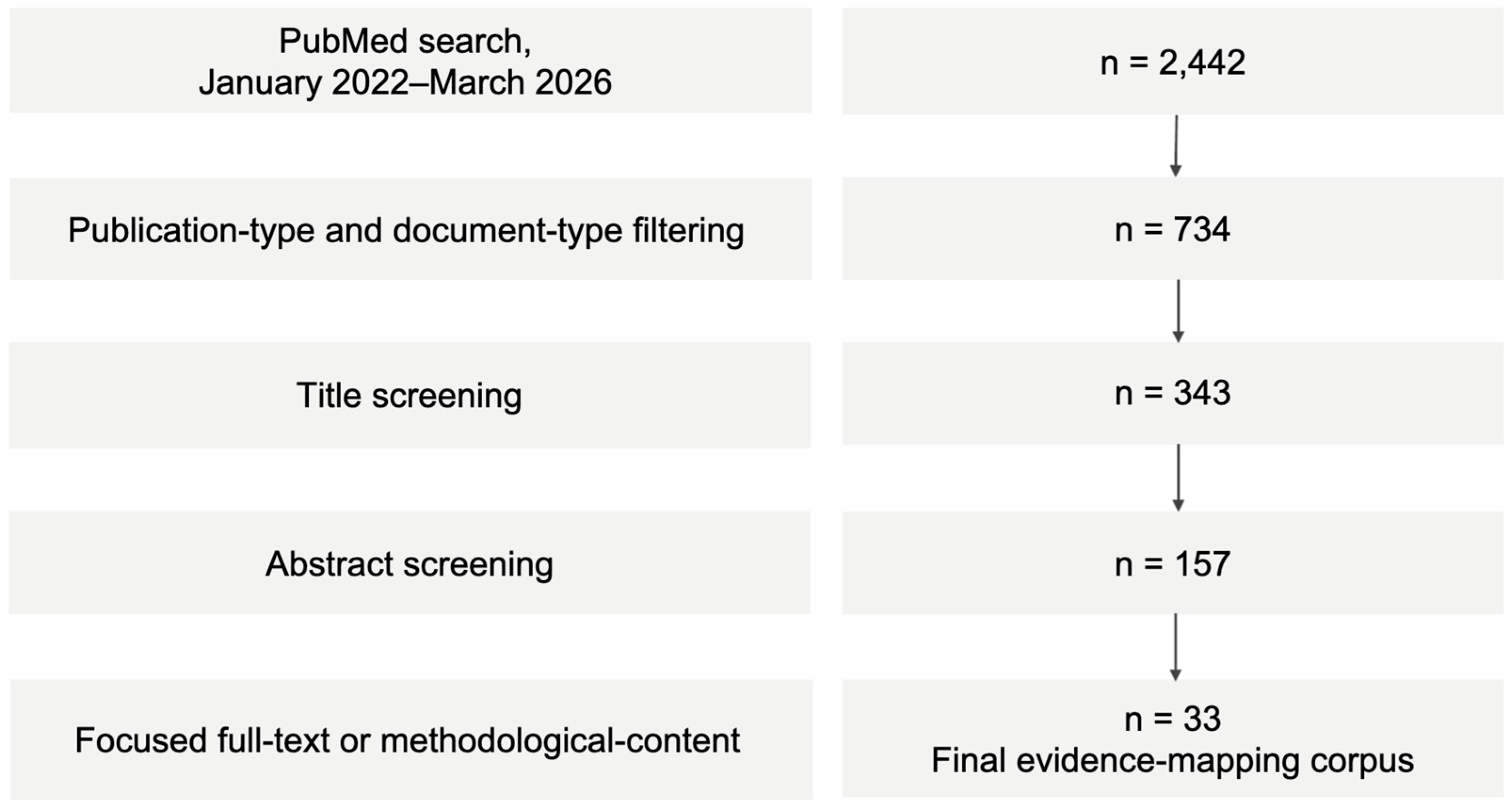
Figure 3.
Sociotechnical architecture of AI-supported continuity within a distributed mental healthcare system.
Figure 3.
Sociotechnical architecture of AI-supported continuity within a distributed mental healthcare system.
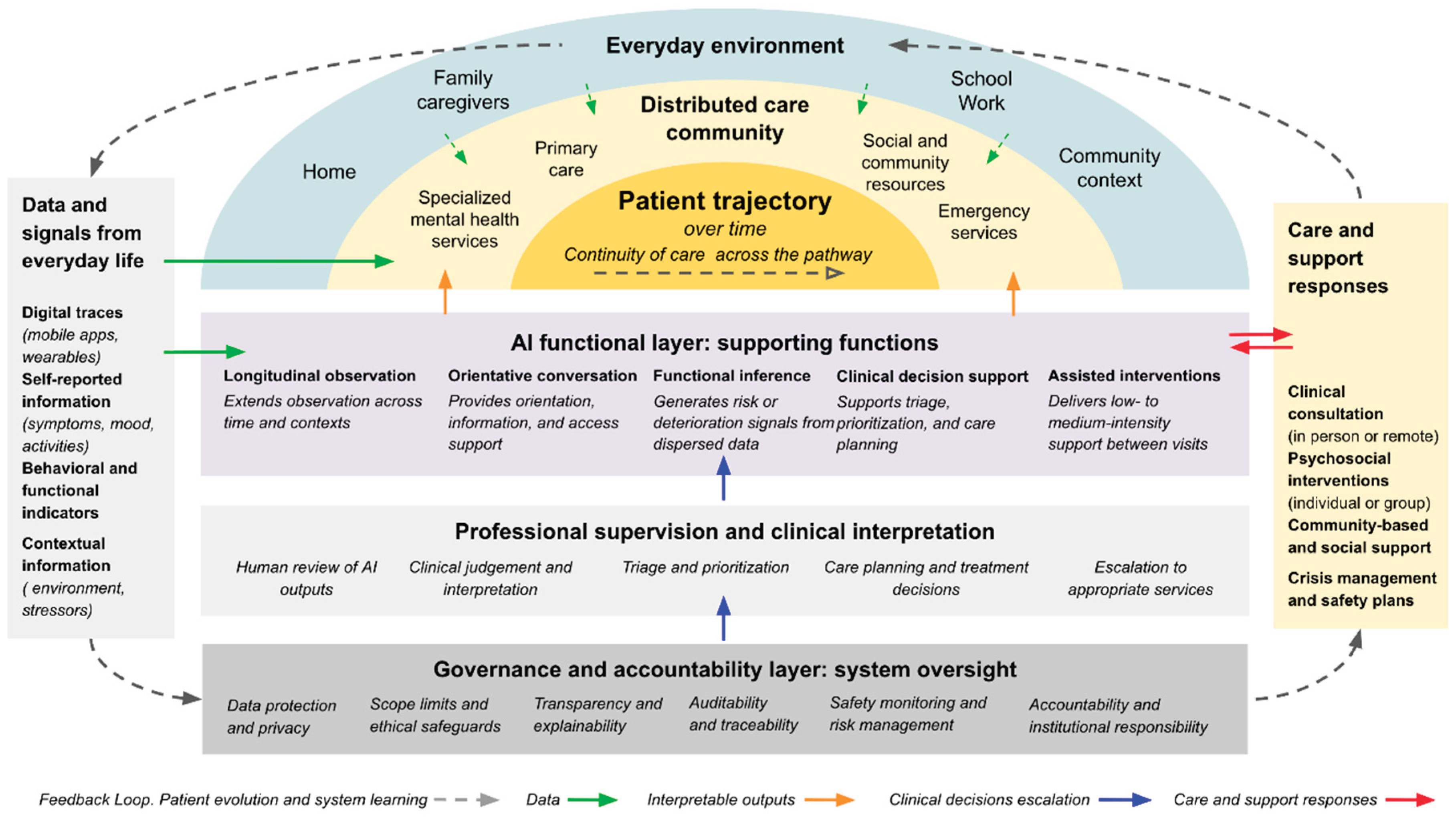

Table 1.
Evidence mapping of the 33 included studies.
| # | Study | ST | Clinical Context | F1 | F2 | F3 | F4 | F5 | CIL | SR |
| 1 | Lee et al. 2023 [10] | Prospective cohort study | Mood disorders / recurrence | P | — | S | — | — | V | IT |
| 2 | Benjet et al. 2023 [24] | Secondary analysis of randomized clinical trial | Anxiety and depression in university population | — | — | — | S | P | V | WS |
| 3 | Bufano et al. 2023 [5] | Systematic review | Multiple mental disorders | P | — | P | S | — | C | ER |
| 4 | Leaning et al. 2024 [25] | Systematic review | MDD / depression | P | — | P | S | — | C | IT |
| 5 | Dhaubhadel et al. 2024 [26] | Prospective cohort study | Suicide risk in US veterans | P | — | P | P | — | V | SI |
| 6 | Walsh et al. 2024 [27] | Observational case-control with multi-site external validation | Bipolar disorder risk | S | — | P | P | — | V | SI |
| 7 | Habicht et al. 2024 [28] | Multi-site observational study | Access to mental health treatment / referral to NHS services | — | P | — | S | P | I | SI |
| 8 | Papini et al. 2024 [29] | Prognostic validation study | Suicide attempt risk at mental health intake | S | — | P | P | — | V | SI |
| 9 | Zierer et al. 2024 [30] | Systematic review | MDD / unipolar depression | P | — | P | S | — | C | IT |
| 10 | Kim et al. 2024 [31] | Algorithm development and validation | Adolescent suicidal thinking | — | — | P | P | — | V | IT |
| 11 | Tai et al. 2024 [32] | Systematic review / meta-analysis | Addiction and concurrent disorders | — | — | — | P | S | C | SI |
| 12 | Al Dweik et al. 2024 [9] | Systematic review | Multiple mental disorders / system strengthening | S | — | S | S | P | C | ER |
| 13 | Guo et al. 2024 [13] | Systematic review | Multiple mental disorders | — | P | S | S | P | C | WS |
| 14 | Terhorst et al. 2024 [7] | Systematic review / meta-analysis | Depression / depressive symptoms | P | — | P | S | — | C | IT |
| 15 | Kolding et al. 2024 [14] | Systematic review | Multiple mental disorders | — | P | S | S | P | C | WS |
| 16 | Salmi et al. 2025 [33] | Randomized controlled trial | Suicide prevention helpline | — | — | — | P | S | I | WS |
| 17 | Cruz-Gonzalez et al. 2025 [12] | Systematic review | Multiple mental disorders | S | — | P | S | P | C | WS |
| 18 | Chen et al. 2025 [34] | Pilot randomized controlled trial | Anxiety and depression in general population | — | P | — | — | P | V | IT |
| 19 | Bentley et al. 2025 [35] | Prognostic EHR | Suicide risk | — | — | P | S | — | V | SI |
| 20 | Wang et al. 2025a [15] | Systematic review | Multiple mental disorders | — | P | S | S | P | C | WS |
| 21 | Pant et al. 2025 [19] | Systematic review | General CDSS / secondary use of EHRs | — | — | S | P | — | C | SI |
| 22 | Curtiss et al. 2025 [36] | Systematic review / meta-analysis | Emotional disorders (anxiety/depression and related) | — | — | P | P | — | C | WS |
| 23 | Wang et al. 2025b [37] | Systematic review | Multiple mental disorders / GenAI in mental health | S | P | P | P | P | C | ER |
| 24 | Amin et al. 2025 [6] | Systematic review | Depression / diagnosed depressive disorders | P | — | P | S | S | C | IT |
| 25 | Benrimoh et al. 2024 [38] | Cluster randomized trial | MDD / personalized depression treatment | S | — | P | P | S | I | SI |
| 26 | Chiang et al. 2025 [39] | Systematic review | Depression / AI-based CDSS | — | — | S | P | — | C | WS |
| 27 | Mendes et al. 2022 [40] | Systematic review | Multiple mental disorders / digital phenotyping | P | — | S | — | — | C | IT |
| 28 | Zarate et al. 2022 [41] | Systematic review | Depression / digital phenotyping | P | — | P | S | S | C | IT |
| 29 | Lejeune et al. 2022 [42] | Systematic review | Psychotic disorders / schizophrenia | S | — | P | S | — | C | IT |
| 30 | Kusuma et al. 2022 [43] | Systematic review / meta-analysis | Suicidal ideation, suicide attempts, and suicide deaths | — | — | P | P | — | C | WS |
| 31 | Moura et al. 2023 [8] | Systematic review | Multiple mental disorders / digital phenotyping | P | — | P | S | — | C | IT |
| 32 | Malgaroli et al. 2023 [44] | Systematic review | Mental health interventions / psychotherapy, assessment, crisis care | — | P | S | P | S | C | ER |
| 33 | Richter et al. 2025 [45] | Observational modeling study | Affective disorders / depression severity | — | — | P | S | — | V | WS |
Table 2.
Distribution of functional assignments, clinical integration levels, and systemic relevance across the included corpus.
Table 2.
Distribution of functional assignments, clinical integration levels, and systemic relevance across the included corpus.
| Analytical dimension | Category | n | Corpus % |
| Total functional presence | F1. Longitudinal observation | 17 | 51.5 |
| Total functional presence | F2. Conversational orientation and support | 7 | 21.2 |
| Total functional presence | F3. Functional inference or prediction | 28 | 84.8 |
| Total functional presence | F4. Clinical decision support or stratification | 30 | 90.9 |
| Total functional presence | F5. Assisted interventions | 15 | 45.5 |
| Core function | F1. Longitudinal observation | 10 | 30.3 |
| Core function | F2. Conversational orientation and support | 7 | 21.2 |
| Core function | F3. Functional inference or prediction | 19 | 57.6 |
| Core function | F4. Clinical decision support or stratification | 13 | 39.4 |
| Core function | F5. Assisted interventions | 9 | 27.3 |
| Secondary function | F1. Longitudinal observation | 7 | 21.2 |
| Secondary function | F2. Conversational orientation and support | 0 | 0.0 |
| Secondary function | F3. Functional inference or prediction | 9 | 27.3 |
| Secondary function | F4. Clinical decision support or stratification | 17 | 51.5 |
| Secondary function | F5. Assisted interventions | 6 | 18.2 |
| Clinical integration level | C. Conceptual or review-based | 21 | 63.6 |
| Clinical integration level | V. Validated | 9 | 27.3 |
| Clinical integration level | I. Implemented | 3 | 9.1 |
| Systemic relevance | IT. Individual task | 11 | 33.3 |
| Systemic relevance | WS. Workflow support | 10 | 30.3 |
| Systemic relevance | SI. Service integration | 8 | 24.2 |
| Systemic relevance | ER. Ecosystem-level relevance | 4 | 12.1 |
Note: Functional categories are not mutually exclusive. Therefore, core and secondary function counts may exceed the total number of included studies. Percentages refer to the proportion of the 33-study corpus in which each function was coded as core, secondary, or present overall. Clinical integration level and systemic relevance were coded once per study and therefore sum to 33.
Table 3.
Operational clinical boundaries for AI-supported mental healthcare functions. .
| AI-supported function | What it can support | What it must not be interpreted as | Required safeguard |
| Functional inference | Risk signals, deterioration patterns, severity estimates | Formal diagnosis | Clinical review and contextual interpretation |
| Assisted intervention | Psychoeducation, structured support, low-intensity accompaniment | Autonomous psychotherapy | Eligibility criteria and escalation protocols |
| Decision support | Triage support, prioritization, treatment planning support | Delegated clinical decision-making | Human oversight and documented accountability |
| Conversational support | Orientation, demand channeling, between-contact support | Therapeutic relationship | Clear scope, risk detection, referral pathways |
Table 4.
Episodic care model versus trajectory-based care model.
| Dimension | Episodic care model | Trajectory-based care model |
| Primary unit of care | The visit or isolated clinical encounter | The patient trajectory over time |
| Temporal logic | Discrete, intermittent contacts | Longitudinal, continuous, and adaptive follow-up |
| Clinical focus | Acute episode, current complaint, immediate symptom presentation | Patterns of change, recurrence, deterioration, recovery windows, and functional evolution |
| Main source of clinical information | Retrospective report collected during the visit | Combined longitudinal information across encounters, contexts, and intermediate periods |
| Observation between contacts | Limited or absent | Explicitly organized as part of care continuity |
| Role of everyday context | Secondary or weakly represented | Clinically relevant and integrated into interpretation of change |
| Detection of early change | Often delayed until next formal encounter | Potentially earlier through continuous or distributed observation |
| Decision-making basis | Snapshot assessment at a given moment | Dynamic interpretation of patient evolution over time |
| Continuity of care | Desired but weakly structured | Explicit system function requiring coordination and support |
| Service–actor relationships | Often fragmented across levels and services | Organized around coordination across actors, services, and care settings |
| Response to deterioration | Frequently reactive | More anticipatory and escalation-oriented |
| Intensity support between visits | Often scarce or poorly integrated | Considered part of the care architecture |
| System requirement | Capacity to manage visits and episodes | Capacity to sustain trajectories, coordination, and adaptive response |
| Potential role of AI | Add-on tool for isolated tasks | Supervised infrastructural layer supporting observation, inference, decision support, escalation, and low-intensity assistance across the care ecosystem |
Disclaimer/Publisher’s Note: The statements, opinions and data contained in all publications are solely those of the individual author(s) and contributor(s) and not of MDPI and/or the editor(s). MDPI and/or the editor(s) disclaim responsibility for any injury to people or property resulting from any ideas, methods, instructions or products referred to in the content. |
© 2026 by the authors. Licensee MDPI, Basel, Switzerland. This article is an open access article distributed under the terms and conditions of the Creative Commons Attribution (CC BY) license (http://creativecommons.org/licenses/by/4.0/).
Copyright: This open access article is published under a Creative Commons CC BY 4.0 license, which permit the free download, distribution, and reuse, provided that the author and preprint are cited in any reuse.


