

Submitted:
10 July 2026
Posted:
13 July 2026
You are already at the latest version
Abstract
Spatial AI is moving from representation to physical action. Single-camera streaming 3D reconstruction illustrates the shift: it can provide pose and geometry on small machines, but a reconstructed model is not yet a safe actuator command. A robot, vehicle, drone, wearable or industrial machine must still decide which spatial events require immediate local action, which can be summarized for a higher layer, and which require richer world-model reasoning. LingBot-Map is used only as a representative case of this class of pipelines; no experimental benchmark claim is made. This paper proposes a Reflex-Policy approach for Spatial AI. Local reflex layers convert urgent evidence from cameras, event sensors, MEMS, tactile, acoustic or other physical sources into low-bit events; execute bounded first actions such as stop, slow, inhibit, freeze, keyframe request, fallback or quarantine; and report compact event-action traces. Policy and world-model layers remain outside the urgent path, updating thresholds, permissions, context and rules. The contribution is an event-contract level of analysis: a spatial reflex event dictionary, structured physical observability with cardinality control, and an EROIE measurement discipline for the energy and value of event-level control. The framework does not claim that layered control is new. It makes the sensor-to-actuator contract, permission envelope, measured feedback, containment state and audit trace explicit, so that Spatial AI can remain energy-proportional, actuation-aware and diagnosable.
Keywords:
spatial AI
; physical AI
; reflex-policy
; structured physical observability
; event-action trace
; 3D reconstruction
; MEMS
; event cameras
; world models
; local reflex
; spatial perception
; cyber-physical containment
; EROIE
; energy-proportional inference
1. Introduction: From Spatial Representation to Spatial Action
Artificial intelligence is entering machines that sense, decide and act in the physical world. In this context, Spatial AI means more than recognizing images: it means estimating where the machine is, what surrounds it, how the scene changes and how actions may change spatial relationships.
Recent advances in neural radiance fields, 3D Gaussian splatting, neural SLAM and streaming reconstruction have greatly improved spatial representation from camera data [4,5,6,7,8,9,10,11,12,13,14]. These methods are usually judged by reconstruction quality, rendering accuracy, pose consistency or map completeness. Those measures are important, but they do not answer the first control question: can the machine act safely in time?
Single-camera 3D reconstruction is especially useful as a case study. It is accessible because it reduces sensor cost and can fit small robots, drones, wearables and industrial nodes. It is also fragile because one RGB stream has limited redundancy. Texture loss, motion blur, illumination change, temporal aliasing and physical adversarial perturbations can all affect the reconstructed state. These are general monocular-pipeline risks; this paper does not claim that they have been measured on LingBot-Map.
LingBot-Map illustrates the current direction well. It reconstructs camera pose and point-cloud geometry from video streams using compact geometric memory and reports stable real-time inference around 20 FPS on 518 × 378 inputs over long sequences exceeding 10,000 frames [1]. This is impressive. It also raises the question that drives this paper: once a machine reconstructs space, how should it act in that space?
This is why Spatial AI specifically needs a reflex-policy approach now. Spatial representation has become fast enough to enter small machines, but the same machines are constrained by battery energy, actuator latency, safety envelopes, communication bandwidth and service diagnostics. The bottleneck is no longer only map quality; it is the controlled conversion of spatial evidence into permitted physical action.
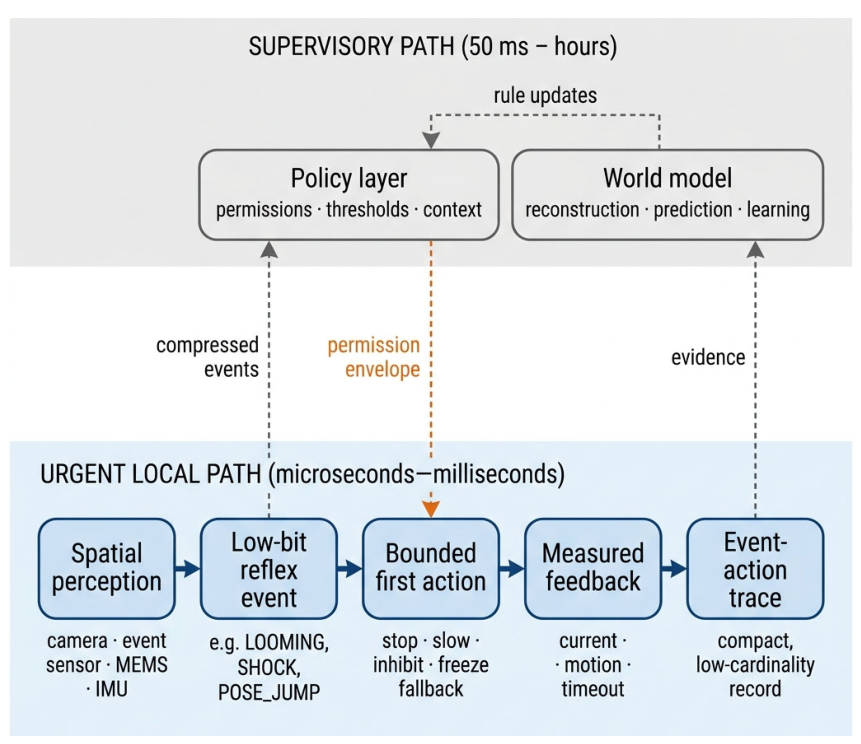
Figure 1 summarizes the signal chain used throughout the paper: spatial evidence becomes a low-bit event, a bounded first action is executed locally, measured feedback closes the loop, and a compact trace remains available for policy, diagnosis and safety.
Reflex-Policy addresses that gap. Earlier work proposed that Physical AI should assign each event to the lowest sufficient layer instead of routing all events through a central processor [2]. A second paper separated latency, throughput, bandwidth and world models, and argued that strong policy models do not eliminate the need for local reflex layers [3]. The present paper applies that logic to Spatial AI while recognizing that layered control has deep roots in robotics: Brooks’ subsumption architecture, behavior-based robotics, Gat’s three-layer model and probabilistic robotics already separated fast action from slower reasoning [15,16,17,18].
Compared with Gat’s deliberative/sequencing/reactive split, Reflex-Policy makes the sensor-to-actuator contract, EROIE accounting, cyber-physical containment and structured observability explicit. MEMS and electronic evidence, actuator feedback, rule provenance and diagnostic summaries are treated as part of the architecture rather than implementation detail. The practical guide is simple: spatial perception becomes useful only when it closes through sensors, conditioning, local events, verified rules, bounded outputs, actuator commands, measured feedback and observable traces.
Event-based vision and agile-robotics work from the Zurich/ETH/UZH ecosystem provides a useful related-work bridge. It already shows that sparse, low-latency visual evidence can be decisive for high-speed UAV control [23,24,25,26,62,63]. The present paper takes that lesson beyond event cameras alone: the sparse event must be linked to MEMS and physical evidence, a bounded action, measured feedback, control-energy accounting and a structured trace.
Scope. The paper is therefore not a claim that layered control is new, nor another generic Physical-AI taxonomy. The focus is the Spatial-AI event-contract level: which spatial signal is sensed, which low-bit event is emitted, which bounded action is allowed, how control energy is accounted, which physical feedback verifies the action, and which structured trace remains available for diagnosis, safety analysis and maintenance.
2. Reflex-Policy in Spatial AI: Physical and Electronic Summary
Spatial AI is often described in software terms: reconstruction, pose, point cloud, map, confidence, semantic scene and world model. A physical machine acts only after these abstractions become signals, decisions and commands. Table 1 translates Spatial AI language into sensing, electronics, actuation, feedback, containment and structured observability.
| Spatial-AI term | Physical/electronic meaning | Reflex-Policy and observability role |
| Spatial perception | Camera, event sensor, radar, lidar, MEMS, tactile, acoustic or thermal sensing. | Physical evidence source. |
| Spatial feature | Pixel event, voltage, current, inertial vector, pressure, vibration, acoustic impulse or temperature signal. | Local condition input. |
| Confidence loss | Threshold crossing, counter overflow, feature collapse, IMU-vision mismatch or consistency failure. | Low-bit reflex event. |
| Temporal aliasing | Frame-rate inconsistency, rolling-shutter artifact, rapid-motion artifact or non-physical pose jump. | Freeze, keyframe request or fallback trigger. |
| Reflex event | SP_EVT_LOOMING, SP_EVT_MEMS_SHOCK, SP_EVT_POSE_JUMP, SP_EVT_LOW_TEXTURE, SP_EVT_TEMPORAL_ALIASING, SP_EVT_RECONSTRUCTION_INCONSISTENT. | Compressed physical state with stable event namespace, source and severity. |
| Policy permission | Verified enable signal, rule authorization, mode bit or safety envelope. | Permitted action boundary and permission trace. |
| Local action | Inhibit, slow, stop, isolate, wake, clamp, reconfigure or fallback. | Bounded first response. |
| Actuation | Motor driver, gate driver, relay, MOSFET, converter, brake, haptic actuator or power switch. | Physical execution. |
| Feedback | Current present, motion stopped, vibration reduced, actuator fault, route disabled or timeout. | Action verification. |
| Security | Authenticated update, active/shadow state, rollback, anti-replay, watchdog and quarantine. | Cyber-physical containment. |
| Structured observability | Event-action record with source, severity, rule/envelope version, permission, action, latency, response, result and fallback state. | Audit, diagnosis, maintenance and safety-case evidence without raw data flooding. |
Spatial AI becomes Physical AI only when perception closes through sensing, electronics, actuation, feedback, containment and observability. The design rule is practical: do not start by asking which model to run. Start by asking what physical event is being sensed, what local evidence is available, which first action is allowed, which actuator will execute it, which feedback proves that it happened and which trace will remain available for diagnosis.
For example, a looming event is not simply an image feature. It is a chain: optical expansion or event-camera divergence crosses a threshold; an IMU or range sensor may confirm or contradict the event; a permission envelope determines whether slowing or stopping is allowed; an actuator command is issued; current, speed or vibration feedback verifies the response; and a compact trace records the source, severity, permission, latency and result.
3. Spatial AI Solves Representation, Not Action
Spatial AI tells a machine where it is, what geometry surrounds it, which surfaces or obstacles are present, and how the scene changes over time. These representation problems are essential, but they are not enough.
A physical system must also decide which event requires action now, which action is permitted, which actuator should be inhibited, what should be reported upward, which sensor stream is still trustworthy, which configuration is verified, and which trace will later explain the action. These are Reflex-Policy and observability questions.
The common mistake is to assume that better representation automatically gives better action. It does not. A rich 3D map can be too slow, too energy intensive or too uncertain for the first protective action. A local reflex can act quickly, but it cannot replace long-term spatial understanding. A log file can record many samples, but it cannot by itself explain whether a map update was rejected because of a symptom, a cause, a permission state or a measured actuator mismatch. The layers have to cooperate.
3.1. Pure Spatial AI Versus Reflex-Policy Spatial AI
| Design dimension | Pure Spatial AI/world-model-heavy view | Reflex-Policy Spatial AI with observability |
| Primary goal | Improve reconstruction, mapping, prediction and semantic understanding. | Use reconstruction when needed, but assign urgent physical events to lower layers first. |
| First response | Often waits for a reconstructed state, planner update or policy cycle. | Can stop, slow, inhibit, wake or fallback from local evidence before full reconstruction completes. |
| Energy strategy | Reduce energy per inference or improve model efficiency. | Reduce unnecessary inference calls, conversions, wake-ups and upstream data movement. |
| Sensor use | Vision stream is often the dominant evidence source. | Vision is fused with MEMS, event sensors, tactile, acoustic and physical feedback. |
| Safety boundary | Perception and action may be coupled through complex software. | A bounded action layer separates perception confidence from permitted physical execution. |
| Failure handling | Reconstruction failure may propagate into planning. | Low confidence, aliasing, sensor mismatch or invalid updates trigger local containment. |
| Observability | Raw logs or high-level metrics may be inspected after failure. | Each significant event can produce a compact event-action trace with cause/symptom, permission, result and latency. |
| Product integration | AI model is central; electronics and safety may be added later. | Sensing, electronics, actuation, feedback, observability and security are designed as one contract. |
4. Biological Anchors: The Fly and the Bee
Biology is not a proof of engineering optimality, but it is a useful antidote to overbuilding models. The insect-inspired Reflex/Policy framing used here is consistent with earlier peer-reviewed work on neuromorphic reflex islands for safety-critical edge systems [67].
A fly escaping an approaching threat does not build a 3D model of the room. It detects urgent spatial cues such as looming, rapid angular expansion, airflow or local motion patterns, and it triggers escape before full deliberation is useful. Loom-sensitive pathways in Drosophila link visual computation to action [27,28,29].
This is not primitive intelligence. It is intelligence placed at the right layer. In Reflex-Policy language, the fly illustrates Layer 1 and Layer 2: a low-bit spatial reflex plus fast analog coordination of the body and wings. The observable engineering counterpart is a compact event-action trace: a looming event occurred, a response was permitted, a stop or evasive output was generated, and the measured response followed or failed within a defined time.
The bee gives the complementary lesson. Bees navigate, remember landmarks, estimate distance and direction, return to the hive and communicate spatial information. They use optic-flow odometry, path integration, landmark memory and persistent directional states rather than a dense metric model of the whole world [30,31,32,33,34,35,36].
The boundary is important. A compact policy state is not defined by the absence of memory; it may carry heading, homing vector, confidence or route state. It is called a policy state here because it directly supports near-term action selection. A world model, in this taxonomy, is richer: it reconstructs or predicts broader scene structure and counterfactual futures. Bee path integration can therefore be seen as a minimal world-model-like state, but its engineering lesson is closer to compact local policy than to full spatial reconstruction.
The mushroom body adds a second lesson: associative learning can update which cues become relevant to navigation and action [38]. In engineering terms, this resembles policy update rather than immediate reflex execution. A robot may initially treat a repeated striped-floor pattern as low texture and merely request keyframes; after experience, the policy layer may update the local threshold so that the same pattern is handled as a benign route feature while still preserving a fallback if MEMS evidence later contradicts vision. The fly and the bee are not rival metaphors. The fly supplies the spatial reflex; the bee supplies compact spatial policy. Together they make the design rule clear: do not reconstruct more of the world than the action requires, and do not record more evidence than the safety case, diagnosis and learning task require.
5. Reflex-Policy Decomposition of Spatial AI
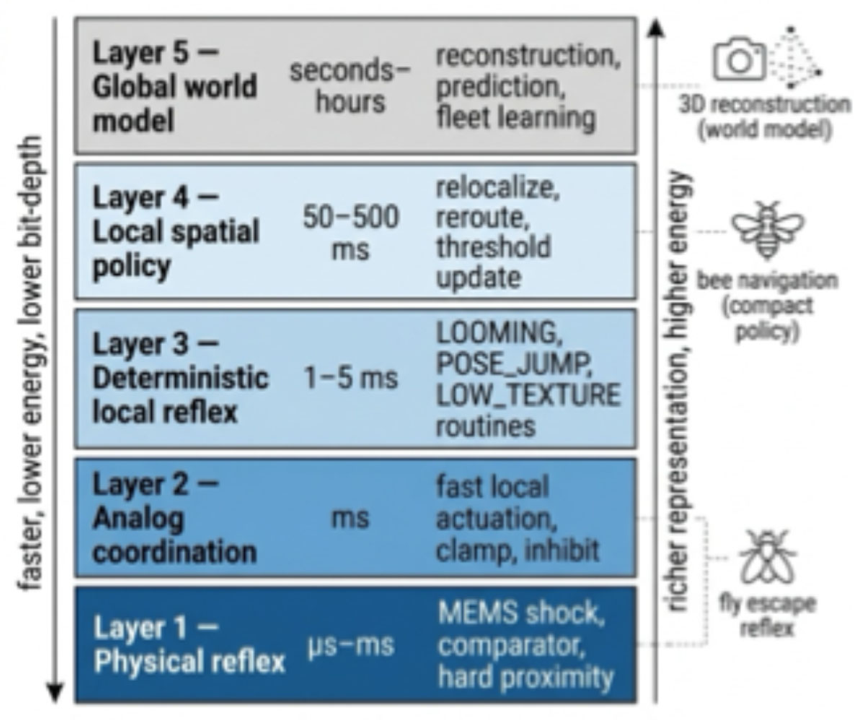
The five-layer model used in this paper is defined explicitly as follows. Layer 1 is the physical reflex level, where MEMS shock, comparator, hard-proximity, saturation or equivalent physical evidence can produce a microsecond-to-millisecond response. Layer 2 is analog coordination, where local actuation, clamping or inhibition is coordinated without rich reconstruction. Layer 3 is deterministic local reflex, where bounded routines handle composite events such as POSE_JUMP, LOW_TEXTURE, TEMPORAL_ALIASING or reconstruction inconsistency. A looming condition may be treated at Layer 1/2 when it is confirmed by hard proximity, event-camera divergence or MEMS/range evidence; it may move to Layer 3 only when it requires a deterministic visual routine. Layer 4 is local spatial policy, where relocalization, rerouting and threshold updates occur over tens to hundreds of milliseconds. Layer 5 is the global world model, where reconstruction, prediction and fleet learning occur over seconds to hours. The point is not to impose a universal taxonomy; it is to assign each spatial event to the lowest sufficient layer.
The Spatial Reflex layer handles simple, urgent events: hard proximity, MEMS shock, rapid obstacle expansion confirmed by local evidence, texture loss, temporal aliasing, sudden pose jump, excessive optical flow, depth inconsistency, unsafe proximity, fall or tilt, map-confidence collapse, critical occlusion or sensor-stream inconsistency. Direct hazards remain in Layer 1/2 when physical evidence is sufficient; deterministic visual or consistency routines belong to Layer 3.
Its outputs are bounded: slow down, stop, inhibit motion, wake the policy processor, request a keyframe, freeze map update, enter fallback, quarantine a sensor stream, report a compressed event or hold the last verified configuration. This layer can use comparators, event cameras, low-bit visual features, IMU thresholds, optical-flow triggers, MEMS sensors, deterministic state machines or compact local logic. Non-volatile rule fabrics may help in future implementations, but the principle does not depend on any single device technology.
Figure 2.
Five-layer Reflex-Policy stack for Spatial AI. The lower layers are faster, lower-energy and lower-bit-depth; the upper layers are richer, slower and more energy intensive. Each spatial event is assigned to the lowest sufficient layer.
Figure 2.
Five-layer Reflex-Policy stack for Spatial AI. The lower layers are faster, lower-energy and lower-bit-depth; the upper layers are richer, slower and more energy intensive. Each spatial event is assigned to the lowest sufficient layer.
The Spatial Policy layer interprets local context. It may decide that a feature-poor corridor requires slower navigation, a repeated drift event requires relocalization, MEMS evidence confirms a visual anomaly, or a sensor stream should remain quarantined.
The Spatial World Model reconstructs and predicts. It estimates geometry, pose, dynamics and possible futures [19,20]. It improves maps, learns patterns, updates thresholds and provides richer context. It should not be asked to perform every urgent action.
In simple terms: the world model predicts; the policy selects; the reflex acts when waiting would be unsafe or wasteful; observability explains what happened and why it happened without forcing the urgent path to stream raw data.
6. MEMS as the Local Physical Nervous System of Spatial AI
A camera estimates geometry. It does not directly measure acceleration, angular velocity, vibration, shock, tilt, acoustic impulse, pressure, contact, strain or structural stress. These are often the fastest signals for safe first reaction. MEMS therefore have a central role in Spatial Reflex [37].
Consider a camera that sees a static corridor while an IMU detects a sudden 0.5 g impulse. If the calibrated mismatch threshold is 0.3 g, the system can raise an IMU-visual mismatch event before a refined 3D reconstruction is available. The mismatch may indicate impact, slip, sensor failure, time synchronization error or physical manipulation.
Cross-calibration is part of the contract. Visual thresholds such as angular expansion, feature loss and pose jump must be aligned with MEMS thresholds such as acceleration, angular velocity, vibration and shock. A concrete design may, for example, trigger a SP_EVT_LOOMING candidate when optical expansion exceeds 0.1 rad/s, promote it to a higher severity when forward range or event-camera divergence agrees, and suppress or downgrade it when IMU and range evidence contradict the visual cue. Conversely, a 0.5 g impulse with a calibrated 0.3 g mismatch threshold can trigger SP_EVT_IMU_VISUAL_MISMATCH even before a refined 3D reconstruction is available. A single compact event such as SP_EVT_MEMS_SHOCK or SP_EVT_IMU_VISUAL_MISMATCH can replace megabytes of video for the urgent safety path. That improves EROIE by avoiding unnecessary high-level inference when the physical evidence is already decisive.
Cold-start thresholds should not be guessed from one trace. A practical method is to start with conservative manufacturer or safety-envelope limits, collect non-action training data under controlled operation, estimate normal distributions for optical expansion, feature loss, IMU impulse and pose-change classes, and then deploy thresholds with hysteresis and hold-time rules. The policy or service layer may later update thresholds, but only through a verified rule/envelope update with rollback and traceability.
For a mismatch event to be useful, it should not be a bare alarm. The local layer should emit an evidence-role code, not a definitive root-cause diagnosis: symptom, likely cause, measured effect, command violation, sensor inconsistency or unknown. Root-cause analysis can then be refined by policy, service tools or offline diagnostics using repeated traces, calibration history and measured actuator response. This avoids over-asking the reflex layer while still preserving enough structure for diagnosis.
| MEMS/local sensor | Physical evidence | Spatial reflex use | Possible first action | Observable trace field |
| Accelerometer | Shock, fall, vibration, impact. | Physical anomaly confirmation. | Stop, inhibit, fallback. | Peak class, duration, sensor source, action result. |
| Gyroscope | Angular velocity, rotation inconsistency. | IMU-vision mismatch. | Slow, reject pose update. | Angular-rate class, visual consistency grade. |
| Pressure sensor | Contact, airflow, altitude, grip. | Contact or environment state. | Adjust, inhibit, report. | Contact state, pressure class, permission state. |
| MEMS microphone | Acoustic impulse or abnormal sound. | Fault, collision or intrusion cue. | Wake policy, local quarantine. | Impulse class, source channel, quarantine state. |
| Tactile MEMS | Touch, slip, pressure distribution. | Manipulation safety. | Reduce force, stop grip. | Slip class, grip command, measured response. |
| Environmental MEMS | Temperature, gas, humidity. | Unsafe operating condition. | Limit action, report event. | Environment class, limit version, derating result. |
| Structural vibration | Resonance, mechanical fault. | Machine-health reflex. | Reduce speed, isolate module. | Vibration class, affected module, maintenance flag. |
7. Structured Physical Observability
Structured physical observability is the ability of a Spatial-AI machine to explain its local event-action behavior through compact, bounded and machine-readable traces. It is not the same as high-rate logging. High-rate logs collect samples; structured observability records the causal and operational meaning of a local action.
In automotive and industrial terms, this is also not a replacement for diagnostic trouble codes, UDS service records or maintenance logs. Those mechanisms summarize faults at service level. The event-action trace proposed here sits closer to the physical action: it records which local evidence triggered which bounded response, under which permission and rule/envelope version, with which measured feedback. Higher diagnostic systems can aggregate these traces into DTC-like or service-level records.
The need appears whenever a machine acts before a full reconstruction or policy cycle completes. If a local tile freezes a map update, slows a robot, rejects a pose estimate or quarantines a camera stream, an operator or certification engineer must later understand the decision. Which event was detected? Which source contributed evidence? Was the event a symptom of an upstream failure or a cause requiring action? Which rule or envelope was active? Which permission allowed or blocked the action? How long did the response take? Did the actuator move as expected? Was the event unique, repeated, sampled or aggregated?
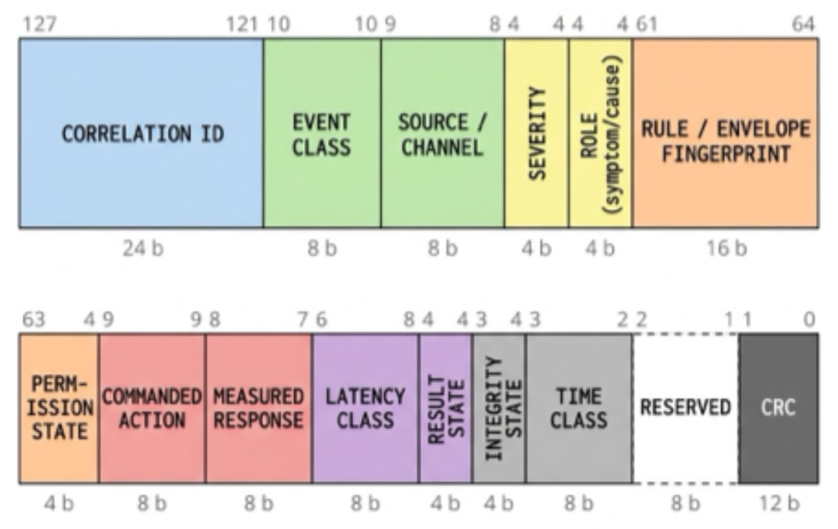
Raw observability can be too expensive for edge machines. A mobile robot or wearable cannot always store all frames, IMU samples and internal states. The objective is therefore structured sufficiency: retain the minimum event-action evidence needed for safety, diagnosis, learning and maintenance, while keeping high-resolution capture optional and event-triggered. In low-bandwidth systems the trace may be implemented as a fixed-width event-action word, for example a 64-bit or 128-bit record, with optional links to sampled diagnostic windows.
7.1. Minimum Event-Action Trace
| Trace field | Meaning | Why it matters |
| Correlation identifier | A compact identifier linking event, action, feedback and optional diagnostic capture. | Allows the local event, command, measured response and later diagnosis to be joined. |
| Event class | Low-bit event such as looming, low texture, pose jump, sensor saturation or shock. | Summarizes what was detected without transmitting raw data. |
| Source and channel | Camera, event camera, depth, radar, lidar, IMU, MEMS, tactile, acoustic, thermal or actuator feedback source. | Identifies the evidence path and affected subsystem. |
| Severity and confidence | Discrete severity and confidence or consistency grades. | Supports prioritization and hysteresis. |
| Symptom/cause/evidence role | Locally coded role: symptom, likely cause, measured effect, command violation, sensor inconsistency or unknown. | Preserves diagnostic structure without asking the local layer to prove root cause. |
| Rule or envelope version | Version or fingerprint of the active threshold, rule map or safety envelope. | Explains why an action was permitted, inhibited or rejected. |
| Permission state | Allowed, denied, degraded, emergency, fallback or maintenance mode. | Separates perception from authorization to act. |
| Commanded action | Stop, slow, inhibit, brake, freeze, reject, request keyframe, relocalize, quarantine or fallback. | Records the first bounded response. |
| Measured response | Stopped, slowed, current limited, vibration reduced, no response, timeout or actuator mismatch. | Verifies whether the physical action happened. |
| Latency and duration class | Time class from event to action and action duration or timeout. | Supports safety analysis and timing validation. |
| Result state | Resolved, escalated, repeated, suppressed, sampled, aggregated, quarantined or failed. | Avoids unbounded event storms and enables maintenance prioritization. |
| Integrity state | Authenticated, stale, replay rejected, physically implausible, incomplete or last-valid. | Connects cybersecurity to physical behavior. |
Figure 3.
Example fixed-width 128 bit structured observability record. The field widths are illustrative; the key design principle is bounded cardinality with enough information to correlate event, rule, permission, action, feedback and integrity state. Field widths, rather than any graphical boundary-numbering artifact, define the intended layout.
Figure 3.
Example fixed-width 128 bit structured observability record. The field widths are illustrative; the key design principle is bounded cardinality with enough information to correlate event, rule, permission, action, feedback and integrity state. Field widths, rather than any graphical boundary-numbering artifact, define the intended layout.
7.2. Cardinality Control, Sampling and Aggregation
Observability can itself become a failure mode if every pixel, feature, pose estimate and local event generates a unique log key. Spatial machines should therefore control cardinality. Event classes should be stable and low in number; source identifiers should be bounded; continuous values should be converted into severity or confidence classes; detailed high-resolution capture should be sampled, windowed or triggered by configured conditions.
Aggregation is especially important for recurring spatial anomalies. A corridor with poor texture should not generate an unbounded stream of unique alarms. A practical implementation may report the first LOW_TEXTURE event, then aggregate repeated occurrences over a 10-second window into one record containing event class, source, count, maximum severity, representative confidence, action result and one optional diagnostic window. The same principle applies to repeated glare, vibration, pose-jump or sensor-saturation events: the urgent path remains sparse, while diagnostics still receive enough evidence to identify persistence and trend.
This approach keeps the urgent path sparse and energy-proportional while preserving accountability. It also helps maintenance: an operator can distinguish a single collision-like shock from a recurring vibration fault, a transient glare event from a persistent sensor saturation condition, and a denied command from an actuator that failed to respond.
8. Case Study: Single-Camera 3D Reconstruction
Single-camera 3D reconstruction is powerful, accessible and fragile. A single RGB camera can estimate pose and geometry without an expensive sensor stack, but the same stream can lose texture, alias fast motion, suffer blur, misestimate parallax or be manipulated by physical perturbations.
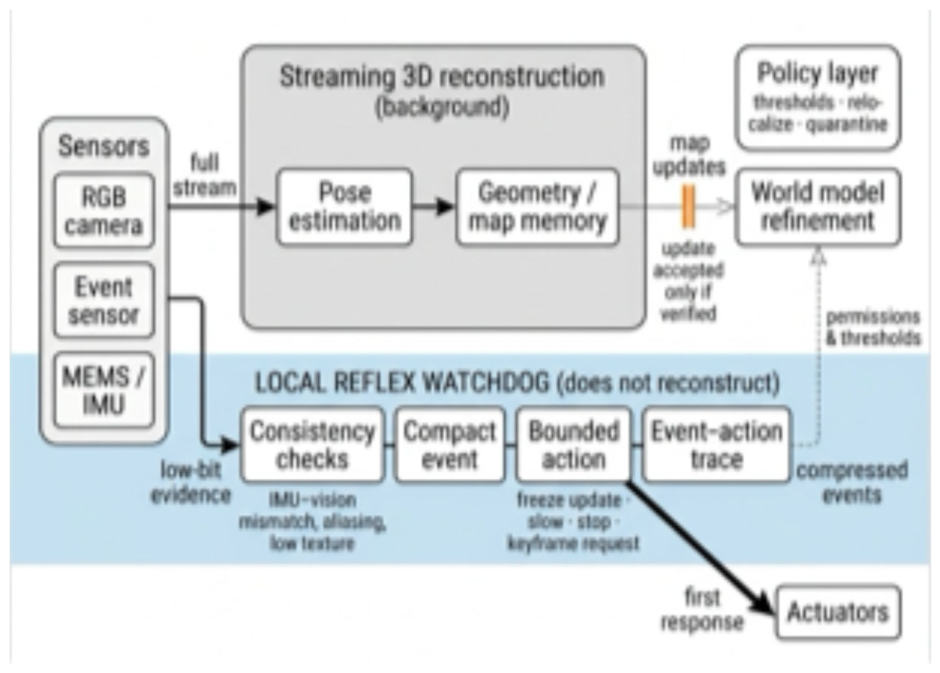
Reflex-Policy does not replace reconstruction. It places a local watchdog and an observable event-action layer around it. The reconstruction continues in the background; the reflex layer can still trigger bounded action without waiting for a full reconstruction cycle.
LingBot-Map is used here as a concrete example of real-time single-camera reconstruction, not as an experimentally evaluated target of the proposed Reflex-Policy layer. The failure cases discussed below are generic to monocular or video-dominant spatial pipelines: texture loss, temporal aliasing, pose jump, motion blur, calibration drift, sensor saturation and physically implausible updates.
The argument therefore does not depend on a single preprint or a single reconstruction method. Neural SLAM, 3D Gaussian SLAM, metric-semantic localization and streaming reconstruction pipelines differ in representation, but each still needs a contract that decides when local evidence is sufficient for first action, when a world-model update should be frozen or rejected, and which trace remains available for diagnosis.
8.1. Conventional View
A conventional streaming reconstruction pipeline treats video as the main input to a high-level model. The model estimates pose, geometry and memory; the downstream controller uses the reconstructed state. This is powerful, but it creates dependence on continuous high-level processing and often leaves diagnostic meaning scattered across frames, pose estimates and controller logs.
8.2. Reflex-Policy View
A Reflex-Policy pipeline includes a reflex front end, a bounded action layer and structured observability. The reflex layer does not reconstruct the scene. It detects excessive frame-to-frame motion, angular expansion, IMU-camera inconsistency, local feature collapse, temporal aliasing, pose discontinuity, insufficient parallax, repeated occlusion, MEMS-confirmed shock or invalid configuration.
Operational flow: camera/event sensor/MEMS → local reflex checks → if urgent, emit a compact spatial event and execute bounded action → record event-action trace → policy decides whether to update thresholds, insert a keyframe, relocalize or keep fallback → world model refines geometry and long-term rules.
Figure 4.
Single-camera 3D reconstruction pipeline wrapped by a local reflex watchdog. Reconstruction continues in the background, while the local watchdog checks consistency, emits compact events, executes bounded action and records an event-action trace.
Figure 4.
Single-camera 3D reconstruction pipeline wrapped by a local reflex watchdog. Reconstruction continues in the background, while the local watchdog checks consistency, emits compact events, executes bounded action and records an event-action trace.
8.3. What the Reconstruction Pipeline Gains
| Reconstruction issue | Reflex-Policy addition | Concrete gain | Observable evidence |
| Texture loss | LOW_TEXTURE event and early keyframe request. | Avoids waiting until the map has already degraded. | Feature-confidence class, keyframe request, result. |
| Pose jump | Pose-change envelope and IMU consistency check. | Freezes suspicious update and limits drift propagation. | Pose-jump class, IMU consistency, freeze duration. |
| Fast motion/aliasing | TEMPORAL_ALIASING event from frame-rate and IMU inconsistency. | At 20 FPS, rapid motion may appear slower or physically plausible; the reflex can freeze the update or request higher-rate evidence. | Frame age, motion class, source and response. |
| Keyframe load | Keyframes requested by events rather than fixed cadence. | In 10,000 frames, a fixed 50-frame cadence gives 200 keyframes; event triggering may reduce this to 50-100 under benign motion. | Request count, keyframe count, map-quality result. |
| Urgent obstacle | LOOMING event and local stop/slow action. | First action can occur before the next complete 3D update. | Event-to-action latency, stop distance class. |
| Security anomaly | Authentication, sequence and physical-plausibility checks. | Rejected update cannot propagate into actuation. | Rejected command class, integrity state, last-valid state. |
The values in the reconstruction table are illustrative measurements to collect, not claims about LingBot-Map or any specific implementation. For instance, the keyframe example states a possible evaluation metric: in 10,000 frames, fixed keyframes every 50 frames produce 200 keyframes, while event-triggered keyframes may reduce the count to about 50-100 under benign motion if map quality remains acceptable.
9. Quantifying the Architectural Advantage
The numbers in this section are transparent calculations under stated assumptions, not measurements of a system. They should be read as design envelopes. Values are rounded deliberately so they do not look more precise than the assumptions justify. Unless stated otherwise, an event packet is assumed to be 64 bits, including event type, timestamp class, source identifier, severity, flags and checksum. The burst rate is a short-interval requirement for safety-critical cases, not normal operation. Structured observability may add compact fields or a linked diagnostic record; it should still remain far smaller than continuous raw stream transfer.
9.1. Raw Spatial Stream Versus Reflex-Event Stream
| Scenario | Raw or low-level stream assumption | Normal reflex-event path | Worst-case burst | Approx. reduction |
| Single RGB camera | 518 × 378 × 3 × 8 × 20 FPS ≈ 94 Mbit/s. | 200 events/s × 64 bit ≈ 13 kbit/s. | 2,000 events/s ≈ 0.13 Mbit/s. | ~10^4× normal; ~10^3× burst. |
| Stereo/RGB-D case | Two 640 × 480 RGB streams plus 16-bit depth at 30 FPS ≈ 0.6 Gbit/s. | 1,000 events/s × 64 bit ≈ 64 kbit/s. | 10,000 events/s ≈ 0.64 Mbit/s. | ~10^4× normal; ~10^3× burst. |
| Low-power wearable | 320 × 240 × 3 × 8 × 15 FPS ≈ 28 Mbit/s. | 50 events/s × 64 bit ≈ 3 kbit/s. | 500 events/s ≈ 32 kbit/s. | ~10^4× normal; ~10^3× burst. |
| Mobile robot camera | 640 × 480 × 3 × 8 × 30 FPS ≈ 0.22 Gbit/s. | 500 events/s × 64 bit ≈ 32 kbit/s. | 5,000 events/s ≈ 0.32 Mbit/s. | ~10^4× normal; ~10^3× burst. |
| Event camera | 1M low-level events/s × 32 bit ≈ 32 Mbit/s. | 1,000 semantic events/s × 64 bit ≈ 64 kbit/s. | 10,000 events/s ≈ 0.64 Mbit/s. | ~10^2–10^3× normal; ~50× burst. |
| MEMS reflex | Continuous high-rate logging plus video context. | 100-500 events/s × 64 bit ≈ 6-32 kbit/s. | 5,000 events/s ≈ 0.32 Mbit/s. | ~10^2–10^4× envelope. |
| Table note: these are bitrate comparisons only. They show how much less information the urgent upward action path might move. They do not measure accuracy, safety, false alarms, diagnostic value or end-to-end energy. Event-camera work is included because it already treats visual input as asynchronous events [21,22,23,24,25,26]; the semantic-event rows are intentionally much sparser than the raw sensor event stream and depend on the local event extractor. | ||||
9.2. Latency Hierarchy in Spatial AI9.3. Reaction-Distance Advantage
| Layer | Example function | Indicative timing target | Role | Observable field |
| MEMS/comparator reflex | Shock, tilt, vibration, contact, hard proximity. | Microseconds to milliseconds. | Immediate physical evidence. | Time class and source. |
| Spatial reflex | Looming, pose jump, IMU-vision mismatch, confidence collapse. | <1-5 ms target. | First bounded action. | Event-to-action latency. |
| Event-camera reflex | High-speed independent motion or obstacle expansion. | Microseconds to few ms sensor latency; system latency depends on processing. | High-speed visual evidence. | Event window and severity. |
| Video-rate reconstruction | Pose and geometry update. | About 50 ms at 20 FPS. | Spatial representation. | Map age and confidence. |
| Local policy | Relocalize, reroute, adjust speed, update keyframes. | 50-500 ms. | Contextual decision. | Reason and permission state. |
| Global world model | Long-horizon prediction, rule learning, fleet improvement. | Seconds to hours. | Learning and optimization. | Model version and rollout state. |
9.3. Reaction-Distance Advantage
| Platform speed | Distance in 50 ms frame | Distance in 5 ms reflex window | Difference |
| 1 m/s indoor robot | 50 mm | 5 mm | 45 mm |
| 5 m/s drone | 250 mm | 25 mm | 225 mm |
| 10 m/s mobile robot/vehicle | 0.5 m | 0.05 m | 0.45 m |
| 20 m/s vehicle-scale system | 1.0 m | 0.10 m | 0.90 m |
| 30 m/s highway vehicle | 1.5 m | 0.15 m | 1.35 m |
| 50 m/s high-speed vehicle/aircraft case | 2.5 m | 0.25 m | 2.25 m |
These numbers do not claim that every platform can or should react in 5 ms. They show why local reflex action can matter even when spatial reconstruction is real-time in video terms. Structured observability should record the latency class actually achieved rather than claiming a fixed universal number.
9.4. Spatial Reflex Events and Measurable Benefit9.5. EROI/EROIE: Energy Return on Invested Control Energy
| Spatial event | Reflex detection | First action | Metric to measure | Trace to retain |
| Looming/obstacle expansion | Angular growth threshold. | Slow, stop or inhibit motion. | Reaction time before next full frame. | Severity, source, latency, stop result. |
| Low texture | Feature-confidence flag. | Request keyframe or slow mode. | Fewer pose-loss events. | Feature class, keyframe request, map result. |
| Pose jump/drift | Pose delta or accumulated drift exceeds envelope. | Freeze map update or fallback. | Drift containment time. | Envelope version, freeze duration, relocalization result. |
| IMU-camera mismatch | MEMS inertial conflict with vision. | Reject update or safe mode. | False map-update reduction. | Source pair, mismatch class, result state. |
| Temporal aliasing | Motion/frame-rate inconsistency. | Freeze update or request event-camera/MEMS confirmation. | Plausible-artifact rejection rate. | Time class, source, confirmation state. |
| Sensor saturation | Camera, IMU or MEMS nonlinear range exceeded. | Quarantine stream or fallback. | Unsafe update prevented. | Source, saturation class, quarantine state. |
| Power critical | Energy budget below reconstruction threshold. | Reflex-only survival mode. | Mission time or safe-shutdown margin. | Energy class, action mode, recovery state. |
9.5. EROI/EROIE: Energy Return on Invested Control Energy
Energy-proportional computing asks that systems consume energy in proportion to useful work [39]. EROI, used in energy systems, asks how much useful energy is returned for energy invested [40,41]. EROIE adapts these ideas to embodied control: how much useful physical value is returned for the energy spent to sense, convert, compute, communicate, switch, update, verify and observe a control action.
In this paper EROIE is used as a boundary-dependent measurement discipline, not as a universal dimensionless constant. The numerator must be stated in a specific unit or normalized utility: joules of energy preserved, milliseconds of reaction margin gained, metres of stopping distance saved, expected damage avoided, mission time extended, or diagnostic time reduced. A scalar ratio is meaningful only after that physical value has been normalized for the stated scenario.
Invested control energy includes sensing, conditioning, ADC or event extraction, memory, computation, communication, wake-up, switching, update, leakage, verification and observability. Useful return may be reported as a vector when values are not commensurable: for example {energy preserved, reaction margin, false-stop cost, diagnostic clarity}. The metric is not automatically higher for a reflex; it must be measured on the target system with its safety boundary and observability overhead included.
| Architecture | Control energy terms to measure | Useful return to measure | EROIE interpretation | Observability requirement |
| Full reconstruction always active | Camera, memory, model inference, map update, policy cycle. | Map quality, navigation success, avoided collision. | Worthwhile when rich representation is needed for action. | Map confidence and model state. |
| Reflex-triggered reconstruction | Low-power monitoring plus occasional reconstruction wake-up. | Same action quality with fewer full cycles. | Candidate gain comes from avoided wake-ups and fewer model calls. | Event-to-wake trace and result. |
| Event-triggered keyframes | Feature checks, keyframe insertion, local optimization. | Stable map with fewer stored or optimized keyframes. | Must be compared against drift and failure rate. | Keyframe request reason and map result. |
| MEMS-confirmed first reaction | MEMS event extraction, local check, bounded output. | Damage avoided, shorter stop distance, safe fallback. | High EROIE only if false alarms and missed events remain acceptable. | Sensor source, response and false-alarm class. |
| Policy-only reaction | Full sensor stream, reconstruction, policy inference, command path. | Richer context before action. | Useful for complex cases, weaker for first protective action. | Policy decision and latency trace. |
The table is a measurement plan, not a result. It prevents EROIE from becoming a slogan: every claim must state the control-energy boundary, the physical value returned and the observability cost required to verify the claim.
A simple unit-explicit envelope makes the point concrete. Assume a platform has 100 spatial candidates during a short mission segment. A full reconstruction and policy cycle costs 1 J per candidate, while a local reflex event costs 10 µJ. If all candidates are escalated, invested control energy is 100 J. If 90 candidates are resolved locally and 10 are escalated, invested control energy is approximately 10 J + 0.001 J, before actuator energy. The physical return must then be reported in stated units: for example 90 J of computation avoided, 225 mm of reaction-distance margin in the drone example, or a normalized utility that combines avoided damage and false-stop cost. The exact numbers must be measured on the target platform.
False positives and false negatives are part of the economics. A reflex that stops too often may save inference energy while reducing mission utility; a reflex that misses rare hazards may look energy-efficient but fail the safety case. Practical designs should therefore report thresholds, hysteresis, hold time, confirmation logic, false-stop rate, missed-event rate and the cost assigned to each. EROIE is credible only when this trade-off is stated.
9.6. Cheaper Inference Is Not the Same as Fewer Necessary Inferences
Much current AI-efficiency research improves the substrate of inference: in-memory computing, analog accelerators, neuromorphic processors, spintronic devices and non-volatile memories [42,43,44,45,46,47,48,49,50,51]. These approaches matter. They make necessary policy and world-model computation cheaper.
The Zurich/ETH/UZH event-camera and neuromorphic-UAV line is a useful bridge: it already treats sparse low-latency sensing as part of the control loop [23,24,25,26,62]. Reflex-Policy generalizes that lesson into a wider Spatial-AI contract that also includes EROIE, verified configuration, physical feedback, observability and containment.
Reflex-Policy acts one layer earlier. It asks whether a physical event should become a model inference at all. If a shock, imminent collision, invalid command or power-critical state can be handled locally, the best inference is the one the system does not need to run. The best log is also not always the largest log; it is the structured evidence that proves the local action was correct, bounded and physically executed.
| Design focus | Processor/IMC/neuromorphic view | Reflex-Policy view |
| Main question | How can the model run faster or with less energy? | Should this event become a model inference at all? |
| Primary gain | Lower energy per MAC, lower memory traffic, lower inference latency. | Fewer ADC conversions, wake-ups, full-frame reconstructions and policy calls. |
| Best use | Policy, world model, sensor fusion and rich prediction. | Urgent local action, event compression, fallback and containment. |
| Observability issue | May produce rich internal metrics but little physical action trace. | Produces event-action traces linked to measured response and rule state. |
| Limitation if used alone | Can still compute too many unnecessary events efficiently. | Cannot replace rich reconstruction when complex spatial reasoning is required. |
| Combined architecture | Accelerates necessary inference. | Avoids unnecessary inference and bounds first action. |
9.7. Worked Example: Looming Event in a Small Drone
Consider a small drone moving at 5 m/s toward a cluttered aisle. A video-rate reconstruction pipeline operating at 20 FPS updates every 50 ms; during that interval the drone travels 250 mm. A local looming reflex operating within a 5 ms design window would act after about 25 mm, giving an illustrative 225 mm reaction-distance margin. This example is not a measurement of a particular drone. It shows how to evaluate the architecture: define speed, frame period, reflex latency, event cost, escalation rate, false-stop rate and the physical value returned.
| Assumption or metric | Monolithic spatial pipeline | Reflex-Policy path | Interpretation |
| Vehicle speed | 5 m/s | 5 m/s | Same physical scenario. |
| First-action latency | 50 ms video frame/reconstruction interval | 5 ms local reflex design window | Illustrative 10× faster first-action path. |
| Distance before first action | 250 mm | 25 mm | ≈225 mm earlier response margin. |
| Control energy example | 100 candidates × 1 J = 100 J | 10 escalations × 1 J + 100 local events × 10 µJ ≈ 10 J | About 90% lower control-energy envelope under the stated assumptions. |
| Trace requirement | Frames, pose states and controller logs | Event class, source, severity, permission, action, latency and measured response | Same scenario becomes auditable without continuous raw logging. |
10. Security, Cyber-Physical Containment and Observability Are Mandatory
Security is not an optional add-on once Spatial AI can move a machine. A false spatial signal, replayed configuration, corrupted map update or adversarial command can become a physical hazard. Physical adversarial examples and adversarial patches have shown that vision systems can be fooled in real-world conditions [52,53,54,55,56].
A Reflex-Policy spatial architecture must include verified configuration, authenticated rule transfer, fallback state, local containment and structured observability. The reflex layer should reject commands that conflict with physical evidence. A projected pattern may create plausible visual structure; a temporal aliasing attack may create coherent-looking reconstruction artifacts; a MEMS stream can still reveal shock, motion or physical inconsistency.
Formal verification and safety arguments should be aligned with existing functional-safety and industrial-security practice, including ISO 26262, IEC 61508 and IEC 62443 where relevant [57,58,59]. Secure boot, configuration attestation and rule/envelope fingerprints are important because the reflex layer is trusted to act locally. A trace that records the active rule version, permission state, integrity state, latency class and measured response can support a safety case: it links the requirement, the configured rule, the physical event, the action and the result rather than leaving them in separate logs.
This framing is compatible with runtime-assurance practice. In Simplex and related runtime-assurance architectures, an advanced controller may operate only while a safety monitor can transfer authority to a trusted baseline or bounded safe controller. Reflex-Policy makes a similar separation at the physical-event level: the world model and policy may be complex, but the urgent local action is constrained by a verified envelope, a fallback state and an auditable event-action trace. For road-vehicle and mobile-machine use, the same evidence can support SOTIF-style arguments by recording not only component faults, but also limitations of the intended perception function, foreseeable insufficiencies and physically implausible updates [64,65,66].
| Risk | Without local containment | With Reflex-Policy containment | Observable evidence |
| Corrupted spatial update | Bad map may propagate upward. | Update rejected, isolated or held for policy verification. | Rejected update trace, source and envelope version. |
| Replayed command | Actuator may execute stale instruction. | Sequence/authentication failure blocks action. | Integrity state and rejection reason. |
| Adversarial visual cue | Policy may misinterpret scene. | MEMS/physical evidence cross-check. | Cross-sensor mismatch class. |
| Temporal aliasing attack | Artifacts may look plausible to reconstruction. | Higher-rate sensing, freeze update or fallback. | Time class and freeze result. |
| Sensor saturation | Nonlinear output enters mapping or control. | Sensor stream quarantined and fallback activated. | Source and quarantine state. |
| Loss of communication | Uncertain state. | Last verified configuration or safe fallback. | Last-valid version and policy timeout. |
| Actuator mismatch | Command assumed successful. | Physical response checked locally. | Expected vs measured response class. |
| Configuration interruption | Partial or inconsistent rule state. | Atomic update or rollback. | Configuration state and rollback result. |
Multi-sensor conflicts should be handled by explicit priority, confirmation, suppression and quarantine rules. The trace should record the source pair, conflict class, selected evidence and result. If the policy layer is unreachable, the local system should maintain the last-valid configuration, apply bounded local actions, enforce timeouts and record the fallback state and recovery event.
A practical implementation should specify a formal event-response and observability contract: upward event types, downward permissions, allowed update states, authentication, rollback, local quarantine behavior, trace fields, sampling rules and aggregation rules. This contract should identify the layer allowed to act, the evidence required for each event, the permission envelope, the bounded output, the expected feedback and the record retained after action.
11. Reflex-Policy as a Smart-System Integration Checklist
Reflex-Policy does not replace earlier layered-control design. It turns that idea into a checklist for modern Spatial AI, where sensing, AI, control, actuation, security, observability and product architecture are often split across different teams. The model is selected first, electronics are adapted later, and safety is patched at the end. Reflex-Policy reverses the order: design from the physical event outward. This remains a cyber-physical systems problem: computation, sensing and physical dynamics must be designed as one coupled system [60,61].
| Design question | Reflex-Policy answer | Integration benefit | Observability output |
| What is the physical event? | Define measurable local evidence. | Avoids abstract AI-only design. | Event class and source. |
| What is the first useful action? | Stop, inhibit, wake, isolate, slow or fallback. | Links perception to actuator reality. | Commanded action and result. |
| What is the lowest sufficient layer? | MEMS, comparator, event camera, reflex logic, local policy or world model. | Reduces unnecessary computation. | Layer and latency class. |
| What must be verified? | Permission, rule map, sensor consistency and actuator feedback. | Improves safety and trust. | Rule/envelope version and measured response. |
| What moves upward? | Compressed event, state summary or fault code. | Reduces bandwidth. | Low-cardinality event-action trace. |
| What moves downward? | Rules, thresholds, permissions and safety envelope. | Keeps reflex bounded. | Configuration version and activation state. |
| What happens on failure? | Last-valid state, all-off, quarantine or safe fallback. | Supports resilience. | Fallback or quarantine state. |
| What is the product boundary? | Sensor + reflex tile + actuator interface + software contract. | Clarifies integration and product development. | Trace ownership and maintenance path. |
This is why Reflex-Policy is useful beyond theory. It aligns AI capability, electronics, safety, security, actuation, observability and productization in one design frame.
11.1. Why a Formal Event-Action Contract Is Needed
The spatial event dictionary defines what a Spatial Reflex system may recognize, but event names alone do not make an interoperable machine. A robot, drone, vehicle or industrial machine also needs an explicit way to report events upward, receive permissions downward, update rules safely, detect loss of supervision, enter fallback and explain local actions without ambiguity.
The transport bus does not solve this problem by itself. CAN, Ethernet, SPI, I2C, shared memory and wireless links can move bytes, but they do not define the physical meaning of a looming event, a map-freeze action, a relocalization request or a rejected command. The system-level contract must define event semantics, permitted actions, trace fields, rule-update states, integrity checks, fallback behavior, sampling and aggregation.
Such a contract should remain implementation-agnostic. It can be implemented by a simple board, a sensor hub, a microcontroller-assisted module, an FPGA, an ASIC or a mixed-signal tile. Its purpose is to make the first action bounded, the update path verifiable and the resulting behavior observable.
The event vocabulary should also be extensible. A lidar-specific near-field conflict, a radar range-rate anomaly or a tactile slip event can be added by reserving platform-specific event classes while preserving the common trace fields: timestamp or time class, source, severity, permission, action, measured response and result. In this way a system can evolve without breaking the diagnostic meaning of older records.
- Box 1. Compact Spatial Reflex Event Dictionary
Box 1 is proposed as a starting vocabulary, not as a standard. Its value is the explicit mapping from spatial failure modes to layer, event, first response and structured trace; the exact syntax would depend on the target platform.
The table is ordered by layer so that designers can see whether an event belongs to immediate physical reflex, deterministic local reflex, local policy or fleet/world-model learning. Event names are illustrative and should be adapted to the platform, but every implementation should retain a coarse timestamp or time class in the trace so that event ordering and latency can be reconstructed.
| Event | Layer | Meaning | First response | Minimum observable trace |
| SP_EVT_LOOMING | 1/2 | A region expands rapidly. | Slow, stop or inhibit. | Source, severity, latency, response. |
| SP_EVT_MEMS_SHOCK | 1/2 | Acceleration, vibration or acoustic impulse indicates impact. | Stop, fallback, report. | Peak class, channel, fallback state. |
| SP_EVT_ACTION_FORBIDDEN | 1/2 | Perception may be valid, but action is not permitted. | Block command. | Permission state, denied action. |
| SP_EVT_LOW_TEXTURE | 3 | Visual field lacks reliable features. | Request keyframe or slow mode. | Feature class, keyframe result. |
| SP_EVT_POSE_JUMP | 3 | Estimated pose changes discontinuously. | Freeze update or fallback. | Envelope version, freeze duration. |
| SP_EVT_POSE_DRIFT_CRITICAL | 4 | Accumulated drift exceeds a safety threshold. | Relocalize or safe mode. | Drift class, relocalization result. |
| SP_EVT_TEMPORAL_ALIASING | 3 | Rapid motion or frame-rate mismatch creates artifacts. | Request higher-rate evidence. | Time class, confirmation state. |
| SP_EVT_RECONSTRUCTION_INCONSISTENT | 3/4 | Geometry contradicts MEMS, prior state or other sensors. | Reject update or quarantine. | Source pair, rejection reason. |
| SP_EVT_SENSOR_SATURATION | 1/3 | Camera, IMU or MEMS enters nonlinear range. | Quarantine sensor or fallback. | Source, saturation class, quarantine state. |
| SP_EVT_POWER_CRITICAL | 1/4 | Energy is too low for full reconstruction. | Reflex-only survival mode. | Energy class, compute suppression. |
| SP_EVT_SECURITY_REJECT | 1/4 | Command or update fails checks. | Hold last-valid state. | Integrity state, last-valid version. |
| SP_EVT_FALLBACK_ACTIVE | 1/4 | System enters safe spatial behavior. | Slow, stop or local wall-following. | Fallback mode, release condition. |
| SP_EVT_RULE_UPDATE_CANDIDATE | 5 | Global model suggests threshold or rule update. | Review before deployment. | Model version, proposed change, validation state. |
| SP_EVT_IMU_VISUAL_MISMATCH | 1/3 | Inertial evidence contradicts visual pose, motion or range estimate. | Reject update, slow or fallback. | Source pair, mismatch class, threshold version, result. |
12. Application Domains
Robotics and manipulation. Robots can use Spatial AI for mapping, object recognition and task planning while local reflexes handle collision proximity, joint overload, unexpected contact, fall risk, MEMS shock or unsafe human proximity. Manipulators add force, contact and vibration evidence, so the event-action contract should include grip slip, excessive force, forbidden motion and measured actuator response.
Automated guided vehicles and mobile robots. AGVs and autonomous mobile robots move through shared industrial spaces with people, shelves, forklifts and other vehicles. Reflex-Policy separates route optimization from immediate stop, proximity, sensor-saturation and fallback behaviors. The trace supports service analysis by showing whether an event came from true proximity, low texture, map drift, sensor saturation or a permission envelope.
Vehicles, drones and energy-constrained mobile platforms. Vehicles already use multiple safety layers, but Spatial AI increases the need for clean separation between perception and first action. Drones and battery-powered robots are especially sensitive to latency and energy: local looming, IMU mismatch, power-critical and fallback events can reduce unnecessary reconstruction calls while preserving a measured safety margin.
Wearables, underwater robots and harsh-environment systems. AR glasses and wearables need low power, so MEMS and low-power reflexes should remain active while richer Spatial AI wakes only when needed. Underwater robots face turbidity, suspended particles, low light, refraction, pressure changes and unreliable communication; local reflexes can use pressure, acoustic, inertial and contact evidence to protect the system while the world model remains uncertain.
13. Research Questions
- How should spatial reflex events be defined so they are general enough for many platforms but specific enough for validation?
- What is the minimum spatial information needed for safe first action in different domains?
- How can MEMS evidence be fused with visual reconstruction to detect physical inconsistency earlier?
- How should cross-sensor calibration align visual thresholds such as angular expansion with MEMS thresholds such as acceleration or angular velocity?
- How can reflex thresholds be calibrated automatically from policy or world-model experience without making the reflex layer opaque?
- How can the event dictionary scale to new sensors and domains without becoming unmanageable?
- Which fields are necessary in a minimum event-action trace for safety, diagnosis and maintenance?
- How should systems distinguish symptoms from likely causes in low-bit spatial events?
- How can cardinality, sampling and aggregation prevent observability from becoming a bandwidth or energy burden?
- How should Spatial AI systems measure energy, latency, safety and EROIE benefits when reflex layers and structured observability are part of the architecture?
- How should cyber-physical containment be validated when spatial perception, rule configuration, observability and actuation are all connected?
The event dictionary in Box 1 should therefore be read as a proposed starting point for community testing rather than a closed taxonomy. Different domains should add events only when they introduce a distinct physical trigger, first action or trace requirement.
14. Discussion: Energy-Proportional, Actuation-Aware and Observable Spatial AI
Spatial AI can become computationally hungry. Cameras, depth sensors, reconstruction models, memory modules and world models all consume energy and bandwidth. This is justified for complex navigation, but not for every event. A local stop, low-texture warning, IMU mismatch, power-critical state or sudden obstacle expansion may not need a dense reconstruction before first action.
As Spatial AI moves from research prototypes to deployed systems, the gap between representation and action becomes a safety-critical bottleneck. Reflex-Policy provides an architectural layer to close that gap. Structured observability provides the evidence layer that lets engineers, operators and safety cases understand the local behavior afterward.
An energy-proportional Spatial AI system does not merely minimize joules per inference; it maximizes useful physical value per invested control energy. The design principle is short: do not ask the world model to do the work of a reflex; do not ask the reflex to understand the whole world; do not ask raw logs to explain causality; connect all layers through verified sensing, permission, actuation, measured feedback and structured observability.
Design principle. Do not ask the world model to do the reflex layer’s job; do not let a reflex act outside a verified envelope; and do not leave a physical action without a compact trace explaining the event, permission, response and result.
15. Conclusion
Spatial AI gives machines the ability to reconstruct, remember and reason about physical space. Single-camera 3D reconstruction shows that rich spatial understanding can now be obtained with simple sensors and compact geometric memory. But a map is not a safe action.
The central problem is no longer only how to make representation better. It is how to close representation through sensing, electronics, permission, actuation, feedback, energy accounting, containment and observability. Reflex-Policy provides a vocabulary for that closure; it does not claim an empirical benchmark advantage until the EROIE boundary is measured on a target system.
The fly illustrates fast spatial reflex. The bee illustrates compact spatial policy. Modern 3D reconstruction illustrates the world-model layer. MEMS and electronics turn spatial evidence into physical action. Structured observability turns local action into auditable, diagnosable and maintainable evidence. EROIE then asks whether the invested control energy returned useful physical value.
By assigning each spatial event to the lowest sufficient layer, Reflex-Policy spends computation and bandwidth only when representation is truly needed for action. By adding structured physical observability, the same architecture avoids both unsafe opacity and uncontrolled data flooding. As a design-integration method, it narrows the gap between AI research and product development by making validation, safety analysis, diagnosis and deployment more concrete.
The compact spatial event dictionary can therefore be read as a Spatial-AI interface proposal: not a claim that every machine should use the same names, but a demonstration that spatial perception needs local events, bounded actions, measured feedback, energy accounting and structured traces. The practical checklist is simple: define the physical event, assign the lowest sufficient layer, bound the first action, verify the response, preserve the trace and escalate only when richer spatial reasoning is worth the cost.
Funding
This research was funded by the European Commission (Grant numbers: 101069782 and 101216680).
Acknowledgments
Supported by the European Commission URBANE, grant no. 101069782 and by STEEL ALIVE grant no. 101216680.
Conflicts of Interest
All authors are employed by the company IFEVS and declare that the research was conducted in the absence of any commercial or financial relationships that could be construed as a potential conflict of interest.
References
- Chen, L.Z.; et al. Geometric Context Transformer for Streaming 3D Reconstruction/LingBot-Map. arXiv 2026, arXiv:2604.14141. [Google Scholar]
- Perlo, P.; Dalmasso, M.; Penserini, D.; Pozzato, S. Physical AI as Seen from Nature: A Reflex-Policy Layered Architecture for Energy-Proportional Embodied Intelligence. Preprints.org 2026. [Google Scholar] [CrossRef]
- Perlo, P. Reflex-Policy Architecture in Physical AI: Latency, Throughput, Bandwidth and the Role of Spintronic Devices. Preprints.org 2026. [Google Scholar] [CrossRef]
- Mildenhall, B.; et al. NeRF: Representing Scenes as Neural Radiance Fields for View Synthesis. ECCV, 2020. [Google Scholar]
- Kerbl, B.; et al. 3D Gaussian Splatting for Real-Time Radiance Field Rendering. ACM Transactions on Graphics, 2023. [Google Scholar]
- Teed, Z.; Deng, J. DROID-SLAM: Deep Visual SLAM for Monocular, Stereo, and RGB-D Cameras. NeurIPS 2021. [Google Scholar] [CrossRef]
- Sucar, E.; et al. iMAP: Implicit Mapping and Positioning in Real-Time. ICCV, 2021. [Google Scholar]
- Zhu, Z.; et al. NICE-SLAM: Neural Implicit Scalable Encoding for SLAM. CVPR, 2022. [Google Scholar]
- Tosi, F.; et al. How NeRFs and 3D Gaussian Splatting are Reshaping SLAM: A Survey. arXiv 2024, arXiv:2402.13255. [Google Scholar]
- Rosinol, A.; et al. Kimera: An Open-Source Library for Real-Time Metric-Semantic Localization and Mapping. ICRA, 2020. [Google Scholar]
- Keetha, N.; et al. SplaTAM: Splat, Track & Map 3D Gaussians for Dense RGB-D SLAM. CVPR, 2024. [Google Scholar]
- Huang, H.; et al. Photo-SLAM: Real-time Simultaneous Localization and Photorealistic Mapping for Monocular, Stereo and RGB-D Cameras. CVPR, 2024. [Google Scholar]
- Deng, K.; et al. GigaSLAM: Large-Scale Monocular SLAM with Hierarchical Gaussian Splats. arXiv 2025, arXiv:2503.08071. [Google Scholar]
- Ji, Y.; et al. NEDS-SLAM: A Neural Explicit Dense Semantic SLAM Framework using 3D Gaussian Splatting. arXiv 2024, arXiv:2403.11679. [Google Scholar]
- Brooks, R.A. A Robust Layered Control System for a Mobile Robot. IEEE J. Robot. Autom. 1986, 2(1). [Google Scholar] [CrossRef]
- Arkin, R.C. Behavior-Based Robotics; MIT Press, 1998. [Google Scholar]
- Gat, E. On Three-Layer Architectures. In Artificial Intelligence and Mobile Robots; MIT Press, 1998. [Google Scholar]
- Thrun, S.; Burgard, W.; Fox, D. Probabilistic Robotics; MIT Press, 2005. [Google Scholar]
- Ha, D.; Schmidhuber, J. World Models. arXiv 2018, arXiv:1803.10122. [Google Scholar]
- Hafner, D.; et al. Mastering Diverse Domains through World Models. arXiv 2023, arXiv:2301.04104. [Google Scholar]
- Gallego, G.; et al. Event-based Vision: A Survey. IEEE Trans. Pattern Anal. Mach. Intell. 2022, 44(1), 154–180. [Google Scholar] [CrossRef] [PubMed]
- Gehrig, D.; et al. Low-latency automotive vision with event cameras; Nature, 2024. [Google Scholar]
- Falanga, D.; et al. Dynamic obstacle avoidance for quadrotors with event cameras. Science Robotics, 2020. [Google Scholar]
- Falanga, D.; Kim, S.; Scaramuzza, D. How Fast is Too Fast? The Role of Perception Latency in High-Speed Sense and Avoid. IEEE Robotics and Automation Letters, 2019. [Google Scholar]
- Weikersdorfer, D.; et al. Event-Based 3D SLAM with a Depth-Augmented Dynamic Vision Sensor. ICRA, 2014. [Google Scholar]
- Vasco, V.; et al. Independent Motion Detection with Event-driven Cameras. ICRA, 2017. [Google Scholar]
- Fotowat, H.; et al. A Novel Neuronal Pathway for Visually Guided Escape in Drosophila melanogaster. J. Neurophysiol. 2009, 102, 875–885. [Google Scholar] [CrossRef] [PubMed]
- de Vries, S.E.J.; Clandinin, T.R. Loom-sensitive neurons link computation to action in the Drosophila visual system. Curr. Biol. 2012, 22(5), 353–362. [Google Scholar] [CrossRef] [PubMed]
- Card, G.; Dickinson, M.H. Visually mediated motor planning in the escape response of Drosophila. Curr. Biol. 2008, 18(17), 1300–1307. [Google Scholar] [CrossRef] [PubMed]
- Srinivasan, M.V.; Zhang, S.W.; Bidwell, N.J. Honeybee navigation en route to the goal: Visual flight control and odometry. J. Exp. Biol. 1996. [Google Scholar] [CrossRef] [PubMed]
- Srinivasan, M.V.; et al. Honeybee navigation: Nature and calibration of the odometer. Science 2000, 287, 851–853. [Google Scholar] [CrossRef] [PubMed]
- Collett, M.; Chittka, L.; Collett, T.S. Spatial memory in insect navigation. Curr. Biol. 2013, 23(17), R789–R800. [Google Scholar] [CrossRef] [PubMed]
- Seelig, J.D.; Jayaraman, V. Neural dynamics for landmark orientation and angular path integration. Nature 2015, 521, 186–191. [Google Scholar] [CrossRef] [PubMed]
- Stone, T.; et al. An Anatomically Constrained Model for Path Integration in the Bee Brain. Curr. Biol. 2017, 27(20), 3069–3085. [Google Scholar] [CrossRef] [PubMed]
- Heinze, S. Principles of Insect Path Integration. Curr. Biol. 2018, 28(17), R1043–R1058. [Google Scholar] [CrossRef] [PubMed]
- Honkanen, A.; et al. The insect central complex and the neural basis of navigational strategies. J. Exp. Biol. 2019, 222, jeb188854. [Google Scholar] [CrossRef] [PubMed]
- Zhou, X.; et al. MEMS: The Sensory Nervous System for Embodied AI Robots; SmartBot, 2025. [Google Scholar]
- Heisenberg, M. Mushroom body memoir: From maps to models. Nat. Rev. Neurosci. 2003, 4, 266–275. [Google Scholar] [CrossRef] [PubMed]
- Barroso, L.A.; Hölzle, U. The case for energy-proportional computing. IEEE Comput. 2007, 40(12), 33–37. [Google Scholar] [CrossRef]
- Murphy, D.J.; Hall, C.A.S. Year in review—EROI or energy return on (energy) invested. Ann. N. Y. Acad. Sci. 2010, 1185, 102–118. [Google Scholar] [CrossRef] [PubMed]
- Hall, C.A.S.; Balogh, S.; Murphy, D.J.R. What is the minimum EROI that a sustainable society must have? Energies 2009, 2(1), 25–47. [Google Scholar] [CrossRef]
- Indiveri, G.; Liu, S.-C. Memory and Information Processing in Neuromorphic Systems. Proc. IEEE 2015, 103(8), 1379–1397. [Google Scholar] [CrossRef]
- Davies, M.; et al. Loihi: A Neuromorphic Manycore Processor with On-Chip Learning. IEEE Micro 2018, 38(1), 82–99. [Google Scholar] [CrossRef]
- Furber, S.B.; et al. The SpiNNaker Project. Proc. IEEE 2014, 102(5), 652–665. [Google Scholar] [CrossRef]
- Roy, K.; Jaiswal, A.; Panda, P. Towards spike-based machine intelligence with neuromorphic computing. Nature 2019, 575, 607–617. [Google Scholar] [CrossRef] [PubMed]
- Sebastian, A.; Le Gallo, M.; Khaddam-Aljameh, R.; Eleftheriou, E. Memory devices and applications for in-memory computing. Nat. Nanotechnol. 2020, 15, 529–544. [Google Scholar] [CrossRef] [PubMed]
- Wan, W.; et al. A compute-in-memory chip based on resistive random-access memory. Nature 2022, 608, 504–512. [Google Scholar] [CrossRef] [PubMed]
- Leroux, N.; et al. Analog in-memory computing attention mechanism for fast and energy-efficient transformer inference. Nat. Comput. Sci. 2025. [Google Scholar] [CrossRef] [PubMed]
- Ortner, T.; et al. Rapid learning with phase-change memory-based in-memory computing neuromorphic hardware. Nat. Commun. 2025. [Google Scholar] [CrossRef] [PubMed]
- Marrows, C.H.; et al. Neuromorphic computing with spintronics. Nat. Rev. Electr. Eng. 2024. [Google Scholar] [CrossRef]
- Grollier, J.; et al. Neuromorphic spintronics. Nat. Electron. 2020, 3, 360–370. [Google Scholar] [CrossRef]
- Goodfellow, I.J.; Shlens, J.; Szegedy, C. Explaining and Harnessing Adversarial Examples. ICLR, 2015. [Google Scholar]
- Eykholt, K.; et al. Robust Physical-World Attacks on Deep Learning Visual Classification. CVPR, 2018. [Google Scholar]
- Lee, M.; Kolter, Z. On Physical Adversarial Patches for Object Detection. arXiv 2019, arXiv:1906.11897. [Google Scholar]
- Braunegg, A.; et al. APRICOT: A Dataset of Physical Adversarial Attacks on Object Detection. European Conference on Computer Vision (ECCV), 2020. [Google Scholar] [CrossRef]
- Zolfi, A.; et al. The Translucent Patch: A Physical and Universal Attack on Object Detectors. arXiv 2020, arXiv:2012.12528. [Google Scholar]
- ISO 26262:2018; Road vehicles—Functional safety. International Organization for Standardization, 2018.
- IEC 61508:2010; Functional safety of electrical/electronic/programmable electronic safety-related systems. International Electrotechnical Commission, 2010.
- Security for industrial automation and control systems. IEC 62443; series. International Electrotechnical Commission.
- Derler, P.; Lee, E.A.; Sangiovanni-Vincentelli, A. Modeling Cyber-Physical Systems. Proc. IEEE 2012, 100(1), 13–28. [Google Scholar] [CrossRef]
- Lee, E.A.; Seshia, S.A. Introduction to Embedded Systems: A Cyber-Physical Systems Approach; MIT Press, 2017. [Google Scholar]
- Vitale, A.; Renner, A.; Nauer, C.; Scaramuzza, D.; Sandamirskaya, Y. Event-driven Vision and Control for UAVs on a Neuromorphic Chip. IEEE International Conference on Robotics and Automation (ICRA), 2021. [Google Scholar]
- ETH Zurich Mobile Robotics Lab. Spatial AI research topic: Novel sensors and event-camera SLAM. ETH Zur. accessed on 2026. [CrossRef]
- Seto, D.; Krogh, B.; Sha, L.; Chutinan, A. The Simplex Architecture for Safe Online Control System Upgrades. In Proceedings of the 1998 American Control Conference, 1998; pp. 3504–3508. [Google Scholar] [CrossRef]
- Mehmood, U.; Sheikhi, S.; Bak, S.; Smolka, S.A.; Stoller, S.D. The Black-Box Simplex Architecture for Runtime Assurance of Autonomous Cyber-Physical Systems. arXiv 2021, arXiv:2102.12981. [Google Scholar]
- Road vehicles — Safety of the intended functionality. ISO 21448:2022; International Organization for Standardization. 2022.
- Perlo, P.; Dalmasso, M.; Biasiotto, M.; Penserini, D. Edge AI in Nature: Insect-Inspired Neuromorphic Reflex Islands for Safety-Critical Edge Systems. Symmetry 18(1), 175, 2026. [CrossRef]
Figure 1.
Signal chain of a Reflex-Policy architecture for Spatial AI. Policy and world-model functions update rules, context and permissions outside the urgent path; the local path converts spatial evidence into bounded action and compact observability. The reflex layer acts locally withing a verified envelope; policy and world models stay outside the urgent path.
Figure 1.
Signal chain of a Reflex-Policy architecture for Spatial AI. Policy and world-model functions update rules, context and permissions outside the urgent path; the local path converts spatial evidence into bounded action and compact observability. The reflex layer acts locally withing a verified envelope; policy and world models stay outside the urgent path.
Disclaimer/Publisher’s Note: The statements, opinions and data contained in all publications are solely those of the individual author(s) and contributor(s) and not of MDPI and/or the editor(s). MDPI and/or the editor(s) disclaim responsibility for any injury to people or property resulting from any ideas, methods, instructions or products referred to in the content. |
© 2026 by the authors. Licensee MDPI, Basel, Switzerland. This article is an open access article distributed under the terms and conditions of the Creative Commons Attribution (CC BY) license.
Copyright: This open access article is published under a Creative Commons CC BY 4.0 license, which permit the free download, distribution, and reuse, provided that the author and preprint are cited in any reuse.


