

Submitted:
11 July 2026
Posted:
13 July 2026
You are already at the latest version
Abstract
Selenium (Se) biofortification of microgreens presents a promising strategy to alleviate global micronutrient deficiencies, yet the interactive effects of organic amendments and rhizosphere microbiomes on Se bioavailability remain poorly understood. Here, we investigated the efficacy of inorganic (selenate) (MSe) versus organic (Se-enriched compost) biofortification in three microgreen species (kale - Brassica oleracea, spinach - Spinacia oleracea, mangel - Beta vulgaris), both with and without microbial treatment with vesicular-arbuscular mycorrhizae and a mixed bacterial consortium (Mycorrhizae-VAM -Mo 1 and Mo 2: Azotobacter vinelandii, A. chroococcum, Bacillus subtilis, B. megaterium, Pseudomonas spp., Trichoderma spp.). We demonstrate that inorganic selenate is associated with the highest total Se accumulation, peaking at 1603.7 µg/kg in kale. Co-application of microbial application with MSe resulted in a species-dependent antagonistic effect, significantly reducing total Se accumulation in mangel and spinach, suggesting potential microbial immobilization. Furthermore, our morphological data show that MSe treatments significantly increase total biomass for all species, but organic Se additions by themselves have a marginally less effect with agronomic advantages. These findings highlight a critical trade-off in functional food production: while microbial bioagents promote general soil health, they may actively compete with host plants for highly bioavailable, inorganic Se.
Keywords:
functional food
; longevity
; anticancer properties
; brassicaceae
; sodium selenate
; selenoraphane
1. Introduction
Selenium (Se) is an essential trace element required for healthy human physiological function [1]. It plays an important part in thyroid hormone metabolism, immunological response, and antioxidant defense [2]. An increasing number of people are interested in using agronomic biofortification to produce functional foods because inadequate dietary selenium consumption is still a global nutritional problem [1]. Vegetables are an important source of micronutrients on a daily basis, and species in the Brassicaceae family, such as kale, as well as other leafy greens like spinach and mangel, are particularly effective biofortification targets because of their inherent ability to accumulate and metabolise sulphur (S) and its chemical analogue, Se. Microgreens are a very efficient nutrition accumulation system due to their rapid development cycles and high metabolic density [3,4,5,6,7]. Additionally, studies have shown that people with low serum Se levels have an elevated risk of developing cancer [8]. This chemopreventive potential is increasingly attributed to the ability of organic Se compounds to modulate phase II detoxification enzymes and induce apoptosis in malignant cells [9,10]. The availability of nutrients to the human population is mainly dependent upon foods produced from agricultural systems [11]. Nutrient deficiencies are experienced by people throughout the world as a result of increased intensification of arable farming [12]. Vegetables are a crucial source of antioxidants, and they play very important roles in the human daily diet due to the presence of various types of vitamins, minerals, protein substances, sugary compounds, and a significant amount of cellulose that makes digestion easy [13]. Therefore, together with growing interest in pharmaceutical supplementation of various key microelements, a lot of attention is paid to the nutritional supplementation of Se and the production of functional food [14]. Several studies have already investigated efficient Se biofortification in spinach (Spinacia oleracea) [13,15,16,17], swiss chard (Beta vulgaris) [18,19], and kale (Brassica oleracea) [2,3,20,21]. However, because of their quick development cycles and high metabolic density, which frequently contains up to 40 times the nutritional concentration of their mature counterparts, microgreens constitute a special “nutritional matrix” [22,23]. Plants take up Se primarily in two forms, either as selenate (SeO42−) or selenite (SeO32-), but they have the capacity to take up organic Se compounds as well [24,25,26,27,28]. The global microgreens market is quickly developing as a result of increased demand for functional foods and advances in controlled-environment agriculture [29,30]. Microgreens require less area and have extremely short cultivation cycles (7-21 days), allowing for year-round turnover and a lower environmental impact [29]. In comparison to their mature vegetative counterparts, they accumulate 4–40 times higher concentrations of vital vitamins (such as ascorbic acid, phylloquinone, and tocopherols) and bioactive phytochemicals [30,31]. Microgreens are a very sustainable crop for addressing contemporary nutritional security because of their exceptional nutrient density and resource-efficient cultivation [30]. The microgreens of various vegetables from the Brassica family not only have significant nutritional value but are also inexpensive and easy to grow [21]. Brassicaceae vegetables may serve as functional foods increasing normal functioning of the human body and they have the preventive role of developing cancer, protection against cardiovascular disease, diabetes and chronic inflammatory diseases [32]. Epidemiological studies have shown that increased consumption of Brassicaceae vegetables can lower the risk of developing pancreatic, lung, colorectal and prostate cancers [33]. These properties exist mainly due to the presence of S- and N-secondary metabolites called glucosinolates (GLS), which, upon enzymatic hydrolysis, release isothiocyanates (ITCs) that are highly beneficial for human health [34]. Due to its chemical similarities to sulphur (S), Se in the form of selenate is transported throughout the plant via the sulfate transport system [35,36]. Because sulphur and selenium belong to the same group of the periodic table (Group 16), which produces analogous oxidation states and structurally related compounds, they have significant chemical similarities. Due to this chemical mimicry, plants preferentially absorb both elements in analogous oxidised forms, namely selenate (SeO42-) and sulphate (SO42-). This allows Se to unintentionally enter the sulphur assimilation pathway and partially replace S in the biosynthesis of secondary metabolites and essential amino acids [37,38]. Because of its chemical mimicry, Se can enter the sulphur metabolic route and perhaps take the place of sulphur in the synthesis of glucoraphanin, resulting in the production of selenoglucosinolates [39,40]. High levels of selenium can result in the synthesis of defective selenoproteins, but moderate amounts can possibly promote the synthesis of other selenium compounds related to changes with sulphur [41,42,43]. By utilizing microorganisms, several studies have successfully improved selenium biofortification in different plant species [44,45,46,47,48,49,50]. Microbes are crucial for soil health and plant growth, often enhancing nutrient mobility, bioavailability, and increase nutrient accumulation in plants [51]. Plant growth-promoting rhizobacteria (PGPR), notably species within the genera Bacillus, Pseudomonas, and Azotobacter, have the potential to increase plant Se levels and subsequently benefit the Se status of humans and livestock in areas of the world that may be Se-deficient [52]. Despite these advantages, the relationship between microbial consortia and inorganic selenium is complicated; some rhizospheric bacteria may sequester selenium by volatilisation or reduction to elemental selenium (Se0), resulting in a rhizosphere competitive rhizosphere sink that restricts plant uptake [53,54,55]. Previous research emphasises the microbiome’s subtle role in trace element cycling. For example, some research has revealed that highly active rhizosphere bacteria, particularly Pseudomonas and Bacillus strains, have sophisticated genetic mechanisms for selenate reduction and methylation, frequently converting bioavailable Se into volatile or insoluble forms (e.g., elemental Se nanoparticles) to reduce local toxicity [56,57]. As a result, while these microorganisms are essential for phytostabilization and overall soil health, their quick biotransformation of selenium produces a competitive sink in the rhizosphere, reducing the biofortification efficiency of fast-growing crops such as Brassica microgreens [58]. However, further research is needed to optimize these microbial strategies for specific, nutrient-rich crops like Brassica microgreens. This study aims to evaluate the impact of microbial treatment with Vesicular-Arbuscular Mycorrhizae-VAM and mixed bacterial inoculum (Mo 2: Azotobacter vinelandii, A. chroococcum, Bacillus subtilis, B. megaterium, Pseudomonas spp., Trichoderma spp.) on selenium uptake, accumulation, and overall biomass production in kale, mangel, and spinach. The ultimate goal of this research is to improve our knowledge of the plant-soil-microbiome continuum by offering crucial insights into the management of microbial treatments to ensure crop nutritional quality. We hypothesised that the solubility of the Se source (MSe versus organic compost) would be the primary determinant of plant Se accumulation and growth, and that the application of microbial consortia would change these parameters. However, during acute Se biofortification, we expected that these bacteria would operate as a crucial biological buffer. To investigate this, we looked at how Vesicular-Arbuscular Mycorrhizae (VAM) and a mixed bacterial inoculum affected the growth, selenium uptake, and elemental profiles of three microgreen species (Brassica oleracea, Spinacia oleracea, and Beta vulgaris) under Se biofortification regimes.
2. Materials and Methods
2.1. Experimental Design
Three microgreen species (Brassica oleracea var. palmifolia—kale, Spinacia oleracea—spinach, and Beta vulgaris—mangel) planted in seedling containers were assessed in a phytotron experiment (4 replications, 192 total experimental units; experiment photographs in supplementary materials), which can be seen in Figure 1. The experiment was carried out in a controlled phytotron environment over a 33-day period. Two compost mixtures were made in different composting boxes for this investigation. The control mixture consisted of 1 m3 of horse dung, 0.5–0.75 3³ of grass clippings, 0.25–0.53m³ of sunflower harvest leftovers, and 0.3 m³ of wood chips (Control Compost Box). The base ingredients of the experimental mixture (Se; Compost Box) were the same: horse dung, grass clippings, and wood chips, but the sunflower leftovers were different because they had been biofortified with selenium (Se treatment) throughout the growing season before being added to the compost. ICP-MS was used to measure the total Se concentrations in samples from both treatments following the composting period. The final determined values were 171.4 µg/kg Se in the compost treated with Se and 127.1 µg/kg Se in the control. In response to two microbial strains and four substrate types, the study evaluated crop growth, development, and Se uptake. Included were the following substrates: (C) Control: Potground P (1:1 v/v) ordinary compost; (Se) Se-enhanced: compost from Se-biofortified plants:Potground P (1:1 v/v); (MSe) Mineral Se: simple compost: Na2SeO4- amended Potground P (1:1 v/v); and (Se+MSe) Combined Se is a blend of the Se-Enriched and Mineral Se substrate bases in equal volume. Microbial bioagents were Vesicular-Arbuscular Mycorrhizae-VAM (Mo I) and a mixed bacterial inoculum (Mo II: Azotobacter vinelandii, A. chroococcum, Bacillus subtilis, B. megaterium, Pseudomonas spp., Trichoderma spp.). The Control substrate (C) received no microbes, while substrates Se, MSe, and Se+MSe were each applied with either Mo I or Mo II.
2.2. Biomass of Microgreens and Se Content
Upon collection, all samples were carefully marked, and the total fresh weight was recorded in grams. To ensure accurate normalisation and statistical analysis of the resulting laboratory data, the precise fresh weight isolated for these operations was meticulously recorded. Samples for mineral analysis were dried in an oven before being analysed. To stop enzymatic activity, these samples were heated at 70 °C for 30 minutes and then dried at 40 °C until a consistent dry mass was reached, then weighted again.
The Se concentration in microgreen species was determined after digesting in concentrated ultra-pure HNO3 and H2O2 (3:1 ratio) by stepwise heating up to 250 °C using a Milestone Ultra clave for 1 h and 15 min. Extraction was carried out according to the modified methodology of Matusiewicz et al. [59]. Se concentration was determined using a Perkin Elmer Sciex Elan Inductively Coupled Plasma–Mass Spectrometer (ICP-MS). The standard reference material (SRM) SRM 2709 was used [60].
2.3. Determination of Heavy Metal Concentrations
Heavy metal concentrations (Zn, Cu, Ni, Mo, Cr, Cd, and Pb) were measured by digesting dry samples with a 1:3 ratio of strong nitric and hydrochloric acid [59]. Heavy metal concentrations (Cr, Co, Ni, As, Se, Mo, Cd, and Pb) are expressed in micrograms per kilogram (µg/kg) of dry matter, while macronutrients and abundant micronutrients (S, P, K, Mn, Fe, Cu, Zn) remain expressed in milligrams per kilogram (mg/kg). The resultant stock solution was examined with a Perkin Elmer Optima 5300 DV Inductively Coupled Plasma Optical Emission Spectrometer (ICP-OES, Waltham, MA, USA). Heavy metal concentrations are given in milligrams per kilogram of dry matter in the sample.
2.4. Statistical Analysis
The R statistical computing platform was used for all statistical studies and data visualisations [61,62]. Each species and elemental dependent variable (S, P, K, Cr, Mn, Fe, Co, Ni, Cu, Zn, As, Se, Mo, Cd, and Pb) was assessed separately in order to determine the elemental composition (macro and micro elements) across the three plant species (spinach, kale, and mangel). The dataset underwent a two-way Analysis of Variance (ANOVA) to assess the main effects and interaction impact of the two independent categorical variables prior to hypothesis testing: Microorganism (three treatments: Control [mo 0], mo I and mo II) and selenium treatment (four treatments: Control [K], Se, MSe, and Se+MSe). Tukey’s Honestly Significant Difference (HSD) test was used for post-hoc multiple mean comparisons in cases where the ANOVA revealed significant main or interaction effects (p < 0.05) in order to pinpoint particular pairwise differences across treatment combinations. The multcompView package was used to convert the Tukey HSD outputs into a Compact Letter Display (CLD) in order to make the interaction effects (Se × MO) easier to understand [61]. At the 95% confidence level (p ≥ 0.05), treatment means that share the same letter do not differ significantly. The dplyr and tidyr packages were used for data manipulation and summary statistic computations (mean ± standard error [SE]) [63,64]. The ggplot2 software (Wickham, 2016) was used to create all graphical representations [65]. A panelled faceting technique with separate y-axis scaling was used to clearly visualise the concentration dynamics of each element within a single, comprehensive figure per plant species means.
2.4.1. Principal Component Analysis
To explore the multivariate relationships between the measured parameters (total fresh weight, dry weight, and moisture content) and to visualize the overall grouping of the plant species under different selenium treatments, a Principal Component Analysis (PCA) was conducted. The analysis was performed in the R programming environment. The PCA was computed using the FactoMineR package, and the resulting biplot, displaying both the variable loadings and individual observation scores, was generated utilizing the factoextra package. Before the PCA, the dataset variables were automatically scaled and centered to ensure that parameters with different units and scales contributed equally to the model. Ellipses were added to the plot to represent the 95% confidence intervals surrounding each plant species cluster.
3. Results
Depending on the plant type, the effects of the microbe (MO) and selenium (Se) treatments, as well as their interactions, varied, according to the statistical analysis (ANOVA) (Table 1). ANOVAs were first conducted for all treatments. Later in the article, after the significance of the interactions was established, ANOVAs were divided into treatments with Se (Table 2) and treatments with mo (Table 3). Total weight (TW, p < 0.001) and Se content (p < 0.001) were both significantly impacted by the Se treatment for kale. Total weight was also significantly impacted by the microorganism (MO) treatment (p < 0.001). However, there was no detectable interaction between Se and microorganisms (Se:MO) for any of the parameters. The moisture content and the number of plants (Nplants) were not significantly affected by either treatment. The number of plants (p = 0.024), total weight (p < 0.001), moisture (p < 0.001), and Se content (p < 0.001) were all significantly affected by the Se treatment in mangel. Moisture (p = 0.003) and overall weight (p = 0.002) were both significantly impacted by the MO treatment. Interestingly, there was a significant interaction (Se:MO) for moisture (p < 0.001) and Se content (p = 0.007), and the observed dependency indicates that Se application may influence microbial effects on these parameters. However, as the underlying microbial processes were not measured, this phenomenon requires further targeted investigation. Total weight, moisture, and Se content were all significantly impacted by the Se treatment in spinach (all p < 0.001). Only moisture was significantly affected by the MO treatment (p < 0.001). Both total weight (p < 0.001) and moisture content (p = 0.001) showed a substantial Se:MO interaction, indicating a joint influence of microbes and Se on spinach biomass and water retention. The replicate effect (REP) was not significant (p > 0.05) for any species or variable, which confirms the consistency of the experimental conditions across different blocks.
The morphological parameters (plant weight—Nplants) and moisture content of spinach, kale, and mangel subjected to different selenium treatments are summarised in Table 2. The use of selenium had a significant effect on the total fresh weight and dry weight across all investigated species, even though the specific reactions varied by plant type and treatment formulation.For both the MSe and combined Se+MSe treatments, Kale’s total weight (16.9 g and 17.67 g, respectively) and dry weight were significantly higher than the control group (K) (p ≥ 0.05). The solo Se treatment likewise improved these parameters above the control, but it was far less effective than the Mse and Se+MSe applications. Remarkably, the moisture content of kale was not significantly affected by any of the selenium treatments (p ≥ 0.05). The MSe treatment yielded the highest total weight (16.68 g) in Mangel, which was significantly higher than the control. Both the MSe and Se+MSe treatments significantly increased Mangel’s dry weight as compared to the control and single Se treatments. Mangel, on the other hand, had a high sensitivity to moisture content; the control plants retained the highest moisture content (86.20%), which progressively and significantly decreased with selenium delivery, reaching its lowest point in the combined Se+MSe treatment (83.42%). Spinach exhibited similar morphological caracterstics (Nplants), and the MSe treatment yielded the highest overall weight (13.94 g), significantly exceeding the control. The maximum dry weight (1.37 g) was obtained with the combined Se+MSe treatment; however, this was not substantially different from the MSe application alone. While the individual MSe and Se treatments did not significantly alter the moisture content of spinach compared to the control, the combination Se+MSe treatment decreased the moisture content to 82.13%.
According to the data, all three plant species’ measured parameters were significantly impacted by the type of selenium that was applied. The administration of MSe and the Se+MSe combination resulted in a significant rise in all tested levels, but the Control and Se treatments produced minute values. In every group, the MSe treatment consistently produced the highest values. Kale responded to MSe the most dramatically, with values peaking at 1603.7 µg/kg under the mo 0 condition. The Se+MSe treatment, on the other hand, produced values that were much lower than those of MSe alone, but they were still significantly higher than those of the Control and Se groups. This implies that when paired with MSe, the addition of inorganic Se can have an intermediate effect. The plants’ uptake Se gradually to the treatments, and showed accumulation from the lowest with Se treatment to Se+MSe and the highst with inorganic form of Se (MSe). As a result, in both the MSe and Se+MSe groups, kale continuously showed the highest accumulation/values. Mangel’s MSe values ranged from roughly 420 µg/kg to 526 µg/kg. Of the three species, spinach showed the least amount of response; nonetheless, the rise in the MSe group was still statistically significant when compared to the control. In general, the differences between the MO treatment (mo 0, mo I, and mo II) were lower in comparison to the effects of the Se treatments. However, there was a modest decreasing trend in Spinach and Kale when the MO level went from 0 to II in the MSe treatment group. Spinach declined significantly from 382.4 µg/kg (mo 0) to 299.1 µg/kg (mo II), with a p-value of < 0.05.
Significant treatment and mo variate effects for important elements were found in the statistical analysis of elemental concentrations in kale leaves under different experimental settings (Table 1) (Figure 2). Significantly, compared to the control (K) and MSe alone, the administration of selenium (Se) (both as Se and SeM+Se) resulted in a ~150-fold increase in leaf Se content, demonstrating successful selenium biofortification (Figure 2, Panel -Selenium (Se)-, p < 0.05). Kale demonstrated the greatest biofortification potential of any of the species studied. MSe treatment elevated selenium concentrations from an average of 15.82 µg/kg to 1496.31 µg/kg, a 94-fold increase. In contrast to spinach, kale’s elevated. Indeed, MSe treatment boosted potassium, phosphorus, and sulphur concentrations by 4% to 8%. Iron and zinc, two essential trace metals, were quite stable and slightly increased.
Different patterns of element content were found in foliar analysis of mangel plants under different treatment environments (Figure 3). Notably, the application of selenium produced a considerable and statistically significant biofortification of Se in leaf tissue, approaching background levels in the control. With concentrations rising 25-fold from 18.88 µg/kg in the control to 465.89 µg/kg with MSe treatment, Mangel showed significant Se absorption. Like spinach, mangel’s higher uptake of selenium caused several macronutrients to be competitively inhibited. Phosphorus and potassium concentrations saw significant drops of 18% and 12%, respectively, while sulphur concentrations dropped by about 4%. Zinc concentrations decreased, while iron uptake was stable and slightly increased.
Foliar elemental analysis of spinach under all treatment settings indicated significant patterns of accumulation and antagonism (Figure 4). All Selenium (Se) forms (Se, MSe, Se+MSe) resulted in effective and statistically significant biofortification of leaf tissue, with MSe treatment leading to maximal foliar Se accumulation (Figure 4, Panel -Selenium (Se)-, p < 0.05). However, this Se enrichment triggered changes in the uptake of other elements. Mineral selenium (MSe) treatment led to a significant 38-fold increase in Se accumulation in spinach, from an average of 8.99 µg/kg in the control group to 340.15 µg/kg. Nevertheless, a small competitive decrease in the accumulation of a number of vital macronutrients coincided with this increased Se absorption. In particular, concentrations of phosphorus and potassium exhibited more noticeable decreases of 16% and 11%, respectively, but sulphur concentrations declined modestly by 4%. Under high Se circumstances, essential trace metals like iron and zinc also showed slight reductions.
To give a thorough picture of the data structure and determine the main variables influencing the variations between the plant species and treatments, a Principal Component Analysis (PCA) was used (Figure 5). A significant portion of the data’s variability was captured by the first two primary dimensions, which together accounted for 72.15% of the variation (PC1: 52.83%; PC2: 19.32%). Strong relationships between the measured qualities are shown by the variable loading vectors (arrows). Both total weight and dry weight (DW. Min.analysis) significantly contribute to the positive side of PC 1 and have a strong and positive correlation with one another, as seen by their sharp angle. The accumulation of total and dry weight and plant moisture is strongly correlated negatively, as seen by the moisture content pointing in the opposite way along PC 1. Based on their morphological characteristics, the three plant species are clearly separated spatially in the PCA biplot. Because of their naturally increased moisture content, mangel plants (green cluster) are primarily found on the negative side of PC 1. On the other hand, Kale (red cluster) is found on the positive side of PC 1 and is strongly associated with increased dry and total weights. In comparison to kale, spinach (blue cluster) forms a unique, tighter group that is located lower on PC 2, indicating generally lower total values for these particular weight criteria. Additionally, a treatment shift can be seen within the species clusters. For instance, the control treatments (K, shown by circles) generally trend further toward the negative side of PC 1 (greater moisture, lower weight) within the Mangel and Kale groups. On the other hand, samples treated with selenium, especially those containing MSe and Se+MSe, tend to move toward the upper right quadrant, indicating that the application of selenium causes the plants to accumulate more total and dry biomass.
4. Discussion
Applying inorganic selenate (MSe) greatly increased biomass accumulation and total Se content in all examined species, supporting the well-established ability of Chenopodiaceae and Brassicaceae to hyperaccumulate Se through the sulphate assimilation pathway [66]. The evolutionary heterogeneity in sulphur (S) and selenium metabolic efficiency is highlighted by the notable differences in selenium (Se) buildup among the three species. With total Se levels almost four times greater than those in Spinacia oleracea and Beta vulgaris under the same inorganic selenate treatments, kale demonstrated a superior biofortification capacity. The Brassicaceae family’s strong expression of high-affinity sulphate transporters (SULTR1;1 and SULTR1;2), which show a high degree of metabolic fluctuation between SO42- and SeO42-, is primarily responsible for this hyper-accumulation [67]. The study’s most important discovery, however, is the clear antagonistic relationship between microbial application (MO) and inorganic Se application [68]. Increasing microbial complexity (mo II) in the MSe treatment group caused a statistically significant decrease in plant Se accumulation in both spinach and kale as compared to controls (mo 0). This phenomenon is most likely caused by rhizosphere characteristics and microbial biotransformation. Soil microbiomes have extremely effective methods for detoxifying selenium, especially Bacillus and Pseudomonas species found in our Mo II consortium. Highly bioavailable selenate (SeO42-) can be quickly reduced by these bacteria to insoluble elemental selenium (Se0) or volatilised into the atmosphere as dimethyl selenide (DMSe) [67]. We can also presume that microbes and selenium have this kind of interaction because, like humans, microorganisms find selenium essential for function, while in plants, it is beneficial. Our data indicate that MSe has a significant stimulatory effect on both total fresh weight and dry weight, particularly in kale and mangel. Although selenium is not a required micronutrient for higher plants, it is widely regarded as a “beneficial element”[69]. However, the data on moisture content in spinach and mangel indicate a change in osmotic adjustment or water-use efficiency (WUE); the decrease in moisture content at higher Se levels indicates that the plants might be giving priority to secondary metabolite synthesis and dry matter accumulation over cell expansion, which is a common reaction to metalloid-induced physiological priming. The decrease in total Se accumulation in S. oleracea and B. oleracea when MSe was mixed with the mixed microbial inoculum (mo II) is arguably the most important observation in Section 3. Although VAM and PGPR (Plant Growth-Promoting Rhizobacteria) are generally thought to improve nutrient uptake. Bacillus and Pseudomonas species proliferate quickly in an environment with highly bioavailable selenate [70]. Selenium was most likely absorbed by microorganisms inside the mo II consortium. Microbes use selenate as an electron acceptor in anaerobic or micro-aerobic rhizosphere pockets, reducing it to insoluble elemental selenium (Se0) or methylating it into volatile dimethyl selenide (DMSe) gas [52]. These dynamics are an important consideration in functional food production for maximizing microbial activity and optimizing plant Se accumulation present competing sinks when utilizing highly bioavailable inorganic Se sources [71,72,73].
The foliar tissue’s multi-elemental profile (Figure 2, Figure 3 and Figure 4) shows that a notable change in the plant ionome is linked to selenium biofortification. We found an unfavourable relationship between high Se concentrations in all three species and the accumulation of important macronutrients and micronutrients, especially phosphorus (P), potassium (K), and zinc (Zn) [73]. We speculate that this broad shift may be related to the competitive inhibition of high-affinity sulphate transporters (SULTR) during selenate uptake, which could then modify the electrochemical gradients required for ideal phosphate and potassium channel function, even though this study depends on endpoint elemental concentrations. Additionally, a possible stress-response mechanism is suggested by the increased accumulation of heavy metals shown in uninoculated plants [72,74]. The literature indicates that high fluxes of available selenium without microbial buffering may cause oxidative stress, which could increase the permeability of root exclusion barriers and permit passive trace metal entry, even though we did not assess the integrity of the root barrier directly [75]. First, competitive inhibition of the high-affinity sulphate transporters (SULTR) used for selenate (SeO42-) absorption may occur, simultaneously disrupting the electrochemical gradients necessary for phosphate (PO43-) and potassium channels to function optimally [66,76]. Furthermore, this reduces the active transport of mobile elements like Zn and K globally [77]. Importantly, the introduction of microbial consortia (mo I and mo II) possibly inhibited the runaway heavy metal accumulation. The rhizosphere microbiome may have a protective and phytostabilizing effect [78]. The microbes most likely reduce metal toxicity through extracellular immobilisation, precipitation of metal complexes in the rhizosphere, or by alleviating Se, it may possibly cause oxidative stress, which leads to the plant’s nutrient-filtering barriers (such as the Casparian strip) to become overly permeable [79]. According to this new elemental data, microorganisms play an essential role in food safety and may operate as a competitive sink for Se [68,80]. The intensive inorganic Se biofortification of leafy greens, such as spinach, unintentionally turns them into potential heavy metal accumulators without microbial application. In order to ensure ionomic safety during targeted trace-element fortification, future functional food production models must consider microbial application as a necessary biological filter rather than just a growth booster. Lastly, a limitation of the current investigation is the relatively low replication number (n = 4 per treatment combination) within our multi-factorial design (species × Se treatment × microbial level), even if the phenotypic and analyzed elements reported in this study are statistically significant. These findings should be viewed as basic because complex interactions between the soil microbiota and inorganic selenium fluxes may show significant variability. The robustness of the microbial immobilisation potential effect seen in this controlled phytotron environment needs to be confirmed by more field-scale experiments with higher biological replication and further biochemical analysis.The significant increase in selenium uptake in kale (approx. 4.4 times) encouraged us to investigate the likely cause of this occurrence. The Brassicaceae family already absorbs more sulphur due to the existence of a particular chemical—sulforaphane. Due to chemical similarities between selenium and sulfur, Se-enriched Brassica species, there is a possibility for synthesize selenoraphane, a hypothetical Se-analogue of sulforaphane [81,82] derived via sulfur substitution in the methionine-to-glucoraphanin pathway [83,84]. Future studies must employ high-resolution metabolomics (e.g., LC-MS/MS) to verify speciation, evaluate digestive and processing stability [84,85], and optimize application rates to prevent phytotoxicity while enhancing nutritional value.
Conclusions
This study creates a significant shift in targeted trace-element enhancement: vigorous inorganic selenate biofortification in Brassica oleracea results in significant selenium accumulation at the expense of severe ionomic dysregulation. In particular, our findings show that kale has a better ability for biofortification, reaching peak Se concentrations of 1603.7 µg/kg, nearly four times higher than spinach and mangel under the same mineral treatments. Crucially, we establish the rhizosphere microbiome not as an agronomic stimulant, but as a necessary phytostabilizing filter. Our data showed a strong ionomic trade-off: although accumulation of Se increased overall biomass, it was negatively correlated with the uptake of zinc, potassium, and phosphorus in all species. Without microbial buffering, Se-fortified plants demonstrate co-accumulation of harmful heavy metals, particularly nickel and chromium, making microbial application an absolute requirement for crop edibility on hazardous soils. There are important implications for human preventative medicine when this plant-microbe fundamental rivalry is mastered. While these data confirm that inorganic selenate is effective for rapid agronomic biofortification, the observed reductions in Se under microbial co-application demonstrate that mineral uptake can be significantly modified by the rhizosphere. Future investigations utilizing high-resolution chromatographic speciation and microbial transcriptomics are necessary to elucidate the specific chemical forms of accumulated selenium and the mechanisms governing plant-microbe interactions in nutrient-dense growing media. The theoretical endogenicity and possibility for synthesis of selenoraphane suggests these biofortified microgreens may offer enhanced nutritional value, though high-resolution metabolomic profiling is required to confirm the biosynthesis and safety of these specific secondary metabolites. Kale (Brassica oleracea) stood out as an excellent model organism for upcoming studies into selenium-sulfur metabolic mimicry and the optimisation of microbe-assisted functional foods due to its significantly higher biofortification capacity among the assessed crops.
Author Contributions
Conceptualization, Lucija Galić, Suzana Kristek, Tomislav Vinković and Zdenko Lončarić; Methodology, Lucija Galić, Iva Nikolin, Branimir Tokić, Katarina Perić, Boris Ravnjak, Tomislav Vinković, Franjo Nemet and Zdenko Lončarić; Validation, Zdenko Lončarić; Formal analysis, Lucija Galić, Iva Nikolin, Jurica Jović, Branimir Tokić, Katarina Perić, Boris Ravnjak, Franjo Nemet and Zdenko Lončarić; Investigation, Lucija Galić, Iva Nikolin, Jurica Jović, Branimir Tokić, Katarina Perić, Boris Ravnjak, Tomislav Vinković, Franjo Nemet and Zdenko Lončarić; Resources, Suzana Kristek and Zdenko Lončarić; Writing—original draft, Lucija Galić, Katarina Perić, Boris Ravnjak, Franjo Nemet and Zdenko Lončarić; Writing—review & editing, Suzana Kristek, Iva Nikolin, Jurica Jović, Tomislav Vinković and Zdenko Lončarić; Supervision, Tomislav Vinković and Zdenko Lončarić; Funding acquisition, Suzana Kristek and Zdenko Lončarić. All authors have read and agreed to the published version of the manuscript.
Funding
This research was funded by the project KK.01.1.1.07.0053 “Application of innovative bioagents in sustainable plant production technologies (InoBioTeh)” funded by the European Union under the Operational program Competitiveness and Cohesion 2014–2020. from the Eu-ropean Regional Development Fund. The research was fully supported by the “Young researchers’ career development project–training of doctoral students” through grant HRZZ-DOK-2020-01-1288, financed by the Croatian Science Foundation.
Institutional Review Board Statement
Not applicable.
Informed Consent Statement
Not applicable.
Data Availability Statement
The data presented in this study are available on request from the corresponding author.
Conflicts of Interest
The authors declare no conflict of interest.
References
- Lyi, S.M.; Heller, L.I.; Rutzke, M.; Welch, R.M.; Kochian, L. V.; Li, L. Molecular and Biochemical Characterization of the Selenocysteine Se-Methyltransferase Gene and Se-Methylselenocysteine Synthesis in Broccoli. Plant Physiol. 2005, 138, 409–420. [Google Scholar] [CrossRef] [PubMed]
- Paśko, P.; Galanty, A.; Zagrodzki, P.; Żmudzki, P.; Bieniek, U.; Prochownik, E.; Domínguez-Álvarez, E.; Bierła, K.; Łobiński, R.; Szpunar, J.; et al. Varied Effect of Fortification of Kale Sprouts with Novel Organic Selenium Compounds on the Synthesis of Sulphur and Phenolic Compounds in Relation to Cytotoxic, Antioxidant and Anti-Inflammatory Activity. Microchem. J. 2022, 179. [Google Scholar] [CrossRef]
- Tavan, M.; Wee, B.; Fuentes, S.; Pang, A.; Brodie, G.; Viejo, C.G.; Gupta, D. Biofortification of Kale Microgreens with Selenate-Selenium Using Two Delivery Methods: Selenium-Rich Soilless Medium and Foliar Application. Sci. Hortic. 2024, 323. [Google Scholar] [CrossRef]
- Brown, K.; Arthur, J. Selenium, Selenoproteins and Human Health: A Review. Public Health Nutr. 2001, 4, 593–599. [Google Scholar] [CrossRef] [PubMed]
- dos Reis, A.R.; El-Ramady, H.; Santos, E.F.; Gratão, P.L.; Schomburg, L. Overview of Selenium Deficiency and Toxicity Worldwide: Affected Areas, Selenium-Related Health Issues, and Case Studies 2017, 209–230. [CrossRef]
- Manojlović, M.; Lončarić, Z. Chapter 13 Selenium Deficiency in Regional Soils Affecting Animal and Human Health; Pdf, 2017. [Google Scholar]
- Schiavon, M.; Nardi, S.; dalla Vecchia, F.; Ertani, A. Selenium Biofortification in the 21st Century: Status and Challenges for Healthy Human Nutrition. Plant Soil 2020, 453, 245–270. [Google Scholar] [CrossRef] [PubMed]
- Abdalla, M.A.; Sulieman, S.; Mühling, K.H. Regulation of Selenium/Sulfur Interactions to Enhance Chemopreventive Effects: Lessons to Learn from Brassicaceae. Molecules 2020, 25. [Google Scholar] [CrossRef] [PubMed]
- Keck, A.S.; Finley, J.W. Cruciferous Vegetables: Cancer Protective Mechanisms of Glucosinolate Hydrolysis Products and Selenium. Integr. Cancer Ther. 2004, 3, 5–12. [Google Scholar] [CrossRef] [PubMed]
- Khurana, A.; Tekula, S.; Saifi, M.A.; Venkatesh, P.; Godugu, C. Therapeutic Applications of Selenium Nanoparticles. Biomed. Pharmacother. 2019, 111, 802–812. [Google Scholar] [CrossRef] [PubMed]
- Assunção, A.G.L.; Cakmak, I.; Clemens, S.; González-Guerrero, M.; Nawrocki, A.; Thomine, S. Micronutrient Homeostasis in Plants for More Sustainable Agriculture and Healthier Human Nutrition. J. Exp. Bot. 2022, 73, 1789–1799. [Google Scholar] [CrossRef] [PubMed]
- Alloway, B.J. Micronutrients and Crop Production: An Introduction. Micronutr. Defic. Glob. Crop Prod. 2008, 1–39. [Google Scholar] [CrossRef]
- Moteshare Zadeh, B.; Ghorbani, S.; Alikhani, H.A. Spinach (Spinaciaoleracea) Nutritional Responses to Selenium Application. Commun. Soil Sci. Plant Anal. 2020, 51, 2537–2550. [Google Scholar] [CrossRef]
- Ruszczyńska, A.; Konopka, A.; Kurek, E.; Torres Elguera, J.C.; Bulska, E. Investigation of Biotransformation of Selenium in Plants Using Spectrometric Methods. Spectrochim. Acta Part B At. Spectrosc. 2017, 130, 7–16. [Google Scholar] [CrossRef]
- Pannico, A.; El-Nakhel, C.; Graziani, G.; Kyriacou, M.C.; Giordano, M.; Soteriou, G.A.; Zarrelli, A.; Ritieni, A.; De Pascale, S.; Rouphael, Y. Selenium Biofortification Impacts the Nutritive Value, Polyphenolic Content, and Bioactive Constitution of Variable Microgreens Genotypes. Antioxidants 2020, 9, 1–22. [Google Scholar] [CrossRef] [PubMed]
- Francini, A.; Quattrini, E.; Giuffrida, F.; Ferrante, A. Biofortification of Baby Leafy Vegetables Using Nutrient Solution Containing Selenium. J. Sci. Food Agric. 2023, 103, 5472–5480. [Google Scholar] [CrossRef] [PubMed]
- Nayan, D.S.; Zainol, R.; Abdul Sukor, A.S.; Mohammad Yusoff, M.; Ishak, C.F. Selenium Biofortification of Green Spinach with Optimum Phosphorus Fertilization and Selenium Application Timing. Agrosystems Geosci. Environ. 2020, 3. [Google Scholar] [CrossRef]
- Hernández-Castro, E.; Trejo-Téllez, L.I.; Gómez-Merino, F.C.; Rodríguez-Mendoza, M.N.; Sánchez-García, P.; Robledo-Paz, A. Bioaccumulation of Iron, Selenium, Nitrate, and Proteins in Chard Shoots; 2015; Vol. 15. [Google Scholar]
- Pereira, A.; Inês Dia, M.; Oliveira, M.B.P.P.; Pinela, J. Biofortification of Swiss Chard Microgreens with Selenium under Indoor Vertical Farming 2024. [CrossRef] [PubMed]
- Zagrodzki, P.; Paśko, P.; Galanty, A.; Tyszka-Czochara, M.; Wietecha-Posłuszny, R.; Rubió, P.S.; Bartoń, H.; Prochownik, E.; Muszyńska, B.; Sułkowska-Ziaja, K.; et al. Does Selenium Fortification of Kale and Kohlrabi Sprouts Change Significantly Their Biochemical and Cytotoxic Properties? J. Trace Elem. Med. Biol. 2020, 59. [Google Scholar] [CrossRef] [PubMed]
- Zagrodzki, P.; Wiesner, A.; Marcinkowska, M.; Jamrozik, M.; Domínguez-Álvarez, E.; Bierła, K.; Łobiński, R.; Szpunar, J.; Handzlik, J.; Galanty, A.; et al. Relationships between Molecular Characteristics of Novel Organic Selenium Compounds and the Formation of Sulfur Compounds in Selenium Biofortified Kale Sprouts. Molecules 2023, 28. [Google Scholar] [CrossRef] [PubMed]
- Galić, L.; Špoljarević, M.; Jakovac, E.; Ravnjak, B.; Teklić, T.; Lisjak, M.; Perić, K.; Nemet, F.; Lončarić, Z. Selenium Biofortification of Soybean Seeds Influences Physiological Responses of Seedlings to Osmotic Stress. Plants 2021, 10. [Google Scholar] [CrossRef] [PubMed]
- Newman, R.G. The Effect of Sodium Selenate Biofortification on Plant Yield, The Effect of Sodium Selenate Biofortification on Plant Yield, Mineral Content, and Antioxidant Capacity of Culinary Herb Mineral Content, and Antioxidant Capacity of Culinary Herb Microgreens Microgreens 2019. [CrossRef]
- White, P.J. Selenium Metabolism in Plants. Biochim. Biophys. Acta Gen. Subj. 2018, 1862, 2333–2342. [Google Scholar] [CrossRef] [PubMed]
- Ellis, D.R.; Salt, D.E. Plants, Selenium and Human Health. Curr. Opin. Plant Biol. 2003, 6, 273–279. [Google Scholar] [CrossRef] [PubMed]
- Brown, T.A.; Shrift, A. Selenium: Toxicity and Tolerance in Higher Plants. Biol. Rev. 1982, 57, 59–84. [Google Scholar] [CrossRef]
- Banuelos, G.S.; Meek, D.W. Accumulation of Selenium in Plants Grown on Selenium-Treated Soil. J. Environ. Qual. 1990, 19, 772–777. [Google Scholar] [CrossRef]
- Galić, L.; Vinković, T.; Ravnjak, B.; Lončarić, Z. Agronomic Biofortification of Significant Cereal Crops with Selenium — A Review. Agronomy 2021. [Google Scholar] [CrossRef]
- Abaajeh, A.R.; Kingston, C.E.; Harty, M. Environmental Factors Influencing the Growth and Pathogenicity of Microgreens Bound for the Market: A Review. Renew. Agric. Food Syst. 2023, 38. [Google Scholar] [CrossRef]
- Bhaswant, M.; Shanmugam, D.K.; Miyazawa, T.; Abe, C.; Miyazawa, T. Microgreens—A Comprehensive Review of Bioactive Molecules and Health Benefits. Molecules 2023, 28. [Google Scholar] [CrossRef] [PubMed]
- Xiao, Z.; Lester, G.E.; Luo, Y.; Wang, Q. Assessment of Vitamin and Carotenoid Concentrations of Emerging Food Products: Edible Microgreens. J. Agric. Food Chem. 2012, 60, 7644–7651. [Google Scholar] [CrossRef] [PubMed]
- Revelou, P.K.; Xagoraris, M.; Kokotou, M.G.; Constantinou-Kokotou, V. Cruciferous Vegetables as Functional Foods: Effects of Selenium Biofortification. Int. J. Veg. Sci. 2021, 00, 1–20. [Google Scholar] [CrossRef]
- Liang, H.; Yuan, Q.P.; Dong, H.R.; Liu, Y.M. Determination of Sulforaphane in Broccoli and Cabbage by High-Performance Liquid Chromatography. J. Food Compos. Anal. 2006, 19, 473–476. [Google Scholar] [CrossRef]
- Gründemann, C.; Huber, R. Chemoprevention with Isothiocyanates—From Bench to Bedside. Cancer Lett. 2018, 414, 26–33. [Google Scholar] [CrossRef] [PubMed]
- Guignardi, Z.; Schiavon, M. Biochemistry of Plant Selenium Uptake and Metabolism; 2017; pp. 21–34. [Google Scholar]
- White, P.J. Selenium Metabolism in Plants. Biochim. Biophys. Acta Gen. Subj. 2018, 1862, 2333–2342. [Google Scholar] [CrossRef] [PubMed]
- Loftus-Hills, G.; Solomon, M. Cobalt, Nickel and Selenium in Sulphides as Indicators of Ore Genesis. Miner. Depos. 1967, 2, 228–242. [Google Scholar] [CrossRef]
- Ganther, H.E.; Baumann, C.A. Selenium Metabolism: II. Modifying Effects of Sulfate. J. Nutr. 1962, 77, 408–414. [Google Scholar] [CrossRef] [PubMed]
- Shinmachi, F.; Buchner, P.; Stroud, J.L.; Parmar, S.; Zhao, F.J.; Mcgrath, S.P.; Hawkesford, M.J. Influence of Sulfur Deficiency on the Expression of Specific Sulfate Transporters and the Distribution of Sulfur, Selenium, and Molybdenum in Wheat. Plant Physiol. 2010, 153, 327–336. [Google Scholar] [CrossRef] [PubMed]
- El Mehdawi, A.F.; Jiang, Y.; Guignardi, Z.S.; Esmat, A.; Pilon, M.; Pilon-Smits, E.A.H.; Schiavon, M. Influence of Sulfate Supply on Selenium Uptake Dynamics and Expression of Sulfate/Selenate Transporters in Selenium Hyperaccumulator and Nonhyperaccumulator Brassicaceae. New Phytol. 2018, 217, 194–205. [Google Scholar] [CrossRef] [PubMed]
- Avery, J.C.; Hoffmann, P.R. Selenium, Selenoproteins, and Immunity. Nutrients 2018, 10. [Google Scholar] [CrossRef] [PubMed]
- Kasaikina, M. V.; Kravtsova, M.A.; Lee, B.C.; Seravalli, J.; Peterson, D.A.; Walter, J.; Legge, R.; Benson, A.K.; Hatfield, D.L.; Gladyshev, V.N. Dietary Selenium Affects Host Selenoproteome Expression by Influencing the Gut Microbiota. FASEB J. 2011, 25, 2492–2499. [Google Scholar] [CrossRef] [PubMed]
- Papp, L.V.; Lu, J.; Holmgren, A.; Khanna, K.K. From Selenium to Selenoproteins: Synthesis, Identity, and Their Role in Human Health. Antioxid. Redox Signal. 2007, 9, 775–806. [Google Scholar] [CrossRef] [PubMed]
- Ye, Y.; Qu, J.; Pu, Y.; Rao, S.; Xu, F.; Wu, C. Selenium Biofortification of Crop Food by Beneficial Microorganisms. J. Fungi 2020, 6. [Google Scholar] [CrossRef] [PubMed]
- Golubkina, N.; Zamana, S.; Seredin, T.; Poluboyarinov, P.; Sokolov, S.; Baranova, H.; Krivenkov, L.; Pietrantonio, L.; Caruso, G. Effect of Selenium Biofortification and Beneficial Microorganism Inoculation on Yield, Quality and Antioxidant Properties of Shallot Bulbs. Plants 2019, 8, 1–16. [Google Scholar] [CrossRef] [PubMed]
- Yasin, M.; El Mehdawi, A.F.; Jahn, C.E.; Anwar, A.; Turner, M.F.S.; Faisal, M.; Pilon-Smits, E.A.H. Seleniferous Soils as a Source for Production of Selenium-Enriched Foods and Potential of Bacteria to Enhance Plant Selenium Uptake. Plant Soil 2014, 386, 385–394. [Google Scholar] [CrossRef]
- Durán, P.; Acuña, J.J.; Jorquera, M.A.; Azcón, R.; Borie, F.; Cornejo, P.; Mora, M.L. Enhanced Selenium Content in Wheat Grain by Co-Inoculation of Selenobacteria and Arbuscular Mycorrhizal Fungi: A Preliminary Study as a Potential Se Biofortification Strategy. J. Cereal Sci. 2013, 57, 275–280. [Google Scholar] [CrossRef]
- Antoniou, O.; Chrysargyris, A.; Xylia, P.; Tzortzakis, N. Effects of Selenium and/or Arbuscular Mycorrhizal Fungal Inoculation on Strawberry Grown in Hydroponic Trial. Agronomy 2021, 11. [Google Scholar] [CrossRef]
- Yang, F.; Pan, Y.; Cheng, Z.; Ali, A.; Zhang, S.; Li, X.; Qi, X.; Liu, H.; Meng, H. Agronomic Biofortification of Garlic through Selenium and Arbuscular Mycorrhizal Fungi Application. Horticulturae 2021, 7. [Google Scholar] [CrossRef]
- Lusa, M.; Help, H.; Honkanen, A.P.; Knuutinen, J.; Parkkonen, J.; Kalasová, D.; Bomberg, M. The Reduction of Selenium(IV) by Boreal Pseudomonas Sp. Strain T5-6-I—Effects on Selenium(IV) Uptake in Brassica Oleracea. Environ. Res. 2019, 177. [Google Scholar] [CrossRef] [PubMed]
- Yang, D.; Hu, C.; Wang, X.; Shi, G.; Li, Y.; Fei, Y.; Song, Y.; Zhao, X. Microbes: A Potential Tool for Selenium Biofortification. Metallomics 2021, 13. [Google Scholar] [CrossRef] [PubMed]
- Daly, D.H.; Velivelli, S.L.S.; Prestwich, B.D. The Role of Soil Microbes in Crop Biofortification. In Agriculturally Important Microbes for Sustainable Agriculture; Springer Singapore, 2017; Vol. 1, pp. 333–356. ISBN 9789811055898. [Google Scholar]
- Bedwal, R.S.; Nair, N.; Sharma, M.P.; Mathur, R.S. Selenium-Its Biological Perspectives. Med. Hypotheses 1993, 41, 150–159. [Google Scholar] [CrossRef] [PubMed]
- Nancharaiah, Y. V.; Lens, P.N.L. Ecology and Biotechnology of Selenium-Respiring Bacteria. Microbiol. Mol. Biol. Rev. 2015, 79, 61–80. [Google Scholar] [CrossRef] [PubMed]
- Fellowes, J.W.; Pattrick, R.A.D.; Boothman, C.; Al Lawati, W.M.M.; van Dongen, B.E.; Charnock, J.M.; Lloyd, J.R.; Pearce, C.I. Microbial Selenium Transformations in Seleniferous Soils. Eur. J. Soil Sci. 2013, 64, 629–638. [Google Scholar] [CrossRef]
- Dwivedi, S.; AlKhedhairy, A.A.; Ahamed, M.; Musarrat, J. Biomimetic Synthesis of Selenium Nanospheres by Bacterial Strain JS-11 and Its Role as a Biosensor for Nanotoxicity Assessment: A Novel Se-Bioassay. PLoS ONE 2013, 8. [Google Scholar] [CrossRef] [PubMed]
- Ullah, A.; Mu, J.; Wang, F.; Chan, M.W.H.; Yin, X.; Liao, Y.; Mirani, Z.A.; Sebt-e-Hassan, S.; Aslam, S.; Naveed, M.; et al. Biogenic Selenium Nanoparticles and Their Anticancer Effects Pertaining to Probiotic Bacteria—A Review. Antioxidants 2022, 11. [Google Scholar] [CrossRef] [PubMed]
- Jiang, Z.; Wang, Z.; Zhao, Y.; Peng, M. Unveiling the Vital Role of Soil Microorganisms in Selenium Cycling: A Review. Front. Microbiol. 2024, 15. [Google Scholar] [CrossRef] [PubMed]
- Matusiewicz, H.; Sturgeon, R.E.; Berman, S.S. Trace Element Analysis of Biological Material Following Pressure Digestion with Nitric Acid—Hydrogen Peroxide and Microwave Heating. J. Anal. At. Spectrom. 1989, 4, 323–327. [Google Scholar] [CrossRef]
- NIST—National Institute of Standards; Technology. Certificate Certificate of Analysis Standard Reference Material® 2709 San Joaquin Soil Baseline. Measurement 2011. [Google Scholar] [CrossRef]
- Graves, S., P.H.P., S.L., & D.-R.S. MultcompView: Visualizations of Paired Comparisons. R Package Version 0.1-8. 2019.
- R Core Team R: A Language and Environment for Statistical Computing. R Foundation for Statistical Computing, 2023.
- Wickham, H., F.R., H.L., M.K., & V.D. Dplyr: A Grammar of Data Manipulation. R Package Version 1.1.2. 2023.
- Wickham, H., V.D., & G.M. Tidyr: Tidy Messy Data. R Package Version 1.3.0. 2023.
- Wickham, H. Ggplot2: Elegant Graphics for Data Analysis; Springer-Verlag New York, 2016; ISBN 978-3-319-24277-4. [Google Scholar]
- Smith, F.W.; Rae, A.L.; Hawkesford, M.J. Molecular Mechanisms of Phosphate and Sulphate Transport in Plants. Biochim. Biophys. Acta Biomembr. 2000, 1465, 236–245. [Google Scholar] [CrossRef] [PubMed]
- Schiavon, M.; Pilon-Smits, E.A.H. The Fascinating Facets of Plant Selenium Accumulation—Biochemistry, Physiology, Evolution and Ecology. New Phytol. 2017, 213, 1582–1596. [Google Scholar] [CrossRef] [PubMed]
- Doran, J.W. Microorganisms and the Biological Cycling of Selenium; 1982; pp. 1–32. [Google Scholar] [CrossRef]
- Schiavon, M.; Pilon, M.; Malagoli, M.; Pilon-Smits, E.A.H. Exploring the Importance of Sulfate Transporters and ATP Sulphurylases for Selenium Hyperaccumulation — a Comparison of Stanleys Pinnata and Brassica Juncea (Brassicaceae). Front. Plant Sci. 2015, 6, 1–13. [Google Scholar] [CrossRef] [PubMed]
- Chasteen, T.G.; Bentley, R. Biomethylation of Selenium and Tellurium: Microorganisms and Plants. Chem. Rev. 2003, 103, 1–25. [Google Scholar] [CrossRef] [PubMed]
- Eich-Greatorex, S.; Sogn, T.A.; Øgaard, A.F.; Aasen, I. Plant Availability of Inorganic and Organic Selenium Fertiliser as Influenced by Soil Organic Matter Content and PH. Nutr. Cycl. Agroecosyst. 2007, 79, 221–231. [Google Scholar] [CrossRef]
- Galić, L.; Galić, V.; Ivezić, V.; Zebec, V.; Jović, J.; Đikić, M.; Filipović, A.; Manojlović, M.; Almås, Å.R.; Lončarić, Z. Modelling Leverage of Different Soil Properties on Selenium Water-Solubility in Soils of Southeast Europe. Agronomy 2023, 13, 1–18. [Google Scholar] [CrossRef]
- Galić, L.; Špoljarević, M.; Auriga, A.; Ravnjak, B.; Vinković, T.; Lončarić, Z. Combining Selenium Biofortification with Vermicompost Growing Media in Lamb ’ s Lettuce ( Valerianella Locusta. Agriculture 2021, 11, 11. [Google Scholar] [CrossRef]
- Galić, L.; Vukadinović, V.; Nikolin, I.; Lončarić, Z. Soil Properties and Microelement Availability in Crops for Human Health: An Overview. Crops 2025, 5. [Google Scholar] [CrossRef]
- Yildiztugay, E.; Ozfidan-Konakci, C.; Kucukoduk, M.; Tekis, S.A. The Impact of Selenium Application on Enzymatic and Non-Enzymatic Antioxidant Systems in Zea Mays Roots Treated with Combined Osmotic and Heat Stress. Arch. Agron. Soil Sci. 2017, 63, 261–275. [Google Scholar] [CrossRef]
- González-Morales, S.; Pérez-Labrada, F.; García-Enciso, E.L.; Leija-Martínez, P.; Medrano-Macías, J.; Dávila-Rangel, I.E.; Juárez-Maldonado, A.; Rivas-Martínez, E.N.; Benavides-Mendoza, A. Selenium and Sulfur to Produce Allium Functional Crops. Molecules 2017, 22, 1–22. [Google Scholar] [CrossRef] [PubMed]
- Jia, S.; Guan, Q.; Niu, Y.; Wang, Y.; Li, L.; Cheng, H. Progress in Elucidating the Mechanism of Selenium in Mitigating Heavy Metal Stress in Crop Plants. Agriculture 2025, 15. [Google Scholar] [CrossRef]
- Dong, H. Mineral-Microbe Interactions: A Review. Front. Earth Sci. China 2010, 4, 127–147. [Google Scholar] [CrossRef]
- Gammelgaard, B.; Jackson, M.I.; Gabel-Jensen, C. Surveying Selenium Speciation from Soil to Cell-Forms and Transformations. Anal. Bioanal. Chem. 2011, 399, 1743–1763. [Google Scholar] [CrossRef] [PubMed]
- Makarewicz, M.; Drożdż, I.; Tarko, T.; Duda-Chodak, A. The Interactions between Polyphenols and Microorganisms, Especially Gut Microbiota. Antioxidants 2021, 10, 1–70. [Google Scholar] [CrossRef] [PubMed]
- Bassil, J.; Naveau, A.; Fontaine, C.; Grasset, L.; Bodin, J.; Porel, G.; Razack, M.; Kazpard, V.; Popescu, S.M. Investigation of the Nature and Origin of the Geological Matrices Rich in Selenium within the Hydrogeological Experimental Site of Poitiers, France. Comptes Rendus—Geoscience 2016, 348, 598–608. [Google Scholar] [CrossRef]
- Emmert, S.W.; Desai, D.; Amin, S.; Richie, J.P. Enhanced Nrf2-Dependent Induction of Glutathione in Mouse Embryonic Fibroblasts by Isoselenocyanate Analog of Sulforaphane. Bioorg. Med. Chem. Lett. 2010, 20, 2675–2679. [Google Scholar] [CrossRef] [PubMed]
- Yagishita, Y.; Fahey, J.W.; Dinkova-Kostova, A.T.; Kensler, T.W. Broccoli or Sulforaphane: Is It the Source or Dose That Matters? Molecules 2019, 24. [Google Scholar] [CrossRef] [PubMed]
- Wiesner-Reinhold, M.; Schreiner, M.; Baldermann, S.; Schwarz, D.; Hanschen, F.S.; Kipp, A.P.; Rowan, D.D.; Bentley-Hewitt, K.L.; McKenzie, M.J. Mechanisms of Selenium Enrichment and Measurement in Brassicaceous Vegetables, and Their Application to Human Health. Front. Plant Sci. 2017, 8. [Google Scholar] [CrossRef] [PubMed]
- Barrera, L.N.; Cassidy, A.; Johnson, I.T.; Bao, Y.; Belshaw, N.J. Postgraduate Symposium: Epigenetic and Antioxidant Effects of Dietary Isothiocyanates and Selenium: Potential Implications for Cancer Chemoprevention. Proc. Proc. Nutr. Soc. 2012, Vol. 71, 237–245. [Google Scholar] [CrossRef]
- Cierpiał, T.; Łuczak, J.; Kwiatkowska, M.; Kiełbasiński, P.; Mielczarek, L.; Wiktorska, K.; Chilmonczyk, Z.; Milczarek, M.; Karwowska, K. Organofluorine Isoselenocyanate Analogues of Sulforaphane: Synthesis and Anticancer Activity. ChemMedChem 2016, 11, 2398–2409. [Google Scholar] [CrossRef] [PubMed]
Figure 1.
Experimental setup in the phytotron growing chamber. The layout depicts the distribution of seedling containers (kale, spinach, and mangel) over multi-tier shelving units fitted with controlled LED lighting and automatic environmental management.
Figure 1.
Experimental setup in the phytotron growing chamber. The layout depicts the distribution of seedling containers (kale, spinach, and mangel) over multi-tier shelving units fitted with controlled LED lighting and automatic environmental management.
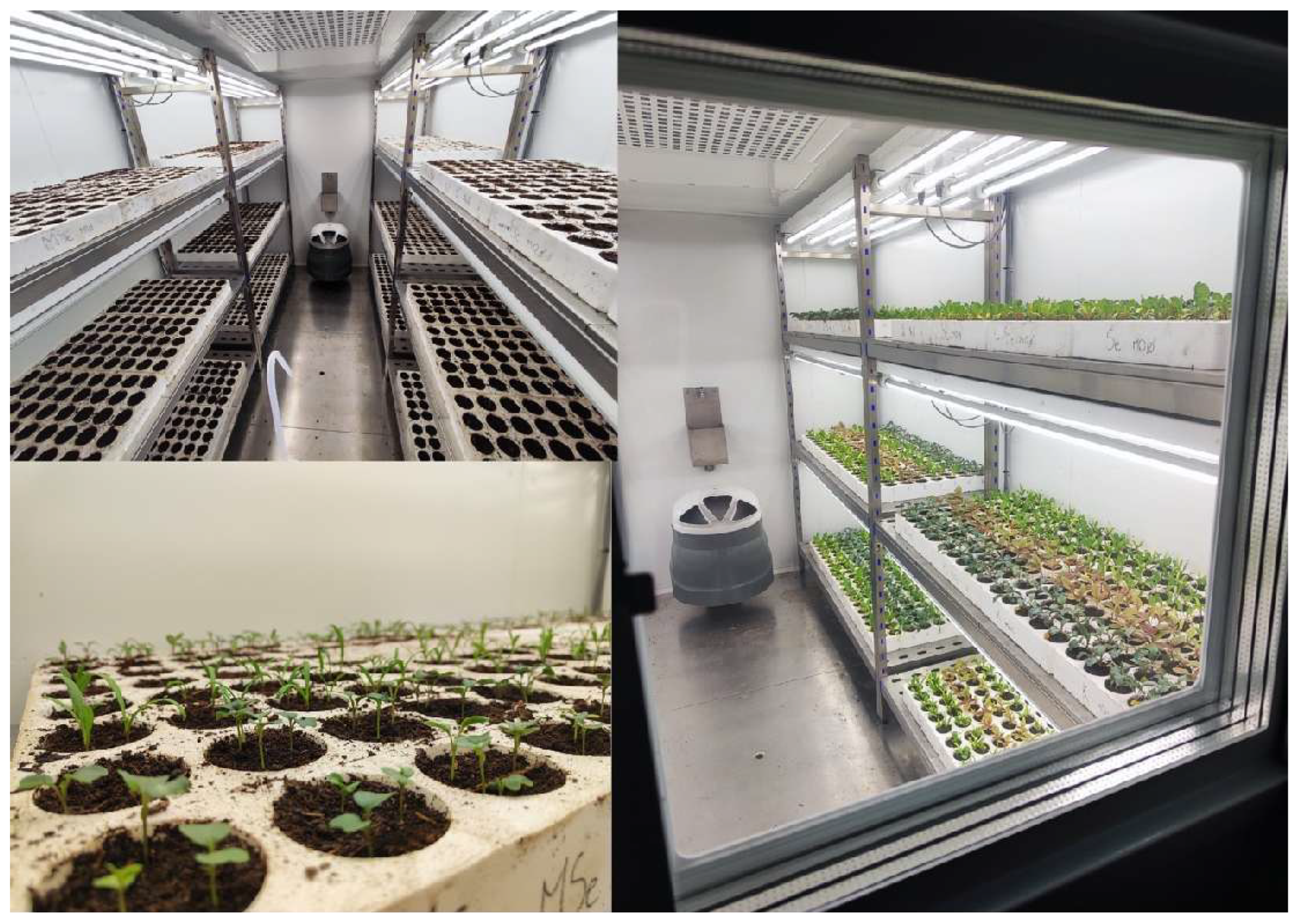
Figure 2.
Elemental accumulation in kale (Brassica oleracea var. acephala) across combined selenium and microbial treatments. Concentrations of 15 essential and trace elements in kale dry biomass cultivated under four selenium treatments: Control (K), Se-enriched compost (Se), Mineral Se (MSe), and Combined Se (Se+MSe). Within each selenium group, plants were subjected to one of three microbial inoculations: no microbes (mo 0, white bars), Vesicular-Arbuscular Mycorrhizae (mo I, light grey bars), and a mixed bacterial inoculum (mo II, dark grey bars). Error bars represent the standard error of the mean (n = 4). Different lowercase letters above the bars indicate statistically significant differences between the interactions of selenium and microbial treatments according to Tukey’s HSD test (p < 0.05). Elemental concentrations are expressed in mg/kg or µg/kg of dry weight, as indicated on the respective y-axes. Concentrations for macronutrients and primary micronutrients (S, P, K, Mn, Fe, Cu, Zn) are expressed in mg/kg dry weight, whereas trace heavy metals (Cr, Co, Ni, As, Se, Mo, Cd, Pb) are expressed in µg/kg dry weight.
Figure 2.
Elemental accumulation in kale (Brassica oleracea var. acephala) across combined selenium and microbial treatments. Concentrations of 15 essential and trace elements in kale dry biomass cultivated under four selenium treatments: Control (K), Se-enriched compost (Se), Mineral Se (MSe), and Combined Se (Se+MSe). Within each selenium group, plants were subjected to one of three microbial inoculations: no microbes (mo 0, white bars), Vesicular-Arbuscular Mycorrhizae (mo I, light grey bars), and a mixed bacterial inoculum (mo II, dark grey bars). Error bars represent the standard error of the mean (n = 4). Different lowercase letters above the bars indicate statistically significant differences between the interactions of selenium and microbial treatments according to Tukey’s HSD test (p < 0.05). Elemental concentrations are expressed in mg/kg or µg/kg of dry weight, as indicated on the respective y-axes. Concentrations for macronutrients and primary micronutrients (S, P, K, Mn, Fe, Cu, Zn) are expressed in mg/kg dry weight, whereas trace heavy metals (Cr, Co, Ni, As, Se, Mo, Cd, Pb) are expressed in µg/kg dry weight.
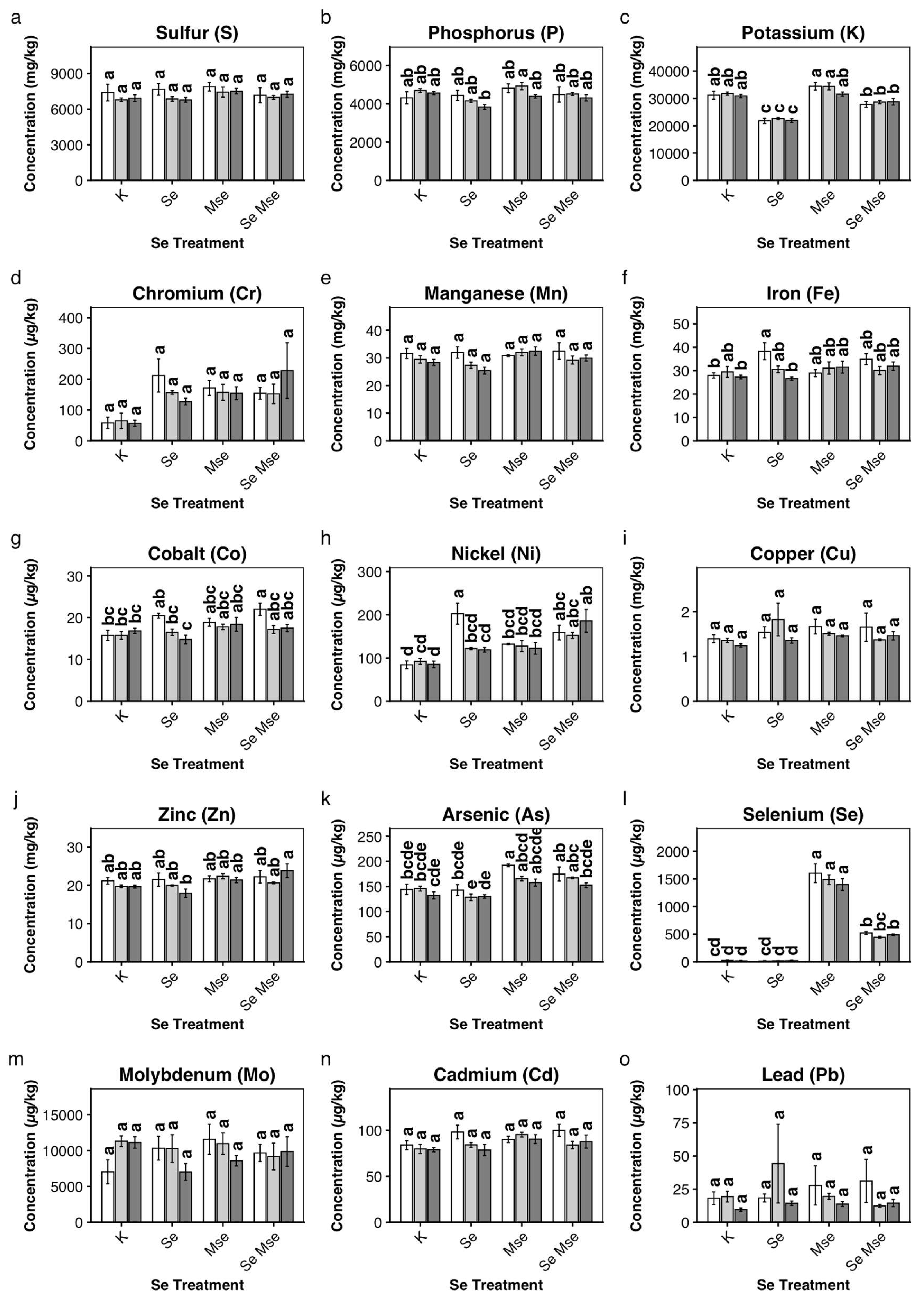
Figure 3.
Elemental accumulation in mangel (Beta vulgaris subsp. vulgaris) across combined selenium and microbial treatments. Concentrations of 15 essential and trace elements in mangel dry biomass cultivated under four selenium treatments: Control (K), Se-enriched compost (Se), Mineral Se (MSe), and Combined Se (Se+MSe). Within each selenium group, plants were subjected to one of three microbial inoculations: no microbes (mo 0, white bars), Vesicular-Arbuscular Mycorrhizae (mo I, light grey bars), and a mixed bacterial inoculum (mo II, dark grey bars). Error bars represent the standard error of the mean (n = 4). Different lowercase letters above the bars indicate statistically significant differences between the interactions of selenium and microbial treatments according to Tukey’s HSD test (p < 0.05). Elemental concentrations are expressed in mg/kg or µg/kg of dry weight, as indicated on the respective y-axes. Concentrations for macronutrients and primary micronutrients (S, P, K, Mn, Fe, Cu, Zn) are expressed in mg/kg dry weight, whereas trace heavy metals (Cr, Co, Ni, As, Se, Mo, Cd, Pb) are expressed in µg/kg dry weight.
Figure 3.
Elemental accumulation in mangel (Beta vulgaris subsp. vulgaris) across combined selenium and microbial treatments. Concentrations of 15 essential and trace elements in mangel dry biomass cultivated under four selenium treatments: Control (K), Se-enriched compost (Se), Mineral Se (MSe), and Combined Se (Se+MSe). Within each selenium group, plants were subjected to one of three microbial inoculations: no microbes (mo 0, white bars), Vesicular-Arbuscular Mycorrhizae (mo I, light grey bars), and a mixed bacterial inoculum (mo II, dark grey bars). Error bars represent the standard error of the mean (n = 4). Different lowercase letters above the bars indicate statistically significant differences between the interactions of selenium and microbial treatments according to Tukey’s HSD test (p < 0.05). Elemental concentrations are expressed in mg/kg or µg/kg of dry weight, as indicated on the respective y-axes. Concentrations for macronutrients and primary micronutrients (S, P, K, Mn, Fe, Cu, Zn) are expressed in mg/kg dry weight, whereas trace heavy metals (Cr, Co, Ni, As, Se, Mo, Cd, Pb) are expressed in µg/kg dry weight.
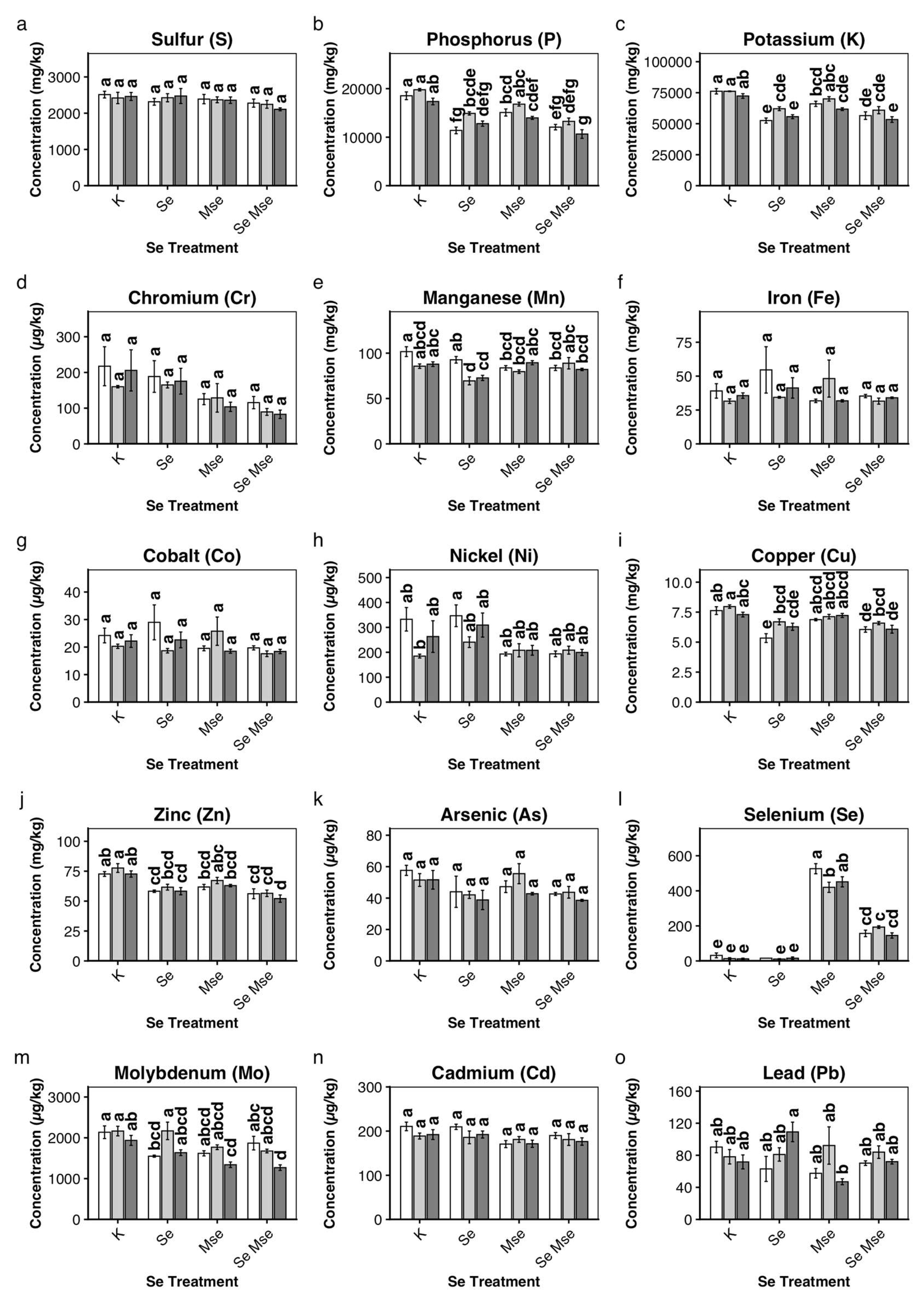
Figure 4.
Elemental accumulation in spinach (Spinacia oleracea) across combined selenium and microbial treatments. Concentrations of 15 essential and trace elements in spinach dry biomass cultivated under four selenium treatments: Control (K), Se-enriched compost (Se), Mineral Se (MSe), and Combined Se (Se + MSe). Within each selenium group, plants were subjected to one of three microbial inoculations: no microbes (mo 0, white bars), Vesicular-Arbuscular Mycorrhizae (mo I, light grey bars), and a mixed bacterial inoculum (mo II, dark grey bars). Error bars represent the standard error of the mean (n = 4). Different lowercase letters above the bars indicate statistically significant differences between the interactions of selenium and microbial treatments according to Tukey’s HSD test (p < 0.05). Elemental concentrations are expressed in mg/kg or µg/kg of dry weight, as indicated on the respective y-axes. Concentrations for macronutrients and primary micronutrients (S, P, K, Mn, Fe, Cu, Zn) are expressed in mg/kg dry weight, whereas trace heavy metals (Cr, Co, Ni, As, Se, Mo, Cd, Pb) are expressed in µg/kg dry weight.
Figure 4.
Elemental accumulation in spinach (Spinacia oleracea) across combined selenium and microbial treatments. Concentrations of 15 essential and trace elements in spinach dry biomass cultivated under four selenium treatments: Control (K), Se-enriched compost (Se), Mineral Se (MSe), and Combined Se (Se + MSe). Within each selenium group, plants were subjected to one of three microbial inoculations: no microbes (mo 0, white bars), Vesicular-Arbuscular Mycorrhizae (mo I, light grey bars), and a mixed bacterial inoculum (mo II, dark grey bars). Error bars represent the standard error of the mean (n = 4). Different lowercase letters above the bars indicate statistically significant differences between the interactions of selenium and microbial treatments according to Tukey’s HSD test (p < 0.05). Elemental concentrations are expressed in mg/kg or µg/kg of dry weight, as indicated on the respective y-axes. Concentrations for macronutrients and primary micronutrients (S, P, K, Mn, Fe, Cu, Zn) are expressed in mg/kg dry weight, whereas trace heavy metals (Cr, Co, Ni, As, Se, Mo, Cd, Pb) are expressed in µg/kg dry weight.
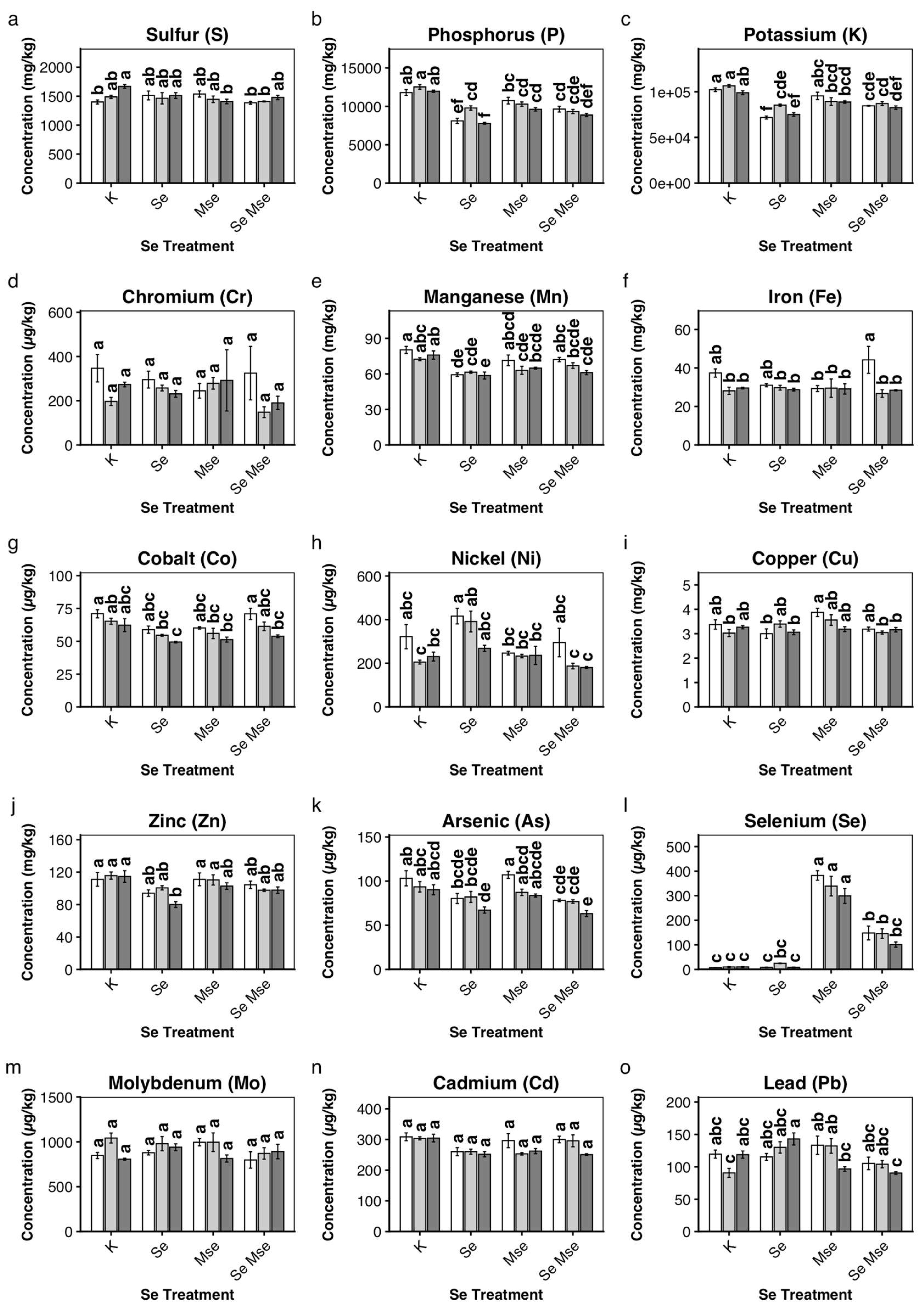
Figure 5.
The multidimensional correlations between plant species (Kale, Mangel, and spinach), selenium treatments (K, MSe, Se, and Se+MSe), and measured morphological attributes are depicted in a Principal Component Analysis (PCA) biplot. 72.15% of the variance is explained by the first two dimensions (PC1 and PC2).
Figure 5.
The multidimensional correlations between plant species (Kale, Mangel, and spinach), selenium treatments (K, MSe, Se, and Se+MSe), and measured morphological attributes are depicted in a Principal Component Analysis (PCA) biplot. 72.15% of the variance is explained by the first two dimensions (PC1 and PC2).
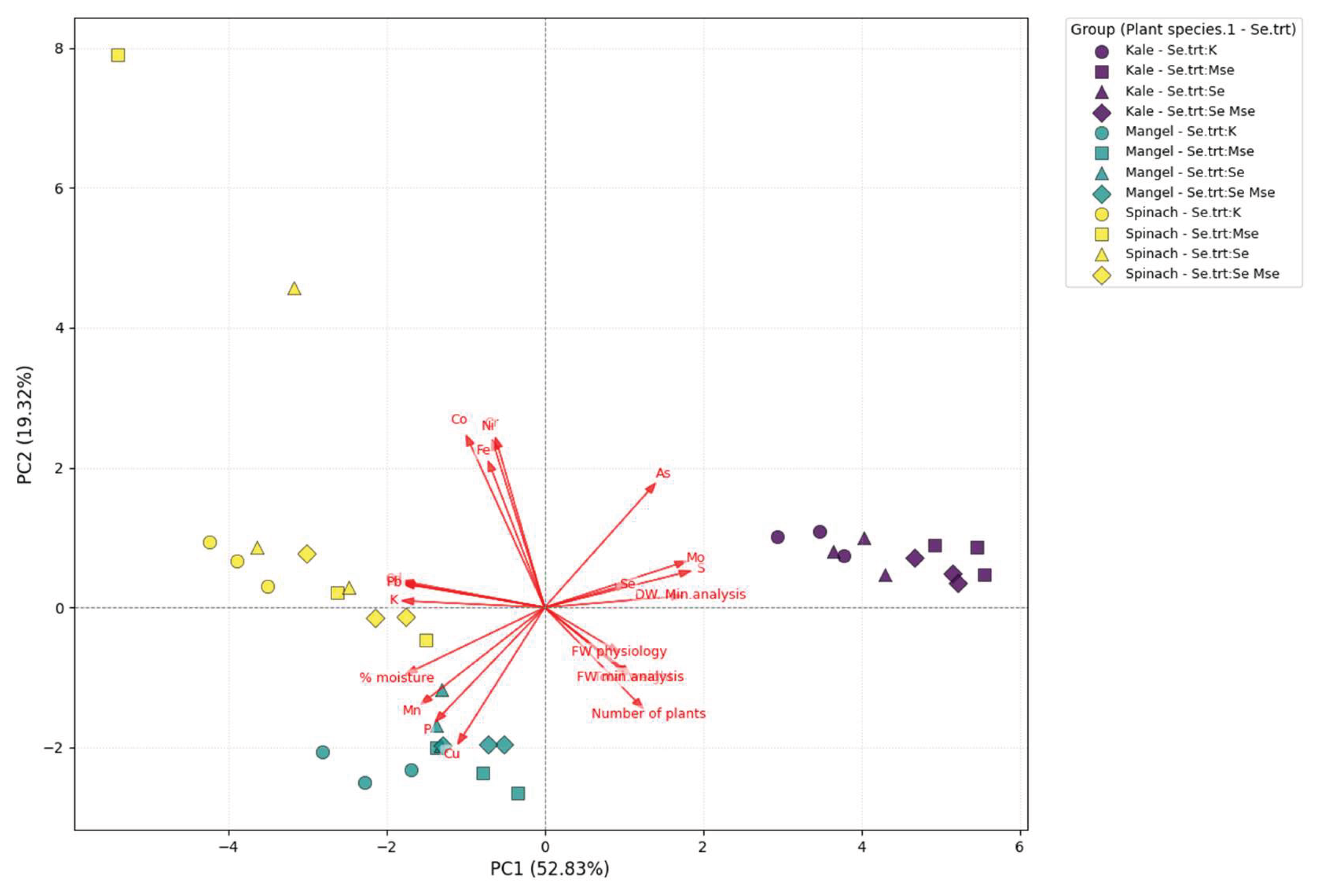

Table 1.
Statistical significance (p-values) evaluated the main effects and interactions between selenium and microbial treatments overall in three microgreen species (Kale, Mangel, Spinach). Significant interactions (p < 0.05) are noted in the species-specific rows. Selenium treatment (Se, MSe, and Se+MSe) and MO treatment (mo 0, mo I, and mo II).
Table 1.
Statistical significance (p-values) evaluated the main effects and interactions between selenium and microbial treatments overall in three microgreen species (Kale, Mangel, Spinach). Significant interactions (p < 0.05) are noted in the species-specific rows. Selenium treatment (Se, MSe, and Se+MSe) and MO treatment (mo 0, mo I, and mo II).
| Variable | Se treatment | MO treatment | Se treatment:MO treatment | REP | |
|---|---|---|---|---|---|
| Kale | Nplants | 0.405 | 0.181 | 0.178 | 0.405 |
| TW | 6.84-15 | 3.80-5 | 0.156 | 0.210 | |
| Moisture | 0.222 | 0.537 | 0.804 | 0.408 | |
| Se | 2.72-25 | 0.449 | 0.628 | 0.378 | |
| Mangel | Nplants | 0.024* | 0.727 | 0.275 | 0.156 |
| TW | 9.18-7 | 0.002** | 0.161 | 0.996 | |
| Moisture | 1.83-10 | 0.003** | 1.15-4 | 0.456 | |
| Se | 1.31-27 | 0.092 | 0.007** | 0.298 | |
| Spinach | Nplants | 0.375 | 0.900 | 0.169 | 0.194 |
| TW | 4.72-6 | 0.382 | 8.65-5 | 0.141 | |
| Moisture | 4.37-6 | 6.07-4 | 0.001** | 0.094 | |
| Se | 3.85-21 | 0.075 | 0.301 | 0.771 |
Table 2.
impact of different selenium (Se) treatments on the moisture content and morphological characteristics (total fresh weight and dry weight) of spinach, kale, and mangel.
Table 2.
impact of different selenium (Se) treatments on the moisture content and morphological characteristics (total fresh weight and dry weight) of spinach, kale, and mangel.
| Plant Species | Selenium Treatment | Total Weight (g) | Dry Weight (g) | Moisture (%) |
|---|---|---|---|---|
| Kale | K | 11.49 ± 1.44 c | 1.70 ± 0.32 c | 73.19 ± 1.70 a |
| MSe | 16.95 ± 1.91 a | 3.09 ± 0.53 a | 72.91 ± 2.56 a | |
| Se | 13.88 ± 1.16 b | 2.41 ± 0.27 b | 71.85 ± 1.25 a | |
| Se+MSe | 17.67 ± 1.38 a | 3.27 ± 0.42 a | 73.28 ± 1.19 a | |
| Mangel | K | 13.35 ± 1.74 c | 1.12 ± 0.26 b | 86.20 ± 0.89 a |
| MSe | 16.68 ± 1.46 a | 1.70 ± 0.25 a | 84.96 ± 0.73 b | |
| Se | 13.92 ± 1.13 bc | 1.32 ± 0.14 b | 84.26 ± 1.45 bc | |
| Se+MSe | 15.19 ± 1.38 ab | 1.63 ± 0.26 a | 83.42 ± 0.59 c | |
| Spinach | K | 10.00 ± 2.50 c | 0.95 ± 0.23 c | 83.92 ± 1.49 a |
| MSe | 13.94 ± 2.80 a | 1.35 ± 0.41 ab | 84.26 ± 1.02 a | |
| Se | 11.01 ± 1.69 bc | 1.04 ± 0.23 bc | 83.58 ± 0.86 a | |
| Se+MSe | 12.89 ± 1.83 ab | 1.37 ± 0.25 a | 82.13 ± 1.41 b |
Mean ± Standard Deviation (SD) is used to express data. Tukey’s Honestly Significant Difference (HSD) post-hoc test at p ≥ 0.05 indicates statistically significant differences between treatments when different lowercase letters are used within the same column and for the same plant species.
Table 3.
Comparative selenium accumulation (µg/kg) in microgreen species at different levels of microbial (MO) and selenium (Se) treatment. At p < 0.05, values in a column that are followed by the same letter do not significantly differ.
Table 3.
Comparative selenium accumulation (µg/kg) in microgreen species at different levels of microbial (MO) and selenium (Se) treatment. At p < 0.05, values in a column that are followed by the same letter do not significantly differ.
| Se Treatment | MO | Spinach | Mangel | Kale |
|---|---|---|---|---|
| mo 0 | 3.5 ± 4.0 d | 23.7 ± 24.8 e | 4.0 ± 4.6 c | |
| Control | mo I | 7.3 ± 5.9 d | 9.9 ± 10.0 e | 23.5 ± 19.3 c |
| mo II | 10.2 ± 3.8 d | 5.9 ± 7.6 e | 12.0 ± 14.1 c | |
| mo 0 | 6.2 ± 4.2 d | 3.9 ± 7.8 e | 6.8 ± 9.6 c | |
| Se | mo I | 12.3 ± 14.3 d | 8.0 ± 6.4 e | 13.3 ± 9.3 c |
| mo II | 4.1 ± 4.9 d | 7.6 ± 10.7 e | 14.9 ± 17.5 c | |
| mo 0 | 382.4 ± 38.9 a | 526.2 ± 57.8 a | 1603.7 ± 339.3 a | |
| Mse | mo I | 339.0 ± 80.3 ab | 420.0 ± 58.1 b | 1487.2 ± 173.8 a |
| mo II | 299.1 ± 61.4 b | 451.4 ± 58.2 ab | 1398.0 ± 213.6 a | |
| mo 0 | 148.3 ± 56.7 c | 157.0 ± 36.9 cd | 521.6 ± 47.2 b | |
| Se+MSe | mo I | 145.8 ± 38.2 c | 193.0 ± 15.0 c | 444.4 ± 37.4 b |
| mo II | 101.0 ± 22.0 c | 145.2 ± 29.6 d | 489.6 ± 27.5 b |
Disclaimer/Publisher’s Note: The statements, opinions and data contained in all publications are solely those of the individual author(s) and contributor(s) and not of MDPI and/or the editor(s). MDPI and/or the editor(s) disclaim responsibility for any injury to people or property resulting from any ideas, methods, instructions or products referred to in the content. |
© 2026 by the authors. Licensee MDPI, Basel, Switzerland. This article is an open access article distributed under the terms and conditions of the Creative Commons Attribution (CC BY) license (http://creativecommons.org/licenses/by/4.0/).
Copyright: This open access article is published under a Creative Commons CC BY 4.0 license, which permit the free download, distribution, and reuse, provided that the author and preprint are cited in any reuse.


